



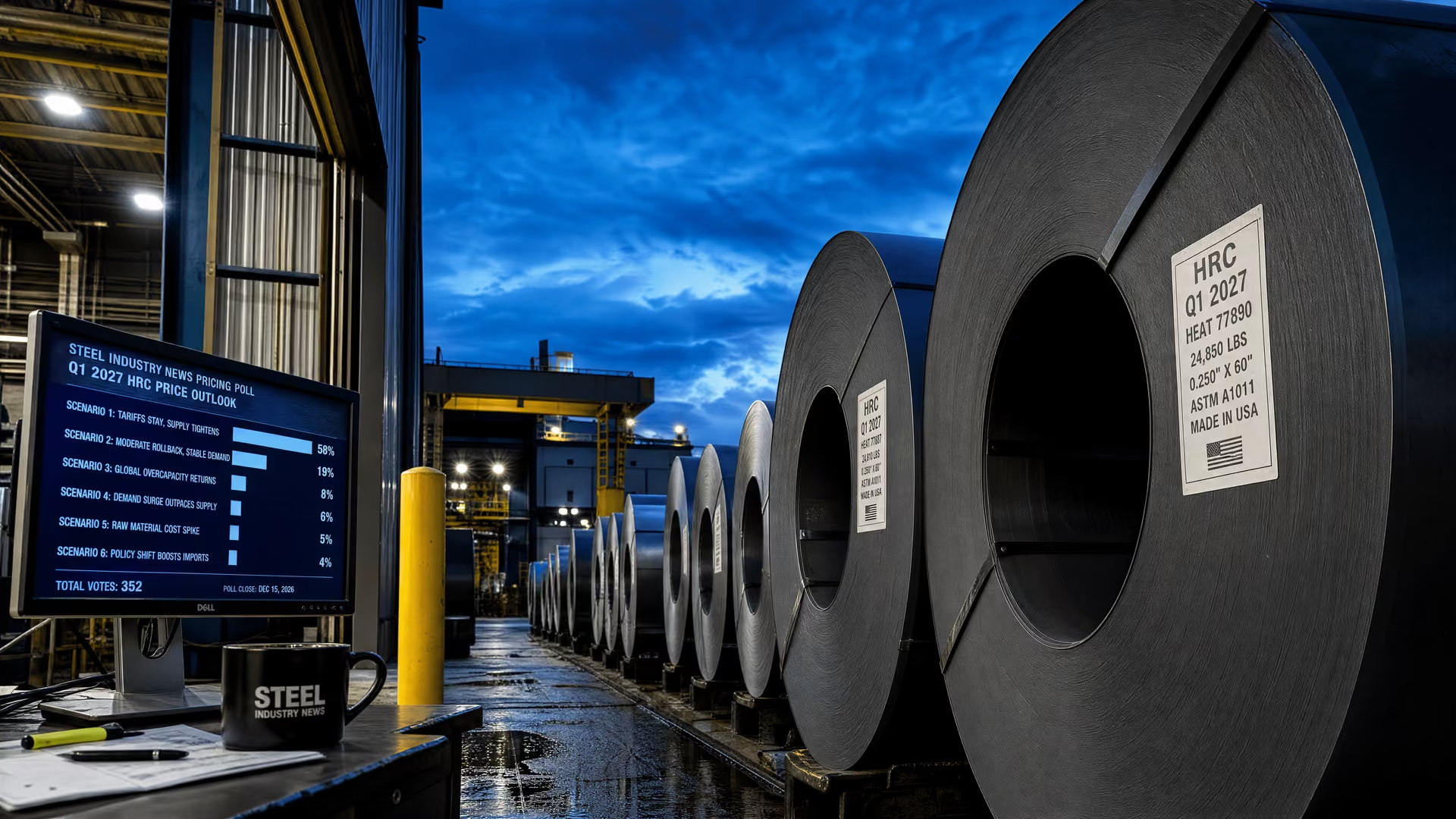
Steel Industry News' 352-vote poll finds a lopsided Q1 2027 HRC direction. Six tariff, supply, demand and logistics scenarios could break consensus.

Steel Industry News’ pricing poll collected 352 votes across its community and parallel LinkedIn poll on where hot-rolled coil prices will finish Q1 2027, producing a lopsided directional call that could still be overturned by six market, policy and supply-chain scenarios identified in the Steel Industry News pricing poll.
A 352-vote poll finds consensus, not certainty
The poll combines votes from the Steel Industry News community with a parallel LinkedIn poll. The publisher presents the agreement between those two audiences as the central finding: the directional view was broadly shared rather than confined to one reader group. The supplied article text does not disclose how many votes came from each poll or how the votes were distributed among the four price options.
The agreement between two very different audiences is the finding that matters most.
Steel Industry News
That distinction matters for procurement and budgeting. A directional majority can indicate where market participants expect prices to move, but it does not by itself establish a settlement price, the path prices will take between now and the end of the quarter, or the probability attached to each outcome. The publisher also says that the four ranges offered in the poll sit in a specific relationship to the level at which the market was trading during the poll period. Without the exact ranges and the winning percentage, the headline result cannot be converted into a precise price forecast.
The poll therefore functions best as a consensus indicator. Its value lies in showing whether buyers and sellers lean in the same direction, while its limitation is that the accessible result does not reveal the distance between the consensus range and the current market.
The four price bands need a live-market reference point
The starting point is as important as the direction. If the winning range sits only modestly above the prevailing market, the poll may describe stabilization or a limited increase. If it sits materially above current transactions, the same directional percentage would imply a much more demanding budget assumption. The source explicitly warns that the relationship between the four bands and current trading levels changes what the headline percentage means.
A related Steel Industry News market update carried a headline reporting that HRC CSP had risen to $1,160 and that monthly shipments had reached a 20-year high. That update provides a contemporary reference point, but it does not turn $1,160 into the poll’s Q1 2027 endpoint. The poll asks where prices finish the quarter; the market update describes a current price and shipment condition.
For a buyer building a 2027 budget, four distinctions should remain separate:
- The poll’s directional majority is not the same as a published price assessment.
- The selected range must be compared with the current transaction level, not read in isolation.
- A quarter-end result does not describe the monthly or weekly path to March 31, 2027.
- High shipment volumes may indicate strong order movement, but they do not determine whether prices will rise, hold or retreat.
The principal numerical anchors are:
The practical reading is that the poll supplies a market view, while the current HRC price and shipment data supply the base against which that view must be stress-tested:
Six scenarios that could break the Q1 2027 call
The primary article says six situations could break the consensus between the poll date and March 31, 2027. Its reference material points to six watchpoints: mill pricing and order momentum, tariff law and court remedies, war-risk logistics, Federal Reserve policy, inflation and spending, and the combined effect of capacity timing, scrap and the political calendar. The table groups those watchpoints by the channel through which they could affect HRC.
The six watchpoints in the poll’s risk frame
| Risk family | Scenarios included | Potential pressure on the outcome | Source |
|---|---|---|---|
| Market and supply | Mill price moves; order momentum; capacity timing; scrap | Could change the starting price, availability or cost base before quarter-end | Steel Industry News Pricing Poll | Six Scenarios That Could Impact The Outcome |
| Policy and geopolitics | Tariff litigation; refunds; Section 232 changes; war-risk freight | Could alter import economics, trade flows or delivered replacement costs | Steel Industry News Pricing Poll | Six Scenarios That Could Impact The Outcome |
| Macro and political calendar | Federal Reserve policy; inflation; spending; midterm politics | Could change demand assumptions or the timing of policy-related market reactions | Steel Industry News Pricing Poll | Six Scenarios That Could Impact The Outcome |
Mill pricing and order momentum
The first risk is already visible in the market’s starting conditions. The source list accompanying the poll includes reports that Nucor raised HRC prices, later paused spot-price hikes, and moved through successive price announcements. The related Steel Industry News update also reports HRC CSP at $1,160 and monthly shipments at a 20-year high. Those facts point to a market in which mill announcements and order flow can alter the base used by a quarter-end poll.
Tariff law and court remedies
The legal scenario is more complicated than a simple tariff increase or repeal. The poll’s reference list includes a Supreme Court decision striking down IEEPA tariffs, analysis of a possible tariff-refund mechanism, and separate material on modifications to Section 232 tariffs covering steel, aluminum and copper. It also lists new 50% tariffs on certain Canadian imports. The relevant question for HRC buyers is not merely whether a tariff headline changes, but which authority applies, to which material and at what point in the import chain.
War-risk logistics
The source material also identifies rising shipping-insurance costs for vessels facing Hormuz risks. For a US HRC market, a change in war-risk insurance would not automatically establish a domestic mill price. It could, however, affect the economics of imported steel, the cost of replacement tons and the confidence buyers place in an import option. That makes freight and insurance a potential route by which a geopolitical event could challenge a domestic price consensus.
Federal Reserve policy
The poll’s sources include the Federal Reserve’s July 29, 2026 FOMC statement, the July rate decision and commentary on what experts expected from the meeting. The supplied facts do not state the direction of the decision or provide a forecast for subsequent meetings. The defensible conclusion is narrower: monetary policy is one of the variables the poll asks readers to keep in view, not evidence that the rate path will necessarily support or weaken HRC prices.
Inflation and consumer spending
The Bureau of Labor Statistics reported that consumer prices rose 3.5% over the year ended June 2026. The poll’s surrounding material also identifies consumer spending as a support for the market. These references place inflation and end-market activity on opposite sides of the scenario test: persistent price pressure can affect purchasing conditions, while continued spending can support steel-consuming sectors. The supplied material does not quantify either effect on HRC demand.
Capacity, scrap and political timing
The final watchpoint combines physical supply with scheduled and political timing. The source list refers to US HRC supply fears, a Nucor mill targeted for a 2027 launch, mixed signals in the July scrap market and analysis of the 2026 US midterm elections. Together, those references describe a market exposed to changes in available capacity, raw-material costs and the policy calendar.
The primary article makes one further point: the largest scheduled disruption is not a tariff, a war or an interest-rate decision. The supplied text does not identify that disruption. It would therefore be speculative to assign it to a particular mill, outage or commissioning event. For readers using the poll, that omission is itself material: the most important scenario cannot be evaluated from the accessible excerpt alone.
Tariffs and court remedies create a non-linear policy risk
The court-tested scenario deserves separate treatment because the source says many buyers misread its result. A decision affecting IEEPA tariffs, a subsequent refund process and changes to Section 232 measures are related policy developments, but they are not presented in the supplied facts as one interchangeable instrument. A legal decision can change the treatment of past imports without producing an immediate change in every current domestic offer.
For HRC budgeting, the relevant exposure can therefore run through several channels: the cost of imported tons, the availability of substitute supply, the timing of refunds or adjustments, and the response of domestic mills. The excerpt supplies no refund eligibility rules, payment timetable or dollar value. It also does not identify the poll’s winning price range. Those gaps prevent a precise calculation of the ruling’s effect on the Q1 2027 consensus.
The policy risk is therefore non-linear. A headline can be significant while its effect on a particular contract depends on product origin, applicable authority, timing and the availability of alternative supply:
Supply, demand and the calendar can reset the baseline
Several of the six scenarios operate before a buyer ever reaches the quarter-end price. A mill announcement can reset offers, shipment momentum can change lead-time expectations, and scrap can change the cost environment for electric-arc-furnace producers. The poll’s supporting material includes both reports of Nucor price actions and a July scrap-market assessment described as mixed.
Capacity timing adds a separate supply question. The source list refers to a Nucor mill targeted for a 2027 launch and to fears over US HRC supply. The primary article calls the largest scheduled disruption a key scenario, but the accessible text does not name the facility or explain whether the event is an outage, restart, commissioning or another supply change. The distinction matters because each would affect availability and timing differently.
Demand indicators are similarly incomplete. The reference material includes the June inflation reading, the Federal Reserve’s July decision and analysis of consumer spending and the midterm elections, but it does not provide a Q1 2027 demand forecast. The poll should consequently be read as a structured test of market sentiment rather than a complete supply-demand model.
The six scenarios matter because they do not all push in the same direction. A supply constraint could challenge a lower price outcome, while weaker demand could challenge a higher one. A legal development might reduce one import cost while a freight shock raises another. The available facts establish the possible channels, but not the probability or combined effect.
How procurement teams should interpret the consensus
For a steel buyer, the poll is most useful as a scenario prompt. The result can help identify the direction that market participants are currently prepared to defend, but it should be tested against the buyer’s actual exposure, contract timing and supply alternatives. A disciplined reading follows four steps:
- Establish the current HRC reference price and confirm how it relates to each of the four poll ranges.
- Separate the quarter-end endpoint from the path required to reach it, including interim mill announcements and shipment conditions.
- Stress-test the six scenarios individually rather than treating tariffs, freight, rates, inflation, capacity and politics as one macro variable.
- Identify which scenarios affect the buyer’s delivered cost, available tonnage or contract mechanism, because a market headline does not have the same effect on every purchase.
The methodology also needs to be kept in view. The page is marked as advertising and a sponsored post and promotes paid access to the full article, podcasts and market insights. The accessible text gives the combined vote total, the four-option structure and the broad result, but not the option-by-option count. That is enough to report a directional consensus; it is not enough to calculate confidence intervals or assign a probability to the winning range.
The core questions answered by the supplied poll material are:
Pricing poll questions answered
How many votes did the poll receive?
The source reports 352 combined votes across the Steel Industry News community poll and a parallel LinkedIn poll.
What period does the poll cover?
It asks where hot-rolled coil prices will finish Q1 2027, with the quarter ending March 31, 2027.
How many price options were offered?
The poll offered four price ranges. The supplied excerpt does not state the numerical boundaries of those ranges.
Does the poll provide a precise Q1 2027 price forecast?
No. The accessible text reports a lopsided directional call, but it does not publish the winning range, the percentage share or the vote split between the two polling audiences.
Is the reported $1,160 HRC CSP the poll’s forecast endpoint?
No. That figure appears in a related market update and serves as current market context; the poll concerns the price at the end of Q1 2027.
The unresolved question is what breaks the consensus before March
The poll establishes a clear directional consensus among 352 participants, and the agreement between the community and LinkedIn audiences gives that signal more weight than a single-platform result. It does not, however, remove the uncertainty around the four price bands, the current-to-future price gap or the events that could alter the market before quarter-end.
The six scenarios provide the appropriate test: mill and shipment momentum, tariff law and court remedies, war-risk freight, Federal Reserve policy, inflation and spending, and capacity, scrap and political timing. The most important scheduled disruption remains unnamed in the supplied excerpt, leaving the central risk unresolved rather than settled.
The poll’s strongest finding is the breadth of its directional agreement, while its main limitation is the absence of the detailed ranges, vote splits and named scheduled disruption needed for a full price model. For steel buyers, the result is best used to frame Q1 2027 budget scenarios around the six identified pressure points rather than as a standalone settlement forecast.
Sources
- HRC CSP Rises To $1,160 | Monthly Shipments Hit A 20-Year High (steelindustry.news)
- Steel Industry News Pricing Poll | Six Scenarios That Could Impact The Outcome (steelindustry.news)
- Online auction of late-model fabrication and machine shop equipment begins Aug. 19 (thefabricator.com)
- Unified Legacy breaks ground on $125 million manufacturing facility (thefabricator.com)
- UK nationalizes Chinese-owned British Steel to protect nation's steelmaking capacity (washingtonpost.com)
- Government brings British Steel under public ownership; oil price rises to $85 as US-Iran tensions escalate – as it happened (theguardian.com)
- Hundreds face furloughs at Liberty Steel & Wire’s Bartonville plant (25newsnow.com)
- German Thyssenkrupp Steel approves company's restructuring program (akm.ru)
- Cleveland-Cliffs Weighs Dearborn Steel Mill Restart Amid Auto Demand (procurementresource.com)
- Global steel output edges up as African surge offsets Mideast drop (spglobal.com)