


What “Steel Family Classification” Actually Means
“Steel family” does not describe one universal hierarchy. It is a convenient phrase for groups of steels that share a selected feature, but the feature may be chemical composition, crystal structure, intended service, designation practice, or manufacturing route. These systems overlap; they do not replace one another.
What each classification label answers
- Low-alloy
- Answers a chemistry question about alloy content.
- Micro-alloyed
- Identifies small controlled additions used to influence strength or grain structure.
- Ferritic
- Describes a predominant metallurgical structure.
- Structural steel
- Identifies an intended engineering application.
- Grade
- Identifies a defined material category in a particular standard.
A single material may therefore be called a low-alloy steel, a micro-alloyed steel, a ferritic steel, a structural steel, and a named standard grade without contradiction. “Low-alloy” answers a chemistry question. “Micro-alloyed” identifies the use of small additions, often niobium, vanadium, or titanium, to control strength and grain structure. “Ferritic” describes the predominant metallurgical structure. “Structural steel” refers to an intended engineering application. The grade name identifies a defined composition, property range, product form, or set of delivery conditions in a particular standard.
Steel family labels answer different questions and should not be treated as one universal hierarchy. Strong evidence
The classification only becomes clear when the question behind the label is stated.

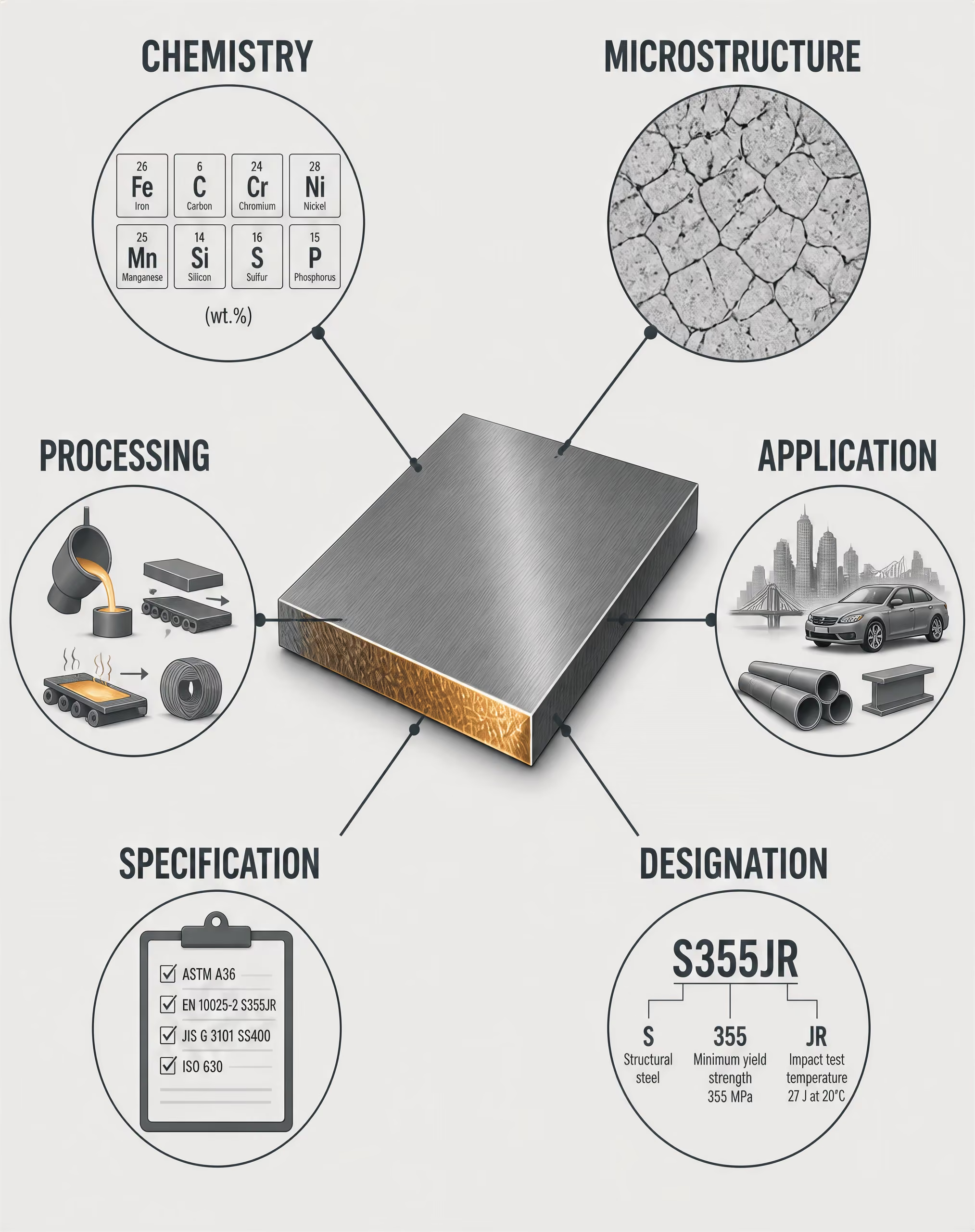
| Classification axis | Typical question | Examples from the article |
|---|---|---|
| Chemistry | Which elements and limits define the steel? | Non-alloy, low-alloy, high-alloy |
| Structure | Which phases or transformation products are present? | Ferritic, austenitic, martensitic |
| Application | What is the steel intended to do? | Structural steel, reinforcing-bar steel, tool steel |
| Designation | What formal identifier does the standard assign? | SAE 1020, UNS S30400, B420 |
| Processing | How was the material produced and conditioned? | Rolled, forged, cast, or additively manufactured |
Classification by chemistry, structure, and application[1] ISO/DIS 4948-1. International Organization for Standardization. ISO/DIS 4948-1, 2024.
Chemical classification begins with the elements present and their specified limits. ISO/DIS 4948-1, published in its 2024 draft form, divides steels into “non-alloy, low-alloy, and high-alloy steels.” This is a composition-based scheme, not a prediction of every service property. The same document places micro-alloy steels within low-alloy steels and stainless steels within high-alloy steels. Those relationships matter because they prevent a common error: treating “micro-alloyed” and “low-alloy” as competing categories. The first is a more specific description inside the second.[2] Chemical Compositions SAE Carbon Steels. SAE International. SAE J403_202402, 2024.
SAE J403_202402 shows how a grade system applies chemistry in practice. Its composition tables for SAE carbon-steel grades define reporting limits or ranges for carbon, manganese, phosphorus, sulfur, copper, chromium, nickel, molybdenum, and silicon. A designation such as SAE 1020 is consequently tied to a chemical range under SAE’s rules. The number does not, by itself, state whether the product was hot rolled, cold drawn, normalized, quenched and tempered, or supplied as plate, bar, wire, or another form.[3] Stainless Steel for the Food Industry. National Institute of Standards and Technology. NBSIR 76-1185, 1976.
Structure supplies a different axis. Metallurgists classify steels by phases and transformation products such as ferrite, pearlite, bainite, martensite, retained austenite, and precipitation-hardened matrices. They may also use the broad phase families ferritic, austenitic, martensitic, or precipitation-hardening. A NIST manual issued in 1976 for meat and poultry processing equipment divides stainless steels into “martensitic, ferritic, austenitic, and precipitation-hardening classes” and gives representative UNS designations. That structure-based grouping helps explain heat-treatment response, magnetic behavior, corrosion performance, and strength, but it does not replace the composition specification.
Austenitic stainless steel illustrates the point. UNS S30400, commonly associated with ASTM A240 Type 304 and the designation 18-8 in older technical usage, is an austenitic stainless-steel designation. “Austenitic” describes its structure family; “stainless” describes a corrosion-resistant composition class; “Type 304” identifies a standard grade designation; and ASTM A240 identifies a product specification for chromium and chromium-nickel stainless-steel plate, sheet, and strip. Each label carries different information.[4] Steel for the reinforcement of concrete — Plain bars. International Organization for Standardization. ISO 6935-1:2005, 2005.
Application classification asks what the steel is intended to do. ISO 6935-1:2005 specifies ten plain reinforcing-bar steel grades, including B240, B300, and B420, with one grade identified as suitable for welding. These names belong to reinforcing-bar practice. They should not be treated as a universal ranking of all steels by strength or chemistry. A structural specification may set yield strength, tensile strength, elongation, bend behavior, weldability, dimensions, testing, and delivery conditions while allowing more than one production route.
Processing creates another descriptive layer. The NIST review of additive manufacturing connects steel and stainless-steel classification with powder feedstock, deposition or melting route, thermal history, microstructure, and post-build heat treatment. A nominally identical alloy can develop different grain structures and defect populations after laser powder-bed fusion, directed-energy deposition, casting, forging, or conventional rolling. Chemistry remains important, but it cannot fully describe the resulting material condition. “Additively manufactured 316L,” for example, is not merely a synonym for every wrought or cast product whose chemistry falls within a 316L range.
Why one steel can carry several valid labels
Labels answer different questions, so stacking them is often more accurate than choosing one. Consider a hypothetical plate meeting a structural standard, containing small niobium and vanadium additions, and supplied with a predominantly ferrite-pearlite microstructure. It could reasonably be described as low-alloy under ISO/DIS 4948-1, micro-alloyed in metallurgical literature, ferritic-pearlitic in a microstructural report, structural steel by application, and a specific grade under the governing product standard.
None of those descriptions establishes every other fact. “Ferritic” does not prove a steel is stainless. “Stainless” does not identify whether it is austenitic, ferritic, martensitic, or precipitation hardening. “Structural steel” does not reveal the carbon equivalent, grain size, or heat-treatment condition. A grade number does not automatically disclose the applicable product form or inspection requirements.
Standard organizations also use different scopes and vocabularies. ASTM A941 consolidates terminology for steel, stainless steel, related alloys, and ferroalloys. ASTM Committee A01 covers a much wider standards field, including carbon and alloy steels, tool steels, corrosion- and heat-resistant alloys, super-strength alloys, clad steels, and stainless steels. SAE J403_202402 focuses on chemical composition for SAE carbon-steel grades. ISO documents may classify composition, establish naming rules, or specify application products. NIST, by contrast, publishes technical references and reference-material categories rather than acting as a single grade-designation system.
NIST organizes reference materials into plain carbon, low-alloy, special low-alloy, high-alloy, stainless, tool, and specialty steel categories. Strong evidence
| NIST category | Classification emphasis |
|---|---|
| Plain carbon steels | Reference-material grouping for carbon-steel compositions |
| Low-alloy steels | Reference-material grouping for low-alloy compositions |
| Special low-alloy steels | NIST catalogue grouping for specially controlled low-alloy materials |
| High-alloy steels | Reference-material grouping for high-alloy compositions |
| Stainless steels | Reference-material grouping for corrosion-resistant steel compositions |
| Tool steels | Reference-material grouping associated with tooling materials |
| Specialty steels | Reference-material grouping for other specialized materials |
NIST’s 2024 Standard Reference Materials categories list plain carbon steels, low-alloy steels, special low-alloy steels, high-alloy steels, stainless steels, tool steels, and specialty steels. That taxonomy is useful for organizing reference materials, but it is not a universal replacement for ISO, ASTM, SAE, or UNS terminology.
| Term | Meaning | Example |
|---|---|---|
| Family | Broad grouping based on a stated property or purpose | Low-alloy steel |
| Grade | Narrower material category defined within a technical system | B420 or SAE 1020 |
| Designation | Written identifier assigned by a naming system | UNS S30400 |
| Specification | Controlling requirements for a product or delivery condition | ASTM A240 |
The difference between a family, grade, designation, and specification
A family is a broad grouping based on a stated property or purpose. “Low-alloy steel,” “austenitic stainless steel,” and “tool steel” are family-level descriptions. Their boundaries depend on the classification system being used.
A grade is a more narrowly defined material category within a standard or technical system. A grade normally has specified chemical limits, mechanical properties, or both. B420 in ISO 6935-1, SAE 1020 under SAE composition practice, and a stainless Type 304 designation in an ASTM product standard are examples of grade-level identifiers, although their standards do not define them in exactly the same way.[5] Steel names. International Organization for Standardization. ISO/TS 4949:2016, 2016.
A designation is the written identifier itself: SAE 1020, UNS S30400, B420, or a name such as X5CrNi18-10 where the applicable ISO naming rules govern its interpretation. ISO/TS 4949:2016 states that steel names use “letters and numbers that express application and principal mechanical, physical, or chemical characteristics.” A designation may encode useful information, but its meaning remains tied to the standard that assigns it.
A specification is the controlling set of requirements for a product or delivery condition. It can define chemistry, dimensions, testing, mechanical properties, heat treatment, surface condition, inspection, marking, and acceptance criteria. ASTM A240, for example, is not simply another word for “stainless steel”; it is a product specification with defined scope and requirements. A material can meet a grade’s chemistry yet fail a specification because its thickness, tensile properties, heat treatment, or test results are outside the required limits.
The practical rule is straightforward: identify the axis before interpreting the label. Family tells you how a material is grouped, grade narrows that group, designation supplies its formal name, and specification states what must be demonstrated for a particular product. Steel classification is therefore a coordinate system, not a single ladder.
The ISO Chemical-Composition Framework
For this article, the primary chemical-composition framework is ISO/DIS 4948-1. The 2024 draft divides steels into exactly three principal categories: non-alloy steels, low-alloy steels, and high-alloy steels. It also states two important nesting relationships: micro-alloy steels are a subclass of low-alloy steels, and stainless steels are a subclass of high-alloy steels.
That arrangement is a classification by chemical composition, not a complete hierarchy of steel identity. It does not say that every low-alloy steel has the same crystal structure, production route, heat treatment, or service purpose. A low-alloy steel may be ferritic, pearlitic, bainitic, martensitic, or a mixture of these structures after processing. Likewise, two stainless steels can belong to the same chemical family while differing substantially in phase constitution, hardenability, weldability, strength, and corrosion behavior.
The categories also should not be turned into universal percentage rules unless a particular standard supplies them. Different standards define grade limits, alloying ranges, and naming conventions for their own product groups. ISO/DIS 4948-1 establishes the broad chemical-composition framework used here; it does not make one numerical boundary applicable to every steel designation in every standard.
Non-alloy steels
Non-alloy steel A steel placed in the non-alloy category of a stated classification framework; it may still contain controlled or residual amounts of elements besides iron and carbon.
Non-alloy steels are the first ISO/DIS 4948-1 category. The term does not mean that the steel contains no elements other than iron and carbon. Commercial steel always contains residual or deliberately controlled amounts of elements such as manganese, silicon, phosphorus, and sulfur, while oxygen, nitrogen, copper, chromium, nickel, and other elements may also occur within specified limits. The classification identifies the steel as non-alloy within the framework, rather than describing it as chemically pure iron-carbon material.
The familiar phrase carbon steel often appears in the same general territory, but it is not automatically identical to every use of “non-alloy steel.” A standard may define carbon-steel grades through composition limits and permitted residual elements, while another document may use non-alloy steel as a wider technical category. SAE J403_202402, for example, supplies composition limits and ranges for SAE carbon-steel grades and identifies reporting for carbon, manganese, phosphorus, sulfur, copper, chromium, nickel, molybdenum, and silicon. Those limits belong to the SAE grade system. They should not be copied as a universal definition of non-alloy steel under ISO/DIS 4948-1.
This distinction matters when reading a designation such as SAE 1045. The number communicates a particular SAE carbon-steel grade and its specified chemistry; it does not by itself describe whether the supplied product is normalized, quenched and tempered, cold drawn, or in another condition. Its final tensile strength and hardness depend on section size, thermal history, and testing condition as well as nominal composition.
Non-alloy steels can therefore be grouped by chemistry while receiving separate classifications by use or delivery condition. ISO 6935-1, an application-specific standard for steel reinforcing bars, specifies ten plain reinforcing-bar steel grades, including B240, B300, and B420; one grade is identified as suitable for welding. These names classify reinforcing-bar products within that standard. They are not alternative chemical-composition classes that replace the ISO/DIS 4948-1 family structure.
Low-alloy steels and micro-alloy steels
Low-alloy steels contain intentionally added alloying elements in amounts that place them in the low-alloy category of ISO/DIS 4948-1. Chromium, nickel, molybdenum, manganese, silicon, copper, and other elements can alter transformation behavior, hardenability, strength, toughness, oxidation resistance, or resistance to particular environments. The effect depends on the complete composition and the processing route, not on the presence of one named element alone.
Micro-alloy steels are a subclass of low-alloy steels rather than a fourth top-level chemical family. Strong evidence
ISO/DIS 4948-1 specifically places micro-alloy steels within low-alloy steels. “Micro-alloy” therefore describes a subclass, not a fourth top-level family parallel to non-alloy, low-alloy, and high-alloy steel. In engineering practice, micro-alloying commonly involves small controlled additions of elements such as niobium, vanadium, or titanium. These elements can form carbonitrides or nitrides and can influence austenite grain control, precipitation strengthening, and recrystallization during hot working. Their effect is tied to dissolution temperature, rolling schedule, cooling rate, and available carbon and nitrogen.
A micro-alloy designation consequently does not predict a single microstructure. Thermomechanically controlled processing may produce a fine ferritic-bainitic structure in one product, whereas a different composition or cooling schedule may produce ferrite and pearlite, bainite, or a predominantly martensitic condition. The chemical category remains low-alloy, even when the mechanical properties arise from a carefully coordinated processing schedule.
The same caution applies to common labels such as high-strength low-alloy steel. “HSLA” generally signals a product or performance concept involving low alloy content and strengthened microstructure, but the exact limits and grade definitions come from the relevant product standard. It is not a license to assign one universal alloy-percentage cutoff. ASTM documents, national standards, and producer specifications may separate grades by composition, yield strength, weldability, delivery condition, or application.
ASTM Committee A01 illustrates why the surrounding standards system cannot be reduced to one chemical ladder. Its scope covers carbon and alloy steels, tool steels, corrosion- and heat-resistant alloys, super-strength alloys, clad steels, and stainless steels. ASTM A941 also provides consolidated terminology for steel, stainless steel, related alloys, and ferroalloys. These documents support communication across many product areas, but they do not turn every term into a synonym for an ISO chemical family.
High-alloy steels and stainless steels
High-alloy steels form the third ISO/DIS 4948-1 category. Their compositions contain larger or more numerous intentional alloy additions than steels placed in the lower categories, but the classification still depends on the applicable framework and stated composition rules. “High-alloy” is not equivalent to “stainless,” nor does it require one universal numerical threshold in this article.
Passivation Formation of a thin protective surface film that can reduce corrosion when the alloy and environment support its stability.
ISO/DIS 4948-1 states that stainless steels are a subclass of high-alloy steels. Stainless steel is therefore nested inside the high-alloy category in this framework. Its defining technical purpose is resistance to corrosion or oxidation under specified conditions, supported principally by chromium and, depending on grade, additions such as nickel, molybdenum, nitrogen, manganese, copper, niobium, or titanium. The passive surface film associated with chromium-rich stainless compositions is important, but corrosion performance also depends on environment, surface condition, heat treatment, welding, contamination, and galvanic contact.
Chemical family and metallurgical structure diverge particularly clearly among stainless steels. A NIST manual for meat and poultry processing equipment, published in 1976, divides stainless steels into martensitic, ferritic, austenitic, and precipitation-hardening classes and gives representative UNS designations. These are structure- and heat-treatment-related classes within the wider stainless category. For example, an austenitic stainless steel and a martensitic stainless steel may both be high-alloy stainless steels under ISO/DIS 4948-1, yet respond very differently to quenching, cold work, welding, and tempering.
A designation also operates on another axis. ISO/TS 4949 explains that steel names use letters and numbers to express application and principal mechanical, physical, or chemical characteristics. A name such as X5CrNi18-10 communicates a standardized chemical naming pattern, while a UNS designation, an ASTM product specification, or a national grade number may identify the same or a closely related material through a different naming system. The label is evidence about the standard behind it, not proof that all classification axes coincide.[6] Additive Manufacturing of Steels and Stainless Steels. National Institute of Standards and Technology. NIST technical review, 2024.
Manufacturing can create another separation. NIST’s review of additive manufacturing connects steel and stainless-steel classifications with powder feedstocks, process routes, microstructures, and post-build thermal treatment. A powder-bed-fusion product and a wrought product may have comparable nominal chemistry but different porosity, segregation, residual stress, grain morphology, and mechanical response. Composition places each steel in a chemical family; processing determines much of the condition in which that family is encountered.
NIST’s 2024 Standard Reference Materials taxonomy makes the same point in practical form by listing plain carbon steels, low-alloy steels, special low-alloy steels, high-alloy steels, stainless steels, tool steels, and specialty steels. Such a list is useful for organizing reference materials, but it is not a single universal hierarchy. “Tool steel” can describe intended function and grade tradition, “stainless steel” identifies a chemical subclass in ISO/DIS 4948-1, and “martensitic” identifies a structural class. One material can carry all three descriptions without contradiction.
Carbon Steels: Composition, Naming, and Limits
What “carbon steel” identifies—and what it does not
“Carbon steel” identifies a composition-based family, not a single grade, crystal structure, manufacturing route, or performance class. In ordinary technical usage, it means steel in which carbon is the principal intentional alloying addition and the concentrations of other alloying elements remain below limits associated with alloy or stainless steels. The boundary depends on the classification system and standard being applied. It is not a universal chemical cutoff shared by every specification.
ISO/DIS 4948-1 (2024) separates steels by chemical composition into “non-alloy, low-alloy, and high-alloy steels.” In the same classification, “micro-alloy steels are a subclass of low-alloy steels,” while “stainless steels are a subclass of high-alloy steels.” That arrangement is useful, but it does not make the word carbon a complete description of a steel. A non-alloy steel can contain measurable copper, chromium, nickel, molybdenum, and silicon as residual or permitted elements without becoming a deliberately alloyed grade under a particular standard.
The name also does not automatically specify whether the steel is ferritic, pearlitic, bainitic, martensitic, or a mixture of these constituents. A low-carbon steel supplied in an annealed sheet condition can have a substantially different structure from the same nominal chemistry after quenching and tempering. Product form matters as well: plate, bar, wire, sheet, tube, and a powder feedstock may follow different processing histories and different product standards.
This distinction is not academic. NIST’s review of additive manufacturing links steel classification with powder feedstock, process route, resulting microstructure, and post-build thermal treatment. The chemistry is one input to that chain, not a substitute for it. A composition table cannot by itself establish yield strength, fatigue life, weld procedure, corrosion resistance, surface condition, or suitability for a stated service.
Nor is “carbon steel” an application designation. ISO 6935-1 (2005), for example, defines ten plain reinforcing-bar steel grades, including B240, B300, and B420; one of those grades is identified as suitable for welding. Those names communicate an application and mechanical requirement through a product standard. They should not be treated as alternative names for every steel with a similar carbon percentage.
SAE carbon-steel grade composition
SAE J403_202402, Chemical Compositions SAE Carbon Steels, defines standardized SAE carbon-steel grades through chemical-composition limits and ranges. The controlling values are established from cast or heat chemical analysis, so the grade is assigned by whether the reported chemistry falls within the specified limits. “Cast” and “heat” refer to the steelmaking batch represented by the analysis; they are not names for a finished microstructure or a heat-treatment condition.
| SAE J403 composition element | Role in the grade system |
|---|---|
| Carbon | Specified grade range or limit |
| Manganese | Specified grade range or limit |
| Phosphorus | Controlled maximum or stated limit |
| Sulfur | Controlled maximum or deliberate addition in free-machining grades |
| Copper | Specified residual or alloying limit |
| Chromium | Specified residual or alloying limit |
| Nickel | Specified residual or alloying limit |
| Molybdenum | Specified residual or alloying limit |
| Silicon | Specified range or deoxidation-related limit |
The reporting framework in SAE J403_202402 lists these elements exactly: carbon, manganese, phosphorus, sulfur, copper, chromium, nickel, molybdenum, and silicon. Each grade table gives a permitted range, a maximum, or another stated limit for the relevant element. A maximum phosphorus value, for example, is a chemical restriction; it does not state the phosphorus content of every piece cut from the heat, nor does it prescribe the grain size or tensile strength of the finished product.
SAE’s familiar four-digit designations express the chemistry family in a compact form, but they are not all read in precisely the same way. The 10xx series denotes plain carbon steels, with the final two digits conventionally indicating nominal carbon content in hundredths of a percent. SAE 1020 therefore points to a plain-carbon grade with approximately 0.20% carbon, subject to the actual limits in the applicable revision and table. SAE 1045 indicates approximately 0.45% carbon. The designation is a grade identifier, not a guarantee that every supplied analysis equals the nominal value.
The first two digits can also signal a deliberate modification to the plain-carbon family. SAE 11xx grades are resulfurized free-machining steels; sulfur is raised to improve machinability, generally with consequences for ductility and weldability. SAE 12xx grades are resulfurized and rephosphorized free-machining steels. SAE 15xx grades contain higher manganese than the ordinary 10xx group. These series remain part of the SAE carbon-steel listing, yet their machining behavior and joining considerations differ from those of a low-sulfur grade such as SAE 1020.
The designation therefore carries useful information, but only within its standard. SAE J403 is not a universal replacement for ASTM product specifications, UNS registration, ISO steel names, or a purchaser’s material condition. ISO/TS 4949 (2016) describes steel names as combinations of letters and numbers expressing application and principal mechanical, physical, or chemical characteristics. That naming logic can coexist with SAE composition designations without making the two systems interchangeable.
The role of carbon, manganese, and residual or alloying elements
Carbon has the largest direct effect on the transformation behavior and potential hardness of ordinary carbon steels. As carbon content rises, the steel can form more pearlite under suitable cooling conditions and can reach greater martensitic hardness after quenching. Higher carbon generally reduces weldability and can reduce ductility and toughness, especially when the heat treatment and section size promote hard, brittle regions. Those statements describe tendencies, not fixed results. Cooling rate, prior austenite grain size, section thickness, and tempering can alter the outcome substantially.
Manganese serves several functions. It contributes to solid-solution strengthening, combines preferentially with sulfur to reduce the harmful effect of iron sulfide, and increases hardenability. A steel with more manganese may transform to harder products deeper from a quenched surface than a steel with the same carbon content and lower manganese. In SAE carbon-steel tables, manganese is therefore not a minor bookkeeping entry. Its permitted range helps define both the grade chemistry and part of its processing response.
Phosphorus and sulfur are often treated as residual or controlled impurity elements, although sulfur is deliberately increased in resulfurized free-machining grades. Excess phosphorus can raise strength while reducing ductility and toughness, particularly at low temperature. Sulfur can improve chip breaking during machining, but sulfide inclusions may reduce transverse ductility, toughness, and resistance to certain forms of cracking. Their limits are consequently tied to the intended balance between machinability and mechanical performance.
Copper, chromium, nickel, molybdenum, and silicon may occur as residuals, deliberate additions, or both, depending on the grade and production practice. Chromium, nickel, and molybdenum can increase hardenability; nickel also supports toughness in suitable compositions. Silicon contributes to deoxidation and strengthening. Copper can affect atmospheric-corrosion behavior when present at appropriate levels, but a permitted copper maximum does not turn a carbon-steel grade into weathering steel.
The practical rule is simple: read the chemistry designation first, then read the product, condition, and test requirements separately. NIST’s 2024 Standard Reference Materials categories distinguish plain carbon, low-alloy, special low-alloy, high-alloy, stainless, tool, and specialty steels, showing how reference materials themselves use several overlapping groupings. ASTM A941 consolidates terminology for steel, stainless steel, related alloys, and ferroalloys, while ASTM Committee A01 covers carbon and alloy steels alongside tool steels, clad steels, stainless steels, and corrosion- and heat-resistant alloys. A carbon-steel grade name answers a chemistry question. It does not answer every metallurgy or service question that follows.
Low-Alloy, Micro-Alloy, and Special Low-Alloy Steels
The meaning of alloy content in a classification system
“Alloy steel” does not name one position in a universal hierarchy. It describes steel through one classification axis: chemical composition. ISO/DIS 4948-1 separates steels into “non-alloy, low-alloy, and high-alloy steels” (International Organization for Standardization, 2024). That division concerns the quantities and types of alloying elements present, not the steel’s product form, service use, crystal structure, heat-treatment condition, or manufacturing route.
This distinction matters because the same steel may receive several valid descriptions at once. A grade can be low-alloy by composition, quenched and tempered by processing history, and specified for pressure equipment or structural use by an application standard. None of those descriptions cancels the others. A designation can also encode a different property altogether. ISO/TS 4949 states that steel names use letters and numbers to express application and principal mechanical, physical, or chemical characteristics. A name therefore belongs to a naming system, not necessarily to the same system as ISO/DIS 4948-1’s compositional family classification.
Alloy content is also more than a count of elements added deliberately. Chemical classification depends on the specified composition framework and its limits, while production chemistry includes residual elements, permitted ranges, and analytical tolerances. SAE J403_202402, for example, sets out composition information for SAE carbon-steel grades and identifies carbon, manganese, phosphorus, sulfur, copper, chromium, nickel, molybdenum, and silicon in its reporting framework. The presence of one of these elements does not by itself turn every grade into the same metallurgical or application category. Its amount, the applicable standard, and the purpose of the designation all matter.
The term low-alloy is consequently broad. It can cover steels whose alloy additions are used to alter hardenability, strength, toughness, resistance to particular service conditions, or response to heat treatment, but the family label alone does not state which of those properties controls the specification. Nor does it tell the reader whether the steel is ferritic, pearlitic, bainitic, martensitic, or a mixture of phases after processing. Those are structural descriptions, and they require information about composition together with thermal and mechanical history.
ASTM A941 provides consolidated terminology for steel, stainless steel, related alloys, and ferroalloys, while ASTM Committee A01 covers a much wider standards field: carbon and alloy steels, tool steels, corrosion- and heat-resistant alloys, super-strength alloys, clad steels, and stainless steels. This breadth is evidence against treating “alloy steel” as a single grade family. Standards group materials for different technical tasks.
NIST’s Standard Reference Materials catalogue makes the same point from a practical reference-material perspective. Its categories include “plain carbon steels, low-alloy steels, special low-alloy steels, high-alloy steels, stainless steels, tool steels, and specialty steels” (NIST, 2024). Those categories help organize reference materials, but they should not be read as an alternative ISO definition in which every item labelled special low-alloy automatically forms a formally equivalent ISO family.
Application standards can cut across the compositional categories. ISO 6935-1 specifies ten plain reinforcing-bar steel grades, including B240, B300, and B420, with one grade identified as suitable for welding. Those designations identify reinforcing-bar products and requirements; they do not create a general chemical hierarchy that replaces ISO/DIS 4948-1. A steel’s family, product standard, grade name, and condition may all answer different questions.
Micro-alloy steels as a low-alloy subclass
ISO/DIS 4948-1 places micro-alloy steels within low-alloy steels. This is the key relationship: micro-alloy is a more specific subclass, whereas low-alloy is the broader compositional family. The terms are not interchangeable. Every micro-alloy steel covered by that classification is low-alloy, but a low-alloy steel need not be micro-alloy.
The prefix “micro-” should not be treated as a universal composition cutoff. The supplied ISO classification establishes the category relationship, not a single worldwide threshold that defines all micro-alloy steels. Different specifications may control different elements, combinations, product forms, and property requirements. A table copied from one grade standard cannot therefore be promoted into a general definition for the entire steel family.
Variables that control micro-alloy steel response
- Composition Niobium, vanadium, titanium, carbon, and nitrogen affect particle formation and phase transformation.
- Reheating Dissolution of particles depends on the reheating condition.
- Deformation Rolling schedule and deformation temperature influence recrystallization and grain control.
- Cooling Cooling rate helps determine whether ferrite, pearlite, bainite, or martensite forms.
- Heat treatment Subsequent thermal treatment can change the final microstructure and properties.
Micro-alloy terminology generally draws attention to small, controlled additions and their relationship with structure and properties. The chemical addition is only part of the description. What matters metallurgically is how composition interacts with solidification, reheating, deformation, cooling, and subsequent heat treatment. Small quantities can influence phase transformation or the formation and distribution of fine particles, but the effect depends on the complete chemistry and thermal-mechanical path. The label alone does not establish a particular particle population, grain size, yield strength, or weldability value.
This is why “micro-alloy” should not be used as a synonym for “high strength,” “weldable,” or “fine grained” without consulting the relevant grade standard. Those properties may be design objectives or measured outcomes in particular products, yet they are not supplied by the subclass name alone. A bar, plate, pipe, or forged component can have a different condition even when its nominal chemistry is similar.
NIST’s categories also require careful reading. “Special low-alloy steels” appears beside low-alloy steels as a separate organizational category for Standard Reference Materials. That separation may reflect the intended reference-material grouping, the composition or certification purpose, or the way NIST manages its catalogue. It does not mean that special low-alloy is automatically an ISO grade family, nor does it prove that every such material is micro-alloyed. The three expressions must remain distinct: low-alloy is the broad ISO compositional class; micro-alloy is an ISO-identified subclass within it; and special low-alloy is a NIST catalogue category unless a separate standard gives it a defined technical meaning.
Why processing and thermomechanical history matter
Composition is necessary for classification, but it cannot predict a steel’s full condition. A low-alloy or micro-alloy designation says what family the chemistry belongs to; it does not record every operation used to produce the supplied product. Rolling temperature, deformation schedule, cooling rate, reheating, quenching, tempering, aging, and post-forming treatment can change the resulting microstructure and therefore the measured properties.
The relation becomes especially clear where controlled processing is part of the material concept. Deformation at selected temperatures can affect grain development and transformation behaviour. Cooling from the finishing or austenitizing range can produce different phase mixtures. Quenching and tempering can establish a different condition from normalizing, even when the heat starts with the same nominal composition. These statements describe why a compositional family cannot stand in for a processing specification; they do not assign one universal treatment to every micro-alloy grade.
NIST’s review of additive manufacturing makes the same separation using a newer production route. Its discussion connects steel and stainless-steel classifications with powder feedstocks, process routes, microstructures, and post-build thermal treatment. A powder’s chemistry does not by itself determine the final component’s structure. Energy input, thermal cycling, solidification conditions, build direction, defects, and post-build treatment can all affect the material state being evaluated. The example also shows why “steel family” cannot be reduced to a list of elements.
The practical result is straightforward. When identifying a low-alloy steel, first ask which chemical classification is being used. Then identify the exact standard and grade designation, followed by product form, delivery condition, heat treatment, and relevant mechanical or physical requirements. For a micro-alloy steel, add the specified micro-alloying chemistry and the controlled processing requirements rather than assuming that the subclass supplies them. For a NIST “special low-alloy” reference material, retain NIST’s catalogue meaning unless another standard defines the material differently. Classification becomes reliable only when these axes are kept separate.
High-Alloy Steels and the Stainless-Steel Subfamily
High-alloy steel as the broader chemical category
“High-alloy steel” is a chemical-composition category, not a description of one crystal structure, service function, or manufacturing route. ISO/DIS 4948-1, published for public discussion in 2024, divides steels by chemical composition into “non-alloy, low-alloy, and high-alloy steels.” That division answers a limited question: how much and what kind of alloying addition does the steel contain?
The label does not, by itself, identify whether the steel is ferritic, pearlitic, martensitic, bainitic, austenitic, or precipitation hardened. Nor does it establish whether the material is a sheet, forging, weld deposit, reinforcing bar, tool, pressure-vessel product, or additively manufactured component. Those are separate classification axes. A high-alloy steel may be selected for corrosion resistance, elevated-temperature strength, wear resistance, magnetic behavior, cryogenic toughness, or some combination of these properties.
Chemical composition still provides the starting point. Chromium, nickel, molybdenum, manganese, silicon, nitrogen, vanadium, tungsten, cobalt, niobium, titanium, and copper can alter phase stability, hardenability, carbide or nitride formation, oxidation resistance, and response to heat treatment. Carbon remains especially important because it changes both phase transformations and the amount of chromium tied up in carbides. Two steels can therefore carry similar alloy-family labels yet behave differently because their carbon, nitrogen, chromium, nickel, or molybdenum contents differ.
A high-alloy designation also does not predict the final microstructure after processing. Hot rolling, forging, solution annealing, quenching, tempering, cold working, welding, and additive-manufacturing thermal cycles can produce different structures from closely related compositions. NIST’s review of additive manufacturing makes this separation explicit by connecting steel classification with powder feedstocks, process routes, microstructures, and post-build heat treatment. The deposited material is not defined by powder chemistry alone.
NIST’s 2024 Standard Reference Materials categories show the practical consequence of this layered system. Its steel-related groups include “plain carbon steels, low-alloy steels, special low-alloy steels, high-alloy steels, stainless steels, tool steels, and specialty steels.” These categories overlap in subject matter but are not one complete hierarchy. “Tool steel,” for example, identifies a broad technical family associated with tooling service and compositionally controlled properties; it does not replace the particular standard grade, heat-treatment condition, or product specification.
Stainless steel as a high-alloy subclass in ISO/DIS 4948-1
ISO/DIS 4948-1 places stainless steels inside the high-alloy category. Its stated relationship is direct: “stainless steels are a subclass of high-alloy steels,” just as “micro-alloy steels are a subclass of low-alloy steels.” This is a relationship between chemical classifications. It does not mean that every high-alloy steel is stainless, or that the word stainless identifies a single metallurgical family.
Stainless steel is associated principally with sufficient chromium to support a protective chromium-rich passive film in suitable environments. That film is thin and self-repairing when oxygen is available and the surface is not exposed to conditions that damage or prevent passivation. Nickel can stabilize austenite and improve toughness and corrosion performance in many environments. Molybdenum assists resistance to localized attack, particularly pitting and crevice corrosion in chloride-bearing conditions. Nitrogen can strengthen austenitic and duplex grades while affecting phase balance and localized-corrosion resistance.
These effects depend on composition and environment. Stainless steel is not immune to corrosion. Austenitic grades can suffer chloride-induced pitting, crevice corrosion, or stress-corrosion cracking. Ferritic grades may have lower toughness in some conditions. Martensitic grades can combine high hardness with reduced corrosion resistance compared with many austenitic grades. Weld thermal cycles can produce sensitization, undesirable phase formation, or local loss of corrosion performance if the grade and procedure are poorly matched.
The NIST manual for meat and poultry processing equipment, issued in 1976, illustrates the structural classification that exists inside the stainless-steel family. It identifies “martensitic, ferritic, austenitic, and precipitation-hardening classes” and gives representative Unified Numbering System designations. Those classes describe metallurgical structure and strengthening behavior, not merely total alloy content. AISI 410 and UNS S41000, for instance, belong to the martensitic stainless group; AISI 430 and UNS S43000 are ferritic; AISI 304 and UNS S30400 are austenitic. A precipitation-hardening grade such as UNS S17400 follows a different strengthening route again.
Duplex stainless steels add another warning. Their structure contains both ferrite and austenite, so “stainless” does not tell the reader whether the material is single-phase, mixed-phase, quenched-and-tempered, cold-worked, or precipitation hardened. A grade name or product standard must supply that information.
Corrosion resistance, alloy identity, and specification language
A corrosion-resistant surface is a property produced by composition, structure, surface condition, and environment. It is not a sufficient grade identity. “Stainless” can therefore be accurate while remaining technically incomplete.
ASTM Committee A01’s scope places stainless steels among several standards subjects: carbon and alloy steels, tool steels, corrosion- and heat-resistant alloys, super-strength alloys, clad steels, and other steel products. This scope matters because the standards system does not treat one label as a universal replacement for all others. ASTM A941 provides consolidated terminology for steel, stainless steel, related alloys, and ferroalloys, while individual material standards establish chemical limits, mechanical requirements, heat treatment, dimensions, testing, and product form.
Specification language may also encode an intended application or a property rather than a chemical family. ISO/TS 4949 explains that steel names use “letters and numbers that express application and principal mechanical, physical, or chemical characteristics.” ISO 6935-1, for example, specifies ten plain reinforcing-bar steel grades, including B240, B300, and B420; one of those grades is identified as suitable for welding. That is an application-specific classification, not a statement that reinforcing-bar grades form a chemical subdivision equivalent to stainless or high-alloy steels.
The same distinction appears in SAE J403_202402. Its composition framework reports carbon, manganese, phosphorus, sulfur, copper, chromium, nickel, molybdenum, and silicon for SAE carbon-steel grades. A chemistry table can identify a grade range, but it does not by itself state whether the product has been normalized, quenched and tempered, cold drawn, welded, additively built, or subjected to a particular surface treatment.
A complete stainless specification consequently needs more than the family word. It may require an AISI or UNS designation, an ASTM or ISO product standard, product form, condition, dimensions, mechanical requirements, heat treatment, and testing requirements. “Austenitic stainless steel” adds a structural class, but still leaves many possible grades. “316 stainless steel” is more informative, yet the applicable standard and product condition remain necessary because plate, bar, tube, wire, and cast products can have different requirements. A UNS number narrows alloy identity, but it does not replace the governing product specification.
The proper classification statement is therefore layered: a steel may be chemically high-alloy, belong to the stainless subclass, possess an austenitic or martensitic structure, satisfy a particular ASTM product standard, and reach that state through solution annealing, cold work, welding, or additive manufacturing. None of those descriptions is interchangeable with the others. Calling a material “stainless steel” identifies a broad alloy family with corrosion-related significance. It does not finish the identification.

Stainless-Steel Families by Metallurgical Structure
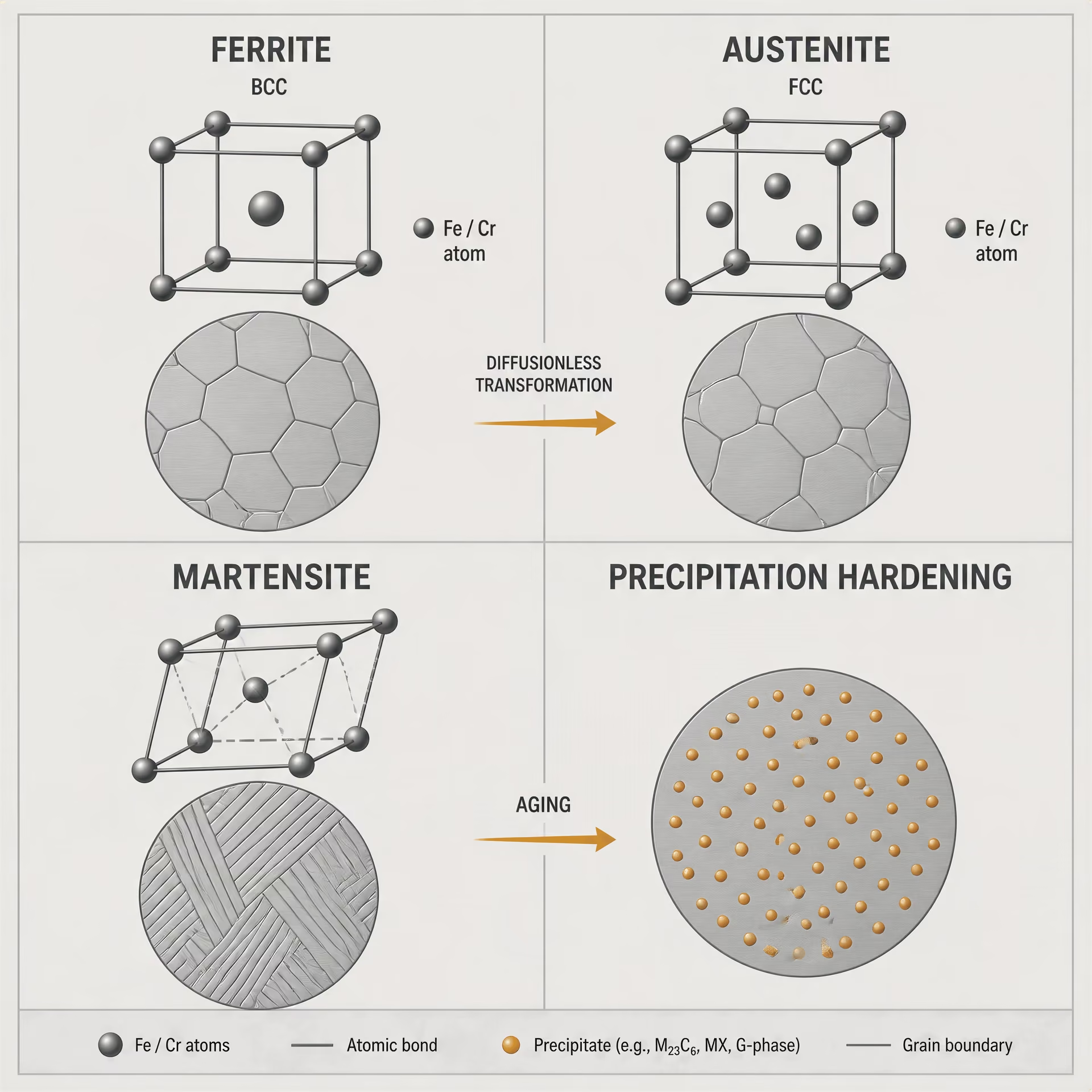
The National Institute of Standards and Technology (NIST) manual Stainless Steel for the Food Industry identifies four principal stainless-steel classes: martensitic, ferritic, austenitic, and precipitation-hardening stainless steels (NBSIR 76-1185, 1976). This arrangement describes metallurgical structure and the main route by which strength is developed. It is not a single ladder from “ordinary” to “advanced” steel, and it is not interchangeable with a composition-based classification.
That distinction matters because the same steel can receive several valid labels at once. A grade may be a high-alloy steel under ISO/DIS 4948-1, an austenitic stainless steel by its structure, and a corrosion-resistant material assigned to a particular product standard. A heat treatment can also alter its phase balance or strength without changing its nominal grade designation.
ISO/DIS 4948-1 uses chemical composition as its organizing principle. It divides steels into “non-alloy, low-alloy, and high-alloy steels”; it places micro-alloy steels within low-alloy steels and stainless steels within high-alloy steels. The NIST four-class system asks a different question: what structure does the steel form, and is its strength obtained mainly through transformation, solid-solution strengthening, cold work, or precipitation after heat treatment?
The boundaries are not perfectly independent. Chromium, nickel, carbon, nitrogen, molybdenum, and other elements influence both the chemical category and the phases that form during cooling and heating. Still, the labels answer different technical questions. SAE J403_202402, for example, sets composition limits and ranges for SAE carbon-steel grades using reported amounts of carbon, manganese, phosphorus, sulfur, copper, chromium, nickel, molybdenum, and silicon. That table does not by itself state whether a finished stainless component has a martensitic, ferritic, or austenitic working structure.
Martensitic stainless steels
Martensitic stainless steels are named for martensite, a hard phase produced when a suitable austenitic structure is cooled rapidly enough to suppress the equilibrium transformation products. Their composition usually permits austenite to form during heating and permits martensite to form during quenching. Carbon is especially important: it raises the attainable hardness by entering the supersaturated martensitic lattice, although excessive carbon can reduce toughness and leave chromium-rich carbides that affect corrosion resistance.
The strengthening logic is therefore transformation hardening. A typical processing sequence includes austenitizing, quenching, and tempering. Tempering reduces some of the as-quenched brittleness and adjusts the balance between hardness, strength, ductility, and dimensional stability. A martensitic designation does not mean that every part made from the grade contains the same proportion of martensite; section size, cooling rate, prior heat treatment, and tempering condition all matter.
| Stainless structure family | Representative designation cited in the article | Primary strengthening or condition concept |
|---|---|---|
| Martensitic | UNS S41000 | Quenching and tempering |
| Ferritic | UNS S43000 | Ferritic matrix, cold work, and grain control |
| Austenitic | UNS S30400 | Solid solution and cold work |
| Precipitation-hardening | UNS S17400 | Aging after solution treatment |
The NIST manual identifies representative UNS designations in this family, including UNS S41000 and UNS S42000. These designations identify specified stainless compositions; they do not, by themselves, guarantee a particular hardness or microstructure in a component. UNS S41000 may be supplied, welded, machined, or heat-treated under conditions that produce different properties from those of another product made to the same composition. The classification remains useful because it predicts the principal response to hardening treatment.
Martensitic stainless steels are also distinct from steels that merely contain some martensite after processing. Many austenitic or ferritic grades can develop deformation-induced or transformation-induced martensite under particular conditions, yet they are not normally placed in the martensitic stainless family. Family names refer to the intended metallurgical basis of the grade, not to the detection of any single phase in every specimen.
Ferritic stainless steels
Ferritic stainless steels are based on a body-centred-cubic ferritic structure over the relevant service and processing range. Chromium stabilizes ferrite and supplies the passive-film chemistry associated with stainless behavior. Ferritic grades generally do not use the quench-and-temper route that defines martensitic grades. Their strength comes mainly from the composition of the ferritic matrix, grain size, cold work, and, in some grades, additions such as molybdenum, titanium, or niobium.
The NIST manual lists UNS S43000 and UNS S44600 among representative ferritic stainless-steel designations. Those identifiers should be read as composition and grade references, not as universal property labels. Ferritic stainless steels can differ substantially in chromium level, impurity control, stabilization practice, weldability, toughness, and resistance to particular environments.
Ferrite remains the key structural criterion even though secondary phases can appear. Chromium-rich carbides or nitrides may form during fabrication or service if carbon and nitrogen are not controlled, and stabilized grades use carbide- or nitride-forming elements to limit chromium depletion near grain boundaries. At high temperatures, ferritic steels may undergo phase changes or develop embrittlement phenomena. Such effects do not erase the family classification; they show why structure must be considered together with thermal history.
A ferritic label also should not be confused with “low-alloy” in ISO terminology. ISO/DIS 4948-1 classifies by alloy content, whereas ferritic describes the matrix structure. A steel can be ferritic and high-alloy, as stainless steels are under the ISO scheme. Conversely, many non-stainless low-alloy steels are ferritic in a given condition. One term concerns chemistry; the other concerns metallurgy.
Austenitic stainless steels
Austenitic stainless steels are based on the face-centred-cubic austenite structure at service temperature. Nickel is a major austenite stabilizer in many grades, while manganese and nitrogen can also affect austenite stability. Chromium supplies stainless character, and molybdenum is added in some compositions for resistance to localized corrosion. The exact balance of elements determines whether austenite remains stable during cooling and deformation.
The NIST manual identifies representative austenitic UNS designations including UNS S30100, UNS S30200, UNS S30400, UNS S31600, UNS S32100, and UNS S34700. These designations should not be converted into a simple ranking. Each denotes a defined composition or composition range, while actual behavior depends on product form, surface condition, welding history, cold reduction, sensitization exposure, and test environment.
Austenitic grades are not normally hardened throughout by quenching because the austenite can remain stable after cooling. Strength may instead be increased by cold work, solid-solution effects, grain refinement, or controlled precipitation in specially designed compositions. Plastic deformation can also produce deformation-induced martensite in some metastable austenitic grades. That possibility illustrates the difference between a family label and a phase observation: an austenitic grade may contain martensite after severe deformation without becoming a martensitic stainless grade in the NIST classification.
Welding and thermal exposure can change the local structure. Chromium-carbide precipitation at grain boundaries, for example, can deplete adjacent regions of chromium and reduce resistance to intergranular corrosion. Low-carbon and stabilized variants address that problem through composition and processing, but the relevant designation must be checked in the applicable standard rather than inferred from the word “austenitic.”
Precipitation-hardening stainless steels
Precipitation-hardening stainless steels are classified by their principal strengthening treatment: a solution treatment followed by aging creates fine precipitates that obstruct dislocation motion. The matrix may be martensitic, semi-austenitic, or austenitic during different stages of processing. Consequently, “precipitation-hardening” is partly a processing and strengthening classification, not a single room-temperature crystal structure.
The NIST manual identifies representative UNS designations such as UNS S17400, UNS S17700, UNS S15500, and UNS S13800. Their precipitation response arises from different alloying designs and heat-treatment schedules. Some compositions form a martensitic matrix before aging; others use a conditioning treatment to transform or control the matrix before the final aging step. The same designation cannot be assigned the same properties without specifying the heat-treatment condition.
Precipitation-hardening stainless steels show most clearly why metallurgical families cannot replace grade standards. A composition standard tells the producer which elements and limits define the grade. A product or condition designation may then specify solution treatment, cooling, aging temperature, aging time, or resulting mechanical requirements. NIST’s classification captures the strengthening mechanism, while the UNS designation identifies the alloy family within a registration system.
Chemical and structure labels can therefore coexist without being synonyms. ISO calls stainless steels a subclass of high-alloy steels because of their chemical composition. NIST separates them according to phase structure and strengthening route. ISO/TS 4949 adds another layer by explaining that steel names use letters and numbers to express application and principal mechanical, physical, or chemical characteristics. ASTM A941 supplies consolidated terminology, while product standards attach requirements to particular forms and conditions. None of these systems should be treated as a universal hierarchy.
The practical question is always which axis a label addresses: composition, structure, heat treatment, application, or designation format. Without that question, “austenitic,” “high-alloy,” “17-4 PH,” and a product-standard grade can appear to compete when they are actually describing different features of the same steel.
Tool Steels, Special Steels, and the Wider Standards Universe
Tool steels as a standards and application family
“Tool steel” is primarily an application and performance family, not a single chemical class. These steels are selected for dies, punches, cutting tools, molds, gauges, and other components that must retain hardness, resist wear, or withstand repeated thermal and mechanical loading. Their common feature is the service demanded of the material. Their alloy design and structure can differ substantially.
ASTM A681, Standard Specification for Tool Steels Alloy, covers tool steels by type and grade, while ASTM A600 covers high-speed tool steels. Familiar designations include W1 water-hardening steel, O1 oil-hardening steel, D2 high-carbon, high-chromium cold-work steel, H13 hot-work steel, and M2 high-speed steel. Those labels do not describe one continuous progression from “ordinary” to “advanced” steel. W1 is essentially a carbon tool steel whose properties depend strongly on heat treatment; D2 contains enough chromium and carbon to form substantial chromium-rich carbides; H13 is a hot-work alloy designed for elevated-temperature service; and M2 is a tungsten-molybdenum high-speed steel intended to retain cutting hardness during heat generated at the tool edge.
The metallurgical differences matter. A quenched W1 structure is mainly martensitic, whereas D2 commonly contains a martensitic matrix with hard alloy carbides. H13 is also hardened to martensite, but its chromium, molybdenum, and vanadium additions support hot-strength and temper resistance. M2 develops a high-alloy carbide-bearing structure after hardening and tempering. Calling all four “tool steels” identifies a standards and application grouping; it does not predict composition, phase constitution, processing route, or final hardness by itself.
Grade names also have different legal and technical force depending on their source. “D2” may function as a widely recognized designation, but a purchase or manufacturing specification must identify the governing document, product form, heat-treatment condition, dimensional requirements, and test requirements. ASTM A681 supplies enforceable chemical and product requirements for the grades within its scope. A general reference to “tool steel” does not.
Specialty steels and special low-alloy categories
“Special steel” is broader and less precise. It can refer to a material made for a particular combination of strength, toughness, fatigue resistance, corrosion resistance, wear resistance, magnetic behavior, or processing requirement. It may also reflect an organization’s catalog or reference-material structure rather than a shared metallurgical mechanism.
NIST’s Standard Reference Materials categories, listed in 2024, include plain carbon steels, low-alloy steels, special low-alloy steels, high-alloy steels, stainless steels, tool steels, and specialty steels. This is a practical taxonomy for reference materials. It helps users locate materials with known chemical or physical values, but it should not be read as a universal hierarchy. “Special low-alloy steel” may describe a controlled alloying strategy or a designated reference-material group; it does not automatically establish a distinct phase structure.
Low-alloy steels commonly obtain higher strength or improved toughness from additions such as manganese, chromium, nickel, molybdenum, vanadium, or niobium, together with controlled rolling and heat treatment. A quenched-and-tempered nickel-chromium-molybdenum steel and a microalloyed ferrite-pearlite structural steel can both be called low-alloy steels while deriving their properties through different mechanisms. One relies heavily on hardenability and tempering; the other may depend on grain refinement and precipitation from niobium or vanadium.
ISO/DIS 4948-1, published in its 2024 draft form, divides steels by chemical composition into “non-alloy, low-alloy, and high-alloy steels.” It places micro-alloy steels within low-alloy steels and stainless steels within high-alloy steels. That classification is composition-based. It does not displace application families such as tool steels or specialty steels.
The word “special” can therefore obscure more than it explains unless the document defines it. A special low-alloy grade may have specified limits for carbon, manganese, and alloying elements, but its actual behavior also depends on prior austenite grain size, cooling rate, tempering, inclusion control, weld thermal cycles, and section thickness. NIST’s additive-manufacturing review makes the same point from another direction: powder feedstock, process route, microstructure, and post-build thermal treatment affect steel performance alongside nominal chemistry.
How ASTM Committee A01 broadens the classification map
ASTM Committee A01 on Steel, Stainless Steel, and Related Alloys shows why “steel family” cannot be treated as one ladder. Its scope extends across carbon steels, alloy steels, stainless steels, tool steels, corrosion- and heat-resistant alloys, super-strength alloys, clad steels, and related products. These groupings combine several classification principles.
Carbon and alloy steels are often discussed through composition and heat treatment. Stainless steels are commonly identified through chromium-bearing corrosion resistance and then divided metallurgically into ferritic, martensitic, austenitic, duplex, or precipitation-hardening groups. Tool steels are organized around demanding tooling functions. Clad steels are defined by product construction: a corrosion-resistant or otherwise distinct layer is bonded to a backing steel. The cladding arrangement is a processing and product-form characteristic, not a phase category.
Corrosion- and heat-resistant alloys similarly describe service conditions and required properties. Some are stainless steels under composition-based systems; others are nickel-base or cobalt-base alloys outside a narrow steel definition. Super-strength alloys identify a mechanical-performance objective, often achieved through precipitation hardening, martensitic transformation, severe tempering control, or combinations of these methods. The label says what the material must accomplish more readily than it says how its atoms are arranged.
ASTM A941 consolidates terminology for steel, stainless steel, related alloys, and ferroalloys, helping standards writers use terms consistently. It is a terminology reference, not a single specification that assigns every steel to one exclusive family. ASTM Committee A01’s scope is also not a claim that all listed groups are parallel metallurgical categories. It reflects the committee’s jurisdiction over standards serving different products, properties, and industries.
Other standards add still more axes. SAE J403_202402 defines chemical-composition limits and ranges for SAE carbon-steel grades and addresses carbon, manganese, phosphorus, sulfur, copper, chromium, nickel, molybdenum, and silicon. Its designation system therefore emphasizes composition. ISO 6935-1, by contrast, specifies ten plain reinforcing-bar steel grades, including B240, B300, and B420; one grade is identified as suitable for welding. That is an application-product classification. ISO/TS 4949 explains that steel names use letters and numbers to express application and principal mechanical, physical, or chemical characteristics.
A grade name can consequently carry several kinds of information, but never all of them automatically. “B420” points toward reinforcing-bar requirements under ISO 6935-1. “H13” points toward a tool-steel type under a tool-steel designation system. “304” identifies a stainless-steel grade in a composition and product-standard context. None alone states the complete heat-treatment history, grain structure, surface condition, joining qualification, or manufacturing route.
The practical rule is simple: treat family labels as coordinates, not as a single ranking. Chemical class, microstructure, application, standard jurisdiction, product form, and processing route may intersect in one grade while remaining separate descriptions. Enforceable requirements come from the cited standard and its stated edition, not from the family name alone.
Structural, Reinforcing, and Other Application-Based Steel Families
Construction and structural-steel classification
“Structural steel” is an application description, not a single chemical family. It identifies steel supplied for load-bearing members, plates, sections, hollow products, bridges, buildings, towers, tanks, and related construction work. The same application label can cover steels with different carbon contents, alloy additions, microstructures, delivery conditions, and welding requirements.
ASTM’s standards structure shows why a single family tree is misleading. ASTM Committee A01 covers carbon and alloy steels, tool steels, corrosion- and heat-resistant alloys, super-strength alloys, clad steels, and stainless steels. Its standards therefore span products used in components and construction rather than one chemically uniform group. ASTM’s steel terminology in ASTM A941 also separates steel, stainless steel, related alloys, and ferroalloys while supporting many product standards. A structural specification may consequently define chemistry, tensile properties, yield strength, elongation, impact toughness, dimensional tolerances, weldability, heat treatment, or delivery condition without assigning the product to one exclusive metallurgical category.
A designation such as ASTM A36 is primarily a product and property specification for structural carbon steel. It does not mean that every steel meeting the specification has the same microstructure after rolling, nor does it place the material in the same chemical category as every other construction steel. ASTM A572/A572M, for example, covers high-strength low-alloy structural steel, while ASTM A588/A588M addresses atmospheric-corrosion-resistant structural steel. Both are structural families by use, but their alloying concepts and performance targets differ. Stainless structural products introduce another overlap: austenitic, ferritic, duplex, or precipitation-hardening stainless steels may all be used in structures, yet “structural” does not identify which of those metallurgical classes applies.
The chemical axis has its own vocabulary. ISO/DIS 4948-1 (2024) divides steels into “non-alloy, low-alloy, and high-alloy steels.” It places micro-alloy steels within low-alloy steels and stainless steels within high-alloy steels. That arrangement is useful for chemical classification, but it does not replace a construction specification. A micro-alloy structural grade may be identified by its yield strength and fine-grained condition in one standard, while its chemical family is determined by alloy content under another.
The word “structural” also says little about processing. A plate may be normalized, thermomechanically rolled, quenched and tempered, or supplied in another controlled condition. Those routes alter grain size, phase balance, residual stress, toughness, and strength. NIST’s review of additive manufacturing makes the same point from a different production route: steel and stainless-steel behavior depends on powder feedstock, thermal history, process parameters, resulting microstructure, and post-build heat treatment. Chemical composition remains important, but it cannot describe the complete material state.
Plain reinforcing bars under ISO 6935-1
ISO 6935-1:2005 provides a clear example of an application-based system. Its subject is plain steel bars for the reinforcement of concrete, so the classification begins with the product’s intended construction function and form. The standard specifies ten plain reinforcing-bar steel grades rather than presenting a universal taxonomy of all steels. Among the listed designations are B240, B300, and B420. The letter B identifies reinforcing steel, while the numerical part relates to the specified yield-strength level in megapascals.
That notation carries practical information, but it does not provide a complete chemical description. B240 is not a synonym for “plain carbon steel,” and B420 is not a synonym for “low-alloy steel.” The grade designation identifies a reinforcing-bar grade under ISO 6935-1; the applicable chemical limits, mechanical properties, dimensions, surface condition, test requirements, and manufacturing provisions must be read in that standard. A bar’s carbon, manganese, phosphorus, sulfur, and residual or alloying-element limits are separate facts.
ISO 6935-1 also distinguishes the grade suitable for welding. That qualification matters because welding performance depends on more than nominal yield strength. Carbon content, manganese content, carbon equivalent, residual elements, cooling rate, restraint, joint design, and welding procedure can all affect heat-affected-zone hardness and cracking risk. A designation that signals suitability for welding is therefore an application and fabrication statement, not proof that the bar belongs to a particular phase class such as ferritic or pearlitic steel.
The numerical progression should also be read carefully. B420 does not mean that the bar contains 420 units of a particular alloying element, nor does it state the carbon percentage. It expresses a mechanical requirement associated with the grade. Two reinforcing grades with similar chemistry can reach different strength levels through differences in rolling practice, grain refinement, cooling, or other permitted processing. Conversely, steels with different compositions can satisfy related mechanical requirements when their processing and product dimensions differ.
Plain bars under ISO 6935-1 should not be confused with every other reinforcing-steel designation. Ribbed bars are addressed separately in ISO 6935-2, and national systems may use designations such as B500B or other symbols governed by their own standards. Similar-looking letters and numbers do not guarantee equivalent requirements across ISO, ASTM, EN, or national specifications. The issuing standard is part of the designation’s meaning.
Application names versus chemical families
Application names answer the question, “What is this steel intended to do?” Chemical families answer, “What elements and composition limits define it?” Metallurgical classes ask a different question: “What phases or microstructure does it contain?” Standard designations add another layer by encoding selected mechanical, physical, chemical, or application characteristics. ISO/TS 4949:2016 states that steel names use “letters and numbers that express application and principal mechanical, physical, or chemical characteristics.” Those signals are compact, but they are not interchangeable.
“Reinforcing bar” describes a concrete-reinforcement product. “Structural steel” describes load-bearing construction use. “Stainless steel” describes a composition-based corrosion-resistance category under the relevant standard, while austenitic, ferritic, martensitic, and precipitation-hardening describe metallurgical classes. NIST’s 1976 manual for meat and poultry processing equipment uses those four stainless-steel classes and gives representative UNS designations. A UNS number can identify a particular composition, but the number itself does not tell the entire processing history or service condition.
The same separation appears in SAE J403_202402. SAE’s carbon-steel grade system defines composition limits and reporting for carbon, manganese, phosphorus, sulfur, copper, chromium, nickel, molybdenum, and silicon. An SAE grade such as SAE 1045 is therefore read through its specified chemistry, whereas an ISO reinforcing designation such as B420 is read first through its reinforcing application and mechanical grade. Neither naming method should be forced into the other’s logic.
NIST’s 2024 Standard Reference Materials categories reinforce this distinction by grouping materials as plain carbon, low-alloy, special low-alloy, high-alloy, stainless, tool, and specialty steels. That is a reference-material taxonomy, not a hierarchy of service applications. A construction product may occupy several labels at once: it can be a structural steel, a low-alloy steel, a thermomechanically rolled product, and a weldable plate under a specific standard. A reinforcing bar can likewise be a plain bar, a specified strength grade, a weldable product, and a non-alloy steel under a chemical classification.
The correct reading is layered. Start with the standard named on the certificate or drawing. Then separate the product designation, intended application, chemical limits, mechanical requirements, metallurgical condition, and processing route. Calling all of these a single “steel family” hides the information that engineers actually need.
Steel Designations: How Letters and Numbers Encode Meaning
A steel designation is not a complete description of a steel family. It is a compact name assigned under a particular naming system, while a classification system groups steels according to a chosen feature such as composition, microstructure, application, or processing route. The same material may therefore have a chemical classification, a structural classification, an application grade, a national standard designation, and a UNS identifier at the same time. None of those labels automatically replaces the others.
ISO/TS 4949 and the logic of steel names
ISO/TS 4949:2016 states that steel names use “letters and numbers that express application and principal mechanical, physical, or chemical characteristics” (ISO, 2016). Its purpose is to establish rules for designating standardized steel grades, not to create one universal ranking of steels. The characters in a name carry selected information; they do not reproduce every requirement governing manufacture, heat treatment, product form, inspection, or service.
A name such as S355 illustrates the principle. In the designation system used by EN 10025-2, the S identifies structural steel and 355 refers to the specified minimum yield strength, in megapascals, for the relevant thickness range. S355 is not simply “a steel containing 355 MPa worth of strength.” The complete grade may include additional suffixes, such as S355JR, S355J0, or S355J2, which identify impact-test requirements at different temperatures. The applicable product standard supplies the conditions that make those characters meaningful.
Likewise, C35E under the EN system identifies a non-alloy steel through a carbon-related designation and an additional quality symbol. The name points toward composition and quality control, but the standard remains necessary for the permitted chemical ranges and delivery requirements. An X5CrNi18-10 designation points to a high-alloy stainless steel whose name expresses approximately 0.05% carbon, chromium and nickel content indicators, yet the exact limits and product conditions still belong to the governing standard.
This is why a designation should be read as encoded information, not as a miniature material certificate. Numerical characters can represent nominal composition, minimum strength, impact energy, or another property depending on the naming convention. A letter can identify an application, product class, alloying condition, or quality level. The grammar changes between systems.
The distinction becomes clearer when classification is considered separately. ISO/DIS 4948-1:2024 divides steels by chemical composition into non-alloy, low-alloy, and high-alloy steels. It places micro-alloy steels as a subclass of low-alloy steels and stainless steels as a subclass of high-alloy steels (ISO, 2024). That classification does not tell the reader whether a grade is structural, pressure-vessel, bearing, tool, or reinforcing steel. ISO/TS 4949, by contrast, governs how a standardized grade name communicates selected characteristics.
Grade designations, UNS identifiers, and standard references
“Grade” is a practical term, but it does not have one identical meaning across all standards. A grade may be defined by a chemical composition range, mechanical-property limits, heat-treatment condition, product form, or a combination of these. SAE J403_202402, for example, specifies composition limits and ranges for SAE carbon-steel grades and sets out reporting for carbon, manganese, phosphorus, sulfur, copper, chromium, nickel, molybdenum, and silicon (SAE International, 2024). Its familiar numbers, such as SAE 1045, identify a grade within the SAE system; they do not constitute a general performance specification for every product made from that grade.
The Unified Numbering System (UNS) works differently. UNS identifiers are alphanumeric designations coordinated through ASTM and SAE systems to identify metals and alloys by composition family and specific material number. Stainless-steel examples include UNS S30400, commonly associated with 18-8 austenitic stainless steel, UNS S31600, associated with molybdenum-bearing austenitic stainless steel, and UNS S41000, associated with martensitic stainless steel. UNS S17400 identifies the precipitation-hardening stainless steel commonly designated 17-4 PH in other contexts.
The NIST manual Stainless Steels for Meat and Poultry Processing Equipment classified stainless steels into martensitic, ferritic, austenitic, and precipitation-hardening classes and provided representative UNS designations (NIST, 1976). That use shows what UNS can do: it provides a cross-reference for alloy identity. It does not, by itself, state the allowable carbon range for a particular product, the solution-annealing practice, the tensile requirement, corrosion test method, weld qualification, or surface condition.
Those details come from the referenced material standard. ASTM A240/A240M, for example, covers chromium and chromium-nickel stainless-steel plate, sheet, and strip for pressure vessels and general applications, while ASTM A276/A276M covers stainless-steel bars and shapes. A material marked UNS S31600 still requires the product standard, edition, dimensional form, and condition to determine what was supplied. A UNS number is an identifier, not a substitute for a specification.
The same caution applies to application grades. ISO 6935-1:2005 specifies ten plain reinforcing-bar steel grades, including B240, B300, and B420, with one grade identified as suitable for welding (ISO, 2005). These names operate within a reinforcing-bar standard. They should not be treated as general-purpose chemical classifications or compared directly with a stainless designation merely because both contain letters and numbers.
Why similar-looking names can describe different systems
Similar-looking designations often conceal different rules. 304, 1.4301, S30400, and X5CrNi18-10 may point toward closely related austenitic stainless steels, but they belong to different systems: an AISI-style grade number, an EN material number, a UNS identifier, and an EN steel name. They are not interchangeable text strings. Their composition limits can differ, and their associated product standards can impose different mechanical, testing, or delivery requirements.
The same problem appears outside stainless steel. SAE 1018, ASTM A108 1018, and an EN non-alloy steel designation may describe chemically similar material while referring to different standard frameworks and product forms. “A36” is another example: ASTM A36/A36M defines a structural carbon-steel specification, so the designation carries requirements that cannot be inferred from the number alone. A number copied without its standard reference is incomplete evidence.
Processing creates another separation between names and behavior. A NIST review of additive manufacturing connects steel classification with powder feedstock, process route, microstructure, and post-build thermal treatment. Two parts made from nominally similar powder can develop different grain structures, porosity levels, residual stresses, and mechanical properties after laser powder-bed fusion, directed-energy deposition, or subsequent heat treatment. Composition identifies an alloy family; it does not uniquely identify the resulting condition.
NIST’s 2024 Standard Reference Materials categories make the same point from a reference-material perspective, listing plain carbon steels, low-alloy steels, special low-alloy steels, high-alloy steels, stainless steels, tool steels, and specialty steels (NIST, 2024). Those categories coexist because different technical tasks require different organizing principles.
A defensible identification therefore states the designation together with its governing standard and edition: for example, UNS S30400 to ASTM A240/A240M, or S355J2 to EN 10025-2, with product form and delivery condition where relevant. Without that reference, letters and numbers may suggest a family while leaving the actual requirements unresolved.
Microstructure as a Separate Classification Axis
Chemical composition and microstructure describe different facts about steel. Composition identifies which elements are present, and often places a grade within a formal family. Microstructure describes the phases, defects, precipitates, grain morphology, and spatial arrangement produced by solidification, deformation, welding, or heat treatment. Those descriptions are related, but neither can replace the other.
ISO/DIS 4948-1 makes the distinction clear at the classification level. It divides steels into “non-alloy, low-alloy, and high-alloy steels.” The same document states that micro-alloy steels are a subclass of low-alloy steels and that stainless steels are a subclass of high-alloy steels. These are composition-based relationships. They do not assert that every low-alloy steel has one structure, or that every stainless steel has the same phase balance.
A single steel may simultaneously have chemical, structural, application, designation, and processing classifications. Limited evidence
A material can therefore carry several valid classifications at once. Its composition may place it in the high-alloy family; its structure may be predominantly austenitic or ferritic; its product form may be plate, bar, wire, or powder; and its designation may identify a corrosion-resistant application or a mechanical property. Calling all of these descriptions a single “steel family” hides the distinctions that control performance.
Ferrite, austenite, martensite, and precipitation hardening
Key microstructural terms
- Ferrite
- A body-centred-cubic iron-based phase in ordinary technical usage.
- Austenite
- A face-centred-cubic iron-based phase that can be stabilized by alloying additions.
- Martensite
- A diffusionless transformation product commonly associated with high hardness and internal strain.
- Precipitation hardening
- Strengthening by forming fine secondary particles during a controlled aging treatment.
Ferrite, austenite, and martensite are microstructural or phase terms, not universal chemical categories. Ferrite is a body-centred-cubic iron-based phase in ordinary usage, while austenite is a face-centred-cubic iron-based phase. Martensite forms through a diffusionless transformation and is commonly associated with high hardness and internal strain, although its properties depend on composition, carbon content, morphology, tempering, and surrounding phases. These labels describe crystal structure and transformation products. They do not by themselves specify the complete alloy chemistry.
A steel described as ferritic may contain chromium, molybdenum, nickel, carbon, nitrogen, manganese, silicon, and other elements in permitted amounts. An austenitic stainless steel is not defined only by the presence of austenite; its corrosion resistance and processing response also depend on alloying additions, impurity limits, thermal history, and surface condition. Martensitic structure similarly does not identify a unique grade. It can occur in different chemical families and in different product forms after suitable cooling or thermal processing.
The NIST manual Stainless Steels for Meat and Poultry Processing Equipment illustrates how a technical classification can be organized around structure and hardening response. Its 1976 treatment divides stainless steels into “martensitic, ferritic, austenitic, and precipitation-hardening classes” and gives representative UNS designations. This is useful for linking structure with properties and processing, but it is not a replacement for a chemistry-based designation. UNS S30400 and UNS S31600, for example, communicate standardized alloy identities; “austenitic stainless steel” communicates a structural class. The two statements answer different questions.
Precipitation hardening is especially important because it describes a strengthening mechanism and processing condition rather than one phase family. A precipitation-hardening stainless steel contains alloying elements capable of forming fine secondary particles during an aging treatment. The strengthening precipitates may coexist with ferrite, austenite, martensite, or a transformed matrix, depending on the alloy and its processing route. The phrase therefore identifies a treatment-sensitive class, not a single crystal structure.
This distinction also prevents a common error: treating “martensitic” as a synonym for “hardened” or “precipitation-hardened.” Martensite is a phase or transformation product. Precipitation hardening results from controlled formation of particles that impede dislocation motion. A steel may be hardened by martensitic transformation, by precipitation, by both mechanisms, or by neither to a substantial degree. The terms overlap in technical descriptions but are not interchangeable.
Composition family versus phase family
A composition family is established by limits or ranges for chemical elements. SAE J403_202402, for instance, defines the reporting framework for SAE carbon-steel compositions using carbon, manganese, phosphorus, sulfur, copper, chromium, nickel, molybdenum, and silicon. A designation within that system points to a chemical specification. It does not guarantee one grain size, one ferrite-to-pearlite ratio, or one final hardness in every product.
A phase family instead groups steels according to the phases expected or measured in a particular condition. Stainless-steel literature commonly uses ferritic, austenitic, martensitic, and precipitation-hardening categories for this purpose. Those categories help explain magnetic response, transformation behavior, strength, weld response, and corrosion performance, but they remain condition-dependent. A steel’s structure can change after annealing, quenching, tempering, aging, welding, or prolonged service exposure.
The difference appears in the standards system. ASTM Committee A01 covers carbon and alloy steels, tool steels, corrosion- and heat-resistant alloys, super-strength alloys, clad steels, and stainless steels. ASTM A941 consolidates terminology for steel, stainless steel, related alloys, and ferroalloys, but terminology does not collapse chemical, structural, product, and application classifications into one hierarchy. NIST’s Standard Reference Materials categories likewise span plain carbon, low-alloy, special low-alloy, high-alloy, stainless, tool, and specialty steels. The categories serve reference and measurement purposes; they are not a phase map.
Application standards add another axis. ISO 6935-1 specifies ten plain reinforcing-bar steel grades, including B240, B300, and B420, with one grade identified as suitable for welding. Those names classify reinforcing products and their specified properties. They do not mean that all B420 material has one identical microstructure from the furnace through final service. ISO/TS 4949 describes steel names as letters and numbers expressing application and principal mechanical, physical, or chemical characteristics. A name can therefore carry useful information without serving as a complete metallographic description.
Heat treatment and product history
Microstructure records what happened to the material after its nominal chemistry was selected. Casting rate affects segregation and solidification structure. Hot rolling changes grain shape and texture. Cold working raises defect density. Welding creates a fusion zone and heat-affected regions with different thermal histories. Quenching, tempering, annealing, solution treatment, and aging then alter phases, precipitates, residual stress, and grain structure. Two products with the same nominal composition can consequently show different structures and properties after different processing histories.
This issue is particularly visible in additive manufacturing. The NIST review of steel and stainless-steel additive manufacturing connects powder feedstocks and process routes with solidification microstructures and post-build thermal treatment. Powder-bed and directed-energy processes impose repeated, localized heating and cooling cycles. Layer orientation, energy input, reheating by subsequent passes, and build geometry can all affect the resulting structure. A post-build heat treatment may reduce residual stress, change phase proportions, coarsen or form precipitates, and alter mechanical response. Composition remains necessary for identifying the alloy, but it is insufficient for describing the printed material’s final condition.
The same principle applies outside additive manufacturing. A nominally identical heat of steel may be supplied as normalized plate, quenched-and-tempered bar, annealed wire, or welded fabrication. Each product history can produce a different arrangement of grains, phases, precipitates, and residual stresses. Reporting only the chemical family loses that information; reporting only “ferritic,” “austenitic,” or “martensitic” loses the specification identity.
Microstructure should therefore be read as a separate classification axis. Chemical standards answer what the steel is made of. Phase classifications describe what structure is present in a stated condition. Product and application standards define how the material is named and what requirements it must meet. Heat treatment and manufacturing history connect those axes, but they do not erase their boundaries.

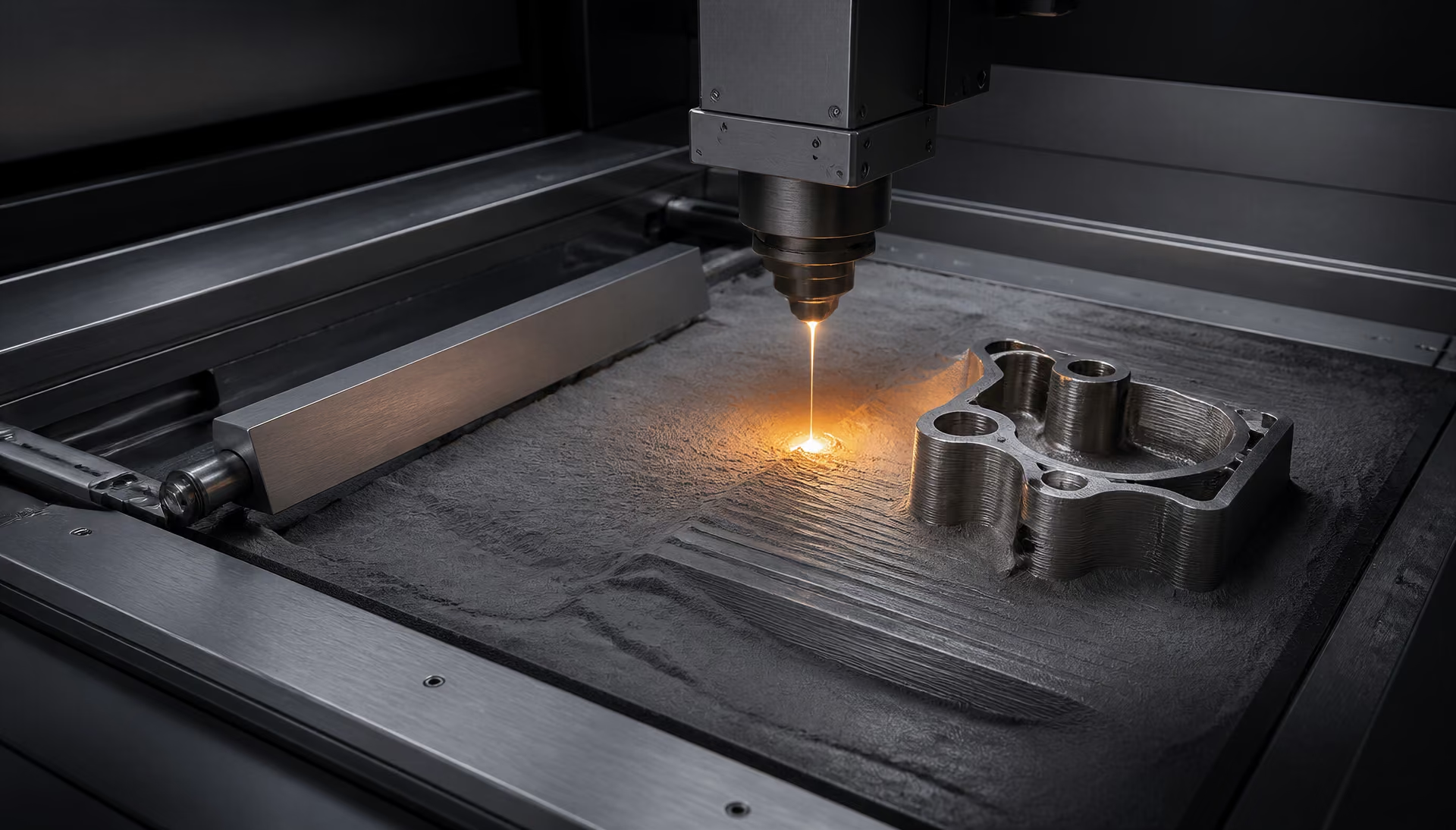
Additive Manufacturing: Why Processing Complicates Family Labels
Additive manufacturing exposes a weakness in the common use of “steel family.” A conventional label may identify composition, crystal structure, application, or a standard designation, but it does not by itself describe how a steel was deposited, melted, cooled, reheated, or relieved of residual stress. Powder-bed fusion and directed-energy deposition add a processing axis to the classification problem. The material may retain the chemistry associated with a familiar wrought grade while developing a different solidification structure and property profile.
NIST’s review of additive manufacturing of steels and stainless steels treats feedstock, process route, microstructure, and post-build treatment as connected variables. That approach does not assign new grades or establish universal additive-manufacturing equivalents. It provides a more accurate description of what an AM material is: a composition-defined alloy produced through a particular thermal history.
Powder feedstocks and steel classifications
The first classification question concerns what enters the machine. Metal powder is not merely a smaller version of bar, plate, or wire. Its particle-size distribution, morphology, internal porosity, surface condition, chemistry, and cleanliness affect powder spreading, feeding, melting, and consolidation. A powder lot can therefore be described by both an alloy designation and feedstock characteristics.
Chemical classification remains important. ISO/DIS 4948-1 (2024) divides steels into “non-alloy, low-alloy, and high-alloy steels.” The same document states that “micro-alloy steels are a subclass of low-alloy steels” and that “stainless steels are a subclass of high-alloy steels.” Those categories describe alloy content; they do not identify whether the material was atomized into powder and processed by laser powder-bed fusion, electron-beam powder-bed fusion, or a directed-energy route.
A powder marketed or specified under a familiar name can also differ from the composition limits of a wrought product standard. SAE J403_202402, for example, sets composition limits and ranges for SAE carbon-steel grades using carbon, manganese, phosphorus, sulfur, copper, chromium, nickel, molybdenum, and silicon. A powder specification may report those same elements, yet its oxygen, nitrogen, hydrogen, or trace-element limits, particle-size range, and production route can be controlled under separate requirements. Matching the nominal SAE number does not prove equivalence to material produced as hot-rolled or annealed stock.
Stainless steel shows the same separation between axes. NIST’s 1976 manual for meat and poultry processing equipment divides stainless steels into “martensitic, ferritic, austenitic, and precipitation-hardening classes,” with representative UNS designations. These are structure- or heat-treatment-related families within the broader stainless category. A powder carrying a UNS designation still requires a description of its manufacturing route and condition. Austenitic stainless powder processed by rapid melting and cooling is not fully characterized by the word “austenitic,” because the build can contain cellular segregation, residual ferrite, martensite, or crystallographic texture depending on the process and thermal history.
Feedstock form also changes the relevant comparison. A powder-bed process deposits successive thin layers, while directed-energy deposition introduces powder or wire into a melt pool that may be larger and repeatedly reheated. Two feedstocks with identical bulk chemistry can therefore produce different defect populations and phase distributions when used in different machines or parameter regimes.
Process-generated microstructures
The melt pool creates a local solidification experiment repeated throughout the part. A laser or electron beam raises a small region above its liquidus temperature, followed by rapid cooling into already deposited material. Heat flows into the substrate, neighboring tracks, and previous layers rather than leaving uniformly in every direction. Scan speed, beam power, layer thickness, hatch spacing, shielding atmosphere, and part geometry alter that thermal cycle.
This produces microstructures that cannot be inferred from a composition label alone. Rapid solidification may refine cellular or dendritic features, while repeated reheating can temper, transform, or partially remelt material beneath a new track. Directional heat flow can produce columnar grains and crystallographic texture. Insufficient fusion may leave lack-of-fusion defects; excessive energy can promote keyholing and gas-porosity. Neither defect is a separate chemical family, but each affects mechanical response and belongs in the material description.
The distinction between composition and structure is already present in conventional standards. ISO/TS 4949 (2016) explains that steel names use “letters and numbers that express application and principal mechanical, physical, or chemical characteristics.” Such a name communicates selected characteristics; it is not a complete record of grain morphology, residual stress, porosity, or build orientation. ASTM A941 likewise consolidates terminology for steel, stainless steel, related alloys, and ferroalloys, while ASTM Committee A01 covers carbon and alloy steels, tool steels, corrosion- and heat-resistant alloys, super-strength alloys, clad steels, and stainless steels. The breadth of that standards landscape is evidence that a single naming system cannot carry every manufacturing variable.
AM microstructure also complicates the use of structure-based family labels. A part can contain martensite in one region and retained austenite or ferrite in another, particularly where geometry changes the cooling rate. Precipitation-hardening alloys may be deposited in a supersaturated or non-equilibrium condition before aging. A nominally ferritic or austenitic stainless composition can show local phase changes caused by dilution, segregation, or reheating. The alloy family has not changed in the ISO chemical sense, but the as-built material condition has.
Post-build thermal processing
The build ends when deposition stops, not when the material reaches its specified condition. Stress relief, annealing, solution treatment, quenching, aging, hot isostatic pressing, or combinations of these treatments can change the microstructure and remove or reduce defects. Each treatment creates another classification descriptor: as-built, stress-relieved, solution-treated, aged, hot-isostatically pressed, or a condition defined by a product specification.
Residual stress is a central reason for this distinction. Layerwise heating and cooling can leave tensile stress near surfaces or distort thin and overhanging features. A stress-relief cycle may reduce that stress without producing the same phase balance as a full anneal or solution treatment. Hot isostatic pressing can close internal pores while also changing grain structure and precipitate distribution. Aging can raise strength through precipitation, whereas an unsuitable cycle can coarsen precipitates or reduce ductility.
Application standards illustrate why the final designation cannot be assumed from chemistry. ISO 6935-1 (2005) specifies ten plain reinforcing-bar steel grades, including B240, B300, and B420, with one grade identified as suitable for welding. Those names belong to a reinforcing-bar classification and carry requirements tied to that product form and use. They do not automatically define an AM-built component made from powder with similar elemental percentages.
NIST’s 2024 Standard Reference Materials categories list “plain carbon steels, low-alloy steels, special low-alloy steels, high-alloy steels, stainless steels, tool steels, and specialty steels.” This practical taxonomy helps organize reference materials, but an AM specimen may need additional information: powder source and condition, process type, build orientation, parameter set, atmosphere, heat treatment, density, defects, and test direction.
The correct conclusion is not that additive manufacturing creates universal new steel families. It adds a descriptive axis. A defensible material record states the chemical family, the applicable standard or UNS designation where one exists, the feedstock form, the AM process, the resulting microstructure, and the post-build condition. Only then can “the same steel” mean something precise rather than merely similar chemistry.
How ASTM, SAE, ISO, NIST, and UNS Fit Together
| Organization or system | Primary function | Example cited in the article |
|---|---|---|
| ISO | International standards and classification rules | ISO/DIS 4948-1 |
| ASTM | Consensus terminology and product specifications | ASTM A941 and ASTM A240/A240M |
| SAE | Composition and engineering standards | SAE J403_202402 |
| NIST | Technical references and reference-material taxonomies | Standard Reference Materials categories |
| UNS | Common identification system for metals and alloys | UNS S30400 |
ASTM, SAE, ISO, NIST, and UNS do not form successive levels of one steel classification tree. They perform different jobs. ASTM develops consensus standards, SAE publishes many composition and engineering specifications, ISO establishes international standards and classification rules, NIST supplies measurement references and technical taxonomies, and UNS provides a common identification system for metals and alloys. A single steel can therefore have an ISO composition class, an SAE grade, an ASTM product specification, a UNS number, and a microstructural description at the same time.
Those labels answer different questions. A composition class asks which alloying range the steel occupies. A product specification asks what a supplied product must meet. A designation identifies the material in a controlled naming system. A metallurgical class describes phases or hardening mechanisms. Confusing these functions produces apparent contradictions that are usually only differences in classification axis.
Terminology standards versus material specifications
ASTM A941, Standard Terminology Relating to Steel, Stainless Steel, Related Alloys, and Ferroalloys, is a terminology document. It consolidates definitions used across steel standards, including terms that describe alloy content, products, treatments, properties, and forms. It does not, by itself, establish the complete chemical limits, dimensions, testing regime, delivery condition, or acceptance criteria for a particular bar, plate, tube, or forging.
That distinction matters when a term sounds like a grade. “Stainless steel,” for example, can describe a broad family defined through composition and corrosion behavior, while a product standard may impose additional requirements on tensile strength, heat treatment, surface condition, or testing. ASTM A941 helps users apply the vocabulary consistently; it does not replace the product specification that governs a shipment or component.
ASTM Committee A01 shows how wide the standards field is. Its scope covers carbon and alloy steels, tool steels, corrosion- and heat-resistant alloys, super-strength alloys, clad steels, and stainless steels, among other steel-related materials. The scope is not a ranked list in which one category supersedes another. “Tool steel” points toward intended function and alloy design; “stainless steel” points mainly toward composition and corrosion resistance; “clad steel” identifies a product construction; and “corrosion- and heat-resistant alloy” describes a performance-oriented material area. A single product may fall under more than one of these descriptions.
UNS occupies another position. The Unified Numbering System assigns identifiers such as UNS G10060 for a carbon steel and UNS S30400 for an austenitic stainless steel. The letter indicates a broad material group, while the digits identify a particular composition or alloy entry within that system. A UNS number is not a purchasing specification and does not state every requirement needed for manufacture or acceptance. ASTM, SAE, and other bodies may reference a UNS designation alongside their own grade names, but the presence of a UNS number does not turn separate standards into one hierarchy.
SAE J403_202402 illustrates the difference between a composition document and a terminology document. It specifies chemical compositions for SAE carbon-steel grades and identifies limits or ranges for carbon, manganese, phosphorus, sulfur, copper, chromium, nickel, molybdenum, and silicon. The listed elements are evidence of the composition axis: J403 can distinguish grades by chemistry, but it does not, merely by naming a grade, describe all processing histories or final mechanical properties. Heat treatment, product form, section size, and test method can change those properties without changing the basic SAE composition designation.
Composition standards versus application standards
ISO/DIS 4948-1 provides a chemical-composition classification of steels as “non-alloy, low-alloy, and high-alloy steels” (International Organization for Standardization, 2024). In that framework, “micro-alloy steels are a subclass of low-alloy steels,” while “stainless steels are a subclass of high-alloy steels.” This is a useful correction to the common habit of treating micro-alloy and stainless steels as entirely separate top-level branches. The ISO classification is sorting steels by alloying content and related compositional criteria, not by the products in which they are used.
An application standard sorts differently. ISO 6935-1:2005 concerns reinforcing bars and specifies ten plain reinforcing-bar steel grades, including B240, B300, and B420. Its grade structure is connected to reinforcement use and mechanical requirements, not simply to the broad alloy-content classes in ISO/DIS 4948-1. One of the grades is identified as suitable for welding, which adds a fabrication requirement to the classification. The same steel could still be discussed using a chemical class, a phase description, and a UNS identifier, but ISO 6935-1 addresses its role as reinforcing bar.
ISO/TS 4949:2016 addresses naming rules rather than defining one universal family tree. It explains that steel names use letters and numbers to express application and principal mechanical, physical, or chemical characteristics. A name can therefore carry information about intended use as well as composition or properties. Reading the name correctly requires knowing the designation rule behind it; reading it as a complete material specification would be an error.
Processing introduces another separation. A steel made by conventional rolling and a steel made from powder by laser powder-bed fusion may share a nominal chemical composition while developing different porosity, grain structures, residual stresses, and precipitate distributions. NIST’s review of steel and stainless-steel classifications in additive manufacturing links classification to powder feedstocks, process routes, microstructures, and post-build thermal treatment. Composition remains necessary, but it does not predict the whole material state. The route from powder to finished part is part of the technical description.
This is why a grade name alone cannot settle questions about weldability, fatigue, corrosion, or dimensional stability. The relevant specification, product form, heat treatment, manufacturing route, and test condition must be identified. A composition designation and an application designation may describe the same steel from different directions without being interchangeable.
Reference-material categories and institutional taxonomies
NIST adds a practical classification that serves measurement rather than commercial grade control. Its Standard Reference Materials categories include “plain carbon steels, low-alloy steels, special low-alloy steels, high-alloy steels, stainless steels, tool steels, and specialty steels” (NIST, 2024). These categories organize reference materials used for calibration, analytical validation, and comparability between laboratories. They are not a replacement for ASTM, SAE, or ISO grade systems.
A NIST reference material has a defined analytical or property purpose. Its certificate may report elemental concentrations, mechanical data, or other assigned values with stated uncertainty. The category tells users what kind of reference material they are consulting; it does not automatically identify the material’s product form, processing history, or qualification under a construction or pressure-vessel specification.
NIST’s 1976 manual on meat and poultry processing equipment provides another institutional taxonomy, dividing stainless steels into martensitic, ferritic, austenitic, and precipitation-hardening classes and giving representative UNS designations. This is a metallurgical and application-oriented organization. Martensitic, ferritic, and austenitic refer to characteristic matrix structures or phase families, while precipitation-hardening identifies a strengthening route. None of those terms alone supplies the full chemical limits of every grade in the class.
The practical method is to cross-read the documents. Use ISO/DIS 4948-1 for the broad composition class, SAE J403 for SAE carbon-steel chemistry, ASTM A941 for controlled terminology, ISO/TS 4949 for naming logic, and ISO 6935-1 when reinforcing-bar application requirements govern. Use UNS to connect equivalent or related alloy identifiers, then consult the applicable ASTM, SAE, ISO, or national product specification for acceptance requirements. NIST classifications and reference-material records add measurement and processing context.
No single label can carry all of that information. Steel classification works as an intersection of systems, not as one ladder from “general” to “specific.”
A Practical Method for Classifying an Unknown Steel
Classifying an unknown steel is not a matter of assigning one label and treating that label as a complete identity. A material can be non-alloy or low-alloy by composition, martensitic or austenitic by structure, intended for reinforcing bar by product standard, and supplied in a particular heat-treatment condition at the same time. These descriptions answer different questions.
Unknown-steel identification sequence
- Product context Record whether the material is plate, sheet, bar, wire, tube, forging, casting, powder, or a finished component.
- Governing document Identify the standard, issuing organization, edition, and product scope.
- Chemistry Compare certified or measured elemental data with the applicable composition limits.
- Metallurgical condition Determine the phases, microstructure, and heat-treatment condition using appropriate evidence.
- Application Record whether the product is structural, reinforcing, tooling, corrosion-resistant, or intended for another service.
- Exact designation Preserve the complete grade, UNS identifier, suffixes, standard number, and edition.
A defensible classification therefore follows the order used by standards: establish the product context, identify the governing document, compare the available chemical data with its limits, determine the metallurgical condition, identify the intended application, and preserve the exact designation with its standard number and edition. If the evidence is incomplete, the result should remain provisional.
Start with the governing standard and product form
Begin with the object itself, not with a visual guess about its grade. Record whether it is a plate, sheet, bar, wire, tube, pipe, forging, casting, fastener, weld deposit, powder, or finished component. Product form affects which standard applies and which properties are controlled. A reinforcing bar, for example, is not classified by the same scheme as a tool-steel die, even if both contain mostly iron and carbon.
Look for the mill certificate, inspection document, drawing, heat number, permanent marking, shipping label, or test report. The first useful question is: which standard governs this product in this form? ASTM A941 is a terminology standard covering steel, stainless steel, related alloys, and ferroalloys, while ASTM Committee A01’s scope spans carbon and alloy steels, tool steels, corrosion- and heat-resistant alloys, super-strength alloys, clad steels, and stainless steels. That scope signals why “steel” alone is not a sufficient classification.
The governing standard may be product-specific. ISO 6935-1, for example, classifies plain reinforcing-bar steels and specifies ten grades, including B240, B300, and B420. In that setting, B420 is an application-linked designation within a reinforcing-bar standard; it is not a universal chemical name for every steel containing a similar amount of carbon or alloying elements. The designation communicates the product class and the standard’s required performance framework. It does not, by itself, identify crystal structure or every composition limit.
The same discipline applies to a powder or additively manufactured part. NIST’s review of additive manufacturing links steel classification with powder feedstock, process route, resulting microstructure, and post-build thermal treatment. A powder marked with a nominal alloy name cannot be assumed to have the same properties as wrought material carrying a related designation. Manufacturing history matters.
If no document is available, record the uncertainty and use the product form to narrow the standards search. Hardness, magnetic response, fracture appearance, and color can guide testing, but they do not establish a grade.
Separate chemistry from structure and application
Once the governing document is identified, record the chemical composition or the applicable composition limits. Use a heat analysis, product analysis, certified laboratory result, or a clearly identified analytical method. Optical-emission spectroscopy and X-ray fluorescence can provide useful elemental data, but the result must be interpreted against the limits and measurement scope of the governing standard.
SAE J403_202402 illustrates a composition-led system. Its SAE carbon-steel designations are supported by limits or ranges for carbon, manganese, phosphorus, sulfur, copper, chromium, nickel, molybdenum, and silicon. A designation such as SAE 1045 therefore points first to a specified carbon-steel composition range under SAE’s designation and composition framework. It does not state that the bar is normalized, quenched and tempered, cold drawn, or machined. Nor does it identify the component’s use. Those are separate facts.
ISO/DIS 4948-1 (2024) uses the broad chemical classes non-alloy, low-alloy, and high-alloy steels. The same document places micro-alloy steels within low-alloy steels and stainless steels within high-alloy steels. This hierarchy is useful for composition, but it should not be mistaken for a hierarchy of strength, corrosion resistance, manufacturing route, or service use. “High-alloy” does not mean a particular crystal structure, and “stainless” does not necessarily mean austenitic.
Structure requires its own evidence. Metallographic examination, phase analysis, hardness mapping, magnetic response, and knowledge of the thermal cycle may all contribute. A stainless steel identified only as austenitic has been assigned a metallurgical class: its dominant room-temperature structure is described as austenitic. That word does not supply a complete grade designation, chemical analysis, product standard, or heat-treatment history. Stainless classifications may also be martensitic, ferritic, or precipitation-hardening. A 1976 NIST manual for meat and poultry processing equipment uses these four classes—martensitic, ferritic, austenitic, and precipitation-hardening—and gives representative UNS designations, demonstrating that structure-based labels and alphanumeric grade systems coexist rather than replace one another.
Condition must be recorded separately. “Annealed,” “normalized,” “quenched and tempered,” “solution annealed,” “cold worked,” and “precipitation hardened” describe processing or resulting condition. Two pieces with the same chemistry and nominal grade can differ substantially in hardness, yield strength, residual stress, and microstructure because their processing routes differ. For additively manufactured steel, powder characteristics, layer-by-layer thermal exposure, build direction, and post-build treatment may be decisive.
Application is another axis. B420 identifies a reinforcing-bar grade under ISO 6935-1; SAE 1045 identifies a carbon-steel composition designation; austenitic identifies a stainless metallurgical class. These labels cannot be substituted for one another. ISO/TS 4949 explains that steel names use letters and numbers to express application and principal mechanical, physical, or chemical characteristics, so the meaning of a designation must be read within its naming system.
Record the complete designation and edition
The final record should preserve the designation exactly as written, including capitalization, spacing, punctuation, prefixes, suffixes, condition symbols, and UNS or national equivalents where stated. Write SAE 1045, B420, or the exact stainless designation found in the source document; do not silently convert one system into another.
Next record the complete standard reference and edition: for example, SAE J403_202402, ISO 6935-1:2005, or the applicable ASTM designation and revision. A standard number without its edition can be inadequate because composition limits, test methods, grade names, and acceptance requirements change. Also note whether the document is a product standard, terminology standard, composition standard, or test method.
Keep the evidence beside the classification: heat or lot number, specimen location, laboratory report, certificate, product dimensions, heat-treatment condition, and any deviations. If chemistry fits SAE 1045 but the product certificate identifies another standard, report both facts rather than forcing a single label. If the evidence supports only “low-alloy, quenched and tempered bar,” do not promote that description to a specific grade.
NIST’s 2024 Standard Reference Materials taxonomy separates plain carbon, low-alloy, special low-alloy, high-alloy, stainless, tool, and specialty steels. That arrangement is useful as a filing and reference system, but it reinforces the central rule: a classification is meaningful only when its axis and source are named. A complete unknown-steel record might therefore read: product form, governing standard and edition, exact designation, composition result, ISO chemical class, metallurgical class, heat-treatment condition, intended application, and confidence or unresolved questions. That record is more useful than a single unqualified word such as “stainless” or “carbon steel.”
Common Classification Errors and Editorial Rules
Steel family names do not form one universal hierarchy. They describe different features, and a single steel can receive several valid descriptions at the same time. A grade may be a low-alloy steel by composition, ferritic by room-temperature structure, structural steel by intended use, and a product made by powder-bed fusion followed by heat treatment. None of those labels replaces the others.
The article must therefore keep classification axes separate. Chemical classification concerns alloying content. Metallurgical classification concerns phases, crystal structure, and transformation products. Application classification concerns the service for which a product or grade is specified. A designation identifies a grade or product within a naming system, while a specification states requirements for composition, properties, dimensions, testing, manufacture, or delivery. Processing route is another axis: forged, cast, rolled, welded, additively manufactured, and heat-treated products may share nominal chemistry but differ in microstructure and properties.
ISO/DIS 4948-1:2024 gives a chemical-composition classification of “non-alloy, low-alloy, and high-alloy steels.” In the same document, “micro-alloy steels are a subclass of low-alloy steels,” and “stainless steels are a subclass of high-alloy steels.” This does not make ferritic, austenitic, martensitic, and precipitation-hardening steels successive levels beneath stainless steel. Those are structural or metallurgical groupings that can overlap the chemical grouping.
Treating stainless steel as one grade
“Stainless steel” is a family description, not a complete grade. It identifies steels whose composition and structure support resistance to aqueous corrosion under specified conditions, but it does not state the required carbon content, nitrogen content, heat treatment, mechanical properties, product form, or corrosion test. Writing that a component is made from “stainless steel” leaves the material designation incomplete.
The major stainless classes also differ substantially. A NIST manual published in 1976 divides stainless steels into “martensitic, ferritic, austenitic, and precipitation-hardening classes.” Duplex stainless steels are also treated as a distinct group in many modern technical systems, combining ferritic and austenitic phases. The classes have different transformation behavior, strengthening mechanisms, magnetic response, weldability, toughness, and resistance to particular environments.
A wiki entry should name the grade and the governing system. For example, AISI 304 is a widely used designation, but it is not equivalent in every detail to a product specification such as ASTM A240/A240M for chromium and chromium-nickel stainless steel plate, sheet, and strip for pressure vessels and general applications. UNS S30400 identifies the composition number in the Unified Numbering System; it does not by itself state plate thickness, finish, tensile requirements, inspection, or acceptance criteria. X5CrNi18-10 is an EN chemical designation and must not be presented as a universal substitute for every 304-related product requirement.
The article should also avoid treating “316 stainless steel” as a sufficient engineering description. A source may mean UNS S31600, an EN name such as X5CrNiMo17-12-2, or a product grade controlled by a particular ASTM, ASME, EN, or national standard. Those references can align chemically while differing in product scope and mandatory tests. If the source gives only “316,” the text should preserve that limitation: “the source identifies the material as 316 stainless steel,” not “the component meets ASTM A240.”
Equating alloy content with performance
An alloying element is not a performance guarantee. Chromium supports formation of a passive chromium-oxide film in suitable environments, nickel affects austenite stability and other properties, molybdenum can improve resistance to some localized corrosion mechanisms, and carbon affects hardenability, carbide formation, and weldability. The result depends on concentration, balance among elements, impurities, processing, surface condition, environment, and service temperature.
SAE J403_202402 illustrates the first part of this problem. Its composition framework reports carbon, manganese, phosphorus, sulfur, copper, chromium, nickel, molybdenum, and silicon for SAE carbon-steel grades. Those listed limits identify chemical ranges; they do not, without more information, establish a tensile strength, fatigue life, impact toughness, corrosion rate, or weld procedure.
Even a small compositional change can matter, but a larger alloy addition does not automatically produce better service behavior. Heat treatment can produce ferrite-pearlite, bainite, martensite, or tempered martensite from related chemistries. Grain size, segregation, inclusions, residual stress, surface condition, and hydrogen exposure can alter the result further. NIST’s additive-manufacturing review connects steel classification with powder feedstocks, process routes, microstructures, and post-build thermal treatment. That evidence directly rejects the editorial shortcut that nominal chemistry alone describes the finished material.
Numerical thresholds require particular care. Do not invent boundaries such as “all steel above X percent chromium is stainless,” “more than Y percent alloying elements makes a steel high-alloy,” or “over Z percent carbon makes it tool steel” unless the cited classification actually specifies those values. ISO/DIS 4948-1 provides its own definitions and scope; a textbook, national standard, or commercial designation may use different criteria. The correct wording is “under ISO/DIS 4948-1, the steel is classified as…” followed by the applicable category and citation.
Application labels can mislead in the same way. ISO 6935-1:2005 specifies ten plain reinforcing-bar steel grades, including B240, B300, and B420, with one grade identified as suitable for welding. “Rebar steel” therefore describes a product/application context under a standard; it is not a chemical family that supersedes ferritic, low-alloy, or non-alloy classifications.
Confusing a designation with a specification
A designation is an identifier. A specification is a set of enforceable requirements. The two may appear together, but they perform different jobs.
ISO/TS 4949:2016 explains that steel names use “letters and numbers that express application and principal mechanical, physical, or chemical characteristics.” Such a name communicates selected information through a naming convention. It does not necessarily include every requirement governing manufacture or inspection. Similarly, S355 in an EN structural-steel designation conveys a specified yield-strength level at the relevant thickness and includes other naming information, but the complete product requirements come from the applicable product standard and its edition.
Editorial copy must state the issuing organization: ISO, ASTM International, SAE International, EN/CEN, ASME, a national standards body, or another authority. ASTM A941, for example, consolidates terminology for steel, stainless steel, related alloys, and ferroalloys, while ASTM Committee A01 covers a much wider standards landscape, including carbon and alloy steels, tool steels, corrosion- and heat-resistant alloys, super-strength alloys, clad steels, and stainless steels. A reference to “ASTM steel” is not a grade.
Standard editions are part of the citation, not optional decoration. Requirements can change between editions, supplements, and incorporated revisions. The finished article should record the standard number, edition or revision where available, issuing organization, and the material or product scope. It should distinguish a normative specification from an explanatory review: NIST may explain classification practice or provide representative UNS designations, whereas ASTM, ISO, SAE, or EN product standards may impose formal requirements.
Finally, the article must never infer a property that the source does not state. A family name does not prove corrosion resistance in a named environment; a composition designation does not prove weldability; a structural designation does not prove fatigue performance; and a heat-treatment description does not prove a particular hardness unless the cited document reports it. NIST’s 2024 reference-material categories—plain carbon, low-alloy, special low-alloy, high-alloy, stainless, tool, and specialty steels—are useful as a practical taxonomy, but they remain a reference-material organization, not a single hierarchy governing every steel classification.
References
- [1] ISO/DIS 4948-1. ISO/DIS 4948-1, 2024. https://www.iso.org/obp/ui?_escaped_fragment_=iso%3Astd%3Aiso%3A4948%3A-1%3Adis%3Aed-2%3Av1%3Aen
- [2] Chemical Compositions SAE Carbon Steels. SAE J403_202402, 2024. https://saemobilus.sae.org/standards/j403_202402-chemical-compositions-sae-carbon-steels
- [3] Stainless Steel for the Food Industry. NBSIR 76-1185, 1976. https://nvlpubs.nist.gov/nistpubs/Legacy/IR/nbsir76-1185.pdf
- [4] Steel for the reinforcement of concrete — Plain bars. ISO 6935-1:2005, 2005. https://www.iso.org/standard/38618.html
- [5] Steel names. ISO/TS 4949:2016, 2016. https://www.iso.org/standard/67751.html?browse=ics
- [6] Additive Manufacturing of Steels and Stainless Steels. NIST technical review, 2024. https://www.nist.gov/