

What a Steel Designation Actually Identifies
A steel designation is not automatically a complete material specification. It may identify a chemical composition, an intended application, a mechanical-property level, a quality class, a classification category, or only an administrative registry entry. The meaning depends on the system that created it.
That distinction matters because steel documents often place short labels beside long technical requirements. A drawing may call for “S355,” a purchasing document may state “ASTM A572 Grade 50,” and a material certificate may show a heat number, a product standard, and a UNS number. These entries do not all identify the same type of information. Some describe what the steel is; others describe how it must perform, how it must be tested, or how a particular heat is recorded.
The scope of this article is therefore broader than finding a supposed equivalent name. It examines the systems behind steel names and numbers, then separates identity from specification. A label such as 1020, S355, or G10180 cannot be interpreted reliably until its governing standard, product form, revision, and required properties are known.
Designation, grade, specification, and classification
Four terms to keep separate
- Designation
- A symbol or number assigned within a recognized naming system.
- Grade
- A defined level within a material or product family.
- Specification
- The technical document or contract requirements governing the supplied product.
- Classification
- A category assigned according to composition, quality class, property, or application.
A designation is the symbol or number assigned within a recognized naming system. EN 10027-1:2016 defines symbolic steel names formed from letters and numbers. Those symbols can express an application and principal mechanical, physical, or chemical characteristics. Structural steel name S355 is an example: “S” indicates structural steel, while “355” refers to a specified yield-strength level under the relevant product standard and conditions. The number is not a universal statement that every piece of S355 has exactly 355 MPa yield strength in every thickness or delivery condition.
EN 10027-2 addresses numerical steel numbers as a separate identification method from symbolic steel names. Strong evidence
EN 10027-2 addresses numerical steel numbers. A numerical number is intended to provide a stable identification within the European system, but it does not function as a complete order requirement by itself. The symbolic name and the material number answer different administrative questions.
A grade is a defined level within a material or product family. In ASTM usage, “Grade 50” in ASTM A572 identifies a required property level for a specified high-strength, low-alloy structural product. In an alloy-steel system, a grade may instead be tied chiefly to composition. The word grade is therefore not self-defining. Its meaning comes from the document that assigns it.
A specification is the controlling technical document, or the set of requirements invoked by the contract, standard, or drawing. It can regulate chemical analysis, tensile and yield strength, elongation, impact testing, hardness, weldability limits, dimensions, tolerances, surface condition, heat treatment, inspection, marking, and delivery condition. ASTM A29, ASTM A108, EN 10025-2, and JIS product standards do not merely provide names; they establish requirements for particular products and uses. A chemical match can still fail the specification if the required test results, dimensions, condition, or certification are absent.
A classification places steels into a category according to stated criteria. ISO 4948-1:1982 classifies steels by specified ladle-analysis composition and uses 2.0% carbon as the usual dividing line between steel and cast iron. ISO 4948-2:1981 further classifies unalloyed and alloy steels by quality class and principal property or application. Classification answers questions such as whether a steel is unalloyed or alloyed, or which quality group it occupies. It does not necessarily provide a product form, delivery condition, or acceptance test schedule.
| Information type | Example | What it primarily identifies |
|---|---|---|
| Symbolic name | S355 | Structural application and specified yield-strength level |
| UNS identifier | G10180 | Administrative material identity |
| Product specification | ASTM A36 | Product requirements and acceptance criteria |
| Classification | ISO 4948 category | Composition or quality grouping |
These layers can overlap, but they should not be collapsed into one word. “S355” is a symbolic name associated with structural application and strength. “G10180” is a numerical identifier in UNS. “ASTM A36” invokes a product specification with defined requirements. A certificate may show all three kinds of information without making them interchangeable.
Name symbols versus numerical identifiers
Steel name symbols are designed to communicate something. ISO/TS 4949:2003 provides internationally standardized rules for steel names based on letter symbols, and EN 10027-1:2016 applies a related European approach. Letters may indicate use, property, alloying element, treatment, or another defined characteristic. Their meaning is conditional, not intuitive. The same letter can have a different role in another national or industry system.
The traditional AISI/SAE designation system illustrates a composition-based approach. In 1020, the first two digits, “10,” identify the plain-carbon steel family, while the final two digits indicate an approximate nominal carbon content of 0.20% by mass. In 4340, “43” identifies a nickel-chromium-molybdenum alloy family and “40” indicates approximately 0.40% carbon. The designation does not mean that every analysis is exactly 0.20% or 0.40% carbon, nor does it state the product’s heat treatment, hardness, dimensions, or mechanical test results.
SAE J402 describes a UNS-based designation system for wrought or rolled steels by chemical composition and additional requirements. ASTM A400 notes that composition numbers may correspond to SAE, AISI, or ASTM designations and identifies H-steel grades as hardenability grades associated with corresponding SAE-AISI compositions. That last qualification is important: an H suffix or H-grade designation can add a hardenability requirement rather than merely repeat a base chemistry.
Numerical systems communicate less through the visible characters. SAE J1086 describes the Unified Numbering System, including letter-and-five-digit families and procedures for assigning unused numbers. UNS G10180 identifies AISI 1018. The initial “G” places the number in the family covering carbon and alloy steels; the number itself is an administrative identifier tied to a recognized composition or designation relationship. It is not a tensile-strength value, a heat-treatment instruction, or a product standard.
| Label | System role | Relationship |
|---|---|---|
| 1020 | Traditional AISI/SAE composition designation | Plain-carbon family with approximately 0.20% nominal carbon |
| G10180 | UNS identifier | Corresponds to AISI 1018 |
| ASTM product grade | Product specification | Requirements depend on the cited ASTM document and product form |
This is why “1020” and “G10180” should not be read as universal synonyms. 1020 is a traditional AISI/SAE composition designation; G10180 is a UNS identifier corresponding to AISI 1018. Their carbon contents are near each other, but the labels identify different nominal grades. Even when two grades have similar chemistry, their permitted ranges, residual-element limits, processing requirements, and product standards may differ.
The scale of the naming problem is visible in the 2024 Steel Equivalents catalogs: 4,704 DIN / EN designations, 3,544 GOST designations, 2,443 ASTM designations, 2,322 JIS designations, 2,161 AISI / SAE designations, 2,038 UNS designations, 1,569 BS designations, and 1,469 AFNOR designations are listed. These counts are evidence of multiple technical traditions, not proof that entries across them are interchangeable.
Why one steel can carry several identities
One steel can carry several identities because different documents need different kinds of control. A producer may identify a melt by a heat number, classify its chemistry under ISO rules, report a UNS number, state an EN symbolic name, and certify the finished plate to a product standard. Each identifier serves a separate purpose.
Consider a carbon steel corresponding to AISI 1018. Its traditional composition name may be 1018; its UNS identity may be G10180; and a product specification may impose requirements through an ASTM standard for bar, sheet, or another form. The same chemistry does not make every product made from that steel compliant with every one of those standards. Cold-drawn bar, hot-rolled plate, and annealed stock can share a composition family while differing in tolerances, mechanical properties, surface condition, and delivery state.
S355 shows the opposite emphasis. Its symbolic name communicates structural application and a nominal yield-strength class within the applicable EN product framework. The complete requirement still depends on the exact product standard, thickness range, subgrade, impact designation, delivery condition, and testing provisions. “S355” alone is not enough to select a compliant plate, section, or welded component.
A numerical identity may also coexist with a symbolic name because one system supports databases and traceability while another communicates engineering meaning. A heat number identifies a particular melt or production unit. It says which material record belongs to the product; it does not replace the grade or specification.
A short designation alone is not sufficient to establish that a steel is acceptable for a defined use. Strong evidence
Verification checklist
- Chemistry and permitted analysis basis
- Product form and dimensions
- Heat-treatment and delivery condition
- Mechanical properties and test methods
- Quality class, inspection, and certification
The practical rule is strict: treat an apparent equivalent as a comparison requiring verification, not as an automatic substitution. Confirm chemistry, product form, dimensions, heat treatment, mechanical properties, quality class, testing, and certification against the governing specification. The short designation is an entry point. The specification is what makes the material acceptable for a defined use.
Why Steel Designation Systems Developed Separately
A steel designation is not a universal material name. It is an identifier created for a particular standards tradition, industrial purpose, and legal setting. One system may encode approximate chemical composition; another may identify a product’s intended use, delivery condition, minimum yield strength, or inspection requirements. A designation can therefore resemble another designation without carrying the same technical obligations.
This separation developed gradually. Steelmaking expanded through national industries, military procurement, railway construction, pressure-vessel regulation, automotive production, and international trade. Each activity created records, test methods, purchasing rules, and manufacturing practices that standards bodies later formalized. The resulting systems overlap, but they do not describe steel from a single shared starting point.
National industrial standards and legacy practice
| Standards tradition | Typical emphasis described in the article | Example |
|---|---|---|
| AISI / SAE | Composition family and approximate carbon level | 1020, 4340 |
| ASTM | Product, service, tests, and acceptance criteria | A36, A516, A240 |
| EN | Application, properties, composition, or numerical identity | S355, P355, 1.4301 |
| GOST | Composition, quality, heat-treatment, and established product conventions | Ст3, 20, 09Г2С |
| JIS | Product category and industrial application | SS400, S45C |
National catalogs preserve the priorities of the industries that created them. The traditional AISI / SAE system, for example, groups wrought steels through family digits and uses approximate nominal carbon content in hundredths of a percent. AISI 1020 indicates a plain carbon steel family and approximately 0.20% carbon; AISI 4340 indicates a nickel-chromium-molybdenum alloy family with approximately 0.40% carbon. Those digits are useful composition clues, not a complete specification of processing, cleanliness, heat treatment, or mechanical properties.
The Unified Numbering System extends that composition-oriented approach across several metal families. SAE J1086 describes UNS letter-and-five-digit designations and procedures for assigning unused numbers. UNS G10180 identifies AISI 1018, while the G family covers carbon and alloy steels. The relationship is administrative as well as metallurgical: a UNS number provides a coordinated identification framework, but it does not replace the product standard that states what the material must meet. SAE J402 likewise describes a UNS-based system for wrought or rolled steels by chemical composition and additional requirements.
ASTM developed in a different direction. ASTM steel designations commonly belong to product standards, where the material name is tied to a form, service, test regime, and acceptance criteria. ASTM A36, for example, is not simply another way to write a carbon percentage; its requirements belong to ASTM A36/A36M for carbon structural steel. ASTM A400 also explains that composition numbers may correspond to SAE, AISI, or ASTM designations and identifies H-steel grades as hardenability grades associated with corresponding SAE-AISI compositions. The same composition family can therefore appear inside a different specification structure.
DIN and EN show the effect of regional consolidation. Older DIN practice arose within German industrial standardization, while EN standards are developed through CEN and adopted across European national standards systems. EN 10027-1:2016 defines symbolic steel names using letters and numbers that express application and principal mechanical, physical, or chemical characteristics. EN 10027-2 addresses numerical steel numbers. A name such as S355 points toward structural application and a specified yield-strength level, whereas a number such as 1.4301 belongs to a numerical identification system. These are not interchangeable formats for the same information.
GOST records the standards history of the former Soviet and related industrial sphere. Its grades often sit within conventions shaped by mass production, state specifications, heat-treatment categories, and established Russian-language engineering practice. JIS developed around Japanese industrial requirements, including tightly controlled product categories and manufacturing sectors such as machinery, automotive production, shipbuilding, and electronics. BS reflects British standards practice, while AFNOR reflects French national standardization before, and alongside, European harmonization. Their catalogs did not arise because engineers selected arbitrary labels. They grew from separate institutions, plants, regulations, and technical vocabularies.
The size of these catalogs shows the scale of the landscape, not the quality of one system over another. Steel Equivalents reported 4,704 DIN / EN designations and 3,544 GOST designations in 2024, compared with 2,443 ASTM, 2,322 JIS, 2,161 AISI / SAE, 2,038 UNS, 1,569 BS, and 1,469 AFNOR designations. A larger count may reflect broader coverage, more historical entries, or the way a catalog separates product and composition designations. It is not evidence that the system is technically superior.
Product forms, manufacturing routes, and legal jurisdictions
A steel’s designation often depends on what is being supplied, not only on what elements are present. Plate, bar, wire, tube, forgings, castings, fasteners, and sheet may require different standards because rolling reduction, casting method, drawing, forging, annealing, quenching, and tempering affect the final material. Two products with similar ladle analyses can have different permitted dimensions, surface conditions, grain requirements, heat-treatment rules, and mechanical tests.
This is why an ASTM grade cannot be treated as a portable chemical label. ASTM A500/A500M for cold-formed welded and seamless carbon structural tubing, ASTM A516/A516M for pressure-vessel plates, and ASTM A240/A240M for corrosion-resistant steel plate, sheet, and strip each establish requirements connected to a product and service context. A nominally similar alloy designation in JIS, EN, or GOST may be produced and tested under different rules.
Legal jurisdiction reinforces the separation. A European purchaser may require an EN product standard, inspection document, and conformity process even when an imported steel has chemistry close to the requested grade. A North American pressure-vessel contract may require an ASME-adopted specification, traceable heat analysis, and specified supplementary tests. National authorities and insurers can make those documents part of the legal acceptance route. Chemical similarity does not erase that obligation.
Classification adds another layer. ISO 4948-1:1982 classifies steels by specified ladle-analysis composition and uses 2.0% carbon as the usual dividing line between steel and cast iron. ISO 4948-2:1981 further classifies unalloyed and alloy steels by quality class and principal property or application. Classification tells readers how a steel is grouped; it does not by itself establish every delivery requirement for a product.
The problem of apparent international equivalence
International tables are useful for finding candidates, but “equivalent” should be read as a comparison result, not an automatic substitution approval. A grade match may cover carbon, chromium, nickel, or molybdenum ranges while missing nitrogen limits, residual elements, grain-size requirements, hardenability, impact energy, tensile testing, surface condition, or heat-treatment state.
The distinction is visible in the international naming rules. ISO/TS 4949:2003 provides standardized rules for steel names based on letter symbols, while EN 10027 separates symbolic names from numerical steel numbers. A chemical designation, a product grade, and a numerical identity answer different questions. Treating them as synonyms loses information.
The correct comparison therefore starts with the governing product standard and purchase condition. Check the chemical limits, product form, manufacturing route, heat treatment, mechanical tests, inspection document, and permitted tolerances before accepting a cross-reference. A designation reflects the system that created it. It may point toward composition, application, classification, properties, or administration—but it does not promise that another system’s nearest-looking label satisfies the same specification.
The European Framework: DIN, EN, and EN 10027
European steel designations are often treated as if they were simply another set of grade names. That is misleading. A designation can identify a material by its intended application, its principal mechanical property, its chemical composition, its product form, or an administrative number assigned for unambiguous reference. Those functions overlap, but they are not interchangeable.
DIN belongs to the German standards tradition. EN standards are European standards developed through CEN, the European Committee for Standardization, and adopted by national standards bodies. A former DIN designation may remain familiar after an EN standard replaces or supersedes the underlying national document, but familiarity does not make the older designation a current specification. The same caution applies when a designation appears beside an ASTM, AISI/SAE, JIS, GOST, BS, or AFNOR name in a conversion table.
The scale of these naming traditions helps explain the confusion. Steel Equivalents catalogued 4,704 DIN / EN designations in 2024, compared with 3,544 GOST, 2,443 ASTM, 2,322 JIS, 2,161 AISI / SAE, 2,038 UNS, 1,569 BS, and 1,469 AFNOR designations. Those totals describe catalogued designations, not interchangeable grades or the number of distinct chemical compositions. One steel may have several names, while one designation may require a product standard to establish delivery condition, testing, dimensions, and acceptance criteria.
EN 10027-1:2016 steel names
EN 10027-1:2016 is the central European reference for symbolic steel names. It establishes rules for constructing names from letters and numbers so that the designation communicates selected principal characteristics. Depending on the steel family, those characteristics may concern application, mechanical properties, physical properties, or chemical composition.
This is a naming system, not a complete material specification. A name may point toward structural use or a compositional family, yet it does not by itself state every requirement governing manufacture and acceptance. The applicable product standard can add limits on ladle analysis, product analysis, impact energy, heat treatment, surface condition, dimensional tolerances, testing frequency, and supply condition. A designation therefore needs its standard context.
- S
- Structural steel
- 235
- Specified yield-strength level under the relevant rules
- JR
- Additional property indication associated with impact testing
- Limitation
- Not a full chemical recipe or complete product specification
The structural name S235JR illustrates the application-led approach. The initial letter identifies structural steel, while the number expresses a specified yield-strength level under the relevant rules; the suffix supplies an additional property indication associated with impact testing. It would be wrong to read S235JR as a full chemical recipe or to assume that every product carrying a similar number has identical weldability, thickness-dependent strength, or delivery condition.
P355 shows the same principle in pressure-vessel and pressure-equipment steels. The “P” foregrounds the application, and the number refers to a specified strength level. The designation does not replace the applicable pressure-equipment product standard. That standard determines such matters as chemistry limits, test temperatures, heat treatment, and permissible product forms.
Other names place chemistry ahead of application. X5CrNi18-10 is a stainless-steel name: “X” identifies a high-alloy steel family, the number relates to carbon content, and the chromium and nickel figures indicate nominal composition values in the designation format. The name points strongly toward stainless chemistry, but it is not permission to substitute any material with approximately similar chromium and nickel content. Nitrogen, molybdenum, stabilizing elements, corrosion testing, heat treatment, and product requirements can determine whether two apparently close grades meet the same specification.
Bearing steel provides another change in emphasis. 100Cr6 identifies a high-carbon chromium steel associated with bearing applications and composition. Tool-steel names likewise foreground tool-steel identity and alloy family rather than a structural yield-strength class. The letters and figures are therefore not decoded with one universal rule. Their meaning depends on the naming family defined by EN 10027-1 and, ultimately, on the standard governing the product.
EN 10027-1 also allows supplementary symbols. These can identify special characteristics, manufacturing or delivery conditions, or other distinctions defined by the relevant rules. Their presence does not turn the designation into a universal property certificate. A suffix has meaning only within the system that assigns it.
The European approach is consequently more informative than a bare inventory number, but it is not self-sufficient. S235JR, P355, X5CrNi18-10, and 100Cr6 direct the reader toward different defining features: structural function, pressure equipment, stainless chemistry, and bearing-steel composition. Treating them as equivalent simply because all are “steel grades” discards the information the names were designed to convey.
EN 10027-2 numerical steel numbers
EN 10027-2 addresses numerical steel numbers. Unlike a symbolic name, a number is intended primarily to provide a compact and unambiguous identity within the European registration system. It does not try to describe the steel in a readable application-and-property phrase.
| Representation | Example | Primary function |
|---|---|---|
| Symbolic name | X5CrNi18-10 | Communicates principal composition features |
| Numerical steel number | 1.4301 | Provides compact administrative identification |
| Product standard | Applicable EN product standard | Defines delivery, testing, and acceptance requirements |
A familiar example is 1.4301, the numerical number associated with the stainless steel commonly named X5CrNi18-10. The two forms identify the same designation family through different systems of representation: the symbolic name communicates composition, while the numerical number acts as an administrative identifier. The number is not a shortened chemical analysis. Reading “1.4301” as though its digits encoded carbon, chromium, or nickel would be a category error.
The initial “1” in European steel numbers identifies the broad steel material group, while the remaining digits distinguish the registered steel within that system. The number’s chief value is stable reference across documents, databases, drawings, and standards. It reduces ambiguity caused by language, punctuation, local naming practice, or different symbolic conventions.
That administrative function also sets a limit. A numerical number does not establish the full requirements of a delivered product any more than a symbolic name does. It must be connected to the relevant EN product standard, grade specification, edition, and delivery condition. Two documents can cite the same numerical identity while imposing different requirements through product form or inspection rules; conversely, similar numbers should not be assumed to indicate similar performance.
This distinction resembles the difference between a registration number and a descriptive name. The name tells the reader what kind of steel is being identified. The number helps ensure that the intended identity is not confused with another. Neither replaces classification or specification.
Application and property symbols in European names
Common European opening symbols
- S
- Structural application.
- P
- Pressure-equipment application.
- X
- High-alloy steel family in names such as X5CrNi18-10.
- 1.
- Broad steel material group in an EN numerical steel number such as 1.4301.
European names often put the most useful engineering clue at the front. S signals structural application; P signals pressure-equipment use; bearing and tool-steel families have their own naming conventions; stainless and other high-alloy steels commonly foreground composition through symbols such as X, followed by element symbols and numerical content indicators. These opening symbols are not decorative abbreviations. They determine which interpretive rule applies.
Numbers can indicate different things in different families. In an application-based structural name, a number may identify a specified yield-strength level. In a compositional name, it may express nominal carbon content or an element-content convention. In a stainless name such as X5CrNi18-10, the figures relate to the compositional designation, not to a mechanical strength class. The same visual pattern—letters followed by digits—therefore does not guarantee the same meaning.
European naming also distinguishes principal characteristics from every characteristic. A name may emphasize an application while leaving chemistry to the product standard. Another may emphasize composition while leaving strength dependent on heat treatment, product form, and delivery condition. Mechanical, physical, and chemical properties are not interchangeable descriptors.
This is why an apparent European equivalent must be checked against the complete specification. A DIN designation may be a historical German name, an EN symbolic name may identify a current European grade family, and an EN 10027-2 number may identify the registered steel without describing its use. The comparison must then examine chemical limits, mechanical requirements, heat treatment, product dimensions, testing, and certification. A matching name is useful evidence. It is not, by itself, compliance.
ISO Classification and International Steel Names
ISO documents separate two questions that are often collapsed into one. Classification asks what kind of steel a material is, usually by composition and quality class. A designation or symbolic name identifies a grade, product family, application, or set of properties within a particular standards system. A product specification then adds requirements for dimensions, delivery condition, testing, inspection, tolerances, and acceptance. Thus, an ISO classification is not automatically a commercial grade designation, and an ISO steel name is not automatically a substitute for the grade specified on an engineering drawing.
The distinction matters because names that appear equivalent may encode different obligations. A chemical-composition match does not prove that two materials share impact-test requirements, weldability limits, heat-treatment condition, cleanliness rules, or mechanical-property values. CEN’s EN 10027-1:2016 and EN 10027-2 illustrate the same division: Part 1 defines symbolic steel names, while Part 2 addresses numerical steel numbers. ISO 4948 classifies steels; it does not turn every steel falling within a class into one interchangeable grade.
ISO 4948-1 and composition-based classification
Ladle analysis The specified chemical analysis of the liquid steel cast or heat, used by classification or product standards as a compositional basis.
ISO 4948-1:1982 classifies steels from their specified ladle-analysis composition. “Ladle analysis” is important: the classification uses the chemical analysis specified for the cast or heat, rather than treating a single product sample or a trade name as the defining evidence. The limits and alloying constituents therefore provide the basis for deciding whether a material belongs to a steel category and, where applicable, to an unalloyed or alloyed group.
ISO 4948-1 gives 2.0% carbon as the usual dividing line between steel and cast iron. This is a classification convention, not a claim that every metallurgical distinction changes abruptly at exactly 2.00% C. Cast irons generally contain more carbon and follow different solidification, processing, and property patterns, while steels are normally processed as wrought products or as compositions intended for steelmaking routes. The word “usual” leaves room for standards and practices that define boundaries differently for particular products or purposes.
The composition-based approach also prevents a common naming error. A designation such as AISI 1020 is not merely a synonym for “low-carbon steel,” and ISO 4948-1 does not declare AISI 1020 to be an internationally interchangeable material. In the traditional AISI/SAE system, the first two digits identify the alloy family and the final two digits indicate approximate nominal carbon content in hundredths of a percent; 1020 therefore indicates a carbon-steel family and approximately 0.20% carbon. SAE J1086 describes the Unified Numbering System (UNS), in which G10180 identifies AISI 1018. Those identifiers organize chemical compositions, but they do not replace the complete specification governing a supplied product.
The scale of the naming problem is substantial. In 2024, Steel Equivalents listed 4,704 DIN / EN designations, 3,544 GOST designations, 2,443 ASTM designations, and 2,322 JIS designations. It also listed 2,161 AISI / SAE designations and 2,038 UNS designations. Those totals are catalog counts, not a measure of globally unique chemistries; many entries overlap chemically while differing in processing, testing, or administrative origin.
ISO 4948-2 quality classes and principal characteristics
| ISO 4948-2 category | Classification emphasis | What it does not establish by itself |
|---|---|---|
| Base steel | Broad category with limited specified characteristics | Complete product testing or delivery condition |
| Unalloyed quality steel | Controlled characteristics within the unalloyed field | Universal strength or service performance |
| Alloyed quality steel | Quality classification where alloying is deliberately used | A single common function for all alloyed steels |
ISO 4948-2:1981 adds a second layer by classifying unalloyed and alloy steels according to quality class and principal characteristic or application. Its categories include base steel, unalloyed quality steel, and alloyed quality steel. These are not three interchangeable labels for increasing “quality” in an everyday sense. They are classification groups tied to the type of requirements imposed on the steel and to the property or use that gives the material its technical identity.
Base steel is the broadest class in this framework. The principal requirements are commonly associated with a limited set of specified characteristics, often composition and basic product conditions, rather than the more demanding controls attached to quality-steel categories. Unalloyed quality steel is still defined within the unalloyed-steel field, but its specification places greater emphasis on controlled characteristics such as chemical limits, mechanical properties, suitability for forming, weldability, or another stated use. Alloyed quality steel applies the corresponding quality concept where alloying elements are deliberately used to obtain the required composition or performance.
The classification does not mean that every alloyed quality steel has the same function. An alloyed steel for quenched-and-tempered machine parts, a pressure-vessel steel, and a bearing steel may all be alloyed, yet their principal characteristics and product requirements differ sharply. The relevant question is not simply “How much alloy is present?” It is which characteristic the governing standard specifies and how that characteristic is verified.
This is why ISO 4948-2 should not be read as a procurement specification. A class can describe the position of a steel within an international classification scheme, but it does not by itself establish plate thickness, bar size, delivery heat treatment, tensile strength, yield strength, elongation, impact energy, nondestructive testing, or certification requirements. ASTM A400 makes a related point in the North American system: composition numbers may correspond to SAE, AISI, or ASTM designations, while H-steel grades identify hardenability grades associated with corresponding SAE-AISI compositions. The added hardenability requirement is precisely the sort of condition a bare composition label can miss.
ISO/TS 4949 symbolic steel names
ISO/TS 4949:2003 provides internationally standardized rules for forming steel names from letter symbols. It is a naming rule set, not a universal replacement for national or regional standards. Its purpose is to make the structure of a symbolic name intelligible across standards traditions, with symbols that can indicate application, principal mechanical or physical characteristics, or chemical composition. The result resembles the broader logic used by EN 10027-1:2016, where letters and numbers express the principal basis of a steel name.
That basis must be read from the complete name and its governing standard. A letter may refer to an application, a mechanical property, a physical property, or a chemical feature; a number may state a strength level, nominal composition, or another defined value. The same visual pattern cannot safely be decoded by applying a rule borrowed from AISI/SAE, ASTM, JIS, GOST, BS, AFNOR, or DIN / EN practice. Their administrative histories and technical conventions are different.
UNS reinforces the point from another direction. SAE J1086 assigns a letter-and-five-digit identifier family, with procedures for assigning unused numbers, while SAE J402 describes a UNS-based designation system for wrought or rolled steels by chemical composition and additional requirements. A UNS number can identify a composition family without reproducing the full product standard. Likewise, an ISO/TS 4949 name can communicate a steel’s principal identity without certifying that it meets a national product specification.
Hierarchy for reading ISO-related information
- Classify Use ISO 4948 to place the steel in a composition or quality category.
- Name Use ISO/TS 4949 or a regional naming rule to interpret symbolic structure.
- Specify Use the applicable product standard to establish compliance, testing, and delivery requirements.
The safe interpretation is therefore hierarchical: ISO 4948 classifies; ISO/TS 4949 supplies naming rules; a national, regional, or product standard defines compliance. A DIN / EN, GOST, JIS, BS, AFNOR, ASTM, SAE, or AISI designation may be chemically close to an ISO-named steel, but apparent equivalence requires comparison of the complete requirements. A substitute is specification-compliant only when the responsible standard, design authority, and applicable acceptance criteria recognize it—not merely because two names point toward similar carbon and alloy contents.
AISI and SAE: Reading Traditional Four-Digit Steel Numbers
The traditional AISI / SAE four-digit system is a shorthand for a steel’s broad chemical family and approximate carbon level. It is not a complete grade specification, and it is not a universal translation key between national standards. The number gives a useful first reading, but the procurement or design requirement must still identify the governing product standard, chemistry limits, delivery condition, heat treatment, and required properties.
AISI and SAE references commonly appear together because both organizations shaped and published the familiar numbering practice. That shared history does not mean that AISI and SAE documents are interchangeable in every technical or administrative sense. AISI, the American Iron and Steel Institute, historically developed and maintained steel grade designations and related classifications. SAE International developed standards for materials used in vehicles, machinery, and other engineering applications, including SAE J1086 for the Unified Numbering System (UNS) and SAE J402 for wrought or rolled steels designated by chemical composition and additional requirements. The designation may be written as “AISI / SAE 1020,” but the applicable document still matters.
Alloy-family digits
- First digit
- Broad alloy family
- Second digit
- Refinement of the family
- Final two digits
- Approximate nominal carbon content in hundredths of a percent
- Example
- 1020: plain-carbon family and approximately 0.20% carbon

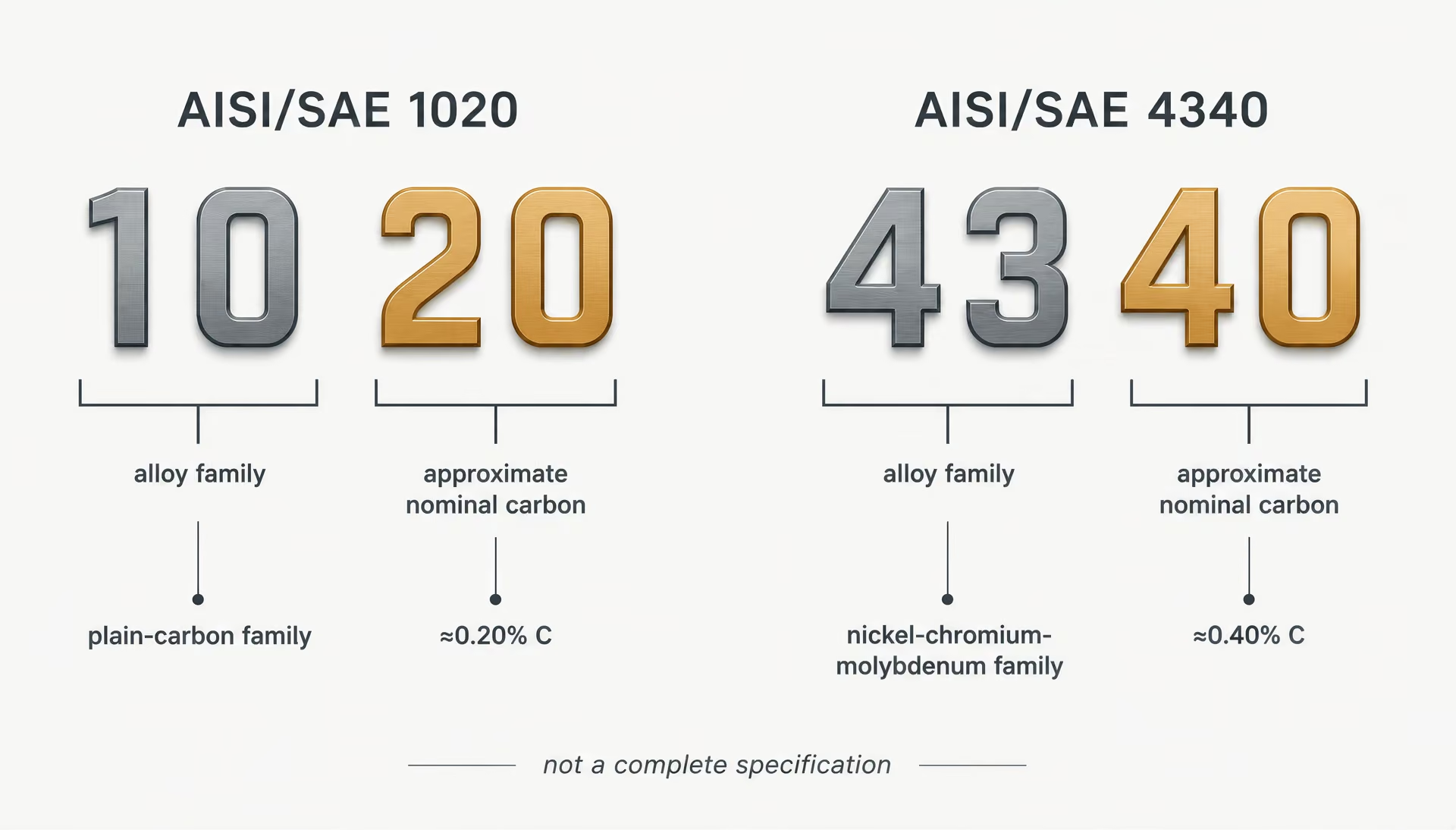
In a traditional four-digit designation, the first two digits generally identify the principal alloy family. The first digit gives the broad family, while the second refines it. The remaining two digits concern nominal carbon content. This is a reading convention, not a claim that every number follows a simple periodic table of alloy additions.
The 10xx family is plain, or carbon, steel. Thus, 1020 belongs to the 10xx family. Other familiar families include 11xx and 12xx resulfurized steels, 13xx manganese steels, 23xx and 25xx nickel steels, 31xx and 33xx nickel-chromium steels, 40xx molybdenum steels, 41xx chromium-molybdenum steels, and 43xx nickel-chromium-molybdenum steels. The 50xx and 51xx families are chromium steels; 61xx steels contain chromium and vanadium, and several 86xx, 87xx, 93xx, 94xx, and 98xx families contain combinations of nickel, chromium, and molybdenum.
The family digits identify the alloying concept, not the full permitted chemistry. In the 43xx family, for example, chromium, nickel, and molybdenum are expected, but the exact ranges depend on the particular designation and the governing document. Small additions, residual elements, grain-refining practice, sulfur and phosphorus limits, and permitted manufacturing variations are not encoded in the four digits.
The system also contains practical complications. A suffix such as “H” can identify a hardenability grade, as in an H-steel designation, rather than a new alloy family. ASTM A400 describes H-steel grades as hardenability grades associated with corresponding SAE-AISI compositions. The H designation therefore raises a different requirement: the steel must meet specified hardenability behavior, commonly assessed with a Jominy end-quench test, rather than merely matching a nominal composition. A plain four-digit number does not establish that hardenability requirement.
Nor do the first digits identify an item’s form. A bar, plate, wire, forging, sheet, and seamless tube may be made from a related composition, yet each product can be controlled by a different standard with different dimensional, testing, surface, and processing provisions. The material number is only one part of the identification.
Nominal carbon content in hundredths of a percent
The final two digits indicate the approximate nominal carbon content in hundredths of a percent by mass. Reading “20” as approximately 0.20% carbon is the central rule. “40” means approximately 0.40% carbon. The word approximately is essential because the designation is not a laboratory result and does not necessarily equal the midpoint of every permitted carbon range.
A designation such as 1020 therefore means, in broad terms, a 10xx plain-carbon steel with approximately 0.20% carbon. It does not mean that an analysis must report exactly 0.20% C. A specification may permit a range around that nominal level, and other elements remain subject to their own limits. The number also says nothing about whether the analysis is a ladle analysis or a product analysis, unless the applicable standard defines that distinction and its tolerances.
Carbon strongly affects hardness, strength, weldability, and the response to heat treatment, but the four-digit number does not predict a finished component’s mechanical properties by itself. Quenched-and-tempered steel and normalized steel can have very different strength and hardness despite sharing a composition designation. Section size, cooling rate, prior processing, austenite grain size, tempering temperature, and test direction all influence the measured result. A 4340 forging and a 4340 bar are not automatically equivalent in delivery condition or performance.
The number also does not establish cleanliness. Sulfur and phosphorus limits, nonmetallic inclusion requirements, vacuum treatment, electroslag remelting, and other steelmaking controls must come from the applicable material specification or purchase requirement. Nor does it establish hardenability, unless an H-grade or separate hardenability requirement is stated. Product form, surface condition, dimensional tolerance, impact testing, ultrasonic examination, and mechanical-property minima are likewise outside the basic four-digit code.
This limitation is especially important when an online equivalence table presents one designation beside another. Steel Equivalents cataloged 2,161 AISI / SAE designations and 2,038 UNS designations in 2024, alongside 2,443 ASTM, 2,322 JIS, 3,544 GOST, 1,569 BS, 1,469 AFNOR, and 4,704 DIN / EN designations. Those counts show the scale of the naming landscape; they do not turn listed entries into specification-compliant substitutes. Equivalence requires comparison of chemistry, product form, heat treatment, mechanical requirements, testing, and acceptance criteria.
Examples: AISI / SAE 1020 and 4340
AISI / SAE 1020 is read as a 10xx plain-carbon steel containing approximately 0.20% carbon. The “10” identifies the plain-carbon family, while “20” gives the nominal carbon level. The designation does not specify whether the material is hot rolled, cold drawn, normalized, annealed, or supplied in another condition. It also does not state a tensile-strength range or guarantee a particular weld procedure. Those details belong to the product and condition specification.
AISI / SAE 4340 follows the same logic but represents a substantially different alloy concept. The “43” identifies a nickel-chromium-molybdenum family, and “40” indicates approximately 0.40% carbon. Nickel, chromium, and molybdenum contribute to hardenability and the response to quenching and tempering, but the designation alone does not define the heat-treatment cycle or the resulting strength. A part marked “4340” still needs a controlling standard or engineering requirement specifying form, chemistry limits, heat treatment, hardness or tensile properties, and inspection.
This is why a designation should not be confused with a classification, product standard, grade specification, or numerical identification system. ISO 4948-1:1982 classifies steels by specified ladle-analysis composition, while ISO 4948-2:1981 adds quality class and principal property or application. EN 10027-1:2016 sets rules for symbolic steel names, and EN 10027-2 addresses numerical steel numbers. ISO/TS 4949:2003 provides international rules for steel names based on letter symbols. SAE J1086 instead concerns UNS letter-and-five-digit identifiers and the assignment of unused numbers. Each system answers a different administrative or technical question.
A four-digit AISI / SAE number is therefore a compact composition clue. It is useful, but incomplete. Treating 1020 or 4340 as a full substitute specification can convert a correct chemical-family identification into an incorrect engineering decision.
UNS: A Registry System, Not a Complete Material Specification
The Unified Numbering System (UNS) is often placed beside AISI, SAE, ASTM, EN, and other steel designations as though each were simply another way to spell the same grade. That interpretation misses the function of UNS. It is primarily a common identification framework for commercially established metals and alloys. A UNS number can point to a recognized material family and connect designations used by different organizations, but it does not, by itself, state every chemical, mechanical, processing, testing, or delivery requirement that a purchasing or product specification may impose.
SAE J1086 describes the UNS system and its method for assigning identifiers. The system covers more than steels: its letter families identify broad alloy groups, while the numerical portion distinguishes materials within each group. SAE J1086 also provides procedures for assigning previously unused numbers when a commercially established metal or alloy does not already have an appropriate UNS identity. This administrative function matters. A newly assigned number is not necessarily a newly invented alloy; it may provide a common identifier for a material already recognized under another designation or established through an industry specification.
The letter-plus-five-digit structure
A UNS designation consists of one letter followed by five digits. The initial letter identifies the material family, and the five-digit number supplies the specific identity within that family. The letter is therefore not an abbreviation for a complete chemical specification. Nor do the five digits always carry the same compositional meaning across all UNS families.
For carbon and alloy steels, the relevant family letter is G. A designation beginning G10 or G43, for example, belongs to the steel family, but interpreting the digits requires knowledge of the related designation practice. The digits may preserve a relationship to an older AISI or SAE composition number rather than independently expressing every limit that governs the material.
This is why UNS should not be read like EN 10027-1:2016 symbolic steel names. EN 10027-1 uses letters and numbers to express characteristics such as application, principal mechanical properties, physical properties, or chemical composition. EN 10027-2 addresses numerical steel numbers, which form a different identification method. ISO/TS 4949:2003 likewise sets internationally standardized rules for steel names based on letter symbols. Those systems are designed to communicate particular material characteristics through the structure of the name. UNS is less ambitious: its central purpose is consistent identification.
The distinction becomes important when a designation appears in a material cross-reference table. A UNS number may identify the composition family associated with a grade, while the governing product standard may also require a particular melting practice, heat treatment, hardness range, tensile strength, product form, surface condition, grain-size control, or inspection procedure. None of those obligations should be inferred merely because the UNS identifier is familiar.
SAE J402 illustrates the closer relationship between a UNS-based designation system and steel requirements. It describes designations for wrought or rolled steels by chemical composition together with additional requirements. The words “together with” are significant: chemical identification alone does not exhaust the specification. ASTM A400 makes a related point when discussing composition numbers that may correspond to SAE, AISI, or ASTM designations. It also identifies H-steel grades as hardenability grades associated with corresponding SAE-AISI compositions. The added H is not decorative; it signals a requirement concerning hardenability, normally verified through a hardenability limit or related control, rather than merely a nominal alloy chemistry.
The same caution applies when the surrounding classification system changes. ISO 4948-1:1982 classifies steels by specified ladle-analysis composition and uses 2.0% carbon as the usual dividing line between steel and cast iron. ISO 4948-2:1981 further separates unalloyed and alloy steels by quality class and principal property or application. Classification answers a different question from UNS identification. A classification can place a material into a compositional or quality category without serving as a procurement specification.
The scale of the naming problem explains why a registry has practical value. In 2024, Steel Equivalents cataloged 2,038 UNS steel designations, alongside 2,161 AISI / SAE, 2,443 ASTM, 2,322 JIS, 3,544 GOST, 1,569 BS, 1,469 AFNOR, and 4,704 DIN / EN designations. These totals describe cataloged designations, not a count of interchangeable materials. A large cross-reference table can show that names are related while leaving open whether the associated standards impose identical requirements.
UNS G-family carbon and alloy steels
The G family is the UNS family for carbon and alloy steels. Its members commonly retain the numerical logic of AISI/SAE steel designations. In the traditional AISI/SAE system, the first digits indicate the broad composition family, and the final two digits approximately indicate nominal carbon content in hundredths of a percent. Thus, 1020 is associated with a plain carbon steel containing approximately 0.20% carbon, while 4340 belongs to a nickel-chromium-molybdenum alloy-steel family with approximately 0.40% nominal carbon.
“Approximately” must remain in that explanation. The designation does not replace the specified ladle-analysis limits. A grade named 1020 is not defined solely by the number 20, and 4340 is not defined solely by the presence of three alloying elements and nominal carbon. The applicable AISI, SAE, ASTM, or product standard determines the actual permitted ranges and any additional conditions.
UNS preserves this relationship in a fixed six-character format. The AISI/SAE composition 1018 is identified as UNS G10180. The leading G identifies the carbon-and-alloy-steel family, while the five digits preserve the composition number with a trailing zero: 1018 becomes G10180. That correspondence is useful for databases, drawings, test reports, and specifications that need one common identifier across standards systems.
It does not mean that “G10180” is a complete material specification for every product. A bar standard, sheet standard, wire standard, fastener standard, or proprietary engineering specification may impose different dimensional tolerances, surface requirements, mechanical-property tests, heat-treatment conditions, or permitted manufacturing routes even when each document points to AISI 1018 or UNS G10180. The material identity and the product compliance statement are separate matters.
AISI 1018 and UNS G10180
AISI 1018 is the legacy composition designation; UNS G10180 is its corresponding UNS identity. In a database field that asks for the material number, G10180 can provide a more standardized identifier than a text entry such as “1018 steel.” In a specification, however, the UNS number should normally appear alongside the governing standard or grade requirement, not as a replacement for it.
For example, a document might require steel identified as UNS G10180 and then prescribe a particular product form, chemical-analysis limits, tensile properties, hardness, or testing method. Those conditions come from the document that invokes them. They do not automatically arise from the five digits in G10180.
That rule also prevents a common error in equivalency work: treating a shared UNS number as proof that two national or organizational standards are interchangeable in every respect. AISI 1018, UNS G10180, and a foreign designation listed as a near match may describe closely related chemistry, yet differences in analysis limits, product condition, inspection, or certification can still affect compliance. UNS answers “which established material identity is this?” It does not, by itself, answer “does this supplied product satisfy the entire specification?”
SAE J402 and the Move Beyond Legacy Steel Numbers
SAE J402 addresses a problem created by the long use of short steel numbers: a familiar designation can identify a composition family without stating all the conditions that matter for technical control. The document describes a UNS-based system for wrought or rolled steel grades, identifying them through chemical composition together with additional requirements. That purpose places J402 between a simple numerical identification scheme and a full product specification. The designation tells the reader what material identity is intended; the applicable specification still determines such matters as product form, heat treatment, testing, dimensions, and acceptance criteria.
This distinction matters because “equivalent” steel names are often treated as interchangeable. They are not. A UNS number, an AISI/SAE composition number, an ASTM grade, and an EN steel name may refer to related material, but each belongs to a different designation or specification practice. SAE J1086 describes the Unified Numbering System, including letter-and-five-digit families and procedures for assigning unused numbers. SAE J402 applies that UNS framework specifically to wrought and rolled steels, with the aim of carrying more technically relevant information than a bare legacy number can carry.
Wrought and rolled steel identification
J402 is concerned with steels made as wrought or rolled products rather than with every possible form of ferrous material. “Wrought” covers material shaped by processes such as forging, drawing, or rolling; rolled products include plate, sheet, bar, and related forms. The designation therefore operates at the level of material identity, not merely at the level of a product catalogue label.
The UNS structure uses a letter followed by five digits. For carbon and alloy steels, the relevant family is the G series. Thus UNS G10180 identifies AISI 1018. The relationship is informative, but the two identifiers should not be collapsed into one name. AISI 1018 is a historical composition designation; UNS G10180 is its Unified Numbering System identity. Neither identifier, by itself, proves that a particular plate, bar, or forging meets every requirement of an ASTM, SAE, or other product specification.
The older AISI/SAE practice remains easy to recognize. In 1020, the first digit places the steel in the plain-carbon family and the final two digits indicate an approximate nominal carbon content of 0.20 percent. In 4340, the first two digits identify a nickel-chromium-molybdenum alloy family, while “40” indicates approximately 0.40 percent carbon. These numbers are useful shorthand, and their continued recognition has practical value. A designation system does not need to discard that history in order to supply more information.
The number also does not describe every metallurgical variable. A 4340 composition can receive different properties through different austenitizing, quenching, and tempering treatments. Section size changes cooling conditions and can alter the resulting microstructure. Product processing, cleanliness limits, grain-size requirements, and hardenability provisions may be decisive in service while remaining invisible in the four-digit composition number.
Chemical composition and additional requirements
Requirements that may accompany composition
- Residual-element limits
- Hardenability controls
- Melting or processing practice
- Product-form requirements
- Testing and acceptance criteria
The central change represented by J402 is the attempt to identify composition alongside requirements that affect how the grade is controlled or applied. Chemical composition normally begins with a ladle analysis: measured concentrations of carbon, manganese, silicon, chromium, nickel, molybdenum, and other specified elements. That analysis establishes the chemical basis of the grade, but it is not the whole specification. Limits on residual elements, permitted ranges, hardenability, melting practice, or other conditions can distinguish materials that appear similar in a short composition code.
ASTM A400 illustrates why the distinction must be kept clear. Its composition numbers may correspond to SAE, AISI, or ASTM designations, while H-steel grades are hardenability grades associated with corresponding SAE-AISI compositions. The “H” therefore carries information about a hardenability requirement; it is not simply an alternative spelling of an ordinary composition number. A steel with the same nominal alloying elements but without the specified hardenability control is not automatically the same grade for a heat-treated component.
SAE J402’s additional-requirements concept should likewise not be read as a promise that one compact code contains an entire purchasing or manufacturing specification. A designation can identify the intended grade and its defining conditions, but a product standard may impose further requirements. For example, a bar specification may control dimensional tolerances and mechanical testing, whereas a plate specification may address delivery condition, ultrasonic inspection, or impact testing. Compliance must be checked against the governing document and its edition.
This is also why a numerical match across standards proves less than it seems to prove. EN 10027-1:2016 defines symbolic steel names whose letters and numbers express application and principal mechanical, physical, or chemical characteristics; EN 10027-2 addresses numerical steel numbers. ISO/TS 4949:2003 provides rules for internationally standardized steel names based on letter symbols. Those systems encode information according to their own rules. A designation from DIN/EN, JIS, GOST, BS, or AFNOR may describe a closely related chemistry, yet still lack the exact delivery and testing requirements attached to a North American grade.
Why the older four- and five-digit systems were limited
The traditional numbers were never intended to be complete material specifications. Their strength was compression: a few digits communicated a steel family and an approximate carbon level. That economy became a limitation as producers and users needed to distinguish tighter chemistry ranges, special cleanliness controls, hardenability, processing conditions, and other requirements. The same historical number could also acquire different practical meanings when cited through separate product standards.
The scale of the designation landscape shows the problem. Steel Equivalents cataloged, in 2024, 2,161 AISI/SAE designations and 2,038 UNS designations, alongside 4,704 DIN/EN, 3,544 GOST, 2,443 ASTM, 2,322 JIS, 1,569 BS, and 1,469 AFNOR designations. These counts are catalogue totals, not proof that each entry is unique or directly comparable. They do show why a shared-looking number cannot serve as a universal substitute across national and organizational systems.
The move associated with SAE J402 is therefore evolutionary rather than a wholesale renaming exercise. Historical recognition can be preserved—AISI 1018 remains a meaningful reference—while UNS identification and additional requirements provide a more controlled technical description. There is no single universally revised name for every legacy grade. The correct modern identifier depends on what has been assigned, which standard governs the product, and which requirements are being invoked.
A sound equivalence statement must consequently compare chemistry, product form, heat treatment, mechanical requirements, and supplementary controls—not just the digits printed after a letter. A familiar number is a useful starting point. It is not, on its own, a specification-compliant substitute.
ASTM Designations: Standards, Products, and Material Requirements
ASTM steel designations commonly identify product specifications with chemical, mechanical, testing, and acceptance requirements rather than chemistry alone. Strong evidence
ASTM steel designations usually identify a specification rather than a chemistry alone. “ASTM A36,” for example, does not function like a bare carbon-content code. It points to a material standard covering a defined product and a set of requirements. Those requirements can include chemical limits, tensile and yield strength, elongation, test methods, heat treatment, dimensions, workmanship, certification, and acceptance criteria.
That distinction matters when a drawing or purchase specification names an ASTM grade. The designation tells the reader which ASTM document governs the material. A steel with a similar composition may fail to meet the cited specification if its product form, strength, impact testing, heat treatment, or manufacturing controls differ.
ASTM steel standards and specification structure
ASTM International organizes steel documents principally as standards for products and their required properties. The ASTM overview of steel standards describes requirements involving chemical composition, mechanical properties, and metallurgical characteristics. In practice, an ASTM designation often combines several layers of information: a letter-and-number series identifying the standard, a grade or type identifying the material category, and sometimes a class, supplementary requirement, or “M” designation for metric units.
The leading letter is significant, but it is not a universal chemical symbol. ASTM A standards generally concern ferrous materials, while the number identifies a particular standard within that series. ASTM A36/A36M addresses carbon structural steel, ASTM A516/A516M addresses pressure-vessel plates for moderate and lower-temperature service, and ASTM A240/A240M covers chromium and chromium-nickel stainless-steel plate, sheet, and strip for pressure vessels and general applications. The designation therefore carries product and application information before the grade is even read.
Within ASTM A516/A516M, Grades 55, 60, 65, and 70 primarily distinguish strength levels and associated requirements; the number is not a direct carbon-content statement. ASTM A240/A240M uses grades such as Type 304 and Type 316, whose compositions and corrosion-related behavior are controlled by the specification, but those type numbers are not interchangeable with the A36-style structural designation system.
| ASTM identifier style | Example | Meaning depends on |
|---|---|---|
| Standard and grade | ASTM A516 Grade 70 | The pressure-vessel product standard and its strength requirements |
| Standard and type | ASTM A240 Type 304 | The stainless product specification and composition limits |
| Standard and grade | ASTM A193 Grade B7 | The bolting standard and high-temperature or high-pressure service requirements |
| Standard and metric edition | ASTM A36/A36M | The carbon structural steel specification and applicable units |
A specification may also identify the material by grade, class, or type. ASTM A193/A193M, for alloy-steel and stainless-steel bolting for high-temperature or high-pressure service, uses designations such as Grade B7 and Grade B8. “B7” is meaningful only within that standard and product context. It should not be treated as a universal steel grade that can be substituted wherever a similar alloy is requested.
The same chemistry can appear in different ASTM documents with different requirements. A bar, plate, forging, tubing product, and fastener may be made from related alloy compositions while being governed by separate standards. Their acceptance tests and permitted processing routes can differ. A material comparison must therefore check the complete specification, including revision, product form, delivery condition, and supplementary requirements.
This is why ASTM designations frequently appear on material certificates as specification identifiers. The certificate is not merely reporting a chemical recipe; it is asserting conformity with a document. A steel designation copied into a table without its standard can lose much of its meaning.
The distinction becomes clearer beside other systems. EN 10027-1:2016 defines symbolic steel names using letters and numbers that express application and principal mechanical, physical, or chemical characteristics, while EN 10027-2 assigns numerical steel numbers. ISO/TS 4949:2003 sets rules for steel names based on letter symbols. ISO 4948-1:1982 classifies steels by specified ladle-analysis composition and generally places the steel–cast iron boundary at 2.0% carbon; ISO 4948-2:1981 adds quality and application classifications. ASTM specifications overlap with these systems in their use of grades and properties, but they serve a different documentary purpose.
The scale of the naming problem is substantial. Steel Equivalents reported in 2024 catalogs containing 2,443 ASTM designations, compared with 4,704 DIN / EN, 3,544 GOST, 2,322 JIS, 2,161 AISI / SAE, and 2,038 UNS designations. These counts describe cataloged designations, not a list of automatic one-to-one equivalents. A larger or smaller catalog count does not change the need to compare requirements line by line.
ASTM A400 and composition-number relationships
ASTM A400, Standard Practice for Steel Bars, Selection Guide, Composition, and Mechanical Properties, is especially useful because it explains how composition numbers relate to several designation traditions. Its tables and explanatory material state that composition numbers may correspond to SAE, AISI, or ASTM designations. That statement does not make the systems identical in purpose. It acknowledges that a number used to identify a nominal alloy composition may be shared or closely related across organizations.
The traditional AISI/SAE pattern illustrates the point. In AISI 1020, the “10” identifies the plain carbon-steel family and the final two digits indicate an approximate nominal carbon content of 0.20%. AISI 4340 belongs to the nickel-chromium-molybdenum alloy family, with an approximate nominal carbon content of 0.40%. These figures describe a composition family, not every requirement imposed on a supplied product.
ASTM A400 also discusses H-steel grades. An H grade, such as 4140H, is a hardenability grade associated with the corresponding SAE-AISI composition, here 4140. The “H” is not simply an extra chemistry digit. It indicates that the steel is specified or controlled for hardenability, commonly evaluated through a hardenability test such as the Jominy end-quench test, with requirements expressed through hardness ranges at specified distances from the quenched end.
Hardenability The ability of steel to develop a specified hardened structure to a given depth during cooling; it differs from hardness, which is measured at a particular location after treatment.

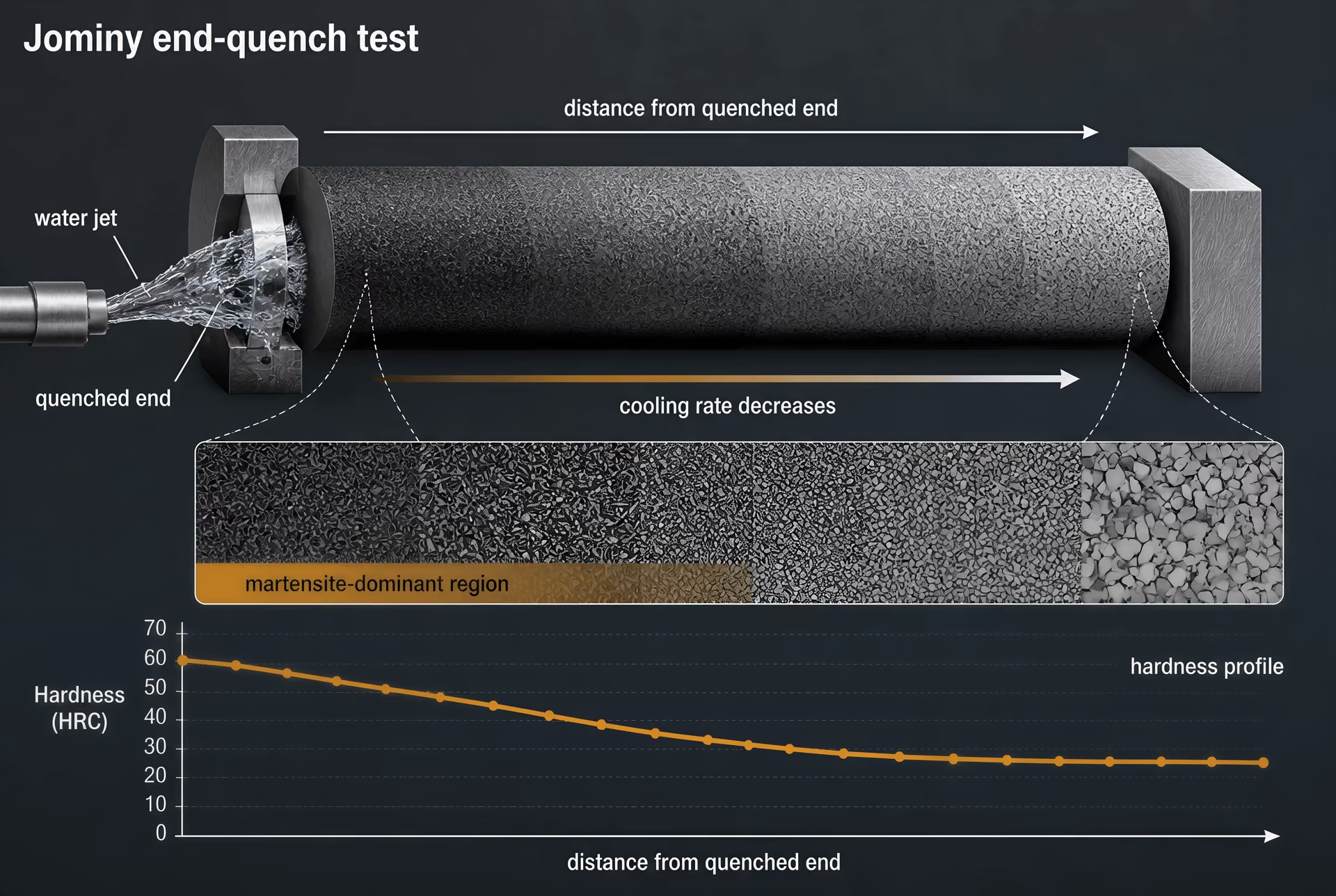
That distinction is metallurgically important. Two heats can fall within a nominal 4140 composition range yet produce different hardness-depth behavior because of variations in alloying elements, grain size, austenitizing practice, and processing history. Hardenability describes the ability of a steel section to form martensite to a given depth under a stated cooling condition; it is not the same as achievable surface hardness, tensile strength, or carbon content.
ASTM A400’s relationship statement should therefore be read as a cross-reference, not as permission to erase the suffix or the governing specification. “4140” and “4140H” identify related composition families, but they do not automatically impose the same hardenability limits or delivery requirements. If a specification calls for an H grade, an ordinary composition match is not enough.
ASTM E527 and UNS numbering
ASTM E527 has a different role. ASTM E527, Practice for Numbering Metals and Alloys in the Unified Numbering System (UNS), describes the UNS numerical identification method. It does not replace ASTM product specifications and does not establish all chemical, mechanical, or processing requirements for a steel.
UNS designations use a letter followed by five digits. For carbon and alloy steels, the family letter is G. UNS G10180 identifies AISI 1018. The UNS number provides a compact identification associated with a composition or established material designation; it is not, by itself, a complete purchase specification. A document that calls for UNS G10180 still needs to state the required product standard, form, condition, and properties when those details matter.
SAE J1086 also describes UNS families and procedures for assigning unused numbers, while SAE J402 describes a UNS-based designation system for wrought or rolled steels by chemical composition and additional requirements. These documents help coordinate numerical identities across standards organizations. ASTM E527’s function is identification within that system, not certification that a material meets ASTM A36/A36M, ASTM A516/A516M, or any other product specification.
The practical rule is direct: an ASTM specification, an AISI/SAE composition number, and a UNS number may refer to related material, but they answer different questions. The ASTM document states what product must comply with; the AISI/SAE number generally communicates composition family; and the UNS number supplies a standardized numerical identity. Treating those labels as interchangeable grade names can conceal missing requirements, especially for heat treatment, hardenability, impact testing, and product form.
JIS, GOST, BS, and AFNOR in the Designation Landscape
JIS, GOST, BS, and AFNOR are not four interchangeable versions of one universal naming scheme. Each developed within a national standards system, with its own rules for expressing composition, intended use, strength, quality class, product form, or administrative status. A designation therefore has meaning only when read with the standard that defines it.
The catalog counts show the breadth of these traditions, not their relative importance and not the number of globally interchangeable grades. Steel Equivalents listed 2,322 JIS designations, 3,544 GOST designations, 1,569 BS designations, and 1,469 AFNOR designations in 2024. Those figures indicate how many entries the catalog organizes under each label. They do not demonstrate that a GOST entry matches a JIS entry, or that an old BS or AFNOR grade remains identical to a current EN grade.
JIS designation practice in Japan
Japanese Industrial Standards commonly identify steels through standards beginning with JIS G, the letter G indicating the iron and steel field. The following number identifies the governing product or material standard, while the grade designation inside that standard supplies the technical identity. The standard is essential: the same apparent pattern cannot be interpreted without knowing whether the material is structural plate, carbon steel for machine parts, stainless steel, tool steel, or another product.
| JIS designation | Standard context | Primary indication described |
|---|---|---|
| SS400 | JIS G 3101 | Structural steel and minimum tensile-strength class |
| S45C | JIS G 4051 | Carbon steel for machine structural use and approximately 0.45% nominal carbon |
| 09Г2С | GOST 19281 | Low-alloy structural steel with composition symbols and approximate contents |
| 080M40 | Older BS 970 tradition | British composition-number designation |
A designation such as SS400, specified in JIS G 3101, is not simply a chemical analysis written in abbreviated form. SS denotes structural steel, and 400 refers to a minimum tensile-strength class in the standard’s specification framework. The grade is controlled by the requirements of JIS G 3101, including chemical limits, mechanical properties, and delivery conditions. Treating “400” as though it were a carbon percentage would produce an immediate error.
By contrast, S45C, associated with JIS G 4051, is a carbon steel designation for machine structural use. The “C” identifies carbon steel within the JIS naming practice, and “45” indicates an approximate nominal carbon level of 0.45%, subject to the standard’s specified range and other requirements. That resemblance to the traditional AISI / SAE use of two final digits is not a license to translate every JIS name through AISI / SAE logic. S45C is not automatically AISI 1045, even where their nominal carbon contents appear close. Limits for manganese, silicon, phosphorus, sulfur, residual elements, heat treatment, mechanical properties, and product condition may differ.
JIS names also occur alongside numerical material numbers, product specifications, supplementary delivery symbols, and later JIS G revisions. A suffix or added symbol may identify a quality level, heat-treatment condition, or product form rather than a new base chemistry. The governing document determines which interpretation applies. This matters especially when a drawing cites only a short grade name but the original procurement or inspection requirement included a particular JIS edition.
The 2024 Steel Equivalents count of 2,322 JIS entries demonstrates a substantial and varied designation body. It does not turn the JIS catalog into a cross-reference table of guaranteed substitutes. A comparison can screen candidate materials; specification compliance still requires checking the actual JIS requirements and the receiving design code.
GOST designation practice in Russia and the CIS
GOST is a standards designation used across Russian and former Soviet standards practice, but “GOST grade” is not one single encoding rule. The applicable document may be a Russian ГОСТ standard, an interstate ГОСТ standard, or a national adoption or revision used in a CIS jurisdiction. The date, edition, product form, and national status can change the controlling requirements.
Several familiar names illustrate the system’s mixed logic. Ст3 is a designation from the structural carbon-steel tradition associated with GOST 380. Its symbols and quality variants belong to that standard’s classification scheme; the name is not a direct statement that the steel contains 0.03% carbon. 20, associated with carbon steel requirements such as GOST 1050, is commonly read as an approximate carbon designation, near 0.20% carbon, but the complete grade remains defined by the applicable standard and quality requirements. A name that looks numerical can therefore carry a different meaning from the final digits in SAE 1020.
Low-alloy designations make the contrast clearer. 09Г2С, used in Russian standards such as GOST 19281 for low-alloy structural steels, combines numerals and Cyrillic element symbols. The opening “09” conventionally indicates approximately 0.09% carbon; Г identifies manganese, and С identifies silicon, with the following numbers indicating approximate alloy levels according to the GOST naming rules. This is a compositional shorthand, but it is still not a complete material specification. Strength class, impact requirements, plate or product form, thickness effects, heat treatment, and delivery condition remain matters for the governing standard.
Cyrillic symbols also create transcription hazards. A translated or Latin-letter version may be useful for search, but it can conceal the original convention or create false similarity with an English-language grade. Х for chromium, Н for nickel, М for molybdenum, and Т for titanium belong to the GOST-style symbolic vocabulary; they should not be silently read as AISI / SAE family digits or as a UNS identifier.
Steel Equivalents cataloged 3,544 GOST designations in 2024, more than the listed JIS, BS, or AFNOR totals. That count records catalog breadth. It does not establish that GOST grades are more important, more widely accepted, or interchangeable with grades from another system. Any proposed match must be tested against the exact GOST document, edition, product form, and property class.
BS and AFNOR national traditions
British Standards and French AFNOR designations preserve older national approaches that often overlap with European practice but should not be assumed identical to current EN designations. The United Kingdom’s BS tradition includes application-based specifications, chemical-composition names, and numerical or alphanumeric identifiers. Older engineering references may cite BS 970 grades such as 080M40, while structural references may cite standards such as BS 4360. These designations belong to their original standards and revision histories. A later BS EN document may adopt an EN grade, but the prefix and publication status matter.
080M40 illustrates why a British designation needs its own key. The name reflects the British composition-number tradition, with an approximate carbon indication and a letter marking the specification family or modification. It should not be rewritten as an AISI / SAE grade merely because both systems use numbers related to carbon content. Requirements for manganese, sulfur, phosphorus, hardenability, section size, heat treatment, and mechanical testing can prevent a direct substitution.
AFNOR, the French national standards tradition, likewise includes names such as XC38 and 35CD4 in older or national references. In these forms, X identifies an alloy-steel naming family, C indicates carbon in the relevant symbolic convention, and D in 35CD4 identifies chromium and molybdenum through the French designation rules. The figures express nominal composition ranges or principal alloy content as defined by the applicable AFNOR standard; they are not a universal chemical cipher.
French standards were later aligned in many fields with European standards published through the French national system as NF EN documents. That administrative transition does not make every former AFNOR designation identical to an EN grade. An old drawing may specify a withdrawn national grade, while a replacement document may alter composition limits, mechanical requirements, testing, or delivery conditions. Historical correspondence is evidence for investigation, not automatic approval.
The 2024 catalog totals—1,569 BS designations and 1,469 AFNOR designations—show that both national traditions contain many entries despite their smaller counts than GOST or DIN / EN. They do not measure market status or prove one-to-one equivalence. The safe reading is documentary: identify the original national standard, locate its edition, determine what the designation expresses, and then compare chemistry, properties, product form, and acceptance requirements with the proposed EN, ASTM, JIS, or other grade. A foreign name is not decoded correctly by forcing it into AISI / SAE logic.
Composition, Quality Class, and Property: Three Different Axes
A steel designation may describe what the steel contains, what quality category it belongs to, or what performance or use the standard places first. These are three separate axes. They can appear in the same designation, but one axis cannot be read as a substitute for another.
The distinction matters because a composition match does not prove compliance with a product specification. Two steels may have similar carbon, chromium, and nickel contents while differing in cleanliness requirements, inspection rules, delivery condition, heat treatment, or guaranteed mechanical properties. Conversely, two grades may offer similar yield strength but reach it through different alloying systems and therefore behave differently during welding, forming, hardening, or service.
Chemical composition as a designation basis
Composition-based designations identify an alloy family or give a shorthand for principal elements and approximate contents. The traditional AISI/SAE system illustrates this approach. In SAE 10xx, the first two digits identify the plain-carbon steel family and the final two digits indicate approximate nominal carbon content in hundredths of one percent. SAE 1020 therefore points to a plain-carbon steel with approximately 0.20% carbon; it is not a complete statement of product form, heat treatment, or guaranteed tensile properties.
SAE 4340 carries a different message. The 43 family identifies a nickel-chromium-molybdenum alloy-steel family, while “40” indicates approximately 0.40% nominal carbon. The designation directs attention to chemistry, not to a single universal mechanical-property condition. Quenched-and-tempered 4340 bar and annealed 4340 bar are not mechanically equivalent even though their composition-based name is the same.
UNS adds an administrative numerical identity to this type of information. Under SAE J1086, a UNS designation consists of a letter and five digits, with families assigned to broad material groups. UNS G10180 identifies AISI 1018; the G family covers carbon and alloy steels. That identity can connect designations used by different organizations, but it does not by itself replace the governing material specification. SAE J402 describes a UNS-based system for wrought or rolled steels identified by chemical composition and additional requirements, while ASTM A400 explains that composition numbers may correspond to SAE, AISI, or ASTM designations. ASTM A400 also identifies H-steel grades as hardenability grades associated with corresponding SAE-AISI compositions. The H suffix is therefore not merely another name for an ordinary composition grade: it signals a hardenability requirement.
International systems express composition differently. EN 10027-1:2016 provides symbolic steel names using letters and numbers that express application and principal mechanical, physical, or chemical characteristics. A name such as C45 foregrounds carbon steel chemistry, while 42CrMo4 identifies a chromium-molybdenum alloy family with a nominal carbon indication. X5CrNi18-10 identifies a high-alloy steel in which the numbers communicate nominal carbon and principal alloy contents. These symbols are useful technical shorthand, but the exact limits remain those of the relevant product standard.
A designation catalog can make these systems appear more interchangeable than they are. Steel Equivalents listed 4,704 DIN / EN designations in 2024, compared with 2,161 AISI / SAE and 2,038 UNS designations. Those counts describe the size of reference collections, not the number of direct cross-standard equivalents. A cross-reference is a starting point for investigation, not evidence that chemistry, processing, and certification requirements coincide.
Quality classes and metallurgical control
Quality classification asks a different question: what category of steel is being defined, and what level or type of metallurgical control does that category require? ISO 4948-1:1982 classifies steels by specified ladle-analysis composition. It uses 2.0% carbon as the usual dividing line between steel and cast iron, while also distinguishing alloy content through specified limits. This is a classification framework, not a promise that every steel below 2.0% carbon has the same use or properties.
ISO 4948-2:1981 adds the quality-class dimension by classifying unalloyed and alloy steels according to quality class and principal property or application. In practical terms, references to base steel, unalloyed quality steel, and alloyed quality steel concern the category under which the material is controlled. They may reflect requirements for specified chemical limits, harmful residual elements, weldability, cleanliness, production controls, or testing. “Alloy steel” in this classification sense does not automatically mean a high-strength or heat-treated product.
The word quality is particularly easy to misread. A quality class is not a ranking in which one designation is universally superior. It identifies a set of metallurgical and specification requirements. A low-alloy pressure-vessel steel, a free-cutting steel, and a bearing steel can all be alloyed, yet their permitted sulfur, phosphorus, inclusion content, heat treatment, and acceptance tests may be directed toward entirely different service demands.
This is why a chemical analysis alone is insufficient. Ladle analysis records the composition of the liquid steel, but the finished product can also be governed by product analysis tolerances, segregation limits, grain-size requirements, ultrasonic testing, impact testing, or delivery-condition rules. ISO 4948 classification helps place a steel in a compositional and quality category; it does not replace the product standard that defines how conformity is demonstrated.
Mechanical properties and application symbols
Property- and application-based designations put the intended characteristic first. EN 10027-1 uses symbolic names in which letters and numbers can express an application, a specified mechanical property, or a principal physical or chemical characteristic. S275, for example, uses S for structural steel and 275 for a specified minimum yield-strength level under the applicable conditions. P265GH uses P for pressure purposes and 265 for a specified yield-strength level, with the remaining symbols carrying additional material information defined by the standard. The first letter changes the technical emphasis: S275 is not simply another spelling of a composition grade such as C45.
Other names foreground a particular service or material family. 100Cr6 is associated with bearing steel chemistry and application, while spring steels such as 51CrV4 are identified through an alloy designation whose use is strongly linked to elastic service after suitable processing. A bearing designation does not guarantee bearing performance without the required cleanliness, heat treatment, hardness, dimensional control, and inspection. A spring designation does not guarantee fatigue life in every section size or surface condition.
Mechanical properties are also conditional statements. Yield strength can vary with product thickness, test direction, heat treatment, and delivery condition. A steel named for a 275 MPa minimum yield-strength level cannot be treated as having that value in every form and condition. The relevant standard may specify impact energy at a test temperature, tensile-strength limits, elongation, or weldability controls that are just as important as the headline yield value.
EN 10027-2 handles numerical steel numbers rather than the symbolic names addressed by EN 10027-1. The numerical identity may be convenient for databases and material control, but it does not turn a property designation into a composition designation. The same caution applies across national traditions: the 2024 Steel Equivalents catalog lists 3,544 GOST, 2,443 ASTM, 2,322 JIS, 1,569 BS, and 1,469 AFNOR designations, alongside DIN / EN entries. These systems overlap in subject matter, not necessarily in legal or technical meaning.
The three axes should therefore be read together. Composition tells what alloy family is specified. Quality classification tells how the material is categorized and controlled. Property or application symbols tell which performance or service requirement the designation foregrounds. A claimed equivalent is technically credible only when the governing specification confirms all relevant axes, including product form, condition, testing, and acceptance criteria.
How to Read a Designation Without Over-Interpreting It
A steel designation is evidence about a material, not a complete material certificate. The first task is therefore not to translate the characters into a familiar grade name. It is to establish who issued the designation, what kind of identification it is, and which properties the issuing system actually promises.
Identify the issuing system first
Start by recording the exact designation, including prefixes, suffixes, punctuation, and condition symbols. Then identify the standard family behind it. “1020,” “4340,” “G10180,” and “S355J2+N” may all appear in the same material schedule, but they do not carry information in the same way.
The traditional AISI/SAE composition system uses numerical families. In 1020, the first two digits identify a plain-carbon steel family and the final two digits indicate an approximate nominal carbon content in hundredths of a percent: about 0.20% carbon. 4340 belongs to the nickel-chromium-molybdenum family, with the final two digits again indicating approximately 0.40% carbon. Those figures are useful orientation, not permission to replace the applicable specification with arithmetic. The actual allowed composition depends on the referenced standard, product type, and revision.
G10180 belongs to the Unified Numbering System described by SAE J1086. The initial G identifies the UNS family for carbon and alloy steels, while the five digits identify a specific composition number; G10180 corresponds to AISI 1018. The UNS number is an administrative identification system. It does not, by itself, state plate thickness, bar size, heat treatment, tensile strength, inspection class, or delivery condition. SAE J1086 also provides procedures for assigning unused numbers, which reinforces that a UNS number is not a universal property statement.
An EN designation follows a different logic. Under EN 10027-1:2016, symbolic steel names use letters and numbers to express an application and selected principal mechanical, physical, or chemical characteristics. S355J2+N is an instructive example. “S” indicates structural steel; “355” refers to a specified minimum yield strength, subject to the thickness range and requirements of the relevant product standard; “J2” identifies an impact-energy category, conventionally 27 J at −20 °C under the applicable structural-steel rules; and “+N” identifies a normalized or normalizing-rolled delivery condition. The designation is meaningful only when read with the relevant EN product standard, such as EN 10025-2, and its tables.
EN 10027-2 deals with numerical steel numbers rather than symbolic names. ISO/TS 4949:2003 provides internationally standardized rules for steel names based on letter symbols. These systems should not be collapsed into one list of interchangeable grades. CEN, ISO, SAE International, ASTM International, and national traditions such as DIN/EN, GOST, JIS, BS, and AFNOR each organize information differently. A 2024 Steel Equivalents catalog lists 4,704 DIN/EN designations, 3,544 GOST designations, 2,443 ASTM designations, 2,322 JIS designations, 2,161 AISI/SAE designations, and 2,038 UNS designations. The number of entries alone shows why a visual match is a weak basis for substitution.
Decode only the information the symbol guarantees
After identifying the system, ask whether the label is a name, a number, a grade designation, or a complete product specification. These categories overlap in everyday speech but not in technical control.
A composition number can indicate a nominal chemistry family without guaranteeing a particular mechanical result. Reading 1020 as “0.20% carbon steel” does not establish the exact carbon range, manganese limit, residual-element limits, grain practice, or tensile properties. Reading 4340 as “nickel-chromium-molybdenum steel” does not establish whether the material was annealed, quenched and tempered, normalized, or supplied in another condition. The heat treatment may change strength, hardness, ductility, toughness, and dimensional behavior while leaving the composition number unchanged.
ASTM A400 makes this boundary explicit in its treatment of composition numbers. Such numbers may correspond to SAE, AISI, or ASTM designations, but the correspondence does not erase the requirements of the ASTM product specification. ASTM A400 also identifies H-steel grades as hardenability grades associated with corresponding SAE-AISI compositions. An H suffix therefore carries information about hardenability requirements; it is not merely another way to write the same chemistry.
The same caution applies to a symbolic EN name. S355 does not mean that every product bearing those characters has identical properties in every size and condition. The specified yield strength can vary with thickness. Impact testing, deoxidation practice, weldability limits, and inspection requirements come from the governing product standard. A symbol may encode one selected property while leaving many others outside its scope.
Even a formal equivalence table should be treated as a research lead, not a certificate. A catalog can identify plausible relationships between 1020 and a listed EN, DIN, JIS, or GOST designation, or between G10180 and AISI 1018. It cannot establish that two products satisfy identical chemical ranges, manufacturing routes, test methods, tolerances, or legal requirements. “Comparable,” “similar,” and “equivalent” are not interchangeable claims.

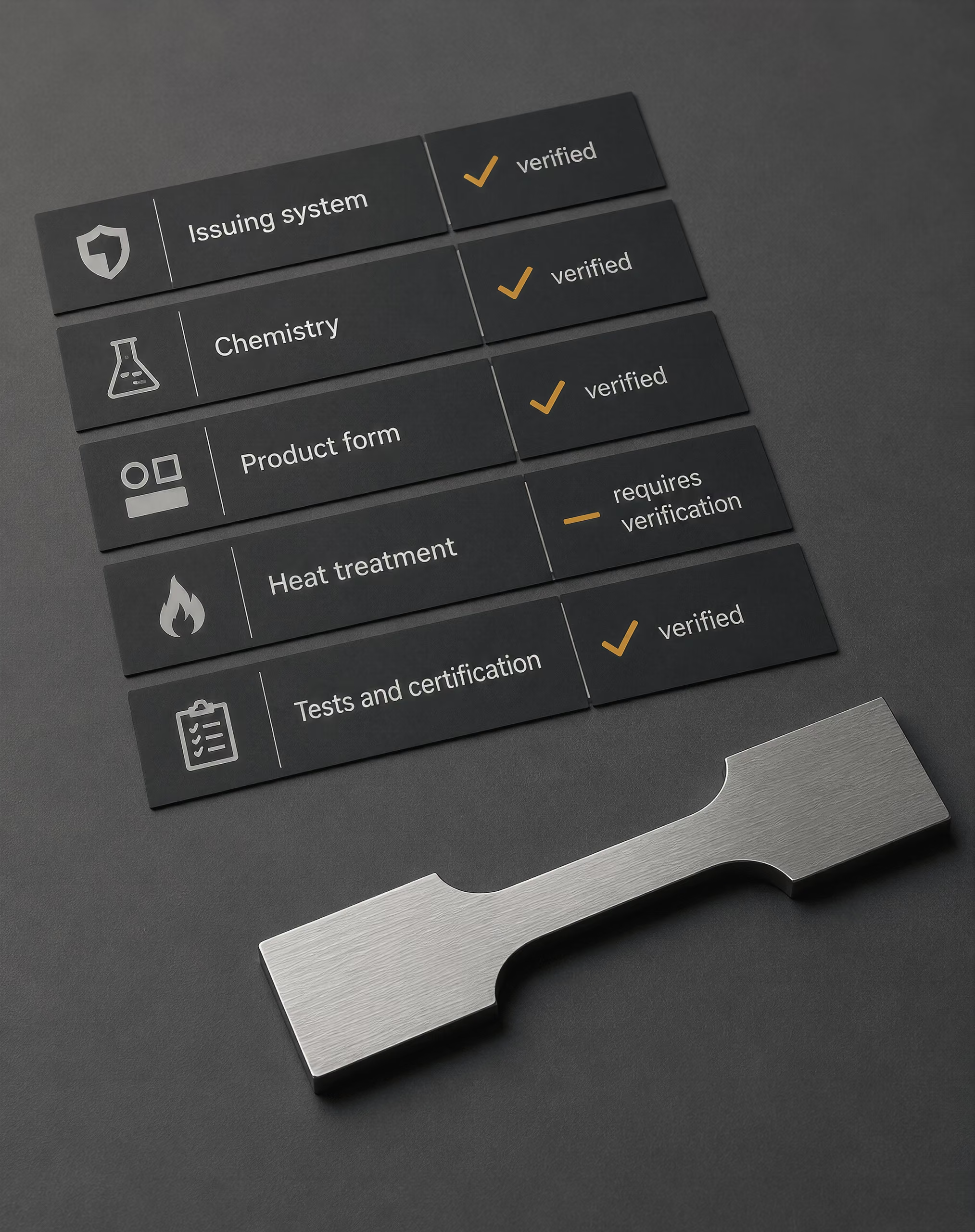
A disciplined reading therefore separates three statements: what the designation explicitly identifies, what the parent standard requires, and what the supplied material has actually demonstrated. Only the first statement can be obtained from the characters alone.
Check product form, condition, and test requirements
Once the designation has been interpreted, find the full product specification and verify the product form. Plate, sheet, bar, wire, tube, forging, and cast product can use related grade names while being controlled by different standards. A chemistry permitted for hot-rolled bar is not automatically permitted for pressure-vessel plate or seamless tube. Product form changes dimensional rules, sampling locations, test frequency, and sometimes the allowable chemistry.
Next check the delivery condition. Terms such as annealed, normalized, normalized rolled, quenched and tempered, cold drawn, and stress relieved describe processing states with direct consequences for properties. The +N in S355J2+N is not decorative. If the drawing or purchase requirement calls for that condition, an unnormalized product with a similar chemical analysis does not satisfy it merely because its nominal grade name matches.
Verify the chemistry against the exact table and product category. Check carbon, manganese, silicon, sulfur, phosphorus, alloying elements, residual elements, and any permitted variation between ladle analysis and product analysis. ISO 4948-1:1982 classifies steels by specified ladle-analysis composition and uses 2.0% carbon as the usual dividing line between steel and cast iron. That classification helps describe what a material is; it does not replace the grade specification. ISO 4948-2:1981 further classifies unalloyed and alloy steels by quality class and principal property or application, again showing that classification and specification answer different questions.
Then verify the mechanical tests: yield strength, tensile strength, elongation, impact energy, hardness, bend testing, or hardenability, as applicable. Confirm the test temperature, specimen orientation, thickness basis, sampling plan, and test method. A 27 J impact requirement at −20 °C is not equivalent to a room-temperature impact result. A hardness value is not a substitute for tensile testing unless the governing standard permits that conversion.
Finally, check supplementary requirements such as ultrasonic examination, through-thickness properties, cleanliness, grain size, surface condition, weldability controls, traceability, and certification level. The material certificate should identify the heat, product form, dimensions, chemical analysis, test results, heat treatment, and standard revision. If those records are absent, the designation remains a clue rather than proof.
The safe reading method is sequential: identify the issuing system; determine what kind of label it is; decode only its stated symbols; retrieve the governing standard; verify chemistry and permitted ranges; then check form, condition, tests, and supplementary requirements. A familiar grade name can begin that investigation. It cannot finish it.
Why 'Equivalent Grade' Tables Can Mislead
An “equivalent grade” table is usually a cross-reference, not a certification of interchangeability. It may place 1.0570, S355J2, AISI 1020, or UNS G10180 beside another designation because the entries have similar chemistry, a related application, or a broadly comparable strength level. That comparison can be useful for research. It does not, by itself, show that the listed material satisfies the same purchase specification, design code, inspection regime, or service condition.
The problem begins with the word equivalent. Equivalence must have a stated basis: equivalent in nominal chemical composition, tensile strength after a specified treatment, product application, designation history, or full compliance with a particular product standard. These are different claims. A numerical identification system such as UNS G10180 identifies a composition family and corresponds to AISI 1018; it does not reproduce every requirement that might apply to a product ordered under ASTM, EN, or another standard. Likewise, a symbolic name under EN 10027-1:2016 can express an application and principal mechanical, physical, or chemical characteristics, while the numerical steel number under EN 10027-2 identifies the grade administratively. Neither label alone states every delivery condition.
The scale of the naming problem encourages false confidence. Steel Equivalents’ 2024 catalogs list 4,704 DIN / EN designations, 3,544 GOST designations, 2,443 ASTM designations, 2,322 JIS designations, 2,161 AISI / SAE designations, 2,038 UNS designations, 1,569 BS designations, and 1,469 AFNOR designations. A table linking entries across these traditions is a navigation aid through different systems established by CEN, ISO, SAE International, ASTM International, and national standards bodies. It is not evidence that each linked entry describes the same manufactured product.
Chemical similarity versus specification equivalence
A designation can encode chemistry without defining the complete material specification. The traditional AISI/SAE system illustrates this limitation. In 1020, the first two digits identify the approximate alloy family and the final two digits indicate nominal carbon content in hundredths of a percent, giving approximately 0.20% carbon. In 4340, the family identifies a nickel-chromium-molybdenum alloy steel and “40” indicates approximately 0.40% carbon. Those figures are useful shorthand, but they do not prescribe a single melting practice, inclusion population, grain size, product form, or final heat-treatment condition.
SAE J1086 describes the Unified Numbering System, whose letter-and-five-digit families assign numerical identities; the G family includes carbon and alloy steels. UNS G10180 identifies AISI 1018, but that identity is not a substitute for an ASTM product specification. A product ordered to ASTM A29, for example, carries requirements concerning permissible chemistry, processing, testing, and delivery that are separate from the short composition name. SAE J402 similarly describes wrought or rolled steels by chemical composition together with additional requirements. The additional requirements are where many apparent matches fail.
Two grades may have overlapping ranges for carbon, manganese, chromium, nickel, and molybdenum while differing in copper, phosphorus, sulfur, silicon, aluminum, boron, or residual elements. One standard may impose tighter sulfur limits for machinability or toughness; another may permit a wider residual range. Calcium treatment, vacuum degassing, electroslag remelting, vacuum-arc remelting, or specified inclusion-control practices can change fatigue performance without producing a dramatic difference in the headline chemistry. A grade comparison that prints only the principal alloying elements hides these distinctions.
ISO 4948-1:1982 classifies steels by specified ladle-analysis composition and uses 2.0% carbon as the usual dividing line between steel and cast iron. ISO 4948-2:1981 then separates unalloyed and alloy steels by quality class and principal property or application. Classification therefore provides a framework for grouping materials; it does not establish that two grades share the same acceptance tests. “Low-alloy steel” is a classification statement, not a complete substitute specification.
Heat treatment, hardenability, and section size
Nominal chemistry also fails to predict the mechanical result when section size changes. A quenched bar may develop high hardness near its surface while cooling too slowly at the center to form the same martensitic structure. Tempering then changes hardness, tensile strength, yield strength, and toughness according to the achieved microstructure. A plate, forging, bar, and wire made from chemically similar steel can therefore meet different property requirements—or fail them—because their dimensions and thermal histories differ.
Hardenability is not the same as hardness. Hardenability describes the depth to which a steel can develop a specified structure during quenching; hardness is the measured resistance at a particular location after a particular treatment. Alloying elements such as chromium, nickel, and molybdenum delay transformation and can increase hardenability, but the result still depends on austenitizing temperature, grain size, quench severity, section thickness, and tempering practice. A composition-only table cannot establish the required center hardness of a 100 mm forging from data for a 20 mm bar.
ASTM A400 makes this distinction explicit in its discussion of H-steel hardenability grades. Composition numbers can correspond to SAE, AISI, or ASTM designations, while an H grade is associated with the corresponding SAE-AISI composition and carries hardenability requirements. Thus 4140 and 4140H are not merely two interchangeable spellings: the “H” identifies a hardenability grade controlled by specified hardenability behavior, commonly assessed with an end-quench or Jominy test. Similar distinctions apply to grades such as 8620H and 4340H where the applicable specification recognizes an H-grade requirement. Matching the carbon and alloying-element ranges alone does not demonstrate compliance with the hardenability band.
Section size makes the distinction practical. A steel may satisfy a Jominy range yet produce different core properties in a thick forging than in a thin bar. Conversely, a non-H composition may happen to achieve the desired hardness in one small part but provide no contractual assurance for a larger section. Heat-treatment condition must therefore be read from the product standard: annealed, normalized, normalized and tempered, quenched and tempered, precipitation treated, or supplied in another defined condition.
Product standards and acceptance criteria
The product standard controls what the designation table usually omits. It may specify permissible product dimensions, manufacturing route, surface condition, straightness, grain size, decarburization, ultrasonic quality, macrostructure, cleanliness, and marking. It may also define whether chemical limits refer to ladle analysis or product analysis, which matters because permitted analytical deviations can differ.
Mechanical acceptance is equally important. One standard may require room-temperature tensile tests from each heat or lot; another may define sampling by product size. Yield strength can be reported by an upper-yield point or a proof-stress method. Elongation depends on gauge length. Impact toughness may be required at a stated temperature, with a minimum individual value and an average value, while a chemically similar grade may have no impact requirement at all. Charpy V-notch results at −20 °C cannot be inferred from a room-temperature tensile match.
Manufacturing route can be part of compliance. A specification may require killed steel, fine-grain practice, vacuum treatment, a prescribed reduction ratio, or a particular forging and heat-treatment sequence. A bar designation does not automatically cover plate; a plate standard does not automatically cover a finished forging. Even when both documents use the same grade number, the product form and inspection clauses can differ.
The defensible use of an equivalent-grade table is therefore narrow. State the comparison basis, compare the full chemical ranges, identify the product form, confirm heat-treatment and hardenability requirements, then check every mechanical, impact, cleanliness, dimensional, and testing clause in the governing specification. Only after those checks can an engineer claim specification equivalence—and even then, the claim belongs to the documented comparison, not to the table’s adjacent names.
A Practical Reference Method for Engineers and Metallurgists
A steel designation should be treated as an information record, not as a universal grade name. One system may encode approximate chemistry; another may identify a product standard, intended application, quality class, heat-treatment condition, or administrative registration. Those functions overlap, but they are not interchangeable.
EN 10027-1:2016 defines symbolic steel names with letters and numbers that express application and principal mechanical, physical, or chemical characteristics. EN 10027-2 addresses numerical steel numbers. ISO/TS 4949:2003 provides internationally standardized rules for steel names based on letter symbols. These documents describe naming architectures, not a general permission to replace one specification with another.
The distinction matters because a designation such as AISI 1020 communicates something different from ASTM A29/A29M Grade 1020, even when the two references concern closely related chemistry. AISI 1020 traditionally indicates a carbon-steel family and nominal carbon content near 0.20%. ASTM A29/A29M is a product standard containing requirements for several grades of carbon and alloy steel bars, including chemical limits and other provisions. The first is principally a composition-based name; the second is a specification framework.
The same caution applies to numerical systems. UNS G10180 identifies AISI 1018 within the UNS G family for carbon and alloy steels. It is an identification entry, not by itself a complete purchase or fabrication specification. SAE J1086 describes the Unified Numbering System, including its letter-and-five-digit families and procedures for assigning unused numbers. SAE J402 describes a UNS-based designation system for wrought or rolled steels by chemical composition and additional requirements. A UNS number can therefore provide a useful identity link while leaving product, processing, testing, and acceptance questions unresolved.
Build a designation identity record
Begin with the designation exactly as it appears in the controlling document. Preserve capitalization, hyphens, spaces, suffixes, prefixes, condition codes, and the difference between a grade name and a standard number. “42CrMo4,” “1.7225,” “ASTM AISI 4140,” and “UNS G41400” should not be collapsed into one unqualified label. They may refer to related material families, but each belongs to a different naming or identification context.
| Record field | What to capture |
|---|---|
| Exact designation | Capitalization, punctuation, prefixes, suffixes, and condition symbols |
| Issuing organization | CEN, ISO, SAE, ASTM, AISI, GOST, JIS, BS, AFNOR, or another authority |
| Edition or revision | The specific standard version governing the material |
| Product form | Bar, plate, sheet, wire, tube, forging, casting, fastener, or other form |
| Identification type | Symbolic name, numerical number, composition designation, UNS identity, classification, or product grade |
The record should then identify the issuing organization. Relevant authorities include CEN for European standards, ISO, SAE International, ASTM International, AISI, and national standards traditions represented by GOST, JIS, BS, AFNOR, and DIN / EN. State the document edition or revision. A designation copied from EN 10083-3:2006 is not adequately documented if a later revision governs the material under review. Requirements can change between editions, even when the familiar grade name remains unchanged.
Record the product form next: bar, plate, sheet, wire, tube, forging, casting, fastener, or another defined product. Product form is not a minor administrative detail. Rolling practice, permitted size range, delivery condition, sampling location, and mechanical testing can depend on it. A chemistry associated with a bar grade cannot automatically be assigned to plate or a pressure-vessel product.
The identity record should also state whether the designation is:
- a symbolic steel name, such as an EN name;
- a numerical steel number, such as 1.7225;
- a composition designation, such as SAE 4340;
- a UNS identification, such as UNS G43400;
- a classification under ISO 4948-1:1982 or ISO 4948-2:1981; or
- a grade within a product specification such as an ASTM document.
This classification prevents a common error: treating a classification or catalogue cross-reference as proof of specification compliance. ISO 4948-1:1982 classifies steels by specified ladle-analysis composition and uses 2.0% carbon as the usual dividing line between steel and cast iron. ISO 4948-2:1981 further classifies unalloyed and alloy steels by quality class and principal property or application. Neither document, by that function alone, supplies every delivery or testing requirement needed for a particular component.
The scale of the naming problem is substantial. Steel Equivalents catalogued 4,704 DIN / EN designations, 3,544 GOST designations, 2,443 ASTM designations, 2,322 JIS designations, 2,161 AISI / SAE designations, and 2,038 UNS designations in 2024. Its catalogue also listed 1,569 BS and 1,469 AFNOR designations. Large cross-reference tables are useful indexes, but their size is also a warning: a matching-looking entry needs its architecture and source document identified.
Compare chemistry and requirements line by line
After identity is established, compare the actual requirements in parallel. Start with chemical composition, using the same basis for every entry: ladle analysis, product analysis, or another basis stated by the source standard. Do not compare a nominal value in one system with a maximum limit in another as though they describe the same constraint.
For carbon steel, the traditional AISI / SAE pattern provides a helpful illustration. In 1020, the first two digits identify the 10xx plain-carbon family and the final two digits indicate approximately 0.20% nominal carbon. In 4340, “43” identifies a nickel-chromium-molybdenum family and “40” indicates approximately 0.40% nominal carbon. These digits do not state the complete permissible ranges for manganese, nickel, chromium, molybdenum, phosphorus, sulfur, silicon, residual elements, or product-specific restrictions.
Compare each element separately. Record minimum and maximum values, permitted residuals, intentional additions, and whether an element is optional, restricted, or mandatory. Check the units and rounding rules. A grade with similar carbon, chromium, and molybdenum can still differ in sulfur, phosphorus, boron, copper, or nickel limits that affect weldability, toughness, hardenability, corrosion behavior, or qualification status.
Then compare mechanical requirements. Yield strength, tensile strength, elongation, reduction of area, impact energy, hardness, and test temperature must be matched by product form, thickness or diameter, and delivery condition. A normalized-and-tempered requirement is not equivalent to an annealed condition merely because both entries show similar chemistry. Nor is a hardness range a substitute for a specified tensile or impact requirement unless the governing standard expressly permits that relationship.
Heat treatment deserves its own line. Record whether the material is supplied as-rolled, normalized, normalized and tempered, quenched and tempered, annealed, solution treated, precipitation hardened, or otherwise conditioned. Include temperature ranges, cooling instructions, tempering restrictions, and any permitted alternatives where the standard gives them.
Next compare test methods and sampling rules. ASTM, EN, ISO, JIS, and other systems may specify different tensile-test procedures, specimen orientations, impact methods, gauge lengths, sampling frequencies, or acceptance rules. A result is meaningful only in relation to the method that produced it. The record should identify the applicable test standard, specimen direction, test temperature, and reporting basis.
Finally, check supplementary requirements. These may cover ultrasonic examination, impact testing, through-thickness properties, cleanliness, grain size, surface condition, hardenability, nondestructive examination, marking, certification, or special melting practice. ASTM A400 explains that composition numbers may correspond to SAE, AISI, or ASTM designations and identifies H-steel grades as hardenability grades associated with corresponding SAE-AISI compositions. That association does not erase the H-grade requirements or prove that an ordinary grade satisfies them.
Record uncertainty instead of inventing certainty
- Strong
- The controlling standard and documented test results establish the relevant requirements.
- Limited
- A source lists a cross-reference or chemistry relationship, but product requirements remain unchecked.
- Preliminary
- The comparison is based on an apparent name, nominal chemistry, or incomplete documentation.
A responsible comparison separates evidence from inference. If two entries share a composition range but differ in mechanical requirements, write “similar chemistry,” not “equivalent.” If a source standard explicitly names the other designation as a cross-reference, write “cross-reference listed,” then cite the exact clause, table, or note. If the available information omits heat treatment, product form, test method, or supplementary requirements, write “requires verification.”
This wording is technically stronger than an unsupported equivalence claim. It shows what has been established and what remains open. A mill certificate can verify one heat’s chemistry and tests, but it may not prove compliance with every clause of a requested product standard. Conversely, a catalogue entry may identify a family relationship without establishing the current edition, dimensional range, delivery state, or acceptance criteria.
Step-by-step comparison method
- 1. Identify Record the exact designation and issuing system.
- 2. Classify Determine whether it is a name, number, composition designation, UNS identity, classification, or product grade.
- 3. Compare chemistry Use the same analysis basis and compare every specified element.
- 4. Compare condition Check product form, dimensions, heat treatment, and delivery state.
- 5. Compare tests Match mechanical tests, impact temperature, specimen orientation, and sampling rules.
- 6. Record uncertainty Mark unmatched or unavailable requirements as requiring verification.
The repeatable wiki method is therefore a structured record containing: the exact designation; issuing organization; edition or revision; product form; chemical limits; mechanical requirements; heat-treatment state; test methods; supplementary requirements; and the source standard. Add the comparison date and cite the controlling clause when a claim depends on a table or note. Mark every unmatched field as unknown rather than filling it with an assumed equivalent.
Steel designation systems are information architectures. EN symbolic names, EN numerical steel numbers, ISO classifications, SAE / AISI composition names, UNS identifiers, ASTM product specifications, and national systems were designed to communicate different kinds of information. Accurate interpretation begins by identifying that purpose, then testing the complete set of requirements against the intended application. A familiar name may guide the search. It cannot, by itself, close the engineering comparison.