



How to Read a Steel Composition and Mechanical-Property Table
A steel table is a reference, not a specification. Its rows compress information that normally belongs to a product standard, a dimensional range, a manufacturing route, a heat-treatment condition, and a test method. A designation such as AISI 4140, 304, or S355 identifies a family or grade designation, but it does not, by itself, establish every chemical limit or mechanical requirement that applies to a supplied product.
| Designation or standard | Product scope | Why scope matters |
|---|---|---|
| ASTM A240 | Chromium and chromium-nickel stainless-steel plate, sheet, and strip | Product-specific chemistry, mechanical, dimensional, and testing rules |
| ASTM A276 | Stainless-steel bars and shapes | Requirements are not automatically identical to A240 |
| S355 | European structural-steel designation | The applicable EN product standard determines the product requirements |
The governing document matters first. ASTM A240 covers chromium and chromium-nickel stainless-steel plate, sheet, and strip for pressure vessels and general applications; ASTM A276 covers stainless-steel bars and shapes. Both may include grades designated 304, yet the product form, permitted manufacturing condition, dimensional rules, and testing provisions are not identical. Likewise, S355 under a European structural-product standard is not a free-floating material identity. The applicable EN product standard determines requirements for plate, sections, hollow sections, or other forms.
Minimum scope fields
- Standard Name the governing document and edition.
- Product form Identify plate, sheet, strip, bar, shape, tube, forging, or another form.
- Condition State whether the material is annealed, normalized, quenched and tempered, solution annealed, cold worked, or supplied in another condition.
- Size Record thickness, diameter, wall thickness, or section range.
- Test basis Include units, direction, temperature, method, and acceptance criteria.
A useful table therefore needs a declared scope. It should identify the standard, grade designation, product form, delivery condition, thickness or section size, units, test direction, and acceptance criteria. Without those fields, a row can support a preliminary comparison but cannot establish compliance.

What a grade row actually represents
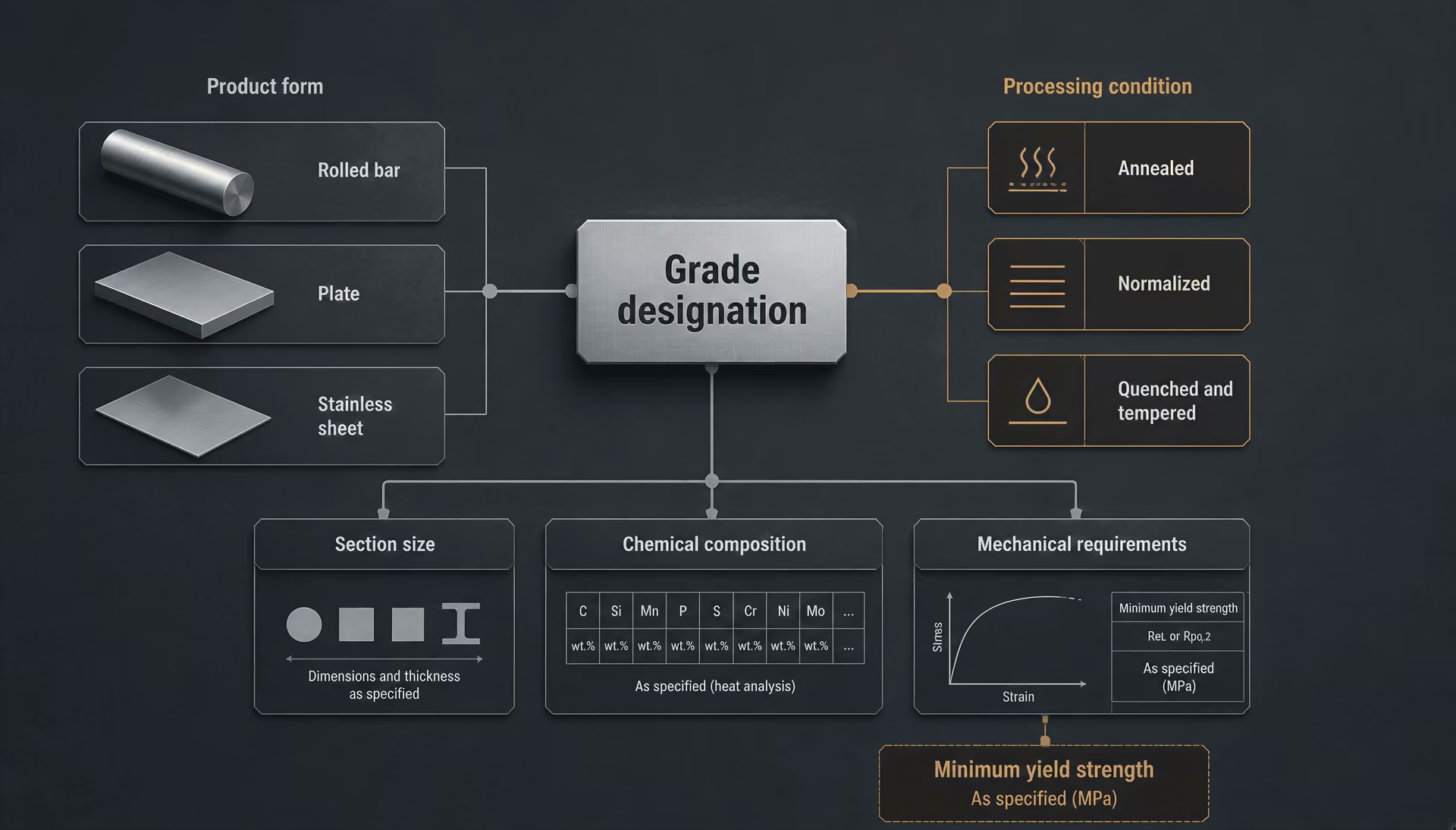
A grade row represents one defined slice of a specification system. At minimum, it connects a designation to chemical composition and one or more property requirements. In a good table, it may also identify whether the values apply to hot-rolled bar, normalized plate, quenched-and-tempered alloy steel, solution-annealed stainless steel, or another condition.
ASTM A400 connects steel-bar selection with grade, chemical composition, processing condition, section size, and desired minimum yield strength. Strong evidence
[1] Standard Practice for Steel Bars, Selection Guide, Composition, and Mechanical Properties. ASTM International. ASTM standard.ASTM A400, Standard Practice for Steel Bars, Selection Guide, Composition, and Mechanical Properties, makes this point unusually clear. Its tabulated guidance relates steel-bar selection to grade, chemical composition, processing condition, section size, and desired minimum yield strength. A row is consequently not just “the properties of 4140.” It is guidance for a particular bar-product context, with strength affected by how the steel was processed and by the size of the section.
| Product form | Possible condition | Properties affected |
|---|---|---|
| Plate | Normalized | Hardness, strength, ductility, and toughness |
| Plate | Normalized and tempered | Strength and toughness balance |
| Plate | Quenched and tempered | Hardness, yield strength, tensile strength, and ductility |
| Bar | Annealed or cold drawn | Hardness, strength, and ductility |
The same designation can carry different requirements in another product specification. A plate may be supplied normalized, normalized and tempered, or quenched and tempered. A bar may be annealed or cold drawn. Those conditions alter hardness, yield strength, tensile strength, and ductility even when the ladle chemistry remains within the same grade limits.
Dimensions also belong to the identity of the requirement. Structural steels commonly have lower minimum yield strengths at greater thicknesses because cooling rates and transformation conditions differ through the section. Eurocode 3, EN 1993-1-1 Section 3.2.6, lists design material properties for S235, S275, S355, S420, S450, and S460, but those values are design inputs tied to the Eurocode framework and its thickness-related provisions. They should not be copied into a general-purpose table and presented as universal tensile-test results.
Test direction is another boundary. Rolled plate can show different strength, elongation, reduction of area, and toughness transverse and longitudinal to the rolling direction. A mechanical-property row that omits direction may conceal a requirement that applies only longitudinally or only transversely. Temperature can matter too, especially for impact energy.
ASTM standards cover chemical, mechanical, metallurgical, and other material properties for carbon, structural, stainless, ferritic, austenitic, and alloy steels. That breadth is a warning against treating a short grade label as a complete material definition.
Composition limits versus reported analyses
Heat analysis A chemical analysis intended to represent the composition of a particular melt or ladle of steel.
Chemical-composition tables usually show limits, not a guaranteed analysis. A specification may state, for example, carbon 0.08% maximum, manganese 2.00% maximum, or chromium between specified minimum and maximum values. These are acceptance boundaries, commonly reported in mass percent. They do not say that every heat contains the midpoint of the range.
A mill test certificate may report a heat analysis such as carbon 0.045%, manganese 1.52%, and chromium 18.20%. Those figures describe the tested heat, subject to the standard’s sampling and analytical rules. They are not replacement limits for the specification. Conversely, an illustrative table may print carbon 0.20% for a grade whose permitted range is 0.17–0.23%. That single number is useful for orientation but cannot determine conformity.
The distinction becomes especially important for alloying elements and residuals. Phosphorus and sulfur may have maximum limits; silicon and manganese may have ranges; nitrogen, copper, niobium, titanium, or other elements may be controlled depending on the grade and product standard. A comparison table that rounds values, combines different editions, or omits optional elements can create a false equivalence.
SSINA, for example, publishes weight-percent composition tables and specified mechanical properties for austenitic stainless grades covered by ASTM product specifications. Such a table is useful only when its cited ASTM specification and product form are retained. The Nickel Institute similarly separates chemical composition, mechanical properties, physical properties, and specifications in tabular form. Keeping those property classes separate prevents a chemistry value from being mistaken for a performance guarantee.
Comparative tables require further caution. The Handbook of Comparative World Steel Standards provides separate tables for chemical compositions and mechanical properties across international designation systems. That separation is justified: similar names or approximate compositions do not prove that two grades have identical processing rules, toughness requirements, cleanliness provisions, or mechanical minima. “Equivalent” should mean equivalent for a stated use and standard, not merely similar in a chemical column.
Specified properties versus typical properties
A specified property is a contractual or standards-based requirement. If a product specification requires a minimum yield strength of 355 MPa, a tested value below that threshold fails the requirement unless the standard provides a valid exception or retest procedure. If it specifies a maximum hardness, a reported value above that limit is likewise significant.
A typical property is representative information and does not replace a specified minimum or maximum. Strong evidence
A typical property is different. It is an observed, representative, or commonly published value, often associated with a particular heat treatment and specimen orientation. Typical tensile strength of a condition may be 700 MPa, while the specification sets only a minimum of 655 MPa. The typical figure helps engineers estimate behavior; it does not raise the minimum requirement to 700 MPa.[2] Mechanical Properties of Carbon and Alloy Steels. ASM International. ASM Metals Handbook.
The difference is critical because strength is not determined by chemistry alone. ASM International states that carbon- and alloy-steel properties result from the combined effects of chemical composition, processing, and microstructure. Quenching rate, tempering temperature, grain size, prior deformation, and section thickness can change hardness, toughness, yield strength, and elongation within the same chemical grade.
| Label | Meaning |
|---|---|
| Maximum | Upper acceptance boundary |
| Minimum | Lower acceptance boundary |
| Range | Lower and upper permitted boundaries |
| Typical | Representative or commonly observed value |
| Nominal | Designation or target value |
| Design value | Value assigned within a design-code framework |
| Reported analysis | Measured chemistry from a specified sample |
A table should label each value plainly: maximum, minimum, range, typical, nominal, design value, or reported analysis. It should also identify the test standard, specimen location, orientation, temperature, and delivery condition where applicable. For structural shapes and plates, the American Institute of Steel Construction notes that ASTM product specifications generally contain both chemical-composition and mechanical-property requirements; neither category can safely stand in for the other.
The editorial rule is simple: never treat a copied table as a substitute for the applicable standard. Use the table to locate a grade and understand the variables. Then verify the controlling specification, product form, condition, dimensions, edition, and test requirements before assigning compliance or engineering properties.
The Architecture of Steel Designations and Standards
ASTM and ASME designation logic
A steel designation is not a complete material identity. It is an address within a particular standards system. ASTM A36, for example, identifies a carbon structural-steel specification, but the specification governs more than the name: it defines permitted product forms, chemical limits, tensile and yield requirements, test methods, delivery conditions, and sometimes supplementary requirements. ASTM A572/A572M Grade 50 refers to high-strength low-alloy structural steel with a specified minimum yield strength, yet the applicable limits and testing provisions still depend on the product covered by the specification.
ASTM’s system generally combines a letter, a serial number, and, where needed, a grade, type, class, or supplementary designation. The letter indicates the broad subject: “A” covers ferrous materials, while the number identifies a particular specification. “A36” and “A572” are therefore not two universal chemical recipes. They are specification identities. “Grade 50” expresses a strength class within A572/A572M, not a standalone grade that can be transferred unchanged to every steel product.
The distinction becomes clear in ASTM A400, Standard Practice for Steel Bars, Selection Guide, Composition, and Mechanical Properties. Its tables relate bar grades to chemical composition, processing condition, section size, and desired minimum yield strength. That arrangement is a warning against reading one row as a complete purchase or design requirement. A 4140-type alloy in a hot-rolled, normalized, quenched-and-tempered, or cold-finished condition can show materially different strength, hardness, and ductility. Larger sections may also fail to achieve the same through-thickness properties as smaller sections after heat treatment.
ASTM steel standards cover carbon, structural, stainless, ferritic, austenitic, and alloy steels, and may specify chemical, mechanical, metallurgical, and other material properties. AISC explains that structural-steel specifications for shapes and plates generally contain both composition requirements and mechanical-property requirements. Neither table replaces the other. Chemistry controls what alloying and residual elements are permitted; the mechanical requirements establish what the supplied product must achieve in testing.
ASME designations often expose a second layer of control. In the ASME Boiler and Pressure Vessel Code, an ASTM specification may appear with an “SA” prefix, such as SA-516/SA-516M for pressure-vessel plate, rather than A516/A516M. That prefix signals acceptance within the ASME code system, but it does not erase the importance of the referenced specification, edition, product form, grade, heat treatment, or supplementary requirements. Metric and customary versions can also carry distinct requirements or ordering conventions. “SA-516 Grade 70” is therefore not a free-floating identity that can be substituted with any plate called “A516 Grade 70” without checking the governing code and edition.
The chemistry-to-property shortcut also fails metallurgically. ASM International states that carbon- and alloy-steel properties arise from the combined effects of composition, processing, and microstructure. Carbon content, manganese, chromium, nickel, molybdenum, and boron influence hardenability and phase transformations, but rolling reduction, cooling rate, tempering, grain size, and section thickness alter the resulting structure. A composition table can show whether a heat falls within a limit. It cannot, by itself, prove yield strength, impact toughness, hardness, or weldability.
European designations such as S235 and S355
European structural designations encode a different set of information. Under the EN system, the “S” in S235 and S355 identifies structural steel, while the number indicates the nominal minimum yield strength in megapascals for a defined product and thickness range. The number is not a chemical equivalence code. S355 does not mean that every product marked S355 has one fixed carbon, manganese, silicon, or alloy content.
The suffix matters. In EN 10025 product standards, designations such as S235JR, S355J2, and S355K2 include impact-toughness categories. “JR,” “J0,” “J2,” and “K2” correspond to different Charpy V-notch impact requirements and test temperatures. “N” or “NL” can identify normalized or normalized-rolled delivery classes in relevant product standards. A designation without its complete suffix can omit information that controls low-temperature performance and processing condition.
Thickness also changes the meaning of the stated strength. EN requirements commonly assign different minimum yield values to thickness intervals, so the 355 MPa figure associated with S355 is not necessarily the required yield strength for every plate thickness or section. Product standards such as EN 10025-2 govern hot-rolled non-alloy structural steels, while other EN standards address hollow sections, forgings, fasteners, or stainless products. The product standard is part of the identity.
SteelConstruction.info distinguishes the European structural-steel designation system from the standards governing chemical composition and mechanical properties. Eurocode 3 then introduces design material properties through EN 1993-1-1, Section 3.2.6. Its table includes S235, S275, S355, S420, S450, and S460, but those are design values tied to the Eurocode framework, not a replacement for mill certification or the applicable EN product standard. A design table and a material acceptance table answer different questions.[4] Composition and Properties. Specialty Steel Industry of North America. SSINA technical resources.
Stainless designations show the same principle from another direction. “304” may refer to a family designation used across systems, while ASTM A240 Type 304 concerns plate, sheet, and strip with product-specific requirements. SSINA presents both weight-percent composition limits and specified mechanical properties for austenitic stainless grades covered by ASTM product specifications. The chemical row and the tensile row must be read together, along with the product form and condition.
National and international equivalence claims
Comparative tables are useful for locating related grades. They are not certificates of interchangeability. The Handbook of Comparative World Steel Standards separates comparisons of chemical compositions from comparisons of mechanical properties across international designation systems. That separation is essential: two grades may have similar ranges for carbon, chromium, nickel, or molybdenum while differing in yield strength, impact testing, heat treatment, dimensional limits, or inspection rules.
A table that places ASTM A36 beside EN S235JR may be showing a practical family relationship based on nominal strength and common structural use. It does not prove that every A36 product meets every S235JR requirement, or that either grade satisfies the other’s toughness, thickness, chemical, or delivery provisions. The same caution applies to ASTM A572 Grade 50 and S355. Their nominal strength levels are related, but grade numbers do not establish matching weldability, impact performance, thickness limits, or certification requirements.
The Nickel Institute’s tables place chemical composition, mechanical properties, physical properties, and specifications in separate categories for this reason. Engineering ToolBox’s representative comparisons of carbon, chromium, manganese, molybdenum, nickel, phosphorus, sulfur, and silicon can help identify broad alloy families, but representative values are not controlling specification limits. Outokumpu’s stainless handbook, SSINA tables, and Metallus practical data serve a similar reference function.
| Comparison field | Why it is required |
|---|---|
| Both standards and editions | Standards systems and revisions can impose different requirements |
| Complete designation | Suffixes can identify toughness or delivery classes |
| Product form | Plate, bar, sheet, tube, forging, and shape standards differ |
| Thickness or section size | Minimum properties can change with dimensions |
| Delivery condition | Heat treatment and cold work alter properties |
| Direction and temperature | Mechanical and impact results depend on test orientation and temperature |
A defensible equivalence claim must name both standards, the complete designation, product form, thickness or section size, delivery condition, test direction, temperature requirements, and applicable edition. If any of those are missing, “equivalent” should be read as “similar for initial comparison,” not as permission to substitute one material for another.
Chemical Composition Tables: Elements and Their Functions
Chemical-composition tables normally report each element as a percentage by mass, usually written as wt.% or simply %. A value such as C 0.20 means that carbon accounts for 0.20% of the steel’s mass. The table may give a maximum, a minimum, or a permitted range. That distinction matters: “P 0.040 max” is not the same requirement as “Mn 0.80–1.20,” and neither value identifies the steel independently of its product standard.
Composition tables and mechanical-property tables answer different questions. Chemistry tables define what elements may be present in the heat; mechanical tables report results such as yield strength, tensile strength, elongation, hardness, or impact energy for a specified product and test condition. ASTM A400, Standard Practice for Steel Bars, Selection Guide, Composition, and Mechanical Properties, connects grade, composition, processing condition, section size, and desired minimum yield strength precisely because chemistry alone cannot establish a guaranteed mechanical result. The ASM Metals Handbook likewise attributes carbon- and alloy-steel properties to the combined effects of composition, processing, and microstructure.
Engineering ToolBox presents representative weight-percent comparisons for steel grades, including carbon, chromium, manganese, molybdenum, nickel, phosphorus, sulfur, and silicon. Such a table is useful for seeing broad chemical differences, but it should not replace the applicable ASTM, EN, ISO, or other product specification. SSINA’s tables for austenitic stainless steels, the Outokumpu Stainless Steel Handbook, and Metallus’s Practical Data for Metallurgists provide more specification-oriented or grade-focused data, yet their limits still apply within the scope stated by each source.
Carbon, manganese, silicon, phosphorus, and sulfur
Carbon is the principal interstitial strengthening element in ordinary carbon and alloy steels. Increasing carbon generally raises hardness, tensile strength, and attainable strength after quenching and tempering. It also increases hardenability to a degree, although alloying elements and section size strongly affect the depth of hardening. The cost is reduced ductility, lower weldability, and greater sensitivity to brittle heat-affected-zone structures. In stainless steels, carbon can combine with chromium as chromium carbide, commonly represented by compounds such as Cr23C6. Precipitation at grain boundaries can lower local corrosion resistance by creating chromium-depleted regions.
The number in a grade designation may suggest a carbon level, but it is not a universal identity. AISI 1045, ASTM A576 1045 bar, and another product sold under a similar 1045 designation may have different permitted chemistry, dimensions, heat treatment, or mechanical requirements. The controlling document is the product specification, not the short grade label.
Manganese strengthens ferrite through solid-solution effects and combines with sulfur to form manganese sulfide inclusions. This is important in carbon steels because manganese reduces the harmful effect of iron sulfide, which can produce hot shortness. Manganese also increases hardenability and can contribute to higher strength after heat treatment. Excessive or poorly controlled manganese may affect toughness, segregation, weldability, and phase stability. In high-manganese austenitic steels, its role is more substantial: it helps stabilize austenite and can alter transformation and deformation behavior.
Silicon is commonly added as a deoxidizer during steelmaking. It strengthens ferrite and can improve oxidation resistance in selected applications, but higher silicon may reduce toughness or complicate welding and forming. Silicon is also significant in electrical steels, where it raises electrical resistivity and reduces eddy-current losses. A general engineering table may show silicon as a minor constituent, while a particular specification can impose a tighter range because processing, magnetic performance, or weldability requires it.
Phosphorus is usually controlled as an impurity. It can increase strength and hardness through solid-solution strengthening, but elevated phosphorus generally reduces ductility and toughness and may promote embrittlement, especially under unfavorable thermal or segregation conditions. Sulfur improves machinability by forming sulfide inclusions, particularly manganese sulfide, but those inclusions can reduce transverse ductility, fatigue resistance, and through-thickness toughness. Free-machining grades therefore accept sulfur levels that would be restricted in pressure-vessel, structural, or demanding welded products. A composition table records the permitted amount; it does not by itself describe inclusion shape, distribution, or the resulting mechanical behavior.
Chromium, nickel, molybdenum, and nitrogen
Chromium increases hardenability, supports carbide formation, and improves resistance to oxidation and aqueous corrosion. Stainless-steel designations require sufficient chromium to form a protective chromium-rich oxide film, but the required performance depends on more than total chromium. Carbon, nitrogen, molybdenum, surface condition, welding history, and the service environment all matter. Chromium can stabilize ferrite, while chromium carbides or intermetallic phases can remove chromium from the surrounding matrix and reduce localized corrosion resistance.
Nickel stabilizes austenite and generally improves toughness, particularly at low temperature. In austenitic stainless steels, nickel helps maintain the face-centered cubic austenitic structure; in alloy steels, it contributes to hardenability and toughness without the same carbide-forming tendency as chromium or molybdenum. Nickel content therefore affects phase balance, magnetic response, transformation behavior, and corrosion performance. The familiar “18-8” description for many austenitic stainless steels indicates an approximate chromium-nickel family, not a substitute for a specification such as ASTM A240 or the exact grade limits listed by SSINA or Outokumpu.
Molybdenum increases hardenability and improves resistance to temper softening. In stainless steels it materially improves resistance to pitting and crevice corrosion, especially in chloride-bearing environments. It also affects carbide and intermetallic formation. A grade with molybdenum cannot be treated as equivalent to a nominally similar grade without it, even if tensile properties appear close in a handbook table.
Nitrogen is a powerful austenite stabilizer and solid-solution strengthener. Controlled additions can raise yield strength and improve pitting resistance in some stainless steels. Too much nitrogen for the process or grade can cause porosity, nitride formation, or unfavorable phase balance. In duplex stainless steels, nitrogen helps maintain the intended ferrite-austenite proportion after processing, so the listed maximum and minimum are functional requirements rather than decorative chemistry values.
Residual elements, microalloying, and balance requirements
Residual elements are present from raw materials, furnace practice, refractories, or alloy additions and are not always deliberate principal ingredients. Copper, tin, cobalt, antimony, lead, and vanadium may appear in a table even when they are not central to the grade description. Copper can improve atmospheric-corrosion resistance in certain structural steels, while tin and antimony may contribute to hot-shortness or temper-embrittlement concerns. Lead can improve machinability but changes inclusion behavior and welding considerations. The effect depends on concentration, thermal history, and interactions with other elements.
Microalloying additions are small but influential. Niobium, vanadium, and titanium form carbonitrides that restrict austenite grain growth, produce precipitation strengthening, and alter recrystallization during controlled rolling. A steel with 0.03% Nb is not chemically interchangeable with one containing only carbon and manganese at similar nominal strength. The final grain size, dissolution state of precipitates, rolling schedule, cooling rate, and subsequent heat treatment determine how much benefit is obtained.
Balance requirements are equally important. Stainless-steel tables may limit carbon while requiring chromium, nickel, molybdenum, or nitrogen within defined ranges to preserve austenitic, ferritic, or duplex phase stability. Alloy-steel specifications may require boron only within a narrow range because a trace addition can improve hardenability, whereas excessive boron forms unwanted compounds. Residual copper, nickel, chromium, and molybdenum can also affect hardenability even when they are not intentional additions.
The Nickel Institute separates chemical, mechanical, physical, and specification data in its alloy tables; that separation is good practice. The Handbook of Comparative World Steel Standards also keeps chemical-composition comparisons distinct from mechanical-property comparisons across international designations. Eurocode 3 lists design properties for S235, S275, S355, S420, S450, and S460 under EN 1993-1-1, Section 3.2.6, but those are design-standard values, not universal consequences of a chemistry range. Product form, thickness, delivery condition, test direction, and heat treatment can change the required result. A composition table defines a chemical window. It does not certify strength, toughness, weldability, corrosion performance, or phase balance without the rest of the specification.
Why Chemical Composition Does Not Determine Mechanical Properties by Itself
A chemical-composition table reports what elements are present and within which limits. It does not report the complete physical history of the steel. Carbon, manganese, silicon, chromium, nickel, molybdenum, vanadium, niobium, titanium, phosphorus, sulfur, and other elements affect hardenability, phase stability, solid-solution strengthening, carbide formation, and transformation behavior, but their effects depend on temperature, deformation, cooling, and section size.
That distinction is central to the ASM Metals Handbook treatment of carbon and alloy steels. ASM states that their properties result from the combined effects of chemical composition, processing, and microstructure. A grade designation therefore identifies a controlled range within a specification, not one universal set of tensile strength, yield strength, elongation, hardness, and toughness values.
ASTM A400, Standard Practice for Steel Bars, Selection Guide, Composition, and Mechanical Properties, demonstrates the point directly. Its tabulated guidance considers grade, chemical composition, processing condition, section size, and desired minimum yield strength when selecting steel bars. A composition entry alone cannot perform those functions. ASTM product standards likewise separate chemical, mechanical, metallurgical, and other material requirements across carbon, structural, stainless, ferritic, austenitic, and alloy steels. AISC makes the same distinction for structural products: ASTM specifications for steel shapes and plates generally contain both chemical-composition and mechanical-property requirements.

Processing history and thermomechanical treatment
The same bulk composition can produce substantially different properties after different manufacturing routes. Rolling is not merely a way to change a billet into plate, bar, or shape. Hot rolling deforms austenite, breaks up cast structure, changes inclusion morphology, and can refine grains when the finishing temperature and reduction schedule are controlled. Controlled rolling below conventional finishing temperatures can promote fine ferrite formation after cooling. The result may have higher yield strength and improved toughness than material of the same chemistry subjected to a less controlled schedule.
Forging also changes the internal structure. Large cast grains and segregation bands can be disrupted by deformation, while the forging temperature and reduction determine recrystallization and grain refinement. Two forgings with identical ladle analyses may not have identical properties if one receives greater reduction or a different final forging temperature.
A simplified heat-treatment sequence
- Normalizing Heat above the austenite transformation range and cool in air.
- Annealing Use slower cooling to produce a softer structure.
- Quenching Cool rapidly to suppress diffusional transformation and form martensite where hardenability permits.
- Tempering Reheat quenched steel to adjust strength, hardness, ductility, and toughness.
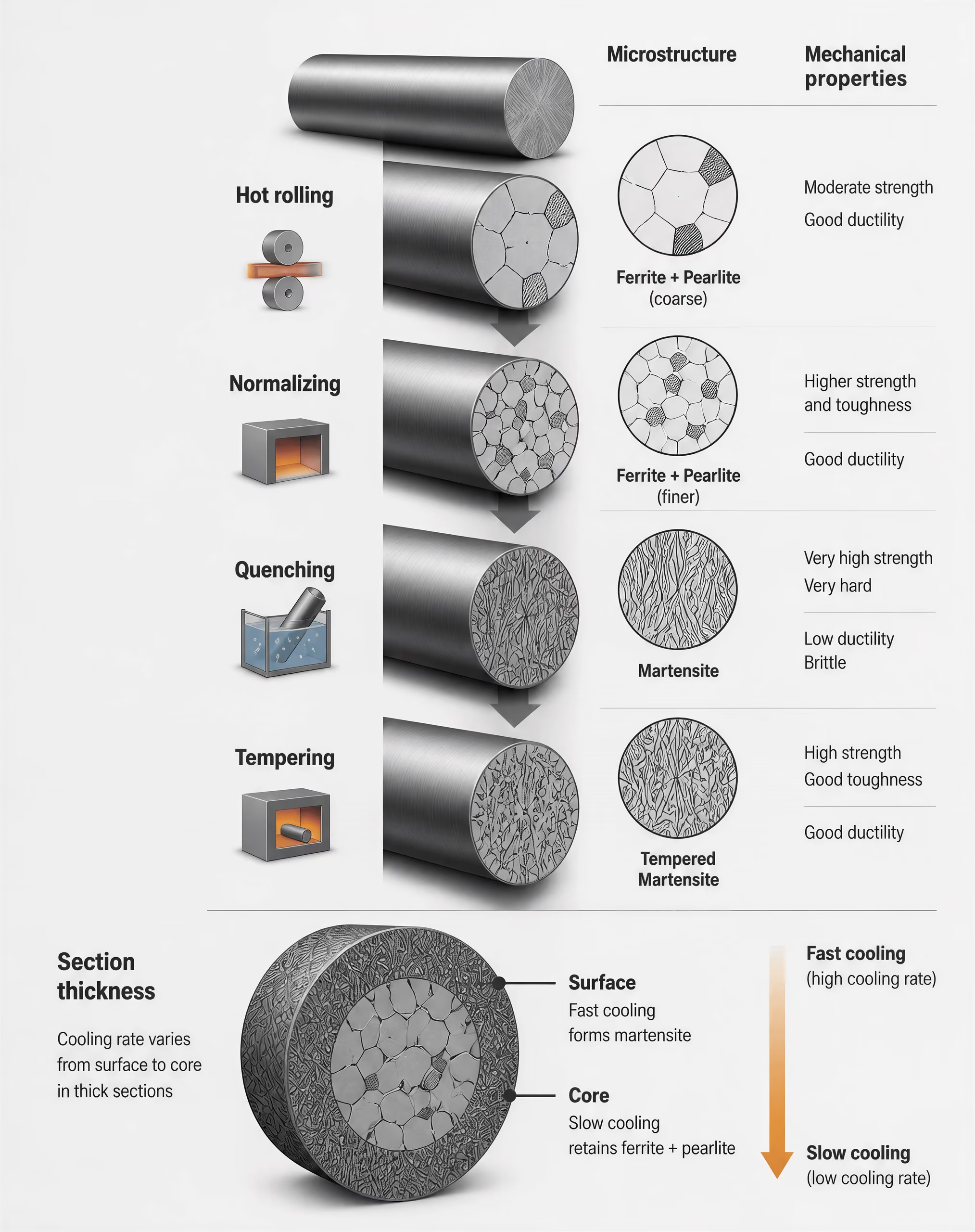
Heat treatment creates still larger differences. Normalizing heats steel above the austenite transformation range and then cools it in air, producing a relatively refined ferrite-pearlite structure in many carbon and low-alloy steels. Annealing generally uses slower cooling, allowing a softer structure with coarser pearlite and lower hardness. Quenching suppresses diffusional transformation and can form martensite, a hard supersaturated phase. Quenched steel is commonly tempered to reduce brittleness and adjust strength, hardness, ductility, and toughness. Tempering temperature and time matter; a low-temperature temper and a high-temperature temper do not yield the same balance of properties.
Hardenability The capacity of steel to develop hard transformation products to a given depth during cooling; it is distinct from the hardness measured at one location.
Cooling rate is affected by more than the furnace program. Section thickness controls heat extraction, so the surface of a thick bar can cool much faster than its center. A thin plate may transform almost entirely to ferrite and pearlite, whereas the center of a heavy section with the same composition may form bainite, martensite, or mixed transformation products if its cooling rate is sufficiently high. Hardenability describes the capacity of a steel to form hard transformation products through a section; it is not the same as the hardness of one test coupon.
Thermomechanical processing can also produce properties that a final chemistry table cannot reveal. A steel may be microalloyed with niobium, vanadium, or titanium, yet the strengthening contribution depends on whether these elements remain in solution, form carbonitrides during reheating, or precipitate during controlled cooling. Processing history is part of the material identity.
Microstructure as the link between chemistry and properties
Mechanical testing measures the response of the resulting microstructure, not the periodic-table composition in isolation. Yield strength reflects the resistance of dislocations to movement. Tensile strength depends on the mechanisms that continue to resist deformation during plastic flow and on the onset of necking. Elongation depends on how uniformly the material can deform before fracture. Hardness reflects resistance to localized plastic deformation. Toughness depends on crack initiation and propagation, including the temperature, loading rate, notch condition, and direction of the test.
Microstructure connects these responses to chemistry. Carbon in solid solution strengthens ferrite, but excess carbon can also form pearlite, cementite, or martensite depending on the thermal path. Manganese and nickel alter transformation behavior and can improve hardenability or stabilize austenite. Chromium and molybdenum affect hardenability and the formation of carbides. Silicon strengthens ferrite and influences deoxidation. These effects are conditional, not additive constants that can be read directly from a composition table.
For example, a low-carbon steel cooled slowly from austenite may contain ferrite and pearlite and show moderate strength with useful ductility. The same nominal carbon level, after quenching where hardenability permits, may contain martensite or bainite and show much higher hardness and strength, usually with lower untempered toughness. Tempering changes the martensite again by allowing carbon redistribution and carbide precipitation. The final properties depend on the complete sequence, including austenitizing temperature, hold time, quench medium, section size, and tempering schedule.
Transformation products also vary within one component. Surface regions can become harder than the core, and weld heat-affected zones can develop microstructures unlike either the parent plate or the weld metal. A reported tensile value from one location cannot automatically represent every location or direction.
Grain size, phase balance, and precipitates
Grain size is a direct reason chemistry cannot independently provide strength or toughness. Fine ferrite grains generally raise yield strength through grain-boundary strengthening and can improve resistance to cleavage fracture. Coarse grains often reduce low-temperature impact toughness, although the measured result also depends on phase distribution, inclusions, and test orientation. Grain refinement may come from controlled rolling, normalizing, or microalloy precipitation that restricts austenite grain growth.
Phase balance matters just as much. Ferrite is relatively soft and ductile; pearlite is stronger but less ductile; bainite and martensite can provide high strength, with their toughness governed by morphology and tempering. Retained austenite can transform during service or testing, altering dimensional stability and deformation behavior. A chemistry table might identify carbon and alloying limits, but it cannot state whether the finished steel contains 20% pearlite, a bainitic matrix, or tempered martensite without processing and metallographic information.
Precipitates add another variable. Fine niobium, vanadium, or titanium carbonitrides can pin austenite grain boundaries and strengthen ferrite after transformation. Their size, number density, composition, and distribution depend on reheating, deformation, and cooling. Coarse precipitates may contribute little to strength while acting as crack-initiation sites. In stainless steels, chromium carbides at grain boundaries can reduce local corrosion resistance even when the bulk chromium analysis meets the grade limit.
This is why tables from SSINA pair weight-percent composition with specified mechanical properties for austenitic stainless-steel grades covered by ASTM product specifications, rather than treating one table as a substitute for the other. The Nickel Institute similarly presents chemical, mechanical, physical, and specification data as separate property classes. Eurocode 3 lists design properties for S235, S275, S355, S420, S450, and S460 under EN 1993-1-1, Section 3.2.6; those are values tied to a governing design standard, product category, thickness, and design use.
Comparative tables, including those in the Handbook of Comparative World Steel Standards, can show approximate relationships between international designations, but they do not establish equivalence. Representative composition comparisons such as those published by Engineering ToolBox are useful for orientation, while controlling limits and mechanical requirements must come from the applicable product specification. The governing standard, product form, thickness, heat treatment, test direction, and test method determine what a reported value means. Chemistry starts the explanation. It does not finish it.
Mechanical-Property Tables: What the Columns Mean
A mechanical-property table is not a second version of a chemical-composition table. It reports how a specified product is expected, or required, to behave in a defined test. The result depends on the steel designation, product form, heat treatment, section size, thickness, sampling location, test direction, temperature, and governing standard.
That distinction matters because a grade name is not a complete material identity. ASTM A400, Standard Practice for Steel Bars, Selection Guide, Composition, and Mechanical Properties, organizes bar-steel information by grade, composition, processing condition, section size, and desired minimum yield strength. The same nominal grade can therefore appear with different property requirements when the product form or dimensions change. A table that gives one strength value beside a grade without naming its product specification may be useful for orientation, but it is not a controlling specification.
ASTM steel standards cover chemical, mechanical, metallurgical, and other material requirements for carbon, structural, stainless, ferritic, austenitic, and alloy steels. AISC likewise explains that specifications for structural-steel shapes and plates generally contain both chemical-composition and mechanical-property requirements. The two sets of columns answer different questions: chemistry limits what elements may be present, while mechanical testing verifies the response of the supplied product.
Yield strength and tensile strength
Yield strength is the stress at which a test specimen begins to undergo specified permanent plastic deformation. For some steels, the stress–strain curve shows a distinct upper and lower yield point. For others, the standard uses proof stress, commonly the stress producing 0.2% permanent strain, written as in many European standards or reported as yield strength by the applicable ASTM method. The exact definition must come from the test standard and product specification.
A table’s minimum yield strength is a requirement, not a prediction of every piece of steel. If ASTM A572/A572M specifies a minimum yield strength for a stated grade, thickness range, and product form, a conforming test result must meet or exceed that value under the specified procedure. The actual measured yield strength may be higher. It can vary with heat, thickness, rolling reduction, cooling rate, sampling position, and test direction. Reporting the minimum as though it were the measured property loses that distinction.
Tensile strength, also called ultimate tensile strength, is the maximum engineering stress reached during a tensile test. It is calculated from the greatest applied load divided by the specimen’s original cross-sectional area. After the maximum load, localized necking may occur, and the engineering stress can fall even while the material continues to deform until fracture.
Ultimate tensile strength is not the same as design resistance. A structural design value is derived through the governing design code, which may apply resistance factors, partial factors, buckling rules, connection provisions, and thickness-dependent limits. Eurocode 3, EN 1993-1-1 Section 3.2.6, lists design material properties for S235, S275, S355, S420, S450, and S460. Those values belong to a design framework; they should not be copied into a generic “tensile strength” column or treated as direct test results.
The test itself imposes conditions. ASTM E8/E8M and ISO 6892-1 specify details such as specimen geometry, gauge length, loading rate, strain measurement, and calculation. A plate, bar, tube, and forging may have different permissible specimen locations and orientations. Longitudinal and transverse results are not interchangeable, particularly in rolled products where inclusions, texture, and banded microstructures create directional differences.
Chemistry alone cannot determine the result. ASM International’s Metals Handbook describes carbon- and alloy-steel properties as the combined effects of chemical composition, processing, and microstructure. Carbon, manganese, chromium, nickel, molybdenum, and other elements affect hardenability and phase formation, but rolling, quenching, tempering, normalizing, precipitation, and cooling history determine how that potential is expressed.
Elongation, reduction of area, and ductility
Elongation measures plastic extension before fracture. It is usually reported as a percentage:
Gauge length The marked initial length of a tensile-test specimen over which elongation is measured.
where is the original gauge length and is the gauge length after fracture, with the broken pieces carefully fitted together. The number is meaningful only with the gauge length and specimen type. A reported “20% elongation” does not identify whether the result used a proportional gauge length, a 50 mm gauge length, a subsize specimen, or another configuration.
This is why elongation values from different standards can appear inconsistent even when the steels are similar. Shorter gauge lengths tend to capture a larger contribution from localized necking and can produce a higher percentage than longer gauge lengths. Product thickness also affects the available specimen geometry and sometimes the minimum specified elongation. Tables should therefore preserve the test designation and gauge length rather than presenting elongation as a universal grade constant.
Reduction of area measures the loss of cross-sectional area at the fracture location:
where is the original area and is the smallest final area. It is especially sensitive to localized plastic deformation and gives information different from elongation. A steel may show substantial reduction of area while its elongation differs because the two measurements respond differently to uniform strain, necking, specimen geometry, and fracture location.
Both measures are indicators of ductility, but ductility is not a single material constant. It includes the ability to sustain plastic strain without cracking under a particular stress state, temperature, strain rate, and geometry. A tensile elongation result cannot establish resistance to hydrogen cracking, bend cracking, weld heat-affected-zone cracking, or fracture under a notch. Nor does high elongation automatically mean high toughness.
SSINA’s tables for austenitic stainless-steel grades illustrate the proper format: weight-percent composition is presented separately from specified mechanical properties under the relevant ASTM product specifications. The Nickel Institute similarly separates chemical composition, mechanical properties, physical properties, and specification data. A comparative table may place these categories on adjacent pages, but adjacency does not make them interchangeable.
Hardness, impact toughness, and fatigue-related data
Hardness is resistance to localized plastic deformation, commonly measured by Brinell, Rockwell, Vickers, or Knoop methods. A value such as HBW 190, 90 HRB, or 210 HV is incomplete without the scale, indenter, applied force, and test standard. ASTM E10 covers Brinell hardness, ASTM E18 Rockwell hardness, and ASTM E384 microindentation hardness. Surface condition, curvature, decarburization, coating, and local microstructure can alter the reading.
Hardness-to-tensile-strength conversions are correlations, not physical laws. They are usually developed for particular steel families and hardness ranges. A conversion may be unsuitable for austenitic stainless steel, heavily alloyed tool steel, case-hardened material, weld metal, or a product with a strong hardness gradient. ASTM conversion tables should not replace the specified tensile test when tensile strength controls acceptance or design.
Impact energy measures the energy absorbed by a notched specimen during a sudden fracture, commonly with the Charpy V-notch test under ASTM E23 or an equivalent standard. The reported value depends on specimen orientation, notch geometry, temperature, dimensions, and test procedure. A Charpy result such as 27 J at −20 °C describes that test condition; it is not a universal toughness constant.
Impact energy must also be distinguished from fracture toughness. Fracture toughness, often reported as , , or a related parameter, characterizes crack-tip resistance under a defined specimen geometry, thickness, loading mode, and constraint condition. Charpy energy can support material screening and quality control, but it cannot be substituted directly for a plane-strain fracture-toughness value.
Fatigue data describe behavior under repeated or fluctuating stress. An S–N curve relates stress amplitude to cycles to failure, while a crack-growth curve commonly relates to stress-intensity-factor range , as in ASTM E647. Results depend on stress ratio, frequency, surface finish, residual stress, environment, specimen size, notch condition, and the definition of failure. A single fatigue strength in a table is therefore meaningless unless those conditions accompany it.
The Handbook of Comparative World Steel Standards keeps chemical-composition comparisons separate from mechanical-property comparisons for this reason. Cross-standard grade matches can indicate similar intended chemistry, but they do not prove identical yield strength, impact performance, fatigue behavior, or acceptance requirements. A responsible table names the governing standard, product form, thickness or section range, test method, direction, temperature, and whether each value is a minimum requirement, a measured result, a typical value, or a design parameter.
Section Size, Thickness, Product Form, and Test Direction
A steel grade name does not identify one fixed set of mechanical properties. The required yield strength, tensile strength, elongation, impact energy, hardness, and permitted variation may depend on thickness, cross-sectional size, product form, heat treatment, and test direction. A table that reports “AISI 4140” or “S355” without those qualifiers is therefore incomplete, even when its chemical analysis is approximately correct.
Thickness-dependent strength requirements
Thickness changes the thermal history of a steel product. A thin plate cools rapidly after rolling or normalizing; a heavy forging or thick plate cools more slowly, allowing different phase transformations, grain growth, and segregation effects. The resulting microstructure can change strength and toughness even when the ladle analysis remains within the same composition limits. ASM International describes carbon- and alloy-steel properties as the combined result of chemical composition, processing, and microstructure. Chemistry is only one part of the specification.
Many product standards consequently reduce the specified minimum yield strength as thickness increases. The reason is not merely geometric. A thick section is harder to cool uniformly, and its center may not receive the same refinement or transformation as its surface. A table that assigns one yield-strength value to every thickness can therefore overstate the requirement for heavy material or understate the differences between size categories.
Eurocode 3 illustrates the point through its design-property table for S235, S275, S355, S420, S450, and S460 in EN 1993-1-1, Section 3.2.6. The tabulated nominal yield strength is tied to nominal thickness, with lower values applying as thickness increases. Thus, “S355” does not mean that every product and every thickness has a design yield strength of 355 MPa. The designation identifies a class within a governing European standard; the thickness determines which value applies.
The same caution applies to ASTM products. ASTM A400, Standard Practice for Steel Bars, Selection Guide, Composition, and Mechanical Properties, presents bar-selection guidance by grade, chemical composition, processing condition, section size, and desired minimum yield strength. That structure is significant. It shows that a grade entry is not a complete material specification unless the reader also knows whether the bar was annealed, normalized, quenched and tempered, or supplied in another listed condition, along with the relevant diameter or equivalent section size.
A mechanical-property table must therefore preserve the thickness or size interval printed in the source standard. Replacing several intervals with one “typical” value makes the table easier to read but less faithful to the specification.
Bars, plates, shapes, forgings, and sheet
| Product form | Manufacturing or supply feature | Why values should not be transferred automatically |
|---|---|---|
| Bar | Hot rolled, cold finished, or machined | Requirements may vary by diameter, finish, and condition |
| Plate | Rolled product with thickness-dependent cooling | Strength and toughness can vary with thickness and direction |
| Sheet | Hot-rolled or cold-reduced product | Temper and forming condition can control properties |
| Forging | Deformed stock with directional flow | Forging reduction and heat treatment affect the result |
| Fastener | Cold heading, threads, and proof-load requirements | The fastener specification may impose additional mechanical rules |
Product form is not a cosmetic label. It identifies a different manufacturing route, and that route controls grain flow, surface condition, residual stress, inclusion distribution, and attainable mechanical properties.
Bars are commonly produced by hot rolling, cold finishing, or machining from larger rolled stock. Their requirements may be organized by diameter, width, or cross-sectional area. ASTM A400 is particularly useful here because it does not present bar grades as isolated chemistry names; it connects composition and minimum yield-strength guidance with processing condition and section size. A 4140 bar in the annealed condition cannot be assigned the same strength values as a quenched-and-tempered 4140 bar merely because both contain nominally similar amounts of chromium, molybdenum, carbon, and manganese.
Plates and structural shapes follow different rolling practices. AISC explains that ASTM specifications for structural steel shapes and plates generally include both chemical-composition and mechanical-property requirements. ASTM A572/A572M, for example, governs high-strength low-alloy structural steel in products such as plates, shapes, and bars, but the applicable requirements still depend on the product and grade designation written in the purchase specification. A value listed for a rolled structural shape should not be transferred automatically to a thick plate of the same nominal grade.
Sheet has its own forming and surface requirements. Cold-reduced sheet may have mechanical properties controlled by temper, forming quality, or bake-hardening condition, while hot-rolled sheet may use a separate specification and thickness range. “Stainless steel 304” is likewise insufficient by itself: ASTM A240/A240M plate, sheet, and strip requirements are not interchangeable with ASTM A276/A276M bar requirements or ASTM A182/A182M forged components. SSINA’s tables pair weight-percent composition with specified mechanical properties for austenitic stainless grades covered by ASTM product specifications, but those properties remain attached to the applicable product standard.
Forgings introduce another distinction. Forging deformation can refine grains and produce directional flow, while the final heat treatment may be specified separately from that used for plate or bar. Fasteners add still more conditions, including cold heading, thread geometry, proof load, and heat treatment. A carbon or alloy steel chemistry table may show a plausible match, yet the fastener specification can impose mechanical requirements that are absent from a general bar standard.
This is why comparative references must be read carefully. The Handbook of Comparative World Steel Standards separates chemical-composition comparisons from mechanical-property comparisons across international designation systems. A chemical match between two designations is not proof that their product standards, thickness ranges, heat treatments, or test requirements are equivalent.

Longitudinal, transverse, and through-thickness behavior
Test directions
- Longitudinal
- Parallel to the principal rolling or drawing direction.
- Transverse
- Across the product plane and generally perpendicular to the principal rolling direction.
- Through-thickness
- Across the short-transverse direction of plate or similar product.
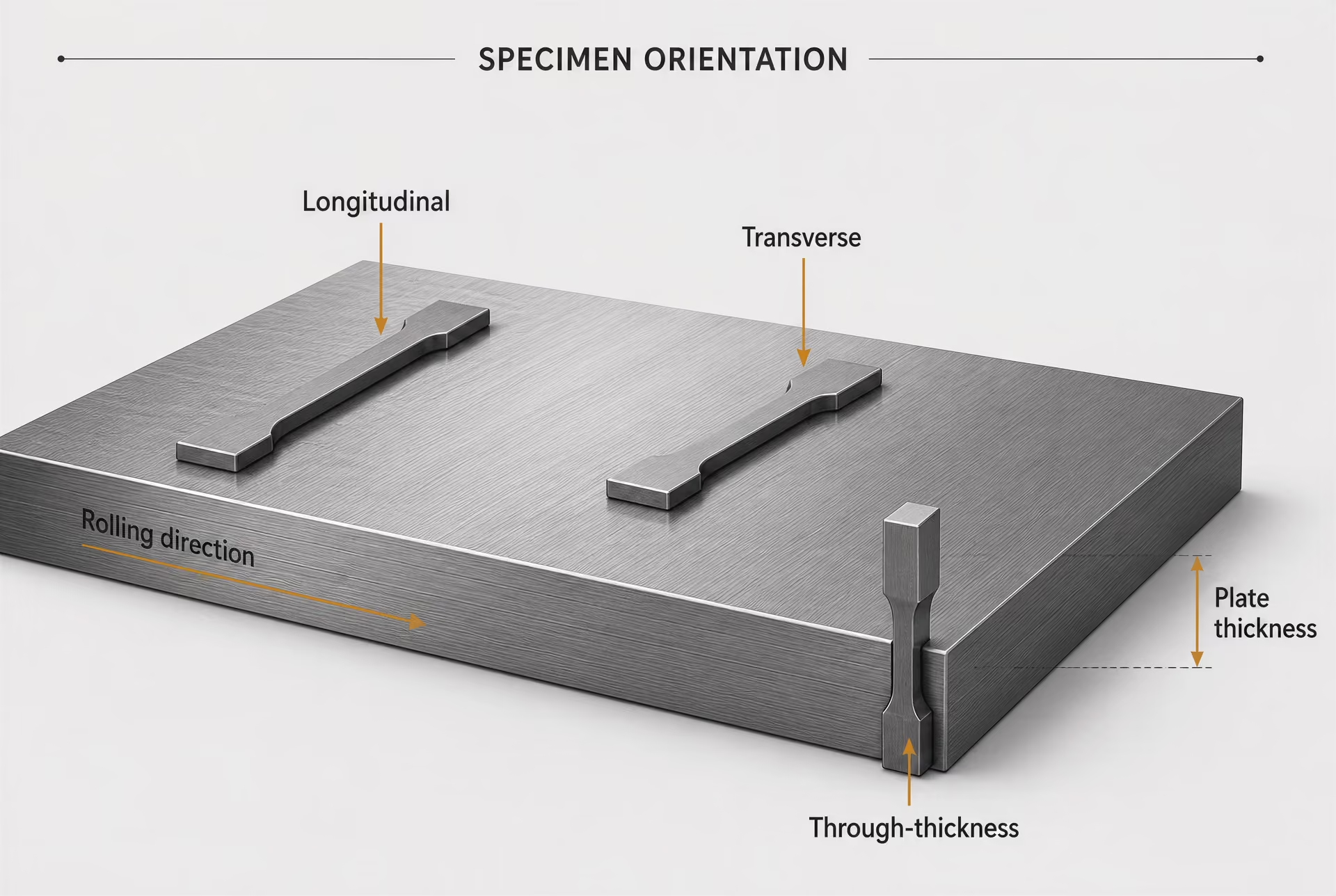
Rolling stretches grains, aligns inclusions, and redistributes segregation. As a result, a plate or bar can show different properties along its length, across its width, and through its thickness. The longitudinal direction is generally parallel to the principal rolling or extrusion direction; the transverse direction is perpendicular to it in the product plane; through-thickness testing samples the short-transverse direction.
Tensile strength may differ modestly between directions, but elongation, reduction of area, impact toughness, and fracture appearance can differ more substantially. Elongated manganese sulfide inclusions, for example, can act as weak paths in the short-transverse direction. Thick plate may also suffer centerline segregation or reduced resistance to lamellar tearing, a failure mode associated with tensile strain through the plate thickness.
A longitudinal tensile result should not be reported as though it guarantees transverse ductility. Nor should a Charpy impact value measured at one orientation be transferred to another without checking the standard’s sampling and notch-orientation rules. Product standards often specify whether specimens are longitudinal or transverse, where they are removed, and how thickness affects the permitted orientation. Those details can change the reported elongation, toughness, and anisotropy.
The practical rule is direct: record the grade, governing standard, product form, thickness or section size, processing condition, and test direction together. Without that chain of identification, a composition table may be chemically informative while the accompanying mechanical-property value belongs to a different steel product.
Carbon and Alloy Steels in Comparative Tables
A steel table can answer several different questions, but not with the same column. A chemical-composition table reports limits or ranges for elements such as carbon, manganese, silicon, chromium, nickel, molybdenum, phosphorus, and sulfur. A hardenability table describes how far a steel can develop hardness beneath a quenched surface. A mechanical-property table gives specified or tested yield strength, tensile strength, elongation, hardness, impact energy, or fatigue data. Confusing these functions is a common reason that grade-comparison pages present inaccurate limits.
The grade designation alone does not settle the matter. ASTM A400, Standard Practice for Steel Bars, Selection Guide, Composition, and Mechanical Properties, organizes bar steels by grade, chemical composition, processing condition, section size, and desired minimum yield strength. That structure is a warning against treating a grade name as a complete material identity. A table may compare chemistry correctly while still assigning the wrong strength because the listed value applies to a different product form, heat treatment, diameter, or thickness.
Carbon-steel composition ranges
Carbon steels are generally organized around carbon content and the relatively small quantities of other alloying elements. In a comparison table, a low-carbon grade might appear near 0.05–0.25 wt% C, a medium-carbon grade near 0.25–0.60 wt% C, and a high-carbon grade above roughly 0.60 wt% C. These are classification ranges, not universal specification limits. The boundary values vary among technical references, national systems, product standards, and historical usage.
Engineering ToolBox’s comparative table places representative steel grades side by side using weight-percent carbon, chromium, manganese, molybdenum, nickel, phosphorus, sulfur, and silicon. It is useful for seeing broad chemical relationships: a plain carbon steel generally contains little intentional chromium, nickel, or molybdenum, while a low-alloy steel contains controlled additions of one or more of them. It should not be copied as the controlling chemistry for a purchase specification or a heat certificate. Representative values show a typical grade family; a standard specifies an allowable range, maximum, minimum, or residual-element limit.
Even “carbon steel” does not mean that carbon is the only controlled element. Manganese affects strength and hardenability, silicon may be used for deoxidation and strengthening, and phosphorus and sulfur are commonly restricted because excessive amounts can impair toughness, ductility, weldability, or hot-work behavior. The applicable ASTM, EN, JIS, or other product specification decides which limits apply. ASTM’s steel standards cover chemical, mechanical, metallurgical, and material requirements across carbon, structural, stainless, ferritic, austenitic, and alloy steels; the designation therefore has meaning only within its governing standard and product category.
Carbon content also cannot be converted directly into a guaranteed tensile strength. The same nominal chemistry can produce different properties after hot rolling, normalizing, quenching and tempering, annealing, or cold finishing. ASM International describes carbon- and alloy-steel properties as the combined result of chemical composition, processing, and microstructure. Grain size, pearlite spacing, martensite fraction, carbide distribution, residual stress, and tempering condition can change the measured result without changing the grade label.
Low-alloy strengthening and hardenability
Low-alloy steels use controlled additions beyond the carbon–manganese base to alter strength, hardenability, toughness, temper resistance, wear response, or high-temperature behavior. “Low alloy” is a classification description, not a promise of a particular strength level. A 0.30%C chromium-molybdenum steel and a normalized structural steel may both appear in an alloy table, yet they are specified and tested for different purposes.
Strength can rise through several mechanisms. Alloying elements may refine grain size, increase solid-solution strengthening, form carbides or nitrides, or permit a larger volume of martensite after cooling. Processing determines whether those mechanisms are actually developed. A quenched-and-tempered 4140-type steel can have much higher strength and hardness than the same chemistry in an annealed condition, while a normalized condition may provide a different balance of ductility and toughness.
Hardenability is not the same as hardness. Hardness is the resistance measured at a location or on a test surface. Hardenability is the capacity of the steel to form hard transformation products to a given depth during cooling. Metallus’s Practical Data for Metallurgists places standard steels alongside chemical compositions, hardenability information, and dimensional tolerances, showing why those data belong in separate table fields. A Jominy end-quench curve, for example, indicates hardness as distance from the quenched end; it does not by itself certify the yield strength of a finished bar.
Section size matters because the center of a thick bar cools more slowly than the surface. A steel with sufficient hardenability for a 25 mm section may not achieve the same transformed structure through a 100 mm section. Quench medium, agitation, furnace practice, prior austenite grain size, and tempering also affect the result. Consequently, a table that lists “typical hardness” without condition, section size, and test location provides comparison data, not a guaranteed property.
Mechanical-property requirements are controlled by the product specification. AISC explains that ASTM specifications for structural shapes and plates generally contain both chemical-composition and mechanical-property requirements. Those requirements can include minimum yield strength, tensile strength, elongation, and sometimes impact toughness. The required value may change with thickness. Eurocode 3, EN 1993-1-1 Section 3.2.6, lists design material properties for S235, S275, S355, S420, S450, and S460; those are design-standard values tied to the relevant structural designation, not universal properties of every steel carrying a similar number elsewhere.
The role of chromium, nickel, molybdenum, and manganese
Chromium increases hardenability and can contribute to carbide formation, wear resistance, oxidation resistance, and corrosion resistance. The amount and metallurgical condition matter. A modest chromium addition in a low-alloy quenched-and-tempered steel does not make it equivalent to a stainless grade. Stainless classifications require sufficient chromium, together with the applicable carbon and other element limits, to support the specified corrosion-resistant structure.[5] Properties of Some Metals and Alloys. Nickel Institute. Nickel Institute technical guide.
Nickel increases hardenability and toughness, particularly at low temperature, and supports austenitic structures in suitable compositions. It is important in nickel-alloyed low-temperature steels and in austenitic stainless steels, but its presence alone does not establish either category. The Nickel Institute separates chemical composition, mechanical properties, physical properties, and specifications in its tabular reference, a useful model for keeping these evidence types distinct.
Molybdenum improves hardenability and helps retain strength during tempering. It can also reduce certain temper-embrittlement risks and support high-temperature performance. In chromium-molybdenum steels, its effect depends on carbon level, chromium content, heat treatment, and section size rather than on a single percentage printed in a comparison table.
Manganese is common in carbon and low-alloy steels. It contributes solid-solution strengthening, combines with sulfur to reduce harmful iron-sulfide effects, and increases hardenability. Too much, however, can affect weldability and transformation behavior. Its specified range must therefore be read with carbon, sulfur, silicon, and the processing condition.
The Handbook of Comparative World Steel Standards keeps comparative tables for chemical compositions separate from those for mechanical properties across international designation systems. That separation is essential. A similar designation may indicate a useful compositional comparison, but it does not prove equivalence of yield strength, toughness, hardenability, or heat-treatment response. The controlling standard, product form, thickness, delivery condition, test direction, and stated test method decide what the reported number means.
Stainless-Steel Composition and Property Tables
A stainless-steel table is useful only when its scope is clear. “304 stainless steel,” for example, identifies a commonly recognized alloy family, but it does not by itself state whether the material is sheet, plate, bar, tube, forgings, or a product supplied under ASTM A240, ASTM A276, ASTM A479, ASTM A213, or another specification. Those standards can impose different product requirements, heat-treatment rules, dimensions, testing provisions, and mechanical-property limits.
This distinction separates a composition table from a property table. A composition table reports permitted weight-percent ranges for elements such as chromium, nickel, carbon, manganese, silicon, molybdenum, phosphorus, sulfur, and nitrogen. A mechanical-property table reports values such as minimum tensile strength, yield strength, elongation, or hardness for a specified product and condition. ASTM A400 makes the broader point for steel bars: selection depends on grade, chemical composition, processing condition, section size, and the required minimum yield strength. A grade name is therefore an identification clue, not a complete material specification.
SSINA publishes composition tables and specified mechanical properties for austenitic stainless grades covered by ASTM product specifications. The Outokumpu Stainless Steel Handbook also separates grade chemistry from mechanical and physical data. These references are valuable because they show the limits of a table-based comparison: the chemistry may identify an alloy family, while the property requirement belongs to a particular product standard and delivery condition.
Austenitic, ferritic, martensitic, and other stainless families
Austenitic stainless steels, including 304, 304L, 316, 316L, 321, 347, and 310S, are generally identified by chromium-nickel or chromium-nickel-molybdenum compositions and an austenitic microstructure at room temperature. They are not normally hardened by quenching in the manner of martensitic grades. Their strength can still vary substantially with cold work, especially in sheet and strip.
Ferritic grades, such as 430 and 409, are principally chromium steels with little or no intentional nickel. Their body-centred cubic ferritic structure affects magnetic response, weldability, toughness, and forming behavior. Martensitic grades, including 410, 420, and 440C, contain enough carbon and alloying additions to respond to austenitizing and quenching. Their hardness and strength depend strongly on heat treatment, so a table showing only nominal chemistry cannot represent the delivered material.
Other families include precipitation-hardening grades such as 17-4 PH, duplex grades such as 2205, and superduplex grades such as 2507. Duplex stainless steels combine ferritic and austenitic phases; phase balance depends on chemistry, solution annealing, cooling, and product thickness. A “2205” table that omits the governing product specification and heat treatment can therefore conceal an important metallurgical requirement.
The designation systems themselves also differ. ASTM and UNS references commonly identify 304 as UNS S30400 and 316 as UNS S31600, while low-carbon variants are 304L, UNS S30403, and 316L, UNS S31603. European designations such as X5CrNi18-10 and X2CrNiMo17-12-2 are related but are not automatically interchangeable with every ASTM product designation. The Handbook of Comparative World Steel Standards keeps comparative chemistry and mechanical-property tables separate for this reason. Similar names do not establish identical limits.
Chromium, nickel, molybdenum, carbon, and nitrogen
Chromium is the defining stainless-steel addition because it supports formation of a thin chromium-rich passive film. A composition table may show a minimum chromium content, but corrosion performance also depends on surface condition, environment, heat treatment, inclusions, weld zones, and exposure to chlorides or acids. Corrosion resistance is not a single mechanical property such as yield strength or elongation, and it should not be presented in the same column as tensile strength without a test method and exposure condition.
Nickel stabilizes austenite and affects phase balance, toughness, ductility, and work-hardening behavior. Two nominally similar austenitic grades may have different nickel limits, producing different stability during forming or welding. Molybdenum improves resistance to localized corrosion in many chloride-containing environments. Thus 316 and 304 are not interchangeable merely because both are austenitic chromium-nickel stainless steels; 316 includes a controlled molybdenum addition, whereas 304 does not have that same molybdenum requirement.
Carbon matters both chemically and metallurgically. The “L” grades, such as 304L and 316L, restrict maximum carbon compared with their standard-carbon counterparts. Lower carbon reduces the risk of chromium-carbide precipitation during welding and subsequent intergranular corrosion, although the final result still depends on welding practice, section thickness, thermal history, and post-weld treatment. Stabilized grades add another distinction: 321 uses titanium, while 347 uses columbium (niobium), to bind carbon and reduce sensitization risk under specified conditions.
Nitrogen may be deliberately controlled rather than treated as an incidental impurity. It strengthens austenitic stainless steel and contributes to corrosion resistance and phase balance in duplex grades. A table that compares only chromium and nickel can miss a meaningful difference between two grades. Carbon, nitrogen, molybdenum, and stabilizing additions may be the reason that similar-looking designations have different strength, weldability, or corrosion-test requirements.
Representative comparison tables, including those published by Engineering ToolBox, can help show broad trends in carbon, chromium, manganese, molybdenum, nickel, phosphorus, sulfur, and silicon. They do not replace the controlling specification. The permitted range in ASTM A240 may differ from that in ASTM A276 or an equivalent EN product standard.
Specification requirements for austenitic stainless grades
For an austenitic grade, a complete table should identify at least the standard, product form, grade, heat-treatment condition, thickness or section range, test direction, and applicable test method. ASTM A240 covers chromium and chromium-nickel stainless-steel plate, sheet, and strip for pressure vessels and general applications; ASTM A276 covers stainless-steel bars and shapes; ASTM A479 covers bars and shapes for pressure vessels and general applications; and ASTM A213 covers seamless ferritic and austenitic alloy-steel boiler, superheater, heat-exchanger, and condenser tubes. The same grade designation appearing in these documents does not mean that every mechanical requirement is identical.
Austenitic specifications commonly state minimum tensile strength, minimum yield strength, and minimum elongation, but those values belong to the specified product and thickness. Cold-rolled strip may have higher strength than annealed plate because of deformation. Bar properties can vary with diameter and heat treatment. Test direction can matter where anisotropy develops from rolling or drawing. Hardness limits may supplement, rather than replace, tensile testing.
ASTM product standards also impose requirements beyond chemistry and tensile testing, including solution annealing, quenching, grain size, intergranular-corrosion testing, hydrostatic or nondestructive examination, and dimensional tolerances where applicable. AISC notes that ASTM structural-steel specifications generally contain both chemical-composition and mechanical-property requirements; the same principle applies to stainless products, although the individual requirements depend on the product standard.
The Nickel Institute organizes alloy references into separate chemical, mechanical, physical, and specification tables. That arrangement is more reliable than assigning one universal tensile strength or corrosion rating to a grade. ASTM, SSINA, and Outokumpu data should be read as specification-linked information: chemistry defines the permitted alloy, while processing and microstructure determine much of the delivered behavior. A table that omits those links may be tidy, but it is not a sufficient material record.
Structural-Steel Tables and Design Values
Structural-steel tables often place S235, S275, S355, S420, S450, and S460 in one neat progression of strength. That presentation is useful, but incomplete. The designation identifies a class of structural steel within a standards system; it does not, by itself, define a universal chemical analysis, product form, heat treatment, thickness range, or certified test result.
The Eurocode 3 material table is a design-material reference, not a procurement or chemistry table. Its values are tied to EN 1993-1-1, Section 3.2.6, and must be read with the relevant product standard. A plate, hot-rolled section, hollow section, forged component, and fastener can carry related designations while being governed by different requirements.
S235, S275, S355, S420, S450, and S460
The “S” in these European designations means structural steel, while the following number conventionally identifies the nominal minimum yield strength in megapascals for a specified reference thickness, normally material up to 16 mm. Thus, S235 denotes 235 MPa, S275 denotes 275 MPa, and S355 denotes 355 MPa under that convention. S420, S450, and S460 similarly indicate nominal yield-strength levels of 420, 450, and 460 MPa.
Those numbers are not constant across all thicknesses. As thickness increases, the specified minimum yield strength can fall because thicker products cool differently during manufacture and may develop less favorable through-thickness properties. In the EN 1993-1-1 design table, the nominal values for material up to 16 mm are 235, 275, 355, 420, 450, and 460 MPa respectively. The permitted design value decreases in the larger thickness bands. For example, the commonly used values for thickness above 16 mm and up to 40 mm are approximately 225 MPa for S235, 265 MPa for S275, 345 MPa for S355, 400 MPa for S420, 430 MPa for S450, and 440 MPa for S460. The exact value must be taken from the applicable table and material standard, not inferred by interpolation.
Tensile strength is a separate requirement. Representative minimum-to-maximum ranges associated with these grades include about 360–510 MPa for S235, 370–530 MPa for S275, 470–630 MPa for S355, 520–680 MPa for S420, 550–720 MPa for S450, and 540–720 MPa for S460, subject to product type, thickness, and delivery condition. The ranges overlap. S460 is not defined simply by having a tensile strength 105 MPa higher than S355, and a test result near the top of an S355 range does not make that material S460.
Suffixes also carry information. Designations such as S355JR, S355J0, and S355J2 include impact-toughness requirements associated with test temperature and absorbed energy. Designations such as S355N or S355M identify delivery conditions under the EN 10025 family. A designation without its suffix can therefore omit information needed to distinguish toughness, processing route, and specification compliance.
Chemistry remains important, but it does not explain the whole table. ASTM A400, Standard Practice for Steel Bars, Selection Guide, Composition, and Mechanical Properties, organizes selection by grade, chemical composition, processing condition, section size, and desired minimum yield strength. That structure illustrates the central point: composition and strength are related, but they are not interchangeable fields. ASM International states that carbon- and alloy-steel properties arise from the combined effects of chemical composition, processing, and microstructure. Carbon content, manganese, silicon, alloy additions, grain refinement, rolling history, cooling, and weld thermal cycles can all affect the reported result.
Material properties versus design resistance
A material property is a characteristic measured or specified for the steel. Yield strength, ultimate tensile strength, elongation, impact energy, and chemical limits belong to this category. A design resistance is calculated from those properties after the design standard applies safety factors, section rules, buckling models, stability limits, and other conditions.
For a cross-section in tension, a simplified Eurocode expression may use the yield resistance
where is the relevant area, is the thickness-dependent yield strength, and is the partial factor specified by the National Annex. This is not a tensile-test result. It is a resistance assigned to a particular failure model under a particular design code.
Compression and bending require further checks. Local plate slenderness can prevent the full gross area from reaching plastic resistance. Member buckling introduces a reduction factor based on slenderness and buckling curve. Lateral-torsional buckling can control a beam even when the steel’s yield strength is high. Welded joints may require separate checks for weld metal, heat-affected zones, net sections, and execution quality.
The distinction also explains why a higher grade does not automatically permit proportional increases in every design capacity. A column governed by Euler-type buckling may gain little from moving from S355 to S460 if its geometric slenderness remains controlling. A connection governed by bolt-hole net area or block tearing may not benefit in the same proportion as a yielding gross section. Design resistance belongs to the member and failure mode, not to the grade label alone.
EN 1993-1-1 and product-standard context
EN 1993-1-1 supplies general rules for the design of steel structures and gives nominal material properties for commonly used structural grades in Section 3.2.6. It does not replace the product standard that controls manufacture, chemical composition, tolerances, testing, delivery condition, and certification.
For structural products, the EN 10025 series is central. EN 10025-2 covers non-alloy structural steels; EN 10025-3 covers normalized or normalized rolled weldable fine-grain structural steels; EN 10025-4 covers thermomechanically rolled weldable fine-grain steels; and other product standards govern hollow sections, cold-formed products, and stainless structural products. The designation must be read together with the product form and standard. SteelConstruction.info reflects this arrangement by linking European structural-steel grades with the standards governing their chemical and mechanical requirements.
A chemistry table showing carbon, manganese, phosphorus, sulfur, silicon, chromium, nickel, or molybdenum is therefore not a substitute for a mechanical-property table. Nor is a mechanical table a complete purchase specification. AISC makes the same distinction in its discussion of ASTM structural-steel specifications: requirements for shapes and plates generally contain both chemical-composition and mechanical-property provisions. ASTM standards also separate carbon, structural, stainless, ferritic, austenitic, and alloy steels into specifications with different testing and acceptance rules.
Reference tables from the Nickel Institute, SSINA, Engineering ToolBox, and comparative steel-standard handbooks can help organize grades across systems, but their entries may be representative, abbreviated, or comparative rather than controlling limits. The governing document is the cited product standard, in the cited edition, for the cited product and thickness. That is the level at which S355 becomes a specified material rather than a label detached from its manufacturing and design context.
ASTM A400 as a Model for Selection and Interpretation
ASTM A400, Standard Practice for Steel Bars, Selection Guide, Composition, and Mechanical Properties, is a useful model because it does not treat a steel grade as a self-contained material identity. Its tables connect several conditions that are often separated, or omitted, in popular steel charts: grade designation, chemical composition, processing condition, section size, and desired minimum yield strength.
That structure matters. A chemical-composition table answers one question: which elements, and within what limits, are specified for the grade? A mechanical-property table answers another: what strength, hardness, ductility, or toughness is required under stated test and product conditions? ASTM A400 places those questions beside the selection problem, but it does not erase the distinctions between them.
AISI or ASTM grade names can narrow the field without identifying every requirement governing a supplied bar. The applicable product specification still controls. So do the stated size range, heat treatment, finish, sampling location, test direction, and acceptance criteria. The same nominal grade can therefore appear with different permissible properties when the product form or section size changes.
Grade selection by required yield strength
Yield strength should be treated as a selection input, not as a number copied from a generic grade chart. ASTM A400 organizes candidate steel bars according to desired minimum yield strength, while also showing the chemistry and processing routes associated with those candidates. This is more informative than ranking grades from “low strength” to “high strength” without explaining how the values were obtained.
A required minimum yield strength first establishes a performance threshold. It does not, by itself, establish the grade. Several grades may meet that threshold, but differ in carbon, manganese, chromium, nickel, molybdenum, or other alloying elements. Those differences affect hardenability, weldability, response to heat treatment, section-size capability, and sometimes toughness. ASM International’s Metals Handbook attributes carbon- and alloy-steel properties to the combined effects of chemical composition, processing, and microstructure. Chemistry is a cause of properties, not a substitute for a property requirement.
The distinction is visible in structural steel references. Eurocode 3 design tables identify S235, S275, S355, S420, S450, and S460 with design material properties under EN 1993-1-1, Section 3.2.6. Those design values belong to that design framework; they should not be transferred automatically to an ASTM bar grade merely because a chart presents similar yield-strength figures. “S355” is an EN designation with a particular product and standard context. It is not a universal chemical or mechanical identity equivalent to every steel listed near it.
A selection table can expose a trade-off between yield strength and other requirements. Increasing strength through alloying or heat treatment may alter elongation, machinability, weld procedure requirements, or low-temperature performance. A grade that meets a 690 MPa minimum yield target in a small quenched-and-tempered bar may not provide that value in a much larger section, and it may not be interchangeable with a normalized product having the same nominal designation.
The reported yield value also needs a test basis. Minimum specified yield strength may be determined by a yield point or by a specified offset method, depending on the standard. Gauge length, specimen orientation, and sampling location can affect the reported result. A table that gives “yield strength” without these details is incomplete even when its numerical entry is copied correctly.
Processing condition and section size
Processing is the bridge between chemistry and mechanical properties. Hot rolling, normalizing, annealing, quenching and tempering, cold finishing, and stress relieving produce different microstructures from the same melt chemistry. Cooling rate is also important. A small bar loses heat more quickly than a large bar, so it can develop a different transformation structure during cooling. The center of a heavy section may cool slowly enough to remain softer than its surface or to require a different heat-treatment schedule.
ASTM A400 makes this practical by associating selection with processing condition and section size rather than presenting one strength value for an entire grade. A bar table may distinguish hot-rolled material from quenched-and-tempered material, or separate diameter ranges before assigning minimum yield values. The reason is metallurgical, not editorial. Carbon and alloy content influence hardenability, but hardenability does not mean that every location in every section reaches the same hardness or strength.
Thickness and diameter can also change the governing minimum. Product specifications commonly divide mechanical requirements by size because larger sections are more difficult to transform uniformly and may show lower properties at their cores. A composition table cannot reveal that limitation. Nor can a mechanical table be read correctly if its size column is ignored.
The product specification controls the actual acceptance requirement. ASTM A400 is a selection practice, while an ASTM product specification defines requirements for a particular product. ASTM standards cover chemical, mechanical, metallurgical, and other material requirements for carbon, structural, stainless, ferritic, austenitic, and alloy steels. AISC likewise explains that ASTM specifications for structural steel shapes and plates generally contain both chemical-composition and mechanical-property requirements. The exact specification, revision, supplementary requirements, and purchase designation must therefore accompany any table entry used for engineering decisions.
Stainless references show the same separation. SSINA tables give weight-percent composition and specified mechanical properties for austenitic stainless grades covered by ASTM product specifications. The Nickel Institute presents chemical, mechanical, physical, and specification data as separate classes of information. These formats are useful precisely because they do not imply that a nickel, chromium, or carbon percentage alone predicts the complete service behavior.
Using a selection guide without misusing it
A selection guide can organize candidates, reveal why two grades are not interchangeable, and show where strength depends on processing or section size. It can help an engineer move from a required minimum yield strength to a short list of plausible grades, then compare chemistry, hardenability, ductility, and treatment condition. It is also a warning against false equivalence. The Handbook of Comparative World Steel Standards keeps comparative chemical-composition tables separate from comparative mechanical-property tables for this reason: designation correspondence does not prove specification equivalence.
A guide cannot replace the governing product specification. It cannot certify a heat, confirm a mill test report, establish actual properties for an untested part, or guarantee performance outside the size, condition, orientation, temperature, and test method stated in its source. Representative comparison tables, such as Engineering ToolBox’s listings of carbon, chromium, manganese, molybdenum, nickel, phosphorus, sulfur, and silicon, are useful for orientation but do not supersede controlling limits. The same caution applies to handbooks, supplier charts, and cross-standard grade lists.
The correct sequence is therefore simple but strict: define the product form and standard, state the required minimum properties, identify the permitted size and processing condition, check chemistry and supplementary requirements, and then verify the supplied material against the applicable certification and tests. ASTM A400 helps with the selection step. It does not perform the specification, manufacturing, or acceptance steps for the user.
How to Compare Grades Across ASTM, EN, and Other Systems
A grade name is a starting point, not a material identity. ASTM, EN, JIS, GB, ISO, and other systems assign designations within different product standards, and those standards can control chemistry, strength, toughness, heat treatment, dimensions, testing, and permitted manufacturing routes. “S355,” “A572 Grade 50,” and “AISI 1045” therefore cannot be treated as interchangeable labels simply because a reference chart places them in the same row.
The Handbook of Comparative World Steel Standards makes this distinction practical: its comparative tables for wrought and cast alloy steels separate chemical compositions from mechanical properties. That separation is not merely an editorial choice. Chemistry describes limits on elements such as carbon, manganese, chromium, nickel, phosphorus, and sulfur; a mechanical table reports outcomes under specified processing and testing conditions. Those are related datasets, but they are not substitutes for one another.
Similar chemistry between two designations does not prove identical product standards, processing rules, toughness requirements, or mechanical minima. Strong evidence
Chemical similarity is not specification equivalence
A chemistry table can show that two grades occupy a similar compositional range. It cannot, by itself, establish that the grades satisfy the same product specification or perform alike in service.
Consider carbon and low-alloy structural steels. ASTM A572/A572M Grade 50 and EN 10025-2 S355 are often compared because their nominal minimum yield strengths are in a similar range for some product forms and thicknesses. Their specification systems still differ in chemical limits, product categories, toughness designations, delivery requirements, dimensional rules, and test provisions. A chart that lists only carbon, manganese, phosphorus, and sulfur conceals those differences.
The same problem appears in stainless steel. “304” may refer to an AISI designation, an ASTM product grade such as Type 304 under a particular product specification, or a European designation such as 1.4301 associated with X5CrNi18-10. These references overlap in common usage, but the controlling requirements depend on the product standard. SSINA separates weight-percent composition tables from specified mechanical properties for austenitic stainless-steel grades covered by ASTM product specifications. That format correctly prevents a composition range from being mistaken for a complete delivery requirement.
ASTM A400, Standard Practice for Steel Bars, Selection Guide, Composition, and Mechanical Properties, is a useful warning against simplified grade tables. It presents selection guidance by grade, composition, processing condition, section size, and desired minimum yield strength. A bar designation does not carry the same meaning without those accompanying variables. Cold drawing, annealing, normalizing, quenching and tempering, or hot rolling can produce substantially different strength and ductility from closely related chemistry.
ASM’s treatment of carbon and alloy steels states the metallurgical reason: properties result from the combined effects of chemical composition, processing, and microstructure. Carbon content may influence hardness and hardenability, but it does not uniquely determine yield strength, impact toughness, fatigue resistance, elongation, or residual stress. Grain size, cooling rate, transformation products, tempering, inclusion content, and prior deformation also matter.
Chemical comparisons remain useful. They can identify obvious mismatches, reveal whether a grade is low-carbon or chromium-bearing, and screen for elements that affect weldability or corrosion resistance. They should remain in a chemical-composition table, however, with the applicable product standard and edition shown beside each grade. A representative comparison, such as one published by Engineering ToolBox, is not a controlling specification limit.
Mechanical-property comparison at matched conditions
Mechanical values become comparable only after the test and supply conditions have been aligned. At minimum, record the product form, governing standard and edition, delivery condition, thickness or section size, test direction, test temperature, test method, and required property type.
Product form comes first. Plate, hot-rolled bar, wire, tube, forging, and structural shape may use different standards even where a designation appears similar. ASTM A36/A36M for carbon structural steel, ASTM A29/A29M for hot-wrought alloy and carbon steel bars, and ASTM A276/A276M for stainless steel bars are not interchangeable documents. Their mechanical tables address different products and may specify different sampling or heat-treatment conditions.
Thickness and section size can change the required minimum. In EN structural-steel tables, the yield-strength requirement for grades such as S235, S275, S355, S420, S450, and S460 is tied to thickness ranges under the applicable product and design provisions. Eurocode 3, EN 1993-1-1, Section 3.2.6, then gives design material properties for structural steel; those design values are not simply tensile-test results copied from a generic grade chart. A plate tested in the longitudinal direction at room temperature is not automatically comparable with a thick section tested transversely or with a value adjusted for elevated-temperature design.
Delivery condition must also be stated. “Normalized,” “thermomechanically rolled,” “quenched and tempered,” “annealed,” and “as-rolled” describe different metallurgical states. ASTM and EN standards may attach separate suffixes, classes, or condition requirements to the same broad grade family. A minimum tensile strength listed for a quenched-and-tempered bar cannot be used to represent an annealed bar merely because both share a nominal alloy designation.
Test method affects the number reported. Yield strength may mean a pronounced yield point or proof stress at 0.2% plastic strain. Elongation depends on gauge length and specimen geometry. Charpy impact energy depends on notch orientation, test temperature, specimen size, and reporting rules. Hardness conversion is also conditional; a converted Rockwell, Brinell, or Vickers value is not equivalent to a direct test without considering the applicable conversion standard.
Grade-comparison checklist
- 1 Identify the product form and exact product specification.
- 2 Record the governing standard, edition, grade, class, type, and supplementary requirements.
- 3 Extract chemistry limits from the controlling document.
- 4 Record delivery condition, size, thickness, diameter, wall thickness, or section size.
- 5 Match test direction, specimen geometry, temperature, and method.
- 6 Compare the same mechanical requirement with the same mechanical requirement.
- 7 Check weldability, toughness, corrosion, fatigue, and dimensional requirements separately.
- 8 Confirm that the intended design code recognizes the proposed material.
A defensible comparison workflow is therefore sequential:
1. Identify the product form and exact product specification. 2. Record the governing standard, edition, grade, class, type, and supplementary requirements. 3. Extract the chemistry limits from that document, not from a general designation table. 4. Record delivery condition, heat treatment, thickness, diameter, wall thickness, or section size. 5. Match test direction, specimen geometry, test temperature, and test method. 6. Compare the same mechanical requirement—yield strength with yield strength, tensile strength with tensile strength, and impact energy with impact energy. 7. Check weldability, toughness, corrosion, fatigue, and dimensional requirements separately. 8. Confirm that the intended design code recognizes the proposed material.
The Nickel Institute’s tables illustrate this disciplined organization by separating chemical, mechanical, physical, and specification data. A similar structure should be used for steel references: chemistry in one table, mechanical requirements in another, and qualification notes beside both.
Limits of cross-reference charts
Cross-reference charts are screening tools. They are useful for finding candidate grades, identifying families with similar alloy content, and locating standards that require further review. They do not authorize one-to-one substitution.
A chart may compress several editions into one row, omit product form, quote a typical composition rather than a maximum limit, or display a mechanical value from a different thickness range. It may also confuse a national designation with a product standard. “AISI 1045,” for example, identifies a commonly recognized carbon-steel composition, but it does not by itself define the requirements for a particular bar, plate, forging, heat-treatment condition, or design application.
The correct conclusion from a cross-reference is conditional: the listed grade may be a candidate for technical review under a named standard and condition. Substitution requires verification against the material specification, inspection certificate, design code, fabrication procedure, and service requirements. Similar chemistry is evidence of proximity, not proof of equivalence. Neither a shared number nor a familiar name can replace that verification.
Testing, Sampling, and the Meaning of a Reported Value
A steel table does not report a property in isolation. It reports the result of a defined chemical analysis or mechanical test performed on a selected sample, under stated conditions, and judged against an acceptance rule. Remove any one of those elements and the number can change meaning.
This is why a grade designation cannot serve as a complete material identity. ASTM A400, Standard Practice for Steel Bars, Selection Guide, Composition, and Mechanical Properties, organizes bar information by grade, chemical composition, processing condition, section size, and desired minimum yield strength. Its structure makes the limitation clear: the same nominal grade may require different interpretation when the product form, size, heat treatment, or governing specification changes.
Heat analysis and product analysis
A heat, or ladle, analysis describes the chemical composition of the molten steel represented by a particular melt. The producer normally takes the sample during steelmaking, before the material is cast into ingots or continuously cast products. The reported values are intended to represent that heat as a whole. They are not necessarily a direct measurement of the finished plate, bar, forging, or tube.
Product analysis is performed on material taken from the manufactured product. It can therefore reflect sampling location, segregation during solidification, surface condition, machining, and local chemical variation. A product-analysis limit may differ from a ladle-analysis limit because the two analyses answer different questions: what composition was made in the furnace, and what composition is present in the supplied product at the sampled location?
That distinction matters particularly for elements with tight limits. Carbon, sulfur, phosphorus, nitrogen, and alloying elements such as chromium, nickel, molybdenum, and vanadium may be reported to several decimal places, but the displayed precision does not guarantee equivalent accuracy. A result of 0.018% sulfur and a limit of 0.020% still depend on the analytical method, calibration, sample preparation, and rounding rule specified by the applicable standard.
A composition table may show a single representative value for 304 stainless steel, such as an approximate chromium or nickel content. SSINA instead presents weight-percent composition ranges and specified mechanical properties for austenitic stainless-steel grades covered by ASTM product specifications. The latter are specification requirements; the former may be a useful comparison. They should not be treated as interchangeable.
The same caution applies to comparative tables that place UNS, EN, JIS, and ASTM designations in adjacent columns. The Handbook of Comparative World Steel Standards separates comparative tables for chemical compositions from those for mechanical properties because chemical similarity does not establish identical processing requirements, product forms, test methods, or acceptance criteria. “Equivalent” is often a shorthand for a limited comparison, not proof that one material can be substituted for another under every standard.
A maximum is an upper boundary. A minimum is a lower boundary. A range has both boundaries. A stated nominal or typical composition may describe expected practice without defining a permissible acceptance interval. Those categories must remain separate in a table.
Tensile and hardness test conditions
Mechanical properties are even more dependent on test definition than composition values. Tensile strength, yield strength, elongation, reduction of area, and hardness describe the response of a particular specimen under a particular procedure. They do not represent fixed constants possessed by every piece carrying the same grade designation.
Sampling location comes first. A specimen may be taken from a prescribed distance below the surface, from the center of a bar, across the thickness of plate, or from a designated end of a product. A surface specimen can show different properties from a center specimen because cooling rate, segregation, decarburization, and later heat treatment vary through the section. For a rolled product, the test location can also determine whether the specimen represents the head, body, or tail of a plate or bar.
Orientation changes the result. A longitudinal specimen is aligned with the principal rolling or drawing direction; a transverse specimen is taken across it. Rolling elongates grains and inclusions, while forging and drawing alter the microstructure in other ways. Consequently, longitudinal elongation, transverse yield strength, and through-thickness ductility are not alternate labels for one universal property.
Gauge length also matters. Elongation measured over a short gauge length is not directly comparable with elongation measured over a longer one, even when both values are reported as percentages. Necking is localized during fracture, so the proportion of total elongation attributed to the gauge length changes with specimen geometry. A table that copies an elongation value without its specimen dimensions and test standard omits essential information.
Test temperature is another boundary condition. Strength and ductility can shift substantially between room temperature and a subzero or elevated-temperature test. The loading rate, extensometer method, yield-point definition, and calculation convention can also affect the reported result. “Yield strength” may mean a yield point or a proof stress at a specified offset, depending on the governing standard.
Hardness values require similar discipline. Brinell, Rockwell, and Vickers numbers use different indenters, loads, dwell conditions, and conversion practices. A Rockwell B value cannot be silently compared with a Rockwell C value, and a hardness-conversion table does not turn the converted number into a direct measurement. Surface roughness, curvature, scale, specimen thickness, and local microstructure can influence the indentation.
ASTM specifications for structural steel shapes and plates generally contain both chemical-composition and mechanical-property requirements, as the American Institute of Steel Construction explains. The two groups of requirements work together. Chemistry identifies compositional limits; testing verifies whether the supplied product, after its specified processing, meets the required performance.
Acceptance values, averages, and scatter
A specified minimum is a threshold that an accepted result must meet or exceed. A specified maximum is a ceiling that must not be exceeded. A specified range imposes both conditions. None of these is an average.
An individual test result belongs to one specimen or one test location. An average combines multiple results, but the averaging rule may be restricted by the product standard. Some standards judge each individual result; others permit retesting, averaging, or replacement of an invalid specimen under defined circumstances. A material can therefore have an average tensile strength above a listed minimum while one individual result fails an individual-result requirement.
Scatter is not automatically evidence of poor material. It can arise from ordinary microstructural variation, specimen placement, machine repeatability, operator technique, and measurement uncertainty. A reported 500 MPa result should not be read as an exact physical boundary when the test method and instrument have finite resolution. Uncertainty does not erase an acceptance limit, but it explains why values close to that limit require the standard’s prescribed decision rule rather than casual rounding.
The distinction is visible in design tables. Eurocode 3 lists design material properties for S235, S275, S355, S420, S450, and S460 under EN 1993-1-1, Section 3.2.6. Those are values established for structural design within that governing framework, not universal tensile-test results for every product bearing an S designation. ASTM A400 similarly connects minimum yield strength with bar size and processing condition.
A table value is therefore inseparable from its method and acceptance rule. Before comparing two entries, identify whether each is a heat analysis or product analysis, a typical value or specification limit, an average or individual result, and a tensile or hardness measurement made at the same temperature, orientation, gauge length, sampling location, and product condition. Without that information, numerical precision can give a false impression of comparability.
Common Errors in Steel Property Tables
A steel table can look authoritative while quietly combining values that belong to different standards, product forms, or test conditions. The first question is not “What is the grade?” but “What document and condition does this number represent?” Chemical-composition tables state limits or ranges for elements, usually in mass percent. Mechanical-property tables report requirements or measured results such as yield strength, tensile strength, elongation, hardness, impact energy, or fatigue strength. Those two table types are related, but they are not interchangeable.
ASTM A400, Standard Practice for Steel Bars, Selection Guide, Composition, and Mechanical Properties, makes the point directly: selecting a steel bar involves grade, chemical composition, processing condition, section size, and desired minimum yield strength. A grade entry without those qualifiers is incomplete.
Mixing nominal, typical, minimum, and maximum values
The most common error is placing unlike values in adjacent columns without labeling their status. “Nominal,” “typical,” “minimum,” and “maximum” do not describe the same kind of information.
A nominal composition is a target or designation value. A table might show approximately 0.40% carbon for a medium-carbon steel, but the applicable product specification may permit a range, such as 0.37–0.44% C, and may impose separate limits on manganese, phosphorus, sulfur, silicon, or residual elements. A maximum value is a compliance boundary; it is not an expected analysis. A minimum tensile strength is also a boundary, not the strength every piece will display.
Typical values are especially dangerous when their status is hidden. A manufacturer, handbook, or laboratory may report a representative yield strength for normalized material, while a standard requires only a minimum value for a particular thickness and delivery condition. The representative result may be useful for comparison, but it cannot replace the acceptance requirement. A table that labels one grade “yield strength: 355 MPa” without stating whether 355 MPa is a minimum, a nominal design value, or a typical test result invites a false conclusion.
Units create a second version of the same problem. “Strength ksi” with no indication of whether the value is yield or tensile strength is defective; “hardness 220” is equally incomplete because 220 HBW, 220 HV, and 220 HRC have very different meanings. Elongation must identify gauge length, commonly 5.65√A or a specified inch-based gauge length. Charpy impact energy needs test temperature, specimen orientation, specimen size, and often the number of specimens. Rounding can conceal compliance boundaries as well. A reported 0.20% carbon may represent 0.195%, 0.204%, or a broad permitted range, so a rounded comparison should not be treated as a specification limit.
The table should state whether each entry is a required minimum, permitted maximum, composition range, nominal target, or typical measured value. If it does not, the reader must assume that the number is unsuitable for acceptance decisions.
Copying values across product standards
A designation may recur across standards without carrying identical requirements. ASTM A36 steel plate, bar, and structural shapes are not automatically governed by one shared table merely because the designation is familiar. Product specifications can set different chemistry limits, thickness rules, testing provisions, supply conditions, and mechanical requirements.
AISC explains that ASTM specifications for structural steel shapes and plates generally contain both chemical-composition requirements and mechanical-property requirements. Those requirements belong to the particular ASTM product specification. Copying a chemistry row from one document and a strength row from another can create a material that no standard actually defines.
Thickness is a frequent omission. Yield and tensile requirements may change with plate or section thickness because cooling rate, segregation, and through-thickness microstructure change as dimensions increase. A table showing S355 with one yield-strength value is therefore incomplete unless it identifies the governing standard and thickness interval. Eurocode 3 lists design material properties for S235, S275, S355, S420, S450, and S460 under EN 1993-1-1 Section 3.2.6, but those are design-standard values, not a license to copy every value into an ASTM, JIS, or mill certificate table.
The same caution applies to stainless steel. SSINA presents weight-percent composition and specified mechanical properties for austenitic grades covered by ASTM product specifications. The chemistry and strength values must remain tied to the relevant product form and ASTM document. A composition row for sheet cannot automatically govern bar, forgings, wire, or castings.
Cross-standard comparison requires even more discipline. The Handbook of Comparative World Steel Standards separates comparative tables for chemical compositions and mechanical properties across international designation systems. That separation matters: similar names can indicate related chemistry without proving identical processing, toughness, weldability, dimensional range, or certification requirements. Engineering ToolBox-style representative comparisons may help show that one grade contains more chromium or nickel than another, but they do not establish controlling limits.
Before accepting a copied value, record the standard number, edition, product form, delivery condition, thickness or diameter range, test direction, test temperature, and unit system. If any item is missing, the number is a lead for further checking, not a confirmed requirement.
Treating grade names as complete material specifications
“304,” “A36,” “S355,” and “4140” are designations, not complete descriptions of a piece of steel. Their meaning depends on the document that defines them and the product being supplied. Even within one designation, annealed, normalized, quenched-and-tempered, cold-worked, and as-rolled conditions can produce different properties.
ASM International states that carbon- and alloy-steel properties arise from the combined effects of chemical composition, processing, and microstructure. Chemistry alone cannot predict a single yield strength, hardness, impact value, or elongation. Two heats with similar carbon and chromium contents may differ because of grain size, tempering temperature, reduction ratio, inclusions, or cooling history.
A table that lists “4140: 0.40% C, 1.0% Cr, 1.0% Mn, 0.25% Mo” may be a useful approximate composition, but it does not identify whether the material is annealed or quenched and tempered, nor whether it is bar, plate, tube, or a finished component. Likewise, “304 stainless steel” does not state whether the entry refers to ASTM A240 plate, ASTM A276 bar, or another product specification. The controlling document may impose different mechanical tests or supplementary requirements.
Outdated editions create another trap. Standards revise chemistry limits, test methods, nomenclature, thickness breaks, and referenced documents. A polished table may preserve an older edition while presenting its values as current. Every table should show the standard designation, edition or revision, and date checked. It should also identify whether a value is a specification requirement, a design value, or a typical property from a handbook.
The Nickel Institute distinguishes chemical, mechanical, physical, and specification data in its tabular presentations; that separation is a useful model. A reliable steel table keeps those categories apart, states all units and test conditions, marks rounded or representative values, and links every requirement to its governing standard. Without that context, precision in formatting only makes the error harder to detect.
A Reference-Wiki Template for Reliable Steel Tables
A reliable steel table must identify the document that gives a value authority. A grade designation alone is not enough. “S355,” “304,” “AISI 4140,” or “ASTM A36” can point to related material families, but the applicable product standard, product form, delivery condition, dimensions, and test requirements determine what the designation means in a particular table.
ASTM A400, Standard Practice for Steel Bars, Selection Guide, Composition, and Mechanical Properties, demonstrates the problem clearly. Its tabulated guidance considers grade, chemical composition, processing condition, section size, and desired minimum yield strength. A bar table copied into a plate table is not merely incomplete; it may assign the wrong requirements to the wrong product. AISC likewise explains that ASTM specifications for structural-steel shapes and plates generally contain both chemical-composition requirements and mechanical-property requirements. Those two groups of requirements should not be merged into one undifferentiated “steel properties” table.
Required fields for composition tables
Every composition table should begin with the exact grade designation as written in the governing document, followed by the product form. Examples include “ASTM A240 Type 304 plate,” “ASTM A276 Type 316 bar,” “EN 10025-2 S355JR plate,” or “SAE J403 4140.” “304 stainless steel” by itself is a search label, not a complete specification.
The governing standard must appear in its own field. Include the edition or revision when it affects the requirement, and state whether the cited document is a material specification, a designation standard, a comparison handbook, or an informational data sheet. ASTM A400 is guidance for steel bars; it should not be presented as though it controls every product made from a listed grade. For European structural steel, EN 10025-2 and the relevant design standard have different roles. A comparative designation list must be labeled as comparative rather than controlling.
List every reported element with its unit. Weight percent should be written as wt.% or mass fraction, not left to inference. A useful header might read: “C, wt.% maximum,” “Mn, wt.%,” “P, wt.% maximum,” “S, wt.% maximum,” “Cr, wt.%,” “Ni, wt.%,” “Mo, wt.%,” and “N, wt.% maximum.” Distinguish maximum, minimum, range, residual, and balance. “Fe—balance” does not mean that all unlisted elements are permitted without limit.
The table should identify the product condition and the size or thickness range attached to the chemistry requirement. Some standards apply the same heat analysis across products while others distinguish heat analysis from product analysis. The editorial note must say which one is shown. If a standard permits an element only as an addition or reports it as residual, that status belongs beside the value.
Do not turn representative comparisons into specification limits. Engineering ToolBox, for example, compares grades using representative weight-percent values for carbon, chromium, manganese, molybdenum, nickel, phosphorus, sulfur, and silicon. Such a table can show broad compositional relationships, but it cannot replace the controlling limits in ASTM, EN, JIS, SAE, or another product standard. The Handbook of Comparative World Steel Standards also separates comparative chemistry tables from mechanical-property tables across designation systems; that separation should be retained.
A composition-table record therefore needs these fields: grade designation; product form; governing standard; edition or revision; heat or product analysis; chemical element; value; unit; limit type; condition; size or thickness range; permitted additions or residual status; and source link. If a value is an editorial comparison, mark it “representative,” not “specified.”
Required fields for mechanical-property tables
Mechanical properties require more context than composition. The table must state whether each number is specified, meaning a standard requirement, or typical, meaning an observed or published representative value. A specified minimum yield strength is not interchangeable with a typical yield strength, and neither is automatically a design resistance.
Define the property precisely. “Strength” is too vague. Use yield strength, proof stress, tensile strength, elongation, reduction of area, hardness, impact energy, fatigue strength, or fracture toughness, with the relevant symbol where useful: , , , or . State whether elongation is measured over 50 mm, 80 mm, or another gauge length. State the hardness scale—HBW, HRC, HV—and do not combine unlike scales into one unsourced ranking.
The product form and governing standard remain mandatory. A table for ASTM A36 plate cannot be silently applied to ASTM A36 bar, and a value for EN 10025-2 S355JR is not automatically a value for S355J2. Include delivery condition such as as-rolled, normalized, normalized rolled, quenched and tempered, annealed, solution annealed, or cold worked. Heat treatment can change strength and ductility while the nominal grade remains unchanged.
Record the size or thickness interval associated with the requirement. Structural-steel yield strength commonly changes by thickness, which is why a single value beside S235, S275, S355, S420, S450, or S460 can mislead. Eurocode 3 material-property tables identify design properties under EN 1993-1-1, Section 3.2.6; those values belong to a design framework, not to a universal mill-certificate table.
Test direction must be explicit: longitudinal, transverse, short-transverse, through-thickness, or unspecified. Add the test method and edition, such as ASTM E8/E8M for tension, ASTM E23 for Charpy impact testing, ASTM E18 for Rockwell hardness, or the applicable EN method. Include specimen orientation, test temperature, and sampling location when the source specifies them. A Charpy value at −20 °C cannot be compared with an unqualified room-temperature impact value.
Separate mechanical data from physical properties. The Nickel Institute organizes chemical composition, mechanical properties, physical properties, and specifications as different data classes. That arrangement prevents density, modulus, thermal expansion, electrical resistivity, and thermal conductivity from being mistaken for strength requirements. Design values deserve a fourth table. They depend on a governing design standard, safety format, exposure assumptions, buckling rules, and sometimes temperature.
A mechanical-property record should contain: grade; product form; standard and edition; condition; size or thickness; property definition; value and unit; specified or typical status; test direction; test temperature; test method and edition; specimen details; and source link. Add an explicit caveat wherever a value is converted, averaged, rounded, or taken from a secondary source.
Citation, revision, and traceability practice
Each row or tightly grouped block should link to its source, not merely cite a homepage. Record the document title, clause or table number, edition, access date, and page or section locator. A wiki editor should be able to trace “S355, 355 MPa” to the exact thickness bracket and clause that produced it.
Keep revision history visible. When ASTM, EN, JIS, SAE, or an organization’s handbook changes, preserve the former value with its edition rather than overwriting it without explanation. Mark whether a source is current, superseded, informative, or a secondary reproduction. SSINA’s austenitic stainless-steel tables, for instance, provide weight-percent compositions and specified mechanical properties for grades covered by ASTM product specifications; the table should still identify which ASTM specification controls each entry.
Do not infer strength from chemistry alone. ASM International states that carbon- and alloy-steel properties result from the combined effects of composition, processing, and microstructure. A higher carbon value may raise hardness under one heat treatment while reducing weldability or impact toughness; chromium and nickel effects likewise depend on phase balance and processing history.
The repeatable editorial and engineering template is:
Grade designation | Product form | Governing standard and edition | Condition | Size or thickness range | Chemistry or property class | Element or defined property | Value and unit | Limit type or specified/typical status | Test direction | Test method and edition | Temperature or specimen condition | Source, clause, and revision note.
Publish separate tables for chemical composition, mechanical properties, physical properties, and design values. Put source links and explicit caveats beside each table, and label every cross-standard comparison as non-controlling unless the cited standard expressly makes it controlling.
References
- [1] Standard Practice for Steel Bars, Selection Guide, Composition, and Mechanical Properties. ASTM standard. https://store.astm.org/a0400-69r12.html
- [2] Mechanical Properties of Carbon and Alloy Steels. ASM Metals Handbook. https://dl.asminternational.org/handbooks/edited-volume/49/chapter-abstract/613530/Mechanical-Properties-of-Carbon-and-Alloy-Steels
- [3] General Content and Format of ASTM Standard Specifications for Steel Products. AISC Engineering FAQ. https://www.aisc.org/aisc/solutions-center/engineering-faqs/10-general-content-and-format-of-astm-standard-specifications-for-steel-products/
- [4] Composition and Properties. SSINA technical resources. https://www.ssina.com/education/technical-resources/composition-properties/
- [5] Properties of Some Metals and Alloys. Nickel Institute technical guide. https://nickelinstitute.org/en/resources/technical-guides/properties-of-some-metals-and-alloys-297/