



What a Steel Microstructure Records After Heat Treatment

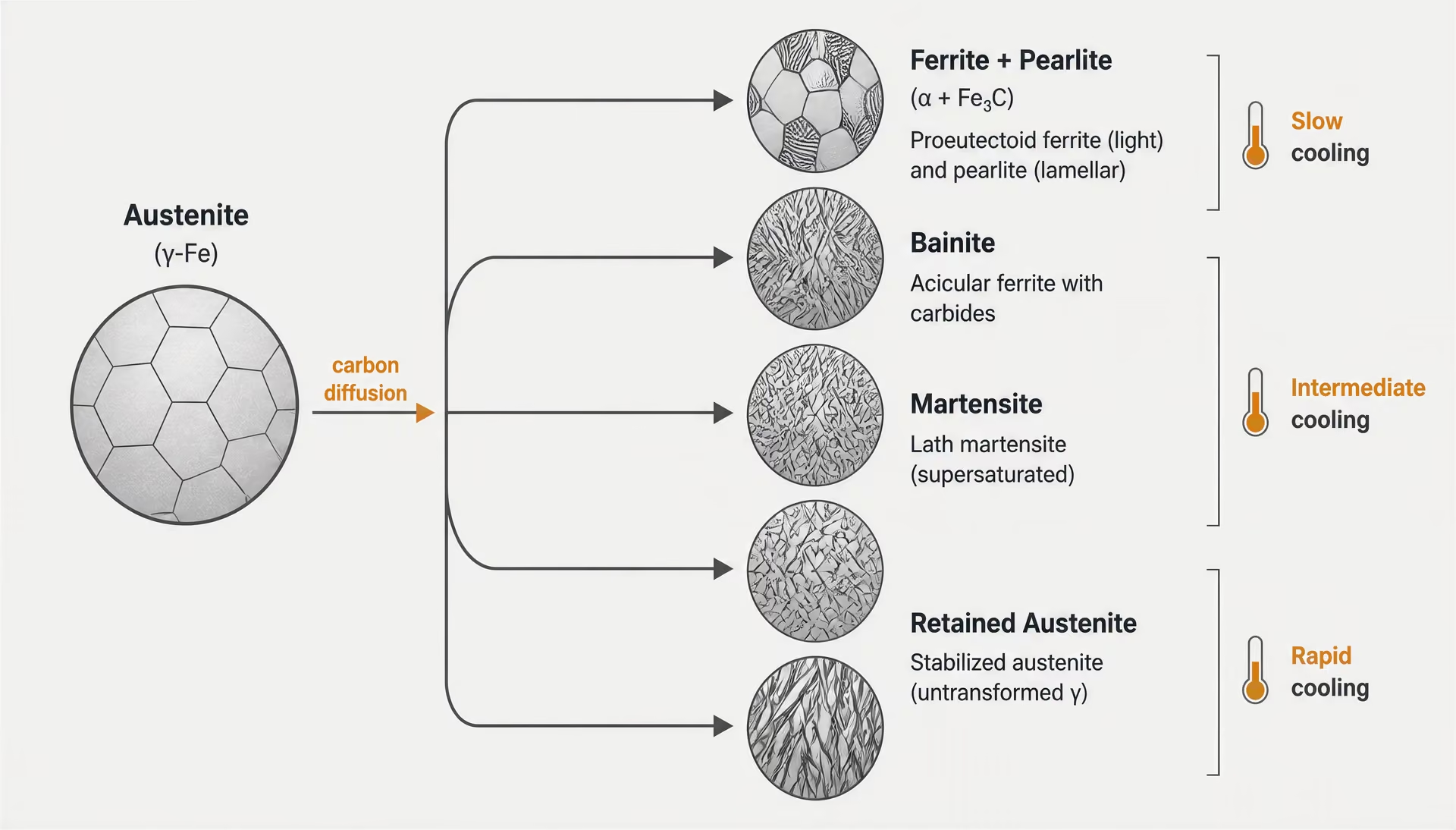
Microstructure as a record of thermal history
Heat treatment changes steel properties primarily by changing its microstructure, not by adding hardness as a separate quality. NPTEL states this process-property relationship directly in its 2024 treatment of steel heat treatment. Heating, holding, and cooling alter which phases form, how much carbon can move, and where alloying elements become concentrated. The final structure therefore records a thermal history: the condition of the steel before heating, the austenitising treatment, the time available for diffusion, the cooling path, and any later tempering or annealing.
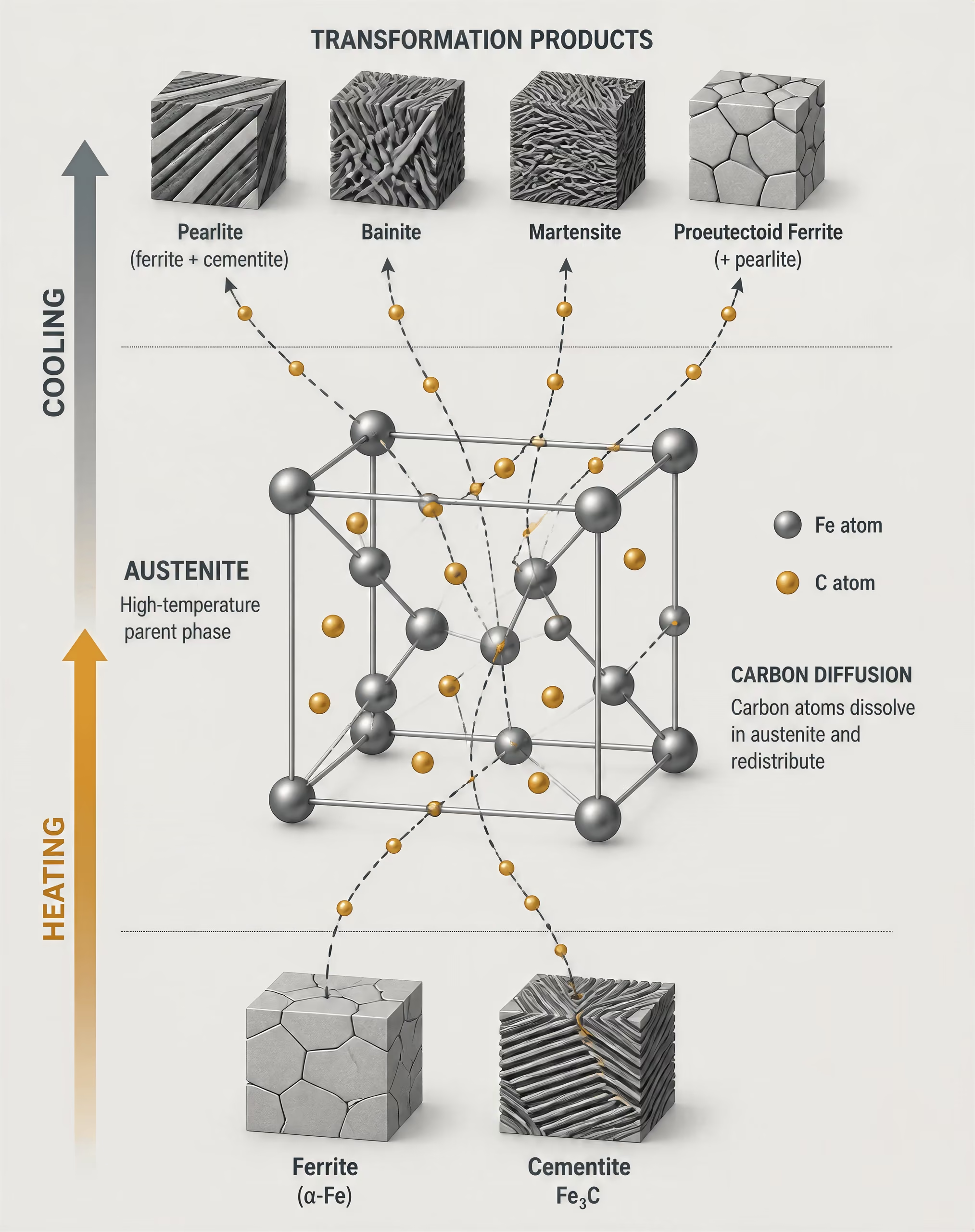
Austenite is the central parent state in this record. During heating, ferrite and cementite can transform into austenite, an iron phase capable of dissolving substantially more carbon than ferrite. This does not mean that every atom instantly reaches an even distribution. Carbon must diffuse, cementite must dissolve to the required extent, and alloying elements may slow or redirect these processes. The resulting austenite can then decompose by more than one route.
Cooling history determines which route dominates. In hypoeutectoid steel, continuous cooling commonly produces allotriomorphic ferrite plus pearlite, according to the University of Cambridge Phase Transformations Group in 2011. With a changed cooling path or greater hardenability, the structure can move toward finer pearlite, bainite, martensite, and retained austenite. These are not simply positions on a cooling-speed scale. Composition, prior austenite grain structure, carbon activity, section size, and alloying-element effects all influence the transformations.
A slow transformation gives carbon time to partition between iron-rich ferrite and iron carbide. A rapid path can suppress much of that diffusion and force a displacive transformation to martensite. Intermediate paths can produce bainite, whose formation combines ferritic transformation with carbon redistribution and carbide formation. Quenching, therefore, is not the complete explanation for a hard steel. It is one part of a sequence that determines whether austenite becomes martensite, bainite, pearlite, ferrite, or a mixture containing retained austenite.
Phases, constituents, morphology, and distribution
Phase and constituent vocabulary
- Phase
- A region with a defined crystal structure and chemical state.
- Constituent
- A recognizable structural combination that may contain more than one phase.
- Pearlite
- A ferrite-and-cementite constituent, commonly arranged as alternating lamellae.
- Bainite
- A nonlamellar ferrite–Fe3C constituent.
- Martensite
- A supersaturated transformed iron phase whose carbon content and morphology reflect the parent austenite.
- Retained austenite
- Austenite that remains after cooling rather than transforming.
A phase is a region with a defined crystal structure and chemical state, while a constituent is a recognizable structural combination that may contain more than one phase. Ferrite and cementite are phases. Pearlite is a constituent made from ferrite and cementite, commonly arranged as alternating lamellae. Bainite is also a constituent: ScienceDirect describes it as a nonlamellar ferrite–Fe3C structure. Martensite is a supersaturated, transformed iron phase whose carbon content and morphology reflect the austenite from which it formed. Retained austenite is austenite that remains after cooling rather than transforming.
The names alone do not describe the visible arrangement. Ferrite may occur as allotriomorphic grains along prior austenite boundaries or as Widmanstätten plates extending into austenite. Pearlite may be coarse, with widely spaced cementite lamellae, or fine, with much closer spacing. ScienceDirect notes that coarse pearlite formed at higher transformation temperatures is relatively soft, while finer pearlite is stronger. The distinction is morphological as well as compositional.
| Structure | Ferrite–carbide arrangement | Relative property statement |
|---|---|---|
| Upper bainite | Carbide associated mainly between ferrite units | Generally softer than lower bainite |
| Lower bainite | Finer carbide distribution within or closely associated with ferrite | Harder than upper bainite |
| Pearlite | Alternating ferrite and cementite lamellae | Fine pearlite is stronger than coarse pearlite |
Bainite likewise has more than one appearance. Upper bainite contains ferrite and carbide in an arrangement associated with transformation at the higher part of the bainitic range; lower bainite forms with a finer carbide distribution within or closely associated with ferrite. ScienceDirect states that lower bainite is harder than upper bainite. That difference cannot be read from the word “bainite” alone.
Heat treatment can also change morphology without replacing every phase. During spheroidisation, the University of Cambridge Phase Transformations Group reported in 2008, pearlitic cementite lamellae become particles. The steel still contains ferrite and cementite, but the particle arrangement changes the resistance to deformation, the cutting response, and the path available for later transformations. Distribution matters: a carbide at a grain boundary does not have the same structural effect as a finely dispersed carbide inside ferrite.
ASM International’s 2024 references identify austenite, ferrite, carbon diffusion, bainite, cementite, martensite, pearlite, and phase transformations as the fundamental subjects needed to interpret these structures. Its 2024 description defines heat-treated steel microstructures as associations of iron, carbon, and other alloying elements that form ferrite, bainite, cementite, martensite, and pearlite. The useful description is therefore “which phases and constituents are present, in what proportions, and with what morphology and distribution.”
Why hardness alone is an incomplete description
Similar hardness values can occur in steels with different phase combinations and morphologies, so hardness alone cannot identify the transformation products. Limited evidence
Hardness compresses a complicated structure into one measured response. It can indicate resistance to indentation, but it does not identify the transformation products that produced that response. Two steels can show similar hardness while containing different combinations of fine pearlite, bainite, martensite, and retained austenite. Their toughness, ductility, dimensional stability, fatigue response, and response to tempering may still differ.
Martensite often raises hardness because carbon is trapped in a strained crystal structure, but the result depends on carbon content, alloying elements, the amount of transformation, and subsequent tempering. Untempered martensite is not the same microstructure as tempered martensite. A quenched steel can also contain bainite or retained austenite if the transformation path was nonuniform or if the composition delayed transformation.
The same caution applies to softer structures. Coarse pearlite and spheroidised cementite may produce comparable hardness in some conditions while presenting different carbide shapes and different deformation mechanisms. Hardness cannot reveal whether cementite is lamellar, particulate, boundary-associated, or finely dispersed. Microscopy, diffraction, chemical analysis, and knowledge of the treatment schedule are needed to reconstruct the record.
Questions for a microstructural diagnosis
- 1. Parent condition What austenite existed before cooling, and were carbides or segregation still present?
- 2. Diffusion How much time did carbon and alloying elements have to move?
- 3. Transformation route Did ferrite, pearlite, bainite, martensite, or retained austenite form?
- 4. Morphology What are the phase proportions, shapes, spacing, and distribution?
- 5. Verification Do microscopy, diffraction, chemical analysis, and the treatment schedule support the interpretation?
The correct question after heat treatment is not simply, “How hard is the steel?” It is: what austenite existed, how did carbon and alloying elements move, which transformations occurred, and what arrangement remains? Hardness is evidence. Microstructure is the explanation.
Austenite, Ferrite, and Cementite: The Foundational Constituents
[1] Introduction to Steel Heat Treatment. ASM International. ASM Handbook, 2024.
Steel microstructures are read as arrangements of phases and constituents, not as points on a simple hard-to-soft scale. ASM International states that heat-treated steel microstructures consist of phases formed by associations of iron, carbon, and other alloying elements, including ferrite, bainite, cementite, martensite, and pearlite (ASM International, 2024). Its treatment of steel heat treatment also places austenite, ferrite, carbon diffusion, cementite, pearlite, bainite, martensite, and phase transformations in the same fundamental framework. That ordering matters: the structure present after treatment depends on what formed from austenite, how carbon moved, and which transformations were allowed to proceed.

Austenite as the high-temperature parent phase
Austenite is the face-centred-cubic form of iron that can dissolve substantially more carbon than ferrite. In ordinary heat-treatment reasoning, it is the parent phase from which several later structures develop. Heating a suitable steel into its austenitic range does not create martensite, pearlite, or bainite directly. It prepares a chemically and structurally different starting condition. Carbon and alloying elements may redistribute during this stage, while existing ferrite and cementite are dissolved to degrees governed by composition, time, temperature, and prior condition.
The phrase “parent phase” describes a transformation relationship, not a guarantee that every part of a component reaches identical austenite. Undissolved carbides, chemical segregation, grain size, and heating practice can leave local differences. The relevant phase diagram and transformation temperatures must therefore be specified for a particular composition before assigning exact treatment conditions. A general description of austenite should not be mistaken for a temperature claim about a named grade.
On cooling, austenite can follow different paths. If carbon diffuses and atoms rearrange over sufficient time, ferrite and cementite may form, commonly producing pearlite as an organized mixture of the two. Under other thermal paths, bainite can develop. If diffusion-dependent reactions are bypassed, the austenite lattice can transform by a displacive mechanism to martensite, while some austenite may remain as retained austenite. Cambridge’s Phase Transformations Group distinguishes allotriomorphic ferrite, Widmanstätten ferrite, pearlite, upper bainite, lower bainite, martensite, and cementite as separate structural descriptions. The parent austenite thus establishes the starting field, but the cooling history determines which products appear and in what morphology.
Ferrite and the role of carbon solubility
Ferrite is an iron-rich phase with a body-centred-cubic crystal structure. Its most important feature for steel transformations is its low equilibrium solubility for carbon compared with austenite. When ferrite forms from austenite, carbon cannot remain evenly dissolved at the same concentration. It must diffuse away from the advancing ferrite or collect in nearby regions that can accommodate more carbon, often contributing to cementite formation.
Carbon diffusion Movement of carbon atoms through interstitial sites in the iron lattice, enabling composition changes and diffusional transformations such as ferrite, cementite, and pearlite formation.
Carbon diffusion is the mechanism that permits these diffusional transformations. Carbon atoms move through interstitial sites in the iron lattice, while the iron-rich matrix changes crystal structure and composition. This movement is temperature- and time-dependent, although exact rates and transformation temperatures vary with composition and must be taken from the applicable phase diagram or kinetic data. Alloying elements can alter diffusion, interface movement, carbide stability, and hardenability. Consequently, two steels subjected to an apparently similar cooling schedule may form different proportions or morphologies of ferrite, pearlite, bainite, martensite, and retained austenite.
Ferrite morphology carries information about how it formed. Allotriomorphic ferrite commonly develops along prior-austenite grain boundaries, whereas Widmanstätten ferrite grows in plates or laths into the austenite grains. In continuously cooled hypoeutectoid steel, Cambridge describes the conventional outcome as allotriomorphic ferrite plus pearlite. As cooling becomes faster, or as hardenability increases, the transformation sequence can move toward finer pearlite, bainite, martensite, and retained austenite. These are not simply progressively harder versions of ferrite. They represent different carbon distributions, interfaces, crystal arrangements, and transformation mechanisms.
A ferritic matrix can also contain particles, bands, or regions created by the preceding thermal and chemical history. Reading a micrograph therefore requires more than identifying light-appearing ferrite. The analyst must ask where it formed, what rejected carbon did, and whether the surrounding constituent is pearlite, bainite, or a carbide-bearing region.
Cementite and Fe3C within transformed structures
Cementite is the iron carbide Fe₃C: three iron atoms associated stoichiometrically with one carbon atom in a distinct compound structure. It is not merely carbon dissolved in ferrite. Cementite forms when the steel’s carbon cannot remain in the low-solubility ferritic matrix and the local chemical and thermal conditions permit carbide precipitation or growth.[2] Steel Heat Treatment. ScienceDirect. ScienceDirect Topics, 2024.
Pearlite is commonly described as a cooperative, layered constituent of ferrite and cementite. The alternating lamellae provide a large interfacial area between the two phases. Transformation temperature affects the spacing: ScienceDirect identifies coarse pearlite formed at higher transformation temperatures as relatively soft, while finer pearlite is stronger. The distinction follows morphology and scale, not the presence of cementite alone.
Cementite also occurs in structures that are not pearlite. ScienceDirect describes bainite as a nonlamellar ferrite–Fe₃C structure and states that lower bainite is harder than upper bainite. In upper bainite, carbide arrangements differ from those in lower bainite, where precipitation occurs within or closely associated with ferritic plates. The exact appearance depends on composition and transformation conditions.
Heat treatment can change cementite shape without changing its chemical identity. Cambridge records that spheroidisation converts pearlitic cementite lamellae into particles (University of Cambridge Phase Transformations Group, 2008). This reduces the continuous layered geometry of pearlite and changes how the ferritic matrix is partitioned by carbide. Annealing, tempering, and other treatments can therefore alter properties by modifying particle size, spacing, and distribution. NPTEL states that heat treatments change mechanical properties primarily by changing microstructure (NPTEL, 2024). Cementite’s amount, continuity, and morphology are part of that explanation; quenching alone is not.
Pearlite: Lamellar Structure and Cooling-Dependent Scale
| Microstructure | Constituents or phases | Morphology | Relative response stated in the article |
|---|---|---|---|
| Coarse pearlite | Ferrite and cementite | Widely spaced lamellae | Relatively soft |
| Fine pearlite | Ferrite and cementite | Closely spaced lamellae | Stronger |
| Spheroidised cementite | Ferrite and cementite | Rounded cementite particles in ferrite | Generally easier to deform than lamellar pearlite |
| Bainite | Ferrite and Fe3C | Nonlamellar ferrite–carbide structure | Lower bainite is harder than upper bainite |
Pearlite is not a single phase. It is a two-phase association of ferrite and cementite, usually written as ferrite–Fe₃C, produced when austenite decomposes through a diffusion-controlled transformation. Ferrite is the relatively carbon-poor body-centred cubic iron phase; cementite is the iron carbide phase that accommodates carbon rejected from the growing ferrite. The result is a composite microstructure rather than a uniform solid solution.
That distinction matters because a quenched steel is not hard simply because it experienced rapid cooling. Hardness and strength depend on which transformations occurred, how much carbon could diffuse, the alloying elements present, and the morphology of the products. ASM International states that heat-treated steel microstructures consist of phases formed by associations of iron, carbon, and other alloying elements, including ferrite, bainite, cementite, martensite, and pearlite (2024). Pearlite therefore belongs in a sequence of transformation products that also includes bainite, martensite, and retained austenite—not on a simple soft-to-hard chart controlled by quench severity alone.
Formation of ferrite and cementite lamellae
When austenite transforms to pearlite, carbon diffusion allows ferrite and cementite to form together. Ferrite contains little carbon compared with austenite, so carbon must move away from the advancing ferrite and collect in neighbouring cementite. The two constituents grow cooperatively: ferrite plates or layers advance beside cementite plates or layers, producing a repeated lamellar arrangement.
A pearlite colony usually contains lamellae with a common orientation, while different colonies may be oriented differently. Under a microscope, the apparent spacing can vary with sectioning direction, so the measured distance is not always the true three-dimensional spacing. Even so, the scale of the lamellae gives useful evidence about the transformation history. Closely spaced lamellae provide more ferrite–cementite interface per unit distance for carbon redistribution; widely spaced lamellae indicate growth under conditions that allowed a larger diffusion length.
Continuous cooling commonly produces allotriomorphic ferrite plus pearlite in hypoeutectoid steel. Strong evidence
For hypoeutectoid steel, pearlite does not normally form alone. On continuous cooling, allotriomorphic ferrite can form first along prior-austenite grain boundaries, followed by pearlite in the remaining austenite. The University of Cambridge Phase Transformations Group describes “allotriomorphic ferrite plus pearlite” as the common product of continuous cooling in hypoeutectoid steel (2011). As cooling becomes faster, or as hardenability increases because of composition, the transformation sequence can shift toward finer pearlite, bainite, martensite, and retained austenite. The final structure may therefore contain pearlite beside proeutectoid ferrite, rather than a fully pearlitic field.
The transformation temperature controls scale because it controls the balance between nucleation, growth, and carbon diffusion. At a relatively high transformation temperature, diffusion is comparatively easy. Fewer pearlite colonies may nucleate, but each colony can grow with greater lamellar spacing. At a lower transformation temperature, diffusion is more restricted and the driving force for transformation is greater; many colonies can form, and their ferrite and cementite layers become more closely spaced. Cooling rate is a practical way to alter the transformation temperature, but it is not a complete description. Alloying elements can delay transformation, change carbon activity, and alter the temperatures and time ranges over which pearlite forms.
Coarse pearlite and fine pearlite
Coarse pearlite has relatively wide ferrite–cementite spacing. It forms when austenite transforms at higher temperatures, where carbon can diffuse over longer distances during growth. The structure is relatively soft compared with finer pearlite, as described in the ScienceDirect steel-heat-treatment reference (2024). This comparison is relational, not a universal hardness value: composition, colony size, prior austenite grain structure, section size, and subsequent treatment all affect the measured result.
Fine pearlite has closer lamellar spacing. It generally forms at a lower transformation temperature, where carbon diffusion is less extensive and the transformation produces a finer arrangement of ferrite and cementite. ScienceDirect identifies finer pearlite as stronger than coarse pearlite. The reason is morphological. Closely spaced cementite lamellae interrupt ferrite over shorter distances and present more interfaces to dislocation motion. The structure can therefore resist plastic deformation more effectively, although the response still depends on carbon content and alloying additions.
“Fine” and “coarse” describe scale, not separate chemical phases. Both structures contain ferrite and cementite, and both can coexist with other products in an actual heat-treated component. A cooling curve that passes through more than one transformation range may produce ferrite and pearlite in one region, bainite in another, or martensite where austenite survives to the martensite-start range. NPTEL states that heat treatments change mechanical properties primarily by changing microstructure (2024). Pearlite demonstrates that principle clearly: changing the transformation path can alter spacing and morphology without changing the basic ferrite-plus-cementite identity.

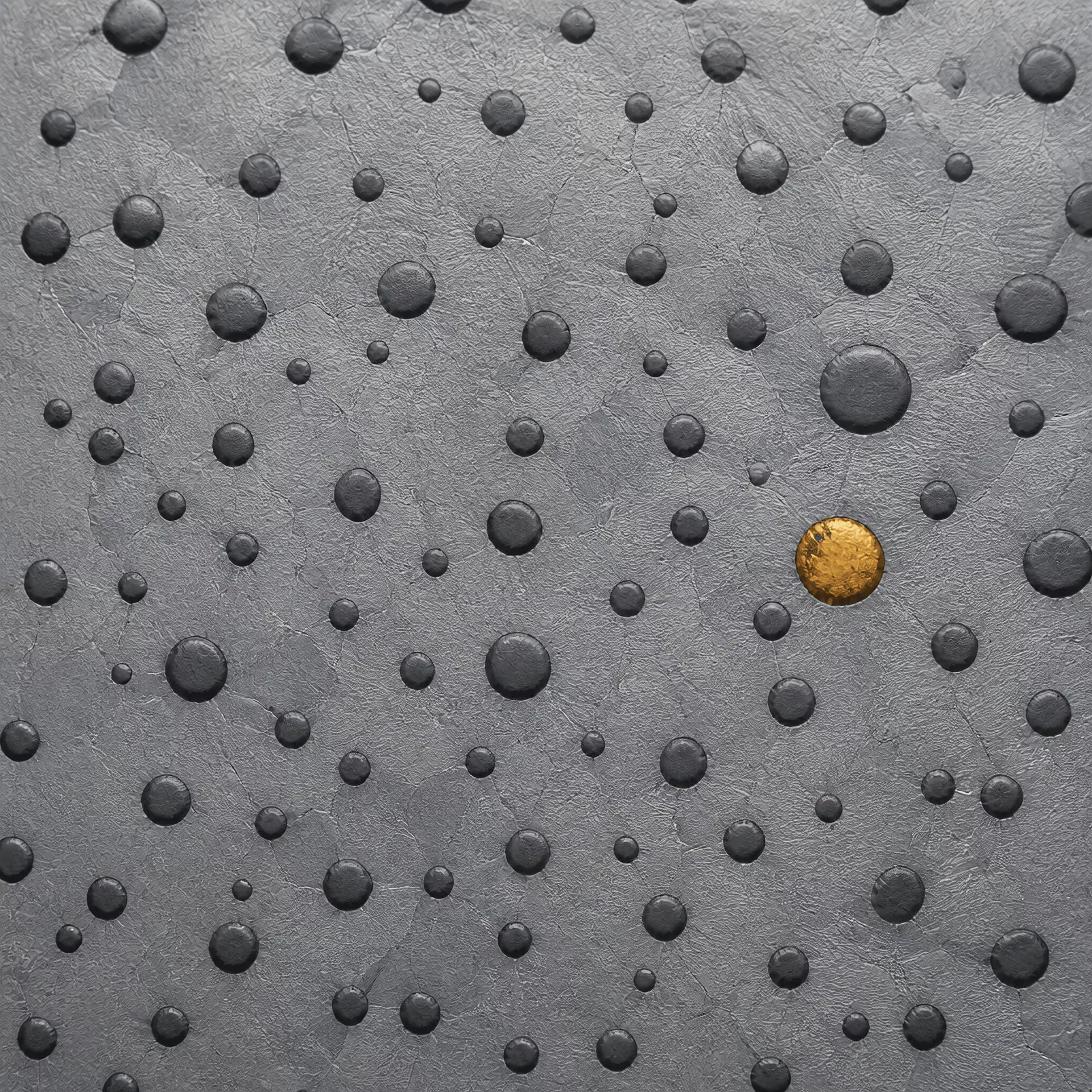
Spheroidised cementite after prolonged treatment[3] Steel Microstructure. University of Cambridge Phase Transformations Group. Phase Transformations Group reference material, 2008.
Pearlite can also lose its lamellar form. During prolonged heating below the eutectoid transformation range, or during suitable annealing cycles, cementite lamellae gradually break up and become rounded particles dispersed through a ferritic matrix. The University of Cambridge Phase Transformations Group states directly that “spheroidisation converts pearlitic cementite lamellae into particles” (2008).
This change reduces the sharp, continuous cementite interfaces characteristic of pearlite. The particles tend to coarsen with continued treatment because reducing interfacial area lowers the system’s interfacial energy. Particle size and spacing depend on the starting pearlite, temperature, time, and alloying elements; prolonged treatment does not produce one fixed morphology in every steel.
Spheroidised cementite is still cementite, and the surrounding matrix is still ferrite, but the geometry has changed from alternating plates to dispersed particles. That geometry usually makes deformation easier than in lamellar pearlite, particularly during forming or machining, yet no single hardness value follows from the word “spheroidised.” The correct interpretation requires the complete microstructure: ferrite composition, cementite volume fraction, particle size, spacing, residual pearlite, and any martensite or retained austenite left by earlier processing.
Hypoeutectoid Steel During Continuous Cooling
Hypoeutectoid steel contains less carbon than the eutectoid composition, so austenite does not transform into pearlite all at once. During cooling, the first product is normally ferrite, followed by transformation of the remaining austenite into pearlite or, at higher cooling rates, into other products. The final structure therefore records a sequence: carbon leaves the growing ferrite, the residual austenite becomes enriched in carbon, and that altered austenite later transforms according to the temperature and time available.
This sequence explains why hardness cannot be assigned directly to the act of quenching. NPTEL states that heat treatments change mechanical properties primarily by changing microstructure, while ASM International identifies austenite, ferrite, carbon diffusion, cementite, pearlite, bainite, martensite, and phase transformations as the fundamental subjects needed to interpret heat-treated steel. The cooling path determines which of those constituents forms, in what proportion, and with what morphology.
Allotriomorphic ferrite before pearlite
On cooling from the austenitic region, hypoeutectoid steel commonly begins forming allotriomorphic ferrite at prior-austenite grain boundaries. “Allotriomorphic” describes ferrite whose external shape is controlled by the surrounding austenite rather than by its own crystallographic form. It often appears as films, layers, or irregular grains along the former austenite boundaries.
Ferrite contains very little carbon compared with austenite. As it grows, carbon is rejected into the adjacent austenite. That diffusion is central to the transformation: ferrite formation makes the untransformed austenite progressively richer in carbon, moving its composition toward the eutectoid composition. The ferrite is therefore not simply a low-carbon region that appears independently of the rest of the structure. Its growth changes the chemistry of the austenite that remains.
The University of Cambridge Phase Transformations Group presents this as the clearest conventional sequence for continuously cooled hypoeutectoid steel. Allotriomorphic ferrite forms first, and the remaining austenite then transforms into pearlite. The ferrite may form a nearly continuous boundary network when the transformation proceeds sufficiently slowly, although the exact appearance depends on composition, prior-austenite grain size, and the cooling schedule.
The distinction between allotriomorphic ferrite and Widmanstätten ferrite also matters. Faster transformation conditions can produce ferrite plates or side-plates that grow into austenite, rather than the boundary-controlled morphology associated with allotriomorphic ferrite. A micrograph showing ferrite is therefore not enough to identify the cooling history; its shape and position must also be examined.
Ferrite-plus-pearlite microstructures
After proeutectoid ferrite has formed, the remaining carbon-enriched austenite commonly transforms into pearlite. Pearlite is a cooperative mixture of ferrite and cementite, Fe₃C, arranged in alternating regions or lamellae. The result is a ferrite-plus-pearlite microstructure: relatively carbon-poor ferrite occupies the proeutectoid portion, while pearlite contains the carbon that was concentrated in the residual austenite.
This is not a single fixed appearance. Pearlite formed at a relatively high transformation temperature has wider ferrite–cementite spacing and is described by ScienceDirect as coarse pearlite; it is relatively soft compared with finer pearlite. At a lower transformation temperature, diffusion distances are shorter and the lamellar spacing becomes finer. Fine pearlite is stronger because its closely spaced cementite barriers restrict dislocation motion more effectively, although its properties still depend on the complete composition and morphology.
The Cambridge reference identifies allotriomorphic ferrite plus pearlite as a common result of continuous cooling in hypoeutectoid steel. That statement describes a pathway, not a universal microstructure for every grade or cooling operation. Carbon content, manganese and other alloying elements, austenite grain size, section thickness, and the actual temperature-time history all affect the start and finish of each transformation.
Pearlite should also be distinguished from spheroidised cementite. During spheroidisation, the University of Cambridge Phase Transformations Group states that pearlitic cementite lamellae become particles. A ferrite matrix containing rounded cementite particles is thus not simply a coarse version of ordinary lamellar pearlite; it records a different treatment and a different cementite morphology.
The effect of faster cooling and hardenability
As cooling becomes faster, the steel spends less time in the temperature range where carbon can diffuse and where ferrite and pearlite can grow. The transformation may still produce ferrite and pearlite, but pearlite becomes finer and the fraction of boundary ferrite can change. With a sufficiently altered cooling path, the austenite bypasses part or all of the ferrite-plus-pearlite range.
The Cambridge continuously cooled example places finer pearlite, bainite, martensite, and retained austenite along this progression. Bainite forms as a nonlamellar mixture of ferrite and Fe₃C rather than as the alternating lamellae of pearlite. Upper bainite and lower bainite have different arrangements of ferrite and cementite; ScienceDirect identifies lower bainite as harder than upper bainite, reflecting its finer scale and different carbide distribution.
If cooling prevents diffusional transformation until the martensitic range is reached, austenite can transform to martensite by a diffusionless shear mechanism. Carbon remains trapped in the distorted iron lattice instead of partitioning into ferrite and cementite during growth. Any austenite that does not transform to martensite can remain as retained austenite. Its amount depends on composition and the cooling path, not on quenching alone.
Hardenability The ability of a steel to form harder transformation products through a section under a specified cooling condition; it is distinct from the hardness measured at one location.
Hardenability changes how far a steel can follow this faster-cooling route within a real component. Alloying elements can delay ferrite, pearlite, or bainite transformations, allowing martensite to form at positions that would transform to ferrite and pearlite in a less hardenable steel. A thick section may therefore contain different structures from its surface to its centre even when the entire part receives the same treatment.
The practical conclusion is direct: hypoeutectoid steel does not move from “soft” to “hard” as a single switch. Continuous cooling can produce allotriomorphic ferrite plus pearlite, finer pearlite, bainite, martensite, retained austenite, or mixtures of these products. The decisive evidence is the transformation sequence and the resulting morphology.
Bainite: Upper, Lower, and Nonlamellar Transformation Products
Bainite as a ferrite–Fe₃C structure
Bainite is not a single phase and should not be treated as a point on a simple hardness scale. It is a transformation product made principally from ferrite and iron carbide, Fe₃C, with its properties controlled by the arrangement, size, and distribution of those constituents. ScienceDirect’s 2024 overview of steel heat treatment defines bainite as a “nonlamellar ferrite–Fe₃C structure.” That definition separates bainite from pearlite at the morphological level: both contain ferrite and cementite, but their ferrite–cementite arrangements are different.
The ferrite in bainite forms from austenite, while carbon rejected from the growing ferrite contributes to carbide formation or redistribution in the surrounding austenite. The transformation therefore involves both the formation of ferritic regions and the movement of carbon. Alloying elements can alter carbon activity, carbide precipitation, ferrite growth, and the range over which bainite forms. The final structure is consequently determined by the transformation path, not by the fact that the steel was quenched or cooled rapidly.
This distinction fits ASM International’s 2024 description of heat-treated steel microstructures as associations of iron, carbon, and other alloying elements that form ferrite, bainite, cementite, martensite, and pearlite. Austenite is the parent structure from which several of these products develop. Cooling changes the conditions for carbon diffusion and phase transformation; the resulting product may contain more than one constituent if transformation occurs over a range of temperatures.
The term “nonlamellar” does not mean that bainite lacks a repeated internal arrangement. Bainitic ferrite commonly appears as plates, laths, or sheaves, while carbides occur between ferrite units or within them, depending on the transformation product. The interfaces and crystallographic relationships between ferrite and the prior austenite influence strength, toughness, and crack propagation. A micrograph can therefore show an organized structure without showing the regular, alternating plates associated with pearlite.
The transformation mechanism also differs from a purely long-range diffusion-controlled rearrangement. Ferrite forms with a shape change related to the austenite lattice, and carbon then redistributes by diffusion. Carbide precipitation follows the local carbon concentration and the transformation conditions. This combination of ferrite formation, lattice displacement, carbon partitioning, and carbide precipitation explains why bainite occupies a distinct position between pearlitic and martensitic products. It is neither simply pearlite made finer nor martensite with a different name.

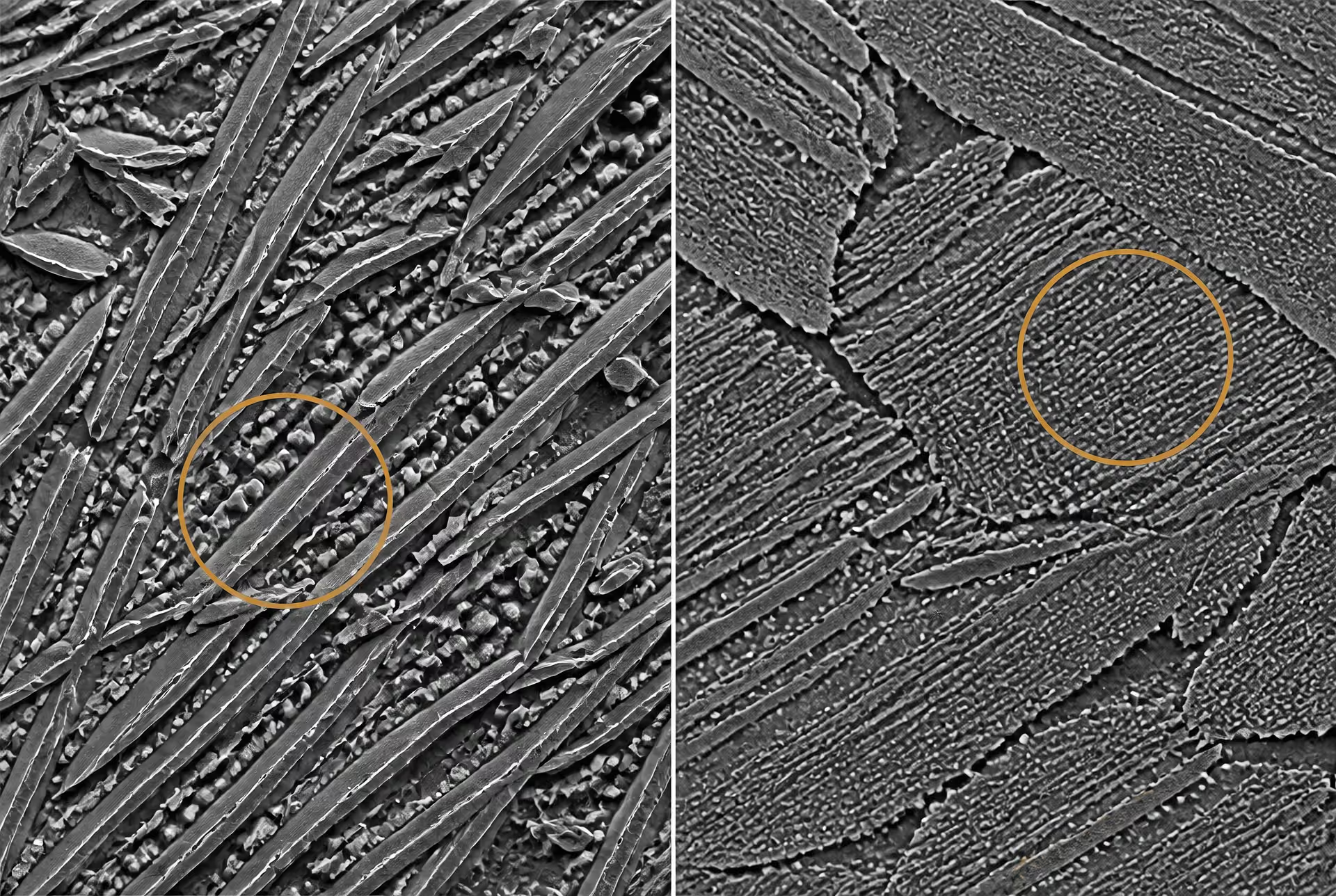
Upper bainite and lower bainite
The University of Cambridge Phase Transformations Group distinguishes “upper bainite” and “lower bainite” as separate steel microstructures. The distinction refers mainly to carbide location and morphology. In upper bainite, ferrite commonly forms as laths or plates, with cementite preferentially appearing between adjacent ferrite units. The carbide-rich regions outline parts of the ferrite aggregate. In lower bainite, carbide particles or thin carbide precipitates form within the ferrite plates as well as in associated regions. The internal precipitation pattern is finer and more closely tied to the ferrite itself.
These descriptions are morphological, but they reflect different balances between ferrite formation and carbon diffusion. At the conditions associated with upper bainite, carbon can redistribute sufficiently for carbide to form largely between ferrite laths. Under lower-bainite conditions, ferrite forms while carbon supersaturation remains significant within the ferrite, allowing carbide precipitation inside the ferritic units. The exact appearance depends on steel composition, prior-austenite grain structure, transformation history, and alloying-element effects.
Lower bainite is harder than upper bainite, according to the 2024 ScienceDirect steel-heat-treatment overview. That difference should not be presented as a mysterious consequence of “more quenching.” Finer ferrite units, internal carbide precipitation, and the resulting barriers to dislocation movement contribute to the higher hardness associated with lower bainite. Upper bainite has a different carbide arrangement and generally offers a different balance of strength and toughness. Neither label alone supplies a complete mechanical-property prediction, because mixed products and variations in scale are common.
A continuously cooled hypoeutectoid steel may not transform into one uniform constituent. Cambridge’s 2011 treatment of mixed microstructures states that continuous cooling commonly produces allotriomorphic ferrite plus pearlite, while progressively faster cooling or greater hardenability can produce finer pearlite, bainite, martensite, and retained austenite. A single specimen can therefore contain proeutectoid ferrite, pearlite, upper bainite, lower bainite, martensite, or retained austenite in different regions. The transformation sequence matters as much as the nominal heat-treatment name.
Why bainite must not be described as fine pearlite
Calling bainite “fine pearlite” is incorrect because it confuses composition with structure. Both products may contain ferrite and Fe₃C, but pearlite is defined by a lamellar arrangement: alternating ferrite and cementite plates produced during the eutectoid transformation. Bainite is defined by a nonlamellar arrangement of ferrite and cementite. Refining pearlite reduces lamellar spacing; it does not convert those lamellae into bainitic ferrite plates and carbide distributions.
ScienceDirect’s 2024 overview makes the contrast directly: coarse pearlite formed at higher transformation temperatures is relatively soft, finer pearlite is stronger, bainite is a nonlamellar ferrite–Fe₃C structure, and lower bainite is harder than upper bainite. The first two statements describe scale within one morphology. The latter statements identify a different morphology and then distinguish two forms of bainite. Hardness changes in both cases, but the structural reason is not the same.
The distinction also survives later heat treatment. Cambridge reported in 2008 that spheroidisation converts pearlitic cementite lamellae into particles. That treatment changes pearlite’s carbide morphology, yet the product remains a spheroidised pearlitic structure rather than bainite. Conversely, tempering a martensitic structure produces carbide precipitation within a ferritic matrix, but that does not retroactively make the structure bainite. Names describe the transformation history and morphology, not only the elements present.
NPTEL stated in 2024 that heat treatments change mechanical properties primarily by changing microstructure. Bainite demonstrates why this principle matters. Its hardness depends on whether the product is upper or lower bainite, on ferrite-unit size, on carbide position and scale, on alloying elements, and on any adjacent martensite, pearlite, ferrite, or retained austenite. Quenching is only part of the history. The decisive evidence is the structure left by phase transformation and carbon redistribution.
Martensite and Retained Austenite After Rapid Cooling
Martensite as a rapid-cooling product
Martensite forms when austenite is cooled quickly enough that the diffusional reactions producing ferrite, cementite, pearlite, or bainite cannot consume all of it first. Carbon therefore remains associated with the transforming iron lattice rather than partitioning fully into cementite or diffusing away. The result is a supersaturated transformation product whose structure and morphology depend on carbon content, alloying elements, prior austenite grain structure, and the thermal path.
This is not the same as saying that “quenching creates hardness” as a direct physical effect. Quenching changes the time available for atoms to move and for competing phases to form. The resulting martensite can raise hardness because its carbon-containing structure resists plastic deformation, but the final property depends on how much martensite formed, what other constituents remain, and whether the steel was later tempered. A quenched component can contain martensite alongside bainite, pearlite, ferrite, or retained austenite.
The University of Cambridge Phase Transformations Group places martensite within a progression of products obtained from continuously cooled hypoeutectoid steel. At relatively slow cooling or low hardenability, the structure commonly begins with allotriomorphic ferrite and pearlite. With faster cooling or greater hardenability, the products move toward finer pearlite, bainite, martensite, and retained austenite. This progression describes competing transformation paths, not a switch that automatically converts every part of a section into one constituent.
Alloying elements affect that competition by changing the kinetics of diffusional transformations and by altering the hardenability of the steel. Section thickness matters for the same reason: the surface and core may follow different cooling paths. A surface can reach a martensitic condition while the interior spends enough time in a ferrite, pearlite, or bainite-forming range. Even within one prior-austenite grain, local composition and thermal history can influence the transformation sequence.
The NPTEL heat-treatment framework connects this sequence to engineering properties: “Heat treatments change mechanical properties primarily by changing microstructure” (NPTEL, 2024). Quenching is discussed as a hardening treatment because it favors a martensite-containing structure; tempering then changes that structure and its carbon distribution. The process label is therefore incomplete without the resulting phases. “Quenched” identifies a thermal treatment, not a guaranteed microstructural diagnosis.

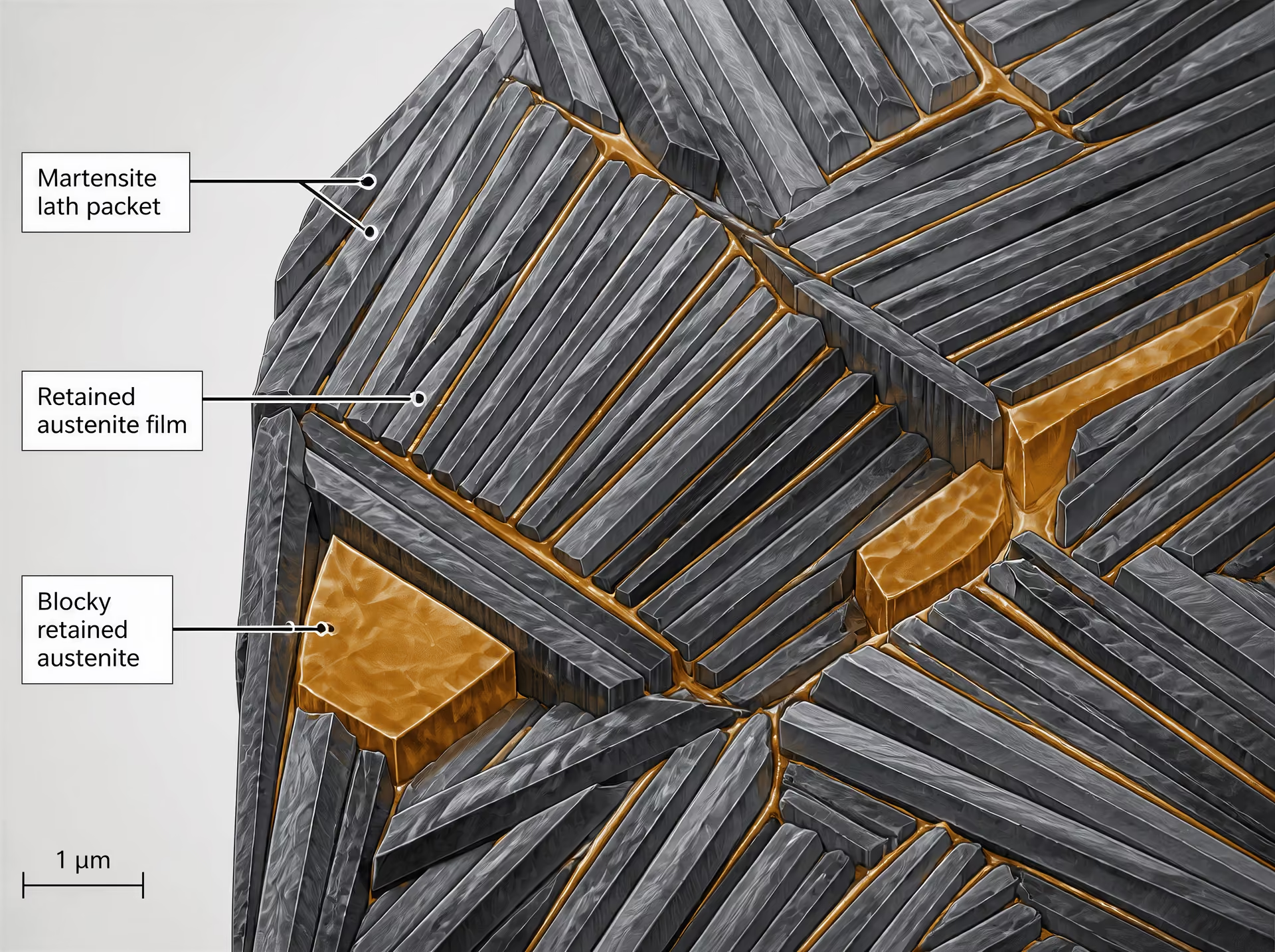
Retained austenite in continuously cooled steel
Retained austenite is the portion of austenite that remains after cooling instead of transforming into martensite or another product. It is not simply untransformed material waiting for the quench to finish. Its persistence reflects the steel’s composition, the prior austenite condition, the cooling path, and the extent to which other transformations have already consumed or altered the austenite.
Carbon enrichment is one important route to its stability. When ferrite, bainite, or other products form, carbon may be rejected into the austenite that remains. Alloying elements can also change transformation kinetics and the stability of austenite. Consequently, a continuously cooled steel may contain martensite formed from one portion of the austenite while another portion survives as retained austenite.
The Cambridge reference specifically includes retained austenite among the possible products in faster-cooled or more hardenable hypoeutectoid steel. That point matters because a steel can be strongly affected by rapid cooling without becoming fully martensitic. A micrograph may show a predominantly martensitic matrix with small amounts of retained austenite, or a mixture containing ferrite, bainite, and martensite where the retained austenite is concentrated between transformed regions.
Retained austenite also makes the word “hardness” an inadequate summary of the structure. Austenite is generally more deformable than martensite, but its presence does not produce one fixed hardness value independent of composition and morphology. It may transform during subsequent mechanical loading, cooling, or tempering, changing dimensions and internal stresses. The amount and distribution matter as much as its name. Thin films between bainitic or martensitic regions do not have the same structural effect as larger islands.
The proper interpretation is therefore phase-based. Identify how much austenite transformed, which products formed first, where carbon moved, and which constituents remain after cooling. ASM International’s 2024 treatment describes heat-treated steel microstructures as associations of iron, carbon, and other alloying elements forming ferrite, bainite, cementite, martensite, and pearlite. Austenite, carbon diffusion, and phase transformations provide the framework for understanding why retained austenite appears.
Why quenching does not guarantee a single-phase result
A quench is a cooling operation with a particular severity and thermal history, not a promise of a single phase. The required cooling path depends on steel composition and section geometry. If any region cools slowly enough for ferrite, pearlite, or bainite to form before martensite can develop, those products remain after the quench. If some austenite does not transform during the available cooling path, retained austenite remains as well.
This is why a quenched hypoeutectoid steel may contain allotriomorphic ferrite plus martensite, bainite plus martensite, or martensite plus retained austenite. In another location, especially toward a slower-cooled core, pearlite may coexist with bainite and ferrite. The final structure records the route through transformation fields rather than the name of the furnace operation.
Cooling rate alone also does not explain every result. Carbon and alloying elements alter diffusion, phase stability, and hardenability. Prior austenite grain size, austenitizing practice, surface condition, and section thickness affect the available transformation paths. A quench can suppress some diffusional reactions without suppressing all of them. The consequence is often a mixed constituent structure.
ScienceDirect’s 2024 steel-heat-treatment overview illustrates why these distinctions matter: coarse pearlite formed at higher transformation temperatures is relatively soft, finer pearlite is stronger, bainite is a nonlamellar ferrite–Fe3C structure, and lower bainite is harder than upper bainite. Martensite is only one member of this family. The final mechanical response follows the association, scale, and distribution of the products, not the cooling label by itself.
A sound microstructural description should therefore state the constituents actually present. “Quenched steel” may be a useful processing history; it is not enough as a phase description. Reference to martensite should be accompanied by the possible presence of retained austenite and other transformation products. That distinction prevents the common error of treating rapid cooling as a guaranteed single-phase hardening mechanism.
How Heat-Treatment Routes Rearrange Microstructure
| Treatment route | Intended classification | Microstructural action described |
|---|---|---|
| Quenching | Hardening treatment | Suppresses much diffusional transformation and favors martensite formation |
| Carburizing | Hardening treatment | Adds carbon to the surface before final hardening, creating a carbon gradient |
| Tempering | Softening treatment | Allows carbon redistribution and carbide formation after quenching |
| Annealing | Softening treatment | Provides time for carbon partitioning and controlled transformation |
| Stress relieving | Stress-reduction treatment | Relaxes residual stresses while aiming to avoid major phase replacement |
NPTEL classifies the principal steel heat-treatment routes by their intended effect: quenching and carburizing are hardening treatments, while tempering, annealing, and stress relieving are softening treatments. That division is useful, but “hardening” and “softening” describe the result only indirectly. The decisive event is the rearrangement of phases and carbon. NPTEL states in 2024 that heat treatments change mechanical properties primarily by changing microstructure. ASM International makes the same framework more specific: heat-treated steel contains phases formed by associations of iron, carbon, and alloying elements, including ferrite, bainite, cementite, martensite, and pearlite.
A treatment therefore does not create hardness as a standalone property. It changes austenite into a selected mixture of transformation products, or changes the shape, spacing, and distribution of phases already present. Cooling rate, carbon content, alloying additions, and section size determine which transformations can proceed before the steel reaches a lower-temperature state.
Quenching and carburizing as hardening treatments
Quenching aims to suppress diffusional transformations while austenite cools. During slower cooling, carbon can move through the iron lattice, allowing ferrite and cementite to form as pearlite, or permitting bainitic ferrite and cementite to develop. A sufficiently rapid quench interrupts much of that redistribution. The austenite then transforms by a diffusionless shear mechanism into martensite, whose carbon-supersaturated lattice is highly strained.
This is why quenching is not accurately described as “cooling steel to make it hard.” The resulting structure may contain martensite, but it can also contain untransformed retained austenite and, where cooling or hardenability is insufficient, bainite or pearlite. Alloying elements alter hardenability by changing transformation kinetics; they do not simply add hardness in isolation. A hypoeutectoid steel that cools continuously can produce allotriomorphic ferrite plus pearlite, as the University of Cambridge Phase Transformations Group reported in 2011. With faster cooling or greater hardenability, the sequence shifts toward finer pearlite, bainite, martensite, and retained austenite.
Carburizing changes the carbon distribution before the final hardening step. Carbon diffuses into the surface of a low-carbon steel, creating a carbon-enriched case and a lower-carbon interior. The subsequent quench transforms the case toward high-carbon martensite, while the core follows the transformation behavior permitted by its original composition and the applied cooling path. The important microstructural feature is the carbon gradient: case and core do not begin with the same austenite chemistry, so they need not form identical products.
Carburizing is thus a diffusion-enabled preparation followed by rapid transformation suppression. Carbon diffusion is central during enrichment, but limited during quenching. The treatment is not equivalent to quenching a uniformly carbon-rich material, and the final structure should be examined across the section rather than inferred from a surface hardness value.
Tempering after a hardened structure
Tempering belongs to NPTEL’s softening-treatment group because it reduces the extreme strain and brittleness associated with as-quenched martensite. It does not simply erase the hardened structure. Instead, carbon redistributes from the supersaturated martensitic lattice, and carbide phases form or become more stable as the structure moves toward tempered martensite.
The exact products depend on the steel’s carbon and alloy content and on the tempering conditions, so a single universal tempering microstructure does not exist. In broad terms, the treatment reduces lattice distortion, changes the morphology and distribution of carbides, and allows retained austenite to decompose or transform in some steels. The result is commonly a ferritic matrix containing finely dispersed carbides rather than the carbon-supersaturated martensite produced directly by quenching.
That change explains why tempering can lower as-quenched hardness while improving resistance to cracking and impact damage. The relevant contrast is between trapped carbon and redistributed carbon. Quenching leaves carbon in a strained martensitic arrangement; tempering gives carbon a path toward carbide formation and chemical partitioning. A quenched-and-tempered steel is therefore not “quenched steel with less hardness,” but a different association of matrix and carbide phases.
Retained austenite also matters. If it remains after quenching, later tempering can alter its stability, and its transformation may affect dimensional consistency and the final phase mixture. The outcome must therefore be interpreted from the whole sequence: austenitization, quenching, retained austenite, and tempering—not from the tempering operation alone.
Annealing and stress relieving
Annealing uses diffusion and controlled cooling to move steel toward a lower-energy, more chemically redistributed structure. Compared with quenching, it gives carbon more opportunity to partition between ferrite and cementite. Depending on composition and the prior condition, the products may include ferrite with coarse pearlite, finer pearlite, or spheroidized cementite particles in a ferritic matrix.
Transformation temperature affects morphology. ScienceDirect’s 2024 steel-heat-treatment overview distinguishes relatively soft coarse pearlite formed at higher transformation temperatures from stronger fine pearlite. It also identifies bainite as a nonlamellar ferrite–Fe3C structure and lower bainite as harder than upper bainite. These distinctions show why “annealed” is not a complete microstructural description: the spacing of cementite, the ferrite grain structure, and any remaining bainite or martensite still matter.
Spheroidization is a particularly clear diffusion-controlled change. The University of Cambridge Phase Transformations Group stated in 2008 that spheroidization converts pearlitic cementite lamellae into particles. Continuous cementite plates become rounded particles, reducing the interfacial geometry between ferrite and cementite. The steel may consequently become easier to deform, but the central event is morphological coarsening and redistribution, not an unexplained loss of hardness.
Stress relieving occupies a narrower position. It is intended primarily to reduce residual stresses from welding, machining, forming, or uneven cooling without deliberately replacing the principal phase constitution. Atomic diffusion allows local stresses to relax, while the treatment remains below the range where a major transformation is intended. If conditions are excessive, however, recovery, tempering, precipitation, or phase transformation can occur. Stress relief is therefore not a phase-neutral guarantee; its microstructural effect depends on the steel and the thermal exposure.
Across all three routes, the governing contrast is clear: quenching restricts diffusion and preserves a strained transformation product, whereas tempering, annealing, and stress relieving provide varying degrees of time for carbon redistribution, carbide rearrangement, recovery, or coarsening.
Reading Mixed Microstructures in Metallography
A heat-treated steel section rarely contains one perfectly uniform constituent. A hypoeutectoid steel cooled continuously from austenite may show allotriomorphic ferrite at prior-austenite grain boundaries, pearlite in the remaining regions, and smaller areas of bainite or martensite where local cooling conditions differed. The correct interpretation begins with transformation history, not with a hardness label. NPTEL states that heat treatments change mechanical properties primarily by changing microstructure; hardness is therefore an outcome of structure, composition, and morphology rather than a visual phase name.
Recognising ferrite, pearlite, bainite, and martensite together
Metallographic reading sequence
- Map the regions Record matrices, boundary decoration, colonies, packets, laths, needles, and particles before assigning constituents.
- Inspect at higher magnification Look for pearlitic lamellae, bainitic carbide arrangements, martensite packets, and cementite particles.
- Separate observation from interpretation Describe what is visible before naming the phase or constituent.
- Check the treatment history Relate morphology to austenitising, cooling, diffusion, transformation interruption, and later tempering or annealing.
Begin at low magnification. Record the distribution of regions before assigning individual constituents. Look for a continuous matrix, boundary decoration, colonies, packets, needles, laths, and isolated particles. Then increase magnification and inspect the internal structure of each region.
Ferrite is usually the least strongly etched constituent in a conventionally prepared carbon-steel specimen. Allotriomorphic ferrite commonly forms first along prior-austenite grain boundaries in hypoeutectoid steel, producing relatively smooth, polygonal or irregular boundary films. It may also occur as larger equiaxed regions. Widmanstätten ferrite has a different appearance: it grows as plates or side-plates from austenite grain boundaries into the austenite grains. Plate-like appearance alone, however, does not prove that the constituent is Widmanstätten ferrite.
Pearlite is recognised by colonies containing alternating ferrite and cementite. At low magnification, a colony may appear as a dark island; at higher magnification, suitably oriented lamellae can be resolved. Other colonies may remain dark because their lamellae lie nearly parallel to the viewing direction or because the etching contrast is weak. Coarse pearlite generally records transformation at a higher temperature than fine pearlite. ScienceDirect describes coarse pearlite as relatively soft and fine pearlite as stronger, but the observed contrast still depends on polishing, etching, section orientation, and alloy chemistry.
Bainite occupies an intermediate interpretive position because its ferrite–cementite arrangement is not lamellar in the pearlitic sense. Upper bainite commonly presents groups of ferrite laths or plates with cementite between them, whereas lower bainite contains finer carbide arrangements within or near the ferrite plates. Lower bainite is harder than upper bainite, according to the ScienceDirect steel-heat-treatment reference. Do not call every dark acicular region bainite: untempered martensite, lower bainite, and heavily etched pearlite can overlap in appearance.
Martensite is commonly lath-shaped in many low- and medium-carbon steels and plate-shaped in some higher-carbon or alloyed steels. Lath packets and blocky regions may be visible, but optical microscopy often cannot establish the distinction securely. Martensite can also be mixed with ferrite, bainite, carbides, and retained austenite, especially when hardenability, section size, or cooling is nonuniform. A dark constituent at a prior-austenite grain boundary is not automatically martensite; boundary ferrite and carbide films can produce similar contrast.
This is why the Cambridge Phase Transformations Group describes continuous cooling in hypoeutectoid steel as commonly producing allotriomorphic ferrite plus pearlite, with progressively different mixtures involving finer pearlite, bainite, martensite, and retained austenite as cooling becomes faster or hardenability increases. The sequence is a useful framework, not a substitute for examination.
Morphology versus phase identification
Morphology describes shape and arrangement. Phase identification establishes what the region is. The two tasks overlap, but they are not interchangeable.
Use morphology to formulate a hypothesis. A boundary film suggests allotriomorphic ferrite; parallel plates suggest Widmanstätten ferrite; colonies suggest pearlite; lath groups suggest bainite or martensite. Next test that hypothesis against chemistry and crystallography. Selective etching, polarized light where appropriate, scanning electron microscopy, electron backscatter diffraction, transmission electron microscopy, or X-ray diffraction can supply evidence that optical appearance cannot.
Preparation can change the apparent answer. Over-etching broadens boundaries and darkens fine constituents. Poor polishing may pull out cementite or leave deformation that resembles martensite. Section orientation can hide pearlite lamellae, while a two-dimensional cut through a three-dimensional lath structure can make bainite appear granular. Magnification also matters: a region that looks homogeneous at 200× may resolve into ferrite and cementite at 5,000×.
A disciplined report should therefore separate observation from interpretation: “dark colonies with partially resolved lamellae” is an observation; “pearlite” is an interpretation supported by that observation and, where necessary, by higher-resolution or analytical evidence. ASM International’s 2024 treatment places austenite, ferrite, carbon diffusion, bainite, cementite, martensite, pearlite, and phase transformations in the same interpretive framework. That is a reminder that no single visual feature carries the whole diagnosis.
Retained austenite and cementite morphology
Retained austenite is austenite that remains after cooling rather than transforming completely. In a martensitic structure it may appear as thin films between laths, blocky islands between packets, or irregular regions near carbon-enriched areas. Contrast varies greatly with etchant and imaging mode, so a pale region between martensite laths should not be identified as retained austenite from appearance alone. X-ray diffraction, EBSD, or carefully validated metallographic methods may be needed.
Cementite, Fe₃C, is equally important because its shape records how carbon was redistributed. In pearlite it forms lamellae with ferrite. In bainite it occurs as discrete particles or films associated with ferrite plates, although the arrangement differs between upper and lower bainite. In spheroidised steel, the cementite lamellae of pearlite have changed into rounded particles. The Cambridge Phase Transformations Group explicitly states in 2008 that spheroidisation converts pearlitic cementite lamellae into particles.
Finally, relate every observed constituent to the thermal path: austenitising condition, carbon diffusion, cooling continuity, transformation interruption, and any subsequent tempering or annealing. A mixed image is not a failed treatment by definition. It is a record of where transformations started, stopped, or proceeded at different rates.
From Microstructure to Mechanical Properties
Strength, hardness, and transformation morphology
Mechanical properties develop from the structure produced during transformation, not from the word quench alone. NPTEL states in 2024 that “heat treatments change mechanical properties primarily by changing microstructure.” Quenching changes the thermal path from austenite, but the resulting hardness depends on which transformations occur, how much of each constituent forms, and how those constituents are arranged.
ASM International describes heat-treated steel microstructures as associations of iron, carbon, and alloying elements that form ferrite, bainite, cementite, martensite, and pearlite. Austenite is the parent phase for many treatments, while carbon diffusion and the competition between transformation mechanisms determine the products that replace it. A slowly or moderately cooled hypoeutectoid steel may contain allotriomorphic ferrite and pearlite; a faster path can produce finer pearlite, bainite, martensite, or retained austenite, depending on composition and hardenability. The University of Cambridge Phase Transformations Group described this progression for continuously cooled hypoeutectoid steel in 2011.
The morphology matters as much as the phase name. Ferrite grains, cementite particles, pearlite colonies, bainitic ferrite plates, martensite packets, and retained-austenite regions do not resist deformation in the same way or distribute stress in the same way. A steel containing a small martensite fraction in a ferritic matrix is not mechanically equivalent to one containing mostly martensite with isolated ferrite. Both may be described as “martensitic steel,” but their strength, hardness, ductility, and fracture response can differ substantially.
Martensite commonly raises hardness because carbon is trapped in a supersaturated, distorted iron lattice during the diffusionless austenite-to-martensite transformation. That description still does not provide a universal hardness value. Carbon content, prior-austenite grain size, alloying elements, quench severity, section size, tempering, and retained austenite all affect the result. Tempering then changes the martensitic structure by allowing carbon redistribution and carbide formation, usually reducing as-quenched hardness while improving dimensional stability and toughness.
Retained austenite also complicates a simple hardness ranking. It is softer than untempered martensite in many hardened steels, but it can transform during service or testing, changing dimensions and local stress. Cementite morphology matters too. Cambridge’s 2008 reference states that spheroidisation converts pearlitic cementite lamellae into particles. The resulting ferrite–cementite arrangement generally deforms differently from lamellar pearlite, so “pearlite” alone is not a sufficient description of the mechanical condition.
The role of pearlite scale and bainite type
Pearlite consists of ferrite and cementite formed together, commonly as alternating lamellae. Its strength is strongly affected by pearlite scale, meaning the spacing and fineness of those lamellae and the size of the pearlite colonies. ScienceDirect’s 2024 steel-heat-treatment overview identifies coarse pearlite formed at higher transformation temperatures as relatively soft and finer pearlite as stronger. Closely spaced cementite lamellae obstruct dislocation motion more effectively than widely spaced lamellae, while fine colonies also reduce the distance over which deformation can concentrate.
This does not mean that every fine pearlitic steel has the same strength. The ferrite chemistry, carbon content, colony size, fraction of pearlite, and any accompanying proeutectoid ferrite remain important. A hypoeutectoid structure with abundant ferrite and fine pearlite can be weaker than a higher-carbon structure containing a larger pearlite fraction, even when both contain “fine pearlite.” The distribution is decisive: continuous ferrite regions, banded constituents, and isolated colonies produce different deformation paths.[4] Steel Heat Treatment. ScienceDirect. ScienceDirect Topics, 2024.
Bainite requires the same care. ScienceDirect describes bainite as a nonlamellar ferrite–Fe3C structure and states that lower bainite is harder than upper bainite. Upper bainite generally contains ferrite formed in a sheaf-like arrangement with cementite between ferrite regions, whereas lower bainite forms at a lower transformation range and places fine carbide within or closely associated with the ferrite plates. The finer carbide distribution makes lower bainite more resistant to dislocation motion.
A label such as “bainitic” therefore leaves critical information unstated. The upper-to-lower bainite distinction, carbide size and position, ferrite morphology, constituent fraction, and presence of martensite or retained austenite all affect measured properties. Mixed structures are common after continuous cooling, particularly when different parts of a section follow different thermal histories. A surface may contain martensite while the interior contains bainite, pearlite, or ferrite. Hardness then varies with depth rather than taking one value for the whole component.
Why composition and hardenability remain essential
Composition controls both the available transformation products and the temperatures and times at which they form. Carbon affects the stability of austenite, the amount of cementite that can develop, and the hardness potential of martensite. Alloying elements alter transformation kinetics, carbide formation, diffusion, and hardenability. Hardenability is not the same as hardness: it describes the ability of a steel to form harder transformation products through a section under a specified cooling condition.
Section size makes that distinction practical. A small section may cool rapidly throughout, while a large section develops a slower interior cooling path. The same composition and furnace schedule can therefore produce martensite near a surface but pearlite or bainite at the center. Quenching medium, agitation, austenitising treatment, transfer time, and tempering schedule add further variation.
For that reason, no universal property value can be assigned to ferrite, pearlite, bainite, martensite, or a named heat treatment without specifying composition, section size, treatment schedule, and test method. Hardness measured by Vickers, Brinell, or Rockwell is not interchangeable without care, and a hardness result does not fully predict toughness, ductility, fatigue performance, or fracture behavior. The defensible interpretation begins with the complete microstructure: constituent fractions, morphology, scale, distribution, and transformation history. Quenching is only one event in that sequence.
A Practical Reference Sequence for Steel Heat-Treatment Analysis
Start with steel composition and initial condition
Begin with the material identity, not the measured hardness. Record the grade designation exactly as supplied, the governing standard, and the heat or product form when known. A statement such as “AISI/SAE 1045, normalized” conveys more than “medium-hard steel”; a statement such as “ASTM A36” identifies a specification, but does not by itself establish the prior thermal history or the final microstructure. Chemical analysis should include carbon, manganese, silicon, chromium, molybdenum, nickel, vanadium, and other deliberate additions, along with residual elements where they may affect transformation.
Carbon content determines whether a plain-carbon steel is hypoeutectoid, eutectoid, or hypereutectoid relative to the eutectoid composition. For a hypoeutectoid steel, cooling from austenite commonly permits proeutectoid ferrite to form before the remaining austenite transforms to pearlite. That distinction matters: ferrite plus pearlite is not the same structure as pearlite alone, even when both samples receive similar hardness readings.
The starting condition must also be recorded. As-received, hot-rolled, normalized, annealed, quenched and tempered, carburized, and cold-worked conditions carry different grain sizes, carbide distributions, residual stresses, and prior-austenite histories. Spheroidized steel is a particularly important case. The University of Cambridge Phase Transformations Group stated in 2008 that spheroidisation converts pearlitic cementite lamellae into particles. The nominal constituents remain ferrite and cementite, but their geometry changes the response to later heating, deformation, and hardening.
Grain size and segregation deserve a place in the record. A coarse prior-austenite grain structure can promote different transformation morphologies from a fine one, while banding may produce direction-dependent ferrite, pearlite, or martensite distributions. “Ferrite” is therefore an incomplete observation unless its location and shape are also described.
Reconstruct the heating and cooling path
Next, reconstruct the thermal route as a sequence rather than assigning a treatment name. Record the starting temperature, heating rate where available, austenitizing temperature and hold time, furnace or atmosphere condition, transfer time, quench medium, agitation, cooling interruptions, and any reheating or tempering step. “Quenched” describes an operation; it does not prove that the entire section became martensitic.
Ask first what phases existed during heating. Annealing or normalizing may dissolve some cementite and produce austenite, whereas an intercritical treatment can leave ferrite undissolved. Carburizing changes the carbon profile, so the surface and core follow different transformation paths during cooling. Decarburization can produce the opposite gradient. A single hardness value may conceal both conditions.
Then identify the likely transformation window. Carbon diffusion permits ferrite and cementite redistribution during diffusional transformations. At higher transformation temperatures, pearlite generally has coarser spacing; ScienceDirect’s 2024 steel-heat-treatment overview describes coarse pearlite as relatively soft and finer pearlite as stronger. The same source defines bainite as a nonlamellar ferrite–Fe3C structure and states that lower bainite is harder than upper bainite. These are morphological and transformational distinctions, not merely points on a hardness scale.
Cooling rate, section thickness, alloying elements, and prior-austenite grain size control which transformations can occur before the steel reaches lower temperatures. Chromium, molybdenum, manganese, and nickel can alter diffusion, transformation timing, and hardenability. Faster cooling may suppress diffusional ferrite and pearlite and permit bainite or martensite, but the result can remain mixed because cooling is rarely identical throughout a component. Retained austenite may persist when transformation is incomplete.
The Cambridge Phase Transformations Group reported in 2011 that continuous cooling commonly produces allotriomorphic ferrite plus pearlite in hypoeutectoid steel. With faster cooling or greater hardenability, the sequence can shift toward finer pearlite, bainite, martensite, and retained austenite. This sequence is a useful interpretive framework, not a substitute for the actual thermal record or microscopy.
Report constituents and morphology precisely
Separate the constituent name from its morphology. Report “proeutectoid allotriomorphic ferrite,” “pearlite colonies with fine interlamellar spacing,” “upper bainite,” “lower bainite,” “lath martensite,” “plate martensite,” “retained austenite,” or “spheroidized cementite particles” when the evidence supports those descriptions. Do not compress all dark-etching regions into “pearlite,” and do not label every acicular region “martensite.”
Ferrite may occur as allotriomorphic grains along prior-austenite boundaries or as Widmanstätten plates. Cementite may appear as pearlitic lamellae, bainitic particles, spheroidized particles, or undissolved carbides. Martensite may be lath-shaped or plate-shaped, and its appearance can be altered by tempering. Bainite should be identified by its ferrite–carbide arrangement and transformation context, not by shape alone.
Use microscopy methods appropriate to the question. Optical microscopy can reveal constituent distribution and pearlite colony structure; scanning electron microscopy can resolve finer carbide arrangements; hardness testing and diffraction can support, but not replace, metallographic identification. If retained austenite is suspected, state how it was assessed. Avoid claiming a single phase when the image shows a transformation mixture.
A repeatable workflow follows: establish composition and whether the steel is hypoeutectoid where relevant; document the initial condition; reconstruct heating, austenitizing, cooling, quenching, and tempering; consider diffusion, alloying effects, section size, and cooling rate; identify the resulting constituents; then report morphology separately from nominal phase names. ASM International’s 2024 description is the correct correction to hardness-first thinking: heat-treated steel microstructures are associations of iron, carbon, and alloying elements forming ferrite, bainite, cementite, martensite, and pearlite. Steel after treatment is usually a transformation history recorded in a mixed microstructure, not a single hardness category.
References
- [1] Introduction to Steel Heat Treatment. ASM Handbook, 2024. https://dl.asminternational.org/handbooks/edited-volume/18/chapter-abstract/278662/Introduction-to-Steel-Heat-Treatment-1
- [2] Steel Heat Treatment. ScienceDirect Topics, 2024. https://www.sciencedirect.com/topics/engineering/steel-heat-treatment
- [3] Steel Microstructure. Phase Transformations Group reference material, 2008. https://www.phase-trans.msm.cam.ac.uk/2008/Steel_Microstructure/SM.html
- [4] Steel Heat Treatment. ScienceDirect Topics, 2024. https://www.sciencedirect.com/topics/engineering/steel-heat-treatment