



1. What Counts as an Alloying Element in Steel?
Steel as an iron-carbon alloy
The World Steel Association defines steel as an iron-carbon alloy containing less than 2% carbon. That boundary is useful, but it does not mean that carbon is the only element that determines steel behavior. Commercial steel also commonly contains manganese, silicon, phosphorus, sulfur, and oxygen, with additional elements either deliberately added during steelmaking or retained from raw materials, scrap, refractories, and processing.
Carbon occupies interstitial sites in iron’s crystal lattice. Its atoms are much smaller than iron atoms, so they fit into spaces between iron atoms rather than replacing them. Even a modest carbon concentration can change the phase constitution and hardness of steel because carbon stabilizes austenite, combines with iron and other elements to form carbides, and controls the amount and distribution of pearlite, bainite, martensite, and ferrite formed during cooling.
| Element or atom type | Lattice location | Typical metallurgical effect |
|---|---|---|
| Carbon | Interstitial sites | Strengthening and phase-stability control |
| Nitrogen | Interstitial sites | Strengthening and austenite stabilization |
| Manganese | Substitutional sites | Solid-solution strengthening and hardenability |
| Nickel | Substitutional sites | Austenite stabilization and low-temperature toughness |
| Chromium | Substitutional sites | Hardenability, oxidation resistance, and passivation |
Most metallic alloying elements, by contrast, enter iron substitutionally: an iron atom in the lattice is replaced by an atom of manganese, nickel, chromium, or another element. This replacement distorts the lattice and impedes dislocation movement, producing substitutional solid-solution strengthening. Steeluniversity explains that the magnitude of this effect is related to atomic size, compressibility, chemical valency, and electronegativity, not simply to the element’s percentage by mass. The same concentration can therefore produce different strengthening or transformation effects in different matrix phases.
Ways alloying elements act
- Solid solution Atoms remain dispersed in the matrix and distort the lattice.
- Precipitation Carbides, nitrides, or carbonitrides obstruct dislocation motion.
- Grain control Particles and deformation alter grain growth and recrystallization.
- Transformation control Elements shift phase stability, transformation temperatures, and kinetics.
The distinction is not absolute. Nitrogen, boron, and hydrogen are small interstitial atoms, while elements such as titanium, niobium, and vanadium may be dissolved substitutionally at one stage and later removed from solution into carbides, nitrides, or carbonitrides. An alloying element can thus change steel first through solid solution, then through precipitation, and finally through its influence on phase transformation.
Steeluniversity’s module on chemical elements in plain-carbon steels identifies silicon, manganese, sulfur, phosphorus, aluminum, copper, tin, chromium, nickel, and molybdenum as elements that influence properties or processing. Their presence does not give each steel the same outcome. Manganese can contribute to solid-solution strengthening and hardenability while binding sulfur as manganese sulfide. Silicon may strengthen ferrite and act as a deoxidizer, but excessive silicon can affect ductility and phase transformation. Sulfur can improve machinability through sulfide formation, yet elongated manganese sulfide inclusions can reduce transverse toughness and fatigue resistance.
Chromium, nickel, and vanadium show why an element cannot be assigned one universal function. Chromium generally increases hardenability and can improve resistance to high-temperature attack, oxidation, and corrosion. Nickel strengthens ferritic steel and helps retain toughness at sub-zero temperatures. Vanadium can form fine vanadium carbide or carbonitride particles, raising strength and influencing grain size. The result depends on whether the element remains in solution, forms a second phase, changes transformation temperatures, or interacts with carbon and nitrogen.
Intentional additions, residual elements, and impurities
An alloying element is usually identified by metallurgical purpose rather than by mere detection. Steelmakers add manganese to adjust sulfur behavior and hardenability, aluminum to remove dissolved oxygen and control grain size, or molybdenum to modify hardenability and resistance to temper-related softening. In a microalloyed grade, very small additions of niobium, titanium, or vanadium may control recrystallization or produce precipitation strengthening. These are intentional additions because composition and process are selected around their effects.
Residual elements are different. Copper, nickel, chromium, tin, and molybdenum can enter a heat from recycled steel or other charge materials without being added for the product’s primary design purpose. A residual is not necessarily harmless. Copper and tin can contribute to surface cracking during hot working; chromium and nickel can alter hardenability and transformation behavior even when they were not specified as principal alloying additions. Whether a residual becomes an impurity depends on the grade, its permitted limit, and its effect on manufacture or service.
“Impurity” is therefore a context-dependent term. Phosphorus is often restricted because it can segregate and reduce toughness, particularly when combined with unsuitable cooling or tempering conditions. Sulfur may be undesirable in a pressure-vessel plate but deliberately controlled upward in free-machining steel. Oxygen is necessary to describe steelmaking reactions, yet excess dissolved oxygen promotes oxide inclusions. The relevant question is not simply whether an element exists, but where it is located, in what chemical form, and whether that form assists or damages the intended processing route.
A 1% difference in alloying-element concentration can substantially change phase-transformation behavior. Limited evidence
Elements may segregate during solidification. Their concentration at dendrite boundaries, grain boundaries, or interfaces can differ from the bulk chemical analysis reported for the heat. Grain-boundary segregation may change nucleation sites, embrittlement susceptibility, and transformation mechanisms. Nippon Steel reports that steel phase-transformation behavior can vary substantially with only a 1% difference in alloying-element concentration, while distributions at boundaries and interfaces can produce further changes. A nominal composition is an average, not a map of the material.
This is especially clear in HSLA steel. Niobium can suppress austenite recrystallization during hot rolling, allowing deformation to refine the eventual ferrite structure. Titanium forms stable TiN precipitates that control austenite grain size during reheating. Vanadium forms fine VC or V(C,N) precipitates that increase yield strength after suitable thermomechanical processing. If reheating dissolves too much TiN, if rolling occurs outside the intended temperature range, or if carbon and nitrogen levels are different, the same nominal addition will not deliver the same microstructure.
Stainless steel provides another example. Chromium is required to form a thin, adherent chromium-oxide passive film; it is not simply a generic “corrosion-proofing” ingredient. Nickel, molybdenum, nitrogen, carbon, and stabilizing additions such as titanium or niobium influence austenite stability, strength, work hardening, localized corrosion resistance, sensitization, and secondary-phase formation. Carbon combined with chromium can produce chromium carbides at grain boundaries during unsuitable thermal exposure, depleting nearby regions of chromium. Titanium or niobium can bind carbon and reduce that risk, but may introduce their own precipitation and fabrication considerations.
Why concentration and specification matter
A steel specification defines more than a list of elements. It sets composition ranges, residual limits, mechanical properties, delivery condition, heat treatment, and sometimes grain-size or inclusion requirements. EN 10025-2 S355J2 and ASTM A709/A709M Grade 50, for example, cannot be judged by carbon content alone; their specified chemistry and processing route support particular strength and toughness requirements. Grade designations do not eliminate variation within the permitted range.
Concentration changes phase stability and transformation kinetics. Chromium, nickel, manganese, carbon, and molybdenum can shift the temperatures at which ferrite, pearlite, bainite, or martensite form. A cooling rate that produces ferrite-pearlite in one composition may produce bainite or martensite in another. Thermal history matters just as much: casting, hot rolling, normalizing, quenching, tempering, and welding alter dissolution, recrystallization, precipitation, grain size, and segregation.
For that reason, “contains vanadium” does not mean “is precipitation strengthened,” and “contains chromium” does not mean “is stainless.” The element must be present at a suitable concentration, in the right phase or compound, and under a process history that permits the intended reaction. Chemical presence starts the analysis. Metallurgical purpose is established only by composition, distribution, phase constitution, and processing together.
2. The Main Mechanisms by Which Elements Change Steel
The effect of an alloying element is not a fixed property attached to its symbol in the periodic table. It depends on how much is present, where its atoms reside, which phases are stable, whether they dissolve or precipitate, and what thermal and mechanical history the steel has experienced. A small addition can change transformation temperatures, while the same element at a higher concentration can produce a second phase, alter corrosion behavior, or reduce ductility.
The World Steel Association defines steel as an iron–carbon alloy containing less than 2% carbon. Manganese is commonly present, along with smaller amounts of silicon, phosphorus, sulfur, and oxygen. Steeluniversity also identifies silicon, manganese, sulfur, phosphorus, aluminum, copper, tin, chromium, nickel, and molybdenum as elements that influence strength, ductility, toughness, machinability, hardenability, grain size, and heat-treatment response. These effects arise through three connected mechanisms: atoms can strengthen the existing crystal lattice, new particles can obstruct dislocation motion, and elements can alter grains, interfaces, segregation, and phase transformations.

Solid-solution strengthening
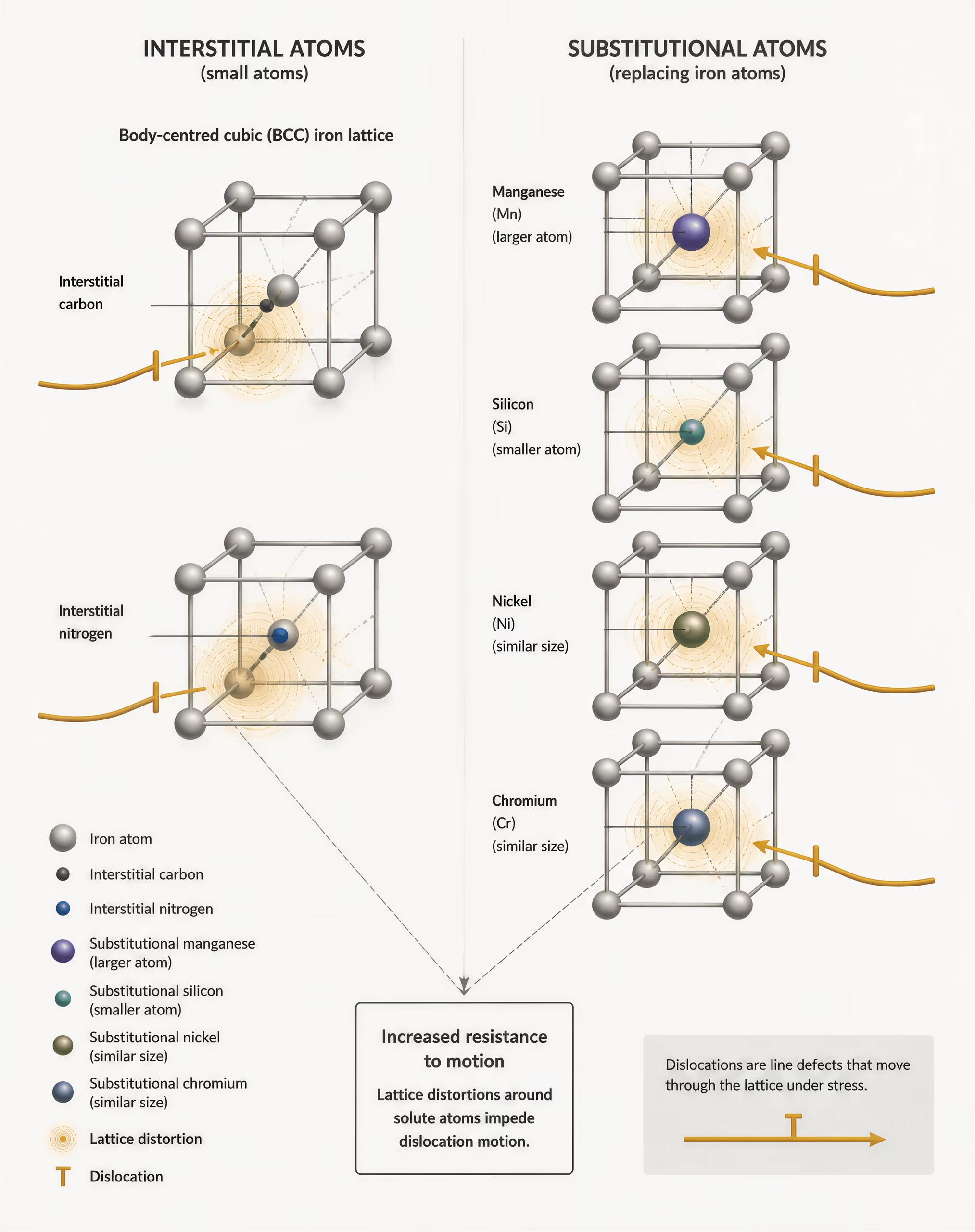
Solid-solution strengthening Strengthening caused by solute atoms distorting the iron lattice and impeding dislocation movement.
Solid-solution strengthening occurs when alloying atoms remain dispersed within a metallic phase rather than forming a separate compound. Carbon and nitrogen occupy interstitial sites between iron atoms. Their small size relative to the available gaps produces large local strains, so interstitial carbon is a powerful strengthener in ferrite. Substitutional atoms replace iron atoms on normal lattice sites. Manganese, silicon, nickel, chromium, and molybdenum commonly act in this way, although their final distribution depends on temperature, composition, and phase constitution.
Steeluniversity describes substitutional strengthening as a consequence of crystal-lattice distortion. An atom larger or smaller than iron pushes or pulls on neighboring atoms, creating a stress field around itself. Dislocations also carry stress fields. When a dislocation encounters the distorted region, its movement requires additional applied stress; yield strength therefore rises. The effect is not determined by atomic radius alone. Steeluniversity relates it to atomic size, compressibility, chemical valency, and electronegativity. Compressibility affects how readily the surrounding lattice can accommodate an impurity, while valency and electronegativity influence the character and strength of bonding between the solute and iron.
This distinction matters when comparing nominally similar steels. Silicon can strengthen ferrite substantially while reducing carbon solubility and changing deoxidation behavior. Manganese strengthens ferrite and delays some transformation reactions, but it also combines with sulfur to form manganese sulfide rather than allowing brittle iron sulfide networks to develop. Nickel strengthens ferritic steel and can preserve toughness at sub-zero temperatures, whereas chromium increases hardenability and contributes to high-temperature, corrosion, and oxidation resistance. Those statements describe tendencies, not guaranteed outcomes. Chromium dissolved in ferrite does not have the same effect as chromium tied up in carbides, and nickel in an austenitic stainless grade has a different structural consequence from nickel in a low-alloy ferritic steel.
Solid-solution strengthening also differs from simply increasing carbon. More dissolved carbon can raise strength sharply, but excess carbon may reduce weldability, promote cementite or other carbides, and change martensite formation. The useful amount of an element is therefore constrained by phase stability and processing conditions.
Precipitation and carbide formation
Precipitation strengthening acts through small particles dispersed within a matrix. These particles obstruct dislocations by forcing them either to cut through the precipitate or to bend around it. Strength depends on particle volume fraction, size, spacing, coherency, and distribution. A fine, closely spaced population can raise yield strength substantially; coarse particles provide less obstruction and may become crack-initiation sites.
Carbide formation is one important form of precipitation. Chromium, molybdenum, vanadium, niobium, and titanium can combine with carbon, while titanium, niobium, and vanadium can also form carbonitrides. Vanadium carbide, VC, and vanadium carbonitride, V(C,N), are fine precipitates that increase yield strength in HSLA steels, according to AZoM. Their strengthening contribution depends on when they form. Particles precipitated during or after rolling can impede dislocations, but particles that coarsen during prolonged heating lose effectiveness.
HSLA processing sequence
- Reheating Titanium nitride can restrict austenite grain growth.
- Hot rolling Niobium can suppress austenite recrystallization and retain deformation.
- Cooling Ferrite transformation and vanadium carbonitride precipitation develop the final structure.
The thermal schedule controls this mechanism. During hot rolling of HSLA steel, niobium suppresses austenite recrystallization, allowing deformation to accumulate and producing a finer transformation structure. Titanium forms stable titanium nitride, TiN, precipitates that control austenite grain size during reheating. These functions are different from the later precipitation of fine VC or V(C,N). A steel containing all three elements is not receiving three independent additions; each one changes the temperature and composition conditions experienced by the others.
Carbides can also remove useful alloying elements from solid solution. Chromium carbides at austenite grain boundaries may reduce chromium locally beside the boundary, creating sensitization and lowering resistance to intergranular corrosion in susceptible stainless steels. Stabilizing additions such as titanium or niobium can bind carbon preferentially, reducing chromium-carbide formation. Molybdenum can improve resistance to localized corrosion in suitable stainless compositions, while nitrogen can strengthen austenite and affect pitting resistance, but nitrogen may also promote nitrides or other secondary phases if solubility is exceeded.
| Mechanism | Primary obstacle or change | Typical controlling variables |
|---|---|---|
| Solid-solution strengthening | Lattice distortion | Solute concentration and atomic characteristics |
| Precipitation strengthening | Fine particles obstructing dislocations | Particle size, spacing, coherency, and volume fraction |
| Grain refinement | Grain boundaries obstructing dislocations | Reheating, deformation, recrystallization, and cooling |
| Transformation control | Changed phase fractions or transformation products | Composition, cooling rate, and thermal history |
Precipitation strengthening must be separated from solid-solution strengthening and grain-size control. A dissolved atom distorts the parent lattice. A precipitate creates a physical barrier inside it. Grain refinement raises strength because grain boundaries obstruct dislocation motion, commonly represented by the Hall–Petch relationship. These contributions can occur together, but they are not interchangeable. A heat treatment that increases particle size may lower precipitation strengthening even while leaving the bulk chemical analysis unchanged.
Grain refinement, segregation, and interfaces
Grain boundaries are not passive lines on a micrograph. They are regions with different atomic packing, chemical composition, diffusion rates, and phase-transformation behavior. Fine grains generally improve strength and often improve toughness by limiting the distance over which cleavage or other localized deformation can spread. Grain size is established by solidification, reheating, deformation, recrystallization, and transformation. Titanium nitride pinning, niobium-controlled recrystallization, and vanadium precipitation can therefore affect properties through both particles and grain structure.
Segregation complicates any interpretation based only on the average composition listed on a mill certificate. During solidification, elements partition between liquid and solid phases. Manganese, sulfur, phosphorus, carbon, and alloying additions can become concentrated in interdendritic regions or at grain boundaries. Subsequent rolling and heat treatment may reduce, redistribute, or preserve these variations. A boundary enriched in an impurity can transform at a different rate from the grain interior; a boundary depleted in chromium can become a corrosion-sensitive region even when the bulk chromium content satisfies the nominal grade.
Nippon Steel reports that phase-transformation behavior can vary substantially with only a 1% difference in alloying-element concentration. That observation is a warning against treating composition ranges as chemically equivalent. A one-percentage-point change can shift transformation temperatures, alter hardenability, change the fraction of ferrite, pearlite, bainite, or martensite, and modify the driving force for precipitation. Local differences may matter even more than the average when segregation concentrates an element at an interface.
Chromium, nickel, and vanadium show why phase constitution and processing must be considered together. Chromium may remain dissolved, form chromium-rich carbides, or contribute to a chromium-oxide passive film at a stainless-steel surface. Nickel may stabilize austenite, strengthen ferrite, and preserve low-temperature toughness. Vanadium may remain in solution during reheating and later form VC or V(C,N), or it may form coarser particles that contribute little to strength. The final result depends on cooling rate, deformation schedule, reheating temperature, hold time, and subsequent heat treatment.
Steel chemistry is therefore a starting condition, not a complete explanation. Performance emerges from the interaction between composition, lattice strain, precipitate population, grain structure, segregation, interfaces, and processing history. That is why two steels with similar nominal analyses can show different transformation curves, microstructures, and mechanical properties.
3. Carbon: The Principal Interstitial Alloying Element
Carbon is the principal interstitial alloying element in steel. The World Steel Association defines steel as an iron–carbon alloy containing less than 2% carbon, with manganese and smaller amounts of silicon, phosphorus, sulfur, and oxygen. That definition identifies carbon as central, but not as an isolated ingredient: the same carbon content can produce different structures and properties when chromium, nickel, manganese, molybdenum, or the thermal history changes.
Carbon atoms are much smaller than iron atoms, so they occupy spaces between iron atoms rather than replacing them on the metallic lattice. This differs from substitutional alloying, in which an element such as manganese or nickel replaces an iron atom and distorts the lattice. Steeluniversity explains that substitutional strengthening depends on atomic size, compressibility, chemical valency, and electronegativity. Interstitial carbon produces especially strong local distortion because it occupies crowded sites in the iron lattice, impeding dislocation movement and altering the stability of the phases around it.
Carbon content and phase transformation
Carbon changes which iron phases can exist and how rapidly they form. Ferrite has a body-centred cubic lattice and dissolves only a small amount of carbon. Austenite has a face-centred cubic lattice and can accommodate substantially more carbon because its interstitial sites are more favourable. Heating steel into the austenite region therefore allows carbon to redistribute, while cooling determines whether that austenite becomes ferrite, pearlite, bainite, or martensite.
Cementite, or iron carbide Fe₃C, is a carbon-rich compound that commonly appears with ferrite in pearlite and in other carbide-containing structures. Its distribution matters as much as its presence. Fine cementite particles impede dislocation motion and increase strength; coarse particles and continuous carbide networks can reduce toughness or create preferred fracture paths.
Martensite forms when austenite cools quickly enough to suppress diffusion-controlled transformations. Carbon remains trapped in the iron lattice, producing a distorted body-centred tetragonal structure. The greater the carbon supersaturation, the greater the lattice distortion and the potential hardness, although retained austenite, prior-austenite grain size, tempering, and other alloying elements determine the final result. Martensite is not simply “carbon-hardened iron.” It is a product of a particular transformation path.
The Nippon Steel report warns that steel phase-transformation behaviour can vary substantially with only a 1% difference in alloying-element concentration. Composition also varies locally through segregation and interfacial enrichment, so a nominal analysis does not describe every region of a cast, rolled, welded, or heat-treated component. Manganese, chromium, nickel, and molybdenum can shift transformation temperatures and delay ferrite, pearlite, or bainite formation. They therefore change the cooling rate needed to obtain martensite, even when carbon remains constant.
Strength, ductility, weldability, and hardenability
Increasing carbon generally raises the attainable hardness and strength of ferrite–pearlite steels by increasing pearlite or carbide content and by strengthening ferrite between those constituents. It also raises the carbon available for martensite formation. The cost is usually lower ductility, lower impact toughness, and greater sensitivity to cracking when the microstructure becomes hard and brittle.
Carbon content and hardenability are related but not identical. Carbon controls the hardness that martensite can reach; manganese, chromium, nickel, and molybdenum help hardenability by delaying diffusional transformations deeper below the quenched surface. A steel with modest carbon and adequate alloy additions may harden through a thicker section than a higher-carbon steel with little alloy support, while still reaching a different maximum martensite hardness. Quenching severity, section size, austenitizing temperature, grain size, and tempering must be considered.
Tempering demonstrates why carbon cannot be assigned one permanent effect. Quenched martensite is hard because carbon is trapped in a supersaturated lattice. During tempering, carbon diffuses and forms transition carbides or cementite, reducing internal stress and hardness while improving toughness and dimensional stability. Molybdenum can modify carbide reactions and tempering resistance; chromium can contribute to alloy-carbide formation. Vanadium, niobium, and titanium may form very stable carbides or carbonitrides instead of leaving all carbon available for cementite.
Weldability usually declines as carbon and hardenability increase. The heat-affected zone can cool into hard martensite, and diffusible hydrogen can then promote cold cracking. Manganese, chromium, molybdenum, and nickel add to this transformation response, which is why welding practice often uses a carbon-equivalent assessment rather than carbon alone. Preheating, controlled heat input, low-hydrogen procedures, and post-weld heat treatment may be required, depending on grade and thickness.
Carbon also interacts with microalloying practice in HSLA steels. Niobium suppresses austenite recrystallization during hot rolling, titanium forms stable TiN precipitates that control reheating grain size, and vanadium forms fine VC or V(C,N) precipitates that increase yield strength, as described by AZoM. The amount of carbon affects the composition, volume fraction, and stability of these precipitates. A small compositional change can therefore alter both transformation behaviour and precipitation strengthening.
Carbon in stainless and alloy-steel designations
Stainless-steel grades show especially clearly why carbon must be read with the rest of the alloy system. Chromium supports a protective chromium-oxide passive film, but carbon can react with chromium during exposure in a sensitizing temperature range to form chromium-rich M₂₃C₆, commonly represented as Cr₂₃C₆, at grain boundaries. The adjacent metal may become depleted in chromium and more vulnerable to intergranular corrosion. Lower-carbon grades such as ASTM A240 Type 304L and Type 316L reduce this risk compared with their standard-carbon counterparts, provided fabrication and service conditions are also controlled.
The “L” designation means low carbon; it does not mean carbon has no metallurgical role. In ASTM and UNS usage, Type 304L corresponds to UNS S30403, while Type 316L corresponds to UNS S31603. Common designations such as Type 304 and Type 316 must still be interpreted alongside the applicable product standard, heat treatment, and actual heat analysis. Nickel stabilizes austenite in these grades, molybdenum improves resistance to localized corrosion in Type 316 compositions, and nitrogen can strengthen austenitic stainless steel while also affecting phase stability.
Stabilizing elements provide another route. Titanium or niobium can preferentially combine with carbon, forming TiC or NbC and leaving less carbon available to form chromium carbides. Grades such as Type 321 and Type 347 use that principle, although stabilization does not eliminate the need for suitable thermal processing. Ferritic and duplex stainless steels present different limits: carbon can promote carbide formation, alter ferrite–austenite balance, and contribute to secondary phases that impair corrosion resistance or toughness.
In alloy-steel designations, carbon may appear through numerical systems such as SAE 1045, but the designation is not a complete prediction of performance. Chromium, nickel, manganese, molybdenum, and processing determine whether that carbon produces pearlite, bainite, martensite, alloy carbides, or retained austenite. Carbon is the principal interstitial element, not a solitary control knob.
4. Manganese and Silicon in Plain Carbon and Low-Alloy Steels
The World Steel Association defines steel as an iron–carbon alloy containing less than 2% carbon, with manganese and smaller quantities of silicon, phosphorus, sulfur, and oxygen commonly present. That definition describes a family of materials rather than a fixed recipe. The Steeluniversity plain-carbon-steel module identifies manganese and silicon, alongside sulfur, phosphorus, aluminum, copper, tin, chromium, nickel, and molybdenum, as elements that can influence strength, ductility, toughness, machinability, hardenability, grain size, and heat-treatment response. Their effects are conditional. A manganese addition in a low-carbon structural grade does not produce the same microstructure as the same addition in a medium-carbon quenched-and-tempered steel.
Manganese as a strength and hardenability contributor
Manganese is usually present in ordinary carbon steel both as an alloying element and as a sulfur-control addition. In ferrite, it provides substitutional solid-solution strengthening: manganese atoms replace iron atoms in the lattice, producing local strain that impedes dislocation motion. Steeluniversity describes this class of strengthening as a consequence of crystal-lattice distortion, with the magnitude affected by atomic size, compressibility, chemical valency, and electronegativity. The resulting strength increase is not independent of carbon, grain size, or processing. A manganese-bearing steel that is normalized, quenched, or heavily cold worked can therefore show different strength and ductility even when its chemical analysis is unchanged.
Manganese also increases hardenability. It delays diffusional transformations of austenite to ferrite and pearlite, allowing a greater fraction of austenite to transform to bainite or martensite during cooling. This is why manganese is important in medium-carbon grades intended for quenching and tempering, and in low-alloy structural steels where section thickness makes through-hardening difficult. The benefit has limits. Excessive manganese can encourage segregation during solidification, particularly in large cast sections, and can contribute to banded ferrite–pearlite structures after rolling. Such chemical banding may produce directional differences in toughness, elongation, and fracture behavior.
Manganese is also an austenite stabilizer. It can lower transformation temperatures and alter the martensite-start temperature, so the selected quench rate and tempering schedule cannot be inferred from carbon content alone. In a grade such as ASTM A572 Grade 50, manganese contributes to the strength and processing response, but the specified mechanical properties still depend on rolling practice, plate thickness, cooling, and the complete composition. ASTM A36 likewise cannot be interpreted from its manganese content as though that element alone determines weldability or toughness.
Grain behavior adds another qualification. Manganese can affect austenite grain growth and transformation kinetics, but it is not a substitute for controlled rolling, normalizing, or microalloy precipitation. Grain refinement generally improves yield strength and fracture toughness through the Hall–Petch relationship, whereas coarse grains usually reduce low-temperature toughness. The final grain structure depends on reheating temperature, deformation, cooling rate, and interactions with carbon, nitrogen, aluminum, niobium, or titanium.
Silicon in deoxidation and ferritic strengthening
Silicon has two especially important functions. First, it is used as a deoxidizer during steelmaking. Dissolved oxygen can react with carbon during solidification to form carbon monoxide, producing gas porosity and other defects. Silicon reacts with oxygen to form silica-containing oxides and helps reduce the dissolved oxygen available for that reaction. The effectiveness of this practice depends on the full deoxidation system: aluminum, manganese, oxygen potential, slag practice, and inclusion removal all matter. “Silicon-killed” steel therefore describes a processing and deoxidation condition, not a guaranteed microstructure.
Second, silicon strengthens ferrite by substitutional solid solution. It distorts the iron lattice and raises resistance to dislocation motion, often increasing yield strength without adding carbon. That can be useful where strength is required without the full loss of weldability and ductility associated with a large carbon increase. Silicon also affects phase transformations and carbide formation. In several heat-treatment systems it delays cementite precipitation and changes the balance between ferrite, pearlite, bainite, and retained austenite. Consequently, the same silicon level may support one desired structure while complicating another.
Silicon is not automatically beneficial to toughness. Higher strength can reduce uniform elongation, and coarse nonmetallic inclusions formed during deoxidation can become crack-initiation sites if they are not controlled. Silicon can also influence tempering response and surface oxidation during reheating. The relevant question is not whether silicon “increases strength,” but whether its strengthening effect, inclusion population, and transformation behavior suit the steel’s carbon level and thermal history.
Interactions with sulfur, carbon, and heat treatment
The clearest manganese interaction is with sulfur. Sulfur combines preferentially with manganese to form manganese sulfide, MnS, rather than allowing iron sulfide to remain concentrated at grain boundaries. Iron sulfide can produce hot shortness during rolling because low-melting films weaken the boundaries. MnS reduces that danger, but inclusions are not harmless: elongated sulfides produced by rolling can lower transverse ductility and impact toughness, and they can act as initiation sites for fatigue or hydrogen-assisted cracking. Calcium treatment, inclusion-shape control, and rolling reduction may change the effect without changing the total sulfur analysis.
Carbon sets the scale of both elements’ consequences. With low carbon, manganese and silicon mainly modify ferrite strength, pearlite fraction, weldability, and transformation temperatures. With medium or higher carbon, manganese raises hardenability while silicon can alter carbide precipitation and tempering behavior. Quenching may then produce martensite through a section that would otherwise form pearlite, but the increased hardness brings a greater risk of quench cracking unless tempering and cooling are controlled.
Processing history can outweigh a simple composition rule. Normalizing refines and resets the structure; annealing reduces hardness; quenching suppresses diffusional products; tempering trades some hardness for toughness and dimensional stability. Rolling temperature and cooling rate determine whether manganese segregation becomes visible as bands and whether silicon-containing steels form the intended ferrite–pearlite or bainitic structure. The Nippon Steel report cautions that phase-transformation behavior can vary substantially with only a 1% difference in alloying-element concentration, while segregation at grain boundaries and interfaces can change transformation mechanisms.
| Element | Useful effect | Potential limitation |
|---|---|---|
| Manganese | Solid-solution strengthening, sulfur control, and hardenability | Segregation and banding can reduce directional toughness |
| Silicon | Deoxidation and ferritic strengthening | Excess can affect ductility, inclusions, and transformation |
| Sulfur | Improved machinability through MnS | Elongated inclusions can reduce transverse toughness |
| Phosphorus | Solid-solution strengthening | Segregation can reduce ductility and impact toughness |
| Aluminum | Deoxidation and grain control through AlN | Excess oxide inclusions or altered casting behavior |
That sensitivity explains why composition tables should be read with standards, steelmaking practice, and heat treatment. Manganese and silicon are influential, as Steeluniversity states, but neither has one guaranteed direction for every property. Oxygen control, sulfur morphology, carbon content, segregation, grain size, and the thermal path determine what those elements actually do in the finished steel.
5. Sulfur, Phosphorus, Aluminum, Copper, and Tin: Useful Effects and Metallurgical Risks
The World Steel Association defines steel as an iron–carbon alloy containing less than 2% carbon, with manganese and smaller quantities of silicon, phosphorus, sulfur, and oxygen also commonly present. These “smaller” additions can still change processing behavior and service performance. Steeluniversity lists silicon, manganese, sulfur, phosphorus, aluminum, copper, tin, chromium, nickel, and molybdenum among the elements that influence strength, ductility, toughness, machinability, hardenability, grain size, and heat-treatment response in plain-carbon steels.
The important qualification is that composition is not a set of independent switches. An element may be dissolved in ferrite, tied up in a compound, concentrated at a grain boundary, or redistributed during casting and rolling. A change of only 1% in alloying-element concentration can substantially alter phase-transformation behavior, according to a Nippon Steel technical report. Smaller changes can also matter when they affect inclusions, precipitation, or segregation.
Sulfur and machinability
Sulfur is often added to free-machining steels because it can improve chip breaking and reduce cutting forces. Its principal metallurgical vehicle is manganese sulfide, MnS. Manganese combines with sulfur preferentially, limiting the formation of iron sulfide and producing sulfide inclusions that deform during hot working. In machining, these inclusions can help a chip fracture rather than form a long, continuous ribbon. The result may be better surface finish, reduced tool loading, and more consistent automated cutting.
That benefit has a cost. MnS inclusions are discontinuities in the steel matrix, and their shape, size, number, and orientation affect mechanical behavior. Hot rolling commonly elongates sulfides in the rolling direction, producing directional properties. Tensile ductility and impact toughness measured transverse to the rolling direction can therefore be lower than values measured longitudinally. Large or clustered inclusions are more damaging than a fine, dispersed population.
Sulfur can also reduce weldability and degrade toughness when the steel contains an unfavorable balance of manganese and sulfur. Manganese is needed to bind sulfur as MnS; if the available manganese is insufficient, iron sulfide can contribute to hot shortness during deformation at elevated temperature. The precise response depends on sulfur concentration, manganese concentration, inclusion morphology, rolling reduction, and the final service direction.
Sulfur can improve machinability but may reduce transverse ductility, impact toughness, fatigue resistance, or weld performance. Limited evidence
This makes “sulfur improves machinability” an incomplete statement. It is true for a cutting operation designed around free-machining steel, but the same sulfur addition can be undesirable in a component requiring high transverse toughness, fatigue resistance, or reliable weld performance. A machinability grade is not automatically a better structural grade. The useful effect is process-specific.
Phosphorus, toughness, and segregation
Phosphorus is a substitutional element in iron and can contribute to solid-solution strengthening. Steeluniversity explains that substitutional strengthening results from distortion of the crystal lattice, with the magnitude related to atomic size, compressibility, chemical valency, and electronegativity. Phosphorus can therefore raise strength, but increased strength does not guarantee improved performance: ductility and toughness may decline, particularly when phosphorus is concentrated in vulnerable regions.
The main concern is segregation. During solidification, phosphorus may partition unevenly between the growing solid and remaining liquid. The last liquid to freeze can become enriched, leaving bands or localized regions with higher phosphorus content. Subsequent rolling may stretch these composition variations into banded structures. Grain-boundary enrichment is also significant because fracture resistance depends on the chemistry and cohesion of boundaries, not only on the average composition measured for the whole heat.
Elevated phosphorus is associated with reduced ductility and a greater risk of brittle fracture, especially when combined with coarse grains, low temperature, high restraint, or other embrittling conditions. The effect is not a fixed penalty at every concentration. A small phosphorus content dissolved relatively uniformly may have a different consequence from the same nominal addition concentrated at interdendritic regions or grain boundaries.
Processing history determines how much of the risk remains. Reheating and rolling can break up segregation patterns, alter grain size, and change the distribution of second phases, but they do not make composition irrelevant. Cooling rate after hot working and later heat treatment further influence the final microstructure. Nippon Steel’s warning about large changes in transformation behavior from a 1% composition difference illustrates why nominal chemistry alone cannot predict toughness.
Phosphorus therefore occupies an awkward position: it can add strength and may assist certain manufacturing routes, yet excessive or uneven phosphorus can reduce ductility and impact toughness. The correct assessment requires the steel grade, product thickness, thermal cycle, test direction, and intended service temperature.
Aluminum, copper, and tin as process or residual elements
Aluminum is widely associated with steel deoxidation. During steelmaking, dissolved oxygen can react with aluminum to form aluminum oxide, Al₂O₃. Removing oxygen changes the cleanliness and solidification behavior of the melt, while the remaining aluminum content can also affect grain control. Aluminum may combine with nitrogen to form aluminum nitride, AlN; the size, distribution, and dissolution state of these particles influence austenite grain development during reheating. That is a process effect, not a universal promise of finer grains under every thermal schedule.
Too much or poorly controlled aluminum can create oxide inclusions or alter casting behavior. Its outcome depends on oxygen activity, nitrogen content, treatment temperature, solidification conditions, and reheating practice. “Aluminum refines grains” is therefore too broad unless the steelmaking route and particle population are specified.
Copper and tin are identified by Steeluniversity as elements that influence plain-carbon-steel properties, but they often enter discussion as residuals rather than deliberate major additions. Copper can remain from recycled feedstock and can affect transformation, strength, oxidation behavior, and hot-working response when its concentration becomes significant. Tin may accompany the same feedstock and can modify steel behavior at low concentrations or become more harmful as it accumulates. Their effects cannot be assigned from the element name alone.
Copper and tin are especially sensitive to concentration and processing history because their distribution changes during melting, solidification, reheating, and deformation. A residual level that produces no important change in one product may matter in another with a different carbon content, cooling rate, surface condition, or hot-working schedule. Copper-rich behavior near the surface during reheating can be particularly relevant to hot-shortness risk, but the severity depends on the complete chemistry and furnace practice rather than copper alone.
The practical lesson is not that sulfur, phosphorus, aluminum, copper, or tin should always be minimized or always be added. Each can serve a controlled purpose, or create a defect, depending on where it resides, what compounds it forms, and what thermal and mechanical history the steel receives. Steeluniversity’s element list is consequently a map of variables, not a catalogue of guaranteed effects. Composition must be read alongside phase constitution, segregation, inclusion morphology, grain size, and processing history.
6. Chromium: Hardenability, Oxidation Resistance, and Passivation
Chromium is often described as if it simply “makes steel stainless.” That description confuses two different effects. Chromium dissolved through the steel can change phase transformations, hardenability, carbide formation, and high-temperature strength. Chromium at a clean exposed surface can react with oxygen and form a thin chromium-oxide film that slows further attack. The first effect is a bulk metallurgical effect; the second is surface passivation. They are related, but they are not interchangeable.
The World Steel Association defines steel as an iron–carbon alloy containing less than 2% carbon. Chromium may then be added in amounts ranging from a small alloy addition in engineering steels to roughly 10.5% or more in stainless grades. Composition alone does not determine the result. Cooling rate, austenitizing temperature, prior grain size, carbon activity, segregation, welding thermal cycles, and the presence of nickel, molybdenum, nitrogen, manganese, and stabilizing elements all alter chromium’s practical effect. Nippon Steel reports that steel phase-transformation behavior can change substantially with only a 1% difference in alloying-element concentration, a useful warning against treating an alloy designation as a complete description of its microstructure.
Chromium in low-alloy and heat-resistant steels
In low-alloy steel, chromium increases hardenability by delaying transformations from austenite to ferrite, pearlite, and bainite during cooling. A thicker section can therefore form martensite, or a greater fraction of bainite, at a cooling rate that would leave an unalloyed carbon steel partly pearlitic. Chromium does not make every region of a component equally hard. The result still depends on carbon content, section size, austenite grain size, quench severity, and tempering treatment.
Chromium acts mainly as a substitutional solute in ferrite and austenite. Steeluniversity explains that substitutional alloying strengthens a lattice through distortion, with the magnitude affected by atomic size, compressibility, chemical valency, and electronegativity. Chromium can therefore contribute to solid-solution strengthening, although its most important effects in many heat-treated grades arise from transformation kinetics and carbide chemistry rather than from lattice strain alone.
Carbon changes the balance. Chromium has a strong affinity for carbon and can form chromium-rich carbides, including the MC family, where M may be principally chromium with contributions from iron and other metallic elements. In suitably designed heat-resistant steels, carbide particles help resist creep and grain-boundary sliding. Excessive or poorly controlled carbide formation can remove chromium from the surrounding matrix, lower local corrosion resistance, and produce brittle or difficult-to-weld microstructures.
Chromium also improves resistance to oxidation at elevated temperature. A chromium-containing surface can form a relatively adherent oxide scale, reducing the rate at which iron continues to oxidize. This is not the same as saying that any chromium-bearing low-alloy steel behaves like stainless steel in air, steam, or combustion gases. Oxide stability depends on chromium concentration, temperature, gas chemistry, surface condition, thermal cycling, and whether the scale remains continuous. Silicon and aluminum can also alter high-temperature scale formation, while nickel affects phase stability and thermal expansion.
Heat-resistant ferritic grades and martensitic chromium steels illustrate the trade-offs. Higher chromium can improve oxidation resistance, but it may promote ferrite stability and alter the amount of austenite available during heat treatment. Carbon, molybdenum, vanadium, niobium, and tungsten can then control carbide or carbonitride precipitation and creep strength. A nominal chromium increase may produce a different result after normalizing, quenching, tempering, welding, or prolonged service exposure.
The same composition–processing link appears in HSLA steel, even when chromium is not the main strengthening addition. AZoM describes niobium as suppressing austenite recrystallization during hot rolling, titanium as forming stable TiN precipitates that control reheating grain size, and vanadium as forming fine VC or V(C,N) precipitates that raise yield strength. Chromium interacts with these additions by changing austenite stability, precipitation conditions, and transformation temperatures. It is not an isolated hardenability switch.

Chromium-oxide passivation in stainless steel
Stainless steel requires enough chromium in the matrix to sustain a protective passive surface. The familiar threshold is about 10.5% chromium by mass, but this figure is a classification boundary, not a guarantee of identical service behavior. Grade, surface condition, environment, inclusions, weld history, and contamination all matter.
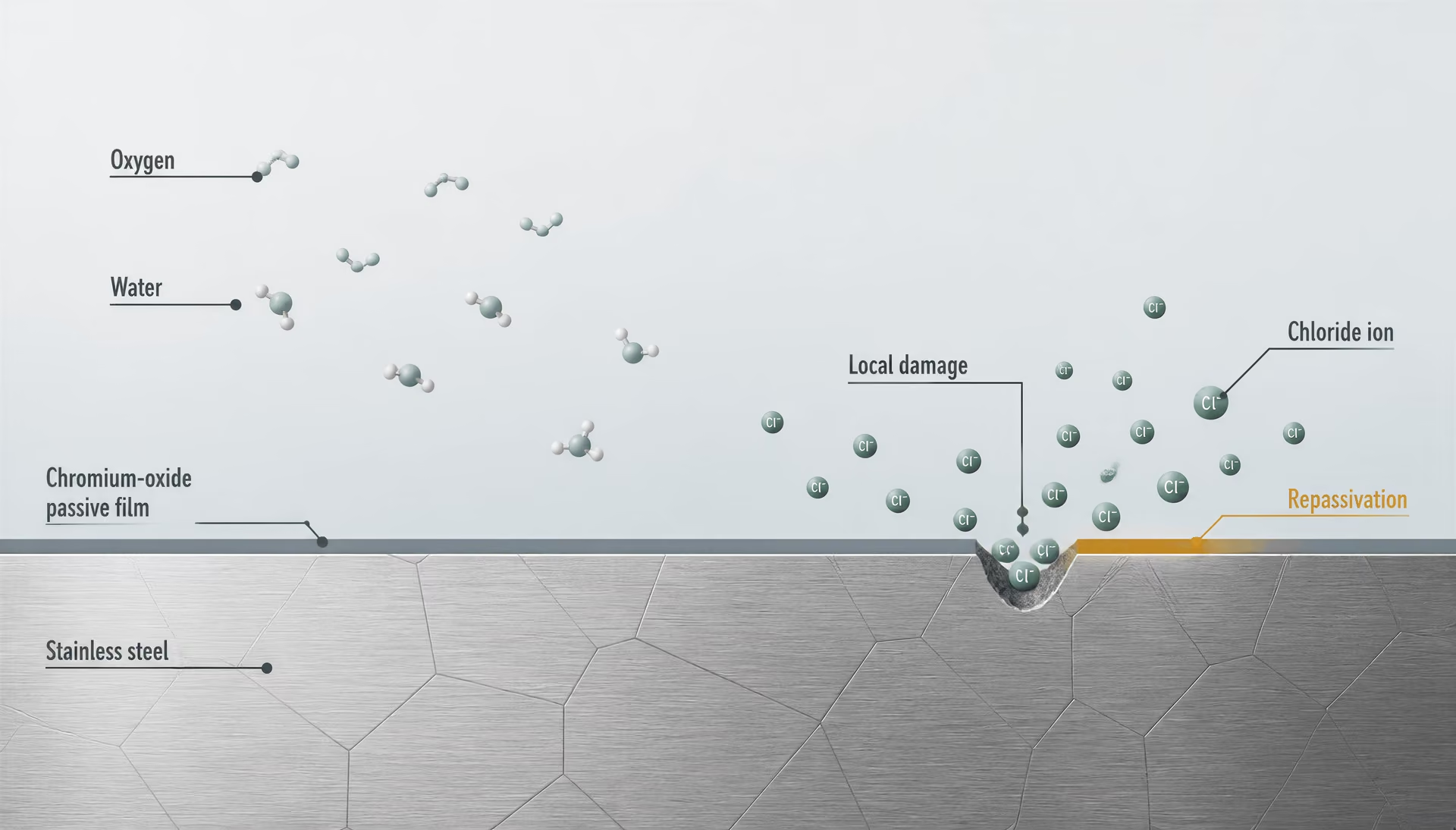
Chromium supports stainless passivation by forming a thin, adherent chromium-oxide film at an exposed surface. Strong evidence
The mechanism supplied by thyssenkrupp Materials is direct: chromium reacts with oxygen to form a protective chromium-oxide layer. This film is extremely thin, adherent, and capable of reforming when oxygen is available after minor mechanical damage. It separates the underlying iron-rich alloy from the environment and greatly reduces the rate of continued dissolution. Passivation is therefore a surface reaction, not a bulk increase in hardness.
A steel can contain substantial chromium and still suffer localized corrosion if the passive film is damaged or chemically destabilized. Chloride ions, crevices, deposits, acidic conditions, iron contamination, rough surfaces, and welding heat effects can initiate pitting or crevice corrosion. Molybdenum improves resistance to chloride-induced pitting and is a major reason that EN 1.4401 / X5CrNiMo17-12-2 and AISI 316 generally resist such environments better than EN 1.4301 / X5CrNi18-10 and AISI 304. These designations identify composition ranges; they do not erase differences caused by fabrication or exposure.
Nickel stabilizes austenite and helps retain the face-centered cubic structure at room temperature. It also affects toughness, work hardening, thermal expansion, and the balance between ferrite and austenite during welding. Nitrogen can strengthen austenitic stainless steel and improve localized-corrosion resistance, while molybdenum supports pitting resistance. Their effects depend on concentration and interaction. Chromium supplies the essential passivating chemistry, but stainless performance is a system property of the alloy and its condition.
Chromium, carbon, and sensitization
The most important warning about chromium in austenitic stainless steel concerns carbon at grain boundaries. During heating in an approximate range of 500–850 °C, chromium-rich MC carbides may precipitate at austenite grain boundaries if carbon can diffuse there. The adjacent matrix is then depleted of chromium. Although the bulk composition may contain enough chromium to qualify as stainless, narrow chromium-depleted zones can lose passivity and become vulnerable to intergranular corrosion.
Sensitization A stainless-steel condition in which chromium-rich carbides form at grain boundaries and leave adjacent regions depleted in chromium.
This condition is called sensitization. It is especially relevant after welding, because the heat-affected zone may spend enough time in the sensitization range for carbide precipitation. Rapid cooling can reduce exposure, but welding procedure, plate thickness, heat input, restraint, and prior thermal history determine the actual result.
Low-carbon grades such as EN 1.4307 / X2CrNi18-9 and EN 1.4404 / X2CrNiMo17-12-2 reduce the available carbon and therefore reduce the tendency to form chromium carbides. Stabilized grades add titanium or niobium, which preferentially bind carbon as TiC or NbC. The chromium remains more available in the matrix for passivation. Stabilization is not a universal cure: excessive precipitates, incorrect heat treatment, or later thermal exposure can create other microstructural problems.
Carbon is still useful. It strengthens austenite and can contribute to wear resistance, while carbon and nitrogen influence stacking-fault energy and work hardening. The difficulty is controlling where carbon goes and which compounds form. Chromium, nickel, molybdenum, nitrogen, titanium, and niobium may all be present, yet their effects depend on phase stability, precipitation, segregation, and processing history. Chromium is essential to passivation, but it does not act alone, and a stainless designation cannot predict performance without the microstructure that processing creates.
7. Nickel and the Control of Austenitic and Ferritic Behavior
Nickel is often described as a strengthening element, but that description is incomplete. Its effect depends on whether it remains dissolved in ferrite, stabilizes austenite, promotes a mixed phase structure, or changes the transformation path during cooling and fabrication. The same addition that improves low-temperature toughness in a ferritic pressure-vessel steel can also keep austenite stable in stainless steel, altering work hardening, weld solidification, and the amount of martensite formed during deformation.
That distinction matters because steel is not a single crystal structure. As the World Steel Association defines it, steel is an iron–carbon alloy containing less than 2% carbon, with other elements added in smaller or larger amounts. Nickel occupies substitutional sites in the iron lattice. Steeluniversity explains that substitutional strengthening results from lattice distortion, with the magnitude affected by atomic size, compressibility, chemical valency, and electronegativity. Nickel therefore changes both the resistance to dislocation motion and the stability of the phases through which those dislocations move.
Nickel as a strengthening and toughening element
In ferritic steel, nickel contributes substitutional solid-solution strengthening. Nickel atoms differ from iron in size and bonding behavior, so their presence produces local elastic strain fields. A moving dislocation interacts with those fields and requires greater applied stress to continue moving. The increase in yield strength is usually moderate compared with precipitation hardening or martensitic transformation, but it is useful because nickel can strengthen ferrite without producing the severe loss of ductility associated with excessive carbon or hard second phases.
The more important contribution is often toughness. The AZoM discussion of alloy-steel elements identifies nickel as an element that strengthens and toughens ferritic steel, with the benefit becoming especially significant at sub-zero temperatures. This is not a universal “more nickel, more strength” rule. Nickel affects the ferrite-to-austenite transformation, grain-scale deformation, and the temperature at which cleavage competes successfully with ductile fracture. In suitable compositions and heat treatments, it lowers the ductile-to-brittle transition temperature and helps ferritic steel absorb impact energy in cold service.
The result is a useful combination: increased strength with improved resistance to brittle fracture. That combination explains the use of nickel-bearing low-temperature steels such as 9% nickel pressure-vessel grades covered by ASTM A553/A553M. Their performance does not come from nickel alone. Carbon level, manganese, heat treatment, retained austenite, martensite morphology, grain size, and weld thermal cycles all influence the final toughness. Nickel is one part of a controlled phase and microstructure design.
Composition must also be treated as a narrow variable rather than a fixed recipe. Nippon Steel reports that steel phase-transformation behavior can vary substantially with only a 1% difference in alloying-element concentration. The practical implication is important: a nominal nickel content does not predict properties without knowing the complete composition and thermal history. Segregation during solidification can make nickel concentration vary locally, while welding can produce regions with different cooling rates and phase fractions from the parent plate.
Sub-zero toughness in ferritic steel
Ferritic steels have a body-centred cubic structure, and many BCC steels show a marked temperature dependence in fracture behavior. At higher temperatures, plastic flow at a crack tip can blunt the crack and support ductile fracture. As temperature falls, dislocation motion becomes more difficult, cleavage becomes more competitive, and impact toughness can drop sharply. Nickel is valuable because it can shift this transition toward lower temperatures.
This benefit should not be confused with the complete removal of low-temperature risks. A coarse ferritic grain structure, phosphorus segregation, untempered martensite, welding defects, or a continuous brittle second phase can still cause premature fracture. Nickel may improve the matrix response while another feature controls failure. Grain refinement is particularly important because smaller ferrite grains generally raise the cleavage fracture stress and lower the effective transition temperature.
Nickel-bearing ferritic steels therefore require process control. Normalizing, quenching and tempering, intercritical treatment, and welding each produce different distributions of ferrite, bainite, martensite, and retained austenite. The nickel content affects the transformation temperatures and hardenability, but it does not dictate the final structure by itself. A cooling rate that produces tough bainite in one plate thickness may produce a harder, less forgiving structure in another.
At cryogenic temperatures, the distinction between strength and toughness becomes especially clear. Strength can rise as temperature falls while fracture resistance declines. Nickel is valuable because it can improve both parts of this balance in appropriately designed ferritic steels, rather than merely increasing the stress required to yield.
Nickel and austenite stability in stainless steel
In austenitic stainless steel, nickel performs a different central function: it stabilizes the face-centred cubic austenite phase. Chromium supplies the chromium-rich oxide film responsible for stainless passivation, while nickel helps retain austenite at room temperature after hot working, solution annealing, and cooling. Common grades such as UNS S30400, designated Type 304 under ASTM A240, and UNS S31603, commonly designated Type 316L under ASTM A240, combine substantial chromium with nickel; Type 316L also contains molybdenum for improved resistance to localized corrosion.
Austenite stability controls fabrication behavior. Austenitic stainless steels generally cannot be strengthened by conventional quench hardening because cooling does not transform the matrix into ordinary carbon martensite. Instead, they gain strength through solid solution, grain size control, and cold work. Stable austenite remains ductile during forming, but insufficient stability can allow deformation-induced martensite to form. That transformation raises strength and work hardening while reducing dimensional predictability and, in some cases, corrosion performance.
Steeluniversity fabrication guidance treats nickel as part of a compositional balance rather than an isolated control. Chromium, nickel, carbon, nitrogen, molybdenum, manganese, and stabilizing additions such as titanium or niobium jointly affect phase balance and processing response. A 304-type alloy with lower austenite stability may form more strain-induced martensite during severe cold forming than a higher-nickel composition. Conversely, excessive austenite stability can alter weld-metal solidification behavior and reduce the ferrite that is often retained in austenitic weld deposits to reduce solidification-cracking susceptibility.
The fabrication route matters as much as the nominal grade. Hot-working temperature, solution-annealing practice, cooling rate, deformation, and welding heat input can change ferrite content, sigma-phase risk, carbide precipitation, and residual stress. Carbon can produce chromium carbides at grain boundaries during unsuitable thermal exposure, causing sensitization; low-carbon designations such as 316L reduce that risk but do not make thermal history irrelevant. Nitrogen can strengthen austenite and influence pitting resistance, while molybdenum changes corrosion behavior without serving as a simple substitute for nickel.
Nickel therefore cannot be assigned one guaranteed outcome. In ferritic steel it can provide solid-solution strengthening and, most importantly, better sub-zero toughness. In austenitic stainless steel it stabilizes the FCC phase and changes forming, work hardening, welding, and transformation behavior. The effect belongs to the phase constitution and processing history, not to the element in isolation.
8. Molybdenum, Nitrogen, and the Stability of Stainless Microstructures
Molybdenum and nitrogen are discussed with chromium and nickel because stainless-steel behavior is controlled by a coupled chemical and phase system, not by chromium content alone. Chromium supplies the condition for a protective chromium-rich oxide film; nickel affects the balance between ferrite and austenite; molybdenum changes localized-corrosion behavior and phase stability; and nitrogen affects both austenite stability and strength. Carbon, manganese, silicon, and fabrication history then alter the result.
The distinction matters even within one family of grades. The nominal composition of an austenitic stainless steel does not uniquely determine its service behavior after rolling, welding, forming, or heat treatment. The Nippon Steel report cautions that phase-transformation behavior can change substantially with only a 1% difference in alloying-element concentration. Segregation at grain boundaries and interfaces can also make the local composition differ from the bulk chemical analysis.
Molybdenum and corrosion-related alloy design
Molybdenum is a substitutional alloying element. As Steeluniversity explains, substitutional strengthening results partly from crystal-lattice distortion, with the magnitude affected by atomic size, compressibility, chemical valency, and electronegativity. In stainless steel, however, molybdenum is rarely added only to raise tensile strength. Its more important design role is resistance to localized attack, especially pitting and crevice corrosion in chloride-bearing environments.
PREN = %Cr + 3.3(%Mo) + 16(%N) can compare pitting-resistance tendencies but cannot predict service life by itself. Preliminary evidence
A passive chromium-oxide film can break down at a local defect or under a deposit. Molybdenum changes the chemistry of the metal and the repassivation process around such sites, reducing the tendency for a small pit to become a stable growing cavity. This is why alloy comparisons often use a pitting-resistance-equivalent relationship such as PREN = %Cr + 3.3(%Mo) + 16(%N). The expression is a screening index, not a service-life equation. Surface condition, chloride concentration, temperature, acidity, inclusions, weld oxidation, and crevice geometry can outweigh a modest composition difference.
The contrast between common austenitic designations illustrates the point without making molybdenum an isolated guarantee. ASTM A240 Type 304 and Type 316 are both chromium-nickel austenitic stainless steels, but Type 316 includes molybdenum in its specified chemistry whereas Type 304 does not. The UNS designations commonly associated with these compositions are UNS S30400 and UNS S31600; low-carbon variants include UNS S30403 and UNS S31603. Their different responses in chloride service arise from the combined effects of chromium, nickel, molybdenum, nitrogen, carbon, inclusions, and processing—not from a single “molybdenum effect.”
Molybdenum also changes phase stability. It is generally ferrite-promoting relative to nickel, so increasing it can reduce the austenite margin or encourage ferrite in a weld solidification structure. That trade-off is managed through the full composition and the thermal cycle. A weld may solidify with some delta ferrite, while the wrought parent material is predominantly austenitic. Excessive ferrite, or later transformation of ferrite into brittle intermetallic constituents, can damage toughness and corrosion resistance.
Nitrogen, austenite stability, and strength
Nitrogen occupies interstitial sites in the iron lattice, so its strengthening mechanism differs from that of molybdenum. It produces lattice strain and interacts strongly with dislocations. In chromium-nickel stainless steels, nitrogen is also a powerful austenite stabilizer. It can therefore replace part of the nickel needed to retain austenite, although the balance depends on chromium, nickel, manganese, molybdenum, carbon, temperature, and cooling rate.
That balance is grade-specific. A composition that remains fully austenitic after solution annealing may form ferrite during welding, while a cold-worked region can develop strain-induced martensite if its austenite stability is insufficient. Nitrogen raises the resistance to such transformation in many austenitic compositions, but it does not eliminate the effects of low temperature, deformation, or unfavorable chemistry.
Nitrogen contributes substantial solid-solution strengthening and can increase yield strength without producing the same carbide-related sensitization mechanism associated with excess carbon. It commonly raises work-hardening capacity as well. During forming, that means the metal may continue to harden rapidly as plastic strain accumulates; the benefit in strength can be accompanied by higher forming loads and a greater need to control deformation uniformity. In service, a high work-hardening response can improve resistance to localized plastic deformation, but the result still depends on grain size, texture, inclusions, and prior cold work.
Nitrogen is not free of processing limits. Its solubility in liquid and solid steel depends on temperature and composition, and excessive nitrogen can promote gas porosity, nitride formation, or unwanted solidification structures. Molybdenum and chromium increase the tendency of certain nitrides to form because they alter chemical activity and phase stability. Thus nitrogen can support austenite in the matrix while being locally removed from it by precipitation.
Secondary phases and fabrication response
The most familiar sensitization mechanism involves chromium carbide, commonly written Cr23C6, forming at austenite grain boundaries during an unfavorable thermal exposure. Chromium is consumed locally beside the boundary, leaving a chromium-depleted zone where intergranular corrosion becomes easier. Low-carbon grades such as UNS S31603 limit the available carbon; stabilized grades use elements such as titanium or niobium to bind carbon preferentially. Neither approach makes welding irrelevant: heat input, cooling rate, joint restraint, thickness, and subsequent thermal exposure still determine the microstructure.
Molybdenum- and chromium-bearing austenitic stainless steels can also form sigma phase, chi phase, Laves phase, or various carbides and nitrides during prolonged exposure in intermediate temperature ranges or during repeated welding cycles. These phases remove chromium, molybdenum, or nitrogen from the austenitic matrix and may embrittle the material. A composition that improves chloride resistance in the solution-annealed condition can therefore become less resistant after an unsuitable fabrication cycle.
Welding makes the interaction visible. Solidification segregation can concentrate ferrite-forming elements in interdendritic regions, while nitrogen and nickel influence whether the weld metal solidifies as austenite, ferrite, or a mixed structure. Excessive delta ferrite can reduce ductility or promote secondary-phase formation during service; too little ferrite in some weld-metal compositions can increase hot-cracking susceptibility. Post-weld cleaning matters too, since heat tint can leave a chromium-depleted or oxide-covered surface even when the underlying bulk composition is unchanged.
The same principle applies to hot and cold fabrication. Solution annealing dissolves many unwanted precipitates and restores a more uniform distribution, but the required temperature and quench depend on the grade and section. Cold work raises strength through dislocation accumulation and can alter magnetic response or trigger martensitic transformation in metastable austenite. No alloying element guarantees a fixed outcome. Molybdenum, nitrogen, chromium, and nickel must be read together with carbon level, phase constitution, segregation, precipitate history, and the actual fabrication route.
9. Vanadium, Niobium, and Titanium in HSLA Steel
High-strength low-alloy (HSLA) steel provides the clearest example of process-sensitive alloying. Small additions of vanadium, niobium, or titanium are not simply ingredients that produce one fixed property. Their effects depend on concentration, carbon and nitrogen availability, reheating temperature, rolling schedule, cooling rate, and the location of the atoms after solidification. A steelmaker can add the same element to two heats and obtain different microstructures if the thermal and deformation histories differ.
That distinction matters because the three elements act through different mechanisms. Vanadium mainly raises strength through precipitation in ferrite. Niobium chiefly changes what happens to austenite during hot rolling, delaying recrystallization and helping retain deformation-produced grain refinement. Titanium forms exceptionally stable titanium nitride, TiN, which pins austenite grain boundaries during reheating. These mechanisms may operate in the same steel, but they do not occur at the same stage or produce the same microstructural result.
HSLA grades illustrate why composition cannot be read as a guarantee. ASTM A572/A572M Grade 50 and ASTM A588/A588M are specified by mechanical and chemical requirements, yet their final properties also depend on rolling and cooling practice. The World Steel Association defines steel as an iron-carbon alloy containing less than 2% carbon; the small additions beyond iron and carbon can change transformation behavior disproportionately. Nippon Steel reports that steel phase-transformation behavior can vary substantially with only a 1% difference in alloying-element concentration. At HSLA addition levels, much smaller changes in precipitation state or thermal history can also matter.

Vanadium carbide and carbonitride precipitation
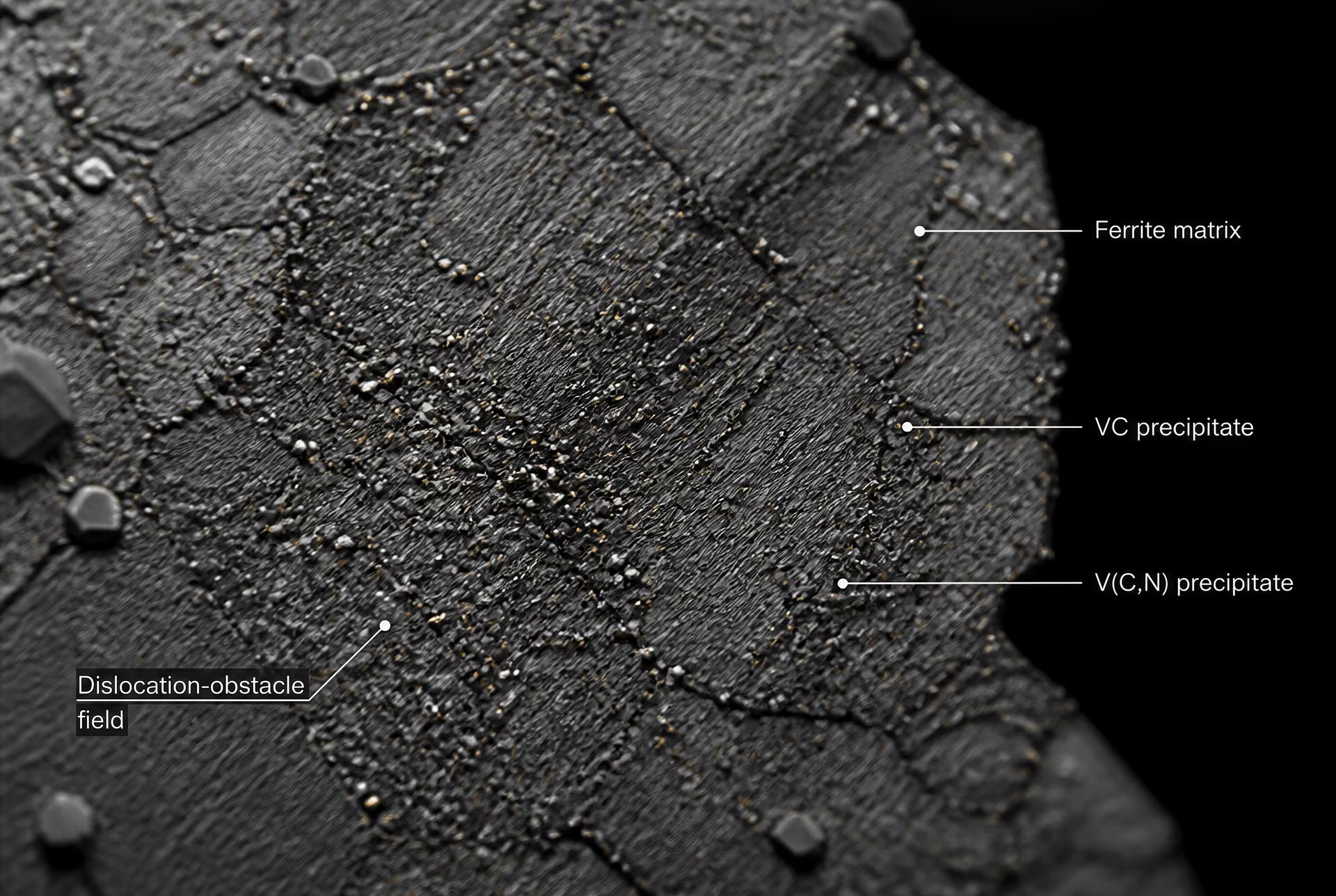
Vanadium strengthens HSLA steel primarily when it precipitates as fine vanadium carbide, VC, or vanadium carbonitride, V(C,N). During hot working, much of the vanadium may remain dissolved in austenite. As the steel cools and ferrite forms, the solubility of vanadium and carbon or nitrogen changes. Fine particles can then nucleate within ferrite or near interfaces. These particles obstruct dislocation motion, so a higher applied stress is required for plastic yielding.
This is precipitation strengthening, not simply solid-solution strengthening. A vanadium atom dissolved in the iron lattice distorts that lattice and can contribute to solid-solution strengthening, as Steeluniversity explains for substitutional alloying elements. The magnitude of that effect depends on atomic size, compressibility, chemical valency, and electronegativity. A VC or V(C,N) particle acts differently: it creates a dispersed obstacle whose size, number density, coherency, and spacing determine how effectively dislocations move around or through it.
The useful precipitates must be fine and numerous. Coarse vanadium carbides consume alloying elements without providing the same obstacle density, and particles that form during an excessively high-temperature stage may coarsen before the final ferritic structure develops. Nitrogen can increase the amount of V(C,N), but its effect depends on the carbon-to-nitrogen balance and on competing nitride formers, especially titanium and aluminum. A nominal vanadium percentage therefore says little about yield strength without information about precipitation temperature and cooling history.
Vanadium can also refine the effective ferrite structure when precipitation and transformation are coordinated. Finer ferrite generally raises strength and often improves toughness through a smaller cleavage-unit size, although strength, ductility, and impact performance still depend on the complete composition and processing route. The AZoM account of HSLA metallurgy identifies fine VC or V(C,N) precipitates as a source of increased yield strength. That statement is accurate, but only when “vanadium addition” is not confused with “precipitation has occurred in the desired form.”
Niobium and controlled rolling
Niobium has a different main job. In controlled-rolled HSLA steel, dissolved niobium and niobium carbonitride particles retard recrystallization of austenite between rolling passes. AZoM identifies niobium as suppressing austenite recrystallization during hot rolling. The consequence is important: repeated deformation can accumulate in austenite instead of being erased by rapid recrystallization.
As rolling continues at temperatures where recrystallization is delayed, austenite grains become elongated and contain a high density of deformation defects. On cooling, ferrite nucleates at numerous sites associated with that deformed austenite structure. The resulting ferrite can be much finer than it would be after ordinary rolling, increasing strength through grain refinement and helping maintain toughness. The Hall–Petch relationship describes the general trend: decreasing ferrite grain size raises resistance to yielding because grain boundaries impede dislocation motion.
Niobium may be present in solution, as fine niobium carbonitride, or in a combination of both states. Temperature determines which state dominates. At sufficiently high temperatures, niobium carbonitride can dissolve, leaving niobium available to retard recrystallization in solution or to precipitate later. At lower temperatures, particles can form and exert pinning and dragging effects. The rolling reduction per pass, interpass time, finishing temperature, and strain accumulation determine whether those effects produce the intended austenite structure.
This is recrystallization control, not precipitation strengthening in the same sense as ferritic VC. Niobium carbonitride particles can contribute to precipitation strengthening, especially after transformation, but the central controlled-rolling effect is the preservation of deformation in austenite. A steel containing niobium but rolled above the relevant recrystallization range may not develop the same grain refinement as a steel with the same niobium content rolled under controlled conditions.

Titanium nitride and reheating grain size
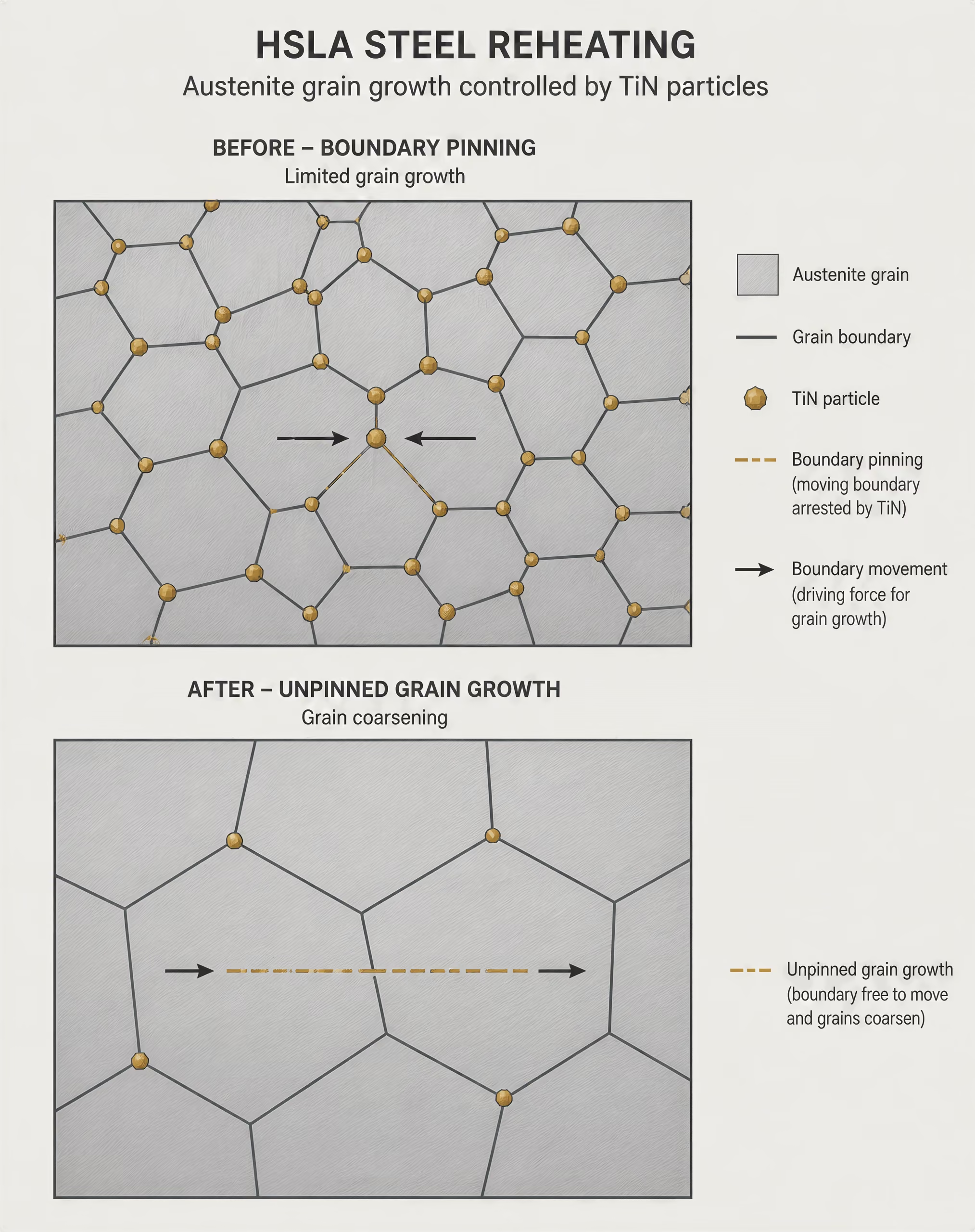
Titanium acts at an earlier thermal stage. Titanium has a strong affinity for nitrogen and forms stable TiN precipitates. According to AZoM, these particles control reheating grain size in HSLA steel. During slab or billet reheating, finely distributed TiN particles pin austenite grain boundaries. Boundary movement becomes more difficult, so austenite grains do not grow as rapidly as they would in a steel without effective pinning particles.
Grain-boundary pinning depends on particle size and distribution. Very fine, numerous TiN particles provide a large total interface area and can exert substantial resistance to boundary movement. Coarse TiN particles are less effective per unit volume and may behave as brittle inclusions or crack-initiation sites under some loading conditions. Excess titanium, excessive nitrogen, slow solidification, or unsuitable reheating can shift the population toward coarse particles. The chemical addition alone does not specify the useful particle population.
Titanium therefore controls reheating grain size, while niobium controls recrystallization during deformation and vanadium commonly strengthens the transformed ferrite by precipitation. The stages overlap, but the mechanisms should remain separate in analysis. TiN pinning limits grain growth before or during reheating; niobium delays austenite recrystallization during rolling; VC or V(C,N) precipitation impedes dislocation motion after transformation. Calling all three effects “grain refinement” hides the sequence that makes HSLA processing work.
Interactions complicate the sequence further. Titanium can remove nitrogen from solution as TiN, reducing nitrogen available for vanadium carbonitride formation. Niobium and vanadium compete with carbon and nitrogen according to temperature-dependent solubility relationships. Manganese, silicon, aluminum, and other elements alter transformation temperatures and phase stability, while segregation during casting can produce local compositions unlike the nominal heat analysis. The Steeluniversity module lists these elements—including silicon, manganese, sulfur, phosphorus, aluminum, copper, tin, chromium, nickel, and molybdenum—as factors affecting strength, ductility, toughness, grain size, hardenability, and heat-treatment response.
The practical lesson is direct: vanadium, niobium, and titanium are processing tools as much as they are alloying additions. Their concentration establishes possibilities; reheating, deformation, precipitation, and cooling decide which possibilities become microstructure. That is why HSLA specifications require controlled production practices and why an isolated element-by-element explanation gives an incomplete account of the steel’s performance.
10. Alloying Elements and Phase Transformation
Steel is not defined by a fixed recipe. The World Steel Association describes it as an iron–carbon alloy containing less than 2% carbon, with manganese and smaller quantities of silicon, phosphorus, sulfur, and oxygen. That definition sets a composition boundary, not a prediction of microstructure. Two steels within it can respond very differently to the same furnace cycle because alloying elements change phase stability, diffusion rates, nucleation sites, precipitation, and the temperatures at which transformations begin.
The distinction matters in plain-carbon steel and becomes more important in alloy grades. Steeluniversity identifies silicon, manganese, sulfur, phosphorus, aluminum, copper, tin, chromium, nickel, and molybdenum as elements affecting strength, ductility, toughness, machinability, hardenability, grain size, and heat-treatment response. Their effects are coupled. Manganese, chromium, nickel, and molybdenum can delay diffusional transformations, while carbon controls the hardness of the martensite that forms after sufficiently rapid cooling. Vanadium, niobium, and titanium also alter transformation behavior through carbide, carbonitride, and nitride precipitation.
Hardenability versus hardness
Hardness is the resistance measured at a particular location after a particular treatment. It depends strongly on carbon content, the fraction of martensite or other hard phases formed, tempering temperature, and local cooling conditions. A high-carbon steel quenched rapidly can produce very hard martensite near the surface, for example, but that fact alone says little about how deeply the martensitic structure extends into a thick section.
Hardenability The capacity of steel to form martensite through a section during cooling; it differs from the maximum hardness that the steel can reach.
Hardenability describes the ability of a steel to form martensite to a given depth during quenching. It is a kinetic property, not a direct measure of maximum hardness. Manganese, chromium, nickel, and molybdenum generally increase hardenability by shifting pearlite and bainite transformations to longer times on a time–temperature–transformation diagram. A slower interior cooling rate may then remain below the critical transformation range long enough for martensite to form. Carbon also contributes, although increasing carbon raises attainable martensite hardness more directly and can reduce toughness or increase retained austenite when used at higher concentrations.
| Property | What it describes | Main influences |
|---|---|---|
| Hardness | Resistance measured at a particular location after treatment | Carbon, phase fraction, cooling, and tempering |
| Hardenability | Depth to which martensite can form during quenching | Manganese, chromium, nickel, molybdenum, section size, and quench severity |
| Jominy profile | Hardness variation along an end-quenched specimen | Local cooling rate and transformation response |
A Jominy end-quench test illustrates the difference. The quenched end cools rapidly and commonly forms martensite; farther away, the cooling rate falls and softer pearlite, bainite, or mixed structures may develop. The hardness profile records both the steel's transformation response and the carbon-dependent hardness of the phases produced. A low-carbon steel can have substantial hardenability yet limited maximum martensite hardness, whereas a higher-carbon steel may be very hard at the surface but show a steep hardness drop through a large section if its hardenability is low.
The alloying element does not act alone. Chromium can increase hardenability while also supporting chromium-rich carbides and improving oxidation and corrosion resistance. Nickel stabilizes austenite and strengthens ferritic steel, including at sub-zero temperatures, but its influence on transformation depends on carbon, manganese, chromium, and the prior austenite grain size. Vanadium may increase strength through fine VC or V(C,N) precipitates while changing available carbon and nitrogen and therefore affecting the austenite-to-ferrite reaction. Calling any one of these elements a guaranteed “hardener” hides the actual mechanism.
Transformation kinetics and thermal history
A phase diagram indicates which phases are stable at equilibrium; it does not specify how fast a real steel part reaches equilibrium. Transformation kinetics fill that gap. Austenite may transform to ferrite and pearlite during slow cooling, to bainite at intermediate cooling rates, or to martensite when diffusion is suppressed. The result depends on the temperature path, not merely on the final chemical analysis.
The Nippon Steel report makes this limitation particularly clear: phase-transformation behavior can vary substantially with only a 1% difference in alloying-element concentration. That difference may alter the positions of transformation-start curves, the temperature of martensite formation, the amount of retained austenite, or the interval in which bainite forms. One percent is large enough to matter in many alloy systems, but the broader point is more important: small composition changes can have disproportionate effects when a transformation boundary is approached.
Cooling rate must therefore accompany any claim about composition. A furnace-cooled section, an air-cooled plate, an oil-quenched bar, and a water-quenched edge experience different thermal gradients and produce different structures even when cut from the same heat. Section thickness changes the result because heat leaves the surface before the core. Quench agitation, transfer time, and surface condition add further variation.
Reheating and rolling create another thermal history before the final heat treatment begins. In HSLA steel, AZoM reports that niobium suppresses austenite recrystallization during hot rolling. Deformed austenite can retain pancaked grains, increasing ferrite nucleation sites during subsequent cooling. Titanium forms stable TiN precipitates that restrict austenite grain growth during reheating; their effectiveness depends on particle size, dissolution temperature, and the nitrogen and titanium contents. Vanadium forms fine VC or V(C,N) precipitates that increase yield strength, especially when precipitation occurs during or after transformation. Excessive reheating can dissolve particles intended to control grain size, while unsuitable cooling can prevent the desired precipitation response.
Tempering changes the interpretation again. Quenched martensite is supersaturated and stressed; tempering allows carbon redistribution, carbide precipitation, and recovery. A steel with the same quenched hardness can acquire different strength, toughness, and dimensional stability after tempering at 200 °C, 500 °C, or 650 °C. Alloy carbides containing chromium, molybdenum, or vanadium may precipitate during higher-temperature tempering, so the final condition cannot be predicted from the quench chemistry alone.
Grain-boundary segregation and interfaces
Bulk composition is an average. Atoms are not always distributed uniformly through the microstructure. Phosphorus, sulfur, tin, antimony, and other solutes can segregate to austenite grain boundaries during solidification, reheating, or transformation. Grain boundaries have different atomic packing and energy from the grain interiors, making them preferred sites for solute accumulation and for the nucleation of new phases. Segregation can reduce boundary cohesion, change ferrite nucleation, or modify the local transformation temperature.
Interfaces between ferrite, austenite, bainite, martensite, and precipitates also have chemical fields that differ from the nominal alloy composition. Carbon can partition from a transforming phase into austenite; manganese and chromium may redistribute more slowly because they are substitutional elements. A boundary enriched in one element and depleted in another can advance or retard transformation locally. The same steel may therefore contain regions with different transformation sequences, especially near inclusions, prior-austenite boundaries, weld heat-affected zones, and segregation bands from casting.
Interfaces control more than phase formation. Fine TiN particles pin austenite boundaries; niobium in solution or as precipitates restricts recrystallization; VC and V(C,N) particles impede dislocation motion and raise yield strength. Sulfide inclusions can provide nucleation sites but may also reduce toughness, depending on morphology and alignment. In stainless steel, chromium must remain sufficiently available near the surface to sustain chromium-oxide passivation, while nickel, molybdenum, nitrogen, carbon, and stabilizing elements affect austenite stability, work hardening, sensitization, and secondary-phase formation.
Chemical analysis is consequently only the starting point. A meaningful statement about an element must identify its concentration range, phase location, segregation state, precipitate population, grain size, cooling rate, reheating and rolling schedule, and tempering condition. Without those variables, “chromium increases hardness” or “nickel improves toughness” is not a result; it is an incomplete hypothesis.
11. Reading Alloy Chemistry Through Steel Grades and Standards
A steel designation is a compressed piece of information, not a complete description of the material. It may indicate a chemical family, a strength class, a stainless classification, a product form, or a specification category. The governing standard supplies the missing conditions: permitted composition, tensile and yield requirements, elongation, impact testing, heat-treatment state, dimensional rules, sampling, and test temperature. Reading only the name can therefore produce a chemically plausible but technically wrong identification.
The World Steel Association defines steel as an iron–carbon alloy containing less than 2% carbon, with manganese and smaller quantities of silicon, phosphorus, sulfur, and oxygen also present. Steeluniversity lists silicon, manganese, sulfur, phosphorus, aluminum, copper, tin, chromium, nickel, and molybdenum among elements that affect plain-carbon-steel behavior. Their effects are not independent. A small change in carbon can alter the response to chromium; nickel can change the temperature range in which austenite is stable; molybdenum can modify carbide precipitation and tempering response; and processing can determine whether the same nominal chemistry becomes ferrite, pearlite, bainite, martensite, or a mixture.
Composition limits and designation logic
Begin with the complete designation and the document that governs it. Ask four questions: which standard applies, what product form is covered, which delivery or heat-treatment condition is specified, and which edition of the standard is contractual? A designation printed on a drawing may identify a family while leaving the required condition to a separate purchase or engineering clause. Plate, bar, forgings, wire, tube, and cast products can have different limits and tests even when their broad alloy families appear similar.
Composition is normally expressed as a range or maximum, not as a recipe. Carbon may be bounded by a maximum value, while manganese, chromium, nickel, or molybdenum may have lower and upper limits. “Maximum” matters. It does not mean that every heat contains that amount, nor does a midpoint represent the specification. Residual elements such as phosphorus, sulfur, copper, tin, and nitrogen can be restricted because they affect toughness, weldability, hot shortness, corrosion behavior, or phase stability.
A designation can also encode a property class rather than an exact chemistry. A high-strength low-alloy, or HSLA, specification may permit several alloying strategies to achieve its required yield strength and toughness. One producer may rely more on niobium and controlled rolling; another permitted chemistry may obtain strength through vanadium precipitation or a different balance of manganese and silicon. The designation does not by itself reveal the rolling schedule, cooling rate, grain size, or precipitate population.
The distinction is especially important near phase boundaries. Nippon Steel reports that transformation behavior can vary substantially with only a 1% difference in alloying-element concentration. That change may alter transformation start temperatures, hardenability, retained austenite, or the fraction of bainite and martensite. The bulk analysis is not the whole story either: segregation at grain boundaries and interfaces can change where transformations begin and which mechanism dominates. A heat that meets the same chemical limits can still show different microstructures after different reheating, rolling, cooling, or tempering histories.
Substitutional elements occupy normal lattice sites and strengthen by distorting the crystal lattice. Steeluniversity relates this effect to atomic size, compressibility, chemical valency, and electronegativity. Carbon and nitrogen behave mainly as interstitial solutes, producing strong local strain and interacting with dislocations, vacancies, and alloy carbides or nitrides. The designation records concentration; it rarely records the spatial distribution that controls the final property.
Carbon, chromium, nickel, and molybdenum families
Plain carbon steel is defined by a relatively limited alloying concept, but “plain” does not mean chemically empty. Manganese contributes solid-solution strengthening and combines with sulfur, while silicon affects deoxidation and strength. Sulfur can improve machinability in controlled compositions but may reduce transverse ductility. Phosphorus can raise strength yet harm toughness. Copper, tin, chromium, nickel, and molybdenum may occur as residuals or deliberate additions, and their significance depends on concentration and processing.
Low-alloy steel adds controlled quantities of elements to change hardenability, strength, toughness, tempering resistance, wear response, or corrosion behavior. Chromium increases hardenability and can improve high-temperature, oxidation, and corrosion resistance, but its effect depends on carbon activity, competing carbide formers, and the thermal cycle. Nickel strengthens and toughens ferritic steel, with a particularly important contribution to sub-zero impact toughness. Molybdenum can increase hardenability and tempering resistance and can alter carbide precipitation; it is also important in several stainless-steel corrosion systems.
Ferritic stainless steel and austenitic stainless steel illustrate why element names cannot be read as guaranteed outcomes. Chromium supplies the basis for a protective chromium-oxide film, but corrosion resistance depends on chromium activity at the surface, environmental chemistry, fabrication, inclusions, and damage to the passive film. Nickel stabilizes austenite, while nitrogen can strengthen austenitic stainless steel and affect phase balance. Carbon may increase strength but can combine with chromium during unsuitable thermal exposure, reducing chromium near grain boundaries and causing sensitization. Titanium or niobium additions can bind carbon and reduce that risk, although stabilizing additions also affect welding response, precipitates, and secondary phases.
The same alloying element can therefore have opposing engineering consequences. Chromium in a ferritic alloy may promote ferrite and carbide formation, whereas nickel may suppress ferrite and support austenite. Molybdenum can improve localized-corrosion resistance in austenitic stainless steel, yet its interaction with chromium, nickel, nitrogen, and thermal history affects sigma-phase or other secondary-phase formation. A family name identifies the expected phase constitution; it does not guarantee a single microstructure after every manufacturing route.
HSLA steels make the processing dependence explicit. During hot rolling, niobium can suppress austenite recrystallization, allowing deformation to refine the eventual ferritic structure. Titanium forms stable TiN precipitates that help control reheating grain size. Vanadium forms fine VC or V(C,N) precipitates that increase yield strength. Those mechanisms require appropriate dissolution, rolling, cooling, and precipitation conditions. An addition that remains in coarse particles cannot provide the same strengthening as a fine, well-dispersed population.
Why grade names do not replace material requirements
A grade name should be treated as an index into a specification, not as a substitute for it. The applicable document may require a minimum yield strength in a stated thickness range, a tensile-strength interval, a minimum elongation, and Charpy impact energy at a specified temperature. It may also prescribe normalized, quenched-and-tempered, thermomechanically controlled, annealed, or solution-treated delivery conditions. Without those clauses, “the same grade” can describe material with different strength, toughness, weldability, and residual stress.
Test conditions are part of the material requirement. Yield strength can vary with specimen orientation, thickness, strain rate, and test method. Impact energy depends strongly on temperature and notch orientation. Chemical analysis may be reported from a ladle sample or a product sample, with different acceptance rules. Heat-treatment records, surface condition, ultrasonic testing, grain-size requirements, and supplementary impact tests may matter more to service performance than a short designation printed beside the material.
A sound interpretation therefore moves from designation to standard, from standard to chemical and mechanical limits, and from those limits to processing history and intended service. Compare the heat analysis with the permitted range, verify the product form and condition, check the required tests, then ask what microstructure those conditions are expected to produce. This approach prevents a family label from being mistaken for a guarantee. Chemistry sets possibilities; phase stability, segregation, precipitation, and manufacturing history decide which of those possibilities becomes the steel in hand.
12. A Practical Method for Predicting an Element's Metallurgical Effect
An alloying element does not carry a fixed property with it. Chromium is not simply a “corrosion element,” vanadium is not merely a “strength element,” and sulfur is not always harmful. The result depends on where the atoms finish up, which phases are present, how the steel was processed, and what temperature and environment the component will experience.
Questions for predicting an element's effect
- Where does it reside?
- Determine whether the element is in solid solution, an interstitial site, a precipitate, an inclusion, a grain boundary, an oxide film, or a secondary phase.
- Which mechanism is active?
- Identify lattice distortion, precipitation, grain refinement, transformation retardation, passivation, or austenite stabilization.
- What processing occurred?
- Check solidification, reheating, rolling, cooling, quenching, tempering, and welding.
- What service conditions apply?
- Consider temperature, environment, loading, and exposure time.
A useful prediction therefore begins with a sequence of questions rather than a list of isolated effects. First locate the element. Then identify the mechanism it can activate or suppress. Finally test that explanation against composition, thermal history, deformation history, and service conditions.
Ask where the element resides
The first question is physical: where is the element after solidification and processing?
An element may remain in ferrite or austenite as a substitutional solute, occupy interstitial sites, combine with carbon or nitrogen in a carbide or carbonitride, segregate to a grain boundary, become concentrated in an oxide film, or form a distinct secondary phase. The same nominal addition can produce different results through these different locations.
Substitutional atoms replace iron atoms in the lattice. Steeluniversity describes their strengthening effect as crystal-lattice distortion, with the magnitude related to atomic size, compressibility, chemical valency, and electronegativity. Manganese, silicon, nickel, and chromium can therefore strengthen ferrite while remaining broadly distributed in solid solution. Their effect is not determined by atomic size alone: the matrix phase, concentration, and interactions with carbon and other solutes also matter.
Carbon and nitrogen behave differently because they occupy interstitial sites and produce strong local strain fields. If they remain dissolved, they can raise strength and alter transformation behavior. If they combine with chromium, niobium, titanium, or vanadium, the relevant effect becomes precipitation or phase control. The distinction is decisive. Vanadium in solution can affect hardenability and transformation kinetics, whereas fine VC or V(C,N) particles impede dislocation motion and increase yield strength.
The particle itself also matters. AZoM identifies stable TiN precipitates as a means of controlling reheating grain size in HSLA steel. Coarse TiN formed during solidification is not equivalent to a fine, well-dispersed precipitate. The former may provide limited strengthening and can act as a crack-initiation site; the latter can pin austenite grain boundaries. Location, size, number density, and stability must be considered together.
Grain-boundary residence introduces another set of possibilities. Phosphorus, sulfur, tin, and antimony may segregate during cooling or heat treatment. Such segregation can weaken boundaries, alter nucleation, or change fracture behavior even when the bulk composition appears modest. An element that is harmless in a uniform matrix may be damaging when concentrated at an interface.
Chromium illustrates the need to identify the relevant phase or film. In stainless steel, sufficient chromium in the surface region supports a thin chromium-rich oxide film that slows further oxidation and dissolution. Nickel, molybdenum, and nitrogen can change the phase balance and strengthen or stabilize austenite, while carbon and stabilizing additions such as titanium or niobium affect carbide formation and sensitization. The chromium content alone does not predict corrosion performance if the surface film is damaged, the alloy is depleted near grain boundaries, or a secondary phase consumes chromium.
Identify the competing mechanisms
Once the element’s location is known, ask what mechanism is actually controlling the property. The principal candidates are lattice distortion, precipitation, grain refinement, transformation retardation, passivation, and a change in austenite stability. More than one may operate at the same time, and they may oppose one another.
A dissolved substitutional element can increase strength by making dislocation motion more difficult. That same distortion may reduce ductility, but the change is not guaranteed: a small addition can raise strength with little loss of elongation if grain refinement or a favorable phase balance offsets the solute penalty. Silicon and manganese, for example, can strengthen ferrite, while manganese also changes austenite stability and transformation temperatures.
Precipitation gives a different response. Fine particles obstruct dislocations and pin moving grain boundaries. Niobium suppresses austenite recrystallization during hot rolling in HSLA steel, allowing deformation to accumulate and helping produce a refined transformation structure. Titanium nitride controls austenite grain size during reheating. Vanadium forms fine VC or V(C,N) precipitates that increase yield strength. These mechanisms depend on precipitation temperature, particle size, dissolution during reheating, and cooling rate. A nominal vanadium addition does not guarantee useful precipitation strengthening if the carbon and nitrogen balance, rolling schedule, or tempering treatment is unsuitable.
Transformation retardation can improve hardenability by delaying ferrite, pearlite, or bainite formation until lower temperatures. Chromium and molybdenum commonly contribute in this way, but their effect depends on the complete alloy composition and austenite grain size. A steel that hardens deeply in one section thickness may not do so in another because cooling rate controls which transformations have time to occur.
Austenite stability creates a separate route to property changes. Nickel stabilizes austenite and strengthens and toughens ferritic steel, particularly at sub-zero temperatures, but in stainless grades its balance with chromium, carbon, nitrogen, and manganese helps determine whether the structure is fully austenitic, ferritic, or duplex. Excessive or poorly controlled additions can promote unwanted secondary phases. Passivation, meanwhile, is a surface process rather than ordinary bulk strengthening. A chromium-rich oxide film may improve corrosion resistance while having little direct effect on tensile strength.
The mechanisms can conflict. A carbide may raise hardness but remove chromium from the matrix and impair localized corrosion resistance. Grain refinement can improve strength and toughness, while coarse precipitates can do the opposite. Sulfur can improve machinability by forming manganese sulfide inclusions, yet those inclusions may reduce transverse ductility and corrosion-fatigue resistance.
Check composition, processing, and service temperature
The next test is quantitative. Do not ask whether an element is present; ask how much is present, in what balance, and in which phase. The Nippon Steel report cautions that steel phase-transformation behavior can vary substantially with only a 1% difference in alloying-element concentration. That difference may alter critical temperatures, phase fractions, segregation, precipitate stability, or the time available for transformation.
Processing can dominate the nominal chemistry. Solidification controls segregation and inclusion formation. Hot rolling controls recrystallization and texture. Reheating can dissolve TiN, NbC, or VC, or leave them intact. Cooling rate determines whether austenite transforms to ferrite, pearlite, bainite, or martensite. Quenching and tempering redistribute carbon and relieve stresses, while welding creates local thermal cycles that may produce coarse grains, hard zones, or sensitized regions.
Service temperature must be checked separately. A precipitate stable during manufacture may coarsen during long exposure at elevated temperature. Austenite that is stable at room temperature may transform under deformation or sub-zero cooling. Nickel’s contribution to low-temperature toughness cannot be inferred from its room-temperature tensile strength. Corrosion resistance also depends on the environment: chloride exposure, acidity, potential, crevices, and temperature can determine whether passivation persists.
The final diagnostic framework is therefore: locate the element in solid solution, a carbide or carbonitride, a grain boundary, an oxide film, or a secondary phase; identify whether the active mechanism is lattice distortion, precipitation, grain refinement, transformation retardation, passivation, or a change in austenite stability; then check concentration, thermal processing, mechanical processing, and service temperature. Only after those checks should you predict strength, ductility, toughness, corrosion resistance, machinability, hardenability, or heat-treatment response.