



What Weathering Steel Is—and What It Is Not
Weathering steel as deliberately alloyed low-alloy steel
Weathering steel is not a single grade and not simply ordinary structural steel left unpainted. It is a family of low-carbon, low-alloy steels whose chemical compositions are adjusted to change the way atmospheric corrosion develops. Copper, chromium, nickel, phosphorus, silicon and manganese are among the traditional additions. Molybdenum may also be used, while research has examined tungsten, titanium, aluminium and rare-earth additions. The Federal Highway Administration’s 2009 review identifies Mn, Si, Cr, Ni, Cu, Mo and P as the historical alloying focus.
Weathering steel develops conditional atmospheric corrosion resistance rather than becoming corrosion-proof. Strong evidence
Electrochemical corrosion Corrosion caused by coupled anodic metal dissolution and cathodic reactions through an electrolyte film.
These additions do not stop electrochemical corrosion. They alter the composition, structure, adhesion and permeability of the rust layer that forms during exposure. When steel is wetted, anodic areas release iron into an electrolyte while cathodic areas support oxygen-reduction reactions. The resulting corrosion products can become relatively dense and adherent, slowing further access by water and oxygen. The reactions continue, however. “Weathering” describes a corrosion behaviour, not immunity.
| Standard or designation | Examples or scope | Design note |
|---|---|---|
| ASTM A242/A242M | High-strength low-alloy structural steel | Weathering-steel product standard |
| ASTM A588/A588M | High-strength low-alloy structural steel with improved atmospheric corrosion resistance | Grade and chemical limits remain controlling |
| ASTM A709/A709M | Bridge steels including Grade 50W and HPS 50W | Project documents determine applicable weathering grade |
| EN 10025-5 | S355J0WP, S355J2WP, S355J0W and S355J2W | Suffix and grade are not interchangeable |
Common designations include ASTM A242/A242M for high-strength low-alloy structural steel, ASTM A588/A588M for high-strength low-alloy structural steel with improved atmospheric corrosion resistance, and ASTM A709/A709M bridge steels, which include weathering grades such as Grade 50W and Grade HPS 50W where specified by the material standard and project documents. European weather-resistant structural steels are designated under EN 10025-5, including S355J0WP, S355J2WP, S355J0W and S355J2W. The suffix and grade matter: chemical limits, mechanical properties, weldability provisions and delivery condition are not interchangeable merely because each product is called “weathering steel.”[1] Improved Corrosion-Resistant Steel for Highway Bridges. Federal Highway Administration. Federal Highway Administration research publication, 2011.
Design variables that control performance
- Alloy chemistry
- Influences the composition, structure and adhesion of corrosion products.
- Wetting history
- Determines whether the surface receives repeated wetting and drying or remains continuously damp.
- Geometry
- Controls water retention, debris accumulation, ventilation and runoff.
- Contaminants
- Chlorides, sulfur dioxide and industrial deposits can maintain active corrosion.
- Inspection
- Verifies whether the design assumptions remain valid during service.
ASTM G101 composition-based corrosion indices are screening or comparative tools and cannot replace site-specific exposure and detailing assessment. Limited evidence
[2] ASTM G101-04(2010), Standard Guide for Estimating Atmospheric Corrosion Data. ASTM International. ASTM International standard, 2010.The alloy is therefore only one part of the design decision. ASTM G101-04(2010) provides methods for estimating long-term atmospheric corrosion losses from shorter exposure data and for estimating the relative atmospheric corrosion resistance of a low-alloy steel from its chemical composition. Such an index is a screening tool, not a site certificate. FHWA research published in 2011 reported that most weathering steels had ASTM G101 corrosion-index values between 6 and 7; that study pursued values near or above 9.5 for substantially improved resistance in chloride-containing atmospheres. A composition-based number cannot account fully for a bridge ledge that holds wet debris or a façade washed by salt spray.
Patina formation versus a factory-applied coating
A weathering-steel patina is produced at the surface after fabrication and erection. It is not paint, galvanizing, thermal spray, or a shop-applied film with a fixed thickness and guaranteed coverage. The initial surface usually corrodes relatively quickly when moisture is present. With repeated exposure, corrosion products change in composition and arrangement, and some portion of the rust layer becomes more adherent and less permeable. Colour may progress through orange, red-brown, dark brown and near-black tones, but colour alone does not prove that stabilization has occurred.
The National Steel Bridge Alliance stated in its 2010 primer that protective patina development requires repeated wetting and drying. That requirement is central. Rain followed by drying can promote a different rust layer from one produced by continuous condensation, standing water or a crevice that never drains. A surface sheltered from rain may remain dirty and damp rather than develop the desired cycle. Conversely, frequent washing by rain does not guarantee protection if deposits retain chlorides or acidic contaminants.
Patina formation also takes time, and the period varies with climate, orientation, steel chemistry, surface condition and pollutant loading. Mill scale, fabrication residue, weld spatter and oils can create local differences in wetting and corrosion. Rust staining on adjacent concrete, stone or coated steel is a separate design concern: even where metal loss is limited, runoff can produce permanent visual damage. A factory coating can be inspected for continuity, specified by dry-film thickness and repaired at defined defects. A patina cannot be accepted by those same assumptions. It develops unevenly, is affected by every joint and drain, and may be disturbed by cleaning, abrasion or later repairs.
[3] Guidance Note 1.07: Weather Resistant Steel. Steel Construction Institute. SCI Guidance Note 1.07, 2015.
Designers should also distinguish a stable exposed face from a crevice. Bolted laps, narrow stiffener gaps, boxed details, splice plates, bearing seats and underside pockets can retain water and debris. SCI Guidance Note 1.07, published by the Steel Construction Institute in 2015, identifies continuously wet or damp environments, high chloride or salt-spray exposure, concentrated industrial fumes and buried conditions as unsuitable or restricted applications for uncoated weather-resistant steel. Those conditions can prevent the surface from reaching a lower-corrosion state or can produce severe local attack despite an attractive general colour.
Atmospheric corrosion resistance versus corrosion immunity[4] ISO 9223:2012 Corrosivity of Atmospheres. International Organization for Standardization. International Standard, 2012.
“Improved atmospheric corrosion resistance” is a conditional performance claim. It does not mean that the steel is suitable for every outdoor exposure, nor that thickness loss becomes negligible. ISO 9223:2012 classifies atmospheric corrosivity using first-year corrosion rates of standard specimens and identifies temperature-humidity influence, sulfur dioxide pollution and airborne salinity as key factors. The classification describes the atmosphere; it does not convert a weathering grade into a universally safe material.[5] Uncoated Weathering Steel in Bridges. Federal Highway Administration. Federal Highway Administration guidance, 2003.
The same distinction applies to project selection. FHWA guidance from 2003 requires site-specific consideration of time of wetness, chloride exposure, industrial pollutants, drainage, geometry and maintenance before uncoated weathering steel is selected. A dry inland site with free drainage may support the intended corrosion behaviour. A coastal structure exposed to salt-laden spray, a roadway over which de-icing brine is blown, or an industrial site with concentrated fumes may not. Repeated wetting is necessary for patina development, but chloride-bearing wetting and persistent dampness can keep corrosion active and promote pitting.
Pitting is recognized in the cited AASHTO treatment by assigning plain uncoated weathering-steel base metal one lower fatigue category than comparable non-weathering steel. Strong evidence
[6] Steel Bridge Design Handbook: Design for Fatigue. Federal Highway Administration. Federal Highway Administration handbook, 2016.Pitting matters structurally, not only cosmetically. FHWA fatigue guidance explains that weathering steel forms its patina through alternating wet and dry cycles, while also reporting that AASHTO assigns plain uncoated weathering-steel base metal one lower fatigue category than comparable non-weathering steel because of pitting. The allowance recognizes that localized corrosion can create stress concentrations even when average section loss appears modest. Fatigue checks, weld details, inspection access and corrosion allowances must therefore remain part of the structural design.
The correct description is straightforward: an uncoated weathering-steel surface is a managed corrosion system. Alloy chemistry can encourage a more protective rust layer under suitable atmospheric exposure, but drainage, ventilation, joint geometry, contaminants, chloride control, inspection and maintenance determine whether that potential is realized. It is weather-resistant steel—not corrosion-proof steel, and not steel with a permanent coating already supplied by the mill.
The Atmospheric Corrosion Environment
Weathering steel is not immune to atmospheric corrosion. It is a low-carbon, low-alloy steel formulated to develop a relatively dense and adherent rust layer when exposure permits corrosion products to form, dry, and reorganize without being repeatedly washed away or kept continuously wet. Copper, chromium, nickel, phosphorus, silicon and other alloying additions alter the electrochemical reactions and the structure of the rust, but chemistry cannot compensate for every exposure condition.
ISO 9223:2012 provides the principal framework for describing atmospheric corrosivity. It classifies environments using first-year corrosion rates measured on standard specimens and identifies three controlling influences: the temperature-humidity regime, sulfur dioxide pollution, and airborne salinity. These factors interact with the steel surface. The same nominal grade can therefore show different corrosion rates, rust colors, pit depths and patina development in an inland rural setting, beside a tidal estuary, beneath an industrial plume, or inside a sheltered bridge detail.
The distinction matters during design. A weathering-steel girder in clean air, with free drainage and regular drying, may develop a stable protective layer. A nominally identical girder under a leaking deck joint can remain actively corroding at the crevice while exposed surfaces appear mature. Atmospheric classification is a starting point, not a substitute for examining the actual site and the geometry that will control moisture retention.

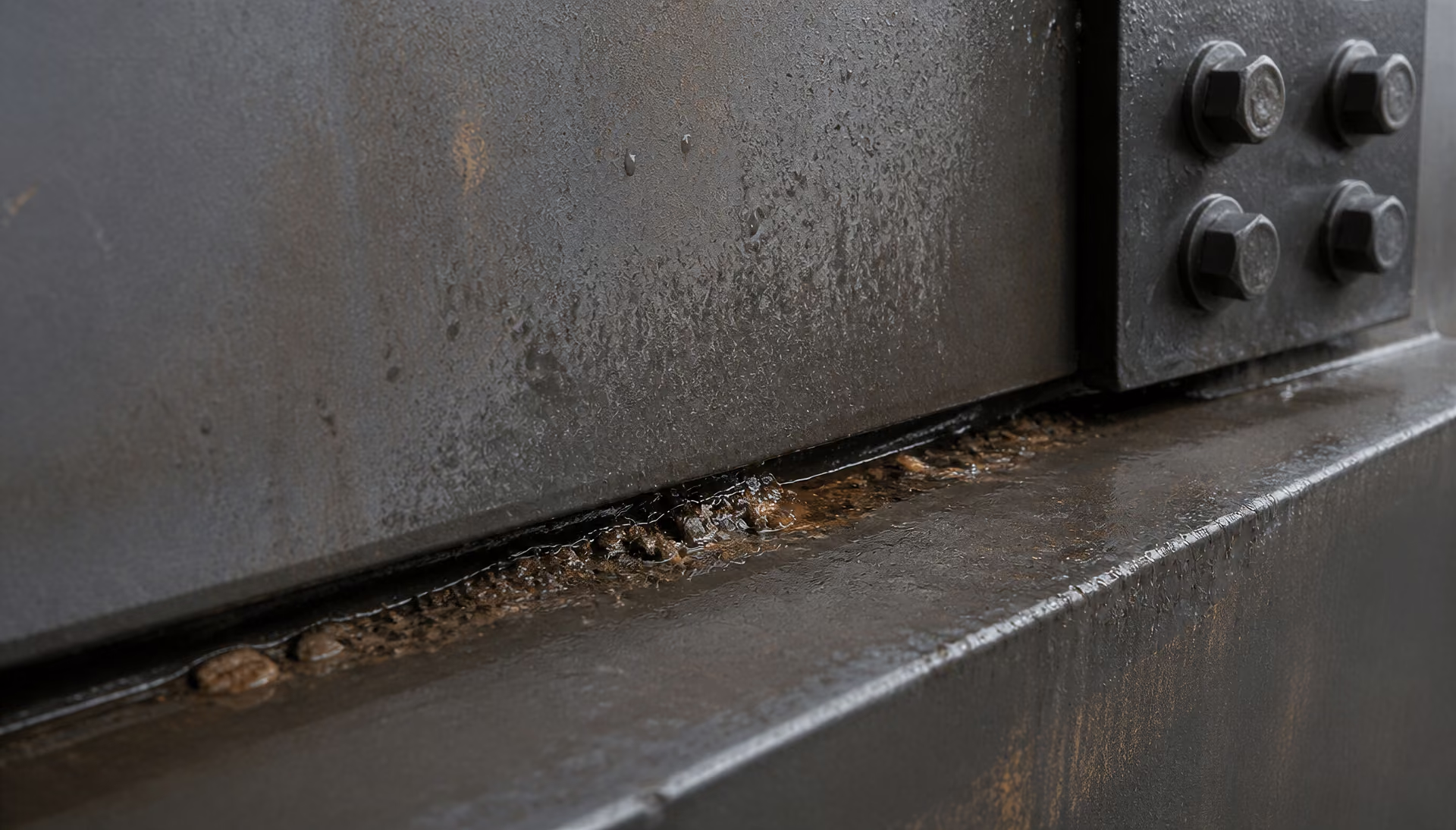
Time of wetness and repeated wetting-drying cycles
Time of wetness The period during which a metal surface remains covered by a sufficiently conductive moisture film to support atmospheric corrosion.
Electrochemical corrosion requires an electrolyte. Rain, fog, dew, condensation and deposited salts provide that electrolyte on the steel surface. The period during which a sufficiently conductive surface film remains is commonly described as time of wetness. Longer wet periods generally allow more anodic metal dissolution and cathodic oxygen reduction, although the relationship is not a simple clock: salt concentration, temperature, oxygen supply, surface contamination and rust-layer permeability also change during the exposure.
Repeated wetting and drying is a necessary environmental condition for protective patina development. Strong evidence
Drying is not merely a pause in corrosion. For weathering steel, alternating wet and dry periods help transform initially loose corrosion products into a more adherent, less permeable patina. The National Steel Bridge Alliance primer, published in 2010, states that protective patina development requires repeated wetting and drying. During wetting, iron dissolves and corrosion products precipitate; during drying, the rust layer contracts, oxidizes further and can become more compact. Repeated cycles may gradually reduce the rate at which water and oxygen reach the steel.
That process fails when water is trapped. A horizontal ledge, tight overlap, plugged drain, stiffener end, bolt pocket or sealed crevice can remain wet after surrounding surfaces have dried. The resulting differential aeration cell can produce localized attack, while chloride deposits raise electrolyte conductivity. Runoff can also carry iron-rich water onto concrete, pavements or architectural surfaces, creating staining even where section loss is moderate.
Exposure sequence
- Wetting Rain, fog, dew, condensation or deposited salts create an electrolyte film.
- Electrochemical reaction Anodic iron dissolution and cathodic oxygen reduction proceed through the film.
- Drying Evaporation changes salt concentration, oxygen access and corrosion-product structure.
- Reorganization Repeated cycles can produce a denser and more adherent rust layer when conditions are suitable.
The exposure history is therefore more important than an annual rainfall figure alone. Short, frequent rain events followed by drying can promote patina formation. Long periods of dampness can maintain active corrosion. Cyclic salt deposition and evaporation can be particularly damaging because evaporation concentrates chlorides at the surface, and the next humid period reactivates the concentrated electrolyte.
FHWA guidance published in 2003 calls for site-specific evaluation of time of wetness, chloride exposure, industrial pollutants, drainage, geometry and maintenance before uncoated weathering steel is selected. That requirement is practical rather than bureaucratic. A bridge in a dry inland climate can contain continuously damp microenvironments, while a wet coastal structure may have exposed faces that dry quickly and sheltered joints that do not.
Temperature, humidity and condensation
Relative humidity affects whether a surface film can persist. As air cools toward its dew point, water condenses on steel even when no rain has fallen. Night-time cooling, shaded faces, enclosed box sections and cold metal beneath warm humid air are common causes. A surface may therefore experience many hours of wetness in a location that receives little measurable precipitation.
Temperature changes both reaction rates and water evaporation. Higher temperatures often accelerate electrochemical reactions, but they can also shorten wetness by increasing evaporation. Near the dew point, a modest temperature change can produce condensation and extend the electrolyte period. Temperature also changes oxygen solubility, salt crystallization, rust transformations and the viscosity or mobility of surface films. ISO 9223:2012 groups these effects through its temperature-humidity influence rather than treating humidity as an independent guarantee of corrosion rate.
Humidity becomes more consequential when soluble pollutants are present. Hygroscopic salts can absorb water from air at relative humidities below the point at which clean steel would remain dry. A surface carrying sodium chloride, magnesium chloride or calcium chloride may thus stay electrolytically active through repeated humid periods. Dust and industrial deposits can have a similar effect, especially where they accumulate on horizontal or sheltered surfaces.
Patina development depends on this balance. Some moisture is needed to initiate and sustain the corrosion reactions that produce the rust layer. Excessive or persistent moisture prevents the layer from drying and can keep pores and cracks electrochemically active. Poor ventilation worsens the condition by slowing evaporation. SCI Guidance Note 1.07, issued by the Steel Construction Institute in 2015, identifies continuously wet or damp environments as unsuitable or restricted applications for uncoated weather-resistant steel, along with high chloride or salt-spray exposure, concentrated industrial fumes and buried conditions.
Alloy chemistry still matters. Weathering steels historically used manganese, silicon, chromium, nickel, copper, molybdenum and phosphorus to influence corrosion products and their adherence. FHWA research published in 2009 also examined tungsten, titanium, aluminum and rare-earth additions. Yet an alloy addition cannot remove condensation from a box section or drain a water trap. Environment and detailing remain coupled.
Sulfur dioxide, chlorides and airborne salinity
Sulfur dioxide is important because it dissolves in surface moisture and forms sulfurous and, after oxidation, sulfuric acid species. These acidic films increase conductivity and can disrupt rust-layer stabilization. Industrial combustion sources historically produced severe sulfur dioxide environments, although emissions vary greatly by region and source. A steel surface near a refinery, smelter, power plant or dense traffic corridor may receive a pollutant load unlike that measured at a nearby rural station.
Chlorides are often more persistent and locally severe. Sea spray, breaking waves, windborne marine aerosol, deicing salts and contaminated runoff deposit chloride ions on steel. Chlorides penetrate pores and defects in rust, promote localized anodic dissolution and make drying less protective because hygroscopic residues reabsorb moisture. Wind direction, elevation, shoreline distance, splash exposure and washing by rain all affect deposition. “Coastal” is not a sufficient exposure description; a sheltered salt-collecting detail can be more aggressive than a fully exposed surface farther from the sea.
ISO 9223:2012 treats airborne salinity as a principal corrosivity factor, and site assessment should consider both deposition and retention. FHWA’s 2011 improved corrosion-resistant-steel research reported that most weathering steels had ASTM G101 corrosion-index values between 6 and 7, while the research targeted values near or above 9.5 for substantially improved resistance in chloride-containing atmospheres. ASTM G101-04(2010) provides methods for estimating long-term atmospheric corrosion losses from short-term exposure data and for estimating the relative atmospheric corrosion resistance of low-alloy steel from chemical composition; it does not turn a composition index into immunity.
Pollutants and salts also affect structural consequences. Pitting creates stress concentrations, and FHWA fatigue guidance explains that AASHTO assigns plain uncoated weathering-steel base metal one lower fatigue category than comparable non-weathering steel because of pitting. Atmospheric corrosion design must therefore connect ISO 9223 exposure, ASTM G101 composition-based estimates, drainage and inspection access with fatigue details. Nominally identical steel is not exposed to a single atmosphere. Its actual corrosion environment is the combination of climate, deposits, wetting history and geometry at each square metre of the structure.
How the Weathering-Steel Patina Develops
Weathering steel does not arrive with a corrosion-proof surface. Its atmospheric resistance develops after exposure, and the result depends on the steel’s chemistry, the surrounding air, and the way water reaches and leaves the surface. Grades such as ASTM A588 and the weathering-steel grades specified under ASTM A709 are low-carbon, low-alloy steels containing deliberate additions that alter corrosion-product formation. Traditional compositions emphasize Mn, Si, Cr, Ni, Cu, Mo and P; Federal Highway Administration research has also examined W, Ti, Al and rare-earth additions.
Those elements do not stop the anodic and cathodic reactions that constitute atmospheric corrosion. Instead, under suitable exposure, they influence which oxides and oxyhydroxides form, how densely the rust layer develops, and how strongly it remains attached to the substrate. A patina is therefore an evolving corrosion product, not an applied coating and not a guarantee of permanent protection.

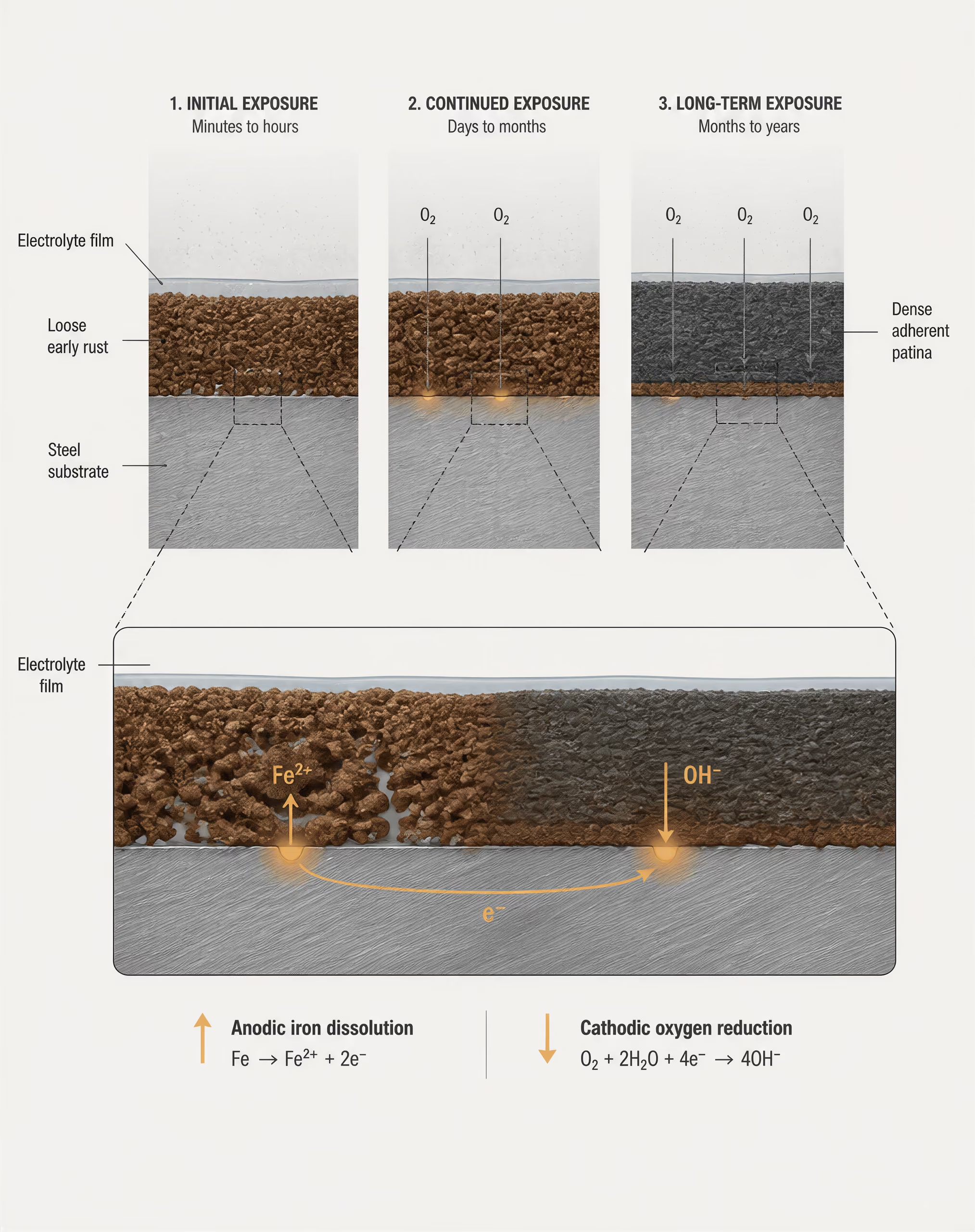
Initial corrosion and rust-layer transformation
A freshly fabricated surface usually carries mill scale, shop contamination, oxide from thermal cutting, or residues from handling and erection. Once moisture forms a continuous or semi-continuous electrolyte on exposed steel, local anodic areas release iron ions:
Cathodic reactions consume oxygen and water, producing hydroxide ions. The early products include poorly ordered iron oxyhydroxides and hydrated oxides. Their appearance may shift from bright orange or yellow-brown to darker red-brown and, in some exposures, near-black areas. Colour is not a reliable measure of protection. A dark surface can still support active pitting beneath deposits, while a lighter layer can contain regions that are relatively adherent.
As exposure continues, the initial rust is repeatedly dissolved, reprecipitated, dehydrated and reorganized. Common corrosion products include lepidocrocite, often written as γ-FeOOH, goethite, α-FeOOH, and magnetite, Fe₃O₄. The proportions and physical arrangement vary with wetting duration, oxygen access, contaminants, temperature and the steel’s alloy content. Weathering-steel additions can promote a finer, more compact corrosion layer than that formed on ordinary structural carbon steel, but they cannot impose one identical mineral structure at every site.
Patina stabilization A condition in which the rust layer and environment produce a relatively consistent, usually lower, corrosion rate over a defined period; it does not mean corrosion has ended.
The distinction matters at the steel surface. A loose, cracked or poorly attached layer allows water and oxygen to reach fresh metal repeatedly. A denser layer restricts transport and reduces the area of readily accessible metal, so the corrosion rate can decline. This is a change in reaction conditions, not a conversion of the surface into an impermeable barrier. Cracks, impact damage, cut edges, crevices and areas beneath accumulated debris can continue corroding even while adjacent broad faces appear mature.
ASTM G101-04(2010) reflects this time-dependent behaviour by providing methods for estimating long-term atmospheric corrosion losses from shorter exposure data and for estimating the relative atmospheric corrosion resistance of low-alloy steel from chemical composition. Its use does not remove the need for exposure-specific judgment. Chemical composition can indicate a tendency, but it cannot account by itself for a leaking joint, a chloride deposit, or a permanently damp underside.
Alternating wet and dry exposure
The patina develops through repetition. During a wet period, rain, condensation, spray or deposited moisture creates an electrolyte. Ionic movement and oxygen reduction support corrosion, while soluble iron compounds can migrate through the wet layer. During drying, evaporation raises the concentration of remaining salts and changes oxygen access. Some products precipitate within pores and defects; others are washed away. This repeated dissolution and precipitation helps transform an initially loose rust deposit into a more structured layer when the exposure is suitable.
The word “alternating” is important. A surface that remains continuously wet does not receive the same drying stages that help consolidate the corrosion layer. SteelConstruction Institute Guidance Note 1.07 identifies continuously wet or damp conditions, high chloride or salt-spray exposure, concentrated industrial fumes and buried conditions as unsuitable or restricted applications for uncoated weather-resistant steel. The National Steel Bridge Alliance likewise states that protective patina development requires repeated wetting and drying.
Drying does not mean that corrosion stops permanently. Thin moisture films may remain in pores, joints and rough areas after a face looks dry. Chlorides can attract moisture and extend the time of wetness, allowing corrosion to resume at lower relative humidity than would occur on a clean surface. Sulfur dioxide and other industrial pollutants can acidify surface moisture or produce deposits that change the corrosion reactions. ISO 9223:2012 classifies atmospheric corrosivity using first-year corrosion rates of standard specimens and identifies temperature-humidity effects, sulfur dioxide pollution and airborne salinity as principal environmental factors. These variables help explain why two structures made from the same designation can develop visibly different rust layers.
Geometry controls the wet-dry cycle as much as climate does. Horizontal ledges, splice plates, stiffener gaps, bolt details and partially sealed cavities can retain water and sediment. A sheltered face may dry slowly, while a wind-exposed face receives short rain events and rapid evaporation. Runoff from one steel surface can carry iron-rich water onto another, creating staining without necessarily creating equivalent protection. Runoff from concrete, galvanized components or contaminated surfaces can also introduce substances that alter local corrosion.
FHWA guidance therefore requires evaluation of time of wetness, chloride exposure, industrial pollutants, drainage, geometry and maintenance before uncoated weathering steel is selected. A patina formed on a well-drained bridge girder cannot be assumed to form in the same manner beneath a leaking deck joint or inside a debris-filled connection.
Patina stabilization and steady-state corrosion
“Stabilized” does not mean corrosion has ended. It describes a condition in which the rust layer and the environment produce a relatively consistent, usually lower, corrosion rate over a defined period. The layer may continue thickening, cracking, compacting and changing mineral form while the average metal loss approaches a steady-state trend. Stabilization time is not a universal number. It varies with alloy chemistry, surface preparation, orientation, rainfall, humidity, pollution, salinity, temperature, drainage and the frequency of wetting and drying.
Atmospheric-corrosion reviews place particular emphasis on distinguishing stabilization times from steady-state corrosion rates. Short exposures may capture the aggressive early stage, before the rust layer has reorganized. They may also coincide with an unusually wet season or a temporary pollutant event. Long-term prediction models must therefore separate transient corrosion from the later rate and state the exposure conditions on which the prediction depends. ASTM G101-04(2010) supplies estimation methods, but field inspection remains necessary where the consequences of underestimating loss are serious.
The alloy’s composition sets part of the ceiling on attainable performance. FHWA’s 2011 improved corrosion-resistant-steel research reports that most weathering steels had ASTM G101 corrosion-index values between 6 and 7, while the research targeted values near or above 9.5 for substantially improved resistance in chloride-containing atmospheres. That result does not establish a site-independent service life; it shows why composition-based indices and chloride-specific testing matter.
Nor does a mature-looking patina remove structural design obligations. Pitting produces localized section loss and stress concentrations. FHWA fatigue guidance states that AASHTO assigns plain uncoated weathering-steel base metal one lower fatigue category than comparable non-weathering steel because of pitting. Inspection must consequently examine water traps, crevices, edges, fastener zones and areas where rust scale or debris hides the steel. If wetting remains continuous, chlorides accumulate, or drainage fails, the expected lower steady-state rate may never develop. The patina is protective only as a conditional outcome of compatible chemistry, exposure and detailing—not as an automatic, permanent coating.
Alloy Chemistry and Corrosion Mechanisms
Weathering steel is a low-carbon, low-alloy steel whose atmospheric performance depends on the rust layer that develops after exposure. That layer is not a factory-applied coating and does not make the base metal immune to corrosion. In suitable conditions, corrosion products become relatively dense, adherent and less permeable than the loose rust formed on ordinary carbon steel. The result is a lower long-term corrosion rate, not zero corrosion.
Alloy chemistry affects the composition, structure and adhesion of this rust layer, but chemistry cannot be separated from exposure. ISO 9223:2012 classifies atmospheric corrosivity using first-year corrosion rates of standard specimens and identifies temperature-humidity conditions, sulfur dioxide pollution and airborne salinity as major influences. A steel that stabilizes in a rural atmosphere may continue losing section in a marine splash zone, beneath debris, or inside a joint that remains wet.
| Element or group | Role described in the article | Important limitation |
|---|---|---|
| Mn | Strength and processing addition; binds sulfur as manganese sulfide inclusions | Inclusions can affect localized electrochemical activity |
| Si | Deoxidizer and strength contribution | Does not independently predict patina stability |
| Cr | Associated with compact, less soluble corrosion products | Effect depends on concentration and exposure |
| Ni | Can improve atmospheric resistance and influence localized attack | Must remain compatible with weldability and toughness requirements |
| Cu | Can promote a more adherent, less permeable rust layer | Does not prevent initial oxidation |
| Mo | Can improve resistance to localized corrosion | Does not prevent chloride-related pitting in wet deposits |
| P | Can assist compact rust-layer formation | Excess can impair toughness or weldability |
Traditional alloying elements: Mn, Si, Cr, Ni, Cu, Mo and P
The conventional weathering-steel approach combines several modest alloy additions rather than relying on one element. FHWA research describes the traditional focus as manganese (Mn), silicon (Si), chromium (Cr), nickel (Ni), copper (Cu), molybdenum (Mo) and phosphorus (P). Their effects overlap through steel cleanliness, segregation, phase formation and the chemistry of corrosion products.
Manganese is commonly present as a strength and processing addition, and it binds sulfur as manganese sulfide inclusions. Those inclusions can affect localized electrochemical activity and pitting, particularly when their shape and distribution are unfavorable. Silicon acts mainly as a deoxidizer and contributes to strength; it can also influence the silica-bearing components and compactness of corrosion products. Neither element, considered alone, predicts whether a bridge girder will form a stable patina.
Chromium is associated with more compact, less soluble corrosion products and can promote enrichment of protective oxide or oxyhydroxide phases at the steel-rust interface. Its effect depends on concentration and exposure. Nickel is especially important in many weathering compositions because it can improve atmospheric resistance without producing the same adverse weldability or embrittlement concerns that may accompany excessive additions of some other alloying elements. In chloride-bearing conditions, nickel-containing steels have been studied for their ability to reduce the severity of localized attack and to alter rust-layer composition.
Copper is a characteristic weathering addition. It tends to enrich near the metal-rust boundary as corrosion proceeds and can promote a more adherent, less permeable layer. Copper does not prevent the first stage of oxidation; moisture still initiates anodic dissolution of iron. Its contribution becomes relevant as corrosion products accumulate and repeated wetting and drying change their structure.
Molybdenum can improve resistance to localized corrosion, including chloride-related attack, by influencing iron oxyhydroxides and the chemistry of pits. It is not a guarantee against pitting where salt deposits remain wet. Phosphorus has historically been used in some weathering steels because it can increase atmospheric corrosion resistance and assist formation of a compact rust layer. High phosphorus, however, can impair toughness, weldability or fracture performance, so its permitted amount is constrained by the steel specification and design requirements.
The mechanism is therefore sequential. During wetting, an electrolyte film permits iron dissolution and cathodic oxygen reduction. During drying, dissolved ions concentrate, corrosion products transform, and the rust may become less conductive and less permeable. Alloying changes the rate and products of these reactions. Repeated cycles are essential: the National Steel Bridge Alliance states that protective patina development requires wetting and drying, while continuously damp steel can remain actively corroding because the rust never experiences the drying stage needed for stabilization.
This distinction also affects fatigue. Pits are stress raisers even when the average corrosion loss is modest. FHWA fatigue guidance reports that AASHTO assigns plain uncoated weathering-steel base metal one lower fatigue category than comparable non-weathering steel because of pitting. Alloy chemistry can reduce corrosion damage, but it does not remove the need to check fatigue details, inspect pits and control water at welds, connections and flange edges.
Emerging investigations of W, Ti, Al and rare-earth additions
Research has examined tungsten (W), titanium (Ti), aluminum (Al) and rare-earth additions as ways to modify rust-layer nucleation, ionic transport and pit development. These investigations do not establish a universal replacement for conventional weathering chemistry. Each addition can affect inclusions, precipitation, weld behavior, toughness and manufacturing practice as well as corrosion.
Tungsten has been studied for its possible contribution to a denser, more chemically stable rust layer, particularly under chloride exposure. Titanium can refine grains and form stable carbide, nitride or carbonitride particles; that refinement may influence corrosion uniformity, although poorly controlled inclusions can create local electrochemical cells. Aluminum can alter deoxidation products and oxide chemistry. Rare-earth elements may modify inclusion shape and distribution, improve steel cleanliness, or change the attachment and morphology of corrosion products. Their effect is strongly dependent on the exact element, concentration and processing route.
The FHWA program on improved corrosion-resistant steel makes the practical distinction clearly. Traditional weathering steel was developed around Mn, Si, Cr, Ni, Cu, Mo and P, whereas later research investigated W, Ti, Al and rare-earth additions to improve performance in chloride-containing atmospheres. FHWA reported in 2011 that most weathering steels had ASTM G101 corrosion-index values between 6 and 7, while the research targeted values near or above 9.5. That target represents a research criterion for substantially improved chloride resistance, not a general threshold proving that an uncoated member is suitable at every coastal or deicing-salt site.
The distinction matters because conventional weathering-steel chemistry and improved corrosion-resistant-steel research address different exposure limits. FHWA site-selection guidance requires evaluation of time of wetness, chloride exposure, industrial pollutants, drainage, geometry and maintenance. SCI Guidance Note 1.07, published in 2015, identifies continuously wet or damp environments, high chloride or salt-spray exposure, concentrated industrial fumes and buried conditions as unsuitable or restricted applications for uncoated weather-resistant steel. No alloy addition compensates for a detail that traps water and road salt indefinitely.
Composition-based corrosion indices under ASTM G101
ASTM G101-04(2010) provides an estimation framework with two distinct uses: estimating long-term atmospheric corrosion losses from short-term exposure data, and estimating the relative atmospheric corrosion resistance of low-alloy steel from its chemical composition. The composition-based corrosion index converts specified alloy contents into an empirical measure intended for comparison among steels. It is not a direct calculation of the service life of a bridge member.
The index is useful because it connects chemistry with a measurable expectation. A higher value generally indicates greater atmospheric corrosion resistance within the range and conditions for which the relationship was developed. The FHWA values—approximately 6 to 7 for most existing weathering steels and near or above 9.5 for the investigated chloride-resistant compositions—show how the index can guide alloy development. They do not mean that every steel above 9.5 will form a stable patina in a salt-laden crevice, nor that every steel below 9.5 will fail in a dry inland atmosphere.
ASTM G101 also has limits imposed by its inputs. Chemical composition does not describe runoff paths, crevice geometry, deposits, drying time, sulfur dioxide concentration, splash exposure or maintenance. It cannot represent a flange underside that stays wet because of a leaking expansion joint. ISO 9223:2012 supplies the atmospheric-corrosivity framework, while FHWA guidance supplies the site and detailing questions; neither standard permits chemistry to replace exposure assessment.
For steels used in bridge construction, the material specification remains relevant. ASTM A709/A709M covers structural steel for bridges, including weathering-steel grades, while design checks must address section loss, connections, welds, fracture toughness and fatigue. The correct conclusion from ASTM G101 is limited but useful: alloy chemistry can raise or lower the probability of rust-layer stabilization, and it can support comparison between candidate compositions. The patina still has to be earned by suitable wetting and drying, protected from persistent contamination, and verified through inspection.
ASTM G101 and the Limits of Composition-Based Prediction
ASTM G101-04(2010) addresses two related but different tasks. It provides methods for estimating long-term atmospheric corrosion losses from short-term exposure data, and it provides a method for estimating the relative atmospheric corrosion resistance of a low-alloy steel from its chemical composition. Neither method turns a steel designation into a guaranteed service-life value.
That distinction matters for weathering steels such as ASTM A588 and the weathering-steel grades covered by ASTM A709. Their resistance depends on the formation and retention of a relatively dense, adherent rust layer. The alloy does not become immune to corrosion, and the patina is not a permanent coating that remains protective under every exposure. ASTM G101 can support an engineering assessment; it cannot replace site characterization, detailing review, exposure testing or inspection planning.
Estimating long-term loss from short-term exposure
A short exposure can provide a starting point for estimating a longer corrosion record, but the estimate depends on whether the exposure represents the environment and the stage of corrosion being modeled. Early corrosion may be relatively rapid while the surface repeatedly wets, dries, rusts and sheds loose products. Later corrosion may decline as a more stable rust layer develops. The transition is neither instantaneous nor identical for every site.
ASTM G101 therefore treats long-term loss as an estimation problem based on exposure data and corrosion behavior, not as a fixed conversion from months to decades. A short-term mass-loss measurement from an openly exposed panel may say little about a bridge splice plate that remains damp beneath a leaking joint. A test rack with good air movement may also produce a different result from a girder flange covered by bird debris, road grit or accumulated salts.
The uncertainty becomes larger when the exposure period does not include the important seasonal conditions. Winter deicing salt, summer condensation, marine aerosol and industrial emissions can produce corrosion events that a short campaign misses. Conversely, a heavily contaminated construction period can exaggerate a long-term average if the contaminant is not representative of normal operation.
ISO 9223:2012 supplies the wider atmospheric-corrosivity framework. It classifies corrosivity using first-year corrosion rates of standard specimens and identifies temperature-humidity influence, sulfur dioxide pollution and airborne salinity as key factors. Its categories describe an atmosphere, not the exact loss of a particular weathering-steel component. A site class can inform selection, but local crevices, ledges and drainage paths may create micro-environments more severe than the nominal classification suggests.
Long-term prediction should therefore use exposure records, comparable corrosion data and the actual component geometry where possible. Coupon testing can improve confidence, particularly for unusual industrial, coastal or deicing-salt environments. Even then, measured section loss is only part of the design question. Pits, lamination exposure, bolt-hole enlargement and fatigue-sensitive notches may govern before average thickness loss becomes large.
Relative corrosion resistance from chemical composition
The composition method in ASTM G101 calculates a corrosion index from specified alloying elements. The index is comparative. It helps indicate how one low-alloy steel may perform relative to another under atmospheric exposure; it does not predict a project’s corrosion rate in millimetres per year with the precision of a site-specific model.
Traditional weathering-steel chemistry focuses on manganese, silicon, chromium, nickel, copper, molybdenum and phosphorus. These elements affect the rust layer, electrochemical reactions and the tendency of corrosion products to become less porous and more adherent. The Federal Highway Administration’s 2009 corrosion-resistant-steel research also examined tungsten, titanium, aluminium and rare-earth additions. That research reflects an important point: composition can be engineered to improve resistance, but the index is only a proxy for the resulting corrosion mechanism.
The Federal Highway Administration reported in 2011 that most weathering steels had ASTM G101 corrosion-index values between 6 and 7, while its research targeted values near or above 9.5 for substantially improved resistance in chloride-containing atmospheres. Those figures are useful for comparing candidate chemistries. They do not mean that an index of 9.5 guarantees acceptable uncoated performance beside a salted roadway, nor that a steel with an index of 6 will fail at every inland site.
A higher index may indicate a more favorable alloy balance, yet composition does not describe surface contamination, weld zones, mill scale condition, runoff or the duration of wetness. Nor does it capture every interaction among alloying elements and the atmosphere. Two heats meeting the same grade limits can show different rust-layer development because of minor compositional differences, processing history, surface preparation and exposure orientation.
The index must also be kept separate from a grade designation. ASTM A588 specifies a weathering-steel product with defined chemical and mechanical requirements; it does not promise a single corrosion-loss curve for all environments. ASTM A709 includes bridge-steel grades and associated requirements, but selecting a compliant grade does not remove the need to assess exposure and details. Material compliance is a necessary condition for the specified steel, not a substitute for corrosion design.
Why exposure conditions still control the result
Weathering steel needs alternating wetting and drying to develop its protective patina. If a surface remains continuously damp, the corrosion products may stay porous and active instead of stabilizing. SCI Guidance Note 1.07 identifies continuously wet or damp environments, high chloride or salt-spray exposure, concentrated industrial fumes and buried conditions as unsuitable or restricted applications for uncoated weather-resistant steel. Those conditions can overwhelm the benefit suggested by a favorable composition index.
Chloride is especially damaging because it can concentrate in deposits and break down protective rust layers. Marine spray, deicing salt carried by vehicles, leaking deck joints and contaminated runoff can produce severe local exposure even where the general atmosphere appears moderate. Sulfur dioxide and other industrial pollutants can increase electrolyte acidity or alter rust chemistry. Sheltered surfaces may corrode faster than exposed faces because they receive less washing by rain and dry more slowly.
Drainage and geometry often decide whether the patina can stabilize. Water traps at splice plates, stiffener ends, connection pockets, unsealed overlaps and horizontal ledges create repeated or continuous wetting. Debris retains moisture and chloride. Poor ventilation beneath decks or inside box sections has the same effect. Details must direct water away from steel rather than allowing it to run across a sensitive connection and collect below.
The design consequence extends beyond average atmospheric loss. Pitting creates stress concentrations, and FHWA fatigue guidance reports that AASHTO assigns plain uncoated weathering-steel base metal one lower fatigue category than comparable non-weathering steel because of pitting. A structure can therefore require fatigue attention even when its calculated general corrosion loss appears modest.
ASTM G101 is valuable when its result is read as evidence, not as a warranty. A credible decision combines the composition index with ISO 9223 atmospheric information, chloride and pollutant assessment, time of wetness, drainage review, geometry, maintenance access and inspection provisions. Where those conditions cannot support repeated drying and stable rust-layer development, painting, weather protection or another corrosion-control measure may be required regardless of the steel’s calculated index.
ISO 9223 Corrosivity Classes in Design Decisions
ISO 9223:2012 provides a common language for atmospheric corrosivity, but it is not an approval certificate for uncoated weathering steel. The standard classifies an atmosphere using the first-year corrosion rate of standard specimens and relates that result to environmental parameters, especially temperature and relative humidity, sulfur dioxide pollution, and airborne salinity. Those inputs describe the aggressiveness of the atmosphere toward reference metals. They do not, by themselves, predict the condition of every alloy, connection, crevice, weld, or drainage detail on a structure.
First-year corrosion rates of standard specimens
For ordinary carbon-steel standard specimens, ISO 9223:2012 assigns the following first-year corrosion-rate ranges:
| ISO 9223 class | First-year corrosion rate of carbon steel |
|---|---|
| C1, very low | ≤1.3 μm/year |
| C2, low | >1.3 to 25 μm/year |
| C3, medium | >25 to 50 μm/year |
| C4, high | >50 to 80 μm/year |
| C5, very high | >80 to 200 μm/year |
| CX, extreme | >200 to 700 μm/year |
| ISO 9223 class | First-year corrosion rate of carbon steel |
|---|---|
| C1, very low | ≤1.3 μm/year |
| C2, low | >1.3 to 25 μm/year |
| C3, medium | >25 to 50 μm/year |
| C4, high | >50 to 80 μm/year |
| C5, very high | >80 to 200 μm/year |
| CX, extreme | >200 to 700 μm/year |
These figures are classification limits, not guaranteed structural-steel thickness losses over the service life. The first year is also a special period. Bare steel commonly corrodes more rapidly at the beginning of exposure, while a rust layer develops and changes the access of oxygen, water and pollutants to the metal surface. Weathering steel is designed to form a relatively dense, adherent corrosion layer, so its later rate may differ substantially from the rate of a plain carbon-steel reference specimen.
That difference does not make the ISO class irrelevant. It establishes the environmental starting point. A C3 atmosphere, for example, is not automatically unsuitable for weathering steel, but it warrants a different assessment from a C2 inland atmosphere. Likewise, a CX classification signals conditions in which chloride deposition, marine aerosol, persistent moisture or aggressive industrial contamination may prevent the corrosion layer from stabilizing.
ISO 9223 uses standardized specimen behavior alongside environmental measurements and estimates. In practice, a site may receive an initial class from temperature-humidity conditions and pollution data, then be assigned a higher or lower practical severity after local exposure characteristics are considered. Sheltered surfaces, underside details and locations close to roads can experience a more damaging microenvironment than an exposed test rack. A chloride-laden splash zone can remain aggressive even where a broad regional classification appears moderate.
The standard rates should therefore be read as an atmospheric benchmark. They are not a substitute for measuring deposition, inspecting comparable structures or examining the proposed geometry.
Using corrosivity classification as an input
The class is useful at the screening stage. It helps establish whether an uncoated weathering-steel concept deserves further evaluation, whether a protective coating system should be considered from the outset, and whether the design team needs site-specific exposure data. It should be recorded with the source and basis of the classification: measured corrosion rate, climatic calculation, pollution data, marine distance, or engineering judgment.
A class alone cannot decide whether uncoated weathering steel is acceptable. The Federal Highway Administration’s guidance requires evaluation of time of wetness, chloride exposure, industrial pollutants, drainage, geometry and maintenance before selecting uncoated weathering steel. That list matters because the patina depends on alternating wet and dry cycles. The National Steel Bridge Alliance states that repeated wetting and drying is required for protective patina development. A surface that stays damp beneath a leaking joint may continue to corrode even in a nominally moderate atmosphere.
The design review should ask what the ISO class conceals. Is the member exposed to sea spray, de-icing salt, or windborne chlorides? Can water drain from flanges and gusset plates, or will it collect behind a splice, stiffener or bearing? Are there narrow crevices, horizontal ledges, pack rust traps or debris-retaining details? Will industrial sulfur dioxide, acidic condensate or incompatible-metal contact create a local cell? Is inspection access sufficient to detect pitting before it affects fatigue performance?
Alloy chemistry also belongs in this decision. Weathering steels depend on deliberate additions including Mn, Si, Cr, Ni, Cu, Mo and P; research has also examined W, Ti, Al and rare-earth additions. ASTM G101-04(2010) provides methods for estimating long-term atmospheric corrosion losses from short-term exposure data and for estimating the relative atmospheric corrosion resistance of low-alloy steel from chemical composition. Its composition-based index can support comparison, but it remains an estimate rather than a site-specific guarantee. FHWA research reported that most weathering steels had ASTM G101 index values between 6 and 7, while the research target for substantially improved resistance in chloride-containing atmospheres was near or above 9.5.
The selected product standard must still control the material requirements. For bridge work, the Steel Bridge Design Handbook places weathering-steel provisions among the material and design considerations for ASTM A709 bridge steels. Chemistry, mechanical properties, weldability and fabrication controls cannot be inferred from an ISO corrosivity class.
Fatigue deserves separate treatment. Pitting reduces the effective fatigue resistance even when average thickness loss appears small. FHWA fatigue guidance reports that AASHTO assigns plain uncoated weathering-steel base metal one lower fatigue category than comparable non-weathering steel because of pitting. Corrosivity classification should therefore feed the fatigue review, not merely the corrosion allowance calculation.
Thickness allowances and exposure-class interpretation
An ISO class can inform a thickness allowance, but the allowance must correspond to the actual exposure, design life, corrosion model and number of exposed faces. A nominal first-year rate multiplied by years of service is usually too crude: corrosion rates change as rust develops, sheltered surfaces behave differently from freely exposed surfaces, and localized pitting can control performance before uniform loss becomes critical.
SCI Guidance Note 1.07 links thickness allowances for weather-resistant steel to the exposure class and the conditions at the steel surface. Its design approach requires the engineer to identify whether the member is externally exposed, sheltered, or subject to conditions that inhibit patina formation, then apply the relevant allowance for the intended service period. The exposure class is not a decorative label. It changes the assumed corrosion demand and therefore the residual thickness available for resistance checks.
The allowance must also be compatible with detailing. An added millimetre cannot compensate for a flange that retains salty water for years. Nor does it make buried steel, continuously damp steel or a salt-spray surface equivalent to a freely draining exposed surface. SCI Guidance Note 1.07 identifies continuously wet or damp environments, high chloride or salt-spray exposure, concentrated industrial fumes and buried conditions as unsuitable or restricted applications for uncoated weather-resistant steel. In those locations, a coating system, altered drainage, sealed detail or different material strategy may be required rather than a larger corrosion allowance.
Designers should distinguish the allowance used to preserve structural resistance from metal needed for fabrication tolerances, erection damage or future inspection uncertainty. Plates should be checked for the thinned condition, and connections should be examined for pack rust, section loss and water traps. Drain holes must remain functional after debris and corrosion products accumulate.
| Workflow stage | Required action | Output |
|---|---|---|
| Atmosphere | Establish corrosivity, humidity, salinity and pollutant conditions | Exposure classification and contaminant record |
| Site details | Review time of wetness, drainage, geometry and maintenance | Local exposure map |
| Material | Verify grade, chemistry, product form and governing standard | Compliant material selection |
| Structural design | Check section loss, pitting, fatigue and fracture requirements | Design resistance and fatigue basis |
| Service planning | Define inspection, cleaning, drainage correction and repair triggers | Maintenance and monitoring plan |
The practical sequence is clear: establish the ISO 9223 class, verify the environmental parameters, identify local exposure modifiers, select and verify the weathering-steel grade, apply the exposure-dependent thickness rules from the governing design guidance, and then check drainage, fatigue, inspection and maintenance. ISO 9223 starts the decision. It does not finish it.
Site Selection: Where Uncoated Weathering Steel Becomes Risky
Uncoated weathering steel is not suitable simply because a structure is outdoors. Its atmospheric corrosion resistance depends on a particular exposure pattern: the surface must become wet, then dry, repeatedly, while the alloy develops a relatively dense and adherent rust layer. That layer can reduce later corrosion, but it is not an automatic, permanent coating. A site that keeps the steel wet, supplies chlorides, traps contaminated water, or concentrates industrial fumes can prevent the patina from stabilizing.
Environmental screening is therefore a prerequisite to selecting an uncoated system. The Federal Highway Administration (FHWA) directs designers to assess time of wetness, chloride exposure, industrial pollutants, drainage, geometry and maintenance conditions before choosing uncoated weathering steel. Those checks belong at the preliminary design stage, not after rust staining, section loss or cracking has appeared.
ISO 9223:2012 provides a useful framework for that screening. It classifies atmospheric corrosivity using the first-year corrosion rates of standard specimens and treats temperature-humidity effects, sulfur dioxide pollution and airborne salinity as major influences. The classification does not, by itself, approve a weathering-steel application. It supplies environmental evidence that must be interpreted alongside alloy chemistry, exposure geometry and the consequences of corrosion at the site.
Marine, salt-spray and chloride-containing atmospheres
Marine exposure is one of the clearest risk conditions. Sea spray, breaking waves, wind-carried salt and de-icing salts deposit chloride ions on steel. Chlorides make the rust layer more conductive and chemically active, retain moisture, and promote localized attack beneath deposits. Instead of developing a relatively uniform, adherent patina, the surface may develop pits and loose corrosion products. A rust layer can look dark and mature while corrosion continues underneath.
Salt exposure is not limited to a shoreline. Bridge decks and ramps can receive repeated applications of sodium chloride or calcium chloride, with spray carried onto girders, bearings, cross-frames and lower flanges. Wind can move salt inland. Coastal industrial sites may combine airborne salinity with sulfur compounds and persistent humidity. The relevant question is not only the distance from the sea, but the amount of chloride reaching the steel, how often it is deposited, and whether rain can wash it away.
FHWA restrictions address marine and chloride-laden environments directly. Uncoated weathering steel should not be selected where chloride contamination is severe or where salt-laden moisture repeatedly wets the surface without sufficient washing and drying. The Steel Construction Institute’s SCI Guidance Note 1.07 identifies high chloride or salt-spray exposure as an unsuitable or restricted condition for uncoated weather-resistant steel. A splash zone is especially problematic: steel alternately immersed, sprayed and exposed to oxygen does not receive the stable wet-dry sequence needed for ordinary atmospheric patina formation.
The chemistry of the grade matters, but chemistry cannot erase a hostile exposure. FHWA research published in 2011 reported that most weathering steels had ASTM G101 corrosion-index values between 6 and 7, while the research targeted values near or above 9.5 for substantially improved resistance in chloride-containing atmospheres. ASTM G101-04(2010) provides methods for estimating long-term atmospheric corrosion losses from short-term exposure data and for estimating the relative atmospheric corrosion resistance of low-alloy steel from chemical composition. These indices support comparison; they are not a site exemption.
Fatigue design adds another reason to treat chloride exposure seriously. Pitting produces local stress concentrations, and corrosion loss can vary sharply over short distances. FHWA fatigue guidance states that AASHTO assigns plain uncoated weathering-steel base metal one lower fatigue category than comparable non-weathering steel because of pitting. A bridge in a salt-exposed environment must therefore be judged for both material loss and the effect of pits on fatigue resistance. Painting vulnerable surfaces, improving drainage, or selecting a different corrosion-protection system may be necessary.
Continuously damp, buried and poorly ventilated locations
The patina requires alternating wet and dry cycles. The National Steel Bridge Alliance (NSBA) states that protective patina development requires repeated wetting and drying. Continuous wetness interrupts that process. Water held against steel limits oxygen transport in some areas while supporting electrochemical corrosion in others; deposits can create differential-aeration cells, and the resulting corrosion products may remain soft, porous and poorly attached.
Design details often create this condition even when the regional climate is moderate. Horizontal ledges, boxed sections, stiffener gaps, splice plates, folded plates, back-to-back angles and blocked drains can hold rainwater or contaminated sediment. A narrow crevice may dry on its exposed edge while remaining wet at its root. That uneven exposure encourages localized corrosion rather than the broadly uniform surface change assumed in an atmospheric design.
FHWA guidance requires site-specific review of drainage and geometry. Water must leave the structure quickly, and details must prevent debris from forming wet pockets. Ventilation is equally important. Enclosed or shielded spaces can remain humid after exposed surfaces have dried, particularly where air movement is weak and condensation occurs. SCI Guidance Note 1.07 identifies continuously wet or damp environments and poor ventilation as restricted or unsuitable conditions for uncoated weather-resistant steel.
Buried steel is a separate warning, not an ordinary atmospheric application. Soil supplies sustained moisture, dissolved salts and, in some locations, acidic or microbiologically active conditions. Soil contact also prevents the open-air wetting and drying sequence on which atmospheric weathering depends. The same problem applies to steel partly embedded in concrete, pavement, fill or accumulated sediment when the interface remains wet. Below-grade sections, retaining details, buried bracing and steel at foundations require a protection strategy designed for soil or immersion exposure rather than reliance on an atmospheric patina.
Water can also be trapped at transitions between materials. Sealants, membranes, fireproofing, incompatible metals and badly fitted covers may create crevices that remain damp. Runoff from one member can discharge onto another, concentrating chlorides and corrosion products at a narrow line. Splash zones below leaking expansion joints or deck drains deserve particular attention because the steel may be repeatedly wetted by contaminated water while receiving little beneficial drying.
Industrial fumes and pollutant concentration
Industrial atmospheres can be corrosive even without visible salt spray. Sulfur dioxide from combustion and processing plants dissolves in surface moisture and forms acidic compounds, including sulfurous and sulfuric acids as oxidation proceeds. Other pollutants, such as hydrogen sulfide, chlorides, nitrogen oxides, acidic aerosols and process dust, can alter the chemistry of the rust layer. Deposited dust may absorb water from humid air, extending time of wetness after rainfall has ended.
ISO 9223:2012 specifically identifies sulfur dioxide pollution as a factor in atmospheric-corrosivity classification. Concentration and deposition pattern matter. A site near a stack, smelter, chemical plant, fertilizer facility, waste-treatment operation or heavily industrialized port may receive a much larger pollutant load than a regional monitoring station suggests. Local plumes, sheltered recesses and downwind faces can produce severe microenvironments within one structure.
FHWA restrictions therefore include concentrated industrial pollutants among the conditions requiring caution or exclusion. SCI Guidance Note 1.07 likewise identifies concentrated industrial fumes as unsuitable or restricted for uncoated weather-resistant steel. The issue is not whether the alloy contains copper, chromium, nickel, phosphorus or other deliberate additions. Weathering steels are low-carbon steels whose corrosion behavior is modified by alloying; FHWA records the traditional focus on Mn, Si, Cr, Ni, Cu, Mo and P, with later studies examining W, Ti, Al and rare-earth additions. Alloy design improves resistance under suitable exposure, but it does not turn an acid-laden, continuously damp surface into a protected one.
A defensible site decision combines atmospheric data with a physical survey: chloride deposition, pollutant sources, prevailing winds, condensation, drainage paths, splash areas, enclosed spaces, soil contact and inspection access. ASTM G101 calculations and ISO 9223 classification can inform the assessment, while exposure coupons or local corrosion monitoring may be justified at uncertain sites. If the structure cannot dry, cannot be inspected, or will receive concentrated chlorides or industrial fumes, uncoated weathering steel should be rejected or restricted before the details are fixed.
Structural Detailing: Drainage, Debris and Ventilation

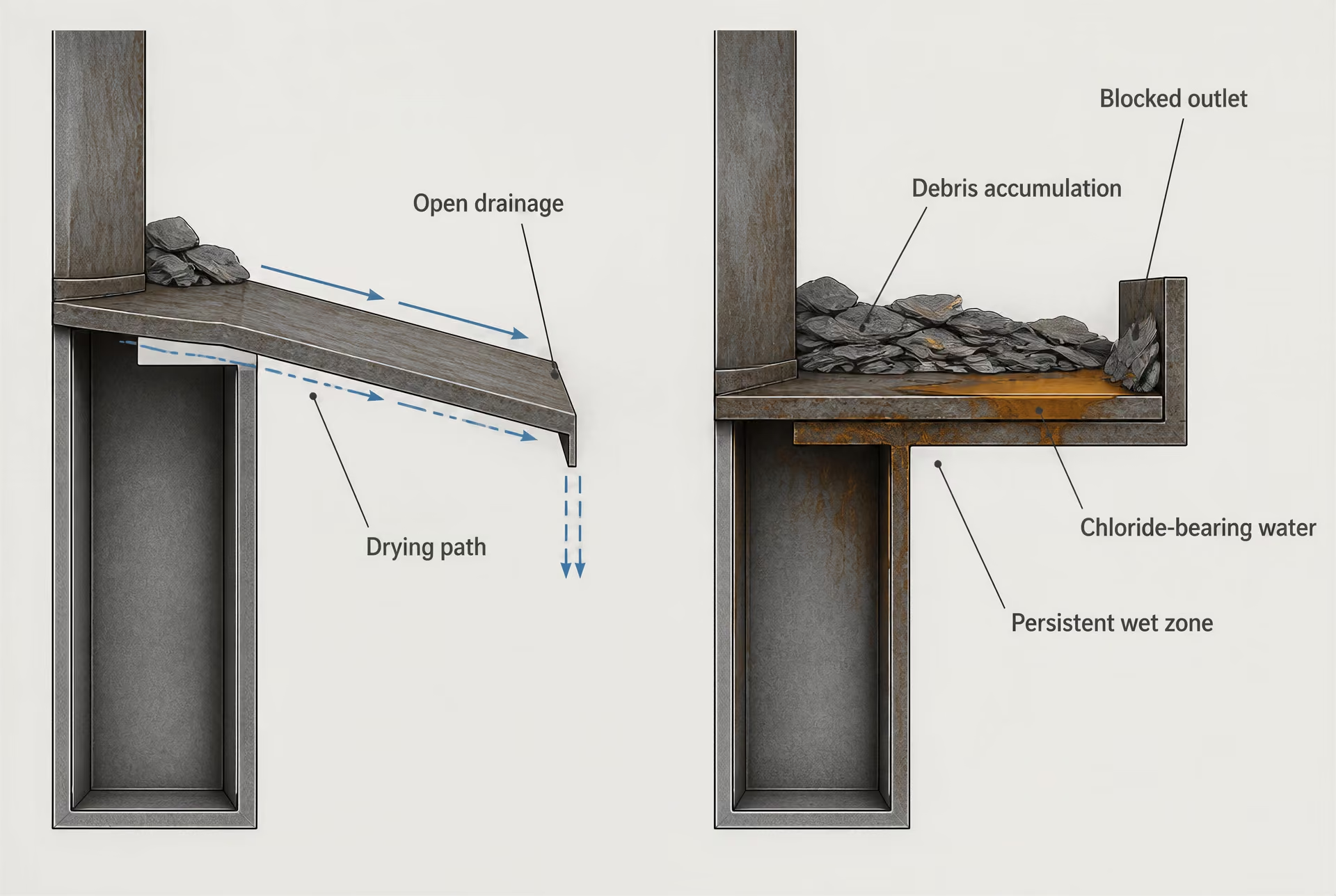
Preventing water traps and debris accumulation
Weathering steel does not compensate for poor geometry. A suitable alloy can form a relatively dense, adherent rust layer only when the surface experiences repeated wetting and drying; a joint that remains damp, retains silt or receives concentrated runoff may corrode faster than an exposed surface made from a less corrosion-resistant steel. The National Steel Bridge Alliance primer (2010) identifies alternating wet and dry cycles as a condition for protective patina development. The practical implication is direct: detailing can control corrosion as strongly as nominal material selection.
SteelConstruction.info and SCI Guidance Note 1.07 place water and debris accumulation among the main causes of unsatisfactory performance in uncoated weather-resistant steel. Horizontal ledges are especially troublesome. A flange projection, stiffener, bracket, bearing shelf or architectural return can catch leaves, grit and bird nesting material, then hold rainwater against the steel. The debris also creates a longer time of wetness and can retain chlorides from road spray or marine aerosols after the visible surface appears dry. A narrow ledge is not made safe merely because it is narrow; capillary forces can keep its underside and the adjacent weld damp.
Details should therefore shed water rather than store it. Sloping upper surfaces, rounded or tapered transitions, open-ended channels and accessible faces reduce retention. Where a ledge is structurally necessary, its width, slope and edge treatment should prevent sediment from remaining, and its underside should be visible for inspection. Stiffeners should not terminate in small closed pockets. Intersections between plates need enough clearance for water to escape and for an inspector to see the relevant welds and parent metal.
Crevices deserve particular attention. Overlapping plates, intermittent welds, bolted lap joints, backing bars and unsealed folded edges can form narrow oxygen-differential cells. Water enters through the opening, while evaporation is restricted within the joint. The resulting local corrosion may be more severe than general surface corrosion and can produce pitting at the crevice mouth. A nominally corrosion-resistant composition does not remove this electrochemical problem.
The same principle applies to construction tolerances. A detail that drains on paper may trap water after plate distortion, weld shrinkage, settlement or a blocked outlet. Drain holes should be positioned so that they remain effective under expected fabrication and erection tolerances, not simply shown at the lowest point of an idealized drawing. Small holes can clog with rust scale or silt; their size and access should reflect the debris likely to reach them. The design record should identify locations where blockage would create prolonged wetting, and inspection access should be provided before the structure is completed.
Fatigue design cannot be separated from this detailing. FHWA fatigue guidance (2016) reports that AASHTO assigns plain uncoated weathering-steel base metal one lower fatigue category than comparable non-weathering steel because of pitting. A crevice or debris trap can intensify that local pitting and create a sharper stress raiser than assumed in a smooth-plate calculation. Weld toes, cope corners, bolt holes and areas beside drain outlets therefore require both appropriate fatigue detail categories and a corrosion inspection plan.
Providing drainage and ventilation
Drainage paths should be continuous, visible and protected from accidental blockage. Water entering a box girder, parapet, sign support, expansion-joint recess or stiffened panel needs a defined route to an outlet. A drain that discharges onto another steel surface simply transfers the problem. Outlet positions should avoid wetting lower flanges, bearings, joints, pedestrian routes and concrete surfaces vulnerable to rust staining. Where a discharge must cross a structural face, the geometry should prevent the stream from spreading along a seam or entering a crevice.
Enclosed pockets are a recurring failure point. A sealed cavity may exclude rain but can still contain fabrication moisture, condensation or a small leak that is difficult to detect. A cavity that is neither sealed against water nor ventilated for drying is particularly hazardous. SteelConstruction.info and SCI Guidance Note 1.07 emphasize drainage and ventilation because drying time, not just rainfall, affects atmospheric corrosion. Vent openings should be arranged to permit air movement and inspection while avoiding direct collection of rain and salt spray. They should also be sized and protected against nests, insects and accumulated debris.
Ventilation is not a substitute for drainage. Air circulation cannot remove a puddle trapped behind an overlapping plate, and an opening can admit humid air or chloride-bearing spray. The intended mechanism must be clear: water should leave by gravity, while ventilation should reduce condensation and support drying. In box sections, high and low openings may be needed to promote air exchange and drainage, but their arrangement must account for wind-driven rain and the possibility that one opening becomes blocked.
The exposure assessment should follow the site, not the label “weathering steel.” ISO 9223:2012 classifies atmospheric corrosivity using first-year corrosion rates of standard specimens and identifies temperature-humidity conditions, sulfur dioxide pollution and airborne salinity as key factors. FHWA guidance (2003) requires evaluation of time of wetness, chlorides, industrial pollutants, drainage, geometry and maintenance before uncoated weathering steel is selected. SCI Guidance Note 1.07 (2015) identifies continuously wet or damp locations, high chloride or salt-spray exposure, concentrated industrial fumes and buried conditions as unsuitable or restricted applications.
This matters at details that alter the local environment. A bridge deck may expose one face to rain but keep another face wet from leaking joints. A coastal parapet may receive salt spray on its seaward side and retain salt deposits beneath its top rail. An industrial structure may experience concentrated sulfur dioxide or other fumes at a process outlet. In each case, the same grade can behave differently at different parts of the structure. Drainage, shielding and ventilation should be reviewed with the environmental exposure map, not after corrosion appears.
Inspection must include the locations least visible from ground level: the underside of ledges, behind gusset plates, inside box sections, around drain holes, at overlapping joints and beneath accumulated deposits. Inspection intervals should allow blocked outlets and persistent dampness to be corrected before section loss becomes significant. The record should distinguish staining, superficial scale, active pitting and loss of thickness; a brown appearance alone does not prove that the patina has stabilized.
Avoiding incompatible-metal contact and staining paths
Weathering steel should not be assumed to be electrochemically compatible with every adjacent material. Contact with a more noble metal in the presence of an electrolyte can produce galvanic corrosion of the weathering steel, especially where the cathodic material has a large exposed area and the steel contact zone is small. Stainless steel attachments, copper-containing components, bronze fittings and some aluminum arrangements require specific assessment of contact, insulation, water retention and drainage. The issue is not the dry contact alone. It is the conductive wet film or trapped solution bridging the metals.
Details should prevent dissimilar-metal couples where practical, or electrically separate the materials and stop runoff from one metal being directed onto another. Fasteners, washers, shims, bearing components, handrail fittings and drainage hardware all need review as part of the connection, rather than being treated as minor accessories. Isolation materials can themselves retain water or create a crevice, so the detail must remain inspectable and drainable after separation is provided.
Runoff also creates staining paths. Rust-laden water from an uncoated weathering-steel surface can mark concrete, stone, render, paving and painted steel. The stain may be unacceptable even where the structural corrosion rate is tolerable. Drips from copes, parapets and exposed plate edges should be directed away from visible finishes through deliberate falls, drip edges and controlled discharge points. A drip edge that sends water onto a lower flange merely concentrates corrosion there; the full route from wetting surface to final outlet must be considered.
Concrete interfaces need care because cracks, joints and porous surfaces can retain contaminated water against steel. Buried or backfilled edges are especially poor candidates for uncoated weathering steel, consistent with the restrictions in SCI Guidance Note 1.07. The detail should either keep the steel exposed to conditions that permit drying or provide a protection strategy suited to the concealed environment.
Finally, drawings should identify corrosion-prone zones for access and future examination. Geometry that hides a joint, blocks a drain or channels runoff onto a connection increases maintenance dependence. Weathering steel remains a conditional atmospheric-corrosion design choice; its performance is established by the alloy, the exposure and the detail acting together. (1,047 words)
Bridge Design, Pitting and Fatigue
Weathering steel is not exempt from bridge durability design. A bridge may use ASTM A709/A709M Grade 50W or another weathering-steel designation and still experience damaging corrosion if water, chlorides, debris, or industrial deposits remain on the steel. Atmospheric corrosion resistance reduces the rate and changes the form of corrosion under suitable exposure; it does not provide immunity, and it does not remove the need to design fatigue details, provide access for inspection, or control drainage.

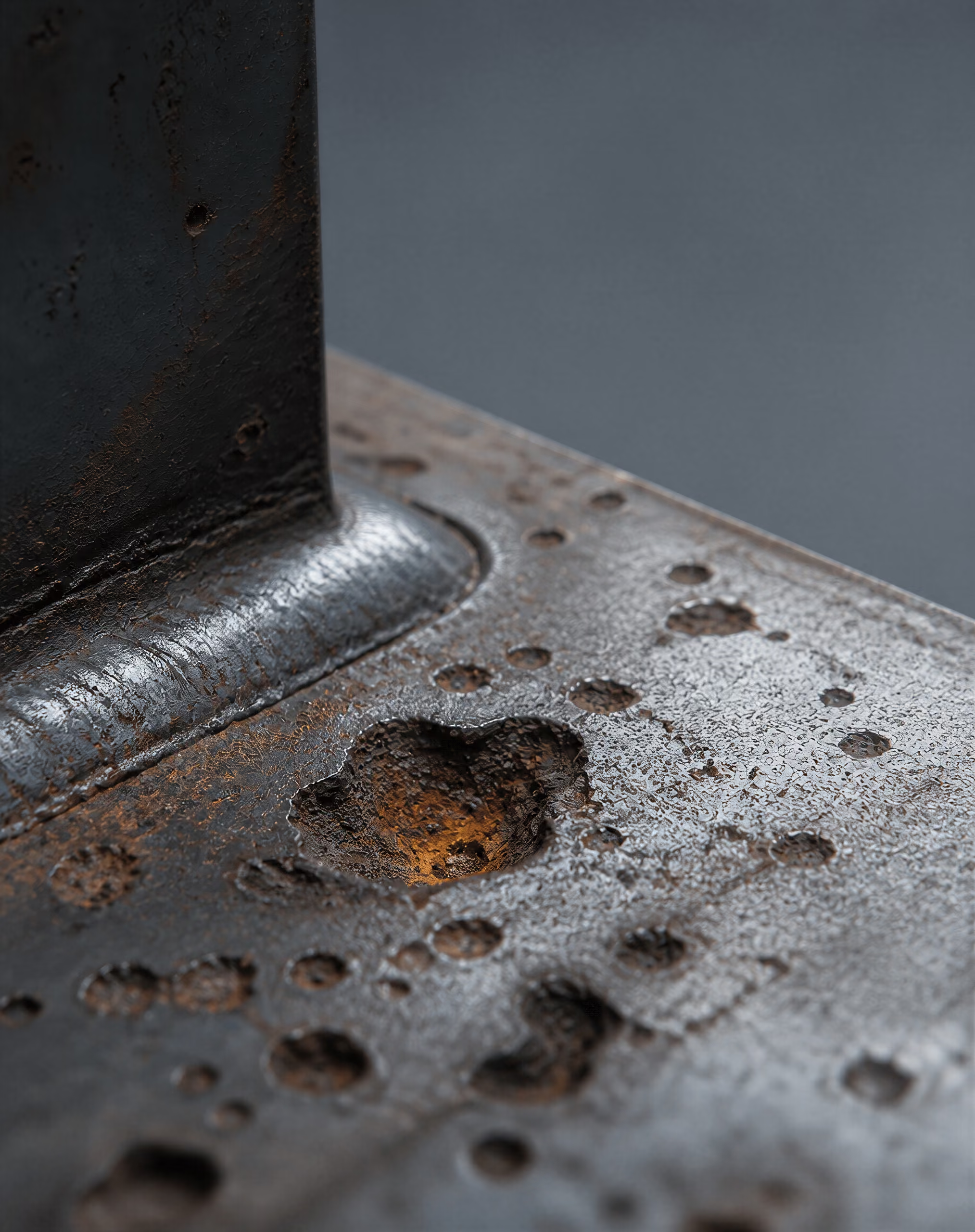
Pitting as a structural and fatigue concern
The FHWA fatigue guidance describes the expected formation of a patina through alternating wet and dry periods. Initial oxidation produces a rust layer, and repeated exposure can transform that layer into a relatively dense, adherent surface film that slows further attack. The process depends on drying. A surface that remains continuously damp, receives salt spray, or collects contaminated runoff does not experience the same exposure sequence as an open, freely draining plate.
Why pitting matters structurally
- Stress concentration A pit acts as a notch and raises local stress.
- Fatigue initiation Pits can provide initiation sites for fatigue cracks.
- Measurement uncertainty A single ultrasonic reading may miss the deepest part of an irregular pit.
- Net-section loss Localized penetration can be substantially greater than average thickness loss.
That distinction matters because corrosion on weathering steel is not always a uniform reduction in thickness. Pitting can produce local depressions with sharper changes in surface profile than the average corrosion loss would suggest. The average thickness loss may appear modest while the remaining steel contains small areas of substantially greater penetration. At a fatigue-sensitive location, the pit acts as a notch: it raises the local stress, changes the stress gradient, and can provide an initiation site for a fatigue crack.
Pitting Localized corrosion that forms cavities or depressions with greater penetration than surrounding general corrosion.
A crack that begins at a pit may grow under stress ranges that would not have caused a crack in smooth, nominally full-thickness base metal. The risk is greater at flange edges, holes, weld toes, intermittent contact surfaces, diaphragm connections, splice regions, and other details where geometric stress concentrations already exist. Pitting also complicates ultrasonic thickness measurements because a single reading may miss the deepest part of an irregular cavity. Measurements must therefore identify the distribution and maximum depth of attack, not only calculate an average loss.
The FHWA manual’s warning is direct: pitting affects the fatigue treatment of weathering steel. This is why a patina should not be described as a permanent coating with a guaranteed thickness or performance. It is an environmental product whose quality depends on the alloy, exposure history, surface geometry, and time of wetting. Chloride deposits are especially important because they can remain hygroscopic, prolonging surface moisture and disrupting the conditions needed for a stable rust layer.
Alloy chemistry influences the result, but chemistry alone cannot rescue poor detailing. FHWA research published in 2009 describes the traditional use of manganese, silicon, chromium, nickel, copper, molybdenum, and phosphorus in weathering steels, while also examining tungsten, titanium, aluminum, and rare-earth additions. Its 2011 improved corrosion-resistant-steel research reported that most weathering steels had ASTM G101 corrosion-index values between 6 and 7; the study targeted values near or above 9.5 for substantially improved resistance in chloride-containing atmospheres. Those figures are comparative indicators, not permission to ignore a bridge’s exposure.
ASTM G101-04(2010) provides methods for estimating long-term atmospheric corrosion losses from shorter exposure data and for estimating the relative atmospheric corrosion resistance of low-alloy steel from chemical composition. ISO 9223:2012 classifies atmospheric corrosivity using first-year corrosion rates of standard specimens and identifies temperature-humidity effects, sulfur dioxide pollution, and airborne salinity as key factors. Neither standard turns a site-independent patina assumption into a structural design basis.
AASHTO fatigue-category treatment
The fatigue category assigned to a bridge detail describes resistance to repeated stress cycles, but the category is not determined by the nominal steel grade alone. Weld geometry, connection type, holes, attachments, surface condition, residual stress, and corrosion exposure all influence fatigue performance. Weathering steel adds a specific concern because localized corrosion can alter the surface condition used to establish the fatigue design assumption.
The FHWA Steel Bridge Design Handbook: Design for Fatigue explains that, under the cited AASHTO treatment, plain uncoated weathering-steel base metal receives one lower fatigue category than comparable non-weathering steel because of pitting. This is a design reduction for the material condition, not a claim that every weathering-steel connection has one universal category. The applicable AASHTO LRFD fatigue category still depends on the actual detail and its governing stress range.
That distinction prevents two opposite errors. It is wrong to assign ordinary bare-steel fatigue performance simply because the rust layer looks mature. It is also wrong to reduce every welded or bolted detail by an arbitrary amount without checking the AASHTO detail classification. A plate of ASTM A709/A709M Grade 50W in plain base-metal service is treated differently from a welded attachment made from the same specification, because the weld detail has its own fatigue behavior and stress concentration.
Fatigue design must account for the stress range produced by traffic, wind, thermal effects, secondary distortion, and restraint. The nominal stress range may be calculated correctly while the local range at a pit, weld toe, cope, hole, or corrosion groove is much higher. Where corrosion has reduced thickness, the same force produces a higher nominal stress as well. These effects can combine: section loss increases nominal stress, while pitting increases the local concentration factor.
Fracture considerations belong in the same assessment. A small fatigue crack may remain stable for a period, then grow rapidly when the remaining net section is reduced or when a brittle fracture-critical region has limited crack-arrest capability. Low temperatures, tensile residual stress, and unfavorable crack orientation can further reduce the margin. Weathering steel should therefore be selected and detailed with the bridge’s fracture-control requirements, toughness specification, fatigue category, and inspection plan considered together.
Interaction of corrosion, stress range and inspection
The site decision begins before steel is specified. FHWA guidance from 2003 calls for evaluation of time of wetness, chloride exposure, industrial pollutants, drainage, geometry, and maintenance conditions before uncoated weathering steel is selected. A bridge over a deicing-salt roadway, a coastal structure exposed to airborne salinity, and a rural bridge with rapid drying do not share one corrosion environment. ISO 9223:2012 supplies a classification framework, but project exposure data and local detailing remain necessary.
Water traps are fatigue and corrosion details at once. Horizontal ledges, stiffener ends, narrow gaps, poorly sealed splice interfaces, debris pockets, and blocked scuppers can keep the steel wet long after adjacent surfaces have dried. Runoff from one member may concentrate chlorides on another. SteelConstruction.info and SCI Guidance Note 1.07 identify continuously wet or damp environments, high chloride or salt-spray exposure, concentrated industrial fumes, and buried conditions as unsuitable or restricted applications for uncoated weather-resistant steel. Dissimilar-metal contact and poor ventilation can create additional local corrosion cells.
The stress history should be connected to the likely corrosion pattern. A low-cycle, high-stress detail may be controlled by a few severe events, whereas a bridge girder subjected to millions of truck-load cycles is sensitive to small changes in fatigue resistance. If pitting is expected at a connection, the design should not rely on a nominal corrosion allowance as though the loss were uniform. Drainage improvements, sealed crevices, replaceable components, protective coating at selected zones, or a different steel-and-maintenance strategy may be more appropriate.
Inspection record
- Water retention Record standing water, damp bands, leaking joints and blocked drains.
- Deposits Record chloride-bearing debris, mud, scale and industrial contamination.
- Corrosion form Distinguish general rusting, loose scale, crevice attack and pitting.
- Structural condition Measure section loss and inspect welds, holes, attachments and fatigue-sensitive details.
Inspection then verifies whether the design assumptions remain valid. Inspectors should record active rusting, loose scale, pit depth, water retention, chloride deposits, pack rust, section loss, crack-like indications, and changes at welds and attachments. Visual color alone is weak evidence. A dark or layered surface may indicate a developing patina, but it does not establish maximum pit depth or fatigue safety.
Inspection intervals and methods should reflect consequence, detail category, traffic loading, exposure severity, and access difficulty. Close visual inspection may need support from ultrasonic thickness mapping, pit-depth gauges, magnetic-particle testing, dye penetrant testing, or other crack-detection methods at fatigue-sensitive locations. Findings must feed back into the structural model: measured section loss can change stress range, and a detected crack can change the fracture and load-rating assessment.
Atmospheric corrosion design is therefore part of fatigue design. The patina can reduce continuing corrosion under the right wetting-and-drying conditions, but the bridge remains a load-bearing system with local stress raisers, repeated traffic cycles, and inspection obligations. A sound weathering-steel design specifies the alloy and AASHTO fatigue treatment, controls water and contaminants, anticipates pitting, and preserves a practical path from inspection findings to repair or strengthening.
Weathering Steel in ASTM A709 Bridge-Steel Practice
ASTM A709 material and design considerations
ASTM A709/A709M is the bridge-steel material standard, not a blanket designation for uncoated weathering construction. Its grades include ASTM A709 Grade 36, Grade 50, Grade 50W, HPS 50W and HPS 70W, among others specified by the applicable edition. The “W” designation identifies weathering-steel requirements, but it does not by itself establish that a bridge can remain unpainted at every site. Grade selection, supplementary requirements, weldability, toughness, fracture control, fabrication and structural resistance still have to be addressed within the project design.
The Steel Bridge Design Handbook places atmospheric corrosion resistance and weathering-steel requirements inside the wider material and design framework for ASTM A709 bridge steels. That placement matters. A bridge engineer does not select a weathering grade first and then treat corrosion as a separate coating decision. The designation must correspond to the required strength and toughness, while the exposure assessment determines whether the atmospheric-corrosion provisions can perform as intended. Connection design, fatigue resistance, weld details and inspection access remain structural issues even when no paint system is specified.
Weathering steel is a low-carbon, alloyed steel intended to form a relatively dense, adherent rust layer under repeated wetting and drying. The layer is not an impermeable coating, and atmospheric corrosion resistance is not immunity from corrosion. Initial oxidation occurs when moisture reaches the steel. A patina can slow later loss when the surface dries between wet periods, but that result depends on alloy composition, pollutant loading, chloride deposition, temperature, humidity and the geometry of the member.
The chemistry should therefore be treated through the requirements of the applicable ASTM A709/A709M grade and project specification rather than through an assumed generic recipe. FHWA research describes the historical alloying focus as manganese, silicon, chromium, nickel, copper, molybdenum and phosphorus; later corrosion studies also investigated tungsten, titanium, aluminum and rare-earth additions. ASTM G101-04(2010) provides methods for estimating long-term atmospheric corrosion losses from short-term exposure data and for estimating the relative atmospheric corrosion resistance of a low-alloy steel from its chemical composition. Those methods inform comparison and prediction. They do not remove the need to examine the actual bridge environment.
The FHWA improved corrosion-resistant-steel program reported that most weathering steels had ASTM G101 corrosion-index values between 6 and 7, while its research targeted values near or above 9.5 for substantially improved resistance in chloride-containing atmospheres. That result is a warning against treating every weathering designation as equivalent in service. Composition affects performance, but a favorable index cannot compensate for a perpetually wet flange, salt-trapping connection or contaminated drainage path.
Atmospheric corrosion resistance in bridge specifications
Atmospheric exposure should be classified before uncoated ASTM A709 weathering steel is accepted. ISO 9223:2012 bases corrosivity classification on first-year corrosion rates of standard specimens and identifies temperature-humidity influence, sulfur dioxide pollution and airborne salinity as key factors. The classification is an environmental framework, not a promise of service life for a particular bridge member. Local exposure can be more severe than a broad site description suggests, especially near deicing-salt routes, marine shorelines, industrial facilities and traffic lanes that generate salt-laden spray.
FHWA guidance calls for site-specific evaluation of time of wetness, chloride exposure, industrial pollutants, drainage, geometry and maintenance before uncoated weathering steel is selected. These factors interact. A girder beneath an open deck may dry rapidly, while a splice plate under a leaking joint can remain damp for long periods. A bridge in a generally mild rural atmosphere may still develop damaging corrosion where debris blocks a drain or where runoff concentrates at a stiffener termination.
SCI Guidance Note 1.07 identifies continuously wet or damp environments, high chloride or salt-spray exposure, concentrated industrial fumes and buried conditions as unsuitable or restricted applications for uncoated weather-resistant steel. Salt is especially troublesome because chloride deposits can maintain electrolytic moisture and disrupt patina stabilization. Sulfur dioxide and other industrial pollutants can also increase corrosion rates. Where the exposure cannot be controlled, a protective coating system, corrosion-resistant detail, alternate material, or combination of measures may be required; the weathering designation alone is not an adequate specification.
The National Steel Bridge Alliance primer states that protective patina development requires repeated wetting and drying. This explains why a bridge can show attractive brown oxide on exposed web surfaces while corrosion continues at sheltered ledges, splice interfaces or lower flanges. Review literature on atmospheric-corrosion data also identifies stabilization time, steady-state corrosion rate, exposure conditions and long-term prediction uncertainty as separate questions. A rust layer that appears uniform after several seasons is not proof that corrosion has stopped, nor does visual color establish a design corrosion allowance.
Fatigue design adds another material-specific concern. FHWA fatigue guidance explains that weathering steel forms its patina through alternating wet and dry cycles, but also reports that AASHTO assigns plain uncoated weathering-steel base metal one lower fatigue category than comparable non-weathering steel because of pitting. The reduction recognizes local surface damage and stress concentration. It means that corrosion selection cannot be separated from stress-range calculations, detail classification and inspection planning.
Coordination between material selection and structural detailing
A weathering-steel bridge succeeds through compatible material selection and water-shedding geometry. Detailing should prevent water and debris from accumulating, provide drainage from closed or partially enclosed spaces, and allow members to dry and inspectors to see critical surfaces. Crevices, narrow ledges, unsealed overlaps and poorly ventilated pockets can defeat the environmental conditions needed for patina formation. The design should also control runoff staining where rust-colored drainage could affect concrete, bearings, expansion joints or adjacent property.
Drain holes must remain accessible and must discharge without wetting another steel surface. Deck joints deserve particular attention because leakage can create a concentrated chloride source at girder ends and cross-frame connections. End diaphragms, stiffener details and splice regions should be reviewed for trapped water, salt accumulation and cleaning access. Incompatible metals can produce galvanic effects, while buried or partially embedded steel faces a different moisture regime from freely exposed atmospheric surfaces.
The same review should examine future maintenance. A detail that cannot be washed, inspected or repaired may turn a manageable exposure into a persistent corrosion site. Inspection intervals should reflect chloride use, industrial contamination, drainage performance and observed section loss rather than relying on a fixed assumption that the patina is permanent.
The Steel Bridge Design Handbook’s broader framework therefore leads to a clear design position: ASTM A709/A709M grade designation, material requirements, exposure classification, corrosion prediction, fatigue treatment and structural detailing must be coordinated. Uncoated weathering steel is a conditional system. It can reduce dependence on paint where the alloy, atmosphere, drainage and inspection provisions support patina formation, but it is not a substitute for environmental assessment or sound bridge design.
Coated, Uncoated and Hybrid Corrosion Strategies
Weathering steel does not remove the need for corrosion design. It changes the way protection is provided: instead of relying primarily on a manufactured coating, the designer may rely on an alloy-dependent rust layer that develops during repeated wetting and drying. That choice is conditional. Where the environment cannot support a stable patina, a coating system, local corrosion protection, altered geometry, or a combination of these measures may be required.
| Strategy | Primary protection mechanism | Main design demand |
|---|---|---|
| Uncoated weathering steel | Alloy-dependent rust layer | Suitable exposure, drainage, drying and inspection |
| Coated steel | Manufactured protective coating | Surface preparation, continuity, repair and coating inspection |
| Hybrid strategy | Uncoated areas plus local or selective protection | Careful boundaries, runoff control, compatibility and access |
The three strategies are not interchangeable labels. An uncoated design places greater demands on steel chemistry, exposure assessment and drainage. A coated design places greater demands on surface preparation, coating specification, edge treatment, repair and inspection. A hybrid design distributes those demands, leaving suitable surfaces uncoated while protecting zones where water, salts or pollutants create unacceptable corrosion risk.
When uncoated weathering steel is being considered
Uncoated weathering steel is reasonable only after the service environment and the proposed details have been assessed together. The steel must receive atmospheric exposure with enough alternating wet and dry periods for a relatively dense, adherent rust layer to form. The National Steel Bridge Alliance primer (2010) identifies repeated wetting and drying as a condition for protective patina development; persistent dampness does not provide the same exposure sequence.
The material designation also matters. Atmospheric corrosion resistance depends on alloy chemistry, not merely on the name “weathering steel.” Traditional weathering compositions focus on manganese, silicon, chromium, nickel, copper, molybdenum and phosphorus. Federal Highway Administration research also examined tungsten, titanium, aluminum and rare-earth additions. ASTM G101-04(2010) provides methods for estimating relative atmospheric corrosion resistance from chemical composition and for estimating longer-term losses from shorter exposure records. It is an assessment method, not a guarantee that a particular structure will develop an acceptable patina.
ISO 9223:2012 provides a useful environmental framework. Its atmospheric-corrosivity classes use first-year corrosion rates of standard specimens and account for temperature-humidity effects, sulfur dioxide pollution and airborne salinity. A site classified only by general climate can therefore conceal important local differences: a sheltered underside, a road spray zone, a marine-facing elevation and an industrial plume may experience different corrosion conditions within one project.
FHWA guidance (2003) calls for specific consideration of time of wetness, chloride exposure, industrial pollutants, drainage, geometry and maintenance before uncoated weathering steel is selected. Those factors should be examined at the detail level. Water trapped behind a splice plate, inside a stiffener, beneath accumulated debris or at a poorly drained flange can keep steel wet long after adjacent surfaces have dried. The resulting corrosion may remain concentrated rather than developing into the comparatively even surface oxidation assumed by a general atmospheric exposure model.
Geometry can determine the outcome. Sloped surfaces, open ends, accessible ledges and properly sized drain paths help water leave the structure. Narrow crevices, horizontal pockets, sealed voids with leakage paths and locations where grit or leaves collect work against patina stabilization. Incompatible-metal contacts also require attention because galvanic effects can alter local corrosion behavior.
Uncoated selection must include structural consequences. Pitting can create greater stress concentration than a relatively uniform loss of thickness. FHWA fatigue guidance reports that AASHTO assigns plain uncoated weathering-steel base metal one lower fatigue category than comparable non-weathering steel because of pitting. Fatigue-sensitive details therefore cannot be justified by an assumed reduction in general corrosion rate. Welded connections, attachments, bolt holes and regions subject to repeated stress need their own fatigue and inspection assessment.
The alloy may be unsuitable even when the surrounding air appears clean. FHWA research published in 2011 reported that most weathering steels had ASTM G101 corrosion-index values between 6 and 7, while the research targeted values near or above 9.5 for substantially improved resistance in chloride-containing atmospheres. That finding supports a clear design position: ordinary weathering-steel chemistry should not be treated as a universal answer for salt-contaminated exposure.
When environmental constraints favor additional protection
A coating becomes more defensible when the environment prevents reliable patina formation or when the consequences of localized corrosion are severe. SCI Guidance Note 1.07 (2015) identifies continuously wet or damp conditions, high chloride or salt-spray exposure, concentrated industrial fumes and buried conditions as unsuitable or restricted applications for uncoated weather-resistant steel. These constraints include more than open marine exposure. Road de-icing salt, spray from traffic, leaking services, condensation in enclosed spaces and contaminated runoff can produce similar problems.
Additional protection may cover the whole member or only selected zones. Full coating can be appropriate where chloride deposition, sulfur dioxide or persistent condensation affects most exposed surfaces. Localized coating may be applied to splash zones, deck drainage paths, beam ends, connection recesses, concealed faces and areas near expansion joints. The boundary between coated and uncoated steel must be detailed so that water cannot be directed onto an unprotected edge or trapped at a coating termination.
A hybrid strategy can also combine weathering-steel members with coated connection components, sealed interfaces or corrosion-resistant fasteners, subject to galvanic compatibility and the governing material standards. It should not be assumed that a coated plate eliminates all risk around bolted joints, crevices or damaged edges. The protection system still has to be inspectable and repairable.
Changing the detail may provide as much benefit as adding a coating. Increasing drainage, removing debris traps, opening a vented enclosure, separating dissimilar metals or preventing direct salt-laden runoff can restore conditions in which uncoated steel performs more predictably. Conversely, a visually exposed surface may still require coating if its position receives concentrated contamination. Appearance is not an exposure classification.
Coating selection must be tied to the inspection interval, expected damage and repair method. Surface preparation, weld profile, sharp edges, bolts, field joints and coating thickness all affect service performance. Where coating damage cannot be reached safely, an uncoated or differently detailed solution may produce a more manageable maintenance burden. The correct comparison is therefore not “patina versus paint,” but the complete corrosion-control system over the planned service period.
Maintenance assumptions and inspectability
Every strategy carries a maintenance assumption. Uncoated weathering steel assumes that inspectors can see whether the rust layer is developing evenly, identify water retention and remove debris before local corrosion accelerates. It also assumes that runoff staining, rust scale and access for close examination are acceptable consequences of the design.
A coating system assumes scheduled inspection for cracking, blistering, delamination, mechanical damage and corrosion at edges or defects. Repairs require compatible materials, suitable weather and access for cleaning and recoating. If those operations are unlikely, the nominal coating life should not be used as the sole basis for design.
Inspection access must be established before members are enclosed or placed above traffic, water or equipment. Drain outlets need to remain visible and clear. Hidden faces, bearing zones, splice interiors and stiffener ends may need dedicated access openings or inspection procedures. Monitoring should record not only section loss but also the cause: standing water, salt accumulation, coating failure, debris, leakage or an unsuitable exposure assumption.
Maintenance planning also affects fatigue design. Pitting and corrosion at stress concentrations may require closer examination than a broad, lightly rusted surface. A design that depends on early detection should specify who inspects, what condition triggers repair and how the repair will be carried out. Without those provisions, “uncoated” is not a maintenance-free category; it is a design that transfers protection duties to drainage, exposure control and inspection.
Testing, Exposure Data and Long-Term Corrosion Prediction
Laboratory and atmospheric exposure testing
Weathering steel is not tested by asking whether rust appears. Ordinary carbon steel also rusts. The relevant question is whether the alloy forms a sufficiently adherent, relatively low-permeability rust layer under the actual sequence of wetting, drying, contamination and cleaning at the site. Laboratory tests can measure that tendency, but no single accelerated test reproduces every atmospheric exposure.
The composition is the first variable. ASTM A242, ASTM A588 and bridge steels specified to ASTM A709/A709M contain deliberate additions that alter the corrosion products and their adhesion. Traditional alloying has concentrated on manganese, silicon, chromium, nickel, copper, molybdenum and phosphorus. Federal Highway Administration research published in 2009 also examined tungsten, titanium, aluminum and rare-earth additions. The aim is not simply to increase alloy content; it is to change electrochemical reactions and rust-layer structure without compromising welding, toughness, strength or fatigue performance.
ASTM G101-04(2010) provides two related methods. It permits an estimate of long-term atmospheric corrosion loss from short-term exposure results, and it permits estimation of the relative atmospheric corrosion resistance of a low-alloy steel from its chemical composition. Its composition-based corrosion index is useful for comparing heats or grades, but it is not a site approval certificate. FHWA research reported that most weathering steels had ASTM G101 index values between 6 and 7, while a later alloy-development programme targeted values near or above 9.5 for substantially improved resistance in chloride-containing atmospheres. Those figures describe an index, not millimetres of guaranteed service life.
The ASM Handbook chapter Corrosion of Weathering Steels treats exposure testing as a connection between metallurgy and service conditions. It covers alloy additions, composition-based indices, rust-layer formation and corrosion tests, while also stressing design problems such as crevices, trapped debris and persistent dampness. A laboratory coupon can reveal whether a proposed chemistry tends to develop a compact rust layer. It cannot decide whether a bridge splice will remain dry enough to behave in the same way.
Atmospheric exposure testing supplies the missing environmental dimension. Coupons are placed at representative sites, weighed, cleaned and reweighed at defined intervals, with observations of rust appearance, runoff and local attack. ISO 9223:2012 classifies atmospheric corrosivity using first-year corrosion rates of standard specimens. Its framework considers the combined influence of temperature and humidity, sulfur dioxide pollution and airborne salinity. That classification is useful for describing an exposure, but it does not replace inspection of the proposed structure. A sheltered beam flange, a rain-washed web and a salt-catching splice can occupy different corrosivity conditions within one bridge.
Salt-spray or cyclic corrosion tests can rank materials quickly, especially when chloride contamination is part of the design case. They are poor substitutes for natural exposure when the test continuously supplies electrolyte or omits drying. Weathering steel needs repeated wetting and drying to develop its characteristic patina. A specimen held continuously wet may suffer attack that would not occur in a freely draining atmospheric position; a specimen dried too aggressively may fail to represent a coastal or industrial microclimate. Test duration, solution chemistry, temperature, wetting cycle and specimen orientation must therefore be reported with the corrosion result.
Short-term data versus long-term behavior
Early mass loss often overstates or understates later performance. During initial exposure, bare steel reacts rapidly at anodic sites, and the rust layer may be porous, cracked or poorly attached. With suitable cycles, corrosion products can become more compact and protective, reducing the later rate. That reduction is not automatic. Chloride can remain within pores, sulfur dioxide can acidify surface moisture, and repeated abrasion or runoff can remove developing rust.
The atmospheric-corrosion review cited for this article describes stabilization time and later steady-state corrosion rate as separate quantities. A specimen may show a falling corrosion rate after several years, yet the time needed to reach that condition depends on climate, pollutant loading, orientation, shelter and alloy chemistry. A short exposure that ends before stabilization cannot establish a long-term rate. Conversely, a short test that forces chloride wetting may produce a loss rate that is inappropriate for a rain-washed inland surface.
ASTM G101 addresses this problem by using short-term exposure information to estimate longer-term loss, but the estimate carries assumptions about how the rate changes with time. Such extrapolation is more defensible when the exposure history resembles the intended service environment and when several exposure intervals show the trend. It becomes weak when the site is changing. De-icing salt may be introduced after years of relatively clean exposure. A road may receive a new drainage arrangement. Industrial emissions may decline, or a nearby source may begin operating. A model calibrated before that change cannot simply be extended unchanged.
FHWA guidance therefore calls for site-specific review of time of wetness, chloride exposure, industrial pollutants, drainage, geometry and maintenance. SCI Guidance Note 1.07 identifies continuously wet or damp locations, high chloride or salt-spray exposure, concentrated industrial fumes and buried conditions as unsuitable or restricted applications for uncoated weather-resistant steel. SteelConstruction.info similarly emphasizes drainage, ventilation and the prevention of water or debris accumulation. These are not secondary detailing preferences. They determine whether the exposure used in a corrosion prediction remains valid at the steel surface.
Corrosion loss should also be separated from visible discoloration. A dark, uniform patina may conceal local pits, while orange runoff may look severe without corresponding section loss. Measurements should include mass loss or thickness readings, pit depth, crevice attack and the condition of edges, connections and contact surfaces. For a fatigue-sensitive member, local pitting matters even when average thickness loss appears modest. FHWA fatigue guidance records the design consequence: AASHTO assigns plain uncoated weathering-steel base metal one lower fatigue category than comparable non-weathering steel because of pitting. A corrosion model that predicts only average loss is therefore incomplete for cyclically loaded details.
Rust-layer stabilization and predictive models
A useful prediction treats patina formation as a time-dependent response, not as a permanent coating applied at fabrication. Alternating wet and dry cycles allow oxidation products to transform and consolidate; drainage and ventilation limit the duration of electrolyte contact. The layer can then reduce the rate of further attack. Its performance remains conditional on the same environmental balance that produced it.
Predictive models commonly express corrosion loss as a function of exposure time, often with an initially steep loss followed by a lower rate after partial stabilization. The coefficients must come from comparable field data. A model developed from rural panels should not be transferred directly to a chloride-laden coastal bridge, and a first-year ISO 9223 corrosivity class should not be treated as a lifetime constant. ISO 9223 describes the starting atmospheric burden through standard specimens; it does not predict every sheltered crevice or future maintenance change.
Long-term prediction should consequently use a range rather than a single attractive number. It should state the assumed wetting and drying pattern, pollutant and chloride levels, cleaning or washing, runoff paths, inspection intervals and point at which repainting or repair would occur. Field coupons, reference panels and scheduled thickness surveys can test whether the assumed stabilization is actually occurring. If corrosion remains active, if pits deepen, or if damp deposits persist, the design response may be drainage correction, washing, local coating or a change in corrosion protection.
The central engineering distinction is simple: weathering steel can reduce atmospheric corrosion under suitable conditions, but its future loss is conditional and revisable. Chemistry establishes a capacity for patina formation. Exposure history, detailing and maintenance decide whether that capacity is realized.
Inspection, Maintenance and Failure Modes
Weathering steel is not maintenance-free. Its atmospheric corrosion resistance depends on the rust layer remaining relatively dense and adherent, which requires suitable alloy chemistry and repeated wetting and drying. If water remains trapped, chloride deposits accumulate, or industrial pollution changes the corrosion environment, the patina may become porous, cracked or poorly attached. Corrosion then continues beneath the visible surface.
Inspection is therefore part of the design. The objective is not to confirm that every surface is brown, but to determine whether the exposure conditions assumed during selection and detailing still exist.
Recognizing abnormal corrosion and water retention
A stable patina generally develops with alternating periods of moisture and drying. The NSBA primer, published in 2010, identifies repeated wetting and drying as necessary for protective patina development. A surface that stays wet does not receive the same environmental cycle as an exposed, freely draining surface. It may show loose orange rust, dark damp staining, flaking layers, corrosion tubercles or localized pitting rather than a relatively uniform adherent patina.
Water retention is often more important than the average appearance of the member. Inspectors should look for rust streaks below joints, continuous damp bands at overlaps, standing water on horizontal plates, mud-filled bolt pockets and wet areas behind connection plates. A narrow leak can produce a severe local condition while the rest of the member appears sound. Fresh rust after a dry period, especially around a crack, drain outlet or fastener, indicates active corrosion rather than a harmless color variation.
Drainage paths deserve close attention. Small openings can become blocked by leaves, silt, bird nesting material, ice, weld spatter or corrosion products. Once blocked, a detail designed for intermittent exposure may become a permanent moisture reservoir. The same failure occurs when a deck joint leaks onto a girder, when a parapet directs salt-laden runoff onto a flange, or when a sealant joint separates and admits water behind a plate.
The surrounding atmosphere can also change. ISO 9223:2012 classifies atmospheric corrosivity using first-year corrosion rates of standard specimens and identifies temperature and humidity, sulfur dioxide pollution and airborne salinity as key factors. A site that was acceptable when a structure was built may become more aggressive after a road is salted more heavily, a port expands, an industrial process changes, or traffic increases pollutant deposition. ASTM G101-04(2010) provides methods for estimating long-term atmospheric corrosion losses from short-term exposure data and for estimating the relative atmospheric corrosion resistance of low-alloy steel from chemical composition; it does not turn a composition estimate into a guarantee for every detail on a structure.
Pitting is a particular concern because average thickness loss can hide a much smaller local section. FHWA fatigue guidance reports that AASHTO assigns plain, uncoated weathering-steel base metal one lower fatigue category than comparable non-weathering steel because of pitting. That reduction matters at members subject to repeated stress, even when general corrosion appears modest. Deep pits near weld toes, holes, stiffener ends or connection lines should be measured and assessed, not merely photographed.
Inspecting concealed and corrosion-prone details
An inspection plan should follow the way water, debris and contaminants move through the structure. Joints, splices, bearing regions, flange transitions, stiffener terminations, web penetrations and bolted connections deserve priority because they interrupt drainage or create crevices. Look beneath splice plates and connection angles, behind gusset plates, around bolt heads and nuts, and at the ends of sealed or partially sealed members. A concealed surface cannot be judged from the exposed face.
Stiffeners can form narrow channels that collect debris and prevent drying. Their ends should be examined for trapped water, incomplete welds, weld crevices and rust jacking. Intermittent welds and unwelded contact lines can retain electrolyte by capillary action. Horizontal ledges should be checked for sediment and plant growth, both of which extend time of wetness. Where access is limited, inspection may require mirrors, borescopes, ultrasonic thickness measurements or carefully selected local cleaning. Cleaning must not remove evidence before the corrosion mechanism has been recorded.
Connections involving dissimilar metals require attention. Galvanic effects can concentrate attack where a weathering-steel component contacts stainless steel, galvanized steel, aluminum or another metal under a conductive wet film. Fasteners must be compatible with the specified steel and exposure, and any coating or isolation system must remain effective at the interface. The presence of a weathering-steel patina does not protect an incompatible metal pair.
Buried, immersed or continuously damp locations should be treated as separate exposure conditions, not as ordinary atmospheric surfaces. Soil contact, leaking utilities, condensation inside box sections and splash zones can prevent the drying cycle on which patina formation depends. SCI Guidance Note 1.07, issued in 2015, identifies continuously wet or damp environments, high chloride or salt-spray exposure, concentrated industrial fumes and buried conditions as unsuitable or restricted applications for uncoated weather-resistant steel.
Inspection should compare current conditions with the original design basis. Records should identify corrosion form, pit depth, affected area, drainage condition, pollutant or chloride sources and any change in cracking or distortion. A uniform visual survey is insufficient where fatigue-sensitive details are present.
Maintenance conditions as part of original design
Maintenance access and cleaning provisions must be specified before fabrication, not added after corrosion appears. Designers should provide drain holes that can be inspected and cleared, slopes that do not create flat water pockets, gaps wide enough to avoid debris bridges, and ventilation where enclosed spaces could condense moisture. Detail drawings should show how water leaves a joint and where it discharges; a nominal opening is not a drainage strategy if runoff is directed onto another corrosion-prone surface.
The selected steel grade and exposure classification must also remain linked. FHWA guidance requires site-specific evaluation of time of wetness, chloride exposure, industrial pollutants, drainage, geometry and maintenance conditions before uncoated weathering steel is selected. Traditional weathering-steel chemistry focuses on manganese, silicon, chromium, nickel, copper, molybdenum and phosphorus. FHWA research published in 2011 reported that most weathering steels had ASTM G101 corrosion-index values between 6 and 7, while its improved corrosion-resistant-steel study targeted values near or above 9.5 for substantially better performance in chloride-containing atmospheres. That result supports screening and material selection; it does not excuse poor drainage.
A maintenance plan should state who will clear drains, remove debris, examine leakage, record pit measurements and repair damaged details. It should also define triggers for engineering review: persistent wetness, new chloride exposure, loose or exfoliating rust, unexpected section loss, corrosion at fatigue-sensitive details, or a change from atmospheric to buried or splash exposure. Repairs may involve restoring drainage, isolating a galvanic couple, replacing damaged steel, sealing a leak or applying a coating to a local area. Painting a visibly rusted surface without removing the moisture source usually conceals the failure rather than stopping it.
The original design assumptions can fail during service. A patina is a condition-dependent corrosion product, not a permanent coating. Inspection and maintenance keep the environmental conditions within the range for which the steel, geometry and fatigue design were selected.
A Practical Atmospheric-Corrosion Design Workflow
Uncoated weathering steel should be selected through a sequence of site, material and detailing decisions, not by grade name or expected patina color. The alloy is designed to form a relatively dense, adherent rust layer under suitable alternating wet and dry exposure. That layer can reduce later corrosion, but it is not an automatic, permanent coating. Continuous dampness, salt deposits, industrial pollution, poor drainage or sheltered crevices can keep corrosion active beneath an uneven surface film.
The workflow should begin before steel grade selection and continue through inspection planning. ISO 9223:2012 supplies the atmospheric-corrosivity framework; FHWA guidance adds the site-specific questions that a classification alone cannot answer.
Classify the atmosphere and identify contaminants
First establish the temperature and humidity pattern at the steel surface, rather than relying only on regional climate data. Record seasonal temperature, relative humidity, rainfall, condensation, fog, freeze-thaw cycles and periods during which surfaces remain visibly or microscopically wet. ISO 9223:2012 treats temperature-humidity influence, sulfur dioxide pollution and airborne salinity as the principal atmospheric factors, and classifies corrosivity using first-year corrosion rates measured on standard specimens. The resulting category is useful for comparison, but it does not describe every sheltered flange, joint or drainage path on a structure.
Time of wetness is the practical bridge between climate and corrosion. A member that dries within an hour after rain has a different exposure from one that holds water beneath a splice plate for several days. Inspect the likely wetting mechanisms: direct rain, splash, condensation, fog, leaking joints, snow storage and wash water. Then identify whether drying is helped or prevented by wind, solar heating, enclosure or adjacent surfaces.
Salinity requires more than a statement that a site is “near the coast.” Determine distance from the shoreline, prevailing wind direction, wave or surf exposure, salt-laden spray, de-icing salt use and the possibility of contaminated runoff. Chlorides can accumulate in horizontal ledges and crevices even where average airborne concentration is modest. A bridge over a salted roadway may face a greater chloride problem on its lower flanges than on its upper surfaces.
Sulfur dioxide and other pollutants also need a source-based assessment. Map heavy traffic, combustion equipment, chemical processing, metal treatment, fertilizer storage and enclosed industrial emissions. Sulfur dioxide can increase electrolyte acidity and alter rust-layer development. Dust may retain moisture and pollutants; soot and process deposits can create locally aggressive cells. Ask whether emissions are continuous, seasonal or episodic, because a short but repeated contaminant pulse can matter at a sheltered detail.
The ISO category should therefore be recorded alongside measured or estimated chloride deposition, sulfur dioxide concentration, time of wetness and local contaminant sources. ASTM G101-04(2010) can estimate long-term atmospheric corrosion losses from short-term exposure data and can estimate relative corrosion resistance from low-alloy steel chemistry. It is a calculation method, not a substitute for exposure evidence or a guarantee that a selected member will develop a protective patina.
Screen the material, geometry and exposure combination
Next review the exact material designation, product form and governing standard. “Weathering steel” is a family description, not a complete specification. Bridge work may invoke ASTM A709/A709M grades, while other structures may use designations established by a national product standard. The chemical limits, mechanical properties, thickness range, welding requirements and delivery condition must match the applicable standard edition. Confirm the mill certificate and heat chemistry rather than assuming that a familiar grade label carries the same atmospheric performance in every standard.
Alloy design matters. Traditional weathering-steel chemistry has focused on manganese, silicon, chromium, nickel, copper, molybdenum and phosphorus. FHWA research published in 2009 also examined tungsten, titanium, aluminum and rare-earth additions. ASTM G101 index values provide a screening comparison: FHWA reported in 2011 that most weathering steels had values between 6 and 7, while its research targeted values near or above 9.5 for substantially improved resistance in chloride-containing atmospheres. Those figures do not define a universal acceptance threshold. They show why composition, pollutant exposure and chloride conditions must be considered together.
Then test the geometry as a water-management system. Every surface should have a credible drying path. Eliminate pockets, unsealed overlaps, upward-facing ledges, narrow crevices, blocked weep holes and details that trap leaves, mud or bird debris. Provide positive drainage and enough ventilation for enclosed spaces. Seal or otherwise protect joints where water can enter but cannot evaporate. Pay particular attention to stiffeners, splice plates, bearing zones, box sections, gusset plates, connection angles and interfaces with concrete.
A visually attractive patina does not prove that a concealed surface is protected. Rust staining may indicate runoff from a stable area, but it may also signal section loss at a wet joint. Likewise, different shades of orange, brown and black can reflect exposure history, contamination, moisture retention or incomplete stabilization rather than a dependable performance stage.
Reject or modify applications with continuously wet or damp exposure, buried contact, persistent salt spray, concentrated industrial fumes or uncontrolled de-icing-salt splash. SCI Guidance Note 1.07 identifies these conditions as unsuitable or restricted for uncoated weather-resistant steel. Where exposure cannot be changed, a coating system, drainage redesign, corrosion allowance or another material strategy may be required.
Check adjacent materials at this stage. Copper, brass, stainless steel, galvanized components and aluminum can create galvanic effects when an electrolyte connects dissimilar metals. The risk depends on area ratio, electrical connection, contaminant concentration and drainage. Isolate incompatible metals where necessary, prevent runoff from a more noble metal onto weathering steel, and specify compatible fasteners and washers.
Finally, assess structural consequences rather than treating corrosion as only a visual issue. Pitting reduces net section and creates local stress concentration. FHWA fatigue guidance reports that AASHTO assigns plain uncoated weathering-steel base metal one lower fatigue category than comparable non-weathering steel because of pitting. Fatigue-prone bridges, crane members, vibrating supports and thin elements therefore need explicit pitting assumptions, connection classification, corrosion allowances and inspection access.
Document inspection and maintenance assumptions
The design record should state what must remain true for uncoated use: expected corrosivity class, chloride and sulfur dioxide conditions, time-of-wetness assumptions, drainage performance, ventilation, patina stabilization period and excluded exposure zones. It should also identify surfaces that are not expected to stabilize, such as continuously wet joints or areas receiving road spray.
Define the first inspection after erection and the later inspection interval according to consequence, exposure and uncertainty. Early inspections should look for water retention, unexpected salt deposits, runoff staining, construction damage, weld zones, crevices and uneven corrosion—not merely overall color. Measure pit depth and section loss at representative and suspect locations, retaining photographs and fixed reference points so changes can be compared.
Maintenance instructions should specify clearing debris, restoring blocked drains, repairing leaking joints and removing contaminant deposits. Do not prescribe washing indiscriminately: captured water can move chlorides into new crevices unless drainage and drying are controlled. Any repair coating should be selected for the actual environment and surface condition, with boundaries and preparation requirements documented.
The record must also define trigger levels. Examples include persistent wetness, recurring salt contamination, measurable pitting beyond the design allowance, cracking at corrosion pits, blocked drainage or fatigue damage near corroded details. At that point, the response may involve drainage correction, local cleaning, coating, thickness measurement, load assessment or replacement.
No single index, grade designation, corrosion category or patina color replaces this evaluation. Atmospheric corrosion resistance is conditional performance. The design is acceptable only when chemistry, exposure, geometry, structural demand and future inspection support one another.
References
- [1] Improved Corrosion-Resistant Steel for Highway Bridges. Federal Highway Administration research publication, 2011. https://www.fhwa.dot.gov/publications/research/infrastructure/bridge/11062/001.cfm
- [2] ASTM G101-04(2010), Standard Guide for Estimating Atmospheric Corrosion Data. ASTM International standard, 2010. https://store.astm.org/g0101-04r10.html
- [3] Guidance Note 1.07: Weather Resistant Steel. SCI Guidance Note 1.07, 2015. https://www.steelconstruction.info/images/a/aa/GN_1-07.pdf
- [4] ISO 9223:2012 Corrosivity of Atmospheres. International Standard, 2012. https://www.iso.org/standard/53499.html
- [5] Uncoated Weathering Steel in Bridges. Federal Highway Administration guidance, 2003. https://www.fhwa.dot.gov/bridge/t514022.cfm
- [6] Steel Bridge Design Handbook: Design for Fatigue. Federal Highway Administration handbook, 2016. https://www.fhwa.dot.gov/bridge/steel/pubs/nhi16016.pdf