



Austempering and Martempering: The Terminology That Must Be Kept Separate
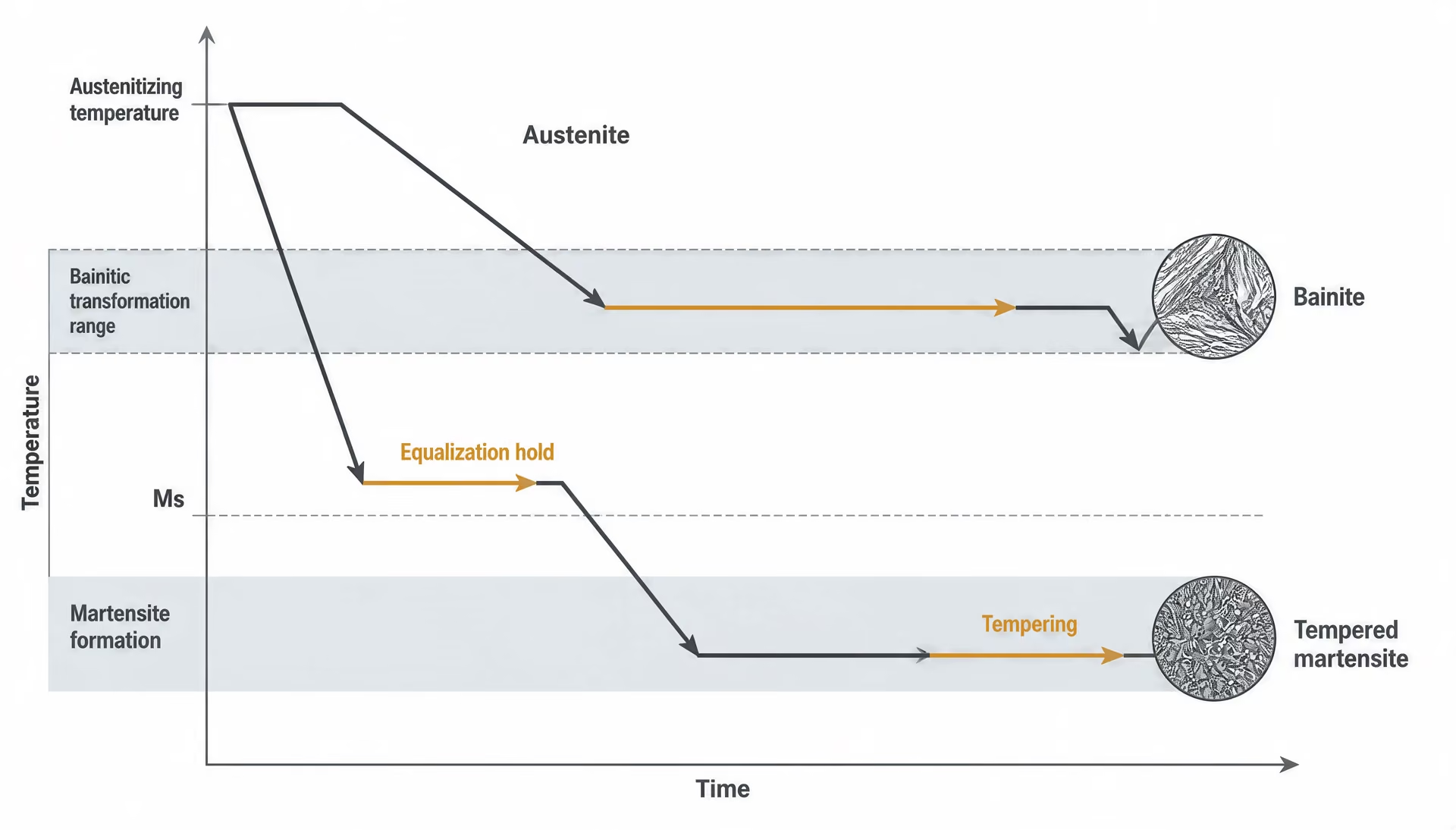
Both treatments interrupt direct quenching, but they do not create the same microstructure. Austempering is a bainitic transformation treatment: austenitized steel is cooled rapidly to a temperature where bainite can form and is held until the required fraction of austenite transforms. Martempering is a temperature-equalization step before martensite formation: the steel is quenched to just above its martensite-start temperature, held only long enough for the section to approach a uniform temperature, and then cooled through the martensitic range. Martempered steel normally requires tempering before service.
That distinction is more important than the name of the quench bath. A salt bath, oil bath, or other controlled medium does not identify the process by itself. Alloy composition determines the positions and shapes of the transformation curves; the martensite-start temperature, section size, hardenability, bath temperature, holding time, agitation, and cooling rate determine the actual path. A 300 °C bath can support austempering in one steel if bainite forms during the hold, yet act as a martempering station in another if the workpiece is removed before bainitic transformation and then cooled to form martensite.
Why the names are often confused
The confusion comes from a genuine similarity in equipment and handling. In both treatments, the workpiece is austenitized, transferred rapidly into a controlled-temperature medium, and prevented from undergoing an uncontrolled direct quench from the austenitizing temperature to room temperature. Both schedules can reduce thermal gradients compared with ordinary quenching, and both may be described informally as “interrupted quenching.” Those shared features do not establish a shared transformation product.
Terms that do not identify the final phase
- Salt-bath quenching
- Describes the heat-transfer medium, not the transformation product.
- Hot quenching
- Describes a controlled-temperature quench but not a unique schedule.
- Isothermal quenching
- Describes a temperature-time path whose resulting phase depends on the hold.
- Ausbay quenching
- Describes an interrupted-quench route that must be tied to its specified procedure.
Bath names add to the problem. Terms such as salt-bath quenching, hot quenching, isothermal quenching, ausbay quenching, and interrupted quenching are often used in overlapping ways, although they describe equipment, temperature control, or a schedule rather than a single final phase. SAE AMS-H-6875C: Heat Treatment of Steel Raw Materials covers four classes of steel and permits austempering, ausbay quenching, and martempering when specified. The specification language therefore reinforces an essential point: the treatment designation must be tied to the required procedure and result, not inferred from the fact that salt was used.
Geometry also changes the interpretation. A thin part may equalize through its thickness during a short hold above martensite start. A thick part may need a longer hold, and that extra time can allow bainite to begin or progress if the temperature lies within the bainitic transformation range. Conversely, a steel with delayed bainite formation may remain substantially austenitic during a hold that would transform a different grade. The same nominal bath temperature can therefore produce different structures in AISI 52100, AISI 8620, and a high-hardenability alloy.
[1] ASM Handbook Volume 4A: Martempering of Steels. ASM International. ASM Handbook, 2013.
ASM International’s 2013 ASM Handbook Volume 4A identifies austenitizing temperature, bath temperature, holding time, agitation, and cooling rate as controlling variables for martempering. These variables are process data, not incidental details. A drawing or procedure that says only “salt quench at 300 °C” is incomplete unless it also defines the steel, transfer time, equalization criterion, hold limit, and subsequent cooling and tempering operations.

The transformation product defines the process
| Feature | Austempering | Martempering |
|---|---|---|
| Primary objective | Form bainite during an isothermal hold | Equalize temperature before martensite forms |
| Hold location | Bainitic transformation range | Just above Ms |
| Transformation during hold | Austenite transforms to bainite | Diffusional transformation is avoided |
| Final structure | Bainite, possibly with martensite or retained austenite | Martensite, possibly with retained austenite |
| Tempering | Not automatically required as the defining step | Required before service |
Austempering is defined by deliberate bainitic transformation during the isothermal hold. Strong evidence
Austempering is defined by the deliberate formation of bainite. After austenitizing, the steel is quenched into a medium held within a temperature range where the austenite can transform isothermally to bainite. A 2013 study of AISI 52100 describes austempering as quenching into a medium maintained at approximately 200 to 400 °C and holding until bainite forms. The precise useful range is grade-dependent; alloying elements shift transformation kinetics, and the upper and lower bainite products need not have identical properties.
The holding time is therefore a metallurgical requirement, not merely a method of reducing temperature differences. If the workpiece is removed before the intended bainitic reaction has occurred, the process has not produced a fully austempered structure. Depending on the schedule, the final material may contain bainite with martensite, retained austenite, or untransformed regions. A 2020 study of short-term, low-temperature austempering in a medium-carbon low-alloy steel reported nano-bainite, martensite, and retained austenite; its wear coefficients were up to 50% lower than those of quenched martensitic steel. That result belongs to the studied steel and schedule, not to every austempered grade.
Martensite-start temperature (Ms) The temperature at which martensitic transformation begins during cooling under a defined composition and thermal history.
Martempering has a different objective. The bath is selected just above the steel’s martensite-start temperature, commonly written . The workpiece remains there only until its surface and core temperatures become sufficiently close. It is then cooled through the martensite-formation range, usually in air or under another controlled cooling condition. Martensite forms during this later cooling stage rather than during the bath hold. ASM’s 2020 Heat Treating Subject Guide describes this sequence and states that the steel must subsequently be tempered before service.
The purpose is to reduce the temperature difference between the surface and interior before the transformation strain of martensite occurs. Thermal contraction and transformation expansion then develop with less severe timing mismatch, which can reduce distortion and cracking compared with a direct quench. Martempering does not eliminate quench stresses, and it does not replace tempering. Untempered martensite can have high hardness but poor toughness and excessive residual stress.
The distinction can be verified rather than guessed. A metallographic examination can identify bainite, martensite, and retained austenite, while hardness testing, dimensional inspection, and, where required, retained-austenite measurement test whether the specified result was achieved. A thermal schedule should be checked against the grade’s continuous-cooling and isothermal-transformation data. Bath temperature alone is insufficient evidence.
A concise comparison of process intent
Austempering holds steel at a bainitic transformation temperature long enough for austenite to convert to bainite. Its defining event occurs during the isothermal hold. Depending on grade and geometry, the resulting structure can provide a useful balance of hardness, toughness, fatigue behavior, and dimensional stability. In carburized AISI 8620, AISI 8822, and AISI 4320, SAE research published in 2013 used austempering temperatures of 260, 288, and 304 °C and reported significantly less distortion than in carburized, quenched, and tempered specimens. The finding supports process selection for those tested conditions; it is not a universal ranking of treatments.
Equalizing steel just above the martensitic range before slower cooling can reduce cracking while sacrificing little hardness. Strong evidence
Martempering holds steel above long enough to equalize temperature, then permits controlled martensitic transformation during cooling. Its defining event is temperature equalization before martensite formation, followed by tempering. The 1946 study on the temperature range of martensite formation described this basis directly: quenching to just above the martensite-formation range and then cooling more slowly can reduce cracking while sacrificing little hardness.
Austempering asks, “Can this steel transform to the required bainitic structure within the available time and temperature range?” Martempering asks, “Can this section equalize above before it transforms to martensite?” Steel hardenability, section size, transfer delay, bath control, and holding time answer those questions. Calling both treatments “hot quenching” obscures the answer and can produce the wrong specification, the wrong microstructure, or an omitted tempering operation.
The Metallurgical Starting Point: Austenite, TTT Diagrams, and Ms
Austempering and martempering begin from the same metallurgical condition: austenite. The process distinction appears later, when the austenitized steel follows a different temperature–time path. Austenite has a face-centered cubic crystal structure and can dissolve substantially more carbon than ferrite. Heating into the austenitic range therefore prepares the carbon and alloying elements for a controlled transformation during cooling. If the steel is not fully or suitably austenitized, neither treatment follows its intended transformation schedule.
Austenitizing and dissolution of prior phases
Austenitizing is more than reaching a furnace setpoint. The workpiece must be heated sufficiently above the relevant critical temperature, held long enough for the section to equalize, and treated at a temperature that dissolves the required prior phases without producing excessive austenite grain growth. The appropriate temperature depends on composition, section size, starting microstructure, and the required final properties.
In a hypoeutectoid steel, heating above the upper critical temperature transforms ferrite and pearlite into austenite. In a hypereutectoid steel, the treatment is commonly selected to dissolve the pearlite and an appropriate fraction of the proeutectoid cementite, although complete carbide dissolution may not be desirable. Alloy carbides add another complication. Chromium, molybdenum, vanadium, and other carbide-forming elements may dissolve slowly or remain partly undissolved at ordinary austenitizing temperatures. Their dissolution changes the carbon and alloy content of the austenite, which then changes hardenability, transformation kinetics, and the martensite-start temperature.
AISI 52100 illustrates why grade-specific interpretation matters. Its chromium-rich carbide population and high carbon content make the austenitizing schedule different from that of a plain-carbon steel. A treatment that produces suitable austenite in AISI 52100 cannot be transferred automatically to AISI 8620 or AISI 4320. The carburized surface of AISI 8620, 8822, or 4320 also has a carbon gradient, so the surface and core do not necessarily possess the same transformation temperatures or martensitic fractions.
Holding time has two opposing effects. Too little time can leave undissolved pearlite, ferrite, or carbides and can produce a nonuniform austenite composition. Excessive time promotes grain coarsening, oxidation, decarburization, and greater dimensional change. Prior austenite grain size affects the number of nucleation sites available for diffusional transformations and can alter hardenability. A coarse-grained austenite may delay pearlite or bainite formation during cooling, while a fine-grained structure often transforms more readily by diffusion. Grain size can also shift measured transformation temperatures, including Ms, although its effect is usually smaller than that of carbon content and alloy chemistry.
Austenitizing also establishes the starting condition for the time-temperature diagram. A TTT curve produced after one austenitizing temperature, holding time, and grain size does not necessarily describe steel austenitized under another schedule. Thermal history matters before the quench even begins.
The pearlite, bainite, and martensite transformation fields
A time-temperature-transformation diagram represents the products formed when austenite is rapidly brought to a selected temperature and held there. Its familiar “C” curves show the start and finish of diffusional transformations, but the curves belong to a particular steel and a particular austenitizing condition. A generic iron-carbon diagram may explain the concepts; it cannot specify the schedule for every engineering grade.
At higher transformation temperatures, austenite can form pearlite. Carbon diffuses over relatively long distances, producing alternating ferrite and cementite. At lower temperatures, diffusion is slower and the resulting pearlite is finer. The transformation still requires time. If cooling passes through the pearlite field too slowly, some or all of the austenite may transform before the steel reaches a bainitic or martensitic range.
Bainite forms at temperatures below the pearlite range and above the temperature at which martensitic transformation begins, although the exact fields overlap differently among alloys. Its formation involves carbon redistribution and a displacive component, producing ferritic bainite with carbide precipitation or retention patterns that depend on temperature and steel chemistry. Upper bainite and lower bainite are not interchangeable structures. Holding temperature, carbon activity, alloying, and completion time affect their morphology and properties.
| Transformation field | Typical product | Defining operation |
|---|---|---|
| Pearlite range | Pearlite | Cooling or holding where ferrite and cementite form by diffusion |
| Bainitic range | Bainite | Isothermal hold until the required austenite fraction transforms |
| Martensitic range | Martensite | Cooling below Ms by a largely diffusionless transformation |
Austempering intentionally sends austenitized steel into the bainitic transformation range and holds it there until the required fraction of austenite transforms. A 2013 study of AISI 52100 described austempering as quenching into a medium maintained at approximately 200 to 400 °C and holding until bainite formed. That interval is a useful description of the reported experiment, not a universal range for all grades. The ACS Omega study published in 2024 states the process distinction directly: austempering holds austenitized steel at a bainitic-transformation temperature, whereas martempering briefly holds it just above Ms before air cooling.
Martensite is different. It forms when austenite is cooled below Ms by a largely diffusionless shear transformation. Carbon remains trapped in the supersaturated body-centered tetragonal martensite lattice, and the transformation produces a rapid volume change. The amount of martensite increases as cooling continues through the martensite-formation range, often described using Mf, the martensite-finish temperature. Some austenite may remain untransformed if Mf lies below room temperature or if alloying depresses the transformation range.
The cooling curve must therefore be compared with transformation kinetics, not with bath names alone. A continuous-cooling-transformation diagram shows whether a real cooling rate avoids the pearlite and bainite noses. A TTT diagram shows isothermal behavior and is useful for understanding holding treatments, but it does not directly reproduce the temperature path of a large part moving through oil, salt, polymer, or air. The center and surface of a section may also follow different curves. Hardness and phase distribution then depend on local cooling rates as well as nominal bath temperature.
Martensite-start temperature and transformation range
Ms is the temperature at which martensitic transformation begins during cooling under a defined set of conditions. It is not a universal constant for “steel.” Carbon generally lowers Ms because carbon stabilizes austenite; alloying elements such as manganese, nickel, chromium, and molybdenum can also alter austenite stability and shift the transformation range. Carbon concentration may vary between the carburized case and the low-carbon core, giving the two regions different Ms values.
Prior austenite grain size, austenitizing temperature, dissolved carbides, residual stresses, and the preceding heating and cooling history can also affect the measured start and finish temperatures. Retained austenite, segregation, and local chemical variation further complicate practical measurements. The Ms marked on a diagram is consequently tied to a specified composition and thermal history, not simply to a grade name.
Martempering uses this temperature dependence in a controlled way. ASM Handbook Volume 4A (2013) defines it as an interrupted quench using oil or salt and identifies austenitizing temperature, bath temperature, holding time, agitation, and cooling rate as controlling variables. The bath is selected just above Ms so the part can equalize internally before martensite begins. It is then cooled through the martensitic range, commonly in air, and must be tempered before service. The brief equalization hold is intended to reduce the surface-to-core temperature difference; it is not a bainitic hold.
Austempering takes the opposite transformation objective. It holds long enough in the bainitic field for austenite to convert to bainite, rather than merely equalizing temperature above Ms. A 2020 low-temperature austempering study reported nano-bainite, martensite, and retained austenite, with wear coefficients up to 50% lower than those of quenched martensitic steel under its stated test conditions. That result cannot be assigned to every steel, geometry, or schedule. It does show why the transformation field and holding time must be verified for the actual grade.
SAE AMS-H-6875C (2020) covers heat-treatment requirements for four classes of steel and permits austempering, ausbay quenching, and martempering when specified. Such permission does not make the processes interchangeable. The applicable specification, grade-specific diagram, section size, and measured temperature history determine whether the intended product is bainite, martensite after martempering, or an unwanted mixture.
How Austempering Works: Quench, Hold, and Bainitic Transformation
Austempering is an isothermal heat-treatment schedule designed to transform austenite into bainite. It is not simply another name for martempering. The distinction depends on what happens during the hold: austempering holds the steel long enough for a planned bainitic transformation, whereas martempering holds it only long enough for the temperature to become nearly uniform before cooling through the martensite-start temperature, or , to form martensite.
Austempering sequence
- Austenitizing Heat the workpiece so the required portion becomes austenite.
- Transfer Move it rapidly into a controlled bath without significant pearlite formation.
- Bainitic hold Maintain the selected temperature until the required austenite-to-bainite reaction occurs.
- Final cooling Cool to ambient temperature, allowing any specified martensite or retained austenite to remain.
The cycle begins by heating the workpiece above its critical transformation range so that the required portion of the structure becomes austenite. The austenitizing temperature and time depend on grade, section size, prior microstructure, and the required carbon distribution. Excessive heating can increase austenite grain size or dissolve carbides that are intended to remain, while insufficient heating can leave ferrite or undissolved constituents that change the final transformation response.

Quenching into the bainitic range
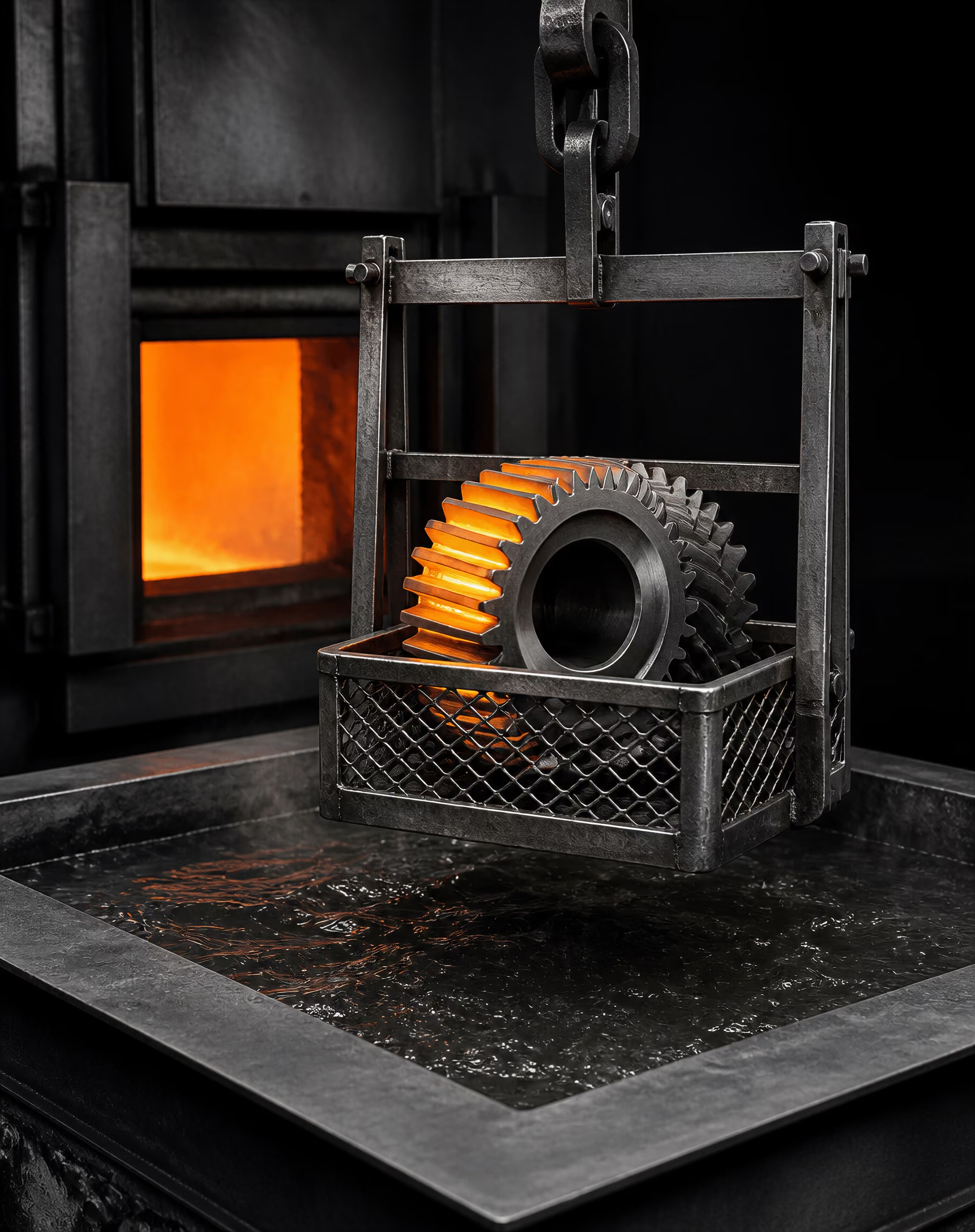
After austenitizing, the steel is transferred rapidly into a bath maintained within the bainitic transformation range. For many steels, this range lies approximately between 200 and 400 °C, although the usable temperature window is grade-specific rather than fixed. An AISI 52100 study defines austempering in these terms: quenching from the austenitizing temperature into a medium held between approximately 200 and 400 °C, followed by holding until bainite forms.
The transfer must be fast enough to pass through the pearlite region without allowing a significant amount of austenite to transform on the way down. This is a time-and-temperature problem. The steel must cross the pearlite “nose” of its time-temperature-transformation diagram before the incubation time for pearlite is reached. Hardenability, section thickness, load arrangement, bath agitation, and the temperature difference between the workpiece and bath all affect whether that condition is met. A small pin may enter the bainitic range quickly; a heavy gear tooth or thick plate may cool unevenly, allowing pearlite or ferrite to form in its interior even when the surface follows the intended schedule.
The bath may contain molten salt, oil, or another controlled heat-transfer medium suitable for the specified temperature. The bath name does not define the process. A salt bath can be used for either an austempering or a martempering schedule, depending on its temperature and the duration of the hold. The ACS Omega study published in 2024 makes this distinction directly for Ca(NO₃)₂–KNO₃ molten-salt mixtures: austempering holds austenitized steel at a bainitic-transformation temperature until austenite converts to bainite, while martempering briefly holds the workpiece just above before air cooling.
Temperature control must account for the heat released and absorbed during transformation, as well as the load entering the bath. Agitation reduces local thermal gradients and helps prevent a cooler or hotter boundary layer from changing the effective cycle. Thermocouples, bath calibration, and representative load trials are often needed to establish that the core, surface, and different positions in the load actually follow the intended path. The process is sensitive to section size because the bath can equalize the surface temperature before the center has reached the same temperature.
The austempering bath is normally selected above the steel’s effective temperature when the intended product is conventional bainite. At this level, austenite can transform by a diffusion-assisted, shear-dominated mechanism without immediately producing martensite. Cooling below before the planned bainitic transformation is complete changes the result: the untransformed austenite may then convert to martensite, producing a mixed structure.
Holding until the required austenite transformation
Once the workpiece reaches the bath temperature, it is held isothermally. During this stage, bainite nucleates at austenite grain boundaries or other favorable sites and grows into the surrounding austenite. Carbon is rejected from the bainitic ferrite into the remaining austenite, changing the stability and composition of both regions. The transformation rate depends on temperature, alloy chemistry, prior austenite grain size, and the amount of bainite already formed.
The hold time is not selected by a universal rule such as “one hour per inch.” It must be based on transformation data, validated process trials, or an appropriate time-temperature-transformation diagram. A short hold may intentionally leave some austenite untransformed. If the steel is then cooled below , that residual austenite can form martensite. A longer hold may convert most or nearly all transformable austenite to bainite, reducing the later martensitic fraction. Both schedules can be correct, but they produce different hardness, toughness, dimensional response, and retained-austenite levels.
Incomplete transformation A condition in which the bainitic reaction ends before all transformable austenite has converted, leaving possible retained austenite or later-forming martensite.
The transformation may also stop before every last portion of austenite becomes bainite because carbon enrichment stabilizes the remaining austenite. This condition is often called incomplete transformation or incomplete reaction. In some alloy steels, the enriched residual austenite is desirable because it can accommodate strain and improve toughness; in other applications, excessive retained austenite may cause dimensional change during service or later cooling. The specification must therefore define not just bath temperature but also the allowed phase constitution and verification method.
Austempering can reduce distortion because the steel avoids the abrupt, nonuniform volume change associated with direct quenching into martensite. A 2013 SAE study of carburized AISI 8620, AISI 8822, and AISI 4320 reported significantly less distortion in carburized-and-austempered specimens than in carburized, quenched, and tempered specimens. The reported austempering temperatures were 260, 288, and 304 °C. Those results apply to the tested chemistries, geometries, and cycle conditions; they do not establish the same reduction for every carburized component.
The end of the hold may be determined by a required minimum bainite fraction, a hardness range, a dimensional limit, or a metallographic requirement. Austempered bainitic steel does not automatically require the same tempering step as martensite. By contrast, martempered steel is cooled through to form martensite and must subsequently be tempered before service. A low-temperature stress-relief treatment may still be specified for an austempered part, but that is a separate requirement rather than the defining transformation step.

Upper bainite, lower bainite, and mixed products
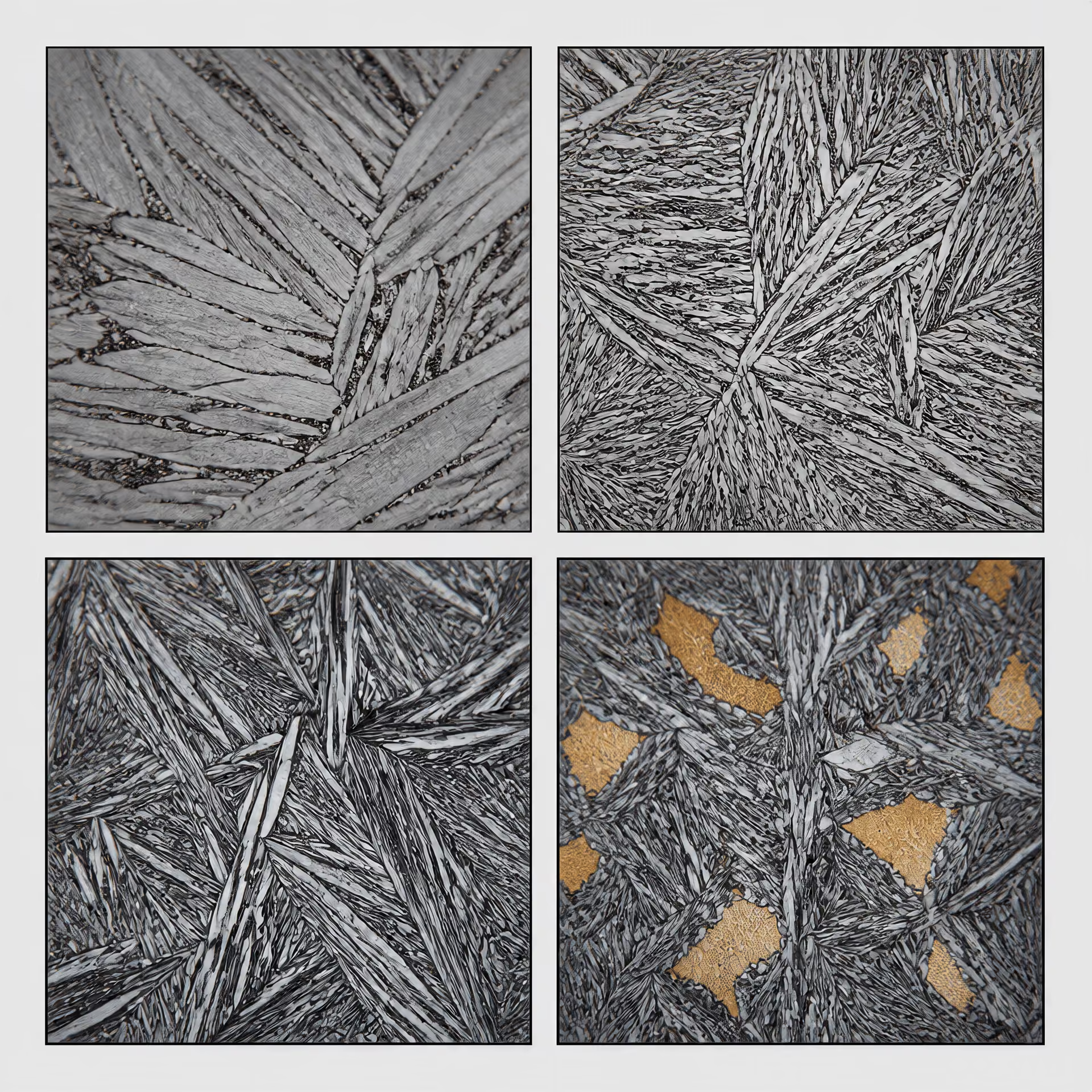
Bath temperature strongly influences the form of bainite. Upper bainite generally forms at the higher part of the bainitic range. It consists of sheaves or laths of bainitic ferrite with carbon-enriched regions between them, where carbides may precipitate. Its morphology and carbide distribution differ from those of lower bainite, which forms at lower temperatures.
Lower bainite develops at temperatures closer to . Carbon has less time and mobility to partition into the surrounding austenite, and carbides can precipitate within the bainitic ferrite plates or laths. This finer structure can provide a different balance of hardness, strength, and toughness from upper bainite. The transition between upper and lower bainite is not a single universal temperature because alloying elements shift the transformation ranges and alter carbide precipitation.
Short-term, low-temperature austempering produced wear coefficients up to 50% lower than quenched martensitic steel in the reported study. Limited evidence
Very low-temperature austempering can produce structures that are not adequately described as a single, fully transformed bainitic product. A 2020 study of short-term low-temperature austempering in a medium-carbon low-alloy steel reported nano-bainite together with martensite and retained austenite. The reported wear coefficients were up to 50% lower than those of quenched martensitic steel under the study’s test conditions. That figure is evidence for the tested steel and wear method, not a general performance guarantee.
Mixed products arise when the hold is deliberately stopped before the bainitic reaction is complete, when the selected temperature is near the lower transformation limit, or when the section cannot cool uniformly. On subsequent cooling, untransformed austenite may become martensite; some may remain as retained austenite if carbon enrichment lowers its effective . The final structure can therefore contain upper bainite, lower bainite, martensite, retained austenite, and, if transfer was too slow, pearlite.
Process qualification should examine hardness, dimensional change, metallographic phase fractions, and retained austenite where relevant. X-ray diffraction, microscopy, dilatometry, and sectioned-load examinations can confirm whether the actual product matches the intended schedule. SAE AMS-H-6875C, published in 2020, covers heat-treatment requirements for four classes of steel and permits austempering, ausbay quenching, and martempering when specified. Such permission does not replace grade-specific cycle development. The steel designation, hardenability, section size, bath capacity, and acceptance criteria still determine whether the chosen austempering schedule is metallurgically successful.
How Martempering Works: Equalization Above Ms, Then Martensite
Martempering is an interrupted quench designed to control when and where martensite forms. It is not austempering under another name. In austempering, austenite is held within the bainitic transformation range until a significant or intended portion of it changes to bainite. In martempering, the hold occurs just above the martensite-start temperature, or Ms, and is short enough to prevent unwanted diffusional transformation. After the temperature has equalized through the steel, the workpiece is cooled through the martensite range. The final structure is therefore martensitic, not bainitic, and it remains untempered until a separate tempering operation.
Interrupted quenching above martensite start
The ASM Handbook, Volume 4A, describes martempering as an interrupted quench using oil or salt. The steel is first heated to its specified austenitizing temperature, where the intended austenitic structure and carbon distribution are established. It is then transferred rapidly into a bath held at a temperature just above Ms. The bath must remove heat quickly enough to avoid pearlite or other high-temperature transformation products, but the interruption prevents the surface from becoming far colder than the core before martensite formation begins.
Ms is not a universal temperature for all steels. It depends on carbon content, alloying elements, austenite grain condition, prior thermal history, and, in some cases, the amount of retained austenite expected after cooling. A plain-carbon steel and a carburized low-alloy steel can therefore require different martempering bath temperatures. The bath is selected with a sufficient margin above the applicable Ms, not by applying one fixed temperature to every grade.
| Variable | Standard martempering requirement | Risk if uncontrolled |
|---|---|---|
| Bath temperature | Just above Ms | Premature martensite or bainite formation |
| Hold duration | Only until section temperatures approach uniformity | Unwanted diffusional transformation |
| Post-hold cooling | Controlled cooling through the martensite range | Excessive thermal gradient or incomplete hardening |
| Tempering | Separate operation before service | High stress and brittle untempered martensite |
The holding period is the defining interruption. It must last long enough for the temperature difference between the surface and the center to decrease, while remaining short enough to avoid bainite, pearlite, or another diffusional product. This requirement separates martempering from austempering more reliably than the name of the bath. A molten salt bath can be used for either process; the transformation path and holding schedule determine which process is being performed.
ASM International’s 2013 ASM Handbook Volume 4A identifies austenitizing temperature, bath temperature, holding time, agitation, and cooling rate as controlling variables. Those variables interact. Excessive agitation can increase heat extraction at the surface, while inadequate agitation can produce local temperature differences in the bath. A bath that is nominally above Ms but poorly controlled may still produce an uneven transformation schedule across a large load.
The temperature must remain high enough to suppress martensite during the hold. If the workpiece reaches Ms in the bath, martensite may begin forming before the section has equalized. If the hold is too long or the temperature is too low, bainite may form. That is a process failure when the specification calls for martensite.

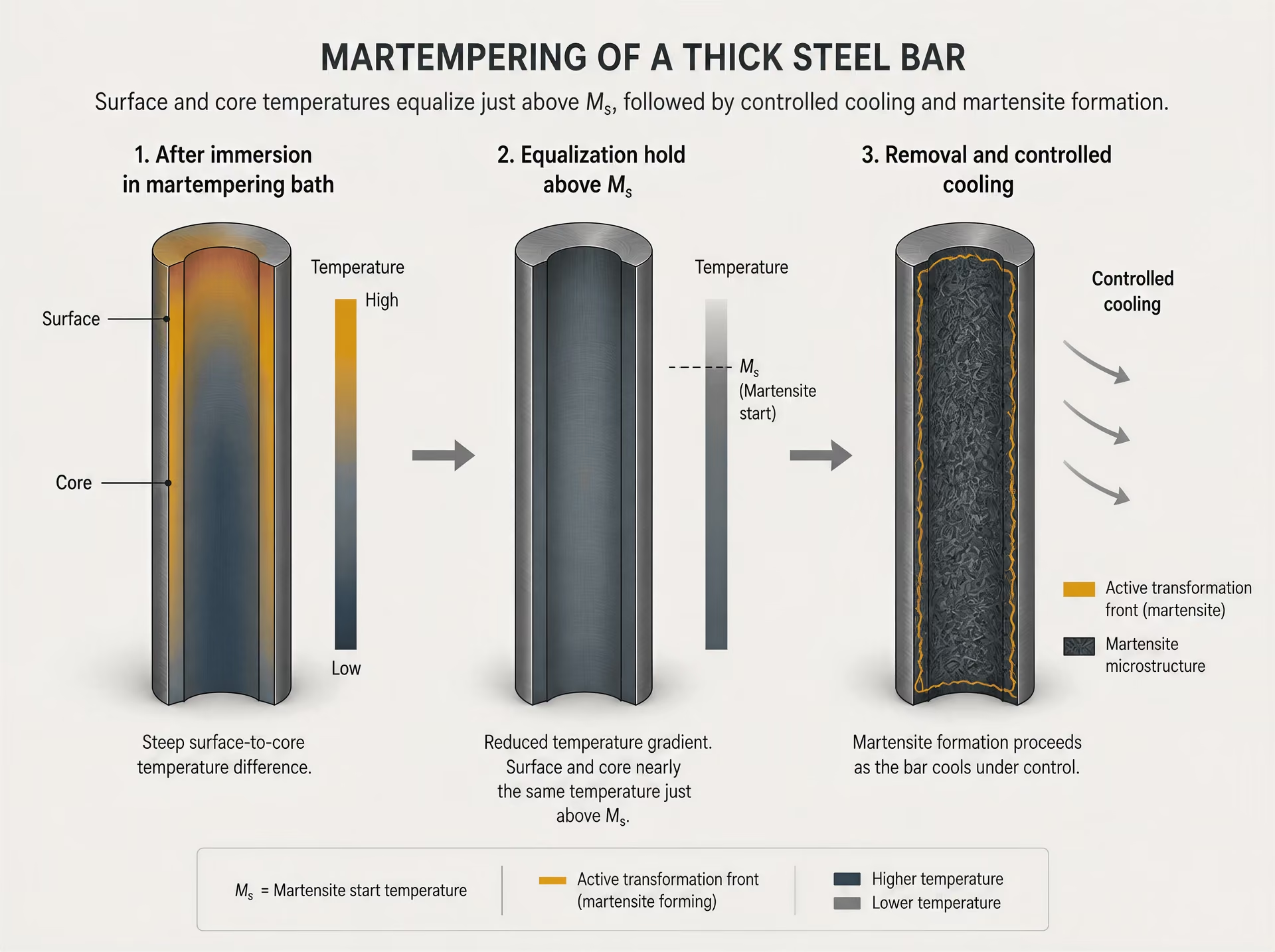
Temperature equalization through the section
Conventional quenching creates a steep thermal gradient. The surface cools first, while the interior remains hotter and continues to expand thermally. As the surface crosses Ms, it begins transforming to martensite and expands as the austenite changes crystal structure. The core may still be austenitic and at a different temperature. Later, when the core transforms, its expansion is constrained by the already transformed outer material. These competing strains generate internal stress, distortion, and sometimes quench cracking.
Martempering changes the timing. The hot workpiece is quenched into the bath, but it is held above Ms until the temperature is more nearly uniform from the outside toward the center. Martensite formation is then initiated during a subsequent cooling step rather than while the surface and core are at widely different temperatures. Reducing the temperature gradient at the moment of transformation reduces the mismatch in thermal contraction and transformation strain.
The benefit is a lower risk of distortion and cracking, not an elimination of either one. A thin plate, a gear tooth, and a heavy shaft do not equalize at the same rate. Section thickness, geometry, holes, sharp changes in cross-section, and contact between parts all affect heat flow. Steel hardenability also matters: the center must cool through the transformation range fast enough to avoid pearlite or bainite if a predominantly martensitic structure is required.
A high-hardenability grade may permit a slower cooling rate after equalization, whereas a low-hardenability grade may require a shorter interruption and faster cooling. Carbon and alloy content also alter Ms and the transformation kinetics. For this reason, the bath temperature and holding time should be established from the grade, section size, load arrangement, and measured thermal response rather than copied from a generic table.[2] The Temperature Range of Martensite Formation. Study on martensite formation, 1946. Source details supplied in the article; no URL provided
The 1946 study on the temperature range of martensite formation described the basic rationale as quenching to just above the martensite-formation range and then cooling more slowly. The method can reduce cracking while sacrificing little hardness, provided the steel remains free of unwanted diffusional transformation. “More slowly” does not mean arbitrarily slowly; it means slow enough to reduce thermal shock while still passing through the transformation range at a rate suitable for the steel.
Air cooling and the mandatory tempering step
After equalization, the workpiece is removed from the oil or salt and cooled through the martensite range, commonly in air. ASM’s 2020 Heat Treating Subject Guide describes this sequence as holding steel just above Ms until its temperature equalizes, followed by air cooling to form martensite. During this stage, the austenite transforms without the severe surface-to-core temperature difference associated with direct quenching.
The resulting martensite is untempered. That point is essential. Martempering does not include tempering simply because the part was cooled in stages. The martensite formed during air cooling is hard and contains high internal stress; it may also contain retained austenite, depending on the steel and the cooling path. The part must undergo a separate tempering treatment before service. Tempering reduces stress and brittleness and adjusts hardness, strength, toughness, and dimensional stability to the specification.
Tempering temperature and time depend on the grade and required properties. A high-carbon bearing steel such as AISI 52100 cannot be assigned the same tempering schedule as a carburizing grade such as AISI 8620. A carburized case and a low-carbon core also respond differently, so the required properties must be checked in both regions where applicable.
SAE AMS-H-6875C: Heat Treatment of Steel Raw Materials covers four classes of steel and permits austempering, ausbay quenching, and martempering when specified. The process designation alone does not establish acceptance. Production control may require recorded austenitizing and bath temperatures, transfer time, interruption time, agitation conditions, tempering records, hardness testing, metallographic examination, and dimensional measurements.
Verification should also look for the failure modes that the schedule is intended to prevent. Hardness traverses can reveal a soft core caused by insufficient hardenability or excessive interruption. Metallography can distinguish martensite from bainite and identify pearlite or excessive retained austenite. Dimensional inspection before and after heat treatment shows whether the reduction in transformation stress produced the expected improvement for the actual geometry.
The process therefore has a precise sequence: austenitize, quench rapidly into oil or salt held just above Ms, hold only until the section equalizes without diffusional transformation, cool through the martensite range, and temper. Changing the hold into a bainitic transformation treatment changes the process to austempering. Changing the post-quench tempering step is not optional; without it, the martempered steel is simply untempered martensitic steel with a controlled route to formation.
Microstructures and Properties: Bainite Versus Tempered Martensite
Austempering and martempering can reduce quench stresses, but they do not produce the same final structure. In austempering, austenitized steel is cooled rapidly to a temperature at which bainite can form and is held there long enough for the intended transformation. The product may be upper bainite, lower bainite, or a mixture that still contains untransformed austenite and, after final cooling, martensite. A 2013 study of AISI 52100 describes the austempering range as approximately 200–400 °C, with holding continued until bainite forms.
Martempering follows a different path. The workpiece is held briefly in oil or salt just above the martensite-start temperature, allowing the section to approach a more uniform temperature before it is cooled through the martensitic range. The resulting martensite is not a service-ready condition: it must subsequently be tempered. ASM International’s Heat Treating Subject Guide (2020) states this sequence directly. ASM Handbook Volume 4A (2013) identifies austenitizing temperature, bath temperature, holding time, agitation, and cooling rate as controlling variables.
The distinction matters because bainite and tempered martensite obtain strength through different arrangements of ferrite, carbon, and carbides. Their hardness may overlap, but overlapping hardness does not make their mechanical behavior interchangeable.
Strength, hardness, toughness, and ductility
| Constituent | Formation mechanism | Property considerations |
|---|---|---|
| Upper bainite | Higher-temperature bainitic transformation with carbides commonly between ferritic regions | May differ in hardness and ductility from lower bainite |
| Lower bainite | Lower-temperature transformation with finer carbide arrangements | Can provide a different strength–toughness balance |
| Tempered martensite | Carbon redistribution and carbide formation during tempering | Hardness and toughness depend strongly on tempering temperature and time |
| Retained austenite | Austenite that remains untransformed after cooling | May transform during service, grinding, or later cooling |
Bainite consists of ferritic regions formed by a displacive transformation, with carbon rejected into austenite or precipitated as carbides depending on the transformation temperature and alloy chemistry. Upper bainite generally contains ferrite laths or plates with carbides between them. Lower bainite forms at lower temperatures and places finer carbides within or closely associated with the ferritic plates. The exact morphology changes with carbon content, alloying additions, cooling rate, and holding time.
Tempered martensite begins as a supersaturated, highly strained body-centered tetragonal phase. During tempering, carbon leaves the martensite, transition carbides and then more stable carbides form, and the matrix loses much of its tetragonality and internal stress. Tempering temperature and duration determine how far that sequence proceeds. A low tempering temperature can preserve high hardness while retaining substantial residual stress; a higher tempering temperature usually lowers hardness but improves toughness and dimensional stability. Prolonged exposure can produce further softening or secondary hardening in steels containing elements such as chromium, molybdenum, or vanadium.
Neither bainite nor tempered martensite has a universal hardness advantage. Fine lower bainite can be very hard, while upper bainite may be softer and more ductile. A low-temperature tempered martensitic structure can exceed the hardness of a particular bainitic structure, yet a higher temper may give the martensitic steel lower hardness and greater fracture resistance. Carbon content, prior-austenite grain size, alloy hardenability, transformation temperature, and the amount of each constituent must be specified before a comparison has meaning.
Toughness follows the same rule. Bainitic ferrite can provide a favorable combination of strength and resistance to crack initiation when its plates are fine and carbide films are controlled. Coarse bainite, untransformed austenite, or fresh high-carbon martensite formed during final cooling can reduce that advantage. Tempered martensite can offer high toughness when tempering relieves stress and refines carbide distributions, but inadequate tempering leaves a brittle structure. Excessive tempering can sacrifice strength.
Ductility is not simply a consequence of choosing one process. It depends on the volume fraction and morphology of bainite, martensite, retained austenite, carbides, inclusions, and any carbon-rich regions. A mixed structure may show useful elongation while still containing brittle local constituents. Tensile strength, yield strength, impact energy, fracture toughness, fatigue performance, and wear resistance should therefore be measured separately rather than inferred from hardness alone.
Distortion can also differ. Research on carburized AISI 8620, AISI 8822, and AISI 4320 used austempering temperatures of 260, 288, and 304 °C and reported significantly less distortion than in carburized, quenched, and tempered specimens. That result reflects the tested carburized geometries and schedules, not a general guarantee. Martempering reduces thermal gradients before martensite forms, so it can also reduce cracking and distortion compared with a direct quench, although martensitic transformation still causes a volume change.
Retained austenite and transformation mixtures
Austempering is often described as producing bainite, but “bainitic” does not necessarily mean 100% bainite. If the hold ends before the austenite has transformed, the remaining austenite may persist as retained austenite or transform to martensite during subsequent cooling. Carbon enrichment of the remaining austenite can stabilize part of it at room temperature. The result may be bainite plus retained austenite, bainite plus martensite, or bainite plus both.
This mixture strongly affects properties. Retained austenite can improve apparent ductility and absorb transformation strain, but it can also transform under load, during grinding, or during service. That transformation may cause dimensional change, local hardening, or residual stress. Martensite formed from untransformed austenite after the austempering hold may be harder and more brittle than the bainite formed in the bath. X-ray diffraction, metallography, dilatometry, and hardness mapping can help identify these constituents; a single bulk hardness value cannot.[3] Short-term low-temperature austempering in medium-carbon low-alloy steel. Metal and Materials International, 2020.
The 2020 study of short-term, low-temperature austempering in a medium-carbon low-alloy steel illustrates this limitation. The reported structure contained nano-bainite, martensite, and retained austenite, rather than a single phase. Under the test conditions, its wear coefficients were up to 50% lower than those of quenched martensitic steel. That is a bounded comparison: it applies to the studied steel, specimen preparation, austempering schedule, counterface, load, and wear test. It does not establish that every austempered steel will have half the wear rate of every quenched-and-tempered steel.
Martempering can also produce transformation mixtures, but its intended sequence is different. The equalization hold above martensite start should be short enough to avoid significant bainite formation. After air cooling through the martensite range, the steel contains martensite, often with some retained austenite and possibly undissolved carbides. Tempering then changes the martensitic matrix and carbide condition. If the austenitizing treatment dissolved too much carbon, or if the steel has high hardenability and the final cooling path is unsuitable, retained austenite may remain substantial.
The SAE paper on modified martempering distinguishes that process by placing the quench bath below martensite start to avoid bainite formation. This detail shows why bath temperature alone is not a sufficient process label: the relation between bath temperature, martensite-start temperature, holding time, and cooling path controls the phases that actually form.
Why property claims must be grade-specific
Steel grade determines transformation kinetics. AISI 52100 bearing steel, AISI 8620 carburizing steel, AISI 8822, AISI 4320, and a medium-carbon low-alloy steel do not share the same carbon level, alloy content, hardenability, martensite-start temperature, carbide stability, or response to tempering. Even within one designation, section size and austenitizing practice can change the center cooling rate enough to produce different structures.
The specification also sets the permitted process and acceptance criteria. SAE AMS-H-6875C: Heat Treatment of Steel Raw Materials covers four classes of steel and permits austempering, ausbay quenching, and martempering when specified. That permission does not assign one hardness, toughness, or retained-austenite limit to every grade. The applicable material specification, drawing, heat-treatment procedure, and inspection method must supply those limits.
A valid comparison therefore states the grade or steel chemistry, austenitizing temperature, transfer time, bath temperature, hold duration, cooling method, tempering temperature and time, section size, and test method. Hardness should be paired with microstructural examination and, where relevant, retained-austenite measurement and dimensional inspection. Without those details, claims such as “austempering is tougher” or “martempering is harder” are too broad to be technically reliable.
Distortion, Cracking, and Residual Stress Control
Why direct quenching creates thermal and transformational stress
Direct quenching subjects austenitized steel to a steep temperature gradient. The surface contacts the coolant first, contracts while the core remains hot and expanded, and therefore becomes constrained by the hotter interior. The surface may enter compression during the early cooling stage, while the core carries tensile stress. As cooling continues, the core contracts and the stress pattern can reverse. Thin sections, sharp corners, holes, and changes in section thickness amplify these differences because they cool at different rates.
A second event follows the thermal contraction: austenite transforms. In plain carbon and low-alloy steels, martensite has a greater specific volume than the parent austenite. The temperature at which this begins is the martensite-start temperature, or . If a surface layer reaches while the core is still austenitic, the surface expands from martensitic transformation while the core continues to contract thermally. The transformation expansion is not uniform through the section, so it adds to the existing thermal stress rather than replacing it.
The resulting stress state depends on timing. A case-hardened gear, for example, may transform first in its carbon-enriched case, while the lower-carbon core transforms later or remains partly austenitic. A hard, relatively brittle martensitic case can then contain tensile residual stress, particularly near geometric discontinuities. That combination promotes quench cracks. Even when cracking does not occur, unequal contraction around a bore or across a tooth can produce ovality, runout, bending, or a change in tooth spacing.
Cooling severity is only one part of the problem. Austenitizing temperature controls grain size and the amount of carbon and alloying elements dissolved in austenite; agitation changes the heat-transfer coefficient; and hardenability determines whether the core transforms to martensite or to softer products such as bainite or pearlite. The ASM Handbook, Volume 4A (2013), identifies austenitizing temperature, bath temperature, holding time, agitation, and cooling rate as important martempering variables. Those same variables influence direct-quench distortion, along with geometry, loading pattern, fixtures, and the condition of the carburized case.
How interrupted quenching changes the stress history
Martempering changes the sequence of events rather than simply selecting a different bath. The hot austenitized workpiece is quenched rapidly into oil or molten salt maintained just above its temperature. It is held there long enough for the surface and core to approach a more nearly uniform temperature, but not long enough for bainite or pearlite to form. The workpiece is then cooled through the martensite-formation range, usually in air or under another controlled low-severity condition, and is tempered before service.
This temperature equalization reduces the thermal differential present when martensite begins to form. The surface and core still do not transform at exactly the same instant, and martensitic transformation still produces expansion, but the temperature gradient and the associated restraint are smaller. Martempering therefore reduces distortion and the likelihood of quench cracking; it does not eliminate either one. A complex component can still warp if its sections have different cooling times, if the bath is poorly controlled, or if its hardenability produces an uneven transformation pattern.
The 2020 ASM Heat Treating Subject Guide describes the schedule directly: steel is held just above until temperature equalizes, then air-cooled so that martensite forms, followed by tempering. Tempering is not optional in ordinary service because as-quenched martensite has high internal stress and limited fracture resistance. The final temperature and time must suit the grade, dimensions, hardness requirement, and retained-austenite condition.
Austempering has a different purpose. The austenitized steel is quenched into a bath held within the bainitic transformation range—approximately 200 to 400 °C in the definition reported for AISI 52100—and held until the required fraction of austenite transforms to bainite. Cooling then produces a bainitic structure, possibly with retained austenite or martensite if the hold is incomplete. The ACS Omega study published in 2024 distinguishes this schedule from martempering: austempering holds until austenite converts to bainite, whereas martempering briefly equalizes temperature above and then allows martensite to form during cooling.
Because bainite forms isothermally after the workpiece has reached a relatively uniform bath temperature, austempering avoids the severe surface-to-core thermal sequence of a direct quench. Bainitic transformation also distributes its strain over the hold instead of concentrating martensitic expansion across a moving temperature gradient. Distortion and residual stress can consequently be lower, but only when the steel’s hardenability, section size, and transformation kinetics permit the entire section to reach the bath and complete the intended reaction before pearlite or unwanted martensite forms.
Martempering and austempering are therefore not interchangeable names for a reduced-distortion quench. Martempering still produces martensite and requires subsequent tempering. Austempering seeks bainite and uses an isothermal hold long enough to obtain it. Specifications can permit both routes: SAE AMS-H-6875C (2020), which covers heat treatment for four classes of steel, lists austempering, ausbay quenching, and martempering when the applicable requirement specifies them. A process record should identify the actual temperature-time path, not merely state that the part was “salt quenched.”
The evidence from carburized low-alloy steels
Austempering produced less distortion than carburizing followed by conventional quenching and tempering in the tested AISI 8620, AISI 8822, and AISI 4320 specimens. Limited evidence
The SAE paper “Austempering Process for Carburized Low-Alloy Steels,” SAE 2013-01-0949, examined carburized AISI 8620, AISI 8822, and AISI 4320. Its comparison was between carburized-and-austempered specimens and specimens that were carburized, conventionally quenched, and tempered. The austempering treatments used bath temperatures of 260, 288, and 304 °C. The reported result was significantly less distortion in the carburized-and-austempered specimens.
That finding fits the stress mechanism. Carburizing creates a carbon gradient: the case has higher carbon, greater hardenability, and a different temperature from the core. During direct quenching, case and core therefore cool and transform on different schedules. Austempering replaces that rapid, spatially uneven martensitic sequence with a controlled bainitic hold after the component has approached the bath temperature. The lower distortion is credible and metallurgically consistent, but it is not a universal correction factor for every gear, shaft, or bearing race.
Transfer to another component depends first on geometry. A thin ring may equalize rapidly, while a thick gear hub may retain a hot core after the case has reached the bath. AISI 8620, AISI 8822, and AISI 4320 also differ in alloy content and hardenability, so the same bath temperature does not guarantee the same phase fractions. Case depth, surface carbon, retained austenite, carbide condition, prior-austenite grain size, and carburizing uniformity affect both transformation strain and cracking sensitivity.
Fixtures and loading matter as well. A component restrained during cooling may show less free movement but acquire higher residual stress; a loosely supported component may distort more while relieving part of that stress. Bath composition, circulation, load spacing, transfer time, and temperature uniformity must be verified. Dimensional checks before and after heat treatment, hardness traverses from case to core, metallographic examination, and residual-stress measurements where necessary are more informative than assuming that a named process guarantees a result.
Baths, Heat Transfer, and Process Control
Bath selection does not define the process by itself. Austempering and martempering can both use salt or oil, yet their temperature paths and transformation targets differ. Austempering transfers austenitized steel into a bath held at a bainitic-transformation temperature—approximately 200 to 400 °C in the AISI 52100 description by G. A. H. D. et al. (2013)—and holds it until bainite forms. Martempering transfers the steel to a bath just above the martensite-start temperature, equalizes the temperature through the section, and then cools it in air so martensite forms more uniformly. Tempering is required afterward.
ASM Handbook Volume 4A (2013) provides a useful control framework for martempering: austenitizing temperature, bath temperature, holding time, agitation, and cooling rate. Those variables also expose why a bath process can produce different results when apparently similar furnace cycles are used. The steel grade, section thickness, hardenability, load mass, transfer delay, and bath condition determine whether the prescribed thermal path is actually reached.
Oil, nitrate-nitrite salts, and molten-salt mixtures
Oil is familiar and practical, but its heat-transfer behavior changes during the quench. When hot steel enters oil, a vapor blanket can form at the surface. This film stage transfers heat relatively slowly and unevenly; as the film collapses, nucleate boiling can remove heat much faster, followed by slower convective cooling. Agitation breaks up the vapor blanket and moves cooler oil toward the workpiece. Oil temperature, viscosity, oxidation, water contamination, sludge, and the ratio of load mass to bath volume all alter that sequence.
Two tanks containing the same nominal oil can therefore produce different cooling curves. Aged oil may have higher viscosity or altered wetting behavior. Water contamination can cause local boiling and, in severe cases, a fire or steam-related ejection hazard. A crowded basket shields surfaces from circulation, while a large hot load raises the oil temperature and slows the next portion of the quench. The relevant variable is not merely “oil quench,” but the measured cooling response under the actual load and agitation condition.
Nitrate-nitrite salt baths generally transfer heat rapidly because the liquid wets the steel directly and does not depend on a persistent vapor blanket in the same way as an oil quench. Convection within the molten salt can keep the bath comparatively uniform, and the steel surface can approach bath temperature quickly. That rapid transfer is valuable when a martempered part must pass through the pearlite or bainite region without excessive temperature differences between its surface and core. It also helps austempering parts reach the selected bainitic temperature before transformation proceeds unevenly.
The salt is not maintenance-free. Salt composition, oxidation, moisture, drag-out, sludge, and contamination affect melting behavior, viscosity, electrical conductivity, and heat transfer. Nitrate-nitrite mixtures also require control of operating temperature and chemical condition because decomposition and contamination can change the bath and create safety hazards. Workpieces must be dry before immersion; water introduced into molten salt can vaporize violently.
The ACS Omega study by Sun et al. (2024) examined Ca(NO3)2–KNO3 molten-salt mixtures and treated heat-transfer measurement as a central issue. Its value for process engineering is not the declaration of one calcium-nitrate/potassium-nitrate ratio as a universal austempering recipe. Different salt compositions have different liquidus temperatures, thermal properties, viscosity, and usable ranges. The study’s measurements help relate bath composition and temperature to heat-transfer behavior, but a production cycle still requires a validated cooling curve, steel-specific transformation data, and control of the actual bath.
Bath temperature, agitation, and load effects
Bath temperature is a transformation variable, not just a furnace setting. In austempering, the bath must remain within the range where the selected steel can transform to bainite at an acceptable rate. The hold continues until the required austenite-to-bainite reaction has occurred, as established by time-temperature-transformation data or metallographic verification. In martempering, the bath is normally held just above martensite start, often written as , long enough for the temperature difference between the surface and core to fall to an acceptable level. Holding too long or at too low a temperature can allow bainite to form, defeating the intended martensitic schedule.
Agitation must be specified by method and intensity rather than described vaguely as “good circulation.” Pump flow, impeller position, workpiece motion, and basket design determine whether all surfaces see comparable fluid movement. Excessive movement can damage delicate parts or entrain air; insufficient movement leaves stagnant regions and increases local cooling differences. Salt baths usually need circulation to remove heat from the load and restore temperature uniformity, even though their direct contact gives faster transfer than oil.
Load effects are often underestimated. A single small specimen may experience a nearly constant bath temperature, whereas a production basket can depress the bath temperature on entry and create a recovery period. The outer parts of a tightly packed load may cool differently from interior parts because spacing restricts fluid access. Parts should be separated sufficiently for bath contact and circulation, with fixtures designed to prevent nesting, contact marks, and trapped salt. The load pattern used during qualification should match the pattern used in production.
Temperature measurement also creates variation. A furnace thermocouple measures furnace atmosphere or a nearby fixture, not necessarily the steel core. A bath controller may read a point close to a heater, while the coldest region lies elsewhere. Independent sensors should survey the working zone, and thermocouples attached to representative parts can establish the actual thermal delay. For thick sections, a surface thermocouple can indicate bath entry while the center remains substantially hotter. That difference is precisely what martempering is intended to reduce before martensite forms.
Quench severity and transfer time
Quench severity describes how quickly heat is removed from the steel, but the useful measure is the complete cooling curve through the critical transformation range. Oil agitation, salt circulation, bath temperature, part geometry, and steel hardenability all contribute. A high-hardenability steel may form martensite through a large section under conditions that leave a lower-hardenability grade partly bainitic or pearlitic. Section corners cool rapidly; heavy centers cool slowly. The same bath cannot guarantee the same structure in a thin pin and a thick gear.
Transfer delay begins when the part leaves the austenitizing furnace and ends when the working surfaces are immersed. During that interval, the surface may cool in air while the core remains near the austenitizing temperature. Delay also permits unwanted transformation in susceptible grades and makes the first part in a batch thermally different from the last. Short, repeatable transfer paths, covered transfer fixtures, and synchronized handling reduce this source of variation.
Bath recovery follows immersion. The incoming load removes heat from the bath, and local cold zones can develop around a crowded basket. The controller may show the setpoint while the work zone is still recovering. A defined recovery limit—based on measured bath temperature at the load location—should govern when the next load enters. Without that limit, consecutive batches can receive different cooling rates despite identical nominal recipes.
The 1946 work on the temperature range of martensite formation explains the purpose of martempering: quench to just above the martensite-formation range, allow temperatures to equalize, then cool more slowly. This reduces thermal and transformation stresses, lowering cracking and distortion risk while sacrificing little hardness when the steel and section are suitable. Austempering follows a different requirement: the bath must remain stable for the full bainitic hold. A 2020 study of short-term, low-temperature austempering reported nano-bainite, martensite, and retained austenite, with wear coefficients up to 50% lower than quenched martensitic steel, but that result does not transfer automatically to another grade or cycle.[4] Heat Treatment of Steel Raw Materials. SAE International. SAE AMS-H-6875C, 2020.
SAE AMS-H-6875C (2020) covers four classes of steel and permits austempering, ausbay quenching, and martempering when specified. Compliance therefore depends on the specified grade, schedule, equipment, and verification—not on the bath name alone. Temperature records, transfer-time records, load configuration, bath surveys, hardness, dimensional inspection, and metallography are needed to show that the intended transformation actually occurred.
Modified Martempering and Its Boundary With Austempering
Standard versus modified martempering
Martempering and austempering both interrupt the direct drop from the austenitizing temperature to room temperature, but they interrupt it for different metallurgical reasons. Austempering is designed to produce bainite. Martempering is designed to reduce temperature differences before martensite forms, thereby limiting distortion and quench cracking.
In standard martempering, austenitized steel is quenched into oil or molten salt held just above the steel’s martensite-start temperature, or Ms. The workpiece remains in that bath only long enough for its surface and core to approach a similar temperature. It is then cooled through the martensitic transformation range, commonly by air cooling. Since martensite forms during this final cooling step, the process must be followed by tempering before service. ASM International’s Heat Treating Subject Guide (2020) describes this sequence as a hold just above Ms, temperature equalization, air cooling to form martensite, and subsequent tempering.
The temperature is not selected from a universal table. Ms varies with carbon content, alloying elements, prior austenite grain size, and the condition of the austenite. A carburized surface, for example, may have a substantially lower Ms than the lower-carbon core. Section thickness also matters because heat leaves the surface faster than it leaves the center. The bath must therefore be selected against transformation data for the specific steel and component, not merely against a nominal grade designation.
ASM Handbook Volume 4A (2013) identifies austenitizing temperature, bath temperature, holding time, agitation, and cooling rate as controlling variables in martempering. Those variables govern whether the component equalizes safely, begins forming bainite, transforms partly to martensite in the bath, or develops excessive thermal and transformation stress. A short, well-controlled hold is central to the standard process.
Modified martempering changes the location of the interruption. In the SAE description of modified martempering, the quench bath is below Ms, whereas standard martempering uses a bath above Ms. This difference is not a minor adjustment to an otherwise identical operation. It changes when martensite begins to form and changes the thermal and transformation path experienced by the workpiece.
A bath below Ms can cause martensite to start forming while the steel is still immersed. The workpiece is not simply being cooled to a lower equalizing temperature before a later transformation. Part of the austenite may transform during the bath hold, and the remainder may transform during subsequent cooling. The resulting fractions depend on the steel’s hardenability, the actual bath temperature, the time in the bath, and the temperature distribution through the section.
SAE AMS-H-6875C (2020), Heat Treatment of Steel Raw Materials, covers four classes of steel and permits austempering, ausbay quenching, and martempering when specified. That permission does not make the processes interchangeable. A process specification, drawing, or purchaser requirement still needs to identify the intended schedule and the inspection criteria. “Martempered” alone may be insufficient if modified martempering is intended.
Why a bath below Ms changes the transformation path
Ms marks the approximate beginning of a diffusionless austenite-to-martensite transformation during cooling. It does not mean that all austenite instantly becomes martensite at one fixed temperature. The transformation progresses over a temperature interval, and the amount formed depends mainly on how far the steel is cooled below Ms. Holding time can also matter indirectly: it allows the component to equalize thermally while transformation proceeds according to the local temperature.
Placing the bath below Ms therefore permits the workpiece to enter the martensitic range before its temperature has fully equalized. This can reduce the surface-to-core temperature difference at a later stage, but it does so while transformation strain is developing. Standard martempering delays most martensite formation until after equalization; modified martempering accepts an earlier start to obtain a different balance between thermal gradients, transformation stresses, and retained austenite.
The boundary with austempering is defined by the phase transformation intended during the hold. Austempering quenches austenitized steel into a temperature range where bainite can form and holds it until the required austenite has transformed. A 2013 study of AISI 52100 describes austempering as quenching into a medium maintained at approximately 200 to 400 °C and holding until bainite forms. An ACS Omega study published in 2024 likewise distinguishes austempering, which holds at a bainitic-transformation temperature, from martempering, which briefly holds just above Ms before air cooling to form martensite.
The temperature ranges can overlap for some steels, so bath temperature alone cannot establish the process name. A bath at 300 °C may produce bainite in one grade, martensite in another, or a mixed structure if the hold is too short or the transformation curves overlap. The relevant evidence comes from the steel’s time-temperature-transformation or continuous-cooling-transformation behavior and from metallographic verification.
A 2020 study of short-term, low-temperature austempering in a medium-carbon low-alloy steel reported nano-bainite, martensite, and retained austenite. Its wear coefficients were as much as 50% lower than those of quenched martensitic steel, but that result belongs to the tested composition, geometry, and schedule. It cannot be transferred automatically to a martempered component.
Austempering can reduce distortion because bainite forms at a comparatively constant temperature rather than during an uncontrolled temperature gradient. In carburized AISI 8620, AISI 8822, and AISI 4320, an SAE study published in 2013 found significantly less distortion in carburized-and-austempered specimens than in carburized, quenched, and tempered specimens; the reported austempering temperatures were 260, 288, and 304 °C. This is evidence for a particular group of carburized steels, not proof that every austempered part will distort less.
Avoiding accidental bainite formation
Modified martempering is selected partly to keep the workpiece out of the bainite-forming region during the interruption. The bath must be below Ms but also positioned so that the hold does not provide enough time for bainite to develop. If the bath lies within a temperature range where the steel has appreciable bainitic kinetics, or if transfer and holding are slow, the structure may contain bainite even though the operation was called martempering.
This is why “modified” does not mean simply “use a colder bath.” The schedule must specify austenitizing conditions, transfer time, bath temperature, agitation, allowable hold time, cooling method, and tempering treatment. The bath temperature must be measured at the workpiece location, not assumed from the furnace or salt-pot setting. Load size and salt circulation can create local variations large enough to alter the transformation path.
The operator also needs the steel’s hardenability and section-size limits. A low-hardenability steel may form pearlite or bainite in the core before the part reaches the intended martensitic path. A high-hardenability steel may retain substantial austenite after cooling, especially where carbon enrichment or carburizing has lowered Ms. Tempering then reduces martensite brittleness and relieves transformation stress, but it does not erase bainite that formed during an unsuitable hold.
Verification should combine hardness mapping with metallography, dimensional inspection, and, where necessary, retained-austenite measurement. A surface hardness value alone cannot distinguish a fully martensitic structure from a mixed martensite-bainite structure in every component. The practical boundary is therefore established by the specified thermal schedule and the phases actually produced—not by the bath label.
Steel Grades, Hardenability, and Section Size
Steel grade determines whether a proposed austempering or martempering schedule can produce the intended structure throughout the part. Carbon content controls the amount of martensite that can form, while chromium, manganese, nickel, molybdenum, and other alloying elements shift transformation curves and increase hardenability. Section size then determines how closely the center of the workpiece follows the bath temperature. A schedule that works on a small test coupon may allow pearlite, ferrite, or upper bainite to form in the center of a larger component before the required transformation is complete.
The distinction between the two treatments remains essential. Austempering holds austenitized steel in a bainitic transformation range until the specified fraction of austenite changes to bainite. Martempering interrupts cooling just above the martensite-start temperature, allows the section to equalize thermally, and then cools it through martensite formation. The martensitic product must subsequently be tempered before service. Bath temperature alone does not identify the process; the transformation path and resulting phases do.
AISI 52100 and bearing-steel considerations
| Steel | Primary application or condition | Process concern stated in the article |
|---|---|---|
| AISI 52100 | High-carbon chromium bearing steel | Carbide dissolution, retained austenite, quench stress, and dimensional change |
| AISI 8620 | Carburizing steel | Case–core carbon gradient and hardenability |
| AISI 8822 | Carburizing steel | Different case and core response from 8620 |
| AISI 4320 | Nickel-chromium-molybdenum carburizing steel | Geometry, case depth, and transformation response |
AISI 52100 is a high-carbon chromium bearing steel commonly specified as UNS G52986. Its nominal composition is approximately 1.00 wt% carbon and 1.5 wt% chromium, although the applicable material specification controls the permitted range and cleanliness requirements. That composition gives 52100 high attainable hardness and strong wear resistance after hardening, but it also makes retained austenite, carbide dissolution, quench stress, and dimensional change important concerns.
A study of AISI 52100 describes austempering as quenching from the austenitizing temperature into a medium maintained at approximately 200 to 400 °C and holding until bainite forms. This range is a definition of the investigated austempering practice, not a universal temperature window for every bearing section or every desired bainite morphology. At the lower part of the range, transformation is slower and the product may be finer; at higher temperatures, transformation can proceed more quickly but produce coarser bainite. The selected temperature must also account for the steel’s time-temperature-transformation behavior, prior austenite grain size, carbide condition, and section thickness.
Bearing applications impose requirements beyond nominal hardness. Rolling-contact fatigue is affected by nonmetallic inclusions, carbide distribution, retained austenite, residual stress, surface finish, and local transformation differences. A surface that reaches the intended bainitic structure while the core contains pearlite is not a successful austempered bearing component. Likewise, a martempered 52100 part may have reduced distortion compared with a direct oil quench, yet it still contains untempered martensite immediately after cooling and requires tempering. Tempering also reduces brittleness and stabilizes dimensions, although the chosen temperature must preserve the required hardness and contact-fatigue performance.
A small 52100 ring can equalize rapidly in a salt bath, allowing the entire cross-section to enter the bainitic field before substantial transformation occurs. A larger ring, roller, or bearing race may have a much slower center response. The surface can begin transforming while the core is still cooling through a different temperature interval. Holding time therefore cannot be selected from diameter alone; it must be linked to the slowest relevant location and verified by hardness, metallography, dimensional measurement, and, where necessary, retained-austenite analysis.
Carburized AISI 8620, 8822, and 4320
Carburized low-alloy steels present a two-zone problem. Carburizing raises the carbon content at the surface while leaving the core at a lower carbon level. The case therefore has higher hardenability and a greater martensite potential than the core, but both regions must follow a compatible thermal cycle. Carbon gradients also change martensite-start temperature: the high-carbon case generally begins martensitic transformation at a lower temperature than the lower-carbon core. Transformation does not occur simultaneously across the section.
Research reported on carburized AISI 8620, AISI 8822, and AISI 4320 used austempering temperatures of 260, 288, and 304 °C. The carburized-and-austempered specimens exhibited significantly less distortion than carburized, quenched, and tempered specimens in those experiments. This result supports a mechanism rather than a blanket claim. Austempering replaces the severe, uneven thermal and transformation shock of a direct quench with a controlled isothermal transformation, reducing the difference in expansion and contraction between case and core. It does not eliminate distortion, and the reported result cannot be transferred automatically to another gear geometry, case depth, carburizing potential, or steel batch.
AISI 8620, designated UNS G86200, contains nickel, chromium, and molybdenum in amounts that support core hardenability after carburizing. AISI 8822, designated UNS G88220, has a higher nickel-bearing alloy design than 8620 and is selected for a different balance of case and core response. AISI 4320, designated UNS G43200, is also a nickel-chromium-molybdenum carburizing steel. Exact chemistry must be taken from the governing specification, because small differences in carbon, manganese, nickel, chromium, and molybdenum can shift the transformation start and finish times.
The case-core relationship is decisive. If the core lacks sufficient hardenability, it may form pearlite or ferrite during transfer or holding, even while the carburized case develops bainite or later martensite. If the austempering hold is long enough for the core but excessive for the selected case condition, the case may develop an undesired morphology or excessive retained austenite. With martempering, the bath must remain above the relevant martensite-start range during equalization; after air cooling, case and core transform over different temperature intervals and must both be tempered.
Thickness, carbon gradients, and alloy response
Cooling is not a single curve for a real component. A thin tooth, small pin, or narrow bearing ring may approach the bath temperature rapidly, while the center of a thick gear blank or shaft remains substantially hotter. Agitation, load arrangement, bath circulation, surface condition, and contact with fixtures alter the heat-transfer rate as well. ASM Handbook Volume 4A identifies austenitizing temperature, bath temperature, holding time, agitation, and cooling rate as controlling variables for martempering. Those variables apply to process control, not merely to laboratory repeatability.
Hardenability The ability of a steel to develop and retain a martensitic structure to a given depth under a specified cooling condition; it is not the same as hardness.
Hardenability determines whether the core can avoid unwanted transformation products during cooling. It is different from hardness. Hardness describes the resistance measured at a location; hardenability describes the depth or section over which a steel can develop a martensitic structure under a given cooling condition. Alloying elements such as manganese, chromium, nickel, and molybdenum generally delay pearlite and bainite reactions, giving the center more time to reach the intended transformation field. They do not guarantee uniform results, because austenite grain size, prior processing, and carbon gradients also affect kinetics.
For austempering, the slowest region must reach the bainitic range without first crossing a pearlite nose on its cooling curve. The bath must then remove heat quickly enough to suppress unwanted transformations but remain controlled enough to prevent large temperature differences within the part. For martempering, the entire section must approach a temperature just above martensite start before the workpiece is cooled through the martensitic range. A thick section that has not equalized can transform at its surface while the core is still contracting thermally, increasing internal stress and distortion.
Standards do not replace this analysis. SAE AMS-H-6875C, Heat Treatment of Steel Raw Materials, covers four classes of steel and permits austempering, ausbay quenching, and martempering when specified. The specification, drawing, steel grade, section size, and approved procedure must therefore be read together. Verification should include case-depth measurement for carburized parts, core and surface hardness, microstructural examination at multiple locations, dimensional inspection, and checks for retained austenite or quench cracking when the application warrants them. A bath label cannot establish that the center followed the required transformation schedule.
Specification Framework: AMS-H-6875C and Process Documentation
SAE AMS-H-6875C, Heat Treatment of Steel Raw Materials, establishes heat-treatment requirements for four classes of steel. Its significance is procedural: the document permits austempering, ausbay quenching, and martempering when the applicable material or part specification calls for one of those schedules. That permission does not approve every salt-bath temperature, transfer delay, holding time, or cooling practice. The purchaser, design authority, or controlling material specification still has to identify the required cycle and acceptance criteria.
The distinction matters because these processes do not produce the same transformation products. Austempering takes austenitized steel rapidly to a temperature range in which bainite can form, then holds it until the required austenite-to-bainite transformation is substantially complete. A 2013 study of AISI 52100 described the austempering medium as being maintained at approximately 200 to 400 °C until bainite formed. The exact range depends on steel chemistry, section size, hardenability, and the desired bainite morphology.
Martempering has a different objective. The workpiece is quenched into oil or molten salt held just above the martensite-start temperature, commonly written , and remains there only long enough for the temperature through the section to equalize. It is then cooled through the martensitic range, often in air. Martensite forms during that subsequent cooling, not during the equalization hold. Tempering is required before service because as-quenched martensite contains high residual stress and can be excessively brittle. ASM International’s 2013 ASM Handbook Volume 4A identifies austenitizing temperature, bath temperature, holding time, agitation, and cooling rate as controlling variables for martempering.
Ausbay quenching is also a specified interrupted-quench route, but its permitted use must not be treated as a synonym for austempering. The name describes the quench path and bath arrangement; the resulting phases depend on the steel’s transformation kinetics and the actual time-temperature history. A process document therefore needs to state whether the intended structure is bainite, martensite after thermal equalization, or another result allowed by the controlling specification.
What AMS-H-6875C covers
AMS-H-6875C provides a general framework for heat treating steel raw materials rather than a universal recipe for every grade and geometry. It addresses requirements associated with operations such as heating, austenitizing, quenching, cooling, tempering, and inspection. The document covers four classes of steel and permits three alternative schedules— austempering, ausbay quenching, and martempering—when they are specified by the governing engineering or material requirement.
That wording is important. A standard can recognize a process without making it acceptable for an individual part. For example, a low-alloy carburizing grade may have sufficient hardenability for a bainitic core at one section thickness, while a larger section of another grade may not transform fully during the same bath hold. AISI 8620, AISI 8822, and AISI 4320 carburized specimens showed significantly less distortion after austempering than after conventional carburizing, quenching, and tempering in the SAE 2013-01-0949 study. The experiments used austempering temperatures of 260, 288, and 304 °C. Those results support a process choice for the tested conditions; they do not establish those temperatures for every component.
A specification invoking AMS-H-6875C should therefore identify the material designation and condition, the permitted heat-treatment route, and any supplementary requirements. Grade chemistry controls the start and finish of bainitic transformation, the temperature, hardenability, retained-austenite response, and tempering response. Section thickness and shape control the temperature gradient and the time required for the core to follow the surface into the bath.
When austempering, ausbay quenching, or martempering is permitted
Austempering is permitted only when the applicable specification expressly selects it or accepts it as an alternate route. Its hold must be long enough for the required bainitic transformation, as established by qualification or a validated time-temperature procedure. Stopping early can leave martensite and retained austenite mixed with bainite. A 2020 study of short-term, low-temperature austempering in medium-carbon low-alloy steel reported nano-bainite, martensite, and retained austenite together; wear coefficients were as much as 50% lower than those of quenched martensitic steel under that study’s test conditions. The mixed structure shows why “austempered” alone is not a sufficient acceptance statement.
Martempering is permitted when the controlling requirement calls for interrupted quenching to reduce thermal and transformational stress. The bath must remain above during the equalization stage, and the hold must not extend into an unintended bainitic transformation range unless that structure is allowed. The 1946 work on the temperature range of martensite formation described the basic purpose: cool to just above the martensite-formation range, equalize, then cool more slowly through it. Cracking and distortion can be reduced, but hardness still depends on complete martensitic transformation, steel hardenability, and subsequent tempering.
Ausbay quenching must likewise be tied to a stated specification and controlled bath conditions. The process name alone does not define the phase constitution. A bath below , for example, can initiate martensite during immersion, whereas a bath above supports the equalization principle associated with conventional martempering. The specification must resolve that difference.
What a process specification must define
A usable process specification starts with the exact steel grade and standard designation, including product form, prior condition, and carburized or decarburized status where relevant. It then identifies the selected route: austempering, ausbay quenching, martempering, or conventional quenching and tempering.
The austenitizing instruction should give furnace type or atmosphere where controlled, target temperature, allowable range, heating method, and soak or equalization time. “Heat to austenitize” is inadequate for production control. The document should state whether the time is measured after furnace recovery, after load equalization, or from insertion.
Bath requirements need equal precision. They should identify the medium—oil, nitrate/nitrite salt, water-based polymer, or another approved medium—plus operating temperature, allowable variation, bath volume or loading ratio where relevant, agitation direction and intensity, and monitoring frequency. A 2024 ACS Omega study using Ca(NO₃)₂–KNO₃ molten-salt mixtures emphasized the different transformation paths produced by a bainitic hold and a brief hold above . Salt chemistry is therefore a process variable, not merely a container detail.
Transfer time from furnace to bath must have a maximum value, with the measurement points defined. The specification should also state immersion orientation, agitation during entry, bath hold time, and the criterion for ending that hold. For austempering, this may be a qualified time sufficient to achieve the required bainite fraction. For martempering, it is normally the time needed for temperature equalization without permitting unacceptable bainite formation.
Cooling after the hold must be defined: air cooling, still air, forced air, or another approved method, including the temperature at which the part leaves the bath. Tempering requirements should state the minimum delay after quenching, tempering temperature, time at temperature, number of cycles, furnace uniformity, and cooling method. Martempered steel must not enter service without the specified temper.
Finally, acceptance must be measurable. The document should define hardness locations and limits, allowable hardness variation, required microstructure and prohibited constituents, retained-austenite limits where applicable, surface condition, and dimensional acceptance. Distortion measurements need datums, instruments, sampling frequency, and maximum permitted change. Qualification records should link furnace charts, bath-temperature records, transfer-time logs, hardness results, metallographic examinations, and dimensional reports to the lot and exact grade. Without that record, a nominally permitted schedule remains an uncontrolled process rather than evidence of conformity.
Designing a Cycle: From Transformation Data to Shop Parameters
A sound cycle begins with the steel and the part, not with a familiar bath temperature. Record the grade, chemical composition, prior heat treatment, section thickness, shape, surface condition, and required properties. AISI 52100 bearing steel, carburized AISI 8620, and a medium-carbon low-alloy steel do not share the same transformation kinetics, even when their parts fit into the same salt tank. Prior condition matters as well: coarse prior austenite grains, undissolved carbides, carburized case depth, and segregation can alter hardenability, transformation time, and dimensional response.
The required phase product sets the direction. Austempering must place the steel in a temperature range where bainite forms, then hold it until the selected volume of austenite transforms. Martempering instead interrupts cooling just above the martensite-start temperature, equalizes temperature through the section, and then allows martensite to form during controlled cooling. The latter requires tempering before service. A bath name alone does not identify the process.
Transformation data should establish the martensite-start temperature, martensite-finish range, bainite-start temperature, and the time needed to avoid pearlite or ferrite. Continuous-cooling-transformation and time-temperature-transformation diagrams provide a first estimate, but they are not a substitute for trials on the actual grade and condition. Carbon content, alloying elements, austenite grain size, and carburized case chemistry all shift the curves. The process designer then matches the transformation window to a bath, load, transfer time, and part geometry.
ASM Handbook Volume 4A (2013) identifies austenitizing temperature, bath temperature, holding time, agitation, and cooling rate as controlling variables for martempering. Those variables interact. A bath temperature that works for a small coupon may fail when a heavy load enters, because the load extracts heat faster than the bath heaters can restore it. The schedule therefore consists of measured part temperatures and recovery limits, not furnace and bath setpoints alone.
Selecting the austenitizing condition
Choose the austenitizing temperature from the steel specification, phase-equilibrium information, and the intended microstructure. The temperature must dissolve enough carbon and alloying elements to provide the required hardenability, but excessive temperature or time can enlarge prior austenite grains, increase retained austenite, promote oxidation, and worsen distortion. For carburized parts, the core and case must be considered separately. The case may contain substantially more carbon than the core, so its martensite-start temperature and retained-austenite response can differ sharply.
Austenitizing time should be based on section size and furnace heat-up behavior, with the holding period beginning when the coldest relevant location—not the furnace display—has reached the specified temperature. A furnace setpoint is the air or control-sensor temperature at one location. Steel temperature lags it during loading and may exceed or trail it during recovery. Radiation, contact with fixtures, part spacing, and furnace circulation produce additional differences. A thermocouple attached to a representative part commonly shows a delayed rise followed by a transient overshoot or undershoot after transfer.
Prior condition determines how much time is needed. Spheroidized AISI 52100, normalized low-alloy steel, and carburized AISI 8620 may require different solution times even at the same nominal temperature. Excessive holding can dissolve carbides that were intended to remain, while insufficient holding leaves chemical variation through the section. Metallography from austenitized samples can confirm carbide dissolution and grain size before a production cycle is fixed.
For martempering, the austenitizing condition must produce enough austenite for the specified hardness after transformation and tempering. For austempering, it must also avoid austenite chemistry and grain size that push the bainite-start temperature or incubation time outside the bath’s operating range. The selection is a compromise, but it should be made from transformation evidence rather than from a generic “heat to” value.
Choosing bath temperature and hold time
Select an austempering bath temperature within the bainitic transformation range identified for the steel. AISI 52100 has been austempered in studies using media maintained approximately between 200 and 400 °C, with holding continued until bainite formed; that range is a broad reference, not a universal production window. A 2024 ACS Omega study likewise describes austempering as holding austenitized steel at a bainitic-transformation temperature until austenite converts to bainite. The required hold may be read from an isothermal transformation diagram, then checked by hardness and metallography because the diagram’s specimen size and prior condition may differ from the part.
Austempering temperature changes the balance between transformation rate, bainite morphology, hardness, and retained austenite. Lower temperatures generally lengthen the incubation and transformation times and can produce finer bainitic structures; higher temperatures shorten the cycle but may produce coarser bainite and a different hardness response. A 2020 study of short-term, low-temperature austempering reported nano-bainite, martensite, and retained austenite, with wear coefficients as much as 50% lower than those of quenched martensitic steel. That result belongs to the studied steel and cycle; it cannot be transferred to every grade.
Martempering bath temperature is set just above the martensite-start temperature, with enough margin to prevent premature martensite formation during equalization. The workpiece remains in the bath only until temperatures through the section approach one another. It is then removed for air cooling through the martensitic range and subsequently tempered. Holding too long at this temperature can permit bainite or other transformations, depending on the steel. Modified martempering deliberately places the bath below martensite start and is a different schedule, so the distinction must appear in the written process specification.
Bath capacity includes more than tank volume. Measure temperature uniformity, agitation, circulation, thermal recovery, and the permissible load-to-bath mass ratio. A salt bath based on Ca(NO₃)₂–KNO₃, oil, or another medium transfers heat according to its viscosity, thermal conductivity, movement, and operating temperature. When a large or densely packed load enters, the bath temperature can fall and recovery can be slow. If the steel crosses a pearlite-start region before the bath restores temperature, the intended phase balance is lost. Record the minimum bath temperature after loading and the time required to return to the control band.
The hold clock should begin when the part reaches the target temperature, not necessarily when the rack enters the bath. For thick sections, this requires a core thermocouple or a validated time relationship. Thin edges may already be transforming while the core is still heating, so section-size limits and transfer times belong in the procedure.
Using thermocouples, coupons, and interrupted trials
Place thermocouples at locations that govern transformation: the center of the thickest section, a thin edge, a surface exposed to the bath, and, for carburized parts, both case and core where practical. Use wires and attachment methods that tolerate the furnace and bath, and verify calibration over the operating range. The recorded trace should show furnace heating, austenitizing, transfer, bath entry, temperature equalization, removal, air cooling, and tempering. It is the part trace—not the furnace setpoint—that confirms the cycle.
Coupons should reproduce the production material, prior condition, section thickness, and surface chemistry. A simple thin coupon may respond too quickly and falsely suggest adequate bath capacity. A stepped coupon or production-shaped witness can reveal the thermal lag between surface and core. Place coupons in the coldest, most crowded, and most representative load locations during qualification.
Interrupted trials provide transformation evidence. Remove specimens after several hold times, quench or cool them by a defined method, and examine polished sections for bainite, martensite, pearlite, carbides, and retained austenite. Measure hardness from surface to center and across different orientations. Hardness mapping can expose a soft core, an overtransformed edge, or case-depth changes that a single Rockwell reading misses.
Dimensional measurements must accompany these tests, but they cannot replace them. Record diameter, flatness, runout, length, and distortion before and after heat treatment at controlled temperatures. Carburized AISI 8620, 8822, and 4320 specimens in a 2013 SAE study showed significantly less distortion after austempering than after carburizing followed by conventional quenching and tempering, using austempering temperatures of 260, 288, and 304 °C. The result supports the process logic, not a blanket guarantee for every geometry.
Finally, compare metallography, hardness mapping, retained-austenite measurements where required, and dimensional data with the governing specification. SAE AMS-H-6875C (2020) covers four classes of steel and permits austempering, ausbay quenching, and martempering when specified. The approved cycle should state the grade and condition, austenitizing range, transfer limit, bath temperature and recovery requirement, equalization or transformation criterion, cooling method, tempering treatment, and inspection evidence. That level of definition turns transformation data into a repeatable shop parameter.
Failure Modes and Diagnostic Metallography
A defective heat-treated part should be diagnosed from its transformation path, not from the bath name alone. Austempering is intended to hold austenitized steel at a bainitic-transformation temperature until bainite forms. Martempering is different: the work is quenched to just above the martensite-start temperature, held only long enough for the section to approach a uniform temperature, then cooled so that martensite forms before tempering. A phase found in the wrong location or amount usually identifies a schedule, heat-transfer, or hardenability problem.
Pearlite or bainite formed during an unintended stage
Pearlite in an austempered part generally indicates that some austenite entered the pearlite transformation range before the planned bainitic hold. The common cause is insufficient transfer speed from the austenitizing furnace to the salt or oil bath. A long transfer through air, a crowded loading arrangement, or a delay while the work is lowered into the bath can allow transformation at the surface. Furnace temperature may be correct while the part still fails because the surface has already crossed the pearlite-start curve.
Inadequate bath control produces the same result. A salt bath with poor circulation, excessive work loading, or an incorrectly calibrated thermocouple may contain local regions below the specified temperature. The first parts into a cold zone can form pearlite before reaching the intended austempering temperature. The 2013 AISI 52100 study describes austempering between approximately 200 and 400 °C, with the work held until bainite forms; that range is not a license to select any temperature within it without checking the steel’s transformation kinetics. Carbon content, alloy additions, austenite grain size, and section thickness alter the time available before pearlite begins.
Metallographically, pearlite appears as colonies of ferrite and cementite, often with a lamellar appearance at suitable magnification. Coarse pearlite near the surface suggests slow entry or surface cooling, whereas a band or isolated region through the section suggests nonuniform bath temperature or contact with fixtures. Hardness mapping can expose the consequence: pearlitic areas are substantially softer than fully bainitic or martensitic regions. Examine a transverse section from the surface to the centre, and compare several locations around the component rather than relying on one polished field.
Bainite can also appear during a schedule intended to produce martensite. In standard martempering, the holding period above martensite start, or Ms, is for temperature equalization; it is not a bainitic transformation hold. Excessive holding time, a bath temperature that lies within the bainite range, or slow cooling through that range allows bainite to form before martensite develops. The resulting structure may show upper bainite, lower bainite, and martensite in adjacent regions. A 2024 ACS Omega study makes the process distinction explicit: austempering holds steel at a bainitic-transformation temperature until austenite converts, whereas martempering briefly holds it just above Ms before air cooling.
Bath records should be checked before blaming steel chemistry. ASM Handbook Volume 4A identifies austenitizing temperature, bath temperature, holding time, agitation, and cooling rate as controlling variables for martempering. These same variables affect whether an austempering treatment reaches the intended phase field. A failed thermocouple, overloaded tank, or weak agitation may explain the microstructure more directly than a small chemistry variation.
Incomplete transformation and retained austenite
Retained austenite results when austenite does not complete its intended transformation during cooling or holding. In a martempered part, austenite should transform largely to martensite during the subsequent controlled cooling, but the amount transformed depends on carbon content, alloying, cooling rate, and the final temperature. High-carbon case regions, especially in carburized steels, commonly have a lower Ms and Mf than the low-carbon core. They can therefore retain more austenite after the same cooling cycle.
Austempering has a different failure mode. If the hold ends before the bainitic reaction is complete, untransformed austenite remains and may transform later to martensite during cooling, service, or grinding. This produces a mixed bainite–martensite–retained-austenite structure rather than the planned predominantly bainitic structure. The 2020 study of short-term low-temperature austempering in medium-carbon low-alloy steel reported nano-bainite, martensite, and retained austenite together; its reported wear coefficient reduction, up to 50% relative to quenched martensitic steel, applies to that investigated material and schedule, not to every partially transformed part.
Retained austenite is not reliably identified by hardness alone. It may be soft enough to depress a reading, yet strain-induced transformation during indentation can raise the apparent value. Use optical metallography after nital etching as a first screen, then confirm significant amounts with X-ray diffraction, magnetic methods, or quantitative image analysis where required. Look for dimensional change, delayed cracking, or growth during service, since retained austenite can transform to fresh, untempered martensite.
For carburized components, examine case and core separately. A case-to-core hardness traverse should be plotted against the observed phases. A hard case with retained austenite and a softer bainitic or pearlitic core indicates different local transformation responses, not necessarily a defective steel heat. Conversely, a uniformly low hardness with martensite absent from both regions points toward inadequate austenitizing, excessive transfer delay, insufficient quench severity, or a bath-temperature error.
Cracks, soft zones, distortion, and mixed microstructures
Cracks usually arise from the combined effects of transformation stress, thermal stress, sharp geometry, residual stress, and excessive hardness. Martempering reduces the temperature difference between the surface and core before martensite forms, which can reduce cracking and distortion compared with direct quenching, but it does not remove the need for tempering. ASM’s 2020 Heat Treating Subject Guide states that martempered steel must be tempered before service. Untempered martensite, especially in a carburized case, remains vulnerable to cracking under grinding or applied load.
Inspect crack surfaces and polished cross-sections separately. Quench cracks often follow prior-austenite grain boundaries or extend inward from corners, keyways, and abrupt section changes. Grinding cracks are usually shallow and aligned with the grinding direction. Dye penetrant testing can locate surface-breaking cracks, while metallography shows whether a crack contains oxide, decarburization, or fresh martensite at its margins.
Soft zones may result from poor agitation, shielding by fixtures, inadequate bath circulation, decarburization, or insufficient hardenability for the section size. Distortion can reflect uneven heating, asymmetric carburization, nonuniform cooling, or delayed transformation between thin and thick regions. The 2013 SAE study on carburized AISI 8620, AISI 8822, and AISI 4320 used austempering temperatures of 260, 288, and 304 °C and found significantly less distortion than in carburized, quenched, and tempered specimens; those results do not eliminate geometry or load-specific distortion.
Mixed microstructures require spatial diagnosis. Compare edge, mid-radius, centre, tooth root, and tooth tip where applicable. Correlate each micrograph with the hardness profile and the time-temperature record. Only after transfer time, bath temperature, agitation, loading, austenitizing, and tempering have been verified should chemistry, hardenability, or material mix-up become the primary explanation.
Comparing Austempering, Martempering, and Conventional Quench-and-Temper
The three processes can produce substantially different properties even when they begin with the same austenitized steel. Their names describe transformation schedules, not merely the liquid used for quenching. Oil, nitrate–nitrite salt, and other media can appear in more than one schedule; the decisive variables are the temperature path, the time at each temperature, and the transformation that is allowed to occur.
Transformation path and final microstructure
In conventional quench-and-temper, austenitized steel is cooled rapidly enough to avoid most pearlite and bainite formation. The austenite passes through the martensite-start temperature, , and transforms progressively to martensite as cooling continues. The resulting martensite is hard but highly stressed, so tempering follows before service. Tempering precipitates carbon-bearing compounds, reduces internal stress, and changes the balance among hardness, strength, toughness, and dimensional stability.
Martempering changes the timing of this sequence rather than its principal product. The workpiece is quenched from the austenitizing temperature into oil or a molten salt bath held just above . It remains there only long enough for the surface and core to approach a similar temperature. The part is then cooled, commonly in air, through the martensite-formation range. Martensite therefore forms after much of the section has equalized thermally, not while a steep surface-to-core temperature gradient is still present. Martempering does not remove the need for tempering. ASM International’s Heat Treating Subject Guide (2020) states that martempered steel must subsequently be tempered before service.
Austempering follows a different transformation path. Austenitized steel is quenched into a bath maintained within the bainitic transformation range and held until the required portion of austenite converts to bainite. A 2013 study of AISI 52100 describes an austempering range of approximately 200 to 400 °C, with the holding period continued until bainite forms. Depending on carbon content, alloying, temperature, and hold time, the product may be upper bainite, lower bainite, or a mixture containing martensite and retained austenite. The process is not simply “martempering with a longer hold.” A 2024 ACS Omega study explicitly distinguishes austempering, which holds until bainitic transformation, from martempering, which briefly equalizes temperature above before air cooling.
Austempered steel may still require a subsequent treatment or stabilization step, but it is not automatically subjected to the same tempering operation used for fully martensitic quenched steel. The required schedule depends on the specified microstructure and service condition. Short-term low-temperature austempering can produce nano-bainite alongside martensite and retained austenite. In a 2020 study of medium-carbon low-alloy steel, this structure produced wear coefficients as much as 50% lower than those measured for quenched martensitic steel. That result supports a process-specific advantage in that test; it does not establish a universal wear ranking.
Distortion and cracking objectives
Conventional quenching exposes the part to two major sources of dimensional change: thermal contraction and transformation strain. The surface cools and transforms before the core, so the section experiences changing stresses as temperature and phase fraction vary through its thickness. Complex shapes, sharp corners, holes, thin-to-thick transitions, and carburized cases are especially sensitive. If the stresses exceed the local strength of the hot or transforming material, cracking can result.
Martempering addresses the thermal-gradient component by holding the steel near, but above, before martensite begins to form. The surface and core then transform over a more similar temperature interval. A 1946 paper on the temperature range of martensite formation described this principle as quenching to just above the martensitic range and cooling slowly afterward, reducing cracking while sacrificing little hardness. The process reduces distortion; it does not guarantee dimensional control, because martensitic transformation still causes volume change and residual stress.
Austempering can reduce distortion for a different reason. Much of the transformation occurs isothermally as bainite, rather than through a moving martensitic front during continuously falling temperature. Bainite also has its own transformation strain, and retained austenite may later transform during machining or service. Consequently, austempering can reduce one class of distortion while introducing other dimensional-stability concerns if the transformation is incomplete or poorly controlled.[5] Austempering Process for Carburized Low-Alloy Steels. SAE International. SAE Technical Paper 2013-01-0949, 2013.
Evidence from carburized low-alloy steels illustrates the geometry and material dependence. SAE paper 2013-01-0949 examined carburized AISI 8620, AISI 8822, and AISI 4320 using austempering temperatures of 260, 288, and 304 °C. The carburized-and-austempered specimens showed significantly less distortion than carburized, quenched, and tempered specimens in those experiments. The result cannot be transferred automatically to every case depth, section size, or furnace and bath arrangement. Hardenability determines whether the center reaches the intended transformation range before pearlite forms, while agitation, bath temperature, loading, and transfer time affect the actual thermal cycle.
When the comparison is not technically fair
A claim that austempering produces more hardness, toughness, wear resistance, or dimensional stability than martempering or conventional quench-and-temper is incomplete unless the comparison controls the variables that determine transformation. The specimens must use the same steel grade, including the same heat and chemical condition; the same geometry and section thickness; the same austenitizing temperature, soak time, atmosphere, and prior microstructure; and comparable surface condition, roughness, decarburization, and carburized case.
Acceptance criteria must also match the intended function. Comparing Rockwell hardness alone can favor a martensitic structure while missing crack sensitivity, retained-austenite instability, impact toughness, or distortion. A wear test with one load, counterface, and lubrication condition cannot rank structures for every contact application. Dimensional measurements must specify when they were taken, because retained austenite can transform after quenching, austempering, machining, or service.
The specification matters as well. SAE AMS-H-6875C (2020) covers heat-treatment requirements for four classes of steel and permits austempering, ausbay quenching, and martempering when the procedure is specified. Verification should therefore include the required hardness profile, microstructure, case depth where applicable, distortion limits, and evidence that cracking and unacceptable decarburization are absent. ASM Handbook Volume 4A (2013) identifies austenitizing temperature, bath temperature, holding time, agitation, and cooling rate as controlling variables for martempering. Changing any of them can invalidate a direct process comparison.
| Conventional quench-and-temper | Martempering | Austempering |
|---|---|---|
| Cools through without an equalizing hold, forms martensite directly, then tempers it. | Interrupts cooling just above so the section equalizes before controlled martensitic transformation, then requires tempering. | Quenches to the bainitic range and holds until austenite transforms to bainite, with the final schedule set by the intended bainitic structure. |
Practical Reference Checklist and Terminology Glossary
Questions to answer before specifying a cycle
Start with the required microstructure, not the name of the bath. Austempering and martempering can both use molten salt or oil, yet their transformation paths and products differ. Austempering is specified when bainite is the intended structure. Martempering is specified when the part is to form martensite after a temperature-equalizing interruption, followed by tempering.
Identify the steel designation exactly as supplied: for example, AISI 52100, AISI 8620, AISI 8822, AISI 4320, or the applicable SAE, ASTM, EN, or AMS designation. Chemical composition controls hardenability, carbide dissolution, bainite kinetics, martensite-start temperature, and retained austenite. A cycle demonstrated on AISI 52100 cannot be transferred automatically to carburized AISI 8620.
Record the section size and shape, including thickness changes, holes, keyways, sharp corners, and the mass of the load. A thin ring and a thick gear tooth do not cool at the same rate, even when placed in the same bath. Ask whether the material is carburized or uncarburized. For carburized parts, specify case depth, surface carbon target, core composition, and whether the intended bainite or martensite structure applies to the case, the core, or both.
The austenitizing temperature must be selected for the grade and condition. It must permit the required austenite formation without excessive grain growth, unwanted carbide dissolution, or abnormal retained austenite. The specification should also state furnace atmosphere, heating rate where distortion matters, soak time, load arrangement, and whether temperature means furnace setpoint, component temperature, or a measured effective temperature.
Define transfer time from the furnace to the quench bath. A long or variable transfer can allow surface cooling, ferrite or pearlite formation in a poorly hardenable steel, or unequal thermal conditions within a load. State the bath composition and operating temperature, rather than writing only “salt quench.” A nitrate-nitrite salt, oil, or another medium has different heat-transfer behavior and safe operating limits. Agitation, circulation, bath loading, and temperature recovery also belong in the cycle.
For austempering, determine the bainitic transformation range and the time required for the selected section to reach a nearly uniform temperature and complete the intended transformation. For martempering, establish the martensite-start temperature, or Ms, and set the interruption above it. The hold equalizes temperature; it is not intended to produce bainite. The subsequent cooling rate must allow martensite to form without excessive thermal gradients. Ask whether a separate temper is mandatory, and specify its temperature, time, atmosphere, and number of cycles.
Finally, define acceptance evidence before processing begins. Hardness alone cannot prove that austempering produced bainite or that martempering produced the intended martensitic structure. Require metallography, dimensional inspection, and retained-austenite measurement where the grade, carbon level, carburized case, or service requirement makes retained austenite significant.
Essential terms: Ms, bainite, martensite, austempering, martempering
Ms, or martensite-start temperature, is the temperature at which martensite begins to form during cooling under the relevant condition. It is not a universal constant for “steel”; alloy content, carbon in austenite, prior heat treatment, and stress state affect it. Martempering interrupts cooling just above Ms so that temperature differences within the part can decrease before martensitic transformation starts.
Martensite is a diffusionless product formed when austenite cools sufficiently rapidly to suppress diffusional products. Its lath or plate morphology and high hardness arise from a displacive transformation and carbon supersaturation. Martensite is usually followed by tempering because as-quenched stress, brittleness, and dimensional instability can be unacceptable in service.
Bainite forms from austenite over a temperature interval below the pearlite range and above the lower martensitic range, although the exact transformation range depends on composition and prior austenite condition. It contains ferritic regions with carbide precipitation or carbon enrichment, and its morphology changes with transformation temperature. An austempered part may also contain martensite or retained austenite if the hold is too short, the bath temperature is unsuitable, or the transformation kinetics are not fully established.
Austempering means quenching austenitized steel to a temperature at which bainite forms, holding until the specified austenite-to-bainite transformation is achieved, and then cooling to ambient temperature. A 2013 study of AISI 52100 described an austempering medium maintained at approximately 200 to 400 °C, with holding until bainite formed. In carburized AISI 8620, AISI 8822, and AISI 4320, experiments used 260, 288, and 304 °C austempering temperatures and reported less distortion than conventional carburizing, quenching, and tempering under those tested conditions. Those figures are process data, not universal settings.
Martempering is an interrupted quench. ASM Handbook Volume 4A (2013) identifies austenitizing temperature, bath temperature, holding time, agitation, and cooling rate as controlling variables. The workpiece is held briefly in oil or salt just above Ms until its temperature equalizes, then cooled through the martensitic range. The result is intended to be martensite, not bainite, and the part must subsequently be tempered before service. A 1946 treatment of martensite formation established the cracking-reduction logic: reduce temperature gradients before transformation, while sacrificing little of the attainable hardness.
The names therefore describe transformation intent. A salt bath does not make a cycle austempering, and a short hold does not make it martempering. The observed microstructure decides whether the intended process occurred. SAE AMS-H-6875C (2020) covers four classes of steel and permits austempering, ausbay quenching, and martempering when specified; the applicable material and product requirements still control.
Minimum records for repeatable heat treatment
Minimum process records
- Material Steel designation, heat or lot number, section size, and carburized condition.
- Heating Austenitizing temperature, atmosphere, heating time, and soak time.
- Transfer and bath Transfer time, bath composition, temperature, agitation, loading, and recovery.
- Transformation Equalization or bainitic-hold criterion and duration.
- Cooling and tempering Final cooling method, tempering temperature, time, atmosphere, and cycles.
- Verification Hardness, metallography, retained-austenite assessment, and dimensional inspection.
A repeatable record links the material, thermal path, bath condition, and inspection results. At minimum, record:
- steel designation, heat or lot number, section size, part geometry, load mass, and carburized or uncarburized condition;
- case depth and surface or core carbon information when carburizing is involved;
- austenitizing temperature, furnace atmosphere, heating and soak times, and measured load temperature;
- furnace-to-bath transfer time, bath composition, bath temperature, agitation or circulation, load spacing, and bath recovery;
- for austempering, equalization time, transformation-hold temperature and duration, and evidence that the bainitic reaction reached the specified condition;
- for martempering, Ms if established, bath temperature above Ms, equalization hold, final cooling method and rate, and the point at which martensitic transformation was allowed to proceed;
- tempering temperature, time, atmosphere, cooling method, and number of tempering cycles;
- hardness location, test method, scale, and results; metallographic preparation and representative images; retained-austenite method and percentage where relevant; and dimensional measurements before and after treatment.
A cycle record should identify instrument calibration and actual temperature traces, not only nominal setpoints. Microstructure should be checked at the surface, core, and transition region when a case is present. Dimensional inspection should include the features most likely to move: outside diameter, bore, tooth form, flatness, runout, and distortion across section changes.
Quick reference: specify the steel designation; section size; carburized or uncarburized condition; austenitizing temperature; transfer time; bath composition and temperature; agitation; equalization or transformation hold; final cooling; tempering; hardness; metallography; retained-austenite assessment where relevant; and dimensional inspection. Then verify the structure. Bainite confirms austempering intent; martensite formed after equalization and followed by tempering confirms martempering intent.
References
- [1] ASM Handbook Volume 4A: Martempering of Steels. ASM Handbook, 2013. https://dl.asminternational.org/handbooks/edited-volume/18/chapter-abstract/278992/Martempering-of-Steels-1
- [2]The Temperature Range of Martensite Formation. Study on martensite formation, 1946. Source details supplied in the article; no URL provided
- [3]Short-term low-temperature austempering in medium-carbon low-alloy steel. Metal and Materials International, 2020. https://doi.org/10.1007/s12540-020-00957-6
- [4] Heat Treatment of Steel Raw Materials. SAE AMS-H-6875C, 2020. https://www.normsplash.com/Samples/SAE/165267379/SAE-AMSH-6875C-2020-en.pdf
- [5] Austempering Process for Carburized Low-Alloy Steels. SAE Technical Paper 2013-01-0949, 2013. https://saemobilus.sae.org/papers/austempering-process-carburized-low-alloy-steels-2013-01-0949