


1. What High-Strength Low-Alloy Steel Means
HSLA as a class rather than a single alloy
High-strength low-alloy (HSLA) steel is a family of low-carbon, low-alloy engineering steels whose strength and service properties are produced by a controlled combination of chemistry, processing, and microstructure. It is not one alloy, one heat treatment, or one universal composition. A plate supplied as ASTM A572/A572M Grade 50 and a weathering plate supplied as ASTM A588 can both be called HSLA, yet they have different specification requirements, alloying strategies, corrosion behavior, and permitted product forms.
The central metallurgical distinction is that HSLA steels obtain increased strength without relying on the high carbon contents associated with many older high-strength carbon steels. Their compositions may contain moderate additions of manganese, silicon, copper, nickel, chromium, molybdenum, or other alloying elements, along with smaller additions of niobium, vanadium, and titanium. In older American terminology, niobium is often written as columbium, so ASTM designations and descriptions may refer to “columbium-vanadium” steels.
Moderate additions of columbium, vanadium, or titanium can increase strength and may improve atmospheric-corrosion resistance or formability. Strong evidence
The American Iron and Steel Institute describes HSLA steel as a group in which moderate additions of columbium, vanadium, or titanium increase strength and may also improve atmospheric-corrosion resistance or formability. Those effects are not automatic consequences of adding an element. They depend on the amount added, the steel’s carbon and nitrogen contents, the thermal history, and the final distribution of precipitates and grains.
ASM International’s 2024 treatment places as-rolled HSLA steels, also called microalloyed steels, among high-strength carbon and low-alloy steels with yield strengths greater than 275 MPa [40 ksi]. That figure is useful for identifying the broad as-rolled category, but it is not a universal legal or specification boundary. An ASTM specification can define an HSLA product through a grade designation, chemical limits, mechanical-property requirements, and manufacturing conditions rather than through a single general threshold.
The range is wide. An ASTM symposium paper published in 1979 reported HSLA yield-strength levels from 40,000 to 140,000 psi [276 to 966 MPa]. Such a range alone shows why “HSLA” cannot replace the actual grade designation. Strength at the upper end may involve different processing, alloy content, section thickness, and toughness requirements from a structural plate near the lower end.
Strength-based definitions differ from specification definitions
| Description | What it establishes | What it does not establish |
|---|---|---|
| Strength-based definition | A specified yield or tensile-strength level | Chemistry, processing route, or product form |
| Specification definition | Chemistry, mechanical properties, product requirements, and manufacturing conditions | One universal HSLA microstructure |
| Microalloyed designation | Controlled additions of niobium, vanadium, titanium, or combinations | Equivalent performance across all products |
A strength-based definition asks what the steel does mechanically. A specification definition asks what the product must satisfy. These questions overlap, but they are not identical.
Yield strength is often the most visible criterion. ASTM A572/A572M, for example, covers five grades of high-strength low-alloy columbium-vanadium structural steel in shapes, plates, sheet piling, and bars. Its specified minimum yield strengths range from 42 ksi [290 MPa] to 65 ksi [450 MPa], depending on grade and product. The designation therefore communicates far more than “strong steel”: it identifies a standard governing chemistry, tensile properties, dimensional or product requirements, and other conditions applicable to the ordered form.
ASTM A588 is another important example. It defines HSLA structural steel with atmospheric-corrosion resistance, and NIST identified the grade as having a 50 ksi minimum yield point in 2005. Calling both A572/A572M and A588 “HSLA” is metallurgically reasonable, but treating them as interchangeable is not. A572 is identified as high-strength low-alloy columbium-vanadium structural steel, whereas A588 includes requirements associated with atmospheric-corrosion resistance. The design engineer still has to check thickness limits, toughness provisions, welding requirements, exposed environment, and the precise product form.
A steel can also exceed 275 MPa yield strength without being classified as HSLA under a particular purchasing or design standard. Conversely, a standard may use HSLA terminology because of the intended chemistry and property combination even when its minimum strength does not align exactly with ASM International’s broad as-rolled threshold. Product standards may distinguish hot-rolled sheet, plate, bar, structural shapes, and quenched-and-tempered products, each with separate requirements.
The mechanical number is therefore only one part of the identity. Tensile strength, yield ratio, elongation, impact toughness, bend performance, weldability, and through-thickness behavior can matter just as much in service. Two steels with similar yield strengths may respond differently to forming or welding because their carbon equivalents, precipitate populations, grain sizes, and cooling histories differ.
Why low-alloy, high-strength, and microalloyed are not interchangeable
“Low-alloy” describes alloy content in a broad compositional sense; it does not by itself promise a particular strength, processing route, or microstructure. A low-alloy steel may be designed for hardenability, wear resistance, elevated-temperature service, toughness, or structural strength. Some low-alloy steels depend on relatively substantial additions of chromium, nickel, molybdenum, or manganese and may be quenched and tempered. They are not automatically HSLA steels.
Main HSLA strengthening routes
- Solid-solution strengthening
- Dissolved alloying atoms distort the ferrite lattice and impede dislocation motion.
- Grain refinement
- Finer ferrite grains increase yield strength and can improve cleavage-fracture resistance.
- Precipitation strengthening
- Fine carbonitride particles obstruct dislocations in the ferritic matrix.
- Transformation strengthening
- Cooling can produce fine ferrite, bainitic ferrite, or other harder constituents.
- Controlled deformation
- Stored deformation and unrecrystallized austenite influence the final ferrite structure.
“High-strength” describes a property level, usually established by specified yield or tensile strength. It says little about how that strength was achieved. Solid-solution strengthening from manganese or silicon, grain refinement, precipitation strengthening, transformation to harder ferritic or bainitic constituents, and controlled rolling can all contribute. A quenched-and-tempered low-alloy steel may be high-strength without being a microalloyed HSLA grade in the usual as-rolled sense.
Microalloyed steel A steel containing very small, controlled additions such as niobium, vanadium, or titanium that alter grain structure, precipitation, recrystallization, or transformation behavior.
“Microalloyed” refers more specifically to the use of very small, controlled additions—commonly niobium, vanadium, titanium, or combinations of them—to alter transformation and deformation behavior. The elements work through mechanisms such as carbide, nitride, or carbonitride precipitation; austenite grain control; and inhibition of recrystallization during rolling. Their nominal presence is not enough. Niobium that remains dissolved during reheating can behave differently from niobium that precipitates before or during rolling. Titanium may tie up nitrogen as titanium nitride, while vanadium precipitation can contribute to ferrite strengthening during cooling. The result depends on dissolution temperature, reheating practice, rolling schedule, cooling rate, and the balance of carbon and nitrogen.
Controlled thermomechanical processing is consequently part of the material definition in practice. Rolling below selected recrystallization temperatures can refine the prior-austenite structure; accelerated cooling can alter ferrite, pearlite, bainite, or other transformation products; and precipitation can raise strength without a large increase in carbon. These mechanisms also affect toughness, ductility, forming limits, and weld heat-affected zones.
The 1979 ASTM symposium discussion reported that most grades under review were microalloyed with columbium, vanadium, titanium, or combinations of those elements. That observation does not mean every steel called HSLA contains all three, or even any one of them. Nor does it mean every microalloyed steel belongs to the same specification family. The reliable identification is the complete designation—such as ASTM A572/A572M Grade 50 or ASTM A588—together with product form, thickness, delivery condition, and applicable supplementary requirements. Only then can strength, toughness, weldability, formability, and corrosion performance be evaluated for the steel actually being used.
2. How HSLA Steels Differ from Plain-Carbon and Conventional Low-Alloy Steels
High-strength low-alloy (HSLA) steel is a family of low-carbon, low-alloy engineering steels, not a single composition. Its defining performance comes from the interaction of chemistry, reheating, rolling, cooling, and resulting microstructure. The label therefore does not identify one universal balance of strength, ductility, toughness, weldability, or corrosion behavior.
ASM International classifies as-rolled HSLA steels, also called microalloyed steels, among high-strength carbon and low-alloy steels with yield strengths above 275 MPa [40 ksi]. That threshold describes a strength range, not one metallurgical recipe. ASTM A572/A572M, for example, covers five grades of high-strength low-alloy columbium-vanadium structural steel. Their specified minimum yield strengths range from 42 ksi [290 MPa] to 65 ksi [450 MPa]. ASTM A588 is a different specification: it covers HSLA structural steel with atmospheric-corrosion resistance, and NIST identifies a 50 ksi minimum yield point for the material.
The distinction matters because a plain-carbon steel, a conventional low-alloy steel, and an HSLA steel can all contain carbon and manganese while reaching different properties through different design strategies. A steel meeting one grade designation cannot be treated as interchangeable with another simply because both are described as “high strength.”
Carbon as a strengthening element versus carbon control
Carbon strengthens ferrite through interstitial solid-solution strengthening and also permits the formation of harder constituents such as pearlite, bainite, and martensite. Increasing carbon can therefore raise tensile and yield strength, particularly when heat treatment produces a substantial fraction of hardened phases. Plain-carbon steels commonly depend on this relationship: carbon content, cooling rate, and heat treatment establish much of the final strength.
That method has costs. More carbon can reduce weldability by increasing hardenability and the risk of a hard, brittle heat-affected zone, especially when welding introduces rapid cooling. It can also reduce ductility and complicate forming. A carbon-rich steel may be strong, yet less tolerant of fabrication than a lower-carbon steel with a carefully controlled microstructure.
HSLA design generally seeks strength without relying on high carbon. Carbon is held low enough to support welding and forming, while manganese supplies solid-solution strengthening and helps control transformation behavior. Silicon, copper, nickel, chromium, and molybdenum may also be controlled or added for particular purposes, but their effects depend on the specification and processing route. They are not simply interchangeable strength ingredients.
Low carbon does not mean carbon has no metallurgical role. Even a small change can alter hardenability, cementite formation, bainite or martensite fractions, and the carbon equivalent used to assess welding conditions. The target is controlled carbon, not the complete removal of carbon. In many HSLA grades, the steelmaker obtains a large share of the required yield strength from grain refinement and precipitation rather than from a high volume of hard transformation products.
Conventional low-alloy steels often contain larger additions of alloying elements than HSLA steels and may depend on quenching and tempering, through-hardening, or carefully designed phase mixtures. Their purpose can include high hardenability, elevated-temperature strength, wear resistance, or a specified response to heat treatment. HSLA steels, by contrast, are frequently supplied in an as-rolled or controlled-rolled condition, with the rolling schedule and cooling path forming part of the property design.

Why small alloy additions can produce large property changes
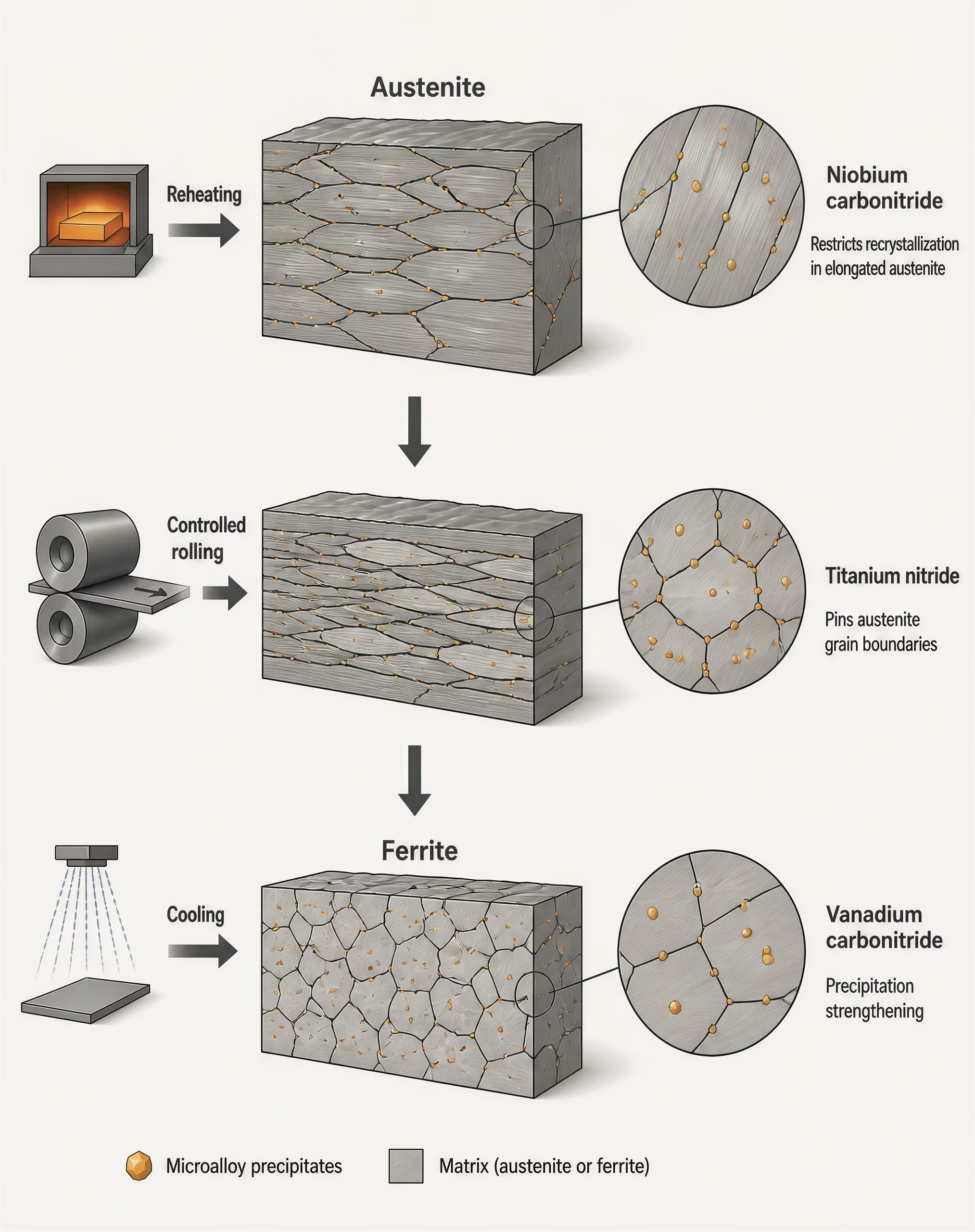
Microalloying works because elements present in small concentrations can control events at the grain and precipitate scale. Niobium, vanadium, and titanium—called columbium, vanadium, and titanium in many American specifications and references—can form stable carbides, nitrides, or carbonitrides. Their nominal presence alone says little about the finished steel. The result depends on whether each element dissolves during reheating, precipitates during rolling or cooling, and remains available to influence the final microstructure.
Niobium can retard austenite recrystallization during controlled rolling. This allows deformation to accumulate before transformation and promotes a fine ferrite grain structure after cooling. Because grain refinement raises yield strength while generally preserving useful toughness, niobium can achieve a different strength-ductility balance from simply increasing carbon.
Vanadium commonly contributes through precipitation strengthening. Vanadium carbonitrides forming in ferrite impede dislocation motion, raising strength after transformation. Titanium forms particularly stable nitrides and can help control austenite grain growth during reheating. If titanium particles are too coarse, however, they may provide less strengthening and can affect toughness or processing response. The same addition can therefore have different value in different steelmaking and rolling conditions.
These mechanisms are additive only in a limited sense. Solid-solution strengthening from manganese or silicon, grain refinement from controlled rolling, precipitation strengthening from niobium or vanadium, and phase-transformation strengthening can interact, but the final property is not predictable from an alloy list alone. Reheating temperature, slab thickness, finish-rolling temperature, cooling rate, section size, and product form all matter.
The scale of the strength range illustrates the point. An ASTM symposium paper published in 1979 reported HSLA yield-strength levels from 40,000 to 140,000 psi [276 to 966 MPa], with most grades microalloyed using columbium, vanadium, titanium, or combinations of these elements. Such a range cannot be represented by one “HSLA composition.” The AISI definition likewise describes moderate additions of columbium, vanadium, or titanium as capable of increasing strength and, in some grades, improving atmospheric-corrosion resistance or formability.
Strength, weldability, toughness, and formability as competing design variables
Yield strength is only one result of HSLA design. Raising it does not automatically improve ductility, impact toughness, weldability, formability, or corrosion resistance. A fine-grained ferritic HSLA steel may combine high yield strength with useful toughness, while another grade with a harder microstructure may show greater sensitivity to notch conditions, welding thermal cycles, or cold forming.
Variables that control HSLA weldability
- Chemistry Carbon, manganese, alloy additions, and carbon equivalent influence hardenability.
- Geometry Plate thickness and joint restraint affect cooling and cracking risk.
- Thermal cycle Heat input, preheat, interpass temperature, and cooling rate alter HAZ hardness and toughness.
- Hydrogen control Consumable storage, surface cleanliness, and low-hydrogen practice reduce delayed-cracking risk.
- Procedure qualification The WPS must cover the actual grade, thickness, process, consumable, and thermal limits.
Weldability is strongly affected by carbon content, manganese and alloy additions, plate thickness, restraint, heat input, and cooling rate. A low-carbon HSLA grade may be easier to weld than a higher-carbon quenched-and-tempered steel, but it still may require control of preheat, interpass temperature, hydrogen, or heat input. Its heat-affected zone can lose toughness, soften, or develop hard constituents depending on the thermal cycle.
Formability presents a similar trade-off. Higher yield strength can increase springback and forming force. Coarse precipitates, banded structures, or anisotropy from rolling may impair bending or deep drawing even when tensile strength meets the specification. Conversely, carefully controlled grain size and chemistry can produce a grade with improved forming behavior at a given strength level.
Corrosion resistance must also be separated from strength. ASTM A588 includes atmospheric-corrosion-resistant HSLA structural steel, whereas ASTM A572 is identified as high-strength low-alloy columbium-vanadium structural steel. The two designations should not be treated as synonyms. Copper, phosphorus, chromium, nickel, exposure conditions, surface condition, and wet-dry cycling influence atmospheric corrosion; higher yield strength by itself does not.
HSLA selection is therefore a constrained design problem. The relevant question is not whether a steel is “stronger,” but which grade, product form, thickness, delivery condition, and specification provide the required combination of properties. Carbon control, microalloy precipitation, grain refinement, controlled rolling, and transformation behavior must be considered together.
3. The Microalloying Elements: Niobium, Vanadium, and Titanium
High-strength low-alloy steels do not gain their properties from one generic “microalloy addition.” Small quantities of niobium, vanadium, titanium, or combinations of them interact with carbon and nitrogen, alter austenite grain behavior, affect recrystallization during rolling, and form precipitates that change the final ferritic structure. The result depends on steel chemistry and processing history: reheating temperature determines which particles dissolve, rolling temperature controls recrystallization, and cooling rate affects the ferrite, pearlite, bainite, or other transformation products that form afterward.
The American Iron and Steel Institute describes HSLA steels as a group in which moderate additions of columbium, vanadium, or titanium increase strength and may also improve atmospheric-corrosion resistance or formability (AISI, 2024). ASM International places as-rolled HSLA steels, also called microalloyed steels, among high-strength carbon and low-alloy steels with yield strengths greater than 275 MPa [40 ksi] (ASM International, 2024). Those descriptions identify a metallurgical family, not a single composition or processing route. An ASTM symposium paper published in 1979 reported HSLA yield-strength levels from 40,000 to 140,000 psi [276 to 966 MPa], with most of the grades discussed being microalloyed with columbium, vanadium, titanium, or combinations of these elements.
Columbium and niobium terminology
Columbium The North American specification term for niobium, the chemical element Nb.
“Columbium” and “niobium” refer to the same chemical element, Nb. Niobium is the widely used modern chemical name in scientific and international metallurgical literature, while columbium remains established in several North American steel specifications. ASTM A572/A572M, for example, is titled Standard Specification for High-Strength Low-Alloy Columbium-Vanadium Structural Steel. Its five grades have specified minimum yield strengths from 42 ksi [290 MPa] to 65 ksi [450 MPa], depending on grade and product requirements (ASTM International, 2000). Calling the element niobium does not describe a different alloy; calling it columbium follows the terminology used by that specification.
In HSLA steels, niobium commonly combines with carbon and nitrogen to form niobium carbide, niobium nitride, or mixed niobium carbonitride, often represented as Nb(C,N). Some particles precipitate during hot rolling, while others form during cooling or remain undissolved from reheating. Fine, dispersed particles can restrict austenite grain growth and can contribute to precipitation strengthening. Undissolved particles may pin austenite grain boundaries at high temperature, but their size and distribution matter. A small population of coarse particles does not provide the same strengthening or grain-control effect as a much finer dispersion.
Niobium also changes the rolling response of austenite. When Nb(C,N) remains in solution, niobium can delay recrystallization between rolling passes. This permits accumulated deformation to produce a pancaked, highly elongated austenite structure rather than a sequence of fully recrystallized equiaxed grains. During subsequent cooling, the increased number of potential ferrite nucleation sites can promote a finer ferritic grain structure. Grain refinement raises yield strength while generally preserving a more useful toughness-strength balance than strength gained only through coarse precipitation or high carbon content.
How niobium affects controlled rolling
- Reheating Some niobium-bearing particles dissolve and return niobium to austenite solid solution.
- Deformation Dissolved niobium and precipitates delay austenite recrystallization during rolling.
- Austenite pancaking Accumulated deformation creates elongated austenite grains and additional transformation sites.
- Cooling The deformed austenite transforms into a finer ferritic structure.
That sequence is not automatic. If reheating dissolves too little niobium, there may be insufficient solute to delay recrystallization or form fine precipitates later. If the rolling schedule is too hot, recrystallization can erase the intended deformation structure. If the steel is cooled under different conditions, the final microstructure may contain polygonal ferrite, pearlite, acicular ferrite, bainitic constituents, or mixtures of these. The same nominal Nb content can therefore produce different properties in plate, sheet, or bar made under different thermal schedules.
Niobium is also not a substitute for specification control. ASTM A572/A572M identifies a columbium-vanadium structural steel family, whereas ASTM A588 addresses HSLA structural steel with atmospheric-corrosion resistance. NIST identifies ASTM A588 as having a 50 ksi minimum yield point (NIST, 2005). The designation and required performance arise from the complete chemistry, product form, processing, and testing requirements, not from the presence of Nb alone.
Vanadium carbonitrides and precipitation strengthening
Vanadium is especially associated with precipitation strengthening because vanadium carbonitride, V(C,N), can precipitate as the steel cools from the austenite region or during the ferrite transformation. Fine V(C,N) particles impede dislocation motion in ferrite. The increase in yield strength is often described by an Orowan-type mechanism: dislocations must pass around or through closely spaced precipitates, requiring additional applied stress.
Vanadium’s response differs from niobium’s. Vanadium carbonitrides are generally more soluble in austenite at reheating temperatures than many niobium or titanium compounds. A greater fraction of vanadium may therefore enter solid solution before rolling and later precipitate in ferrite. This makes the cooling schedule, carbon and nitrogen levels, and transformation temperature important. Faster or slower cooling can change the amount, size, and spacing of V(C,N), while nitrogen availability can strongly affect precipitation because vanadium nitride is an important part of the carbonitride population.
Precipitation strengthening has a cost if the particles become too coarse or too widely spaced. Coarse precipitates contribute less to strengthening per unit volume and may interact unfavorably with fracture processes. Excessive vanadium addition also does not guarantee a proportional increase in yield strength. The useful effect depends on a fine particle distribution, and that distribution is governed by the complete thermal cycle rather than nominal alloy content.
Vanadium can work with niobium. Niobium may control austenite recrystallization and refine the transformed grain structure, while vanadium precipitates during or after transformation and adds strength in the ferrite. A steel containing both elements can therefore combine grain refinement with precipitation strengthening, but the balance must be designed for the product and processing route. In a normalized plate, a thermomechanically controlled-rolled sheet, and an as-rolled bar, the same Nb-V chemistry may not produce the same ferritic structure or mechanical properties.
Titanium nitride, grain control, and inclusion-related effects
Titanium has a strong affinity for nitrogen and forms titanium nitride, TiN, at high temperatures. TiN particles are relatively stable during reheating, so a controlled population of fine particles can pin austenite grain boundaries and limit grain coarsening. This is particularly important in heat-affected zones during welding, where high temperatures can produce substantial austenite grain growth. A fine-grained transformed structure can support better toughness than a coarse-grained one, although welding performance remains grade- and procedure-specific.
Titanium’s grain-control effect depends sharply on TiN size and distribution. Very fine TiN particles provide effective boundary pinning; coarse cubic TiN particles provide much less pinning because their number density is lower. Large TiN inclusions can act as local stress concentrators and may become sites for crack initiation, especially under demanding toughness or through-thickness loading conditions. Thus titanium is not simply a universal grain refiner. The nitrogen balance, titanium content, reheating temperature, and solidification practice determine whether it forms a useful dispersion or undesirable coarse inclusions.
Titanium may also combine with carbon and form titanium carbide or mixed carbonitrides, but TiN is often the dominant high-temperature particle considered in grain-control design. Its persistence can preserve grain-boundary pinning where niobium and vanadium compounds dissolve more readily. At the same time, excessive or poorly controlled titanium can consume nitrogen and alter the precipitation behavior of other microalloying elements.
| Element | Primary tendency | Processing sensitivity |
|---|---|---|
| Niobium (columbium) | Recrystallization control and fine precipitation | Reheating dissolution and rolling temperature |
| Vanadium | Ferritic precipitation strengthening | Cooling rate, transformation temperature, carbon, and nitrogen |
| Titanium | High-temperature nitride stability and austenite grain pinning | Nitrogen balance, reheating temperature, and particle size |
The three elements can therefore produce overlapping but distinct effects. Niobium is strongly associated with recrystallization control and fine precipitation; vanadium is strongly associated with ferritic precipitation strengthening; titanium is strongly associated with high-temperature nitride stability and austenite grain pinning. These are tendencies, not fixed rules. Dissolution, precipitation, rolling reduction, reheating, cooling, welding, and final phase transformation decide which mechanism dominates in a particular HSLA grade. That is why ASTM, AISI, ASM International, and NIST classifications should be read alongside the specific grade, product form, and test requirements rather than treated as interchangeable labels.
4. The Metallurgical Mechanisms That Produce HSLA Strength
High-strength low-alloy steel does not obtain its yield strength from one universal recipe. It is a family of low-carbon, low-alloy steels in which chemistry, reheating, rolling, cooling, and the resulting microstructure are designed together. The distinction matters: ASTM A572/A572M covers five grades of high-strength low-alloy columbium-vanadium structural steel, with specified minimum yield strengths from 42 ksi [290 MPa] to 65 ksi [450 MPa], but those grades are not interchangeable. ASTM A588, by contrast, is specified as atmospheric-corrosion-resistant HSLA structural steel; NIST identifies it with a 50 ksi minimum yield point.
ASM International places as-rolled HSLA steels, also called microalloyed steels, among high-strength carbon and low-alloy steels with yield strengths above 275 MPa [40 ksi]. An ASTM symposium paper published in 1979 reported HSLA yield-strength levels from 40,000 to 140,000 psi [276 to 966 MPa]. Such a range cannot be explained by the nominal label alone. Strength is the combined result of several barriers to dislocation motion, while toughness and weldability depend on additional features such as grain size, impurity control, phase distribution, and local heat treatment.
Grain refinement
Ferrite grain refinement is one of the most important ways HSLA processing raises yield strength without requiring a large increase in carbon. The relationship is described qualitatively by the Hall–Petch effect: as the average ferrite grain size decreases, the yield stress rises because grain boundaries obstruct the movement of dislocations. A dislocation moving through one grain cannot pass into a neighboring grain without changing its direction or accommodating a different crystallographic arrangement. More closely spaced boundaries therefore make plastic deformation more difficult.
The useful result is not simply “more alloy means more strength.” A low-carbon steel with a fine, uniform ferrite grain structure can achieve a better combination of strength and toughness than a higher-carbon steel with coarse ferrite and pearlite. Fine grains also reduce the size of the region available for cleavage fracture. This is why grain refinement can raise yield strength while supporting impact toughness, whereas some other strengthening methods increase strength at a greater toughness cost.
Niobium, written as columbium in several ASTM and AISI designations, is especially important in controlled-rolled HSLA steels. Niobium in solid solution can retard austenite recrystallization during hot rolling, allowing deformation to accumulate in the austenite. Subsequent transformation then produces finer ferrite. Titanium can form stable titanium nitride, which helps restrict austenite grain growth during reheating when the particles remain suitably distributed. Vanadium has a stronger role in precipitation during or after transformation, although its effect also depends on temperature and steel chemistry.
The processing window is narrow. Excessive reheating can dissolve or coarsen particles that were intended to control austenite grain size. Rolling at unsuitable temperatures can permit recrystallization and erase the stored deformation needed for refinement. Grain refinement is therefore a processing result, not a guaranteed consequence of adding niobium, vanadium, or titanium.
Precipitation strengthening
Microalloying elements form finely dispersed compounds that impede dislocation motion. Common examples include niobium carbonitride, vanadium carbonitride, and titanium carbonitride or nitride. These particles strengthen the ferritic matrix when their size, spacing, distribution, and volume fraction are controlled. A precipitate is not automatically beneficial merely because it contains a microalloying element.
Very fine particles can obstruct dislocations effectively. If particles coarsen during reheating or prolonged exposure at elevated temperature, the average spacing between effective barriers increases and their strengthening contribution falls. An insufficient volume fraction may provide too few obstacles. An excessive or poorly distributed population can consume alloying elements without producing the intended strengthening, promote local heterogeneity, or impair toughness. Large titanium nitride particles are a familiar concern because they can act as fracture initiation sites even while titanium-bearing precipitates restrict austenite grain growth.
Precipitation can occur in austenite, during the austenite-to-ferrite transformation, or after transformation in ferrite. The temperature history controls which reactions occur. Niobium carbonitride precipitation during controlled rolling can pin recrystallization and refine the transformed structure. Vanadium carbonitride precipitation in ferrite can produce a direct increase in yield strength after cooling. Titanium nitride is generally more stable at high temperatures and is often selected for grain-growth control rather than as the sole source of ferritic precipitation strengthening.
These mechanisms explain why nominal composition is an incomplete description. Two steels containing similar amounts of vanadium may have different strengths if one has retained vanadium in solution and the other has produced a fine ferritic precipitate population. The difference can arise from reheating temperature, cooling rate, carbon and nitrogen contents, rolling schedule, and final product thickness.
Solid-solution and dislocation strengthening
Atoms dissolved in ferrite distort its crystal lattice. Carbon and nitrogen are particularly effective interstitial solutes, while manganese, silicon, copper, nickel, chromium, and molybdenum can contribute substitutional solid-solution strengthening. The local elastic distortion around these atoms interacts with dislocations and makes their movement more difficult.
HSLA chemistry uses this mechanism with restraint. Increasing carbon can raise strength, but it can also reduce weldability, encourage harder transformation products in the heat-affected zone, and harm toughness. Manganese provides useful strengthening and affects transformation behavior, yet its amount must be controlled alongside carbon, sulfur, phosphorus, and the microalloying additions. AISI describes HSLA steels as a group in which moderate additions of columbium, vanadium, or titanium provide higher strength and may also improve atmospheric-corrosion resistance or formability. “Moderate” is significant: the intended result comes from controlled additions, not from maximizing every alloying element.
Cold or hot deformation also raises strength by increasing dislocation density. Rolling produces dislocations and substructures within the austenite or ferrite; if the material is not fully recrystallized, some of that stored deformation contributes to the final strength. In controlled-rolled plate, unrecrystallized and pancaked austenite can transform into fine ferrite. In the finished ferrite, dislocations interact with one another and obstruct further slip. This contribution may be reduced by recovery or by later heating.
Strengthening and toughness must be separated conceptually. Solid-solution atoms and dislocations can raise yield strength, but a high dislocation density does not automatically improve impact performance. Toughness depends strongly on grain size, inclusion shape and cleanliness, phase continuity, local hardness differences, and the temperature-dependent fracture mechanism. A steel can meet a yield-strength requirement while failing a toughness requirement if its microstructure or inclusion population is unsuitable.
The role of phase transformations
Austenite transforms during cooling, and the transformation path determines much of the final HSLA microstructure. Slow or moderate cooling may produce ferrite and pearlite. Faster controlled cooling can generate fine ferrite, bainitic ferrite, or other low-carbon transformation products, depending on composition, plate thickness, and cooling conditions. These structures differ in dislocation density, phase morphology, carbon distribution, and resistance to crack propagation.
Controlled rolling first modifies the austenite, then controlled cooling determines how that deformed austenite transforms. Deformation can increase nucleation sites for ferrite, while rapid cooling suppresses coarse transformation products. The resulting fine ferritic or bainitic structures can provide high yield strength without the carbon levels associated with conventional quenched-and-tempered steels. Some HSLA grades also use dual-phase or precipitation-strengthened ferritic structures, but the designation and specification must be checked for the particular product.
Transformation conditions also affect weld behavior. Welding reheats the heat-affected zone, potentially dissolving precipitates, coarsening grains, or producing hard local transformation products on cooling. A plate whose parent metal has excellent strength and toughness can therefore show different properties beside a weld. Carbon equivalent, plate thickness, heat input, cooling rate, and microalloying chemistry all matter.
The final strength of HSLA steel is consequently additive only in a limited sense. Fine ferrite grains, controlled carbonitride precipitation, solid-solution atoms, dislocation structures, and transformation products each contribute, but they also interact. A specification such as ASTM A572/A572M records required mechanical and chemical limits; it does not imply that every grade reaches those limits by the same microstructural route. The steel’s strength, toughness, formability, weldability, and corrosion behavior must be judged from its grade, product form, and processing history.
5. Controlled Rolling, Cooling, and the As-Rolled Condition
HSLA properties are set by more than the elements listed on a mill certificate. The same nominal carbon, manganese, niobium, vanadium, or titanium contents can produce different yield strength, toughness, elongation, and weldability when reheating, rolling reduction, finishing temperature, and cooling practice change. This is why HSLA steels are a family of processing-dependent products rather than a single alloy or a simple synonym for stronger carbon steel.
ASTM A572/A572M illustrates the range hidden behind one specification: it covers five grades of high-strength low-alloy columbium-vanadium structural steel, with specified minimum yield strengths from 42 ksi [290 MPa] to 65 ksi [450 MPa]. ASTM A588, by contrast, is an HSLA structural steel specified with atmospheric-corrosion resistance; NIST identifies it with a 50 ksi minimum yield point. The designations describe requirements for particular products and grades, not one universal microstructure. The 1979 ASTM symposium discussion placed reported HSLA yield-strength levels from 40,000 to 140,000 psi [276 to 966 MPa], showing why grade-specific processing matters.

Recrystallization control during hot rolling
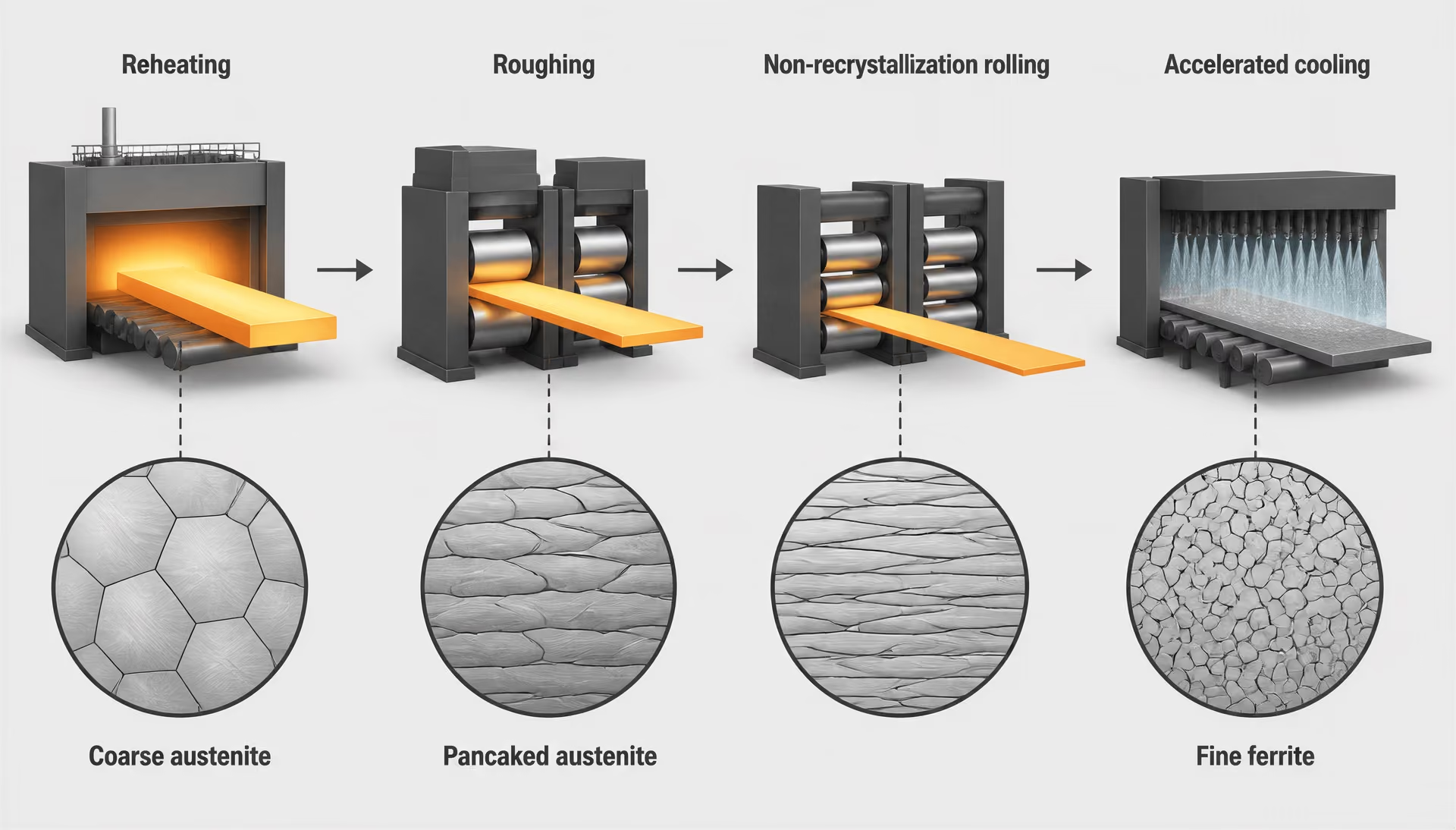
HSLA plate begins with reheating, commonly at a temperature selected to dissolve enough microalloy precipitates for later precipitation strengthening and austenite control. Niobium carbide and carbonitride, vanadium carbonitride, and titanium nitride do not all dissolve at the same temperature or to the same extent. TiN is especially stable and may remain as coarse particles after reheating, while portions of niobium-bearing precipitates can dissolve and return niobium to solid solution. The reheating schedule therefore establishes the amount of microalloying available during subsequent rolling.
That distinction is decisive. A nominal addition of 0.04% Nb does not mean that all of the niobium is active in the same way. If much of it remains tied in undissolved particles, less is available to retard recrystallization or precipitate during cooling. If reheating dissolves too much, precipitation may occur at an unhelpful stage, and grain-growth control can differ from the intended practice. Carbon and nitrogen contents also alter the stability and composition of these particles.
During hot rolling, deformation stores energy in the austenite. At sufficiently high temperature, the deformed grains recrystallize between passes. New, strain-free grains replace elongated grains, so repeated deformation and recrystallization can refine the austenite before transformation. Niobium in solid solution delays this recrystallization; niobium carbonitride precipitating during rolling can delay it further by pinning austenite grain boundaries. Titanium nitride can restrict grain growth during reheating, while vanadium generally contributes more strongly through precipitation after transformation or during later cooling than through early recrystallization control.
The rolling schedule must therefore separate temperature regions with different metallurgical purposes. Roughing at higher temperatures can break down the cast structure and establish a suitable austenite grain size. Finishing passes may be made near, or below, the temperature at which recrystallization is sufficiently suppressed. Pass reduction, interpass time, and delay between roughing and finishing all affect whether austenite recrystallizes. A change of only a few tens of degrees can alter precipitation kinetics and the amount of stored deformation.
This is the basis of controlled rolling. The term does not mean merely rolling a steel to a specified thickness. It refers to managing reheating and deformation so that austenite grain growth, recrystallization, precipitation, and the final transformation occur in a planned sequence. ASM International’s 2024 treatment places “as-rolled HSLA steels,” also called microalloyed steels, among high-strength carbon and low-alloy steels with yield strengths greater than 275 MPa [40 ksi]. In that usage, “as-rolled” identifies the condition produced by the rolling and cooling route, not a composition shared by every HSLA product.
Non-recrystallization rolling and pancaked austenite
Once the steel enters the non-recrystallization temperature range, deformation no longer produces complete recrystallization between passes. Austenite grains become elongated and flattened, often described as pancaked austenite. Each pass adds dislocations and increases the area of austenite grain boundaries. The deformed structure supplies more nucleation sites when ferrite begins to form during cooling.
Pancaking is useful because transformation can produce a much finer ferrite structure than would result from coarse, equiaxed austenite. The effect is not simply a matter of squeezing grains smaller. Stored strain, deformation bands, and austenite boundary area alter the nucleation conditions, while microalloy precipitates pin boundaries and preserve the deformed arrangement until transformation begins. Fine ferrite raises yield strength through grain-boundary strengthening and commonly improves the balance between strength and low-temperature toughness.
The finish-rolling temperature is consequently a central process variable. If the passes are completed too hot, austenite may recrystallize and lose much of the stored deformation. If the temperature is too low, rolling loads rise, surface and shape defects may become more likely, and the intended precipitation sequence may not occur. The workable window depends on chemistry, slab thickness, mill capacity, interpass time, and product form. A plate and a hot-rolled sheet with similar chemistry can leave the mill with different austenite histories.
Microalloy precipitation makes the schedule still more grade-specific. Niobium carbonitride can precipitate during deformation and strongly retard recrystallization. Vanadium may remain in solution through much of rolling and then form fine carbonitride particles during or after transformation, contributing precipitation strengthening. Titanium’s strong nitride-forming tendency can control austenite grain growth, but coarse titanium nitrides can also act as fracture-initiation sites if their size and distribution are unfavorable. The useful effect depends on particle size, volume fraction, and location, not merely on the presence of the element.
Controlled rolling also explains why post-rolling heat treatment changes the meaning of the delivered condition. Normalizing can recrystallize austenite on reheating and produce a different transformation structure. Quenching and tempering replaces the as-rolled route with martensitic transformation followed by tempering. Those products may meet different strength and toughness requirements, but they should not be described as equivalent simply because their chemistry is similar.
Accelerated cooling and transformation products
After the final rolling pass, cooling determines how the deformed austenite transforms. Air cooling may produce polygonal ferrite and pearlite, with strength governed by grain size, pearlite fraction, solid-solution effects, and any precipitation that occurs during cooling. Accelerated cooling lowers the transformation temperature and can suppress coarse pearlite, producing finer ferrite-pearlite, bainitic ferrite, or other low-temperature transformation structures. With suitable chemistry and a sufficiently high cooling rate, mixtures containing acicular ferrite, bainite, or martensite may form.
The cooling path must be considered with the finish-rolling schedule. Cooling too slowly can permit grain growth or coarse transformation products and may allow microalloy precipitates to form with relatively large dimensions, reducing their strengthening contribution. Cooling more rapidly can refine transformation products and retain alloying elements for later precipitation, but an excessive rate may generate untempered martensite, higher residual stress, or reduced weldability. Plate thickness matters because the surface and center do not follow identical temperature histories.
Vanadium-bearing steels often gain a substantial part of their strength from fine vanadium carbonitride precipitation during controlled cooling or subsequent exposure to moderate temperatures. Niobium can contribute both grain refinement and precipitation strengthening, while titanium primarily affects grain-growth control and inclusion or precipitate populations. Manganese, silicon, molybdenum, nickel, and chromium modify hardenability and transformation kinetics. Thus, a “bainitic HSLA” or “ferritic-pearlitic HSLA” description refers to a product’s structure, not to a universal HSLA chemistry.
The final as-rolled condition records this entire thermal and mechanical history. It may contain refined ferrite, pearlite, bainitic ferrite, or mixed constituents, along with microalloy precipitates whose sizes and distributions were set during processing. Nominal chemistry alone cannot predict those features. The relevant specification—such as ASTM A572/A572M or ASTM A588—must be read together with product thickness, delivery condition, mechanical requirements, toughness provisions, and any applicable welding limits. Strength is only one result of the route; formability, fracture toughness, corrosion behavior, and heat-affected-zone performance also depend on the grade and product form.
6. ASTM A572/A572M: Grades, Product Forms, and Yield-Strength Levels
The exact designation ASTM A572/A572M
ASTM A572/A572M is a product specification, not a generic name for every high-strength low-alloy steel. Its title identifies it as a specification for high-strength low-alloy columbium-vanadium structural steel. “Columbium” is the name retained in the ASTM designation for niobium, so the title points to a microalloyed structural-steel system in which columbium and vanadium contribute to strength through grain refinement, precipitation, and processing-dependent effects.
- A572
- Inch-pound requirements
- A572M
- SI requirements
- Specification scope
- Shapes, plates, sheet piling, and bars
- Grade count
- Five
The dual designation matters. ASTM A572 expresses requirements in inch-pound units, while ASTM A572M expresses them in SI units. The two appear together as ASTM A572/A572M, but the applicable edition still governs the material. Requirements can change between editions, and a project specification may invoke a particular year, supplementary requirement, testing provision, or purchasing condition. A drawing that says only “A572” leaves important questions unanswered.
ASTM A572/A572M covers five grades with specified minimum yield strengths from 42 ksi [290 MPa] to 65 ksi [450 MPa]. Strong evidence
[1] Standard Specification for High-Strength Low-Alloy Columbium-Vanadium Structural Steel. ASTM International. ASTM A572/A572M, 2000. ASTM International, ASTM A572/A572M (2000)ASTM International’s 2000 description states that ASTM A572/A572M covers five grades of high-strength low-alloy structural steel, with specified minimum yield strengths from 42 ksi [290 MPa] to 65 ksi [450 MPa]. That range places the specification within the broader HSLA field, but it does not make all A572 products interchangeable. ASM International’s 2024 materials classification describes as-rolled HSLA, or microalloyed, steels as high-strength carbon and low-alloy steels with yield strengths above 275 MPa [40 ksi]. An ASTM symposium paper published in 1979 reported HSLA yield-strength levels from 40,000 to 140,000 psi [276 to 966 MPa], showing that A572 occupies only part of the larger HSLA range.
The specification should therefore be read as a controlled set of product requirements. It does not define one universal chemistry. Nominal additions of columbium, vanadium, or other elements do not, by themselves, establish the final properties. Their effects depend on reheating temperature, dissolution before rolling, precipitation during deformation or cooling, austenite grain size, cooling history, carbon and manganese levels, and the selected processing route. Two steels that both satisfy a broad HSLA description can have different weldability, toughness, forming response, and strength retention after fabrication.
Five grades and specified minimum yield strengths
| ASTM A572/A572M grade | Specified minimum yield strength | Metric equivalent |
|---|---|---|
| Grade 42 | 42 ksi | 290 MPa |
| Grade 50 | 50 ksi | 345 MPa |
| Grade 55 | 55 ksi | 380 MPa |
| Grade 60 | 60 ksi | 415 MPa |
| Grade 65 | 65 ksi | 450 MPa |
ASTM A572/A572M identifies five grades: Grade 42, Grade 50, Grade 55, Grade 60, and Grade 65. Their cited specified minimum yield-strength levels are:
- Grade 42: 42 ksi [290 MPa]
- Grade 50: 50 ksi [345 MPa]
- Grade 55: 55 ksi [380 MPa]
- Grade 60: 60 ksi [415 MPa]
- Grade 65: 65 ksi [450 MPa]
These figures are the defining strength levels commonly associated with the grades, not a complete mechanical-property specification. A minimum yield value is a lower limit established by the standard’s test requirements. It is not a guarantee that every heat, plate, bar, or rolled shape will have the same tensile strength, elongation, notch toughness, or behavior after welding.
Thickness and product form must be checked alongside the grade. Structural sections, plate, sheet piling, and bars can be produced by different rolling practices and may be subject to different dimensional ranges or testing provisions. The standard’s applicable tables and clauses determine which requirements govern a particular product. A Grade 50 designation alone does not tell an engineer whether the material is plate, a W-shape, a bar, or sheet piling, nor does it establish the relevant test orientation.
The five-grade sequence should also not be mistaken for a simple ladder in which higher numbers always represent a direct substitute for lower numbers. Increasing specified yield strength can affect fabrication choices. Higher-strength grades may require closer control of preheat, heat input, joint restraint, consumable selection, and hydrogen management, depending on thickness, chemistry, and weld procedure. Forming limits and fracture resistance likewise require grade- and product-specific review. Strength is only one part of the selection decision.
The metallurgy explains why the grade cannot be reduced to a carbon-steel label. Microalloying with columbium can restrict austenite grain growth and promote fine ferrite after controlled rolling; vanadium can form strengthening precipitates during cooling; titanium can tie up nitrogen and influence grain control. Those mechanisms are sensitive to processing history. A steelmaker’s reheating, rolling, and cooling schedule can determine whether an element remains in solution, forms a useful precipitate, or contributes little to the intended property. The standard controls the resulting product through chemical, mechanical, and manufacturing requirements rather than through a single universal recipe.
Shapes, plates, sheet piling, and bars
The scope of ASTM A572/A572M includes shapes, plates, sheet piling, and bars. “Shapes” covers rolled structural sections such as beams, channels, angles, tees, and related structural forms made within the dimensional and product requirements of the specification. “Plates” are flat-rolled products used in fabricated structural members, girders, equipment, and other load-bearing assemblies. Sheet piling consists of interlocking rolled sections intended for retaining or earth-support systems, while bars include specified hot-rolled structural bar products.
Product form changes more than geometry. A thick plate and a rolled shape may experience different thermal histories from the same general steelmaking route. Rolling reduction, section thickness, cooling rate, and residual stress can alter grain size and phase balance. These differences affect toughness, through-thickness behavior, weld response, and dimensional performance even when the nominal grade number is identical.
The test direction must be recorded as well. Rolled steel is anisotropic: deformation during rolling produces directional differences in grain structure, inclusions, and mechanical response. Tensile specimens may be taken longitudinally or transversely according to the standard and product, and the specified minimum applies through the required test procedure, not to every possible direction or location in the component. For critical welded or highly restrained structures, the material certificate and the governing edition should be reviewed rather than inferred from the grade marking.
A specification callout should consequently identify ASTM A572/A572M, the edition or contractually applicable revision, the grade, the product form, dimensions or thickness, and any required supplementary provisions. If toughness, weldability, atmospheric-corrosion resistance, or forming performance is important, those properties require separate verification. ASTM A572/A572M is not the same specification as ASTM A588, which NIST identifies as HSLA structural steel with a 50 ksi minimum yield point and which ASTM reference material associates with atmospheric-corrosion resistance. A572 and A588 may appear in similar structural discussions, but their specification requirements and intended property profiles are not interchangeable.
That distinction is the central practical point: A572 is a family of five specified grades and several product forms, not one material with one set of properties. Its yield-strength levels provide a useful starting classification, while the grade, thickness, form, test direction, edition, and applicable requirements determine what the supplied steel actually qualifies to do.
7. ASTM A588 and Atmospheric-Corrosion-Resistant HSLA Steel
ASTM A588 is not a generic name for weathering steel, nor is it interchangeable with every high-strength low-alloy (HSLA) grade. It is a specification for structural steel in which the required strength and atmospheric-corrosion-resistance characteristics are defined together. The distinction matters because HSLA describes a family of steels, while ASTM A588 identifies a particular specification with grade, product, chemical, mechanical, and delivery requirements.
HSLA steels generally contain low carbon and modest additions of elements such as niobium (columbium), vanadium, and titanium. Those additions can promote grain refinement, precipitation strengthening, or both, but their effects depend on steel chemistry and processing. Reheating temperature determines which particles dissolve; rolling controls recrystallization and grain size; cooling affects transformation products. The nominal presence of a microalloying element does not, by itself, establish the resulting microstructure or performance.
That point separates A588 from a simple “stronger carbon steel” description. ASTM A588 belongs to a specification-defined group of atmospheric-corrosion-resistant structural steels. Its behavior reflects alloy design and processing, but also the service environment and the details of fabrication. A grade designation is not a guarantee that two products with similar yield strength will weld, form, fracture, or corrode in the same way.
How ASTM A588 is identified in comparative references
| Specification | Primary identification | Cited minimum yield point or range | Atmospheric-corrosion requirement |
|---|---|---|---|
| ASTM A572/A572M | High-strength low-alloy columbium-vanadium structural steel | 42 to 65 ksi [290 to 450 MPa], by grade | Not identified by the cited description as the defining feature |
| ASTM A588 | HSLA structural steel with improved atmospheric-corrosion resistance | 50 ksi minimum yield point | Part of the specification identity |
NIST identifies ASTM A588 as HSLA structural steel with a 50 ksi minimum yield point. Strong evidence
[2] Federal Building and Fire Safety Investigation of the World Trade Center Disaster: Steel Analysis, NCSTAR 1-3A. National Institute of Standards and Technology. NIST NCSTAR 1-3A, 2005.Comparative references commonly place ASTM A588 beside ASTM A572 because both are structural HSLA specifications, but they do not define them in the same terms. The National Institute of Standards and Technology (NIST) identifies ASTM A588 as HSLA structural steel with a 50 ksi minimum yield point. In the same type of material classification, NIST identifies ASTM A572 as high-strength low-alloy columbium-vanadium steel. Those descriptions are useful precisely because they preserve the difference between a broad structural-steel designation and a specified atmospheric-corrosion-resistant grade. The NIST material is available in Federal Building and Fire Safety Investigation of the World Trade Center Disaster: Steel Analysis, NCSTAR 1-3A (2005): NIST.
The ASTM product-definition source identifies ASTM A588 as “high-strength low-alloy structural steel with improved atmospheric corrosion resistance.” ASTM A572/A572M, by contrast, covers “high-strength low-alloy columbium-vanadium structural steel.” ASTM A572/A572M covers five grades with specified minimum yield strengths from 42 ksi [290 MPa] to 65 ksi [450 MPa], according to the ASTM product information for the 2000 edition. A572 therefore cannot be treated as a single composition or as an automatic substitute for A588 merely because both specifications use HSLA terminology.
The strength ranges also show why broad comparisons can mislead. An ASTM symposium paper published in 1979 reported HSLA yield-strength levels from 40,000 to 140,000 psi [276 to 966 MPa], while ASM International’s 2024 reference describes as-rolled HSLA steels, also called microalloyed steels, as high-strength carbon and low-alloy steels with yield strengths greater than 275 MPa [40 ksi]. These classifications describe a large technical field, not one uniform product. The cited ASTM discussion states that most of the grades considered were microalloyed with columbium, vanadium, titanium, or combinations of those elements.
Moderate microalloy additions may improve atmospheric-corrosion resistance or formability in some HSLA grades. Limited evidence
AISI likewise describes HSLA steel as a group in which moderate additions of columbium, vanadium, or titanium can increase strength and may improve atmospheric-corrosion resistance or formability. That wording is conditional. It does not say that every HSLA grade resists atmospheric corrosion to the same degree, or that a grade meeting a strength requirement also meets A588’s corrosion-related specification requirements.

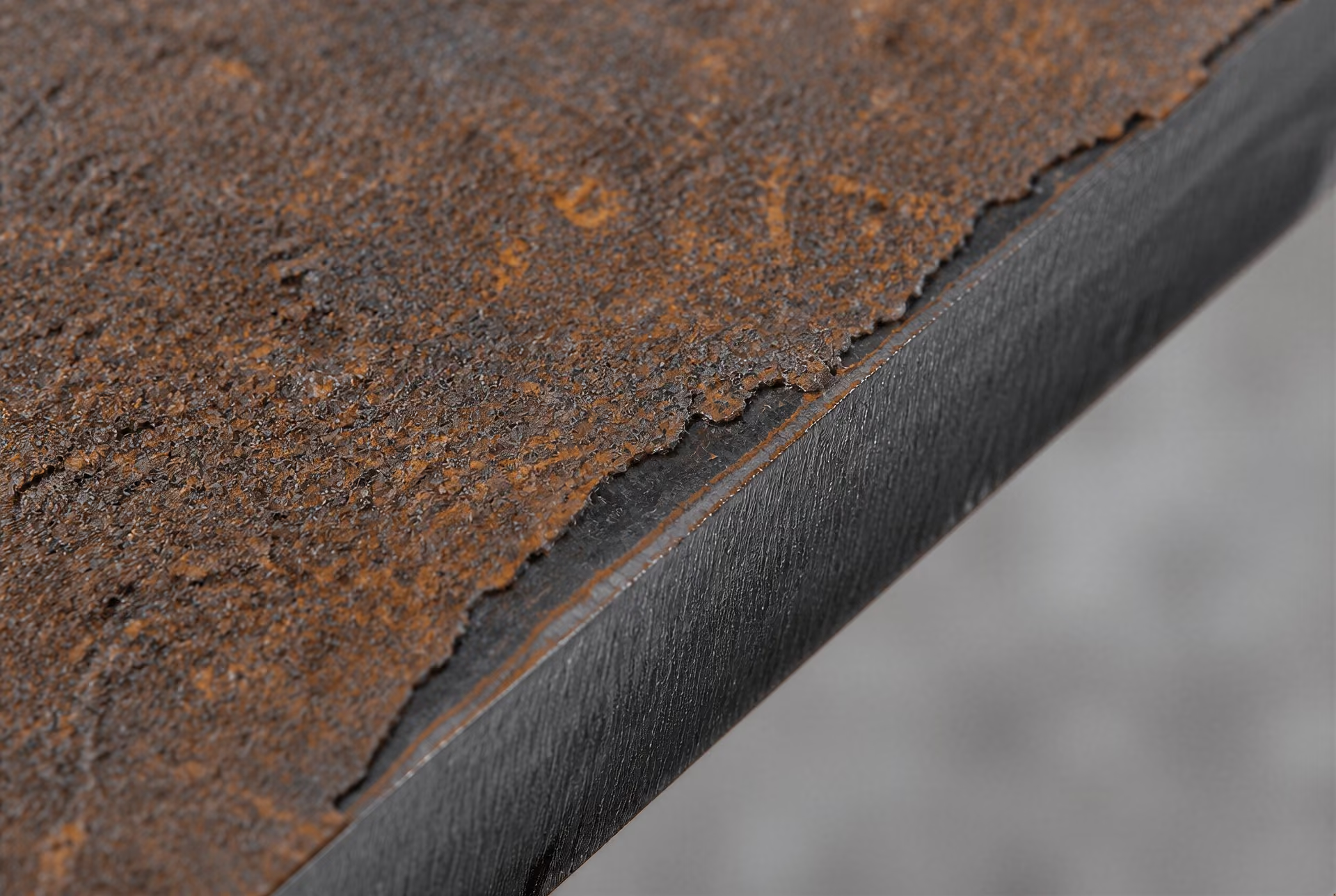
The meaning of atmospheric-corrosion resistance
Atmospheric-corrosion resistance means that, under suitable atmospheric exposure, the steel can develop corrosion products that reduce the rate of subsequent attack compared with ordinary structural carbon steel. The process is often associated with a relatively adherent, less permeable rust layer. That layer can limit access of water and oxygen to the underlying metal, but it is not a sealed coating and does not stop electrochemical corrosion under all conditions.
A588 should therefore not be described as corrosion-proof, maintenance-free, or immune to rust. Its specification language concerns improved resistance under atmospheric conditions, not resistance to immersion, buried exposure, persistent condensation, chemical attack, or every industrial atmosphere. The distinction is practical: a steel surface may form a protective patina during repeated wetting and drying, yet corrode rapidly where water remains trapped or contaminants concentrate.
The alloying strategy is only part of the result. Copper, nickel, chromium, phosphorus, and other elements may contribute to the composition and character of corrosion products in atmospheric-corrosion-resistant steels, while the carbon, manganese, silicon, and microalloying contents still affect strength, toughness, welding response, and processing. The relevant performance is the combined outcome of specification limits, product thickness, surface condition, fabrication history, and exposure—not the presence of one “weathering” element.
Why corrosion behavior depends on environment and exposure
Atmospheric corrosion requires an electrolyte film, so wetting and drying cycles strongly influence the rate and form of attack. Rain followed by drying may allow a relatively stable corrosion layer to develop. Continuous dampness can prevent that layer from maturing and can maintain electrochemical activity. Alternating exposure is not automatically benign either; frequent cycles can repeatedly reactivate the surface.
Contaminants change the situation. Chloride from marine spray or deicing salt can break down protective corrosion products and promote localized attack. Sulfur compounds and other industrial pollutants can acidify surface moisture. Dust, dirt, mill scale, and biological deposits may retain water and create differences in oxygen concentration across the surface. A site described simply as “atmospheric” may therefore include several different corrosion environments.
Geometry is equally important. Crevices, lap joints, stiffener intersections, boxed sections, and horizontal ledges can trap water and debris. Poor drainage creates a near-continuous wet exposure even when the surrounding air is relatively dry. Fasteners, weld regions, cut edges, and damaged surfaces may also corrode differently from broad, freely exposed plate. Design that permits drainage and inspection can matter as much as the nominal grade.
Service conditions must be checked before specifying A588. Immersion, contact with wet soil, enclosed condensation, heavy chloride exposure, and process-plant atmospheres may require coating, sealing, corrosion allowance, a different material, or a specifically engineered protection system. A588 can be an atmospheric-corrosion-resistant HSLA structural steel, but it is not a universal replacement for ASTM A572 or for other HSLA grades. The correct comparison must include the applicable ASTM designation, product form, thickness, mechanical requirements, weld procedure, toughness needs, and actual exposure environment.
8. Strength, Toughness, Ductility, and Formability
HSLA properties cannot be reduced to one number called “strength.” A specification may require a minimum yield strength, tensile strength, elongation, impact energy, bend performance, or some combination of these. Each measures a different response to loading, and the same microalloying treatment that raises one property can reduce another if composition and processing are not controlled.
Yield strength versus tensile strength
Yield strength The stress associated with the onset of permanent plastic deformation, measured according to the applicable tensile-test method.
Yield strength is the stress at which permanent plastic deformation begins. It matters when a component must retain its shape under service loads. Tensile strength is the maximum engineering stress reached during a tensile test, normally after substantial plastic deformation and before necking causes the measured load to fall. A steel can therefore have a high tensile strength but a comparatively low yield strength, or a high yield-to-tensile ratio with less uniform plastic strain before fracture.
The distinction is clear in structural specifications. ASTM A572/A572M covers five grades of high-strength low-alloy columbium-vanadium structural steel, with specified minimum yield strengths from 42 ksi [290 MPa] to 65 ksi [450 MPa] (ASTM International, 2000). Those grades are not defined by yield strength alone: tensile-strength requirements, elongation, thickness limits, and product form also matter. ASTM A588, another HSLA structural designation, is identified by NIST as having a 50 ksi minimum yield point, while its atmospheric-corrosion resistance is part of its specification identity (NIST, 2005).
ASM International places as-rolled HSLA, also called microalloyed steel, among high-strength carbon and low-alloy steels with yield strengths above 275 MPa [40 ksi] (ASM International, 2024). An ASTM symposium discussion published in 1979 reported HSLA yield-strength levels from 40,000 to 140,000 psi [276 to 966 MPa]. The range itself shows why “HSLA” is a family classification rather than a single mechanical grade.
Strength may come from several sources acting together. Lowering grain size raises yield strength through the Hall–Petch effect while generally improving resistance to cleavage fracture. Niobium, called columbium in several specifications and source documents, can retard recrystallization during rolling and promote a fine austenite structure before transformation. Vanadium and titanium can form carbonitrides that contribute precipitation strengthening or restrict grain growth. Manganese and silicon provide solid-solution strengthening, while controlled cooling may produce ferrite-pearlite, bainitic, or other transformation products with different strength and toughness balances.
Nominal alloy content does not predict the result by itself. A titanium addition that forms coarse titanium nitride particles during solidification will not act like finely dispersed precipitates formed under controlled conditions. Similarly, niobium that remains dissolved during reheating can behave differently from niobium precipitated during rolling. Reheating temperature, finishing temperature, cooling rate, slab chemistry, and section thickness all influence the final yield and tensile strengths.
Ductility and strain localization
Ductility describes how much plastic deformation a steel can sustain before fracture, but the reported value depends on the test and the gauge length. Total elongation, uniform elongation, reduction of area, and bend strain are related but not interchangeable. Uniform elongation measures deformation distributed along the gauge section before necking. Total elongation also includes localized deformation after necking and may appear larger when measured over a shorter gauge length.
A high yield strength can reduce the available margin between elastic loading and plastic deformation, but high strength does not automatically mean low ductility. Fine-grained ferritic structures can provide useful elongation while raising yield strength, provided the grain boundaries are clean and the phase distribution is controlled. Fine grains also distribute plastic strain more evenly than a coarse, heterogeneous structure.
Localization begins when deformation concentrates into a neck, shear band, band of softer ferrite, or region surrounding a hard particle. Large inclusions, coarse carbonitrides, segregation bands, and martensite or bainite islands can create local stress concentrations. Excessive precipitation may raise yield strength while reducing uniform elongation, particularly if the precipitates are numerous, coarse, or poorly distributed. A steel with impressive tensile-test strength can consequently perform poorly in stretch forming or in a notched component.
The yield ratio—the yield strength divided by tensile strength—helps describe this behavior. A high yield ratio often leaves less capacity for stable plastic deformation after yielding, although the actual forming response also depends on strain-hardening exponent, anisotropy, surface condition, and stress state. Strain hardening is important because it allows a region that begins to deform to strengthen and transfer load to neighboring material. If hardening is insufficient, deformation localizes early.
AISI states that moderate additions of columbium, vanadium, or titanium provide higher strength and may also improve formability in some HSLA grades (AISI, 2024). The qualification matters. Microalloying can refine grains and adjust recrystallization, but excessive precipitate volume, unfavorable particle size, or an unsuitable ferrite–pearlite morphology can have the opposite effect.
Impact toughness and transition behavior
Impact toughness The energy absorbed by a notched specimen during a rapid-impact fracture test, often used to assess temperature-dependent fracture behavior.
Impact toughness measures the energy absorbed during rapid fracture, commonly with Charpy V-notch testing. It is not the same as tensile ductility. A steel may show good elongation in a smooth tensile specimen yet absorb little energy in a notched test, especially at low temperature.
Many ferritic steels exhibit a ductile-to-brittle transition. Above the transition range, fracture is more likely to involve ductile microvoid nucleation and growth. Below it, cleavage fracture can spread rapidly through suitably oriented grains. The transition is not a single universal temperature: specimen orientation, thickness, notch geometry, grain size, inclusions, cooling history, and test energy all affect the measured result.
Grain refinement is especially valuable because smaller ferrite grains interrupt cleavage paths and lower the temperature at which brittle fracture becomes likely. This is one reason controlled rolling and accelerated cooling can raise yield strength without imposing the same toughness penalty as heavy carbon or alloy additions. Fine grains support both properties, but only when the processing route produces a reasonably uniform structure.
Coarse particles and inclusions are harmful because they can initiate microvoids or cleavage cracks. Sulfur- and oxygen-bearing inclusions, centerline segregation, banded structures, and coarse carbonitrides can produce directional toughness differences between longitudinal, transverse, and through-thickness specimens. Excessive precipitation can also remove solute needed for grain control or create brittle particle–matrix interfaces. Plate thickness and cooling rate further complicate comparisons: a thick plate may develop a different centerline structure from a thin sheet made from nominally similar steel.
Consequently, a grade’s impact requirement must be read with its product form, thickness range, test temperature, and specimen orientation. A572, A588, and other HSLA designations should not be treated as interchangeable simply because their names contain “high-strength low-alloy.”
Formability in sheet and plate products
Formability is the ability of a particular product to undergo a specified operation—drawing, stretching, bending, flanging, hole expansion, or roll forming—without cracking, wrinkling, excessive thinning, or unacceptable springback. It is not an automatic benefit of HSLA chemistry.
Sheet formability depends on thickness, surface condition, crystallographic texture, planar anisotropy, strain-hardening behavior, and the exact operation. Deep drawing favors sufficient uniform elongation and a favorable plastic-strain ratio. Stretch forming depends strongly on strain hardening and resistance to localized necking. Hole expansion is often controlled by the quality of the sheared edge and by hard second phases near that edge, not by tensile elongation alone. High-strength sheet also tends to produce greater springback, requiring process-specific tooling and compensation.
Plate products face different demands. Bending performance depends on plate thickness, bend radius, rolling direction, surface defects, inclusions, and through-thickness segregation. A plate that passes a tensile elongation requirement may still crack during a tight transverse bend. Welded plate structures add heat-affected-zone softening or hardening and residual-stress effects to the forming assessment.
Controlled rolling can improve formability by producing a fine, more uniform grain structure and reducing severe segregation. Microalloying may help in some grades, as AISI indicates, but the result depends on how niobium, vanadium, or titanium precipitate and how the steel is rolled and cooled. Coarse particles, excessive precipitation, banding, and unsuitable phase mixtures can reduce local ductility even while increasing yield strength. Formability therefore belongs to the specified grade, product, thickness, direction, and operation—not to the HSLA label alone.
9. Weldability and Heat-Affected-Zone Behavior
HSLA steels are not one weldability category. Their response to welding depends on the specified grade, product thickness, delivery condition, carbon and alloy content, microalloy precipitates, toughness requirements, and the welding process. ASTM A572/A572M, for example, covers five grades of high-strength low-alloy columbium-vanadium structural steel with specified minimum yield strengths from 42 ksi [290 MPa] to 65 ksi [450 MPa]. ASTM A588 is a different HSLA structural-steel specification, associated with atmospheric-corrosion resistance and a 50 ksi minimum yield point in the NIST reference material. A welding procedure suitable for one designation, thickness range, or product form cannot be assumed suitable for another.
Carbon control and weldability
HSLA steels are commonly designed with less carbon than many conventional high-strength steels because carbon raises hardenability and increases the likelihood that the heat-affected zone (HAZ) will transform into hard, brittle microstructures during cooling. Lower carbon also reduces the carbon available to form untempered martensite or other high-hardness constituents near the fusion boundary. That helps reduce cold-cracking risk, but it does not make every low-carbon HSLA steel automatically easy to weld.
Strength is obtained through several mechanisms instead. Grain refinement, solid-solution strengthening, precipitation of niobium- or columbium-, vanadium-, and titanium-containing compounds, controlled rolling, and carefully managed cooling can produce high yield strength without relying on high carbon. The American Iron and Steel Institute describes HSLA steels as a group in which moderate additions of columbium, vanadium, or titanium increase strength and may also improve atmospheric-corrosion resistance or formability. ASM International’s 2024 classification places as-rolled, or microalloyed, HSLA steels among high-strength carbon and low-alloy steels with yield strengths above 275 MPa [40 ksi]. The resulting weldability reflects the complete chemistry and processing history, not the nominal presence of a single microalloying element.
Carbon equivalent A calculated index combining carbon and alloying elements to estimate hardenability and the likelihood of hard, crack-sensitive heat-affected-zone structures during welding.
Carbon equivalent provides a useful framework for estimating weldability. It combines the effects of carbon and alloying elements that influence hardenability, allowing a preliminary assessment of the steel’s tendency to form a hard HAZ under a given cooling condition. Several carbon-equivalent indices are used in standards, research, and fabrication practice; they are not interchangeable, and their interpretation depends on the steel family, thickness, hydrogen level, restraint, and welding process. A reported carbon-equivalent value should therefore be read with its applicable equation and specification. It should not replace a qualified welding procedure or a review of the mill certificate.
Two plates with similar yield strength can have different carbon equivalents and very different HAZ behavior. A thicker plate generally cools more slowly through some regions but can also impose greater restraint; a thin plate may cool rapidly and produce greater HAZ hardening. Sulfur, phosphorus, manganese, copper, nickel, chromium, molybdenum, and microalloying additions can affect transformation behavior and toughness. The grade and thickness must be evaluated together.

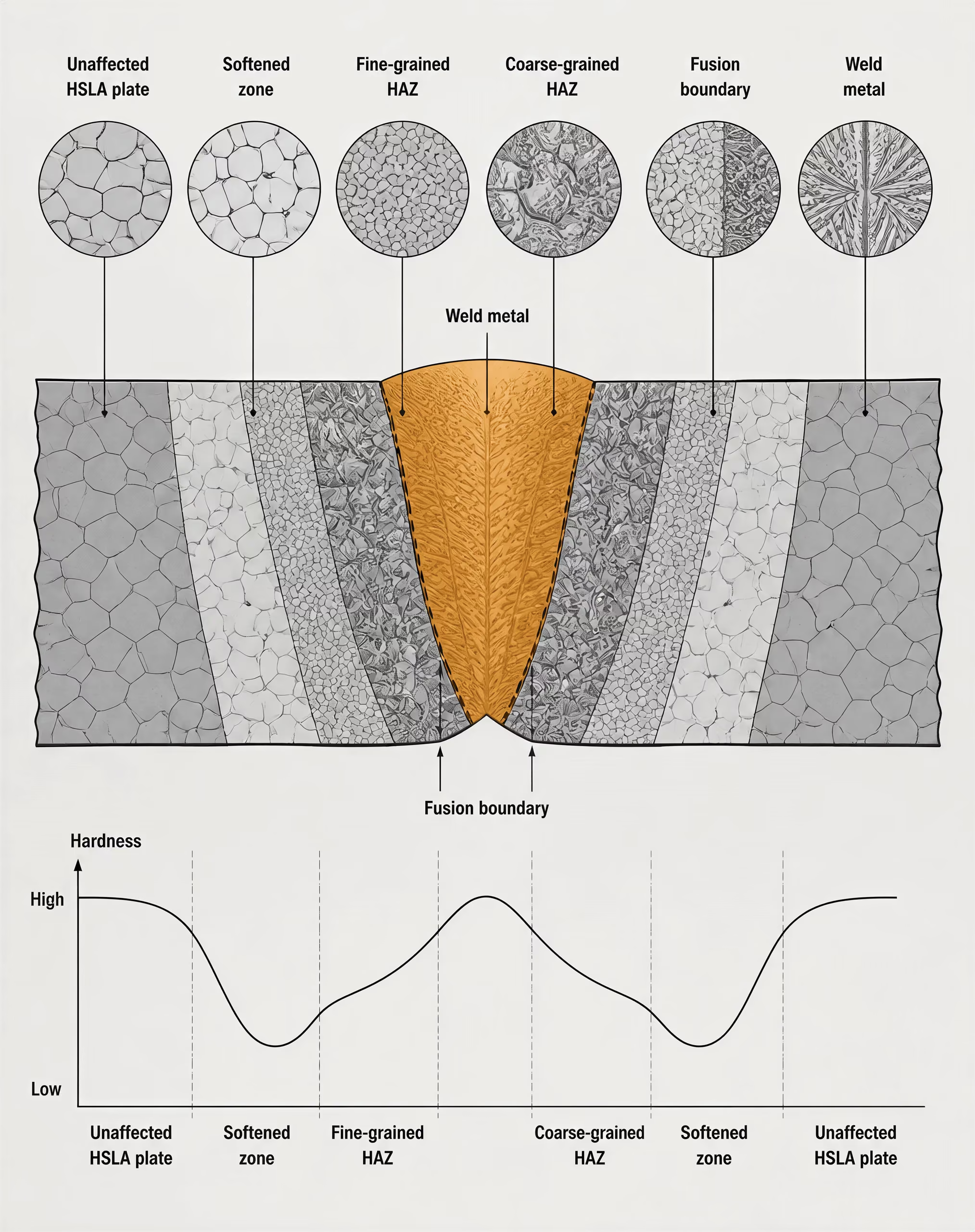
Heat-affected-zone softening and hardening risks
The HAZ is not a single uniform band. Welding creates regions that experience different peak temperatures and cooling histories. Immediately beside the fusion boundary, the coarse-grained HAZ may develop large austenite grains because existing grain-control precipitates dissolve or lose effectiveness at high temperature. Coarse grains can reduce notch toughness, particularly when the weld thermal cycle is severe. Farther from the fusion line, a fine-grained or intercritical region may experience different transformations and may not show the same toughness loss.
Local hardening is a major concern when the HAZ cools rapidly enough to form martensite or a martensite-rich structure. Hardness alone does not prove that a joint will crack, but a hard HAZ is more susceptible to hydrogen-assisted cracking when diffusible hydrogen, tensile restraint, and a susceptible microstructure are present. Cracks may appear during cooling or after a delay. Thick restrained joints, high-strength consumables, contaminated surfaces, damp electrodes, and inadequate preheat increase the concern. Inspection timing may therefore matter, especially for highly restrained joints or steels with elevated hardenability.
The opposite problem occurs in some precipitation-strengthened HSLA steels. Welding can dissolve strengthening precipitates in a portion of the HAZ, and subsequent cooling may not reproduce the original precipitation state. Overaging, precipitate coarsening, or transformation to a softer local structure can reduce yield strength in that region. The softened band may become the controlling location in tensile loading or cyclic deformation even when the weld metal and unaffected plate retain their specified strength. This is particularly important for thermomechanically processed products and for grades whose strength depends strongly on a carefully controlled precipitate population.
Higher heat input is not a universal solution. It can slow cooling and reduce the formation of very hard transformation products, but excessive heat input enlarges the coarse-grained HAZ, promotes grain growth, dissolves more precipitates, and can reduce toughness or strength. Low heat input can preserve a narrower thermal zone, yet rapid cooling may increase HAZ hardness. The acceptable balance is grade- and thickness-specific.
Preheat, heat input, and procedure qualification
Preheat is selected to control the cooling rate, reduce thermal gradients, and give hydrogen time to diffuse from the joint. Its required value, when one is specified, depends on carbon equivalent, thickness, joint restraint, ambient conditions, hydrogen control, welding process, and the governing fabrication code. Preheating a plate merely because it is labeled HSLA is not a sound rule; neither is omitting preheat because its carbon content is low. Excessive preheat can widen the HAZ and impair toughness, so the temperature must be controlled rather than increased without limit.
Interpass temperature matters for the same reason. A high interpass temperature can accumulate heat and alter HAZ grain size and precipitation behavior, while an excessively low temperature can produce rapid cooling in successive passes. Multipass welding may temper or partially refine portions of an earlier HAZ, but it can also create overlapping regions with different hardness and toughness. The qualified procedure must specify the permitted heat-input range, preheat, interpass temperature, pass sequence, travel speed, current, voltage, and consumable classification.
Hydrogen control begins with the consumable and extends to storage, handling, joint preparation, and surface cleanliness. Low-hydrogen electrodes and processes can reduce risk, but they do not eliminate the effects of high restraint or a hard HAZ. Moisture, oil, paint, rust, and cutting residues can add hydrogen or interfere with fusion. Postheat or controlled cooling may be required by the applicable procedure for particular steels and joint conditions.
Procedure qualification is the deciding control. The welding procedure specification (WPS) must comply with the material specification and the governing fabrication code, such as AWS D1.1/D1.1M for applicable structural welding or ASME Section IX for pressure-equipment procedure qualification. The qualification record must cover the actual base-metal group, thickness range, welding process, filler-metal classification, position, preheat and interpass limits, heat-input range, and any required toughness or hardness tests. ASTM A572/A572M and ASTM A588 identify material requirements; they do not make all welding variables interchangeable. Qualified procedures, verified consumables, and inspection suited to delayed cracking and HAZ toughness are necessary because HSLA performance is established at the specific joint, not inferred from the alloy label alone.
10. Product Forms, Processing Routes, and Property Directionality
HSLA steel does not leave the mill with one uniform set of properties. A plate, a rolled shape, a bar, and a sheet-piling section can share a specification family while developing different grain structures, cooling histories, residual stresses, and test results. Product form is therefore part of the metallurgical description, not merely a dimensional detail.
Plate, sheet, shapes, bars, and sheet piling
ASTM A572/A572M covers five grades of high-strength low-alloy columbium-vanadium structural steel: Grade 42 [290 MPa], Grade 50 [345 MPa], Grade 55 [380 MPa], Grade 60 [415 MPa], and Grade 65 [450 MPa] minimum yield strength, depending on grade and product requirements. Its listed product forms are shapes, plates, sheet piling, and bars. The specification should not be read as a blanket designation for every flat sheet product sold or processed under a similar trade description.
Plate is rolled from a slab and may be supplied in a thickness range where the center of the product cools much more slowly than the surface. That difference affects ferrite grain size, pearlite distribution, precipitation of niobium or vanadium compounds, and the persistence of centerline segregation. Thick plate can therefore show lower toughness or different through-thickness ductility than a thinner product of nominally similar chemistry and yield strength.
Sheet is thinner and normally experiences greater reduction and faster cooling after rolling. Its small thickness promotes a more uniform temperature through the section, although surface condition, coiling temperature, and strain history still matter. Sheet products may also receive forming, pickling, cold reduction, annealing, or skin-pass operations that are not represented by the phrase “HSLA” alone.
Shapes such as I-sections, channels, angles, and tees contain flanges, webs, corners, and sometimes substantial changes in local thickness. A flange tip cools sooner than the junction between a flange and web. The resulting property pattern can vary within one section. Residual stress also develops when exposed surfaces contract before hotter interior regions. These stresses influence distortion during cutting and welding even when tensile-test values meet the specification.
Bars are produced in rounds, squares, hexagons, and other profiles. Their smaller cross sections often permit more even cooling than heavy plate, but a large bar can still contain a slower-cooling core and a segregated center. Forging, controlled rolling, or subsequent heat treatment may further alter the structure. Sheet piling adds another complication: interlocking profiles concentrate deformation and service stresses near locks, corners, and bends, so section geometry matters alongside the nominal grade.
Hot-rolled versus normalized or thermomechanically processed products
“As-rolled” describes a delivery condition, not a chemical definition of HSLA steel. ASM International’s 2024 materials reference places as-rolled HSLA, also called microalloyed steel, among high-strength carbon and low-alloy steels with yield strengths above 275 MPa [40 ksi]. The strength may result from several mechanisms acting together: reduced ferrite grain size, precipitation of niobium, vanadium, or titanium carbonitrides, solid-solution strengthening, and transformation products formed during controlled cooling.
In conventional hot rolling, the steel is reheated, reduced at elevated temperature, and allowed to cool after the final pass. If the finishing temperature is high enough to recrystallize austenite between passes, repeated recrystallization can reset the austenite grain structure. If rolling continues below the relevant recrystallization range, deformation accumulates in the austenite instead. This is the basis of controlled rolling: microalloy precipitation can delay recrystallization, while pancaked austenite promotes fine ferrite after transformation.
Cooling rate then becomes decisive. Slow cooling favors ferrite and pearlite, while faster cooling can produce finer ferrite, bainite, or mixed transformation structures, depending on carbon content, alloying, thickness, and start temperature. A nominal addition of niobium, vanadium, or titanium does not guarantee a particular result. The element must be dissolved, retained, or precipitated at the appropriate stage, and its effect depends on reheating temperature, rolling schedule, cooling practice, and the rest of the chemistry.
| Delivery condition | Principal route | Typical consequence |
|---|---|---|
| As-rolled | Controlled reheating, rolling, and cooling | Properties depend strongly on deformation and cooling history |
| Normalized | Heating above the critical transformation range, then air cooling | Can refine or homogenize the prior structure |
| Quenched-and-tempered | Austenitizing, rapid cooling, then reheating below the critical range | Often produces tempered martensite or a related high-strength structure |
| Thermomechanically processed | Controlled deformation and cooling in a planned temperature sequence | Uses processing to refine grains and control precipitation |
Normalized products are heated above the critical transformation range and cooled in air. This treatment can refine and homogenize the structure after prior rolling, reduce some effects of an uneven thermal history, and produce properties different from those of the as-rolled condition. Normalizing is a processing route, not proof that the steel is HSLA. A plain-carbon steel can be normalized, and an HSLA steel can be supplied as-rolled.
Quenched-and-tempered products are first austenitized, rapidly cooled, and then reheated below the critical range. The resulting tempered martensite or related structure can provide high strength and controlled toughness, but that heat-treatment label does not by itself establish low-alloy or microalloyed status. Conversely, an HSLA grade may gain much of its specified strength without quenching and tempering. ASTM A572/A572M should be interpreted through its grade, product form, chemical limits, mechanical requirements, and delivery provisions rather than through a generic assumption about processing.
Anisotropy, thickness effects, and sampling direction
Rolling stretches inclusions, segregation bands, and grains preferentially along the rolling direction. Tensile specimens cut parallel to rolling commonly produce different elongation, reduction of area, and sometimes yield behavior than specimens cut transverse to rolling. Longitudinal properties are not interchangeable with transverse or through-thickness properties.
The difference is especially important for plate and structural sections. Elongated manganese sulfide inclusions can act as crack paths during deformation, while centerline segregation can create bands with altered hardenability and toughness. In thick products, the mid-thickness region cools later and may transform differently from the surface. The result can be a through-thickness gradient in grain size, precipitation, hardness, and impact toughness.
Test sampling must therefore follow the applicable specification and product geometry. A tensile bar from a flange is not metallurgically identical to one from a web; a longitudinal plate specimen does not represent a through-thickness or transverse fracture path. Charpy impact values are likewise sensitive to notch orientation, sampling location, thickness, and test temperature. Reported yield strength is a measured property of a defined specimen, not an orientation-free constant.
The range of HSLA strength illustrates why such distinctions matter. An ASTM symposium paper published in 1979 reported yield-strength levels from 40,000 to 140,000 psi [276 to 966 MPa], with most discussed grades microalloyed using columbium, vanadium, titanium, or combinations of these elements. ASTM A572/A572M occupies only part of that wider family. Product form, rolling schedule, cooling rate, section geometry, and sampling direction determine how a particular grade performs in an actual component.
11. How to Read HSLA Standards and Material Designations
A designation such as ASTM A572/A572M identifies a specification family, not a complete engineering decision. The specification covers high-strength low-alloy columbium-vanadium structural steel, but the designation alone does not say which grade, product form, thickness, test condition, or supplementary requirement applies. Those details control the material actually delivered and the properties that can be credited in design.
HSLA is a metallurgical class rather than one composition. AISI describes the class as low-carbon steels in which moderate additions of columbium (niobium), vanadium, or titanium increase strength and may also improve atmospheric-corrosion resistance or formability. The result depends on chemistry and processing: dissolution of microalloy carbonitrides during reheating, precipitation during rolling or cooling, austenite grain control, ferrite transformation, and the final product thickness all matter. A nominal vanadium addition does not guarantee the same microstructure or weldability in every specification.
ASM International’s 2024 reference material places as-rolled, or microalloyed, HSLA steels among high-strength carbon and low-alloy steels with yield strengths above 275 MPa [40 ksi]. That threshold is a classification aid, not a universal acceptance rule. An ASTM symposium paper published in 1979 reported HSLA yield-strength levels from 40,000 to 140,000 psi [276 to 966 MPa], showing why a broad HSLA label cannot substitute for a grade designation. ASTM A572/A572M, for example, covers five grades with specified minimum yield strengths ranging from 42 ksi [290 MPa] to 65 ksi [450 MPa] (ASTM International, 2000).
Specification, grade, product form, and edition
How to read an HSLA material callout
- Specification Identify the standard number and applicable edition.
- Grade Record the exact grade, such as Grade 50 or Grade 65.
- Product form Confirm whether the product is plate, shape, sheet piling, bar, or another listed form.
- Thickness Use the thickness-specific mechanical and dimensional requirements.
- Delivery condition Check whether the material is as-rolled, normalized, thermomechanically processed, or heat treated.
- Supplementary requirements Verify toughness, through-thickness, ultrasonic, weldability, or other selected provisions.
Read a material callout from left to right, then find the referenced tables and clauses. ASTM A572/A572M is the specification number and indicates inch-pound and SI requirements. The grade must still be stated: Grade 42, Grade 50, Grade 55, Grade 60, or Grade 65. “A572 steel” is incomplete because these grades do not have the same minimum yield strength, tensile-strength range, thickness limits, or sometimes the same ordering requirements.
Product form is equally important. ASTM A572/A572M covers structural shapes, plates, sheet piling, and bars, but a plate requirement is not automatically interchangeable with a shape or bar requirement. The relevant product-form table can set different dimensional tolerances, thickness ranges, sampling locations, permissible variations, and test provisions. A specification may also invoke a general standard such as ASTM A6/A6M for rolled structural products. The purchaser, designer, fabricator, and inspector must identify the actual form rather than relying on a generic grade name.
The edition matters. A callout may appear as ASTM A572/A572M-00a, where the year and letter suffix identify a particular historical edition, while a project may require the edition adopted by its contract or governing code. Requirements can change between editions, including chemistry limits, test methods, ordering information, and supplementary provisions. A material certificate that satisfies one edition should not be assumed to satisfy another without comparison.
Heat-treatment condition must be read from the specification and purchase description. “As-rolled,” normalized, controlled-rolled, normalized-and-tempered, quenched-and-tempered, or thermomechanically processed material can have different strength, toughness, residual-stress, and forming behavior. Some HSLA grades obtain their properties in the supplied rolling and cooling condition rather than through a later furnace treatment. If a drawing says only “HSLA,” it has not identified that condition.
ASTM A572/A572M should also be separated from ASTM A588/A588M. NIST identifies ASTM A588 as HSLA structural steel with a 50 ksi minimum yield point, and ASTM reference material associates it with atmospheric-corrosion resistance. That does not make A588 a corrosion-resistant replacement for every A572 grade. Exposure, detailing, weld zones, thickness, coating requirements, and the governing atmospheric-corrosion provisions still have to be checked.
Minimum properties versus typical properties
A specified minimum is a contractual acceptance limit, not a prediction of every heat’s result. If a table gives a minimum yield strength of 50 ksi [345 MPa], a conforming test result must meet or exceed that value under the stated test procedure and thickness range. The specification may also give a tensile-strength range, minimum elongation, and other requirements. These are limits used for conformity.
Mill certificates often report actual results substantially above the minimum. Such values are useful evidence about a particular heat or lot, but they are not automatically guaranteed for all future material of that grade. Nor should a designer replace the specification minimum with an average certificate value. Extra strength can affect bending, hole-making, welding heat input, fracture behavior, and connection resistance; it is not simply an unqualified benefit.
Design values form a third category. Structural design standards may derive nominal and allowable resistances from specified minimum properties, section behavior, stability, resistance factors, safety factors, and applicable limit states. A code value is therefore not identical to the mill test result or the steel specification minimum. The design standard may also restrict which editions or grades are recognized. A plate that passes ASTM A572/A572M does not acquire a different design resistance merely because its certificate reports a higher yield strength.
Thickness deserves particular attention. Yield and tensile requirements may change with thickness, and elongation requirements can use different gauge lengths or reduction-of-area provisions. The correct row in the table must match the ordered thickness, not merely the nominal grade. Test orientation also matters: longitudinal and transverse specimens can produce different results, especially in rolled plate and shapes.
Chemical limits, mechanical tests, and supplementary requirements
Chemical tables establish permitted limits or ranges for carbon, manganese, phosphorus, sulfur, silicon, and microalloying elements such as niobium, vanadium, and titanium. They do not, by themselves, describe the complete microstructure. Carbon equivalent or other weldability calculations may be needed, and the applicable formula must be identified because different standards use different definitions. A heat within the chemistry limits can still require controlled rolling, accelerated cooling, or specified delivery condition to achieve the mechanical requirements.
Mechanical testing must be read with its method, specimen, location, orientation, and frequency. Tensile testing establishes yield strength, tensile strength, and elongation according to the referenced method, commonly through standards such as ASTM A370 where invoked. Yield may be defined by a yield point or by an offset method. Charpy V-notch impact testing, when required, adds a temperature, absorbed-energy criterion, specimen orientation, and sampling rule; it is not implied merely because a steel is called HSLA.
Supplementary requirements are additional provisions selected by the purchaser or required by the project. They can address impact toughness, through-thickness ductility, fine-grain practice, weldability documentation, ultrasonic examination, or other quality controls, depending on the specification. They must be expressly identified and verified; assuming that every plate carries every supplementary requirement is a serious reading error.
The final check is against the complete material callout: specification and edition, grade, product form, thickness, delivery condition, chemistry, mechanical tests, supplementary requirements, and applicable design code. Only then can strength, toughness, weldability, formability, and corrosion behavior be evaluated for the actual HSLA product rather than for an imprecise label.
12. Applications and Engineering Selection Without Oversimplification
HSLA steels are selected for a combination of strength, fabrication behavior, durability, and code compliance—not for a generic “high-strength” label. ASM International classifies as-rolled HSLA, also called microalloyed steel, among high-strength carbon and low-alloy steels with yield strengths above 275 MPa [40 ksi] (2024). An ASTM symposium paper published in 1979 reported HSLA yield-strength levels from 40,000 to 140,000 psi [276 to 966 MPa]. That range alone shows why application decisions cannot treat every HSLA grade as interchangeable.
The grade designation describes only part of the engineering behavior. Columbium (niobium), vanadium, and titanium can refine ferrite grain size or form precipitates, but their effect depends on steel chemistry, reheating temperature, rolling schedule, cooling rate, product thickness, and final microstructure. A grade with a higher specified yield strength may therefore have different forming, welding, fracture-toughness, or fatigue behavior from another grade at a similar strength level.
Structural members and transportation structures
Structural HSLA steels are used where a designer can convert higher yield strength into a smaller cross-section, lower member mass, or greater resistance to local yielding. The resulting benefit is not automatic: buckling, lateral-torsional instability, connection resistance, fatigue, and serviceability may govern before the nominal yield strength is reached. A thinner or lighter member can also have less corrosion allowance, lower bending stiffness, or greater sensitivity to weld distortion.
ASTM A572/A572M illustrates the difference between a family classification and a product specification. It covers five grades of high-strength low-alloy columbium-vanadium structural steel in shapes, plates, sheet piling, and bars, with specified minimum yield strengths from 42 ksi [290 MPa] to 65 ksi [450 MPa] (ASTM International, 2000). The applicable grade, thickness range, tensile-strength requirement, impact requirement, and supplementary provisions must be checked separately. “A572 steel” is not one uniform mechanical condition.
Bridge girders, trusses, columns, crane-supporting members, frames, and other fabricated structures may use HSLA plate or rolled shapes when the governing structural standard permits the selected grade. In bridge work, fatigue details and weld categories can control the design even when static strength is adequate. Toughness at the lowest service temperature also matters, particularly at welded attachments, notches, changes in section, and regions subject to constraint.
ASTM A588 occupies a different specification position. It is identified as HSLA structural steel with atmospheric-corrosion resistance, and NIST reported a 50 ksi minimum yield point for ASTM A588 in 2005. Its atmospheric-corrosion behavior does not eliminate painting, drainage, inspection, or corrosion-control requirements. Exposure severity, deposited salts, crevices, wet-dry cycling, and the ability to maintain a weathering surface determine whether the intended corrosion performance is achieved. A588 should not be substituted for A572 merely because both are HSLA structural steels.
Transportation structures apply the same reasoning at a tighter mass and fatigue margin. Vehicle frames, railcars, trailers, heavy equipment, and transport-support structures may use HSLA sheet, plate, or shapes to reduce mass while retaining crash, suspension, or payload capacity. Yet a vehicle component is exposed to repeated variable-amplitude loads, forming strains, weld heat, stone impact, and sometimes deicing salts. Static tensile strength is only one input.
Formed sheet and fabricated components
HSLA sheet is often selected for formed brackets, chassis parts, rails, reinforcements, pressure-retaining supports, and machinery components where reducing thickness would otherwise require a larger section or add mass. The relevant question is not simply whether the sheet meets a yield-strength target. Uniform elongation, total elongation, strain-hardening behavior, bend radius, anisotropy, edge quality, and springback affect whether the specified shape can be produced without cracking or dimensional failure.
Microalloy precipitation can increase strength while reducing ductility in some conditions, and a high-strength grade may require larger bend radii than a lower-strength grade of similar thickness. Cutting method also matters. Sheared or thermally cut edges can contain work-hardened zones, notches, or local hardness changes that become crack initiation sites during forming or service. Hole expansion and stretch-flange performance may govern a component with pierced edges even when a tensile test appears satisfactory.
Fabricated plate components introduce a second set of controls. Welding can alter the heat-affected zone, dissolve or coarsen strengthening precipitates, reduce local toughness, and create residual stress. The carbon equivalent or other weldability measure must be considered with plate thickness, restraint, hydrogen control, preheat, interpass temperature, consumable selection, and heat input. A low-carbon HSLA grade is generally designed to support welding, but “weldable” does not mean that every process or joint detail is acceptable without procedure qualification.
Machinery frames, lifting components, agricultural equipment, and engineered supports may combine formed sheet with welded plate or machined details. In such assemblies, strength mismatches between parent metal, weld metal, heat-affected zones, bolts, and attachments can control failure. Machining can also remove the surface condition or corrosion allowance assumed by the design. The component must be assessed as a fabricated system rather than as a coupon of nominal grade.
Selection by load, joining, environment, and inspection requirements
Selection begins with the load path and the governing limit state. Specify the required minimum yield strength and tensile strength for the relevant thickness, then evaluate elastic deflection, plastic collapse, buckling, bearing, tear-out, and fatigue. For cyclic structures, weld geometry and stress concentration may matter more than the difference between adjacent strength grades. For impact-prone or cold-service structures, Charpy impact requirements or another code-defined toughness measure must be stated; tensile strength cannot stand in for fracture resistance.
Thickness changes the decision. Product standards may assign different mechanical requirements by thickness, while thick plate increases restraint and can change cooling behavior during welding. The designer must verify the actual product form—plate, sheet, bar, or shape—and the dimensional tolerances required by the governing code. ASTM A572/A572M requirements cannot simply be transferred to an unlisted product form.
Joining method narrows the permissible grade and procedure. Welded construction requires qualified procedures and inspection suited to the joint, thickness, restraint, and service. Bolted construction shifts attention toward hole-making, net-section fracture, bearing, slip, bolt compatibility, and coating or corrosion details. Formed or mechanically fastened sheet requires edge quality, local ductility, and springback control. Thermal cutting, bending, welding, and straightening should be treated as manufacturing operations that can change local properties.
Environment adds another filter. Atmospheric exposure, immersion, chloride contamination, elevated or subzero temperature, abrasion, and hydrogen-producing corrosion mechanisms require separate assessment. A grade recognized for atmospheric-corrosion resistance is not a universal corrosion-resistant material. Coatings, drainage, sealing, inspection access, and planned maintenance remain part of the design.
Finally, the specification must define inspection and acceptance requirements: chemical limits, heat and product traceability, tensile and bend tests, impact tests where required, weld nondestructive examination, dimensional checks, and repair controls. Choosing HSLA steel is therefore a grade-and-process decision governed by load, thickness, forming strain, joining, environment, fatigue, inspection, and the applicable design code.
13. Common Misconceptions About HSLA Steels
HSLA is not one grade
High-strength low-alloy (HSLA) steel is a family classification, not a single chemical composition or product designation. These steels are generally low-carbon, low-alloy engineering steels whose strength and other properties result from controlled chemistry, processing, and microstructure. AISI describes the family as steels in which moderate additions of columbium (niobium), vanadium, or titanium can increase strength and may also affect atmospheric-corrosion resistance or formability. That definition does not make every steel containing one of those elements equivalent.
The term also covers more than one metallurgical route. Strength may come from solid-solution strengthening, grain refinement, precipitation of carbonitrides, controlled rolling, accelerated cooling, or phase-transformation effects. Niobium, vanadium, and titanium do not produce the same result under all conditions. Their effect depends on whether they dissolve during reheating, precipitate during rolling or cooling, refine austenite grains, and interact with the steel's carbon and nitrogen contents.
“Microalloyed steel” is therefore related to HSLA, but the terms should not be treated as exact synonyms in every specification. ASM International's 2024 reference describes as-rolled HSLA steels, also called microalloyed steels, among high-strength carbon and low-alloy steels with yield strengths above 275 MPa [40 ksi]. That is a classification based on metallurgy and strength, whereas ASTM designations identify products with defined chemistry, mechanical properties, dimensions, testing, and delivery requirements.
ASTM A572/A572M illustrates the point. It covers five grades of high-strength low-alloy columbium-vanadium structural steel in shapes, plates, sheet piling, and bars. The specified minimum yield strengths range from 42 ksi [290 MPa] to 65 ksi [450 MPa], depending on grade and product. “A572” is not a generic name for all HSLA steel. It identifies a particular ASTM structural-steel specification, and its grades are not automatically interchangeable with ASTM A588, a different specification.
A588 is also an HSLA structural steel, but its specification includes atmospheric-corrosion-resistance provisions. NIST identifies ASTM A588 as having a 50 ksi minimum yield point. That strength level does not define the whole HSLA family: an ASTM symposium paper published in 1979 reported HSLA yield-strength levels from 40,000 to 140,000 psi [276 to 966 MPa]. Grade, product form, thickness, heat treatment, and processing history all matter.
More alloying does not automatically mean better performance
A larger alloy addition is not a universal route to a better steel. HSLA design depends on controlling modest quantities of elements and matching them to a processing schedule. Excessive alloying can increase hardenability, alter transformation products, raise cost, complicate welding, or produce a strength level that reduces forming capacity. It may also create undesirable precipitate populations or segregation if melting and cooling are not controlled.
The same nominal addition can produce different properties in different heats. Niobium that remains in solution during reheating can influence recrystallization during controlled rolling; niobium that precipitates later can strengthen the ferrite. Vanadium precipitation is strongly affected by cooling and coiling temperatures. Titanium may tie up nitrogen and form titanium nitride particles, but coarse particles do not provide the same grain-refining effect as a controlled fine dispersion. Chemistry alone cannot reveal the final microstructure.
Strength is only one part of specification compliance. Toughness, elongation, bend performance, through-thickness behavior, weldability, and dimensional limits may control whether a grade is suitable. A high-yield-strength steel that cannot meet the required impact toughness at the design temperature, or that develops an unacceptable heat-affected zone during welding, is not made suitable by its strength number.
Higher yield strength does not eliminate design constraints
A higher yield strength can permit thinner sections or greater resistance to yielding, but it does not erase buckling, fatigue, fracture, connection, deflection, or local-instability requirements. A slender compression flange can buckle before the nominal yield strength is reached. A thin plate can experience local buckling, and a welded connection may be governed by the weld metal, net section, block shear, bolt behavior, or stress concentrations rather than by the parent steel's yield point.
Higher-strength grades can also impose stricter fabrication controls. Forming operations produce larger springback and may require larger bend radii or different tooling. Cold forming can raise local hardness and reduce remaining ductility. Welding may introduce a heat-affected zone whose hardness, toughness, and strength differ from those of the plate. Preheat, heat input, interpass temperature, consumable selection, and hydrogen control must be assessed against the specific grade, thickness, restraint, and welding procedure.
It is therefore incorrect to describe every HSLA steel as readily formable or readily weldable. Some grades are designed for cold-forming applications; others are structural products whose forming limits are narrower. A certified mill specification and qualified fabrication procedure matter more than the HSLA label alone. Design codes may also impose limits that are more restrictive than the material's published minimum yield strength.
A588 corrosion resistance is not universal corrosion protection
ASTM A588's atmospheric-corrosion resistance does not mean that every HSLA steel resists corrosion to the same degree, nor does it mean that A588 is immune to corrosion. The protective oxide layer associated with weathering steels develops only under suitable exposure conditions. Repeated wetting and drying, access to oxygen, and the absence of persistent contamination help that patina form and remain stable.
Constant moisture, poor drainage, chloride deposits, marine spray, industrial pollutants, crevices, and contact with dissimilar materials can prevent protective patina development or accelerate localized attack. Water trapped at splices, stiffeners, deck joints, or horizontal ledges can produce corrosion even when the nominal material is A588. Runoff may also stain adjacent concrete or masonry.
AISI's statement that microalloying elements may improve atmospheric-corrosion resistance describes a possible grade-specific property, not a family-wide guarantee. ASTM A572 and ASTM A588 must be evaluated under their own specification requirements. Environmental assessment, drainage, inspection access, joint detailing, and any required coating or corrosion allowance remain part of design. Atmospheric-corrosion resistance reduces one set of risks under defined conditions; it does not replace corrosion engineering.
14. A Practical Technical Checklist for Evaluating an HSLA Grade
An HSLA designation is not enough to establish suitability. HSLA steels form a family of low-carbon, low-alloy steels whose strength and performance result from particular combinations of chemistry, reheating, controlled rolling, cooling, precipitation, grain size, and transformation behavior. The same nominal strength level can therefore conceal important differences in weldability, toughness, forming response, corrosion behavior, and through-thickness properties.
A sound evaluation begins with the material specification, not with a generic statement such as “HSLA is stronger than carbon steel.”
Identify the exact specification and grade
Record the governing standard exactly as it appears on the design documents, purchase specification, material certificate, and inspection plan. For structural plate, that might be ASTM A572/A572M, High-Strength Low-Alloy Columbium-Vanadium Structural Steel, or ASTM A588/A588M, High-Strength Low-Alloy Structural Steel with 50 ksi [345 MPa] Minimum Yield Point to 4 in. [100 mm] Thick. Do not treat those designations as interchangeable. ASTM A572/A572M covers five grades with specified minimum yield strengths from 42 ksi [290 MPa] to 65 ksi [450 MPa], while ASTM A588/A588M addresses atmospheric-corrosion-resistant structural steel.
Write down the grade designation, product form, thickness or diameter range, and delivery condition. “ASTM A572” without a grade and form is incomplete. A plate, bar, rolled shape, sheet, and welded tubular product may be governed by different requirements, even when their chemistry or nominal grade appears similar. Include the standard edition, supplementary requirements, and any invoked provisions such as normalized, normalized-and-tempered, quenched-and-tempered, or thermomechanically controlled delivery.
The grade must also be distinguished from a metallurgical category. ASM International’s 2024 reference material places as-rolled HSLA, also called microalloyed steel, among high-strength carbon and low-alloy steels with yield strengths above 275 MPa [40 ksi]. An ASTM symposium paper published in 1979 reported HSLA yield-strength levels from 40,000 to 140,000 psi [276 to 966 MPa]. Those ranges describe a class; they do not replace the requirements of a material standard.
Chemistry limits require the same precision. Identify the permitted carbon, manganese, phosphorus, sulfur, silicon, copper, nickel, chromium, molybdenum, niobium (columbium), vanadium, titanium, nitrogen, and any carbon-equivalent limits. Niobium, vanadium, and titanium are not interchangeable labels for “microalloyed.” Their effect depends on dissolution during reheating, precipitation during rolling or cooling, grain refinement, and interactions with carbon and nitrogen. Nominal presence alone does not predict the final microstructure.
Match mechanical properties to design actions
Begin with the actual design actions: tension, compression, bending, shear, bearing, local buckling, impact, cyclic loading, or combinations of these. Then compare them with the specified minimum yield strength, tensile strength, elongation, reduction of area where required, and thickness-dependent values. A higher yield strength can reduce section size, but it does not automatically improve fatigue life, fracture resistance, weld performance, or resistance to local instability.
Check whether the design relies on yield strength at a particular thickness. Many standards reduce specified properties as thickness increases because cooling rate, segregation, grain structure, and internal soundness vary through the section. Confirm whether the reported value is a minimum longitudinal property, a transverse property, or a through-thickness requirement.
Toughness must be tied to the failure risk and service temperature. Identify the Charpy V-notch test temperature, absorbed-energy requirement, specimen orientation, testing frequency, and acceptance rule. A room-temperature tensile certificate cannot establish low-temperature fracture resistance. For thick restrained weldments, pressure-containing components, bridges, offshore structures, and members exposed to impact, specify whether supplementary toughness requirements apply and whether the base metal, weld metal, and heat-affected zone all require examination.
Fatigue demands need separate treatment. Establish the stress range, number of cycles, stress concentration, weld category, surface condition, residual stress assumptions, and inspection interval. Raising yield strength does not by itself raise the allowable fatigue stress range for a welded detail. Fracture-control requirements may also govern if a crack could propagate before detection.
Assess fabrication and service conditions
List every fabrication operation before accepting the grade: cutting, drilling, punching, cold bending, hot forming, straightening, machining, and welding. The forming radius must be checked against the grade, product direction, thickness, and bend orientation. Higher-strength plate can show greater springback and may require larger radii or controlled forming sequences. Severe cold work can reduce ductility and alter local toughness, so post-forming inspection or heat treatment may be necessary.
For welding, identify the approved welding procedure, process, consumable classification, heat input range, preheat and interpass temperatures, minimum and maximum pass temperatures, hydrogen control, and any post-weld heat treatment. The procedure must be qualified for the actual grade, thickness, joint restraint, and welding position. Carbon equivalent is useful for screening hardenability and cracking risk, but it is not a substitute for procedure qualification. Heat input can change the coarse-grained heat-affected zone, toughness, strength, and softening behavior. A steel with acceptable base-metal properties may still produce an unacceptable welded joint if the thermal cycle is wrong.
Assess the service environment in specific terms. For atmospheric exposure, determine wetting, chloride or marine contamination, pollutant concentration, drainage, crevices, and maintenance access. ASTM A588/A588M provides atmospheric-corrosion resistance under suitable exposure, but it does not eliminate corrosion in continuously wet, immersed, chloride-rich, or poorly drained conditions. Decide whether a coating, corrosion allowance, weathering-steel detailing, or another protection system is required.
Include temperature range, fire exposure, abrasion, hydrogen service, pressure cycling, seismic loading, and contact with dissimilar metals where applicable. The required property is condition-specific.
Verify evidence and certification
Trace the material from the finished component to the heat number and original mill documentation. Review the material test report for the exact standard and grade, product form, thickness, delivery condition, heat chemistry, tensile results, yield measurement method, elongation, impact results, and supplementary tests. Confirm that reported values meet the correct thickness bracket rather than a more favorable range.
Check whether the certificate is a manufacturer’s test report, an inspection certificate, or a project-specific release document. Verify laboratory accreditation, test dates, specimen orientation, calibration status, and any deviations or waivers. Where fracture control matters, consider ultrasonic examination, lamellar-tearing assessment, hardness mapping, weld procedure qualification records, and independent witness testing.
| Evaluation area | Evidence to verify |
|---|---|
| Identity | Specification, edition, grade, product form, thickness, and delivery condition |
| Mechanical properties | Yield strength, tensile strength, elongation, bend results, and thickness bracket |
| Toughness | Impact temperature, energy requirement, specimen orientation, and frequency |
| Fabrication | Qualified WPS, preheat, interpass temperature, heat input, consumables, and hydrogen control |
| Environment | Wetting, chloride exposure, drainage, coatings, corrosion allowance, and inspection access |
The decision framework is direct: identify the exact ASTM or other governing designation and grade; confirm product form, thickness, delivery condition, minimum mechanical properties, chemistry limits, and toughness requirements; then match them to the design actions, welding procedure, forming operation, corrosion environment, fatigue demands, and inspection basis. Accept the grade only when the evidence covers each controlling requirement. Whenever a current applicable standard and the project code differ from a general reference summary, the current standard and project code control.
References
- [1] Standard Specification for High-Strength Low-Alloy Columbium-Vanadium Structural Steel. ASTM A572/A572M, 2000. ASTM International, ASTM A572/A572M (2000)
- [2] Federal Building and Fire Safety Investigation of the World Trade Center Disaster: Steel Analysis, NCSTAR 1-3A. NIST NCSTAR 1-3A, 2005. https://nvlpubs.nist.gov/nistpubs/Legacy/NCSTAR/ncstar1-3a.pdf