



1. Why steel product form changes the specification
Product standard The governing document that applies grade requirements to a defined product form, manufacturing route, dimensional system and inspection regime.
Steel product form is a specification variable, not merely a description of appearance. Carbon steel and alloy steel may be supplied as sheet, plate, strip, section, bar, tube, forging or casting, yet those forms do not carry the same dimensional tolerances, surface requirements, mechanical tests or acceptance criteria. A grade identifies the material’s chemical and mechanical class; a product standard defines how that material is made, measured, tested, inspected and marked in a particular form.
Parts of a complete designation
- Product form
- Identifies whether the item is sheet, plate, strip, section, bar, tube, forging or casting.
- Governing standard
- Defines the manufacturing, dimensional, testing, inspection and marking requirements.
- Grade or strength level
- States the applicable chemical and mechanical property class.
- Delivery condition
- Records the supplied metallurgical state, such as normalized or quenched and tempered.
- Impact quality
- Identifies toughness requirements at a specified test temperature where applicable.
- Supplementary tests
- Adds controls such as ultrasonic examination or through-thickness properties.
A steel grade alone does not identify the complete product specification. Strong evidence
The distinction matters because “carbon steel” is a broad material family, while “plate to a named standard” is a supply requirement. A designation may therefore contain several separate decisions: product form, governing standard, grade or strength level, delivery condition, surface condition, impact quality and supplementary tests. The National Structural Steelwork Specification, for example, treats rolled sections, structural hollow sections, plates and bars as separate constituent product types. Its complete designation includes the standard number, strength grade and impact quality. A grade alone does not provide that information.
Geometry is not a specification
| Product family | Typical forms | Primary specification concerns |
|---|---|---|
| Flat products | Sheet, strip, plate, wide flat | Thickness, width, flatness, edge condition and coil or cut-length supply |
| Long products | Bars, sections, rails, wire rod | Profile, mass, straightness, length and section properties |
| Tubular products | Round, square and rectangular tubes or HSS | Outside dimensions, wall thickness, corner geometry, weld or pressure performance |
A flat product is not automatically sheet, plate or strip simply because it has a flat rectangular shape. Width, thickness, manufacturing route and the applicable standard determine which term is appropriate. ISO 6929:2013 provides standardized vocabulary for steel products and distinguishes categories including flat products, long products and tubular products. That vocabulary reduces ambiguity, but it does not make every flat product subject to one common set of requirements.
| Description | What it identifies | What it does not establish |
|---|---|---|
| Floor plate | Hot-rolled plate with raised figures on one surface | A universal thickness range, grade or pressure-service suitability |
| Sheet | A flat product category under the applicable standard | That the product is interchangeable with plate |
| Heavy-thickness sheet coil | A dimensional or supply classification permitted by the floor-plate standard | That the product follows every plate tolerance |
| Plate | A flat-product category governed by a named specification | A particular chemistry, heat treatment or inspection level |
The boundary between sheet and plate can also depend on the product standard. ASTM A786/A786M-15(2025) defines floor plate as hot-rolled plate with raised figures on one surface. The same standard permits supply in dimensions classified as sheet, heavy-thickness sheet coil or plate, while limiting maximum thickness to 25 mm. “Floor plate,” then, identifies a patterned surface and a product type; it does not mean that every raised-pattern flat product has identical tolerances or delivery requirements.
Shape terminology creates a similar problem for long products. An I-shaped member, for example, may be described as a rolled section, wide-flange shape or structural shape, but its specification requires more than the outline. Flange width, web depth, thickness, root radius, straightness, mass per unit length and allowable deviations affect fabrication and structural calculations. AISC Shapes Database v16.0, published in 2022, lists standardized dimensions and section properties in U.S. customary and metric units, with naming conventions that allow a designer to identify a particular structural shape. A visual resemblance between two I-sections is not enough to substitute one for the other.
| Hollow product description | Dimensions or controls that matter | Why the label alone is insufficient |
|---|---|---|
| Structural hollow section | Outside dimensions, wall thickness, corner geometry and section properties | A structural HSS follows different requirements from pressure or mechanical tube |
| Pressure tube | Wall thickness, weld or seamless route, hydrostatic or leak performance | Service pressure controls testing and acceptance |
| Mechanical tube | Diameter, wall, finish and dimensional precision | Machining or forming requirements may differ from structural products |
Hollow products show the same principle in a different way. ASTM A1085/A1085M covers hollow structural sections in square, rectangular and round forms. Their outside dimensions, wall thickness, corner radii, out-of-roundness or corner geometry determine area, radius of gyration and section modulus. Those properties cannot be inferred safely from the label “tube,” which may refer to a structural hollow section, pressure tube, line pipe or mechanical tube under a different standard.
Geometry also affects inspection. A plate can be checked across a broad surface for flatness, lamination and surface discontinuities; a small bar may require checks of diameter, straightness and decarburization; a tube requires controls for wall thickness, weld quality or hydrostatic performance. The product shape sets the practical measurement points, but the standard determines the permitted result.
Manufacturing route and delivery condition
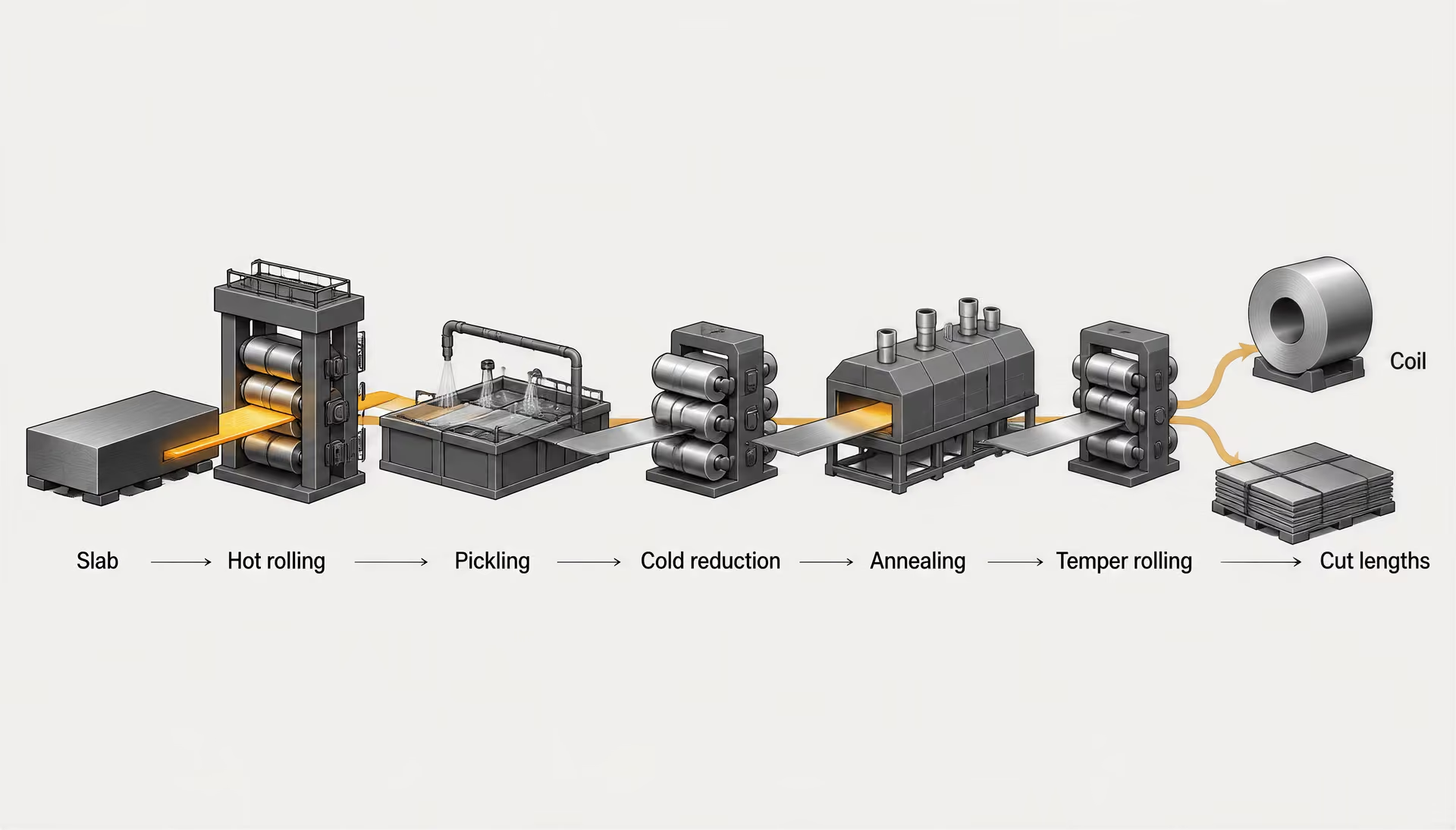
Typical flat-product route
- 1. Hot rolling Slab is reheated and reduced through successive mill stands.
- 2. Pickling Scale may be removed before further processing.
- 3. Cold reduction Gauge and surface finish are improved while work hardening develops.
- 4. Annealing Ductility and the required metallurgical response are restored or adjusted.
- 5. Temper rolling or coating Flatness, appearance, surface condition or corrosion protection is established.
Product form records part of the manufacturing history. Sheet and strip commonly pass through continuous rolling operations, often in coils, followed by pickling, cold reduction, annealing, temper rolling or coating. Plate may be produced by reversing-mill rolling or other plate-mill processes and supplied as discrete lengths. Sections and bars are generally rolled through shaped passes, although some bars receive subsequent cold finishing. Tubes may be seamless or welded. Forgings are shaped under compressive force, while castings solidify in a mould and can have different segregation, porosity and grain-flow characteristics from wrought products.
| A1088 category | Meaning in the article | Supply form |
|---|---|---|
| CP | Complex-phase steel sheet | Coils and cut lengths |
| DP | Dual-phase steel sheet | Coils and cut lengths |
| TRIP | Transformation-induced plasticity steel sheet | Coils and cut lengths |
These routes change the specification even when the nominal chemistry is similar. ASTM A1088-25 covers cold-rolled CP, DP and TRIP steel sheet supplied in coils and cut lengths. It addresses chemistry, mechanical properties, surface finish, appearance, dimensions and permissible variations. Those requirements are tied to cold-rolled sheet production and its intended forming behaviour; they cannot simply be transferred to hot-rolled plate of a similar carbon or manganese content.
| Delivery condition | Typical significance | Forms mentioned in the article |
|---|---|---|
| As-rolled | Properties reflect the rolling and cooling route | Plate, sections and bars |
| Normalized or normalized rolled | Refined structure and controlled delivery condition | Structural flat and long products |
| Thermomechanically controlled processed | Rolling schedule contributes to final properties | Structural products |
| Annealed | Improved ductility and reduced work hardening | Cold-rolled sheet and bars |
| Quenched and tempered | Strength, toughness and residual stress are adjusted by heat treatment | Pressure-purpose flat products and forgings |
Delivery condition is another independent variable. A product can be supplied as-rolled, normalized, normalized rolled, thermomechanically controlled processed, annealed, stress relieved or quenched and tempered, depending on the standard and grade. ISO 9328-6:2018 specifies technical delivery conditions for flat steel products used in pressure equipment, including weldable fine-grain steels supplied in quenched-and-tempered condition. The heat treatment affects yield strength, toughness, weldability and residual stress, so “the same grade” without its delivery condition is incomplete.
Surface condition carries its own requirements. Cold-rolled sheet may be ordered with a specified surface finish and appearance class; hot-rolled plate may be supplied descaled, as-rolled or with restrictions on repair of surface defects. A bar intended for machining may be bright finished, peeled or ground, whereas a rolled bar may retain mill scale. A tube may need a clean internal bore or a defined weld seam condition. Surface vocabulary is therefore part of the product specification, not decorative terminology.
Testing follows the route and the risk associated with the product. Plate for structural work may require tensile tests, bend tests, impact tests at a stated temperature and through-thickness properties. A pressure tube may require hydrostatic or nondestructive examination. A forging may require ultrasonic inspection from defined directions, while a casting may require radiography, magnetic-particle testing or liquid-penetrant examination focused on shrinkage and porosity. Heat analysis and product analysis also have different roles: the former represents the cast, while the latter verifies chemistry in the finished product within permitted variation.
Why product-specific standards exist
Product-specific standards exist because one generic steel rule cannot control every manufacturing route, geometry or failure mode. ISO/TC 17 organizes steel standardization into product groups that include continuous-mill flat-rolled products, structural steels, steel tubes and steel-product vocabulary. That structure reflects technical differences, not bureaucratic duplication.
| Included by ISO 630-1:2021 | Excluded by ISO 630-1:2021 |
|---|---|
| Plates | Sheet |
| Sections | Strip |
| Wide flats | Tubular products |
| Bars | — |
ISO 630-1:2021 excludes sheet, strip and tubular products from its stated scope. Strong evidence
ISO 630-1:2021 applies general technical delivery conditions to hot-rolled structural steel flat and long products, including plates, sections, wide flats and bars. It explicitly excludes sheet, strip and tubular products. The exclusion is significant: even within structural steel, the standard’s tolerances, testing arrangements and product descriptions are not intended to govern every form.
ASTM uses the same product separation. Its specifications address plates, structural shapes, sheet piling, bars, wire, tubular products, forgings and castings through different documents. A plate specification can define thickness tolerances and impact testing without defining tube weld examination; a casting specification can address mould-related discontinuities without prescribing the section properties listed for rolled shapes.
The end use adds another layer. Structural members depend on section properties and connection dimensions. Pressure equipment depends on toughness, weldability and resistance to rupture. Cold-formed sheet depends on forming limits, surface quality and coating compatibility. Forgings may require controlled grain flow and volumetric inspection, while castings may require acceptance levels for internal cavities.
For that reason, a valid callout should identify more than a chemical grade. It should state the product form and governing standard, then the grade, dimensions, delivery condition, surface condition and any supplementary inspection or marking requirements. “Carbon steel,” “S355,” or “A36” may begin the description; none, by itself, specifies whether the material is plate, section, bar, tube, forging or casting, nor whether the finished product meets the dimensional and inspection rules needed for its service.
2. The vocabulary of steel products: ISO 6929 and ISO/TC 17
[2] ISO 6929:2013 — Steel products — Vocabulary. International Organization for Standardization. International Standard, 2013.
ISO 6929:2013 is the terminology foundation for describing steel products. It supplies standardized terms for product families, including flat products, long products and tubular products, rather than treating every visible shape as a self-explanatory category. That distinction matters because a product name often carries assumptions about manufacturing route, dimensional limits, delivery form and the specification that governs inspection.
“Steel plate,” for example, is not simply any rectangular piece of steel. “Sheet” and “strip” may also be rectangular and may have similar surface appearance, but their definitions and applicable standards can differ. A rolled I-shaped member is not merely a bar with material removed from its sides; it belongs to the language of sections and is normally specified through section dimensions, mass, tolerances and section properties. A hollow rectangular product is not adequately described as a “box bar” when the applicable product family is a structural hollow section or a tube.
ISO 6929:2013 does not replace a product standard. It gives the vocabulary with which product standards can state their scope. Grade, product form, manufacturing process, delivery condition, surface condition, dimensions, mechanical requirements and intended service remain separate specification variables.
Flat products, long products and tubular products
Flat products are characterized by a broad, substantially plane cross-section produced in forms such as plates, sheet and strip. Width, thickness, edge condition and delivery length or coil form are central descriptors. Those terms are not interchangeable in every standards system. A specification may distinguish a product supplied in coils from one supplied as cut lengths, or may set different dimensional tolerances according to thickness and rolling route.[3] ASTM A1088-25 — Cold-Rolled Carbon and High-Strength Low-Alloy Steel Sheet. ASTM International. ASTM International Standard, 2025.
ASTM A1088-25 illustrates the point. It covers cold-rolled CP, DP and TRIP steel sheet supplied in coils and cut lengths. Its requirements address chemistry, mechanical properties, surface finish, appearance, dimensions and permissible variations. Calling material covered by ASTM A1088-25 “cold-rolled plate” would lose the product-form information that identifies the standard’s scope.
The boundary between sheet and plate can also depend on the governing specification, not only on a universal visual rule. ASTM A786/A786M-15(2025) defines floor plate as hot-rolled plate with raised figures on one surface. It permits supply in dimensions classified as sheet, heavy-thickness sheet coil or plate, while setting a maximum thickness of 25 mm. The raised pattern, supply form and dimensional classification therefore operate together. “Tread plate” or “checker plate” may communicate a visual feature, but “floor plate” under ASTM A786/A786M-15(2025) identifies a defined product category with technical limits.
Long products have a length that substantially exceeds their cross-sectional dimensions and are commonly supplied as individual lengths. The group includes bars, sections, rails, wire rod and related forms. A bar may be round, square, hexagonal or another solid profile; a section normally has a shaped cross-section, such as an I, H, channel or angle, intended to provide a particular distribution of area and section properties. A casual description such as “steel beam” does not state whether the item is an I-section, a welded built-up member, a hollow section or a bar.
AISC Shapes Database v16.0 demonstrates why section vocabulary must be tied to dimensional data. Published in 2022, it lists standardized structural steel shapes, their dimensions and section properties in U.S. customary and metric units, together with naming conventions. The designation of a W-shape or an unequal angle is meaningful only when linked to the relevant shape table and unit system. Mass per unit length, flange and web dimensions, area, moments of inertia and section moduli cannot be inferred reliably from a photograph.
Tubular products are defined by a hollow cross-section and include round, square and rectangular forms. Their specification has to address outside dimensions or diameter, wall thickness, length, straightness, forming or manufacturing route, weld condition where applicable, and pressure or structural performance. ASTM A1085/A1085M covers hollow structural sections in square, rectangular and round forms. Such geometry requires separate dimensional and section-property tables because a rectangular hollow section and a round tube respond differently to bending, compression, local buckling and connection detailing.
How standardized vocabulary prevents ambiguous descriptions
Product-form terms prevent a grade from being mistaken for a shape. “S355” identifies a strength designation in a relevant European specification; it does not, by itself, identify whether the product is a plate, section, bar or hollow section. Likewise, “A572 Grade 50” does not determine the product dimensions, surface condition or manufacturing route without the applicable ASTM product specification. A complete callout must connect the grade to the product standard.
ISO 630-1:2021 is a clear example of a defined boundary. It applies general technical delivery conditions to hot-rolled structural steel flat and long products, including plates, sections, wide flats and bars. It excludes sheet, strip and tubular products. The exclusion is not a semantic footnote: it prevents users from applying a delivery-condition standard to a product family whose dimensional conventions and requirements are addressed elsewhere.
The same separation appears in pressure-service material. ISO 9328-6:2018 specifies technical delivery conditions for flat steel products used in pressure equipment, including weldable fine-grain steels supplied in quenched-and-tempered condition. A plate ordered to that standard is not described completely by saying that it is “high-strength steel.” The service context, flat-product form, weldability requirements and quenched-and-tempered delivery condition all matter.
The National Structural Steelwork Specification similarly distinguishes rolled sections, structural hollow sections, plates and bars as separate constituent product types. Its complete designation must include the standard number, strength grade and impact quality. This is a practical safeguard: “S355 steel” is incomplete when the required impact quality and product standard have not been stated.
The ISO product-group structure
ISO/TC 17, the ISO technical committee responsible for steel standardization, organizes its work through product and subject groups rather than one universal specification for all steel forms. The structure includes continuous-mill flat-rolled products, structural steels, steel tubes and steel-product vocabulary, among other areas. That organization reflects manufacturing and performance differences.
Continuous-mill flat-rolled products require terminology and requirements suited to coils, cut lengths, rolling direction, surface finish and thickness variation. Structural steels require rules for sections, plates, bars and other load-bearing forms. Steel tubes require provisions for hollow geometry, joining or forming routes, dimensional control and, in some applications, pressure testing. Vocabulary work provides the common language that allows those product groups to refer to one another without collapsing their scopes.
ASTM follows a comparable principle by separating specifications according to product form and route, including plates, structural shapes, sheet piling, bars, wire, tubular products, forgings and castings. A forging and a casting may have the same nominal chemistry as a rolled bar, yet their solidification or deformation histories produce different inspection concerns and permitted discontinuities. Product form is therefore part of the technical identity of the steel, not a label added after the grade has been selected.
3. Sheet, strip and plate: related flat forms with different requirements
Sheet, strip and plate are all flat-rolled steel products, but the shared appearance does not make them interchangeable specification categories. Their differences arise from the rolling route, dimensional limits, delivery form, surface condition and intended fabrication process. A cold-rolled sheet for automotive forming is not simply a thinner plate, while a hot-rolled plate is not merely sheet supplied in a larger cut length.
ISO 6929:2013 provides standardized vocabulary for steel products and separates the language used for flat products, long products and tubular products. That vocabulary matters because a product designation normally carries more information than nominal thickness and width. Grade, delivery condition, finish, dimensional tolerance and testing requirements may change when the product category changes.

Continuous-mill flat-rolled products
Continuous-mill flat rolling begins with a slab that is reheated and passed through successive stands. Each stand reduces thickness and controls width, profile, crown and flatness. The resulting strip may leave the hot mill as a coil, proceed through pickling and cold reduction, or undergo annealing, temper rolling, coating and other finishing operations. The route determines much of the material’s final behavior.
Hot rolling produces a scale-covered surface unless the scale is removed. Pickling can remove that scale, but it does not turn the product into cold-rolled sheet. Cold rolling reduces thickness at lower temperature and improves gauge control and surface finish, while also changing the steel’s work-hardening state. Annealing may restore ductility; temper rolling can adjust flatness, surface appearance and yield behavior. These steps are specification matters, not cosmetic details.
ASTM A1088-25 illustrates the distinction. It covers cold-rolled CP, DP and TRIP steel sheet supplied in coils and cut lengths. The designations refer to classes of advanced high-strength steel: complex-phase (CP), dual-phase (DP) and transformation-induced plasticity (TRIP) sheet. The specification addresses chemistry, mechanical properties, surface finish, appearance, dimensions and permissible variations. A purchaser specifying only “cold-rolled steel sheet” has omitted the strength class and several controls that affect forming, welding and inspection.
Transformation-induced plasticity (TRIP) A deformation mechanism in which retained austenite transforms progressively to martensite, increasing work hardening during forming.
Dual-phase (DP) steel A steel sheet microstructure consisting mainly of ferrite with harder second-phase constituents, commonly martensite.
The mechanical requirements also reflect the intended deformation route. A DP steel sheet may combine high tensile strength with useful uniform elongation through a ferritic matrix containing harder second phases. TRIP grades depend on retained austenite transforming during deformation, while CP grades use a more complex hardened microstructure. These are not interchangeable responses to the same nominal thickness. Forming limits, springback, weldability and required test values can differ even when two sheets have similar gauge.
Continuous mills commonly produce material in coils because the rolling operation is continuous. Coil supply reduces the need to stop the mill for each individual piece, but it shifts later operations to a processor or service center. The coil may be slit into narrower widths, leveled, cut to length, blanked or coated. Slitting creates strips from a wider parent coil; it does not change the steel grade, but it can introduce edge condition requirements and width tolerances that need separate control.
The word “strip” therefore describes a product form or dimensional relationship, not a grade. Strip is generally narrower than sheet and is often supplied in coil, but the numerical boundary between strip and sheet depends on the governing standard and product practice. Some specifications define width thresholds; others control a product under a named sheet or strip standard without relying on one universal industry cutoff. ISO 6929:2013 supplies common terminology, but it does not erase the product-specific limits written into individual standards.
Plate versus sheet and heavy-thickness sheet coil
Plate is normally associated with hot-rolled, relatively thick flat product, often supplied as individual lengths rather than a coil. Sheet usually refers to thinner flat product, frequently produced and shipped in coils or cut lengths. Those descriptions are useful, but they are not sufficient for specification work. Thickness ranges overlap, and a standard can assign a product to a category according to supply form, width and manufacturing route as well as thickness.
ISO 630-1:2021 demonstrates a deliberate boundary. It applies to hot-rolled structural steel flat and long products, including plates, sections, wide flats and bars, but excludes sheet, strip and tubular products. A structural plate ordered to a steel grade under ISO 630-1:2021 is therefore not automatically covered by the same technical delivery conditions as a sheet of similar chemistry and thickness. The exclusion is a specification boundary, not a claim that the products look different after cutting.[4] ASTM A786/A786M-15(2025) — Rolled Floor Plate. ASTM International. ASTM International Standard, 2025.
ASTM A786/A786M-15(2025) provides an especially clear example of overlapping terminology. It defines floor plate as hot-rolled plate with raised figures on one surface. The specification permits supply in dimensions classified as sheet, heavy-thickness sheet coil or plate, and sets a maximum thickness of 25 mm. A floor product can therefore carry a plate-related description while being supplied in a dimensional category associated with sheet or coil. Its raised pattern also introduces requirements that ordinary smooth plate does not have, including control of the patterned surface and the dimensional effects of the raised figures.
That example defeats a common shortcut: “plate” cannot be identified only by a thickness number, and “sheet” cannot be identified only by coil form. A 20 mm floor product in coil and a 20 mm smooth structural plate may differ in standard, surface geometry, permissible variation and inspection requirements. Cutting the coil into rectangular pieces does not make the result equivalent to plate ordered under a plate specification.
Pressure equipment provides another boundary. ISO 9328-6:2018 specifies technical delivery conditions for flat steel products used in pressure purposes, including weldable fine-grain steels supplied in quenched-and-tempered condition. The pressure-service designation adds requirements connected with weldability, toughness, heat treatment and testing. A plate of the right width and thickness but supplied under a general structural standard is not automatically a pressure-equipment product.
The same principle applies to floor plate, bridge plate, boiler plate and general structural plate. “Plate” identifies a broad form; the governing standard identifies the chemical limits, mechanical properties, heat treatment, surface condition, ultrasonic or other testing, and dimensional tolerances. Those controls cannot be inferred from the word alone.
Thickness, width, coil form and cut-length supply
Thickness and width are the first dimensional descriptors, but they do not operate independently. A specification may permit one thickness range in coil and another in cut lengths, or impose different flatness, edge, camber and length tolerances on each supply condition. A coil has an outside diameter, inside diameter, mass and winding direction in addition to nominal thickness and width. A cut length has length, squareness, flatness and edge requirements that do not apply in the same way to an uncut coil.
Coil supply is valuable to a continuous rolling process because the strip can remain connected through the mill. It is not automatically suitable for every fabrication operation. Coil memory, residual stress, telescoping, welds between successive coils and edge condition may influence leveling, blanking and feeding. When coil is leveled and cut, the processor must preserve the specified grade and thickness while meeting the cut-length tolerances. The resulting sheets are not necessarily certified under a different product standard merely because their physical form changed.
Width also affects classification. A wide flat product, a sheet, and a narrow strip may all be made by rolling, yet their standards can assign different limits for width deviation, crown, flatness and edge quality. Slit strip often has sheared edges, whereas mill edge or trimmed edge sheet may be subject to different requirements. The distinction becomes important in resistance welding, stamping, seam welding and any operation that relies on consistent edge geometry.
A specification must also state whether dimensions are nominal or guaranteed after processing. Cold-rolled sheet may have tight thickness and flatness limits but a surface-finish designation; hot-rolled plate may permit a different scale condition and larger dimensional variation. Neither tolerance set should be transferred from one form to another by assumption.
Product-form boundaries extend beyond flat products. ASTM A1085/A1085M covers hollow structural sections in square, rectangular and round forms, which require separate dimensional and section-property tables because wall thickness, corner radius and closed geometry affect behavior. AISC Shapes Database v16.0, published in 2022, lists standardized dimensions and section properties for structural shapes in U.S. customary and metric units. Those tables have no direct substitute in a plate or sheet specification.
The National Structural Steelwork Specification likewise treats rolled sections, structural hollow sections, plates and bars as separate constituent product types. Its complete designation includes the standard number, strength grade and impact quality. That practice is sound: “steel plate” states a form, not the full identity of the material. The complete order or design reference must connect form with grade, delivery condition, surface and dimensional requirements, and any impact, testing or end-use standard that governs the component.
4. Hot-rolled structural products under ISO 630-1
[5] ISO 630-1:2021 — Structural steels — Part 1. International Organization for Standardization. International Standard, 2021.
ISO 630-1:2021 sets general technical delivery conditions for hot-rolled structural steel flat and long products. Its product scope includes plates, sections, wide flats and bars. That wording is important: the standard does not classify every steel item used in a structure under one interchangeable product category. It establishes a framework for particular products made by hot rolling, with requirements applied through the relevant ISO 630 grade and product provisions.
ISO 6929:2013 provides the vocabulary behind this distinction. It separates steel products into groups such as flat products, long products and tubular products. Those groups describe geometry and manufacturing form, not strength grade by themselves. A plate and an I-section can both be supplied in a structural grade, yet they are produced, inspected, dimensioned and specified differently. The grade identifies the steel’s chemical and mechanical requirements; the product form determines how those requirements are expressed and verified.
ISO/TC 17 reflects the same separation in its standards structure, with product groups for continuous-mill flat-rolled products, structural steels, steel tubes and steel-product vocabulary. A specification therefore has to answer several questions at once: what steel grade is required, what product form is being supplied, what dimensions and tolerances apply, what delivery condition is permitted, and what inspection or impact requirements govern acceptance.
Plates and wide flats
A plate is a flat product whose width is substantially greater than its thickness and whose dimensions are normally supplied as individual pieces rather than as a continuous coil. In structural work, plate may form a girder web, flange, connection component, base plate or stiffener. Its performance is governed not only by nominal thickness and grade, but also by flatness, thickness tolerance, edge condition, internal soundness, surface condition and, where specified, through-thickness properties.
Hot rolling changes the steel’s shape and microstructure. Slabs are reheated and reduced between rolls, and the rolling schedule affects grain structure, residual stress and final dimensions. The process does not make every hot-rolled flat product equivalent. A plate supplied under ISO 630-1 has a different specification route from a pressure-vessel plate supplied under ISO 9328-6:2018. The latter addresses flat steel products for pressure purposes, including weldable fine-grain steels supplied in quenched-and-tempered condition. Both may be flat, thick and weldable, but the service requirement controls the applicable standard.
Wide flats occupy the boundary between plate-like and long products. They are flat, elongated products with a specified width and thickness, rolled continuously or in repeated passes and supplied in long lengths. Their geometry makes them useful as edge members, bracing components, connection elements and fabricated profiles. Unlike a plate cut from a large sheet, a wide flat is treated as a long product in the relevant product classification. That affects dimensional tables, permissible variation, ordering terminology and sometimes the inspection basis.
Terminology can overlap across standards and regions. ASTM A786/A786M-15(2025), for example, defines floor plate as hot-rolled plate with raised figures on one surface. It permits supply in dimensions classified as sheet, heavy-thickness sheet coil or plate, but limits the maximum thickness to 25 mm. The raised pattern is a surface feature, not a new strength grade. A floor plate’s structural designation must still identify the material specification and required properties; its patterned surface does not make it interchangeable with plain structural plate.
The distinction between plate and sheet also cannot be reduced to a single universal thickness cutoff. Different standards use different dimensional ranges and delivery conventions. Coil supply, cut lengths, thickness, width and intended processing can all affect the applicable product standard. ISO 630-1’s exclusion of sheet is therefore a scope decision tied to its product definitions and technical route, not a statement that sheet has no structural use.
Bars and structural sections
Long products are characterized by their extended shape and are commonly supplied in straight lengths. Bars may be round, square, hexagonal or flat, depending on the specification. Structural bars can serve as tension members, cleats, lacing elements, posts, ties or machined components. A flat bar and a wide flat may look similar in a drawing, but their defined width-to-thickness ranges, rolling practices and dimensional tolerances need not be the same.
Structural sections have a cross-sectional shape designed to provide resistance through geometry. Examples include I-sections, H-sections, channels, angles and tees. Their designation is not merely a description of appearance. An IPE 300, HEA 400 or an equal angle carries dimensional and section-property information associated with a recognized series; changing the series changes flange width, web thickness, area, mass and the values of second moment of area and section modulus.
AISC Shapes Database v16.0 illustrates this approach by listing standardized dimensions and section properties in U.S. customary and metric units. Designers use those tables to select and analyze shapes, while the material specification separately establishes grade, chemistry, tensile properties, yield strength, elongation and delivery requirements. The shape designation cannot replace the steel grade designation.
The National Structural Steelwork Specification makes the same point by treating rolled sections, structural hollow sections, plates and bars as separate constituent product types. Its complete designation includes the standard number, strength grade and impact quality. “S355” alone is therefore incomplete where the order or fabrication requirement calls for a particular standard and impact class. Product form and grade must travel together in the specification.
Delivery condition also matters. Hot-rolled structural products may be supplied as rolled, normalized or normalized rolled, or subject to another condition permitted by the governing standard. Heat treatment changes the resulting microstructure and mechanical response. Two products with the same nominal grade and similar dimensions may not satisfy the same requirements if one is supplied in a different delivery condition or under a specification intended for another service.
The significance of excluded product forms
ISO 630-1:2021 excludes sheet, strip and tubular products. This is a boundary of applicability, not a claim that those products are unrelated to structural steel. The exclusion prevents one general standard from absorbing products whose manufacture, geometry and inspection practices require separate rules.
Sheet and strip are commonly associated with continuous rolling, coil handling and thinner gauges. ASTM A1088-25 covers cold-rolled CP, DP and TRIP steel sheet in coils and cut lengths, with requirements for chemical composition, mechanical properties, surface finish, appearance, dimensions and permissible variations. Those requirements address a product route quite different from the heavy hot-rolled plates and long products covered by ISO 630-1.
Tubular products require their own dimensional and structural treatment because the closed cross-section affects local buckling, weld seams, corner geometry, wall thickness and section properties. ASTM A1085/A1085M covers hollow structural sections in square, rectangular and round forms. A square HSS cannot be specified by quoting the requirements for a solid square bar, just as a circular tube cannot be treated as a round bar with a hole drilled through it. The manufacturing route and geometry are part of the product identity.
Wrought product A steel product shaped by mechanical working after solidification, such as rolling, forging or drawing.
The same principle separates structural products from forgings and castings. A forging is shaped under compressive deformation, while a casting solidifies in a mould; each route creates different grain flow, defect risks and acceptance requirements. A hot-rolled plate, a rolled section, a welded HSS, a forging and a casting may all appear in one steel structure, but they do not share a single technical delivery condition. ISO 630-1 defines one important part of that system. It does not erase the boundaries that make product form a specification variable.
5. Structural sections and the role of section-property databases
Structural sections are not simply plate or bar cut into distinctive silhouettes. They are products made to controlled cross-sectional geometry, usually by hot rolling, cold forming or welding, and their specification must address both shape and steel grade. A section designation identifies a geometry or a family of geometries; it does not, by itself, establish yield strength, tensile strength, weldability, impact performance or delivery condition.
ISO 6929:2013 provides standardized vocabulary for steel products and separates terms used for flat products, long products and tubular products. That distinction matters because a rolled I-section, a cold-formed rectangular hollow section and a fabricated plate girder may occupy similar structural roles while following different dimensional rules and product standards. ISO 630-1:2021 applies to hot-rolled structural steel flat and long products, including plates, sections, wide flats and bars, but expressly excludes sheet, strip and tubular products. The boundary is technical, not merely visual.
I, H, channel, angle and tee forms
An I-section has two flanges connected by a web. In North American practice, the most common wide-flange family is the W-shape, such as W14x22. The letter W identifies the series, while the number and suffix conventionally indicate nominal depth and nominal weight in pounds per foot. The designation does not mean that every measured dimension equals the number printed in the name. A W14x22 has a nominal depth near 14 inches and a nominal mass of 22 lb/ft, but its tabulated depth, flange width, web thickness and flange thickness are separate values.
AISC also lists S-shapes, whose proportions differ from W-shapes, and M-shapes, which are miscellaneous wide-flange sections. HP-shapes are commonly used as bearing or piling sections and have proportions selected for that purpose. These letters identify shape series, not steel chemistry. A W-shape can be ordered or specified in different grades under the applicable material standard; its W designation remains a geometric and mass designation.
H-shapes are often used as a general visual term, but it should not replace the actual series designation. In some international catalogues, an H designation identifies a family governed by a particular dimensional system. In AISC terminology, the relevant series may be W, M or HP. Confusing an informal “H-beam” label with an AISC W-shape can lead to incorrect assumptions about flange proportions and section properties.
Channels place the web on one side of the centroidal width, with two flanges projecting from it. AISC identifies standard channels with C, as in C12x20.7, and miscellaneous channels with MC, as in MC12x...? where the complete designation includes the tabulated nominal series and weight. The channel’s open shape produces different strong- and weak-axis behavior from an I-section and can introduce torsional effects when loading is eccentric. A channel is therefore not interchangeable with a W-shape of similar area.
Angles have two legs meeting at approximately 90 degrees. Equal-leg angles may be designated, for example, L4x4x1/2; unequal-leg angles use two leg dimensions, such as L6x4x1/2. The angle’s centroid is offset from the intersection of the legs, and its principal axes generally do not coincide with the geometric horizontal and vertical axes used for a symmetric section. Connection detailing, eccentricity and buckling calculations may require properties about the principal axes rather than only the x and y axes.
A tee can be rolled as a tee or produced by splitting an I-section. AISC designations include WT, MT and ST series, corresponding to tee families derived from W-, M- and S-shapes. A designation such as WT6x13 identifies the series and nominal weight, not a universal tee geometry. The web and flange dimensions must be taken from the applicable table.
Tubular structural sections require a separate vocabulary. ASTM A1085/A1085M covers square, rectangular and round hollow structural sections, commonly designated HSS. An expression such as HSS 8x8x1/2 describes a square hollow section by nominal outside dimensions and nominal wall thickness; a round designation uses nominal outside diameter and wall thickness. Corner radii, actual wall thickness and manufacturing tolerances affect the calculated properties. The same area cannot be assumed to produce the same buckling or torsional response in an open section and a closed HSS.

Dimensions versus calculated section properties
| Information class | Examples | Use |
|---|---|---|
| Physical dimensions | Depth, flange width, web thickness, flange thickness and root radius | Fabrication, fit-up and connection detailing |
| Geometric properties | Area, moments of inertia, section moduli and radii of gyration | Structural analysis and member design |
| Material properties | Yield strength, tensile strength, elongation and toughness | Strength, ductility and fracture assessment |
| Inspection properties | Straightness, twist, surface condition and dimensional variation | Acceptance of the supplied section |
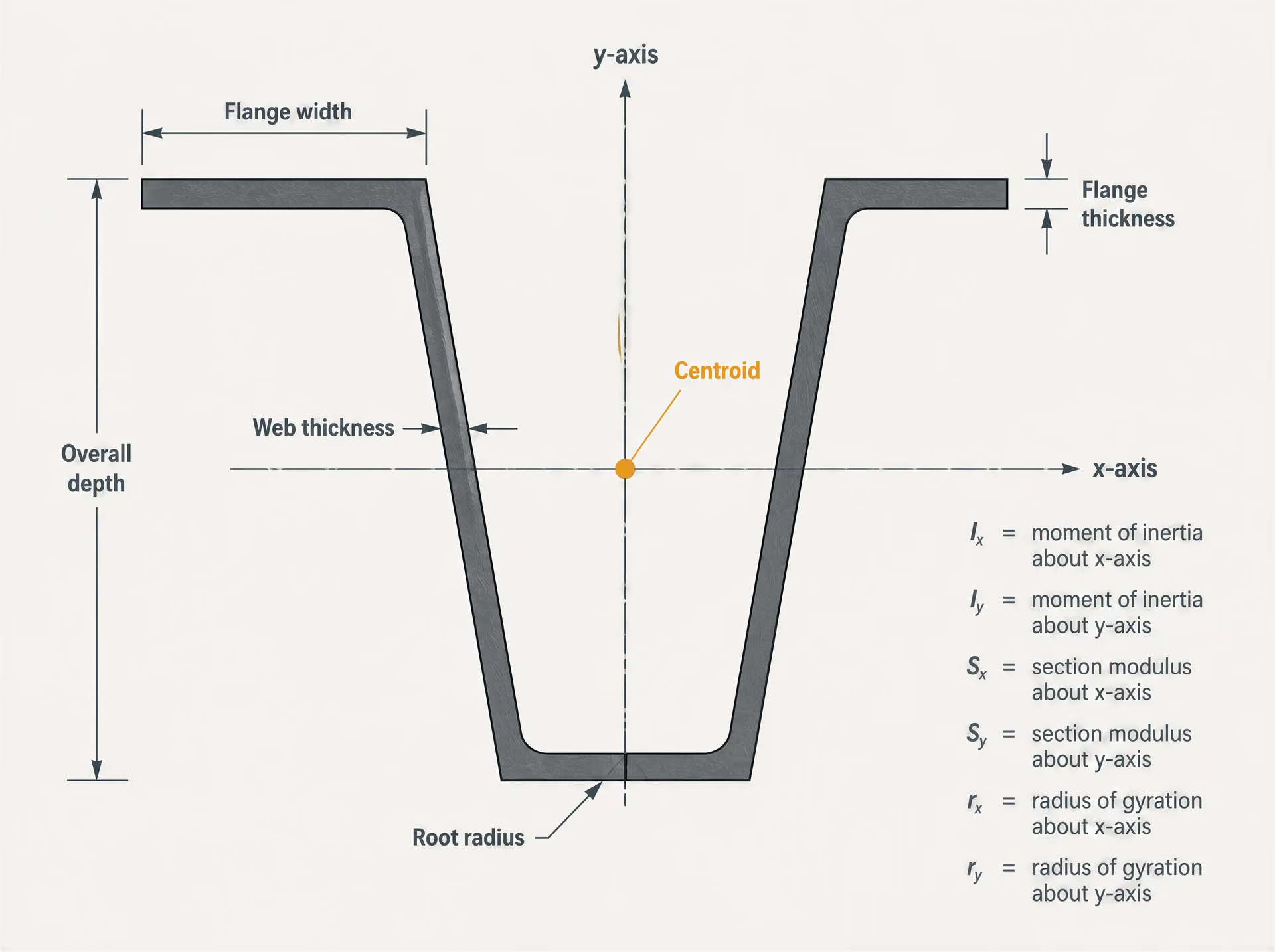
A section table contains two different kinds of information. Dimensions describe the physical boundary: overall depth, flange width, web thickness, flange thickness, outside diameter, wall thickness, root radius and, for some shapes, toe or fillet geometry. These values support fabrication, fit-up and connection detailing.
Calculated section properties describe the geometric response of that boundary. Cross-sectional area, A, determines mass per unit length when combined with steel density. The centroid locates the area’s balance point. The moments of inertia, Ix and Iy, quantify resistance to bending-related curvature about the chosen axes. The elastic section moduli, Sx and Sy, relate those moments of inertia to the extreme-fibre distances. Plastic section moduli, Zx and Zy, are used in plastic analysis where the applicable design rules permit them. The radii of gyration, rx and ry, equal the square root of the corresponding moment of inertia divided by area and appear in member-slenderness calculations. Torsional constant J, warping constant Cw and shear-centre data become important for torsion and lateral-torsional buckling.
These are geometric quantities, not material properties. A W14x22 made from one grade and a W14x22 made from another have essentially the same tabulated geometry, area and nominal section properties, while their yield strength, tensile strength, elongation, fracture toughness and welding requirements may differ. Conversely, two sections with similar area can have very different moments of inertia because their material is distributed differently from the centroidal axes.[6] AISC Shapes Database v16.0. American Institute of Steel Construction. AISC reference database, 2022.
AISC Shapes Database v16.0 does not replace the material standard or certify chemical composition and mechanical properties. Strong evidence
AISC Shapes Database v16.0, issued by the American Institute of Steel Construction in 2022, is a reference for standardized structural-shape dimensions, properties, units and naming conventions. It is not a steel material specification. It does not, by the shape name alone, certify a chemical composition, yield strength or tensile strength. Those requirements come from the material and product standards named in the project specification.
That separation prevents a common documentation error: writing only “W18x35 steel” when the required description also needs the material standard, grade, supplementary requirements and delivery condition. The shape tells the fabricator what cross-section and nominal mass are required. The material designation tells the supplier what steel must satisfy. Surface condition, heat treatment, impact quality and inspection requirements may still need separate statements.
AISC naming and unit conventions
AISC Shapes Database v16.0 presents U.S. customary and metric data. In U.S. customary tables, lengths are generally in inches, area in square inches, moments of inertia in inches to the fourth power, section moduli in inches to the third power, radii of gyration in inches and mass per length in pounds per foot. Metric tables provide corresponding values in millimetres, square millimetres, millimetres to the fourth power, millimetres to the third power, millimetres and kilograms per metre.
The unit system must be read with the designation. W14x22 uses the U.S. convention of nominal inches and pounds per foot. A metric designation such as W360x134 should not be converted by replacing the numbers mechanically; the database’s metric naming and tabulated dimensions control. Rounding can also make a converted value differ from a nominal designation.
Database values are calculated or tabulated for a defined idealized shape and may include fillets, radii and other geometric features according to the database rules. They should not be confused with inspection measurements on a particular delivery length. Mill tolerances, straightness, camber, residual stress and local imperfections are separate specification matters. Nor should a database entry substitute for a product standard: ASTM, EN, ISO or other governing documents establish manufacturing, dimensional tolerance, mechanical and inspection requirements for the supplied section.
The National Structural Steelwork Specification makes the same practical distinction by treating rolled sections, structural hollow sections, plates and bars as separate product types. Its complete designation includes the standard number, strength grade and impact quality. A section schedule that omits those elements is geometrically suggestive but technically incomplete. That is why section-property databases are essential for analysis, yet insufficient as stand-alone product specifications.
6. Bars, wire and other long-product forms
Long products are not defined by length alone. A round bar, a wire rod, a cold-drawn wire, a rolled I-section and a square hollow section may all be supplied as long, mill-produced pieces, yet their specifications address different manufacturing routes, geometries and inspection risks. Product form is therefore part of the technical designation, alongside grade, dimensions, delivery condition and surface requirements.
ISO 6929:2013 provides standardized vocabulary for steel products and separates flat products, long products, tubular products and other forms. That vocabulary matters because a specification written for one group does not automatically transfer to another. ISO 630-1:2021, for example, covers hot-rolled structural steel flat and long products, including plates, sections, wide flats and bars, but excludes sheet, strip and tubular products. The exclusion is not a minor editorial detail: thickness ranges, rolling practice, dimensional tolerances and testing provisions differ between those product families.
Bars versus structural sections
A bar is generally specified by a relatively simple solid cross-section. Common forms include round, square, hexagonal and flat bar, while special bar shapes may be produced for machining, wear components or fabrication. A structural section has a geometry selected for its section properties: area, second moment of area, torsional constant, radius of gyration and related values used in design. An I-section, channel, angle, tee or hollow section cannot be specified adequately by mass per metre and an outside dimension alone.
ASTM makes this distinction visible through separate product specifications. ASTM A6/A6M addresses general requirements for rolled structural steel bars, plates, shapes and sheet piling, while other ASTM standards address particular grades or applications. Structural shapes are identified through established designations such as W, S, M, HP, C, MC, L and WT shapes in U.S. practice. AISC Shapes Database v16.0, published in 2022, gives standardized dimensions and section properties in U.S. customary and metric units. A W-shape designation therefore carries information about a recognized geometric series, not merely the fact that the product is “bar-like” and long.
Hollow structural sections require a separate treatment again. ASTM A1085/A1085M covers square, rectangular and round hollow structural sections. Their specification must control outside dimensions, wall thickness, corner geometry, straightness and section properties, with requirements suited to a product made by forming and welding or other tube-producing operations. A solid square bar and a square HSS may have similar external dimensions but cannot be substituted on the basis of shape words alone. Their mass, local buckling behavior, weld location, dimensional tolerances and design tables are different.
Terminology also varies between standards and industries. A flat bar may be a long product under one classification, while a wide flat or plate may fall under a structural flat-product specification according to width and thickness. ASTM A786/A786M-15(2025) defines floor plate as hot-rolled plate with raised figures on one surface and permits supply in dimensions classified as sheet, heavy-thickness sheet coil or plate, with a maximum thickness of 25 mm. The raised pattern changes the surface requirement, but it does not turn the product into a structural section or a bar.
For structural steelwork, the complete designation must identify more than the profile. The National Structural Steelwork Specification distinguishes rolled sections, structural hollow sections, plates and bars, and requires a complete designation to include the standard number, strength grade and impact quality. “Bar” is consequently only one part of the product description. Diameter or width, length, end condition, straightness and surface class may still be required.
Wire and wire-product specification logic
Wire begins with a different dimensional and production logic from ordinary bar. Wire rod is commonly a hot-rolled intermediate product supplied in coils; wire is then produced by drawing, often through one or more dies, to reduce diameter and improve dimensional control. The finished wire may be round, shaped, coated, stranded or incorporated into another product. Its specification therefore concentrates on diameter or cross-sectional dimensions, tolerance, tensile strength, ductility, torsion or wrapping performance, surface condition and coating mass where applicable.
ASTM A510/A510M addresses general requirements for wire rods and coarse round wire in carbon steel. Product-specific standards then add requirements linked to the intended wire product. ASTM A641/A641M, for example, covers zinc-coated carbon steel wire, so coating adherence, coating weight and surface condition become central requirements in addition to steel chemistry and mechanical properties. Stainless steel wire follows another specification family, such as ASTM A580/A580M, whose requirements differ from those for carbon wire because corrosion-resistant alloy composition and condition are part of the product definition.
Wire rope, spring wire, welding wire, tire cord, reinforcing wire and wire mesh cannot be treated as interchangeable simply because each contains drawn steel wire. A spring-wire specification may require high tensile strength and controlled fatigue behavior; welding wire may require limits on composition, surface cleanliness and feeding consistency; galvanized fence wire requires coating performance. The downstream product can therefore determine tests and acceptance criteria that would not appear in a generic bar specification.
Coil delivery also changes inspection and handling requirements. A wire coil is not a series of individually straight lengths, so straightness may be assessed after unwinding or may be controlled through a specified coil condition. Cut wire, welded mesh and prestressing wire introduce additional requirements for length, weld integrity, relaxation or dimensional stability. The same nominal diameter does not establish the same permissible variation or mechanical condition.
Rolled, drawn and otherwise processed long products
Manufacturing route is a specification variable because it changes grain flow, surface quality, residual stress and dimensional accuracy. Hot-rolled bar leaves the mill at elevated temperature and commonly carries a mill scale surface. Cold-drawn or cold-finished bar is pulled through a die, or otherwise finished by turning, peeling or grinding, to obtain tighter dimensions and a more controlled surface. The process can raise strength through cold work while reducing ductility unless a subsequent heat treatment restores the required condition.
A designation such as “cold-drawn round bar” should not be reduced to the grade and diameter. The order may need to state annealed, normalized, quenched-and-tempered or cold-worked delivery condition; allowable straightness deviation; diameter tolerance; surface class; end preparation; and whether decarburization, seams or laps are restricted. Turned and ground products may satisfy a surface requirement that hot-rolled material cannot meet, while a peeled product may remove a defined depth of surface material without having the same dimensional range as ground stock.
Long products can also be forged, upset, heat treated, machined or coated after rolling. Forged bars have a different deformation history from rolled bars, and their specifications may control forging reduction, grain flow, ultrasonic examination or test location. Reinforcing bars add rib geometry, bend performance and mechanical requirements to the basic long-product form. Bright steel products may be supplied to a dimensional standard that is tighter than the corresponding hot-rolled range, but that does not make them structural sections.
Grade, form and condition must remain separate in technical writing. ISO 9328-6:2018 specifies delivery conditions for flat steel products used in pressure equipment, including weldable fine-grain steels supplied quenched and tempered; that example shows why a grade designation alone cannot identify the required product. For long products, the same principle applies: diameter or profile identifies geometry, while the standard, grade, manufacturing route, heat treatment, surface condition and tolerances define what the product actually is.
7. Tubular products and hollow structural sections
Tubular products form a separate steel product family, not a round version of bar or a folded version of plate. Their defining feature is a closed cross-section, usually produced by forming flat steel and joining it longitudinally, or by piercing and rolling a solid billet in a seamless process. The manufacturing route affects weld location, dimensional tolerance, residual stress, surface condition and permissible inspection methods. Those differences are reflected in product standards.
ISO 6929:2013 places tubular products alongside flat products and long products in standardized steel-product vocabulary. That classification matters because product geometry changes the relevant measurements and engineering properties. ISO 630-1:2021, for example, applies to hot-rolled structural steel flat and long products such as plates, sections, wide flats and bars, but expressly excludes sheet, strip and tubular products. A hollow structural section therefore should not be specified as though it were an open rolled section, even when both are used as columns or beams.

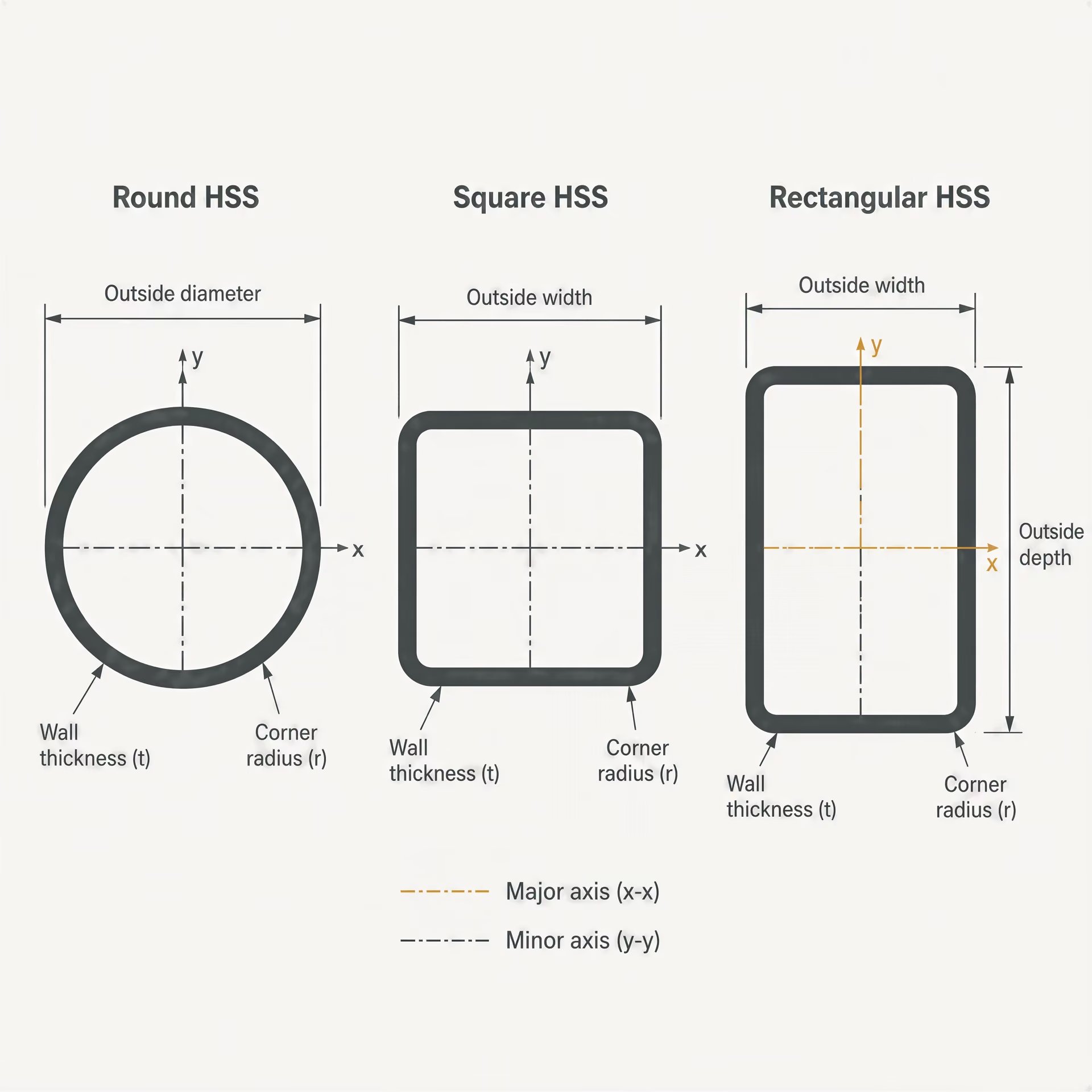
| HSS form | Primary geometry | Axis behavior described in the article |
|---|---|---|
| Round | Outside diameter and wall thickness | Equal bending properties about perpendicular centroidal axes |
| Square | Side dimension, wall thickness and corner radii | Approximately equal orthogonal properties |
| Rectangular | Depth, width, wall thickness and corner radii | Distinct major- and minor-axis properties |
Round, square and rectangular hollow sections
Round HSS have a circular outside profile and, in most structural applications, a concentric or nearly concentric bore. The principal geometric variables are outside diameter, wall thickness and length. Because the cross-section has continuous rotational symmetry, its centroidal second moments of area about any two perpendicular axes are equal. A round HSS consequently has no strong and weak bending axis in the way a rectangular HSS does. Its closed perimeter also gives it efficient resistance to torsion relative to an open I-, channel- or angle-shaped section.
Square HSS have four nominally equal flat sides joined by rounded corners. Their two principal centroidal axes have equal section properties when the section is manufactured within the specified dimensional tolerances. They are therefore useful where bending may occur about either orthogonal axis, or where a uniform appearance and repeated connection orientation matter. The corners are not sharp ninety-degree folds. Corner radius affects the exact steel area, flat-width limits, local buckling behavior and calculated section properties.
Rectangular HSS retain the closed form but have unequal outside dimensions. A typical designation gives the larger overall depth and smaller overall width, followed by wall thickness, although the applicable standard and design convention must be checked. The larger dimension creates a major axis with a higher moment of inertia and section modulus; the smaller dimension defines the minor axis. A rectangular HSS can therefore be oriented to place its stronger bending axis in the direction of the principal load.
These forms cannot share one geometry table. For a round HSS, diameter controls the radial geometry and the two bending axes are equivalent. For a square HSS, side dimension and corner radius govern equal orthogonal properties. For a rectangular HSS, depth, width, unequal radii and wall thickness produce different major- and minor-axis values. The same nominal wall thickness can also lead to different gross area, clear width, slenderness limits, torsional constant and plastic section modulus across the three forms.
“Hollow structural section” is a structural designation, while “tube” is a broader product term. A pressure tube, boiler tube, mechanical tube and structural HSS may all be hollow and may all be circular, but their specifications can impose different requirements for chemistry, heat treatment, testing, dimensional tolerance, surface condition and end finish. Geometry alone does not identify the applicable product standard.
Tube-specific dimensional and manufacturing concerns
HSS dimensions are commonly stated as nominal outside dimensions and nominal wall thickness. The actual wall is subject to permitted negative and positive variation, so a designer must distinguish nominal geometry from measured geometry and from the effective dimensions used in a particular design check. Corner radii are equally important. In square and rectangular HSS, the outside corner radius and inside corner radius influence the flat portions of the wall, the net cross-sectional area and the local slenderness of each element.
Manufacturing begins with a strip or plate-like feedstock in many welded products. The material is progressively formed into a circular, square or rectangular shape, then joined along a longitudinal seam. Square and rectangular sections may be formed directly or produced by shaping a round welded tube. A welded seam does not make the product an open section; it is part of a closed wall, and the governing specification determines weld quality, inspection and permitted discontinuities. Seamless products follow a different route, generally involving piercing and subsequent elongation or sizing, with different dimensional and surface considerations.
The finished section may be cut to length, saw-cut, beveled, drilled or otherwise prepared, but these operations do not change its product family. End squareness, twist, straightness, corner geometry and local denting can affect fit-up and connection design. A round tube can also be measured by outside diameter, inside diameter or nominal diameter depending on the standard, while structural HSS tables usually organize dimensions around outside dimensions and nominal wall thickness. Confusing pipe-size terminology with HSS dimensions can produce a section that is visually similar but not specified or calculated on the same basis.
The designation must also separate product form from material grade and delivery requirements. ASTM A1085/A1085M covers hollow structural sections in round, square and rectangular forms. It is not a generic label for every hollow steel product. A complete specification still requires the standard designation, grade or strength requirements where applicable, dimensions, length, testing provisions and any project requirements concerning welding, impact performance or surface condition. The standard’s requirements govern the product; a drawing that merely says “steel tube” leaves too much unspecified.
The distinction is parallel to the one made in other steel families. ASTM A1088-25 covers cold-rolled CP, DP and TRIP steel sheet in coils and cut lengths, not HSS. ASTM A786/A786M-15(2025) defines floor plate as hot-rolled plate with raised figures on one surface and permits supply in dimensions classified as sheet, heavy-thickness sheet coil or plate, with a maximum thickness of 25 mm. Neither specification becomes applicable simply because a tubular product began as flat steel. A manufacturing starting material and a finished product form are different specification variables.
ASTM A1085/A1085M and AISC geometry tables
ASTM A1085/A1085M is important because it treats square, rectangular and round HSS as one related but geometrically differentiated family. Its scope does not erase the distinctions among those shapes. The standard supplies product requirements; it does not replace structural design tables or authorize a designer to transfer properties from one shape to another.
AISC references organize HSS by nominal outside dimensions and wall thickness, then provide calculated geometric properties. AISC Shapes Database v16.0, published in 2022, lists standardized dimensions, section properties, naming conventions and units in both U.S. customary and metric systems. For HSS, the relevant entries include area, weight per unit length, outside dimensions, nominal wall thickness, corner-radius assumptions and properties about the major and minor axes. Round entries instead use diameter-based geometry and equal-axis properties.
Those tables must not be confused with tables for open structural shapes. A W shape has flanges and a web exposed to the surrounding space; an HSS has a closed wall. An angle, channel or tee has different plate-element boundaries, torsional behavior and connection surfaces. AISC geometry tables for those sections cannot supply valid HSS properties merely because the area or overall depth appears close.
Section properties are also not interchangeable with design resistance. AISC tables provide geometric data, while the applicable specification and design standard determine limit states such as local buckling, yielding, fracture, compression resistance, flexural resistance and connection behavior. Wall slenderness may depend on flat width between rounded corners rather than the full outside dimension. Welded HSS connections can introduce concentrated forces, wall plastification and punching-type limit states that do not occur in the same manner in an open rolled beam.
For that reason, a complete HSS callout identifies the shape, nominal dimensions, wall thickness, length, applicable standard and grade. The geometry tells the engineer what the member is. ASTM A1085/A1085M tells part of the manufacturer’s product requirements. The AISC tables supply consistent dimensions and properties for calculation. None of those elements should be substituted for another.
8. Floor plate and patterned surfaces: when surface geometry is part of the form
Floor plate demonstrates why steel product form cannot be identified from thickness alone. It is still a flat, hot-rolled product, but its working surface has a designed pattern that changes the product’s specification, handling and dimensional description. A plain plate and a patterned floor plate may have similar base-metal thicknesses, yet they are not interchangeable categories.
Raised figures on one surface
ASTM A786/A786M-15(2025) defines floor plate as hot-rolled plate with raised figures on one surface. The figures are part of the rolled product, not a later coating, weld deposit or machined feature. That distinction matters: the surface geometry is produced during rolling and becomes part of the product identity.
The raised pattern can improve traction under foot or reduce sliding of equipment, but those functional effects do not turn floor plate into a separate structural grade. Grade, chemical composition, tensile properties, impact requirements, delivery condition and surface quality remain specification matters. A patterned surface does not, by itself, establish that the steel is structural steel, pressure-vessel steel or a particular carbon equivalent.
The nominal thickness also needs careful reading. For a patterned product, the purchaser and fabricator must distinguish the base metal from the height of the raised figure. The figure increases the overall surface profile, but it should not be treated as extra structural thickness when calculating section resistance, welding preparation or mass per unit area. The applicable order and dimensional requirements control how thickness, width, length and permissible variation are measured.
This is one reason a visual description such as “checker plate” is inadequate for technical identification. It may describe the appearance, but it does not state the governing ASTM specification, steel grade, pattern requirements, dimensional class or permitted deviations. A product designation must carry those details.
The distinction aligns with the vocabulary approach in ISO 6929:2013, which standardizes terms for flat products, long products, tubular products and other steel forms. “Flat product” describes a broad product family. It does not erase the differences between sheet, strip, plate and patterned plate, nor does it prescribe the mechanical requirements of a particular grade.
ASTM A786/A786M classification boundaries
ASTM A786/A786M-15(2025) is a useful case because it permits floor plate to be supplied in dimensions classified as sheet, heavy-thickness sheet coil or plate. The specification therefore links three ideas that are often wrongly treated as synonyms: the product’s surface configuration, its manufacturing form and its dimensional category.
The standard limits the maximum thickness of floor plate to 25 mm. That stated ceiling is important. A thicker hot-rolled product with a raised surface should not automatically be called ASTM A786/A786M floor plate merely because it resembles the product visually. Once thickness, delivery form or other requirements move outside the standard’s defined scope, another specification or a separately agreed product description is needed.
“Sheet,” “heavy-thickness sheet coil” and “plate” describe supply and dimensional classifications, not three different raised patterns. Sheet and heavy-thickness sheet coil are associated with coil-based production and supply conventions, while plate is generally supplied as cut lengths. The rolling route affects achievable dimensions, coil handling, cutting practice, edge condition and the dimensional tolerance system that applies. A floor plate cut from a coil is therefore not described in exactly the same way as a discrete plate rolled and supplied as a plate product, even if both have raised figures on one surface.
That boundary also explains why ASTM product standards must be read individually. ASTM A1088-25 covers cold-rolled CP, DP and TRIP steel sheet in coils and cut lengths, with requirements for chemistry, mechanical properties, surface finish, appearance, dimensions and permissible variations. It is not a floor-plate standard, and its cold-rolled sheet terminology cannot simply be transferred to hot-rolled patterned products. Likewise, ASTM A1085/A1085M covers square, rectangular and round hollow structural sections; those products require outside dimensions, wall thickness, corner geometry and section-property tables rather than a flat-product thickness-and-width description.
The same separation appears in structural references. ISO 630-1:2021 covers hot-rolled structural steel flat and long products, including plates, sections, wide flats and bars, but excludes sheet, strip and tubular products. The exclusion is not a semantic quibble. It signals different production routes and different technical delivery frameworks. AISC Shapes Database v16.0, published in 2022, records standardized dimensions and section properties for structural shapes in U.S. customary and metric units; it does not convert a floor plate into a rolled section.
Flatness, dimensions and permissible variation
Flatness is especially significant when raised geometry is present. The base plate must remain sufficiently flat for laying, cutting, welding and supporting loads, while the figures must retain their intended profile without being counted as random surface irregularities. A specification may therefore control overall flatness, thickness, width, length, squareness, edge condition and pattern-related features through separate provisions or referenced tolerance standards.
Permissible variation is not the same as a guaranteed exact dimension. A plate ordered at a stated thickness or width is supplied within the tolerances allowed by ASTM A786/A786M and any referenced general requirements. Rolling temperature, cooling, residual stress, cutting and pattern formation can affect deviation from the nominal value. Flatness can also change after thermal cutting or fabrication, even when the as-delivered product complies.
The engineering consequence is direct: dimensions used for design, nesting, fit-up and weight calculations must come from the applicable tables and measurement rules, not from a ruler placed over the highest point of the pattern. Delivery condition and surface condition must be recorded separately from grade. A pressure-equipment flat product, for example, may fall under ISO 9328-6:2018 and be supplied as weldable fine-grain steel in quenched-and-tempered condition; its flat geometry does not make it floor plate.
Floor plate is therefore a strong example of form as specification. It is flat, but not merely flat. Its raised figures, hot-rolled route, dimensional classification and 25 mm maximum thickness work together to define the product covered by ASTM A786/A786M-15(2025).
9. Cold-rolled advanced high-strength steel sheet
ASTM A1088-25 shows why “sheet” is not a sufficient product description. Its title identifies the product as cold-rolled steel sheet, then identifies three metallurgical families: complex phase (CP), dual phase (DP) and transformation-induced plasticity (TRIP) steel. It also states how the material is supplied: in coils and cut lengths. Product form, processing route and metallurgical category are therefore part of the specification itself, not labels added after manufacture.
That distinction matters because steel products with similar thicknesses can have different standards, tolerances and acceptance tests. ISO 6929:2013 provides standardized vocabulary for flat products, long products, tubular products and other steel forms, but a vocabulary term does not replace a product specification. A cold-rolled sheet, a hot-rolled plate, a structural hollow section and a forged component require different controls because their shapes and manufacturing histories produce different dimensional and metallurgical conditions.
ASTM A1088-25 is directed at flat, cold-rolled sheet rather than at plate, sections or tubular products. The sheet may be delivered wound into a coil or unwound and cut into specified lengths. That supply form affects handling and inspection, while the cold-reduction route affects surface quality, thickness control, work hardening and the final response to forming. It does not turn the material into a generic “high-strength steel” category.
Complex phase, dual phase and TRIP designations
The CP, DP and TRIP designations describe microstructural design strategies, although the specification still controls the material through measurable chemistry and mechanical properties.
Complex phase steel contains a hard, strengthened matrix with small proportions of phases or constituents such as martensite, bainite and retained austenite. Grain refinement and precipitation can also contribute to strength. The resulting structure is intended to combine high strength with more usable forming capacity than a fully martensitic sheet of comparable strength. CP grades are commonly selected where resistance to local deformation and crash loading matters, but the designation alone does not state a finished part’s forming limit.
Dual phase steel has a relatively soft ferritic matrix containing hard martensite islands. When the sheet is strained, the difference in hardness between these constituents produces a pronounced initial work-hardening response. DP steel can therefore provide substantial tensile strength while retaining elongation suitable for many formed components. The grade designation must still be read with its specified yield strength, tensile strength and elongation requirements; “DP” by itself is a family name, not a complete material callout.
TRIP steel depends on retained austenite that transforms progressively to martensite during plastic deformation. This transformation-induced plasticity raises work hardening during forming and can delay localized necking. Silicon, aluminium and carbon control are often important to the processing route because the steel must retain an appropriate austenite fraction after cooling and annealing. Actual chemistry limits, however, belong to the applicable grade in ASTM A1088-25 rather than to a broad textbook description of TRIP metallurgy.
ASTM A1088-25 names CP, DP and TRIP as specification categories and assigns grade designations within those families. A designation such as DP 600 communicates a family and a strength level, but it does not communicate every requirement needed for manufacture or design. The full order or drawing reference must also identify the governing standard, thickness, width, length or coil condition, surface requirement and any supplementary provisions. A designer should not substitute a DP grade for a CP or TRIP grade solely because their nominal tensile-strength numbers appear similar. Their yield behavior, work hardening, elongation, bend response and forming limits can differ.
The distinction is also visible in the wider standards system. ISO 630-1:2021 applies general technical delivery conditions to hot-rolled structural steel flat and long products, including plates, sections, wide flats and bars, while excluding sheet, strip and tubular products. That exclusion is not a minor editorial choice. It prevents a hot-rolled structural plate rule from being treated as a cold-rolled automotive sheet rule.
Coils and cut lengths
ASTM A1088-25 permits supply in coils and cut lengths, but those forms are not interchangeable in every practical or contractual sense. A coil is a wound length of sheet whose width and thickness remain specified, while its individual part lengths are produced later by levelling and cutting. A cut length is supplied as a discrete sheet with specified length and width, making flatness, edge condition and length tolerance directly inspectable on each piece.
Coil supply can introduce issues associated with the leading and trailing ends, welds in a processed coil, telescoping, camber and variations through the winding sequence. Cut lengths can expose different concerns, including squareness, flatness after levelling and edge quality after shearing. The standard’s requirements for dimensions and permissible variations establish the limits; the word “coil” does not erase those limits.
This is another reason not to confuse sheet with plate. ASTM A786/A786M-15(2025) defines floor plate as hot-rolled plate with raised figures on one surface and permits supply in dimensions classified as sheet, heavy-thickness sheet coil or plate, subject to a maximum thickness of 25 mm. That terminology overlap concerns dimensions and supply practice, not the metallurgical identity of ASTM A1088 cold-rolled CP, DP or TRIP sheet. A raised-pattern hot-rolled floor plate is not an alternative form of advanced high-strength cold-rolled sheet.
Chemistry, mechanical properties and surface requirements
ASTM A1088-25 treats chemical composition as a controlled requirement rather than as background information. Limits for elements such as carbon, manganese, silicon, phosphorus, sulfur and alloying or microalloying additions constrain weldability, phase formation, strength and processing response. In TRIP grades, chemistry supports the retained-austenite mechanism; in DP and CP grades, it supports the intended ferritic, martensitic, bainitic or refined-phase balance. A heat analysis and any required product analysis must be assessed against the grade limits stated by the specification.
Mechanical properties provide the next layer of identification. Yield strength, tensile strength and elongation distinguish strength classes within and between CP, DP and TRIP families. These values are not interchangeable with hardness alone. Tensile testing also depends on specimen orientation, gauge length and the test provisions referenced by the standard, so a reported elongation needs its test basis. Forming calculations should use the specified grade data and verified sheet direction, not a generic value for “AHSS.”
The specification also addresses surface finish and appearance. Cold-rolled sheet is often used where surface condition affects coating, painting, joining or visible-part quality. ASTM A1088-25 therefore does more than state a strength requirement: it establishes expectations for surface finish, appearance and permissible imperfections, together with provisions governing whether defects may be repaired, removed or rejected. Surface scale, staining, scratches, slivers and roll marks cannot be judged under rules written for rough hot-rolled plate.
Dimensional requirements complete the product definition. Thickness, width, length, flatness, edge condition and allowable variation are specification matters, not informal descriptions. The applicable tolerances determine whether a supplied coil or cut length conforms even when its chemical analysis and tensile results are acceptable.
The same separation appears in other product standards. ASTM A1085/A1085M covers square, rectangular and round hollow structural sections, whose closed geometry requires separate outside-dimension, wall-thickness and section-property tables. AISC Shapes Database v16.0 lists standardized structural-shape dimensions and properties in U.S. customary and metric units. ISO 9328-6:2018, by contrast, addresses flat steel products for pressure purposes, including weldable fine-grain steels supplied in the quenched-and-tempered condition. Each document links geometry to a particular manufacturing route and service requirement. ASTM A1088-25 does the same for cold-rolled CP, DP and TRIP sheet.
10. Pressure-purpose flat products and delivery condition
Pressure equipment as a distinct application context
A plate is not defined only by its rectangular shape. Its specification also records how it was made, what service it must withstand and what condition it must have at delivery. This distinction becomes critical when the plate forms part of a pressure vessel, boiler, storage tank, heat exchanger or other pressure-retaining assembly. Such equipment is designed around internal pressure, temperature, cyclic loading, fracture resistance, corrosion exposure and weld integrity. A generic hot-rolled plate description does not establish any of those controls.
ISO 6929:2013 provides standardized vocabulary for steel products and separates the language used for flat products, long products, tubular products and other forms. “Flat product” identifies a product geometry and manufacturing family; it does not, by itself, identify a pressure-vessel grade. The same broad shape can be supplied under a structural-steel standard, a general engineering specification, a shipbuilding specification or a pressure-purpose specification, with materially different requirements for chemistry, testing and heat treatment.[7] ISO 9328-6:2018 — Flat Steel Products for Pressure Equipment. International Organization for Standardization. International Standard, 2018.
ISO 9328-6:2018 demonstrates this difference directly. It specifies technical delivery conditions for flat steel products used in pressure equipment, including weldable fine-grain steels supplied in the quenched-and-tempered condition. The standard therefore combines several specification variables: the product is flat, its intended function is pressure service, its metallurgy is designed for weldability and fine grain size, and its delivery state is produced by a defined heat-treatment route. Geometry is only one part of the designation.
This is why “pressure-vessel plate” should not be treated as a synonym for thick plate. Thickness may affect the applicable requirements, but it does not create them. A pressure-purpose specification can impose limits on carbon, sulfur, phosphorus and alloying elements; require tensile, yield and impact tests; prescribe testing through the thickness; control weldability through carbon-equivalent limits; and define delivery tolerances, surface condition and inspection documentation. None of these obligations follows merely from calling the product plate.
ISO 630-1:2021 illustrates the boundary from another direction. It applies to hot-rolled structural steel flat and long products, including plates, sections, wide flats and bars, but excludes sheet, strip and tubular products. A plate supplied to ISO 630-1:2021 is consequently not interchangeable, on the strength of geometry alone, with a plate supplied to ISO 9328-6:2018. Their dimensions may overlap. Their technical delivery conditions do not.
The same separation appears in other standards systems. ASTM divides requirements by product form and manufacturing route, with distinct specifications for plates, structural shapes, sheet piling, bars, wire, tubular products, forgings and castings. ASTM A1088-25 covers cold-rolled CP, DP and TRIP steel sheet in coils and cut lengths, including chemistry, mechanical properties, surface finish, appearance, dimensions and permissible variations. It would be technically wrong to substitute that sheet specification for a pressure-purpose plate specification simply because both are flat steel.
Surface pattern and thickness terminology can also mislead. ASTM A786/A786M-15(2025) defines floor plate as hot-rolled plate with raised figures on one surface and permits supply in dimensions classified as sheet, heavy-thickness sheet coil or plate, with a maximum thickness of 25 mm. The raised pattern changes the product’s surface and use, but does not make it pressure equipment material. A floor plate and a pressure-vessel plate may share a nominal thickness while having different chemistry, testing, surface requirements and permitted applications.
Weldable fine-grain steels
Weldable fine-grain steels are specified around a metallurgical problem: the material must retain suitable strength and toughness while allowing fabrication by welding. Fine grain size can improve toughness, but the result depends on composition, rolling or heat-treatment practice, plate thickness and the final thermal history. A grade name alone cannot replace the requirements of the governing standard.
In ISO 9328-6:2018, the pressure-purpose context places attention on properties relevant to a welded pressure boundary. The steel must meet specified mechanical values, and its chemistry is controlled so that welding does not produce an unacceptable loss of toughness or a high risk of fabrication cracking. Carbon content matters, but so do manganese, microalloying additions and the balance expressed through carbon-equivalent calculations. Weldability is therefore a specification property, not a visual property of the plate.
Designation letters carry information that should be read as part of the material description. Pressure-purpose grades in this family use designations such as P460Q and P690Q, with the number identifying a strength level and the suffix identifying the delivery condition or impact-quality category according to the applicable designation system. Related quality levels may appear with suffixes such as QL1 or QL2, where the impact-test requirements differ. The exact grade, thickness range, test temperature and quality level must be taken from the cited edition of the standard; “fine-grain pressure plate” is not a complete callout.
The mechanical values are also thickness-dependent. A plate’s specified yield strength may reduce as thickness increases, while impact requirements can remain decisive at the design temperature. Consequently, a certificate showing that a thin specimen met a nominal strength value does not prove compliance for a thicker pressure boundary. Test orientation, sampling location, heat number and supplementary requirements matter.
Welding adds another layer. Preheating, heat input, interpass temperature and post-weld heat treatment can change the heat-affected zone and the residual-stress state. A pressure-purpose specification may therefore be paired with fabrication rules that are separate from the steel product standard. The plate standard establishes the material’s delivered properties; the construction code establishes how the pressure equipment is designed, welded, examined and accepted.
Quenched-and-tempered supply condition
“Quenched and tempered” describes material state, not product geometry. The plate may still be a flat product, but its properties have been established through a specific heat-treatment sequence. Quenching rapidly cools the austenitized steel, producing a hard transformed structure. Tempering then reheats it below the transformation range to reduce excessive brittleness and adjust strength, toughness and residual stress. The final condition is a balance produced by processing, not a separate shape of steel.
This matters because the same nominal composition can produce different properties after normalizing, thermomechanical rolling, annealing or quenching and tempering. A designation ending in Q must not be read as a decorative suffix. It signals that the delivery condition is part of the grade definition. Cutting, forming, welding or later heat treatment can alter the properties that justified the original designation.
For that reason, pressure-purpose documentation should identify the standard, grade, thickness, heat number, delivery condition and required tests. “Plate, 690 MPa” omits too much. “ISO 9328-6:2018, P690Q, quenched and tempered,” subject to the specified thickness and quality requirements, conveys a materially different level of information. The distinction is essential: product form says what the steel looks like, while delivery condition says what metallurgical state it has reached.
11. Forgings and castings: why wrought-product comparisons fail

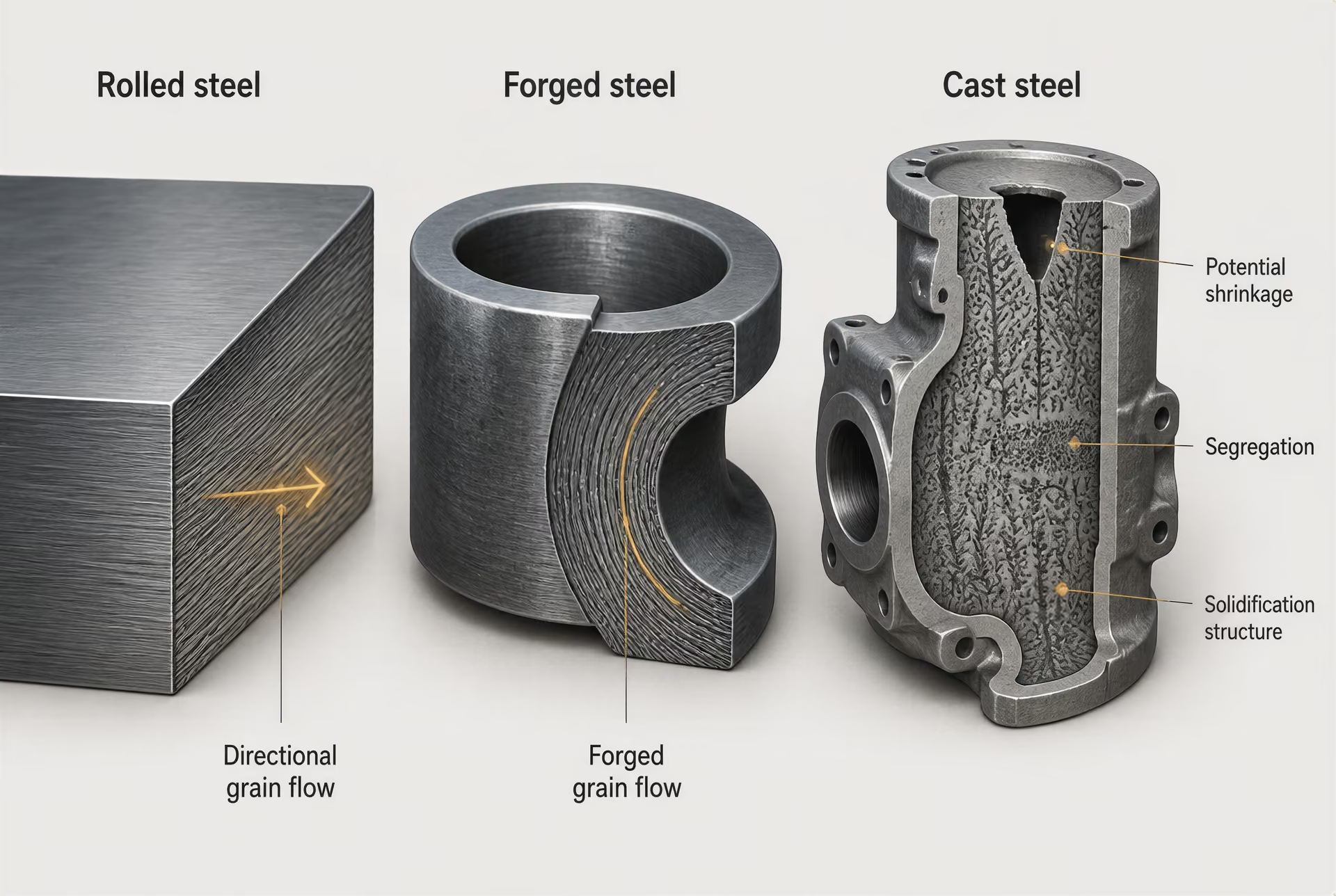
Wrought forms versus cast forms
| Product form | Primary route | Typical inspection emphasis |
|---|---|---|
| Rolled plate | Reduction between rolls | Thickness, flatness, surface condition, tensile and impact testing |
| Forging | Compressional deformation under dies or similar tooling | Grain flow, forging reduction, test orientation and ultrasonic examination |
| Casting | Solidification in a mould | Shrinkage, porosity, inclusions, radiography and penetrant or magnetic-particle testing |
Product form is a specification variable, not a visual label. A rolled plate and a forged disc may both appear as thick, flat steel components, yet their standards address different manufacturing routes, defect populations, dimensions and acceptance tests. The same problem occurs when a cast housing is compared with a tubular product merely because both contain a hollow passage.
ASTM training material draws the key boundary between wrought and cast products at the method by which the steel reaches its final form. Wrought products are shaped by mechanical working after solidification. Rolling, forging and drawing reduce or redistribute the material through applied deformation. Cast products are poured into a mold and obtain their primary shape during solidification. Subsequent heat treatment, machining or local working can alter the result, but it does not turn a cast product into a rolled or forged product.
That distinction affects internal structure. Rolling commonly produces directional grain flow and elongated inclusions, with properties and defect sensitivity that can vary between the longitudinal, transverse and through-thickness directions. Forging can redirect grain flow around a component and close or reduce certain internal discontinuities when the reduction and process control are suitable. Neither statement permits a universal performance ranking: steel grade, reduction, forging practice, heat treatment and inspection still control the result. Cast steel solidifies from liquid metal, so its structure is shaped by thermal gradients, feeding, segregation and the geometry of the mold. Shrinkage cavities, gas-related discontinuities and nonmetallic inclusions are assessed as casting-process concerns rather than assumed to have the distribution found in rolled plate.
ISO 6929:2013 standardizes vocabulary for flat products, long products and tubular products, but its terminology does not make those categories interchangeable with forgings or castings. ISO/TC 17 likewise separates product groups for continuous-mill flat-rolled products, structural steels, steel tubes and steel-product vocabulary. That organization reflects different technical controls, not a catalogue of alternative names.
The scope of ISO 630-1:2021 shows how easily a familiar grade designation can be misapplied. It covers hot-rolled structural steel flat and long products, including plates, sections, wide flats and bars, while excluding sheet, strip and tubular products. ASTM follows the same product-specific logic: specifications are divided among plates, structural shapes, sheet piling, bars, wire, tubular products, forgings and castings. A plate specification cannot be treated as a default specification for a forging because the chemistry happens to be similar.
Geometry also follows the route. A rolled I-section is produced through rolls and is identified by standardized dimensions and section properties. AISC Shapes Database v16.0 lists those properties in U.S. customary and metric units. A hollow structural section has its own manufacturing and dimensional rules; ASTM A1085/A1085M covers square, rectangular and round HSS, with separate geometry and section-property considerations. A forged crankshaft, ring or valve body is instead produced near a required envelope and then machined, while a casting may obtain ribs, bosses and internal cavities directly from the mold. Shape is therefore evidence of process, but it is not the whole specification.
Forging-specific requirements
A forging specification must control more than the steel analysis and finished dimensions. It normally identifies the forging process or product class, heat treatment condition, forging reduction or working practice where required, and the locations from which mechanical-test specimens are taken. Specimen orientation matters because deformation can produce directional properties. A test from the longitudinal direction of a forged bar does not establish the same information as a transverse or tangential test from a ring.
Forging standards also address the relationship between stock size, forging size and final machined dimensions. The component may receive substantial machining, so the acceptance examination may apply before machining, after machining, or at both stages. Surface discontinuities can be removed within stated limits, whereas internal indications may require ultrasonic examination. The applicable specification can prescribe examination zones, reference blocks, indication evaluation and repair restrictions. Those controls answer questions that a sheet or plate standard does not ask.
Heat treatment is another dividing line. A forging may be supplied normalized, normalized and tempered, quenched and tempered, or in another specified condition, with hardness and tensile tests tied to that condition. ISO 9328-6:2018, by contrast, addresses flat steel products for pressure equipment, including weldable fine-grain steels supplied in quenched-and-tempered condition. Its requirements belong to pressure-purpose flat products; they do not become forging requirements simply because both products can be quenched and tempered.
A forged part can also require a manufacturer’s forging procedure, traceability by heat and forging, macroetch examination, grain-flow evidence or supplementary nondestructive testing. Acceptance is tied to the finished component’s risk and geometry. Substituting a plate certificate for those records leaves the principal manufacturing evidence unaddressed.
Casting-specific requirements
Casting specifications begin with soundness and mold-related control. They may define the casting method, risering and feeding practice, heat treatment, repair rules, surface condition and examination of critical sections. Test coupons may be attached to the casting, poured from the same heat, or separately produced under specified conditions. Their mechanical results can represent the casting only within the sampling scheme stated by the specification.
Radiographic or ultrasonic examination is interpreted differently for a casting than for a rolled product. A casting contains changes in section, cores, junctions and hot spots that affect solidification. Inspection therefore concentrates on areas susceptible to shrinkage, porosity, hot tearing or inclusions, often using a quality level or acceptance class linked to the component’s service. A linear indication in a pressure-retaining casting may be unacceptable even when a comparable-looking surface mark on a rolled product could be removed and reinspected.
Casting standards also distinguish repair from routine finishing. Welding to correct a cavity or other discontinuity may require approval, qualified procedures, examination of the repair and renewed heat treatment. The acceptance requirement can reject a casting for internal or surface indications without implying that every cast steel product has the same defect limit.
This is why a cast steel grade, a forged grade and a rolled grade should be read as complete designations rather than isolated chemical names. The National Structural Steelwork Specification separates rolled sections, structural hollow sections, plates and bars and requires a designation containing the standard number, strength grade and impact quality. ASTM A1088-25, covering cold-rolled CP, DP and TRIP steel sheet in coils and cut lengths, addresses chemistry, mechanical properties, surface finish, appearance, dimensions and permissible variations. ASTM A786/A786M-15(2025) defines floor plate as hot-rolled plate with raised figures on one surface and permits supply in sheet, heavy-thickness sheet coil or plate dimensions, up to a maximum thickness of 25 mm. Neither specification supplies the process controls for a forging or casting.
Product-form substitutions must account for manufacturing route and route-specific acceptance requirements. Strong evidence
The correct comparison is therefore route to route: rolled product with rolled-product requirements, forging with forging requirements, and casting with casting requirements. Grade similarity is useful, but it is not equivalence.
12. Reading a complete steel designation
[8] National Structural Steelwork Specification. British Constructional Steelwork Association, SteelConstruction.info. NSSS reference material, 2010.
A steel designation is not merely a grade name. It is a compact specification chain that identifies what product standard applies, which strength level is required, how the material performs under impact loading, how it was delivered or treated, and whether additional controls apply. The National Structural Steelwork Specification (NSSS) makes this explicit: a complete designation contains the standard number, strength grade and impact quality. Those elements describe different things and should not be collapsed into one label.
For example, EN 10025-2 S355J2+N can be read as follows:
- EN 10025-2 identifies the product standard and its scope.
- S355 identifies the structural steel strength grade.
- J2 identifies the impact quality.
- +N identifies the delivery condition, normalizing or normalizing rolling.
A project may then add requirements such as ultrasonic testing, through-thickness properties, restricted chemistry, or a special surface condition. The resulting order or material certificate contains more information than “S355 steel.”
Standard number and product scope
The standard number comes first because it establishes the rule set. It is not a decorative reference. It determines the permitted product forms, dimensions, manufacturing route, test regime, tolerances and inspection documents against which the material is assessed.
ISO 6929:2013 provides standardized vocabulary for steel products, including flat products, long products and tubular products. That vocabulary matters because a plate, a section and a tube are not interchangeable categories even when their chemical analysis appears similar. Their production routes create different dimensional conventions, surface conditions and mechanical-test arrangements.
The scope of the standard can exclude a product that looks closely related. ISO 630-1:2021 applies to hot-rolled structural steel flat and long products, including plates, sections, wide flats and bars, but excludes sheet, strip and tubular products. A designation conforming to ISO 630-1 therefore cannot automatically be transferred to a cold-rolled sheet or a hollow section.
ASTM follows the same product-form logic. Its specifications are divided among plates, structural shapes, sheet piling, bars, wire, tubular products, forgings and castings. ASTM A1088-25, for example, covers cold-rolled CP, DP and TRIP steel sheet supplied in coils and cut lengths. Its requirements address chemistry, mechanical properties, surface finish, appearance, dimensions and permissible variations. Calling that material simply “high-strength steel” omits the cold-rolled sheet scope that controls its manufacture and acceptance.
A surface pattern can also affect the applicable product description. ASTM A786/A786M-15(2025) defines floor plate as hot-rolled plate with raised figures on one surface. It permits supply in dimensions classified as sheet, heavy-thickness sheet coil or plate, but sets a maximum thickness of 25 mm. “Floor plate” therefore conveys both a product form and a surface feature; it is not just a visual nickname for any plate with a raised pattern.
The same principle applies to structural shapes. A designation such as W-shape W14×90 uses a section naming system rather than a plate thickness convention. AISC Shapes Database v16.0 lists the standardized dimensions and section properties of such shapes in U.S. customary and metric units. Flange width, depth, area, radii, mass and properties such as and belong to the section designation. They cannot be inferred from a flat-product grade such as S355 or from a nominal thickness alone.
For hollow structural sections, geometry is part of the specification. ASTM A1085/A1085M covers square, rectangular and round hollow structural sections, each requiring separate dimensional and section-property tables. A round HSS and a rectangular HSS may use the same steel specification, yet their wall thickness, outside dimensions, corner radii and design properties differ. The product standard must therefore be read before the grade symbol.
Strength grade and impact quality
After the standard number, the strength grade identifies the material’s required strength class within that product standard. In S355, the letter S denotes structural steel and 355 refers to the specified minimum yield strength in the relevant thickness range, expressed in megapascals for the EN designation. It does not mean that every test specimen will yield at exactly 355 MPa, nor does it describe toughness, weldability or surface finish.
Thickness can change the required value. The applicable table may assign lower minimum yield strength to thicker material, so the number in the grade is not a universal property detached from product dimensions. The certificate must be checked against the actual thickness or diameter and the standard edition stated in the order.
Impact quality is a separate part of the chain. In S355J2, the J2 suffix identifies a Charpy V-notch impact requirement at a specified test temperature, commonly −20 °C under the relevant EN structural-steel requirements. The impact class is not a higher strength grade. S355JR, S355J0 and S355J2 can share the S355 strength designation while differing in impact test temperature and required absorbed energy.
The distinction is practical. A component that may experience low service temperatures, dynamic loading or restraint against brittle fracture needs a specified impact quality, not just a stated yield strength. A steel marked S355 without an impact suffix is incomplete where the governing standard or project specification requires one.
Other standards express the same ideas differently. ISO 9328-6:2018 covers flat steel products for pressure purposes and includes weldable fine-grain steels supplied in quenched-and-tempered condition. Its designation must be interpreted through the pressure-equipment standard, not borrowed from a structural-plate naming system. Strength, toughness, weldability and heat-treatment condition remain related but distinct requirements.
Delivery condition, finish and supplementary requirements
The final parts of a designation describe how the steel is supplied and what additional controls apply. In EN 10025-2 S355J2+N, +N states a normalized or normalizing-rolled delivery condition. Other suffixes can identify thermomechanical rolling or quenched-and-tempered supply, depending on the standard. The suffix is significant because heat treatment and rolling history affect grain structure, toughness, residual stress and fabrication response.
Delivery condition should not be confused with surface finish. A plate can be supplied normalized and still require a specified surface-quality class, edge condition or permissible repair practice. A cold-rolled sheet may require a particular finish and appearance classification under ASTM A1088-25, while a structural section is controlled through section dimensions, straightness, twist and mass tolerances.
Supplementary requirements add controls beyond the base designation. These may include ultrasonic examination for internal discontinuities, through-thickness ductility, tighter chemical limits, carbon-equivalent restrictions, weldability provisions, additional impact tests, or inspection-document requirements. A steel specified with a through-thickness property is not fully described by its strength and impact symbols alone; the added requirement addresses resistance to lamellar tearing in welded joints.
Designation-reading sequence
- 1. Standard Confirm the exact standard number, edition and product-form scope.
- 2. Grade Read the strength or composition class within that standard.
- 3. Impact quality Check the toughness class and test temperature where required.
- 4. Delivery condition Verify normalizing, thermomechanical rolling, quenching and tempering or another stated condition.
- 5. Supplementary requirements Check testing, surface, dimensional, weldability and documentation clauses.
The reading sequence is therefore deliberate: identify the standard and product scope, read the strength grade, read the impact or toughness class, then check delivery condition, surface and dimensional requirements, and every supplementary symbol or clause. EN 10025-2 S355J2+N describes a different specification chain from a generic “S355 plate,” just as an ASTM A1085/A1085M rectangular HSS differs from an ASTM A1088-25 cold-rolled TRIP sheet. Product geometry, manufacturing route and mechanical designation must remain connected, but they must not be treated as the same item.
13. How ASTM product specifications divide requirements
ASTM specifications do not treat steel as one interchangeable material divided only by yield strength. They assign requirements according to product form, manufacturing route and intended service. A plate, an I-shaped section, a round bar, a hollow structural section (HSS) and a structural fastener may all be described with a nominal yield strength of 50 ksi, yet they are not controlled by the same dimensional rules, test locations, surface requirements or acceptance criteria.
This structure aligns with the product vocabulary in ISO 6929:2013, which distinguishes flat products, long products, tubular products and other steel forms. ISO 630-1:2021 applies to hot-rolled structural flat and long products—plates, sections, wide flats and bars—but expressly excludes sheet, strip and tubular products. That exclusion is not a minor terminology preference. It shows why a specification written for one product family cannot automatically be transferred to another.
Plates, shapes, bars, HSS and fasteners
For structural plate, ASTM A6/A6M supplies general requirements commonly used with grades such as ASTM A36/A36M, ASTM A572/A572M Grade 50 and ASTM A588/A588M. The product is a flat-rolled item, so thickness, width, length, flatness, camber, edge condition and permissible thickness variation are central controls. A plate order may also require supplementary requirements for through-thickness properties, weldability, impact toughness or ultrasonic examination. Pressure-service plate follows another route: ISO 9328-6:2018 addresses flat steel products for pressure equipment, including weldable fine-grain steels delivered in the quenched-and-tempered condition.
“Plate” also overlaps with sheet in ordinary language. ASTM A786/A786M-15(2025), for example, defines floor plate as hot-rolled plate with raised figures on one surface and permits supply in dimensions classified as sheet, heavy-thickness sheet coil or plate, subject to a maximum thickness of 25 mm. The raised pattern affects appearance, thickness measurement and dimensional control. It does not turn floor plate into ordinary smooth structural plate.
An open structural shape—such as a W, S, M, HP, C, MC or L shape—has a rolled geometry with flanges, webs, fillets and specified end conditions. ASTM A6/A6M general requirements work with structural shape specifications such as ASTM A992/A992M for rolled structural shapes. The relevant dimensions include depth, flange width, web and flange thickness, out-of-square condition, straightness and end squareness. AISC Shapes Database v16.0 records standardized shape dimensions, section properties, names and unit systems; it is a dimensional and design reference, not a replacement for the material specification or mill certification. A W-shape and a plate may share a grade designation, but the shape’s section geometry governs properties such as area, radius of gyration and torsional characteristics.
Bars are long products supplied in rounds, squares, hexagons, flats or other cross-sections. ASTM A29/A29M establishes general requirements for carbon and alloy steel bars, while ASTM A108 covers cold-finished carbon and alloy steel bars. Bar specifications therefore address diameter or width, straightness, surface condition, machining allowance, decarburization and, where applicable, heat treatment. A round bar is not simply a narrow plate: rolling, drawing, turning or peeling changes its dimensional tolerances and surface condition.
HSS are tubular products, even when their cross-section is square or rectangular. ASTM A1085/A1085M covers square, rectangular and round hollow structural sections. The closed shape creates requirements that do not arise in an open section: outside dimensions, corner radii, wall thickness, twist, straightness, weld condition and internal section properties. Design tables must account for the actual closed geometry. ASTM A500/A500M is another important HSS specification, with product requirements tied to cold-formed welded tubing in round and shaped forms. A nominal grade statement alone does not identify which HSS standard governs.
Fasteners are separate manufactured products rather than cut lengths of structural bar. ASTM F3125/F3125M covers high-strength structural bolts, including Grade A325 and Grade A490 designations within the specification system. Requirements can include bolt configuration, thread dimensions, hardness, tensile strength, proof load, rotational-capacity testing, coating, marking and lot traceability. The nut and washer specifications must also be compatible. A bar meeting a 50 ksi tensile or yield requirement cannot be substituted for a bolt whose performance depends on threads, head geometry, preload behavior and assembly testing.
Product-specific characteristic requirements
The most important difference is not the number printed beside the grade. It is the set of characteristics that the product must demonstrate in its delivered form.
A plate may be tested in the longitudinal and transverse directions, with impact specimens taken at a defined location relative to the plate surface. Thickness affects rolling reduction, internal soundness and weld heat flow. A specification may therefore impose chemistry limits, tensile properties, elongation, Charpy V-notch energy, weldability controls or supplementary ultrasonic examination.
A rolled shape must satisfy both material and geometric requirements. Its flange and web thicknesses influence cooling rates after rolling, while residual stress and straightness affect fabrication and erection. AISC section tables provide calculated properties from standardized dimensions; they do not waive the ASTM limits on chemical composition, tensile testing, yield strength or permissible variation.
For bars, the characteristic concern may be surface integrity and size control after hot rolling or cold finishing. A turned or ground bar can have a different permissible surface condition from a hot-rolled bar even when both are made from the same nominal grade. Heat treatment, grain flow and machining stock can also change what the specification requires.
HSS add welding and forming to the inspection picture. Cold forming bends strip into a closed section, and longitudinal welding joins the edges. The standard must consequently address weld quality, corner geometry and dimensional variation alongside strength and elongation. Round, square and rectangular HSS cannot be assigned section properties from a flat-product table.
Fasteners require lot-based mechanical and assembly checks. Tensile strength alone says little about whether a bolt develops the specified pretension without thread failure, head failure or unacceptable rotation. Coating thickness and installation method can also affect the connection, although those controls may be specified through separate referenced standards.
Why one ASTM number cannot stand in for another
An ASTM designation identifies a defined set of requirements, not a general permission to use any steel with similar chemistry or strength. ASTM A572/A572M Grade 50 plate and ASTM A992/A992M Grade 50 structural shapes do not become equivalent because both use “Grade 50” language. Their product forms, chemistry limits, dimensional tolerances, testing provisions and permitted manufacturing routes differ.
The same issue appears in project designations. The National Structural Steelwork Specification separates rolled sections, structural hollow sections, plates and bars and requires a complete designation containing the standard number, strength grade and impact quality. “S355” alone is incomplete in that framework; the product and quality designation matter. A plate, HSS and rolled section may require different impact classes or delivery conditions.
The correct identification therefore combines product form, governing standard, grade, delivery condition and any supplementary requirements. ASTM A1088-25 covers cold-rolled CP, DP and TRIP steel sheet in coils and cut lengths, with controls for chemistry, mechanical properties, surface finish, appearance, dimensions and permissible variations. Those provisions cannot be replaced by citing a structural-plate specification. Form is part of the specification, not a visual afterthought.
14. A practical taxonomy for comparing steel product forms
Product form is a specification variable, not just a description of appearance. A plate, a sheet, a flat bar and a flange may all look like flat steel, yet they can differ in thickness ranges, manufacturing route, delivery condition, inspection rules and permissible variation. The same grade designation also does not erase those differences. “S355J2” identifies strength and impact properties within the relevant standard; it does not state whether the material is a plate, section, hollow section or forging.
A useful comparison asks six questions of every product: what geometry is supplied, how was it produced, how is it delivered, which chemical and mechanical requirements apply, which tolerances govern it, and what surface condition and compliance documents accompany it? ISO 6929:2013 provides the vocabulary for making that first distinction, covering flat products, long products, tubular products and related steel forms.
Shape and dimensions
Flat products include plate, sheet and strip, but those terms cannot be treated as universal size categories. Their boundaries vary between standards and production systems. Plate is generally supplied as discrete cut lengths or large rectangular pieces, while sheet and strip are commonly associated with thinner material and coil processing. The specification, rather than visual appearance alone, determines which dimensional rules apply.
ASTM A786/A786M-15(2025) illustrates the problem. It defines floor plate as hot-rolled plate with raised figures on one surface and permits supply in dimensions classified as sheet, heavy-thickness sheet coil or plate; its maximum thickness is 25 mm. The raised pattern is therefore a surface and geometry requirement, while the underlying classification still depends on the dimensional category used by the standard.
Sections are long products with a defined cross-sectional profile. I-sections, channels, angles, tees and other rolled shapes are identified by nominal depth, mass per unit length or a standard designation. AISC Shapes Database v16.0 records standardized dimensions and section properties in U.S. customary and metric units, including area, mass, moments of inertia and section moduli. Those properties are not interchangeable with the dimensions of a flat bar having a similar overall width and thickness.
Bars may be round, square, hexagonal or flat, and are often supplied in straight lengths. Their specification may control diameter or across-flats dimension, straightness, end condition and length tolerance. Wire is usually produced in much smaller cross-sections and commonly delivered in coils, so coil weight, winding and surface condition become part of the product description.
Tubular products require separate treatment because outside diameter, wall thickness, internal diameter, ovality and length all affect the product. ASTM A1085/A1085M covers hollow structural sections in square, rectangular and round forms. A rectangular hollow section cannot be specified by width and height alone: corner radius, wall thickness, section area and calculated properties also matter. Tube standards may further distinguish seamless, welded, cold-drawn and electric-resistance-welded products.
Forgings are shaped under compressive force, commonly between dies or in open dies, and are specified by finished dimensions, machining allowance and sometimes grain-flow direction. Castings are produced by filling a mould, so wall thickness transitions, fillets, risers, shrinkage allowances and internal soundness become central concerns. A casting and a machined forging with the same external outline remain different product forms.
Metallurgy and processing history
The production route leaves a specification fingerprint. Plate and structural sections are commonly hot-rolled from slabs or billets. Sheet and strip may be hot-rolled, pickled, cold-reduced, annealed, temper-rolled, galvanized or otherwise coated. Cold reduction changes thickness and surface finish while also affecting yield behaviour, elongation and residual stress.
ASTM A1088-25 covers cold-rolled CP, DP and TRIP steel sheet supplied in coils and cut lengths. The designation therefore conveys more than a thickness range: it identifies families of advanced high-strength steel whose chemistry, microstructure and deformation response are controlled together. CP means complex phase, DP dual phase and TRIP transformation-induced plasticity. Mechanical requirements, surface finish, appearance, dimensions and permissible variations all form part of that specification.
Thermal treatment must be recorded separately from shape. A pressure-equipment plate may be supplied normalized, normalized rolled or quenched and tempered, depending on the governing standard and grade. ISO 9328-6:2018 covers flat steel products for pressure purposes, including weldable fine-grain steels supplied in quenched-and-tempered condition. The same nominal thickness in a general structural plate and a pressure-vessel plate does not imply the same toughness, cleanliness, weldability or heat-treatment history.
Long products can be normalized, quenched and tempered, cold-finished or solution treated. Bars may receive peeling, centerless grinding or machining after rolling. Tubes can be expanded, drawn, welded, heat treated and hydrostatically tested in combinations set by the applicable product standard. Forging reductions and reheating cycles influence grain flow and internal integrity; casting practice controls segregation, porosity and inclusion distribution. These are metallurgical facts, not optional labels.
ISO 630-1:2021 applies general technical delivery conditions to hot-rolled structural steel flat and long products, including plates, sections, wide flats and bars. It expressly excludes sheet, strip and tubular products. That boundary shows why a grade or strength level cannot be transferred from one product family without checking the relevant standard.
Testing, inspection and documentation
Testing follows the risks created by geometry and manufacture. Flat products commonly require tensile testing, bend testing, impact testing where specified, chemical analysis and dimensional inspection. Long products add checks for section dimensions, straightness, mass and length. Tubular products may require weld examination, hydrostatic or leak testing, flattening, flaring, ring-expansion or ultrasonic examination, depending on whether the tube is structural, pressure-rated or intended for another service.
Surface condition also needs an explicit description. Hot-rolled plate may carry mill scale, whereas cold-rolled sheet is judged by finish and visible defects. Floor plate must retain its raised pattern. Bars may be supplied as-rolled, peeled or ground. Forgings can require inspection after machining, and castings may require radiography, ultrasonic testing, magnetic-particle testing or penetrant testing to locate internal and surface discontinuities.
Tolerances are product-specific. Plate tolerances may cover thickness variation across the sheet, flatness, width, length and edge condition. Sections require limits for depth, flange width, web thickness, out-of-square and mass. Hollow sections need wall-thickness, corner-radius, outside-dimension, squareness and twist limits. A dimension that is acceptable for a rolled section may be unacceptable for a fabricated tube because it changes fit-up and section properties.
Documentation must identify the complete product, not merely the steel grade. The National Structural Steelwork Specification separates rolled sections, structural hollow sections, plates and bars and requires a complete designation to include the standard number, strength grade and impact quality. A conforming record should also state product form, dimensions, heat or cast number, delivery condition, heat treatment where relevant, test results and inspection status. Mill certificates, test reports and traceability markings connect the physical item to its declared chemistry and mechanical performance.
The practical comparison is therefore between specification systems, not between names that sound similar. Geometry defines the starting category; processing history explains its structure; delivery condition, surface requirements, tolerances and testing complete its identity. Without all of those fields, “steel plate,” “steel bar” or “steel tube” is only a partial description.
15. Common classification errors and a standards-based checklist
Product form is a specification variable, not merely a visual description. Two products may both appear as rectangular pieces of steel while following different rolling routes, dimensional rules, surface requirements and acceptance tests. ISO 6929:2013 provides standardized vocabulary for flat products, long products, tubular products and other steel forms, but vocabulary does not replace the product standard. ISO/TC 17 likewise separates work into product groups such as continuous-mill flat-rolled products, structural steels, steel tubes and steel-product terminology.
That separation matters when a drawing, purchase description or inspection record identifies only a shape. “Steel plate,” “HSS,” or “S355” is incomplete information.
Calling every flat product plate
A flat product is not automatically plate. Sheet, strip, wide flat and plate can overlap in ordinary speech, yet their standards may define different thickness ranges, widths, delivery forms, tolerances and manufacturing routes. A cold-rolled sheet supplied in coil is not converted into plate simply because it is later cut into rectangles.
ASTM A1088-25 illustrates the point. It covers cold-rolled CP, DP and TRIP steel sheet supplied in coils and cut lengths. The specification addresses chemical composition, mechanical properties, surface finish, appearance, dimensions and permissible variations. Its subject is cold-rolled sheet, not generic flat steel. A cut length from an A1088 coil remains a sheet product for specification purposes unless another applicable standard governs the material.
ISO 630-1:2021 makes a similarly important boundary. It applies general technical delivery conditions to hot-rolled structural steel flat and long products, including plates, sections, wide flats and bars, but excludes sheet, strip and tubular products. A designation under ISO 630-1 therefore cannot be extended casually to a cold-rolled sheet or a hollow section.
“Floor plate” creates another trap. ASTM A786/A786M-15(2025) defines floor plate as hot-rolled plate with raised figures on one surface. The same standard permits supply in dimensions classified as sheet, heavy-thickness sheet coil or plate, and sets a maximum thickness of 25 mm. The raised pattern is a surface characteristic; the thickness and supply classification still require checking. Calling every patterned flat product “plate” misses the standard’s dimensional and manufacturing distinctions.
Pressure-equipment material adds a further qualification. ISO 9328-6:2018 covers flat steel products for pressure purposes, including weldable fine-grain steels supplied in quenched-and-tempered condition. A flat product meeting a structural-steel grade is not thereby suitable for pressure equipment. The product standard, delivery condition, toughness requirements, weldability controls and intended service must agree.
The correction is simple but exact: identify whether the material is sheet, strip, plate, wide flat or another flat form; record the manufacturing route and supply condition; then cite the governing specification. Thickness alone is not enough.
Treating HSS as open sections
Hollow structural sections are frequently placed in the same mental category as angles, channels, tees and I-sections because all can appear in a structural-shape table. That classification is wrong. An HSS is a closed tubular product with a hollow interior, while an angle, channel or I-section is an open section formed by exposed elements joined at corners or a web.
ASTM A1085/A1085M covers square, rectangular and round hollow structural sections. Each form requires its own dimensional and section-property information. Outside dimensions, wall thickness, corner geometry, inside dimensions, area, radius of gyration and torsional properties cannot be inferred safely from an open-section table. A rectangular HSS and a fabricated box may look similar in a drawing but can differ in manufacturing route, weld locations, corner radii, tolerances and specified testing.
AISC Shapes Database v16.0, published by the American Institute of Steel Construction in 2022, lists standardized dimensions, section properties, unit systems and naming conventions for structural steel shapes. It is a useful reference for identifying a section designation and calculating properties. It is not a material certificate and does not establish conformity to ASTM A1085/A1085M or any other product specification. A database entry can identify an HSS 8×4×3/8, for example, but it does not prove the supplied member has the required chemistry, yield strength, tensile strength, wall tolerance, weld quality or delivery condition.
The same caution applies in European and British practice. The National Structural Steelwork Specification distinguishes rolled sections, structural hollow sections, plates and bars as separate constituent product types. A hollow section must remain identified as such even when its nominal area or mass resembles that of an open rolled section. Product geometry governs the relevant table; it does not merely decorate a grade designation.
Confusing grade, form and specification
A grade identifies required material properties or composition within a defined standard. A form identifies what was produced: plate, sheet, bar, section, tube, forging or casting. A specification combines those elements with manufacturing, testing, tolerances and delivery requirements. They are related, but none is a substitute for the others.
“S355” is therefore not a complete product designation. It indicates a strength family, but the applicable product standard may determine whether the material is plate, section, bar or another form. Impact quality also matters. Under the National Structural Steelwork Specification guidance, a complete designation includes the standard number, strength grade and impact quality. A designation such as EN 10025-2 S355J2+N communicates substantially more than “S355”: the standard, grade, impact class and normalized or normalized-rolled delivery condition are identified.
Even that designation may not answer every project requirement. The purchaser or design specification may add through-thickness properties, ultrasonic testing, weldability limits, surface class, testing frequency, dimensional tolerances or restrictions on repair. A plate for a welded structure and a plate for pressure equipment can share a nominal strength level while being governed by different technical delivery conditions. ISO 9328-6:2018 is a clear example of a product-specific pressure-purpose requirement that cannot be established from the grade name alone.
The same principle applies to bars, forgings and castings. A cast steel grade is not interchangeable with a bar grade carrying similar chemical limits, because solidification structure, heat treatment, inspection and permitted discontinuities differ. Forgings have their own deformation history and specification requirements. Form is evidence of a manufacturing route.
Correct classification changes the answer in practical cases. A cold-rolled DP sheet cut from coil should be recorded under ASTM A1088-25, not relabeled plate. A raised-pattern product should be checked against ASTM A786/A786M-15(2025), including its floor-plate definition and 25 mm maximum thickness, rather than classified by appearance alone. A square HSS should be checked against ASTM A1085/A1085M and its HSS section properties, not an AISC open-section table. A pressure-purpose flat product should identify ISO 9328-6:2018, the steel grade, quenched-and-tempered condition and required tests.
| Check | Required information |
|---|---|
| Product form | Sheet, strip, plate, wide flat, bar, open section, HSS, tube, forging or casting |
| Governing standard | Exact standard number and edition |
| Grade and designation | Complete grade notation, not a strength number alone |
| Impact quality | Specified impact class where required |
| Delivery condition | As-rolled, normalized, quenched and tempered, cold-reduced or another stated condition |
| Dimensions and tolerances | Thickness, width, length, wall, profile, radius and permissible variations |
| Surface condition | Finish, pattern, scale, defects and repair limits |
| Supplementary requirements | Through-thickness properties, ultrasonic examination, toughness, cleanliness and project clauses |
Use this checklist before accepting a classification:
- Product form: sheet, strip, plate, wide flat, bar, open section, HSS, tube, forging or casting.
- Governing standard: exact standard number and edition, including the relevant product-form scope.
- Grade and designation: complete grade notation, not a strength number alone.
- Impact quality: such as the specified impact class where the standard requires it.
- Delivery condition: as-rolled, normalized or normalized-rolled, quenched and tempered, cold-reduced or another stated condition.
- Dimensions and tolerances: thickness, width, length, wall thickness, profile, corner radius and permissible variations.
- Surface condition: finish, raised pattern, scale condition, defects and repair limits.
- Supplementary requirements: through-thickness properties, ultrasonic examination, additional toughness, testing, cleanliness or project-specific clauses.
No single shape database, vocabulary term or grade designation establishes complete product conformity. Strong evidence
A shape database, a vocabulary standard such as ISO 6929:2013, or a grade designation alone establishes none of these complete conformity questions. The product form, standard, grade, impact quality, delivery condition, dimensions, surface condition and supplementary requirements must be checked together.
References
- [1] ASTM A1085/A1085M — Hollow Structural Sections. ASTM product specification, 2025. https://www.aisc.org/aisc/publications/steel-construction-manual/astm-a1085/
- [2] ISO 6929:2013 — Steel products — Vocabulary. International Standard, 2013. https://www.iso.org/standard/50770.html
- [3] ASTM A1088-25 — Cold-Rolled Carbon and High-Strength Low-Alloy Steel Sheet. ASTM International Standard, 2025. https://store.astm.org/a1088-25.html
- [4] ASTM A786/A786M-15(2025) — Rolled Floor Plate. ASTM International Standard, 2025. https://store.astm.org/a0786_a0786m-15r25.html
- [5] ISO 630-1:2021 — Structural steels — Part 1. International Standard, 2021. https://www.iso.org/standard/73841.html
- [6] AISC Shapes Database v16.0. AISC reference database, 2022. https://www.aisc.org/aisc/publications/steel-construction-manual/aisc-shapes-database-v160/
- [7] ISO 9328-6:2018 — Flat Steel Products for Pressure Equipment. International Standard, 2018. https://www.iso.org/standard/72065.html
- [8] National Structural Steelwork Specification. NSSS reference material, 2010. https://www.steelconstruction.info/images/1/10/BCSA_52-10.pdf