




What Tempering Changes in Steel
Definition below the lower critical temperature
ASM International defines tempering as “the heating of hardened or normalized steel to a temperature below the lower critical temperature” (ASM Handbook Volume 4A, 2024). That definition is more exact than the common description of tempering as reheating steel to make it softer. Tempering follows a hardening treatment, and it can also follow normalization. The steel is reheated, held for a selected time, and cooled under controlled conditions without intentionally crossing the lower critical temperature and forming a new bulk austenitic structure.
| Treatment | Primary purpose | Relationship to tempering |
|---|---|---|
| Tempering | Modify hardened or normalized steel below the lower critical temperature | Changes the existing structure |
| Normalizing | Refine or reset the structure through heating into the austenitic range followed by cooling | Can precede hardening or tempering |
| Annealing | Soften and relieve stress through a controlled thermal cycle | Has a different thermal purpose |
| Second hardening | Form a new bulk austenitic structure before quenching | Replaces rather than modifies the prior structure |
The lower critical temperature is commonly associated with the eutectoid transformation range, although its precise position depends on composition and heating conditions. Remaining below it matters because tempering changes the structure produced by hardening rather than replacing that structure through complete reaustenitization. A tempering cycle therefore has a different metallurgical purpose from normalizing, annealing, or a second hardening operation.
Variables that shape the response
- Thermal cycle Tempering temperature, holding time and heating rate control how far diffusion-controlled reactions proceed.
- Composition Carbon and alloying elements determine supersaturation, carbide stability and precipitation potential.
- Starting structure Austenite grain size, martensite morphology, retained austenite and undissolved carbides affect the response.
- Quench and geometry Quench severity and section size create different local microstructures and thermal histories.
The principal variables are tempering temperature, holding time, carbon content, alloy content and residual elements. Initial microstructure also matters. So do austenitizing temperature, prior normalization or forging history, quench severity, section size and heating rate. Two components made from nominally similar steel can therefore show different responses when their thermal histories differ.
Temperature usually accelerates the reactions more strongly than time alone, but time still controls how far those reactions proceed. Carbon content affects the amount and supersaturation of carbon trapped in as-quenched martensite. Chromium, molybdenum, vanadium, tungsten and other alloying elements alter carbide stability, diffusion rates and precipitation behavior. Residual elements can change transformation kinetics and tempering resistance even when they are not deliberate additions. Tempering is a path-dependent treatment, not a single hardness setting.

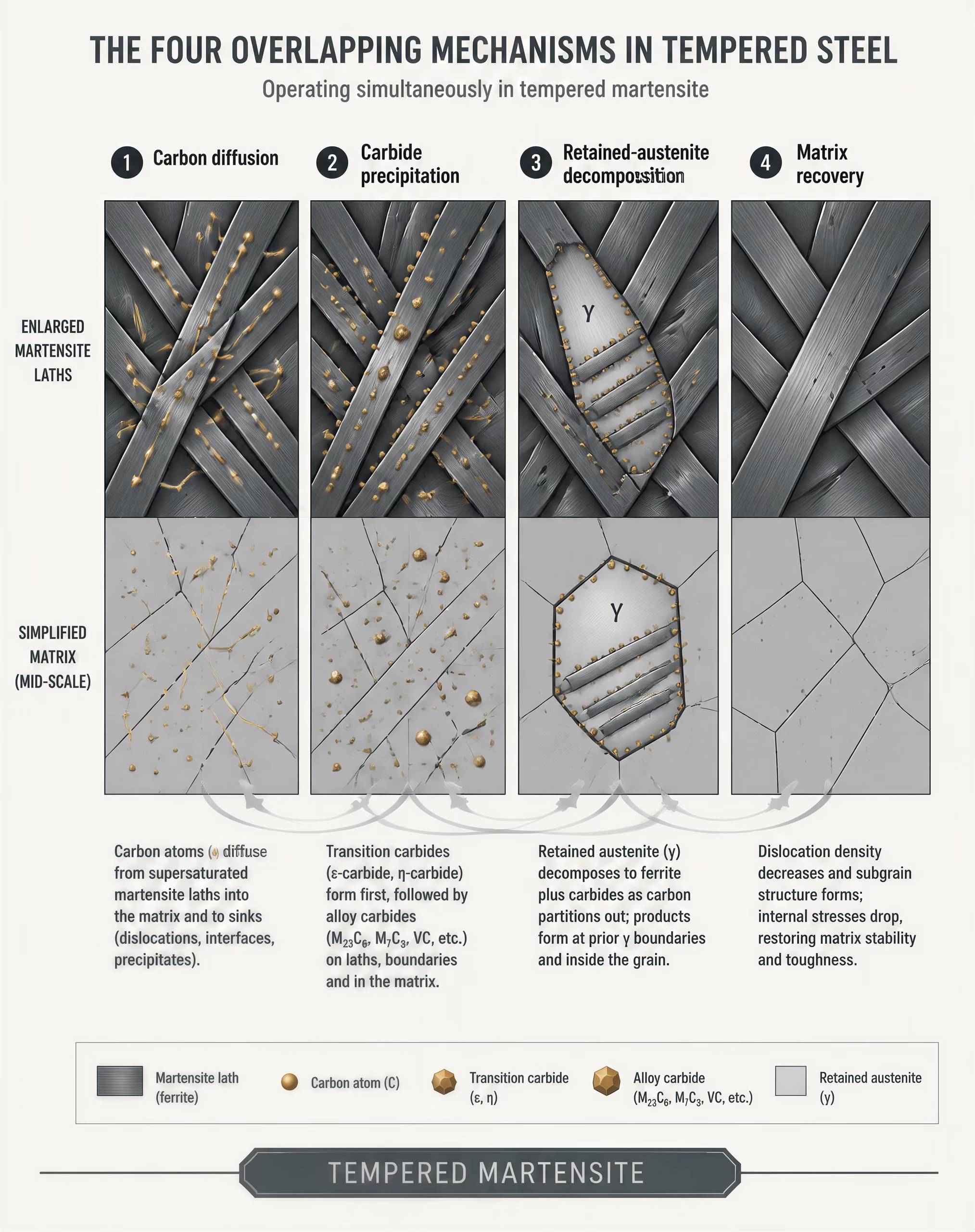
From as-quenched martensite to tempered microstructure
As-quenched martensite A hard, carbon-supersaturated phase formed by rapid cooling of austenite, with high dislocation density and stored internal energy.
How the as-quenched structure changes
- Carbon redistribution Carbon moves from supersaturated martensite toward defects, boundaries and forming carbide particles.
- Carbide precipitation Transition carbides or more stable carbides form, change composition, grow or coarsen.
- Retained-austenite decomposition Retained austenite may reject carbon and transform, affecting dimensions and properties.
- Matrix recovery Dislocations rearrange or annihilate, reducing strain hardening and internal stress.
As-quenched martensite is a supersaturated, strained phase. Its high dislocation density and carbon supersaturation account for much of its hardness, but they also store elastic and chemical energy. Tempering allows the structure to reduce that energy through several overlapping reactions. The U.S. Department of Energy describes carbon diffusion, carbide formation, austenite decomposition and recovery as central parts of the process (2010).
At relatively low tempering temperatures, carbon moves over short distances and may segregate to defects or form transition carbides. Internal stresses fall, and the tetragonality of martensite decreases as carbon leaves the martensitic lattice. The steel may lose some hardness while gaining dimensional stability and resistance to delayed cracking. Retained austenite, if present, can also decompose during subsequent tempering stages, producing fresh transformation products that affect both dimensions and mechanical properties.
With higher temperature or longer holding time, carbide particles coarsen or change into more stable compounds, while the ferritic matrix recovers and loses some of its dislocation strengthening. These changes commonly reduce hardness and yield strength but increase toughness and ductility. The result is tempered martensite: a ferritic matrix containing a distribution of carbide particles, with the distribution determined by composition and treatment history rather than by temperature alone.
High-alloy tool steels can develop secondary hardening during tempering through fine alloy-carbide precipitation. Strong evidence
Secondary hardening A rise in hardness during tempering caused by precipitation of fine alloy carbides after earlier softening reactions.
High-alloy tool steels provide an important exception to simple softening. ASM International states that secondary hardening is produced by precipitation of fine alloy carbides, including carbides associated with molybdenum, vanadium and tungsten (2024). During tempering, these particles can strengthen the matrix sufficiently to produce a hardness increase after an earlier decline. The effect is called secondary hardening, and stronger precipitation generally gives greater tempering resistance.
The National Institute of Standards and Technology reported in 1930 that “the intensity of the secondary-hardening peak increases with the degree of austenitization.” This finding links the peak not only to tempering temperature but also to the prior hardening cycle. A higher degree of austenitization can dissolve more alloying elements and carbon into austenite before quenching, changing the composition available for later precipitation. The same nominal tempering schedule can consequently produce different hardness curves after different austenitizing treatments.
H13 tool steel illustrates why heating history must be included. A peer-reviewed study recorded a method for predicting the tempering response of H13 under isothermal, slow-heating and rapid-heating schedules, including secondary-hardening behavior (University of Arizona publication record, 2013). A component heated continuously through a precipitation range does not necessarily experience the same reactions as one held isothermally at that temperature. The calculated hardness response can differ even when the final nominal temperature is identical.
J. H. Hollomon and L. D. Jaffe addressed the time-temperature problem in 1945 by formulating a relation between tempering time, temperature and composition for quenched steel. The Hollomon-Jaffe expression is commonly written as:
T(log t + c)
Here, T is absolute temperature, t is tempering time, and c is a composition- and condition-dependent constant. The expression provides a tempering parameter for comparing exposures and quantifying the degree of martensite tempering. It is useful because temperature and time can be combined into one index, but an equivalent parameter does not erase differences in heating rate, prior microstructure, austenitization, section size or alloy response.
ASM Handbook Volume 4C notes that Hollomon-Jaffe and Grange-Baughman correlations can represent equivalent time-temperature conditions when assessing induction-hardened steels (ASM International, 2024). That agreement concerns correlation, not proof that every thermal path produces the same microstructure. The distinction is important in surface-hardened parts, where a steep temperature gradient and changing section temperature can make the actual tempering history nonuniform.
Why hardness is not the only response variable
Hardness is convenient to measure, but it is only one result of tempering. Strength can fall as martensitic strain and dislocation density decrease, then rise locally when fine alloy carbides precipitate. Toughness may improve because internal stresses are relieved, yet retained-austenite decomposition, carbide morphology or embrittling temperature ranges can reduce toughness in particular steels. Dimensional stability can improve through stress relief, while transformation of retained austenite can cause measurable expansion.
Microstructure provides the explanation behind these competing trends. Carbon diffusion, recovery, carbide precipitation, retained-austenite decomposition and particle coarsening may occur in sequence or overlap. The final structure controls fatigue behavior, wear resistance, fracture resistance and resistance to further thermal exposure, not merely the indentation number obtained in a hardness test.
A 2013 study of hot- and warm-forging die steels used the tempering parameter—also called the Hollomon-Jaffe or Larson-Miller parameter—to correlate time-temperature exposure with hardness change. Such correlations are practical for describing a particular grade and treatment range. They are not universal hardness laws. Grade, initial condition and treatment history remain decisive, which is why tempering should be specified as a thermal path and a resulting microstructure, not simply as “softening.”
The Variables That Control the Tempering Response
Tempering is not defined by a furnace setpoint alone. ASM International states in ASM Handbook Volume 4A (2024): “Tempering is the heating of hardened or normalized steel to a temperature below the lower critical temperature.” That definition identifies a transformation path, not a single operation. Temperature, time, carbon content, alloy content and residual elements all influence the resulting microstructure and properties. Heating rate, the temperature reached by the steel itself, the preceding austenitizing treatment and the quench also matter.
Temperature and duration
During tempering, carbon diffuses from supersaturated martensite, carbides form or change composition, retained austenite may decompose, and the martensitic structure undergoes recovery. The U.S. Department of Energy describes the process through these linked diffusion, precipitation, decomposition and recovery reactions rather than as simple heat-induced softening. At relatively low temperatures, carbon segregation and transition-carbide precipitation can reduce internal stress while retaining substantial hardness. With increasing temperature or holding time, carbide coarsening, ferrite recovery and further transformation generally reduce hardness and strength.
| Steel or condition | Typical competing response | Important controlling factors |
|---|---|---|
| Plain-carbon or low-alloy martensitic steel | Hardness and strength generally decrease | Carbon diffusion, carbide formation and recovery |
| High-alloy tool steel | Hardness can rise after an earlier decline | Fine molybdenum-, vanadium- or tungsten-associated carbide precipitation |
| Steel containing retained austenite | Dimensional and hardness changes can accompany decomposition | Austenite stability, carbon content and tempering history |
| Large section | Surface and core can reach different properties | Thermal gradients, section size and measurement location |
The word “generally” matters. In high-alloy tool steels, hardness can rise after an initial decrease. ASM International reported in 2024 that secondary hardening is produced by precipitation of fine alloy carbides, including carbides associated with molybdenum, vanadium and tungsten. A steel must first contain enough dissolved alloying elements and carbon, and the prior austenitizing treatment must place those elements in a condition from which precipitation can occur. Stronger precipitation produces greater resistance to tempering, but the peak and its magnitude are grade- and history-dependent; there is no universal secondary-hardening temperature.
Duration changes the result even when the nominal temperature is identical. A short exposure may produce incomplete precipitation or recovery, whereas a longer hold allows diffusion-controlled reactions to proceed further. Repeated tempering passes add another part of the history: the first pass may transform retained austenite or alter the population of nucleation sites, so the second pass does not act on the original martensite.
The furnace temperature is also not necessarily the part temperature. A small coupon can approach the setpoint quickly, while a large die, shaft or plate develops thermal gradients through its section. A rapid-heating cycle may expose the surface to the nominal tempering temperature before the core has reached it. Conversely, a slow ramp allows reactions to begin continuously at every intermediate temperature. Thus, “540 °C for two hours” is incomplete unless the schedule states how the part was heated, when holding time began, and whether the stated temperature was measured in the furnace or at the steel.
J. H. Hollomon and L. D. Jaffe addressed this problem in their 1945 Metals Technology paper by relating tempering time, temperature and composition to the structure and properties of quenched steel. The Hollomon-Jaffe expression is commonly written as:
where is absolute temperature, is time, and is a composition- and material-dependent constant. The U.S. Department of Energy describes this parameter as a way to quantify the degree of martensite tempering. It is useful for comparing exposures, but an equal parameter does not erase differences in heating rate, prior microstructure, austenitizing, section size or alloy response. Two cycles can have the same calculated and still produce different hardness profiles.
Carbon, alloying elements and residual elements
Carbon controls the amount and supersaturation of martensite formed during quenching, so nominal carbon content strongly affects the starting hardness and the amount of carbon available for temper reactions. More carbon can support harder martensite and a larger carbide-forming inventory, although the final response also depends on austenite stability and the carbon dissolved before quenching. Carbon tied up in undissolved carbides is not equivalent to carbon dissolved in austenite.
Chromium, molybdenum, vanadium and tungsten alter carbide stability, diffusion and precipitation kinetics. Chromium can increase hardenability and contribute to stable carbides; molybdenum, vanadium and tungsten can support fine alloy-carbide precipitation during secondary hardening. These elements may delay softening at elevated tempering temperatures, but their effect depends on dissolution during austenitizing and on the size and distribution of existing carbides. Excessive austenitizing can dissolve more carbide and enrich austenite, while insufficient austenitizing can leave alloying elements unavailable for later precipitation.
In the high-speed steel studied by NIST, the intensity of the secondary-hardening peak increased with the degree of austenitization. Strong evidence
The NIST study on high-speed steel, published in 1930, stated that “the intensity of the secondary-hardening peak increases with the degree of austenitization.” That result is a direct warning against assigning one fixed tempering curve to a nominal grade. Greater austenitization can change carbon and alloy content in solution, the amount of retained austenite, the martensite composition and the precipitation potential. It can also enlarge prior-austenite grains, which affects transformation behavior and toughness.
Residual elements and manufacturing history add smaller, but sometimes important, variables. Silicon, manganese, nickel, copper, phosphorus, sulfur, nitrogen, oxygen and trace additions can influence carbide reactions, retained austenite, segregation and temper embrittlement. Residual stresses and prior deformation change nucleation sites and recovery rates. Two specimens certified to the same nominal grade can therefore differ because their heats, carbide distributions or forging reductions differ, even before heat treatment begins.
A high-alloy tool steel illustrates the point sharply. Ordinary tempering softens untempered martensite as carbon leaves supersaturated sites and recovery proceeds. Secondary hardening reverses the hardness trend over part of the schedule because fine alloy carbides provide precipitation strengthening and restrict recovery. The later peak is not evidence that tempering has stopped; it is evidence that competing reactions have changed which one controls hardness.
Initial condition, quench severity and section size
The quenched structure is the starting condition for tempering. Austenite grain size, dissolved carbon, undissolved carbides, retained austenite, martensite morphology and quench stresses all influence the subsequent response. A specimen quenched rapidly enough to form mostly martensite will not temper like one containing bainite or pearlite. Nor will the center of a thick section necessarily match its surface.
Quench severity determines cooling rate and therefore transformation products. Water, polymer, oil and gas quenching produce different cooling histories, and even one quenchant can give different results with agitation, temperature and loading changes. A large section cools slowly at its core, allowing bainite, pearlite or retained austenite to form where a small coupon forms martensite. During tempering, those regions then undergo different reactions and may reach different hardness values.
Section size also changes austenitizing and tempering lag. The surface may exceed the target temperature while the core is still heating, creating a radial tempering gradient. If a controller starts the hold when the furnace reaches the setpoint, the center receives less time at temperature than the schedule implies. If a thermocouple is placed at the surface, the recorded history can overstate the exposure of the interior.
H13 tool steel can show different predicted hardness responses under isothermal, slow-heating and rapid-heating tempering schedules, including secondary-hardening behavior. Limited evidence
A 2013 peer-reviewed study of H13 tool steel modeled isothermal, slow-heating and rapid-heating tempering schedules and predicted different hardness responses, including secondary-hardening behavior. That finding supports treating tempering as a continuous thermal history. ASM Handbook Volume 4C (2024) likewise compares Hollomon-Jaffe and Grange-Baughman correlations for induction-hardened steels as ways to represent equivalent time-temperature conditions, not as substitutes for measuring the actual process.
A 2013 Journal of Materials Processing Technology study on hot- and warm-forging die steels used the tempering parameter—also called the Hollomon-Jaffe or Larson-Miller parameter—to correlate time-temperature exposure with hardness change. Such correlations are valuable for process comparison, but they remain empirical descriptions of a specified steel and initial condition. The same nominal temperature label can describe different metallurgical treatments when heating rate, section size, austenitizing, quenching or prior tempering changes.
Tempering Mechanisms: Diffusion, Decomposition and Recovery
ASM International defines tempering as “the heating of hardened or normalized steel to a temperature below the lower critical temperature” (ASM Handbook Volume 4A, 2024). That definition identifies the treatment window, not a single reaction. The resulting microstructure and properties depend on tempering temperature and time, carbon content, alloy content, residual elements, prior austenitization, quench condition and heating history. A quenched steel can therefore soften, retain much of its hardness, or develop a later hardness increase as its supersaturated martensitic matrix changes.
The U.S. Department of Energy describes tempering as a sequence involving carbon diffusion, carbide formation, retained-austenite decomposition and recovery. These events overlap rather than occur as four perfectly separated steps. Their rates and relative importance vary with composition and thermal path. “Low-temperature tempering,” “medium-temperature tempering” and “high-temperature tempering” are useful process descriptions, but they do not identify a universal set of reactions. A high-alloy tool steel and a plain-carbon martensitic steel may respond very differently at the same nominal temperature.
Carbon diffusion and early-stage tempering
Fresh martensite is a supersaturated, strained phase. Carbon occupies interstitial sites that are not in equilibrium with the body-centered tetragonal martensitic lattice, while the quench has generated substantial dislocation density and residual stress. During the first part of tempering, carbon moves over short distances toward more favorable sites: dislocations, lath boundaries, autotempered regions and nascent iron-carbide particles. This redistribution reduces lattice tetragonality and lowers the elastic and distortion stresses associated with the as-quenched condition.
The early reaction is not simply “hardness removal.” Carbon segregation can stabilize local configurations before a recognizable carbide population develops, and the extent of stress relief depends on temperature, time and heating rate. A slowly heated component begins changing while its core and surface are still at different temperatures. A rapidly heated component may pass through the same nominal temperature range before diffusion has produced the same distribution of carbon. Section size matters for the same reason.
In plain-carbon and low-alloy martensites, transition carbides may form before more stable cementite develops. The exact sequence depends on carbon level, alloying additions and the initial martensite morphology. Some low-carbon martensites contain less supersaturated carbon and may show a weaker early reaction; higher-carbon martensites can show greater tetragonality and stronger initial stress relief. These differences are why a temperature label cannot substitute for a mechanism-based description.
The Hollomon-Jaffe method, formulated by J. H. Hollomon and L. D. Jaffe in 1945, relates tempering time, temperature and composition to the structure and properties developed in quenched steel. Its familiar form, , is used to quantify the degree of martensite tempering, with as absolute temperature, as time and as a composition-related constant. It is a useful comparison tool, not a cancellation of metallurgical history. Equal parameters do not guarantee equal results when heating rate, prior microstructure, austenitization, section size or alloy response differs.
Carbide formation and growth
As carbon leaves supersaturated martensite, carbide precipitation becomes a central part of the tempering response. In many steels, the products evolve from fine transition carbides toward more stable cementite, while alloying elements can delay, alter or replace that sequence. Carbide nucleation consumes carbon and changes the matrix composition; growth and coarsening reduce the obstacles available to dislocations. Ordinary temper softening usually follows when the matrix loses supersaturation and the precipitates become larger or more widely spaced.
High-alloy tool steels can reverse that trend. ASM International states that “secondary hardening in high-alloy tool steels is produced by precipitation of fine alloy carbides,” including carbides associated with molybdenum, vanadium and tungsten (2024). Fine, coherently or semi-coherently related alloy carbides can obstruct dislocation motion more effectively than coarse cementite, producing a hardness increase during a later tempering interval. Stronger precipitation generally gives greater tempering resistance, although the result depends on the amount of alloy in solution, the tempering schedule and the stability of the matrix.
| Austenitizing condition | Likely effect before tempering | Possible consequence during tempering |
|---|---|---|
| Greater dissolution | More carbon and alloying elements enter austenite | Greater potential for alloy-carbide precipitation and secondary hardening |
| Insufficient dissolution | More alloy remains in undissolved carbides | Lower solute availability and weaker intended precipitation response |
| Excessive austenitization | More dissolution and possible grain growth | Changed retained austenite, toughness and precipitation behavior |
Austenitization controls this response because it determines which carbides dissolve and how much alloying element and carbon enter austenite before quenching. A 1930 National Institute of Standards and Technology study on high-speed steel reported that “the intensity of the secondary-hardening peak increases with the degree of austenitization.” That observation does not establish one fixed peak temperature or hardness for every high-speed steel. It shows that the starting state controls the precipitation potential.
The 2013 peer-reviewed study of H13 tool steel is useful for the same reason. Its method predicts hardness after isothermal, slow-heating and rapid-heating tempering schedules, including secondary-hardening behavior. Those schedules can produce different predicted hardness responses even when their nominal exposure ranges overlap. During continuous heating, precipitation and recovery proceed while temperature rises; an isothermal treatment gives the reactions more time at one selected temperature. Treating both schedules as equivalent solely because they share a calculated tempering parameter can conceal these differences.
Retained austenite decomposition and matrix recovery
Quenching can leave retained austenite, especially when alloying additions depress transformation temperatures or when the austenitizing condition dissolves substantial carbon and alloy content. During tempering, retained austenite may reject carbon, transform to ferritic products and carbides, or become less stable before transforming on cooling. Its decomposition can change dimensional stability, hardness and residual stress. The timing is grade-dependent, and retained austenite does not follow the same path in every steel.
Matrix recovery occurs alongside these reactions. Dislocations rearrange or annihilate, lath and plate stresses decrease, and local strain fields become less severe. Recovery generally reduces strength and hardness, but precipitation can offset or exceed that loss in secondary-hardening grades. The final property is therefore the balance between matrix softening, stress relief, retained-austenite transformation, carbide precipitation and carbide coarsening.
ASM Handbook Volume 4C compares Hollomon-Jaffe and Grange-Baughman correlations as representations of equivalent time-temperature conditions for assessing induction-hardened steels. Such correlations are practical ways to organize data, not proof that two thermal histories create identical microstructures. A hot- or warm-forging die-steel study published in the Journal of Materials Processing Technology in 2013 likewise used the tempering parameter—also called the Hollomon-Jaffe or Larson-Miller parameter—to correlate time-temperature exposure with hardness change. These tools describe trends within a defined material and treatment range. They do not supply universal hardness values or guaranteed property changes, because grade, initial condition, austenitization, heating path and cooling history remain part of the tempering mechanism.
Secondary Hardening in High-Alloy Tool Steels

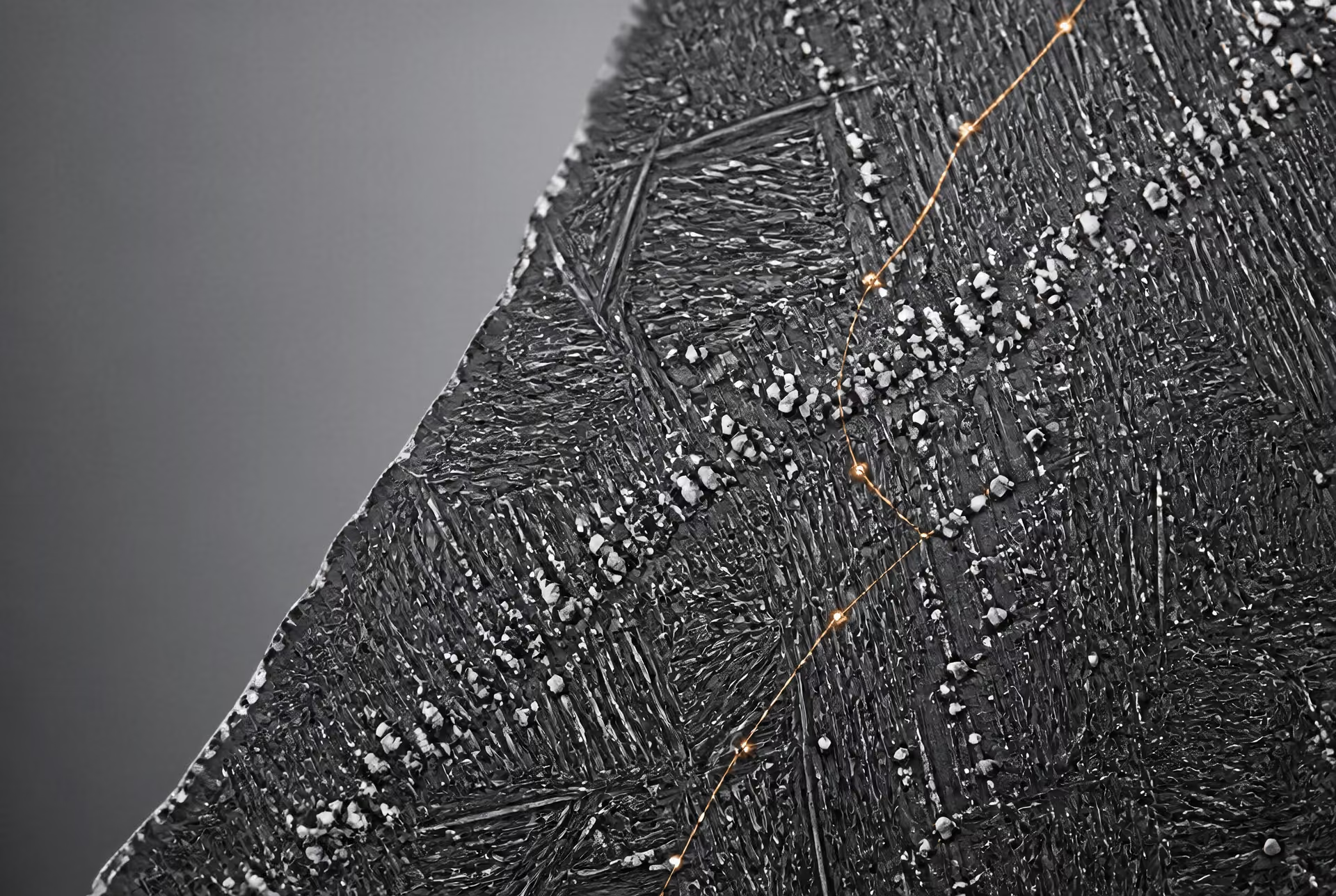
Why hardness can rise during tempering
Tempering is not defined simply as softening. ASM International states in ASM Handbook Volume 4A (2024): “Tempering is the heating of hardened or normalized steel to a temperature below the lower critical temperature.” The resulting structure and properties depend on tempering temperature and time, carbon content, alloy content, residual elements, and the condition produced by hardening or normalizing. Those variables determine which reactions occur and how far they proceed.
In plain-carbon and many low-alloy steels, the usual result is a fall in hardness. Quenched martensite contains supersaturated carbon, high dislocation density, and substantial internal stress. During tempering, carbon diffuses from martensite, transition carbides or cementite form, retained austenite may decompose, and the martensitic structure recovers. The U.S. Department of Energy’s 2010 treatment of tempering describes these linked processes as carbon diffusion, carbide formation, austenite decomposition, and recovery. Each generally reduces the stored strain energy and the resistance to plastic deformation.
High-alloy tool steels can follow a different path. As the temperature rises, alloying elements that remained dissolved during quenching can diffuse over short distances and form a dense population of extremely small alloy carbides. These particles obstruct dislocation motion. If their strengthening effect exceeds the softening caused by martensite recovery, measured hardness increases during tempering. This is secondary hardening.
ASM International explains that “secondary hardening in high-alloy tool steels is produced by precipitation of fine alloy carbides,” including carbides associated with molybdenum, vanadium, and tungsten. The word fine matters. A coarse carbide population does not strengthen the matrix as effectively because the particles are farther apart and provide less resistance to moving dislocations. Very small precipitates, distributed through the tempered martensite, create precipitation strengthening while the matrix is still undergoing recovery.
The response is therefore a competition between softening and strengthening. Early tempering may reduce hardness as carbon leaves martensite. At a higher temperature, alloy-carbide precipitation can reverse that trend. At still higher exposure, precipitates coarsen, the matrix loses more of its martensitic strength, and hardness falls again. Not every grade displays a large increase, and a hardness curve can contain overlapping reactions rather than one clean peak.
Molybdenum-, vanadium- and tungsten-associated carbides
Molybdenum, vanadium, and tungsten are central to secondary hardening because they have strong carbide-forming tendencies and diffuse from the steel matrix into precipitates during suitable tempering treatments. The exact phases depend on composition and thermal history. Carbides may be described by crystal-structure or composition designations such as MC, M₂C, M₆C, or M₂₃C₆, where M represents one or more metallic elements; those labels do not mean that every steel forms every listed phase.
Vanadium commonly contributes very stable, vanadium-rich MC carbides. Their resistance to dissolution allows them to remain effective at temperatures that would coarsen or dissolve less stable particles. Molybdenum can participate in fine M₂C-type precipitation and in mixed alloy-carbide populations. Tungsten may enter M₆C-type carbides or other mixed carbides, depending on the steel and tempering schedule. In high-speed steels, where tungsten, molybdenum, vanadium, chromium, and carbon are combined at substantial levels, several carbide families can form sequentially or simultaneously.
The matrix chemistry before tempering is critical. Austenitizing dissolves some carbides and enriches austenite in carbon and alloying elements, while undissolved carbides retain other elements outside the matrix. Quenching then produces martensite plus, often, retained austenite. A higher austenitizing temperature or longer hold can dissolve more carbide, although excessive austenitizing may cause grain growth and other damage. The dissolved alloy content available for later precipitation can consequently alter the secondary-hardening response.
A National Institute of Standards and Technology study on high-speed steel reported in 1930 that “the intensity of the secondary-hardening peak increases with the degree of austenitization.” This observation should not be converted into a universal temperature or hardness increment. Greater austenitization can increase the supply of alloying elements for precipitation, but it also changes grain size, retained austenite, carbon activity, and the amount of undissolved carbide. The final curve reflects all of those changes.
Tempering resistance and the secondary-hardening peak
Tempering resistance means retaining hardness, strength, or dimensional stability during a specified thermal exposure. Fine alloy-carbide precipitation raises tempering resistance because the precipitates oppose dislocation motion and delay the loss of martensitic strength. A steel with strong secondary hardening may show little softening over a temperature interval where a plain-carbon steel would lose hardness rapidly. That does not mean it is immune to tempering; continued exposure eventually permits recovery, carbide coarsening, retained-austenite transformation, and other softening reactions.
The peak’s position and magnitude are grade- and history-dependent. They cannot be stated responsibly as fixed values without naming the steel, initial hardness, austenitizing treatment, quench, tempering time, heating rate, cooling method, and hardness test. AISI H13, for example, can show a different response from a tungsten-rich high-speed steel because its alloy balance and carbide population differ. Even two H13 specimens can produce different curves after different austenitizing or quenching treatments.
J. H. Hollomon and L. D. Jaffe’s 1945 method relates tempering time, temperature, and composition to the structure and properties developed in quenched steel. Its familiar form is the tempering parameter:
Here, T is absolute temperature, t is time, and c is a composition- and response-dependent constant. The U.S. Department of Energy describes this expression as quantifying the degree of martensite tempering. It is useful for comparing exposures and fitting hardness data, but an equal parameter does not erase differences in heating rate, prior microstructure, austenitization, section size, or alloy response.
That limitation is especially important for non-isothermal processing. The peer-reviewed 2013 study on H13 tool steel examined isothermal, slow-heating, and rapid-heating tempering schedules and developed a method that predicted different hardness responses, including secondary-hardening behavior. A rapidly heated section can pass through precipitation ranges before diffusion and carbide growth match an isothermal assumption. Temperature gradients also make the surface and core experience different thermal paths.
ASM Handbook Volume 4C (2024) compares Hollomon-Jaffe and Grange-Baughman correlations for induction-hardened steels, treating them as ways to represent equivalent time-temperature conditions for assessing tempering response. “Equivalent” means equivalent within the tested correlation and material range, not identical microstructural history.
A 2013 Journal of Materials Processing Technology study of hot- and warm-forging die steels likewise used the tempering parameter—also called the Hollomon-Jaffe or Larson-Miller parameter—to correlate time-temperature exposure with hardness change. Such correlations are valuable process tools, but they describe measured behavior for specified steels and treatments. They do not establish a universal secondary-hardening peak. In high-alloy tool steels, tempering remains a sequence of competing diffusion, precipitation, transformation, and recovery reactions.
Austenitization as a Driver of Secondary Hardening
Austenitization is not merely a preliminary heating step before quenching. It sets the chemical and structural condition from which martensite forms, and that condition governs how the steel responds during tempering. ASM Handbook Volume 4A defines tempering as “the heating of hardened or normalized steel to a temperature below the lower critical temperature.” The resulting microstructure depends on tempering temperature and time, carbon content, alloy content, and residual elements. Those variables act on a prior condition established by austenitization, dissolution, grain growth, and quenching.

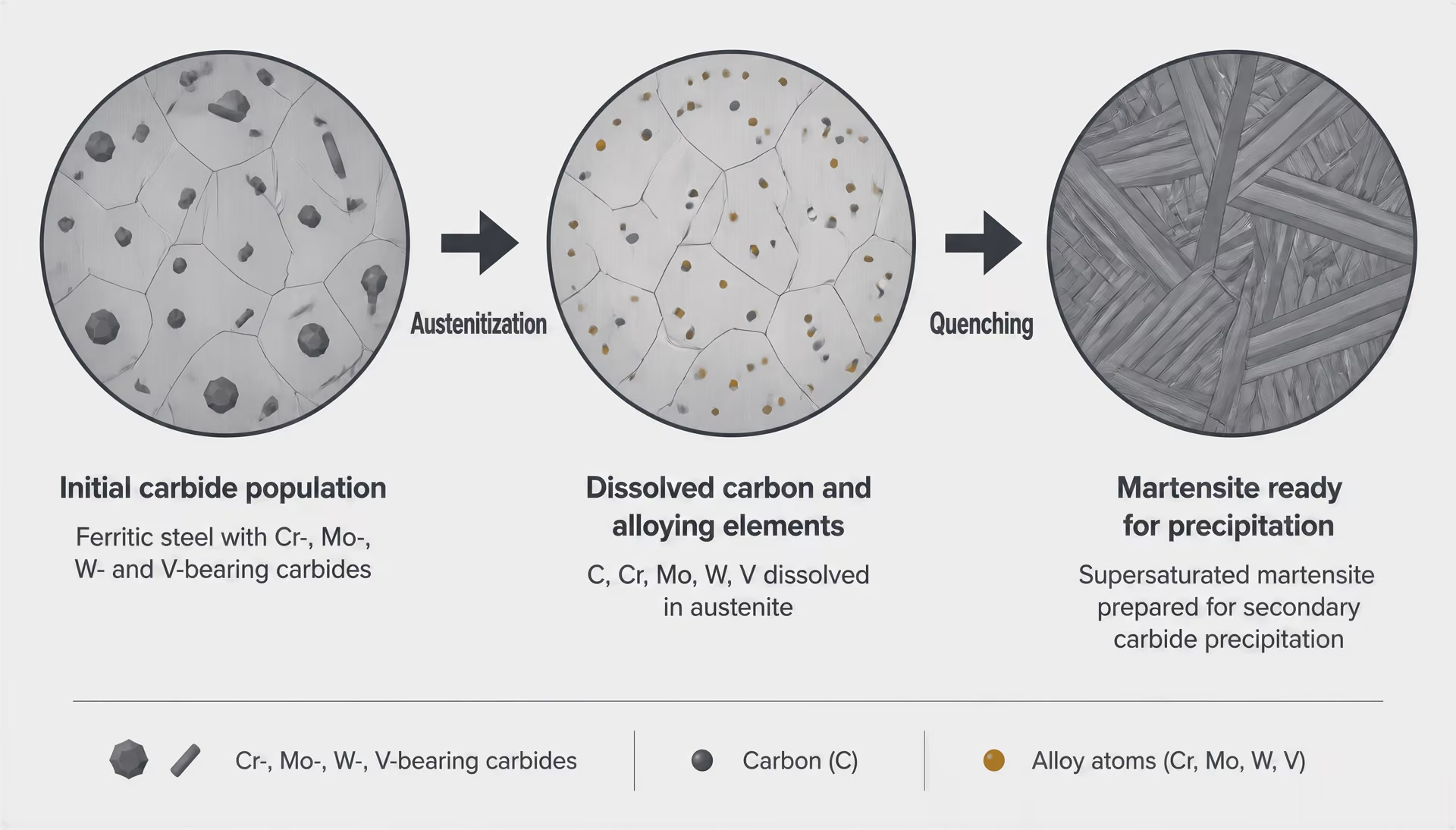
Dissolution of alloying elements before quenching
During austenitization, some carbides dissolve into austenite while others remain undissolved. The temperature, holding time, heating rate, and original carbide population determine the balance. Carbon and substitutional alloying elements such as chromium, molybdenum, tungsten, and vanadium do not enter solution at identical rates, so austenite can leave the furnace with very different solute contents even when two treatments use the same nominal steel grade.
That dissolved material matters after quenching. A larger quantity of carbon and alloying elements in austenite can produce a more supersaturated martensitic matrix. During tempering, carbon diffusion, carbide formation, decomposition of retained austenite, and recovery progressively reduce the stored energy and chemical instability of that structure. The U.S. Department of Energy describes these processes as central parts of tempering, but they do not proceed at the same rate in every steel or from every austenitizing condition.
High-alloy tool steels add another path: secondary hardening. ASM International states in its 2024 description that “secondary hardening in high-alloy tool steels is produced by precipitation of fine alloy carbides,” including carbides associated with molybdenum, vanadium, and tungsten. If the quenched matrix contains sufficient dissolved alloying elements, tempering can produce a dense dispersion of fine, resistant carbides. Their precipitation may offset, or temporarily exceed, the softening caused by martensite tempering. This is why hardness need not decline monotonically as tempering temperature rises.
Austenitization also controls what remains outside the matrix. Undissolved primary carbides can restrict austenite grain growth and retain alloying elements that would otherwise contribute to secondary precipitation. Retained austenite may increase when the austenite contains more dissolved carbon and alloying elements, because its martensite-start temperature is depressed. On subsequent tempering, that retained austenite can decompose or transform, adding a separate hardness change to the precipitation and recovery reactions.
NIST findings in high-speed steel
A National Institute of Standards and Technology paper published in 1930 provides a direct link between austenitization and secondary hardening in high-speed steel. Its stated finding is that “the intensity of the secondary-hardening peak increases with the degree of austenitization.” In this context, degree of austenitization refers to how far the heating treatment has dissolved the carbide constituents and enriched the austenite before quenching, not simply to a furnace temperature listed on a specification sheet.
The metallurgical logic is clear. More complete dissolution can place more carbide-forming elements into supersaturated martensite. On tempering, that matrix has a greater potential for precipitation of fine molybdenum-, tungsten-, or vanadium-rich carbides. The resulting precipitation strengthens the matrix and raises resistance to temper softening. The NIST observation therefore connects the height of the secondary-hardening response to the starting solute condition of the quenched steel.
It does not establish a universal instruction to raise the austenitizing temperature. Excessive heating can enlarge prior-austenite grains, increase retained austenite, promote decarburization or overheating, and alter quench cracking sensitivity. It can also dissolve carbides whose undissolved fraction was needed for grain control. A larger grain size may change hardenability and fracture behavior even when the final hardness appears acceptable. The response can therefore become less useful despite greater nominal alloy dissolution.
Insufficient austenitization creates the opposite problem. Undissolved alloy carbides may leave too little carbon and too few alloying elements in austenite for the intended martensitic hardness or secondary precipitation response. Incomplete solution can also produce chemical segregation between matrix regions and carbide-rich regions. Quenching then yields a less uniform structure, and tempering cannot fully correct that starting condition.
The trade-off between austenitization and final response
The final response is a process history, not a single temperature effect. J. H. Hollomon and L. D. Jaffe’s 1945 method relates tempering time, temperature, and composition through a tempering parameter commonly written as T(log t + c), used to quantify the degree of martensite tempering. The parameter is useful for comparing exposures, but an equivalent value does not erase differences in heating rate, prior microstructure, austenitization, section size, retained austenite, or alloy-specific precipitation.
A 2013 peer-reviewed study of H13 tool steel demonstrated this limitation by treating isothermal, slow-heating, and rapid-heating schedules separately. The predicted hardness responses differed, and the calculations included secondary-hardening behavior. A rapidly heated section does not spend the same time crossing transformation and precipitation ranges as an isothermally tempered section, so equal nominal peak temperature and holding-time descriptions can conceal different reactions.[1] Tempering of Induction-Hardened Steels. ASM International. ASM Handbook Volume 4C, 2024.
ASM Handbook Volume 4C likewise compares Hollomon-Jaffe and Grange-Baughman correlations for induction-hardened steels. Both represent equivalent time-temperature conditions for assessing tempering response, yet their usefulness depends on the thermal cycle and material condition used to establish the correlation. The hot- and warm-forging die-steel study published in the Journal of Materials Processing Technology in 2013 used the tempering parameter—also called the Hollomon-Jaffe or Larson-Miller parameter—to correlate time-temperature exposure with hardness change. Such correlations organize data; they do not supply fixed hardness values or guaranteed property changes across grades.
Austenitization should therefore be selected to balance dissolution, grain control, retained-austenite management, quench response, and the desired precipitation sequence. The NIST result supports a stronger secondary-hardening peak with greater austenitization in the high-speed steel studied. It does not make maximum dissolution the general objective. The useful target is the starting structure that gives the required final response after the complete quench-and-temper history.
Time-Temperature Equivalence and the Hollomon-Jaffe Parameter
Hollomon and Jaffe’s 1945 formulation
Tempering is not defined simply as “softening after quenching.” ASM Handbook Volume 4A defines it as “the heating of hardened or normalized steel to a temperature below the lower critical temperature” (ASM International, 2024). During that treatment, carbon diffuses from supersaturated martensite, transition carbides and cementite may form, retained austenite may decompose, and the martensitic structure undergoes recovery. The final hardness and toughness depend on temperature and time, but also on carbon content, alloying additions, residual elements, prior austenitization, and the structure produced by quenching.[2] Transformation of Austenite: Time-Temperature Relations in Tempering Steel. J. H. Hollomon, L. D. Jaffe. Metals Technology, 1945.
J. H. Hollomon and L. D. Jaffe addressed the need to compare tempering treatments in their 1945 paper, “Transformation of Austenite: Time-Temperature Relations in Tempering Steel,” published in Metals Technology. Their method related tempering time, temperature, and composition to the structure and properties developed in quenched steel. The practical problem was straightforward: a steel tempered for a short period at a high temperature might reach a similar condition to one held for much longer at a lower temperature. A single tempering temperature could not describe both treatments.
Their empirical relation is commonly written
where is the Hollomon-Jaffe tempering parameter, is absolute temperature in kelvins, is tempering time, and is a composition- and reaction-dependent constant. In many engineering calculations, is assigned a value near 20, but that number is a convention rather than a material constant shared by every grade and every reaction. The time unit must also be stated because changing from hours to seconds changes the logarithmic term and therefore changes the numerical parameter.
The relation is empirical. Hollomon and Jaffe did not establish a universal thermodynamic law that makes all tempering treatments interchangeable. They provided a useful correlation for data sets in which the same steel, initial condition, and dominant tempering mechanism are being compared. The parameter compresses two variables into one index so that hardness, tensile strength, or another measured property can be plotted against a common exposure measure.
Meaning of
The temperature term gives the parameter its strong sensitivity to thermal exposure. It must be expressed on an absolute scale, normally kelvins, because the relation is intended to reflect the temperature dependence of diffusion-controlled reactions. The logarithm of time represents diminishing returns from extending a hold: increasing a treatment from 1 to 10 hours changes by one unit, while increasing it from 100 to 110 hours produces only a small change.
The constant , often written , adjusts the relation for the steel and for the tempering response being fitted. It is sometimes described as a composition-related constant because carbon and alloy content alter diffusion, carbide stability, precipitation kinetics, and resistance to recovery. In practice, however, the fitted value can also absorb experimental conventions, including the selected property range, time units, and the reaction mechanism represented by the data. Treating as a universal law can give a misleading sense of precision.
For ordinary carbon and low-alloy steels, the parameter often correlates reasonably with progressive temper softening over a restricted temperature and time range. The physical sequence can include carbon redistribution, formation of iron carbides, decomposition of retained austenite, and recovery of the dislocation structure. The U.S. Department of Energy describes as a measure of the degree of martensite tempering, but that interpretation does not mean that every microstructural event advances at the same rate.
The same parameter can also describe a hardness increase. In high-alloy tool steels, tempering may cause secondary hardening rather than continuous softening. ASM International attributes secondary hardening to precipitation of fine alloy carbides, including carbides associated with molybdenum, vanadium, and tungsten. Stronger precipitation can increase resistance to tempering. The National Institute of Standards and Technology reported for high-speed steel that “the intensity of the secondary-hardening peak increases with the degree of austenitization.” This observation matters because austenitization changes the amount of alloying elements and carbon dissolved in austenite before quenching. Two specimens of the same nominal grade can therefore reach different secondary-hardening peaks if their austenitizing treatments differ.
A rising hardness value at a given Hollomon-Jaffe parameter is not an error by definition. It may indicate precipitation hardening, while a falling value may indicate martensite tempering and recovery. The parameter records a calculated exposure; it does not identify the reaction responsible for the measured property.
What an equivalent tempering parameter can and cannot predict
An equivalent parameter is most useful when it compares treatments within a controlled family: the same grade, section size, quenched structure, austenitization schedule, atmosphere, and property measurement. Within those limits, it can help estimate whether a revised combination of temperature and holding time should produce a similar hardness trend. ASM Handbook Volume 4C presents Hollomon-Jaffe and Grange-Baughman correlations as equivalent time-temperature methods for assessing the tempering response of induction-hardened steels. Such correlations are engineering tools for organizing results, not proof that the thermal histories are physically identical.
Heating rate is a major limitation. A specimen raised rapidly to the tempering temperature spends little time in the lower-temperature range, whereas a slowly heated specimen may begin carbon redistribution, carbide formation, or retained-austenite decomposition before reaching the nominal hold temperature. A 2013 peer-reviewed study of H13 tool steel developed predictions for isothermal, slow-heating, and rapid-heating schedules and included secondary-hardening behavior. Its significance is that schedules with comparable nominal parameter values can still produce different predicted hardness responses when the heating path changes.
Interrupted tempering creates another problem. Cooling between two tempering stages can alter precipitation, retained-austenite decomposition, and the population of transition carbides. Reheating does not necessarily resume the same reaction at the same rate. Section size also matters: the surface and center of a large die may experience different heating and cooling histories, even when the furnace temperature is recorded as a single value.
Prior microstructure is equally important. Austenite grain size, martensite carbon content, retained austenite, segregation, and undissolved carbides all affect subsequent reactions. Austenitization is especially influential in high-speed and hot-work tool steels because it controls solute availability for secondary carbide precipitation. A nominally equivalent parameter cannot reconstruct that starting condition.
The limitation becomes sharper near transformation or precipitation peaks. A single monotonic softening curve cannot represent a steel that first softens, then hardens as fine molybdenum-, vanadium-, or tungsten-rich carbides precipitate, and later softens again after overaging. The hot- and warm-forging die-steel study published in the Journal of Materials Processing Technology in 2013 used the tempering parameter—also called the Hollomon-Jaffe or Larson-Miller parameter—to correlate time-temperature exposure with hardness changes. That approach is useful for mapping die-steel behavior, but its fitted relation remains tied to the investigated steel and treatment range.
Thus, is a comparison index, not a substitute for thermal history or microstructural evidence. It can organize tempering data and support interpolation between tested conditions. It cannot guarantee equal hardness, equal toughness, equal carbide populations, or equal retained-austenite content when heating rate, interruptions, austenitization, prior structure, or alloy response differs.
Non-Isothermal Tempering and Real Heating Schedules
Tempering is not defined by the furnace setpoint alone. ASM International states in ASM Handbook Volume 4A (2024), “Tempering is the heating of hardened or normalized steel to a temperature below the lower critical temperature.” The resulting condition depends on tempering temperature and time, but also on carbon content, alloying elements, residual elements, prior austenitization, and the thermal path used to reach the holding temperature.
That distinction matters because industrial parts rarely heat everywhere at the same rate. A die, insert, or large shaft may have a hot surface while its core is still below the intended tempering range. During that interval, different regions are undergoing different reactions.

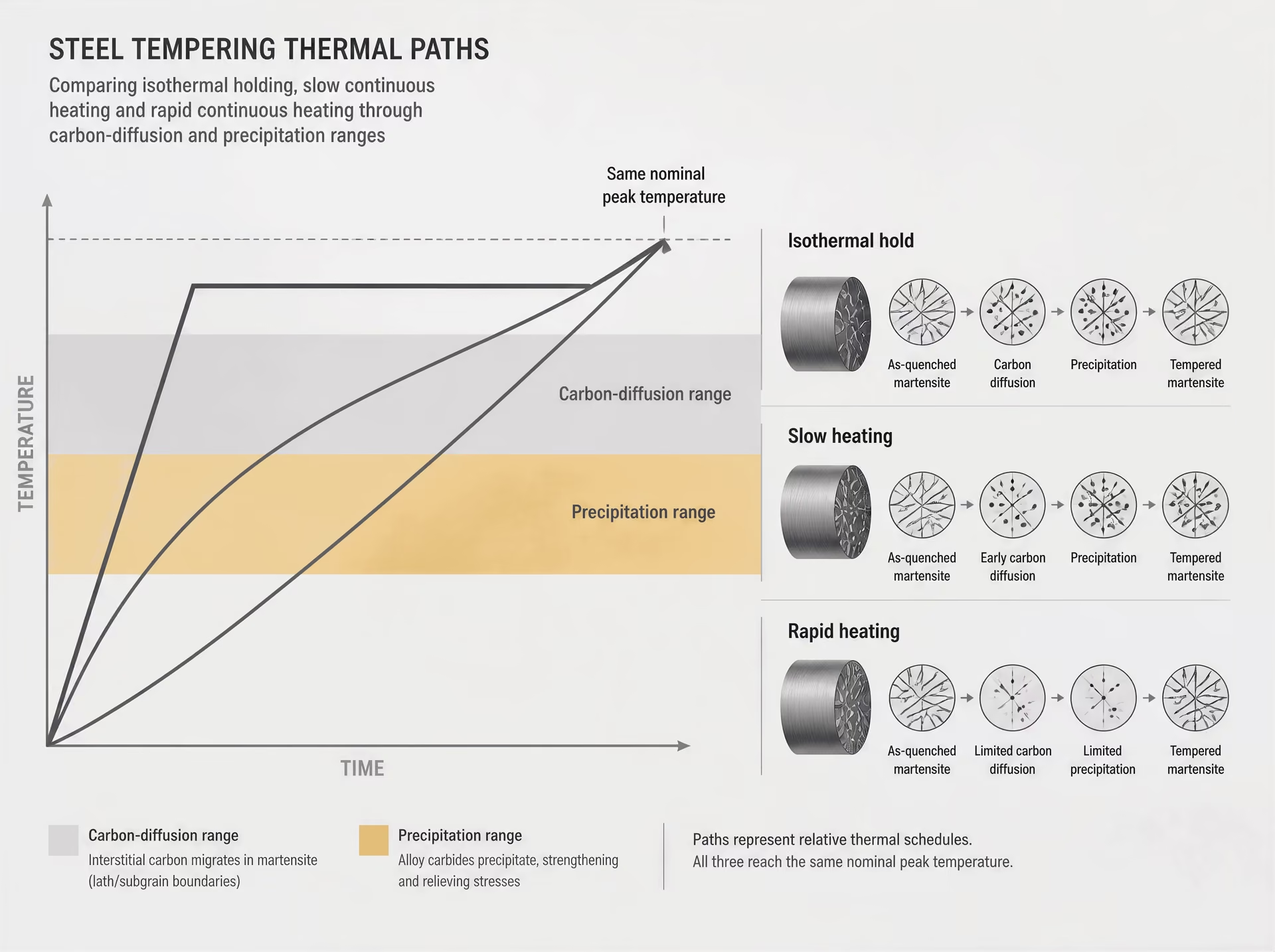
Isothermal holding versus continuous heating
| Schedule | Thermal path | Interpretive limitation |
|---|---|---|
| Isothermal | Heat to a selected temperature and hold | Does not reproduce reactions during a real heating ramp |
| Slow heating | Pass through intermediate temperatures over an extended ramp | Early diffusion and precipitation can begin before the final hold |
| Rapid heating | Pass through intermediate temperatures quickly | Less time is available for lower-temperature reactions |
An isothermal tempering test heats a specimen to a selected temperature and holds it there. It is useful for separating the effect of holding time, but it does not reproduce the complete history of a real component. Continuous heating exposes the steel to a succession of temperatures, and each temperature permits a different combination of carbon diffusion, carbide formation, austenite decomposition, and recovery.
The U.S. Department of Energy describes tempering in terms of carbon diffusion and the associated formation of carbides, decomposition of retained austenite, and recovery of the martensitic structure. These reactions do not begin, proceed, or finish at one identical rate. A slowly heated specimen may spend substantial time in lower-temperature ranges where carbon redistributes and transition carbides form before the nominal tempering temperature is reached. A rapidly heated specimen spends less time there, so precipitation and recovery begin under a different sequence of conditions.
The difference is not simply a matter of adding the time spent above a chosen temperature. Diffusion is temperature-sensitive, while precipitation depends on both the availability of solute and the nucleation and growth history of the particles. A reaction that starts during slow heating can alter the matrix and thereby change what occurs at the final hold. In contrast, rapid heating can carry the steel into a higher-temperature regime before the same intermediate reactions have progressed to a comparable degree.
The Hollomon-Jaffe method, formulated by J. H. Hollomon and L. D. Jaffe in 1945, expresses a time-temperature-composition relation for quenched steel. Its commonly presented form is:
where is absolute temperature, is tempering time, and is a composition- and response-dependent constant. The U.S. Department of Energy describes this expression as a way to quantify the degree of martensite tempering. It is a useful comparison parameter, not a physical eraser. Two schedules with the same calculated value can differ because of heating rate, prior microstructure, austenitization, section size, and alloy-specific precipitation reactions.
ASM Handbook Volume 4C (2024) makes a similar practical point for induction-hardened steels: Hollomon-Jaffe and Grange-Baughman correlations can represent equivalent time-temperature conditions for assessing tempering response, but their agreement applies within the tested material and process range. Correlation is not proof that every thermal path produces the same microstructure.
H13 tool steel as a case study[3] Hardness of H13 Tool Steel After Non-Isothermal Tempering. University of Arizona publication record. Peer-reviewed publication record, 2013.
A peer-reviewed study recorded in the University of Arizona publication database, Hardness of H13 Tool Steel After Non-Isothermal Tempering (2013), is especially useful because it compares predicted responses for AISI H13 under isothermal, slow-heating, and rapid-heating schedules. The study includes secondary-hardening behavior rather than treating hardness as a quantity that must decline monotonically.
AISI H13 is a hot-work tool steel containing chromium, molybdenum, and vanadium. In high-alloy tool steels, ASM International identifies secondary hardening as precipitation of fine alloy carbides, including carbides associated with molybdenum, vanadium, and tungsten. The precipitation can offset or exceed the softening caused by martensite recovery over part of the tempering range. The exact response depends on the steel’s chemistry and initial condition; the H13 study should not be read as assigning one universal hardness value or one fixed secondary-hardening temperature to all H13 products.
Its comparison of heating schedules demonstrates the central point: isothermal, slow-heating, and rapid-heating treatments can generate different predicted hardness histories, including different expressions of the secondary-hardening peak. Under slow heating, the material begins tempering before reaching the nominal target temperature. Under rapid heating, the time available for low-temperature diffusion and early precipitation is reduced. The final hardness therefore reflects the path into the hold, not only the hold itself.
Secondary hardening also depends strongly on austenitization. A National Institute of Standards and Technology study (1930) reported that “the intensity of the secondary-hardening peak increases with the degree of austenitization.” Greater austenitization can change the amount of alloy dissolved in austenite and the condition of the quenched matrix, which then changes the precipitation response during tempering. This finding is another reason to avoid transferring a tempering chart from one heat-treatment history to another without verification.
The practical consequence is direct: a nominally identical H13 tempering schedule can produce different results if the heating ramp, prior austenitizing treatment, specimen size, or cooling history changes. Prediction is valuable, but the prediction must be calibrated against the grade and process.
Why furnace charts do not fully describe the part
A furnace chart usually reports air temperature, or the temperature measured by a thermocouple at one selected location. That value is not automatically the temperature of the steel surface, and it says even less about the center of a thick die. Furnace loading, contact with fixtures, radiation, convection, and part geometry all affect the thermal gradient.
Consider a large forging die. Its exposed corners may reach the tempering range while a recessed section remains cooler. The surface then accumulates more reaction time at elevated temperature, whereas the interior may still be heating through the lower part of the tempering interval. If the die is removed when the furnace chart reaches the scheduled hold time, the surface and core have not experienced equivalent thermal exposure.
Measurement location can also conceal overshoot and delay. A control thermocouple may respond quickly to furnace air, while a thermocouple embedded near the part center records a slower rise. For process qualification, both locations can matter: the furnace measurement establishes equipment behavior, while part thermocouples reveal the actual exposure governing transformation and precipitation.
The hot- and warm-forging die-steel study published in the Journal of Materials Processing Technology (2013) uses the tempering parameter—also called the Hollomon-Jaffe or Larson-Miller parameter—to correlate time-temperature exposure with hardness change. Such a parameter helps organize data from several schedules, but it remains a fitted relation. Grade-specific coupons, representative section sizes, measured part temperatures, and hardness or microstructural checks are needed to validate it. A furnace chart is a record of the heating environment. It is not, by itself, a complete description of the steel’s tempering history.
Tempering of Induction-Hardened Steels

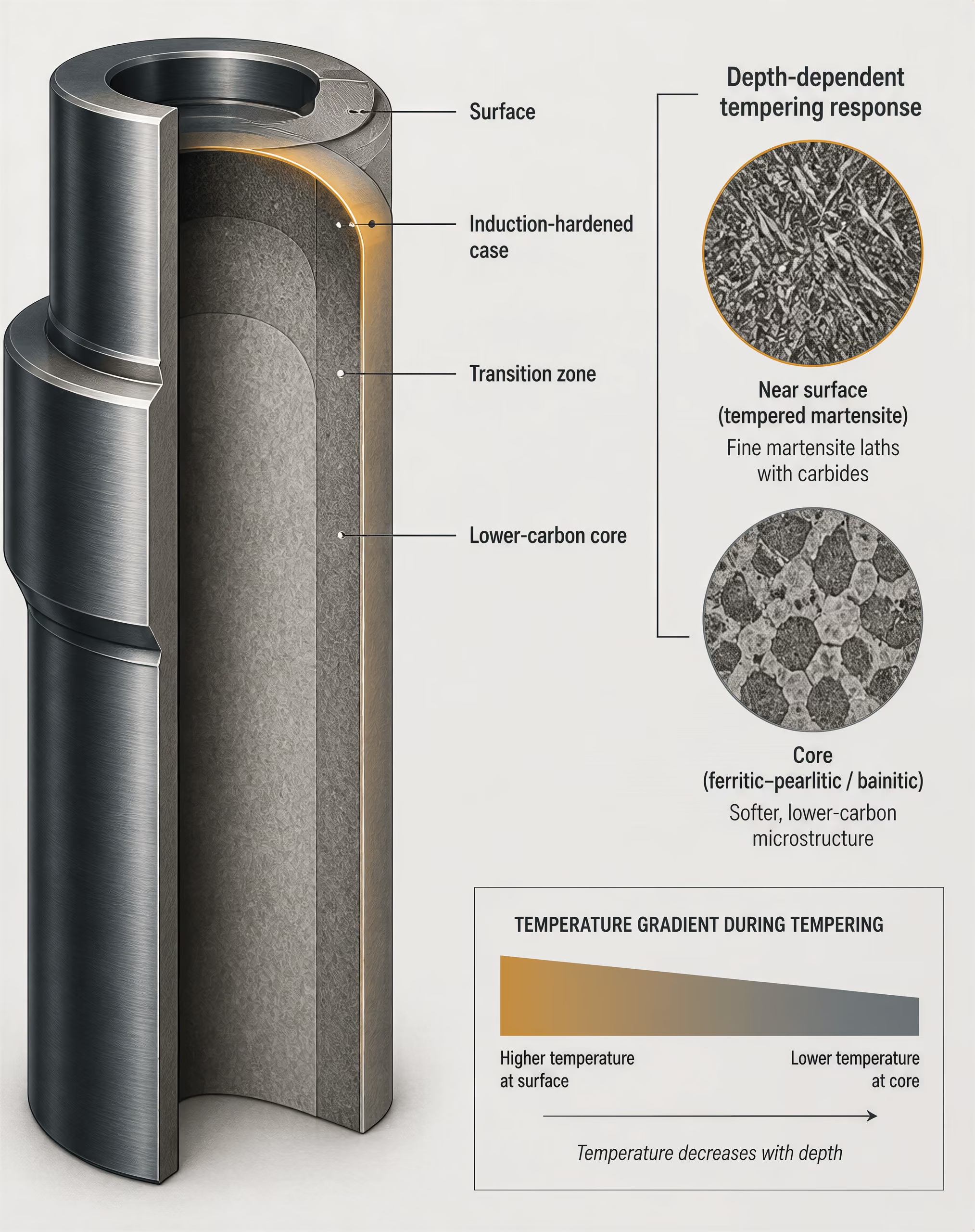
A hardened case and a lower-carbon core
ASM International defines tempering as “the heating of hardened or normalized steel to a temperature below the lower critical temperature” (ASM Handbook Volume 4A, 2024). That definition is simple; an induction-hardened section is not. Induction heating produces austenite mainly near the surface, followed by rapid quenching. The result is commonly a high-carbon martensitic case over a lower-carbon, softer core that may remain ferritic-pearlitic, bainitic, tempered, or partly transformed depending on the starting condition and the depth reached by the thermal cycle.
The case and core therefore do not begin tempering from the same microstructure. Near the surface, carbon content may reflect the base grade, carburizing or carbonitriding, decarburization, segregation, or incomplete dissolution of carbides during austenitization. Deeper material may contain less dissolved carbon and may never have exceeded the austenitizing range. Even within the hardened layer, prior-austenite grain size, martensite carbon content, retained austenite, alloy-carbide dissolution, and quench rate can change with depth.
Tempering then drives several overlapping reactions. The U.S. Department of Energy describes carbon diffusion, carbide formation, decomposition of retained austenite, and recovery as important parts of the process. Their rates depend on temperature and time, but also on the local structure available to react. A surface zone heated rapidly to a tempering temperature does not experience the same reaction sequence as a core that warms slowly by conduction. During induction tempering, the surface can reach the target temperature while the subsurface is still heating; during a separate furnace temper, the entire component may approach a more uniform temperature, although section size still controls the time required.
Ordinary tempering often lowers as-quenched martensite hardness as carbon leaves supersaturated martensite and forms transition carbides or cementite. That trend is not universal. ASM International states that secondary hardening in high-alloy tool steels is produced by fine alloy-carbide precipitation, including carbides associated with molybdenum, vanadium, and tungsten. Stronger precipitation produces greater resistance to temper softening and can raise hardness after an initial decrease. The National Institute of Standards and Technology reported in 1930 that “the intensity of the secondary-hardening peak increases with the degree of austenitization.” Greater austenitization can dissolve more alloying elements, but it can also increase retained austenite and alter grain size, so the peak cannot be assigned one fixed temperature for every grade or treatment.
Applying Hollomon-Jaffe and Grange-Baughman correlations
J. H. Hollomon and L. D. Jaffe developed their 1945 method as a time-temperature-composition relation for quenched steel. Its familiar form is the tempering parameter
where is absolute temperature, is time, and is a composition- and reaction-dependent constant. The expression represents the degree of martensite tempering by placing different time-temperature exposures on an equivalent scale. A long exposure at a lower temperature can therefore be compared with a shorter exposure at a higher temperature, provided the correlation is appropriate for the material and reaction range.
ASM Handbook Volume 4C applies this type of analysis to induction-hardened steels and compares Hollomon-Jaffe with the Grange-Baughman correlation for representing equivalent time-temperature conditions. These relations are useful for converting a measured or calculated thermal cycle into a parameter that can be related to hardness change. They are not substitutes for metallography or sectioned hardness measurements. An equivalent parameter does not erase differences in heating rate, austenitization, prior microstructure, section size, retained austenite, or alloy response.
That limitation is especially important when secondary hardening occurs. A correlation fitted to monotonic temper softening can misrepresent a hardness rise caused by alloy-carbide precipitation. A peer-reviewed 2013 study of H13 tool steel demonstrated predictions for isothermal, slow-heating, and rapid-heating tempering schedules, including secondary-hardening behavior. The schedules could produce different predicted hardness responses even when their nominal thermal exposures appeared comparable. H13, with substantial chromium, molybdenum, and vanadium, is not a model for every induction-hardening grade.
Depth-dependent response and process interpretation
A useful interpretation begins with a temperature-time history at each depth, not with one furnace setpoint. The surface may undergo a rapid austenitization cycle, quench into martensite, and then receive a short temper. At a depth near the hardening boundary, the peak temperature may be below full austenitization but high enough to temper the existing structure. The core may experience only conduction heating and retain properties determined largely by the original normalize, anneal, or prior temper.
Hardness traverses should consequently be taken on a properly prepared cross-section, with the measurement origin, spacing, load, and surface condition recorded. Case hardness, effective case depth, transition-zone behavior, and core hardness must be reported separately. Metallography, retained-austenite measurement, and, where necessary, carbide or composition analysis help explain departures from a calculated profile.
The 2013 hot- and warm-forging die-steel study makes the same point in another setting: a tempering parameter, also called the Hollomon-Jaffe or Larson-Miller parameter, can correlate time-temperature exposure with hardness change, but the correlation remains tied to the tested steel and treatment range. For induction-hardened parts, Hollomon-Jaffe and Grange-Baughman values are best used as process-comparison tools. Validation still requires depth-resolved thermal records and sectioned measurements of both the hardened case and the lower-carbon core.
Using Tempering Parameters for Die Steels and Process Control
Hot- and warm-forging die steels
Tempering is not simply a scheduled reduction in hardness. ASM International defines it as “the heating of hardened or normalized steel to a temperature below the lower critical temperature” (ASM Handbook Volume 4A, 2024). During that treatment, carbon diffuses from supersaturated martensite, carbides form or coarsen, retained austenite may decompose, and the matrix undergoes recovery. The U.S. Department of Energy describes these processes as coupled changes rather than a single softening reaction.
That distinction matters for hot- and warm-forging die steels. Grades such as ASTM A681 H13 are commonly quenched from an austenitizing treatment and tempered to establish a controlled balance of hardness, toughness and resistance to thermal cycling. Other hot-work grades, including H11 and H10, respond according to their own carbon, chromium, molybdenum and vanadium contents, prior grain condition and quench history. A tempering schedule that produces a particular hardness in H13 cannot be transferred directly to another grade merely because the nominal tempering temperatures are similar.
High-alloy tool steels can harden during tempering. ASM International attributes secondary hardening to precipitation of fine alloy carbides, including carbides associated with molybdenum, vanadium and tungsten. The stronger the precipitation reaction, the greater the resistance to temper softening may be. The National Institute of Standards and Technology reported in 1930 that “the intensity of the secondary-hardening peak increases with the degree of austenitization.” A higher austenitizing temperature can dissolve more alloy carbide and increase alloy content in austenite, but it can also enlarge prior-austenite grains and alter retained-austenite content. The resulting hardness peak is therefore a product of the full treatment history, not of tempering temperature alone.
For forging dies, process control should record the steel designation, heat or lot, starting hardness, austenitizing temperature and hold time, transfer time, quench medium, cooling rate, tempering temperature, heating rate, hold time and cooling method. Furnace uniformity also matters. A die surface and its core may experience different thermal cycles, especially in a large section.
Hardness correlation through tempering parameters
J. H. Hollomon and L. D. Jaffe proposed a time-temperature-composition relation for quenched steel in 1945. Their method expresses the degree of martensite tempering with:
where is absolute temperature, is time, and is a material-related constant. Depending on the source and application, this quantity is called the Hollomon-Jaffe parameter, or the Larson-Miller parameter. Time must be stated in the units used to establish the correlation, and temperature must be absolute rather than Celsius.
The parameter is useful because it combines exposure time and temperature into one comparison value. A process engineer can plot measured hardness against , then identify whether a production cycle falls within the tested range. The 2013 forging-die-steel study in the Journal of Materials Processing Technology used this tempering parameter—also called the Hollomon-Jaffe or Larson-Miller parameter—to correlate time-temperature exposure with hardness change in hot- and warm-forging die steels.
Correlation is not causation. Two cycles with the same need not produce identical microstructures if one uses rapid heating and the other uses a long furnace ramp. The prior martensite morphology, retained austenite, section size, austenitizing treatment, quench severity and alloy carbide population can all change the response. The parameter also does not provide direct hardness prediction across unrelated grades. Its constant , fitted curve and useful range require evidence from the steel and condition being evaluated.
A peer-reviewed H13 study recorded different predicted hardness responses for isothermal, slow-heating and rapid-heating tempering schedules, including secondary-hardening behavior (University of Arizona publication record, 2013). That result directly limits the use of a single equivalent parameter for non-isothermal production cycles. ASM Handbook Volume 4C likewise compares Hollomon-Jaffe and Grange-Baughman correlations for induction-hardened steels, describing them as equivalent time-temperature conditions for assessing tempering response, not as universal property equations.
Verification by hardness and microstructure
Verification begins by identifying the material precisely: grade designation, applicable specification, heat number, delivery condition, austenitizing treatment and quench condition. The inspector should then preserve the complete thermal record, including furnace calibration, load temperature if available, ramp rate, dwell, transfer delays and cooling between multiple tempers. “Two tempers at 550 °C” is incomplete unless the duration and heating history are also known.
Hardness testing must state the method. For a sufficiently thick die section, Rockwell C testing according to ASTM E18 may be appropriate; the report should include surface preparation, test locations, number of indents and instrument verification. Vickers testing according to ASTM E384 is better suited to thin sections, gradients, decarburized layers or local investigations. Measurements should cover the working surface, subsurface and core where section size permits. A hardness value without location and method is weak process evidence.
Unexpected softening, an unusually high hardness, or a hardness rise in the expected temper-softening range calls for metallographic examination. A polished and suitably etched section can reveal tempered martensite, carbide distribution, retained-austenite products, grain coarsening and decarburization. Optical microscopy may establish the general condition; scanning electron microscopy can resolve fine secondary carbides, while hardness traverses can expose thermal gradients. X-ray diffraction or other retained-austenite measurements may be needed when dimensional change or delayed transformation is suspected.
The acceptance decision should compare both hardness and structure with a qualified reference condition. A matching Hollomon-Jaffe value is useful evidence, but it is not proof that the die received the same metallurgical treatment. For secondary hardening, the measured hardness peak and carbide state must agree with the validated grade-specific process window.
How to Read a Tempering Curve Without Misreading It
A tempering curve normally plots hardness against tempering temperature, tempering time, or a combined time–temperature parameter. It is not a universal map of “hardness lost with heat.” ASM Handbook Volume 4A defines tempering as “the heating of hardened or normalized steel to a temperature below the lower critical temperature.” The resulting structure depends on temperature and time, but also on carbon content, alloy content, residual elements, austenitizing treatment, quench, and the steel’s condition before tempering.
Read the curve as a record of competing reactions. Carbon diffuses from supersaturated martensite; transition carbides or cementite may form; retained austenite may decompose; alloy carbides may precipitate; and the matrix may recover. The U.S. Department of Energy identifies carbon diffusion, carbide formation, austenite decomposition, and recovery as central tempering processes. Their sequence and rate differ between grades and heating schedules.
Softening regions and secondary-hardening peaks
The first descending portion of a curve commonly reflects ordinary temper softening. As quenched martensite loses supersaturated carbon and internal stress, its hardness generally falls. A dip may therefore indicate carbide formation and matrix recovery, but it can also include retained-austenite transformation or a change in the volume fraction of hard phases. A nearly flat region is not proof that “nothing happens.” Several reactions may be occurring while their effects on measured hardness partly cancel.
A later rise is the characteristic warning against treating tempering as continuous softening. In high-alloy tool steels, ASM International states that secondary hardening is produced by precipitation of fine alloy carbides, including carbides associated with molybdenum, vanadium, and tungsten. These particles strengthen the tempered matrix, while stronger precipitation generally increases resistance to further tempering. The rise can be especially important in high-speed steels and hot-work die steels, although its temperature range and magnitude are grade-specific rather than fixed properties of the steel category.
A 1930 National Institute of Standards and Technology study on high-speed steel reported that “the intensity of the secondary-hardening peak increases with the degree of austenitization.” That result has a direct interpretive consequence: two curves for nominally identical steel can show different peaks if one specimen was austenitized more severely, dissolved more alloy carbide, or retained a different amount of austenite. Do not transfer a peak from AISI M2 high-speed steel to another high-speed steel, or from AISI H13 to another hot-work grade, without matching the treatment history.
Time matters as much as temperature. J. H. Hollomon and L. D. Jaffe’s 1945 method relates tempering time, temperature, and composition to the structure and properties developed in quenched steel. Its commonly written parameter, T(log t + c), quantifies the degree of martensite tempering; temperature is normally absolute temperature, time is the exposure time, and c represents a composition- and response-dependent constant. This parameter can place different schedules at an equivalent nominal tempering condition, but it does not erase differences in heating rate, prior microstructure, austenitizing, section size, or alloy response.
A peer-reviewed 2013 study of H13 tool steel reinforces that limitation. Its method predicted different hardness responses for isothermal, slow-heating, and rapid-heating schedules, including secondary-hardening behavior. A furnace schedule that spends minutes passing through a precipitation range is not necessarily equivalent to an instantaneous jump to the final temperature.
Peak hardness versus useful service properties
The highest point on the graph is only the highest measured hardness under that test procedure. It is not automatically the best tempering condition. Peak secondary hardness may accompany reduced toughness, greater sensitivity to cracking, residual stress, or dimensional change from retained-austenite transformation. Wear resistance may improve in one contact condition while thermal-fatigue resistance or impact performance declines.
A die steel may require a hardness below its secondary-hardening maximum to obtain acceptable toughness and dimensional stability. Conversely, a tool operating hot may benefit from resistance to softening even when its room-temperature hardness is not the maximum available. Hardness alone also says little about fracture toughness, tensile ductility, thermal fatigue, distortion, or service-induced softening. The curve must therefore be read alongside impact, tensile, toughness, dimensional, and application-specific data.
For induction-hardened steels, ASM Handbook Volume 4C compares Hollomon–Jaffe and Grange–Baughman correlations as representations of equivalent time–temperature conditions. “Equivalent” means equivalent within the tested material and model range, not interchangeable for every steel or heating path. Likewise, a 2013 Journal of Materials Processing Technology study used the tempering parameter—also called the Hollomon–Jaffe or Larson–Miller parameter—to correlate exposure with hardness change in hot- and warm-forging die steels. Such correlations organize data; they do not supply guaranteed hardness values or fixed peak temperatures.
Reporting grade, condition and test method
A useful curve must state the exact steel designation and standard, such as AISI H13 or AISI M2, with the applicable specification such as ASTM A681 where relevant. Report chemical composition when it is known, including carbon and major carbide-forming elements. State whether the material was annealed, normalized, quenched and tempered, or otherwise processed before the experiment.
The heat treatment record should give austenitizing temperature, hold time, atmosphere, specimen size, heating rate, quench medium and quench delay. Give the tempering temperature, time at temperature, heating rate, cooling method, and number of tempering cycles. State specimen location—surface, center, transverse section, longitudinal section, or another defined position—because section size and thermal gradients can change the result.
Finally, identify the hardness method and scale: for example, HRC, HV, or HBW; indenter and load where applicable; surface preparation; test temperature; and the number and spread of readings. Without those details, a curve may describe a real experiment yet remain unsafe for comparison. A hardness peak is evidence about one steel, one condition, and one measurement method—not a general rule for all tempering treatments.
Reference Framework: A Defensible Tempering Specification
Define the material and starting condition
A tempering specification is not defensible unless it identifies the steel precisely. State the grade, product standard, heat-treatment standard and designation exactly as applicable: for example, ASTM A681 H13, UNS T20813, or another designation required by the governing specification. Do not write only “tool steel” or “hardened steel.” Chemical composition controls the available carbon, alloy-carbide-forming elements and residual elements, while section size and prior processing influence the structure that will respond to tempering.
The starting metallurgical condition must also be recorded. State whether the material is annealed, normalized, quenched and untempered, or already tempered, and include the prior hardness when it is known. For a hardened condition, document the austenitizing temperature, soak time, furnace atmosphere, transfer time and quenching medium. Quench agitation, interruption and cooling severity can change retained austenite, martensite morphology, residual stress and precipitation potential. A second temper applied to previously tempered steel is not equivalent to the first temper, even when the furnace temperature and holding time match.
ASM Handbook Volume 4A defines tempering as “the heating of hardened or normalized steel to a temperature below the lower critical temperature.” That definition sets the process boundary, not a universal recipe. The same reference identifies tempering temperature, time, carbon content, alloy content and residual elements as controls on the resulting microstructure and properties.
Specify the thermal cycle
Write the cycle as a sequence, not as a single nominal temperature. The specification should state the target temperature and allowable range, the heating rate or furnace ramp, the method used to measure load temperature, the time at temperature, the number of tempering cycles and the cooling method. “Temper at 550 °C for two hours” leaves important questions unanswered if the workpiece reaches 550 °C slowly, if the thermocouple measures furnace air rather than the load, or if cooling occurs in still air, forced air or another controlled medium.
Tempering is a coupled process. The U.S. Department of Energy describes carbon diffusion, carbide formation, austenite decomposition and recovery as concurrent or sequential parts of the response. Ordinary carbon-steel tempering often produces a reduction in hardness as supersaturated martensite decomposes and recovery progresses. High-alloy tool steels can behave differently: ASM International states that secondary hardening is produced by precipitation of fine alloy carbides, including carbides associated with molybdenum, vanadium and tungsten. Stronger precipitation can increase resistance to temper softening and produce a hardness peak.
That peak must be treated as a normal metallurgical response, not as an abnormal test result. A National Institute of Standards and Technology study reported in 1930 that “the intensity of the secondary-hardening peak increases with the degree of austenitization.” The result does not establish one peak temperature for every grade. More extensive austenitization can alter alloy dissolution, retained austenite and the amount of solute available for later precipitation.
Time-temperature parameters help compare cycles, but they do not replace a specified cycle. J. H. Hollomon and L. D. Jaffe’s 1945 method relates tempering time, temperature and composition to the structure and properties developed in quenched steel. In the commonly used form, the parameter is expressed as T(log t + c), where absolute temperature, time and a composition-related constant are used to quantify the degree of martensite tempering. An equivalent parameter does not erase differences in heating rate, prior microstructure, austenitizing practice, section size or alloy response.
This limitation is especially important for non-isothermal heating. A peer-reviewed 2013 study of H13 tool steel compared isothermal, slow-heating and rapid-heating schedules and predicted different hardness responses, including secondary-hardening behavior. ASM Handbook Volume 4C likewise compares Hollomon-Jaffe and Grange-Baughman correlations for induction-hardened steels; both can represent equivalent time-temperature conditions, but correlation is not proof that two physical cycles produce identical microstructures. A 2013 study of hot- and warm-forging die steels used the tempering parameter—also called the Hollomon-Jaffe or Larson-Miller parameter—to relate exposure time and temperature to hardness change. Such a parameter is a comparison tool, not permission to omit heating history.
Validate the result against the intended property set
The specification must define what acceptance means. State the required hardness scale, test method, load, measurement locations and allowable range. For a large or gradient-hardened component, specify surface, core and intermediate locations rather than reporting one convenient reading. Record the actual tempering chart and load temperature, because furnace setpoint alone cannot demonstrate compliance.
Hardness verification should be paired with microstructural examination when the grade, service risk or secondary-hardening response warrants it. The examination may assess tempered martensite, alloy-carbide precipitation, retained austenite, bainite, decarburization and quench cracking. Metallographic evidence cannot identify every carbide chemistry by light microscopy, so carbide composition or distribution may require higher-resolution methods when it controls performance. Dimensional change, toughness or residual-stress testing may also belong in the property set; hardness alone cannot establish that a temper is suitable.
A concise review framework is therefore: identify the exact grade and applicable designation; state the starting metallurgical condition; document austenitizing and quenching; define tempering temperature, time, heating rate, number of cycles and cooling method; then verify hardness and, where required, microstructure against stated acceptance criteria. The specification should acknowledge that diffusion, precipitation, decomposition and recovery interact. Continuous softening is one possible outcome—not the governing rule for every steel.
References
- [1] Tempering of Induction-Hardened Steels. ASM Handbook Volume 4C, 2024. https://dl.asminternational.org/handbooks/edited-volume/11/chapter-abstract/127400/Tempering-of-Induction-Hardened-Steels
- [2] Transformation of Austenite: Time-Temperature Relations in Tempering Steel. Metals Technology, 1945. https://onetunnel.org/documents/transformation-of-austenite-time-temperature-relations-in-tempering-steel-metals-technology-september-1945-with-discussion-
- [3] Hardness of H13 Tool Steel After Non-Isothermal Tempering. Peer-reviewed publication record, 2013. https://experts.arizona.edu/en/publications/hardness-of-h13-tool-steel-after-non-isothermal-tempering/