

What Electrical Steel Is—and What the Grade Name Does Not Tell You
Electrical steel as a magnetic-circuit material
Electrical steel is a family of ferromagnetic sheet and strip products engineered to carry alternating magnetic flux with controlled losses. It is not one composition, one texture, or one processing state. The material forms the laminations or wound strip in motors, generators, transformers, reactors, and other magnetic circuits, where the steel must magnetize and demagnetize repeatedly without converting too much electrical energy into heat.
That function imposes different requirements from those applied to structural steel. A magnetic core needs high permeability at its intended operating induction, limited core loss at its intended frequency, adequate mechanical handling strength, and an electrically insulating surface between adjacent laminations. The steel is therefore processed through melting, rolling, annealing, surface treatment, and sometimes strain or laser treatment to control its magnetic response.
Three electrical-steel classes
- Fully processed nonoriented
- Supplied with its intended magnetic condition established and designed for relatively similar in-plane magnetic behavior.
- Semi-processed nonoriented
- Supplied before the user's final magnetic-improvement heat treatment.
- Fully processed grain-oriented
- Supplied with a strong crystallographic texture that favors magnetization along the rolling direction.
| Material class | Magnetic directionality | Delivery condition | Typical design context |
|---|---|---|---|
| Fully processed nonoriented | Relatively similar in-plane response | Final magnetic condition established | Rotating machines |
| Semi-processed nonoriented | Relatively similar in-plane response after final processing | Further user processing expected | Rotating-machine components requiring final annealing |
| Fully processed grain-oriented | Strong rolling-direction preference | Fully processed before delivery | Transformer magnetic paths |
Three product classes should be kept separate. Fully processed nonoriented electrical steel is intended to have relatively similar magnetic behavior in different in-plane directions, making it common in rotating machines. Semi-processed nonoriented steel is supplied with further magnetic improvement expected during the user's final annealing operation. Fully processed grain-oriented electrical steel is produced with a strong crystallographic texture, conventionally the Goss texture, so that magnetization along the rolling direction is especially favorable. These are different engineering products, not merely different points on a silicon-content scale.
Components of core loss
- Hysteresis loss Energy dissipated by irreversible domain-wall motion during magnetization cycling.
- Classical eddy-current loss Heat generated by circulating currents induced inside the conducting sheet.
- Excess loss Additional dynamic loss associated with moving domain structures and local interactions.
The loss mechanisms explain why the sheet is laminated. The 2017 Karlsruhe Institute of Technology study separates transformer-core loss into hysteresis loss, classical eddy-current loss, and excess loss. Hysteresis loss arises from irreversible aspects of domain-wall motion as the magnetic field cycles. Alternating flux also induces circulating currents within the steel; these classical eddy currents dissipate energy through electrical resistance. Excess loss represents additional dynamic loss associated with moving domain structures and their local interactions.
Thin sheet reduces the path available for eddy currents. An insulating coating electrically separates one lamination from the next. Increased silicon and aluminium content generally raises electrical resistivity, while processing and texture control affect domain-wall motion and permeability. Grain alignment can lower loss along a preferred direction. None of these measures is a universal ranking rule: thickness, chemistry, texture, coating, annealing, stress, and operating induction act together.
Grade designation versus measured magnetic property
A grade designation is meaningful only with its governing standard and delivery condition. A name printed on a mill certificate does not, by itself, state a single magnetic property that can be transferred unchanged to every core design. The designation identifies a class and a specification framework; the measured result belongs to a test condition.
| Standard | Scope | Delivery or function |
|---|---|---|
| ASTM A677 | Fully processed nonoriented electrical steel | Material specification |
| ASTM A683 | Semiprocessed nonoriented electrical steel | Material specification |
| ASTM A876 | Fully processed grain-oriented electrical steel | Material specification |
| ASTM A976 | Electrical-steel insulating coatings | Coating classification |
| ASTM A804/A804M | Unidirectional magnetic measurements | Test method |
ASTM International provides a useful standards map through Subcommittee A06.02. ASTM A677 covers fully processed nonoriented electrical steels, ASTM A683 covers semiprocessed nonoriented electrical steels, ASTM A876 covers fully processed grain-oriented electrical steels, and ASTM A976 classifies electrical-steel insulating coatings. The distinction between A677 and A683 is not cosmetic. One describes material supplied in a finished magnetic condition, while the other concerns material whose final processing can change its magnetic properties.
ASTM A677 classifies fully processed nonoriented electrical-steel grades by maximum core loss at 60 Hz and 1.5 T using the Epstein method. Strong evidence
[1] ASTM A677-07: Standard Specification for Nonoriented Electrical Steel. ASTM International. ASTM International standard, 2007.Under ASTM A677, grades for primarily 50- and 60-Hz magnetic devices are classified by maximum core loss measured at 60 Hz and 1.5 T with the Epstein test method, as specified in the 2007 edition cited here. Thus a stated A677 loss value should be read as “loss at 60 Hz, 1.5 T, Epstein,” not as a frequency-independent constant. A value measured at 1.0 T, or at 400 Hz, is answering a different question.
| Grain-oriented designation | Specified test induction |
|---|---|
| Conventional grades | 1.5 T |
| Other grain-oriented grades | 1.7 T |
Grain-oriented designations require still more care. ASTM A876, cited in its 2017 edition, covers low-carbon silicon-iron grain-oriented steels containing approximately 3.2% silicon and includes conventional, high-permeability, and laser-scribed grades. ASTM practice distinguishes conventional grain-oriented grades designated for testing at 1.5 T from other grain-oriented grades designated for testing at 1.7 T. A grade associated with a lower reported loss at one induction cannot be declared superior to another grade tested at a different induction.
IEC 60404-8-3:2023 covers cold-rolled non-oriented electrical steel strip and sheet delivered in the semi-processed state. Its nominal thicknesses include 0.47, 0.50, 0.64, 0.65, and 0.79 mm, alongside requirements for magnetic properties, dimensions, tolerances, and inspection. IEC 60404-8-7:2017 covers cold-rolled grain-oriented strip and sheet delivered fully processed, including Goss-textured material at nominal thicknesses of 0.23, 0.27, 0.30, and 0.35 mm. These thickness designations describe products within a standard; they do not predict the complete loss behavior of every assembled core.
Silicon content has the same limitation. ASTM A876's approximately 3.2% silicon description identifies an important chemistry range for its covered grain-oriented steels, but silicon percentage alone does not reveal texture sharpness, domain refinement, coating behavior, stress sensitivity, or measured loss. Two steels with similar silicon contents can respond differently because their rolling, annealing, grain size, and texture differ.
Why frequency, induction, direction, and specimen method matter
Core loss is conditional. Frequency changes the number of magnetization cycles per second and alters the relative contributions of hysteresis, eddy-current, and excess loss. Induction changes the magnetic excursion and can move the material into a region where domain-wall behavior and local saturation produce much higher loss. Thickness matters particularly to eddy-current loss, but it cannot be separated from resistivity and insulation quality.
Direction is decisive for grain-oriented steel. Its favorable magnetic path lies substantially along the rolling direction, whereas a transverse or oblique path can show different permeability and loss. Nonoriented steel is less directional, not perfectly direction-independent. Cut edges, punching stress, bending, joints, and clamping can also change the result from the value measured on undeformed sheet.
ASTM A804/A804M provides unidirectional measurements on thermally flattened grain-oriented electrical steel with results comparable to the 25-cm Epstein method. Strong evidence
The specimen method sets the geometry and magnetic circuit used to obtain the number. ASTM A804/A804M, cited in the 2021 edition, is principally intended for unidirectional alternating-current magnetic measurements on thermally flattened grain-oriented electrical steel used as transformer-core lamination stock. Its results are comparable to the 25-cm Epstein method, but that statement does not make every magnetic test interchangeable. A single-strip or unidirectional result and an Epstein result must be identified by method, direction, and specimen preparation.
Minimum fields for a responsible comparison
- Material class Identify nonoriented, grain-oriented, or semi-processed nonoriented steel.
- Standard and designation Name the governing specification and grade framework.
- Delivery state State whether the product is fully processed or semi-processed.
- Thickness Record nominal thickness separately from the grade.
- Magnetic conditions Give frequency, peak induction, waveform where relevant, and rolling direction where relevant.
- Test and surface condition Identify specimen method and coating condition.
The safe comparison format therefore includes the material class, standard and designation, delivery state, nominal thickness, frequency, peak induction, rolling direction where relevant, specimen method, and coating condition. “0.30 mm grain-oriented steel” is incomplete. “Fully processed grain-oriented steel, IEC 60404-8-7:2017, 0.30 mm, measured along the rolling direction at a stated frequency and induction by a stated method” can be compared responsibly.
A core-loss figure without those conditions is not a portable performance rating. It is only an orphaned measurement.
The Three Material Classes: Nonoriented, Grain-Oriented, and Semi-Processed
Electrical steel is not one material category with a single ranking from “low silicon” to “high silicon.” The first distinction is the delivery class and crystallographic structure: fully processed nonoriented electrical steel, fully processed grain-oriented electrical steel, or semi-processed nonoriented electrical steel. Each class reaches the user in a different metallurgical state, is measured under different magnetic directions and test conditions, and can respond differently to stamping, stress relief, coating, and assembly.
ASTM Subcommittee A06.02 provides a useful standards map. ASTM A677 covers fully processed nonoriented electrical steel; ASTM A683 covers semiprocessed nonoriented electrical steel; ASTM A876 covers fully processed grain-oriented electrical steel; and ASTM A976 classifies electrical-steel insulating coatings. The corresponding IEC documents add an important distinction: IEC 60404-8-3:2023 covers cold-rolled non-oriented electrical steel strip and sheet delivered in the semi-processed state, while IEC 60404-8-7:2017 covers cold-rolled grain-oriented electrical steel strip and sheet delivered in the fully processed state.
The magnetic result cannot be read from the grade name alone. Frequency, peak induction, specimen method, rolling direction, thickness, coating, and delivery condition must accompany any quoted core-loss or permeability value.
Fully processed nonoriented electrical steel
Fully processed nonoriented electrical steel is designed so that its magnetic properties are substantially established before the material reaches the component manufacturer. Its grains do not share the strong preferred alignment characteristic of transformer-grade grain-oriented steel. Instead, the in-plane magnetic response is approximately isotropic: flux can travel in different sheet directions without the very large rolling-direction advantage associated with a Goss texture. “Approximately” matters. Processing still produces texture, residual stress, edge effects, and directional differences, so nonoriented does not mean perfectly direction-independent.
ASTM A677, cited by ASTM International in 2007, covers fully processed nonoriented electrical steels used primarily in 50- and 60-Hz magnetic devices. Its grades are classified by maximum core loss measured at 60 Hz and 1.5 T, using the Epstein test method. That designation is a test-based classification, not a universal loss value for every motor, generator, or inductor. A specimen tested at another induction, frequency, or waveform can produce a different result. The Epstein result also does not automatically predict the magnetic behavior of a punched and assembled core, where cutting stress, burrs, joints, clamping, and local flux distortion affect loss.
Nonoriented sheet is therefore associated with magnetic circuits in which flux changes direction around the machine or component. Motor and generator stators provide the familiar example, although the material class itself does not prescribe a particular machine design. The absence of strong one-direction alignment makes the average in-plane response more useful when the flux path rotates or occupies several sheet directions.
Core loss has separate physical sources. The 2017 Karlsruhe Institute of Technology study separates transformer-core loss into hysteresis, classical eddy-current, and excess-loss contributions. Hysteresis loss accompanies domain-wall motion as magnetization reverses. Classical eddy-current loss arises when changing flux induces circulating currents in the conducting sheet. Excess loss accounts for additional dynamic effects associated with moving domain structures and their local interactions. A grade’s stated core loss is the combined measurement under specified conditions, not a direct measurement of one mechanism.
Thickness is especially connected to the classical eddy-current contribution, because thinner laminations restrict the size of current loops. Electrical insulation between laminations performs the same basic electrical task at the stack level. Increased silicon and aluminium content can raise electrical resistivity, reducing eddy-current loss, but composition also affects saturation induction, ductility, processing response, and texture. Silicon percentage is therefore a design variable, not a substitute for the material classification or measured loss.
Fully processed material can still suffer property changes during fabrication. Punching introduces plastic deformation and residual stress near cut edges. Welding, clamping, and sharp bends can alter local permeability and increase loss. The word “processed” describes the steel’s delivery condition; it does not guarantee that a finished core retains the supplier’s sheet-test result.
Fully processed grain-oriented electrical steel
Goss texture A crystallographic texture in grain-oriented electrical steel that places a favorable easy-magnetization direction approximately along the rolling direction.
Fully processed grain-oriented electrical steel is deliberately engineered for a strong crystallographic preference. In the usual transformer-oriented texture, the easy magnetization direction is aligned closely with the rolling direction. Magnetic behavior is consequently highly directional: permeability is high and loss is comparatively favorable when flux follows the rolling direction, while transverse or cross-rolling behavior can be substantially different. A grain-oriented grade should never be described by a single undirected magnetic number.[2] ASTM A876-17: Standard Specification for Flat-Rolled, Grain-Oriented, Silicon-Iron, Electrical Steel. ASTM International. ASTM International standard, 2017.[3] IEC 60404-8-7:2017. International Electrotechnical Commission. IEC standard, 2017.
ASTM A876, identified by ASTM International in 2017, covers low-carbon silicon-iron grain-oriented steels containing approximately 3.2% silicon and includes conventional, high-permeability, and laser-scribed grades. IEC 60404-8-7:2017 covers cold-rolled grain-oriented strip and sheet delivered fully processed. Its listed nominal thicknesses include 0.23, 0.27, 0.30, and 0.35 mm, substantially thinner than the nominal semi-processed nonoriented thicknesses specified in IEC 60404-8-3:2023.
Those thicknesses are not a universal performance ladder. Grain orientation, domain refinement, coating, stress state, and the magnetic test condition all contribute. Laser scribing, for example, is a domain-control treatment intended to modify magnetic behavior; it does not turn a grain-oriented sheet into a nonoriented one.
ASTM practice also distinguishes conventional grain-oriented grades designated for testing at 1.5 T from other grain-oriented grades designated for testing at 1.7 T. The induction belongs with the property value. “Core loss of a grain-oriented grade” is incomplete unless the statement gives the frequency, induction, specimen method, and direction. ASTM A804/A804M:2021 is principally intended for unidirectional alternating-current magnetic measurements on thermally flattened grain-oriented electrical steel used as transformer-core lamination stock. Its results are comparable to the 25-cm Epstein method, but that comparison still depends on the defined specimen and procedure.
Grain orientation supports transformer core designs in which the principal flux path can be arranged along the rolling direction. Joints interrupt that path, and local flux may turn across the sheet near corners or step-lap regions. The measured rolling-direction property therefore describes a critical material direction, not every point in an assembled core.
Semi-processed nonoriented electrical steel
Semi-processed nonoriented electrical steel reaches the manufacturer before the final magnetic condition has been established. Subsequent operations—commonly stamping followed by a specified heat treatment—remain relevant to grain structure, residual stress, carbon control, insulation condition, and magnetic loss. The delivery state is part of the grade description, not a minor note.[4] IEC 60404-8-3:2023. International Electrotechnical Commission. IEC standard, 2023.
IEC 60404-8-3:2023 covers cold-rolled non-oriented electrical steel strip and sheet delivered semi-processed, with nominal thicknesses of 0.47, 0.50, 0.64, 0.65, and 0.79 mm. The standard addresses magnetic properties, dimensional tolerances, and inspection procedures. ASTM A683 occupies the corresponding semiprocessed nonoriented position in the ASTM A06.02 standards map.
Semi-processed A delivery condition in which the user is expected to perform further processing, commonly a final annealing operation, before the intended magnetic state is established.
A semi-processed sheet’s tested property before the manufacturer’s heat treatment does not necessarily equal the property after that treatment. Stamping may introduce deformation and edge damage; the subsequent thermal cycle can reduce some stress and change the final magnetic response. Temperature, time, atmosphere, furnace practice, component geometry, and coating survival can all matter. Two cores made from the same delivered designation can therefore differ if their manufacturing histories differ.
This class is often confused with fully processed nonoriented steel because both are nonoriented and both may be used in rotating-machine magnetic circuits. The distinction is the unfinished magnetic processing route. Thickness, silicon content, and the word “nonoriented” cannot reveal whether later treatment is expected. The applicable standard and delivery state must be checked first; only then do the stated frequency, induction, direction, specimen method, and loss components provide a meaningful comparison.
How ASTM and IEC Standards Organize Electrical-Steel Grades
Electrical-steel standards do not form one universal grade table. They divide material by magnetic class, processing state, product form, test condition, and surface insulation. A designation in one document therefore cannot be read as a direct substitute for a designation in another.
The principal ASTM map comes from Subcommittee A06.02. ASTM A677 covers fully processed nonoriented electrical steel; ASTM A683 covers semiprocessed nonoriented electrical steel; ASTM A876 covers fully processed grain-oriented electrical steel; and ASTM A976 classifies electrical-steel insulating coatings. These documents have different jobs. A677 and A876 are material specifications, A976 concerns coating classification, and test standards such as ASTM A804/A804M define how particular magnetic properties are measured.
IEC documents organize the material in a similar but not identical manner. IEC 60404-8-3:2023 covers cold-rolled non-oriented electrical steel strip and sheet delivered in the semi-processed state. IEC 60404-8-7:2017 covers cold-rolled grain-oriented electrical steel strip and sheet delivered in the fully processed state. The standards identify permitted product categories and required properties; they do not turn thickness, silicon content, or a coating class into a universal performance ranking.
ASTM A677 and fully processed nonoriented grades
ASTM A677 is the specification for fully processed nonoriented electrical steels used primarily in 50- and 60-Hz magnetic devices. “Nonoriented” means that the magnetic properties are not concentrated in one deliberately developed rolling direction in the manner of grain-oriented transformer steel. The material is supplied in a finished magnetic condition, so the purchaser is not expected to carry out the final stress-relief anneal that defines semiprocessed practice.
Under ASTM A677, grades are classified by maximum core loss measured at 60 Hz and 1.5 T with the Epstein test method, according to the ASTM International description recorded in 2007. That statement contains four necessary qualifiers: maximum loss, 60 Hz, 1.5 T, and Epstein specimens. Remove any one of them and the grade comparison becomes incomplete. A loss measured at 50 Hz, at a different induction, or with a different specimen geometry is not the same reported property.
The fully processed designation also says nothing by itself about the exact division between hysteresis, classical eddy-current, and excess loss. The 2017 Karlsruhe Institute of Technology study treats those as separate contributions to transformer-core loss. Domain-wall motion contributes to hysteresis loss. Alternating flux drives circulating currents within the sheet, producing classical eddy-current loss, while excess loss represents additional dynamic domain processes. Grain size, texture, residual stress, lamination thickness, and electrical insulation affect the balance.
A677 should therefore be read as a defined specification-and-test framework, not as a claim that every nonoriented grade behaves identically in a motor, reactor, or high-frequency component. The test induction of 1.5 T is part of the grade classification. It is not a general operating limit.
ASTM A683 occupies the neighboring category: semiprocessed nonoriented electrical steel. Its inclusion in the A06.02 standards map matters because semiprocessed sheet is delivered in a condition that requires a subsequent processing treatment, commonly a final annealing operation, before its intended magnetic state is established. A677 and A683 thus separate delivery state as well as magnetic class. Calling both products simply “nonoriented electrical steel” hides a manufacturing distinction that can change the measured result after the user’s processing step.
ASTM A876 and grain-oriented designations
ASTM A876 covers fully processed, low-carbon silicon-iron grain-oriented electrical steels containing approximately 3.2% silicon, according to ASTM International’s 2017 description. Their crystallographic texture is developed so that magnetic behavior is strongly favorable along the rolling direction. This is a different material class from fully processed nonoriented steel, not merely a higher-silicon version of it.
The specification includes conventional, high-permeability, and laser-scribed grain-oriented grades. The laser-scribed category signals a processing route intended to modify domain structure and magnetic loss; it does not mean that the material can be compared with an unscribed grade without using the same test conditions. ASTM grade-identification practice also distinguishes conventional grain-oriented grades designated for testing at 1.5 T from other grain-oriented grades designated for testing at 1.7 T. The induction belongs beside the reported property. A numerical loss value without its specified induction is incomplete.
Rolling direction is especially important for grain-oriented steel. A result measured parallel to the rolling direction cannot be transferred directly to a transverse or cut-edge region in a fabricated core. Cutting, punching, bending, joint design, and applied stress can all disturb the magnetic behavior that the specification measures on controlled specimens.
ASTM A804/A804M is principally a measurement standard for unidirectional alternating-current magnetic properties of thermally flattened grain-oriented electrical steel. Its results are comparable to those from the 25-cm Epstein method, as stated by ASTM in the 2021 edition record. It is not a replacement for A876’s material specification and should not be treated as a separate grade family. It supplies a test route for a relevant class of grain-oriented core material.
IEC 60404-8-3:2023 and IEC 60404-8-7:2017
IEC 60404-8-3:2023 specifies cold-rolled non-oriented electrical steel strip and sheet delivered in the semi-processed state. Its stated nominal thickness series is 0.47, 0.50, 0.64, 0.65, and 0.79 mm. The document addresses magnetic properties, dimensional tolerances, and inspection procedures as part of the product specification.
Those thicknesses are not interchangeable grade names. Thickness affects classical eddy-current loss because a thinner electrical path restricts the distance over which circulating currents can develop, but the measured core loss also depends on resistivity, insulation, frequency, induction, texture, stress, and the final processing condition. A 0.50 mm product is not automatically superior to a 0.65 mm product under every test or application condition.
IEC 60404-8-7:2017 covers cold-rolled grain-oriented electrical steel strip and sheet delivered in the fully processed state. It includes Goss-textured material in nominal thicknesses of 0.23, 0.27, 0.30, and 0.35 mm, together with conventional and high-permeability classes. The Goss texture aligns favorable crystallographic directions with the rolling direction, which explains the strong directional character of the material.
The IEC and ASTM documents should be compared by scope and test conditions, not by attempting to translate every designation word for word. IEC 60404-8-3 concerns semi-processed non-oriented sheet, while ASTM A677 concerns fully processed nonoriented steel. IEC 60404-8-7 concerns fully processed grain-oriented sheet, while ASTM A876 addresses fully processed grain-oriented silicon-iron steel. Similar words do not erase the difference in delivery state.
ASTM A976 adds another layer by classifying insulating coatings. The coating limits electrical contact between laminations and therefore affects interlaminar eddy currents, but a coating class is not a magnetic-steel grade. Likewise, increased silicon or aluminium content, thinner sheet, grain alignment, and surface insulation are loss-control mechanisms rather than universal indicators of one material’s behavior. The standard designation remains meaningful only with its class, delivery state, frequency, induction, specimen method, and—where relevant—rolling direction.
Nonoriented Electrical Steel: Grades, Processing, and Magnetic Use
The meaning of fully processed nonoriented steel
Fully processed nonoriented electrical steel is a cold-rolled, silicon-bearing magnetic steel supplied with its final magnetic condition established by the producer. Its grains are not arranged into one strong crystallographic direction. Instead, the material is processed so that magnetic properties remain reasonably similar when flux travels in different in-plane directions. “Nonoriented” therefore describes the magnetic texture, while “fully processed” describes the delivery state. Neither term, by itself, specifies silicon content, thickness, or a particular core-loss value.
That distinction matters because electrical-steel designations are tied to standards and test conditions. ASTM A677 covers fully processed nonoriented electrical steels used primarily in 50- and 60-Hz magnetic devices. Under that specification, grades are classified by maximum core loss measured at 60 Hz and 1.5 T with the Epstein test method (ASTM International, 2007). A grade designation is consequently a limit under a stated measurement procedure, not a universal prediction of loss at every frequency, induction, waveform, temperature, or direction of magnetization.
The Epstein result also requires context. The test uses a defined specimen arrangement and a specified alternating magnetic condition; it does not reproduce every stress, joint, punch edge, coating, or local flux distortion in a motor stator. Core loss measured at 60 Hz and 1.5 T should be reported with those conditions attached. A value without its frequency, induction, and specimen method invites a misleading comparison.
Fully processed nonoriented sheet is different from semi-processed nonoriented sheet. ASTM Subcommittee A06.02 identifies ASTM A677 for fully processed nonoriented steel and ASTM A683 for semiprocessed nonoriented steel. IEC 60404-8-3:2023 covers cold-rolled non-oriented electrical steel strip and sheet delivered in the semi-processed state, including nominal thicknesses of 0.47, 0.50, 0.64, 0.65, and 0.79 mm. Semi-processed material may receive a final anneal after stamping, often as part of the manufacturer’s processing route, so its delivered magnetic state is not equivalent to that of fully processed sheet.
The distinction prevents a common error: treating a thickness or nominal silicon level as though it were a grade. Two sheets with the same thickness can differ in texture, grain size, residual stress, coating, and measured loss. Conversely, a thinner sheet does not automatically have lower total loss if processing or magnetic test conditions differ.
The role of rolling and annealing history
Manufacturing variables that affect magnetic response
- Cold reduction Introduces dislocations, stored strain, and texture changes.
- Recovery and recrystallization Relieve deformation and establish new grain structures.
- Grain growth Changes grain-boundary density and magnetic domain-wall pathways.
- Cutting and punching Add local plastic deformation and residual stress.
- Clamping and stacking Apply mechanical stress and can damage interlaminar insulation.
Rolling creates the sheet geometry but also changes the metal’s internal state. Plastic deformation introduces dislocations, alters crystallographic texture, and stores strain energy. Before annealing, these effects usually make domain-wall movement more difficult and increase magnetic loss. Punching, shearing, bending, and assembly can add further local stress, particularly near cut edges. The final property is therefore a processing result, not simply a chemical composition.
Annealing permits recovery and recrystallization. During recovery, some stored deformation energy is relieved. During recrystallization, new, relatively strain-free grains form and grow. Grain size and crystallographic texture then depend on the temperatures, times, heating and cooling conditions, reduction schedule, and preceding steelmaking steps. Grain growth can reduce the number of grain boundaries encountered by moving domain walls, but excessive or poorly controlled growth may affect mechanical behavior and produce an unsuitable texture. The useful magnetic condition is a balance established by the entire route.
Silicon and aluminium content influence electrical resistivity and magnetic behavior, yet chemistry alone does not establish performance. Increased resistivity can reduce circulating eddy currents, while rolling and annealing determine how that chemistry is expressed through texture, grain size, and stress state. This is why two nominally similar grades can show different loss when one has been strained during fabrication or tested after a different anneal.
The loss itself has separate parts. A 2017 Karlsruhe Institute of Technology study describes transformer-core loss through hysteresis, classical eddy-current, and excess-loss contributions. Hysteresis loss is associated with irreversible domain-wall motion and magnetization changes. Classical eddy-current loss results when alternating flux induces electrical currents within the steel. Excess loss represents additional dynamic effects linked to the movement and interaction of magnetic domains. These components respond differently to frequency, induction, resistivity, grain structure, and stress.
Sheet thickness mainly addresses the path available for eddy currents, which is why thinner laminations can reduce that contribution. It does not erase hysteresis or excess loss. Nor does a nominally low-loss grade retain its tested behavior if stamping leaves severe residual stress or if laminations are electrically connected by damaged coating.
Surface insulation is part of the magnetic system. An insulating coating raises electrical resistance between adjacent laminations and limits interlaminar current. ASTM A976 addresses classification of electrical-steel insulating coatings. Coating type, coverage, adhesion, curing, and damage during cutting or stacking can affect assembled-core loss. The steel substrate and its coating must therefore be considered together.
Why nonoriented behavior matters in rotating magnetic circuits
A transformer generally channels flux along a preferred direction, allowing grain-oriented electrical steel to exploit a strong crystallographic alignment. A motor or generator is different. As the rotor moves, the stator teeth and yoke experience magnetic flux that changes direction around the machine. Flux also turns locally near tooth roots, slots, corners, and joints. A sheet with low loss only along one favored direction would not provide that property throughout a rotating circuit.
Nonoriented steel addresses this directional problem by limiting the disparity between magnetic responses in the plane of the sheet. The goal is not identical behavior in every direction; real texture and processing still produce directional differences. The aim is a suitable magnetic response across the changing flux paths found in rotating machines.[5] ASTM A804/A804M-04(2021): Standard Test Method for Alternating-Current Magnetic Properties of Thermally Treated Grain-Oriented Electrical Steel. ASTM International. ASTM International standard, 2021.
The distinction from grain-oriented steel is explicit in the standards map. ASTM A876 covers low-carbon silicon-iron grain-oriented steels with approximately 3.2% silicon, including conventional, high-permeability, and laser-scribed grades. IEC 60404-8-7:2017 covers fully processed grain-oriented sheet in nominal thicknesses of 0.23, 0.27, 0.30, and 0.35 mm. Conventional grain-oriented grades are designated for testing at 1.5 T, while other grain-oriented grades are designated for testing at 1.7 T. ASTM A804/A804M is principally intended for unidirectional measurements on thermally flattened grain-oriented steel, with results comparable to the 25-cm Epstein method. Those results should not be transferred directly to a rotating-machine nonoriented grade.
For nonoriented material, engineers compare the relevant loss and permeability at the frequency, induction, waveform, rolling direction, specimen method, and delivery state that match the application. The correct question is not whether a sheet has more silicon or is thinner. It is whether its processed magnetic structure, insulation, and tested loss remain suitable as flux repeatedly changes direction through the finished core.
Grain-Oriented Electrical Steel and Goss Texture

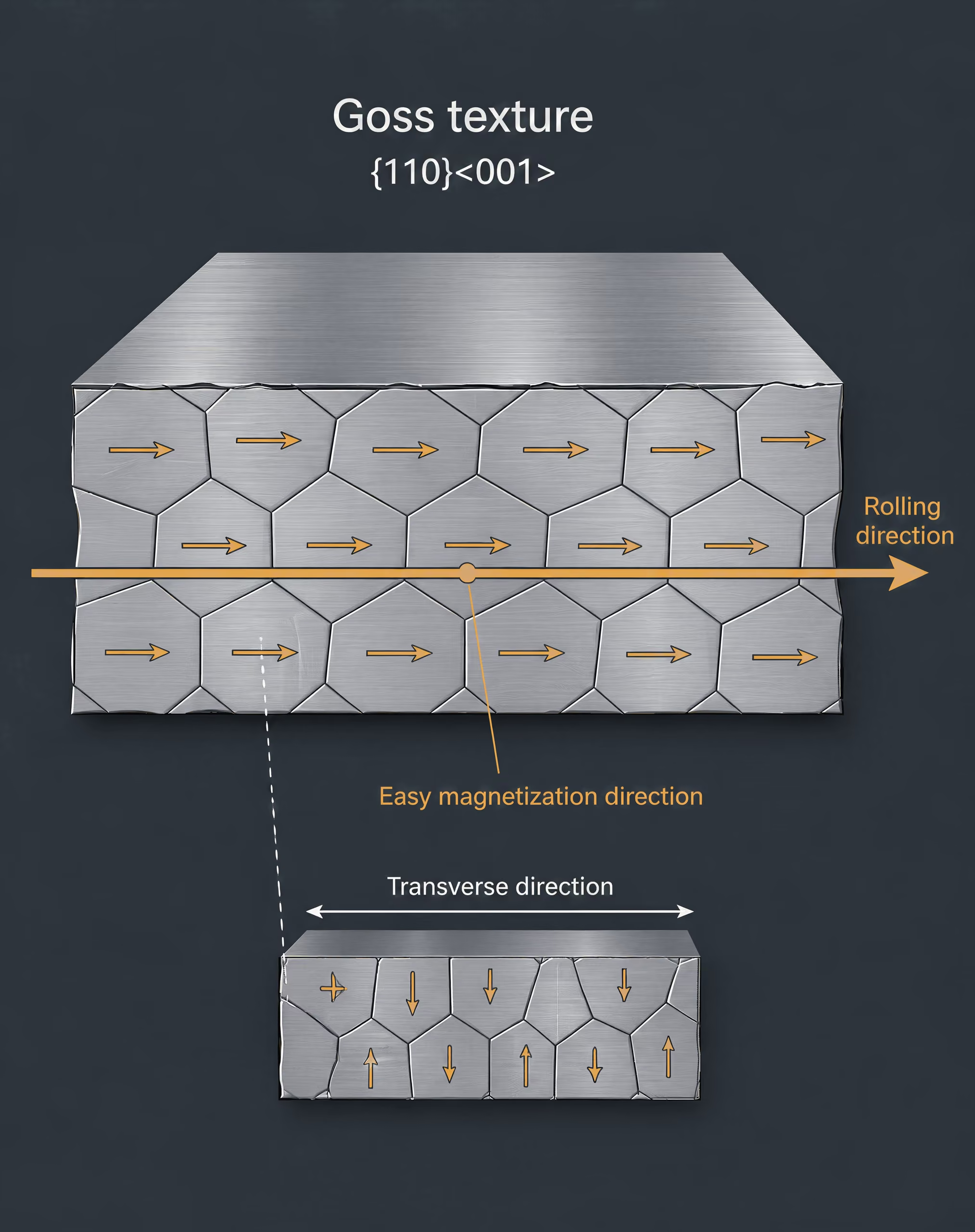
Goss texture and rolling-direction magnetization
Grain-oriented electrical steel is not defined by silicon content or sheet thickness alone. Its defining feature is a controlled crystallographic texture produced by rolling, annealing, and secondary recrystallization. In the desired Goss orientation, the body-centred-cubic iron crystal has approximately the \(\{110\}\) plane parallel to the sheet surface and the \(\langle001\rangle\) direction parallel to the rolling direction. The notation is often written \(\{110\}\langle001\rangle\).
This orientation matters because magnetization is easier along the cubic \(\langle001\rangle\) directions than along the harder crystallographic directions. When many grains place an easy direction close to the rolling direction, magnetic domains can grow and domain walls can move with less applied field. The result is high permeability and lower hysteresis loss when the alternating flux follows the rolling direction. Across the sheet, the same material can show substantially different magnetic behavior. A value measured transverse to rolling direction is therefore not interchangeable with a rolling-direction value.
The texture is never perfectly uniform. Grains deviate from the ideal Goss orientation, and the deviation distribution affects permeability, coercive field, and loss. Local texture, grain size, residual stress, surface condition, and the magnetic interaction between adjacent grains all contribute. A grade name cannot express these variables by itself.
Grain-oriented sheet is normally used with the magnetic path aligned to rolling direction, as in transformer limbs and yokes. Cutting, joint design, punching strain, bending, and clamping can disturb the intended behavior. A strip measured as an undamaged, fully processed specimen may therefore show lower loss than a finished core containing cut edges, joints, and applied stress.
Core loss must also be separated into physical contributions. The Karlsruhe Institute of Technology study published in 2017 treats transformer-core loss as the sum of hysteresis loss, classical eddy-current loss, and excess loss. Hysteresis loss is associated with irreversible domain-wall motion and rotation during each magnetization cycle. Classical eddy-current loss results from currents induced by the changing magnetic flux, while excess loss represents additional dynamic losses linked to nonuniform domain-wall motion and localized magnetic processes.
Thin sheet reduces the paths available for eddy currents. An electrically insulating coating further increases electrical resistance between laminations, limiting current circulation through a core stack. Silicon and aluminium can raise electrical resistivity, but their effects also interact with texture, processing, ductility, grain structure, and annealing. None of these measures independently identifies a grade’s total loss.
The test condition belongs with every property statement. “Core loss” without frequency, peak induction, specimen method, and direction is incomplete. For unidirectional measurements, ASTM A804/A804M-04(2021) is intended principally for thermally flattened grain-oriented electrical steel and produces results comparable to the 25-cm Epstein method. Its measurement is especially relevant to transformer-core lamination stock, where flux is intended to travel in one direction rather than rotate as it does in many motor cores.
Conventional and high-permeability classes
IEC 60404-8-7:2017 covers cold-rolled grain-oriented electrical steel strip and sheet delivered in the fully processed state. Its scope includes Goss-textured material in nominal thicknesses of 0.23, 0.27, 0.30, and 0.35 mm, and it distinguishes conventional and high-permeability classes. “Fully processed” means that the magnetic processing, including the final annealing and insulation treatment specified for the product, has been completed before delivery; the user is not expected to develop the magnetic properties through a further final anneal.
The conventional and high-permeability labels describe classes of magnetic performance within grain-oriented steel. They do not mean that every high-permeability sheet has lower loss under every possible induction, frequency, direction, or core construction. Permeability is field- and induction-dependent, while core loss changes with frequency, peak induction, waveform, stress, specimen geometry, and interlaminar insulation.
ASTM A876 addresses low-carbon silicon-iron grain-oriented steels containing approximately 3.2% silicon. The standard includes conventional, high-permeability, and laser-scribed categories. ASTM grade-identification practice also distinguishes conventional grain-oriented grades designated for testing at 1.5 T from other grain-oriented grades designated for testing at 1.7 T. Those induction designations are essential: a loss value at 1.5 T cannot be compared directly with a value at 1.7 T and treated as a ranking of the steel alone.
This is one reason grade numbers and thicknesses are poor substitutes for measured magnetic data. A thinner lamination usually reduces classical eddy-current loss when other conditions remain comparable, but the measured result also reflects texture quality, resistivity, coating resistance, domain structure, and the imposed induction waveform. A high-permeability designation indicates a class defined by the applicable standard’s requirements; it does not turn thickness into a universal performance index.
The standards map reinforces the distinction between steel classes. ASTM Subcommittee A06.02 identifies ASTM A677 for fully processed nonoriented electrical steel, ASTM A683 for semiprocessed nonoriented electrical steel, ASTM A876 for fully processed grain-oriented electrical steel, and ASTM A976 for classification of electrical-steel insulating coatings. These documents do not describe one interchangeable material family. Grain-oriented steel is processed to favor a specific flux direction, whereas nonoriented steel is designed to provide more nearly similar magnetic behavior in the sheet plane.
For comparison, ASTM A677 covers fully processed nonoriented electrical steels used primarily in 50- and 60-Hz magnetic devices. Its grades are classified by maximum core loss measured at 60 Hz and 1.5 T with the Epstein test method. That classification cannot be transferred to an ASTM A876 grain-oriented grade without preserving the steel class, specimen method, direction, induction, and delivery state.
Laser-scribed grain-oriented grades
Laser scribing is a domain-refinement treatment, not a synonym for high permeability. A laser creates closely spaced tracks, usually transverse to the principal rolling-direction flux, by producing localized thermal or stress changes at the surface. These tracks subdivide magnetic domains or constrain their width. Smaller domains can reduce dynamic domain-wall movement and, under the specified test conditions, lower total core loss.
The treatment does not replace Goss texture. A laser-scribed product remains grain-oriented steel whose rolling-direction behavior depends on its crystallographic alignment, processing history, and magnetic stress state. Nor does laser scribing automatically place the material in the high-permeability class. ASTM A876 lists laser-scribed grades as a separate category alongside conventional and high-permeability grades because the classification describes the processing route or resulting category, not one universal permeability level.
The effect is condition-dependent. Scribing may reduce loss at a stated frequency and induction while producing a different change in permeability, magnetostriction, or loss at another induction. Track spacing, depth, energy input, coating condition, and subsequent stress can matter. Core assembly can also alter the result: cutting and stacking may interrupt the intended domain pattern, and clamping stress can increase loss.
A proper specification therefore states the class, nominal thickness, delivery state, rolling direction, test induction, frequency, and method. For example, a fully processed Goss-textured sheet tested in rolling direction at 1.5 T under the applicable Epstein or unidirectional procedure is a defined measurement. “3.2% silicon, thin, high-permeability steel” is not. The first description preserves the variables that control magnetic behavior; the second collapses texture, processing, domain refinement, and test conditions into a misleading label.
Silicon, Aluminium, Carbon, and the Metallurgy of Magnetic Loss
Silicon and electrical resistivity
Silicon is added to iron primarily because it raises electrical resistivity and changes the magnetic behavior of the alloy. A higher resistivity reduces the current that can circulate within a steel sheet when the magnetic flux changes. Those circulating currents are the classical eddy-current component of core loss. For a given induction waveform and frequency, thinner laminations and higher resistivity both restrict the size of these current paths, although neither removes eddy-current loss entirely.
Silicon also changes iron’s crystal and magnetic characteristics. It generally lowers saturation induction and can make processing more difficult when the concentration becomes high, so composition is a compromise rather than a single-direction scale of quality. The electrical resistivity effect remains important: adding silicon separates electrical-steel behavior from that of low-carbon structural iron, where lower resistivity permits greater induced current.
The grade designation must still be read with its test condition. ASTM A677, cited by ASTM International in 2007, covers fully processed nonoriented electrical steels used primarily in 50- and 60-Hz magnetic devices. Its grades are classified by maximum core loss measured at 60 Hz and 1.5 T with the Epstein test method. A reported loss under that condition is not a universal material constant. It describes a particular steel, delivery state, specimen arrangement, frequency, and induction.
The silicon level associated with grain-oriented steel is also often simplified incorrectly. ASTM A876 describes low-carbon silicon-iron grain-oriented steels with approximately 3.2% silicon. That figure identifies the broad chemistry of the class; it does not, by itself, establish permeability or core loss. Grain-oriented steel obtains much of its magnetic advantage from crystallographic texture, especially the alignment of favorable crystal directions with the rolling direction. Silicon supports the electrical and magnetic design, but it does not create the Goss texture by chemical composition alone.
Frequency makes the resistivity advantage more consequential. Classical eddy-current loss rises strongly with frequency and depends on lamination thickness, resistivity, and the local flux waveform. A thicker sheet made from higher-resistivity steel can still show a different loss from a thinner sheet made from lower-resistivity steel, while hysteresis and excess loss may move independently. “More silicon” is therefore not a substitute for stating thickness, frequency, induction, and the measured loss component or total loss.
Aluminium, carbon control, and secondary effects
Aluminium can raise resistivity and contributes to the processing metallurgy of electrical steels. In grain-oriented grades, aluminium-bearing precipitates, particularly aluminium nitride, can act as inhibitors during the sequence of annealing treatments that controls abnormal grain growth. The desired final texture depends on the interaction of composition, hot rolling, cold reduction, annealing, and precipitate stability. Aluminium is consequently more than a simple resistivity additive in grain-oriented production.
Its effect is conditional. The amount, form, and thermal history of aluminium-bearing particles matter, as do nitrogen, manganese, sulfur, and the annealing schedule. A chemical analysis reporting aluminium content without the precipitate state says little about whether the final grain structure will produce the intended magnetic response. If inhibitors are too weak, too coarse, or dissolved at the wrong stage, secondary recrystallization and texture development can change.
Carbon control is equally important. Low carbon permits decarburization during final processing and reduces the risk of magnetic aging. Residual carbon can combine with iron and alloying elements to form carbides, and interstitial atoms can impede domain-wall motion or change with time and temperature. Those effects can increase hysteresis loss or make magnetic properties less stable. In fully processed grain-oriented steel, carbon is removed to a low level before the final insulating and magnetic state is established; the relevant point is the processing outcome, not a universal carbon number that applies to every standard.
Carbon also affects grain growth and texture indirectly. It influences recrystallization, carbide precipitation, and the conditions under which grains consume their neighbors. A low-carbon composition does not guarantee large, favorably oriented grains. It creates a chemistry that can support the required processing route. The final result depends on whether rolling strain, annealing, inhibitors, and decarburization produce the intended grain structure.
The loss mechanism explains why these details matter. The 2017 Karlsruhe Institute of Technology study separates transformer-core loss into hysteresis, classical eddy-current, and excess-loss contributions. Hysteresis loss reflects irreversible domain-wall motion as magnetization reverses. Classical eddy-current loss comes from currents induced by changing flux. Excess loss accounts for additional dynamic domain processes not captured by the classical term. Silicon and aluminium mainly help by increasing resistivity and influencing microstructure, while carbon control affects domain-wall behavior, grain structure, and magnetic aging. Their effects overlap, but they are not interchangeable.
Insulation provides another chemical and processing variable. A coating between laminations increases electrical resistance across sheet-to-sheet contacts and limits interlaminar current. ASTM A976 classifies electrical-steel insulating coatings; it does not turn coating designation into a direct ranking of total core loss. Coating thickness, coverage, adhesion, damage during punching, and the resulting clamping stress can all affect a finished core.
Composition as one variable among many
Electrical steel is not one material category. Fully processed nonoriented steel, semi-processed nonoriented steel, and fully processed grain-oriented steel follow different manufacturing routes and should not be compared through silicon percentage alone. ASTM Subcommittee A06.02 identifies ASTM A677 for fully processed nonoriented steel, ASTM A683 for semiprocessed nonoriented steel, ASTM A876 for fully processed grain-oriented steel, and ASTM A976 for insulating-coating classification. IEC 60404-8-3:2023 covers cold-rolled non-oriented strip and sheet delivered in the semi-processed state, including nominal thicknesses of 0.47, 0.50, 0.64, 0.65, and 0.79 mm. IEC 60404-8-7:2017 covers fully processed grain-oriented sheet in nominal thicknesses of 0.23, 0.27, 0.30, and 0.35 mm.
Those thicknesses matter because eddy-current loss responds strongly to lamination thickness, yet thickness does not predict total loss without the rest of the test description. Grain size, texture sharpness, residual stress, surface condition, punching damage, coating, and applied tension can alter domain-wall motion and therefore hysteresis or excess loss. A laser-scribed grain-oriented sheet may control domains differently from a conventional or high-permeability grade with similar nominal chemistry.
Test direction and induction are essential. ASTM A804/A804M is principally intended for unidirectional alternating-current measurements on thermally flattened grain-oriented electrical steel used as transformer-core lamination stock, with results comparable to the 25-cm Epstein method. ASTM A876 includes conventional, high-permeability, and laser-scribed grades tested at 1.5 or 1.7 T. ASTM grade-identification practice distinguishes conventional grain-oriented grades designated for testing at 1.5 T from grades designated for testing at 1.7 T. A loss quoted at 1.5 T cannot be treated as equivalent to one measured at 1.7 T.
The same discipline applies to nonoriented steel. A value classified under ASTM A677 means maximum core loss at 60 Hz and 1.5 T by the Epstein method, not performance at every motor frequency, induction, or waveform. Semi-processed material under IEC 60404-8-3:2023 may require final annealing or other manufacturer-defined processing before its magnetic properties represent the intended service state.
Composition supports magnetic performance; it does not dictate it. Silicon and aluminium can reduce eddy-current loss through higher resistivity, and aluminium-bearing precipitates can help control grain development. Low carbon supports decarburization, processing stability, and resistance to magnetic aging. Yet the finished property emerges from chemistry combined with texture, grain size, stress, thickness, coating, delivery state, and measurement conditions. Any comparison that omits those variables is comparing labels rather than magnetic behavior.

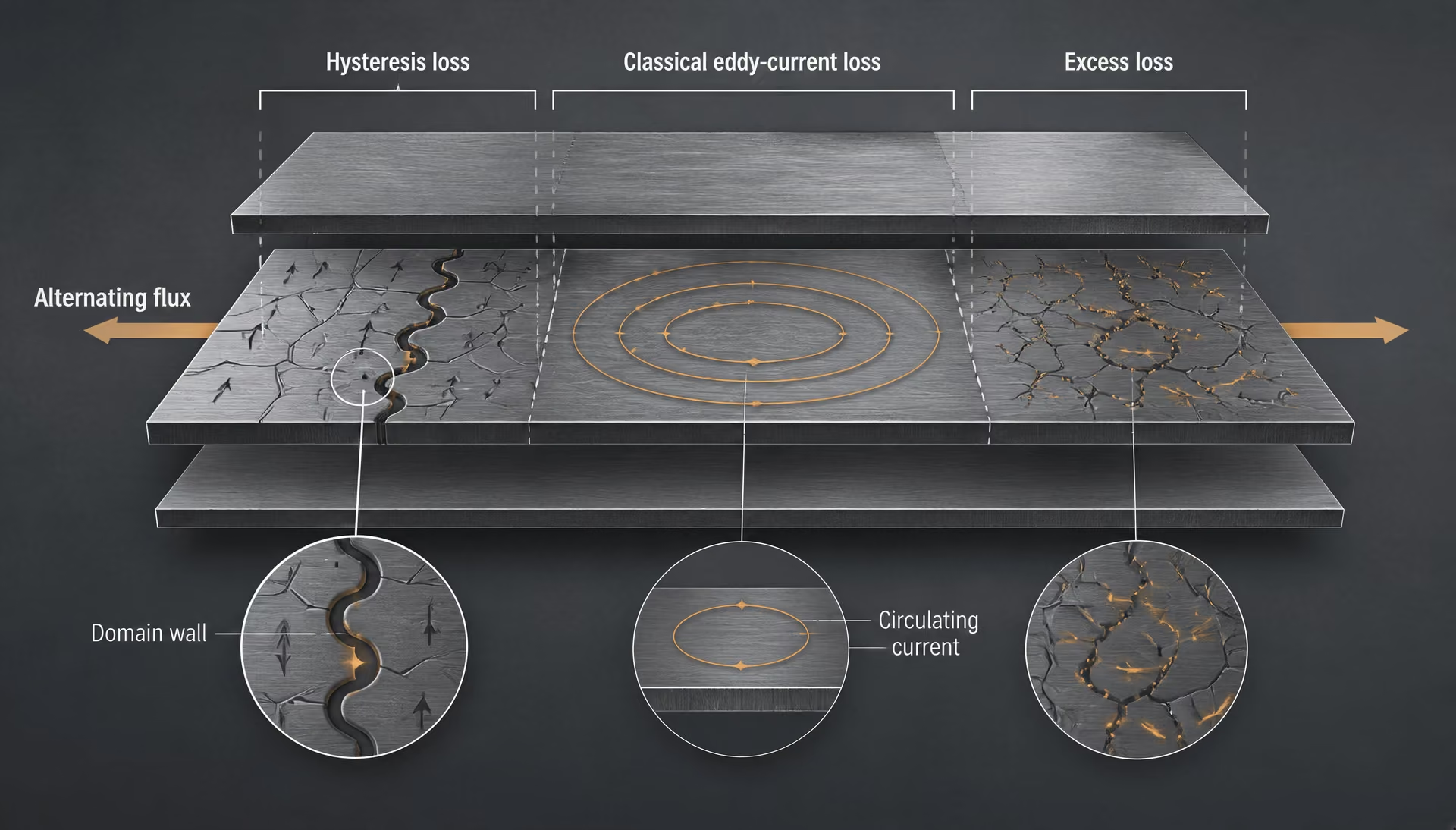
Core Loss Deconstructed: Hysteresis, Eddy Currents, and Excess Loss
Core loss is the electrical power converted into heat when a ferromagnetic core carries alternating magnetic flux. The measured number is not a single material constant. It depends on frequency, peak induction, waveform, specimen geometry, rolling direction, lamination thickness, insulation, stress, and the steel’s delivery state. A loss value reported at 60 Hz and 1.5 T cannot be compared directly with one reported at 50 Hz and 1.7 T, even when both specimens carry the same grade designation.[6] Transformer-core loss separation study. Karlsruhe Institute of Technology. Karlsruhe Institute of Technology publication, 2017.
The 2017 Karlsruhe Institute of Technology (KIT) study separates transformer-core loss into three contributions: hysteresis loss, classical eddy-current loss, and excess, or anomalous, loss. This division is a physical framework rather than three independently printed properties on a standard certificate. The measured total is their combined result:
The terms can interact through processing and microstructure. Grain size, crystallographic texture, residual stress, coating resistance, and domain refinement may change more than one contribution at once.
Hysteresis loss and domain-wall motion
Hysteresis loss is the energy dissipated during irreversible magnetization cycling. When an alternating field changes direction, magnetic domains do not return along the same magnetization path. The area enclosed by the magnetic hysteresis loop represents energy lost per cycle and per unit volume. Multiplying that energy by frequency gives a power-loss contribution.
Domain wall The transition region separating magnetic domains with different magnetization directions.
At low induction, magnetization often begins through the movement of domain walls. A domain wall separates regions whose magnetic moments point in different crystallographic directions. In a perfect crystal, a small applied field could move a wall with little resistance. Real electrical steel contains dislocations, grain boundaries, inclusions, residual stress, surface irregularities, and local variations in texture. These features pin or distort walls. The field must then rise before a wall breaks free, producing irreversible jumps and energy dissipation.
At higher induction, domain-wall movement is joined by rotation of magnetization toward the applied field. The balance between wall motion and rotation depends on crystallographic orientation. This is why texture matters. Fully processed grain-oriented electrical steel develops a strong Goss texture, placing many grains in an orientation that supports low-loss magnetization along the rolling direction. Its low loss applies under the specified direction and test conditions; it does not mean that the sheet has the same magnetic response in every direction.
Nonoriented electrical steel is processed to reduce directional differences rather than to create one dominant easy direction. Fully processed nonoriented material is covered by ASTM A677 for applications primarily using 50- and 60-Hz magnetic devices. Under that standard, grades are classified by maximum core loss measured at 60 Hz and 1.5 T with the Epstein test method. The grade label therefore communicates a result under a defined test, not a universal hysteresis-loss value at every induction and frequency.
Delivery state also changes wall motion. Fully processed sheet has received the final annealing and surface treatment intended to establish its magnetic condition. Semi-processed nonoriented sheet, covered by ASTM A683 and IEC 60404-8-3:2023, is supplied for a subsequent treatment by the user. Cutting, punching, stress relief, and final annealing can alter domain-wall pinning. A semi-processed designation cannot be treated as a lower-resolution version of a fully processed grade.
Silicon and aluminium can raise electrical resistivity and modify magnetic behavior, but chemical content alone does not determine hysteresis loss. Annealing, grain growth, texture, and stress control may have a larger effect on the loop shape than a simple comparison of nominal silicon percentages suggests. The same caution applies to thickness: a thinner sheet can reduce eddy-current loss while leaving hysteresis loss governed mainly by texture, defects, and domain-wall pinning.
Classical eddy-current loss in laminations
Changing magnetic flux induces electric fields inside a conductive steel sheet. Those fields drive circulating currents, called eddy currents, in planes that link the changing flux. The currents encounter the electrical resistance of the steel and dissipate power as heat. This is the classical eddy-current contribution.
For a simple laminated-sheet model under sinusoidal excitation, classical eddy-current loss rises approximately with the square of frequency, the square of peak induction, and the square of lamination thickness, while it falls as electrical resistivity increases. The relation is not a permission to compare thickness in isolation. The coefficient depends on geometry, flux distribution, waveform, and the extent to which insulation interrupts current paths.
Laminations reduce the area available for circulating currents. An electrically insulating coating on each sheet adds resistance between adjacent layers, preventing a large current loop from crossing the stack. ASTM A976 classifies electrical-steel insulating coatings; the coating designation is therefore part of the magnetic construction, not merely a surface-finish description. A damaged, thin, discontinuous, or electrically conductive coating can increase stack loss even when the base steel meets its specified magnetic grade.
Silicon increases resistivity, and aluminium can contribute to the same loss-control strategy when present within the applicable composition and processing system. Higher resistivity suppresses classical eddy currents, but it can also affect ductility, texture development, grain growth, and saturation behavior. Silicon content is consequently a design variable, not a grade-equivalence rule. “More silicon” does not identify a particular standard grade or guarantee a lower measured total loss.
Thickness must likewise be read with the test condition. IEC 60404-8-3:2023 covers cold-rolled non-oriented electrical steel strip and sheet delivered in the semi-processed state, including nominal thicknesses of 0.47, 0.50, 0.64, 0.65, and 0.79 mm. IEC 60404-8-7:2017 covers fully processed grain-oriented material in nominal thicknesses of 0.23, 0.27, 0.30, and 0.35 mm. These ranges illustrate a construction difference, but they do not establish that every 0.23 mm sheet has lower total loss than every 0.35 mm sheet. Hysteresis and excess contributions remain, and the test induction may differ.
Cutting and stacking also affect the practical result. Burrs can create electrical bridges between laminations. Punching introduces plastic deformation and residual stress near edges, increasing local hysteresis loss and changing domain patterns. A stress-relief anneal may restore part of the magnetic performance, but its effect depends on the steel class, coating, atmosphere, and thermal cycle.
Excess or anomalous loss and real microstructure
Excess loss is the additional dynamic contribution associated with domain structure and nonuniform magnetization. It is not simply the classical eddy-current term calculated from thickness and resistivity. During alternating excitation, domain walls move in discontinuous steps rather than as one smooth, uniformly advancing front. Each moving wall creates local changes in magnetic flux and therefore local eddy currents. These currents interact with wall motion, producing a dynamic loss beyond the idealized classical calculation.
The real domain pattern controls this contribution. Grain boundaries, inclusions, stress fields, surface damage, and the spacing and shape of domains create regions that switch at different fields and times. As frequency rises, walls have less time to respond before the applied field changes again. The resulting nonuniform magnetization increases the excess component. Domain refinement can reduce the size of local flux changes and shorten current paths around moving walls, which is why domain-control treatments are used in some grain-oriented products.
Grain-oriented electrical steel demonstrates the importance of separating these mechanisms. ASTM A876 covers low-carbon silicon-iron grain-oriented steels with approximately 3.2% silicon and includes conventional, high-permeability, and laser-scribed grades. ASTM grade-identification practice distinguishes conventional grain-oriented grades designated for testing at 1.5 T from grades designated for testing at 1.7 T. A reported loss must retain that induction condition. ASTM A804/A804M is principally intended for unidirectional alternating-current measurements on thermally flattened grain-oriented steel, with results comparable to the 25-cm Epstein method; its unidirectional configuration is not interchangeable with an isotropic test.
Laser scribing changes domain structure locally and can reduce loss under specified conditions, but it does not erase the effects of stress, cutting, stacking, or transverse flux. Likewise, grain alignment can lower the loss measured along the rolling direction while producing a different response away from that direction. Fully processed grain-oriented steel under IEC 60404-8-7:2017 and fully processed nonoriented steel under ASTM A677 therefore belong to different magnetic classes, even if a single test result makes their total losses appear similar.
The practical conclusion is precise: core-loss control requires matching the steel class, delivery state, thickness, coating, orientation, frequency, induction, waveform, and specimen method to the application. Hysteresis loss describes irreversible cycling, classical eddy-current loss describes currents induced by changing flux, and excess loss captures dynamic effects from domain structure and nonuniform magnetization. The total measured loss contains all three. Treating it as any one of them produces the wrong explanation and can lead to the wrong material or processing decision.
Thickness, Lamination, and Insulating Coatings as Loss Controls
Electrical-steel thickness, coating thickness, and assembled core dimensions describe different physical features. Treating them as interchangeable leads to incorrect predictions of core loss. Sheet thickness is the gauge of one steel lamination. Coating thickness is the thickness of the electrically resistive film on its surface. Stack geometry includes the number of laminations, their overlap and joints, the stacking factor, the direction of flux, and the assembled magnetic path. A core made from thinner sheet does not automatically have lower total loss if cutting damage, poor insulation, excessive clamping, or an unsuitable magnetic grade offsets the reduction in eddy-current loss.
The KIT study published in 2017 separates transformer-core loss into hysteresis loss, classical eddy-current loss, and excess loss. Domain-wall motion is associated with hysteresis loss; an alternating magnetic flux induces circulating currents; and the remaining dynamic contribution is treated as excess loss. Lamination and coating design act most directly on the current-related terms, not as a replacement for suitable crystallographic texture, chemistry, stress control, or test conditions.
Why thinner sheet usually reduces interlaminar eddy-current paths
A changing magnetic flux produces an electric field. In a solid steel core, that field can drive circulating currents through loops extending across the material. These currents dissipate power through the steel's electrical resistance, producing classical eddy-current loss and altering the local magnetic field. The larger the available loop dimension in the direction affected by the changing flux, the greater the induced voltage around that loop.
A laminated core breaks one large conducting volume into many thin sheets. Each sheet carries flux mainly in its plane, while the interfaces between sheets interrupt current flow from one lamination to the next. For the classical eddy-current component, the familiar simplified relationship contains the square of lamination thickness: with frequency, induction, resistivity, and waveform held constant, reducing thickness generally produces a disproportionately large reduction in this component. The statement is a trend, not a grade-independent guarantee. Actual loss also includes hysteresis and excess terms, and manufacturing stresses can increase them.
The physical benefit comes from two related effects. First, a thinner sheet offers a shorter dimension for induced current loops. Second, a stack of individually insulated sheets prevents those loops from joining through the broad faces of adjacent laminations. If the interfaces become electrically bridged, the effective loop dimension can approach the height or width of a substantial part of the core, defeating much of the lamination design.
The thickness values specified by a product standard are therefore meaningful only with the material class and delivery state attached. IEC 60404-8-3:2023 covers cold-rolled non-oriented electrical-steel strip and sheet delivered in the semi-processed state, with nominal thicknesses of 0.47, 0.50, 0.64, 0.65, and 0.79 mm. These are standards-defined product thicknesses, not universal performance rankings. A semi-processed non-oriented sheet at one of those gauges must still be evaluated under its specified magnetic test and processing condition.
IEC 60404-8-7:2017 covers cold-rolled grain-oriented electrical steel delivered in the fully processed state, including nominal thicknesses of 0.23, 0.27, 0.30, and 0.35 mm. Grain-oriented material is commonly used with flux primarily along the rolling direction, so thickness and texture operate together. A 0.27 mm grain-oriented sheet and a 0.50 mm semi-processed non-oriented sheet cannot be compared by thickness alone, because their texture, heat treatment, magnetic direction, and delivery state differ.
Thinner laminations also increase the number of interfaces in a given stack height. That can reduce the volume of steel per unit external dimension because coatings and small gaps occupy part of the stack. The resulting stacking factor matters: a nominally 100 mm-high package does not contain 100 mm of magnetic steel. Cutting and punching introduce another qualification. Burrs can connect neighboring laminations electrically, while residual stress near cut edges can raise hysteresis and excess loss. Thus, thinner material can lower classical eddy-current loss while poor fabrication raises other contributions.
The electrical role of surface insulation
The coating is not merely a corrosion barrier or handling finish. Its electrical function is to maintain high resistance across the broad faces of neighboring laminations, so an induced current remains confined largely to its own sheet. The coating need not stop current flowing along a lamination; that would be impossible without changing the steel itself. It must limit current crossing the lamination-to-lamination interface.
This distinction explains why coating continuity matters. A small damaged area, exposed edge, conductive contaminant, or punch burr can create a bridge across several sheets. One bridge does not necessarily short the entire core, but many bridges can form extended interlaminar paths. Clamping pressure may also compress or damage the coating, and welding or bonding processes can create local conductive connections. Core assembly therefore affects loss even when the steel sheet and its nominal coating are unchanged.
Coating thickness and sheet thickness have different consequences. Increasing sheet thickness changes the steel region through which flux and eddy currents develop. Increasing coating thickness mainly increases electrical separation and reduces the fraction of a fixed stack occupied by steel. It does not turn a thick lamination into a thin one. Conversely, a very thin coating on a thin sheet is not equivalent to a thicker sheet with the same total package thickness.
The insulation must also survive the specified manufacturing and thermal processes. Fully processed grain-oriented steel may receive stress-relief or other controlled treatments associated with its specification; semi-processed non-oriented steel is supplied for subsequent processing that can alter magnetic properties. The electrical resistance, adhesion, temperature tolerance, and response to cutting or annealing must be considered together, but a coating designation should not be treated as a numerical core-loss value.
ASTM A976 is the relevant ASTM specification for classification of electrical-steel insulating coatings. ASTM does not use A976 as a substitute for the magnetic-steel product standards. ASTM Subcommittee A06.02 identifies ASTM A677 for fully processed nonoriented electrical steel, ASTM A683 for semiprocessed nonoriented electrical steel, ASTM A876 for fully processed grain-oriented electrical steel, and ASTM A976 for classification of insulating coatings. The coating classification identifies the coating type or class under the applicable standard framework; it does not, by itself, establish the core loss of a particular steel at an unstated frequency and induction. Coating classes and measured performance must therefore be taken from the applicable edition of ASTM A976 rather than inferred or assigned from sheet appearance.
Core-loss comparisons remain tied to measurement conditions. ASTM A677, for example, covers fully processed nonoriented electrical steels used primarily in 50- and 60-Hz magnetic devices, with grades classified by maximum core loss measured at 60 Hz and 1.5 T using the Epstein test method. ASTM A804/A804M is principally for unidirectional alternating-current measurements on thermally flattened grain-oriented electrical steel, with results comparable to the 25-cm Epstein method. Grain-oriented grade designations also distinguish conventional grades tested at 1.5 T from other grades designated for testing at 1.7 T. A quoted loss without its frequency, induction, specimen method, rolling direction where applicable, and delivery state is incomplete. Thickness and coating control the electrical paths; they do not erase those measurement conditions.
Magnetic Testing: Epstein, Single-Sheet, and Unidirectional Methods
A magnetic property is not a free-standing number. It belongs to a test condition: material class, delivery state, specimen geometry, magnetic path, frequency, peak induction, direction relative to rolling, and electrical insulation between laminations. Reporting “core loss” without those details can make two valid measurements appear contradictory.
The distinction matters because electrical steels are not one material category. Fully processed nonoriented electrical steel, semi-processed nonoriented electrical steel, and fully processed grain-oriented electrical steel have different textures, heat treatments, intended applications, and testing conventions. ASTM Subcommittee A06.02 maps these distinctions into separate standards: ASTM A677 covers fully processed nonoriented steel, ASTM A683 covers semi-processed nonoriented steel, ASTM A876 covers fully processed grain-oriented steel, and ASTM A976 classifies insulating coatings.
The measured loss also has several physical sources. The 2017 Karlsruhe Institute of Technology study separates transformer-core loss into hysteresis loss, classical eddy-current loss, and excess loss. Hysteresis loss arises as domain walls move through defects and pinning sites during magnetization reversal. Classical eddy-current loss is caused by currents induced in the steel when alternating flux changes. Excess loss represents additional dynamic loss associated with nonuniform domain-wall motion and localized magnetic processes. A test method records their combined effect under a specified waveform and frequency; it does not identify a grade by chemistry alone.
The 25-cm Epstein method and strip specimens
| Test approach | Magnetic path | Most relevant use |
|---|---|---|
| 25-cm Epstein | Defined strip assembly with averaged directional response | Standardized sheet comparison |
| Single-sheet or unidirectional | Defined selected direction | Directional grain-oriented measurements |
| Finished-core measurement | Actual joints, stacking, stress, and assembly | Component-level validation |
The 25-cm Epstein method uses narrow, rectangular strips assembled into a square magnetic circuit. The specimen length is conventionally 25 cm, and strips are arranged so that the magnetic path includes material cut in the principal test directions. The resulting test is not a measurement on an isolated sheet segment. It is a controlled assembly in which the applied magnetizing force, induced voltage, flux, and mass or volume of the specimen are related to the reported magnetic quantities.
For nonoriented sheet, this arrangement gives a standardized average response from material sampled in different directions. That average is useful because nonoriented electrical steel is designed to limit directional differences rather than to concentrate its magnetic performance along one crystallographic direction. The result still depends on cutting, burrs, specimen condition, stacking, insulation, and the way the excitation is controlled.
ASTM A677 is the central example. It covers fully processed nonoriented electrical steels used primarily in 50- and 60-Hz magnetic devices, and classifies grades by maximum core loss measured at 60 Hz and 1.5 T using the Epstein test method. The frequency and induction are part of the grade criterion. A value measured at 50 Hz, or at 1.0 T, is not the same ASTM A677 classification result even when the strips and instrument are unchanged.
The strips must also represent the delivery state being specified. Fully processed sheet has received the final annealing and insulation treatment needed to establish its supplied magnetic condition. Semi-processed nonoriented steel is different: its final magnetic development can depend on the user’s processing, commonly including a stress-relief anneal. IEC 60404-8-3:2023 covers cold-rolled non-oriented electrical steel strip and sheet delivered in the semi-processed state, including nominal thicknesses of 0.47, 0.50, 0.64, 0.65, and 0.79 mm. Those thickness designations do not convert automatically into ASTM A677 fully processed grades.
Thickness affects loss, but it is not a substitute for a grade designation. Reducing lamination thickness generally shortens the path available for circulating eddy currents. Electrical insulation on the surface further interrupts those currents, while silicon and aluminium additions increase electrical resistivity. Yet the final loss depends on texture, grain size, stress, coating, waveform, and frequency as well. A thin sheet tested in one state cannot be ranked from thickness alone against a thicker sheet tested under another standard.
ASTM A804/A804M for grain-oriented sheet
Grain-oriented electrical steel requires a different emphasis because its magnetic behavior is deliberately directional. In thermally flattened grain-oriented material, the rolling direction is associated with a strong Goss texture, so magnetization along that direction can differ sharply from magnetization transverse to it. A test that averages directions may conceal the property that matters in a transformer core.
ASTM A804/A804M is principally intended for unidirectional alternating-current magnetic measurements on thermally flattened grain-oriented electrical steel used as transformer-core lamination stock. Unlike a conventional Epstein assembly, the method is designed to measure the material in a defined magnetic direction. ASTM International states that results from ASTM A804/A804M are comparable to results from the 25-cm Epstein method, but “comparable” does not mean that the specimen arrangement and directional information are interchangeable. The method must still be named with the result.
A single-sheet or unidirectional test can expose the rolling-direction behavior of grain-oriented material more directly than a multidirectional strip assembly. The specimen is magnetized along a selected direction, and the alternating induction is established from the induced voltage. The reported loss therefore carries directional meaning: a rolling-direction value should not be read as an isotropic sheet average, and a transverse-direction result should not be substituted for it.
ASTM A876 covers low-carbon silicon-iron grain-oriented steels with approximately 3.2% silicon. It includes conventional, high-permeability, and laser-scribed grades. IEC 60404-8-7:2017 covers cold-rolled grain-oriented electrical steel strip and sheet delivered in the fully processed state, including Goss-textured material with nominal thicknesses of 0.23, 0.27, 0.30, and 0.35 mm. These documents describe classes and delivery conditions; the test method supplies the measurement context that makes a listed magnetic property meaningful.
Interpreting induction and frequency conditions
Induction, usually expressed in tesla, is not interchangeable with magnetic field strength. In an alternating-current test, the induction waveform and its peak value determine how far the material is driven along its magnetization curve. At higher induction, domain processes and saturation effects can increase loss substantially. Frequency changes the number of magnetization reversals per second and increases dynamic contributions, especially eddy-current and excess loss.
That is why ASTM practice distinguishes grain-oriented designations tested at 1.5 T from those tested at 1.7 T. Conventional grain-oriented grades are designated for testing at 1.5 T, while other grain-oriented grades are designated for testing at 1.7 T. The designation identifies the prescribed induction for the classification or reported property; it is not merely a preferred operating point. Comparing a 1.5 T result with a 1.7 T result as though they were the same grade test can reverse apparent rankings.
The same caution applies to frequency. ASTM A677’s classification condition is 60 Hz and 1.5 T, reflecting its primary use in 50- and 60-Hz devices. A test at 400 Hz measures a different balance of hysteresis, classical eddy-current, and excess loss. Even if the material, thickness, and specimen method remain constant, the number cannot be transferred without a justified frequency model and matching waveform assumptions.
A defensible report therefore states the material standard and grade designation, delivery state, nominal thickness, specimen method, frequency, peak induction, waveform where relevant, insulation condition, and test direction. For grain-oriented steel, rolling direction must be explicit. “Core loss: 1.5 W/kg” is incomplete; “core loss measured by the 25-cm Epstein method at 60 Hz and 1.5 T on fully processed nonoriented steel” identifies a usable result. For a unidirectional grain-oriented measurement, the direction and ASTM A804/A804M method are equally essential.
Testing method is part of the property—not a footnote after it.
How to Read a Grade or Datasheet Without Misreading It
Datasheet reading sequence
- 1. Identify the standard Find the governing ASTM or IEC document.
- 2. Identify delivery state Determine whether the sheet is fully processed or semi-processed.
- 3. Identify material family Separate nonoriented from grain-oriented steel.
- 4. Record test conditions Capture frequency, induction, direction, specimen method, and waveform where relevant.
- 5. Check fabrication conditions Review thickness, coating, cutting, stress relief, stacking, and clamping.
A grade designation is not a complete magnetic specification. It identifies a material within a standard, but the reported behavior also depends on delivery state, thickness, test frequency, induction, specimen direction, and measurement method. A disciplined reading sequence prevents the common mistake of treating silicon percentage or a thin nominal gauge as a direct substitute for magnetic performance.
Decode the standard, delivery state, and grade family
Start with the governing standard, not the grade number. ASTM A677, for example, covers fully processed nonoriented electrical steels intended primarily for 50- and 60-Hz magnetic devices. Its grades are classified by maximum core loss measured at 60 Hz and 1.5 T with the Epstein test method, as specified in ASTM A677-07 (ASTM International, 2007). That classification does not describe every possible operating condition.
Then identify the delivery state. Fully processed material has received the magnetic heat treatment required by its specification and is supplied with its magnetic properties established. Semi-processed material is supplied for further processing by the user, commonly including a final anneal. Its as-delivered magnetic behavior should not be read as equivalent to that of fully processed sheet.
The ASTM standards map makes this distinction explicit. ASTM Subcommittee A06.02 lists ASTM A677 for fully processed nonoriented steel, ASTM A683 for semiprocessed nonoriented steel, and ASTM A876 for fully processed grain-oriented steel. ASTM A976 addresses classification of insulating coatings. A datasheet that gives only “electrical steel” has omitted the information needed to place the material in this map.
Next determine the steel family. Nonoriented electrical steel is designed to provide relatively similar magnetic behavior in different in-plane directions, although it is not perfectly direction-independent. Grain-oriented electrical steel has a strong crystallographic texture, usually associated with the Goss orientation, and is normally evaluated along the rolling direction or another specified direction. The two families serve different magnetic-circuit designs and should not be compared through a single grade-number hierarchy.
ASTM A876 covers low-carbon silicon-iron grain-oriented steel containing approximately 3.2% silicon. It includes conventional, high-permeability, and laser-scribed grades. IEC 60404-8-7:2017 covers cold-rolled grain-oriented electrical steel strip and sheet delivered in the fully processed state, including nominal thicknesses of 0.23, 0.27, 0.30, and 0.35 mm. Those thicknesses are characteristic entries in that product standard; they are not performance rankings by themselves.
For semi-processed nonoriented material, IEC 60404-8-3:2023 specifies nominal thicknesses of 0.47, 0.50, 0.64, 0.65, and 0.79 mm, along with magnetic properties, dimensional tolerances, and inspection procedures. The presence of a thickness in this list does not make a sheet equivalent to a fully processed nonoriented grade of the same thickness.
Record the nominal thickness separately from the grade. Also record coating or insulation information. An electrically insulating coating increases interlaminar resistance and reduces current circulating between adjacent laminations; ASTM A976 provides the relevant coating classification framework. Silicon and aluminium can increase electrical resistivity, while texture control and processing affect hysteresis and permeability. None of these features, considered alone, determines the final core-loss value.
Read maximum core-loss classifications correctly
A maximum core-loss class is a pass limit under stated conditions, not a universal loss constant. If ASTM A677 assigns a grade by maximum loss at 60 Hz, 1.5 T, and Epstein testing, the value applies to that defined measurement. It does not automatically predict loss at 400 Hz, at 1.0 T, under rotating flux, or after a different punching and stress-relief process.
A useful transcription keeps the condition beside the number: “maximum specific total loss, [frequency], [induction], Epstein test.” Removing the bracketed conditions turns a qualified result into a misleading one. The same discipline applies to grain-oriented grades. ASTM practice distinguishes conventional grades designated for testing at 1.5 T from other grain-oriented grades designated for testing at 1.7 T (ASTM International, 2024). Comparing their numerical limits without retaining the test induction is invalid.
The specimen method can change the result as well. ASTM A804/A804M is principally intended for unidirectional alternating-current measurements on thermally flattened grain-oriented electrical steel used as transformer-core lamination stock. Its results are comparable to the 25-cm Epstein method, but “comparable” does not mean that every test geometry produces identical readings. ASTM A804/A804M-04, reaffirmed 2021, should therefore be identified whenever its measurements appear in a datasheet.
Core loss itself contains several physical contributions. The Karlsruhe Institute of Technology study published in 2017 separates transformer-core loss into hysteresis loss, classical eddy-current loss, and excess loss. Domain-wall motion through the magnetic structure contributes to hysteresis loss. Changing flux induces eddy currents in the steel, producing classical eddy-current loss; domain structure and localized current paths contribute to excess loss.
Thinner electrical-steel sheet is not automatically lower-loss when texture, processing, coating, stress, or test conditions differ. Limited evidence
Thickness mainly affects the eddy-current contribution, because shorter electrical paths reduce circulating-current loss. Lower loss may also result from higher resistivity, suitable insulation, reduced stress, or improved grain alignment. A thinner sheet can still show higher measured total loss if its texture, processing state, coating, or test condition differs. “0.27 mm” is a thickness, not a complete magnetic grade.
Separate permeability, induction, and loss
Permeability describes how much magnetic induction is produced for a given magnetizing field. In simplified form, relative permeability compares the material’s response with that of free space. A datasheet may report initial permeability, maximum permeability, or permeability at a stated induction. These are different quantities and must not be collapsed into one number.
Induction is the magnetic flux density, commonly reported in tesla. It is the operating or test point at which a property is measured. A high-permeability grain-oriented steel may reach a specified induction with a lower magnetizing field than another steel, yet its total loss still depends on frequency, waveform, thickness, texture, stress, and insulation. Ease of magnetization is not the same as low energy dissipation per cycle.
Core loss is power dissipated per unit mass or volume under a defined alternating magnetic excitation. Its value depends strongly on both frequency and induction. Two sheets can have similar permeability at one induction while showing different losses, or similar loss at one test point while having different permeability elsewhere on the magnetization curve.
Read every property as a complete tuple: delivery state, grade family, nominal thickness, frequency, induction, direction, specimen method, and reported property. For grain-oriented steel, add the rolling direction and whether the test is longitudinal, transverse, or otherwise specified. For a comparison, change one variable at a time. A datasheet that lacks these conditions may still identify a product family, but it does not support a sound magnetic comparison.
Manufacturing Variables That Change Magnetic Performance
Electrical steel does not acquire its magnetic behavior from silicon content or nominal thickness alone. Rolling history, annealing, grain orientation, residual stress, surface insulation, and the state in which the sheet reaches the core shop all affect the measured result. The distinction between fully processed nonoriented, semi-processed nonoriented, and fully processed grain-oriented steel is therefore a manufacturing distinction as well as a standards distinction.
ASTM Subcommittee A06.02 identifies ASTM A677 for fully processed nonoriented steel, ASTM A683 for semiprocessed nonoriented steel, ASTM A876 for fully processed grain-oriented steel, and ASTM A976 for electrical-steel insulating coatings. IEC 60404-8-3:2023 covers cold-rolled non-oriented electrical steel delivered in the semi-processed state, while IEC 60404-8-7:2017 covers cold-rolled grain-oriented electrical steel delivered in the fully processed state. A grade designation has meaning only alongside that delivery state and the test conditions attached to its magnetic property.
Cold reduction, recrystallization, and grain size
Cold reduction changes more than sheet thickness. It elongates grains, raises dislocation density, stores deformation energy, and creates crystallographic and mechanical anisotropy. Those changes affect domain-wall motion and the ease with which magnetization follows an applied field. A heavily deformed strip may therefore show magnetic behavior that differs substantially from an annealed strip of the same composition and nominal gauge.
Recrystallization removes much of the cold-worked structure by forming new, relatively strain-free grains during heat treatment. The resulting texture depends on the starting structure, reduction history, annealing conditions, inhibitors, and alloy chemistry. Grain growth then changes the number and character of grain boundaries. Boundaries can impede domain walls, while excessively large or irregular grains can increase local magnetic nonuniformity and complicate the response around joints and cut edges. There is no universal grain-size rule that applies equally to nonoriented and grain-oriented products.
In nonoriented electrical steel, processing seeks a distribution of crystallographic orientations that gives useful magnetic response in more than one in-plane direction. Fully processed nonoriented material has received its final magnetic anneal from the producer. Semi-processed nonoriented material has not received the complete final treatment; the user’s later annealing and fabrication sequence can change its recrystallized structure, grain size, and magnetic properties. IEC 60404-8-3:2023 includes semi-processed material in nominal thicknesses of 0.47, 0.50, 0.64, 0.65, and 0.79 mm, but those thicknesses do not specify the eventual loss after an unspecified downstream heat treatment.
Grain-oriented steel follows a different objective. Its processing develops a strong Goss texture, commonly described by the {110}<001> orientation, so that many grains have their easy magnetization direction parallel to the rolling direction. ASTM A876 covers low-carbon silicon-iron grain-oriented steels with approximately 3.2% silicon and includes conventional, high-permeability, and laser-scribed grades. IEC 60404-8-7:2017 covers fully processed grain-oriented strip in nominal thicknesses of 0.23, 0.27, 0.30, and 0.35 mm.
The rolling direction is essential when reporting grain-oriented performance. A value measured along the intended flux direction cannot be transferred directly to a transverse or joint-dominated region. ASTM A804/A804M is principally intended for unidirectional alternating-current measurements on thermally flattened grain-oriented steel, with results comparable to the 25-cm Epstein method. The specimen geometry and direction are part of the result.
Grain size also interacts with the separate components of core loss. The 2017 Karlsruhe Institute of Technology study separates transformer-core loss into hysteresis, classical eddy-current, and excess-loss contributions. Hysteresis loss reflects irreversible domain-wall movement and magnetization processes. Classical eddy-current loss arises when alternating flux induces circulating currents in the sheet. Excess loss represents additional dynamic domain processes not captured by the simple classical term. Annealing can reduce hysteresis-related effects by removing strain, while thickness, resistivity, domain structure, and frequency affect the other contributions.
Stress relief and flatness
Cutting, punching, shearing, bending, and stacking impose stresses that were absent from the flat test strip. A punched edge contains plastic deformation and residual stress; a narrow tooth or corner can carry a large stress gradient relative to its width. These regions impede domain-wall movement and can raise local hysteresis loss. The effect may be small in a large Epstein specimen yet significant in a compact motor stator, transformer corner, or sharply formed part.
The delivery condition matters because fully processed material is not necessarily unaffected by fabrication. A fully processed sheet has completed its specified producer-side magnetic treatment, but cutting and forming can still degrade the magnetic response of the finished lamination. Semi-processed nonoriented steel is more dependent on the purchaser’s later annealing and forming sequence. A core assembled from sheets that were tested before fabrication can therefore have higher loss than the certificate suggests.
Thermal flattening addresses both geometry and stress. Heat treatment can reduce residual stress from rolling, cutting, or handling and can improve flatness, but temperature exposure also affects grain structure, coating behavior, and magnetic properties. ASTM A804/A804M specifically concerns thermally flattened grain-oriented material used as transformer-core lamination stock. That qualification is important: a value for thermally flattened, unidirectionally tested strip does not automatically describe a sheared, stacked, and clamped core.
Mechanical clamping introduces another source of stress. Excessive pressure, uneven stacking, tight winding, or local burr contact can restrain magnetostriction and domain motion. Flatness problems can produce gaps or point contacts between laminations, changing flux distribution and increasing local loss. Thermal flattening is not a generic repair step that erases every processing effect. Its outcome depends on the prior deformation, the heat treatment, the steel class, and the coating system.
Domain refinement and surface condition
Domain refinement reduces the distance over which magnetic domains reverse, limiting the energy associated with moving domain walls and, in suitable conditions, reducing loss. Laser scribing is one method used with grain-oriented steel. It creates narrow, controlled surface disturbances that subdivide domains across the sheet. The treatment is not equivalent to changing the bulk silicon percentage, and its effect must be considered with the grade’s specified test induction.
ASTM A876 distinguishes grain-oriented grades and test conditions that include conventional grades designated at 1.5 T and other grades designated at 1.7 T. Comparing loss values at those different inductions can produce a false ranking. The frequency, induction, rolling direction, specimen method, and delivery state must travel with every quoted magnetic value.
The surface coating has two jobs. It electrically insulates adjacent laminations, raising interlaminar resistance and reducing circulating eddy currents, while also affecting tension, punchability, heat-treatment compatibility, and stacking behavior. ASTM A976 provides the classification framework for electrical-steel insulating coatings. A damaged coating, conductive burr, excessive coating thickness, or poor contact pattern can alter the loss of the assembled core even when the steel substrate meets its sheet specification.
Surface condition also affects stress. Roughness, scratches, oxide residues, and coating nonuniformity can create local contact points or constrain the sheet during stacking. Laser scribing, coating tension, and post-cut edge damage may act together rather than independently. Thin laminations help reduce classical eddy-current loss, but thinner sheet does not cancel hysteresis or excess loss caused by poor texture, residual stress, or unfavorable excitation.
For that reason, the relevant question is not simply which grade was supplied. It is whether the specified grade, processing state, texture, surface insulation, cutting practice, stress-relief treatment, and core assembly produce the required loss at the actual frequency and induction. The finished core is the magnetic component being used; the original flat-strip test is only one controlled measurement along its manufacturing history.
Designing Transformer and Rotating-Machine Cores Around Material Behavior
A core is not exposed to the same magnetic condition used to classify a sheet grade. The material is cut into a geometry, insulated, stacked, clamped, and driven by a particular waveform. Each step can alter the magnetic response seen by the finished component. A grade name therefore identifies a material class and a specified test condition, not a guaranteed loss value for every assembled core.
The distinction between delivery states matters at the design stage. ASTM A677 covers fully processed nonoriented electrical steels used mainly in 50- and 60-Hz magnetic devices; its grades are classified by maximum core loss measured at 60 Hz and 1.5 T with the Epstein test method. ASTM A683 covers semiprocessed nonoriented steel, while ASTM A876 covers fully processed grain-oriented steel. IEC 60404-8-3:2023 specifies cold-rolled non-oriented electrical steel strip and sheet delivered in the semi-processed state, whereas IEC 60404-8-7:2017 covers fully processed grain-oriented material.
Those standards do not describe interchangeable products. They describe different combinations of composition, texture, processing, magnetic testing, and delivery condition.
Transformer cores and preferred flux direction
A transformer core is designed so that most of its alternating flux follows a controlled path through the rolling direction of grain-oriented electrical steel. In fully processed grain-oriented steel, a strong Goss texture places many crystal directions favorably relative to the rolling direction. Magnetization then requires less field in that direction than it would in a randomly oriented aggregate, particularly at the induction and frequency used for the design.
This is why transformer laminations are not simply arranged as a stack of identical rectangles. The strip is cut and oriented so that flux travels along limbs and yokes with as few abrupt changes in direction as possible. Step-lap and related joint arrangements spread the transition across several laminations rather than forcing the entire flux to cross one sharp butt joint. The objective is not only a shorter magnetic path. It is also a lower concentration of local magnetizing field and reduced disturbance of the preferred texture.
ASTM A876 covers low-carbon silicon-iron grain-oriented steels containing approximately 3.2% silicon and includes conventional, high-permeability, and laser-scribed grades. The designation of the test induction must remain attached to any reported property: conventional grain-oriented grades are designated for testing at 1.5 T, while other grain-oriented grades are designated for testing at 1.7 T under the ASTM classification practice identified by ASTM International in 2024. A loss figure at 1.5 T cannot be compared casually with one at 1.7 T.
ASTM A804/A804M is principally for unidirectional alternating-current magnetic measurements on thermally flattened grain-oriented steel. Its results are comparable to the 25-cm Epstein method, but the test arrangement still differs from a finished transformer containing joints, corners, clamping hardware, and winding-induced fields. The rolling direction and specimen orientation are part of the measurement definition.
Grain orientation reduces one component of the magnetic burden; it does not erase the three physical sources of core loss. The 2017 Karlsruhe Institute of Technology study separates hysteresis loss, classical eddy-current loss, and excess loss. Domain-wall motion contributes hysteresis loss. Alternating flux induces eddy currents, whose magnitude is affected by lamination thickness, electrical resistivity, and insulation between sheets. Excess loss represents additional dynamic effects associated with domain processes and local magnetic nonuniformity. Silicon, aluminium, thin strip, surface insulation, and texture can affect these terms in different ways.
A transformer designer must therefore match the steel's preferred direction to the flux path, then preserve that advantage during fabrication. A sheet with a low standardized loss can perform poorly if its cut edges, joints, or stressed regions dominate the assembled core.
Rotating machines and changing in-plane flux
The magnetic path in a rotating machine is less obedient. In stator teeth, back iron, and rotor components, the local flux direction changes as the rotor moves and as the winding field rotates. Much of this flux remains in the plane of the laminations, but its angle to the rolling direction continually varies. A grain-oriented sheet would offer its strongest response only over selected directions, making it poorly matched to a core that must accept repeated in-plane directional changes.
Fully processed nonoriented electrical steel is consequently the usual material class for such paths. Its crystallographic texture is controlled to limit directional differences rather than to create one dominant easy direction. The relevant choice is still not “high silicon versus low silicon.” It includes the specified grade, nominal thickness, delivery state, resistivity, surface insulation, magnetic induction, frequency, and processing history.
Semi-processed nonoriented steel presents another design condition. IEC 60404-8-3:2023 includes nominal thicknesses of 0.47, 0.50, 0.64, 0.65, and 0.79 mm for strip and sheet delivered in the semi-processed state, together with magnetic properties, dimensional tolerances, and inspection procedures. Final annealing may be part of the user's manufacturing route, so the magnetic state after punching and heat treatment cannot be inferred from a fully processed material designation. ASTM Subcommittee A06.02 lists A683 for semiprocessed nonoriented steel and A677 for fully processed nonoriented steel; those designations should not be substituted for one another.
Rotating-machine cores also experience local flux components created by slotting, tooth-tip saturation, harmonics, and mechanical asymmetry. These fields can differ from the sinusoidal, uniform excitation used in a catalogue or standards test. The resulting loss may rise even when the nominal operating frequency is unchanged. Thin laminations help reduce classical eddy-current loss because each insulated sheet restricts the circulating current path, but thinner material does not automatically solve hysteresis or excess loss caused by damaged edges, stress, or distorted flux.
Stacking, joints, and local stress
The finished core contains more steel than the magnetic circuit effectively receives. The stacking factor is the ratio of solid steel volume to the total stacked volume, with the remainder occupied by coating, surface roughness, waviness, and small gaps. A lower stacking factor requires greater flux density in the steel to produce the same average flux through the core cross-section. That can raise loss and magnetizing current even though the individual sheet still meets its original Epstein result.
Electrical insulation between laminations is essential for limiting interlaminar eddy currents. ASTM A976 provides the ASTM classification framework for electrical-steel insulating coatings. A coating that is damaged, contaminated, poorly cured, or compressed beyond its intended condition can create conductive bridges across multiple sheets. Such bridges enlarge eddy-current loops. The nominal steel grade has not changed, but the electrical circuit inside the stack has.
Cutting and punching introduce another mismatch between sheet testing and core behavior. Shearing plastically deforms the material near an edge, alters local magnetic domains, and can increase hysteresis and excess loss. Punching may impose more severe strain around holes and narrow tooth sections. A narrow damaged zone can matter disproportionately when it occupies a large fraction of a tooth or when flux crowds near the edge. Deburring, suitable tooling, stress-relief annealing where the delivery state and coating permit it, and careful control of clearance are means of limiting that penalty; none changes the standardized grade result retrospectively.
Burrs are both a mechanical and an electrical defect. A burr can reduce the effective gap between adjacent laminations, puncture or displace insulation, and form conductive contact through the stack. It can also create a local geometric protrusion that concentrates stress during clamping. The result is a region with altered flux density and additional circulating-current paths.
Joints deserve separate attention. At a transformer corner, flux must transfer from one limb or yoke section to another. Even a well-designed step-lap joint adds reluctance and creates local fringing. A poor fit, excessive gap, misaligned laminations, or burr can concentrate the field at only a few sheets. Measured loss from the complete core may then exceed the value estimated by multiplying a sheet-loss figure by mass.
Clamping pressure is necessary to maintain geometry, but excessive or uneven pressure introduces elastic and plastic stress. Stress changes domain-wall motion and can reduce permeability, especially near holes, corners, joints, and narrow teeth. The same effect appears when laminations are distorted during stacking or when a frame restrains thermal expansion. Core design should specify pressure distribution, flatness, joint fit, coating condition, and edge quality alongside the steel designation.
The practical rule is simple: select material by magnetic direction and test condition, then design the manufacturing route so those properties survive assembly. A standardized result belongs to a defined specimen. A machine core is a stressed, insulated, jointed magnetic structure.
A Practical Comparison Framework for Electrical-Steel Grades
Compare like with like
“Electrical steel” describes several material classes, not one interchangeable product. A fully processed nonoriented steel, a semi-processed nonoriented steel, and a fully processed grain-oriented steel can all be called electrical steels while serving different magnetic circuits and requiring different comparisons.
Fully processed nonoriented electrical steel is characterized after the manufacturer has completed the magnetic-processing route. Its properties are intended to be relatively similar in different in-plane directions, although they are never perfectly isotropic. ASTM A677 covers this class, primarily for 50- and 60-Hz magnetic devices. Its grades are classified by maximum core loss measured at 60 Hz and 1.5 T with the Epstein test method. That classification is useful only when the design operates near the same frequency, induction, specimen method, and delivery condition.
Semi-processed nonoriented steel is a different comparison. The purchaser or fabricator may perform a final anneal after punching, stamping, or forming, allowing the material to develop its specified magnetic state. ASTM A683 addresses semiprocessed nonoriented steel, while IEC 60404-8-3:2023 covers cold-rolled non-oriented strip and sheet delivered in the semi-processed state. The IEC standard includes nominal thicknesses of 0.47, 0.50, 0.64, 0.65, and 0.79 mm. A semi-processed sheet and a fully processed sheet of the same nominal thickness are not equivalent merely because both carry a loss designation.
Grain-oriented electrical steel belongs to another category again. Its Goss texture concentrates favorable crystallographic orientation along the rolling direction, making it particularly suited to magnetic circuits in which flux follows that direction. ASTM A876 covers low-carbon silicon-iron grain-oriented steels with approximately 3.2% silicon and includes conventional, high-permeability, and laser-scribed grades. IEC 60404-8-7:2017 covers fully processed grain-oriented sheet in nominal thicknesses of 0.23, 0.27, 0.30, and 0.35 mm. These thinner products may show lower eddy-current loss than thicker nonoriented sheet, but that does not make them a direct substitute in a rotating machine with substantial transverse or rotating flux.
| Comparison field | Why it matters |
|---|---|
| Material class | Determines directionality and intended magnetic circuit. |
| Delivery state | Determines whether further user heat treatment is expected. |
| Nominal thickness | Influences classical eddy-current paths. |
| Texture and direction | Controls directional permeability and loss. |
| Frequency and induction | Define the magnetic operating or test condition. |
| Specimen method | Defines geometry and magnetic path. |
| Coating and assembly | Controls interlaminar current paths in the finished core. |
The first comparison question is therefore not “Which grade has the lower number?” It is “Do these materials belong to the same class, delivery state, and magnetic application?”
A standards-based property checklist
A useful comparison records the property together with its measurement conditions. Start with the standard and grade designation, then state whether the material is fully processed or semi-processed. Processing state affects permeability, hysteresis, punching response, residual stress, and the result obtained after any required final anneal.
Record nominal thickness separately from measured thickness. Thickness affects classical eddy-current loss because alternating flux induces circulating currents within the sheet; reducing lamination thickness shortens their path and increases electrical resistance across the relevant current loops. Yet thickness alone does not specify total core loss. The KIT study published in 2017 separates transformer-core loss into hysteresis, classical eddy-current, and excess-loss contributions. Domain-wall motion produces hysteresis loss, while changing flux induces eddy currents; excess loss reflects additional dynamic domain processes. A thickness comparison that ignores the other two contributions can misidentify the controlling mechanism.
The test frequency and induction must appear beside every loss value. ASTM A677 uses 60 Hz and 1.5 T for its classification basis. Grain-oriented grades require special care: ASTM practice distinguishes conventional grades designated for testing at 1.5 T from other grades designated for testing at 1.7 T. A value measured at 1.5 T cannot be ranked directly against one measured at 1.7 T without accounting for the different point on the magnetization curve. Frequency changes the balance among hysteresis, eddy-current, and excess loss as well.
State the specimen method. The Epstein test averages magnetic behavior through a defined strip assembly, whereas ASTM A804/A804M is intended principally for unidirectional alternating-current measurements on thermally flattened grain-oriented electrical steel used as transformer-core lamination stock. ASTM A804/A804M results are comparable to the 25-cm Epstein method, but the methods are not interchangeable labels. Measurement direction is equally important. For nonoriented steel, report the direction or the averaging procedure. For grain-oriented steel, specify rolling direction, transverse direction, or the angle between flux and rolling direction. A grain-oriented result measured parallel to rolling direction says little about a circuit dominated by transverse flux.
The checklist must also include permeability, not only loss. High permeability can reduce magnetizing current and local flux stress, even where the quoted core-loss value is similar. Grain alignment can raise permeability in one direction while increasing anisotropy and making corner joints, skewed flux, and transverse components more difficult to manage. Laser scribing can modify domain structure and reduce loss in a specified test condition, but it does not erase directional behavior.
Finally, record the insulating coating classification and the condition of the surface after fabrication. ASTM A976 provides the classification framework for electrical-steel insulating coatings. Coating thickness, interlaminar resistance, punchability, weldability, and stress relief after cutting all affect the assembled core. A coating that raises interlaminar resistance can reduce circulating currents between laminations, while excessive coating or damaged interfaces can change fill factor and joint behavior.
When a lower nominal loss is not the whole design answer
A lower catalogued loss can be the wrong selection when it is obtained under a different induction, frequency, direction, or specimen method. The error is especially serious when comparing grain-oriented and nonoriented materials. Grain-oriented steel may provide very low loss and high permeability along rolling direction, but a motor stator experiences rotating flux and a transformer joint contains local flux deviations. Nonoriented steel sacrifices peak directional performance for more uniform in-plane behavior, often simplifying the magnetic circuit and manufacturing process.
Manufacturability also changes the result. Punching introduces edge damage and residual stress, which can increase hysteresis loss and lower permeability. Semi-processed material may recover magnetic properties during a controlled final anneal, but that step imposes atmosphere, temperature, cleanliness, fixture, and dimensional constraints. Fully processed material avoids that particular operation, yet it remains sensitive to cutting stress, clamping, bending, and joint pressure.
Silicon and aluminium content contribute to higher electrical resistivity and can reduce eddy-current loss, but composition is not a universal grade ranking. Texture, grain size, precipitate control, annealing history, coating, and stress state can outweigh a simple silicon comparison. Thin laminations, insulating coatings, increased silicon and aluminium content, and grain alignment are loss-control mechanisms—not interchangeable indicators of overall magnetic suitability.
A reusable comparison framework is:
material class; delivery and processing state; nominal thickness; texture and anisotropy; quoted permeability and loss; test induction; frequency; specimen method; magnetic direction; coating classification and interlaminar resistance; fabrication and stress condition; and the intended magnetic circuit.
Only after those fields match, or their differences have been modelled, should one grade be judged against another. The correct comparison is condition-matched, not label-matched.
References
- [1] ASTM A677-07: Standard Specification for Nonoriented Electrical Steel. ASTM International standard, 2007. https://store.astm.org/a0677-07.html
- [2] ASTM A876-17: Standard Specification for Flat-Rolled, Grain-Oriented, Silicon-Iron, Electrical Steel. ASTM International standard, 2017. https://store.astm.org/a0876-17r26.html
- [3] IEC 60404-8-7:2017. IEC standard, 2017. https://webstore.iec.ch/en/publication/32891
- [4] IEC 60404-8-3:2023. IEC standard, 2023. https://webstore.iec.ch/en/publication/68450
- [5] ASTM A804/A804M-04(2021): Standard Test Method for Alternating-Current Magnetic Properties of Thermally Treated Grain-Oriented Electrical Steel. ASTM International standard, 2021. https://store.astm.org/a0804_a0804m-04r21.html
- [6] Transformer-core loss separation study. Karlsruhe Institute of Technology publication, 2017. https://publikationen.bibliothek.kit.edu/1000066142/4047647