


1. What the Heat-Affected Zone Is—and Is Not
Definition relative to the fusion zone and unaffected base metal
The heat-affected zone (HAZ) is the portion of the base metal whose microstructure, properties, or both have been altered by welding heat without being melted. It lies between the fusion boundary and the unaffected base metal. The fusion zone is different: it is the weld metal that became liquid, mixed with any melted parent material, and then solidified. Its structure is governed mainly by solidification conditions, dilution, weld-metal composition, and subsequent cooling.
That boundary is metallurgical, not simply visual. Etching may reveal a fusion line, but the HAZ extends beyond it because heat travels into the plate, pipe, or fitting. The metal immediately outside the fusion boundary may have reached a temperature above the upper critical range and transformed completely to austenite before cooling. Farther away, the peak temperature may have been high enough only to refine existing grains, partially transform the structure, temper martensite, or cause carbide coarsening. Still farther out, the temperature may have been too low to produce a measurable alteration.
The HAZ is therefore not weld metal and not unaffected parent material. It is thermally altered parent material in its original location. Its chemical composition generally remains that of the base steel, although local melting, segregation, oxidation, carbon migration, or interaction with a coating can complicate that description near the fusion boundary.
Why the HAZ is a thermal-history map rather than a single material
Thermal-cycle variables
- Peak temperature
- Sets whether melting, full austenitization, partial transformation or tempering can occur.
- Heating rate
- Changes the time available for diffusion, carbide dissolution and austenite formation.
- Cooling rate
- Controls the competition between ferrite, pearlite, bainite and martensite formation.
- Reheating history
- Adds tempering, refinement, partial reaustenitization or over-tempering during later passes.
A popular diagram often shows the HAZ as a narrow, uniform strip beside a weld. That representation is useful for locating it, but misleading as a description of its metallurgy. Every position in the HAZ records a different temperature–time cycle. Peak temperature, time spent at elevated temperature, heating rate, cooling rate, and the number of thermal cycles determine which reactions can occur.
| TWI terminology | NIST pipeline-steel terminology | Defining thermal exposure |
|---|---|---|
| Grain-coarsened | Coarse-grained | Above Ac3 with substantial austenite grain growth |
| Grain-refined | Fine-grained | Above Ac3 without the same degree of grain growth |
| Partially transformed or intercritical | Intercritical | Between Ac1 and Ac3; partial austenitization |
| Tempered | Over-tempered | Below Ac1; softening or precipitate and carbide coarsening |
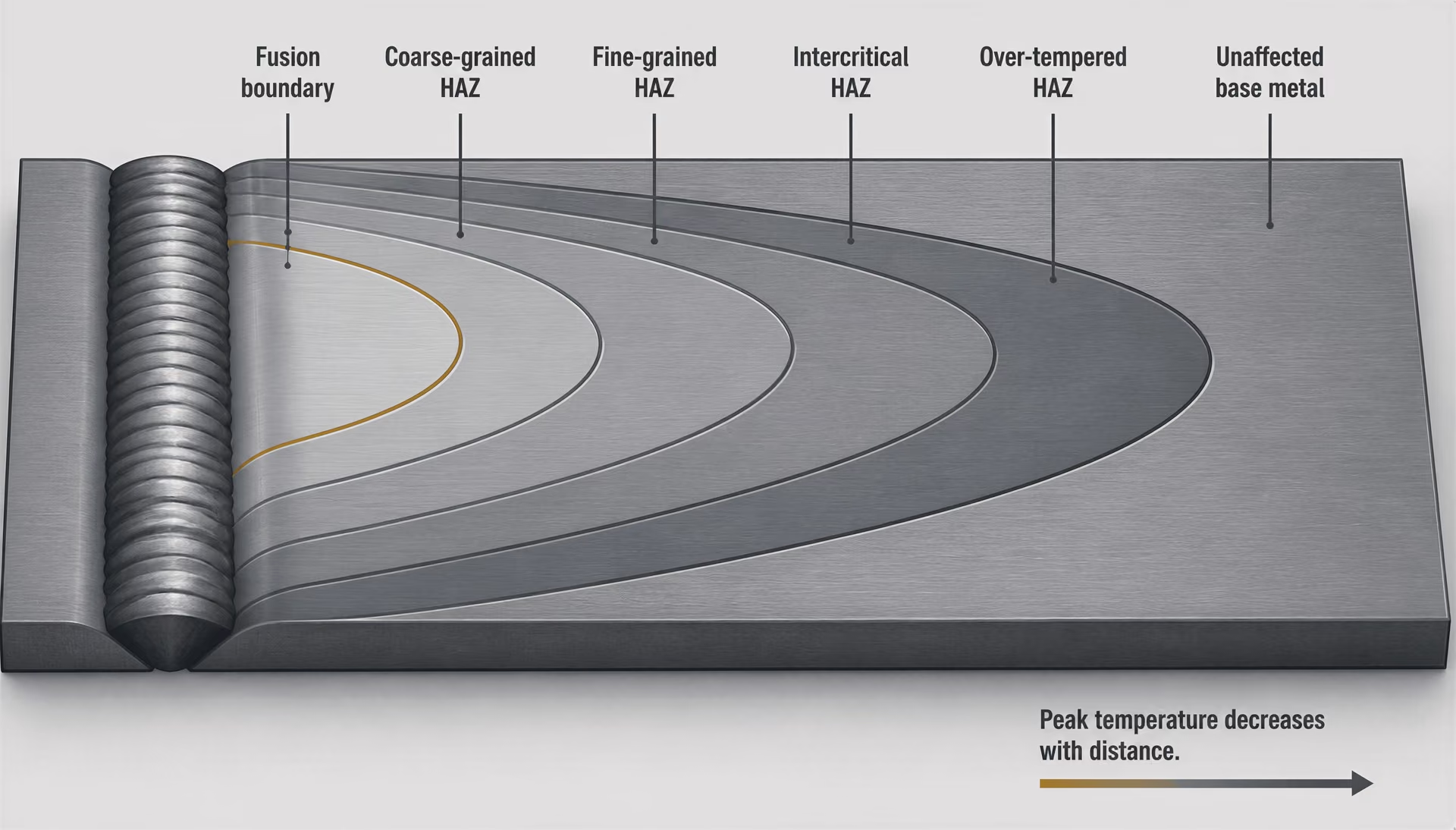
TWI describes conventional-steel HAZ regions as grain-coarsened, grain-refined, partially transformed, and tempered zones, classified by peak temperature and distance from the weld. A pipeline-steel classification in a National Institute of Standards and Technology report uses the closely related terms coarse-grained, fine-grained, intercritical, and over-tempered. These are not separate alloys deposited in layers. They are gradients within the same original steel.
In the grain-coarsened HAZ, the peak temperature is high enough for austenite grains to grow substantially. On cooling, those large prior-austenite grains can produce a coarse transformation structure with reduced resistance to cleavage fracture, depending on composition and cooling conditions. The grain-refined, or fine-grained, HAZ reaches austenite but at a lower peak temperature or for a shorter effective time; recrystallization or austenite formation occurs without the same degree of grain growth.
The partially transformed or intercritical HAZ reaches a temperature between the lower and upper critical transformation temperatures. Only part of the original structure becomes austenite. During cooling, that austenite may form fresh ferrite, bainite, or martensite while the untransformed regions retain, and may modify, their previous condition. In a tempered or over-tempered zone, the peak temperature remains below full austenitization but is high enough to soften or coarsen strengthening precipitates and carbides. This region matters especially in quenched-and-tempered steels and creep-resistant alloys.
Ferritic-steel HAZ microstructure and hardness depend principally on cooling rate through the transformation range, steel composition and hardenability, and prior-austenite grain size. Strong evidence
The important variable is not peak temperature alone. TWI states that ferritic-steel HAZ microstructure and hardness depend principally on cooling rate through the transformation range, steel composition and hardenability, and prior-austenite grain size. A low-alloy steel with sufficient carbon and hardenability may form hard bainite or martensite during rapid cooling, whereas a lower-hardenability steel under the same thermal cycle may form ferrite and pearlite. The nominal grade has not changed, but the local structure and properties have.
This is why HAZ hardness, toughness, residual stress, and cracking susceptibility cannot be assigned from a single grade designation. Welding current, arc voltage, travel speed, joint geometry, plate thickness, preheating, interpass temperature, restraint, and multipass sequence all change the thermal cycle. EN 1011-2 gives guidance for arc welding of ferritic steels, excluding ferritic stainless steels, because such variables must be controlled in relation to steel composition and weldability rather than treated as incidental settings.
Δt8/5 The elapsed time required for a location in a weldment to cool from 800 °C to 500 °C; it is a useful transformation-range descriptor but not a complete thermal history.
Cooling is often described by Δt8/5, the time required for a location to cool from 800 °C to 500 °C. This interval is a practical measure for many ferritic steels because it spans a major part of the austenite-to-ferrite, bainite, or martensite transformation range. The NIST pipeline report relates Δt8/5 to heat input, chemistry, distance from the weld, and wall thickness. It is a useful descriptor, not a complete identity card for the HAZ: two points can have similar Δt8/5 values yet differ in peak temperature, prior-austenite grain size, or the number of reheating cycles.

How peak temperature and distance from the weld establish zones
Temperature falls with distance from the heat source, but the fall is neither instantaneous nor perfectly uniform. The fusion boundary marks the location where the local peak temperature reached the liquidus. Just outside it, the peak temperature remains high enough to create the coarse-grained HAZ. Moving outward, peak temperatures pass through the grain-refining and intercritical ranges, then reach the tempering range before becoming too low to alter the steel detectably.
| Procedure variable | Typical thermal effect | Possible HAZ consequence |
|---|---|---|
| Higher heat input | Broader thermal field and longer exposure | More grain growth and longer cooling time |
| Preheating | Higher starting temperature and reduced gradient | Usually longer cooling time and greater hydrogen escape |
| Greater thickness | Different three-dimensional heat flow | Changed cooling response compared with thin material |
| Multipass sequence | Additional overlapping thermal cycles | Tempering, refinement, partial reaustenitization or over-tempering |
These boundaries move when the welding procedure changes. Higher heat input generally spreads the thermal field and lengthens the time available for grain growth and transformation. Preheating raises the starting temperature and commonly increases cooling time. A thick section conducts heat away differently from a thin one. A subsequent pass can reheat an earlier HAZ, producing a fresh fine-grained or intercritical region inside, or adjacent to, the first thermal cycle. Post-weld heat treatment (PWHT) can then temper martensite, relieve stress, and alter precipitates across several regions at once.
Failure mechanisms by location
- Hydrogen-induced cracking Typically affects a susceptible hard HAZ under diffusible hydrogen and tensile stress.
- Liquation cracking Forms in locally melted HAZ grain boundaries or segregated regions.
- Solidification cracking Forms primarily in solidifying weld metal rather than in the unmelted HAZ.
- Lamellar tearing Relates to through-thickness strain and inclusion-sensitive plate.
- Reheat cracking Develops during later heating or elevated-temperature service in susceptible alloys.
Consequences can be severe without being uniform. Grade 91 steel, a creep-resistant martensitic alloy, is susceptible to Type IV cracking in the base-metal HAZ, particularly in fine-grained and intercritical regions. ASM International and EPRI reported this susceptibility in 2016; simulated thermal cycles also showed that ferrite formation in the intercritical HAZ can reduce high-temperature tensile strength. The vulnerable location is therefore not simply “the weld,” but a particular transformed part of the parent metal.
HAZ metallurgy also controls degradation other than fracture. Hydrogen-induced cracking, liquation cracking, lamellar tearing, and reheat cracking have different causes and locations; solidification cracking belongs primarily to the solidifying fusion zone, not automatically to the HAZ. ESDEP identifies HAZ liquation cracking, hydrogen-induced cracking, and reheat cracking among the principal weldability problems of structural steels. Calling every weld discontinuity “HAZ cracking” hides the mechanism.[2] Supermartensitic stainless-steel weld HAZ microstructures and environmental cracking. TWI. TWI study, 2002.
Corrosion behavior follows the same spatial logic. A 2002 TWI study of supermartensitic stainless-steel welds examined HAZ microstructures in relation to corrosion, stress-corrosion cracking, sulfide-stress cracking, reheating by subsequent passes, and PWHT. Local tempering, fresh martensite, precipitate changes, and compositional effects can make adjacent HAZ regions respond differently in service. ISO 13916:2025 specifies measurement of preheating, interpass, and preheat-maintenance temperatures during fusion welding, but excludes PWHT temperature measurement. That distinction matters because both welding and later reheating contribute to the HAZ thermal-history map.
2. Thermal Cycles: Peak Temperature, Heating Rate and Cooling Time
Thermal history is the organizing principle of HAZ metallurgy. A weld does not expose all adjacent base metal to one temperature for one duration. Each point follows its own cycle: rapid heating, a peak temperature, a period above critical transformation temperatures, and cooling at a rate that changes continuously with time. The HAZ is therefore a spatially graded region, not a uniform strip. Its local structure depends on the combined effects of peak temperature, heating rate, cooling rate, steel chemistry, prior-austenite grain size, restraint and later reheating.
For conventional steels, TWI describes grain-coarsened, grain-refined, partially transformed or intercritical, and tempered zones according to peak temperature and distance from the weld. The NIST pipeline-steel report uses the related designations coarse-grained, fine-grained, intercritical and over-tempered zones. These boundaries are metallurgical descriptions, not fixed distances that apply to every weld. A change in arc energy, joint geometry, plate thickness or travel speed shifts them.
Peak temperature gradients across the HAZ
The highest peak temperature occurs immediately outside the fusion boundary. In the grain-coarsened HAZ, the metal reaches a temperature high enough to form austenite and promote substantial austenite-grain growth before transformation on cooling. A coarse prior-austenite grain structure can alter the products formed during cooling and can reduce local toughness, even when the weld metal itself meets its specified requirements.
Farther from the fusion boundary, the peak temperature falls. The grain-refined HAZ is heated above the austenite transformation range but not for the same time or at the same temperature as the coarse-grained region, so recrystallized austenite grains remain smaller. In the intercritical HAZ, only part of the original ferrite-pearlite, bainitic or tempered structure transforms to austenite. Untransformed regions sit beside newly formed austenite and later acquire different constituents during cooling. Still farther away, the peak temperature may remain below the lower critical transformation temperature. The metal is then tempered or over-tempered rather than transformed, which can lower hardness and strength in quenched-and-tempered steels.
The temperature gradient is also a time gradient. A point close to the fusion boundary reaches a higher peak quickly and may remain above austenite-start or austenite-finish temperatures longer than a point farther away. Heating rate matters because transformation kinetics are not determined by peak temperature alone. Rapid heating can delay diffusion-controlled reactions and change the amount of material that transforms during a short excursion. A slower cycle permits carbon redistribution, carbide dissolution and grain growth to proceed farther.
This is why two locations with similar peak temperatures can still develop different microstructures. TWI states that HAZ microstructure and hardness depend principally on cooling rate through the transformation range, steel composition and hardenability, and prior-austenite grain size. Hardness may rise where rapid cooling produces martensite or hard bainite, while toughness may fall because of coarse grains, brittle constituents or local carbon enrichment. Conversely, a slow cycle can produce softer ferrite-pearlite or tempered structures, but excessive softening may create a strength minimum beside harder regions.
The meaning and limits of Δt8/5
The notation Δt8/5, often written Δt8/5 or t8/5, denotes the elapsed cooling time between 800 °C and 500 °C. It is a practical welding parameter because this interval commonly overlaps important austenite decomposition reactions in ferritic steels. A short Δt8/5 generally indicates rapid cooling and increases the possibility of martensite or hard bainitic products in a susceptible composition. A long Δt8/5 generally allows more diffusional transformation and tends toward softer ferritic or bainitic structures. The actual result still depends on the steel.
The NIST report on pipeline steels specifically relates Δt8/5 to heat input, chemistry, distance from the weld and wall thickness. This relationship is central: heat input changes the thermal field, chemistry changes transformation kinetics, distance changes the local peak temperature and heat flow, and wall thickness changes the paths available for heat to leave the joint. A thicker section can extract heat differently from a thin plate, while a restrained joint, backing arrangement or nearby weld bead can alter the thermal boundary conditions.
Δt8/5 is not a complete thermal history. It compresses a cooling curve into one time interval and says little about the heating rate, the exact peak temperature, the time above austenite-finish, or cooling before 800 °C. Two cycles can have the same Δt8/5 but different peak temperatures and different prior-austenite grain sizes. They can therefore produce different fractions of martensite, bainite, ferrite or pearlite. The parameter also has limited meaning for regions that never reach austenitization, for some stainless steels whose transformations differ from those of carbon-manganese steels, and for reheated regions whose prior structure has already been altered.
For that reason, Δt8/5 should support, not replace, metallographic examination, hardness mapping and a suitable continuous-cooling-transformation or weld thermal simulation. It is a control variable, not a universal microstructure predictor.
Heat input, plate thickness, restraint and multipass reheating
Nominal heat input is commonly calculated from welding current, voltage and travel speed, with an efficiency factor applied when appropriate. It describes energy supplied per unit length, but it does not uniquely determine the local HAZ cycle. The same nominal value can generate different temperature fields in a thick restrained joint, a thin plate, a pipe with a large heat sink, or a joint with preheat. Bead shape, arc efficiency, interpass temperature, joint preparation and heat transfer to clamps or backing also matter.
Chemistry changes the response to a given cycle. Carbon equivalent, alloying additions and hardenability determine how readily austenite transforms to martensite or bainite during cooling. A low-alloy steel with the same measured Δt8/5 as a lower-hardenability steel may form a harder HAZ. Prior thermal exposure matters as well. Tempered martensite, normalized ferrite-pearlite and bainitic pipeline steel do not begin a new cycle from the same microstructural condition.
Plate or wall thickness changes heat flow in three dimensions. Thin material can lose heat rapidly through its surfaces, whereas a thick section stores more heat and may cool differently as the weld progresses. Preheating reduces the temperature gradient and usually lengthens cooling time. Restraint does not simply change temperature; it raises the stresses imposed while the HAZ contracts and while hydrogen diffuses through a hard, potentially brittle region. Hydrogen-induced cracking is therefore distinct from solidification cracking in weld metal, lamellar tearing associated with through-thickness strain and inclusions, liquation cracking near partially melted grain boundaries, and reheat cracking during later heating. ESDEP identifies HAZ liquation cracking, hydrogen-induced cracking and reheat cracking among the principal weldability problems in structural steels.
Multipass welding adds new thermal cycles before the joint has cooled to its final condition. A later pass can temper, refine, partially reaustenitize or over-temper the HAZ produced by an earlier pass. Its peak temperature varies across the previous bead and HAZ, so one location may be softened while another undergoes fresh grain growth or intercritical transformation. Grade 91 illustrates the consequence: ASM International and EPRI reported in 2016 that Type IV cracking is associated with the base-metal HAZ, particularly the fine-grained and intercritical regions. Simulated cycles also showed that ferrite formation in the intercritical HAZ can reduce high-temperature tensile strength.
ISO 13916:2025 covers measurement of preheating, interpass and preheat-maintenance temperatures during fusion welding but excludes PWHT temperature measurement. Strong evidence
The same principle extends beyond strength and cracking. TWI’s 2002 study of supermartensitic stainless-steel welds examined HAZ structure in relation to corrosion, stress-corrosion cracking, sulfide-stress cracking, reheating by subsequent passes and post-weld heat treatment (PWHT). Temperature control must therefore be measured rather than assumed. ISO 13916:2025 specifies measurement of preheating, interpass and preheat-maintenance temperatures during fusion welding, but it excludes PWHT temperature measurement. EN 1011-2 covers arc welding of ferritic steels, excluding ferritic stainless steels. Together, the thermal cycle—not nominal heat input alone—provides the meaningful link between welding procedure, local structure and service behavior.
3. Austenitization and the Conventional HAZ Subregions
| HAZ subregion | Austenitization condition | Likely transformation or property effect |
|---|---|---|
| Coarse-grained HAZ | Above Ac3 at a high enough peak temperature for grain growth | Coarse prior-austenite grains; possible toughness loss |
| Fine-grained HAZ | Above Ac3 without pronounced grain growth | Finer transformed structure, but hardness remains chemistry-dependent |
| Intercritical HAZ | Between Ac1 and Ac3 | Mixed transformed and untransformed structure; possible local softening |
| Over-tempered HAZ | Below Ac1 | Tempering, carbide coarsening and reduced hardness or strength |
The conventional subdivision of a ferritic-steel HAZ follows the maximum temperature reached during welding, rather than a fixed distance measured from the fusion boundary. A point close to the weld may be heated above the upper critical temperature, , and transformed completely to austenite before cooling. A point farther away may pass only through the intercritical range between and , while another may remain below and receive only a tempering cycle. The boundaries are therefore thermal contours, not sharp metallurgical lines.
TWI describes the conventional-steel HAZ as grain-coarsened, grain-refined, partially transformed and tempered zones, classified by peak temperature and distance from the weld. NIST uses closely related terms for pipeline steels: coarse-grained, fine-grained, intercritical and over-tempered zones. The same weld can contain all of these regions, but their widths change with arc energy, travel speed, plate or pipe wall thickness, joint geometry, preheat and the thermal conductivity of the steel.
Austenitization The transformation of ferrite, pearlite, bainite or tempered martensite into austenite on heating through the critical temperature range.
Austenitization is the central event in the hotter part of the HAZ. On heating through , ferrite and any pearlite, bainite or tempered martensite begin to transform into austenite. Above , a low-carbon hypoeutectoid steel is nominally austenitic, although the rate of heating, alloy segregation, undissolved carbides and prior microstructure affect how complete that transformation is. Grain growth then depends on both temperature and time. A short welding cycle can produce major grain enlargement because temperatures near the fusion boundary are exceptionally high, even though exposure lasts only seconds.
Coarse-grained or grain-coarsened HAZ
The coarse-grained HAZ (CGHAZ) lies immediately outside the fusion boundary in conventional ferritic steels. Its peak temperature is above and high enough to activate rapid austenite grain growth; in many descriptions it extends into the range approaching the solidus, although it remains solid and is not part of the fusion zone. Austenite forms throughout the original ferrite matrix, and the original ferrite grain boundaries cease to define the transformed structure. On cooling, ferrite, pearlite, bainite or martensite forms within the enlarged prior-austenite grains, depending on composition and cooling rate.
Large prior-austenite grains reduce the total boundary area available for nucleation during transformation. That can delay diffusional ferrite formation and increase hardenability in the local thermal cycle. With sufficiently rapid cooling, a low-alloy steel may therefore develop bainite or martensite in the CGHAZ even when the unaffected plate is ferritic-pearlitic. Carbon content, manganese, chromium, molybdenum, nickel, microalloying additions and boron all influence this response. Titanium, niobium and vanadium carbonitrides can restrain austenite growth when they remain stable, but excessive dissolution at high temperature removes that pinning effect.
Coarse prior-austenite grains can lower impact toughness while cooling conditions determine whether harder bainitic or martensitic products form. Strong evidence
The result is not simply “a harder HAZ.” Coarse prior-austenite grains can lower impact toughness by increasing the effective cleavage facet size and by permitting unfavorable transformation products to form. A hard CGHAZ may also be susceptible to hydrogen-induced cracking when diffusible hydrogen, tensile residual stress and a sufficiently crack-sensitive microstructure occur together. Cooling rate remains decisive. TWI identifies cooling rate through the transformation range, composition and hardenability, and prior-austenite grain size as the principal factors controlling HAZ microstructure and hardness.
For pipeline steels, the practical cooling descriptor is often , the time required for a location to cool from 800 °C to 500 °C. A short generally signifies faster cooling and a greater tendency toward bainitic or martensitic products; a long value permits more diffusional transformation and tempering. The relationship is not universal or one-dimensional. A NIST pipeline-steel report states that depends on heat input, chemistry, distance from the weld and wall thickness. Consequently, two points at the same nominal distance from a weld can experience different cooling histories in different pipe geometries or welding procedures.
Fine-grained or grain-refined HAZ
The fine-grained HAZ (FGHAZ) reaches a peak above , so the structure is substantially or fully austenitized, but its peak temperature is below the range that causes pronounced austenite grain coarsening. Austenite grains remain smaller than those in the CGHAZ. During cooling, that finer prior-austenite structure provides more nucleation sites and usually favors a finer ferrite-bainite or martensitic arrangement.
“Fine-grained” does not guarantee low hardness or high toughness. A fast thermal cycle in a highly hardenable steel can still produce hard bainite or martensite. Conversely, a slow cycle can produce softer ferrite and pearlite. The FGHAZ is often mechanically favorable relative to the CGHAZ because its transformed constituents are finer, but local toughness depends on the actual product, carbon content, inclusions, segregation and reheating history.
Multiple weld passes complicate the picture. A later pass can heat part of a previously formed CGHAZ into the fine-grained austenitic range, or into the intercritical range, producing a narrow band with a different structure from both the original CGHAZ and the unaffected base metal. HAZ nomenclature therefore describes a particular thermal cycle, not a permanent label attached to a fixed piece of steel.
Intercritical, partially transformed and over-tempered regions
The intercritical HAZ (ICHAZ) reaches a peak between and . Only part of the original microstructure becomes austenite. In a ferritic-pearlitic steel, the pearlitic or carbon-enriched constituents and selected ferrite regions transform preferentially, while some ferrite remains untransformed. On cooling, the newly formed austenite may become ferrite, bainite or martensite, whereas the untransformed ferrite retains a separate thermal history. This mixed structure can produce sharp local differences in hardness and deformation resistance across very small distances.
The ICHAZ is particularly important in creep-resistant Grade 91 steel, nominally designated X10CrWMoVNb9-2 in EN 10088-1 and commonly identified as Grade 91 or P91 in engineering practice. ASM International and EPRI reported in 2016 that Grade 91 is susceptible to Type IV cracking in the base-metal HAZ, particularly in fine-grained and intercritical regions. Thermal-cycle simulations have also shown that ferrite formation in the intercritical HAZ can reduce high-temperature tensile strength. Type IV cracking is therefore not equivalent to ordinary hydrogen cracking: it is a creep-damage problem associated with the softened, microstructurally altered HAZ during long-term service.
Below , no bulk austenitization occurs, but substantial changes can still take place. In a normalized ferritic steel, this region may be called the subcritical HAZ. In a quenched-and-tempered steel, the weld thermal cycle can temper martensite, coarsen carbides and reduce hardness. If the peak temperature and holding time are high enough, the region is described as tempered or over-tempered. Its strength may fall even though no new austenite forms. In precipitation-strengthened or creep-resistant grades, dissolution, coarsening or redistribution of strengthening phases can be more important than ferrite transformation.
Subsequent-pass reheating extends this complexity. A previously hardened region can be tempered by a later pass; a previously tempered region can be partially reaustenitized; and an intercritical band can be reheated again into a different transformation range. Supermartensitic stainless-steel welds demonstrate why the HAZ cannot be treated only as a strength gradient. A 2002 TWI study examined their HAZ microstructures in relation to corrosion, stress-corrosion cracking, sulfide-stress cracking, reheating by subsequent passes and post-weld heat treatment (PWHT). The thermal cycle can alter chromium distribution, martensite tempering and retained austenite, changing both mechanical response and corrosion behavior.
EN 1011-2 provides guidance for arc welding ferritic steels, excluding ferritic stainless steels, while ISO 13916:2025 specifies measurement of preheating, interpass and preheat-maintenance temperatures during fusion welding; it does not cover PWHT temperature measurement. Such controls matter because the conventional zones are consequences of thermal history. They cannot be defined reliably by distance alone.
4. Transformation Products and HAZ Microstructure
The heat-affected zone (HAZ) does not acquire one uniform structure. Each location beside the fusion boundary experiences a different peak temperature, time above critical temperatures, and cooling path through the austenite-to-ferrite transformation range. In conventional steels, TWI divides the HAZ into grain-coarsened, grain-refined, partially transformed, and tempered zones according to peak temperature and distance from the weld. Pipeline descriptions commonly use coarse-grained, fine-grained, intercritical, and over-tempered zones for the same spatial progression.
These labels describe thermal exposure, not guaranteed properties. A fine-grained region can be tougher than an adjacent coarse-grained region, but its hardness still depends on composition and cooling rate. A region described as martensitic may have high hardness, yet its cracking susceptibility depends on carbon content, hydrogen, restraint, tempering condition and local stresses. Phase names are necessary, but they are not property predictions.

Ferrite, pearlite, bainite and martensite formation
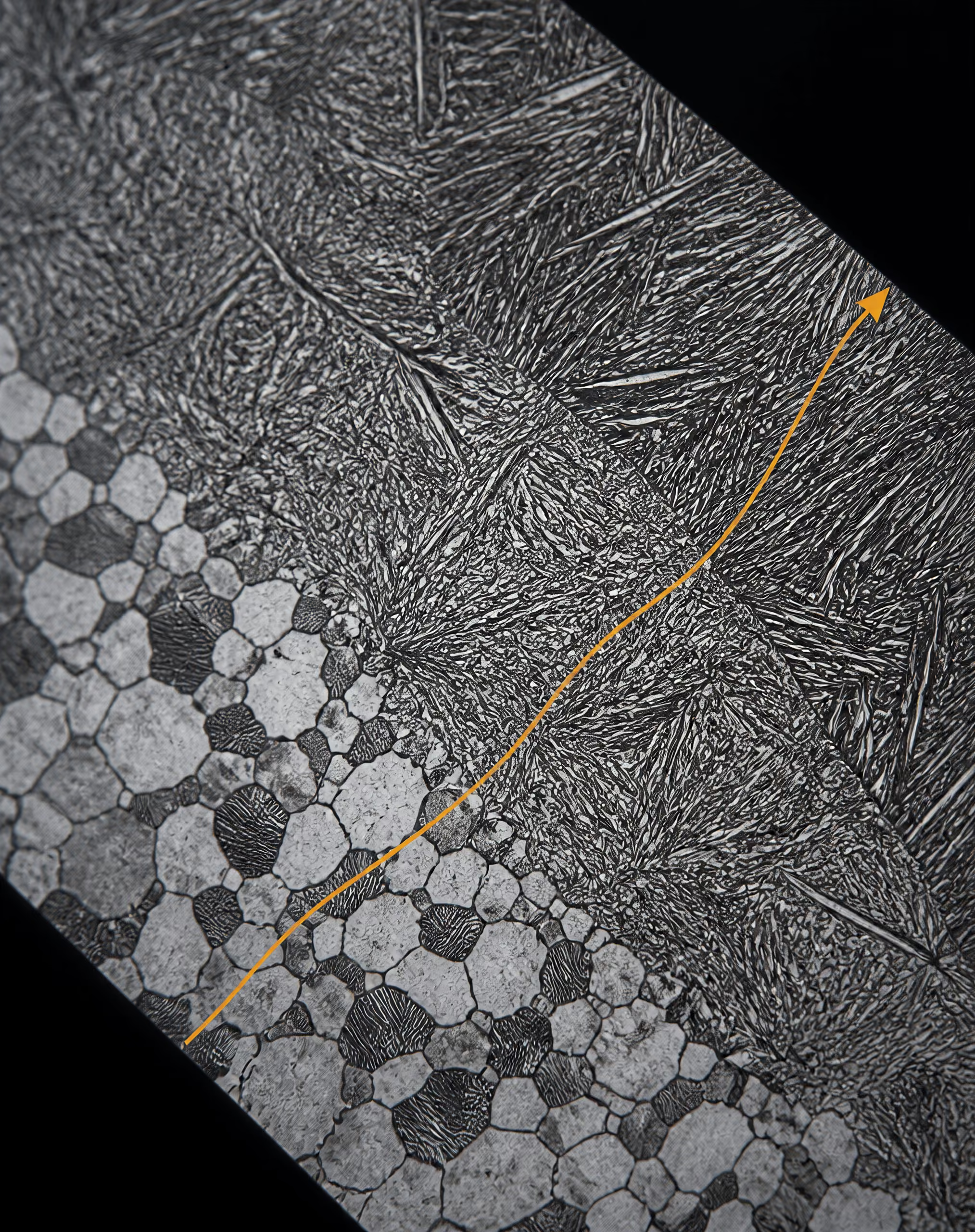
When ferritic steel is heated above its upper critical temperature, the original ferrite and pearlite transform into austenite. The peak temperature controls how much austenite forms and how much the austenite grains grow. During subsequent cooling, that austenite decomposes by competing transformation reactions. The cooling rate is often represented by Δt8/5, the elapsed time while the material cools from 800 °C to 500 °C. This interval is a practical welding parameter because much of the transformation of austenite in carbon and low-alloy steels occurs within or near this range.
| Cooling regime | Dominant possible products | Typical property tendency |
|---|---|---|
| Relatively slow | Polygonal ferrite and pearlite | Lower hardness; possible softening |
| Intermediate | Upper, lower or granular bainite | Intermediate to high hardness depending on morphology and chemistry |
| Rapid | Martensite, often with bainite or ferrite | Higher hardness and greater hydrogen-cracking concern |
| Subcritical reheating | Tempered martensite or bainite | Reduced hardness and strength through tempering |
With relatively slow cooling, diffusional transformation produces polygonal ferrite, often followed by pearlite. Carbon rejected from growing ferrite enriches the remaining austenite, allowing ferrite and cementite to form together as pearlite. In a HAZ, however, the ferrite may be aligned, Widmanstätten, or otherwise non-equiaxed because the austenite grain boundaries and thermal gradient influence nucleation and growth. The resulting morphology matters. Two regions may both be identified as ferritic-pearlitic while differing substantially in grain size, cementite distribution and impact toughness.
At intermediate cooling rates, bainitic transformation can replace much of the ferrite-pearlite reaction. Bainite forms below the temperature range in which ordinary polygonal ferrite and pearlite dominate, but above the range where martensite forms by diffusionless shear. Upper bainite and lower bainite are not interchangeable descriptions: their ferrite morphology and carbide arrangement differ, and lower bainite generally has finer carbide dispersion. Welding metallography may also identify granular bainite or bainitic ferrite, terms that reflect morphology and etching response rather than a single universal structure.
Rapid cooling suppresses diffusional carbon movement and can transform austenite to martensite. Martensite is a supersaturated, distorted form of ferrite produced by a diffusionless transformation. In low-carbon structural steels it may occur as lath martensite, often mixed with bainite or ferrite; higher-carbon material can produce harder, more brittle martensitic regions. Fresh untempered martensite is particularly important in hydrogen-induced cracking because high hardness, tensile residual stress and diffusible hydrogen can act together. Preheating and controlled heat input lengthen the cooling interval, but they do not by themselves prove that martensite has been avoided.
A subsequent weld pass can alter any of these products. Reheating may temper martensite, refine or partially reaustenitize a previous HAZ, or produce an intercritical region containing newly formed austenite alongside untransformed ferrite. Post-weld heat treatment can temper martensite and reduce residual stress, while excessive exposure can soften tempered regions and change carbide distributions. The final cross-section is therefore a record of overlapping thermal cycles rather than only the first-pass cooling event.
NIST reports that Δt8/5 in pipeline steels depends on heat input, chemistry, distance from the weld and wall thickness. That dependence is important: the same nominal welding procedure can generate different structures at the fusion boundary, at the coarse-grained HAZ edge and farther into the plate. Heat input is not a complete thermal history, since arc efficiency, joint geometry, restraint and interpass temperature also affect the local cycle.
Prior-austenite grain size and hardenability
Prior-austenite grain size is the size of the austenite grains present immediately before transformation on cooling. It is not the same as the final ferrite grain size. In the grain-coarsened HAZ, high peak temperatures and prolonged exposure above the austenite grain-coarsening range allow grains to grow. Grain boundaries then provide fewer sites for diffusional ferrite nucleation, so transformation can be delayed to lower temperatures. Lower transformation temperatures and reduced nucleation can favor bainite or martensite, especially when the steel has substantial hardenability.
Hardenability The ability of steel to form martensite through its section under a specified cooling condition; it is distinct from the maximum hardness attainable.
Hardenability describes the depth or extent to which steel can form martensite under a given cooling condition; it is not the same as maximum attainable hardness. Alloying elements such as manganese, chromium, molybdenum and nickel generally delay ferrite and pearlite reactions, shifting transformation to longer times on a continuous-cooling-transformation diagram. Boron can strongly increase hardenability when retained in the correct condition at austenite grain boundaries. Carbon raises martensite hardness and also affects hardenability, but its effect cannot be separated from the rest of the chemistry.
Grain size changes this balance. Coarse prior-austenite grains often increase hardenability because they reduce the total grain-boundary area available for ferrite and pearlite nucleation. They can also reduce toughness by producing larger final transformation packets or cleavage-effective units. Fine prior-austenite grains usually encourage earlier diffusional transformation and provide a finer transformed structure, although a fine-grained region can still become hard if the cooling rate and alloy content are sufficient.
This is why TWI identifies cooling rate, steel composition and hardenability, and prior-austenite grain size as principal controls on HAZ microstructure and hardness. The same hardness value can arise from different mixtures of martensite, bainite and ferrite, with different fracture behavior. Conversely, equal martensite fractions do not guarantee equal toughness because packet size, carbon content, inclusions and tempering state may differ.
Grade 91 illustrates the danger of treating the HAZ as a single martensitic band. Grade 91 is susceptible to Type IV cracking in the base-metal HAZ, particularly in fine-grained and intercritical regions, as reported by ASM International and EPRI in 2016. Those regions are not simply the hardest part of the weld. Long-term creep damage concentrates where the thermal cycle and subsequent tempering or partial transformation produce a weaker local microstructure. Simulated thermal cycles have also shown that ferrite formation in the intercritical HAZ can reduce high-temperature tensile strength.
Carbon equivalents and composition-sensitive transformation
- Formula
- CEIIW = C + Mn/6 + (Cr + Mo + V)/5 + (Ni + Cu)/15
- Basis
- Mass percentages
- Interpretation
- Higher values generally indicate greater hardenability and HAZ hardening risk
- Limitation
- A screening parameter, not a substitute for thermal-cycle analysis
Carbon equivalent formulas compress several alloying effects into one weldability index. The IIW carbon equivalent, commonly written:
uses mass percentages. A higher value generally indicates greater hardenability and a greater possibility of forming hard HAZ constituents under a specified cooling cycle. The CET and Pcm formulas are alternative carbon-equivalent systems used for particular low-alloy steel ranges and welding assessments. They are not interchangeable without regard to the standard or procedure in which they are specified.
Carbon equivalent is therefore a screening parameter, not a substitute for thermal-cycle analysis. Two steels with similar CEIIW can have different transformation behavior because their alloying elements affect ferrite, bainite and martensite reactions in different ways. Ni, Cr, Mo, Mn, V, Nb, Ti and B also influence precipitation, austenite grain growth and tempering response. The actual HAZ depends on peak temperature, Δt8/5, prior-austenite grain size and reheating history as well as bulk chemistry.
EN 1011-2 addresses arc welding of ferritic steels, excluding ferritic stainless steels, and uses composition and welding conditions to guide control of hydrogen cracking risk. Temperature measurements require separate attention: ISO 13916:2025 specifies measurement of preheating, interpass and preheat-maintenance temperatures during fusion welding, but excludes post-weld heat-treatment temperature measurement. Neither a carbon-equivalent value nor an interpass reading identifies the final phase mixture by itself.
The composition-sensitive principle extends beyond carbon and low-alloy structural steels. TWI’s 2002 discussion of supermartensitic stainless-steel welds relates HAZ microstructures to corrosion, stress-corrosion cracking, sulfide-stress cracking, reheating by subsequent passes and post-weld heat treatment (PWHT). In such steels, austenite reformation, martensite tempering and retained or reverted austenite can alter corrosion response as well as strength. HAZ metallurgy consequently determines more than hardness: it can control local toughness, creep strength, hydrogen response and corrosion behavior.
5. Hardness, Toughness and Strength Across the HAZ
The heat-affected zone (HAZ) does not have one hardness or one mechanical response. It contains a sequence of regions formed by different peak temperatures and cooling paths: grain-coarsened, grain-refined, partially transformed or intercritical, and tempered or over-tempered zones. TWI describes these regions as subdivisions of conventional steels based on peak temperature and distance from the fusion boundary. A pipeline-steel description from the National Institute of Standards and Technology (NIST) uses the closely related terms coarse-grained, fine-grained, intercritical and over-tempered HAZ.
Each region has its own prior-austenite grain size, transformation products, residual stress and response to later thermal cycles. A hardness traverse therefore records a spatial gradient, not a single property of “the HAZ.” Hardness can rise close to the fusion boundary, fall in an intercritical region, and change again where the base metal has been tempered without being fully reaustenitized. Tensile strength, toughness and ductility follow related but not identical trends.
Why hardness changes with cooling rate
The central relationship identified by TWI is among cooling rate, steel composition and hardenability, and prior-austenite grain size. These variables determine which transformations occur as austenite cools through the transformation range. A rapid thermal cycle can suppress diffusional formation of ferrite and pearlite, leaving bainite or martensite. A slower cycle gives carbon and alloying elements more time to diffuse, often producing softer ferritic or pearlitic structures. The result is a higher or lower hardness, but not simply a direct measure of every other mechanical property.
Weld thermal cycles are often described using Δt8/5, the time taken to cool from 800 °C to 500 °C. This interval is a practical indicator for ferritic steels because much of the austenite transformation occurs within or near that range. NIST states that Δt8/5 depends on heat input, chemistry, distance from the weld and wall thickness. It is not a universal material constant. A thick section can retain heat and cool more slowly than a thin section under otherwise similar welding conditions; preheating and interpass temperature have similar effects.
Composition changes the response to a given cooling time. Carbon raises the capacity for martensite formation, while alloying additions such as manganese, chromium, molybdenum and nickel alter hardenability and transformation kinetics. Prior-austenite grain size also matters. Coarse austenite grains provide fewer nucleation sites for diffusional products and can promote harder transformation products under a particular cooling cycle. The same nominal Δt8/5 can therefore produce different hardness in two grades, or in two HAZ regions of the same component if the peak temperatures and grain structures differ.
A hard HAZ commonly indicates martensite, bainite, or another transformation-hardened structure. That observation is important, but hardness alone does not prove the presence of a particular phase. Metallographic examination, carbon content, welding procedure and cooling history are needed for that interpretation. High hardness can accompany reduced toughness and increased susceptibility to hydrogen-induced cracking when diffusible hydrogen and tensile restraint are also present. It is not correct to label every hard region a crack, or every crack beside a weld “HAZ cracking.” ESDEP identifies HAZ liquation cracking, hydrogen-induced cracking and reheat cracking as separate weldability problems; solidification cracking and lamellar tearing are separate mechanisms again.
Preheat and interpass control affect the cooling path and hydrogen escape. EN 1011-2 covers arc welding of ferritic steels, excluding ferritic stainless steels, and provides guidance relevant to controlling weld thermal conditions and cracking risk. ISO 13916:2025 specifies measurement of preheating, interpass and preheat-maintenance temperatures during fusion welding, but it does not cover post-weld heat-treatment temperature measurement. Those distinctions matter when a hardness result is compared with a qualified welding procedure.
Toughness loss in coarse-grained regions
The coarse-grained HAZ (CGHAZ) reaches a temperature high enough to reaustenitize the steel and grow prior-austenite grains. Grain growth reduces the number of effective barriers to cleavage fracture and can produce large bainitic or martensitic packets, depending on composition and cooling rate. The CGHAZ may therefore show a lower Charpy impact energy or a higher ductile-to-brittle transition temperature even when its tensile strength is high.
Hardness and toughness should not be treated as interchangeable. A harder structure may have greater yield and tensile strength while absorbing less impact energy before fracture. Conversely, a region with moderate hardness can have poor toughness if its grain size, inclusions, local segregation or martensite–austenite constituents create easy crack paths. The coarse-grained region is often the critical location in low-temperature fracture assessment, but the exact weakest zone depends on steel grade and thermal cycle.
A second welding pass can partly transform or temper material heated by the first pass. This reheating may refine or temper some structures while leaving adjacent coarse grains unchanged. In multipass welds, the HAZ is consequently a superposition of thermal histories rather than a single pass boundary. Post-weld heat treatment can reduce residual stress and temper martensitic constituents, but it does not recreate the original fine-grained base-metal structure.
Grade 91 illustrates why local toughness and high-temperature strength require separate attention. An ASM International and EPRI contribution from 2016 reports susceptibility to Type IV cracking in the base-metal HAZ, particularly in fine-grained and intercritical regions. Simulated thermal cycles showed that ferrite formation in the intercritical HAZ can reduce high-temperature tensile strength. The vulnerable region is therefore not necessarily the hardest or the coarsest part of the weld. Under creep service, a relatively soft, fine-grained band can accumulate strain and damage beside stronger material.
Softening, local ductility and property gradients
The intercritical HAZ is heated above the lower critical transformation temperature but not far enough to transform the entire microstructure to austenite. Only part of the structure reaustenitizes. On cooling, newly formed transformation products develop beside ferrite or tempered constituents that survived the cycle. The resulting mixture can have lower hardness than the adjacent CGHAZ, particularly when the original steel was quenched and tempered or precipitation strengthened.
The over-tempered region experiences a subcritical thermal cycle. It does not reaustenitize, but carbides can coarsen, precipitates can lose strengthening effect and previously hardened constituents can temper further. Local hardness and yield strength may fall. This softened band can become a preferred deformation site during tensile loading, bending or service creep. Its greater local ductility does not automatically make the joint safer: strain concentrates there because neighboring regions remain stronger, and the accumulated deformation can promote Type IV damage, fatigue initiation or failure at a metallurgical boundary.
Tensile strength describes the maximum engineering stress reached in a tensile test. Yield strength describes the onset of substantial plastic deformation. Hardness is a localized resistance to indentation and often serves as a rapid indicator of strength, but it cannot replace tensile testing. Ductility describes plastic strain or elongation before fracture. Toughness describes energy absorption and resistance to crack extension under a specified test condition. These properties can move in different directions across the same HAZ.
A hardness minimum beside a weld may signal over-tempering or intercritical softening, whereas a hardness maximum may signal martensitic transformation and hydrogen-cracking risk. Neither result, by itself, establishes the local fracture toughness, fatigue life or service strength. A hardness traverse should be read alongside macrostructure, microstructure, tensile or bend testing, impact testing where required, and the expected service temperature and loading mode.
Subsequent-pass reheating and PWHT further modify these gradients. TWI’s 2002 study of supermartensitic stainless-steel welds examined HAZ microstructures in relation to corrosion, stress-corrosion cracking, sulfide-stress cracking, reheating by subsequent passes and PWHT. This example shows that mechanical-property mapping cannot be separated from environmental performance: a softened or transformed band may also differ in corrosion potential, passive-film stability and hydrogen uptake. The HAZ is thus a graded mechanical and chemical region, with the controlling risk determined by the local structure and the service conditions acting on it.
6. HAZ Cracking Mechanisms in Carbon and Low-Alloy Steels
Cracking near a weld is not one metallurgical event. ASM International and the European Steel Design Education Programme (ESDEP) classify weld cracks by their location, timing and driving force: some form in the solid-state HAZ after welding, some form while weld metal or locally melted base metal is solidifying, and others appear only during reheating or service. The distinction matters because a crack beside the fusion boundary may be caused by hydrogen, grain-boundary liquation, solidification shrinkage, creep damage or through-thickness ductility loss.
The HAZ has a thermal gradient rather than a single structure. Conventional-steel regions are commonly described as grain-coarsened, grain-refined, partially transformed or intercritical, and tempered or over-tempered zones. The NIST classification for pipeline steels uses coarse-grained, fine-grained, intercritical and over-tempered regions. Each location experiences a different peak temperature and cooling path. The practical cooling descriptor Δt8/5—the time taken to cool from 800 °C to 500 °C—helps relate thermal cycles to transformation products, although its use depends on the steel and welding process. A NIST pipeline report identifies heat input, chemistry, distance from the weld and wall thickness as factors affecting Δt8/5.
Cooling rate, composition, hardenability and prior-austenite grain size control the resulting HAZ microstructure and hardness. A short cooling interval can produce martensite or bainite in a hardenable carbon or low-alloy steel; a longer interval may permit ferrite, pearlite or tempered transformation products. The resulting structure determines whether a crack can initiate, whether it can propagate, and whether restraint supplies enough tensile stress to keep it open. Preheating and interpass control change the thermal cycle, but they do not remove the need to assess steel chemistry, joint restraint and hydrogen control. EN 1011-2 covers arc welding of ferritic steels, excluding ferritic stainless steels. ISO 13916:2025 specifies measurement of preheating, interpass and preheat-maintenance temperatures during fusion welding; it does not specify measurement of post-weld heat-treatment temperature.
Hydrogen-induced or cold cracking
Hydrogen-induced cracking, also called cold cracking or delayed cracking, occurs after the weld has solidified and the adjacent HAZ has cooled. Its characteristic timing is therefore different from hot cracking, although a crack may be discovered hours after welding. ASM discussions generally associate this mechanism with three interacting requirements: diffusible hydrogen, a susceptible hard or brittle microstructure, and tensile stress. Restraint and weld-transformation stresses provide the local stress field; residual stress can remain high even when the externally applied load is zero.
Hydrogen enters the weld pool from moisture, contamination, flux coverings, lubricants or other process sources. After solidification, atomic hydrogen diffuses through the weld and HAZ. It can accumulate at inclusions, prior-austenite grain boundaries, martensite interfaces, dislocations and other regions of high local stress. The exact fracture process depends on steel, microstructure and loading, so a single universal hydrogen threshold should not be assigned. Hydrogen reduces the tolerance of a hard, stressed microstructure to cracking; it does not act independently of restraint or metallurgical susceptibility.
The most vulnerable HAZ is often the coarse-grained region or another zone that transforms to untempered martensite or a hard bainitic structure during rapid cooling. Coarse prior-austenite grains can lower toughness and provide an easier path for crack growth. The fine-grained and intercritical regions can also be affected, particularly when local hardness, residual stress or service loading is unfavorable. A weld may therefore contain different hydrogen-cracking risks at different distances from the fusion boundary.
Crack orientation reflects the stress field and geometry. Longitudinal or transverse cracks may occur in weld metal, while HAZ cracks can run parallel to the fusion boundary or extend from the toe into hardened base metal. Root regions, starts and stops, undercuts and abrupt changes in joint restraint concentrate stress. Delayed inspection is not proof of a hydrogen mechanism, but delayed appearance is a useful warning sign.
Control follows the causal chain: reduce diffusible hydrogen, avoid excessive HAZ hardness, and reduce or manage tensile restraint and residual stress. Dry consumables and clean joint surfaces address hydrogen input. Preheating slows cooling and allows hydrogen to escape before the HAZ reaches a highly stressed, low-temperature condition. Postheating may assist hydrogen removal when specified by the welding procedure, while post-weld heat treatment can temper susceptible structures and reduce residual stress. These measures must be selected for the grade and thickness; they are not interchangeable with a generic temperature rule.
Liquation, solidification and reheat cracking
Liquation cracking is a hot crack in the HAZ, usually along grain boundaries that have been locally melted by the welding thermal cycle but are outside the principal fusion zone. The crack forms as this thin liquid film is stretched during cooling and contraction. Segregated impurities, low-melting eutectic constituents, inclusions or alloy-rich grain-boundary regions can lower the local melting temperature. The HAZ may therefore crack even though the bulk base metal did not melt.
This mechanism differs from fusion-zone solidification cracking. In solidification cracking, liquid weld metal in the fusion zone solidifies between growing dendrites. Solute segregation and feeding limitations leave a weak, liquid-bearing boundary network; weld-metal contraction then opens the interdendritic region. Its location is within the deposited or melted weld metal, not in an unmelted HAZ. A crack that follows the fusion boundary requires examination of both possibilities: locally melted HAZ material indicates liquation, whereas an interdendritic path through weld metal indicates solidification cracking. Mixed cracks can occur where the fusion boundary and HAZ thermal field overlap.
ESDEP lists HAZ liquation cracking, hydrogen-induced cracking and reheat cracking among the principal weldability problems in structural steels. Liquation susceptibility is affected by base-metal chemistry, segregation, grain size, peak temperature and thermal strain. Coarse grains provide long grain-boundary paths, while repeated thermal cycles can remelt or weaken previously heated regions. The relevant driving force is tensile strain during high-temperature cooling, not diffusible hydrogen accumulated after solidification.
Reheat cracking occurs during a later thermal exposure, commonly stress-relief heat treatment or service at elevated temperature. The crack is a solid-state, often intergranular failure in a previously welded HAZ or weld region. Precipitation and recovery can strengthen grain interiors while leaving grain boundaries relatively weak; relaxation of residual stress and creep deformation then concentrates strain at those boundaries. Susceptibility is associated with particular alloy systems and impurity or precipitate conditions, so it cannot be inferred solely from the presence of a weld or from room-temperature hardness.
Grade 91 illustrates why a HAZ must be treated as several microstructural regions. ASM International and EPRI reported in 2016 that Grade 91 is susceptible to Type IV cracking in the base-metal HAZ, especially the fine-grained and intercritical regions. Type IV damage is a service-temperature creep failure rather than ordinary hydrogen cold cracking. Simulated thermal cycles showed that ferrite formation in the intercritical HAZ can reduce high-temperature tensile strength. Subsequent-pass reheating and PWHT further alter precipitates, tempering condition and local strength, so the final crack susceptibility depends on the complete weld thermal history.
Lamellar tearing and through-thickness susceptibility
Lamellar tearing is a base-metal cracking mechanism associated with tensile strain normal to the rolled plate surface. It usually develops beneath a restrained weld, particularly around a T-joint, corner joint or large attachment where weld contraction pulls the plate through its thickness. The crack path is generally stepped or terrace-like: it advances through elongated inclusions and links them by ductile shear regions.
The decisive material property is through-thickness ductility, not simply transverse tensile strength or HAZ hardness. Rolled plate contains non-metallic inclusions—historically manganese sulfide, and also oxide or silicate inclusions depending on steelmaking practice—that become flattened and aligned during rolling. These inclusions act as void-nucleation sites when the plate is strained in the short-transverse direction. A clean steel with fewer or less severe inclusion stringers has lower susceptibility, while high restraint, thick plate, large weld deposits and unfavorable joint design increase the applied through-thickness strain.
Lamellar tearing may initiate in the base metal below the HAZ and can be mistaken for a HAZ crack because the crack lies close to the weld. Its driving force is weld-shrinkage strain and constraint acting through the plate thickness; hydrogen is not the defining requirement. Nor is a hard martensitic HAZ necessary. Metallographic location, crack morphology, inclusion alignment and the direction of the applied strain distinguish it from hydrogen-induced cracking and liquation cracking.
Design and procedure changes can reduce the strain: orient joints to avoid pulling through the plate thickness, reduce excessive weld volume, use suitable joint details, control restraint and, where specified, select plate with verified through-thickness properties. A weld repair that merely removes the visible surface indication may miss the subsurface inclusion-linked crack. Examination must address the plate volume around the attachment, not only the fusion line.
7. Preheat, Interpass Control and Welding Procedure Variables
The metallurgical purpose of preheating
Preheating is a thermal control, not a universal cure for HAZ problems. It raises the temperature of the joint before arc heat is applied, reducing the temperature gradient between the weld pool and surrounding steel. The immediate result is slower cooling through the transformation range. In ferritic steels, that change can prevent an excessively hard martensitic or bainitic HAZ, depending on composition, hardenability, prior-austenite grain size and the actual thermal cycle.
A useful description is Δt8/5: the time required for a point in the weldment to cool from 800 °C to 500 °C. This interval covers an important part of austenite decomposition in many steels, although it is not a complete description of every alloy or weld condition. A short Δt8/5 generally indicates rapid cooling and a greater risk of hard, brittle transformation products; a longer interval permits more diffusional transformation and tempering effects. The National Institute of Standards and Technology (NIST) reports that pipeline-steel Δt8/5 depends on heat input, chemistry, distance from the weld and wall thickness. Preheat changes that relationship by altering the initial temperature and heat flow into the base metal.
Preheat also assists hydrogen management. Hydrogen introduced by moisture, surface contamination, consumables or shielding-gas problems can diffuse away from austenitic or hard HAZ regions before the steel reaches low temperature. This lowers the concentration available to combine with tensile residual stress and a susceptible microstructure. The effect is conditional. Preheat cannot compensate for wet electrodes, contaminated joint faces, excessive restraint or a steel whose procedure produces unacceptable hardness. Hydrogen-induced cracking is a distinct mechanism, not a label for every crack near a weld.
The required temperature is therefore selected from steel composition, product thickness, restraint, hydrogen control, welding process and procedure qualification. Excessive preheat has its own costs. It can lengthen cooling times enough to coarsen grains, reduce local strength, promote excessive softening in tempered steels and enlarge the region exposed to elevated temperature. In quenched-and-tempered steels, an over-hot cycle may temper the base-metal HAZ. For precipitation-strengthened or creep-resistant grades, it may disturb the intended precipitate population.
The HAZ remains spatially graded despite a single specified preheat value. Closest to the fusion boundary, a conventional steel may form a coarse-grained region after high peak temperatures. Farther away, the grain-refined, intercritical and tempered or over-tempered regions experience different peak temperatures and transformation paths. TWI identifies these four conventional-steel subdivisions by peak temperature and distance from the weld. Preheat shifts their cooling histories; it does not make them metallurgically identical.
Interpass temperature and thermal accumulation
| Temperature term | When it applies | Purpose |
|---|---|---|
| Preheat temperature | Before welding or a specified weld segment begins | Sets the initial thermal condition |
| Interpass temperature | Immediately before depositing the next pass | Controls thermal accumulation between passes |
| Preheat-maintenance temperature | During an interruption or between operations | Prevents the joint from falling below the specified minimum |
| PWHT temperature | During a later post-weld heat treatment | Requires separate measurement and control |
Preheat temperature is the minimum temperature established in the joint before welding starts, or before a specified weld segment begins. Interpass temperature is the temperature of the weld area immediately before depositing the next pass. A preheat-maintenance temperature is a minimum temperature that must be maintained when welding is interrupted or when the joint must remain hot between operations. These terms should not be treated as interchangeable.
Interpass control governs thermal accumulation. In a multipass weld, the second and later passes reheat the previous weld metal and adjacent HAZ. A high interpass temperature means that the next thermal cycle begins from a hotter base state, usually slowing cooling and reducing Δt8/5. It can also expose earlier passes to repeated tempering or partial reaustenitization. The resulting microstructure may contain narrow bands with different hardness and toughness only millimetres apart.
A maximum interpass limit is often as important as a minimum preheat requirement. If it is exceeded, the accumulated heat can produce excessive grain growth, softening or reduced toughness, particularly in quenched-and-tempered steels and creep-resistant steels. If the temperature falls below the specified minimum, rapid cooling and hydrogen cracking risk may return. The correct value is procedure-specific, not a fixed property of a welding process.
Grade 91 illustrates why simple temperature rules fail. An ASM International and EPRI study from 2016 describes Type IV cracking in the base-metal HAZ, especially in fine-grained and intercritical regions. These regions are not the coarse-grained strip often shown in simplified diagrams. Simulated thermal cycles also showed that ferrite formation in the intercritical HAZ can reduce high-temperature tensile strength. Repeated pass reheating may temper some martensite while creating fresh intercritical material elsewhere, so a compliant interpass reading cannot by itself establish resistance to Type IV damage.
The same principle applies to stainless steels. TWI’s 2002 study of supermartensitic stainless-steel welds examined HAZ microstructures in relation to corrosion, stress-corrosion cracking and sulfide-stress cracking, as well as reheating by subsequent passes and post-weld heat treatment (PWHT). Local reheating can change chromium distribution, martensite tempering and corrosion response. HAZ control therefore concerns service degradation as well as hardness and cracking.
EN 1011-2 and ISO 13916:2025
EN 1011-2 provides recommendations for arc welding of ferritic steels. Its scope is ferritic steels and it excludes ferritic stainless steels. The document addresses welding procedure factors such as hydrogen control, heat input, preheating and cooling conditions, helping the engineer assess HAZ hardness and cold-cracking risk. It is guidance for selecting and controlling a welding procedure, not a substitute for qualification evidence or grade-specific requirements.
ISO 13916:2025 addresses measurement rather than the full metallurgical design of a procedure. The standard specifies requirements for measuring preheating, interpass and preheat-maintenance temperatures during fusion welding. It does not cover measurement of PWHT temperature. That exclusion matters: the temperature recorded before a weld pass is not evidence that a later stress-relief or tempering treatment reached its specified temperature or uniformity.
Measurement location and timing must represent the material that controls the weld’s thermal cycle, rather than merely the hottest convenient surface. The temperature may vary through thickness and around a joint, especially in restrained sections, attachments and thick-wall components. A procedure should state when the reading is taken, where it is taken and the permitted minimum or maximum.
Heat input and pass sequence add another layer of control. Arc energy is commonly related to current, voltage and travel speed, with process efficiency and bead geometry affecting the heat actually transferred to the workpiece. Higher heat input generally broadens the heated zone and lengthens cooling time, but joint geometry, plate thickness and restraint can reverse a simple prediction. A stringer-bead sequence, wide weave, alternating sides or planned interpass pauses changes which regions are reheated and when. Consequently, two welds with the same nominal preheat can have different HAZ grain size, hardness, toughness and cracking susceptibility. The welding procedure must control the complete thermal history, not one temperature reading.
8. Multipass Welding: Reheating, Tempering and HAZ Overlap
A multipass weld does not produce one fixed HAZ beside the fusion boundary. Each pass adds a new thermal cycle, and the temperature field from that pass overlaps material altered by earlier passes. A region that was once coarse-grained HAZ may later be reheated below the lower critical temperature and tempered; another region may be heated into the intercritical range, where some ferrite transforms to austenite; material closer to a later fusion boundary can be fully reaustenitized and transformed again on cooling.
The final cross-section therefore records a sequence rather than a single event. Peak temperature, time at temperature, cooling through the transformation range, and the number and spacing of reheating cycles all matter. TWI describes conventional-steel HAZ regions as grain-coarsened, grain-refined, partially transformed, and tempered zones according to peak temperature and distance from the weld. In a multipass joint, those labels describe local responses to several passes, not necessarily four permanent, parallel bands.

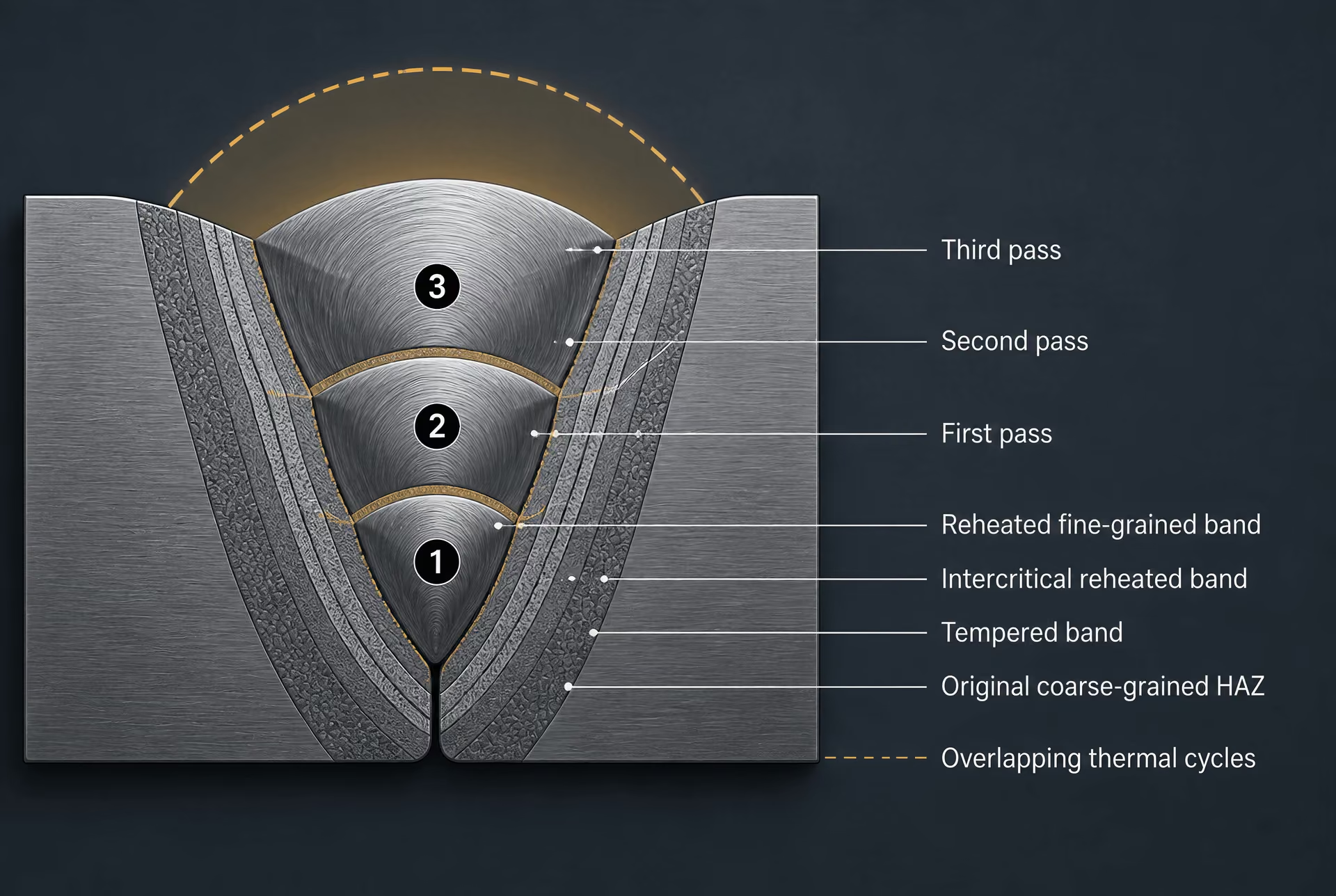
Subsequent-pass reheating of earlier HAZ regions
Effects of subsequent-pass reheating
- Tempering A lower-temperature cycle can reduce martensitic hardness and residual stress.
- Refinement A later austenitic cycle can create new, finer austenite grains.
- Partial reaustenitization An intercritical cycle transforms only part of the previous structure.
- Over-tempering Repeated subcritical exposure can coarsen carbides or precipitates and reduce strength.
A subsequent bead reheats the preceding weld metal and part of the earlier HAZ. The extent depends on bead size, travel speed, arc energy, joint geometry, plate or wall thickness, interpass temperature, and the location of the pass. Heat input and thermal conductivity control how quickly the surrounding metal reaches a given temperature, while the distance from the new fusion boundary determines the peak temperature. The same point can experience a high-temperature cycle during one pass and a lower-temperature tempering cycle during the next.
The practical cooling parameter Δt8/5 describes the elapsed time while the material cools from 800 °C to 500 °C. It is useful where the steel undergoes austenite decomposition in that range, but it is not a complete description of a multipass thermal history. The National Institute of Standards and Technology pipeline report relates Δt8/5 to heat input, chemistry, distance from the weld, and wall thickness. It does not imply that every point in a joint has one common cooling time. Adjacent points can have substantially different cycles, and later passes can alter the structure created by the first cycle.
For a low-alloy ferritic steel, the first pass may create coarse prior-austenite grains next to the fusion boundary. A later pass whose peak temperature lies in the austenite region can refine that structure by forming new austenite grains, depending on the local peak temperature and the duration of the cycle. If the later peak reaches only the intercritical range, a fraction of the original ferrite transforms to austenite. On cooling, that fraction may become fresh bainite, martensite, or another transformation product, while the untransformed matrix retains some earlier features. A lower-temperature cycle may not reaustenitize the steel at all, but can temper martensite or soften a previously hardened region.
This is why weld procedure control cannot be reduced to nominal arc energy. Interpass temperature changes the starting temperature of each pass and can shorten the effective cooling interval. ISO 13916:2025 specifies measurement of preheating, interpass, and preheat-maintenance temperatures during fusion welding; it explicitly excludes post-weld heat-treatment temperature measurement. EN 1011-2 addresses arc welding of ferritic steels, excluding ferritic stainless steels, and provides guidance for controlling welding conditions in relevant ferritic grades.
Tempered and over-tempered structures
Reheating below the lower critical transformation temperature can temper a martensitic or bainitic HAZ without forming a new austenite field. Carbon redistributes, transition carbides may form or change, residual stresses decline, and hardness commonly falls. The resulting structure may have greater resistance to hydrogen-induced cracking than an as-quenched martensitic region, but the change can also reduce strength. The outcome depends on the original constituent, reheating temperature, holding time, and the number of cycles.
“Tempered HAZ” is therefore not a single microstructure. A short, relatively cool cycle may produce limited tempering, whereas a hotter or repeated cycle may cause substantial carbide coarsening and loss of precipitation strengthening. The term “over-tempered” indicates that the thermal exposure has reduced properties beyond the intended tempering condition. In quenched-and-tempered steels, this softened zone can become a local strength minimum. In creep-resistant steels, reheating can disturb the carefully controlled distribution of precipitates that supports long-term strength.
Grade 91 illustrates the danger of treating softening as automatically beneficial. ASM International and EPRI reported in 2016 that Grade 91 is susceptible to Type IV cracking in the base-metal HAZ, particularly in fine-grained and intercritical regions. Thermal-cycle simulations showed that ferrite formation in the intercritical HAZ can reduce high-temperature tensile strength. The critical location is not the visibly coarse region alone: repeated excursions through the intercritical range can create a fine-grained, partially transformed structure with unfavorable creep deformation and damage behavior. Subsequent weld passes may temper some martensite while also creating or enlarging this vulnerable region.
Post-weld heat treatment adds another controlled thermal cycle across the entire joint. It can temper hard transformation products and reduce residual stress, but it can also promote carbide or precipitate changes, alter hardness gradients, and expose reheated regions to further degradation. PWHT must therefore be specified for the steel grade, thickness, welding procedure, and service condition rather than assumed to erase HAZ differences.
Supermartensitic stainless steels make the same point while adding corrosion effects. TWI’s 2002 study examined their HAZ microstructures in relation to corrosion, stress-corrosion cracking, sulfide-stress cracking, reheating by subsequent passes, and PWHT. A subsequent pass can temper fresh martensite, partially reaustenitize an earlier region, or produce a mixed structure across a narrow reheated band. Those changes affect chromium partitioning, carbide formation, hardness, residual stress, and the electrochemical behavior of the surface. A lower hardness may reduce one cracking tendency, while local compositional or phase changes can impair corrosion resistance or create a susceptible path under hydrogen-containing service.
Why a weld cross-section contains overlapping thermal histories
A cross-section through a multipass joint should be read as a map of thermal peaks and cooling paths. Near a pass, the metal may have melted or been fully reaustenitized. Farther away, it may have reached the grain-growth range, the grain-refining range, the intercritical range, or only a tempering temperature. The next pass shifts those boundaries and superimposes another set of zones. They are curved, displaced, and partly coincident rather than neatly stacked.
The overlap produces property heterogeneity at several scales. Hardness can rise where rapid cooling forms martensite, fall where martensite is tempered, and vary again where a later cycle creates fresh untempered transformation products. Toughness follows grain size, phase balance, carbon content in the transformed fraction, and local residual stress; it cannot be inferred from distance to the weld alone. Cracking susceptibility likewise changes from point to point. ESDEP identifies HAZ liquation cracking, hydrogen-induced cracking, and reheat cracking as distinct structural-steel weldability problems, while solidification cracking occurs in the weld metal and lamellar tearing relates to through-thickness ductility. Reheating does not make these mechanisms interchangeable.
The same spatial grading controls corrosion and service cracking in stainless welds. A reheated band may differ from adjacent metal in hardness, passive-film stability, precipitate population, and tensile stress. Consequently, metallographic examination and hardness traverses should be located with the actual bead sequence in mind. A single measurement at the fusion boundary can miss the softened intercritical band, the reheated martensitic band, or the over-tempered region that governs failure.
9. Grade 91 and Type IV Cracking
| Grade 91 HAZ region | Thermal history | Reported concern |
|---|---|---|
| Coarse-grained | High-temperature full austenitization with grain growth | Coarse transformed structure and possible toughness loss |
| Fine-grained | Full or substantial austenitization without pronounced grain growth | Part of the Type IV-susceptible base-metal HAZ |
| Intercritical | Partial transformation between Ac1 and Ac3 | Ferrite formation and reduced high-temperature tensile strength |
| Over-tempered | Subcritical reheating | Softening and altered precipitate condition |
Grade 91 is a useful case study because its weldability problem is not confined to the visible fusion boundary. The steel is a tempered-martensitic creep-resistant alloy, commonly designated Grade 91, P91 for pipe, and T91 for boiler tubing, with approximately 9% chromium and additions such as molybdenum, vanadium, niobium and nitrogen. Its strength at elevated temperature depends on a finely tempered martensitic structure containing stable precipitates, especially carbonitrides and the chromium-rich carbide population associated with long-term tempering.
Welding replaces that carefully developed structure with a sequence of local thermal cycles. A location immediately beside the fusion line may be fully austenitized and transformed into coarse martensite. A little farther away, the peak temperature may refine the austenite without producing the same grain growth. Farther again, only part of the original microstructure may transform. The result is a graded HAZ, not a uniform strip.
The ASM-EPRI Grade 91 study published in 2016 identified susceptibility to Type IV cracking in the base-metal HAZ, particularly in the fine-grained and intercritical regions. That distinction matters. A fracture surface may be near the weld, but proximity to the weld does not make the fusion boundary the controlling metallurgical location.

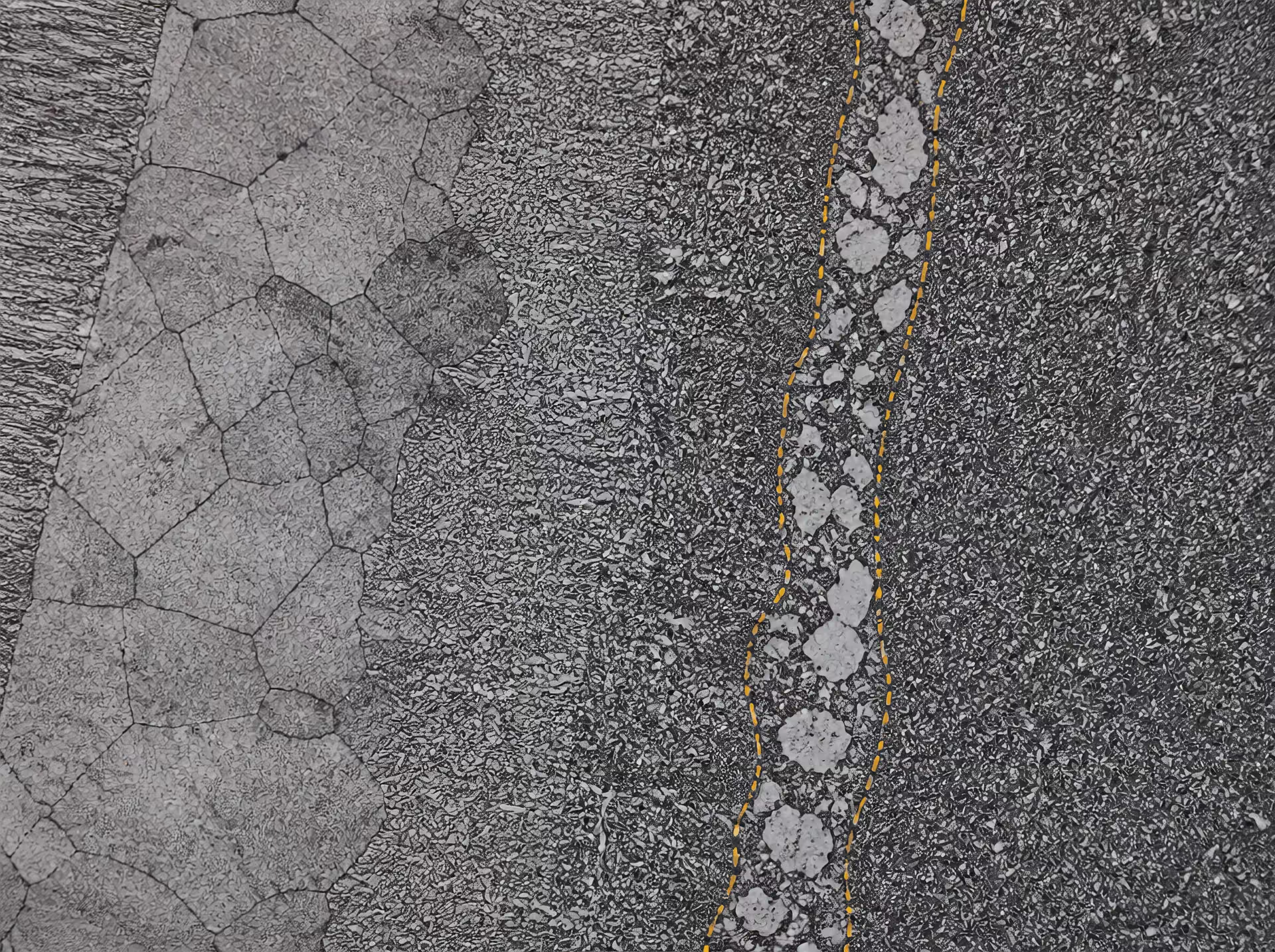
Fine-grained and intercritical HAZ regions in Grade 91
The fine-grained HAZ forms where the peak temperature is above the austenite-transformation range but not high enough, or not sustained long enough, to produce the prior-austenite grain growth found in the coarse-grained HAZ. Welding dissolves or redistributes some precipitates, then rapid cooling produces fresh martensite. Because the prior-austenite grains are smaller than in the coarse-grained region, the transformed packet and block structure also differ. Tempering during fabrication and service then acts on a region whose original precipitate distribution and grain geometry have already been disturbed.
The intercritical HAZ lies at a lower peak-temperature range. Only part of the material enters the austenitic field during the weld thermal cycle; the remainder retains a tempered Grade 91 structure. On cooling, newly formed austenite transforms beside untransformed or partially tempered material. This creates a mixed microstructure with local differences in hardness, carbon distribution, precipitate state and creep resistance. The intercritical zone can therefore be mechanically weaker even when its hardness does not identify it as the most conspicuous part of the HAZ.
TWI describes conventional-steel HAZ subregions as grain-coarsened, grain-refined, partially transformed and tempered zones, classified by peak temperature and distance from the weld. NIST uses the related terms coarse-grained, fine-grained, intercritical and over-tempered zones for pipeline-steel HAZs. The labels are not interchangeable in every alloy system, but the underlying point applies to Grade 91: each position records a different thermal history.
Cooling is equally important. The practical parameter Δt8/5 describes the time required for the weld region to cool from 800 °C to 500 °C. The NIST treatment relates Δt8/5 to heat input, steel chemistry, distance from the weld and wall thickness. Those variables change transformation kinetics and the amount of tempering imposed by the weld. Grade 91’s HAZ cannot be assessed from peak temperature alone.
TWI states that HAZ microstructure and hardness depend principally on cooling rate through the transformation range, composition and hardenability, and prior-austenite grain size. For Grade 91, the same variables determine whether a local region forms hard fresh martensite, undergoes additional tempering, or develops a mixed intercritical structure. A hardness traverse is useful, but it is not a complete map of creep damage or Type IV susceptibility.
Ferrite formation and high-temperature strength
The ASM-EPRI study also examined simulated Grade 91 weld thermal cycles and reported that ferrite formation in the intercritical HAZ can reduce high-temperature tensile strength. This observation gives the Type IV problem a more specific metallurgical basis than the general statement that welding “weakens the HAZ.”
Ferrite is softer and less creep-resistant than the tempered-martensitic matrix that gives Grade 91 its elevated-temperature strength. Its formation can accompany local carbon and alloy redistribution, changes in precipitate stability and loss of the finely controlled lath-martensite structure. Under a sustained load, deformation may concentrate in this altered region. The surrounding weld metal, unaffected base metal and harder HAZ areas then impose constraint, increasing the local stress and strain demand on the fine-grained or intercritical material.
The result is not simply a hardness mismatch. High-temperature tensile behavior depends on the microstructure’s resistance to plastic flow and creep, on precipitate evolution, on grain and subgrain structure, and on the distribution of deformation across the welded joint. A region with moderate measured hardness can still have poor long-term strength if its creep resistance has been reduced by partial transformation or ferrite formation.
This finding should not be converted into a universal life estimate. The response of a welded Grade 91 component depends on stress, temperature, geometry, weld procedure, restraint, post-weld heat treatment, service history and the actual distribution of HAZ microstructures. Thermal-cycle simulations establish a mechanism and identify a vulnerable region; they do not by themselves specify when a particular vessel, tube or pipe will fail.
Preheat, interpass control and weld heat input remain relevant because they affect the thermal cycles and transformation behavior. ISO 13916:2025 specifies measurement of preheating, interpass and preheat-maintenance temperatures during fusion welding, but it expressly excludes measurement of post-weld heat-treatment temperature. That distinction is important for Grade 91 work: weld-temperature control and PWHT are related operations, not one measurement requirement.
Why Type IV failure is a base-metal HAZ problem
Type IV cracking A service-temperature creep failure associated with weakened fine-grained and intercritical regions of the base-metal HAZ, especially in Grade 91.
Type IV cracking is generally associated with creep damage in the fine-grained and intercritical base-metal HAZ. It is therefore misleading to describe it as a generic “weld cracking” event or to locate its cause automatically at the fusion boundary. The weld may provide the thermal disturbance and the joint geometry, but the susceptible microstructure is usually produced in the adjacent parent material.
During prolonged service, cavities can nucleate and grow along boundaries in the weakened HAZ. Local strain accumulation, grain-boundary sliding and precipitate changes contribute to damage development. The crack may advance approximately along the boundary between altered HAZ material and stronger neighboring regions, although its exact path depends on stress state, microstructure and fabrication history. Inspection must consequently cover the base-metal HAZ, not only the weld metal and fusion line.
This mechanism is distinct from hydrogen-induced cracking, solidification cracking, lamellar tearing, liquation cracking and reheat cracking. ESDEP identifies HAZ liquation cracking, hydrogen-induced cracking and reheat cracking among the principal weldability problems in structural steels, but those mechanisms occur under different metallurgical and loading conditions. Type IV damage is primarily a service-temperature creep problem in a vulnerable Grade 91 HAZ.
A sound assessment therefore combines weld procedure records, PWHT history, thermal-cycle information, hardness and microstructural examination with service stress and temperature data. The ASM-EPRI finding on ferrite and reduced high-temperature tensile strength helps explain why the fine-grained and intercritical regions deserve focused attention. It does not justify treating every Grade 91 weld as equally susceptible, nor does it support a fixed allowable service duration without component-specific evidence.
Reheating adds another layer. A subsequent weld pass can temper, partially transform or otherwise modify an earlier HAZ, and PWHT can reduce hardness while also changing the precipitate and substructure state. Similar spatial effects occur in other alloys: TWI’s 2002 discussion of supermartensitic stainless-steel welds relates HAZ microstructures to corrosion, stress-corrosion cracking, sulfide-stress cracking, reheating by later passes and PWHT. The material-specific failure mechanism changes, but the governing principle remains: the HAZ is a set of local thermal histories whose service behavior must be assessed by region.
10. HAZ Corrosion and Environment-Assisted Cracking
The heat-affected zone (HAZ) is also a corrosion variable. A hardness survey can identify a highly hardened band, but it cannot show whether chromium-rich precipitates have formed, whether protective alloying elements have segregated, whether local ferrite and martensite are balanced, or whether welding has left tensile residual stress. Those details control corrosion and environment-assisted cracking.
A HAZ therefore requires assessment against its service environment. Chloride-bearing water, carbon dioxide, hydrogen sulfide, dissolved oxygen, acidic condensate and high-temperature steam impose different demands. The same thermal cycle may be tolerable in dry atmospheric exposure but unsafe in sour production, where hydrogen absorption and tensile stress can combine with a susceptible microstructure.
Microstructure as a corrosion variable
HAZ microstructure changes continuously with distance from the fusion boundary rather than at a single sharp interface. TWI describes conventional-steel regions as grain-coarsened, grain-refined, partially transformed and tempered zones, classified by peak temperature and distance from the weld. A pipeline-steel treatment from the National Institute of Standards and Technology (NIST) uses the closely related terms coarse-grained, fine-grained, intercritical and over-tempered zones.
Each region can present a different corrosion response. Grain coarsening changes the density and character of boundaries; intercritical heating partially transforms the original structure and may produce islands of hard, carbon-enriched martensite after cooling; tempering can dissolve or coarsen strengthening phases and alter local electrochemical behavior. In stainless steels, the important changes may include chromium depletion beside chromium-rich carbides, precipitation of intermetallic phases, formation or dissolution of delta ferrite, and changes in the fraction and chemistry of martensite and austenite.
The controlling thermal description is not simply “welding temperature.” Cooling through the transformation range matters, and Δt8/5—the time taken to cool from 800 °C to 500 °C—is a useful welding parameter where those temperatures describe the relevant transformation interval. NIST states that Δt8/5 depends on heat input, chemistry, distance from the weld and wall thickness. Consequently, two locations at the same nominal distance from a weld may not develop the same structure if restraint, thickness or heat flow differs.
In ferritic steels, TWI identifies cooling rate through the transformation range, composition and hardenability, and prior-austenite grain size as principal controls on HAZ microstructure and hardness. Corrosion assessment must add local chemistry, phase distribution and precipitate state to that list. A hard martensitic region may be vulnerable to hydrogen-assisted cracking, while a softer over-tempered region may contain a galvanically different constituent or have lost corrosion resistance through precipitate formation. Neither condition can be inferred reliably from hardness alone.
The distinction between corrosion and cracking is important. General metal loss, pitting, intergranular corrosion and galvanic attack may initiate at different microstructural features. A weld cap, root, overlap or crevice can also concentrate electrolyte independently of bulk HAZ hardness. Surface condition, oxide films, weld slag removal and post-weld cleaning must therefore accompany metallurgical examination.
Stress-corrosion and sulfide-stress cracking
Stress-corrosion cracking (SCC) requires a susceptible material, a suitable environment and tensile stress. Welding can supply the last condition through residual stress, while local transformation products and precipitates supply the first. Applied load is not required to be large: locked-in tensile stress near a weld may remain significant after the component appears dimensionally stable.
Chloride SCC is especially sensitive to temperature, chloride activity, electrochemical potential and local passive-film stability. A stainless-steel HAZ with chromium-depleted regions may repassivate less effectively at selected boundaries, allowing localized attack to become a crack-initiation site. The effect is spatially selective, so a polished cross-section showing one apparently uniform HAZ can conceal sharply different susceptibility across the thermal gradient.
Sulfide-stress cracking (SSC) is a hydrogen-assisted failure mechanism associated with aqueous hydrogen sulfide service. Hydrogen generated during corrosion enters the steel; tensile stress then promotes crack initiation and growth in a susceptible microstructure. High hardness is a recognized warning sign in many sour-service assessments, but hardness is a screening indicator, not a complete mechanism. Crack susceptibility also depends on strength, inclusions, prior-austenite grain structure, transformation products, residual stress and the actual H₂S-containing environment.
The supermartensitic stainless-steel study published by TWI in 2002 is useful because it treats HAZ metallurgy as a combined corrosion and cracking problem. Its scope links HAZ microstructures with corrosion, SCC, SSC, reheating by subsequent weld passes and post-weld heat treatment (PWHT). Supermartensitic grades are designed around a low-carbon martensitic matrix with chromium and other alloying additions, but welding can create local variations in martensite tempering, retained or reverted austenite, ferrite and precipitate populations. Those variations alter both passive corrosion behavior and hydrogen-assisted cracking response.
Service qualification should consequently identify the environmental mechanism before accepting a welding procedure. ISO 15156, where applicable to oil and gas production in H₂S-containing environments, addresses material selection and cracking resistance; a production weld assessment may also require testing in the actual service medium. A hardness map alone cannot establish SSC resistance, and a corrosion test performed on unaffected parent metal cannot represent the HAZ.
Grade 91 illustrates the same principle at elevated temperature, although its principal concern is creep damage rather than aqueous SSC. ASM International and EPRI reported in 2016 that Grade 91 is susceptible to Type IV cracking in the base-metal HAZ, particularly in fine-grained and intercritical regions. Simulated thermal cycles showed that ferrite formation in the intercritical HAZ can reduce high-temperature tensile strength. The example reinforces a broader rule: a narrow, mechanically weaker subregion can govern failure even when the weld metal and unaffected base metal meet their individual requirements.
The effect of reheating and PWHT in stainless steels
A subsequent weld pass does not merely add metal; its thermal cycle reheats an earlier HAZ. The reheated zone may be tempered, partially reaustenitized, solution-treated or exposed to a temperature range that promotes carbide, nitride or intermetallic precipitation. Its final condition depends on peak temperature, hold time, cooling rate and the number and spacing of later passes.
In supermartensitic stainless steels, reheating can temper hard martensite and may create a locally softer region, while a higher reheating peak can generate fresh untempered martensite on cooling. The resulting band may differ in corrosion potential, hardness and hydrogen sensitivity from both the first-pass HAZ and the parent material. Repeated passes can also change austenite stability and phase balance, so the final microstructure cannot be predicted from the first thermal cycle alone.
PWHT adds another deliberate thermal history. Tempering may reduce residual stress and soften untempered martensite, lowering one source of cracking susceptibility. It can also promote precipitation or chromium redistribution that changes passivity and localized-corrosion behavior. Excessive or poorly controlled treatment may therefore trade one risk for another. The correct cycle is grade-specific and must be verified by procedure qualification, metallography and environmental testing where service demands it.
Temperature measurement requirements should not be confused with PWHT control. ISO 13916:2025 specifies measurement of preheating, interpass and preheat-maintenance temperatures during fusion welding, but excludes post-weld heat-treatment temperature measurement. PWHT needs its own instrumentation, temperature records and acceptance criteria. For stainless-steel HAZ assessment, the evidence should connect those records to phase balance, precipitates, residual stress and the relevant corrosion or cracking test—not stop at a hardness traverse.
11. HAZ Examination and Property Characterization
| Examination method | What it can establish | Important limitation |
|---|---|---|
| Macroetching | Weld geometry, fusion boundary and approximate thermal regions | Not a phase-identification method |
| Optical microscopy | Ferrite, pearlite, bainite, martensite and grain-size changes | May not resolve fine precipitates |
| Hardness mapping | Local hardening, softening and property gradients | Does not establish toughness or service life |
| SEM or EBSD | Fine morphology, fracture features and crystallographic information | Requires targeted sampling and interpretation |
| Creep or environmental testing | Service-relevant damage response | Must match the actual mechanism and environment |
A defensible HAZ examination begins with the weld cross-section, not with a hardness number. The HAZ is base metal altered by welding heat without melting, so its boundaries rarely form a single sharp line. Peak temperature decreases with distance from the fusion boundary, while cooling rate also changes with position, plate thickness, joint restraint, heat input and interpass temperature. The resulting structure is spatially graded.
HAZ diagnosis sequence
- Document Record grade, thickness, weld geometry, pass sequence, preheat, interpass temperature, heat input and PWHT.
- Reveal Use a representative transverse section and macroetching to locate the fusion boundary and altered regions.
- Identify Determine phases, grain size, precipitates and crack morphology with suitable microscopy.
- Map Traverse hardness across unaffected base metal, HAZ, fusion boundary and weld metal.
- Test Select toughness, tensile, creep, fatigue, corrosion or cracking tests based on the suspected failure mechanism.
The examination should therefore proceed in sequence: document weld geometry and welding conditions; reveal the fusion boundary and thermal regions; identify phases, grain size and transformation products; map hardness across the weld; then select mechanical or cracking tests that address the suspected service failure. A fracture, leak or premature shutdown may involve the HAZ, but it should not be labelled “HAZ cracking” until the crack path and mechanism have been established.

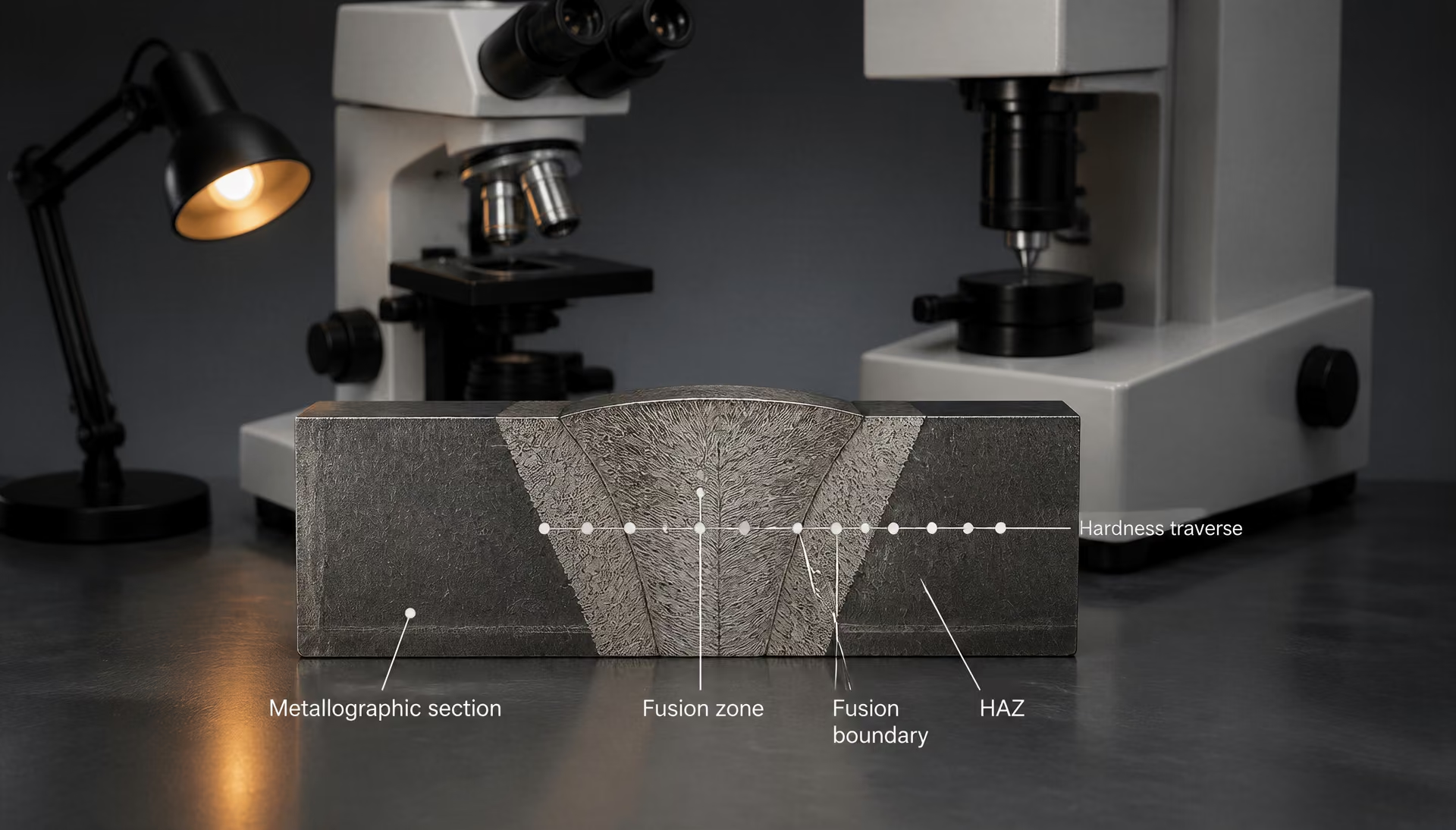
Macroetching, metallography and zone identification
Begin with a representative transverse section through the weld, including unaffected base metal on both sides. Record plate or component thickness, bevel geometry, number and sequence of passes, weld size, travel direction, preheat, interpass temperature, heat input and any post-weld heat treatment (PWHT). These details provide the thermal context needed to interpret the section. ISO 13916:2025 specifies measurement of preheating, interpass and preheat-maintenance temperatures during fusion welding; it does not cover measurement of PWHT temperature.
After sectioning, mounting and grinding, macroetching can expose the weld metal, fusion boundary, penetration profile, lack of fusion, arc strikes and the approximate width of thermally altered material. The etchant must match the alloy and examination purpose. A macrograph is a map, not a phase identification method. Etching contrast can exaggerate or conceal narrow regions, and a single section may miss asymmetry caused by torch angle, multipass reheating or a nearby geometric restraint.
Conventional steels are commonly divided, as TWI describes them, into grain-coarsened, grain-refined, partially transformed or intercritical, and tempered or over-tempered zones according to peak temperature and distance from the weld. Pipeline-steel descriptions from NIST use coarse-grained, fine-grained, intercritical and over-tempered zones. These labels are useful, but they are not universal physical boundaries. The coarse-grained region has exceeded the upper transformation range by enough to permit austenite grain growth; the fine-grained region austenitized at a lower temperature; the intercritical region experienced partial transformation; and the over-tempered region remained below the transformation range while existing martensite or bainite was softened.
Metallographic examination should then move from the fusion boundary outward at known distances. Optical microscopy can establish ferrite, pearlite, bainite, martensite, tempered martensite, inclusions and visible grain-size changes. Scanning electron microscopy is often needed for fracture-surface features, carbide distributions and fine precipitates. Electron backscatter diffraction can measure crystallographic texture, prior-austenite reconstruction in suitable alloys, and local misorientation associated with deformation or transformation. Transmission electron microscopy may be required when precipitate coarsening controls strength, as in Grade 91.
The thermal history matters more than the zone name alone. Ferritic-steel HAZ microstructure and hardness depend principally on cooling rate through the transformation range, composition and hardenability, and prior-austenite grain size, as TWI states. Δt8/5, the time taken to cool from 800 °C to 500 °C, is a practical descriptor where those temperatures are appropriate. A NIST pipeline report relates Δt8/5 to heat input, chemistry, distance from the weld and wall thickness. It is not a transferable material constant. Two points assigned to the same named zone can have different transformation products if their cooling paths differ.
The examination should also distinguish mechanisms. Hydrogen-induced cracking commonly develops in susceptible hard HAZ microstructures under tensile restraint and diffusible hydrogen. Solidification cracking occurs in the weld metal as it freezes. Lamellar tearing follows susceptible plate through-thickness structures and inclusions, while liquation cracking involves local melting near grain boundaries or inclusions. Reheat cracking develops during stress relief or service exposure in susceptible alloys. ESDEP identifies HAZ liquation cracking, hydrogen-induced cracking and reheat cracking among the principal weldability problems in structural steels, but that list does not make every weld discontinuity a HAZ crack.
Hardness mapping and mechanical testing
Hardness mapping links visible structure to a local response, provided the method and spacing are reported. Indent from unaffected base metal across the HAZ, fusion boundary and weld metal, with additional traverses where the weld is asymmetric or multipass. Use a sufficiently small load and spacing to resolve narrow fine-grained or intercritical regions, while avoiding interaction between adjacent indents and edge effects. Vickers HV0.5 or HV1 measurements are often suitable for laboratory maps; the selected scale must be stated because values from different loads are not automatically interchangeable.
A hardness traverse can locate an over-tempered soft band, a hard martensitic region, a softened intercritical region or an unusual local peak. It can also reveal variation between the first-pass HAZ and regions reheated by later passes. Yet hardness is an indicator, not a complete property assessment. A hard HAZ may have poor hydrogen-cracking resistance, but hardness alone cannot establish fracture toughness, Charpy impact toughness, fatigue-crack growth, stress-corrosion cracking resistance or service life. Conversely, a softened region may lose creep strength without becoming a likely source of hydrogen cracking.
Mechanical testing must follow the failure concern. Charpy V-notch tests assess notch toughness at specified temperatures, but their absorbed energy does not equal plane-strain fracture toughness. CT or SEN(B) fracture-toughness specimens can address crack initiation and growth under defined constraint. Tensile specimens reveal yield strength, ductility and strength mismatches, although a conventional specimen may average several HAZ regions. Bend tests expose gross lack of fusion, cracking and ductility problems. Fatigue tests, creep tests and sustained-load cracking tests are necessary when cyclic loading, long-term high temperature or environmental cracking controls performance.
For Grade 91, a tempered martensitic creep-resistant steel, Type IV cracking is associated with the base-metal HAZ, particularly the fine-grained and intercritical regions. A 2016 ASM International and EPRI contribution identifies this susceptibility. The local weakness may be missed by a bulk tensile test or by hardness measurements that do not resolve the narrow softened region. Examination should include prior-austenite grain structure, martensite lath condition, carbide and MX precipitate populations, PWHT condition and the location of creep voids or cracking.
Corrosion assessment also requires more than hardness. TWI’s 2002 discussion of supermartensitic stainless-steel welds examines HAZ microstructures in relation to corrosion, stress-corrosion cracking and sulfide-stress cracking, including reheating by subsequent passes and PWHT. For such alloys, local phase balance, chromium-rich passive-film stability, residual stress, hydrogen exposure and tempering history may control performance.
Interpreting simulated HAZ thermal-cycle experiments
Simulated HAZ specimens are produced by imposing a controlled thermal cycle on separate pieces of steel, often with a Gleeble-type thermomechanical simulator. They permit one variable at a time—peak temperature, heating rate, Δt8/5, repeated-pass reheating or applied strain—to be studied without the spatial overlap present in a real weld. Resulting microstructures can be examined by microscopy, hardness, tensile, impact, creep or cracking tests.
Their value depends on matching the actual weld. A single peak temperature and Δt8/5 do not reproduce the full thermal gradient, multiaxial restraint, hydrogen distribution, weld-metal dilution or sequence of reheating cycles. Specimen dimensions also alter heat flow. Simulated material may therefore represent one point within a HAZ, not the whole HAZ.
Grade 91 illustrates the limitation clearly. Simulated cycles have shown that ferrite formation in the intercritical HAZ can reduce high-temperature tensile strength, helping explain why Type IV damage concentrates in that region. The result supports a mechanism; it does not by itself predict the service life of a welded pressure component. Actual welds add residual stress, local geometry, chemical segregation, prior thermal exposure and PWHT variation.
The strongest interpretation compares simulated and real-weld evidence: reproduce the measured or calculated thermal cycle, confirm the microstructure and hardness, then test the property relevant to the suspected failure. A hardness match is useful confirmation. It is not proof that toughness, crack resistance, corrosion behavior or long-term service performance also match.
12. Reading Welding Standards and Procedure Qualifications
Welding standards do not all answer the same question. A technical guidance document may recommend preheat, interpass temperature, heat input or hydrogen-control measures. A temperature-measurement standard may define how those temperatures are obtained and recorded. A procedure-qualification standard determines whether a proposed welding procedure has demonstrated acceptable properties within stated limits. Confusing these functions leads to a common error: treating a recommended thermal control or a measured temperature as proof of one particular HAZ microstructure.
The HAZ is a spatially graded region, not a uniform strip. TWI describes conventional-steel HAZ subregions as grain-coarsened, grain-refined, partially transformed and tempered zones, classified by peak temperature and distance from the fusion boundary. The NIST treatment of pipeline steels uses the related terms coarse-grained, fine-grained, intercritical and over-tempered zones. Each location can experience a different peak temperature, maximum austenite grain size, transformation path and cooling rate.
What EN 1011-2 provides
EN 1011-2, Welding — Recommendations for welding of metallic materials — Part 2: Arc welding of ferritic steels, is guidance for controlling weldability risks in ferritic steels. Its scope must be read literally: it covers arc welding of ferritic steels and excludes ferritic stainless steels. It is not a universal rulebook for every steel, welding process or stainless-steel HAZ.
The document connects steel composition, thickness, restraint, hydrogen condition, heat input and preheating with the risk of undesirable weld and HAZ conditions. Its methods support decisions about preheat and interpass temperature, and about controlling the cooling behavior relevant to hydrogen-induced cracking. Carbon-equivalent approaches can indicate hardenability and susceptibility, but they do not replace a qualified procedure or direct examination of the welded joint. Two steels with similar carbon-equivalent values may still form different HAZ structures because their alloying balance, prior processing, grain size and transformation kinetics differ.
The practical value of EN 1011-2 lies in turning metallurgy into welding controls. A higher preheat temperature generally slows cooling; altered heat input changes the thermal cycle; hydrogen control reduces the amount of diffusible hydrogen available to participate in cracking. None of these statements predicts every local constituent. The same nominal heat input can produce different Δt8/5 values when plate thickness, joint geometry, arc efficiency, welding position or distance from the weld changes.
Δt8/5 is the cooling time between 800 °C and 500 °C, where that interval is applicable to the steel and transformation being considered. The NIST pipeline report relates it to heat input, chemistry, distance from the weld and wall thickness. That relationship is a useful bridge between a WPS variable and HAZ metallurgy, but it is not a universal conversion. A measured or calculated cooling time must be interpreted with the steel grade and thermal cycle in view.
The guidance also cannot be read as a direct acceptance test for toughness, hardness or service life. Ferritic-steel HAZ microstructure and hardness depend principally on cooling rate through the transformation range, steel composition and hardenability, and prior-austenite grain size, as TWI explains. Faster cooling may increase hard martensitic or bainitic products in a hardenable steel; slower cooling may favor softer transformation products but can also enlarge grains or alter strength. The acceptable balance depends on the design specification and service conditions.
What ISO 13916:2025 measures
ISO 13916:2025 has a narrower and more precise function. It specifies requirements for measuring preheating, interpass and preheat-maintenance temperatures during fusion welding. It does not cover measurement of post-weld heat-treatment temperature. That exclusion matters: a thermocouple arrangement or infrared reading accepted for preheat control cannot automatically establish that a PWHT cycle met its required temperature, holding time or through-thickness uniformity.
The standard helps make temperature records comparable by addressing what temperature is being measured and how measurement is applied during welding. In a procedure qualification, this supports evidence that the welder or welding operator followed the specified thermal controls. It does not measure the HAZ hardness, identify the coarse-grained zone, determine Δt8/5 directly in every joint, or reveal whether Type IV cracking will develop during service.
Measurement location is therefore part of the engineering judgment. A surface temperature away from the fusion boundary may not represent the thermal history of a narrow HAZ region. Likewise, an interpass reading records a condition before the next pass, not the complete peak-temperature history produced by that pass. Subsequent-pass reheating can temper, refine or partially transform earlier HAZ material. In supermartensitic stainless-steel welds, TWI’s 2002 study examined HAZ microstructures in relation to corrosion, stress-corrosion cracking, sulfide-stress cracking, reheating by subsequent passes and PWHT. The thermal record and the metallographic result are related, but they are not interchangeable.
Connecting procedure variables to HAZ acceptance
| Evidence type | Question answered | What it does not prove alone |
|---|---|---|
| Welding procedure record | What thermal controls and essential variables were used? | The exact phase mixture at every HAZ location |
| Temperature record | Were preheat and interpass limits followed? | That PWHT requirements were met |
| Hardness traverse | Where are hard and soft bands? | Toughness, creep life or corrosion resistance |
| Macro- and microexamination | What zones, phases and defects are present? | Long-term service performance |
| Mechanical or environmental test | Does the joint meet a relevant property requirement? | That all other service mechanisms are controlled |
A procedure qualification connects controllable variables with demonstrated joint properties. The WPS identifies the grade, thickness range, joint configuration, process, consumables, preheat, interpass temperature, heat input or travel-speed limits, shielding conditions and any PWHT. The qualification record then documents the actual values used and the tests performed. Under the applicable qualification system, such as ISO 15614-1 for welding procedure tests, changes outside permitted ranges may require requalification rather than an informal assumption that the HAZ will remain equivalent.
Acceptance must be tied to the failure mechanism being controlled. Hardness testing can identify an excessively hard HAZ and support hydrogen-cracking control, but hardness alone does not establish adequate fracture toughness. Tensile and bend tests assess different aspects of joint performance. Charpy impact testing samples a defined location and temperature; it does not represent every HAZ subregion. Macroexamination can reveal fusion, geometry and visible defects, while non-destructive testing addresses discontinuities that may not be visible metallographically.
The distinction between cracking mechanisms is essential. ESDEP identifies HAZ liquation cracking, hydrogen-induced cracking and reheat cracking among the principal weldability problems in structural steels, while solidification cracking occurs in the weld metal and lamellar tearing is associated with through-thickness deformation and inclusion-sensitive base metal. Calling every indication “HAZ cracking” obscures the relevant control. Hydrogen-induced cracking requires attention to hydrogen, hardenability, restraint and cooling. Reheat cracking concerns susceptible microstructures during stress relief or service exposure. Liquation cracking involves local melting in the HAZ.
Grade 91 shows why qualification cannot stop at a nominal preheat value. ASM International and EPRI reported in 2016 that Grade 91 is susceptible to Type IV cracking in the base-metal HAZ, particularly in fine-grained and intercritical regions. Simulated thermal cycles also showed that ferrite formation in the intercritical HAZ can reduce high-temperature tensile strength. A procedure may satisfy temperature and visual requirements yet still demand targeted hardness, toughness, metallographic or creep-service evaluation when the governing specification identifies this risk.
The correct reading is therefore layered: EN 1011-2 supplies ferritic-steel welding recommendations, ISO 13916:2025 controls specified temperature measurement during fusion welding, and the qualification standard defines demonstrated acceptance within a range of essential variables. None should be cited beyond its scope. A sound qualification uses the measured thermal controls as evidence, then tests the properties that matter for the actual HAZ, fabrication process and service condition.
13. A Practical Metallurgical Framework for HAZ Diagnosis
Start with material, weld process and thermal history
A sound HAZ diagnosis starts before microscopy. First identify the product specification, grade, heat number, thickness, delivery condition and any previous welding or heat treatment. “Carbon steel” is not enough information: ASTM A516 Grade 70, API 5L X65, EN 10025-2 S355J2, ASTM A387 Grade 91 and a quenched-and-tempered alloy steel can develop very different HAZ structures under the same arc. Record the plate or pipe orientation, segregation-sensitive regions, forming history and whether the original material was normalized, quenched and tempered, thermomechanically processed or tempered after fabrication.
The weld record must then be reconstructed. Identify the process—SMAW, GMAW, FCAW, GTAW, SAW or another process—along with consumable classification, polarity, current, voltage, travel speed, bead size, arc efficiency, joint geometry, pass sequence and interpass temperature. Preheat, heat treatment between passes, restraint and environmental exposure belong in the same record. EN 1011-2 gives guidance for arc welding of ferritic steels; its scope excludes ferritic stainless steels, so its recommendations must not be transferred to those materials without checking applicability. ISO 13916:2025 specifies measurement of preheating, interpass and preheat-maintenance temperatures during fusion welding, but does not specify measurement of post-weld heat-treatment temperature.
The central question is not simply how hot the weld became, but which thermal cycle each location experienced. The HAZ is solid metal altered by welding heat without melting. Near the fusion boundary, the peak temperature may produce a coarse prior-austenite grain structure; farther away, lower peaks may refine grains, partially transform the original structure, or temper an already hardened or quenched-and-tempered condition. TWI describes conventional-steel HAZ subregions as grain-coarsened, grain-refined, partially transformed or intercritical, and tempered zones according to peak temperature and distance from the weld. NIST uses the closely related terms coarse-grained, fine-grained, intercritical and over-tempered for pipeline-steel HAZ regions.
Estimate the cooling history rather than inferring it from distance alone. Where applicable, Δt8/5—the time taken to cool from 800 °C to 500 °C—provides a practical comparison between welds and locations. The NIST pipeline report relates Δt8/5 to heat input, steel chemistry, distance from the weld and wall thickness. A short cooling interval can promote martensite or bainite in a hardenable steel; a longer interval can permit ferrite, pearlite or tempering reactions. The same nominal heat input can therefore produce different structures in thin plate, heavy wall pipe and restrained joints.
Separate cracking, softening, hardening and corrosion evidence
Map the affected region before assigning a failure mechanism. Use a macroetch cross-section to locate the fusion boundary and approximate HAZ width, then examine polished and etched sections through the crack, adjacent unaffected base metal, weld metal and, where relevant, several passes. Hardness traverses should cross the fusion boundary at multiple distances and orientations. A hardness maximum can indicate a martensitic or bainitic region, but it does not prove hydrogen-induced cracking. Conversely, a soft band may indicate intercritical transformation, tempering or over-tempering without being the origin of failure.
TWI states that HAZ microstructure and hardness depend principally on cooling rate through the transformation range, composition and hardenability, and prior-austenite grain size. These variables must be read together. A coarse-grained region may have poor toughness even when its hardness is moderate. A fine-grained or intercritical region may be softer yet vulnerable under creep loading. In Grade 91, the ASM International and EPRI study published in 2016 identifies Type IV cracking in the base-metal HAZ, particularly in fine-grained and intercritical regions. Simulated thermal cycles showed that ferrite formation in the intercritical HAZ can reduce high-temperature tensile strength. A hardness profile alone would miss that mechanism.
Classify cracks by location, morphology, timing and loading. Solidification cracking occurs in weld metal as the last liquid solidifies; it is not automatically a HAZ crack. Liquation cracking forms when local constituents at or near the fusion boundary become partially liquid during welding or reheating. Hydrogen-induced cracking usually requires diffusible hydrogen, a susceptible hard microstructure, tensile stress or restraint, and often delayed crack formation. Lamellar tearing is associated with through-thickness strain and poor ductility from elongated inclusions in the parent plate, rather than with a generic “hard HAZ.” Reheat cracking develops during post-weld heating or service exposure in susceptible alloy steels. ESDEP identifies HAZ liquation cracking, hydrogen-induced cracking and reheat cracking among the principal weldability problems in structural steels.
Corrosion evidence requires a separate examination. Identify the electrolyte, temperature, potential, contaminants, cathodic protection condition and residual or applied stress. A narrow HAZ band may have a different phase balance, carbide distribution, hardness or passive-film response from both weld metal and base metal. In supermartensitic stainless-steel welds, TWI’s 2002 study examined HAZ microstructures in relation to corrosion, stress-corrosion cracking, sulfide-stress cracking, reheating by subsequent passes and PWHT. Subsequent-pass thermal cycles can temper, reaustenitize or otherwise alter an earlier HAZ; PWHT can reduce hardness while changing carbide precipitation and local corrosion response.
From observed region to defensible mechanism
Move from observation to mechanism in explicit stages. First, mark the crack, pit, softened band or fracture origin on a measured cross-section. Second, correlate that position with peak-temperature subregion and hardness. Third, identify phases by optical microscopy, SEM and, where necessary, EBSD, X-ray diffraction or transmission electron microscopy. Carbon extraction replicas or analytical methods may be needed to examine carbides in Grade 91 and other creep-resistant steels. Fractography should establish whether the fracture is cleavage, quasi-cleavage, ductile microvoid coalescence, intergranular or environmentally assisted.
Next test the relevant contributing conditions. For a hydrogen hypothesis, measure or document consumable drying, diffusible hydrogen, preheat, delayed cracking time, restraint and hardness; hydrogen charging or controlled delayed-cracking tests can provide a comparison. For liquation or solidification cracking, examine partially melted grain boundaries and segregated constituents. For lamellar tearing, inspect inclusion morphology and through-thickness ductility. For reheat or Type IV cracking, reproduce the thermal exposure and service stress, then compare creep or stress-rupture behavior with unaffected material.
Finally, use a test that could disprove the proposed explanation. Repeat hardness mapping, perform microchemical analysis, expose matched specimens to the service environment, or reproduce the weld thermal cycle with controlled Δt8/5 and reheating. A visible crack proves discontinuity, not cause. A hardness peak proves a local response, not failure mode. The defensible diagnosis is the one that connects material condition, thermal history, spatial microstructure, loading and environment, then survives a targeted test.
14. Synthesis: Why HAZ Metallurgy Controls Welded-Steel Performance
The HAZ as a spatially graded material
The heat-affected zone (HAZ) is not a single material band with one predictable structure. It is the portion of base metal altered by welding heat without melting, and its condition changes continuously with distance from the fusion boundary. Peak temperature, time at temperature, cooling rate, prior microstructure and reheating determine what each small volume experiences. Two locations only a few millimetres apart may therefore contain different phases, grain sizes and residual stresses.
In conventional steels, TWI divides the HAZ into grain-coarsened, grain-refined, partially transformed and tempered zones according to peak temperature and distance from the weld. The grain-coarsened region lies nearest the fusion boundary and reaches temperatures high enough to produce austenite grain growth. Its coarse prior-austenite grains can promote unfavourable transformation products and reduce impact toughness, particularly when cooling is sufficiently rapid to form hard bainite or martensite. Farther away, the grain-refined region austenitizes at a lower peak temperature and normally develops smaller prior-austenite grains. That refinement may improve toughness, but it does not remove the effects of chemistry or cooling rate.
The intercritical, or partially transformed, region is heated between the lower and upper critical temperatures. Only part of its original structure becomes austenite. On cooling, the transformed fraction may become harder than the surrounding material, while untransformed ferrite or tempered constituents retain a different strength and ductility. Still farther from the weld, a tempered or over-tempered region may experience softening, coarsening of precipitates or loss of precipitation strengthening without complete austenitization.
Pipeline-steel descriptions from the National Institute of Standards and Technology use the related terms coarse-grained, fine-grained, intercritical and over-tempered zones. These labels help locate thermal histories, but they are not performance classifications. The controlling variable is the complete thermal cycle, especially cooling through the transformation range. TWI states that HAZ microstructure and hardness depend principally on cooling rate through that range, steel composition and hardenability, and prior-austenite grain size. The practical parameter Δt8/5—the time required to cool from 800 °C to 500 °C—often describes this part of the cycle for ferritic steels. NIST cautions that Δt8/5 depends on heat input, chemistry, distance from the weld and wall thickness. It is a useful descriptor, not a universal substitute for thermal-cycle measurement.
Trade-offs between strength, toughness, ductility and corrosion resistance
A welded joint can satisfy a tensile-strength requirement while containing a HAZ that controls failure. Rapid cooling may produce high hardness through martensite or hard bainitic structures, increasing local strength but also increasing susceptibility to hydrogen-induced cracking when diffusible hydrogen and restraint are present. Slower cooling can reduce hardness and hydrogen-cracking risk, yet excessive heat input or prolonged high temperature may enlarge grains, soften the HAZ or reduce toughness. Preheat changes the cooling cycle; it does not guarantee a safe microstructure by itself.
Strength and toughness also compete through grain size and transformation products. Fine grains generally support better resistance to brittle fracture, whereas coarse grains can raise the ductile-to-brittle transition temperature. A soft intercritical or over-tempered zone may accommodate strain through greater local ductility, but it can become the weakest section under tensile loading or cyclic deformation. In creep-resistant steels, the issue is more severe because small changes in precipitate distribution and subgrain structure can govern long-term strength.
Grade 91 illustrates why a general statement such as “the HAZ is harder” is inadequate. The ASM International and EPRI proceedings from 2016 identify Type IV cracking in the base-metal HAZ, particularly in fine-grained and intercritical regions. Simulated thermal cycles showed that ferrite formation in the intercritical HAZ can reduce high-temperature tensile strength. The failure location is therefore linked not simply to the hottest zone, but to a specific combination of partial transformation, weakened creep structure, stress and service temperature.
Cracking mechanisms must also remain distinct. ESDEP identifies HAZ liquation cracking, hydrogen-induced cracking and reheat cracking among the principal weldability problems in structural steels. Solidification cracking occurs in weld metal as it freezes, although adjacent HAZ liquation can involve low-melting constituents or precipitate-rich boundaries. Lamellar tearing results mainly from through-thickness strain in susceptible plate containing elongated inclusions; it is not interchangeable with hydrogen cracking. Reheat cracking develops during stress relief or service exposure when susceptible microstructures and residual stress interact. Calling every weld discontinuity “HAZ cracking” obscures the needed prevention method.
Corrosion adds another layer. HAZ transformations can create local galvanic differences, chromium-depleted or precipitate-affected regions, hardness gradients and residual tensile stress. In supermartensitic stainless-steel welds, TWI’s 2002 study examined HAZ microstructures in relation to corrosion, stress-corrosion cracking, sulfide-stress cracking, reheating by subsequent passes and post-weld heat treatment (PWHT). A subsequent weld pass may temper one region while reheating another into an intercritical condition. PWHT can reduce residual stress and temper hard constituents, but it can also alter precipitation and corrosion response. The service environment—chloride, sour production fluid, hydrogen, temperature and applied stress—determines which weakness becomes decisive.
Questions a sound HAZ assessment must answer
A credible assessment starts with the actual welding procedure rather than a generic HAZ width. EN 1011-2 covers arc welding of ferritic steels, excluding ferritic stainless steels, and provides guidance relevant to heat input, preheating and hydrogen control. ISO 13916:2025 specifies measurement of preheating, interpass and preheat-maintenance temperatures during fusion welding; it does not cover PWHT temperature measurement. Those limits matter because recorded temperature control and actual PWHT are separate evidence.
Metallographic examination should locate the fusion boundary and identify each thermal subregion, grain size and transformation product. Hardness traverses should cross the weld metal, coarse-grained, fine-grained, intercritical and over-tempered areas rather than report one HAZ value. Toughness testing must represent the critical location and service temperature, while tensile, creep or bend testing should account for softened zones and anisotropic plate properties. Thermal-cycle estimates should state heat input, thickness, chemistry, restraint and Δt8/5 assumptions.
The final judgment must connect structure to failure mechanism and environment. It should ask:
- Which HAZ zone is being assessed, and where is it relative to the fusion boundary?
- What transformation occurred during the first thermal cycle and during reheating?
- Does the hardness profile indicate martensite, bainite, tempering, softening or a local mismatch?
- Is toughness adequate at the specified service temperature and loading rate?
- Which cracking mechanism is credible: hydrogen-induced, liquation, solidification, lamellar tearing, reheat or Type IV?
- What corrosion, hydrogen, chloride or sulfide exposure will act on the HAZ?
- Which applicable standard, procedure qualification and measurement method governs acceptance?
HAZ behavior is the combined result of composition, prior microstructure, thermal cycle, restraint, reheating and service environment. No single HAZ label predicts welded-steel performance.
References
- [1] Grade 91 Type IV cracking and simulated HAZ thermal cycles. ASM International and EPRI proceedings, 2016. https://www.asminternational.org/
- [2] Supermartensitic stainless-steel weld HAZ microstructures and environmental cracking. TWI study, 2002. https://www.twi-global.com/