

What Corrosion Resistance Means in Stainless Steel
Stainless steel corrosion resistance is the ability of an alloy to form, maintain and repair a chromium-rich passive film in a specified service environment. It is not a permanent property that follows the material from the mill into every application. A stainless grade may remain passive in clean, aerated water and suffer rapid localized attack in a narrow chloride-bearing crevice at a higher temperature. The alloy designation identifies nominal chemistry; service performance also depends on geometry, surface condition, fabrication history, stress and exposure.

Passive films and depassivation
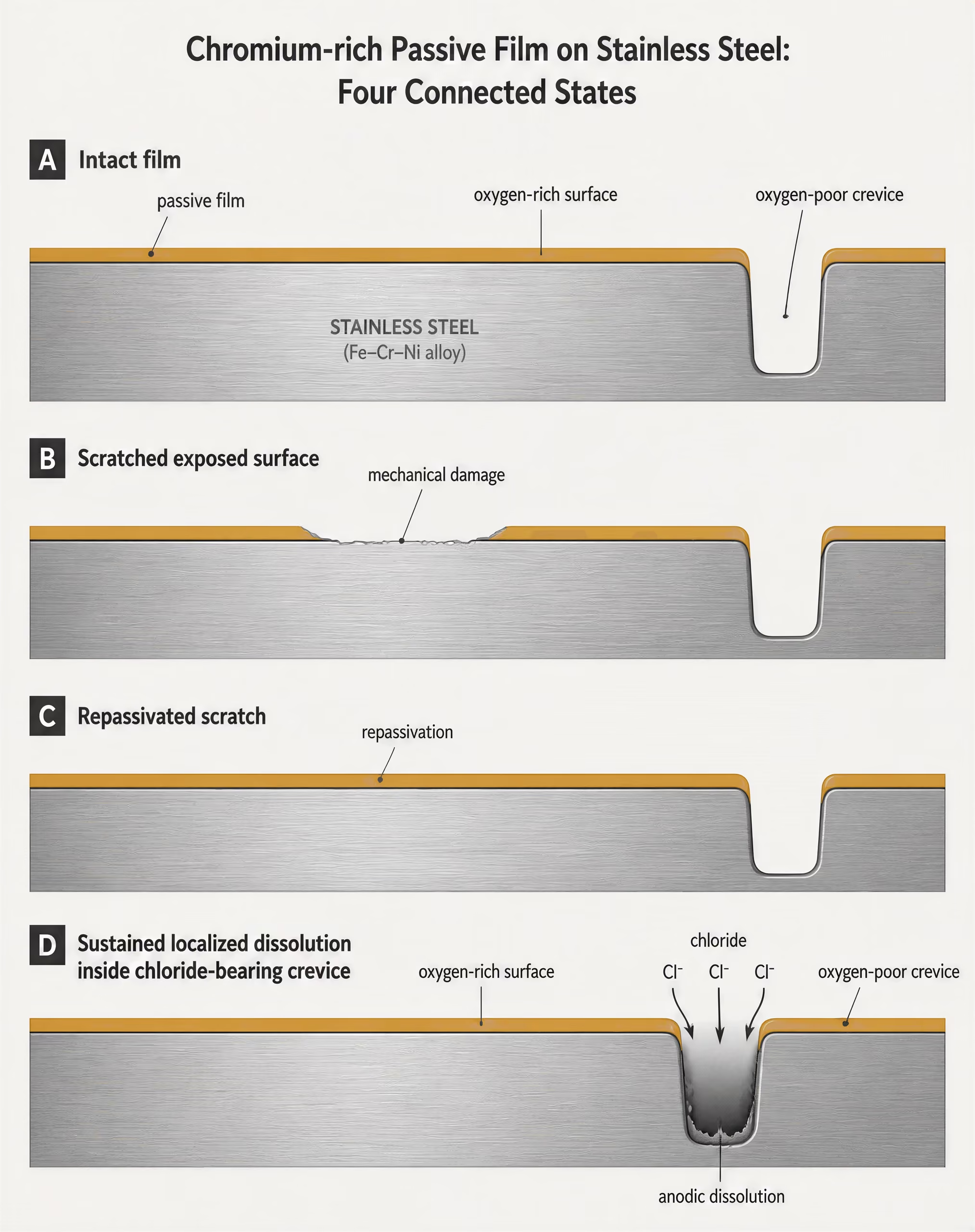
When a stainless alloy containing sufficient chromium is exposed to air or water, chromium at the surface reacts with oxygen and forms an extremely thin oxide-rich film. This passive layer sharply reduces the rate at which iron, chromium and other alloying elements dissolve. It is not a paint coating, and it does not isolate the metal permanently from the environment. The film remains dynamic: it can be damaged mechanically, dissolved locally, or altered by changes in pH, chloride concentration, temperature and electrochemical potential.
Repassivation Re-formation of a protective passive film after local damage when alloy and environmental conditions permit film repair.
A clean surface can often repair the film quickly because the surrounding alloy supplies chromium and the environment supplies oxygen. That repair is more difficult inside a stagnant crevice, beneath deposits, at a rough weld heat tint, or under a contaminant that concentrates chloride. The distinction matters. A scratch across an exposed, well-aerated surface may repassivate, while a small defect in a shielded crevice can become the site of sustained metal dissolution.
Principal corrosion mechanisms
- Pitting Localized passive-film breakdown sustained by chloride-rich chemistry.
- Crevice corrosion Attack in oxygen-depleted gaps, joints and deposits.
- Intergranular corrosion Preferential attack associated with susceptible grain-boundary chemistry.
- Stress-corrosion cracking Cracking requiring tensile stress and specific environmental factors.
- Galvanic corrosion Electrochemical attack caused by coupling dissimilar metals.
- General corrosion Relatively even dissolution across an exposed surface.
Depassivation does not necessarily produce uniform thinning. Stainless steels commonly fail through localized mechanisms. The British Stainless Steel Association lists pitting, crevice corrosion, intergranular corrosion, stress-corrosion cracking, galvanic corrosion and general corrosion among the principal mechanisms affecting stainless steels. Pitting begins when a small passive-film breakdown site becomes an anodic region and chloride ions help sustain dissolution. Crevice corrosion begins where oxygen availability is extremely low, according to BSSA. The resulting chemistry inside the crevice differs from the bulk solution: metal ions hydrolyse, acidity increases, and chloride can migrate into the restricted volume to maintain charge balance.
The ASM Handbook describes crevice corrosion as a coupled process involving electrochemical reactions, homogeneous chemical reactions and mass transport. That description explains why a nominally small design detail can control failure. A bolted lap joint, gasket edge, threaded connection or support contact can restrict oxygen transport and retain solution even when the surrounding surface looks clean. Crevice corrosion is therefore not simply a test of chromium content. It is a reaction system involving the alloy, the crevice dimensions and the solution trapped within it.
Fabrication-related corrosion variables
- Heat tint Can leave a less protective oxide and locally altered surface.
- Embedded iron Can produce rust staining and local electrochemical sites.
- Grinding contamination Can introduce carbon-steel particles or chloride-retaining grooves.
- Weld thermal history Can alter sensitization risk or duplex phase balance.
- Surface deposits Can restrict oxygen and retain concentrated electrolyte.
Fabrication can change the passive-film starting condition. Heat tint, embedded iron, grinding contamination, weld spatter and rough, heat-affected surfaces may reduce local resistance or create sites where deposits remain. Cleaning, pickling or an appropriate mechanical and chemical finishing procedure can restore a more suitable surface, but it cannot compensate for a crevice that continuously concentrates chlorides. Design and fabrication are part of corrosion control.
Why grade names do not predict service behavior alone
| Stainless grade | Common EN designation | Distinguishing feature |
|---|---|---|
| Type 304L | 1.4307 | Low-carbon austenitic grade |
| Type 316L | 1.4404 | Low-carbon, molybdenum-bearing austenitic grade |
| Type 444 | 1.4521 | Molybdenum-bearing ferritic grade |
| Duplex 2205 | 1.4462 | Austenite-ferrite duplex structure |
A grade designation is a chemistry category, not a universal corrosion guarantee. Type 304L, for example, is commonly designated 1.4307 in the EN system, while Type 316L corresponds to 1.4404. Their nominal compositions differ, particularly in molybdenum content, but neither designation states the chloride concentration, temperature, oxygen condition, crevice geometry or applied stress of a component. Those omitted variables can determine whether the passive film survives.
| Evidence level | What it can show | What it cannot establish |
|---|---|---|
| Alloy comparison | Relative resistance under defined conditions | Universal service performance |
| Laboratory test | Performance for a specified solution, specimen and procedure | Service life of every fabricated assembly |
| Component experience | Actual performance in a documented application | Transferability to a different geometry or exposure |
Relative alloy resistance is one level of evidence. Laboratory comparison is another. Actual component performance is a third, and the three should not be treated as interchangeable. A test ranking may show that one alloy resists pitting or crevice corrosion longer than another under the test solution and procedure. It does not establish a service life for a fabricated assembly with welds, deposits and fluctuating temperatures.
PREN Pitting Resistance Equivalent Number, a chemistry-based screening index for relative chloride-pitting resistance; it is not a service-life prediction.[2] Steel grades and PREN expression. International Molybdenum Association. International Molybdenum Association technical guidance.
PREN illustrates both the value and the limit of grade-based comparison. The International Molybdenum Association gives the austenitic and duplex expression as:
PREN = %Cr + 3.3(%Mo + 0.5%W) + 16%N
A higher PREN generally indicates greater relative resistance to chloride-induced pitting in comparable conditions. Limited evidence
A higher calculated value generally indicates greater relative resistance to chloride-induced pitting in comparable conditions. It does not predict the time to failure of a particular component, and it does not fully represent crevice corrosion, welding effects, surface contamination, galvanic coupling or stress-corrosion cracking. Nitrogen, molybdenum and chromium may improve alloy resistance, but a severe crevice can still defeat a high-alloy material.
World Stainless gives PRE values of 19 for 1.4301, 25 for 1.4401 and 1.4521, and 34 for duplex 1.4462 in its 2025 soils-and-concrete guidance. These figures support relative comparisons; they do not mean that 1.4462 will remain corrosion-free in every buried application. The same guidance identifies chloride concentration, soil resistivity and pH as selection factors. World Stainless associates lower selection scores with Type 304/304L, intermediate conditions with Type 316/316L or 444, more severe conditions with Type 317L, and highly aggressive environments with 904L, superduplex and 6% molybdenum alloys. The progression is a screening framework, not a substitute for exposure analysis.
Temperature can be decisive. Pitting and crevice corrosion become more likely as chloride-bearing solutions become hotter, while evaporation can concentrate salts on surfaces that are only intermittently wet. Coastal spray, de-icing salts, acidic condensate and polluted atmospheres produce different risks from clean immersion. An alloy selected for an indoor tank may therefore be unsuitable at an outdoor flange, even when both components contact water.
Mechanism, exposure and design as a single system
System-based selection sequence
- Mechanism Identify whether pitting, crevice corrosion, cracking, galvanic attack or general corrosion controls.
- Exposure Define chloride, temperature, pH, oxygen, deposits, wetting and drying.
- Design Review drainage, joints, crevices, material pairing and stress.
- Fabrication Account for weld heat tint, contamination, heat treatment and surface finish.
Grade selection should begin with the expected mechanism, then connect that mechanism to exposure and component design. The British Stainless Steel Association states that stress-corrosion cracking requires tensile stress together with specific environmental factors. Residual welding stress, forming strain, assembly loads and applied pressure can supply the tensile component; chlorides, temperature and the alloy’s susceptibility supply the environmental component. Increasing chromium alone does not remove that combined risk.
Galvanic corrosion also depends on the assembly rather than one grade in isolation. Electrical contact between stainless steel and a less noble metal, a conductive electrolyte and an unfavorable area ratio can accelerate attack on the smaller anodic member. Insulation, drainage and material pairing may matter as much as changing the stainless grade.[3] Standard Guide for Crevice Corrosion Testing of Iron-Base and Nickel-Base Stainless Alloys in Seawater and Other Chloride-Containing Aqueous Environments. ASTM International. ASTM G78-95, 1995.
ASTM G78-95 provides procedures for identifying conditions likely to cause crevice corrosion and for comparing the relative crevice-corrosion resistance of iron-base and nickel-base stainless alloys in specified chloride-containing aqueous environments. The phrase “specified environments” is central. A result from that method is evidence about a defined exposure and specimen arrangement, not a universal service certificate.
Exposure questions to record
- Chloride How does chloride enter, concentrate and remain on the surface?
- Temperature What normal, upset and local hot-spot temperatures occur?
- Oxygen Where does oxygen access differ across the component?
- Geometry Where are gaskets, lap joints, threads, deposits or support contacts?
- Stress What residual, applied or thermal tensile stresses remain?
- Maintenance Can the surface be drained, cleaned and inspected?
Practical selection therefore asks where water collects, whether deposits dry and re-wet, how chloride enters, what temperatures occur, whether oxygen access differs across the surface, and what stresses remain after fabrication. A coastal structural application may justify 1.4401 or a suitable duplex grade over 1.4301 when de-icing salt or marine deposition is credible, as structural stainless-steel guidance indicates. A sealed crevice may still require redesign, drainage, a different joint detail or a different alloy.
Corrosion resistance is consequently a system outcome. Chemistry sets the potential for passivity; exposure challenges the film; fabrication and stress alter local conditions; design determines whether the environment can be removed or becomes concentrated. Grade selection is sound only when all four are considered together.
The Metallurgy Behind Passivity and Localized Attack
Stainless steel resists corrosion because its surface can form a thin, chromium-rich oxide film. This passive film is only a few nanometres thick, yet it separates the metal from water, dissolved oxygen and aggressive ions. Passivity is not a permanent shield. Chloride can penetrate weak points in the film, and a small damaged area may become anodic while the surrounding passive surface acts as the cathode. The result is localized attack: a pit or crevice that can deepen while the visible surface remains largely unchanged.[4] Corrosion mechanisms in stainless steel. British Stainless Steel Association. BSSA technical library.
The British Stainless Steel Association identifies pitting, crevice corrosion, intergranular corrosion, stress-corrosion cracking, galvanic corrosion and general corrosion as principal mechanisms affecting stainless steels. Each depends on more than nominal grade chemistry. Temperature, chloride concentration, acidity, oxygen supply, deposits, surface roughness, residual stress, weld thermal history and crevice geometry all influence whether passivity survives.
Roles of principal alloying elements
- Chromium
- Promotes formation of the chromium-rich passive film.
- Molybdenum
- Improves resistance to chloride-induced pitting and crevice corrosion.
- Nitrogen
- Contributes to pitting resistance and strengthens austenitic and duplex steels.
- Nickel
- Stabilizes austenite and supports ductility and toughness.
Chromium, molybdenum, nitrogen and nickel
Chromium is the element that gives stainless steel its passive-film-forming capability. In practical stainless grades, chromium promotes an oxide film enriched in chromium compounds, which is more protective than the iron oxides formed on ordinary carbon steel. Increasing chromium generally improves resistance to general corrosion and pitting, but the nominal percentage does not describe the whole surface condition. A heat tint left beside a weld, embedded iron particles, grinding contamination or a rough mechanically damaged surface can create sites where the film is less protective than the bulk composition would suggest.
Molybdenum strengthens resistance to chloride-induced pitting and crevice corrosion. Its effect is particularly important after a pit or crevice has begun to acidify. Local chemistry inside a pit differs sharply from the surrounding solution: metal ions accumulate, hydrolysis lowers pH, and chloride migrates into the active region to maintain charge balance. Molybdenum-bearing alloys generally tolerate this aggressive local chemistry better than comparable chromium-only alloys. That does not make them immune. A stagnant, hot chloride solution in a narrow joint can attack a molybdenum-bearing grade when an open, clean surface in the same solution remains passive.
Nitrogen contributes to pitting resistance and also strengthens austenitic and duplex stainless steels. In duplex grades, nitrogen helps stabilise austenite during processing and supports a controlled balance between austenite and ferrite. Its beneficial effect is reflected in the pitting resistance equivalent number, or PREN, expression used for austenitic and duplex stainless steels by the International Molybdenum Association (IMOA):
PREN = %Cr + 3.3(%Mo + 0.5%W) + 16%N
The coefficient for nitrogen is large, but nitrogen is not simply a substitute for every other alloying element. Its useful concentration is constrained by solubility, phase balance and manufacturing conditions. Excessive or poorly controlled nitrogen can contribute to porosity or unwanted nitride formation, while insufficient nitrogen in a duplex weld can disturb phase balance and reduce localized-corrosion resistance.
Nickel has a different principal function. It stabilizes austenite, supports ductility and toughness, and influences the electrochemical behaviour of the passive surface. Nickel does not enter the IMOA PREN expression, because PREN is aimed primarily at estimating relative resistance to chloride pitting from chromium, molybdenum, tungsten and nitrogen. A nickel-rich alloy may therefore have corrosion properties that are not captured by a simple PREN comparison, especially where reducing acids, caustic solutions or stress-corrosion cracking are involved.
Pitting resistance and PREN
PREN is a useful screening calculation, not a service-life prediction. Higher values indicate greater relative pitting resistance in chloride-bearing environments, provided the grades are compared under relevant and reasonably similar conditions. The number does not describe crevice geometry, weld quality, inclusions, surface finish, chloride activity, temperature or exposure duration. It also says little about resistance to sulfuric acid, formic acid, strong alkalis, erosion-corrosion or chloride stress-corrosion cracking.
World Stainless illustrates the ranking function without presenting it as a universal rule. Its 2025 guidance on soils and concrete gives PRE values of 19 for 1.4301, 25 for 1.4401 and 1.4521, and 34 for duplex 1.4462. The same document stresses that chloride concentration, soil resistivity and pH must be considered for buried applications. A soil with a higher calculated PREN grade can still produce attack if a wet, oxygen-depleted crevice traps chlorides against a contaminated or poorly finished surface.
The practical distinction between pitting and crevice corrosion matters. Pitting begins on an exposed surface after local film breakdown. Crevice corrosion develops in shielded gaps beneath washers, lap joints, deposits, gaskets or poorly drained geometries. The British Stainless Steel Association states that crevice corrosion begins where oxygen availability is extremely low. Within the crevice, oxygen depletion and hydrolysis create conditions that maintain an active anodic zone. The ASM Handbook describes the process as coupled electrochemical reactions, homogeneous chemical reactions and mass transport; material, environment and crevice geometry therefore operate together.
ASTM G78-95 provides procedures for identifying conditions likely to cause crevice corrosion and for comparing the relative crevice-corrosion resistance of iron-base and nickel-base stainless alloys in specified chloride-containing aqueous environments. That qualification is important. A test result obtained for a defined chloride solution, temperature, exposure period and crevice former should not be converted into a universal ranking for every plant, marine structure or buried installation.
World Stainless associates low selection scores with Type 304/304L, intermediate conditions with Type 316/316L or 444, more severe conditions with Type 317L, and highly aggressive environments with grades such as 904L, superduplex and 6% molybdenum alloys. These groupings are selection guidance, not permission to ignore design. Drainage, joint sealing, cleaning, weld finishing and control of thermal exposure can determine whether a grade performs close to its expected resistance.

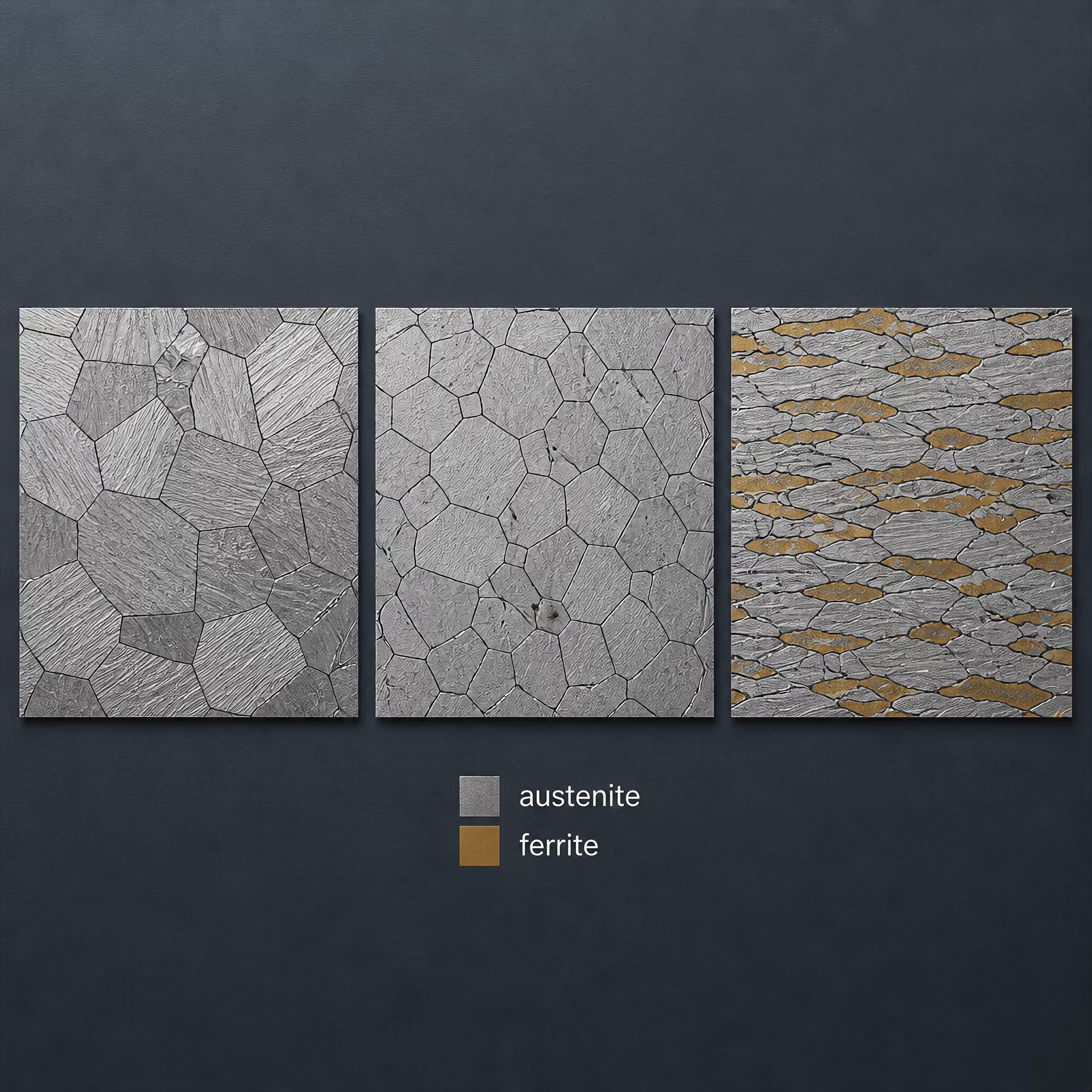
Austenitic, ferritic and duplex microstructures
Austenitic stainless steels, including Type 304/304L and Type 316/316L, have a face-centred cubic austenitic matrix at service temperature. Nickel commonly stabilizes this structure, while chromium, molybdenum and nitrogen modify passivity and strength. Their ductility and toughness are valuable in fabricated equipment, but cold work can create deformation-induced martensite in some compositions. That transformed material may respond differently from the surrounding austenite during localized corrosion or stress-corrosion exposure.
Ferritic stainless steels have a body-centred cubic ferritic matrix and generally contain little or no nickel compared with common austenitic grades. Type 444, for example, combines ferritic structure with meaningful chromium and molybdenum additions. Ferritic grades avoid the strain-induced martensite issue associated with some metastable austenitic steels and have useful resistance to chloride stress-corrosion cracking, but weld thermal cycles, grain coarsening and sensitization risks must still be controlled. Their toughness and fabrication behaviour also depend strongly on composition and section thickness.
Duplex stainless steels contain both ferrite and austenite. Grade 1.4462, commonly designated UNS S31803/S32205 depending on product chemistry and specification, is a widely referenced duplex composition. Its corrosion behaviour depends on phase balance and on keeping chromium, molybdenum and nitrogen available in both phases. Improper solution annealing, slow cooling, or excessive weld heat input can produce chromium nitrides, sigma phase or other intermetallic phases. These consume alloying elements locally and may leave adjacent regions depleted, reducing pitting and intergranular-corrosion resistance even though the bulk analysis remains unchanged.
Inclusions are another local variable. Sulfide inclusions, oxide particles and fabrication debris can interrupt the passive film and act as pit initiation sites. Welding introduces further concerns: heat tint, oxidation, compositional segregation and altered phase balance. Pickling, passivation, suitable shielding gas and removal of embedded iron can restore a more consistent surface, but surface treatment cannot correct an unsuitable crevice design or an alloy exposed beyond its environmental limits.
Stress adds a separate failure route. The British Stainless Steel Association states that stress-corrosion cracking requires tensile stress together with specific environmental factors. Residual welding stress, cold-forming strain and applied load may therefore matter as much as the nominal grade when hot chloride solutions are present. Grade selection must connect chemistry with microstructure, fabrication procedure and service geometry. PREN helps identify relative pitting resistance; it does not replace that engineering assessment.
General Corrosion and Uniform Metal Loss
General corrosion is the relatively even dissolution of metal across an exposed surface. If a stainless-steel wall loses material at approximately the same rate over its wetted area, the result can be estimated as an average thickness-loss rate, often expressed in mm/year. The surface may tarnish, become rough, or lose its original finish, but no sharply defined holes or narrow attack sites dominate the damage.
That mechanism differs from localized corrosion. Pitting removes metal from small areas and can perforate a component while the average thickness remains almost unchanged. Crevice corrosion concentrates attack beneath gaskets, lap joints, deposits and fastener heads. Intergranular corrosion follows susceptible grain boundaries, while stress-corrosion cracking can produce cracks with little general metal loss. The British Stainless Steel Association lists pitting, crevice, intergranular, stress-corrosion cracking, galvanic, and general corrosion as principal mechanisms affecting stainless steels. Grade selection therefore cannot be based on a single “corrosion resistance” label.
Stainless steels resist general corrosion because chromium supports a thin passive oxide film. That film is not a permanent shield. Acidity, reducing conditions, halide ions, temperature, contamination, weld heat input, surface deposits and stagnant solution can prevent repassivation or increase the rate at which metal dissolves. Outokumpu’s corrosion guidance treats alloy chemistry and service conditions as linked variables: chromium, nickel, molybdenum, nitrogen and copper alter passivity and acid resistance, but the surrounding solution determines whether those advantages remain effective.
Acidic and alkaline exposure
Acid service must be described by more than pH. Sulfuric acid, hydrochloric acid, nitric acid, phosphoric acid and organic acids produce different reactions with stainless steel. A low-pH solution containing an oxidizing species may support passivation, whereas a less oxidizing acid can dissolve the passive film and produce rapid general attack. Hydrochloric acid is particularly difficult because chloride can destabilize the film and promote localized corrosion even when the average dissolution rate appears modest.
The acid concentration can change the mechanism as well as the rate. Stainless steel may tolerate a dilute oxidizing acid but attack rapidly at an intermediate concentration, then behave differently again at a very high concentration because conductivity, water activity and reaction products have changed. Sulfuric acid is a standard example: alloy performance depends strongly on concentration, temperature, aeration and impurities such as chlorides or fluorides. A table entry for “sulfuric acid” without those details is not a service prediction.
Austenitic grades such as Type 304L and Type 316L are not interchangeable in acid duty. Type 316L, corresponding to UNS S31603 and commonly designated 1.4404, contains molybdenum for improved resistance to chloride-assisted localized attack, but molybdenum does not make it universally resistant to reducing acids. Higher-alloy grades, including 904L, may be considered where sulfuric or mixed-acid conditions demand greater resistance, but their suitability still depends on concentration and temperature.
Alkaline solutions usually present less risk of general corrosion than strong acids, yet “alkaline” does not mean harmless. Concentrated caustic soda or potash at elevated temperature can cause general dissolution, caustic cracking, or other forms of environmentally assisted damage. Austenitic stainless steels can also suffer stress-corrosion cracking in hot concentrated alkaline environments when tensile stress is present. The BSSA states that stress-corrosion cracking requires tensile stress together with specific environmental factors; removing residual or applied stress may therefore matter as much as changing grade.
Ferritic and duplex grades require separate assessment. Their chromium content can support passivity in many alkaline services, while their lower nickel content changes phase balance and response to fabrication. Welded areas, heat-affected zones and carbon contamination can have different behavior from the parent plate. ESDEP selection guidance consequently treats fabrication condition, design details and inspection as parts of corrosion control rather than as matters separate from grade choice.
Chemical concentration and temperature effects
Concentration and temperature act together. Raising temperature usually accelerates electrochemical reactions, increases diffusion and shortens the time required for a defect to become significant. It can also reduce oxygen solubility and change the stability of the passive film. A grade that performs satisfactorily in a cool, intermittently wetted solution may experience rapid attack in the same chemistry held continuously at 80 °C.
Exposure duration is equally important. A short laboratory contact may show an acceptable surface, while months of evaporation and replenishment can concentrate chlorides beneath a deposit. Repeated wetting and drying leaves salt residues; an apparently mild bulk solution can therefore create a severe local environment at a gasket, support or weld. General corrosion rates measured under fully immersed conditions may not represent these cycles.
Chemical analysis should identify the principal species and their ranges: chloride in mg/L or mass fraction, acid concentration, pH, oxidizing agents, dissolved oxygen, fluorides, sulfur compounds and contaminants. It should also state temperature range, pressure, flow velocity, residence time, wetting pattern, cleaning chemicals and shutdown conditions. “Corrosive water” is not an adequate specification.
PREN illustrates why composition is useful but limited. The International Molybdenum Association gives the austenitic and duplex expression as “PREN = %Cr + 3.3(%Mo + 0.5%W) + 16%N.” A higher value indicates greater relative pitting resistance in chloride-bearing environments; it does not calculate a uniform corrosion rate, predict cracking, or establish a service life. Fabrication, crevice geometry and temperature can overturn a simple ranking.
Using corrosion tables without overreading them
Corrosion tables are screening tools, not guarantees. Outokumpu tables and ESDEP guidance are useful when the alloy, solution chemistry and temperature match the published conditions. A rating such as “good,” “limited,” or “not recommended” normally compresses test data and operating experience into a broad category. It may not include welds, surface deposits, chloride concentration peaks, aeration changes or prolonged exposure.
World Stainless illustrates the relative nature of grade comparisons in soils and concrete. Its 2025 guidance gives PRE values of 19 for 1.4301, 25 for 1.4401 and 1.4521, and 34 for duplex 1.4462, while emphasizing chloride concentration, soil resistivity and pH for buried applications. The same source associates low selection scores with Type 304/304L, intermediate conditions with Type 316/316L or 444, more severe conditions with Type 317L, and highly aggressive environments with 904L, superduplex and 6% molybdenum alloys. These are selection directions, not universal thresholds.
For coastal or de-icing-salt exposure, the structural stainless-steel design guidance identifies 1.4401 or suitable duplex grades as preferable to 1.4301 because chloride deposition and wetting make localized attack more likely. ASTM G78-95, issued in 1995, provides procedures for identifying conditions likely to cause crevice corrosion and comparing stainless alloys in specified chloride-containing aqueous environments. That wording matters: the test applies to defined conditions.
A defensible table-based decision records the exact grade designation, product form, heat treatment, weld condition, solution composition, concentration, temperature and exposure duration. It then checks whether the dominant risk is uniform corrosion or a localized mechanism. Without that information, “stainless steel is resistant” says too little to support design.
Pitting Corrosion in Chloride-Bearing Environments
Pit initiation and propagation
Pitting is a localized form of corrosion in which a normally protective passive film breaks down at small surface sites. Stainless steel remains passive because chromium-rich oxide forms rapidly in air or water, but that film is not an unchanging barrier. A chloride ion can adsorb at a weak point, a machining mark, a sulfide inclusion, a weld-related surface defect, or a deposit beneath which the surface chemistry differs from the surrounding metal. Once the film fails locally, metal dissolves from a very small anodic area while the surrounding passive surface acts as a large cathode.
The resulting pit can be microscopic at first and still create a serious engineering problem. Dissolved metal ions hydrolyse in the pit, producing acidity. Chloride ions migrate into the pit to maintain charge balance and form soluble metal-chloride species. The pit therefore becomes more acidic and chloride-rich than the bulk solution. This is an autocatalytic process: the chemistry created by the first dissolution makes repassivation less likely and accelerates further dissolution. A pit may grow downward beneath an apparently intact surface, so visual inspection can underestimate the remaining wall thickness.
Pit initiation and pit propagation are related but distinct events. A surface may experience a brief film rupture and repassivate without measurable damage. Propagation begins when the local electrochemical conditions remain sufficiently aggressive to sustain the acidic, chloride-concentrated environment. Temperature, potential, surface condition and mass transport all affect that transition. The critical pitting temperature, often determined by a standardized test method, is therefore a comparative test result rather than a fixed operating threshold for every component.
Geometry can turn a small pit into a wider corrosion problem. Gaskets, lap joints, deposits, weld attachments and threaded connections retain chloride solution and restrict oxygen transport. The British Stainless Steel Association identifies crevice corrosion as a principal stainless-steel corrosion mechanism and states that it begins where oxygen availability is extremely low. A crevice can thus support differential aeration, acidification and chloride concentration even when the exposed surface outside the crevice remains bright. ASTM G78-95 provides procedures for identifying conditions likely to cause crevice corrosion and for comparing relative crevice-corrosion resistance among iron-base and nickel-base stainless alloys in specified chloride-containing aqueous environments. Its results do not remove the need to assess the actual joint design.
The distinction matters during inspection and failure analysis. A component may show isolated pits, broad crevice attack, or both. Stainless-steel corrosion is not limited to pitting: the British Stainless Steel Association also lists intergranular corrosion, stress-corrosion cracking, galvanic corrosion and general corrosion among the principal mechanisms. Stress-corrosion cracking, for example, requires tensile stress together with specific environmental factors; a higher pitting-resistance value does not by itself rule out cracking.
Chloride, temperature, acidity and oxidizing conditions
Chloride is the most familiar trigger because it penetrates or destabilizes passive films and concentrates readily in evaporation zones, crevices and surface deposits. Seawater, de-icing salt, brine, chlorinated process water, cleaning residues and contaminated concrete can all supply chloride. Bulk chloride concentration is only one part of the exposure. A wet-dry cycle can leave salt behind as water evaporates, while a poorly drained horizontal surface can maintain a concentrated electrolyte for long periods. World Stainless guidance for buried stainless steel specifically calls for consideration of chloride concentration, soil resistivity and pH, rather than treating soil exposure as a single category.
Temperature generally increases the rate of electrochemical reactions and reduces the margin against pit initiation. A grade that remains passive in cool, clean water may pit in the same nominal chloride concentration at a higher temperature. Heat also increases evaporation and can concentrate salts around waterlines, insulation edges and equipment roofs. For this reason, a stated chloride value without temperature and wetting history has limited predictive value.
Pitting risk depends on interacting exposure variables rather than chloride concentration alone. Strong evidence
Acidity makes local film repair more difficult and promotes metal dissolution once a pit has formed. Low pH may arise from the process fluid itself, acidic condensate, hydrolysis inside a pit, or pollutants deposited on a surface. Pollutants matter even when they are present in small amounts: sulfides, industrial fumes, dust, marine deposits and residues from fabrication or cleaning can retain moisture or alter local chemistry. The structural stainless-steel design manual identifies chloride content, temperature, pollutants, acidity, oxidizing agents and oxygen as factors affecting pitting. These variables interact rather than act as independent switches.
Oxidizing conditions require careful interpretation. An oxidizing solution can raise the corrosion potential into a range where passive-film breakdown is more likely, particularly in the presence of chloride. Dissolved oxygen also supports the cathodic reaction needed for corrosion outside an active pit and creates oxygen-concentration differences around deposits and crevices. Yet a completely oxygen-starved crevice behaves differently from an exposed surface: restricted oxygen access can destroy the normal passive condition inside the crevice while the outside surface remains cathodic. Chlorine-containing oxidants, ferric ions and other strong oxidizing species can be especially demanding. Water chemistry, flow, deposits and component geometry determine their effect.
Fabrication adds another set of variables. Heat tint on a weld can contain a chromium-depleted or poorly protective oxide layer; embedded iron from carbon-steel tools can create rust stains and local galvanic sites; rough grinding marks can retain chloride. Pickling, passivation, clean handling and removal of weld contamination are corrosion-control measures, not cosmetic treatments. Design has equal importance. Drainage, cleanable surfaces, avoidance of stagnant pockets and properly compressed seals reduce the local concentration effects that initiate attack.
Why pitting resistance is not the same as immunity
The Pitting Resistance Equivalent Number, or PREN, is a useful way to compare alloy chemistry for chloride-bearing service. The International Molybdenum Association gives the austenitic and duplex expression as:
PREN = %Cr + 3.3(%Mo + 0.5%W) + 16%N
Chromium supports passivity, molybdenum improves resistance to localized breakdown and repassivation, and nitrogen contributes strongly to the calculated value. The number is practical for screening grades, but it is not a service-life prediction. Different product forms, heat treatments, surface finishes, weld zones, inclusions, temperatures, chloride activities and test methods can produce different performance from alloys with similar calculated PREN. The expression also does not describe crevice geometry, residual stress, deposits or maintenance.
World Stainless gives indicative PRE values of 19 for EN 1.4301, 25 for EN 1.4401 and EN 1.4521, and 34 for duplex EN 1.4462 in its 2025 soils-and-concrete guidance. Those values show the effect of alloy chemistry in a clear comparative way. EN 1.4301, commonly associated with Type 304, contains no deliberate molybdenum addition and has a lower calculated resistance to chloride pitting than EN 1.4401, commonly associated with Type 316, which contains molybdenum. EN 1.4521, commonly associated with Type 444, reaches the cited value through its chromium, molybdenum and nitrogen balance. Duplex EN 1.4462 combines substantial chromium and molybdenum with nitrogen and has the highest of these four indicative values.
The comparison does not mean that EN 1.4462 cannot pit, that EN 1.4301 will always fail, or that EN 1.4521 and EN 1.4401 will behave identically in every fabrication condition. World Stainless associates Type 304/304L with low selection scores, Type 316/316L or 444 with intermediate conditions, Type 317L with more severe conditions, and grades such as 904L, superduplex and 6% molybdenum alloys with highly aggressive environments. This is a selection framework, not a universal boundary between safe and unsafe chloride concentrations.
Service design must therefore combine PREN with exposure and construction details. Coastal splash zones, de-icing salt, warm chloride solutions and stagnant joints usually deserve more scrutiny than their average water analysis suggests. The structural stainless-steel manual notes that EN 1.4401 or suitable duplex grades should be preferred over EN 1.4301 for coastal or de-icing-salt exposure, but the final choice still depends on temperature, acidity, pollutants, oxygen access, surface condition, welding and drainage. Pitting resistance is a margin against one failure mechanism. It is not immunity.
Crevice Corrosion: Geometry Can Defeat a Suitable Alloy
A stainless-steel grade can resist open-surface corrosion while suffering severe attack inside a narrow, wet crevice. The contradiction is only apparent. Corrosion resistance is measured at the exposed surface, but a crevice creates a separate electrochemical environment whose chemistry changes as the attack develops. Alloy selection still matters, particularly through chromium, molybdenum and nitrogen content, but geometry, wetting, temperature, chlorides, deposits, fabrication condition and drainage can determine whether the passive film remains stable.
The British Stainless Steel Association (BSSA) identifies pitting, crevice corrosion, intergranular corrosion, stress-corrosion cracking, galvanic corrosion and general corrosion as principal mechanisms affecting stainless steels. Its explanation of crevice corrosion is direct: initiation occurs where oxygen availability is extremely low. That makes a shielded region more than a poorly ventilated version of the exposed surface. It becomes a different chemical reactor.

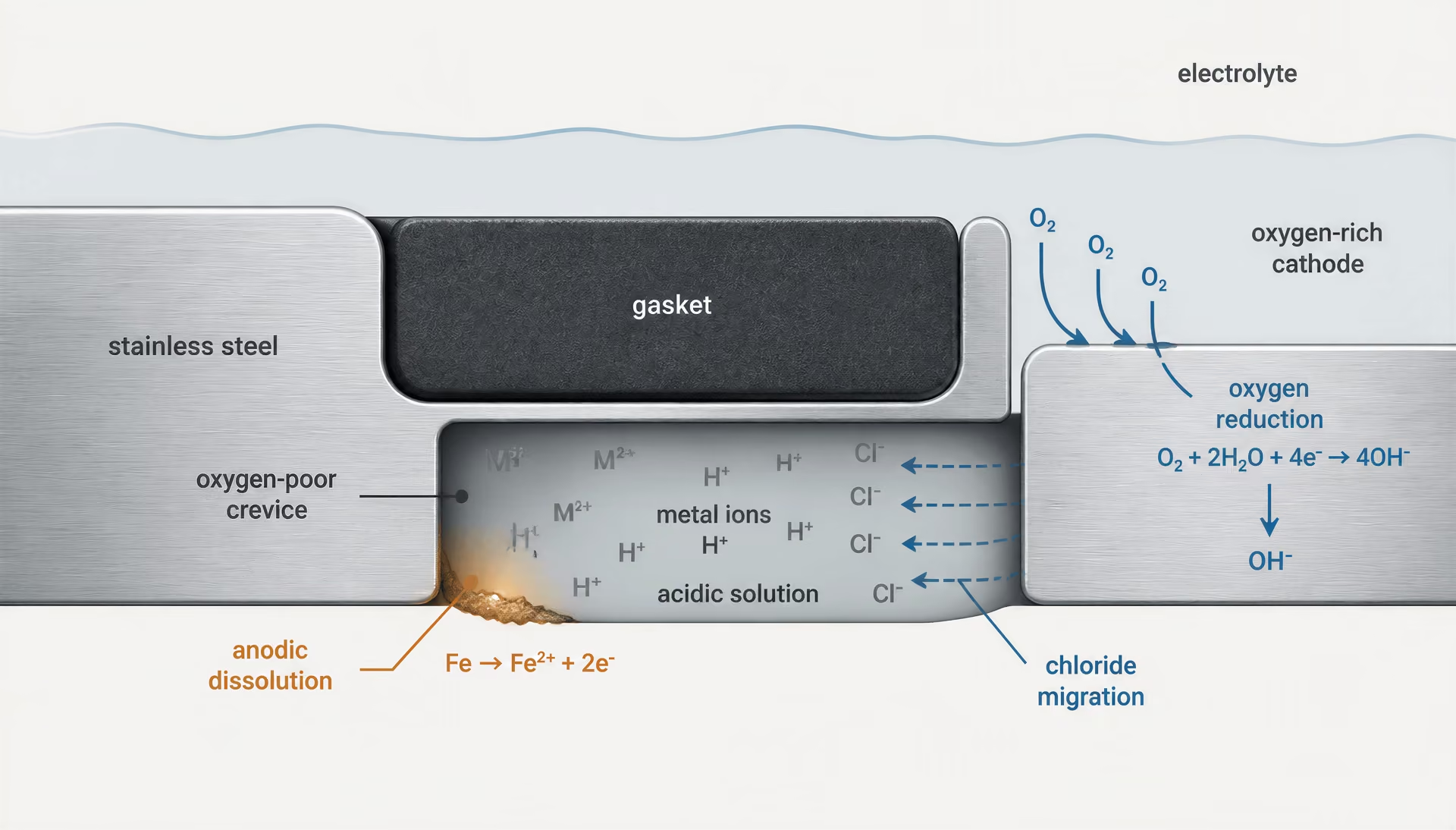
Oxygen depletion and chemistry inside a crevice
A crevice usually starts as a narrow region containing a thin film of electrolyte. Oxygen dissolved in that liquid is consumed by the cathodic reaction on the metal surface:
At the mouth and on the surrounding exposed surface, oxygen can be replenished from the atmosphere or flowing liquid. At the closed end, diffusion is slow. The cathodic reaction therefore consumes oxygen faster than mass transport can replace it. The crevice becomes oxygen-poor, while the outside surface remains comparatively oxygen-rich.
Differential-aeration cell An electrochemical cell formed when areas of the same metal receive different oxygen supplies, commonly making the oxygen-poor area anodic.
This difference establishes a differential-aeration cell. The oxygen-starved area supports less cathodic reaction and becomes anodic relative to the exposed surface. Iron, chromium and nickel dissolve at the anodic site:
The released metal ions hydrolyse in the confined electrolyte. For example, ferric and ferrous species can participate in reactions that generate hydrogen ions, lowering pH. Chloride ions migrate into the crevice to maintain electrical neutrality as positively charged metal ions accumulate. The resulting solution can be acidic and chloride-rich, conditions that destabilise the chromium-rich passive film. Once local dissolution begins, the damaged region admits more current, produces more metal ions and becomes still more aggressive.
The ASM description treats crevice corrosion as a coupled process involving electrochemical reactions, homogeneous chemical reactions and mass transport. That distinction matters. The electrochemical reactions create dissolved species; hydrolysis and other chemical reactions alter acidity and speciation; diffusion, migration and convection determine what enters or leaves the crevice. A calculation based only on bulk chloride concentration misses this feedback. The liquid outside may contain a modest chloride level, yet the liquid inside a stagnant crevice can become substantially more acidic and concentrated.
Stagnation also changes temperature and evaporation effects. A warm surface accelerates reaction kinetics and reduces the oxygen solubility of water. During drying, dissolved salts become concentrated; during rewetting, the concentrated brine can contact a surface that has not fully repassivated. Repeated wet-dry cycling is especially consequential beneath deposits and horizontal joints. It can produce several short, aggressive exposures rather than one steady exposure represented by a bulk-water test.
The grade sets the probability and rate of passive-film breakdown, not a guaranteed life for every geometry. The International Molybdenum Association gives the commonly used austenitic and duplex expression:
PREN is useful for screening relative localized-corrosion resistance but does not predict component service life. Limited evidence
A higher PREN generally indicates greater relative resistance to pitting and crevice initiation in chloride-bearing environments, but PREN does not describe crevice width, deposit chemistry, fabrication defects, temperature or propagation after initiation. It is a comparison aid, not a service-life equation.
Bolted joints, gaskets, deposits and lap joints
Bolted connections create several possible crevices at once: beneath a washer, between faying surfaces, under a bolt head, around threads and at the edge of a clamped plate. Tightness is not a single material property. A joint may be tightly clamped at assembly but contain roughness valleys, incomplete contact, distortion or a narrow path that retains electrolyte. A very narrow gap can restrict oxygen transport and create strong concentration gradients. A wider gap may drain more readily, but its behaviour depends on orientation, surface roughness and whether liquid can circulate.
Gaskets can either reduce exposure or create the most severe local condition. A continuous, chemically compatible gasket may exclude water from the joint. A discontinuous, damaged or poorly compressed gasket can trap chloride-bearing liquid around its edge. Organic gasket materials may absorb water, swell, shrink or degrade, changing contact pressure during service. The critical region is often not the centre of the gasket but the wet perimeter where oxygen supply is limited and evaporation concentrates contaminants.
Deposits act as artificial crevice formers. Road salt, marine aerosol, process solids, corrosion products, weld spatter and biological films can shield the metal from oxygen while retaining moisture. A stainless surface that is clean and freely drained may remain passive, then develop local attack after a deposit forms. The deposit need not be thick. Its ability to hold a persistent electrolyte and block replenishment of oxygen is more important than its visual size.
Lap joints are particularly sensitive because their overlapping sheets may contain long, narrow, poorly drained interfaces. Seal welding can remove the internal electrolyte path, provided the weld is continuous and the welding procedure does not leave unacceptable contamination or heat-affected damage. Intermittent welds can leave unsealed pockets at the ends of laps. The joint may look closed from outside while allowing capillary ingress of water.
Design therefore has to address the crevice itself, not merely specify a more corrosion-resistant grade. Continuous drainage, downward-facing ledges, accessible cleaning surfaces and avoidance of horizontal liquid traps reduce exposure. Joint edges should not create blind pockets. Where bolting is necessary, washers, sealants, gasket details and clamp loads need evaluation as a system. Welded details require suitable cleaning and removal of heat tint because a damaged or contaminated passive surface can provide an easier initiation site.
The same principle applies to grade selection. World Stainless associates lower selection scores with Type 304/304L, intermediate conditions with Type 316/316L or 444, more severe conditions with Type 317L, and highly aggressive environments with grades such as 904L, superduplex and 6% molybdenum alloys. Those associations cannot rescue a badly designed crevice. A poorly drained Type 316L joint can fail where a freely exposed Type 304L surface would not. Conversely, increasing alloy resistance may be necessary when the crevice cannot be eliminated.
For buried stainless steel, World Stainless lists chloride concentration, soil resistivity and pH as relevant selection factors. Its 2025 soils-and-concrete guidance gives PRE values of 19 for 1.4301, 25 for 1.4401 and 1.4521, and 34 for duplex 1.4462. These figures help compare alloy families, but a buried lap, contaminated sleeve or compacted low-resistivity pocket can impose a local condition more severe than the nominal soil classification.
ASTM G78 testing and interpretation
ASTM G78-95 is a comparative laboratory method, not a universal field-life prediction. ASTM International describes it as providing procedures for identifying conditions likely to cause crevice corrosion and for comparing the relative crevice-corrosion resistance of iron-base and nickel-base stainless alloys in specified chloride-containing aqueous environments. The qualification “specified” controls the interpretation. Results belong to the tested alloy, surface condition, crevice former, chloride solution, temperature, exposure duration and examination method.
The method is useful when the engineering question is comparative: under a defined chloride-containing exposure and a defined crevice assembly, does one alloy show fewer or shallower crevice attacks than another? Such testing can reveal a ranking that open-immersion corrosion rates would conceal. It can also show whether a proposed alloy remains susceptible when a standardised crevice former maintains a shielded contact.
A test result should not be translated directly into “this joint will last X years.” Field crevices vary in contact pressure, width, depth, roughness and cleanliness. They also experience changing chloride concentration, temperature, oxygen supply, loading and wet-dry cycling. A gasket that behaves one way in a laboratory fixture may shrink in service; a deposit may accumulate gradually; a bolted joint may be disturbed by thermal expansion or vibration.
Interpretation must also separate initiation from propagation. A small stain, a superficial pit and deep under-gasket penetration are not equivalent observations. Examination should record attack location, number, depth and relation to the crevice geometry, while preserving the surface condition and exposure history. Repeated comparative tests can support a grade decision, but they do not remove the need to design out stagnant pockets.
Stress adds another failure route. BSSA states that stress-corrosion cracking requires tensile stress together with specific environmental factors. A crevice can provide the aggressive chemistry while residual stress from cold forming, welding, bolt preload or service loading supplies the mechanical condition. Crevice control and stress assessment must therefore be considered together, especially in warm chloride service. Geometry can defeat a suitable alloy; disciplined design decides whether that geometry is allowed to exist.
Galvanic Corrosion and Dissimilar-Metal Assemblies
Galvanic corrosion is not a fixed property of stainless steel. It is an electrochemical interaction between two electrically connected metals exposed to the same electrolyte. One metal becomes the anode, where metal dissolves, while the other supports the cathodic reaction, commonly oxygen reduction. The electrolyte carries ionic current; the metal-to-metal connection carries electronic current. Remove either path and the galvanic cell cannot sustain corrosion.
The practical mistake is to label one material universally “noble” and another universally “active.” Stainless steel can act as the cathode in one assembly and the anode in another. Its position depends on alloy composition, surface condition, passivation, oxygen supply, chloride concentration, temperature, flow, deposits and the potential of the mating metal. Uhlig’s Corrosion Handbook treats galvanic corrosion as a system problem governed by the coupled potentials and polarization behaviour of the metals in their actual environment, not simply by their positions in a nominal galvanic series.
Potential differences and galvanic coupling
When stainless steel is coupled to carbon steel in aerated, conductive water, the stainless surface commonly behaves as the more cathodic member and the carbon steel becomes the anode. Carbon steel dissolution can then accelerate near the joint, particularly where the exposed carbon-steel area is small and the stainless-steel area is large. The stainless steel may show little visible attack while protecting the wrong component at its own expense.
The reverse arrangement is also possible. A passive stainless surface can become anodic relative to a more noble material under particular conditions, especially if the stainless passive film is damaged, chemically destabilized or confined in a chloride-bearing crevice. Copper alloys, titanium and graphite are frequent examples of materials that can create demanding galvanic conditions for stainless components, although the actual result depends on water chemistry and surface state. A stainless fastener in a large copper-alloy fitting is not automatically safe because the fastener is “stainless”; the assembly must be assessed as a coupled electrochemical system.
BSSA lists galvanic corrosion alongside pitting, crevice corrosion, intergranular corrosion, stress-corrosion cracking and general corrosion as principal mechanisms affecting stainless steels. These mechanisms can overlap. A galvanic couple may increase the cathodic current on stainless steel while a crevice beside the joint becomes oxygen-starved. BSSA states that crevice corrosion begins where oxygen availability is extremely low. The resulting acidification and chloride concentration inside the crevice can depassivate stainless steel, even when the openly exposed surface remains passive.
Electrical continuity is essential. Two metals separated by a nonconductive coating, gasket or oxide layer may have little galvanic interaction until the barrier is punctured or bypassed by a fastener. Conversely, a small metallic contact can sustain a large current if the surrounding electrolyte provides a continuous, conductive path. A dry joint is not an active galvanic cell; a wet joint connected by salt-contaminated water may be.
Area ratio and electrolyte continuity
| Assembly arrangement | Likely concern | Preferred control |
|---|---|---|
| Small carbon-steel area coupled to large stainless area | High anodic current density on carbon steel | Increase anodic area, isolate or change material pairing |
| Small stainless fastener coupled to large carbon-steel plate | Potentially lower stainless attack but coupling remains exposure-dependent | Drain, isolate and assess coating defects |
| Dissimilar metals in salt water | Galvanic current through conductive electrolyte | Break electrical continuity and prevent water bridging |
The cathode-to-anode area ratio often determines whether galvanic damage is tolerable or severe. A large cathodic surface can drive a substantial total cathodic reaction while the anodic current is concentrated on a small area. That produces high local current density and rapid attack at the anode. A small stainless-steel bolt coupled to a large carbon-steel plate is usually less concerning than a small carbon-steel bolt coupled to a large stainless-steel plate, although neither arrangement should be accepted without considering the electrolyte and joint details.
The ratio must be evaluated as the actively wetted area, not merely the manufactured surface area. A painted carbon-steel plate may have only a small exposed defect, while an uncoated stainless washer remains fully wet. Coatings can therefore change the effective ratio, and a damaged coating may concentrate attack at its holiday. Painting the cathode can reduce the driving current, whereas coating only the anode can create a small exposed anodic defect surrounded by a large cathodic area. This is a common design trap.
Electrolyte continuity depends on more than whether water is present. Conductivity rises with dissolved salts, including chlorides, and a thin salt film can connect metals that appear separated under dry conditions. Intermittent wetting may be more damaging than continuous immersion because evaporation leaves concentrated deposits, followed by renewed wetting. Temperature affects reaction rates and oxygen transport. Flow can remove corrosion products and alter polarization, while stagnant water permits deposits and concentration cells to develop.
Crevices deserve particular attention. A washer underside, threaded joint, lap seam or poorly drained support can retain electrolyte after the surrounding surface dries. Oxygen depletion inside the gap creates a differential-aeration cell, and the confined solution may become more acidic and chloride-rich. The ASM Handbook describes crevice corrosion as a coupled process involving electrochemical reactions, homogeneous chemical reactions and mass transport; geometry, material and environment all control the result. ASTM G78-95 provides procedures for identifying conditions likely to cause crevice corrosion and comparing relative crevice-corrosion resistance of iron-base and nickel-base stainless alloys in specified chloride-containing aqueous environments. A galvanic calculation that ignores the crevice can therefore give false confidence.
Isolation, drainage and compatible material selection
The first design measure is often geometric rather than metallurgical: prevent water from remaining at the dissimilar-metal junction. Orient horizontal surfaces to drain, seal or eliminate lap joints, avoid cup-shaped washers, and provide access for inspection and cleaning. A sealed joint can be preferable to a joint that repeatedly traps and evaporates chloride-bearing water, but sealants must remain compatible with the service temperature, chemicals and movement. Poorly applied sealant can create a hidden crevice rather than remove one.
Electrical isolation can interrupt galvanic current. Nonconductive sleeves, washers, bushings and gaskets are useful only when they remain intact during assembly and service. The isolation system must also prevent water from bridging around the barrier. Fastener holes, sharp edges and damaged coatings require attention because a single metallic bypass can reconnect the couple. Isolation should be verified after installation, not assumed from the presence of a plastic washer.
Material selection still matters. The mating materials should have compatible corrosion potentials in the actual electrolyte, and the design should avoid a small anodic area coupled to a large cathodic area. For coastal exposure or de-icing salt, the structural stainless-steel design guidance identifies Type 316/316L, corresponding to EN 1.4401/1.4404 where applicable, or suitable duplex grades as preferable to Type 304/304L, corresponding to EN 1.4301/1.4307. This recommendation addresses chloride-driven localized corrosion as well as the galvanic consequences of a damaged passive surface.
Grade metrics do not replace assembly assessment. The International Molybdenum Association gives the austenitic and duplex expression “PREN = %Cr + 3.3(%Mo + 0.5%W) + 16%N”; a higher value indicates greater relative pitting resistance in chloride-bearing environments, not immunity from galvanic or crevice attack. World Stainless reports PRE values of 19 for 1.4301, 25 for 1.4401 and 1.4521, and 34 for duplex 1.4462, while stressing chloride concentration, soil resistivity and pH for buried service. Those figures can inform grade selection, but drainage, isolation, area ratio and electrical continuity determine whether the selected grade will remain a safe part of the assembled system.
Intergranular Corrosion and Sensitization
Intergranular corrosion is preferential attack along or beside grain boundaries because the local chemistry at those boundaries differs from the chemistry within the grains. The mechanism is not simply “corrosion of the grain boundary.” A stainless steel may remain passive across most of its surface while narrow regions adjacent to boundaries become anodic and dissolve. Sensitization is the metallurgical condition that makes this possible, usually after exposure to a temperature range that permits chromium carbide precipitation.
Chromium-depleted zones at grain boundaries
In austenitic stainless steels, carbon can react with chromium during thermal exposure to form chromium-rich carbides, commonly described as , with chromium as the principal metallic constituent. These carbides precipitate preferentially at grain boundaries because diffusion and nucleation are favorable there. Chromium is drawn from the surrounding solid solution, leaving a narrow chromium-depleted zone on each side of the boundary.
The carbide itself is not usually the principal source of rapid attack. The adjacent depleted zone is. If its chromium concentration falls sufficiently, it cannot restore a stable chromium-oxide passive film as quickly as the surrounding material. An electrolyte can then attack the boundary region, producing a network-like corrosion path through the affected microstructure. In severe cases, grains become physically separated from the matrix.
Sensitization depends on more than peak temperature. Time at temperature, carbon content, prior cold work, grain size, alloy composition and cooling rate all influence carbide precipitation. Austenitic grades may become susceptible after exposure roughly within the 500–850 °C range, although the precise time-temperature response varies by heat and product form. A short excursion through this range may have little consequence in a thin component, while a slower thermal cycle or repeated heating can produce a substantial sensitized zone.
This mechanism must be separated from pitting and crevice corrosion. Pitting is a highly localized breakdown of passivity, often associated with chloride ions. Crevice corrosion is controlled strongly by restricted geometry and oxygen depletion; the British Stainless Steel Association states that crevice corrosion begins where oxygen availability is extremely low. Intergranular corrosion instead follows a metallurgical path created by grain-boundary chemistry. The mechanisms can coexist, particularly in welded chloride service, but they are not interchangeable explanations.
Weld thermal cycles and stabilization
Welding is a common source of sensitization because the heat-affected zone (HAZ) experiences a moving thermal cycle rather than a uniform furnace treatment. Material immediately beside the fusion boundary may enter the carbide-precipitation range during heating and then cool slowly enough for precipitation to continue. The affected band can be narrow, irregular and different on opposite sides of a joint. Thick sections, high restraint and large weld beads generally increase heat retention, but the actual risk depends on interpass temperature, bead sequence, joint design, ambient conditions and the thermal conductivity of the assembly.
High heat input does not automatically produce intergranular corrosion, and low heat input does not guarantee immunity. Heat input affects the peak temperature and the time spent at elevated temperature, while cooling history determines whether carbide precipitation has time to develop. Multiple-pass welding can reheat material that was previously unaffected or partially sensitized. A repair weld may therefore create a second thermal cycle in an already altered HAZ.
Low-carbon grades reduce this risk by reducing the carbon available for carbide formation. Type 304L, commonly designated UNS S30403, and Type 316L, commonly designated UNS S31603, contain a maximum carbon level of 0.030% under the relevant product specifications, compared with 0.08% for the conventional Type 304 and Type 316 limits in many specifications. The lower carbon content permits more practical welding without subsequent solution annealing, particularly in thin and moderate-section fabrications.
The “L” designation is not a universal corrosion guarantee. It addresses sensitization risk associated with carbon precipitation; it does not prevent chloride pitting, crevice corrosion, galvanic attack, erosion-corrosion or stress-corrosion cracking. The BSSA identifies tensile stress combined with specific environmental factors as necessary for stress-corrosion cracking. A welded Type 316L vessel can therefore avoid intergranular attack yet fail by chloride-induced cracking or crevice corrosion if the design and service environment permit those mechanisms.
Stabilized grades use elements with a stronger affinity for carbon than chromium has. Type 321 contains titanium, while Type 347 contains niobium (columbium); these elements preferentially form stable carbides and reduce chromium carbide precipitation. Their performance still depends on the product’s thermal history and fabrication practice. Stabilization is not a substitute for sound welding control, and excessive or unusual thermal exposure can create other microstructural concerns.
304L, 316L and post-fabrication considerations
Grade selection should begin with the service environment, then account for fabrication. Type 304L may be suitable where chloride loading, temperature and crevice severity are limited. Type 316L adds molybdenum and generally offers greater resistance to chloride-related pitting and crevice corrosion, but its advantage does not remove the need to control weld contamination, heat tint, stagnant geometry and deposits. World Stainless places Type 304/304L in lower selection-score conditions and Type 316/316L or Type 444 in intermediate conditions; it lists Type 317L, 904L, superduplex and 6% molybdenum alloys for progressively more aggressive environments.
Post-weld condition matters. Heat tint can contain a chromium-depleted surface layer and oxides that reduce local passivity, so cleaning and, where specified, pickling or other approved surface treatment may be necessary. Mechanical damage, embedded carbon-steel particles and weld spatter can create corrosion sites unrelated to classic sensitization. Solution annealing can dissolve chromium carbides and restore a more uniform solid solution, but it is often impractical for large fabrications and must be followed by rapid cooling to avoid renewed precipitation.
Inspection should match the suspected mechanism. A visually clean weld does not prove that its HAZ is unsensitized. Procedure qualification, control of heat input and interpass temperature, suitable filler selection, clean joint preparation, and avoidance of unnecessary reheating provide stronger evidence. Section thickness and post-fabrication heat treatment belong in the assessment, along with chloride concentration, temperature, crevice geometry and exposure duration.
PREN can help compare relative pitting resistance, using the International Molybdenum Association expression “PREN = %Cr + 3.3(%Mo + 0.5%W) + 16%N,” but it does not predict intergranular corrosion or service life. Grain-boundary chemistry and welding history must be evaluated separately.
Stress-Corrosion Cracking
Stress-corrosion cracking (SCC) is not simply corrosion occurring in a stressed component. The British Stainless Steel Association (BSSA) states that it requires tensile stress together with specific environmental factors. All three elements matter: a susceptible material, a tensile-stress field, and an environment capable of sustaining crack initiation and propagation. Remove one of them and the characteristic cracking process may stop, although another corrosion mechanism can still remain.
The stress may be applied or residual. Applied tensile stress comes from service loads such as pressure, bending, vibration, thermal restraint, or externally imposed displacement. Residual tensile stress remains after manufacture, even when the component is unloaded. Welding is a common source: the weld metal and heat-affected zone contract as they cool, while surrounding material restrains that contraction. Cold forming, machining, grinding, straightening, press fitting, and uneven heat treatment can also leave tensile stress near the surface.
This distinction affects inspection and design. A vessel that appears unloaded can still crack because its welded joints contain residual tensile stress. Conversely, a component under a nominal tensile load may experience a higher local stress at a thread root, sharp corner, pit, weld toe, or crevice. SCC usually develops as a narrow crack or branching crack, often with limited general metal loss around it. Pitting is different. A pit is a localized corrosion cavity produced by passive-film breakdown and localized electrochemical dissolution; it may act as a stress concentrator and crack-initiation site, but pitting and SCC are not interchangeable diagnoses.
The combined requirements of stress and environment
The environment must support the electrochemical and chemical steps needed to keep a crack active. For stainless steel, chloride-bearing water is a major concern, particularly where oxygen access, evaporation, deposits, crevices, and temperature produce locally aggressive conditions. The bulk chloride concentration alone does not describe the exposure. A thin wet film can become much more concentrated as water evaporates, while a deposit or gasketed joint can retain moisture after the surrounding surface appears dry.
Oxygen has a complicated role. BSSA explains that crevice corrosion begins where oxygen availability is extremely low. A crevice can therefore establish a differential-aeration cell, with a restricted region becoming anodic relative to the exposed surface. Once the crevice acidifies and concentrates chloride, it can supply a severe local environment beside a stressed region. Elsewhere, oxygen access and oxidizing conditions can support passive-film breakdown or repassivation behavior. The relevant question is not whether oxygen is simply “present” or “absent,” but how oxygen, moisture, chloride and mass transport vary across the component.
Crevice geometry is consequently a design variable, not a minor detailing issue. The ASM Handbook describes crevice corrosion as a coupled process involving electrochemical reactions, homogeneous chemical reactions and mass transport. Gap width, depth, surface condition, drainage and the material in contact with the crevice all affect the local chemistry. ASTM G78-95, published by ASTM International in 1995, provides procedures for identifying conditions likely to cause crevice corrosion and for comparing the relative crevice-corrosion resistance of iron-base and nickel-base stainless alloys in specified chloride-containing aqueous environments. Such tests compare defined conditions; they do not produce a universal service-life limit for every geometry.
SCC should therefore be evaluated as a system problem. BSSA lists pitting, crevice, intergranular, stress-corrosion cracking, galvanic and general corrosion among the principal mechanisms affecting stainless steels. A failed part may show several at once: a crevice may concentrate chlorides, pitting may initiate at the crevice mouth, and residual tensile stress may convert a localized defect into a propagating crack. Calling every dark mark or pit “stress corrosion cracking” obscures the cause and can lead to the wrong corrective action.
Chloride cracking in austenitic stainless steels
Chloride SCC is strongly associated with austenitic stainless steels, including Type 304/304L and Type 316/316L, when tensile stress and a suitable chloride-containing environment occur together. Susceptibility rises with temperature and with conditions that maintain a concentrated, wet, oxidizing surface. Hot process water, salt deposits, insulation that becomes wet, coastal splash, de-icing residues and evaporative surfaces can all create conditions more severe than the nominal composition of the water suggests.
There is no single chloride concentration or temperature that separates “safe” from “unsafe” service for every austenitic grade. Alloy composition, cold work, surface condition, stress intensity, oxygen availability, pH, contaminants, wetting and drying cycles, and exposure duration alter the result. A threshold quoted without these qualifications is not a design rule. The structural stainless-steel design manual identifies chloride content, temperature, pollutants, acidity, oxidizing agents and oxygen as factors affecting localized corrosion; the same variables can influence whether a stressed, locally damaged passive film develops into SCC.
Pitting resistance still matters, but it does not predict SCC by itself. The International Molybdenum Association gives the austenitic and duplex expression:
PREN = %Cr + 3.3(%Mo + 0.5%W) + 16%N.
A higher PREN indicates greater relative resistance to pitting in chloride-bearing environments, not immunity to SCC and not a complete service-life prediction. A grade with higher molybdenum or nitrogen may reduce pit initiation while remaining susceptible to cracking under a particular temperature, stress and chloride exposure. Conversely, eliminating a crevice or reducing residual stress can be more effective than changing grade alone.
Ferritic, duplex and high-alloy austenitic families must be considered on the actual failure mechanism. Ferritic grades do not have the same austenitic chloride-SCC susceptibility, but they bring other constraints involving welding, toughness, forming and fabrication quality. Duplex stainless steels often provide higher resistance to chloride-induced localized corrosion and greater strength, while their weld thermal cycles, phase balance and fabrication controls require attention. High-alloy austenitic grades, superduplex grades and 6% molybdenum alloys can extend the range of chloride service, but their selection still depends on stress, temperature, crevices and fabrication.
World Stainless illustrates the relative grade-selection logic by associating low selection scores with Type 304/304L, intermediate conditions with Type 316/316L or 444, more severe conditions with Type 317L, and highly aggressive environments with grades such as 904L, superduplex and 6% molybdenum alloys. These categories are not SCC guarantees. They are starting points for matching alloy family and localized-corrosion resistance to the exposure.
Residual stress, temperature and design mitigation
Stress reduction is often the most direct control. Designers can lower applied stress, avoid sustained tensile loading where practicable, increase radii at corners, remove abrupt section changes, and prevent notch-like threads or weld toes. Joints should drain rather than retain salt water. Gaskets, lap joints, clamps and deposits need assessment as potential crevices, especially where thermal cycling pumps solution into a narrow gap.
Fabrication control is equally important. Welding procedures should limit harmful heat input and distortion while preserving the specified metallurgical condition. Weld surfaces require cleaning and removal of heat tint where the service demands it; grinding should not introduce sharp grooves or smeared contamination. Cold-worked regions, cut edges and repaired welds deserve separate review because their residual stress and surface condition may differ from the parent plate. Stress-relief heat treatment is not automatically suitable for every stainless grade or welded assembly, so its effects on sensitization, phase balance, distortion and mechanical properties must be checked.
Temperature deserves explicit treatment. It accelerates many corrosion reactions and can make chloride films more concentrated through evaporation. Insulation systems are a particular concern when they admit and retain chlorides while preventing inspection. Design should consider the hottest metal temperature, local hot spots, cyclic wetting and drying, and whether a nominally dilute process stream can concentrate during shutdown or evaporation.
Grade selection is the final part of the control strategy, not a substitute for sound geometry and fabrication. World Stainless reported PRE values in 2025 of 19 for 1.4301, 25 for 1.4401 and 1.4521, and 34 for duplex 1.4462 in its soils-and-concrete guidance, while emphasizing chloride concentration, soil resistivity and pH for buried applications. Those figures help compare localized-corrosion resistance under a defined framework; they do not establish SCC limits. Selection should combine the relevant grade family with stress analysis, crevice avoidance, temperature control, fabrication records and inspection for early pits, weld defects and crack-like indications.
Corrosion Under Deposits, in Soil and in Concrete
Deposits, stagnant water and differential aeration
A stainless surface does not experience one uniform environment when mud, scale, marine growth, process solids or trapped water cover part of it. The covered region becomes an oxygen-poor anode, while the exposed, oxygenated surface acts as a cathode. This differential-aeration cell can concentrate attack at the deposit boundary or inside the covered zone, even when the surrounding water is only mildly aggressive. The deposit also retains chloride, lowers local flushing, and may prevent the chromium-rich passive film from repairing after a small breakdown.
Stagnant water produces a similar result. Evaporation can increase chloride concentration; hydrolysis of dissolved metal chlorides can lower pH; and oxygen consumption inside a narrow gap can create a chemistry unlike that measured in the bulk liquid. ASM International describes crevice corrosion as a coupled process involving electrochemical reactions, homogeneous chemical reactions and mass transport. Geometry therefore matters as much as nominal alloy composition. A gasket edge, lap joint, threaded connection, weld undercut, support clip or sediment-filled drain can become a crevice with its own electrolyte.
The British Stainless Steel Association states that crevice corrosion begins where oxygen availability is extremely low. Once the passive film breaks down, metal dissolution inside the crevice produces positively charged ions. Chloride migrates into the gap to maintain charge balance, while acidic hydrolysis makes repassivation more difficult. The attack can then progress beneath an apparently intact surface. Pitting and crevice corrosion may coexist: a pit can create its own occluded geometry, and a deposit can conceal pits from visual inspection.
ASTM G78-95, published by ASTM International in 1995, provides procedures for identifying conditions likely to cause crevice corrosion and for comparing the relative crevice-corrosion resistance of iron-base and nickel-base stainless alloys in specified chloride-containing aqueous environments. Its results are comparative test evidence, not a direct prediction of service life. Temperature, chloride concentration, wetting period, crevice former, surface condition and applied stress can change the outcome.
Design often controls the first failure more effectively than a modest grade change. Surfaces should drain rather than retain sediment, horizontal ledges should be avoided or sloped, and joints should not form uninspectable gaps. Continuous welds may remove a crevice formed by intermittent attachment, but weld heat tint and contamination must still be addressed by suitable cleaning and finishing. A 1.4301 component with clean, freely draining geometry may outperform a nominally more resistant grade trapped beneath a chloride-bearing deposit. That does not make 1.4301 a universal choice; it shows why alloy selection and detailing cannot be separated.
Deposits can also create galvanic effects when carbon-steel particles, iron oxide or an incompatible fastener contacts the stainless surface. Free iron is not a stainless corrosion mechanism by itself, but it can stain the surface, retain moisture and promote local cells. Fabrication areas exposed to carbon-steel grinding dust require segregation, cleaning and inspection before service.
Buried stainless steel and soil variables
Burial replaces a controlled, visible surface with a variable porous electrolyte. Soil moisture changes with rainfall, drainage, groundwater level and seasonal drying. Chloride may enter from seawater, de-icing salt, industrial contamination or contaminated backfill. Some soils remain nearly dry and resistive; others hold conductive water against the metal for long periods. A buried component can therefore encounter several exposure conditions along its length.[5] Corrosion resistance of stainless steels in soils and concrete. World Stainless. World Stainless technical guidance, 2025.
World Stainless guidance published in 2025 identifies chloride concentration, soil resistivity and pH as variables to consider when selecting buried stainless steel. Soil resistivity is a practical indicator of how readily ionic current can pass through the soil, although it does not describe the full chemistry. Low resistivity commonly accompanies higher moisture and dissolved salts, while high resistivity does not guarantee safety if a wet chloride pocket, acidic zone or crevice is present. pH affects passive-film stability and the reactions occurring at inclusions, deposits and damaged areas.[6] Corrosion resistance of stainless steels in soils and concrete. World Stainless. World Stainless technical guidance, 2025.
World Stainless gives comparative PRE values of 19 for 1.4301, 25 for 1.4401, 25 for 1.4521 and 34 for duplex 1.4462 in its soils-and-concrete guidance. These figures help show the relative effect of alloy chemistry, but they are not standalone selection rules. The International Molybdenum Association defines the austenitic and duplex expression as “PREN = %Cr + 3.3(%Mo + 0.5%W) + 16%N.” A higher calculated value generally indicates greater relative resistance to chloride-induced pitting in specified environments; it does not include soil drainage, crevice geometry, surface condition, stray current, fabrication defects or the duration of wetting.
The distinction matters for buried 1.4301, 1.4401, 1.4521 and 1.4462. A PRE comparison cannot establish a permissible chloride concentration for every soil, nor can it predict whether a weld, coupling or transition zone will remain passive for decades. World Stainless presents Type 304/304L for low selection scores, Type 316/316L or 444 for intermediate conditions, Type 317L for more severe conditions, and grades such as 904L, superduplex and 6% molybdenum alloys for highly aggressive environments. The actual grade decision should follow measured or defensible site data and the consequences of failure.
Buried design should prevent water traps at entry points and should account for the transition from soil to air, concrete, grout or a flooded chamber. The soil-line region is often more exposed than the fully buried section because it experiences alternating wetting and drying, oxygen access and salt concentration. Backfill should be clean, compatible and free from carbon-steel debris, chloride-bearing waste and construction chemicals. Compacting unsuitable fill around stainless steel can create a permanent deposit. Drainage and cathodic interactions with nearby carbon steel, reinforcing steel or impressed-current systems also require review.
Reinforced concrete, chlorides and carbonation context
Stainless steel embedded in sound, alkaline concrete benefits from a passive environment. That protection is not absolute. Cracks, pores, honeycombing, poorly consolidated cover and joints can provide routes for water and dissolved salts. Chloride ions from marine exposure, contaminated aggregates, de-icing salts or mixing water may migrate toward reinforcement. When the chloride concentration at the steel reaches a critical condition for the particular alloy and concrete environment, local depassivation can produce pitting.
Carbonation follows a different path. Atmospheric carbon dioxide reacts with cement hydrates and lowers the alkalinity from the surface inward. Carbonated concrete can reduce the passive protection available to conventional carbon-steel reinforcement, but stainless grades generally retain useful resistance across a wider range of concrete conditions. Carbonation still matters where it coincides with chloride ingress, cracking, thin cover, wetting cycles or crevices around reinforcement connections. It should not be treated as a substitute explanation for every reinforcement failure.
Concrete can also create concentration cells. A crack or porous zone may remain wet while adjacent concrete dries, and a bar crossing that boundary can experience different oxygen and chloride conditions along its length. Stainless reinforcement joined to carbon steel may introduce galvanic coupling, particularly where a small stainless area is connected to a large active carbon-steel area or where chloride has depassivated the carbon steel. Electrical continuity, bar arrangement, cover, crack control and drainage belong in the assessment.
The same grade numbers cannot be transferred from an exposed façade to reinforcement without considering the concrete system. 1.4401 and 1.4521 have the World Stainless comparative PRE value of 25, while duplex 1.4462 is listed at 34; those values indicate relative alloy resistance, not a guaranteed concrete service life. Chloride binding by cement, moisture transport, concrete resistivity, crack width and temperature all affect the time and location of attack. Details that keep water out of joints and prevent salt-laden runoff from collecting against concrete can be as consequential as selecting a higher-PRE alloy.
How Stainless-Steel Grades Are Selected
Stainless-steel grade selection is an exposure assessment, not a ranking of alloys from weak to strong. The same grade can perform well in a clean, drained interior installation and fail rapidly in a warm chloride-bearing crevice. Selection therefore starts with the corrosion mechanism that can control service life: pitting, crevice corrosion, intergranular attack, stress-corrosion cracking, galvanic corrosion or general corrosion. The British Stainless Steel Association identifies all six as principal mechanisms affecting stainless steels.
A practical sequence published by World Stainless links increasingly severe selection conditions with progressively higher-alloyed grades: Type 304/304L at low selection scores; Type 316/316L or Type 444 at intermediate scores; Type 317L for more severe conditions; and grades such as 904L, superduplex and 6% molybdenum alloys for highly aggressive environments. That sequence is conditional. It applies only when the exposure has been defined using the referenced World Stainless selection method, including its assumptions about chlorides, temperature, wetting, contamination and design. It is not a universal service-life table.
The first question is whether the proposed component will remain dry, drain freely, or retain a concentrated solution. Chloride concentration can rise sharply as water evaporates. A gasket, lap joint, threaded connection or deposit can prevent oxygen renewal and create a crevice. BSSA states that crevice corrosion begins where oxygen availability is extremely low. The ASM Handbook describes the resulting attack as a coupled process involving electrochemical reactions, homogeneous chemical reactions and mass transport. Geometry matters as much as nominal alloy composition.
Temperature, pH, oxidizing species, pollutants, surface condition, weld heat input and residual stress then modify the selection. ASTM G78-95, published in 1995, provides procedures for identifying conditions likely to cause crevice corrosion and comparing relative crevice-corrosion resistance among iron-base and nickel-base stainless alloys in specified chloride-containing aqueous environments. Its results do not convert directly into a lifetime prediction for every fabricated structure.
Type 304/304L and 1.4301
| Grade family | Typical selection position | Important limitation |
|---|---|---|
| Type 304/304L | Low selection scores | Limited margin in chloride-bearing crevices |
| Type 316/316L or 444 | Intermediate conditions | Still vulnerable to hot, concentrated chlorides |
| Type 317L | More severe conditions | Requires design and fabrication control |
| 904L, superduplex and 6% molybdenum | Highly aggressive environments | Not immune to crevice or stress-related attack |
Type 304 and Type 304L are chromium-nickel austenitic stainless steels used where the exposure produces a low selection score and chloride concentration remains limited. EN 10088 designation 1.4301 corresponds to Type 304, while the low-carbon counterpart is commonly designated 1.4307; Type 304L is the ASTM/UNS designation used for the low-carbon composition. The low carbon level reduces the risk of sensitisation during welding, but it does not make the alloy resistant to chloride pitting or crevice corrosion.
The useful distinction is between fabrication condition and environmental resistance. Type 304L can reduce susceptibility to chromium-carbide precipitation at weld heat-affected zones, which helps avoid intergranular corrosion after welding. It does not add molybdenum, so it provides no specific molybdenum-based increase in resistance to chloride-induced local attack. A polished, clean 304L surface in a ventilated indoor application is a different corrosion problem from a 304L flange under a salt-contaminated gasket.
World Stainless gives a PRE value of 19 for 1.4301 in its 2025 soils-and-concrete guidance. Here PRE is a comparative indicator, not a prediction of penetration rate or design life. The International Molybdenum Association defines the commonly used austenitic and duplex expression as “PREN = %Cr + 3.3(%Mo + 0.5%W) + 16%N.” Because 1.4301 contains little or no molybdenum and relatively limited nitrogen, its calculated value is lower than those of molybdenum-bearing or nitrogen-alloyed grades.
Type 304/304L is therefore a rational starting point for low chloride, low temperature, well-drained service with controlled fabrication. It becomes a poor choice when deposits, stagnant water, de-icing salt, marine spray or narrow crevices are central features of the design. Surface cleanliness and drainage can matter more than a small nominal difference in composition.
Type 316/316L, 1.4401 and 1.4404
Type 316 and Type 316L add molybdenum to the chromium-nickel austenitic system. Molybdenum raises resistance to chloride-assisted pitting and crevice corrosion relative to Type 304, although it does not eliminate either mechanism. EN 10088 designation 1.4401 corresponds to Type 316, while 1.4404 corresponds to the low-carbon Type 316L. The lower carbon content of 1.4404 supports welded construction by reducing sensitisation risk; it should not be interpreted as a general increase in resistance to every corrosive environment.
World Stainless assigns a PRE value of 25 to 1.4401 in its 2025 guidance, compared with 19 for 1.4301. The numerical gap is useful for relative comparison within a defined material and chloride framework, but it does not specify the critical pitting temperature, crevice-corrosion threshold or allowable chloride concentration for an actual component. Those values depend on surface finish, inclusions, welds, deposits, solution chemistry and test method.
Type 316/316L is associated with intermediate selection scores in the World Stainless sequence. The grade can suit atmospheric marine exposure, many process-water duties and concrete or soil conditions that exceed the assumed range for Type 304, provided the component drains and the temperature is controlled. It remains vulnerable in warm, concentrated chlorides and tight, stagnant crevices. A 316L vessel with chloride-bearing deposits at a hot liquid line can suffer local attack even when its bulk composition is fully compliant.
The structural stainless-steel design manual cited in the research basis identifies chloride content, temperature, pollutants, acidity, oxidizing agents and oxygen as factors affecting pitting. It also places 1.4401 or suitable duplex grades ahead of 1.4301 for coastal or de-icing-salt exposure. That recommendation still requires attention to weld quality, crevice detail and galvanic contact. A dissimilar-metal joint can concentrate attack at the less noble member or at a damaged passive surface.
444, 317L, 904L, duplex and 6% molybdenum grades
Type 444 is a molybdenum-bearing ferritic stainless steel, commonly associated with EN designation 1.4521. Its ferritic structure avoids the nickel-rich austenitic matrix and gives useful resistance to chloride pitting and stress-corrosion cracking in selected environments. It is not a simple substitute for Type 316L: forming behaviour, weld toughness, thermal expansion and fabrication limits differ. World Stainless reports a PRE value of 25 for 1.4521, the same stated value as 1.4401 in its 2025 soils-and-concrete guidance. That equality does not mean equal performance in every geometry or corrosion mechanism.
Type 317L is a higher-molybdenum austenitic grade intended for more severe conditions than the 304/304L and 316/316L range. Its selection depends on whether the additional molybdenum and chromium address the controlling chloride or chemical exposure. It still requires low-contamination fabrication and sensible crevice design. If tensile stress and a specific environment occur together, stress-corrosion cracking remains a separate concern; BSSA states that cracking requires tensile stress together with specific environmental factors. Increasing PREN alone does not remove that requirement.
Duplex stainless steels combine austenitic and ferritic phases. A common grade, EN 1.4462, is often identified with 2205-type duplex stainless steel. Its composition and nitrogen content can produce higher pitting resistance than 304 or 316, while the ferritic phase can improve resistance to chloride stress-corrosion cracking. World Stainless gives a PRE value of 34 for 1.4462, compared with 25 for 1.4401 and 1.4521 and 19 for 1.4301. Duplex grades introduce different controls: phase balance, solution annealing, weld thermal cycles and fabrication temperature must be managed. Poor processing can reduce toughness or local corrosion resistance despite a favourable nominal analysis.
904L is a highly alloyed austenitic grade containing substantial nickel and molybdenum, with copper also supporting resistance in certain reducing acidic media. It belongs to the high-aggression end of the World Stainless sequence, but its selection must match the chemistry rather than rely on its designation. Superduplex grades combine high chromium, molybdenum and nitrogen with duplex metallurgy. They can address severe chloride exposure, high mechanical loading and chloride stress-corrosion concerns, subject to welding and phase-control requirements.
The 6% molybdenum austenitic grades occupy an even higher alloy range. Their chromium, molybdenum and nitrogen contents provide strong resistance to pitting and crevice corrosion in demanding chloride solutions, but crevice geometry, temperature and oxidizing conditions can still control failure. They should be assessed using relevant testing and service data, not PREN alone. The IMOA equation indicates relative pitting resistance in chloride-bearing environments; it does not account fully for galvanic corrosion, erosion-corrosion, intergranular attack, fabrication defects or stress-corrosion cracking.
For buried stainless steel, World Stainless specifically calls for consideration of chloride concentration, soil resistivity and pH. A grade selected from a score without those measurements has not completed the selection process. The same discipline applies to concrete, process equipment and marine structures: define wetting and concentration, identify crevices and stresses, account for fabrication, then select the lowest-alloy family that controls the identified mechanism with a credible margin. Where the exposure is uncertain, changing the design to remove stagnant crevices may provide more dependable protection than moving one step upward in grade.
Fabrication, Surface Condition and Maintenance as Corrosion Variables
A stainless-steel grade does not carry its nominal corrosion resistance unchanged through fabrication and service. Welding, grinding, handling, deposits and drainage can alter the local surface enough to initiate attack that would not occur on a clean, well-finished specimen. Grade selection remains important, but it cannot automatically compensate for a heat-tinted weld, embedded carbon steel, a rough crevice or a horizontal ledge that retains chloride solution.
This distinction matters because stainless corrosion is often local rather than uniform. The British Stainless Steel Association identifies pitting, crevice corrosion, intergranular corrosion, stress-corrosion cracking, galvanic corrosion and general corrosion as principal mechanisms. Fabrication may increase susceptibility to several of them at once.

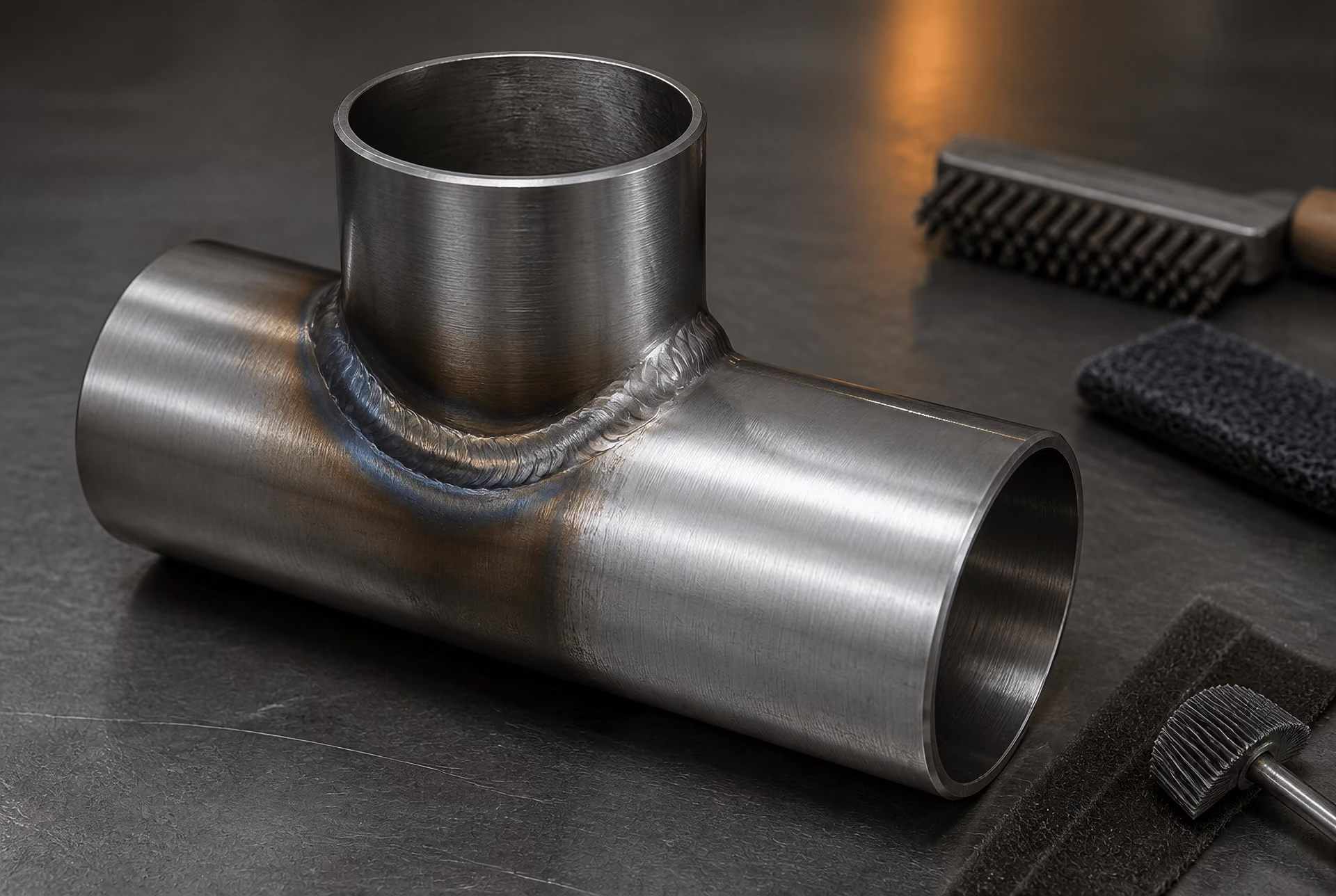
Welding, heat tint and contamination
Welding changes both the metal and its surface oxide. Heat tint is the visible discolouration produced when the heated stainless surface reacts with oxygen. Its colour is not a dependable measure of service performance, but the oxide beneath and around the tint is generally less protective than the properly formed passive film on a clean surface. Chromium may be depleted locally beneath the oxide, while the rough, irregular scale can retain moisture and chloride. On a welded Type 304L or Type 316L component, leaving heat tint in a wet or chloride-bearing service can therefore create sites for pitting and crevice corrosion.
Post-weld treatment must match the fabrication method and service environment. Mechanical removal by suitable stainless-only abrasives can remove scale, but it may also smear the surface or introduce grooves if carried out carelessly. Chemical pickling removes heat tint and associated oxide more uniformly, while passivation treatments can promote formation of a clean chromium-rich passive film after fabrication. These are different operations: pickling removes contamination and scale; passivation conditions the cleaned surface. The treatment should be controlled for concentration, temperature, exposure time and waste handling rather than applied as an unspecified cleaning step.
Weld design is equally significant. Incomplete penetration, undercut, overlap, arc strikes and intermittent welds can form narrow cavities. A crevice under a weld attachment, backing strip or lap joint may remain wet after the surrounding surface has dried. The ASM Handbook describes crevice corrosion as a coupled process involving electrochemical reactions, homogeneous chemical reactions and mass transport. Geometry controls those processes. A higher-alloy grade does not remove the oxygen differential or stagnant chemistry created by a badly detailed joint.
Welding can also affect intergranular corrosion. Excessive heat input, unsuitable thermal cycles or prolonged exposure in the sensitising range can allow chromium carbide precipitation at grain boundaries in susceptible austenitic stainless steels. Low-carbon grades such as Type 304L and Type 316L reduce this risk, as do stabilised grades such as Type 321 and Type 347 where the design and welding procedure call for them. Correct filler selection, heat control and an approved welding procedure remain necessary. Duplex stainless steels add another concern: excessive or insufficient heat input can disturb the ferrite-austenite balance and reduce local corrosion performance or toughness.
Iron contamination is a separate and common fabrication failure. Carbon-steel tools, wire brushes, lifting chains, grinding dust and workshop debris can leave free iron on stainless steel. The stainless substrate may be sound, yet the deposited iron rusts in humid or chloride-containing conditions and can create misleading red-brown staining. More importantly, particles can establish local electrochemical cells and shield areas from oxygen. Stainless-only brushes and abrasives should be segregated from carbon-steel equipment; surfaces should be protected from grinding dust and sparks. A final cleaning and inspection should identify contamination before the component enters service.
Surface roughness, inclusions and passivation
Surface finish affects how easily a passive film forms and how long deposits remain attached. Deep grinding marks, burrs, folds and weld spatter increase the area available for retention of water, salts and process solids. Grinding direction also matters. Long grooves running across a drainage path can hold liquid, while random coarse scratches create multiple sheltered sites. Finishing should remove defects rather than merely polish around them, and the final direction should support drainage where practical.
The abrasive must be appropriate for stainless steel. Abrasives previously used on carbon steel may transfer iron; overheated grinding can produce a damaged, oxidised layer; and aggressive local grinding can thin a component or create stress concentrations. A smooth appearance alone proves little. Inspection should include weld toes, crevices, corners, underside surfaces and areas hidden by fittings.
Non-metallic inclusions in the steel can also become initiation sites when exposed by machining or grinding. Manganese sulfide inclusions, for example, may dissolve preferentially in chloride-bearing water and leave small cavities that develop into pits. Clean steelmaking reduces inclusion-related risk, but fabrication still determines whether inclusions are opened, smeared over or left beneath a damaged surface. PREN helps compare relative pitting resistance among suitable grades, not predict the service life of a particular scratched or contaminated surface. The International Molybdenum Association gives the austenitic and duplex expression as “PREN = %Cr + 3.3(%Mo + 0.5%W) + 16%N.” It is a useful grade-selection measure, not a substitute for surface control.
Passivation depends on cleanliness and oxygen access. Oil, adhesive, shop soil, scale and iron particles interfere with film formation. Cleaning should precede passivation, and the finished surface should be rinsed so that treatment residues do not dry into deposits. World Stainless reports PRE values of 19 for 1.4301, 25 for 1.4401 and 1.4521, and 34 for duplex 1.4462 in its 2025 soils-and-concrete guidance. Those differences matter, but a poorly finished 1.4401 surface can still pit in a crevice where a clean, well-drained lower-alloy surface might remain intact.
Cleaning, inspection and eliminating water traps
Maintenance begins with design details that allow surfaces to dry. Continuous welds are generally preferable to intermittent welds where the latter create pockets; joints should avoid unsealed overlaps; and horizontal ledges, dead legs, recessed bolts and close-fitting washers should not collect process liquid. Drain holes must be large enough to remain effective after fabrication, and they should discharge without directing contaminated water onto another component. Crevice corrosion begins where oxygen availability is extremely low, as BSSA explains, so eliminating stagnant zones is often more effective than simply specifying a higher grade.
Deposits deserve attention even when the underlying grade is appropriate. Chloride salts from seawater, de-icing chemicals, cleaning agents or hand contact can concentrate as water evaporates. Dirt, scale and biological deposits hold moisture against the metal and create differential aeration cells. Cleaning frequency should reflect the contaminant load, temperature, wetting pattern and consequence of failure. Fresh water rinsing can remove soluble salts; neutral detergents and non-contaminating pads can remove soil. Chloride-bearing cleaners, hydrochloric acid and steel wool are unsuitable choices for routine stainless maintenance.
Inspection should look for discolouration, pits, rust staining, crevice deposits, weld defects and areas that remain wet after adjacent surfaces have dried. A magnified visual examination may reveal pits that a general walk-through misses; roughness measurement, borescope inspection or chloride residue testing may be justified in critical service. If corrosion is found, its location and geometry should be recorded before cleaning removes useful evidence. ASTM G78-95 provides procedures for identifying conditions likely to cause crevice corrosion and comparing relative crevice-corrosion resistance in specified chloride-containing aqueous environments.
Finally, maintenance cannot remove all fabrication risk. Tensile residual stress from welding or forming can combine with chlorides and temperature to produce stress-corrosion cracking; BSSA states that cracking requires tensile stress together with specific environmental factors. A grade change may reduce one susceptibility while leaving the geometry, stress and deposit problem untouched. Durable performance therefore comes from coordinated grade selection, controlled fabrication, clean surfaces, inspectable joints and reliable drainage.
A Service-Environment Decision Method
Stainless-steel grade selection should begin with the service envelope, not with a material label such as “marine,” “coastal,” or “chemical.” Those labels compress too many variables into one word. A sheltered coastal roof, a continuously wetted seawater pipe, a salt-contaminated road structure, and a process vessel containing chloride-bearing acid may all be described as coastal or chemical service, yet they impose very different corrosion conditions.
The practical question is not whether a grade is corrosion resistant in general. It is whether its surface, microstructure, fabrication condition and stress state can tolerate the controlling environment for the required period.
Define the exposure before naming a grade
Record the exposure as an operating envelope. Start with chloride concentration, but do not treat one laboratory or bulk-water value as the whole exposure. Chloride can concentrate by evaporation beneath deposits, at liquid lines, inside insulation, under gaskets and in narrow joints. Intermittent spray can therefore be more damaging than immersion in cleaner, continuously renewed water. Include expected peaks, not only average composition.
Temperature affects reaction rates, oxygen solubility, evaporation and the stability of passive films. Record normal and upset temperatures, thermal cycling and hot spots near welds or heat exchangers. Measure or specify pH, and identify acids, alkalis, sulfides, oxidizing salts, reducing species and organic contaminants. Nitric acid, hypochlorite, ferric ions and hydrogen peroxide do not impose the same electrochemical conditions as sodium chloride alone. Oxidizing conditions can raise the corrosion potential and make localized attack more likely in a chloride-bearing environment.
Describe wetness with equal care. Is the surface continuously immersed, periodically wetted, or nominally dry but exposed to condensation? How quickly does it dry? Are there deposits of salt, mud, scale, product residue or biological material? Deposits may retain moisture and create oxygen or concentration differences. A clean external surface and the underside of a contaminated flange are different environments.
Geometry belongs in the specification. Note lap joints, threaded connections, gasket faces, bolt heads, support clips, drain pockets and partially sealed cavities. The British Stainless Steel Association states that crevice corrosion begins where oxygen availability is extremely low. That condition can occur beneath a washer even when the surrounding surface remains bright. The ASM Handbook describes crevice corrosion as a coupled process involving electrochemical reactions, homogeneous chemical reactions and mass transport; crevice width, depth, surface condition and solution exchange all matter.
Stress must be recorded rather than assumed away. Include residual stress from cold forming, machining and welding, applied tensile stress, cyclic loading and thermal expansion restraint. BSSA identifies stress-corrosion cracking as requiring tensile stress together with specific environmental factors. Chloride, temperature and alloy structure then become decisive. A grade that resists pitting in an unstressed coupon may still be unsuitable for a hot, chloride-contaminated component under sustained tensile stress.
For buried or embedded stainless steel, add soil resistivity, moisture retention, drainage, chloride and sulfate content, pH, redox condition, stray current and contact with concrete or other metals. World Stainless specifically identifies chloride concentration, soil resistivity and pH as selection variables for buried stainless steel. Finally, identify galvanic partners: carbon steel, galvanized steel, copper alloys, nickel alloys, titanium and even weld overlays can change the electrochemical arrangement. Area ratio, electrical continuity and the conductivity of the electrolyte determine whether galvanic coupling is significant.
The fabrication state completes the exposure definition. Specify the actual product form, heat treatment, weld process, filler metal, pickling and passivation, surface finish, scale removal, contamination control and post-weld cleaning. A solution-annealed plate and a heat-tinted weldment are not equivalent surfaces. The governing mechanism may be pitting, crevice corrosion, general corrosion, intergranular corrosion, galvanic corrosion or stress-corrosion cracking; grade selection follows that diagnosis.
Screening with PREN and corrosion tables
Once the mechanism and exposure are defined, screen candidate grades using published composition data, PREN and corrosion tables. For austenitic and duplex stainless steels, the International Molybdenum Association gives the expression:
PREN = %Cr + 3.3(%Mo + 0.5%W) + 16%N
A higher PREN generally indicates greater relative resistance to chloride-induced pitting in comparable conditions. It does not predict a guaranteed service life, a critical chloride concentration or resistance to every form of corrosion. The formula also does not capture crevice geometry, surface contamination, weld microstructure, residual stress, temperature history or galvanic effects. Nitrogen values and heat-to-heat chemistry matter, and different PREN conventions may be used for alloys containing tungsten.
Use PREN as a screening index, not as a pass/fail boundary. World Stainless gives soil-and-concrete PRE values of 19 for 1.4301, 25 for 1.4401 and 1.4521, and 34 for duplex 1.4462. Those figures help rank candidates, but they do not mean that 1.4521 will perform identically to 1.4401 in every soil or that 1.4462 is immune to crevice attack. Local oxygen depletion and deposits can defeat a favorable bulk composition.
Published corrosion tables provide the next filter. World Stainless associates lower selection scores with Type 304/304L, intermediate conditions with Type 316/316L or 444, more severe conditions with Type 317L, and highly aggressive environments with 904L, superduplex or 6% molybdenum alloys. Treat these associations as conditional guidance. Type 316L may be a sensible candidate for a drained, regularly washed coastal component, while a creviced fitting exposed to warm, concentrating chloride may require a different design, alloy or both. “Marine grade” does not identify chloride level, temperature or wet-dry cycle.
Check the table against the actual governing mechanism. PREN helps with pitting and often provides useful comparative information for crevice resistance, but it does not screen intergranular corrosion caused by sensitization, nor does it establish resistance to chloride stress-corrosion cracking. A lower-alloy grade with a sound, drained design may outperform a higher-PREN grade trapped beneath deposits. Conversely, a smooth open surface can mask a serious risk at a gasket or weld.
Confirming the choice with testing and standards
Testing should reproduce the suspected failure mechanism and the worst credible service condition. If crevice corrosion controls, ASTM G78-95 is directly relevant. ASTM International describes this practice as providing procedures for identifying conditions likely to cause crevice corrosion and for comparing the relative crevice-corrosion resistance of iron-base and nickel-base stainless alloys in specified chloride-containing aqueous environments. Its crevice formers and exposure conditions make the comparison more meaningful than a polished, freely exposed coupon.
For pitting comparisons, ASTM G48 ferric-chloride methods or ASTM G150 critical-pitting-temperature testing may be useful, provided their limitations are stated. Ferric chloride is an aggressive screening medium, not a replica of every process solution. Critical pitting temperature is comparative evidence under a defined protocol, not a direct prediction of plant life. ASTM A262 practices address susceptibility to intergranular attack in austenitic stainless steels, while weld qualification and metallographic examination may be needed when thermal history is important.
SCC evaluation must apply the relevant tensile stress, residual-stress condition, temperature and chemical environment. A test that omits one of those variables cannot rule out cracking. Where galvanic corrosion is possible, test the actual coupled materials with representative area ratios, electrical continuity and electrolyte chemistry. For buried components, use soil or synthetic pore solutions that reproduce resistivity, moisture, chloride and pH rather than relying only on seawater data.
The final decision should document the exposure envelope, governing mechanism, candidate compositions, PREN calculation, published-table comparison, fabrication controls, test method, acceptance criteria and inspection plan. If the design depends on an unverified assumption—such as rapid drainage, no chloride concentration or negligible residual stress—that assumption belongs in the design basis and in maintenance inspections. Grade selection is therefore an iterative engineering decision: define the environment, identify how attack can start, screen alloys, test the credible weakness, then revise the geometry or fabrication requirements when changing grade alone cannot control the risk.
Common Grade-Selection Errors
Treating 304 as universally corrosion resistant
Austenitic stainless steel Type 304, commonly designated 1.4301 under EN standards, is often treated as a general-purpose answer to every corrosion problem. That is a design error. Its chromium content supports a passive film, but 1.4301 contains no deliberate molybdenum addition and therefore has less resistance to chloride-induced pitting and crevice corrosion than molybdenum-bearing grades such as 1.4401 (Type 316) or suitable duplex stainless steels.
The distinction matters most where surfaces remain wet, deposits accumulate or salt is repeatedly concentrated by evaporation. Coastal spray, tidal splash zones, road de-icing salts and contaminated runoff can create chloride levels far above those suggested by the surrounding atmosphere. A clean, freely drained 1.4301 handrail may perform acceptably, while the same grade beneath a gasket, at a bolted lap joint or inside a partially sealed support can develop local attack.
The structural stainless-steel design manual identifies chloride content, temperature, pollutants, acidity, oxidizing agents and oxygen availability as factors affecting pitting. It specifically indicates that 1.4401 or suitable duplex grades are preferred over 1.4301 for coastal or de-icing-salt exposure. “Preferred” here is a service-environment judgment, not a guarantee that 1.4401 will remain corrosion-free. A duplex grade such as 1.4462 can provide a larger margin against localized chloride attack, but its suitability still depends on design, fabrication and exposure.
World Stainless’ 2025 soils-and-concrete guidance illustrates the relative, not absolute, nature of such comparisons. It gives PRE values of 19 for 1.4301, 25 for 1.4401 and 1.4521, and 34 for duplex 1.4462. These figures support a higher-alloy selection where chloride exposure is more severe; they do not convert an exposed crevice into a safe detail. In buried applications, the same guidance calls for consideration of chloride concentration, soil resistivity and pH. A grade selected from atmospheric assumptions may be poorly matched to a wet, chloride-bearing soil.
Fabrication can also erase part of the expected advantage. Heat tint, embedded iron, rough grinding marks and weld contamination can damage the local passive condition or create sites for initiation. Poor drainage has a similar effect. Selecting 1.4401 while retaining narrow crevices, horizontal ledges and contaminated welds is not a substitute for controlling those features.
Assuming 316 eliminates chloride corrosion
1.4401, or Type 316, is more resistant to chloride pitting than 1.4301 because its molybdenum addition improves the stability of the passive film in many chloride-bearing environments. That is a comparative advantage, not immunity. Chlorides can still initiate pits or attack oxygen-starved crevices in 1.4401, especially when temperature, concentration, wetting time and deposits increase the local severity.
Crevice corrosion is especially easy to underestimate. The British Stainless Steel Association states that it begins where oxygen availability is extremely low. Inside a gasketed joint or beneath a washer, oxygen depletion changes the local electrochemistry; acidification and chloride concentration can then accelerate dissolution. The ASM Handbook describes the process as a coupled interaction of electrochemical reactions, homogeneous chemical reactions and mass transport. Crevice geometry, alloy condition and environment act together. More alloying does not remove the crevice.
ASTM G78-95, Standard Guide for Crevice Corrosion Testing of Iron-Base and Nickel-Base Stainless Alloys in Seawater and Other Chloride-Containing Aqueous Environments, provides procedures for identifying conditions likely to cause crevice corrosion and for comparing relative resistance in specified test environments. Its scope is important. A test comparison under defined conditions cannot serve as a field-performance guarantee across different joint designs, temperatures, deposits or exposure cycles.
Galvanic coupling creates another failure route. If 1.4401 is electrically connected to a less noble metal while immersed in a conductive chloride solution, the area ratio, electrical continuity and relative exposed areas affect the corrosion current. The stainless steel may remain passive, or the less noble metal may suffer accelerated attack; the outcome depends on the couple and geometry rather than the stainless designation alone. Insulating washers, drainage and compatible fastener choices may matter more than moving from one stainless grade to another.
Stress also changes the problem. The BSSA identifies stress-corrosion cracking as requiring tensile stress together with specific environmental factors. Residual welding stress, cold forming, restrained thermal movement and applied load can combine with hot chloride-bearing conditions. Type 316 is not a universal solution for chloride stress-corrosion cracking, particularly where temperatures and concentrations are high.
Using PREN as a complete design calculation
The Pitting Resistance Equivalent Number is useful for screening grades, but it is not a service-life model, acceptance criterion or field guarantee. The International Molybdenum Association gives the austenitic and duplex expression as PREN = %Cr + 3.3(%Mo + 0.5%W) + 16%N. A higher calculated value generally indicates greater relative pitting resistance in chloride-bearing environments.
The word “relative” carries the engineering meaning. PREN compares nominal alloy chemistry; it does not calculate the critical pitting temperature for a particular product, weld or surface finish. It does not describe crevice dimensions, chloride deposits, pH, oxygen transport, galvanic current, stress or wetting cycles. Nitrogen, molybdenum and chromium may be distributed differently between phases in duplex material, while segregation and heat treatment can affect local performance. Weld metal and heat-affected zones also require separate attention.
World Stainless associates low selection scores with Type 304/304L, intermediate conditions with Type 316/316L or 444, more severe conditions with Type 317L, and highly aggressive environments with grades such as 904L, superduplex and 6% molybdenum alloys. This is a graded selection framework, not permission to select by PREN alone. The same document’s buried-service guidance brings the environmental variables back into view: chloride concentration, soil resistivity and pH must be considered.
Acceptance should therefore come from the service specification, applicable test methods and design verification. ASTM G78-95 can support comparative crevice testing; it cannot certify every installed joint. A defensible selection records the exposure, temperature, chloride source, geometry, fabrication condition, stress state, inspection access and cleaning or drainage provisions. PREN can narrow the candidates. It cannot make those decisions for the designer.
Reference Framework: Standards, Handbooks and Technical Guides
Corrosion claims about stainless steel need a source matched to the question being asked. A test method does not replace a mechanism description; a PREN equation does not predict service life; and a grade-selection chart cannot remove the effects of crevices, welding, deposits, stress or drainage. The references below are therefore most useful when read as a connected framework rather than as interchangeable authorities.
ASTM G78 and comparative corrosion testing
ASTM G78-95, Standard Guide for Crevice Corrosion Testing of Iron-Base and Nickel-Base Stainless Alloys in Seawater and Other Chloride-Containing Aqueous Environments, addresses a specific experimental problem: how to identify conditions likely to produce crevice corrosion and compare the relative resistance of alloys under defined chloride-containing exposures. Its procedures use deliberately shielded or contacting regions so that the test can examine corrosion associated with restricted mass transport and oxygen access.
That scope matters. ASTM G78-95 is a comparative test guide, not a universal ranking of stainless-steel grades for every installation. Results depend on the solution, chloride level, temperature, exposure duration, crevice former, surface condition and evaluation method. A material that performs better in a standardized seawater test may still fail in a tight gasket joint, a chloride-contaminated concrete detail or a deposit-filled pipe support. The test can reveal susceptibility under specified conditions; it cannot reproduce every geometry and operating history.
The method should also be separated from pitting tests. Pitting and crevice corrosion share a dependence on passive-film breakdown, but a crevice imposes a distinct local environment. Restricted oxygen transport, acidification and concentrated chloride within the shielded region can make an apparently acceptable bulk solution damaging at the contact. ASTM G78 consequently supports alloy comparison and exposure screening, while design assessment must still examine the actual joint, surface finish, weld condition and cleaning practice.
ASM International supplies the mechanism-level explanation behind that result. Its treatment of crevice corrosion describes a coupled process involving electrochemical reactions, homogeneous chemical reactions and mass transport. Crevice geometry controls how rapidly oxygen and dissolved species enter or leave; the alloy controls film stability and repassivation; and the environment controls the reactions that concentrate aggressive chemistry. This is why a nominal grade designation alone cannot establish resistance at a particular crevice.
BSSA, World Stainless and IMOA guidance
The British Stainless Steel Association (BSSA) is particularly useful for separating mechanisms that are often collapsed into the single word “corrosion.” Its technical material identifies pitting, crevice, intergranular, stress-corrosion cracking, galvanic and general corrosion as principal mechanisms affecting stainless steels. It states that crevice corrosion begins where oxygen availability is extremely low, a concise description of the differential-aeration condition that initiates local chemistry changes inside a shielded region.
BSSA also makes the stress requirement for stress-corrosion cracking clear: tensile stress must act together with specific environmental factors. That statement prevents a common error in grade selection. Increasing alloy resistance to chloride pitting does not automatically eliminate cracking risk, because residual stress, applied stress, temperature, chloride concentration and susceptible microstructure remain relevant. BSSA’s material is explanatory guidance, not a component-specific design calculation or a guarantee of crack-free service.
World Stainless extends the discussion toward selection. Its educational guidance associates low selection scores with Type 304/304L, intermediate conditions with Type 316/316L or 444, more severe conditions with Type 317L, and highly aggressive environments with grades such as 904L, superduplex and 6% molybdenum alloys. These categories are screening guidance, not permission to ignore exposure details. A grade choice must still account for stagnant water, evaporation, deposits, weld heat input, crevices, cleaning chemicals and temperature.
Its 2025 soils-and-concrete guidance is more specific about buried applications. It gives PRE values of 19 for 1.4301, 25 for 1.4401 and 1.4521, and 34 for duplex 1.4462. It also emphasizes chloride concentration, soil resistivity and pH. Those variables can differ substantially across a site, so the values should not be read as a buried-service lifetime scale. Concrete pore chemistry, carbonation, cracking, moisture movement and contact with other metals can alter the exposure experienced by the steel.
The International Molybdenum Association (IMOA) defines the commonly used pitting-resistance equivalent number expression for austenitic and duplex stainless steels as: “PREN = %Cr + 3.3(%Mo + 0.5%W) + 16%N.” A higher calculated value generally indicates greater relative pitting resistance in chloride-bearing environments. PREN is a chemistry-based comparison, however. It does not include surface condition, weld metallurgy, crevice geometry, chloride activity, temperature, mechanical stress or fabrication contamination. It is not a complete service-life prediction, and grades with similar PREN can behave differently because their microstructures and processing histories differ.
ASM, Outokumpu, ESDEP and Uhlig references
The ASM Handbook provides the strongest general mechanism context in this source set. Its coverage connects passive-film behavior, local electrochemistry, transport and material condition, helping explain why pitting, crevice corrosion, galvanic attack and stress-corrosion cracking respond differently to the same environment. It is a technical reference for understanding causes and variables, not a substitute for a project specification, qualification test or fracture assessment.
Outokumpu’s stainless-steel technical guidance adds practical context on alloy families, corrosion mechanisms, fabrication and grade selection. It is useful for relating chromium, nickel, molybdenum and nitrogen to austenitic, ferritic and duplex grades, while also showing why welding, heat tint, surface contamination and finishing affect actual performance. Because some guidance is organized around product families and typical applications, its tables should be checked against the exact product standard, heat treatment and service condition.
The ESDEP structural stainless-steel design manual places corrosion resistance within structural design. It identifies chloride content, temperature, pollutants, acidity, oxidizing agents and oxygen as factors affecting pitting. For coastal exposure or de-icing salt, it notes that 1.4401 or suitable duplex grades are preferred over 1.4301. That is a design-oriented recommendation, not a universal coastal rule: splash zones, sheltered ledges, drainage, salt retention, weld details and inspection access can make two structures at the same atmospheric site behave differently.
Finally, Uhlig’s Corrosion Handbook provides broader corrosion-control context, including electrochemical principles, galvanic corrosion, stress-corrosion cracking, materials selection, coatings, inhibitors and environmental control. Its value lies in connecting stainless-steel problems to general corrosion engineering rather than treating grade chemistry as the only variable. Like the other references, it has limits. Handbook guidance must be translated into the actual alloy, geometry, fabrication route, environment and consequence of failure. Used together, these sources support a defensible sequence: identify the mechanism, characterize the exposure, select candidate grades, control fabrication and geometry, and validate the choice with relevant testing or field evidence.
References
- [1] Corrosion mechanisms in stainless steel. BSSA technical library. https://bssa.org.uk/bssa_articles/3-corrosion-mechanisms-in-stainless-steel/
- [2] Steel grades and PREN expression. International Molybdenum Association technical guidance. https://www.imoa.info/molybdenum-uses/molybdenum-grade-stainless-steels/steel-grades.php
- [3] Standard Guide for Crevice Corrosion Testing of Iron-Base and Nickel-Base Stainless Alloys in Seawater and Other Chloride-Containing Aqueous Environments. ASTM G78-95, 1995. https://store.astm.org/g0078-95.html
- [4] Corrosion mechanisms in stainless steel. BSSA technical library. https://bssa.org.uk/bssa_articles/technical-library-principles-of-corrosion-mechanisms-page1/
- [5] Corrosion resistance of stainless steels in soils and concrete. World Stainless technical guidance, 2025. https://worldstainless.org/wp-content/uploads/2025/02/CorrResist_SoilsConcrete_EN.pdf
- [6] Corrosion resistance of stainless steels in soils and concrete. World Stainless technical guidance, 2025. https://worldstainless.org/wp-content/uploads/2025/02/CorrResist_SoilsConcrete_EN.pdf