


What Maraging Steel Is—and What It Is Not
The low-carbon iron-nickel martensitic concept
Maraging steel is a family of highly alloyed, very-low-carbon iron–nickel steels in which the final strength comes mainly from intermetallic precipitation during aging, not from carbon hardening. Its defining matrix is a low-carbon lath martensite, usually formed by solution annealing followed by cooling from the austenitic region. Nickel suppresses the martensite-start temperature sufficiently that the austenite transforms to martensite on cooling without requiring the high carbon content used in conventional quenched-and-tempered steels.
That martensite is strong compared with ferrite, but it is deliberately much softer than the finished maraging condition. This is central to the concept. The alloy is designed so that solution treatment produces a relatively ductile, machinable, low-carbon martensitic structure; a later aging treatment then causes nanoscale or fine intermetallic phases to form within and around that matrix. The material is not simply “hard martensite.” It is a precipitation-strengthened martensitic steel.
| Element | Primary metallurgical role | Example or qualification |
|---|---|---|
| Nickel | Stabilizes austenite and supports formation of the martensitic matrix | Approximately 18.5% in AMS6515 |
| Cobalt | Changes matrix thermodynamics and promotes molybdenum-rich precipitation | 12.0% in AMS6515 |
| Molybdenum | Participates directly in strengthening intermetallic phases | 4.9% in AMS6515 |
| Titanium | Contributes to nickel–titanium-rich strengthening precipitates | 1.40% in AMS6515 |
| Aluminum | Can enter ordered intermetallic phases and affect precipitation | 0.10% in AMS6515 |
The alloying additions distinguish maraging grades from ordinary iron–nickel alloys. Conventional cobalt-bearing grades commonly contain nickel, cobalt, molybdenum, titanium and small additions of aluminum. Cobalt affects the matrix and precipitation response, while molybdenum and titanium participate in strengthening reactions that produce intermetallic compounds. The exact balance matters: changing the nickel, cobalt, molybdenum, titanium or aluminum content changes transformation temperatures, precipitate populations, aging response, toughness and dimensional stability.
SAE AMS6515 illustrates why a grade must be treated as a defined material rather than a loose recipe. It specifies double-vacuum-melted, annealed steel designated “18.5Ni-12.0Co-4.9Mo-1.40Ti-0.10Al.” That composition is not interchangeable with every product called 18Ni maraging steel. Melting practice, product form, required condition and permitted composition ranges are part of the specification.
The low carbon content is equally important. Carbon is typically kept low enough to limit carbide formation and to prevent carbon from becoming the primary source of hardness. The resulting martensite has a relatively low dislocation and solid-solution strengthening contribution compared with high-carbon martensite, leaving substantial capacity for subsequent precipitation hardening. This also helps explain why maraging steels can combine high strength with useful toughness and ductility when their heat treatment and cleanliness are controlled.
Maraging steel A low-carbon, high-nickel iron-based steel that forms a martensitic matrix on cooling and develops much of its engineering strength through age-induced intermetallic precipitation.
A useful formal description is therefore narrower than “very strong steel”: a maraging steel is a low-carbon, high-nickel iron-based alloy that forms a martensitic matrix on cooling and develops much of its engineering strength through age-induced intermetallic precipitation. A steel can be exceptionally strong without meeting that definition.

Why age hardening, not carbon hardening, is the defining mechanism
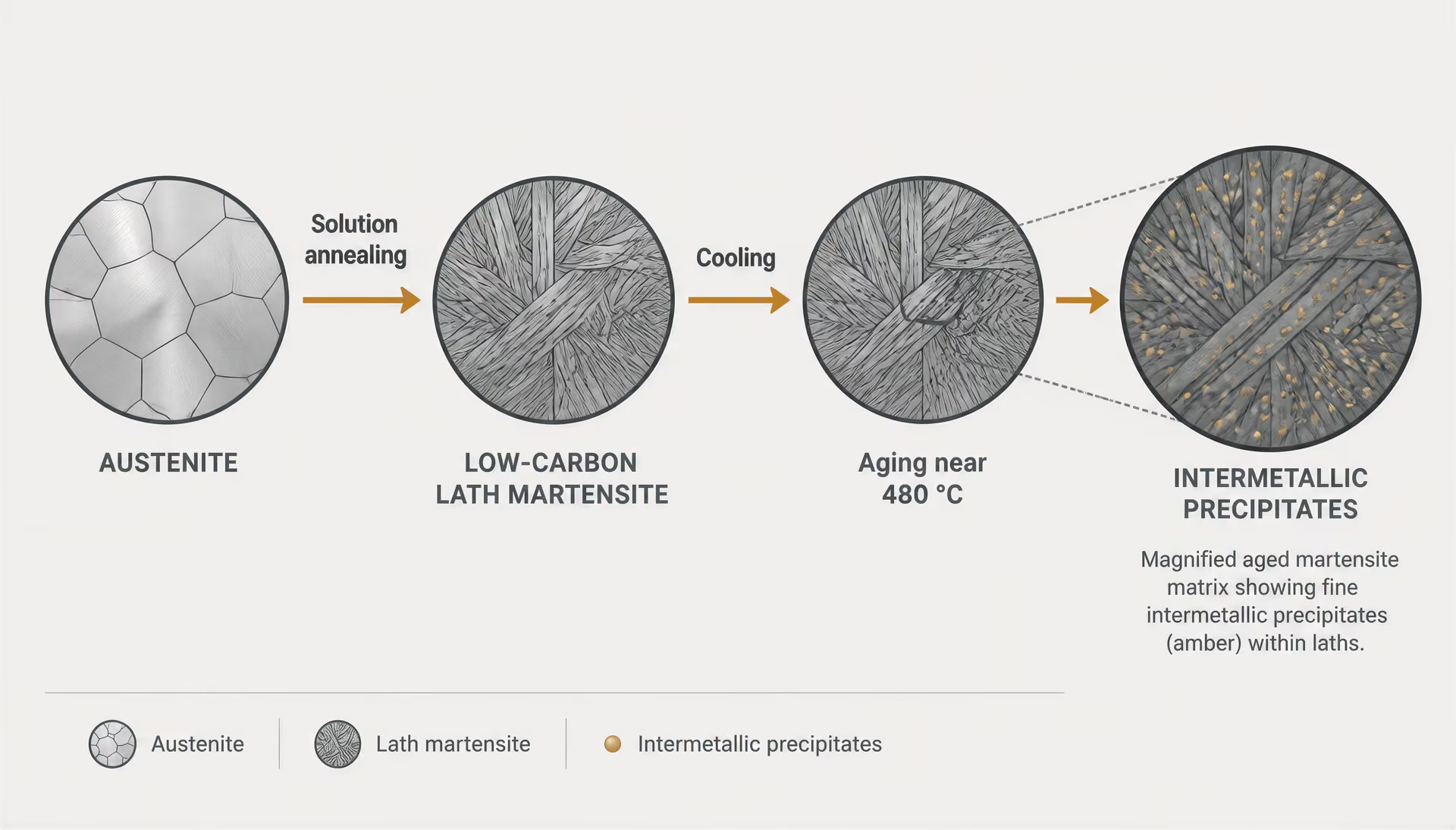
The maraging sequence
- Solution annealing Dissolves relevant alloying elements into austenite and establishes a suitable chemical state.
- Cooling Transforms the austenite into low-carbon lath martensite.
- Aging Allows solute atoms to cluster and ordered intermetallic precipitates to form.
- Strengthening The precipitates obstruct dislocation motion and raise yield strength.
The conventional thermal sequence has distinct stages. First, solution annealing dissolves alloying elements into austenite and establishes a suitable chemical state. Cooling then produces lath martensite. In the newly quenched condition, that martensite is relatively soft. Aging at approximately 480 °C causes solute atoms to cluster and ordered intermetallic precipitates to form. These precipitates obstruct dislocation motion, producing the large increase in yield strength associated with the grade.[1] Maraging Steels. ASM International. ASM Handbook, 2018. ASM Handbook, Volume 4A, Steel Heat Treating Fundamentals and Processes
ASM International’s 2018 Maraging Steels chapter describes the sequence as solution annealing, martensite formation, aging, precipitation and short-range ordering. The same source places the principal precipitation treatment at approximately 480 °C and reports commercial yield strengths from 1030 to 2420 MPa. Those figures describe the result of a particular composition and thermal history, not an intrinsic property of every low-carbon nickel steel.
The 18Ni(250) designation corresponds approximately to a 250 ksi strength class, or about 1720–1725 MPa. Limited evidence
NASA’s 2018 material reference identifies 18Ni(250) as a low-carbon iron–nickel lath-martensitic steel age hardened by intermetallic precipitation at about 480 °C. The “250” designation refers approximately to a 250 ksi strength class, or about 1720 MPa, rather than to a carbon percentage or a universal chemical formula. Related designations such as 18Ni(300) and 18Ni(350) indicate higher nominal strength classes, but the designation alone does not eliminate the need to check the governing specification and heat-treatment condition.
Maraging steels obtain most of their final strength from age-induced intermetallic precipitation rather than carbon hardening. Strong evidence
NIST Internal Report 8582, published in 2025, states the distinction directly: solutionizing and quenching first create relatively soft martensite, after which precipitation heat treatment generates fine precipitates and high strength, ductility and toughness. In a conventional quenched-and-tempered carbon steel, carbon trapped in martensite and the later tempering reactions dominate the hardening mechanism. In maraging steel, the deliberately low carbon level means that this explanation is incomplete and usually misleading. The decisive strengthening event is precipitation.
Overaging shows why the response is metallurgical rather than merely thermal. Aging too little can leave the precipitate population insufficient for the specified strength. Aging too long or too hot can coarsen precipitates and reduce strengthening, while excessive thermal exposure can alter the matrix and dimensional condition. The nominal aging temperature is not a substitute for a full schedule: section size, furnace uniformity, prior solution treatment, cooling rate and product form all affect the outcome.
Processing route adds another variable. Laser powder-bed fusion can produce fine solidification cells, residual stress, porosity, texture and direction-dependent microstructures before any conventional heat treatment begins. NIST Technical Note 2352, published in 2025, evaluates solution annealing, intercritical annealing and aging treatments for cobalt-free M789 made by laser powder-bed fusion. That work demonstrates that an additive-manufactured maraging alloy cannot automatically be treated as equivalent to wrought material of a similar nominal chemistry.
NIST’s 2024 In Situ Fatigue Monitoring Investigation of Additively Manufactured Maraging Steel also reported build-direction variations in hardness and stiffness. Its magnetic-permeability measurements detected fatigue damage before failure, showing that the process-structure problem extends beyond the initial tensile properties. Additive manufacturing does not change the definition of maraging steel, but it changes the starting microstructure that the heat treatment must condition.
Separating grade names from generic descriptions
| Designation | Meaning | What it does not establish |
|---|---|---|
| Maraging | Metallurgical family based on low-carbon martensite and precipitation strengthening | A single chemistry or property level |
| 18Ni(250) | Nominal 18Ni family and approximately 250 ksi strength class | A complete chemical specification or certification |
| 18Ni(300) | Nominal 18Ni family and higher strength class | Equivalent chemistry to every other 18Ni grade |
| M789 | Cobalt-free maraging grade | Interchangeability with cobalt-bearing 18Ni grades |
| AMS6515 | Specific alloy, melting route, condition, and product-form specification | A generic synonym for 18Ni maraging steel |
“Maraging” is a metallurgical family name; “18Ni(250),” “18Ni(300),” “18Ni(350),” “M789” and “AMS6515” identify particular grade systems, strength classes or specifications. They should not be used as synonyms.
The classic 18Ni grades are generally associated with cobalt-bearing chemistries. Cobalt-free grades were developed for different composition, cost, supply and processing considerations, but removing cobalt does not leave every other metallurgical variable unchanged. M789, for example, is a cobalt-free maraging steel with its own alloy design, precipitation behavior, heat-treatment requirements and product-property limits. Calling it simply “18Ni(300)” would erase information needed to interpret its response.
Nor does nickel alone make a steel maraging. Many stainless, cryogenic, structural and precipitation-hardening steels contain nickel but form different matrices or rely on different strengthening reactions. A nickel-bearing steel that is hardened primarily by carbon, nitrogen, carbide precipitation, copper precipitation or transformation products belongs to another class unless its specified metallurgy meets the maraging definition.
The reverse shortcut is also wrong: not every ultrahigh-strength steel is maraging. Bainitic steels, quenched-and-tempered alloy steels, tool steels and some precipitation-hardening stainless steels can reach comparable strength through different mechanisms. Strength level is evidence of performance, not proof of identity. Correct identification requires the grade designation, chemical limits, melting and product-form requirements, heat-treatment condition and the precipitation reaction that produces the specified properties.
The Composition of Conventional Maraging Steels
Maraging steel is defined less by a single alloy recipe than by a compositional and heat-treatment strategy. Its matrix is a very-low-carbon, iron–nickel martensite that is deliberately made soft enough after quenching for substantial strengthening during aging. Nickel, cobalt, molybdenum, titanium, aluminum, and smaller additions then control the formation, distribution, and stability of strengthening precipitates. The result is a different hardening route from that of conventional carbon steels.
In a carbon steel, rapid cooling produces hard martensite because carbon trapped in supersaturated solution distorts the body-centered tetragonal lattice. Maraging steels contain so little carbon that this mechanism contributes comparatively little. After solution annealing and quenching, the matrix is usually a low-carbon lath martensite with relatively low hardness and good machinability. NIST Internal Report 8582 describes the sequence as solutionizing and quenching to form relatively soft martensite, followed by precipitation heat treatment that produces fine precipitates and high strength, ductility, and toughness. Aging commonly occurs near 480 °C, where intermetallic compounds form and short-range ordering can also contribute to strengthening.
That distinction matters when composition is discussed. An alloying element may influence martensite formation, precipitate chemistry, austenite stability, grain structure, or all four. Its nominal percentage cannot be interpreted independently of the grade designation, melting practice, product form, and thermal history.
The role of nickel in the martensitic matrix
Nickel is the principal matrix-forming alloying element in conventional maraging steels. It stabilizes austenite at the solution-annealing temperature, allowing the steel to be processed as a nickel-rich solid solution before cooling. On quenching, the austenite transforms to lath martensite even though the carbon content is very low. Nickel therefore helps create the low-carbon martensitic starting structure on which later precipitation hardening depends.
The nickel content is also tied to the balance between martensite formation and retained austenite. Too little nickel can reduce the stability of the intended austenitic processing range and alter transformation behavior. Higher nickel levels can increase austenite stability and, depending on the complete composition and heat treatment, promote retained austenite or reversion during aging. The matrix is not simply a passive container: its nickel content affects the chemical driving force for later precipitation and the response to overaging.
The familiar designation 18Ni(250), used by NASA in a 2018 materials reference, identifies a maraging grade with approximately 18% nickel and a nominal strength level of 250 ksi. The designation is not a complete chemical specification. It communicates a grade family and expected strength class, while the applicable material specification controls limits for nickel, cobalt, molybdenum, titanium, aluminum, carbon, and other elements.
SAE AMS6515 provides a more exact example. It specifies double-vacuum-melted, annealed steel for bars, forgings, tubing, and rings with the composition written as 18.5Ni-12.0Co-4.9Mo-1.40Ti-0.10Al. This chemistry should not be treated as the formula for all 18Ni maraging steels. It is the composition identified by that particular AMS designation, and its response depends on the specified product and heat-treatment requirements.
Nickel also supports toughness in the low-carbon matrix. Because the quenched martensite is not heavily strained by carbon, maraging steels can combine a high strength potential with useful fracture toughness, provided that inclusions, segregation, prior-austenite grain size, precipitate coarsening, and processing defects remain controlled. The strength does not come from nickel alone. Nickel establishes the matrix and transformation conditions; the major increase in hardness arrives during aging.
Cobalt and molybdenum as precipitation-hardening contributors
Cobalt is characteristic of many conventional, high-strength maraging grades. It is not usually regarded as the sole precipitate-forming element. Instead, cobalt changes the thermodynamics and kinetics of the matrix so that molybdenum- and nickel-containing intermetallic precipitates form more effectively during aging. Cobalt can reduce the solubility of molybdenum in the iron–nickel martensite, increasing the chemical driving force for molybdenum-rich precipitation. It also affects martensite transformation and the response of the alloy during reheating.
Short-range ordering Local chemical arrangement in which solute atoms develop preferred neighboring relationships before or alongside the formation of identifiable precipitates.
Molybdenum is a direct contributor to precipitation strengthening. During aging, it participates in fine intermetallic phases, often described in conventional maraging steels as molybdenum-rich precipitates associated with nickel and iron. The exact precipitate population depends on grade and treatment; simplified descriptions that assign one compound to every maraging steel are misleading. Early nanoscale clusters, ordered regions, and later intermetallic particles may appear in sequence, with their size and spacing determining strength and their coarsening reducing it.
The interaction between cobalt and molybdenum explains why nominal composition must be read as a system. In AMS6515, the combination of 12.0% cobalt and 4.9% molybdenum is not equivalent to adding either element separately. The specified 18.5% nickel supplies the matrix, while cobalt and molybdenum help establish a precipitation response capable of producing a high-strength aged condition. ASM International reported in 2018 that commercial maraging steels span yield strengths from approximately 1030 to 2420 MPa, a range that reflects differences in composition, grade, aging treatment, and product condition rather than one universal chemistry.
Cobalt-bearing grades therefore cannot be directly substituted for cobalt-free grades by matching nickel content. Cobalt-free M789 illustrates the point. It belongs to a different compositional approach in which precipitation strengthening is obtained without the conventional cobalt addition, with other alloying adjustments supplying the required response. Its solution treatment, aging temperature, and allowable process window must be established for M789 itself.
Manufacturing route adds another variable. NIST Technical Note 2352, published in 2025, evaluates solution annealing, intercritical annealing, and aging treatments for cobalt-free M789 produced by laser powder-bed fusion. These treatments address a material that begins with a rapidly solidified, directionally built microstructure rather than the same homogenized structure expected from wrought conventional stock. The grade name alone does not predict identical precipitate distributions across those routes.
Titanium, aluminum, and minor additions
Titanium is a powerful precipitation-forming addition in many maraging grades. It can contribute to nickel–titanium-rich intermetallic precipitation during aging, producing a dense population of nanoscale strengthening particles when the treatment is properly controlled. The titanium level is consequently one of the most consequential differences among nominally similar grades. In AMS6515, titanium is specified at 1.40%, a substantial addition that must be considered alongside its 18.5% nickel, 12.0% cobalt, and 4.9% molybdenum.
Aluminum is present at a much lower level in the AMS6515 example, 0.10%, but a small concentration does not mean a negligible metallurgical effect. Aluminum can enter ordered intermetallic phases, alter precipitation reactions, and affect deoxidation and inclusion populations. Its role depends on the rest of the chemistry and on the aging schedule. A titanium-rich grade with a trace aluminum addition will not necessarily produce the same particle population as a grade with more aluminum and less titanium.
Carbon is normally restricted to very low levels because excess carbon would redirect strengthening toward carbide formation and carbon-distorted martensite. That could consume titanium or molybdenum, create undesirable inclusions, reduce toughness, and weaken control over the intended intermetallic reaction. Silicon and manganese are generally controlled rather than used as the primary strengthening additions; sulfur and phosphorus are restricted because inclusions and grain-boundary segregation can damage ductility and fatigue performance. Boron, zirconium, calcium, or other minor additions may appear in particular specifications to control grain boundaries, inclusions, or processing behavior, but they are not universal features of the maraging family.
The same caution applies to additively manufactured material. NIST reported in 2024 that laser-powder-bed-fused maraging-steel specimens showed build-direction variations in hardness and stiffness. That study also found that magnetic-permeability measurements could detect fatigue damage before failure. Such findings reinforce the central point: composition sets the precipitation possibilities, but melting practice, thermal gradients, porosity, texture, solution treatment, and aging determine the structure actually obtained. Maraging steel is therefore a grade-specific, process-dependent precipitation-hardening system—not merely a high-nickel steel with an exceptionally high strength number.
Grades, Designations, and the Meaning of 18Ni(250)
18Ni nominal designations and strength classes
The 18Ni family is defined first by its metallurgical concept: a very-low-carbon, nickel-rich steel that forms a tough lath-martensitic matrix and is then strengthened by aging. The “18Ni” part is a nominal composition reference, not a complete chemical specification. Conventional cobalt-bearing grades generally contain about 18% nickel together with cobalt, molybdenum, titanium, and small additions such as aluminum. Carbon is deliberately kept very low, commonly around 0.03% or less, so that the steel does not depend on carbon supersaturation and carbide formation for its principal hardening response.
That distinction separates maraging steel from ordinary quenched-and-tempered alloy steel. Solution annealing and cooling transform the austenite into martensite, but this initial martensite is comparatively soft. The major increase in strength follows a separate precipitation treatment. NIST Internal Report 8582, published in 2025, describes the sequence plainly: solutionizing and quenching produce relatively soft martensite, then precipitation heat treatment forms fine precipitates and raises strength while retaining useful ductility and toughness. Transformation hardening creates the matrix; precipitation hardening supplies the exceptional strength.
| Designation | Nominal strength-class reference | Specification needed? |
|---|---|---|
| 18Ni(200) | Approximately 200 ksi class | Yes |
| 18Ni(250) | Approximately 250 ksi class | Yes |
| 18Ni(300) | Approximately 300 ksi class | Yes |
| 18Ni(350) | Approximately 350 ksi class | Yes |
The parenthetical numbers used with conventional grades—18Ni(200), 18Ni(250), 18Ni(300), and 18Ni(350)—are strength-class references. They are associated approximately with ultimate tensile-strength levels in ksi after the specified aging treatment, although the exact property requirements depend on the applicable material specification, product form, test direction, and condition. The names therefore function as shorthand within engineering literature, design practice, and aerospace material discussions. They do not replace a procurement or certification specification.
The strength range across commercial maraging steels is broad. ASM International’s 2018 Maraging Steels entry reports commercial yield strengths from 1030 to 2420 MPa. That span cannot be explained by the “18Ni” label alone. Nickel content, cobalt and molybdenum levels, titanium or aluminum additions, melting practice, section size, solution treatment, aging temperature, and aging time all influence the final result. The designation gives a useful family and strength-class signal, but it does not erase those variables.
Composition also varies between grades that are sometimes grouped together in general descriptions. A conventional cobalt-bearing 18Ni grade is not chemically interchangeable with cobalt-free M789. M789 was developed as a cobalt-free maraging steel, and its precipitation reactions, thermal response, and processing window must be assessed on their own terms. Calling both materials “maraging steel” identifies their age-hardening mechanism; it does not establish equivalent chemistry or equivalent properties.
Standards add another layer of precision. SAE AMS6515, for example, is written as Steel, Maraging Bars, Forgings, Tubing, Rings, 18.5Ni-12.0Co-4.9Mo-1.40Ti-0.10Al, Double Vacuum Melted, Annealed. The composition embedded in that designation is specific: 18.5 nickel, 12.0 cobalt, 4.9 molybdenum, 1.40 titanium, and 0.10 aluminum, with double-vacuum melting and an annealed delivery condition. It is not merely another spelling of “18Ni(250).” A technical document should reproduce such a grade and specification exactly, including the standard number and the stated product form where relevant.
18Ni(250) and the approximately 250 ksi reference
- Nominal strength class
- 250 ksi
- Approximate metric equivalent
- 1724 MPa
- Matrix
- Low-carbon iron–nickel lath martensite
- Age-hardening temperature
- About 480 °C
- Designation limitation
- Not a complete chemical specification
NASA uses 18Ni(250) as a representative maraging-steel designation and identifies it as approximately 250 ksi. Since 1 ksi is about 6.895 MPa, 250 ksi corresponds to approximately 1724 MPa. The figure is a convenient reference to a strength class, not a claim that every 18Ni(250) specimen will test at precisely 250 ksi or that every reported value refers to the same property.
This point matters because “250 ksi” may be read as tensile strength, while a standard may specify yield strength, elongation, reduction of area, hardness, or impact performance as well. The relevant property can also change with orientation and product geometry. A bar, forging, ring, sheet, and additively manufactured build may share a broad grade family while responding differently to solution treatment and aging. Large sections can develop thermal gradients during furnace treatment; thin sections can cool more rapidly. Testing a longitudinal bar specimen does not automatically establish transverse or through-thickness performance.
NASA’s description is metallurgically more informative than the strength number by itself. It identifies 18Ni(250) as a low-carbon iron-nickel lath martensite that is age hardened by intermetallic precipitation at about 480 °C. ASM International likewise places the principal precipitation treatment near 480 °C and describes the hardening sequence as solution annealing, martensite formation, aging, precipitation, and short-range ordering. The matrix is not made exceptionally strong simply by quenching. The aging treatment changes it by producing fine intermetallic phases, commonly involving nickel, molybdenum, titanium, and related alloying elements.
The nominal class remains useful. It lets a designer distinguish a roughly 200, 250, 300, or 350 ksi family when comparing established material options. Yet the number is a target class within a defined condition, not a universal intrinsic property. Overaging can coarsen or alter the precipitate population and reduce strength. Insufficient aging leaves the material below its intended condition. Excessive solution-treatment temperatures, unsuitable cooling, or prior processing can also change the response.
Why an alloy designation is not a heat-treatment certificate
An alloy designation identifies what a material is supposed to be; it does not prove how a particular heat, section, or part was processed. A complete material record must connect chemistry with the standard, product form, melting practice, delivery condition, heat-treatment schedule, specimen location, and measured mechanical properties. “18Ni(250)” alone supplies none of those details.
Magnetic-permeability measurements can detect fatigue damage in additively manufactured maraging steel before final failure. Preliminary evidence
The distinction becomes sharper for laser powder-bed fusion. NIST Technical Note 2352, published in 2025, evaluates solution annealing, intercritical annealing, and aging treatments for cobalt-free M789 made by that process. The study’s subject is not merely the nominal alloy but the interaction between powder, melting history, thermal cycles, microstructure, and post-build treatment. NIST’s 2024 In-Situ Fatigue Monitoring Investigation of Additively Manufactured Maraging Steel also reports build-direction variations in hardness and stiffness. Magnetic-permeability measurements detected fatigue damage before failure, showing that process history can affect both properties and inspection signals.
A printed M789 component therefore cannot be certified by attaching a conventional 18Ni strength-class label without qualification. Its layer orientation, porosity, surface condition, residual stress, heat treatment, and sampling plan matter. The same caution applies to wrought material, though the relevant variables differ.
For that reason, specifications should be quoted in full: the exact grade or standard designation, chemistry limits, product form, melting route, annealed or aged condition, heat-treatment requirements, and applicable mechanical-property tests. “18Ni(250)” is a valuable shorthand for an approximately 250 ksi maraging class. It is not a substitute for the document that establishes whether a particular piece of steel actually meets that class.
How Maraging Steel Forms Martensite
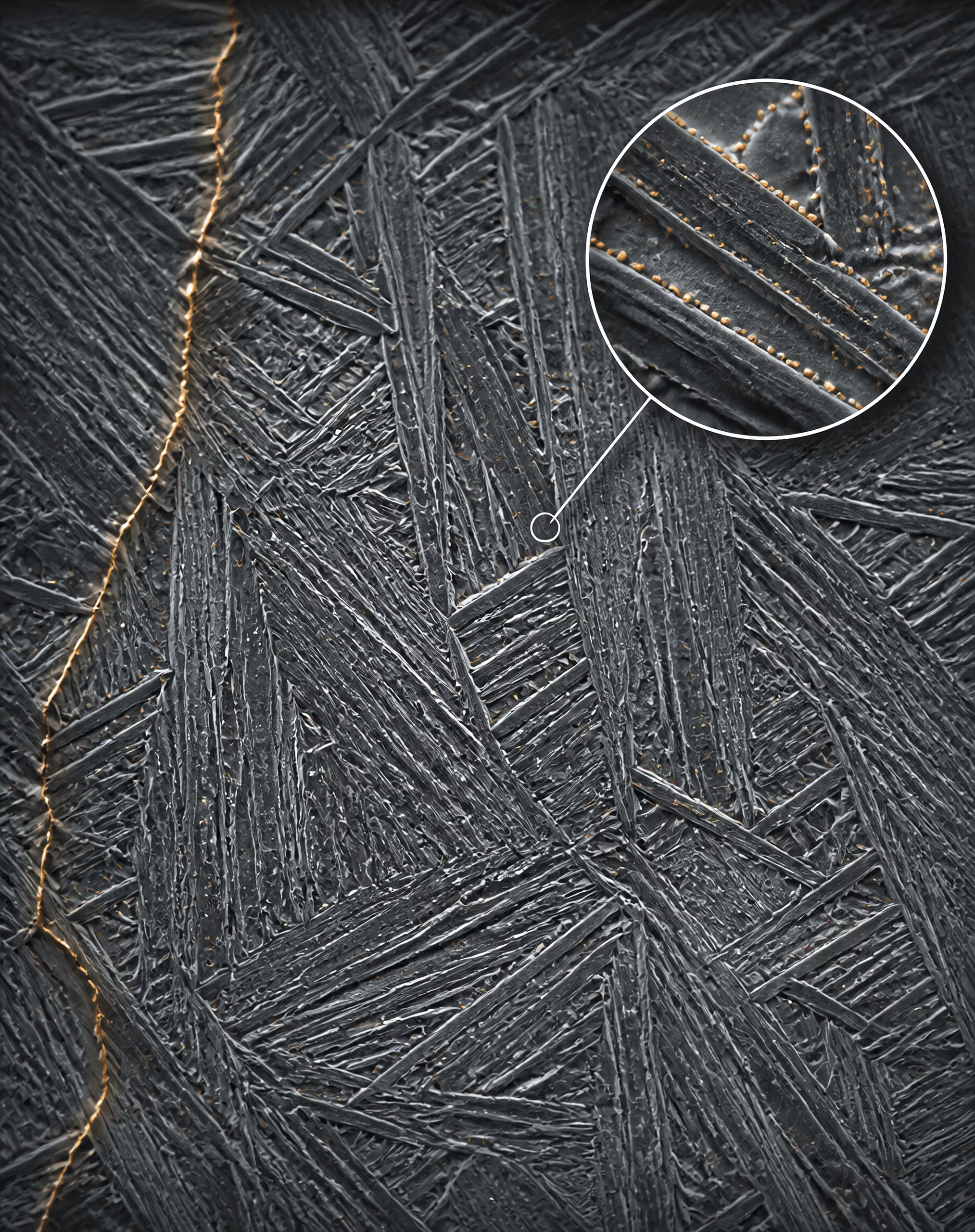
Maraging steel begins with a heat treatment that creates a martensitic matrix, but the first martensite is not the main source of its exceptional strength. The essential sequence is transformation followed by precipitation: solution annealing prepares a chemically suitable austenite, quenching converts that austenite into low-carbon lath martensite, and aging near 480 °C forms nanoscale intermetallic particles that obstruct deformation. Confusing these two hardening mechanisms leads to an incorrect description of maraging steel as merely a very hard quenched alloy.

Solution annealing and homogenization
The starting microstructure depends on the product form and prior processing, but the first major thermal step is solution annealing. The steel is heated into the austenitic region, commonly at a temperature specified by the grade and product standard, and held long enough for alloying elements to dissolve or redistribute through the iron-rich matrix. This treatment removes much of the chemical unevenness produced by casting, forging, rolling, or previous thermal exposure.
Nickel is central to the transformation behavior. In conventional grades, substantial nickel lowers the martensite-start temperature and allows austenite to transform during cooling without the high carbon content used in ordinary quenched-and-tempered steels. Cobalt and molybdenum also alter the phase stability and later precipitation response, while titanium and aluminum may participate in strengthening precipitates or affect their nucleation. Their presence is not interchangeable from grade to grade.
SAE AMS6515, for example, specifies double-vacuum-melted, annealed 18.5Ni-12.0Co-4.9Mo-1.40Ti-0.10Al steel for bars, forgings, tubing, and rings. That designation describes a particular composition and product condition, not every steel sold under the general maraging name. The 18Ni(250) grade identified by NASA is another designation used for a nominally 250 ksi class of material, while cobalt-free grades such as M789 rely on a different alloy balance. The heat treatment must therefore be matched to the specified chemistry.
During solution annealing, the aim is not simply to make the steel austenitic. The hold must also give alloying elements time to leave segregated regions and enter a more uniform solid solution. Excessive temperature or time can cause grain growth, incipient melting in segregated zones, or undesirable changes in precipitate-forming elements. Insufficient treatment can leave local composition differences that change transformation temperatures and produce uneven aging responses.
Homogenization is especially important where the material has experienced solidification segregation. A large ingot, a forged section, and a laser-powder-bed-fused part do not begin with the same chemical or defect structure. Additive manufacturing can introduce melt-pool boundaries, cellular segregation, residual stress, and lack-of-fusion defects before any conventional solution treatment occurs. The subsequent annealing schedule must address those features rather than assume that a wrought-steel cycle will produce the same result.
The ASM International heat-treatment reference describes the sequence as solution annealing, martensite formation, aging, precipitation, and short-range ordering. The first two stages establish the matrix. They do not yet create the dense population of strengthening particles responsible for the highest yield strengths.
Quenching into low-carbon lath martensite
After solution annealing, the austenite is cooled rapidly enough to suppress diffusional transformations such as ferrite or pearlite formation. The austenite then transforms by a largely diffusionless shear mechanism into martensite. In maraging steel, that product is generally a low-carbon iron-nickel lath martensite.
“Low carbon” is the decisive qualification. Carbon steels form martensite with carbon trapped in supersaturated interstitial sites. That carbon produces a large tetragonal distortion of the iron lattice and contributes strongly to the hardness of the as-quenched structure. The familiar high hardness of a water-quenched medium-carbon steel is therefore transformation hardening associated with carbon supersaturation, lattice strain, and a high density of defects.
Maraging steel takes a different route. Its carbon content is deliberately very low, often low enough that carbon cannot provide the dominant strengthening effect. Nickel stabilizes austenite during heating and depresses the transformation temperature, while the low carbon level allows the transformed martensite to remain closer to a low-distortion, body-centered-cubic or body-centered-tetragonal iron lattice with little tetragonality. The martensite forms as packets and laths, with dislocations and interfaces supplying useful strength and providing sites that later influence precipitation.
The lath morphology matters. Individual laths are arranged into packets within prior-austenite grains, and the high dislocation density generated during transformation gives the matrix a measurable level of strength. Yet this structure is not equivalent to carbon-rich martensite. It is less strained by interstitial carbon and usually much less hard immediately after quenching.
Cooling rate still matters, although the reason differs from the case of ordinary carbon steel. The section must cool sufficiently quickly to avoid unwanted diffusional products and excessive retained austenite, but the required rate depends on composition, section size, starting temperature, and the alloy’s transformation kinetics. Nickel-rich maraging grades can have considerable hardenability, allowing martensite to form through substantial sections under practical cooling conditions. A quench that is too slow, or a composition that stabilizes too much austenite, can alter the matrix available for aging.
Cobalt-bearing and cobalt-free grades should not be treated as identical during this step. Cobalt changes the balance among nickel, molybdenum, titanium, and other additions and affects both transformation and precipitation. M789, a cobalt-free maraging steel, was examined by the National Institute of Standards and Technology in Technical Note 2352 through solution-annealing, intercritical-annealing, and aging treatments after laser powder-bed fusion. Those treatments reflect a specific composition and manufacturing history; they cannot be transferred automatically to an 18Ni-Co-Mo grade such as the AMS6515 chemistry.
Why the as-quenched condition is comparatively soft
Quenching is necessary, but it does not deliver final maraging strength. The low-carbon martensite produced at this stage has a high dislocation density and can be stronger than a ferritic structure, yet it lacks the carbon supersaturation that makes conventional quenched martensite extremely hard. Much of the alloy’s nickel, molybdenum, titanium, aluminum, and related additions remain dissolved in the martensitic matrix rather than existing as a fine, obstructive precipitate population.
That condition is deliberately created. The relatively soft matrix permits subsequent aging to generate large increases in strength without relying on a high carbon content. During the aging treatment, commonly near 480 °C, intermetallic compounds nucleate and grow from the supersaturated martensite. Depending on the grade and thermal history, strengthening may involve nickel-molybdenum-rich particles and titanium- or aluminum-containing phases, together with short-range ordering. These particles impede dislocation motion far more effectively than the as-quenched low-carbon matrix alone.
NIST Internal Report 8582 states the process directly: solutionizing and quenching first produce relatively soft martensite, after which precipitation heat treatment generates fine precipitates and high strength, ductility, and toughness. ASM International reported commercial yield strengths from 1030 to 2420 MPa and identified intermetallic precipitation at approximately 480 °C. NASA describes 18Ni(250) as low-carbon iron-nickel lath martensite age hardened by intermetallic precipitation, with a strength class of approximately 250 ksi.
The distinction also matters in additive manufacturing. NIST’s 2024 fatigue-monitoring study found build-direction variations in hardness and stiffness in laser-powder-bed-fused maraging-steel specimens, while magnetic-permeability measurements detected fatigue damage before failure. Those observations show that the matrix and its defects depend on the processing route as well as on the nominal grade. Solution annealing and quenching establish the starting martensite; aging determines how much of the alloy’s precipitation potential becomes useful strength.
Aging, Precipitation, and Short-Range Ordering
Maraging steel gains its characteristic strength through two different metallurgical events. Solution treatment and quenching create a low-carbon, iron–nickel martensitic matrix; subsequent aging allows alloying elements to diffuse and form ordered intermetallic precipitates. The first step is transformation hardening, although the resulting martensite is comparatively soft because it contains very little carbon. The second step is precipitation hardening, which raises strength by obstructing dislocation motion with a dense population of nanoscale particles.
This distinction separates maraging steel from conventional quenched-and-tempered carbon or alloy steels. In a carbon-rich steel, supersaturated martensite is hard because carbon produces a strained body-centred tetragonal lattice. In maraging steel, carbon is deliberately kept very low, so the quenched matrix is generally a low-carbon, body-centred-cubic or body-centred-tetragonal lath martensite with modest intrinsic hardness. Its later strength comes mainly from nickel-, molybdenum-, titanium-, aluminium-, and related intermetallic reactions during aging.
The approximately 480 °C aging regime
ASM International describes maraging steels as very-low-carbon, high-nickel steels containing additions such as cobalt and molybdenum, strengthened by intermetallic precipitation at approximately 480 °C. That temperature is a useful reference point, not a universal prescription. The actual aging temperature and holding time depend on grade, product form, prior solution treatment, section size, furnace control, and the required balance of strength, toughness, ductility, and dimensional stability.
The conventional sequence is often stated as solution annealing, martensite formation, aging, precipitation, and short-range ordering. Solution annealing places the principal alloying elements into a sufficiently homogeneous austenitic solid solution. Quenching then suppresses diffusional transformation and produces lath martensite. Because the carbon content is low, this martensite is relatively soft and usually has limited quench distortion compared with high-carbon martensitic steels. During the later heat treatment, diffusion becomes fast enough for solute atoms to cluster, order locally, and develop into strengthening precipitates.
The approximate 480 °C regime is a compromise. At lower temperatures, diffusion is slower and the desired reactions may require longer times. At higher temperatures, precipitation can proceed rapidly, but particles may coarsen, competing phases may form, and overaging can reduce the resistance offered to dislocations. A nominal furnace temperature also does not describe the thermal history of a large forging or thick bar: the centre may reach the target temperature later than the surface, and cooling from solution treatment may produce different martensitic structures through the section.
For that reason, a published aging schedule should not be transferred between grades without checking the relevant specification. SAE AMS6515, for example, identifies a double-vacuum-melted, annealed steel with the designation 18.5Ni-12.0Co-4.9Mo-1.40Ti-0.10Al and covers bars, forgings, tubing, and rings. Its chemistry is not interchangeable with every steel sold under an 18Ni designation, nor with cobalt-free grades. NASA’s 2018 materials overview identifies 18Ni(250) as approximately 250 ksi, or about 1724 MPa, but that designation describes a strength class and composition family rather than a single heat-treatment result applicable to all products.
The time at temperature must be long enough for the intended precipitation reaction to reach the required degree. A short hold may leave the matrix underaged, with too few or too small a population of effective particles. A longer hold can increase strength initially, then reduce it as particles grow or lose coherency. Section size adds another variable because thermal lag, temperature gradients, and local chemistry can produce different aging responses between the surface and centre. Prior cold work, retained austenite, porosity, and segregation can also change the number and location of nucleation sites.

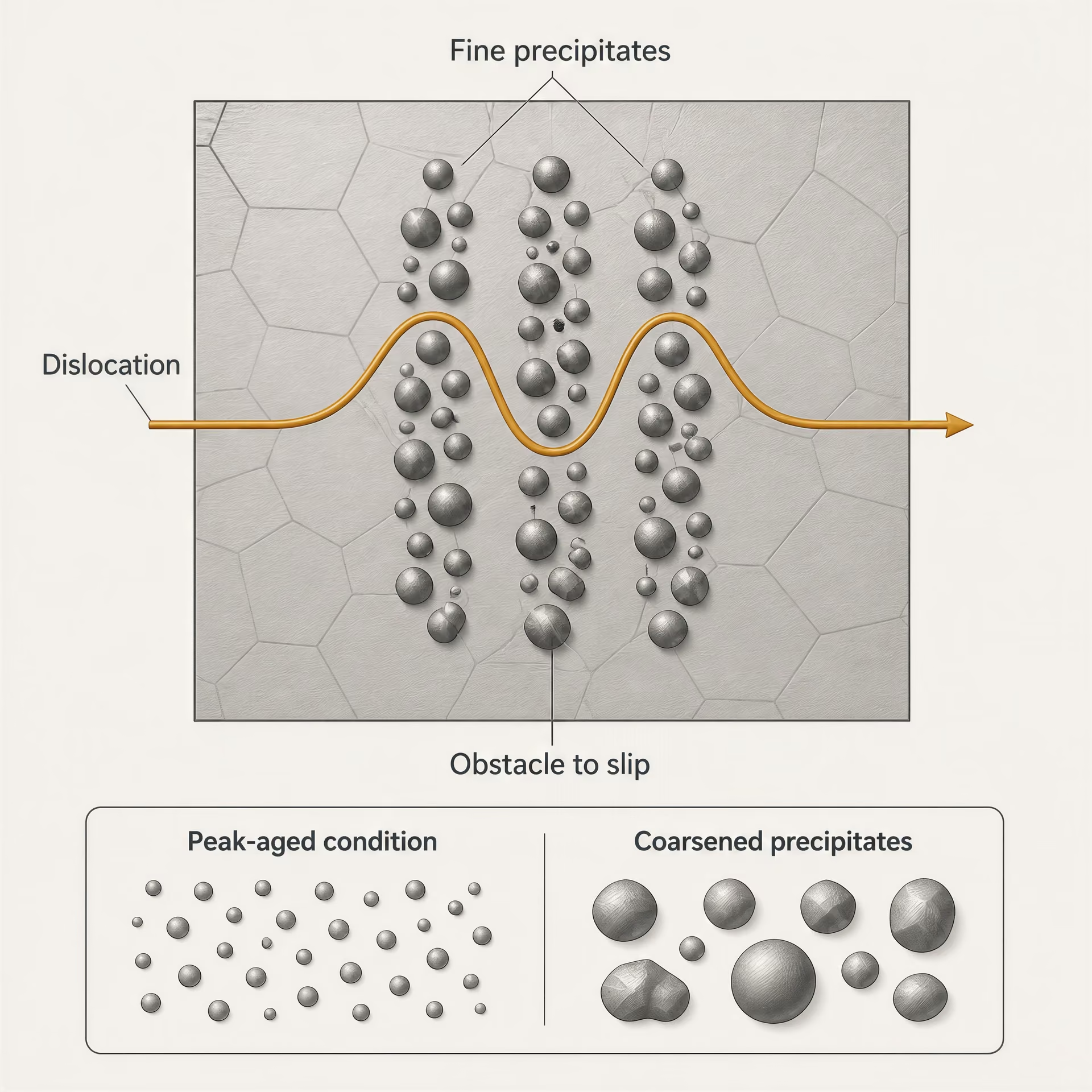
Intermetallic precipitates and matrix strengthening
NIST Internal Report 8582 describes the conventional route in direct terms: solutionizing and quenching first produce relatively soft martensite, followed by precipitation heat treatment that generates fine precipitates and high strength, ductility, and toughness. The precipitates are not simply “hard particles” added to a soft steel. Their size, spacing, crystal structure, composition, coherency, and distribution determine how effectively they impede plastic flow.
A newly aged matrix contains solute-rich regions and very fine precipitates. When the precipitate lattice has a relationship with the surrounding martensite, coherency strains develop at the interface. Those strains create an additional barrier to dislocation movement. Dislocations may cut through very small coherent particles, depending on their strength and structure, or bow between particles as the precipitates become less coherent and more widely separated. Peak strength occurs when the combined obstacle effect is high, commonly while the particles remain fine and closely spaced.
Nickel supplies the martensitic matrix and participates in several precipitation reactions, while molybdenum and titanium are especially important strengthening additions in many commercial grades. Cobalt affects the matrix and the solubility or precipitation behaviour of other elements, helping conventional cobalt-bearing grades reach high strength after aging. Aluminium may contribute to ordered phases and precipitation control. The exact sequence and phase assemblage vary with chemistry; naming one compound as though it governs every grade would be misleading.
Commercial maraging-steel yield strengths are reported across a range of 1030 to 2420 MPa. Strong evidence
Commercial yield strengths reported by ASM International in 2018 range from 1030 to 2420 MPa. That span reflects more than nominal nickel content. Grade chemistry, melting practice, inclusion content, solution treatment, aging condition, test direction, and product size all contribute. A 2420 MPa result cannot be treated as the defining response of every maraging steel, just as a lower-strength condition may reflect deliberate retention of toughness or machinability rather than an unsuccessful treatment.
The distinction from carbon-rich martensite remains important at this stage. Carbon-rich martensite obtains much of its hardness from a high density of lattice defects and the strain field generated by trapped carbon. Maraging steel’s aged strength is instead governed by intermetallic precipitation in a low-carbon lath matrix. This gives the material a useful processing sequence: machining can often be performed after solution treatment, before the final age hardening, when the workpiece is much softer and less prone to distortion than it would be after full precipitation treatment.
Cobalt-free steels show why composition must be considered directly. M789 is a cobalt-free maraging steel, so its precipitation response cannot be inferred from a cobalt-bearing 18Ni grade merely because both are called maraging steels. NIST Technical Note 2352 evaluates solution annealing, intercritical annealing, and aging treatments for cobalt-free M789 made by laser powder-bed fusion. The need to compare several thermal routes indicates that its as-built structure and precipitation behaviour require their own process window.
Short-range ordering, overaging, and property trade-offs
Short-range ordering describes local chemical arrangement before, alongside, or between the formation of identifiable precipitates. Solute atoms do not distribute randomly once diffusion begins. Neighbouring nickel, molybdenum, titanium, aluminium, and other atoms can develop preferred local associations, producing ordered regions that alter the matrix resistance to dislocation motion. In the ASM sequence, aging is followed by precipitation and short-range ordering as related parts of the hardening response, although the reactions overlap rather than occurring as perfectly separate steps.
Early ordering and clustering can increase strength before large, well-defined precipitates appear. With continued aging, these regions develop into more distinct intermetallic particles. The matrix then reaches a peak-aged condition when particle size and spacing provide a strong barrier to slip. Further exposure causes overaging: precipitates coarsen, their number density falls, interfaces become less effective, or equilibrium phases replace a finer metastable population. Strength and hardness decline, while ductility may rise. Toughness does not automatically improve, because coarse particles, reverted austenite, segregation, or defects can introduce new crack-initiation paths.
Temperature accelerates both useful precipitation and damaging coarsening. An accidental excursion above the specified aging temperature can therefore reduce strength even if the total time at temperature appears short. Conversely, an underaged condition may be selected when a lower strength level, greater forming capacity, or a different toughness balance is required. The relevant property is not hardness alone. Yield strength, ultimate tensile strength, elongation, fracture toughness, fatigue resistance, and dimensional change can respond differently to the same thermal treatment.
Additive manufacturing adds a separate process–structure problem. Laser-powder-bed fusion produces steep thermal gradients, repeated reheating, cellular segregation, residual stress, and build-direction effects before any conventional solution or aging treatment begins. NIST’s 2024 fatigue-monitoring study found build-direction variations in hardness and stiffness in laser-powder-bed-fused maraging-steel specimens. The same work reported that magnetic-permeability measurements could detect fatigue damage before failure, showing that the evolving magnetic response of the martensitic and precipitation-hardened structure can carry information that a final tensile test cannot provide.
Thus, aging at approximately 480 °C is a metallurgical regime, not a magic number. The final structure depends on what entered the furnace, how rapidly it was heated and cooled, how uniformly the section reached temperature, and which precipitate population the specification requires. Maraging steel is strong because a deliberately low-carbon martensitic matrix is given a controlled diffusion and ordering history—not because quenching alone produces exceptionally hard martensite.
Strength, Ductility, Toughness, and Failure Behavior
The commercial yield-strength range
Maraging steel is often described by its very high yield strength, but the number is a result of a particular composition and thermal history, not a fixed property of every steel carrying the maraging name. ASM International reported commercial yield strengths from 1030 to 2420 MPa in its 2018 ASM Handbook treatment of maraging steels. That range spans substantially different grades, aging conditions, product forms, and inspection requirements. It should be read as a description of commercial capability, not as a promise for an unspecified bar, plate, forging, wire, or additively manufactured component.[2] NIST Internal Report 8582. National Institute of Standards and Technology. NIST Internal Report, 2025. NIST Internal Report 8582
The defining sequence begins with transformation hardening. Austenite is solution annealed and then cooled so that the iron–nickel alloy transforms to a low-carbon lath martensite. Unlike the high-carbon martensite in many quenched-and-tempered steels, this matrix is relatively soft and tough immediately after quenching. NIST Internal Report 8582, published in 2025, describes solutionizing and quenching as producing relatively soft martensite, followed by precipitation heat treatment that forms fine precipitates and raises strength while retaining useful ductility and toughness.
The second step is precipitation hardening. During aging at approximately 480 °C, alloying elements form intermetallic phases and undergo short-range ordering. The precipitates obstruct dislocation motion; the matrix therefore resists plastic flow at stresses far above those of the as-quenched condition. The strength comes mainly from this controlled precipitation response, rather than from carbon strengthening of the martensite. Overaging coarsens or changes the precipitate population and can reduce yield strength, while an incomplete aging treatment leaves part of the available hardening response unused.
Grade designations provide a necessary warning against treating the range as interchangeable. NASA’s 2018 material overview identifies 18Ni(250) as approximately 250 ksi, or about 1725 MPa, while the SAE specification AMS6515 covers a specific double-vacuum-melted, annealed steel containing 18.5Ni-12.0Co-4.9Mo-1.40Ti-0.10Al. That chemistry is not a generic recipe for every 18Ni grade. Cobalt and molybdenum contribute to the precipitation system, titanium and aluminum affect precipitate formation, and nickel controls the martensitic transformation and matrix condition. A reported yield strength has meaning only when paired with the grade, product form, test orientation, solution and aging treatment, and governing specification.
Conventional cobalt-bearing grades and cobalt-free grades also cannot be assigned the same expected properties by name alone. Cobalt-free M789, for example, has a different alloy design and a different precipitation response from familiar cobalt-bearing 18Ni grades. NIST Technical Note 2352, published in 2025, evaluates solution annealing, intercritical annealing, and aging for laser-powder-bed-fused M789. Those treatments are process-specific variables, not interchangeable labels for a single universal heat treatment. The resulting yield strength, elongation, hardness, and toughness must be established for the stated grade and manufacturing route.
Why strength is not the only design variable
Yield strength indicates when substantial plastic deformation begins in a tensile test. It does not state how a component behaves after yielding, how rapidly a crack grows, or how much energy the material absorbs before fracture. A design that selects only the highest reported yield strength can trade away elongation, fracture resistance, fatigue life, dimensional stability, or tolerance of manufacturing defects.
The precipitate population controls this balance. Very fine, closely spaced intermetallic particles provide strong resistance to dislocation motion, but excessive precipitation can reduce the capacity for plastic redistribution around a notch. The matrix also matters. Lath morphology, reverted austenite, dislocation density, grain-boundary condition, and segregation affect how strain spreads through the material. A slightly lower-strength aging condition may provide greater elongation or crack-growth resistance than the peak-aged condition, particularly where the component contains holes, threads, sharp radii, weld transitions, or machining marks.
Ductility is not synonymous with toughness. Tensile elongation measures the total strain accumulated in a smooth specimen, whereas toughness describes resistance to crack initiation and propagation under a specified loading state. A material can show respectable elongation yet lose fracture resistance in a thick section, at low temperature, or under plane-strain constraint. Charpy impact energy, fracture toughness, crack-tip-opening displacement, and fatigue-crack-growth data answer different questions. None should be inferred from yield strength alone.
Residual stress adds another variable. Solution treatment, quenching, straightening, machining, welding, and aging can leave tensile or compressive stresses that alter local yielding and crack driving force. A high-strength maraging steel may tolerate a nominal applied stress in a simple tensile calculation while a tensile residual stress at a notch raises the effective stress intensity. Dimensional changes during aging can also matter in precision parts, even when the average shape change is small.
Variables that can control failure
- Inclusions Can initiate fatigue cracks or brittle fracture.
- Porosity Reduces load-bearing area and can act as a crack-initiation site.
- Residual stress Can increase local crack-driving force at notches or defects.
- Texture and direction Can produce different properties in longitudinal, transverse, or build directions.
- Environment Hydrogen, moisture, chlorides, and sustained tensile stress can affect cracking risk.
Defects are equally important. Nonmetallic inclusions, oxide films, pores, lack-of-fusion regions, seams, and coarse particles can initiate fatigue cracks or brittle fracture. The relevant defect population depends on melting practice, cleanliness, forging reduction, rolling direction, heat treatment, machining, and inspection. AMS6515’s double-vacuum-melted designation therefore carries metallurgical significance: it identifies a specified production route and chemistry, not merely a nominal strength class.
Testing direction must be read alongside the result. Rolled and forged products can be anisotropic because inclusions, segregation, grain flow, and prior processing are directionally distributed. Tensile properties measured longitudinally do not automatically establish transverse properties, short-transverse ductility, or fracture toughness through thickness. Mechanical-property requirements should be read together with the applicable material specification and heat-treatment condition, including specimen orientation and product form. “Aged” is insufficient unless the aging temperature, time, prior solution treatment, cooling procedure, and permitted processing are known.
Fracture, toughness, and environmental considerations
Maraging steels often combine high strength with useful ductility because their low-carbon martensitic matrix avoids the severe carbon-related brittleness associated with some quenched high-strength steels. That advantage has limits. Peak aging raises the stress needed for plastic flow, and high strength increases the elastic energy available to drive a crack. Notches, inclusions, sharp machining grooves, and local residual stresses can therefore become decisive failure sites.
Fatigue deserves separate treatment. Cyclic loading may initiate a crack at a surface imperfection or internal defect long before the component reaches its tensile yield strength. Once initiated, growth depends on stress ratio, frequency, environment, microstructure, and direction relative to the processed material. Additive manufacturing adds lack-of-fusion defects, keyhole pores, partially melted particles, rough surfaces, and thermal-history variation. These features can dominate fatigue behavior even when tensile coupons meet a specified strength.[3] In Situ Fatigue Monitoring Investigation of Additively Manufactured Maraging Steel. National Institute of Standards and Technology. NIST investigation, 2024. In Situ Fatigue Monitoring Investigation of Additively Manufactured Maraging Steel
NIST’s 2024 In Situ Fatigue Monitoring Investigation of Additively Manufactured Maraging Steel reported build-direction variations in hardness and stiffness in laser-powder-bed-fused specimens. The same work found that magnetic-permeability measurements could detect fatigue damage before failure. This result is significant because maraging steels are ferromagnetic in useful processing conditions, and changes in magnetic response can reflect evolving microstructural damage or stress state. It does not remove the need for conventional fatigue and fracture testing; it shows that process orientation and monitoring method can expose failure precursors hidden by a single tensile value.
The environment can alter failure behavior as well. High-strength steels may be susceptible to hydrogen-assisted cracking when hydrogen enters during pickling, electroplating, corrosion, welding, or service exposure. Moisture, chloride-containing environments, cathodic protection, and sustained tensile stress can increase concern for stress-corrosion or delayed cracking, depending on grade and condition. Surface treatments and cleaning procedures must therefore be assessed with the specified strength level and service environment rather than selected independently.
A sound design specifies the complete material state: grade designation, chemistry, melting route, product form, orientation, solution treatment, aging condition, minimum tensile and yield properties, elongation, hardness, toughness or fatigue requirements, and inspection limits. The central distinction remains decisive: transformation produces the low-carbon martensitic matrix; aging produces the intermetallic precipitates that supply most of the high strength. Failure behavior reflects both stages, plus defects, residual stress, direction, and environment. There is no single “maraging steel property” detached from that history.
AMS6515 as a Standards Case Study
SAE AMS6515 shows why a maraging steel cannot be identified adequately by a strength number or by a nominal alloy family alone. Its designation is:
Steel, Maraging, Bars, Forgings, Tubing, Rings, 18.5Ni-12.0Co-4.9Mo-1.40Ti-0.10Al, Double Vacuum Melted, Annealed.
That wording identifies chemistry, melting route, supply condition, and several permitted product forms in one line. The grade is not simply “18Ni maraging steel,” nor is it interchangeable with every alloy sold under an 18Ni, 250 ksi, or maraging label. SAE AMS6515 defines a controlled material and manufacturing route whose properties depend on what happens before, during, and after the steel is shaped.
The exact AMS6515 chemical designation
The chemical designation is 18.5Ni-12.0Co-4.9Mo-1.40Ti-0.10Al. These figures describe the principal alloying additions in the AMS6515 grade: approximately 18.5% nickel, 12.0% cobalt, 4.9% molybdenum, 1.40% titanium, and 0.10% aluminum, with iron as the balance and the specification controlling carbon, manganese, silicon, sulfur, phosphorus, and other limits.
The low-carbon matrix is central to the metallurgy. Conventional hardenable steels gain much of their as-quenched strength from carbon trapped in martensite. AMS6515 takes a different route. After solution treatment and cooling, its iron-nickel matrix forms low-carbon lath martensite that is comparatively soft and tough. The subsequent aging treatment supplies the main increase in strength through precipitation of fine intermetallic phases and associated short-range ordering.
ASM International’s 2018 Maraging Steels entry describes the class as very-low-carbon, high-nickel steels containing cobalt and molybdenum, with intermetallic precipitation at approximately 480 °C. Commercial maraging-steel yield strengths span about 1030 to 2420 MPa, a wide range that reflects grade chemistry and heat treatment rather than a single universal property. NASA’s 2018 material description identifies 18Ni(250) as approximately 250 ksi, or about 1724 MPa, but that designation is a strength-class shorthand, not a substitute for the full AMS product specification.
Nickel stabilizes the low-carbon austenitic structure during processing and supports formation of martensite on cooling. Cobalt and molybdenum participate in the precipitation-hardening system; titanium and aluminum also affect the precipitate population and response to aging. The exact balance matters. A cobalt-bearing alloy specified by AMS6515 should not be treated as chemically equivalent to a cobalt-free grade such as M789, even if both are called maraging steels and may reach similar strength levels after suitable processing.
This distinction separates transformation hardening from precipitation hardening. Quenching produces the martensitic matrix; aging produces the high-strength condition. NIST Internal Report 8582, published in 2025, describes the conventional sequence as solutionizing and quenching to form relatively soft martensite, followed by precipitation heat treatment that produces fine precipitates and high strength, ductility, and toughness. The matrix is therefore not an incidental starting condition. Its carbon content, morphology, dislocation structure, and thermal history determine how the later precipitation reaction proceeds.
Double-vacuum melting and annealed condition
“Double vacuum melted” is a manufacturing requirement, not a decorative quality label. For specialty steels, the phrase commonly denotes a vacuum-induction-melted heat followed by vacuum-arc remelting. The route reduces gases and unwanted inclusions, improves chemical homogeneity, and gives the producer tighter control over a steel intended for demanding forgings, rings, tubing, and bar products. The applicable AMS text governs the accepted melting practice; the important point is that AMS6515 identifies the route as part of the material specification.
Vacuum melting does not create maraging behavior by itself. It prepares a controlled starting material. The hardening response still depends on solution treatment, cooling, and aging. A heat with the right nominal chemistry but different segregation, inclusion content, or thermal history can show different fatigue, fracture, dimensional, or machining performance.
The second condition in the designation is annealed. AMS6515 is supplied in an annealed condition rather than as a fully aged, maximum-strength product. That condition leaves the material relatively soft compared with its final precipitation-hardened state, allowing machining and forming before the component receives its specified solution and aging treatments. The word also places limits on what the purchaser can infer from a tensile value: annealed bar is not automatically representative of the properties of an aged finished part.
The usual metallurgical sequence can be stated plainly:
1. solution annealing dissolves relevant alloying elements and establishes a suitable austenitic structure; 2. cooling produces low-carbon lath martensite; 3. aging near the appropriate temperature causes intermetallic precipitation and ordering; 4. the precipitate distribution raises strength while retaining more ductility and toughness than a comparably strong carbon-martensitic steel might provide.
A specification must control more than the final aging temperature. Heating rate, hold time, section size, quench conditions, prior deformation, and reheating during fabrication can alter the response. That is why an AMS designation is more informative than the phrase “250 ksi maraging steel.”
Covered product forms and specification language
SAE AMS6515 covers bars, forgings, mechanical tubing, flash-welded rings, and related forging stock, subject to the dimensions, processing conditions, and requirements stated in the document. Product form matters because a bar, a forged shape, a tube, and a welded ring do not experience identical thermal gradients, deformation histories, or grain-flow patterns.
The reference to mechanical tubing distinguishes the material from tubing categories defined only by pressure service or general corrosion requirements. Mechanical tubing is assessed as a manufactured structural product, with dimensions, condition, and mechanical requirements tied to its intended fabrication route. Flash-welded rings add another process variable: the ring is made by joining heated material under pressure, so the weld region and subsequent heat treatment must be included in acceptance and property control. Forging stock may be supplied for a later forging operation, meaning its condition is controlled even though the final component geometry does not yet exist.
Specification language also separates what is mandatory from what is merely typical. Chemical limits define the heat. Melting requirements define how that heat is produced. Annealed condition defines the supplied state. Product-form clauses define which shapes and manufacturing routes fall within the document. Testing and acceptance provisions then establish how compliance is demonstrated, including chemical analysis, mechanical testing, examination, dimensions, and correction or rejection of nonconforming material where applicable.
This matters even more when the production route changes. NIST Technical Note 2352, published in 2025, evaluates solution annealing, intercritical annealing, and aging in cobalt-free M789 made by laser powder-bed fusion. That work concerns a different alloy and a different solidification process; its heat-treatment results cannot simply be transferred to AMS6515. NIST’s 2024 fatigue-monitoring study likewise found build-direction variations in hardness and stiffness in laser-powder-bed-fused maraging-steel specimens, while magnetic-permeability measurements detected fatigue damage before failure. Additive manufacture therefore creates a separate process-structure problem involving melt-pool geometry, texture, porosity, residual stress, and anisotropic heat treatment.
AMS6515 captures the older but still essential engineering lesson: composition, melting, condition, form, testing, and acceptance are one connected material identity. The alloy name tells only part of the story.
Processing, Fabrication, and Dimensional Control
Maraging steel is processed through two substantially different property states. Solution annealing and cooling produce a low-carbon iron–nickel lath-martensite matrix that is relatively soft compared with the aged condition; a subsequent treatment near 480 °C precipitates strengthening intermetallic compounds. The distinction matters on the shop floor. The material is usually formed and heavily machined before aging, then finish-aged and inspected when its strength, hardness, and dimensional response have reached the specified condition.
This is not transformation hardening in the sense used for plain-carbon tool steels. Carbon content is deliberately very low, so cooling does not create a hard, carbon-supersaturated martensite. Nickel promotes martensite formation, while cobalt, molybdenum, titanium, aluminum, and related additions support precipitation and short-range ordering during aging. NIST Internal Report 8582 (2025) describes the sequence as solutionizing and quenching to form relatively soft martensite, followed by precipitation heat treatment that produces fine precipitates and high strength, ductility, and toughness. ASM International reports commercial yield strengths from 1030 to 2420 MPa, but that range covers different compositions, product forms, and heat treatments; it should not be applied to an unspecified “maraging steel.”
Machining before and after aging
Rough machining is normally performed in the annealed or solution-treated condition. In that state, the matrix has much lower hardness and cutting resistance than the aged steel, allowing larger stock removal with lower tool loads and less abrasive wear. The workpiece must still be supported carefully: thin walls, interrupted cuts, and long slender sections can move as residual stresses are released. A stress-relief treatment or controlled intermediate operation may be necessary where stock removal is unbalanced.
| Manufacturing stage | Typical objective | Main control concern |
|---|---|---|
| Annealed or solution-treated state | Rough machining and forming | Residual-stress release and support of thin sections |
| Stabilization or intermediate treatment | Reduce movement before final operations | Grade-specific thermal exposure |
| Aging | Develop intermetallic precipitation and final strength | Underaging, overaging, and temperature uniformity |
| Finish machining or grinding | Meet final dimensions and surface condition | Cutting forces, grinding burn, and surface tensile stress |
| Final inspection | Verify dimensions and properties | Correct specimen location, orientation, and condition |
The practical sequence is therefore often rough machine, stabilize or heat treat as specified, age, and then finish machine or grind. Allowance for final operations is important because aging can produce small but significant dimensional changes, especially in precision parts, long shafts, thin rings, and components with uneven section thickness. The magnitude is grade- and process-dependent rather than a universal constant. A drawing should identify the condition in which dimensions apply, and the heat-treatment procedure should state whether dimensional inspection follows aging, stabilization, or both.
Machining aged material is possible, but the cutting conditions must reflect its increased strength and hardness. The precipitated condition can impose higher cutting forces and greater risk of edge chipping, heat generation, and residual tensile stress at the machined surface. Carbide, ceramic, or other tooling choices, coolant practice, feed control, and interrupted-cut strategy belong in the process qualification rather than being copied from the annealed condition. Grinding may be preferred for close tolerances, although grinding burn and tensile surface stress remain concerns. A low-carbon matrix does not eliminate heat-treatment sensitivity.
The grade designation must accompany the machining plan. SAE AMS6515, for example, specifies double-vacuum-melted, annealed 18.5Ni-12.0Co-4.9Mo-1.40Ti-0.10Al steel in the product forms identified by that specification, including bars, forgings, tubing, and rings. That chemistry is not interchangeable with 18Ni(250), 18Ni(300), 18Ni(350), or a cobalt-free grade such as M789. Tool life, expected hardness after aging, allowable aging cycle, and dimensional correction can differ.
Distortion, residual stress, and section effects
Solution treatment and cooling establish the martensitic matrix, while aging changes the matrix through precipitation. Both stages can affect dimensions, but by different mechanisms. Quenching from the solution-treatment temperature creates thermal gradients and residual stress. Thick sections cool more slowly at their centers than at their surfaces; plates, forgings, rings, and hollow products therefore experience different cooling histories through the section. Aging then changes strength and may cause additional movement as precipitation proceeds and previously retained stresses relax.
Maraging steels generally show less quench distortion than high-carbon steels because the martensitic transformation occurs with comparatively small volume change. That advantage does not mean that quenching is dimensionally neutral. Thermal contraction, section-temperature differences, fixture restraint, prior cold work, and uneven machining stock can still bend or ovalize a part. Large forgings and rings demand particular attention to furnace loading, transfer time, quench agitation, and orientation. A nominally identical cycle can produce different results in a thin tube and a heavy bar.
Residual stress also affects later machining. Removing material from one side of a solution-treated plate can release balancing stress and change flatness; machining the same plate after aging may preserve the original shape more effectively but requires cutting a much stronger material. Neither option is automatically correct. A qualified route may include roughing with balanced stock removal, a stress-relief or intermediate heat treatment, semi-finishing, aging, and final grinding.
Temperature uniformity is central to precipitation control. ASM International identifies intermetallic precipitation at approximately 480 °C, but the specified time and temperature range depend on the grade and governing document. A furnace indicator alone does not prove that a heavy section has reached the required temperature. Load thermocouples, calibrated furnace surveys, controlled ramp rates, and documented soak times help establish that the whole part received the intended treatment. Overaging can reduce strength, while underaging can leave hardness and yield strength below specification. Surface decarburization is less central than in carbon steels, but contamination, oxidation, and furnace atmosphere can still affect surface condition and subsequent inspection.
Verification must relate to product location and orientation. Hardness should be measured at defined surfaces or sections, and tensile specimens should represent the required longitudinal, transverse, or tangential direction. A single easy-to-reach surface cannot establish the condition of a large ring or forging. Dimensional inspection after aging should include roundness, straightness, wall thickness, and datum relationships, not only isolated outside diameters.
Forgings, tubing, rings, and wrought-product differences
Product geometry changes the thermal and mechanical history before aging. A bar has a relatively simple section, while a forging may contain local changes in thickness, flow direction, and fiber orientation. Forging deformation can refine the structure and close internal discontinuities, but the final heat treatment still must produce uniform martensite and precipitation through the thickest region. Forging temperature, reduction, die filling, and post-forging cooling are therefore part of the material condition, not merely shape-making details.
Rings introduce circumferential and radial differences. Their wall thickness, upset or rolled-ring history, machining allowance, and quench orientation influence residual stress and properties. Tensile sampling may need longitudinal or tangential specimens, depending on the specification and application. A ring that meets hardness at its outside diameter may still require separate checks through the wall and around the circumference.
Tubing combines thin walls with high surface-area-to-volume ratio. It can cool quickly and develop less through-wall temperature difference than a heavy forging, yet ovality, wall-thickness variation, straightness, and handling distortion become more important. Mandrels, plugs, supports, and fixtures can restrain movement during heat treatment and create local stress. The product specification controls whether tubing is supplied annealed, solution treated, aged, or subject to additional cold-work requirements.
Wrought-product data cannot be transferred automatically to additively manufactured material. Laser-powder-bed-fused cobalt-free M789 contains process-dependent melt-pool boundaries, texture, porosity, and residual stress that are absent or differently distributed in conventional bar and forging stock. NIST Technical Note 2352 (2025) evaluates solution annealing, intercritical annealing, and aging treatments for this material, showing why the heat-treatment route must be qualified for the build process. NIST’s 2024 fatigue-monitoring study also found build-direction variations in hardness and stiffness. Magnetic-permeability measurements detected fatigue damage before failure, offering a process-monitoring and inspection signal rather than a substitute for mechanical qualification. Geometry, build orientation, support removal, heat treatment, and specimen direction must all be recorded when establishing properties for a printed maraging-steel part.
Cobalt-Free Maraging Steels and M789
Why cobalt-free grades were developed
Maraging steel is defined less by a single strength value than by the sequence that creates its microstructure. The steel is first solution annealed and quenched to form low-carbon, iron–nickel lath martensite. This martensite is relatively soft because it is not the carbon-supersaturated martensite found in conventional quenched-and-tempered steels. Strength develops later, during aging, when intermetallic compounds precipitate through the martensitic matrix.
That distinction separates transformation hardening from precipitation hardening. Quenching supplies the matrix and its lath structure; aging supplies most of the final strength. NIST Internal Report 8582, published in 2025, describes the conventional sequence as solutionizing and quenching to produce relatively soft martensite, followed by precipitation heat treatment that forms fine precipitates and raises strength, ductility, and toughness. ASM International describes precipitation at approximately 480 °C, with commercial maraging-steel yield strengths spanning 1030 to 2420 MPa.
Traditional grades obtain part of their precipitation response from cobalt. Cobalt reduces the solubility of molybdenum in the iron–nickel matrix during solution treatment, so aging can produce a greater population of strengthening molybdenum-rich intermetallic particles. It also affects the transformation and tempering response of the matrix. The result is an effective route to high strength, but it creates dependence on an alloying element whose supply, cost, and geopolitical concentration have encouraged alternatives.
Cobalt-free development was therefore a materials-design response, not merely a substitution exercise. Researchers sought compositions that could produce a comparable precipitate population without relying on cobalt, while retaining the low-carbon martensitic structure that makes maraging steels distinct. The supplied research statement identifies comparable strength and ductility to 18Ni(250) as a development objective. That target matters because 18Ni(250) is not just a nominal composition: NASA identifies it as a maraging grade with a strength level of approximately 250 ksi, or about 1724 MPa.
The reference designation also has a precise alloy meaning. SAE AMS6515 specifies double-vacuum-melted, annealed 18.5Ni-12.0Co-4.9Mo-1.40Ti-0.10Al steel in bar, forging, tubing, and ring product forms. This composition illustrates the conventional cobalt-bearing approach: nickel stabilizes the low-carbon martensitic matrix, cobalt and molybdenum support precipitation strengthening, and titanium and aluminum participate in the formation of strengthening phases. A cobalt-free grade cannot be judged by removing the 12.0 percent cobalt from this formula and leaving every other variable unchanged.
Comparing cobalt-bearing and cobalt-free strengthening strategies
| Feature | Cobalt-bearing grades | Cobalt-free grades such as M789 |
|---|---|---|
| Matrix | Low-carbon iron–nickel lath martensite | Low-carbon iron–nickel lath martensite |
| Strengthening route | Intermetallic precipitation and ordering | Intermetallic precipitation and ordering |
| Cobalt | Present in many conventional grades | Intentionally omitted |
| Heat-treatment response | Controlled by the specified grade and schedule | Requires a grade-specific process window |
| Manufacturing-route sensitivity | Depends on wrought or other product history | Especially significant in LPBF material |
Cobalt-bearing and cobalt-free maraging steels share the same broad architecture, but they do not achieve strength through identical precipitation chemistry. In both families, low carbon limits carbide formation and permits the formation of a tough, relatively ductile lath-martensite matrix after quenching. Aging then produces nanoscale intermetallic precipitates and may also involve short-range ordering. ASM’s heat-treatment description follows this sequence as solution annealing, martensite formation, aging, precipitation, and short-range ordering.
The difference lies in how the alloy balances solute content, matrix stability, and precipitate formation. Conventional cobalt-bearing grades use cobalt to make molybdenum precipitation more effective during aging. Cobalt-free grades must compensate through other changes: altered nickel, molybdenum, titanium, aluminum, chromium, or other solute levels; different precipitate-forming reactions; and carefully selected solution and aging treatments. The precise mechanism depends on the grade. “Cobalt-free maraging steel” describes a design family, not one interchangeable chemical specification.
This is why strength comparisons require more than a tensile-test number. A grade may reach a similar yield strength through a different precipitate size distribution, a different martensite morphology, or a different balance between matrix strength and crack resistance. Overaging can coarsen precipitates and reduce strength, while insufficient aging leaves the available strengthening reactions incomplete. Solution treatment also controls how much solute remains available for precipitation and how uniform the prior microstructure becomes.
Cobalt-free development consequently pursued a balance rather than a single maximum value. Matching 18Ni(250) in strength while retaining comparable ductility requires control of both phases: the martensitic matrix must remain capable of plastic deformation, and the precipitates must be numerous and fine enough to impede dislocation motion without creating severe embrittlement. A nominally similar tensile strength does not prove metallurgical equivalence.
M789 is a distinct cobalt-free grade within this wider effort. It should not be described as a chemical replacement for conventional 18Ni grades, because its composition, precipitation reactions, heat-treatment window, and response to manufacturing history are separate matters. The grade designation identifies a particular alloy system and processing specification; it does not imply that the solution-annealing or aging schedule used for 18Ni(250), 18Ni(300), or the AMS6515 material can be transferred without validation.
M789 made by laser powder-bed fusion
Laser powder-bed fusion adds another layer to the metallurgy. The material is melted and solidified in many small tracks and layers, with steep thermal gradients, rapid cooling, repeated reheating, and a build direction that can introduce texture and local variation. The as-built condition may therefore contain segregation, residual stress, cellular substructure, and nonuniform precipitation potential even before conventional aging begins.
For laser-powder-bed-fused M789, heat treatment is not a single fixed step. NIST Technical Note 2352, published in 2025, evaluates solution annealing, intercritical annealing, and aging treatments for this cobalt-free grade. Solution annealing is intended to redistribute solute and reduce the effects of the as-built thermal history. Intercritical annealing introduces a different route for modifying the matrix and phase balance before aging. Aging then determines the size, density, and distribution of the strengthening precipitates. The chosen sequence can therefore change hardness, tensile behavior, ductility, and anisotropy even when the alloy powder is nominally the same.
The additive route also makes direction-dependent testing essential. In a 2024 NIST investigation of additively manufactured maraging steel, laser-powder-bed-fused specimens showed build-direction variations in hardness and stiffness. Those differences reflect the interaction between layerwise solidification, defect populations, texture, and heat treatment. They are not evidence that M789 has a different fundamental strengthening principle; they show that the processing route modifies how that principle is expressed.
NIST’s fatigue-monitoring work reported another important result: magnetic-permeability measurements could detect fatigue damage before failure. Maraging steels respond to mechanical damage through changes in their martensitic and precipitate-containing microstructure, and those changes can affect magnetic behavior. For additively manufactured material, such monitoring is useful because fatigue performance may be influenced by lack-of-fusion defects, surface condition, residual stress, and build orientation as well as by precipitation state.
M789 thus demonstrates the central point of cobalt-free maraging metallurgy. Removing cobalt does not reduce the problem to a revised recipe. The grade must be designed around its own precipitation chemistry, then processed through a heat-treatment schedule suited to its starting microstructure. With laser powder-bed fusion, the powder, scan history, build direction, post-build anneal, and aging treatment all contribute to the final result.
Additive Manufacturing Changes the Metallurgical Problem
Maraging steel made by laser powder-bed fusion (LPBF) does not enter heat treatment with the same structure as bar, plate, or forgings. The conventional sequence is comparatively clear: solutionizing dissolves alloying elements, quenching produces a relatively soft low-carbon martensite, and aging near 480 °C precipitates intermetallic compounds that raise strength. NIST Internal Report 8582 (2025) describes this sequence as solutionizing and quenching followed by precipitation heat treatment, with fine precipitates providing high strength, ductility, and toughness. Additive manufacturing inserts another sequence before those operations: repeated melting, rapid solidification, reheating by later tracks and layers, cooling into a constrained part, and sometimes stress relief before final aging.
That distinction matters because transformation hardening and precipitation hardening do different work. Maraging steel is not primarily strengthened by carbon-rich martensite. ASM International describes the family as very-low-carbon, high-nickel steels containing additions such as cobalt and molybdenum; their commercial yield strengths range from 1030 to 2420 MPa, with intermetallic precipitation occurring at approximately 480 °C. The martensitic matrix supplies the structure in which precipitation occurs, but the major increase in hardness and yield strength follows the formation of nanoscale or near-nanoscale intermetallic phases and short-range ordering during aging.
LPBF changes both the starting martensite and the path by which precipitates later form.

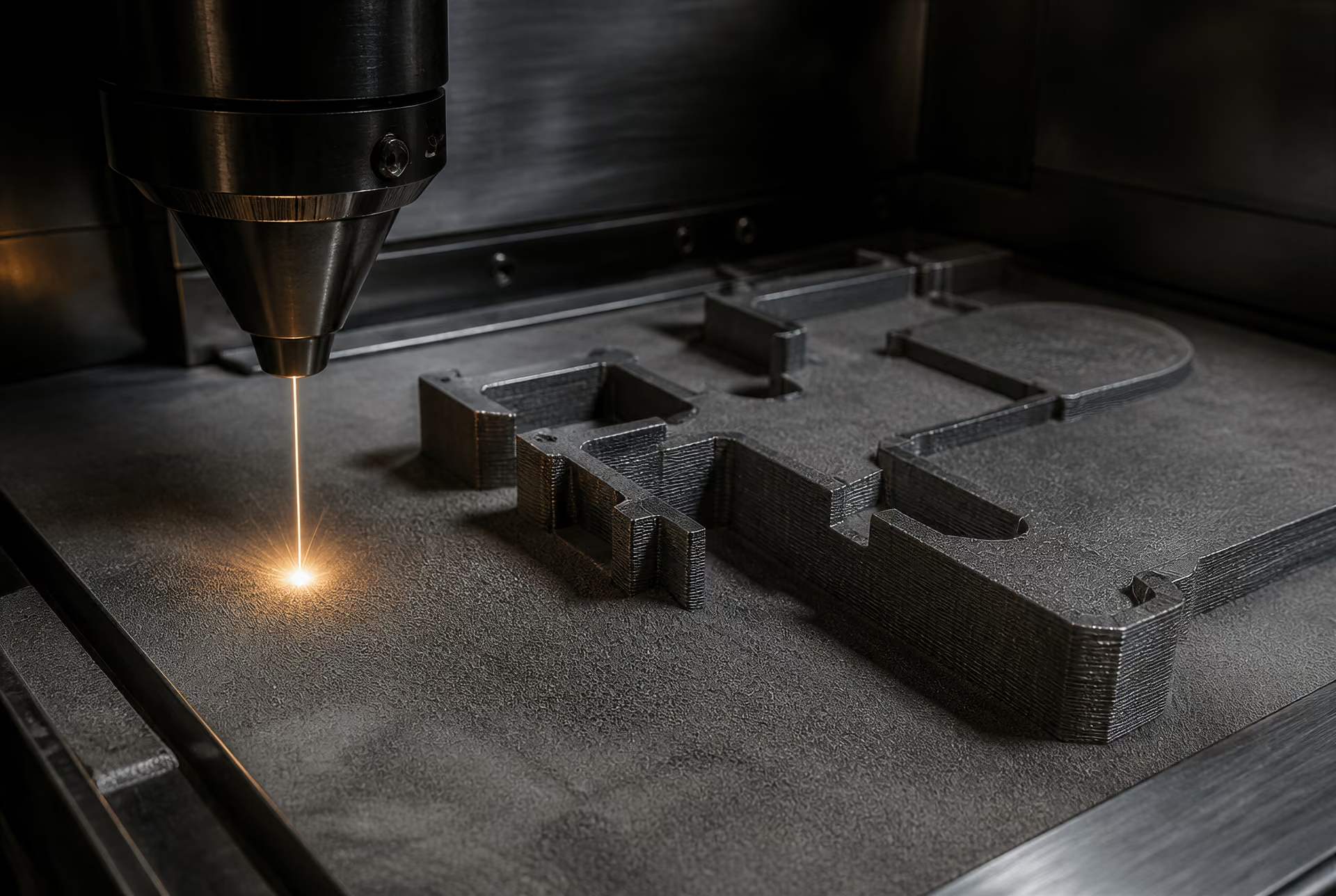
Laser powder-bed fusion and directional microstructures
In LPBF, a focused laser scans a thin powder layer and creates a sequence of overlapping melt pools. Each pool has a steep temperature gradient: material near the fusion boundary is heated and partially remelted, while material above the pool cools rapidly. The next layer then reheats part of the previous one. A component therefore contains many local thermal histories rather than one furnace exposure. Scan direction, layer thickness, laser power, scan speed, hatch spacing, and build interruption all affect that history.
Rapid solidification can produce fine cellular or columnar structures aligned with the thermal gradient. Those gradients usually have a strong relationship to the build direction, so grain morphology and crystallographic texture can become directional. Melt-pool boundaries may remain visible in the as-built condition, although later heat treatment can reduce or erase some of their contrast. The resulting structure is not simply “quenched martensite” in the conventional sense; it is martensite formed after a sequence of solidification and reheating events, with local segregation and precipitation potential inherited from those events.
Defects add a second problem. Lack-of-fusion pores result when adjacent tracks or layers do not bond completely. Gas pores may originate in the powder or become trapped during melting. Keyhole instability can generate larger irregular voids. These defects reduce load-bearing area and act as fatigue-crack initiation sites, while their position relative to the build direction affects the measured response. Residual stress is also generated because the laser-heated region expands and contracts while surrounded by cooler, less compliant material. Distortion, microcracking risk, and local changes in phase stability can follow.
Composition controls how consequential these effects become. A cobalt-bearing grade such as 18Ni(250) cannot be treated as interchangeable with a cobalt-free grade. NASA’s 2018 material definition identifies 18Ni(250) as approximately 250 ksi, while SAE AMS6515 specifies a particular double-vacuum-melted, annealed steel containing 18.5Ni-12.0Co-4.9Mo-1.40Ti-0.10Al. The designation is tied to composition and product form, not merely to a nominal strength class. Cobalt-free M789 has a different alloy balance and therefore a different response to segregation, martensite formation, solution treatment, and aging.
Solution and intercritical annealing in printed material
For conventional material, solution annealing is intended to place the alloying elements into a suitable solid solution before martensite forms on cooling. In LPBF material, the treatment also acts on cellular segregation, melt-pool remnants, residual stress, and the nonuniform structures produced by repeated reheating. Temperature and time must be considered together. A treatment that dissolves unwanted segregation may also promote grain growth, alter texture, or change the distribution of pores and inclusions without removing them.
NIST Technical Note 2352 (2025) specifically evaluates solution annealing, intercritical annealing, and aging in laser-powder-bed-fused cobalt-free M789. That study should not be read as establishing one universal schedule for every printed maraging steel. It establishes that these variables require investigation because the LPBF starting condition differs from conventionally processed stock.
Intercritical annealing is especially significant because it places the steel in a temperature interval where the phase constitution can differ from that produced by a conventional full solution treatment. In a printed alloy, this treatment may modify the martensitic morphology, reverse-transformed regions, segregation pattern, or austenite fraction. The result can affect both hardness and ductility before aging, and it can change where and how intermetallic precipitates form afterward. Whether that change is beneficial depends on M789’s composition, the as-built density, the prior thermal cycle, and the required mechanical test direction.
Aging remains the precipitation-hardening step, but “aging at approximately 480 °C” is a metallurgical description rather than a complete manufacturing instruction. Time, temperature, heating rate, prior annealing, and cooling conditions govern nucleation, growth, coarsening, and short-range ordering. Underaging leaves some strengthening potential unused; overaging can coarsen precipitates and reduce strength. Printed material may also contain a nonuniform population of nucleation sites created by cellular segregation and melt-pool reheating. Consequently, an aging response measured in a dense, stress-relieved LPBF coupon cannot automatically be assigned to every geometry or build parameter.
The transformation sequence also deserves care. Low carbon promotes a relatively soft, tough iron-nickel martensitic matrix rather than the high-carbon martensite associated with ordinary quenched-and-tempered steels. Aging then supplies much of the hardness increase through intermetallic precipitation. If LPBF thermal cycles produce retained or reverted austenite, or if annealing changes the fraction of those phases, the final result reflects more than precipitate density alone.
Build-direction differences in hardness and stiffness
An LPBF part is often tested along, across, and sometimes at an angle to the build direction because its structure is directional. The differences can arise from several sources at once: columnar grain growth, crystallographic texture, melt-pool boundaries, porosity alignment, residual stress, and the orientation of fatigue-sensitive defects. Heat treatment may reduce some differences, but it does not guarantee isotropic properties.
NIST’s 2024 study, In Situ Fatigue Monitoring Investigation of Additively Manufactured Maraging Steel, reported build-direction variations in hardness and stiffness in laser-powder-bed-fused maraging-steel specimens. The finding is important precisely because hardness and stiffness are not interchangeable measures. Hardness is strongly affected by martensite condition and precipitate state; stiffness is more closely related to elastic response, texture, porosity, and the effective load-bearing structure. A direction-dependent hardness value can therefore indicate differences in aging or phase constitution, while a direction-dependent stiffness value may point more strongly toward texture, defects, or residual stress.
The same NIST work found that magnetic-permeability measurements could detect fatigue damage before failure. That observation connects the magnetic response to evolving microstructure and damage, rather than treating the printed component as mechanically uniform until a crack becomes visible. It also shows why post-build heat treatment and inspection must be considered together. A treatment can change magnetic response, hardness, residual stress, and fatigue behavior at the same time.
The practical metallurgical question is thus not whether LPBF “works” for maraging steel in the abstract. It is whether a specified powder chemistry, scan strategy, density, build orientation, annealing route, and aging schedule produce a controlled martensitic matrix and a controlled precipitate population with acceptable directional properties. For cobalt-bearing grades and cobalt-free M789, those answers may differ. Additive manufacturing does not replace the maraging sequence; it makes the prior thermal history part of that sequence.
Testing, Characterization, and In-Situ Fatigue Monitoring
Maraging steel cannot be characterized by a single tensile strength value. The measured response depends on grade, product form, heat-treatment condition, specimen orientation, and manufacturing route. A solution-annealed bar, an aged forging, and a laser-powder-bed-fused part made from cobalt-free M789 may all be called maraging steel while containing different precipitate populations, defect structures, and residual stresses.
The metallurgical sequence explains why. Unlike conventional quenched-and-tempered steels, maraging steels contain very little carbon and do not obtain their principal strength from carbon-rich martensite. Solution annealing and quenching produce a relatively soft, low-carbon iron–nickel lath-martensite matrix. Aging, commonly near 480 °C, then forms fine intermetallic precipitates and promotes short-range ordering. ASM International’s 2018 description gives commercial yield strengths from 1030 to 2420 MPa, but those values represent different compositions and conditions rather than one intrinsic property of the maraging-steel family.
Mechanical tests and direction-dependent results
Tensile testing should report the complete condition: grade designation, product form, solution treatment, aging treatment, specimen orientation, test temperature, and strain rate. Yield strength, ultimate tensile strength, elongation, and reduction of area can shift substantially with aging time. Underaging may leave strength below the specified condition while retaining useful ductility; overaging coarsens or changes the precipitate population and can reduce strength even as dimensional stability changes.
The distinction between transformation hardening and precipitation hardening matters during interpretation. Quenching does produce martensite, but in a low-carbon maraging composition that martensite is comparatively soft and tough. The NIST Internal Report 8582, published in 2025, describes solutionizing and quenching as the first step, followed by precipitation heat treatment that generates fine precipitates and the high strength, ductility, and toughness associated with the aged condition. A tensile result from solution-treated material therefore cannot stand in for an aged-grade result.
Standards and grade names also require care. NASA identifies 18Ni(250) as approximately 250 ksi, or about 1724 MPa, but that designation does not make every 18Ni alloy equivalent to it. SAE AMS6515 specifies a particular double-vacuum-melted, annealed steel designated “18.5Ni-12.0Co-4.9Mo-1.40Ti-0.10Al,” supplied as bars, forgings, tubing, or rings. Its chemistry and product-form requirements must not be transferred to a cobalt-free alloy by assumption.
Cobalt-bearing grades such as 18Ni(200), 18Ni(250), and 18Ni(300) use nickel, cobalt, molybdenum, titanium, and sometimes aluminum to establish their precipitation response. Cobalt-free M789 is a separate alloy system, not a direct chemical substitute. Its heat-treatment window, precipitate chemistry, retained austenite behavior, and response to manufacturing defects require separate measurement. NIST Technical Note 2352, published in 2025, specifically evaluates solution annealing, intercritical annealing, and aging treatments for laser-powder-bed-fused M789.
Mechanical tests must also account for direction. Rolled or forged products may show longitudinal and transverse differences from texture, segregation, inclusion alignment, and flow lines. Additive parts add build direction, layer interfaces, scan strategy, hatch spacing, contour passes, and heat accumulation to the list. In a 2024 NIST investigation of additively manufactured maraging steel, specimens displayed build-direction variations in hardness and stiffness. That finding is a warning against treating an isotropic material model as automatically valid for a printed component.
Fatigue testing should use the orientation and surface condition expected in service. Stress-controlled and strain-controlled tests can reveal different damage trends, while crack-growth testing measures a different property from smooth-specimen endurance testing. Notched specimens, residual stress, surface roughness, lack-of-fusion pores, gas porosity, and inclusions may dominate results in additively manufactured material. Fracture toughness and fatigue-crack-growth tests are therefore needed when a component assessment depends on an existing flaw rather than on nominal strength alone.
Hardness, stiffness, and microstructural examination
Hardness testing is a rapid condition check, not a substitute for tensile or fatigue characterization. Rockwell C, Vickers, and microhardness measurements can identify the increase caused by aging and can map local variation across a weld, build, heat-affected region, or machined surface. A hardness traverse through an additively manufactured part may reveal thermal-history differences that a single bulk reading conceals. However, hardness conversion between scales introduces uncertainty, especially at very high hardness or across gradients.
Elastic stiffness is usually described by Young’s modulus, shear modulus, or an ultrasonic modulus rather than by hardness. Aging can change the modulus less dramatically than it changes yield strength, but porosity, cracking, crystallographic texture, and build direction can produce measurable differences. The NIST build-direction result is therefore important: a stiffness variation may reflect process structure, defects, texture, or measurement geometry, and it should not be dismissed merely because the alloy has the same nominal chemistry.
Microstructural examination connects those measurements to the strengthening mechanism. Optical microscopy can reveal prior melt-pool geometry, grain morphology, banding, and gross porosity. Scanning electron microscopy is suited to fracture surfaces and precipitate-related contrast, while transmission electron microscopy can resolve nanoscale intermetallic particles that are too small for routine optical examination. Electron backscatter diffraction can map lath-martensite packets, crystallographic texture, local misorientation, and recrystallized regions. X-ray diffraction can assist with phase identification, residual-stress measurement, and detection of retained or reverted austenite.
The examination should compare solution-treated, aged, and fatigued material. Overaging, reverted austenite, precipitate coarsening, and crack-tip deformation can produce different signatures even when bulk hardness is similar. In laser powder-bed fusion, lack-of-fusion defects and unmelted-powder remnants may provide a shorter path to failure than a change in matrix precipitation. A meaningful report links the observed fracture or fatigue behavior to the actual thermal cycle rather than assigning every difference to the nominal grade.
Magnetic permeability as a fatigue-monitoring signal
Magnetic permeability A measure of how readily a material supports magnetic flux; changes in stress, microstructure, or damage can alter the measured response.
Maraging steel is ferromagnetic, so its magnetic response can provide information about changes in stress state, microstructure, and damage. Magnetic permeability describes how readily the material supports magnetic flux. Plastic deformation, dislocation rearrangement, crack formation, residual stress, and phase changes can alter magnetic-domain behavior and therefore shift a measured signal. The response is not unique to fatigue damage, which makes calibration and control of measurement conditions essential.
NIST’s 2024 study, In-Situ Fatigue Monitoring Investigation of Additively Manufactured Maraging Steel, reported that magnetic-permeability measurements detected fatigue damage before specimen failure. That result is significant because it indicates a possible non-contact or minimally intrusive signal for tracking damage during cyclic loading. A permeability trend could identify a transition from stable deformation to accelerating damage before a visible crack or final fracture appears.
The finding remains a monitoring and research result, not a replacement for qualification. Permeability is affected by alloy chemistry, aging condition, build direction, texture, residual stress, probe position, lift-off, geometry, temperature, and electromagnetic history. A signal change must therefore be correlated with companion evidence such as load-cycle data, strain measurement, acoustic emission, microscopy, crack-length measurement, or post-test fractography.
Formal fatigue testing still establishes the relation between stress, cycles, environment, and failure probability. Fracture mechanics still determines how a known crack grows and whether a critical flaw can be tolerated. Component qualification still requires specified material controls, process qualification, inspection methods, acceptance criteria, and representative geometry. Magnetic monitoring can add an early warning or produce valuable research data, but it cannot by itself certify a maraging-steel part or replace a validated damage-tolerance assessment.
Applications and Selection Logic Without Marketing Claims
Aerospace and tooling contexts
Maraging steel is selected in aerospace and tooling contexts for a particular sequence of properties, not for tensile strength alone. Its matrix is a very-low-carbon, iron–nickel lath martensite formed during cooling from solution-annealing temperature. That transformation hardens the steel only moderately: NIST Internal Report 8582 describes the quenched martensite as relatively soft before the subsequent precipitation treatment. Aging near 480 °C then produces fine intermetallic precipitates, with short-range ordering also contributing to the strengthening sequence identified by ASM International.
This distinction affects how the material is processed into a component. A solution-treated part can be machined, formed, or otherwise finished before aging, after which its strength rises substantially. ASM International reported commercial yield strengths from 1030 to 2420 MPa in 2018, while NASA identifies 18Ni(250) as a grade with approximately 250 ksi strength. Those figures describe particular grades and conditions; they do not represent a universal property of every steel sold under the maraging designation.
Aerospace hardware may therefore involve parts whose geometry, mass, and heat-treatment access make the solution-treated condition useful during manufacture, followed by aging after critical machining operations. Tooling contexts can involve dies, molds, or forming components where high compressive and tensile strength must coexist with controlled dimensions. The relevant material characteristic is the combination of a low-carbon martensitic matrix, precipitation response, and the ability to specify a heat-treatment condition—not a general claim that maraging steel suits every highly loaded part.
The product form also constrains the application. SAE AMS6515, for example, specifies double-vacuum-melted, annealed steel in the composition designation 18.5Ni-12.0Co-4.9Mo-1.40Ti-0.10Al and covers bars, forgings, tubing, and rings. A requirement written around AMS6515 cannot be satisfied merely by naming “maraging steel”; the melt practice, chemistry, product form, and annealed condition are part of the material definition.
When high strength is insufficient as a selection criterion
A high yield-strength number does not establish adequate fracture resistance, fatigue life, dimensional stability, or manufacturing compatibility. Maraging steels are strengthened by precipitates introduced after martensite formation, so the final condition depends on solutionizing, cooling, aging temperature, aging time, and section size. A furnace cycle that produces the intended precipitation state in a small coupon may not produce the same result through a thick ring or forging. Verification must therefore include the actual product form and thermally representative location.
Toughness deserves separate treatment. The low-carbon matrix avoids the carbon-rich martensitic condition associated with many conventional quenched-and-tempered steels, but toughness still depends on grade, inclusion content, prior processing, precipitate population, and heat treatment. A specification based only on hardness or yield strength can miss the fracture behavior required at a notch, fastener hole, fillet, or crack-like defect.
Fatigue adds another limitation. The cyclic response is affected by surface finish, residual stress, inclusions, porosity, geometry, and directional structure. These factors become especially important in additively manufactured material. NIST’s 2024 In Situ Fatigue Monitoring Investigation of Additively Manufactured Maraging Steel reported build-direction variations in hardness and stiffness in laser-powder-bed-fused specimens. The same work found that magnetic-permeability measurements could detect fatigue damage before failure. Such monitoring results do not remove the need for fatigue testing; they show that the manufacturing route creates measurable structure and damage differences that a nominal grade name cannot capture.
Cobalt-bearing and cobalt-free grades must also be kept distinct. Conventional grades such as 18Ni(250) obtain their precipitation response from a composition containing substantial nickel, cobalt, molybdenum, and, depending on the grade, titanium or aluminum. Cobalt-free M789 is not compositionally interchangeable with those grades. NIST Technical Note 2352, published in 2025, evaluates solution annealing, intercritical annealing, and aging specifically for cobalt-free M789 produced by laser powder-bed fusion. Its separate treatment of these cycles is evidence that the grade and process route alter the required thermal history.
Dimensional control is another selection criterion. Low carbon limits carbon-driven transformation effects, but the part still undergoes dimensional change during martensite formation and precipitation aging. Allowances, fixturing, machining sequence, and measurement temperature must be established from the specified grade and route. “Low distortion” is not a substitute for measured process data.
Matching grade, product form, and condition to the requirement
Selection should begin with the governing specification and the component’s failure mode. Define the required yield and tensile strength, fracture toughness, fatigue performance, hardness range, dimensional tolerance, corrosion environment, section size, and allowable manufacturing processes. Then identify the exact grade designation and standard that control chemistry, cleanliness, melting practice, product form, and delivery condition.
The next step is to separate transformation hardening from precipitation hardening. Confirm that solution annealing and quenching produce the required martensitic structure, then confirm that aging generates the intended intermetallic population without excessive overaging. The process record should identify furnace uniformity, loading, quench conditions, temperature, time, and specimen location. Hardness alone is insufficient evidence; tensile testing, toughness testing, metallography, and dimensional measurements should match the qualification plan.
For wrought material, compare the required geometry with the forms permitted by the standard—such as bar, forging, tube, or ring in AMS6515—and account for grain flow, reduction, and section thickness. For laser-powder-bed fusion, qualify powder condition, scan strategy, build orientation, post-build solution treatment, intercritical treatment where specified, aging, porosity, and anisotropic properties separately. The final choice is defensible only when grade chemistry, product form, processing route, heat-treatment condition, and verification data describe the same material state.
How to Read a Maraging-Steel Material Specification
A maraging-steel specification describes more than an alloy analysis. It defines a linked sequence of composition, melting, thermal treatment, product form, testing, and acceptance limits. That distinction matters because maraging steel is not strengthened primarily by carbon-driven transformation hardening. Its solution-treated structure is a low-carbon iron–nickel lath martensite that is comparatively soft; the major increase in strength comes later, when aging forms fine intermetallic precipitates.
ASM International describes commercial maraging steels as very-low-carbon, high-nickel steels containing combinations of cobalt, molybdenum, titanium, and aluminum. Intermetallic precipitation occurs at approximately 480 °C, and commercial yield strengths range from 1030 to 2420 MPa (ASM International, 2018). A material callout that gives only “maraging steel” therefore omits information needed to predict performance.
Chemistry and melting practice
Start with the exact grade designation, not the family name. “18Ni(250)” identifies a strength class commonly associated with approximately 250 ksi yield strength, as described by NASA (2018), but it does not replace the controlling material specification. Different 18Ni grades vary in alloy content and in the required aged properties. Cobalt-bearing grades typically use cobalt and molybdenum to promote precipitation reactions, while titanium and aluminum can contribute to the formation of strengthening phases. Carbon remains deliberately low so that the steel forms a tough, low-carbon martensitic matrix rather than relying on a high-carbon martensite transformation.
The chemistry in SAE AMS6515 illustrates the level of precision expected in a real specification. It covers 18.5Ni-12.0Co-4.9Mo-1.40Ti-0.10Al steel, with the designation also identifying bars, forgings, tubing, and rings that are double-vacuum-melted and annealed. The numbers are not informal grade shorthand: they state nominal alloying levels, while the full AMS document supplies permitted ranges, residual-element limits, and analytical procedures.
Melting practice belongs in the material identity. Vacuum induction melting followed by vacuum arc remelting, or another specified double-vacuum route, can reduce inclusions, dissolved gases, and segregation compared with less controlled processing. A chemistry that falls within a nominal grade range does not prove equivalence if the standard requires a particular melting sequence. This is especially important for large sections, fatigue-loaded parts, and aerospace components, where inclusion populations and segregation can affect properties even when a bulk chemical analysis passes.
Cobalt-free grades must be read as separate alloys, not substitutions for conventional cobalt-bearing material. M789 is one example. Its precipitation reactions, heat-treatment response, and achievable properties differ from those of cobalt-containing 18Ni grades, so a specification for M789 cannot be interpreted by copying the aging schedule or strength expectations of 18Ni(250).
Heat-treatment condition and mechanical properties
The condition stated beside the grade is central. Solution annealing dissolves prior precipitates and establishes a controlled austenitic state; cooling then produces low-carbon lath martensite. NIST Internal Report 8582 (2025) describes this sequence as producing relatively soft martensite before a subsequent precipitation treatment generates fine precipitates and high strength, ductility, and toughness. Aging near 480 °C causes precipitation and short-range ordering, as summarized in the ASM heat-treatment reference.
“Annealed” and “aged” are therefore not interchangeable words. An annealed bar may be intended for machining or forming and may have substantially lower strength than the same grade after aging. An aged condition must state, or reference, the temperature, time, cooling method, and sometimes the allowed furnace variation. Those details control precipitate size, number density, and overaging. A component aged too briefly may not reach the specified yield strength; one held too long or too hot may coarsen precipitates and lose strength.
Read the mechanical-property table together with the condition and section size. Yield strength, ultimate tensile strength, elongation, reduction of area, hardness, and impact toughness may each have separate requirements. A minimum tensile strength does not guarantee a minimum yield strength, and a room-temperature requirement does not establish performance at another temperature. Some specifications assign different limits to thin and thick products because cooling rate, segregation, and thermal uniformity change with section dimensions.
The test direction also matters. Longitudinal tensile properties may differ from transverse properties, particularly in forgings, rings, plate, and additively manufactured material. NIST Technical Note 2352 (2025) evaluates solution annealing, intercritical annealing, and aging in laser-powder-bed-fused cobalt-free M789, showing why a printed part cannot be treated as wrought stock with a different shape. NIST’s 2024 fatigue-monitoring study found build-direction variations in hardness and stiffness in laser-powder-bed-fused maraging steel. It also reported that magnetic-permeability measurements detected fatigue damage before failure. For printed material, build orientation, scan strategy, powder condition, porosity limits, and post-build heat treatment belong in the process definition.
Product form, testing, and traceability
The product form determines which requirements apply. Bars, forgings, tubing, rings, plate, and powder-bed-fused parts can have different dimensional limits, sampling locations, heat-treatment rules, and mechanical tests. AMS6515, for example, explicitly covers bars, forgings, tubing, and rings rather than every possible form of maraging steel. A certificate that names the chemistry but not the product form leaves a significant gap.
Check how specimens are removed and oriented. The specification may require longitudinal, transverse, radial, or tangential tests, with sampling tied to a heat, lot, forging, or finished part. Confirm whether hardness is a release test, a supplementary check, or a substitute permitted only under stated conditions. Review acceptance criteria for tensile results, impact energy, grain flow, surface defects, inclusions, nondestructive examination, dimensions, and repair. “Meets specification” is meaningful only when the referenced edition and all required tests are identified.
Traceability should connect the finished item to its heat number, melt route, product lot, thermal-treatment records, chemical analysis, test specimens, and inspection results. For additive manufacturing, add powder-lot identity, reuse history, machine, build number, orientation, and parameter record.
How to read a material specification
- Exact grade
- Identify the grade designation rather than relying on the family name.
- Standard and revision
- Record the governing standard and its applicable revision.
- Chemistry and melting
- Verify alloy limits, residual-element limits, and the required melting practice.
- Condition
- State whether the material is annealed, solution treated, aged, or supplied in another condition.
- Product form
- Identify whether the material is bar, forging, tubing, ring, or additively manufactured.
- Testing
- Check mechanical-property requirements, test direction, specimen location, and acceptance criteria.
- Traceability
- Connect the finished item with its heat, lot, thermal records, specimens, and inspection results.
A practical standards-reading sequence is straightforward: identify the exact grade; record the applicable AMS or other standard and revision; verify chemistry and melting practice; state whether the material is annealed, solution treated, aged, or supplied in another condition; identify the product form and section size; read every mechanical-property requirement with its test direction and specimen location; then check the acceptance criteria and traceability records. Only after those items agree should two maraging steels be treated as comparable. The class is defined by a process-and-specification chain, not by one universal alloy.
References
- [1] Maraging Steels. ASM Handbook, 2018. ASM Handbook, Volume 4A, Steel Heat Treating Fundamentals and Processes
- [2] NIST Internal Report 8582. NIST Internal Report, 2025. NIST Internal Report 8582
- [3] In Situ Fatigue Monitoring Investigation of Additively Manufactured Maraging Steel. NIST investigation, 2024. In Situ Fatigue Monitoring Investigation of Additively Manufactured Maraging Steel