

What Steel Weldability Means
Steel weldability is the ability to produce a welded joint that satisfies specified mechanical, metallurgical, and integrity requirements under a defined welding procedure. That definition is deliberately conditional. It does not mean that a steel can be welded safely in every position, thickness, temperature, restraint condition, or service environment. A joint may pass a procedure qualification test and still crack in production if the welder encounters colder plate, greater joint restraint, damp consumables, contaminated surfaces, or a different heat input.
Weldability requirements
- Mechanical
- Tensile strength, toughness, hardness, fatigue resistance, and dimensional stability.
- Metallurgical
- Acceptable HAZ structure, transformation behavior, and post-weld heat-treatment response.
- Integrity
- Freedom from unacceptable discontinuities and compliance with inspection criteria.
- Service
- Corrosion resistance, pressure-boundary performance, and resistance to fatigue loading.
The relevant requirements can include tensile strength, toughness, hardness, fatigue resistance, dimensional stability, corrosion resistance, and freedom from unacceptable discontinuities. For a pressure vessel, a weld may need to meet impact-toughness and post-weld heat-treatment requirements. For a structural connection, restraint, lamellar tearing, fatigue loading, and inspection acceptance criteria may dominate. Weldability therefore belongs to the combination of steel, consumable, joint design, welding process, thermal cycle, environment, and service history—not to the steel designation alone.
Hydrogen cracking requires the combined presence of hydrogen, a hard and brittle susceptible structure, and tensile stress. Strong evidence
Hydrogen-assisted cold cracking illustrates the point. TWI states that cracking requires the combined presence of hydrogen, a hard and brittle susceptible structure, and tensile stress (TWI, 2024). The International Institute of Welding identifies the same controlling factors in slightly different terms: hydrogen content, residual tensile stress, and microstructural susceptibility (IIW White Paper, 2023). Remove one factor or reduce it sufficiently and the probability of cracking falls; increase all three and a joint can fail after welding appears complete.
Weldability versus weldability ratings
Carbon equivalent An index combining selected alloying elements to screen hardenability and support preheat selection; it is not a complete prediction of cracking risk.
A weldability rating is a simplification used to support decisions. Carbon equivalent formulas, hydrogen-control classifications, preheat tables, and material groupings can indicate how demanding a procedure may be, but they are not direct measurements of joint performance. A carbon equivalent calculated from a mill certificate does not reveal the actual hydrogen entering the weld, the cooling rate at the HAZ, or the tensile stress locked into a highly restrained joint.
| Approach | What it indicates | What it does not prove |
|---|---|---|
| Carbon equivalent | Relative hardenability and possible preheat demand | That a particular joint will not crack |
| Hydrogen-control classification | Defined weld-metal hydrogen condition | The hydrogen inventory of service-exposed parent steel |
| Preheat table | Procedural thermal guidance | Universal safety for every thickness and restraint condition |
| Cold-crack test | Cracking sensitivity under prescribed conditions | A universal numerical property of the steel |
For example, carbon equivalent is useful when comparing the hardenability of steels such as S355, S460, 16Mo3, or 2¼Cr-1Mo, but the same nominal value can lead to different outcomes when plate thickness, heat input, interpass temperature, and moisture control change. A rating may classify a steel as requiring preheat. It cannot prove that a specified preheat temperature will prevent cracking in a particular repair weld.[1] ISO 3690:2018. International Organization for Standardization. International Standard, 2018.
Testing provides stronger evidence, but each test answers a defined question. ISO 17642-1:2004 describes general principles for destructive cold-crack tests and identifies approaches for assessing the cracking sensitivity of welding consumables, parent materials, and weld metal. The result is evidence from a prescribed thermal and restraint condition, not a universal numerical property of the steel. Likewise, ISO 3690:2018 specifies sampling and analytical procedures for measuring diffusible hydrogen in arc-welded weld metal made with filler material, including weld metal associated with martensitic, bainitic, and ferritic steels. It measures a controlled hydrogen quantity; it does not measure every form of hydrogen that may exist in an old component.
“Weldability rating” should therefore be read as procedural guidance. The rating may trigger low-hydrogen consumables, minimum preheat, an interpass-temperature limit, controlled cooling, or post-weld heat treatment. Qualification then demonstrates that the proposed procedure can meet the required criteria. Production control ensures that the qualified conditions are actually maintained. Inspection checks the resulting joint for specified defects and properties. These are separate safeguards. Radiography cannot restore toughness lost through excessive HAZ hardness, and a satisfactory visual inspection cannot demonstrate that delayed hydrogen cracking will not appear the next day.
Preheat is an important control, but it is not a universal cure. NF EN 1011-2 links hydrogen-cracking control to steel composition, hydrogen content, heat input, preheat, and interpass temperature. Increasing preheat generally slows HAZ cooling and gives hydrogen more time to escape. Dillinger’s guidance, applying Method B of EN 1011-2, describes the same effects. Yet TWI cautions that excessive heat input can increase weld-metal hydrogen retention by enlarging diffusion distances and shortening the time available for diffusion. A higher temperature can also produce excessive grain growth or an undesirable transformation structure. The qualified thermal cycle matters more than a single temperature printed in a work instruction.
Fabrication cracking versus service performance
Fabrication cracking is damage generated during welding, cooling, or the delayed period after welding. Hydrogen-assisted cold cracking is especially deceptive because it may form hours after the arc has stopped. It commonly develops in hard HAZ regions, weld metal, or areas of high local stress, and may be invisible until sectioning or delayed non-destructive examination reveals it. Hot cracking is different: it occurs at elevated temperature during solidification or cooling while the weld metal still has limited ductility. The causes and controls are not interchangeable.
A steel can perform well in service and still be difficult to weld. Conversely, a joint can be fabricated without visible cracks yet lack the toughness, fatigue resistance, or corrosion performance required in service. Weldability and service performance overlap, but neither guarantees the other. A quenched-and-tempered high-strength steel may retain excellent parent-metal strength while its HAZ becomes locally softened or hardened by welding. A low-alloy pressure-vessel steel may accept a qualified repair procedure when new, but behave differently after years of hydrogen exposure.
Service history is a direct welding variable in such cases. Hydrogen absorbed during exposure to hydrogen-containing process streams, corrosion, cathodic protection, or wet service can remain in steel after shutdown. This retained hydrogen is not the same as diffusible hydrogen measured from newly deposited weld metal under ISO 3690:2018. It may migrate during reheating and concentrate near a new weld, increasing the risk of fabrication cracking. Experiments on hydrogen-charged 2¼Cr-1Mo steel reported that retained service hydrogen could require a 130 °C increase in preheat (TWI, 2024). That result cannot be converted into a universal rule, but it decisively rejects the assumption that the original welding procedure remains adequate for every repair.
Three-condition cracking model
- Hydrogen Hydrogen must be present and mobile enough to reach a vulnerable region.
- Susceptible structure The weld metal or HAZ must contain a hard and brittle structure.
- Tensile stress Residual, applied, or restraint-related tensile stress must act on that region.
Hydrogen release treatment, conservative preheat, low-hydrogen consumables, drying controls, suitable heat input, and delayed inspection may all be required. Postheat can maintain a temperature that permits hydrogen migration before hard, stressed regions trap it. The correct choice depends on the component, thickness, steel condition, restraint, and applicable construction standard.
Why composition alone cannot define weldability
Composition affects hardenability, transformation products, toughness, carbon equivalent, and susceptibility to hot cracking, so it cannot be ignored. But composition is only the starting condition. Cooling rate determines whether the HAZ forms soft ferrite-pearlite, bainite, or hard martensite. Heat input and plate thickness alter that cooling rate. Restraint controls tensile stress. Consumable condition and surface cleanliness determine hydrogen entry. Joint geometry creates local stress concentrations. Ambient temperature changes both cooling and hydrogen diffusion.
Two plates with the same grade and heat analysis can therefore produce different HAZ hardness and different cracking risks in a fillet weld, a full-penetration butt weld, and a restrained repair excavation. Mill processing, thickness, prior thermal cycles, aging, cold work, and service charging may further change behavior without changing the nominal designation.
The practical question is not “Is this steel weldable?” It is “Can this joint, in this condition, be produced and shown to meet its specified requirements under a controlled procedure?” That question leads to the right sequence: characterize the material and its history, assess hydrogen and restraint, qualify the thermal cycle, control production, and inspect for both immediate and delayed defects.
Hydrogen-Assisted Cold Cracking: The Three Necessary Conditions
Hydrogen, a susceptible hard and brittle microstructure, and tensile stress must act together for hydrogen-assisted cold cracking. Strong evidence
Hydrogen-assisted cold cracking is not caused by hydrogen alone. The central model used by TWI and the International Institute of Welding (IIW) requires three conditions at the same time: hydrogen must be present and able to move through the joint, the weld metal or heat-affected zone (HAZ) must contain a susceptible hard and brittle microstructure, and tensile stress must act on that region. Remove, reduce, or delay any one of these conditions and cracking becomes less likely. That does not make one control—especially preheating—a universal cure.
The IIW White Paper (2023) identifies hydrogen content, residual tensile stress, and microstructural susceptibility as the three principal factors governing hydrogen-induced cracking in high-strength steel welds. TWI states the same mechanism in practical terms. The crack may initiate in weld metal, at the fusion boundary, or in the HAZ, depending on local chemistry, cooling rate, hydrogen distribution, and restraint. It is a cold-cracking mechanism, not hot cracking: the joint can appear sound when welding stops, then develop a crack minutes or hours later as hydrogen diffuses toward stressed, susceptible sites.

Hydrogen entering and moving through the joint
| Hydrogen source | Control measure |
|---|---|
| Electrode coverings and flux | Drying, sealed storage, and exposure control |
| Joint surfaces | Remove moisture, oil, paint, scale, and corrosion products |
| Shielding-gas systems | Control leaks, flow, purity, and drafts |
| Service exposure | Assess retained hydrogen before repair welding |
Diffusible hydrogen Hydrogen in deposited weld metal that can move and escape under the temperature, time, and handling conditions of a defined test.
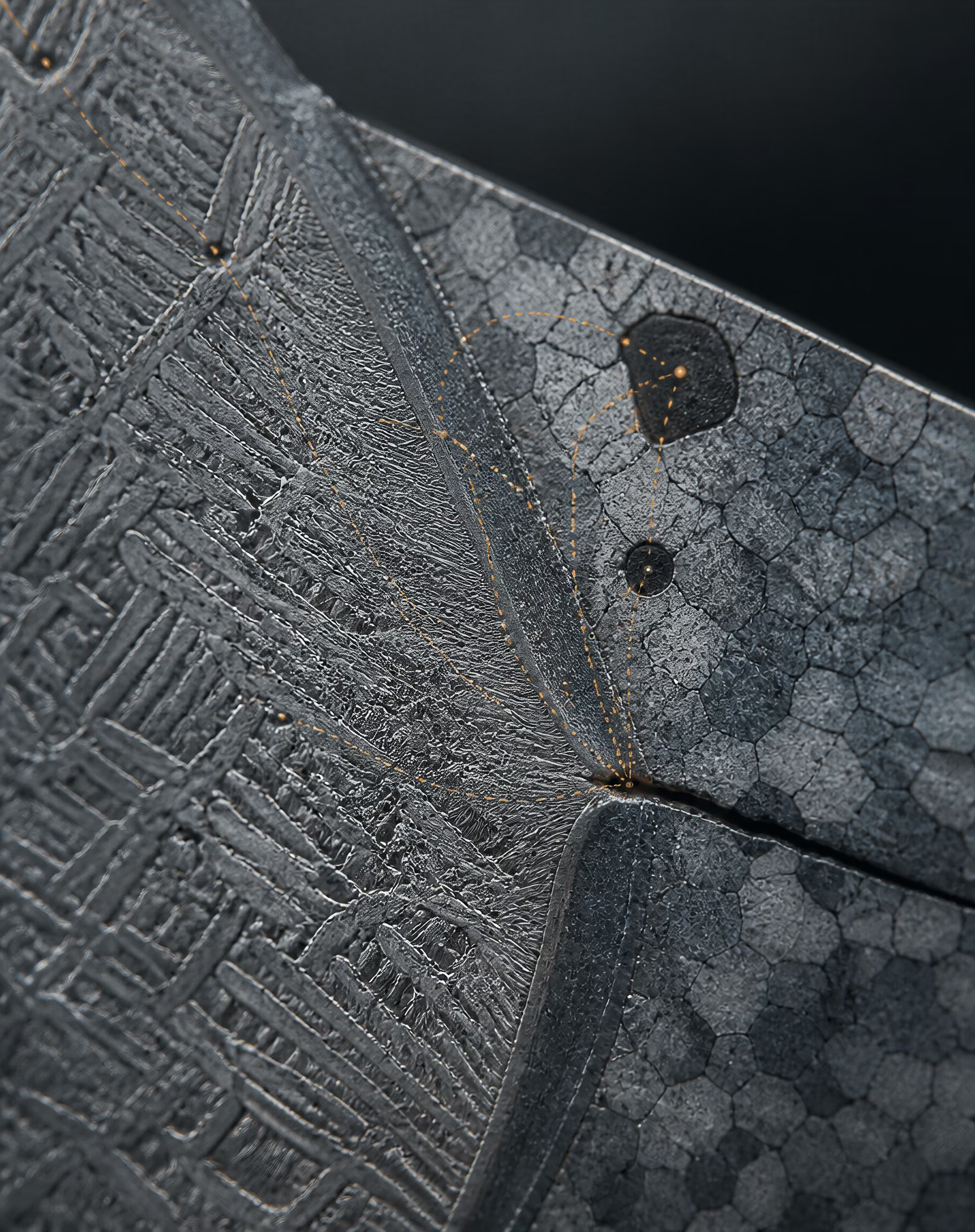
Hydrogen enters an arc weld through several routes. Moisture in electrode coverings, flux, shielding gas systems, joint surfaces, mill scale, grease, paint residues, and damp consumables can dissociate in the arc and dissolve into molten metal. The resulting atomic hydrogen is far more mobile than molecular hydrogen. As the weld cools, some hydrogen escapes from the weld pool and some remains as diffusible hydrogen in weld metal or moves into the adjacent HAZ.
ISO 3690:2018 specifies sampling and analytical procedures for measuring diffusible hydrogen in arc-welded weld metal made with filler material. The standard covers weld metal associated with martensitic, bainitic, and ferritic steels. This measurement is useful because diffusible hydrogen can migrate during the period when the joint is cooling and residual stresses are developing. It does not represent every form of hydrogen in a component.
A service-exposed vessel or pipe may contain hydrogen absorbed before fabrication or repair. That retained service hydrogen can be released during heating and welding, adding to hydrogen from the consumable and joint preparation. The distinction matters: controlling electrode moisture does not remove hydrogen already stored in the parent steel. In experiments on hydrogen-charged 2¼Cr-1Mo steel reported by TWI in 2024, retained hydrogen increased the required preheat by 130 °C. The result is a warning against applying a consumable-based welding procedure to a steel with an unknown service history.
Hydrogen moves through lattice defects, grain boundaries, inclusions, and other trapping sites. It can collect at a notch, a hard constituent, an inclusion, or a region under tensile stress. Cooling rate affects both the formation of traps and the time available for hydrogen to escape. A rapid transformation may create a hard HAZ while also leaving hydrogen concentrated near the fusion boundary. Postheat or sustained preheat can keep the joint warm long enough for hydrogen to migrate out before the most vulnerable condition is reached.
Preheat helps, but its effect is not unlimited. TWI reports that increased preheat generally gives hydrogen more opportunity to escape and slows cooling; however, excessive heat input can increase weld-metal hydrogen retention by enlarging diffusion distances and shortening the overall time available for diffusion. A hotter weld is therefore not automatically a safer weld. The heat input, bead size, joint thickness, interpass temperature, and cooling conditions must be considered together.
Hard and brittle susceptible microstructures
Hydrogen requires a susceptible structure in which cracking can initiate and propagate. In carbon-manganese, low-alloy, and high-strength steels, the critical structure is often hard martensite or a martensitic-bainitic mixture formed in the HAZ by rapid cooling. Hardness is a useful warning indicator, but hardness alone does not define cracking risk. Hydrogen content, stress, local toughness, inclusions, segregation, and crack-tip conditions also affect the result.
Steel chemistry controls transformation behavior. Carbon raises hardenability and increases the likelihood of a hard HAZ, while alloying elements such as manganese, chromium, molybdenum, and nickel alter hardenability and transformation temperatures. Carbon equivalent formulas are therefore screening tools, not complete weldability predictions. Two steels with similar carbon equivalent values can respond differently because their actual chemistry, plate thickness, prior thermomechanical processing, grain size, and cooling history differ.
A high heat input may reduce peak HAZ hardness by slowing cooling, but it can also enlarge the HAZ, change grain size, lower toughness, and alter hydrogen transport. Low heat input can produce a narrow HAZ yet create high cooling rates and hard transformation products. The relevant question is not whether heat input is simply high or low; it is whether the thermal cycle produces an acceptable combination of hardness, toughness, hydrogen escape, and restraint.
ISO 17642-1:2004 describes principles and test methods for assessing cold-crack sensitivity in welding consumables, parent materials, and weld metal. Such tests are valuable where a steel, consumable, or joint design falls outside routine experience. They also show why chemical composition alone cannot stand in for a weldability assessment. A crack-sensitive weld metal may be involved, or the HAZ may be the controlling region.
The crack can start at a local hard spot rather than across the whole HAZ. A coarse-grained region beside the fusion line, an untempered martensitic island, or a hard inclusion-bearing zone may provide the initiation site. Once a small crack forms, hydrogen can concentrate at its tip and accelerate propagation under tensile stress.
Tensile stress and restraint
The third condition is tensile stress. Welding creates thermal contraction: hot weld metal and nearby steel cool, shrink, and are restrained by the surrounding plate, the joint geometry, tack welds, fixtures, and previously deposited beads. This produces residual tensile stress even when no external load is applied. Applied service loads can add to it.
Joint restraint is not a single material property. Thick plates, short weld lengths, rigid attachments, closed sections, and poorly sequenced welds can restrict contraction more strongly than a flexible joint. Root gaps, fit-up errors, highly asymmetric welds, and repairs may produce local stress concentrations. A weld can therefore crack at a modest measured hardness if restraint and hydrogen are high, while a harder region may survive when hydrogen is low and contraction is less restricted.
This explains why removing only one condition reduces risk without proving safety. Dry, low-hydrogen consumables and controlled storage reduce hydrogen input, but they cannot prevent cracking if a very hard HAZ is formed under severe restraint. A lower-carbon or lower-hardenability steel may resist hardening, but contamination or service hydrogen can still create a problem. Stress relief or improved weld sequencing can lower tensile stress, yet a high-hydrogen procedure may leave enough mobile hydrogen to crack the joint before relief is effective.
NF EN 1011-2 links hydrogen-cracking control to steel composition, hydrogen content, heat input, preheat, and interpass temperature. Its logic is procedural: control the thermal cycle, limit hydrogen, and account for restraint rather than prescribing one temperature for every weld. BS EN 1011-2 guidance also recommends maintaining preheat or applying postheat so hydrogen can migrate from the weld before it becomes trapped in hard, stressed regions. Dillinger’s application of Method B of EN 1011-2 describes the same balance: preheating slows HAZ cooling while promoting hydrogen escape.
Inspection remains necessary because prevention controls probability, not certainty. Delayed cracking may appear after visual inspection, and a weld should be held, where specified, at controlled temperature before final examination. Non-destructive testing performed too early can miss a crack that has not yet formed. Hydrogen-assisted cold cracking is thus a time-dependent interaction among hydrogen transport, transformation to a susceptible structure, and tensile restraint—not a defect that preheating alone can reliably erase.
Diffusible Hydrogen and How It Is Measured
Meaning of diffusible hydrogen in arc weld metal
Diffusible hydrogen is the portion of hydrogen present in newly deposited weld metal that can move through the metal and escape under the temperature and time conditions of the test. It is not a fixed chemical constituent of the steel lattice. Hydrogen may occupy interstitial sites, migrate through defects and grain boundaries, or become temporarily trapped at inclusions, dislocations, phase boundaries, and other microstructural features. Some of it can reach a free surface; some can move into the heat-affected zone (HAZ) or a stressed region before escaping.
This mobility makes diffusible hydrogen relevant to delayed cold cracking. TWI states that hydrogen cracking requires three conditions together: hydrogen, a hard and brittle susceptible structure, and tensile stress. The International Institute of Welding (IIW) White Paper, published in 2023, identifies hydrogen content, residual tensile stress, and microstructural susceptibility as the three principal factors governing hydrogen-induced cracking in high-strength steel welds. A weld can therefore contain a measurable hydrogen concentration without cracking if its structure and restraint do not permit a crack to form. Conversely, a relatively low reported value can still be dangerous when welding produces hard martensite in a highly restrained joint.
The term refers to hydrogen in the weld metal covered by the test, not automatically to hydrogen throughout the welded joint. Hydrogen in the HAZ may have a different distribution and may be measured by another procedure. Hydrogen already absorbed by a pressure vessel, pipeline, or other steel during service is also a separate issue. Service exposure to wet hydrogen sulfide, cathodic protection, corrosion, or high-temperature hydrogen can leave hydrogen in the parent steel. That retained hydrogen may migrate into a repair weld or a newly formed hard HAZ, increasing fabrication-cracking risk even when the consumable itself has a low diffusible-hydrogen classification.
Diffusible hydrogen must also be separated from total hydrogen. Total hydrogen includes mobile hydrogen plus hydrogen retained in traps or released only at higher extraction temperatures. A total-hydrogen result can therefore be higher than the diffusible fraction and cannot be substituted for it without knowing the test method and its purpose. The two measurements answer different questions: diffusible hydrogen indicates the mobile hydrogen available during the period when a weld cools and develops stress, while total hydrogen describes a larger inventory that may include strongly trapped hydrogen.
Results are commonly reported as millilitres of hydrogen per 100 grams of deposited weld metal, often written mL/100 g, with the reference temperature and pressure stated by the applicable method. The number is not a universal property of an electrode, wire, or steel grade. It belongs to a defined welding and testing condition.
Sampling under ISO 3690:2018
ISO 3690:2018 specifies sampling and analytical procedures for determining diffusible hydrogen in arc weld metal made with filler material. Its scope includes weld metal associated with martensitic, bainitic, and ferritic steels. This is important because a result from the standard is tied to a deposited weld-metal specimen produced under specified conditions; it is not a direct measurement of the hydrogen concentration in the whole joint.
The test begins with controlled welding using the specified filler material, welding current, polarity, travel conditions, and specimen arrangement. The deposited weld metal is then separated or prepared as required, with slag and surface contamination removed. Handling after welding is critical. Hydrogen starts to escape as soon as the weld cools, so the specimen must be transferred, cooled, stored, and analysed according to the timing and temperature requirements of the standard. Delays in exposing the specimen to the collection system can reduce the measured value.
ISO 3690:2018 sets out the collection and analytical sequence rather than treating hydrogen testing as an ordinary chemical assay. In gas-collection procedures, hydrogen leaving the specimen is accumulated under controlled conditions and then quantified, commonly by gas chromatography or another permitted analytical arrangement defined by the laboratory procedure. The result is converted to the reporting basis specified by the standard. Calibration, blank correction, apparatus leakage, specimen mass, and reference conditions all affect the final number.
Rapid cooling is used to limit hydrogen loss before collection. The specimen may be stored at a low temperature when the procedure requires it, because reducing temperature slows hydrogen movement. The laboratory must also control the time between welding, quenching or cooling, collection, and analysis. These details are not administrative decorations. They determine how much of the mobile hydrogen remains in the specimen when measurement begins.
| Standard | Primary subject | Evidence produced |
|---|---|---|
| ISO 3690:2018 | Diffusible hydrogen in arc-weld metal | Controlled hydrogen measurement |
| ISO 17642-1:2004 | Destructive cold-crack testing | Cracking sensitivity under defined thermal and restraint conditions |
ISO 3690:2018 should not be confused with ISO 17642-1:2004. ISO 17642-1:2004 establishes general principles for destructive cold-crack testing in arc-welded metallic materials and describes approaches for assessing the cracking sensitivity of welding consumables, parent materials, and weld metal. A diffusible-hydrogen test measures one important input to cracking; a cold-crack test examines the outcome of hydrogen, structure, stress, geometry, and welding conditions acting together.
Why test values depend on procedure and specimen handling
A reported hydrogen value has meaning only when its welding process, consumable condition, sampling method, and analytical context accompany it. The same nominal electrode classification can produce different results if the coating has absorbed moisture, the wire has been stored improperly, shielding gas contains contamination, or the arc length and transfer mode change. Basic-coated low-hydrogen electrodes, for example, must be dried and held within the manufacturer’s specified temperature range; excessive or incorrect baking can damage the coating and may also alter arc behaviour.
Welding parameters change both hydrogen input and hydrogen escape. Current, voltage, travel speed, arc length, shielding, bead size, and heat input affect the amount of hydrogen entering the arc and the cooling path followed by the weld. Preheat generally slows HAZ cooling and gives hydrogen more time to leave the joint, as described in EN 1011-2 guidance and Dillinger’s application of Method B. It is not a universal cure. TWI reported in 2024 that excessive heat input can increase weld-metal hydrogen retention by enlarging the diffusion distance and shortening the effective time available for diffusion. A large, slowly cooling weld can therefore retain hydrogen in locations where it later contributes to cracking.
Specimen geometry matters as well. A thick or bulky test deposit provides a longer path to the surface than a thin deposit, while surface condition, bead placement, and the interval before quenching alter the measured release. Cutting, grinding, washing, or leaving slag attached can either remove hydrogen-bearing material or introduce contamination. Even storage after collection can change the result if the container leaks or the specimen warms for too long.
Service history adds another layer. In experiments on hydrogen-charged 2¼Cr-1Mo steel, retained hydrogen from prior service was reported to require a 130 °C increase in preheat during repair welding. That hydrogen would not be represented by a consumable qualification value alone. The repair procedure might need hydrogen-release treatment, conservative preheat, controlled interpass temperature, low-hydrogen consumables, and delayed inspection.
A low number from ISO 3690:2018 is therefore evidence about a defined weld-metal test, not a guarantee that a restrained production joint will remain crack-free. Hydrogen control must be read alongside steel chemistry, cooling rate, transformation products, restraint, heat input, and the steel’s service history.
Microstructure: Why the Heat-Affected Zone Can Crack
The heat-affected zone (HAZ) is not melted during welding, but its thermal cycle can change the steel’s structure enough to create a cracking path. Material next to the fusion boundary may be heated above the austenitising range, then cooled through transformation temperatures at a rate controlled by plate thickness, joint geometry, restraint, preheat, interpass temperature, heat input, and surrounding material. The resulting HAZ may contain coarse grains, hard transformation products, or local zones with sharp hardness changes. If hydrogen reaches such a region while tensile stress is acting, delayed cracking can occur after the weld has cooled.
TWI’s 2024 description identifies the required combination directly: hydrogen, a hard and brittle susceptible structure, and tensile stress. Remove or reduce any one of these factors and the probability of hydrogen-assisted cold cracking falls, although practical welding control usually has to address all three. The International Institute of Welding’s 2023 White Paper expresses the same relationship through hydrogen content, residual tensile stress, and microstructural susceptibility. A hard HAZ alone does not prove that cracking will occur. Nor does a low measured weld-metal hydrogen value prove that the HAZ is safe.
Rapid cooling and hard transformation products
Welding creates a short, severe thermal cycle. The HAZ is heated rapidly, held at high temperature for a period determined by the arc and joint, and then cooled as heat flows into the plate and the surrounding atmosphere. Rapid cooling can prevent carbon from redistributing through diffusional transformations such as ferrite and pearlite formation. Instead, austenite may transform into martensite, lower bainite, or other hard constituents. The exact result depends on the steel’s composition and the cooling path, not on peak temperature alone.
A narrow HAZ can therefore be harder than either the unaffected parent plate or the deposited weld metal. Grain coarsening near the fusion boundary can add to this problem by reducing toughness and providing a less forgiving structure. Local hardness peaks are especially important at weld toes, root regions, incomplete-fusion boundaries, and other locations where geometric stress concentration combines with metallurgical change.
Hydrogen moves through steel by diffusion. Some hydrogen remains in solution; some collects at traps such as dislocations, inclusions, interfaces, voids, and hard-phase boundaries. Under tensile stress, hydrogen can assist crack initiation and propagation in a susceptible microstructure. The crack may appear minutes or hours after welding, which is why a visually acceptable weld immediately after completion is not necessarily free from cold-cracking risk.
Cooling rate is affected by more than nominal heat input. A thick plate can draw heat away quickly, while a restrained joint or a highly conductive backing condition can produce a different thermal cycle from a free plate welded with the same electrical parameters. Preheat raises the starting temperature and reduces the temperature gradient, generally slowing HAZ cooling. Interpass temperature has a similar effect when successive passes are deposited before the joint has cooled too far.
Heat input should not be treated as a simple crack-risk dial. Increasing it often reduces the cooling rate, but it can also enlarge the HAZ, alter grain size, change the weld-metal deposit sequence, and affect hydrogen diffusion distances. TWI notes that excessive heat input may increase weld-metal hydrogen retention because the diffusion distance becomes larger and the time available for hydrogen to escape may be shorter. The relevant question is the complete thermal cycle and hydrogen history, not whether a higher or lower heat-input number is automatically safer.
Martensitic and bainitic susceptibility
Martensite forms when austenite cools below its transformation range too quickly for carbon diffusion and ordinary ferritic transformations to occur. Its high hardness arises from a supersaturated, strained crystal structure. That hardness is useful evidence of increased susceptibility, but hardness is not the only controlling property: local toughness, residual stress, hydrogen concentration, restraint, and the size and distribution of hard regions also matter.
Fresh, untempered martensite is particularly vulnerable because it combines high strength with limited plastic accommodation. Hydrogen-assisted cracking may initiate at a stressed interface or defect and then extend through the hard HAZ. A crack can run partly through martensite and partly along prior-austenite grain boundaries or other weakened paths. Tempering reduces hardness and relieves some transformation stress, which is one reason post-weld heat treatment can change cracking behavior, but tempering requirements depend on the steel, thickness, service condition, and applicable construction standard.
Bainite requires more careful description. It is not one uniform structure. Upper bainite, lower bainite, granular bainite, and mixed bainitic-martensitic regions can have different hardness and toughness. A bainitic HAZ may be less susceptible than a fully martensitic HAZ, yet a hard bainitic structure with trapped hydrogen and high tensile stress can still crack. ISO 3690:2018 specifically includes martensitic, bainitic, and ferritic steel weld metal in its procedures for sampling and measuring diffusible hydrogen. That scope reflects the fact that hydrogen behavior must be assessed in relation to the actual metallurgical system.
The HAZ is also distinct from the weld metal. ISO 3690 measurements describe diffusible hydrogen in arc-weld metal made with filler material; they do not directly measure all hydrogen that may enter or remain in the parent steel. Service-exposed equipment can retain hydrogen before repair welding begins. Research on hydrogen-charged C-Mn and Cr-Mo steels shows that this retained hydrogen can increase fabrication-cracking risk. For 2¼Cr-1Mo steel, one reported experiment found that the required preheat could increase by 130 °C when service hydrogen was present. That is not a general correction factor for every grade, but it demonstrates why service history matters.
Steel chemistry and carbon-equivalent concepts
Steel chemistry controls hardenability: the tendency of austenite to form martensite or other hard products during cooling. Carbon has a strong effect because it raises achievable hardness and influences transformation temperatures. Alloying elements such as manganese, chromium, molybdenum, nickel, copper, and vanadium can also delay diffusional transformations and increase hardenability. Two steels with the same carbon content may therefore produce different HAZ structures under the same welding procedure.
Carbon-equivalent (CE) concepts combine selected alloying contents into an index that helps estimate hardening tendency and preheat demand. They are screening tools, not universal crack limits. Different formulas serve different purposes, and their interpretation depends on product form, thickness, hydrogen level, restraint, heat input, and the chosen welding procedure. A CE value cannot by itself predict whether a delayed crack will form.
For ferritic steels, EN 1011-2 links welding recommendations to steel composition, hydrogen content, heat input, preheat, and interpass temperature. NF EN 1011-2 does not turn these variables into one universal carbon-equivalent threshold applicable to every joint. Its methods, including the conditions used for estimating cooling and preheat requirements, must be applied with the material designation, thickness, joint restraint, consumable hydrogen level, and procedure in view.
This is why preheating is a control measure rather than a universal cure. It can slow HAZ cooling, reduce the chance of forming the hardest transformation products, and give hydrogen more time to escape. Maintaining preheat or applying suitable postheat can also encourage hydrogen migration before it becomes trapped in a hard, stressed region. But excessive temperature, inadequate coverage, an unsuitable interpass range, high restraint, contaminated consumables, or hydrogen already retained from service can defeat that measure. ISO 17642-1:2004 provides general principles for destructive cold-crack testing of welding consumables, parent materials, and weld metal; testing is often more informative than assigning safety to a single CE number or preheat temperature.
Preheat, Interpass Temperature, and Postheat
Preheat is a control on weld thermal history, not a universal cure for hydrogen cracking. Its effect depends on the amount and form of hydrogen present, the steel’s chemistry and hardenability, the restraint imposed by the joint, the weld-metal hydrogen level, and the microstructure produced as the heat-affected zone (HAZ) cools. A high preheat can lower cracking risk in one procedure yet create unacceptable grain growth, reduced toughness, distortion, or excessive softening in another.
Hydrogen cracking is a delayed cold-cracking mechanism. TWI states that it requires the combined presence of hydrogen, a hard and brittle susceptible structure, and tensile stress. The International Institute of Welding identifies the corresponding controlling factors as hydrogen content, residual tensile stress, and microstructural susceptibility in high-strength steel welds. Temperature control addresses only part of that combination.
How preheat slows cooling
The immediate physical effect of preheat is to reduce the temperature difference between the weld pool and the surrounding plate. Heat therefore flows away from the weld more slowly. This extends the time available for the HAZ and adjacent weld metal to pass through transformation ranges in which hard, crack-susceptible products may form.
For carbon-manganese steels, a sufficiently rapid cooling rate can produce hard bainite or martensite in the HAZ, particularly where carbon equivalent, plate thickness, and restraint are high. Those structures have limited capacity to accommodate hydrogen and local plastic strain. Slowing the cooling rate can promote a less brittle transformation product and reduce the peak hardness of the HAZ. It also reduces the thermal gradient and can moderate some of the residual tensile stress generated as the weld contracts.
Preheat has a second action: it gives hydrogen more time to move out of the joint before the steel reaches lower temperatures at which hydrogen mobility falls. Hydrogen introduced by damp electrodes, contaminated surfaces, flux, shielding gas, or the welding environment may diffuse from the weld metal into the HAZ and parent material. Some hydrogen can escape from exposed surfaces; some can move toward microstructural traps. The longer period at elevated temperature improves the opportunity for escape, although it does not guarantee that hydrogen will leave.
This distinction matters because diffusible hydrogen measured in weld metal is not the same as hydrogen retained in steel after service exposure. ISO 3690:2018 specifies sampling and analytical procedures for diffusible hydrogen in arc-welded weld metal made with filler material, including martensitic, bainitic, and ferritic steels. Hydrogen absorbed during service, especially in wet hydrogen sulfide, hydrogen charging, or high-pressure hydrogen environments, may be distributed through the parent steel and released during fabrication. A normal low-hydrogen consumable procedure may therefore face a hydrogen inventory far greater than the weld-metal test result suggests.
The cooling benefit also has limits. TWI reports that increased preheat generally supports hydrogen escape and slows cooling, whereas excessive heat input may increase hydrogen retention by enlarging diffusion distances and shortening the time available for diffusion from the weld. Heat input, joint thickness, bead size, and welding sequence must be considered together. Simply raising the temperature without controlling hydrogen sources or restraint can leave the basic cracking conditions intact.
NF EN 1011-2 links selection of preheat and cooling conditions to steel composition, hydrogen content, heat input, and interpass temperature. Its calculation methods are not a substitute for the qualified welding procedure specification (WPS), especially for restrained repairs, highly hardenable steels, or components with an uncertain service history. The specified preheat may be measured on the parent plate, at a defined distance from the joint, and immediately before depositing the pass; the WPS must state the location and method.
| Input | Effect on procedure selection |
|---|---|
| Steel grade and carbon equivalent | Influences hardenability and HAZ transformation |
| Plate thickness | Changes heat flow and cooling rate |
| Joint geometry and restraint | Changes tensile stress and crack driving force |
| Consumable hydrogen condition | Changes hydrogen entering weld metal |
| Heat input and interpass temperature | Change thermal cycle, hardness, toughness, and hydrogen movement |
Preheat selection is procedure-specific. A value suitable for a thick S355 joint cannot be transferred automatically to an ASTM A514 weld, a 9% Ni steel, or a 2¼Cr-1Mo pressure-vessel repair. Plate thickness, carbon equivalent, joint geometry, restraint, consumable classification, hydrogen control, heat input, and required toughness all affect the selected range.
Maintaining interpass temperature
Preheat is useful only while the joint remains within the intended thermal window. As welding progresses, the joint must not cool below the minimum preheat before the next pass begins. That requirement is the purpose of maintaining interpass temperature.
If the joint falls below the minimum, the next pass may cool the HAZ at a rate different from the qualified procedure. The resulting hardness, transformation structure, hydrogen diffusion time, and residual stress can all change. This is particularly important in multipass welds, where each pass tempers or reheats portions of earlier weld metal and HAZ. The thermal cycle is cumulative, not a series of isolated weld beads.
The interpass maximum is equally important. Excessive temperature can prevent the intended tempering sequence, enlarge prior-austenite grains, reduce impact toughness, and alter weld-metal properties. In low-alloy Cr-Mo steels, uncontrolled interpass heat can affect creep strength and post-weld heat-treatment response. A WPS may therefore specify both a minimum preheat and a maximum interpass temperature, rather than permitting the welder to maintain an unrestricted “hot” joint.
Temperature should be verified at the prescribed measurement location using calibrated temperature crayons, contact thermometers, thermocouples, or other approved equipment. Surface readings taken immediately beside a hot bead can be misleading; the relevant temperature is the joint temperature before depositing the next pass. Large components may also develop temperature differences through the thickness, so the heating arrangement must produce reasonably uniform conditions rather than a narrow hot band.
The welder must pause when the interpass temperature exceeds its upper limit, while avoiding uncontrolled cooling below the lower limit. Welding sequence, bead length, balanced deposition, insulation, and local heating may be specified to keep the joint inside the range. Drafts and rain can sharply increase heat loss. They also add moisture, which can raise hydrogen input.

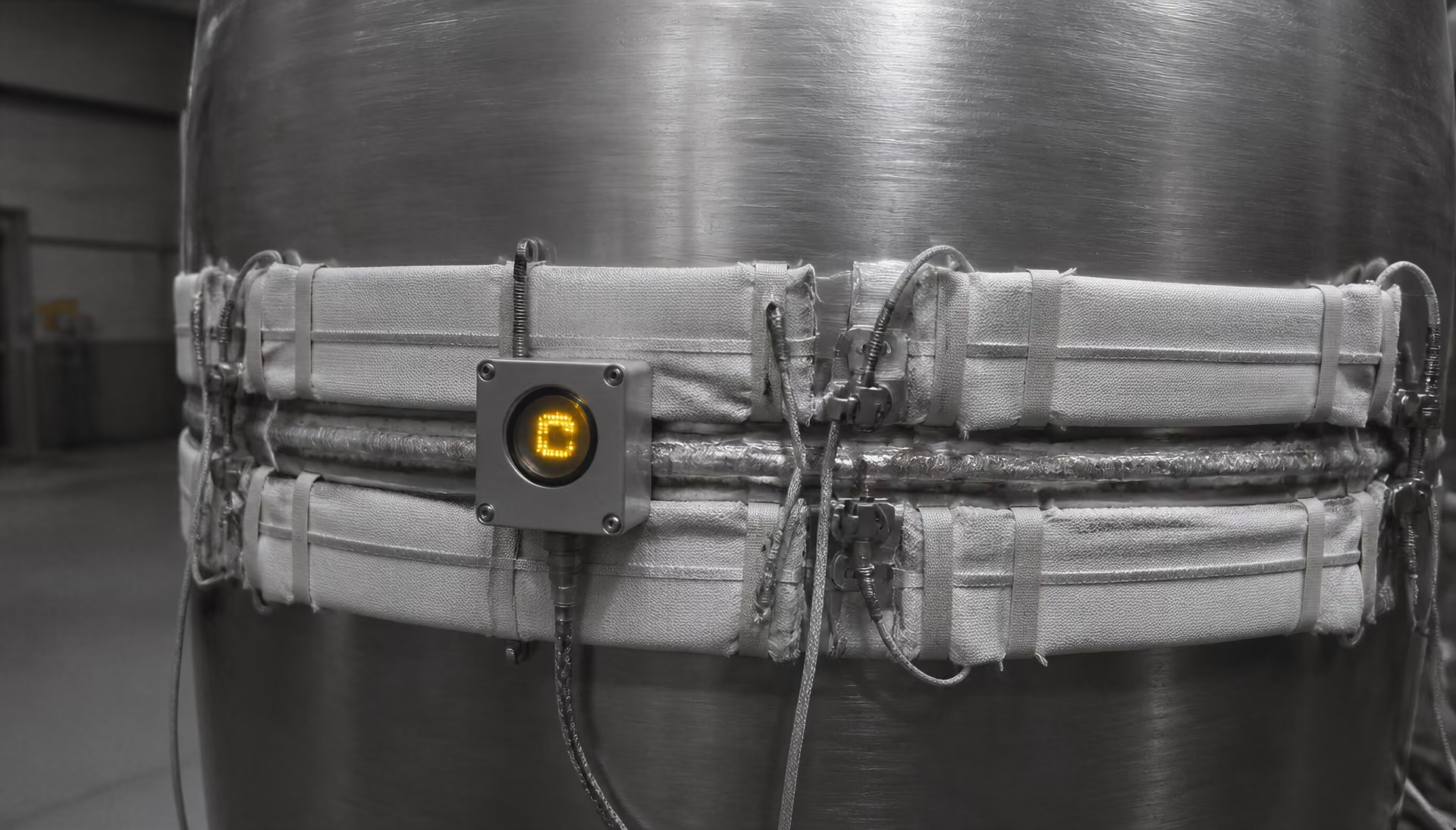
Postheat and hydrogen-release treatment
Postheat distinction
- Postheat Maintains a specified temperature to promote hydrogen migration before critical cooling.
- PWHT Applies a separate heat-treatment cycle intended to alter residual stress or metallurgical condition.
- Inspection Checks whether cracking occurred after the required hold and cooling period.
Hydrogen-release treatment A controlled post-welding heating and holding operation intended to allow mobile hydrogen to migrate from the weld region before final cooling.
Postheat is a separate operation performed after welding, usually at a specified temperature for a specified holding time. It is not the same as post-weld heat treatment (PWHT), although the operations may be combined in some procedures. Hydrogen-release treatment holds the welded joint warm long enough for hydrogen to diffuse toward exposed surfaces before the weld cools into a highly susceptible, stressed condition. SteelConstruction.info and Guidance Note 6.04 describe maintaining preheat or applying postheat as a means of allowing hydrogen to migrate from the weld before it becomes trapped in hard regions.
The treatment must begin promptly after welding, including after arc interruption or completion of a repair, when the procedure requires it. Insulation and controlled furnace or local heating may be needed to prevent premature cooling. The required temperature and duration depend on steel grade, thickness, weld size, hydrogen level, restraint, and the applicable WPS. An arbitrary “keep it warm for a while” instruction has no reliable metallurgical meaning.
Hydrogen-release treatment is especially significant for hydrogen-charged Cr-Mo steels. Research on service-exposed material found that retained hydrogen could increase fabrication-cracking risk substantially. In one reported experiment on 2¼Cr-1Mo steel, the retained service hydrogen required a 130 °C increase in preheat. That result is a warning against applying ordinary fabrication tables to a vessel or pipe section without assessing its service history.
Postheat cannot repair a crack that has already formed, remove all trapped hydrogen, or compensate for a hard untempered HAZ and severe restraint. Inspection remains necessary, often after a delay because hydrogen cracks may appear hours after welding. ISO 17642-1:2004 describes cold-crack formation and destructive test principles for assessing cracking sensitivity in consumables, parent materials, and weld metal. Temperature control is one part of the procedure; low-hydrogen consumables, dry surfaces, suitable joint preparation, controlled restraint, qualified heat input, and delayed inspection must support it.
Heat Input: Useful Control and Common Misinterpretation
Heat input is a useful way to describe the thermal energy delivered per unit length of weld, but it is not a direct measure of hydrogen-cracking safety. For a basic arc-welding calculation, the nominal heat input is often expressed as:
where is energy per unit weld length, is arc efficiency, is voltage, is current, and is travel speed. The equation helps compare procedures, but it does not capture plate thickness, joint geometry, restraint, bead sequence, preheat, interpass temperature, or the actual thermal field in the heat-affected zone (HAZ). A higher calculated value can therefore produce different metallurgical results in different joints.
Hydrogen cracking is not prevented by heat input alone. TWI identifies three conditions that must coincide: hydrogen, a hard and brittle susceptible structure, and tensile stress. The International Institute of Welding (IIW) describes the same controlling factors as hydrogen content, residual tensile stress, and microstructural susceptibility. Heat input affects mainly the thermal and transformation parts of that interaction, while current welding practice determines how much hydrogen enters and how readily it leaves.
Thermal cycle and cooling-rate effects
Each point beside a weld experiences a thermal cycle: rapid heating, a peak temperature, and cooling through the transformation range. The cooling rate controls the phases that form in the weld metal and HAZ. In susceptible carbon-manganese, low-alloy, or quenched-and-tempered steels, rapid cooling can produce hard bainitic or martensitic regions. These regions have lower tolerance for hydrogen and tensile stress than a softer, more ductile microstructure.[2] Welding parameter guidance. Dillinger. Dillinger technical guidance, 2024.
Increasing heat input usually broadens the thermal field and slows cooling, particularly when the joint is thick or highly conductive. Preheat raises the starting temperature, reducing the temperature difference between the weld and surrounding steel. Interpass temperature has a similar effect on later passes. Dillinger’s guidance, applying Method B of EN 1011-2, states that preheating slows HAZ cooling while promoting hydrogen escape. BS EN 1011-2 guidance also links cooling-rate control with maintaining preheat or applying postheat so hydrogen can migrate before becoming trapped in hard, stressed regions.
The result is not simply “hotter is safer.” A slower cooling rate may reduce the amount of martensite, but the same thermal cycle can alter grain size, transformation products, residual stress, and hydrogen transport. A procedure must be judged against the actual steel grade, thickness, joint restraint, and weld sequence.
Higher heat input does not always reduce hydrogen-cracking risk. Limited evidence
Hydrogen transport is time-dependent. Diffusible hydrogen can move through steel during and after welding, but its path and escape rate depend on temperature, microstructure, geometry, and available surfaces. TWI cautions that increasing heat input can sometimes increase weld-metal hydrogen retention: the larger molten or heated region may increase the distance hydrogen must travel, while the overall period available for effective diffusion can become shorter. That finding directly rejects the common assumption that any increase in heat input gives hydrogen more opportunity to escape.
Why excessive heat input is not automatically safer
A large heat input may reduce the peak cooling rate while creating other defects or damaging properties. Excessive energy can coarsen prior-austenite grains in the HAZ, reduce toughness, increase distortion, and produce an oversized softened or embrittled region. In quenched-and-tempered steels, the thermal cycle may temper material that was deliberately strengthened, or locally overheat it above the range permitted by the welding procedure qualification.
Hydrogen retention can also rise rather than fall. A large bead has greater volume and may place hydrogen farther from a free surface. If welding pauses, interpass conditions change, or the joint is capped before hydrogen has escaped, the hydrogen can remain in the weld or migrate toward a hard HAZ under tensile stress. Delayed cracking may then appear hours or days after welding, even though visual inspection immediately after completion found no defect.
The distinction between heat input and preheat matters here. Preheat acts before and between passes, preserving a higher workpiece temperature and supporting hydrogen diffusion. Heat input describes energy delivered during a pass. They influence the same cooling and diffusion processes, but they are not interchangeable controls. A low-hydrogen consumable, dry handling, correct storage, suitable preheat, controlled interpass temperature, and an appropriate postheat hold may be required even when the nominal heat input is high.
The procedure must also account for hydrogen already present in the steel. Service-exposed equipment can absorb hydrogen during operation, and that retained hydrogen is not represented by a weld-metal diffusible-hydrogen test under ISO 3690:2018. TWI reports that experiments on hydrogen-charged 2¼Cr-1Mo steel found a preheat increase of 130 °C could be required to address retained service hydrogen. That is a fabrication-history issue, not a reason to assume that simply increasing arc energy will solve the risk.
Balancing penetration, dilution, toughness, and cracking risk
Heat input must be controlled as part of a coordinated procedure. Current affects deposition rate, penetration, arc force, and the quantity of metal melted. Voltage changes arc length and bead width. Travel speed changes energy per unit length and the time available for heat to spread. Bead size and sequence determine reheating, restraint, and the thermal cycles imposed by later passes. Preheat and interpass temperature modify the starting condition for every pass. Optimizing one setting while ignoring the others can produce a procedure that looks satisfactory on paper but generates an unacceptable HAZ or hydrogen-retention condition.
| Heat-input condition | Possible benefit | Possible risk |
|---|---|---|
| Too little | Reduced thermal exposure | Rapid cooling, hard HAZ, lack of fusion, and insufficient penetration |
| Qualified range | Balances cooling, penetration, toughness, and hydrogen movement | Requires production control |
| Too much | Slower cooling in some conditions | Grain coarsening, distortion, reduced toughness, and hydrogen retention |
Too little heat input may cause insufficient penetration, lack of fusion, excessive hardness, and rapid cooling. Too much may cause burn-through, excessive dilution, grain coarsening, distortion, reduced toughness, and hydrogen retention. The acceptable range is therefore bounded on both sides.
Joint design and steel chemistry also matter. Carbon equivalent, plate thickness, restraint, and transformation behavior influence the preheat and heat-input range recommended by EN 1011-2 and NF EN 1011-2. A procedure for S355J2 may not transfer directly to a high-strength quenched-and-tempered grade such as S690Q, or to a service-exposed 2¼Cr-1Mo component. Testing under ISO 17642-1:2004 can assess cold-crack sensitivity in the parent material, weld metal, and consumable combination, while ISO 3690:2018 provides procedures for measuring diffusible hydrogen in arc weld metal.
Heat input is thus a control variable, not a universal cure. The sound approach is to qualify a complete thermal procedure: measured current, voltage, and travel speed; specified bead dimensions; controlled preheat and interpass temperature; low-hydrogen practice; suitable postheat where required; and inspection for delayed cracking after the prescribed holding period. Penetration and productivity matter, but they must remain within the metallurgical limits set by cooling rate, toughness, hydrogen movement, and restraint.
Low-Hydrogen Welding Practice
Low-hydrogen welding is a controlled process, not a label attached to one electrode. Hydrogen cracking occurs only when three conditions overlap: hydrogen is present, the weld or heat-affected zone (HAZ) develops a hard and brittle susceptible structure, and tensile stress exists from restraint, shrinkage, or residual stress. TWI stated this three-part requirement in 2024, while the International Institute of Welding (IIW) identifies hydrogen content, residual tensile stress, and microstructural susceptibility as the principal factors in high-strength steel welds.
The practical objective is therefore to reduce hydrogen entering the arc and weld pool, prevent contaminated surfaces from adding more, and deposit weld metal under conditions that limit rapid formation of susceptible microstructures. Storage, issue control, cleaning, shielding, arc control, preheat, interpass temperature, and deposition sequence all belong to the same prevention system.
Consumable storage and moisture control
Moisture is the most familiar hydrogen source, but it reaches the weld through several routes. Basic-coated low-hydrogen electrodes can absorb water from humid air after their sealed package is opened. Flux on submerged-arc welding wire, flux-cored wire, and metal-cored wire can also collect moisture during storage or handling. The water dissociates in the arc, and part of the resulting hydrogen enters molten weld metal. Some hydrogen later diffuses away, while the remainder can move toward hard, stressed regions as the joint cools.
Electrodes should remain in their original sealed packaging until they are needed. Once opened, they should be held in a heated, controlled cabinet at the temperature and maximum exposure time specified by the consumable manufacturer or the applicable welding procedure. A site should record package opening, issue, return, and exposure time rather than relying on appearance. An electrode may look dry while carrying enough absorbed moisture to raise diffusible hydrogen.
Drying or rebaking is permitted only when the consumable specification and manufacturer’s instructions allow it. The required temperature, holding time, and number of rebakes matter. Excessive heating can damage binders, alter coating performance, or produce an electrode that no longer meets its intended condition. Repeated movement between a hot cabinet and a cold, humid work area is also poor practice: condensation can form before the electrode is used.
The designation does not remove these obligations. An AWS E7018 electrode, for example, is not a guarantee that a joint will be low risk after the electrodes have been left exposed overnight, nor does an “H8” diffusible-hydrogen classification replace control of preheat, restraint, steel chemistry, and heat input. ISO 3690:2018 specifies sampling and analytical procedures for measuring diffusible hydrogen in arc-welded weld metal for martensitic, bainitic, and ferritic steels. That measurement describes a deposited weld-metal condition under a test method; it does not certify every field weld made with the same product.
Consumables should be issued in quantities that can be used within the permitted exposure period. Damaged packages, wet flux, rusty wire, and electrodes with cracked, swollen, or flaking coatings should be quarantined. Welding operators also need clean, dry gloves and storage trays. Handling the coated end of an electrode with wet gloves can add moisture directly to the coating.
Arc length, surface condition, and shielding
A short, stable arc normally reduces atmospheric contamination and limits the amount of hydrogen-bearing moisture that reaches the weld pool. Excessive arc length makes the arc more exposed to air, increases spatter, and can destabilize shielding. It also changes penetration and deposition, so the correct length remains the one specified for the process and consumable rather than an arbitrary minimum. For shielded metal arc welding, a long arc is a common consequence of poor technique and can produce porosity as well as increased hydrogen pickup.
Gas-shielded processes require the same discipline. Shielding-gas cylinders, regulators, hoses, flowmeters, and torches must be dry and free from leaks. A leak on the suction side of a gas line can draw humid air into the stream without producing an obvious external gas loss. Excessive flow can cause turbulence and entrain air, while insufficient flow leaves the pool exposed. Drafts, wind, torch angle, stick-out, and premature removal of shielding must be controlled. Gas purity and the specified gas mixture matter, especially where small additions of oxygen or carbon dioxide affect arc behavior and surface reactions.
Joint surfaces must be cleaned to bright, sound metal where the procedure requires it. Oil, grease, paint, adhesive, cutting-fluid residue, marker ink, salts, wet abrasive dust, and corrosion products can introduce hydrogen or prevent reliable fusion. Rust and mill scale are not interchangeable with clean steel. Condensation is particularly dangerous when cold plate is moved into a warm, humid area; the joint can be visibly dry yet carry a thin water film. Preheating should bring the surface above the relevant dew-point margin, not merely warm the center of a thick component.
Controlled deposition includes correct travel speed, current, voltage, wire-feed speed, bead size, interpass cleaning, and sequence. Large, slow deposits do not automatically reduce cracking. TWI reported in 2024 that increasing preheat generally gives hydrogen more time to escape and slows cooling, whereas excessive heat input can increase weld-metal hydrogen retention by enlarging diffusion distances and shortening the time available for diffusion. Heat input must therefore remain within the qualified procedure range.
Hydrogen sources beyond the electrode
The electrode or flux is only one part of the hydrogen balance. Moisture on plate edges, backing bars, clamps, ceramic fixtures, and temporary attachments can enter the arc. Compressed air used for cleaning can carry oil or water from a poorly maintained compressor. Wet grinding wheels, damp abrasive cloths, and water-based marking products can leave residues that are heated during welding. Galvanized coatings and other surface treatments introduce additional fumes and may require removal under the applicable safety and welding procedure requirements.
Hydrogen can also come from the welding environment. Rain, condensation, high humidity, wet insulation, and unprotected gas lines defeat a dry consumable system. A joint may be cleaned at the start of a shift and then become contaminated while waiting under tarpaulin or outdoors. The procedure should define protection, surface re-cleaning, and the conditions under which welding must stop.
Service history creates a different problem. Hydrogen absorbed during pickling, cathodic protection, sour-service exposure, corrosion, or operation at elevated pressure may remain in the parent steel. This retained hydrogen is not measured simply by testing a new electrode batch and cannot be removed by switching from one consumable designation to another. Research on hydrogen-charged steels found that 2¼Cr-1Mo steel could require a 130 °C increase in preheat during repair because of hydrogen retained from service. Such work may require hydrogen-release treatment, extended holding, conservative preheat, controlled interpass temperature, and a qualified repair procedure.
Postheat or delayed cooling can give hydrogen time to migrate before it becomes trapped in a hard, stressed region. BS EN 1011-2 guidance links this practice with cooling-rate control, while ISO 17642-1:2004 sets out general principles for destructive cold-crack testing of consumables, parent materials, and weld metal. These measures are procedural controls, not substitutes for inspection. Delayed cold cracking may appear hours after welding, so visual examination immediately after deposition cannot prove that the joint is crack-free.
Restraint, Joint Design, and Residual Stress
Hydrogen cracking needs a third condition after hydrogen and a susceptible hard microstructure: tensile stress. TWI’s 2024 guidance describes the mechanism as the combined presence of hydrogen, a hard and brittle structure, and tensile stress. The IIW White Paper (2023) makes the same division, identifying hydrogen content, microstructural susceptibility, and residual tensile stress as the three principal factors controlling hydrogen-induced cracking in high-strength steel welds.
That stress may come from the component, the welding operation, or both. A joint can be below its nominal yield stress while a small region beside the weld carries a much higher local stress. Hydrogen then migrates toward traps such as inclusions, prior-austenite grain boundaries, martensitic regions, and weld discontinuities. If the local tensile stress exceeds the resistance of that region, a crack may start during cooling or hours after welding. This is delayed cold cracking, not hot cracking, which forms while molten or partly solidified metal is present.
Root gaps, fit-up, and local restraint
Joint preparation controls more than weld volume. A root gap that is too small can prevent proper root fusion and force the welder to increase current, arc length, or manipulation to bridge the joint. A gap that is too large demands a large root pass or excessive reinforcement, increasing shrinkage and the force needed to pull the members together. Neither condition is harmless. The specified gap, root face, groove angle, and alignment must be maintained along the joint rather than assumed from a few acceptable measurements.
Poor fit-up creates local restraint because the weld must correct dimensional errors as it contracts. High-low misalignment, a twisted flange, or a plate forced into contact by clamps can leave bending stress beside the weld even before the joint cools. Tack welds add another complication: undersized or cracked tacks can become part of the final weld, while excessively strong tacks prevent the members from moving as shrinkage develops.
Restraint is especially severe where a short weld connects thick material to a large rigid structure. Examples include brackets welded to pressure-vessel shells, stiffeners attached close to flange toes, crane details with boxed corners, and repairs made inside an existing frame. The surrounding steel cannot deform freely, so longitudinal and transverse weld contraction is converted into tensile stress. A narrow attachment welded around three or four sides can produce a severe stress concentration at the unwelded termination.
Joint geometry can magnify that effect. Abrupt changes in thickness, sharp re-entrant corners, small weld toes, and closely spaced welds concentrate stress and may also create hard HAZ regions through rapid cooling. A smooth transition, adequate weld access, and a termination located away from a highly loaded corner reduce the peak stress. The design choice may be constrained by fatigue, corrosion allowance, pressure-boundary rules, access, or the need to retain an existing attachment; restraint reduction is therefore a design decision, not a universal fabrication instruction.
Where permitted, a larger root radius, a less severe attachment detail, or a weld placed on the neutral side of a member can reduce local stress. Temporary strongbacks and clamps may hold alignment during deposition, but they should not lock the joint so rigidly that all contraction is trapped. They also need a removal plan. Cutting off a temporary attachment can leave a gouge or a new highly restrained repair weld, both of which require controlled finishing and inspection.
Residual tensile stress after welding
As weld metal cools, it contracts. Hot weld metal is surrounded by colder parent material, which restrains that contraction; the weld and nearby HAZ commonly finish with longitudinal and transverse residual tensile stress, balanced by compression farther away. The peak values depend on section thickness, joint shape, heat input, deposition sequence, and the freedom of the assembly to move.
Residual stress matters because hydrogen cracking is often local. A small hard zone at the HAZ may contain little hydrogen in absolute terms, yet still crack if tensile stress and hydrogen concentration coincide there. The stress can be raised by an external load, but a joint does not need to be in service to crack. Welding residual stress alone can supply a substantial part of the driving force. This is why a crack may appear beneath a weld toe or along the HAZ after the component has cooled and hydrogen has redistributed.
The weld’s final stress state is not reliably predicted from weld size alone. A heavy cap pass may add metal and heat while increasing transverse shrinkage. Conversely, a low heat input procedure can produce a narrow, rapidly cooled HAZ with a hard transformation product. Preheat and interpass control address cooling and hydrogen movement, but they do not remove restraint. BS EN 1011-2 recommendations, summarized by SteelConstruction.info in 2024, call for controlling cooling and maintaining preheat or postheat so hydrogen can migrate before becoming trapped in hard, stressed regions. That measure works best when joint design does not impose extreme restraint.
Post-weld heat treatment can reduce residual stress and temper susceptible microstructures where the material, thickness, and service requirements permit it. It is not a substitute for sound fit-up or a low-hydrogen procedure, and it may be impractical for large structures or field repairs. Inspection also has limits: finding a crack after welding does not prove that the stress problem has been controlled.
Sequence and deposition planning
Welding sequence determines where shrinkage accumulates. If welds are deposited continuously from one end of a long assembly, the completed section may pull the remaining joint out of alignment and leave the final weld highly restrained. A planned sequence can distribute contraction, preserve access, and allow earlier welds to cool before nearby welds add more stress.
Balanced deposition is often preferable. Welding alternating sides of a double-sided joint, moving from the centre toward the ends, or using a back-step sequence can reduce distortion and prevent one-sided contraction from locking the assembly. These methods are not interchangeable in every structure: a back-step pattern changes travel direction but does not automatically lower heat input or hydrogen risk. The procedure must state pass size, interpass temperature, waiting time where necessary, and the order of welds.
Large attachments are commonly divided into stages so that no single short region receives all the shrinkage restraint. Welds that meet at a corner should be sequenced to avoid trapping a final closure weld between rigid, already contracted members. Skip welding can reduce heat accumulation, but excessive spacing between segments may allow cold areas and uneven restraint; the specified minimum preheat must be maintained at each start point.
Temporary attachments, presetting, and controlled jacking can give a structure room to move, provided calculations and access allow them. Presetting is not a cure if it simply transfers stress to another detail. On repair work, the existing component may contain service hydrogen, altered microstructure, and residual stress from earlier repairs. TWI reports that hydrogen-charged 2¼Cr-1Mo steel in one experiment required a 130 °C increase in preheat, showing why a sequence chosen for new plate may be unsafe for service-exposed steel.
The practical aim is not to eliminate all restraint, which is rarely possible. It is to avoid sudden local restraint, distribute shrinkage, maintain sound geometry, and keep the cooling and hydrogen-control procedure matched to the actual joint. ISO 17642-1:2004 provides principles for destructive cold-crack testing of welding consumables, parent materials, and weld metal; such tests can expose a restraint sensitivity that nominal carbon content alone cannot predict.
Applying EN 1011-2 to Ferritic Steels
NF EN 1011-2 provides the organizing framework for welding recommendations for ferritic steels, including carbon-manganese, low-alloy, thermomechanically rolled, normalized, and quenched-and-tempered grades. Its purpose is not to assign one universal preheat temperature to a steel family. It relates steel composition, hydrogen content, heat input, preheat, and interpass temperature to the cooling and transformation conditions that control hydrogen-assisted cold cracking.
That distinction matters. A welded joint cracks when several conditions coincide: hydrogen is present, the weld or heat-affected zone (HAZ) develops a hard and brittle susceptible structure, and tensile stress acts on that region. TWI identified this three-part requirement in its 2024 guidance on hydrogen cracks in steels. The International Institute of Welding made the same mechanism more specific in its 2023 White Paper, identifying hydrogen content, residual tensile stress, and microstructural susceptibility as the three principal factors governing hydrogen-induced cracking in high-strength steel welds.
The standard therefore supports a risk assessment, not a shortcut. A recommendation made for EN 10025-2 S355J2 cannot automatically be transferred to EN 10083-3 42CrMo4, EN 10028-2 P355GH, or a quenched-and-tempered structural grade of similar nominal strength. The actual grade certificate, product thickness, joint geometry, welding process, filler classification, restraint, and service history must be known before a Method B calculation or parameter selection has meaning.
Steel composition and susceptibility assessment
Composition affects weldability mainly through its influence on hardenability and the microstructure formed as the HAZ cools. Carbon is important, but carbon content alone is a poor screening tool. Manganese, chromium, molybdenum, nickel, copper, vanadium, boron, and the steel’s delivery condition can all change the critical cooling behavior. Two steels with similar carbon contents may produce markedly different HAZ hardness because their alloying systems and prior heat treatment differ.
Carbon-equivalent indicators are useful for comparing susceptibility, but they remain indicators. A higher equivalent generally signals greater hardenability and a greater possibility of forming martensite or hard bainite under restrained welding conditions. It does not predict cracking without the accompanying hydrogen level, cooling rate, heat input, and restraint. A low-alloy pressure-vessel steel such as 2¼Cr-1Mo may require more severe controls than a lower-alloy steel even when nominal carbon content is comparable.
Thickness also changes the assessment. A thick plate or a highly conducting joint draws heat away rapidly, reducing the time available for hydrogen to diffuse and increasing the chance of a hard HAZ. A fillet weld in a restrained corner joint has a different crack risk from a butt weld in a freely contracting plate. Root gaps, weld size, tack-weld quality, joint sequencing, and attachments alter local restraint and stress concentration.
The material’s history must be included. Hydrogen introduced during service can remain in steel and raise the cracking risk during repair. Research on hydrogen-charged steels, including 2¼Cr-1Mo, reported that retained service hydrogen could require a 130 °C increase in preheat. That result is not a general temperature rule; it demonstrates why a fabrication procedure for new plate cannot simply be applied to a hydrogen-exposed vessel or pipeline component. Hydrogen-release treatment, extended heating, low-hydrogen consumables, and additional examination may be needed.
Cold-crack testing can help when the normal assessment is uncertain. ISO 17642-1:2004 describes principles for destructive testing of arc-welded metallic materials and methods for assessing cracking sensitivity in consumables, parent materials, and weld metal. Such testing complements, rather than replaces, a procedure based on the actual joint and service conditions.
Hydrogen, preheat, and interpass variables
Hydrogen entering a weld comes from several sources: moisture in electrodes or flux, contamination on the joint, shielding-gas or environmental exposure, and consumable handling. ISO 3690:2018 specifies sampling and analytical procedures for measuring diffusible hydrogen in arc-welded ferritic, bainitic, and martensitic steel weld metal when filler material is used. The measured value applies to weld metal produced under the specified test and handling conditions; it should not be confused with all hydrogen present in the HAZ or with hydrogen retained in service-exposed parent steel.
Preheat has two useful effects. It slows HAZ cooling, reducing the likelihood of forming a hard susceptible structure, and it gives hydrogen more time to leave the weld region before stresses become critical. Maintaining the specified interpass temperature extends those effects through a multipass weld. BS EN 1011-2 guidance, as summarized by SteelConstruction.info, connects preheat or postheat with hydrogen migration away from hard, stressed regions.
Preheat is not a universal cure. If the joint remains highly restrained, hydrogen input is high, or the steel forms a very hard HAZ, an apparently adequate temperature may still fail. Excessive preheat can also create problems: it may enlarge the HAZ, reduce productivity, alter toughness, and increase distortion. TWI reported in 2024 that increasing heat input does not always reduce hydrogen cracking. Although slower cooling can lower HAZ hardness, excessive heat input can increase weld-metal hydrogen retention by enlarging diffusion distances and shortening the time available for hydrogen to escape.
Interpass temperature must therefore be controlled as a range, not treated as a casual continuation of preheat. A low interpass temperature can allow the next pass to impose a rapid thermal cycle on a cold, hydrogen-bearing joint. A high value can produce excessive grain growth or undesirable transformation behavior. Measurements should be taken at the prescribed location near the weld, with enough delay after welding for the reading to represent the joint rather than only the hottest surface.
Postheat and delayed inspection address the time-dependent nature of the defect. Hydrogen cracking may appear minutes or hours after welding, often after the joint has cooled. Holding the joint at a controlled temperature can promote hydrogen escape, but postheat does not repair a crack that has already formed. Inspection is a separate control: it detects the result of cracking risk rather than preventing the metallurgical conditions that created it.
Method B and welding-parameter guidance
Method B An EN 1011-2 approach for relating composition, thickness, hydrogen condition, heat input, and thermal limits to preheat and interpass selection.
Method B of EN 1011-2 is the approach referenced in Dillinger’s welding-parameter guidance. It is used to connect the steel’s composition and thickness with hydrogen conditions, heat input, and the preheat or interpass temperature needed for the proposed weld. The method is best understood as a structured selection procedure. It does not justify copying a single temperature from a table without checking the inputs.
Dillinger’s guidance explains the central thermal balance: preheating slows HAZ cooling while promoting hydrogen escape from the welded joint. The selected heat input then affects cooling time, HAZ hardness, weld-metal properties, distortion, and hydrogen diffusion. These variables interact. Raising heat input may reduce HAZ hardness yet increase weld-metal hydrogen retention; lowering it may reduce total thermal exposure but produce a harder HAZ. Neither direction is automatically safer.
Application of Method B requires the exact steel designation and thickness, the hydrogen classification or measured hydrogen condition of the consumable, the welding process, joint type and restraint, weld size, heat-input range, and intended preheat and interpass limits. Electrode drying and storage, surface cleanliness, shielding, arc length, pass sequence, and tack-weld practice must agree with the assumptions behind the selected procedure. A procedure qualified for a low-hydrogen process cannot be treated as equivalent to one using damp flux or poorly stored electrodes.
The result should be a controlled welding procedure specification, not merely a preheat number. It should state how temperature is measured, the permitted heat-input range, maximum interpass temperature, consumable conditioning, minimum delay before inspection, and any postheat requirement. For a repaired, thick, highly restrained, or service-exposed component, engineering review and hydrogen testing may be justified before welding begins.
NF EN 1011-2 thus works as a decision framework for ferritic-steel weldability. It makes preheat one part of a linked control system: reduce hydrogen, avoid a susceptible hard structure, limit tensile restraint where possible, control cooling and heat input, and allow time for hydrogen to escape. That is why the same nominal steel grade can need different procedures in different joints.
Cold-Crack Testing and Procedure Qualification
Purpose of destructive cold-crack tests
Destructive cold-crack tests are used to expose a welded joint to conditions that may produce delayed hydrogen-assisted cracking, then examine the weld and heat-affected zone (HAZ) for cracks. The purpose is not merely to check whether a bead looks sound immediately after welding. Cold cracks can form after cooling, sometimes several hours later, when diffusible hydrogen moves through the weldment toward hard microstructures and tensile-stressed regions.
ISO 17642-1:2004 sets out the general principles for destructive cold-crack testing of arc-welded metallic materials. It describes how test methods are used to assess cracking sensitivity in welding consumables, parent materials, and weld metal, while also explaining the formation mechanisms that the tests are intended to reproduce. The standard provides a framework for selecting and interpreting test approaches; it does not convert one test result into a universal safe welding limit.
The metallurgical condition being challenged is a combination of three requirements. TWI identified hydrogen, a hard and brittle susceptible structure, and tensile stress as necessary elements of hydrogen cracking in steel. The International Institute of Welding’s 2023 White Paper presents the same problem through hydrogen content, residual tensile stress, and microstructural susceptibility. Remove one factor, or reduce it sufficiently, and cracking may not occur. Raise all three together and a joint that passed a mild test can fail in production.
A destructive test can therefore impose restraint, notch effects, rapid cooling, or a deliberately severe joint geometry. Typical observations include cracks in the weld metal, longitudinal or transverse cracks near the fusion boundary, and HAZ cracks that may not be visible on the surface. Metallographic sectioning is often needed. A specimen that appears acceptable under visual inspection may contain short internal cracks, and a specimen that shows only a small crack can still demonstrate that the selected material and procedure have a narrow safety margin.
Hydrogen measurement supports, but does not replace, crack testing. ISO 3690:2018 specifies sampling and analytical procedures for determining diffusible hydrogen in arc-weld metal made with filler material for martensitic, bainitic, and ferritic steels. That measurement concerns hydrogen released from weld metal under the specified test conditions. It does not directly quantify hydrogen already absorbed by an old plate, hydrogen trapped in the HAZ, or hydrogen introduced during service.
This distinction matters in repair work. Hydrogen-charged C-Mn and Cr-Mo steels can retain hydrogen from service, and that hydrogen may add to the hydrogen introduced by welding. In one reported experiment involving 2¼Cr-1Mo steel, retained service hydrogen was associated with a required preheat increase of 130 °C. The result is a warning against treating a low-hydrogen electrode or a conventional diffusible-hydrogen value as proof that a service-exposed vessel is safe to weld.
Test sensitivity versus production behavior
A cold-crack test is a comparison under defined conditions. It is not a guarantee that a production joint cannot crack. A test weld may be more severe than the fabrication joint because it uses higher restraint or a smaller heat input, in which case a pass can provide useful evidence that the procedure tolerates that condition. Conversely, a test may be less severe because the plate is thinner, the consumable is drier, the hydrogen level is lower, or cooling is slower than in production. Its pass then says little about a different joint.
The variables that control the comparison must remain representative. These include the steel grade and product condition, thickness, joint preparation, welding position, consumable classification and storage condition, measured hydrogen condition, heat input, preheat, interpass temperature, restraint, and cooling history. Steel chemistry affects hardenability and transformation products; thickness and joint geometry affect heat flow; restraint determines the tensile stress that develops as the weld contracts. Changing any one of these can change the result.
Cooling history deserves particular attention. A high-carbon-equivalent steel may form hard martensite or a hard bainitic structure in the HAZ when it cools rapidly. Preheat slows that cooling and can reduce the amount or hardness of susceptible transformation products. It also gives hydrogen more time to escape before the weld reaches a colder, less permeable condition. Dillinger’s guidance, applying Method B of EN 1011-2, describes this dual effect: preheating slows HAZ cooling while promoting hydrogen escape from the welded joint.
That does not make preheat a universal cure. TWI reported in 2024 that increasing preheat generally assists hydrogen escape and reduces cooling rate, but excessive heat input can increase weld-metal hydrogen retention by enlarging the diffusion distance and shortening the time available for diffusion. A large, slow weld can therefore produce a different hydrogen distribution from a smaller weld made at lower heat input. Interpass temperature can also alter successive thermal cycles, grain growth, transformation behavior, and the time hydrogen remains mobile.
The test must also distinguish delayed cold cracking from hot cracking. Hot cracks form during solidification or at high temperature, often through segregation and liquid-film mechanisms. Cold cracks form after cooling, usually in or near hard, stressed regions, and may be delayed. A visually sound joint immediately after welding is not proof against hydrogen cracking.
A positive test result is not automatically a production failure either. The test may intentionally amplify restraint to rank two consumables or procedures. Its value lies in showing relative sensitivity and in identifying which control variable matters. The result becomes meaningful only when the test report records the delay before inspection, crack-location method, sectioning practice, hydrogen condition, thermal cycle, and restraint arrangement.
When qualification evidence matters
Qualification evidence matters when the consequences of a delayed crack are serious, when the joint is highly restrained, or when production conditions differ from established welding practice. It is especially important for high-strength steels, thick sections, high-carbon-equivalent steels, low-temperature fabrication, repairs to pressure equipment, and components that have absorbed hydrogen during service. A procedure qualified on clean, new plate should not be assumed to cover hydrogen-charged material.
Procedure qualification should connect the destructive test to the actual welding controls. The record should identify the steel designation, thickness range, consumable designation, drying and storage practice, welding current and travel speed, heat input, preheat, interpass temperature, restraint condition, and any postheat or hydrogen-release treatment. The cooling interval and inspection delay should be recorded rather than inferred.
EN 1011-2, including its guidance for ferritic steels, links cracking control to steel composition, hydrogen content, heat input, preheat, and interpass temperature. BS EN 1011-2 guidance also recommends controlling cooling rates and maintaining preheat or postheat so hydrogen can migrate away from the weld before becoming trapped in hard, stressed regions. These controls are procedural measures, not substitutes for inspection. Non-destructive examination can find a crack after welding; it cannot demonstrate that the procedure had sufficient margin before the crack formed.
Where service history is uncertain, qualification may need to represent both the original material and the suspected absorbed hydrogen condition. That can mean sampling the steel, measuring relevant hydrogen, applying a controlled hydrogen-release treatment, or testing with a conservative thermal cycle. The chosen evidence should match the failure risk. A simple comparative test may support consumable selection; a restrained, delayed-crack test with metallographic examination may be needed to qualify a repair procedure.
The sound decision is therefore not “preheat was used, so cracking is prevented.” It is that the specified steel, hydrogen condition, microstructure, stress state, and thermal history were tested together, and that production will keep those variables within the qualified range.
Hydrogen-Charged Steel in Repair and Modification
A vessel, pipe, nozzle, or pressure-containing component that has operated in hydrogen service is not simply “old plate.” Its repair weld may be made on steel whose hydrogen content, trap population, residual stress, and local microstructure have been changed by years of exposure. A procedure qualified on new material can therefore underestimate the risk of delayed fabrication cracking.
Hydrogen cracking is not caused by hydrogen alone. TWI identifies three conditions that must act together: hydrogen, a hard and brittle susceptible structure, and tensile stress. The IIW White Paper (2023) expresses the same mechanism through hydrogen content, residual tensile stress, and microstructural susceptibility. A repair introduces all three concerns at once. Welding creates a hydrogen source, rapid cooling can form hard HAZ regions, and restraint around an existing vessel or attachment can impose high tensile stress as the weld shrinks.
This is delayed cold cracking, not hot cracking. Hot cracks form during solidification at high temperature and are linked mainly to liquid-film segregation and weld-metal solidification behavior. Hydrogen-assisted cracks may appear hours after welding, often in the HAZ or beneath the weld bead after the joint has cooled. Inspection immediately after welding can therefore miss the defect.
Hydrogen absorbed during prior service
Hydrogen in a repair situation has two distinct origins. The first is hydrogen introduced by the welding operation: moisture in electrodes or flux, contamination on the joint, damp shielding gas equipment, surface oils, and hydrogen-bearing compounds in the arc atmosphere. ISO 3690:2018 specifies sampling and analytical procedures for measuring diffusible hydrogen in arc weld metal made with filler material for martensitic, bainitic, and ferritic steels. That measurement is important, but it does not describe every atom of hydrogen already present in the component.
The second source is hydrogen absorbed during service. Hydrogen may enter steel through wet hydrogen sulfide environments, corrosion reactions, cathodic protection, high-pressure hydrogen, or process streams containing hydrogen. Some hydrogen remains mobile and can diffuse toward a newly heated repair zone. Some is held at inclusions, dislocations, interfaces, carbide particles, laminations, or other trapping sites. Heating can release part of this stored hydrogen, while the thermal cycle and stress field of welding can draw it toward a hard, stressed region.
Service exposure can also alter the steel apart from its hydrogen content. Temper embrittlement, carbide coarsening, creep damage, decarburization, local corrosion, hydrogen blistering, and earlier repairs may change the material response. Thickness, restraint, and the actual chemistry may differ from the records available to the repair engineer. Positive material identification and examination of the service history are consequently part of weldability assessment, not administrative extras.
The TWI work on hydrogen-charged steels is especially significant because it showed that retained hydrogen can increase the preheat required for repair. In one reported experiment on 2¼Cr-1Mo steel, service-retained hydrogen required a 130 °C increase in preheat. That is a study-specific result, not a universal design value for every 2¼Cr-1Mo vessel or every hydrogen-exposed component. It demonstrates the scale of the possible effect and the danger of applying a new-plate welding table without considering prior service.
A component can also continue releasing hydrogen during and after welding. The released gas may not escape uniformly; thick sections, weld toes, attachment intersections, and cold HAZ regions can remain critical. Hydrogen analysis, thermal desorption work, metallographic examination, and a review of operating conditions may be justified when the service history indicates charging.
Cr-Mo and C-Mn steel repair considerations
C-Mn steels are not automatically safe because their carbon content is moderate. Carbon equivalent, plate thickness, restraint, hydrogen level, heat input, and cooling rate all affect the HAZ transformation. A high-carbon-equivalent C-Mn steel cooled rapidly under restraint may form hard bainite or martensite. A lower-alloy steel with a less severe chemistry can still crack when the weld is wet, the joint is highly restrained, or hydrogen has accumulated during service.
Cr-Mo steels require particular care because their alloying additions increase hardenability and can produce crack-sensitive HAZ structures under unsuitable thermal conditions. Grades such as 1¼Cr-½Mo and 2¼Cr-1Mo are commonly encountered in pressure equipment, but their repair requirements depend on thickness, heat treatment condition, service temperature, degradation history, and the applicable construction or repair code. A nominal grade designation does not establish a safe preheat by itself.
Preheat has two main effects. It slows HAZ cooling, reducing the likelihood of a hard transformation product, and it gives hydrogen more time to diffuse away from the weld. Dillinger’s guidance applying Method B of EN 1011-2 describes these effects directly. Yet preheat is not a universal cure. TWI reported in 2024 that excessive heat input can increase weld-metal hydrogen retention because the hydrogen has a greater diffusion distance and the overall thermal cycle may provide less effective time for diffusion. Excessive heat input can also enlarge the HAZ, reduce toughness, alter tempering, and damage the properties of a previously heat-treated component.
The repair procedure must therefore control a range rather than chase the highest possible temperature. Electrode and flux storage should follow the manufacturer’s qualified conditions, low-hydrogen consumables should be selected, and exposed consumables should be reconditioned or rejected according to the governing specification. Joint surfaces must be dry and free of rust, oil, paint, scale, and moisture. Welding parameters should restrict arc energy to the qualified range, while interpass temperature is measured rather than guessed.
Hydrogen control also interacts with restraint. A small fillet weld at a rigid nozzle can be more dangerous than a larger, less restrained weld on free plate. Weld sequencing, balanced deposition, access for continuous heating, and removal of temporary attachments can reduce local tensile stress. ISO 17642-1:2004 describes cold-crack formation and test principles used to assess the cracking sensitivity of consumables, parent materials, and weld metal; procedure qualification should reflect the actual combination of material, thickness, restraint, consumable, and thermal cycle.
Hydrogen-release treatment and conservative procedures
When prior charging is credible, a hydrogen-release treatment may be specified before the repair weld. The treatment usually involves controlled heating and holding at a temperature selected by the responsible welding or materials engineer, with temperature uniformity confirmed through suitable thermocouples. Its purpose is to allow mobile and releasable hydrogen to migrate out of the repair zone without causing unacceptable tempering, distortion, loss of strength, or damage to pressure-equipment condition. It is not a substitute for removing blistered or severely degraded material, and it cannot guarantee removal of hydrogen held in every trap.
A conservative procedure may combine hydrogen-release heating, elevated preheat, strict low-hydrogen handling, controlled interpass temperature, limited arc energy, and postheat or delayed cooling. BS EN 1011-2 guidance, as reported by SteelConstruction.info, recommends maintaining preheat or postheat so hydrogen can migrate from the weld before becoming trapped in hard, stressed regions. The component should remain within the specified temperature window long enough for the required thermal action; allowing the joint to cool between passes can defeat the procedure.
After welding, delayed inspection is essential. Visual inspection, magnetic particle testing, or other surface methods should be performed only after the specified hold and cooling period, and volumetric examination may be required for pressure-boundary welds. A clean result immediately after deposition proves little if the inspection occurred before hydrogen-assisted cracking had time to develop. Preheat matters, but the safe repair decision rests on the combined evidence: service hydrogen, steel chemistry and condition, consumable hydrogen, cooling rate, heat input, restraint, thermal treatment, and delayed examination.
Inspection, Delay, and Failure to Find Cracks Early
Why hydrogen cracking is delayed
Hydrogen-assisted cold cracking can develop after the arc has stopped. It is not a defect that must be visible while the weld pool is still hot. During welding, hydrogen enters the molten weld metal from moisture, surface contamination, flux, shielding gas problems, or damp consumables. As the joint cools, some hydrogen diffuses through the weld metal and heat-affected zone (HAZ). Some reaches metallurgical traps, inclusions, prior-austenite grain boundaries, hard transformed regions, or areas of high residual stress.
Cracking requires the combination of hydrogen, a susceptible hard and brittle structure, and tensile stress, as TWI states in its 2024 guidance. The International Institute of Welding’s 2023 White Paper expresses the same relationship through three principal factors: hydrogen content, residual tensile stress, and microstructural susceptibility. Restraint from the joint, shrinkage stresses, fit-up, weld sequencing, and local geometry can supply the tensile component even when the applied service load is zero.
The timing therefore depends on diffusion and transformation, not on a simple clock that starts when welding ends. A crack may initiate during cooling, after the weld has reached ambient temperature, or later while hydrogen continues moving toward a stressed and susceptible location. Cracks can extend incrementally. A small toe crack may be concealed by surface oxidation, weld spatter, paint, grinding marks, or an adjacent weld pass before it becomes detectable.
Immediate visual acceptance proves only that no visible imperfection was found at that moment with that access and that inspection method. It does not demonstrate that hydrogen has escaped, that the HAZ has avoided a brittle structure, or that a crack is absent below the surface. A joint can look sound while containing a short subsurface crack that later links with another crack or reaches the surface.
Preheating is not a universal cure. Increasing preheat generally slows HAZ cooling and gives hydrogen more opportunity to escape, while maintained preheat or postheat can reduce the amount trapped in hard, stressed regions. Yet excessive heat input can enlarge diffusion distances and shorten the time available for hydrogen to leave the weld metal, increasing retained weld-metal hydrogen in some conditions. Steel chemistry, thickness, heat input, cooling rate, restraint, consumable condition, and thermal history must be considered together.
The distinction between hydrogen introduced by welding and hydrogen already present in the steel is also important. Service-exposed material may retain hydrogen absorbed during corrosion, cathodic protection, sour service, or other operating conditions. Research on hydrogen-charged 2¼Cr-1Mo steel reported that retained service hydrogen could require a 130 °C increase in preheat during repair welding. That is not a general preheat rule; it shows why inspection and welding decisions may need to account for service history as well as the new weld.

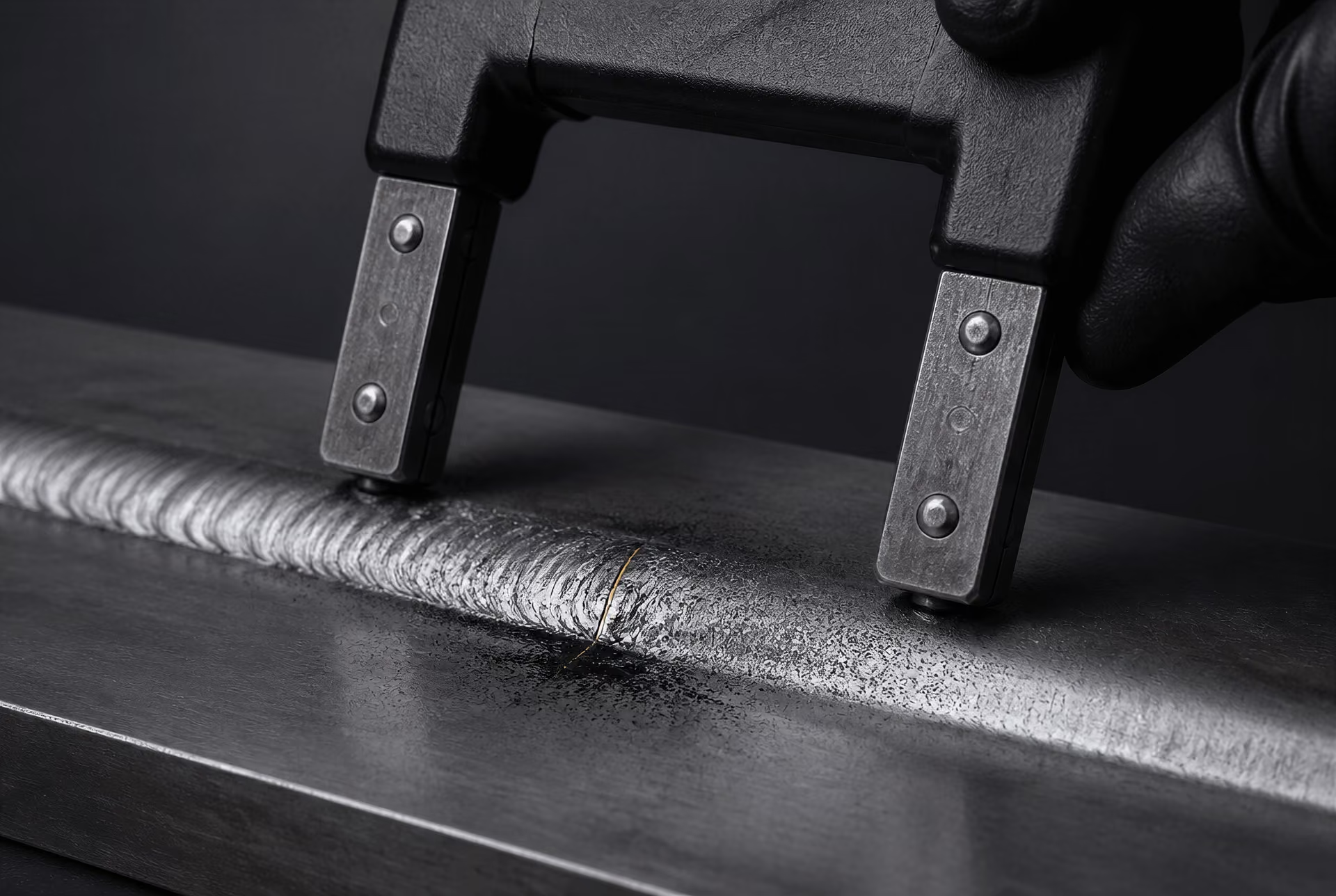
Inspection timing and access
| Method | Useful for | Important limitation |
|---|---|---|
| Visual examination | Visible surface cracks and profile defects | Cannot reliably detect embedded cracks |
| Magnetic particle testing | Surface and near-surface cracks in ferromagnetic steel | Field direction affects sensitivity |
| Liquid penetrant testing | Open-to-surface cracks on suitable clean surfaces | Cannot detect embedded cracks |
| Ultrasonic testing | Many embedded planar discontinuities | Depends on orientation, access, and calibration |
| Radiographic testing | Some volumetric and planar discontinuities | Tight cracks aligned with the beam may be difficult to detect |
Inspection timing should follow the governing fabrication or quality specification, the material and joint category, the welding procedure, and the credible defect mechanisms. Standards may define when a particular examination is to be performed, whether temperature maintenance or postheat is required, and whether repair areas receive additional examination. No single waiting period applies to every steel weld, and an arbitrary delay cannot replace a technically justified inspection plan.
The purpose of delayed examination is to allow a possible cold-cracking mechanism to develop sufficiently for the selected method to detect it. This is different from delaying inspection merely as a customary practice. The responsible engineer or specification may consider steel grade, carbon equivalent, hydrogen control, weld size, restraint, heat input, preheat and interpass temperature, joint thickness, and whether the steel was exposed to hydrogen in service.
Access controls what can actually be examined. A weld toe may be reachable for direct visual testing and magnetic particle testing, while the root may be hidden behind a backing strip, internal attachment, insulation, or a second component. A crack oriented parallel to the inspection surface can produce a strong indication in one method but a weak or missed indication in another. Probe angle, scanning direction, calibration, surface condition, coating, geometry, and operator competence all affect the result.
Visual examination is useful for surface-breaking cracks, poor profile, undercut, arc strikes, and visible repair evidence. It cannot reliably find tight cracks below the surface. Magnetic particle testing can be highly sensitive to surface and near-surface cracks in ferromagnetic steels, but its indication depends on magnetic field direction. A crack parallel to the applied field may produce little magnetic flux leakage; changing the field direction is therefore important. Liquid penetrant testing can reveal open-to-surface cracks on suitable clean surfaces, but it cannot find an embedded crack and is unsuitable where penetrant cannot enter the discontinuity.
Ultrasonic testing can examine substantial weld volumes and may detect embedded planar cracking, but interpretation depends on crack orientation, reflectivity, access from one or both sides, weld geometry, and the procedure’s qualification. Radiographic testing may reveal some planar defects, yet a tight crack aligned with the radiation beam can be difficult to distinguish because its projected width is small. The method must match the suspected crack location and orientation rather than being selected solely because it is familiar.
Surface-breaking and embedded cracking
Surface-breaking hydrogen cracks often occur at the weld toe, weld root, crater, or fusion boundary, where restraint and stress concentration are high. They may be transverse to the weld, longitudinal, or irregular and branching. A crack at the toe can remain hidden under slag, spatter, coating, or a later weld deposit. Grinding may expose it, but grinding can also remove evidence, smear a tight opening, or leave a geometry that complicates interpretation.
Embedded cracks are more difficult. They may lie in the HAZ rather than in the weld metal, and a surface examination can be entirely negative. A root crack beneath an internal attachment or a crack along a fusion boundary may require ultrasonic examination, radiography, or removal of material for destructive examination. ISO 17642-1:2004 describes cold-crack formation and test principles for assessing the cracking sensitivity of welding consumables, parent materials, and weld metal; it is concerned with evaluating susceptibility, not with declaring a production weld safe after a single visual check. ISO 3690:2018 separately specifies sampling and analytical procedures for measuring diffusible hydrogen in arc-welded weld metal of martensitic, bainitic, and ferritic steels.
When a crack is found, the investigation should preserve its location and orientation before repair. The examiner should identify whether it is hot cracking, hydrogen-assisted cold cracking, lack of fusion, or another discontinuity, because the corrective action differs. Removing and rewelding a crack without controlling hydrogen, cooling, restraint, and residual service hydrogen can reproduce the defect. Inspection is therefore not the final substitute for weldability control; it is the means of finding whether the combined controls actually worked.
A Procedure-Based Prevention Workflow
Hydrogen-cracking prevention starts before the arc is struck. The welding procedure must address three conditions at the same time: hydrogen in or entering the joint, a hard and brittle susceptible microstructure, and tensile stress from restraint or residual stress. TWI describes this combination as necessary for hydrogen cracking, while the International Institute of Welding (IIW) identifies hydrogen content, residual tensile stress, and microstructural susceptibility as the three principal factors in high-strength steel welds. A preheat temperature by itself does not remove any of these conditions.
Collect material, service, and joint data
First identify the product standard, grade, delivery condition, thickness, weld type, and repair history. Record designations exactly, such as S355J2+N to EN 10025-2, ASTM A516 Grade 70, or 2¼Cr-1Mo steel where that is the specified material. Do not infer weldability from carbon content alone. A steel with modest carbon can still develop a hard heat-affected zone (HAZ) when alloying elements, cooling rate, and thickness produce a high hardenability response.
Obtain the ladle or product analysis, including carbon, manganese, chromium, molybdenum, nickel, copper, vanadium, and any microalloying additions. Calculate the carbon equivalent required by the governing welding standard or specification. EN 1011-2 commonly uses a carbon-equivalent approach together with thickness, hydrogen level, heat input, and restraint. The result is an input to the procedure, not a pass-or-fail weldability number.
Then characterize the joint. Note thickness at the weld, heat-sink effects from attachments, groove angle, root gap, backing, weld length, sequence, and access for heating. A highly restrained nozzle, patch, or closure weld can crack at a lower nominal hydrogen level than a lightly restrained butt joint. Tack welds count: a short, cold, poorly dried tack may become the first crack site or may impose restraint on the production weld.
Service history requires separate attention. Ask whether the steel has operated in wet hydrogen sulfide, hydrogen, high-pressure water, cathodic-protection conditions, or high-temperature hydrogen service. Diffusible hydrogen introduced by the electrode or arc is not the same as hydrogen retained in service-exposed parent steel. The latter can migrate during cutting, gouging, preheating, and welding, increasing fabrication-cracking risk even when the consumable test result is acceptable. For hydrogen-charged 2¼Cr-1Mo steel, one reported experiment found that the required preheat could increase by 130 °C. That figure is not a general allowance; it shows why service exposure must be investigated rather than hidden inside a generic preheat table.
Assess susceptibility with the applicable procedure qualification and, where necessary, a cold-crack test. ISO 17642-1:2004 sets general principles for destructive cold-crack testing in arc-welded metallic materials and covers approaches used to assess cracking sensitivity in consumables, parent materials, and weld metal. Such testing is especially useful when the grade, repair condition, restraint, or service hydrogen history falls outside established procedure experience.
Set hydrogen, thermal, and restraint controls
Select a qualified consumable whose strength, toughness, diffusible-hydrogen class, and deposition method match the procedure. For low-hydrogen covered electrodes, specify the manufacturer’s drying, rebaking, holding, and exposure limits; keep electrodes in heated quivers after opening. Flux-cored and submerged-arc wires require control of sealed storage, flux drying, and exposure to workshop humidity. Shielding-gas quality, flow, leaks, wind, surface moisture, oil, paint, and rust also affect hydrogen entry.
Measure rather than assume diffusible hydrogen when the risk warrants it. ISO 3690:2018 specifies sampling and analytical procedures for diffusible hydrogen in arc-welded filler-metal weld deposits, including weld metal in martensitic, bainitic, and ferritic steels. The measured value belongs to a particular consumable, process, storage condition, and test method; it cannot automatically be assigned to every weld made with the same trade designation.
Establish preheat from the applicable standard, qualified procedure, and actual joint conditions. Measure it on the parent metal adjacent to the weld, not on the flame or only on the opposite face. Specify the measurement distance and timing, and ensure that the full weld area reaches temperature. Maintain the minimum preheat through tack welding, root deposition, interruptions, and restart. Set a maximum interpass temperature as well as a minimum. Excessive interpass temperature can alter toughness, grain size, precipitation behavior, and the final cooling path.
Preheat has two useful effects: it slows HAZ cooling and gives hydrogen more time to escape. Dillinger’s guidance applying Method B of EN 1011-2 describes both effects. But more heat is not automatically safer. TWI reports that excessive heat input can increase weld-metal hydrogen retention because it enlarges the diffusion distance and may shorten the time available for diffusion. The procedure therefore needs a controlled thermal window, not the highest attainable temperature.
Calculate or verify heat input for every qualified range:
where is heat input in kJ/mm, is arc efficiency, is voltage, is current, and is travel speed in mm/s. Record whether the stated value is arc energy or effective heat input, since the efficiency factor changes the meaning. Excessively low heat input can produce rapid cooling and hard HAZ structures; excessive heat input can increase distortion, reduce toughness, and affect hydrogen diffusion. Welding speed, bead size, pass sequence, and interpass temperature must remain inside the qualified range.
Restraint-reduction measures
- Fit-up Maintain the specified root gap, alignment, root face, and groove geometry.
- Tacks Use sound, adequately sized, dry tack welds that are compatible with the final procedure.
- Sequence Balance deposition and distribute shrinkage rather than locking contraction into one region.
- Attachments Plan temporary attachment removal and repair of any resulting gouges or local defects.
Control restraint through fit-up and sequence. Remove forced alignment where possible, use a balanced sequence, avoid oversized tacks, and prevent root gaps or mismatched edges that concentrate stress. Plan starts and stops away from geometric stress raisers. Where service hydrogen is suspected, define hydrogen-release treatment or a conservative thermal cycle before welding; this may include prolonged heating, controlled holding, and verification by the responsible welding engineer.
Define postheat when the risk assessment or qualified procedure requires it. Postheat is not the same as post-weld heat treatment. A hydrogen bake-out holds the weld at a specified temperature to promote hydrogen migration before the joint cools into a hard, stressed condition. SteelConstruction.info and Guidance Note 6.04 describe maintaining preheat or applying postheat for this purpose. A separate stress-relief treatment has different temperatures, times, and metallurgical effects.
Verify execution and document deviations
The welding supervisor should record consumable batch, drying cycle, holding temperature, welder, process, current, voltage, travel speed, calculated heat input, preheat, interpass temperature, shielding gas, joint identification, and weld sequence. Temperature crayons can provide a quick check, but calibrated contact thermometers or infrared instruments are preferable where emissivity and access permit. Record readings at a defined location and interval.
Treat deviations as engineering events. If preheat falls below its minimum, stop, restore the specified temperature, and document the interruption. If an electrode exceeds its exposure limit, quarantine it rather than returning it to the quiver. If heat input, interpass temperature, restraint, consumable condition, or service history differs from the qualified procedure, obtain a disposition before continuing.
Inspection must account for delayed cracking. Allow the specified cooling and hydrogen-diffusion period before final non-destructive examination; the interval may require several hours or longer depending on the material, thickness, restraint, procedure, and governing code. Visual inspection immediately after welding cannot clear a joint for delayed cold cracking. Use the required magnetic particle or penetrant examination for surface-breaking cracks and ultrasonic or radiographic examination where volumetric coverage is specified. If a crack appears, do not simply grind it out and reweld. Map the defect, identify its origin, review hydrogen and thermal records, reassess service-charged material, and revise the procedure before repair. Prevention is a coordinated welding control system, not a single temperature instruction.
Common Claims That Fail Metallurgical Scrutiny
Hydrogen cracking is not controlled by one dial. TWI describes the necessary combination as hydrogen, a hard and brittle susceptible structure, and tensile stress. The International Institute of Welding (IIW) White Paper (2023) expresses the same relationship through three principal factors: hydrogen content, residual tensile stress, and microstructural susceptibility. Remove or reduce one factor and cracking risk may fall; leave the other two unchanged and a weld can still crack, sometimes hours after welding.
This is why a sound procedure considers steel chemistry, restraint, joint thickness, cooling rate, heat input, consumable condition, preheat, interpass temperature, and the service history of the material. ISO 17642-1:2004 sets out general principles for destructive cold-crack testing of arc-welded metallic materials, including assessment of welding consumables, parent materials, and weld metal. Such testing exists because weldability cannot be inferred from carbon content or a single welding parameter.
More preheat always means less cracking
Preheat usually helps, but “more” is not a metallurgical rule. Raising the temperature before and during welding slows cooling through the heat-affected zone (HAZ), reducing the likelihood that a hard, brittle martensitic structure will form. It also gives diffusible hydrogen more time to leave the weld and adjacent steel before the joint reaches lower temperatures at which hydrogen can become trapped. Dillinger’s guidance, applying Method B of EN 1011-2, describes these two effects directly: preheating slows HAZ cooling and promotes hydrogen escape. SteelConstruction.info likewise recommends controlling cooling rates and maintaining preheat or postheat so hydrogen can migrate away from hard, stressed regions.
The benefit has limits. A temperature above the qualified procedure range can enlarge the HAZ, change grain size, reduce toughness, and affect strength or dimensional accuracy. Excessive interpass temperature may also produce undesirable microstructures or reduce the performance required by the design standard. Preheat does not cancel severe restraint, a high-hardenability steel, contaminated joint surfaces, or hydrogen already absorbed into the parent material.
That last point matters during repair welding. Hydrogen charged into steel during service is not the same as diffusible hydrogen introduced by a welding electrode. Experiments on hydrogen-charged C-Mn and Cr-Mo steels found that retained hydrogen could increase fabrication-cracking risk. For 2¼Cr-1Mo steel, one reported case required a 130 °C increase in preheat. The response may include hydrogen-release treatment, conservative preheat, controlled interpass temperature, and low-hydrogen welding practice. Simply applying a familiar preheat value is not enough.
Preheat must therefore be specified from the material and procedure, not selected as an unlimited safety margin. EN 1011-2, including its recommendations for ferritic steels, links cracking control to composition, hydrogen content, heat input, preheat, and interpass temperature. The relevant question is whether the selected thermal cycle keeps cooling and hydrogen movement within an acceptable range.
More heat input always improves weldability
Higher heat input often slows cooling, so it can reduce the formation of hard HAZ constituents in some steels. That limited observation is frequently turned into an absolute claim. It should not be.
Heat input changes the complete thermal history. A larger weld pool and wider heated region can increase HAZ width and alter grain growth, toughness, strength, and transformation products. In restrained joints, the resulting shrinkage pattern may also affect residual stress. The outcome depends on steel chemistry, thickness, joint geometry, welding process, travel speed, and the temperature range through which the material transforms.
Hydrogen movement makes the claim still less reliable. TWI reports that excessive heat input can increase weld-metal hydrogen retention because it enlarges diffusion distances and may shorten the overall time available for diffusion. A hotter or larger weld is not automatically a cleaner weld. Hydrogen must reach an escape path, and the path may become longer as the deposited weld volume increases. Subsequent cooling can then leave hydrogen concentrated near hard or highly stressed areas.
Very low heat input has risks too: rapid cooling can form martensite or other susceptible structures, particularly in high-hardenability steels and thick restrained joints. The answer is a qualified heat-input window, not a race toward either extreme. Preheat, interpass control, bead sequence, welding current, voltage, travel speed, and postheat have to work together. A procedure that prevents a hard HAZ but produces unacceptable toughness is not a successful hydrogen-cracking solution.
The defect under discussion is delayed cold cracking, not hot cracking. Hot cracking occurs during solidification or at elevated temperature and is governed by different mechanisms, including solidification segregation and liquid-film formation. A higher heat input may affect both defect classes, but it does not make them interchangeable.
Low-hydrogen electrodes eliminate hydrogen cracking
Low-hydrogen electrodes reduce hydrogen entering the weld. They do not make hydrogen content zero, and they do not remove the other conditions required for cracking. Moisture, damaged flux coverings, dirty joint faces, lubricants, paint, shielding-gas problems, and poor storage can raise hydrogen despite the nominal classification of the consumable. Consumables must be dried, stored, issued, and used according to the applicable procedure.
Hydrogen measurements also need a defined method. ISO 3690:2018 specifies sampling and analytical procedures for diffusible hydrogen in arc-welded weld metal made with filler material, including weld metal in martensitic, bainitic, and ferritic steels. That measurement concerns weld-metal hydrogen. It does not directly quantify hydrogen retained in a service-exposed plate or hydrogen distributed in the HAZ.
A low-hydrogen electrode cannot soften a martensitic HAZ created by rapid cooling, and it cannot remove tensile stress generated by weld contraction or external restraint. Nor can it instantly release hydrogen that entered a pressure vessel, pipeline component, or other steel during service. In such cases, preheat, postheat, joint preparation, restraint reduction, sequencing, and delayed inspection may all be necessary.
Low-hydrogen practice is essential where the procedure requires it, but it is one control in a connected system. Hydrogen cracking is prevented when hydrogen input and retained hydrogen are controlled while the thermal cycle avoids a susceptible microstructure and the joint is allowed to tolerate or shed tensile stress. That is a metallurgy problem, not an electrode label.
References
- [1] ISO 3690:2018. International Standard, 2018. https://www.iso.org/standard/72150.html
- [2] Welding parameter guidance. Dillinger technical guidance, 2024. https://service.dillinger.de/d/en/e-service/tools/welding/help/embed_index.shtml