



What Free-Machining Steel Actually Means
Machinability response measures
- Chip formation How readily the material produces short, manageable chips.
- Cutting force The force generated under stated speed, feed, depth of cut, and tool conditions.
- Tool wear The rate of flank wear, crater wear, chipping, or other damage.
- Surface integrity Whether roughness, tearing, residual stress, and near-surface damage remain acceptable.
Free-machining steel is steel that gives a favorable machining response under specified conditions. It is not defined by sulfur content alone, nor by the presence of a particular inclusion viewed in isolation. A useful assessment asks how the material forms chips, how much cutting force it generates, how quickly the tool wears, and whether the machined surface retains acceptable integrity at a stated speed, feed, depth of cut, coolant condition, and tool geometry.
That definition matters because machinability is a system property. The ASM Handbook identifies composition, microstructure, strength level, cutting conditions, cutting fluids, and tool material as interacting controls. Changing any one of them can alter the ranking of two steels. A resulfurized grade that cuts freely with a carbide insert at moderate speed may behave differently with high-speed steel, a sharp polished tool, interrupted cutting, or a dry operation. Even within one heat, normalized, cold-drawn, and quenched-and-tempered material can produce different chips and different wear rates.
| Steel family or variable | Machinability-related role | Principal trade-off |
|---|---|---|
| SAE/AISI 11xx | Added sulfur forms excess MnS inclusions | Reduced transverse ductility and fatigue resistance may result |
| SAE/AISI 12xx | Added sulfur plus approximately 0.04–0.12% phosphorus | Improved chip fracture with possible ductility and toughness penalties |
| Leaded resulfurized steel | Lead may occur with sulfides or as free lead particles | Exposure, recycling, welding, and environmental concerns |
| Free-machining stainless steel | Controlled sulfur additions modify sulfide populations | Potential pitting-corrosion and transverse-property penalties |
Sulfur is therefore a design variable, not a universal machinability rating. In SAE/AISI 11xx steels, added sulfur combines mainly with manganese to form excess manganese sulfide, or MnS. These inclusions can weaken the chip locally, encourage segmentation, and reduce contact conditions at the tool–chip interface. SAE/AISI 12xx steels add phosphorus as well; the Mechanical Engineers’ Handbook, Carbon and Alloy Steels (2022), gives approximately 0.04–0.12% phosphorus for this family. Phosphorus can assist chip breaking and raise hardness, but its effect must be considered alongside matrix structure, ductility, and the intended service properties.
Machinability depends on interacting chemistry, matrix, processing, and cutting variables rather than sulfur content alone. Strong evidence
The ASTM symposium volume Additives to Steel and Iron for Improved Machinability (2024) treats sulfur, lead, selenium, tellurium, phosphorus, nitrogen, the manganese-to-sulfur ratio, and ASTM specifications as machinability-design variables. That framing is more accurate than saying that “more sulfur means easier machining.” Sulfur content changes the potential inclusion population, while manganese availability, oxygen control, calcium treatment, rare-earth additions, solidification, rolling, and heat treatment determine what that population actually becomes.
Inclusion engineering The deliberate control of non-metallic inclusion chemistry, quantity, size distribution, shape, and spatial arrangement through steelmaking and processing.[1] ISO 4967:2026. International Organization for Standardization. ISO standard, 2026.
Inclusion engineering means tailoring inclusion composition, amount, size distribution, and morphology through steelmaking and processing variables. Measurement is not the same as engineering. ISO 4967:2026 specifies micrographic determination of non-metallic inclusions in rolled or forged steel products with “a reduction ratio of at least 3,” but the standard also warns that its reference chart is not entirely applicable to free-cutting steels. A chart rating can describe a field of inclusions without revealing whether those particles produce the desired chip segmentation, tool life, or surface finish. The measured feature must match the engineering question.
Machinability is a system property, not a sulfur percentage
Matrix structures and their effects
- Ferrite
- A relatively soft matrix that can support easier plastic flow but may encourage adhesion under some conditions.
- Pearlite
- A ferrite–cementite structure whose strength and spacing affect cutting resistance.
- Martensite
- A hard matrix that can raise cutting force and abrasive tool wear.
- Bainite
- A transformed structure whose strength and morphology influence shear resistance.
- Tempered structures
- Heat-treated matrices whose hardness, toughness, and carbide condition modify inclusion behavior during cutting.
The matrix sets the mechanical environment in which inclusions operate. Ferrite, pearlite, martensite, bainite, and tempered structures offer different resistance to plastic flow and different tendencies toward built-up edge formation. Strength level and hardness affect cutting force, while toughness affects chip ductility and the way cracks propagate through a chip. A steel can contain a machinability-promoting inclusion population yet require high force because its matrix is strong or work-hardening.
This is why machinability must be separated from tensile strength, hardness, toughness, fatigue performance, and corrosion resistance. A low cutting force does not prove high fatigue strength. Easy chip separation does not prove adequate fracture toughness. A free-machining stainless grade may machine more readily than a closely related low-sulfur grade, while its sulfides reduce pitting-corrosion resistance or alter transverse ductility. Machinability describes manufacturing response; it does not replace the property specification for the component.
| Inclusion population | Reported machining effect | Preferred response |
|---|---|---|
| MnS | Included in the reported cutting-force comparison | Reference population |
| (Mn,Ca)S | Included in the reported cutting-force comparison | Calcium-modified chemistry |
| MnS–RE2S3 | Included in the reported cutting-force comparison | Rare-earth-containing population |
| (Mn,Ca)S–RE2S3 | Included in the reported cutting-force comparison | Calcium- and rare-earth-containing population |
The shape and chemistry of sulfides produce different trade-offs. A 1995 study, Effects of the composition, shape factor and area fraction of sulfide inclusions on the machinability of re-sulfurized free-machining steel, reported cutting-force effects in the order MnS, (Mn,Ca)S, MnS–RE2S3, and (Mn,Ca)S–RE2S3. Elongated sulfides reduced cutting force more effectively, whereas globular sulfides reduced tool flank wear more effectively. The result rejects a single-score view of machinability: the inclusion population that lowers force most may not be the population that preserves the tool edge.
A separate quantitative study from the University of Liège, Quantitative analysis of sulphide inclusions in free cutting steels and their influence on machinability (1995), reported a machinability index that “varied from 200% to 100% with sulfide-inclusion shape ratio.” It preferred globoidal manganese-sulfide inclusions for free-cutting machinability. Shape ratio, area fraction, spacing, and orientation can matter as much as nominal sulfur. Rolling elongates sulfides along the working direction, so machining parallel and transverse to that direction can expose different inclusion geometries.
Calcium treatment offers one route for controlling this geometry and chemistry. Calcium can modify oxide inclusions and influence sulfide formation, while thermodynamic prediction of calcium partitioning between oxides and sulfides helps guide the resulting population. The objective is not simply to maximize inclusion volume. Excessive, coarse, clustered, or poorly bonded particles can damage fatigue performance and surface quality.[4] Free-machining stainless steels grades. British Stainless Steel Association. BSSA technical article, 2024.
Leaded resulfurized steel illustrates another mechanism. Lead may occur with sulfide inclusions or as free lead particles, reducing friction and aiding chip separation. In free-machining stainless steels, sulfide inclusions can act as “solid lubricants at the tool–workpiece interface,” as described by the British Stainless Steel Association in 2024. BS EN 10088 permits machinable variants with sulfur additions of 0.015% or 0.030% for some grades. Those additions change machining behavior, but they also require assessment of corrosion, weldability, ductility, and inclusion-related damage.
Chip formation, cutting force, tool wear, and surface integrity
Machining responses to record
- Chip length Indicates chip-control behavior and evacuation risk.
- Cutting force Quantifies resistance to chip formation under defined conditions.
- Flank-wear land Tracks wear on the clearance face.
- Crater depth Tracks wear on the rake face.
- Surface roughness Measures the resulting machined surface texture.
- Metallographic damage Reveals tearing, smeared material, white or rehardened layers, and near-surface defects.
Short chips are useful because they reduce entanglement, evacuation problems, and interruptions around the cutting zone. MnS particles can initiate local shear, interrupt chip continuity, and reduce the real contact area between chip and tool. A short chip, however, is only one result. Tool wear and surface condition may tell a different story.
Flank wear develops as the tool rubs against the newly machined surface, while crater wear develops on the rake face under hot, sliding chip contact. Adhesion, abrasion, diffusion, thermal softening, and chemical reactions can act together. An inclusion that lowers cutting force may still promote abrasive wear if it contains hard oxide material, or it may alter thermal contact so that the edge reaches an unfavorable temperature. Globular sulfides can reduce flank wear more effectively than elongated sulfides even when the latter produce lower cutting force.
Surface integrity includes roughness, residual stress, plastic deformation, tearing, smeared material, white or rehardened layers, and near-surface inclusions pulled from the matrix. A steel can generate cleanly broken chips while leaving torn marks or tensile residual stress. Cutting speed, feed, tool nose radius, edge preparation, coolant chemistry, and tool material decide whether the inclusion benefit survives at the surface.
Machining tests must therefore state their conditions and response metrics. Cutting force, chip length, flank-wear land, crater depth, tool life, roughness, and metallographic surface damage are different measurements. No single inclusion rating predicts all of them. Free-machining steel means engineered behavior under a defined machining system—not a sulfur number printed in a grade designation.
Why Inclusions Matter During Cutting

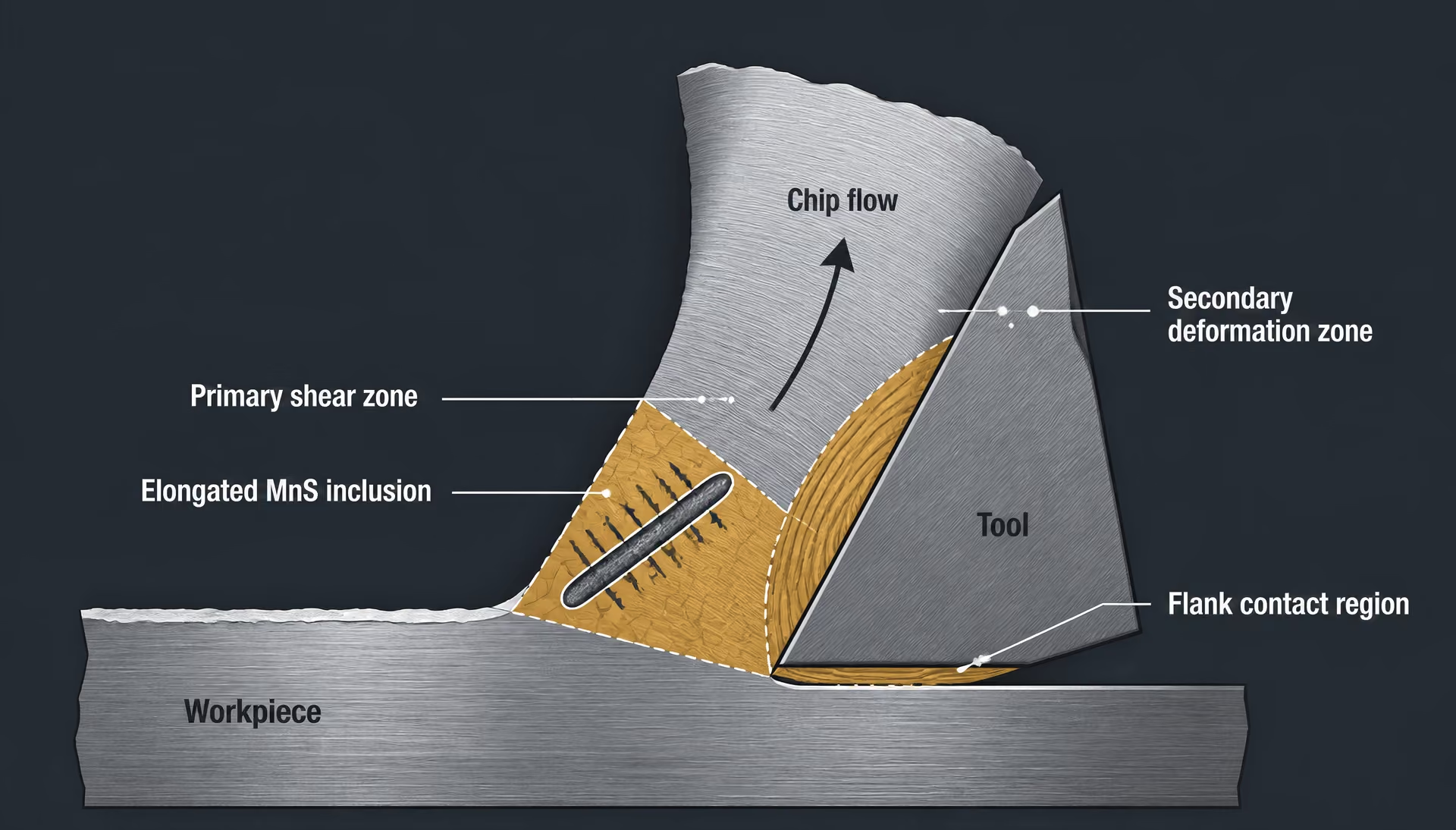
The tool–chip–workpiece interface
Cutting is concentrated deformation, not simple material removal. A narrow primary shear zone converts the workpiece into a chip, while a secondary deformation zone develops where the chip slides across the rake face. A third contact region lies between the tool flank and the newly machined surface. Pressure, temperature, strain rate, and sliding velocity are high in all three regions, so small changes in the steel’s local constitution can alter cutting force, heat flow, chip shape, built-up edge, and tool wear.
Sulfide inclusions matter because they interrupt the steel matrix inside these highly strained zones. In SAE/AISI 11xx steels, added sulfur combines mainly with manganese to form excess manganese sulfide, usually written MnS. The inclusion is softer and more deformable than the surrounding ferrite, pearlite, or martensitic matrix, although its response depends strongly on temperature, strain rate, and the matrix strength. As a cutting edge passes through the material, an elongated MnS particle can deform, debond from the matrix, or form a weak path along which local shear concentrates. Less force is then required to advance the shear zone than would be needed in an equivalent region of inclusion-free matrix.
The British Stainless Steel Association and the Nickel Institute describe sulfides in free-machining stainless steels as machining-active constituents rather than merely unwanted contamination. That distinction is important. Sulfur is not acting by one universal mechanism, and an inclusion is not beneficial simply because it is present. Its chemistry, shape, size, spacing, area fraction, orientation, and bonding to the matrix all govern what the cutting edge encounters. Matrix condition matters just as much: a hard, work-hardening austenitic matrix can respond very differently from a softer ferritic or pearlitic one.
Rake face The tool surface over which the chip flows during cutting.
At the rake face, fractured sulfides and sulfur-rich reaction products may reduce adhesion between chip and tool. BSSA specifically describes sulfide inclusions in free-machining stainless steels as capable of acting as solid lubricants at the tool–workpiece interface. This does not mean that every sulfide creates a continuous lubricating film. The effect depends on whether inclusions reach the contact surface, whether they deform or fracture, the tool material, cutting speed, feed, depth of cut, and cutting fluid. A carbide tool cutting dry at high speed presents a different chemical and thermal environment from a coated tool operating with flood coolant.
Leaded resulfurized steel supplies another example of chemistry-dependent behavior. Lead may occur with sulfide inclusions or as free lead particles. These constituents can lower interfacial adhesion and assist chip separation, but they also alter the inclusion population and the response of the surface under pressure. ASTM International’s 2024 symposium description treats sulfur, lead, selenium, tellurium, phosphorus, nitrogen, manganese-to-sulfur ratio, and applicable ASTM specifications as interacting machinability-design variables. That is a more accurate framework than assigning a fixed machinability benefit to sulfur alone.
The same point applies to stainless grades. BS EN 10088 permits machinable variants with sulfur additions of 0.015% or 0.030% for some grades. Those limits describe a controlled grade chemistry, not a guarantee of identical tool life or chip form across all heats and operations. Calcium treatment can modify oxide and sulfide chemistry and morphology; thermodynamic prediction of calcium partitioning between oxides and sulfides helps steelmakers target a population that behaves differently from ordinary elongated MnS.
Inclusion measurement therefore needs a defined purpose. ISO 4967:2026 specifies micrographic determination of non-metallic inclusions in rolled or forged steel products with “a reduction ratio of at least 3,” but it also warns that its standard reference chart is not entirely applicable to free-cutting steels. A chart rating can describe cleanliness under the method’s conditions while failing to predict chip control or flank wear. The relevant engineering measurement may instead require three-dimensional morphology, inclusion spacing, area fraction, or orientation relative to the cutting direction.
Chip segmentation, lubrication, and crack initiation
An elongated sulfide can help a chip break by making deformation non-uniform. As the primary shear zone advances, the inclusion and its surrounding matrix do not carry strain in the same way. The particle may stretch with the rolling direction, fracture at its ends, or separate from the matrix. These events create local stress concentrations. Adjacent shear bands can then link across the chip, producing segments rather than one continuous ribbon. Shorter chips reduce entanglement and limit the time that hot chip material remains in contact with the tool.
Crack initiation is not automatically desirable, however. A large or closely spaced inclusion population can create severe discontinuities in the machined surface, promote edge chipping, or reduce transverse ductility. A globular inclusion may resist elongation and produce a different crack path from a long, stringered MnS particle. Orientation also matters: an inclusion aligned with the cutting direction may assist chip splitting, while the same inclusion viewed across its length may interact more strongly with the tool edge and leave a defect.
The 1995 study Effects of the composition, shape factor and area fraction of sulfide inclusions on the machinability of re-sulfurized free-machining steel reported cutting-force effects in the order MnS, (Mn,Ca)S, MnS–RE2S3, and (Mn,Ca)S–RE2S3. The result shows why “sulfide content” is an inadequate description. Rare-earth-containing and calcium-containing sulfides changed the response through composition and morphology, not merely through the amount of sulfur in the heat. In the same work, elongated sulfides reduced cutting force more effectively, whereas globular sulfides reduced tool flank wear more effectively. The inclusion population that makes a chip easier to shear may therefore be different from the population that protects the flank.
A separate quantitative study from the University of Liège, Quantitative analysis of sulphide inclusions in free cutting steels and their influence on machinability (1995), reported a machinability index that “varied from 200% to 100% with sulfide-inclusion shape ratio.” It favored globoidal manganese-sulfide inclusions for free-cutting machinability. The apparent tension with the force and wear results is instructive: machinability is a collection of responses, not one scalar property. Cutting force, chip breakability, surface finish, crater wear, flank wear, and tool-edge damage may rank the same steel differently.
SAE/AISI 12xx steels add approximately 0.04–0.12% phosphorus, which can influence matrix strength, embrittlement, and chip fracture alongside the sulfur-rich inclusion population. Cutting conditions then decide which mechanism dominates. A high feed may force crack initiation through inclusions; a high cutting speed may make diffusion, adhesion, and thermal wear more important; a sharp geometry may exploit weak inclusion–matrix interfaces, while a blunt edge may crush inclusions without gaining clean chip segmentation.
Inclusion engineering means controlling composition, amount, size distribution, and morphology through steelmaking and processing variables. It is not the same as counting dark particles in a polished section. The useful question is whether the engineered population produces the required fracture and lubrication behavior for a specified matrix, tool material, fluid, and cutting regime. A sulfur addition can lower force in one operation and accelerate tool damage or surface tearing in another. That conditional behavior is the reason inclusions matter during cutting.
Inclusion Engineering: From Defect Control to Functional Design
Inclusion engineering treats non-metallic inclusions as designed constituents of steel rather than as impurities to be eliminated at any cost. The objective is to tailor inclusion composition, amount, size distribution, and morphology so that the steel meets a defined combination of machinability, fatigue resistance, toughness, cleanliness, corrosion resistance, and dimensional stability. That objective differs from inclusion measurement. Measurement asks what is present and how much; engineering asks whether the observed population produces the desired result under a particular service or cutting condition.
The distinction matters most in free-machining grades. An inclusion that interrupts a chip, lowers cutting force, or supplies a weak path for crack initiation can be beneficial during turning but harmful under cyclic loading. Sulfur-bearing inclusions are therefore not simply contaminants. Their value depends on steel grade, matrix strength, section size, heat treatment, cutting speed, tool material, cutting fluid, and the failure mode being controlled.
A useful classification separates inclusions into three groups. Harmful inclusions are those whose composition, size, shape, or location causes unacceptable fatigue damage, fracture, corrosion, or surface defects. Tolerated inclusions remain within an agreed quality limit because removing them would impose a greater metallurgical or economic penalty than their measured risk. Intentionally introduced inclusions are added or encouraged because they provide a functional benefit, as manganese sulfide does in SAE/AISI 11xx free-machining steels.
Composition, amount, size distribution, and morphology
Inclusion chemistry begins with the elements available to react during steelmaking. Oxygen forms oxides such as alumina, silica, manganese oxide, and calcium aluminates. Sulfur combines mainly with manganese to form MnS, although calcium, rare-earth elements, and other additions can alter the sulfide phase. In leaded resulfurized steel, lead may occur alongside sulfide inclusions or as separate free lead particles. Selenium and tellurium can also modify sulfide behavior. ASTM International’s Additives to Steel and Iron for Improved Machinability identifies sulfur, lead, selenium, tellurium, phosphorus, nitrogen, the manganese-to-sulfur ratio, and applicable ASTM specifications as interacting machinability variables, not isolated targets.
Amount alone cannot predict performance. A small area fraction of large, elongated inclusions may be more damaging in fatigue than a larger population of fine, globular particles. Conversely, a sufficient sulfide area fraction may be needed to interrupt chips consistently during automatic machining. The 1995 University of Liège study Quantitative analysis of sulphide inclusions in free cutting steels and their influence on machinability reported a machinability index that “varied from 200% to 100% with sulfide-inclusion shape ratio.” Its results favored globoidal manganese-sulfide inclusions for free-cutting machinability, showing why a nominal sulfur percentage is an inadequate description of the engineering variable.
Morphology develops through the sequence of nucleation, growth, collision, and deformation. During solidification, inclusions nucleate from supersaturated liquid or form through reactions between dissolved elements and existing particles. They grow as solute is consumed, collide and agglomerate when fluid flow brings them together, and may float into slag if their size and buoyancy permit. Some remain trapped in the steel. Their final population reflects not only equilibrium chemistry but also residence time, turbulence, temperature, viscosity, and the rate at which the metal solidifies.
Manganese sulfide illustrates the design trade-off. SAE/AISI 11xx steels contain added sulfur, which forms excess MnS inclusions that promote chip breaking and can provide a lubricating effect at the cutting interface. SAE/AISI 12xx steels add approximately 0.04–0.12% phosphorus, further changing chip formation and matrix behavior. During rolling or forging, soft MnS inclusions elongate into stringers, while harder oxides may fracture, rotate, or remain angular. The resulting aspect ratio and alignment create directional properties: machinability can improve in the longitudinal direction, while transverse ductility and fatigue resistance may decline.
The inclusion population that produces the lowest cutting force need not minimize tool wear. In the 1995 study Effects of the composition, shape factor and area fraction of sulfide inclusions on the machinability of re-sulfurized free-machining steel, the reported cutting-force effect followed the order MnS, (Mn,Ca)S, MnS–RE2S3, and (Mn,Ca)S–RE2S3. Elongated sulfides reduced cutting force more effectively, whereas globular sulfides reduced tool flank wear more effectively. This is a direct warning against treating “machinability” as one measurement. Force, chip breakability, tool wear, surface finish, and production stability can respond differently to the same inclusion population.
Calcium treatment changes this balance by modifying both oxide and sulfide inclusions. Calcium can react with alumina and other oxides, producing calcium aluminates with different melting behavior and shapes; it can also enter sulfides, producing calcium-bearing particles such as (Mn,Ca)S. Thermodynamic predictions of calcium partitioning between oxides and sulfides help define the treatment window. Too little calcium may leave angular alumina; too much may generate undesirable calcium-rich phases or impair castability. The intended result is not simply “more calcium,” but a controlled inclusion population that resists harmful deformation and supplies the required machining response.
Steelmaking and processing variables
Inclusion engineering begins in the furnace but is completed through ladle treatment, casting, and deformation processing. Deoxidation practice determines which oxide particles nucleate first. Aluminium-killed steel may contain alumina clusters; silicon-manganese practice produces a different oxide chemistry. Ladle stirring changes collision frequency and flotation, while slag composition and interface conditions determine whether inclusions are absorbed or returned to the metal. Tundish flow control and submerged-entry-nozzle design affect reoxidation, entrainment, and the spatial distribution of particles entering the mould.
Solidification then fixes much of the inclusion geography. Local segregation changes sulfur and manganese concentrations, so sulfides may concentrate between dendrites and form at different times during freezing. Cooling rate influences particle size and the distance available for growth. Centreline segregation, shrinkage, and flow-induced banding can place inclusions in clusters rather than distributing them uniformly.
ISO 4967 chart ratings alone cannot predict chip control, flank wear, or the complete machining response of free-cutting steels. Limited evidence
Hot rolling and forging alter that inherited population. Deformation elongates sulfides, fractures some oxide clusters, changes particle spacing, and aligns inclusions with the working direction. Reduction ratio therefore affects what a polished section shows. ISO 4967:2026 specifies micrographic determination of non-metallic inclusions in rolled or forged steel products with “a reduction ratio of at least 3,” while warning that its standard reference chart is not entirely applicable to free-cutting steels. A chart comparison can document severity, but it cannot replace an application-specific analysis of sulfide aspect ratio, area fraction, clustering, and orientation.
The same caution applies to sampling and image analysis. A longitudinal section may capture elongated sulfides while a transverse section emphasizes spacing and clustering. Two-dimensional area fraction does not directly reveal three-dimensional volume fraction, and a single maximum-size particle may control fatigue even when the average population appears acceptable. Measurements must represent the property being evaluated: chip formation requires shape and spacing data under the cutting direction; fatigue assessment requires extreme-size, clustering, and matrix-interface information.
For free-machining stainless steels, the design compromise also includes corrosion performance. British Stainless Steel Association guidance notes that sulfide inclusions may act as “solid lubricants at the tool–workpiece interface,” and BS EN 10088 permits machinable variants with sulfur additions of 0.015% or 0.030% for some grades. Those additions can improve cutting behavior while increasing the need to assess pitting sensitivity and transverse mechanical properties. Inclusion engineering therefore ends with a service-specific decision: retain the phases that perform a useful function, control their size and shape, and remove or transform the populations whose defects outweigh their machining benefit.
Manganese Sulfide in Resulfurized Free-Machining Steels
MnS formation and the role of manganese
Sulfur is not added to resulfurized steel as a passive contaminant. It is added because, under controlled conditions, it forms manganese sulfide (MnS), an inclusion population that changes chip formation, cutting force, and tool damage. The essential reaction is simple: manganese combines with dissolved sulfur during solidification, producing MnS particles once the local solubility limits are exceeded. The metallurgy is not simple, however, because the resulting inclusion population depends on sulfur and manganese contents, the manganese-to-sulfur ratio, oxygen and calcium levels, solidification conditions, rolling reduction, and the steel matrix surrounding each particle.
Manganese performs two related functions. It binds sulfur into MnS, reducing the amount of sulfur available to form iron sulfide, which is associated with hot shortness. It also establishes the chemical conditions under which sulfide inclusions precipitate and grow. If manganese is insufficient relative to sulfur, iron-rich sulfides may form at grain boundaries and impair hot working. With adequate manganese, sulfur is preferentially retained in manganese-rich sulfides dispersed through the steel.
SAE/AISI 11xx steels are the familiar resulfurized carbon-steel grades. Their added sulfur produces excess manganese-sulfide inclusions, which assist chip breaking and can provide a lubricating effect during cutting. The word “excess” matters: compared with ordinary carbon steels, these grades deliberately contain a larger sulfide population. That population is not judged only by total sulfur. Two heats with similar sulfur contents can machine differently if their sulfide size, shape, area fraction, composition, or distribution differs.
SAE/AISI 12xx steels add phosphorus to the resulfurized design. The Mechanical Engineers’ Handbook, Carbon and Alloy Steels (2022), gives approximately 0.04–0.12% phosphorus for this family. Phosphorus can raise hardness and improve chip fracture, but it also affects ductility and the response of the matrix during cutting. Sulfur therefore operates within a larger chemistry system rather than acting as an isolated machinability additive. ASTM International’s 2024 symposium work, Additives to Steel and Iron for Improved Machinability, identifies sulfur, lead, selenium, tellurium, phosphorus, nitrogen, the manganese-to-sulfur ratio, and applicable ASTM specifications as design variables.
Manganese sulfide chemistry can be modified further. Calcium treatment changes oxide inclusions and can alter sulfide composition and morphology, producing calcium-bearing sulfides such as (Mn,Ca)S. Rare-earth additions can produce mixed populations such as MnS–RE2S3 and (Mn,Ca)S–RE2S3. These designations describe more than a chemical footnote: the inclusion’s composition affects its melting behavior, interfacial energy, deformability, and response to rolling. Thermodynamic prediction of calcium partitioning between oxides and sulfides is used to guide this control, with the aim of changing inclusion shape and distribution rather than merely increasing or decreasing total inclusion content.
That distinction separates inclusion measurement from inclusion engineering. The 2018 review Non-metallic inclusions in steels – origin and control defines engineering in terms of tailoring inclusion composition, amount, size distribution, and morphology through steelmaking and processing variables. A polished-section count can report what is present. It does not, by itself, show whether that population produces lower cutting force, longer tool life, better fatigue performance, or acceptable cleanliness for another application.
Measurement also has a defined scope. ISO 4967:2026 specifies micrographic determination of non-metallic inclusions in rolled or forged steel products with “a reduction ratio of at least 3.” Its standard reference chart is not entirely applicable to free-cutting steels, where a high sulfide content is intentional. A rating system designed to compare ordinary inclusion cleanliness can therefore misrepresent a resulfurized grade unless the analyst records sulfide morphology, dimensions, area fraction, and orientation separately.

Why sulfide shape changes machining behavior
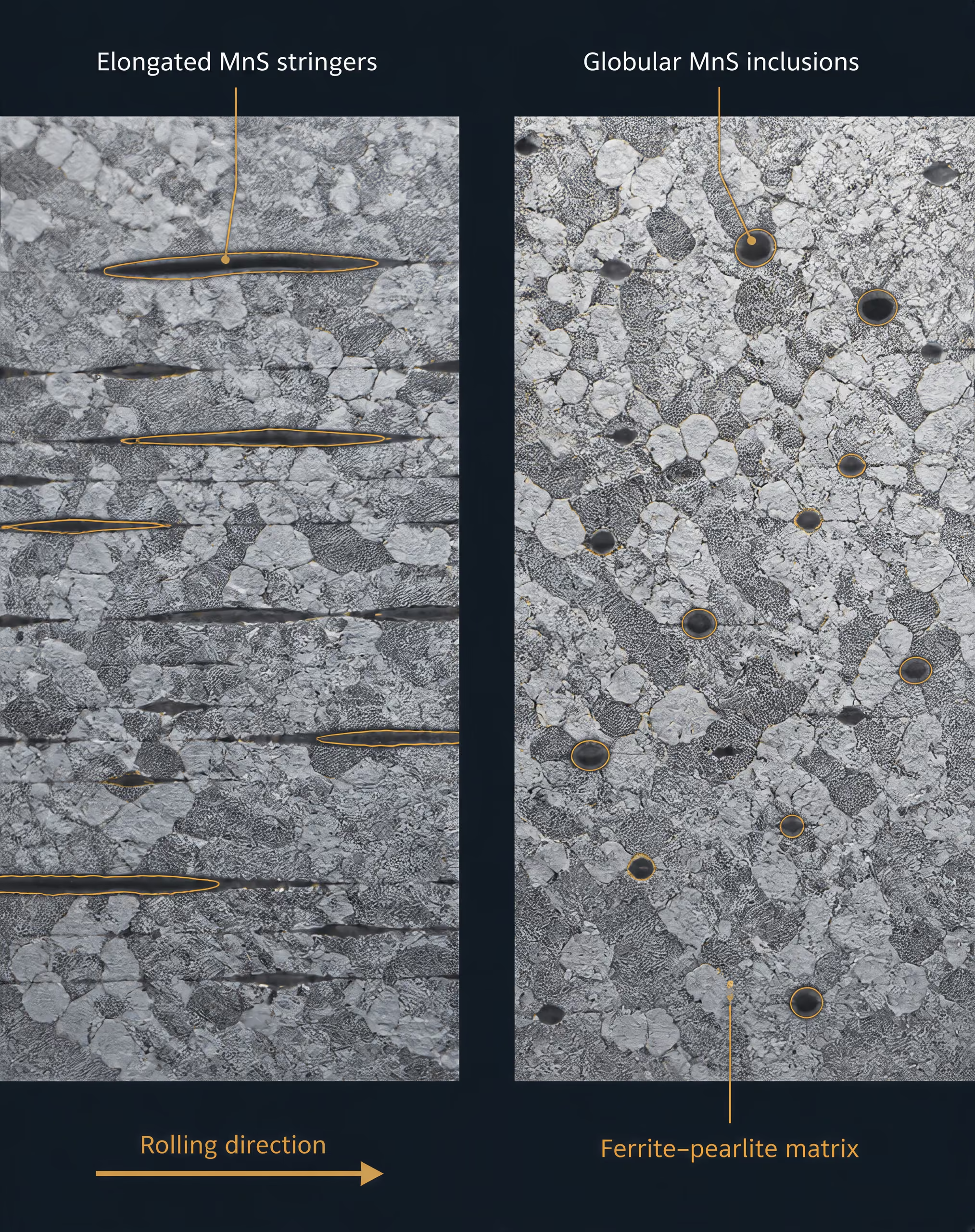
The decisive variable is often not whether MnS exists, but what deformation has done to it. During hot rolling, relatively soft and deformable sulfide particles are stretched along the rolling direction. In a longitudinal section they appear as elongated, stringer-like inclusions; their shape ratio, commonly expressed as length divided by thickness, can become large. In a transverse section the same particles may appear short or nearly circular. Orientation is therefore part of the measurement, not a minor descriptive detail.
Elongated sulfides can help a cutting edge by acting as preferential fracture paths. As the tool compresses and shears the workpiece, the stringer-like particles interrupt the steel matrix and promote void formation or local separation. Chips may segment more readily, reducing the plastic deformation required to produce each chip. The inclusions can also lower friction near the tool–workpiece contact region, especially at cutting temperatures where sulfide-rich debris is smeared across the interface. The result is often a lower cutting force and easier chip breaking.
But the same elongated geometry can create a different penalty. Long stringers provide extended, weak interfaces through the matrix and can carry abrasive or chemically active debris toward the tool face. Their orientation may concentrate deformation in narrow bands, while fractured inclusion remnants can contribute to edge chipping or unstable wear. A population that lowers the force needed to cut is not automatically the population that preserves the flank.
Globular or globoidal sulfides behave differently. Their lower shape ratio gives them a more compact geometry, reducing the length of inclusion–matrix interfaces and limiting the formation of long, continuous planes of weakness. They can still interrupt chip flow and provide local lubrication, but their effect is distributed through shorter particles rather than extended stringers. This commonly reduces the severity of tool flank wear, even when the reduction in cutting force is smaller.
The 1995 journal study Effects of the composition, shape factor and area fraction of sulfide inclusions on the machinability of re-sulfurized free-machining steel compared sulfide populations identified as “MnS, (Mn,Ca)S, MnS–RE2S3, and (Mn,Ca)S–RE2S3.” Its reported cutting-force effects followed that order. The study also established the central trade-off: elongated sulfides reduced cutting force more effectively, whereas globular sulfides reduced tool flank wear more effectively. There is no single inclusion shape that optimizes every machining response.
A separate 1995 University of Liège study, Quantitative analysis of sulphide inclusions in free cutting steels and their influence on machinability, reported a machinability index that “varied from 200% to 100% with sulfide-inclusion shape ratio.” The result links shape ratio directly to measured machining behavior and supports preferred globoidal manganese-sulfide inclusions when the target is free-cutting performance with controlled tool wear. It does not mean that every globular inclusion population will outperform every elongated one; area fraction, particle size, matrix strength, cutting speed, feed, depth of cut, coolant, and tool material remain active variables.
The ASM Handbook makes that interaction explicit, identifying composition, microstructure, strength level, cutting conditions, cutting fluids, and tool material as simultaneous controls on machinability. Sulfur can significantly change the machining behavior of through-hardening alloy steels, but its effect is filtered through the matrix and the cutting system. A low-force result measured with one carbide grade and cutting speed cannot be transferred directly to a high-speed-steel tool or a different feed rate.
This is why free-machining steel should not be specified by sulfur percentage alone. The useful question is whether the engineered MnS population—its chemistry, area fraction, size distribution, orientation, and shape—matches the machining response being sought. Cutting force, chip segmentation, flank wear, crater wear, surface finish, and fatigue sensitivity can demand different inclusion populations. Manganese makes sulfur usable; processing decides what that sulfur does.
Sulfide Chemistry Beyond MnS
Manganese sulfide is not a single, fixed machining agent. Its effect depends on composition, shape, size, area fraction, distribution, and the steel matrix around it. A long, soft sulfide stringer can promote chip segmentation and reduce cutting force, whereas a compact, less deformable inclusion may interrupt the cutting zone differently and reduce abrasive or adhesive damage at the tool flank. The same steel can therefore show lower cutting force without showing the lowest tool wear.
This distinction matters because “sulfur content” is only a starting point. SAE/AISI 11xx steels contain added sulfur that produces excess manganese-sulfide inclusions. SAE/AISI 12xx steels add phosphorus as well; the Mechanical Engineers’ Handbook, Carbon and Alloy Steels (2022), gives approximately 0.04–0.12% phosphorus for this family. Phosphorus, manganese-to-sulfur ratio, matrix strength, heat treatment, cutting speed, feed, depth of cut, cutting fluid, and tool material all alter the response attributed casually to MnS. ASTM International’s 2024 symposium, Additives to Steel and Iron for Improved Machinability, treats sulfur, lead, selenium, tellurium, phosphorus, nitrogen, manganese-to-sulfur ratio, and ASTM specifications as interacting design variables rather than isolated targets.
A 1995 study, Effects of the composition, shape factor and area fraction of sulfide inclusions on the machinability of re-sulfurized free-machining steel, reported a cutting-force sequence of MnS, (Mn,Ca)S, MnS–RE2S3, and (Mn,Ca)S–RE2S3. That sequence is useful as a comparison within the study, not as a universal ranking of all steels, tools, and cutting conditions. Its meaning depends on what was measured and how the inclusions were produced. The study also reported that elongated sulfides reduced cutting force more effectively, while globular sulfides reduced tool flank wear more effectively. Force and wear were not interchangeable outcomes.
(Mn,Ca)S and calcium-modified sulfides
Calcium changes sulfide behavior by changing both inclusion chemistry and the path by which inclusions form. In a conventional resulfurized steel, manganese combines with sulfur to produce MnS, generally a soft inclusion that deforms readily during hot rolling. The resulting sulfide may become a long stringer aligned with the rolling direction. Calcium can enter the sulfide lattice or produce composite inclusions described as (Mn,Ca)S, while calcium treatment also modifies oxide inclusions that may act as nucleation sites for sulfide precipitation.
This chemistry changes deformability, morphology, hardness, and the interface between inclusion and matrix. A calcium-modified sulfide is not simply “more MnS.” Its shape after rolling may be less elongated, and its resistance to deformation may differ from that of manganese sulfide. Those changes affect chip formation and the contact conditions at the tool–workpiece interface. An elongated inclusion can create a weak path through the sheared material, helping a chip break into shorter segments and lowering the force needed to continue cutting. A more globular inclusion can produce less directional damage and may limit the extent of inclusion-related grooving or smearing at the tool flank.
The trade-off is central. If the test objective is cutting force, elongated sulfides may produce a favorable result. If the objective is flank-wear rate, globular sulfides may be more effective, even when they do not produce the lowest force. The 1995 study’s sequence—MnS, (Mn,Ca)S, MnS–RE2S3, and (Mn,Ca)S–RE2S3—should therefore be read alongside its shape-factor and area-fraction observations. Changing calcium addition can alter the population enough to change the conclusion: inclusion count, mean size, aspect ratio, clustering, and matrix hardness may all move at once.
Calcium treatment is consequently an inclusion-engineering operation, not a guaranteed machinability additive. Thermodynamic calculations can predict how calcium partitions between oxide and sulfide phases, helping steelmakers target particular inclusion populations. The final result still depends on oxygen and sulfur activity, calcium recovery, temperature, solidification, reheating, rolling reduction, and cooling. A nominal calcium analysis does not reveal how much calcium entered sulfides, how much remained in oxides, or whether the desired morphology survived processing.
Measurement must match the engineering question. ISO 4967:2026 specifies micrographic determination of non-metallic inclusions in rolled or forged steel products with “a reduction ratio of at least 3,” but the standard also warns that its reference chart is not entirely applicable to free-cutting steels. A chart rating may describe inclusion severity for a general product-control purpose while missing the elongated sulfide fraction that controls chip breaking. Conversely, a two-dimensional section may underrepresent the three-dimensional connectivity that affects tool wear. Area fraction and shape ratio are not optional details when morphology is the intended design variable.
The quantitative study Quantitative analysis of sulphide inclusions in free cutting steels and their influence on machinability (University of Liège, 1995) reported that its machinability index “varied from 200% to 100% with sulfide-inclusion shape ratio.” That range does not assign one fixed value to every calcium-treated steel. It shows why a chemistry specification alone cannot stand in for inclusion characterization. The study preferred globoidal manganese-sulfide inclusions for free-cutting machinability under its selected conditions, while the other 1995 work found elongated sulfides particularly effective for reducing cutting force. Different response metrics can produce different preferred populations.
Rare-earth-containing sulfide inclusions
Rare-earth additions, commonly represented in inclusion descriptions by the family notation RE2S3, introduce another change in sulfide chemistry. Rare-earth elements can react with sulfur and oxygen, producing rare-earth oxysulfides, sulfides, or composite particles associated with MnS. In the reported comparison, MnS–RE2S3 and (Mn,Ca)S–RE2S3 were distinct inclusion classes, not merely higher-sulfur versions of ordinary MnS. Their hardness, melting behavior, interfacial bonding, and resistance to deformation can differ from those of MnS and calcium-modified sulfides.
Such particles may modify the nucleation and growth of manganese sulfide, changing the number of inclusions and their size distribution as well as their chemical identity. They may encourage more compact or complex inclusions, alter the aspect ratio produced during rolling, and change the degree to which an inclusion debonds from the steel matrix during cutting. These effects explain why rare-earth-containing populations can alter both force and wear, but they do not justify treating rare-earth content as a direct machinability index.
The reported force sequence places MnS, (Mn,Ca)S, MnS–RE2S3, and (Mn,Ca)S–RE2S3 in a particular order for that resulfurized steel and test method. It should not be converted into a universal rule that each successive chemistry always lowers or raises force. Cutting speed, feed, tool grade, edge preparation, lubrication, matrix strength, and inclusion area fraction can change the ranking. A rare-earth-containing inclusion that resists deformation may reduce the long stringer population and improve wear behavior, yet increase the force required for chip shearing. Another population with the same nominal rare-earth addition may contain coarse clusters that damage the tool rather than assist chip control.
The practical variable is the inclusion population delivered by steelmaking and processing: composition, amount, size distribution, morphology, and spatial distribution. This definition of inclusion engineering, stated in the 2018 review Non-metallic inclusions in steels – origin and control, is more informative than an additive table. It also explains why calcium and rare-earth treatments must be assessed through machining tests linked to a specified response. Cutting force, chip breakability, surface finish, tool flank wear, crater wear, and dimensional stability can point to different inclusion targets.
Sulfide chemistry should therefore be evaluated with the matrix and cutting operation held in view. The inclusion that lowers force may not minimize wear. A population that performs well in a low-carbon resulfurized bar may behave differently in a through-hardening alloy steel, where sulfur can significantly change machining behavior through its interaction with strength and microstructure. For stainless steels, sulfides may act as “solid lubricants at the tool–workpiece interface”; BS EN 10088 permits machinable variants with sulfur additions of 0.015% or 0.030% for some grades. In every case, nominal sulfur, calcium, or rare-earth content is only a process input. The machining response comes from the finished inclusions and the steel surrounding them.
Shape Factor, Area Fraction, and Inclusion Population Statistics
An inclusion micrograph is a measurement of a section, not a direct photograph of the three-dimensional steel volume. That distinction matters in free-machining grades, where sulfide geometry can alter cutting force, chip segmentation, tool wear, and the apparent effectiveness of the same sulfur addition. A polished longitudinal section may show manganese sulfides as long, aligned stringers; a transverse section through the same material may show short, nearly circular intercepts. Neither image is false. Each samples a different plane through an anisotropic inclusion population.
| Measurement | What it describes | Why it matters |
|---|---|---|
| Composition | Chemical identity of the particle | Separates MnS, oxides, calcium-bearing phases, lead, and rare-earth-containing inclusions |
| Area fraction | Section area occupied by inclusions | Indicates population quantity under stated sampling conditions |
| Size distribution | Spread of particle dimensions | Captures fine particles and damaging large-particle tails |
| Morphology | Shape, aspect ratio, and circularity | Relates inclusion geometry to chip formation and tool wear |
| Orientation | Alignment relative to rolling or cutting direction | Captures anisotropic machining and service behavior |
The relevant description therefore requires more than a maximum inclusion length or a visual statement such as “many sulfides.” At minimum, the analysis should report inclusion composition, morphology, area fraction, number density, size distribution, and orientation, while also stating the sampling direction, magnification, field-selection method, and image-analysis rules.
Shape factor A dimensionless descriptor of particle shape; one common two-dimensional definition is F = 4πA/P², where A is area and P is perimeter.
Shape factor is a dimensionless measure of how closely an inclusion approaches a selected reference shape, usually a circle in a two-dimensional image. One common definition is:
where is the inclusion area and is its perimeter. A perfect circle has ; a stretched, angular, or irregular particle has a lower value. Other studies call a length-to-width measure the shape factor, so the term cannot be interpreted without its equation. The same inclusion can receive different numerical values under different conventions.
Aspect ratio The ratio of an inclusion's major dimension to its minor dimension; elongated particles have higher values than globular particles.
Aspect ratio, also called shape ratio in some machinability studies, generally compares the major dimension with the minor dimension:
Here is the maximum or fitted major-axis length and is the corresponding width. A globular particle has a ratio near 1, whereas an elongated sulfide has a substantially larger ratio. This ratio is not interchangeable with circularity. A smooth ellipse and a jagged particle may have the same , while their perimeters and shape factors differ.
Area fraction is the percentage of the measured section occupied by inclusions. It estimates the volume fraction only when stereological assumptions and sampling conditions are appropriate. Number density is the count of inclusions per unit area in a two-dimensional assessment, or per unit volume when a validated three-dimensional method is used. Size distribution records how inclusion sizes are spread across the population, rather than giving only an average. It may be expressed by equivalent-circle diameter, area, length, width, or class intervals. Orientation describes the direction of an inclusion’s major axis relative to the rolling direction, transverse direction, or another reference. In rolled steel, this directional information is essential because sulfides commonly deform and align during working.
Why one inclusion image can mislead
Sampling bias begins before the microscope is switched on. Selecting fields with conspicuous inclusions exaggerates area fraction and large-particle frequency; selecting visually clean fields does the opposite. A small number of high-magnification images can also overrepresent local clusters, while low-magnification fields may hide fine particles or merge adjacent inclusions into one object. Threshold settings in automated image analysis create a similar problem: changing the gray-level cutoff can split one irregular sulfide into several particles or erase a thin oxide film around it.
The section plane imposes another bias. An elongated MnS inclusion cut parallel to its long axis appears long and narrow. The same inclusion cut near its center in a transverse plane may appear as a compact oval. An oblique cut produces an intermediate result. Consequently, a reported shape ratio from longitudinal sections should not be compared directly with a value obtained from transverse sections unless the orientation and measurement convention are matched.
Rolling creates banding and directional clustering. Sulfides may occur in layers separated by cleaner matrix, so fields chosen at random across a width can produce a different result from fields taken along one band. Clustering also affects local performance. Two heats can have the same total area fraction and number density, yet one may contain evenly distributed particles while the other contains dense colonies separated by inclusion-poor regions. During machining, a tool may encounter the cluster repeatedly along a cutting path, making local behavior differ from the bulk average.
A maximum inclusion size is especially easy to misuse. It identifies the largest detected particle in the examined area; it does not describe the typical particle, the upper tail of a statistically stable distribution, or the spacing between particles. The maximum rises with examined area, so a larger inspection can find a larger apparent maximum even when the steel population is unchanged. A meaningful population description should give the number of fields or total area examined, particle-count threshold, size classes or distribution parameters, and, where relevant, an extreme-value method.
ISO 4967:2026 specifies micrographic determination of non-metallic inclusions in rolled or forged steel products with “a reduction ratio of at least 3.” Its reference chart is useful for standardized comparison, but the standard warns that the chart is not entirely applicable to free-cutting steels. That limitation follows from the purpose of engineered sulfides: a large, elongated MnS stringer may be scored as an objectionable inclusion under a general cleanliness assessment while contributing to chip breaking and lower cutting force in a machining test. The measurement must match the question being asked.
Shape ratio, globoidal sulfides, and machinability indices
The 1995 University of Liège study, Quantitative analysis of sulphide inclusions in free cutting steels and their influence on machinability, reported that the machinability index “varied from 200% to 100% with sulfide-inclusion shape ratio.” The range is a direct warning against treating sulfide quantity as the sole control variable. A population with similar sulfur content and comparable area fraction can produce a very different machining response when its particles change from elongated stringers to more globular forms.
The result does not mean that a high aspect ratio is always desirable. In resulfurized free-machining steel, elongated sulfides can reduce cutting force more effectively, plausibly because they deform and fracture along the shear zone and assist chip segmentation. Globular sulfides, by contrast, have been reported to reduce tool flank wear more effectively. The inclusion population that lowers instantaneous cutting force may therefore not be the population that produces the lowest cumulative wear. Any claim about “machinability” must specify the response: cutting force, chip-break performance, tool flank wear, surface finish, power, or tool life.
The 1995 study Effects of the composition, shape factor and area fraction of sulfide inclusions on the machinability of re-sulfurized free-machining steel compared sulfide chemistries in the order MnS, (Mn,Ca)S, MnS–RE2S3, and (Mn,Ca)S–RE2S3. Composition, shape factor, and area fraction acted together. Calcium and rare-earth additions can change sulfide morphology and the associated oxide population rather than simply increasing or decreasing the inclusion count. Calcium treatment is used to control oxide and sulfide composition and shape, with thermodynamic predictions of calcium partitioning between oxides and sulfides helping guide the resulting population.
This is inclusion engineering: tailoring “composition, amount, size distribution, and morphology,” as described in the 2018 review Non-metallic inclusions in steels – origin and control. It is not a cleanliness contest detached from service conditions. SAE/AISI 11xx steels contain added sulfur that forms excess manganese sulfide, while SAE/AISI 12xx steels additionally contain approximately 0.04–0.12% phosphorus, so matrix chemistry and inclusion chemistry change together. ASTM International’s 2024 symposium scope lists sulfur, lead, selenium, tellurium, phosphorus, nitrogen, manganese-to-sulfur ratio, and ASTM specifications as machinability-design variables.
The same principle applies to stainless grades. The British Stainless Steel Association describes sulfides in free-machining stainless steels as “solid lubricants at the tool–workpiece interface” and records machinable variants with sulfur additions of 0.015% or 0.030% under BS EN 10088 for some grades. Those additions cannot be judged from a single polished field. A valid interpretation connects the measured inclusion population to steel matrix strength, cutting speed, feed, depth of cut, coolant, and tool material—the interacting controls identified by the ASM Handbook. Statistics are useful only when their sampling direction and engineering purpose are clear.
How ISO 4967:2026 Measures Non-Metallic Inclusions
ISO 4967:2026 is a micrographic standard for determining non-metallic inclusions in steel. It is concerned with what can be observed and classified on a prepared metallographic section, not with a direct measurement of cutting performance. That distinction matters in free-machining grades, where inclusions are often deliberate additions to the steel design rather than accidental residue from melting.[5] ISO 4967:2026. International Organization for Standardization. ISO standard, 2026.
The standard specifies examination of rolled or forged steel products made with a reduction ratio of at least 3. Its reference framework is therefore aimed at products that have undergone substantial hot working after casting. Rolling and forging alter the original inclusion population: inclusions may elongate, fracture, cluster, redistribute, or become aligned with the working direction. A polished section taken from the finished product records that processed state, not simply the inclusion population present in the ladle or continuously cast strand.
ISO 4967:2026 can establish a repeatable classification of observed non-metallic inclusions under defined microscopic conditions. It can help a producer, purchaser, laboratory, or failure investigation compare heats and product locations using a common language. It cannot, by itself, prove that a steel will produce short chips, low cutting force, long tool life, or a particular surface finish.
That limitation is especially important for free-cutting steels. A chart rating may describe the apparent severity or size class of an inclusion field while leaving unanswered the questions that control machining: What is the inclusion chemistry? Is the sulfide elongated or globular? How are inclusions oriented relative to the cutting direction? What is the area fraction and size distribution? Are oxide particles present with the sulfides? What are the matrix hardness, strength, and work-hardening response? Which tool material, cutting speed, feed, depth of cut, and cutting fluid were used?
The ASM Handbook treats machinability as an interaction among composition, microstructure, strength level, cutting conditions, cutting fluids, and tool material. Sulfur can significantly change the machining behavior of through-hardening alloy steels, but sulfur content alone is not a sufficient description of that behavior. ASTM International’s 2024 symposium work, Additives to Steel and Iron for Improved Machinability, identifies sulfur, lead, selenium, tellurium, phosphorus, nitrogen, the manganese-to-sulfur ratio, and applicable ASTM specifications as design variables. The chemistry and morphology of the resulting inclusion population must be considered together.
Scope, product form, and reduction ratio
The phrase “reduction ratio of at least 3” in ISO 4967:2026 is a scope condition, not a machinability threshold. It indicates that the covered rolled or forged product has experienced a minimum amount of deformation from its starting cross-section. This processing history affects the shape and distribution of inclusions visible in the final section. A manganese sulfide inclusion that was approximately compact before hot working may become a long stringer after rolling, while a brittle oxide may fracture into several smaller particles.
The measured result therefore belongs to a particular product form, location, orientation, and preparation. A longitudinal section through bar can show sulfide stringers very differently from a transverse section from the same bar. A forged component may contain flow-related variations that are not represented by one polished field. Sampling has to match the engineering question. If the concern is machining along the bar axis, longitudinal sulfide shape and spacing may be more relevant than a transverse count. If the concern is fatigue or internal cleanliness, clustered oxides and large isolated particles may require a different examination strategy.
The standard’s micrographic basis also places practical limits on what the result means. The analyst examines a two-dimensional plane through a three-dimensional population. An apparent inclusion length depends on section orientation; an apparent area fraction depends on which particles the plane intersects; and a cluster can look more or less severe according to the selected field. Preparation quality matters as well. Pullout, polishing scratches, contamination, overheating, or inadequate contrast can be mistaken for inclusion features.
In resulfurized SAE/AISI 11xx steels, added sulfur combines mainly with manganese to form excess manganese sulfide, or MnS. These inclusions assist chip breaking and can contribute to lubrication in the cutting zone. SAE/AISI 12xx steels add phosphorus, reported in the Mechanical Engineers’ Handbook, Carbon and Alloy Steels as approximately 0.04–0.12% phosphorus. Leaded resulfurized grades contain lead associated with sulfide inclusions or as free lead particles. Such details are not interchangeable with a single inclusion rating.
Free-machining stainless steels provide another example. Sulfide inclusions can act as “solid lubricants at the tool–workpiece interface,” according to the British Stainless Steel Association. BS EN 10088 permits machinable variants with sulfur additions of 0.015% or 0.030% for some grades. Yet the same nominal sulfur addition can produce different inclusion populations according to deoxidation practice, calcium treatment, oxygen potential, solidification conditions, and hot-working history.
Reference charts and their limits for free-cutting steels
A chart-comparison method assigns an observed microstructure to standardized reference categories. This is useful for control and communication. It can identify whether a field resembles a specified inclusion class, permit comparisons between samples examined by the same procedure, and support acceptance criteria when a product specification calls for an inclusion rating. It does not automatically identify every particle chemically, measure the complete three-dimensional population, or predict machining behavior.
ISO 4967:2026 expressly warns that its standard reference chart is not entirely applicable to free-cutting steels. The warning is fundamental. The chart was developed to classify inclusion appearances in a standardized manner, whereas free-cutting steels are designed to contain inclusions whose effects depend on composition, shape, amount, distribution, and interaction with the steel matrix. A chart category that treats elongated sulfide as an inclusion feature does not, without further analysis, establish whether that sulfide lowers cutting force or accelerates tool wear.
The 1995 study Effects of the composition, shape factor and area fraction of sulfide inclusions on the machinability of re-sulfurized free-machining steel reported cutting-force effects in the order MnS, (Mn,Ca)S, MnS–RE2S3, and (Mn,Ca)S–RE2S3. It also found that elongated sulfides reduced cutting force more effectively, whereas globular sulfides reduced tool flank wear more effectively. The result rejects any simple rule that one inclusion appearance is universally preferable. The inclusion population that helps a chip separate may not be the population that protects the tool edge.
A separate quantitative study, Quantitative analysis of sulphide inclusions in free cutting steels and their influence on machinability, reported a machinability index that “varied from 200% to 100% with sulfide-inclusion shape ratio” and identified preferred globoidal manganese-sulfide inclusions for free-cutting machinability. A chart comparison may record elongated or globular morphology, but it does not necessarily reproduce the study’s shape ratio, area fraction, spatial distribution, or machining test conditions.
Calcium treatment shows why chemistry must accompany appearance. Calcium can modify oxide and sulfide inclusion composition and morphology, and thermodynamic prediction of calcium partitioning between oxides and sulfides can support process control. Two inclusions that appear similar at low magnification may differ in Ca, Mn, rare-earth, oxygen, or sulfur content and therefore behave differently during cutting.
For that reason, ISO 4967:2026 should be treated as a standardized cleanliness and inclusion-classification method, not as a machining certificate. A useful free-cutting assessment may combine chart comparison with automated image analysis, scanning electron microscopy and energy-dispersive spectroscopy, quantitative area fraction, size-distribution measurements, shape ratios, orientation data, hardness, and controlled cutting tests. The measurement must represent the property under evaluation. Inclusion data selected for fatigue analysis are not automatically suitable for predicting chip formation, and a passing chart rating does not prove machining performance.
Selecting the Right Inclusion Measurement for the Engineering Question
An inclusion measurement is only useful when its scale and sensitivity match the property being investigated. A method that separates heats by total inclusion rating may be adequate for a cleanliness survey, yet fail to explain why two resulfurized steels produce different chips or tool lives. Inclusion engineering concerns the deliberate control of inclusion composition, amount, size distribution, and morphology; measurement must therefore preserve the features that the process is meant to control.
Chart methods, quantitative image analysis, and metallographic sections
Rating charts remain practical for production control because they are quick, inexpensive, and familiar. A polished, etched or unetched section is compared with standard fields, usually by inclusion type and severity. The result can provide a common cleanliness language, but it compresses a population into a class number. It may not distinguish whether a sulfide population consists of many short particles or fewer, highly elongated stringers with the same apparent severity.
ISO 4967:2026 specifies the micrographic determination of non-metallic inclusions in rolled or forged steel products having “a reduction ratio of at least 3.” Its reference chart is useful for conventional inclusion assessment, but the standard warns that the chart is not entirely applicable to free-cutting steels. That limitation matters. A high sulfide rating in SAE/AISI 11xx steel is not interpreted in the same way as a high oxide rating in a bearing steel, because excess manganese sulfide is intentionally added in the former to support chip breaking and lubrication.
The metallographic section itself controls the answer. A longitudinal section parallel to the rolling direction exposes sulfide stringers and permits measurements of length, width, aspect ratio, and spacing along the deformation path. A transverse section presents a different two-dimensional intersection, often making elongated inclusions appear shorter or more nearly equiaxed. Neither view is “the” inclusion morphology. It is a section-specific projection of a three-dimensional population.
For that reason, a report should identify the section orientation, polishing practice, magnification, field area, number of fields, and sampling location. “Longitudinal, quarter-thickness, 100 fields at 500×” is meaningful; “cleanliness: 1.0” is not. Sampling should also cover the relevant position in the product. Center, quarter-thickness, and near-surface material can differ because inclusions move, deform, float, or segregate during solidification and rolling. If a fatigue study examines the surface region, a centerline sample cannot stand in for it.
Automated quantitative image analysis supplies measurements that charts cannot: particle count, area fraction, equivalent diameter, length, width, aspect ratio, nearest-neighbor spacing, and size distributions. It is particularly useful when the engineering question depends on a tail of large inclusions rather than an average rating. However, image analysis is not automatically objective. Threshold selection, illumination, polishing scratches, segmentation of touching particles, magnification, and field selection can alter the measured population. The analyst must state whether particles were classified by projected area, maximum length, equivalent-circle diameter, or another definition.
Composition-sensitive methods are needed when chemistry separates functional inclusion classes. Scanning electron microscopy with energy-dispersive spectroscopy can distinguish MnS from calcium-modified sulfides, oxides, lead particles, and rare-earth-containing sulfides. Electron-probe analysis or related microanalytical methods can add more reliable elemental partitioning where spectra overlap or particles are small. These methods cost more time, but a black or gray feature in an optical image does not identify its compound. In leaded resulfurized steel, lead may occur with sulfide inclusions or as free lead particles; grouping both under “sulfide” loses a machinability-relevant distinction.
Directional measurement deserves separate treatment. For rolled products, measuring only particle area fraction can conceal elongation. Report the orientation distribution, length-to-width or shape ratio, and, where possible, measurements in both longitudinal and transverse sections. A three-dimensional reconstruction or serial-section method may be justified for fatigue-critical work, although it requires more material and careful registration. The method should follow the failure mechanism, not merely the easiest polished face.
Matching measurement to fatigue, cleanliness, and machinability
Fatigue investigations usually need the largest and most damaging inclusions identified by location, composition, and distance from the stressed surface. A mean inclusion rating can miss a single alumina cluster or calcium aluminate particle that initiates a crack. Automated area and size distributions, extreme-value analysis, and composition-sensitive examination are more appropriate. Section orientation must correspond to the principal stress and rolling direction, while sampling should include the region where fatigue cracks actually nucleate. The result should report inclusion size using a defined metric and should separate inclusion clusters from isolated particles.
A cleanliness assessment has a different purpose. It may ask whether a heat or product complies with a specification, whether oxide populations changed after secondary metallurgy, or whether casting practice produced a measurable defect increase. Chart methods can answer that question efficiently when the standard and steel family are compatible. Quantitative image analysis adds value when changes are small, when large-particle frequency matters, or when the product contains inclusion types that the chart merges. The method should not be presented as a universal cleanliness truth: a low total area fraction does not prove that fatigue risk, machinability, or surface quality will be low.
Machinability requires the most deliberate selection because cutting force and tool wear do not respond to exactly the same inclusion population. The ASM Handbook identifies composition, microstructure, strength level, cutting conditions, cutting fluids, and tool material as interacting controls. Sulfur can substantially change machining behavior in through-hardening alloy steels, but sulfur content alone is not a sufficient measurement variable.
| Engineering question | Most relevant measurements |
|---|---|
| Chip formation | Sulfide chemistry, aspect ratio, orientation, spacing, and matrix condition |
| Fatigue initiation | Largest inclusions, clusters, composition, location, and three-dimensional spacing |
| Cleanliness control | Standardized chart rating, area fraction, particle count, and product location |
| Tool wear | Inclusion chemistry and morphology together with cutting force, temperature, and tool conditions |
| Corrosion performance | Sulfide chemistry, exposed interfaces, size, shape, and surface condition |
A machinability study should therefore characterize sulfide chemistry, morphology, orientation, area fraction, and size distribution, while also documenting the steel matrix and cutting conditions. ASTM International’s Additives to Steel and Iron for Improved Machinability treats sulfur, lead, selenium, tellurium, phosphorus, nitrogen, manganese-to-sulfur ratio, and ASTM specifications as design variables rather than isolated targets. SAE/AISI 12xx steels, for example, add approximately 0.04–0.12% phosphorus to the sulfur-bearing chemistry of resulfurized grades. In free-machining stainless steels, sulfides may act as “solid lubricants at the tool–workpiece interface”; BS EN 10088 permits sulfur additions of 0.015% or 0.030% for certain machinable variants.
The required distinction is demonstrated by the 1995 study Effects of the composition, shape factor and area fraction of sulfide inclusions on the machinability of re-sulfurized free-machining steel. Reported cutting-force effects followed the order MnS, (Mn,Ca)S, MnS–RE2S3, and (Mn,Ca)S–RE2S3. Elongated sulfides reduced cutting force more effectively, whereas globular sulfides reduced tool flank wear more effectively. One inclusion population therefore cannot be declared universally superior.
A separate 1995 University of Liège study, Quantitative analysis of sulphide inclusions in free cutting steels and their influence on machinability, reported a machinability index that “varied from 200% to 100% with sulfide-inclusion shape ratio” and favored globoidal manganese-sulfide inclusions for free-cutting machinability. These findings support a direct position: machinability claims based on a single oxide-plus-sulfide rating are under-specified. The measurement must state what was counted, where it was measured, how the section was oriented, and whether the test evaluates force, chip form, surface finish, or tool wear. Calcium treatment may alter oxide and sulfide chemistry and morphology, so composition-sensitive analysis is essential when attributing a machining result to that treatment.
Alloying Additions Used to Modify Machinability
The ASTM symposium Additives to Steel and Iron for Improved Machinability (2024) treats machinability additions as a linked set of chemistry and process variables: sulfur, lead, selenium, tellurium, phosphorus, nitrogen, the manganese-to-sulfur ratio, and the limits imposed by applicable ASTM specifications. That organization is more useful than a simple ranking of “good” and “bad” elements. An addition changes the inclusion population, matrix response, chip formation, tool contact, or some combination of these effects. The result depends on steel grade, strength level, heat treatment, cutting speed, feed, depth of cut, cutting fluid, and tool material.
Inclusion engineering means controlling inclusion composition, amount, size distribution, and morphology through steelmaking and subsequent processing. Measuring inclusions is not the same as engineering them. ISO 4967:2026 specifies micrographic determination of non-metallic inclusions in rolled or forged products having “a reduction ratio of at least 3,” but it also warns that its standard reference chart is not entirely applicable to free-cutting steels. A chart rating can therefore describe a population without predicting the cutting force or tool life produced by that population.
Sulfur, phosphorus, lead, selenium, and tellurium
Sulfur is the principal addition in many carbon and alloy free-machining steels because it forms manganese sulfide, MnS. Manganese is added in sufficient quantity to bind sulfur preferentially as MnS rather than leave iron sulfide, which would promote hot shortness. In SAE/AISI 11xx steels, the deliberately increased sulfur content produces excess MnS inclusions. During cutting, these inclusions interrupt the chip, reduce the continuity of the metallic matrix, and can lower friction or adhesion near the tool–workpiece contact. The same inclusions can reduce transverse ductility, fatigue resistance, impact toughness, and weldability.
The effect is not governed by sulfur percentage alone. Sulfide aspect ratio, area fraction, composition, and distribution matter. A 1995 study, Effects of the composition, shape factor and area fraction of sulfide inclusions on the machinability of re-sulfurized free-machining steel, reported cutting-force effects in the order MnS, (Mn,Ca)S, MnS–RE2S3, and (Mn,Ca)S–RE2S3. Elongated sulfides reduced cutting force more effectively, whereas globular sulfides reduced tool flank wear more effectively. This is a direct warning against treating one inclusion form as optimal for every machining objective.
The distinction also appears in the 1995 University of Liège study Quantitative analysis of sulphide inclusions in free cutting steels and their influence on machinability. Its machinability index “varied from 200% to 100% with sulfide-inclusion shape ratio,” and globoidal manganese sulfides were favored for free-cutting machinability. The numerical range does not establish a universal grade-to-grade prediction; it shows how strongly inclusion shape can alter the measured result.
Calcium treatment offers one route to changing that shape and chemistry. Calcium can modify oxide inclusions and influence sulfide precipitation, producing more globular or complex inclusions under suitable oxygen, sulfur, and temperature conditions. Thermodynamic predictions of calcium partitioning between oxides and sulfides can guide this control, but the result still depends on ladle treatment, solidification, rolling reduction, and reheating. Rare-earth additions may likewise produce MnS–RE2S3 or calcium-containing variants, yet their value must be judged against cleanliness, fatigue, toughness, and process consistency.
Phosphorus adds a different machinability mechanism. SAE/AISI 12xx steels contain the increased sulfur characteristic of resulfurized grades and additionally contain approximately 0.04–0.12% phosphorus, as reported in the 2022 Mechanical Engineers’ Handbook, Carbon and Alloy Steels. Phosphorus strengthens and embrittles the ferritic matrix, helping chips fracture and often improving free-cutting behavior. Excess phosphorus can impair ductility, impact toughness, cold forming, and weldability, particularly where segregation or a coarse-grained structure magnifies its effect. Thus, a 12xx designation is not merely an 11xx steel with another inclusion additive; phosphorus changes the matrix as well as the chip.
Lead is found in leaded resulfurized steels either associated with sulfide inclusions or as discrete free lead particles. Because lead has very limited solubility in solid steel, its distribution is controlled by particle formation, steel cleanliness, and processing history. During machining, lead can promote chip separation and act at the tool interface, but it also introduces serious concerns for exposure control, recycling, welding fumes, and environmental regulation. A lead addition cannot be assessed only by its force-reduction effect. The intended product specification and permitted uses may exclude it.
Selenium and tellurium are further chemistry options for modifying inclusion behavior and chip fracture. They can alter sulfide morphology and the interaction between inclusions and the cutting zone, but their effects are sensitive to sulfur level, manganese content, deoxidation practice, and matrix condition. Their use requires assessment of mechanical properties, hot and cold processing, welding, worker exposure, waste handling, and the applicable grade specification. They should not be presented as interchangeable substitutes for sulfur or lead.
Free-machining stainless steels illustrate the same compromise under a more demanding matrix. Sulfide inclusions may act as “solid lubricants at the tool–workpiece interface,” according to the British Stainless Steel Association (2024), but they can lower corrosion resistance and impair pitting or crevice-corrosion performance. BS EN 10088 permits machinable variants with sulfur additions of 0.015% or 0.030% for some grades. Those values are grade-specific permissions, not general targets for stainless steel.
Nitrogen, manganese-to-sulfur ratio, and specification limits
Nitrogen is often discussed as a machinability variable because it affects both the steel matrix and inclusion chemistry. In some compositions, nitrogen combines with titanium, aluminum, vanadium, or other elements to form nitrides or carbonitrides. These particles can influence chip fracture, tool abrasion, toughness, and surface quality. Dissolved nitrogen can also raise strength and alter strain aging, while excessive or uncontrolled nitrogen may harm ductility, formability, toughness, or weld performance. Its effect therefore depends on whether nitrogen remains in solution, is tied up in precipitates, or participates in complex inclusions.
The manganese-to-sulfur ratio controls whether sulfur is safely captured as MnS and influences sulfide morphology. Too little manganese relative to sulfur increases the risk of iron sulfide and hot-shortness problems. A high ratio does not automatically produce superior machinability: excess manganese changes hardenability and matrix strength, while sulfur content, oxygen potential, calcium, rare-earth additions, and solidification conditions determine the final inclusion population. The useful ratio is consequently grade- and process-specific rather than a universal recipe.
Specification limits convert these metallurgical choices into enforceable chemistry and quality requirements. SAE/AISI 11xx and 12xx designations identify families with intended sulfur additions, but the purchase or production requirement may also invoke ASTM A29/A29M, an applicable product standard, or a customer-controlled chemistry range. ASTM limits for sulfur, phosphorus, nitrogen, lead, and residual elements must be read with mechanical-property, surface-quality, cleanliness, and heat-treatment requirements. A chemistry that lowers cutting force can still fail because it reduces transverse toughness, worsens fatigue performance, complicates welding, or conflicts with environmental restrictions.
Cutting conditions remain part of the assessment. The ASM Handbook identifies composition, microstructure, strength level, cutting conditions, cutting fluids, and tool material as interacting controls on machinability; sulfur can significantly change the machining behavior of through-hardening alloy steels. Inclusion measurements should therefore match the engineering question. A longitudinal section may reveal sulfide elongation relevant to chip control, while a transverse section, three-dimensional analysis, or area-fraction measurement may better represent fatigue or tool-wear behavior. The additive is only one input to the result.
Calcium Treatment and Inclusion Morphology Control
Calcium treatment is an inclusion-engineering operation, not a generic cleanliness treatment. The objective is not simply to reduce the total number of non-metallic particles. It is to change what those particles are, how they are shaped, how large they become, and how they behave during rolling, machining, and casting. A steel with fewer inclusions can still machine poorly if its remaining sulfides have the wrong morphology or if hard oxide particles damage the cutting edge.
Calcium-treatment sequence
- Deoxidation Establish the oxide condition and adjust the steel chemistry.
- Calcium injection Introduce calcium under controlled temperature, stirring, and recovery conditions.
- Inclusion modification Promote calcium-bearing oxides and sulfides with the intended chemistry and morphology.
- Casting and verification Cast the treated steel, then examine the finished inclusion population rather than relying on the wire addition alone.
The treatment normally introduces calcium by cored wire or another controlled injection method after deoxidation and alloy adjustment. Dissolved calcium has a strong chemical affinity for oxygen and sulfur. It can therefore react with solid or liquid oxide inclusions and with manganese sulfide-forming reactions during solidification. The resulting population may contain calcium aluminates, calcium-bearing sulfides, or composite oxide–sulfide particles. The outcome depends on steel temperature, oxygen and sulfur activity, aluminum content, manganese-to-sulfur ratio, stirring, treatment time, and the amount of calcium that actually enters solution.
Oxide and sulfide modification
In aluminum-killed steel, untreated alumina inclusions can be angular, hard, and capable of accumulating at submerged-entry nozzle walls. Calcium changes the oxide chemistry toward calcium aluminates. Within a suitable composition range, these products are liquid or partially liquid at steelmaking and casting temperatures, so they can become more rounded and less prone to forming rigid alumina clusters. This is the casting benefit often associated with calcium treatment, but it should not be confused with a universal reduction in inclusion content. Calcium may lower the harmful effect of a given oxide population while leaving the total inclusion area fraction nearly unchanged.
The sulfide response is equally important in free-machining grades. Calcium can enter manganese sulfides to form (Mn,Ca)S, alter sulfide aspect ratio, and change the attachment between sulfides and the steel matrix. Depending on composition and cooling history, sulfides may become less elongated and more globular. That change can reduce stress concentration and tool flank wear, but it can also reduce the chip-breaking action associated with long, aligned MnS stringers.
The 1995 study Effects of the composition, shape factor and area fraction of sulfide inclusions on the machinability of re-sulfurized free-machining steel compared MnS, (Mn,Ca)S, MnS–RE2S3, and (Mn,Ca)S–RE2S3 populations. Its reported cutting-force effects followed that sequence, showing that inclusion chemistry matters rather than sulfur percentage alone. Elongated sulfides reduced cutting force more effectively, whereas globular sulfides reduced tool flank wear more effectively. Those are different performance objectives. A treatment selected to minimize force can therefore produce a less favorable wear result.
This trade-off is consistent with the 1995 University of Liège study Quantitative analysis of sulphide inclusions in free cutting steels and their influence on machinability, which reported a machinability index that “varied from 200% to 100% with sulfide-inclusion shape ratio.” The study preferred globoidal manganese-sulfide inclusions for free-cutting machinability, but the result does not make globular particles universally superior. Tool material, feed, cutting speed, work-hardening behavior, matrix strength, lubrication, and chip-control requirements remain active variables.
Calcium treatment must also be judged against the grade specification. SAE/AISI 11xx steels contain added sulfur that forms excess manganese-sulfide inclusions, while SAE/AISI 12xx steels add approximately 0.04–0.12% phosphorus as another machinability-related variable. ASTM International’s 2024 symposium work, Additives to Steel and Iron for Improved Machinability, identifies sulfur, lead, selenium, tellurium, phosphorus, nitrogen, manganese-to-sulfur ratio, and ASTM specifications as design variables. Calcium is one control in that system, not a substitute for controlling the matrix and the full inclusion population. In free-machining stainless steels, sulfides can act as “solid lubricants at the tool–workpiece interface”; BS EN 10088 permits sulfur additions of 0.015% or 0.030% for machinable variants of some grades.
The process window is narrow. Too little calcium leaves alumina and manganese sulfide behavior largely unchanged. Too much calcium can generate calcium sulfide or calcium-rich oxide phases, consume sulfur and oxygen unpredictably, and produce inclusions with poor deformation behavior. Calcium recovery is especially sensitive because calcium has high vapor pressure at steelmaking temperatures and reacts rapidly with the slag, refractory, dissolved oxygen, and sulfur. The wire addition rate, injection depth, argon stirring, slag condition, and delay before casting all affect the dissolved-calcium peak and its decay.
Casting practice exposes those errors quickly. Insufficient oxide modification can leave solid alumina clusters that restrict a submerged-entry nozzle. Excessive or poorly timed calcium can create calcium-rich solids, reoxidation products, or agglomerates that also obstruct flow. A nozzle that casts cleanly does not prove that the sulfide population has the desired machining response; nozzle behavior and cutting behavior may favor different inclusion chemistries.

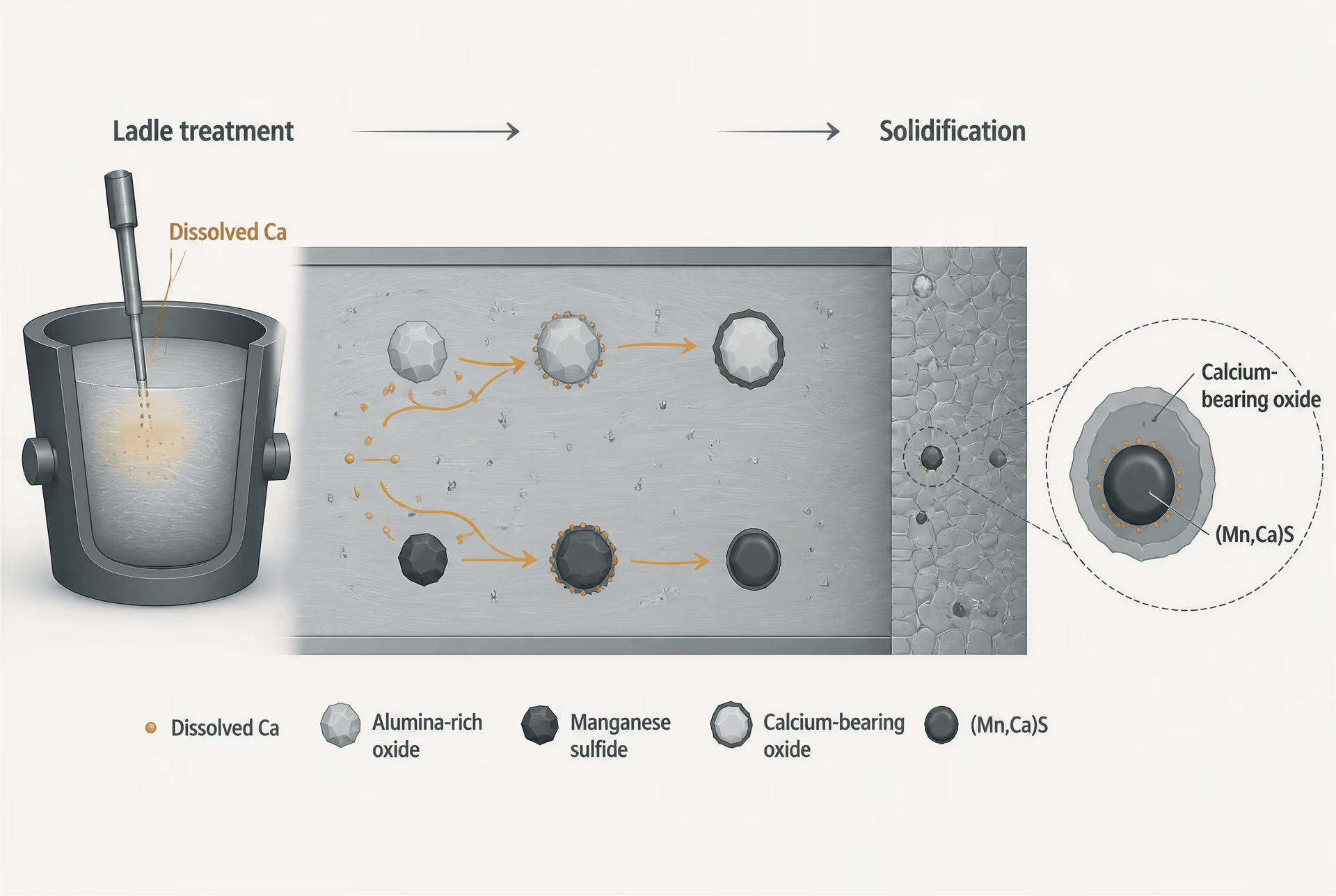
Thermodynamic prediction of calcium partitioning
Thermodynamic calculation helps define the treatment window before plant trials. The central question is how calcium partitions between oxide and sulfide reactions at the prevailing activities of Ca, O, S, Al, Mn, and other elements. Calcium may first reduce or modify an oxide inclusion and then react with sulfur, or sulfur-bearing reactions may consume the available calcium before oxide modification is complete. Equilibrium models can estimate whether the stable inclusion field contains alumina, calcium aluminates, CaS, (Mn,Ca)S, or composite phases.
Such predictions require activities rather than nominal bulk concentrations alone. Slag carryover, dissolved oxygen, aluminum activity, temperature, and the effective calcium recovery determine the chemical environment seen by an inclusion. A calculated phase boundary is therefore a process guide, not a guarantee. Calcium losses to vapor, slag, refractory, and flotation alter the actual condition, while solidification segregation changes local manganese and sulfur activities after treatment.
The practical target is often a calcium range in which oxide inclusions become deformable or liquid during casting while sulfides retain a controlled shape after rolling. That target may differ between a high-speed automatic-lathe application, where chip segmentation and low cutting force dominate, and a tool-life-sensitive operation, where globular sulfides and reduced abrasive interaction matter more.
Final verification must be metallographic. ISO 4967:2026 specifies micrographic determination of non-metallic inclusions in rolled or forged steel products with “a reduction ratio of at least 3,” but it warns that its standard reference chart is not entirely applicable to free-cutting steels. Examination should therefore record inclusion chemistry, morphology, size distribution, area fraction, and alignment, using image analysis or microscopy suited to the engineering question. A cleanliness rating alone cannot establish successful calcium treatment. The final inclusion population—not the calcium wire addition, calculated equilibrium, or nozzle history—is what determines whether the steel delivers the intended machining behavior.

Free-Machining Stainless Steels: The Corrosion-Resistance Trade-Off
Stainless steel does not become easier to machine merely because sulfur is added. The result depends on sulfur content, manganese availability, inclusion chemistry, inclusion shape, area fraction, steel matrix, and cutting conditions. A sulfur addition that improves chip breaking in one austenitic grade can produce a different balance of tool wear, corrosion resistance, weldability, and transverse strength in another.
The reason is metallurgical. Sulfur has limited solubility in austenitic stainless steel and combines principally with manganese to form manganese sulfide, MnS. These inclusions interrupt the metal during cutting. They can weaken chip continuity, reduce the energy required to shear the material, and act as solid lubricants at the tool–workpiece interface, as described by the British Stainless Steel Association (BSSA). The effect is useful during drilling, turning, and automatic screw-machine operations, but the inclusions also create local chemical and mechanical discontinuities.
Sulfide inclusions in austenitic stainless steels
In a conventional corrosion-resistant austenitic grade, cleanliness and inclusion control support surface quality and service performance. In a free-machining grade, some inclusions are introduced deliberately. That does not make them simple contaminants. Inclusion engineering adjusts inclusion composition, amount, size distribution, and morphology through steelmaking and processing variables.
MnS inclusions are especially important because their shape changes during hot working. Rolled sulfides commonly become elongated stringers, while calcium treatment or altered sulfur chemistry can produce more globular particles. These forms do not produce the same machining response. The 1995 study Effects of the composition, shape factor and area fraction of sulfide inclusions on the machinability of re-sulfurized free-machining steel reported cutting-force effects in the order MnS, (Mn,Ca)S, MnS–RE2S3, and (Mn,Ca)S–RE2S3. Elongated sulfides reduced cutting force more effectively, whereas globular sulfides reduced tool flank wear more effectively. Cutting force and tool life therefore cannot be treated as interchangeable measures of machinability.
A separate 1995 University of Liège study, Quantitative analysis of sulphide inclusions in free cutting steels and their influence on machinability, reported a machinability index that “varied from 200% to 100% with sulfide-inclusion shape ratio.” The result supports a clear engineering point: inclusion geometry matters, not only sulfur percentage. A high area fraction of elongated sulfides may assist chip segmentation, but excessive stringer formation can damage transverse ductility and create preferred paths for crack growth. Smaller, more globular inclusions may reduce flank wear while providing less assistance with chip breaking.
The surrounding matrix also controls the result. Austenitic stainless steels work harden during cutting, have relatively low thermal conductivity, and can generate substantial heat at the tool edge. Cutting speed, feed, depth of cut, tool material, edge geometry, coolant, and work-hardening state can alter the benefit obtained from a given inclusion population. ASTM International’s 2024 symposium work, Additives to Steel and Iron for Improved Machinability, treats sulfur, lead, selenium, tellurium, phosphorus, nitrogen, manganese-to-sulfur ratio, and applicable ASTM specifications as interacting design variables. No single sulfur target predicts machining performance across all stainless grades.
The corrosion penalty arises because sulfide inclusions and their surrounding interfaces can become preferential sites for localized attack. MnS may dissolve or partially dissolve in chloride-containing or acidic environments, leaving a pit initiation site. Inclusion shape affects the exposed interface: elongated stringers can create longer, more connected paths along the rolling direction, while globular particles present a different surface-to-volume relationship. The actual risk depends on passivation behavior, inclusion chemistry, surface finish, chloride concentration, temperature, residual stresses, and post-machining cleaning. Sulfur additions do not automatically cause failure, but they reduce the margin available for demanding service conditions.
Sulfide additions can also influence transverse properties and weldability. Stringer-like inclusions reduce ductility and toughness more strongly across the rolling direction than along it. During welding, inclusions and sulfur-rich regions may contribute to hot cracking sensitivity, altered weld-metal cleanliness, or reduced corrosion performance adjacent to the weld. The result depends on the welding process, heat input, filler metal, joint restraint, and grade chemistry. A free-machining stainless steel specified for machined components should not be assumed to have the same welding or pressure-containing suitability as its lower-sulfur counterpart.
BS EN 10088 machinable variants
BS EN 10088 recognizes that machinability can be specified through controlled composition rather than treated as an accidental consequence of poor cleanliness. According to the BSSA, the standard permits machinable variants for some stainless grades with sulfur additions of 0.015% or 0.030%. Those figures are additions or permitted compositional variants within particular grade requirements; they are not a universal recipe for every austenitic stainless steel.
Grade designations must therefore be read with their standard designation and product requirements. A commonly encountered free-machining austenitic grade is X8CrNiS18-9 (1.4305), corresponding to the widely used designation 303 in other designation systems. The sulfur-bearing designation identifies a deliberate machinability modification, not a general property of all stainless steel marked 303 or all products sold under equivalent trade descriptions. Other grades may have different sulfur limits, different corrosion behavior, and different restrictions on welding or forming.
The distinction matters when comparing a sulfur-modified grade with X5CrNi18-10 (1.4301) or X5CrNiMo17-12-2 (1.4401). Their nominal corrosion-resistant alloy families may appear similar, but their inclusion populations, sulfur limits, work-hardening responses, and processing histories can differ. A machinable variant may cut with lower force yet show greater pitting sensitivity or weaker transverse ductility. Conversely, a low-sulfur grade may demand more careful tooling and chip control while retaining better resistance in a corrosive service.
Inspection must match the question being asked. ISO 4967:2026 specifies micrographic determination of non-metallic inclusions in rolled or forged steel products with a reduction ratio of “at least 3”, while warning that its standard reference chart is not entirely applicable to free-cutting steels. A chart rating can describe inclusion severity, but it does not by itself establish cutting force, tool wear, pitting resistance, or weld reliability. Inclusion measurements should therefore report the features relevant to the property under evaluation: composition, aspect ratio, size distribution, spacing, area fraction, and orientation.
- Machining aid
- Sulfide inclusions can act as solid lubricants at the tool–workpiece interface
- Permitted sulfur variants
- 0.015% or 0.030% for some BS EN 10088 grades
- Potential penalties
- Pitting sensitivity, reduced transverse ductility, and weldability concerns
- Required comparison
- Machining response plus corrosion, loading direction, and fabrication route
The practical trade-off is deliberate rather than mysterious. Sulfur can make austenitic stainless steel cut more predictably, but the same sulfides may lower corrosion tolerance and transverse performance. Selection must connect grade designation and BS EN 10088 limits to the component’s cutting operation, environment, loading direction, and fabrication route. There is no single “machinable stainless” behavior; there is only a specific matrix and inclusion population operating under specific service and cutting conditions.
Tool Wear, Cutting Force, and the Non-Intuitive Optimum
Why lower cutting force is not the same as longer tool life
A free-machining inclusion does not produce one universal machining benefit. Its effect depends on whether the measured outcome is cutting force, chip segmentation, flank wear, crater wear, surface finish, or material removed before a specified tool-life limit. These outcomes can move in different directions because the inclusion population changes both deformation in the workpiece and contact conditions at the tool.
The 1995 study Effects of the composition, shape factor and area fraction of sulfide inclusions on the machinability of re-sulfurized free-machining steel reported a clear example. Sulfide-inclusion effects on cutting force followed the order MnS, (Mn,Ca)S, MnS–RE2S3, and (Mn,Ca)S–RE2S3. More importantly, elongated sulfides reduced cutting force more effectively, whereas globular sulfides reduced tool flank wear more effectively. That is not a contradiction. It is a warning against treating “machinability” as one measured property.
Elongated manganese sulfides tend to align with the rolling direction. During cutting, these inclusions can promote local separation and chip segmentation, reducing the force required to shear the chip. They may also interrupt the continuity of the matrix near the primary shear zone. The result can be a lower measured main cutting force, particularly when the test direction and rolling direction produce favorable inclusion alignment.
The same elongated particles can create a less favorable tool-contact environment. A long sulfide stringer can pass through the cutting zone as a repeated, directional discontinuity. It may expose harder neighboring phases, promote intermittent contact, or create local stress concentrations at the newly formed surface. Globular inclusions distribute their interruption over a shorter dimension and can produce a more uniform sequence of small fracture or lubrication events. The tool may therefore experience less abrasive or adhesive damage even when the cutting force is higher.
The University of Liège study Quantitative analysis of sulphide inclusions in free cutting steels and their influence on machinability (1995) reported a machinability index that “varied from 200% to 100% with sulfide-inclusion shape ratio.” It also favored globoidal manganese-sulfide inclusions for free-cutting machinability. That result does not establish a universal optimum shape; it shows that changing shape ratio alone can materially alter the ranking of steels. Area fraction and size distribution matter as well. A small population of large inclusions may act differently from the same area fraction divided among many fine particles.
The matrix can overturn the inclusion effect. Higher workpiece strength raises shear stress and often raises cutting force, while hard martensite, bainite, or dispersed carbides can increase abrasion at the flank. A softer ferritic matrix may permit easier chip separation, but excessive softness can promote built-up edge and adhesion. Pearlite spacing, cold work, heat treatment, and residual stress also affect how an inclusion opens during cutting. Sulfur is therefore not a standalone machinability control. The ASM Handbook identifies composition, microstructure, strength level, cutting conditions, cutting fluids, and tool material as interacting controls; it also notes that sulfur can significantly change the machining behavior of through-hardening alloy steels.
Grade chemistry illustrates the design intent. SAE/AISI 11xx steels contain added sulfur, producing excess manganese-sulfide inclusions that support chip breaking and lubrication. SAE/AISI 12xx steels additionally contain approximately 0.04–0.12% phosphorus, which can further affect matrix deformation and chip formation. In leaded resulfurized steel, lead may occur with sulfide inclusions or as free lead particles, changing the interface response without replacing the role of manganese sulfide. ASTM International’s 2024 symposium work lists sulfur, lead, selenium, tellurium, phosphorus, nitrogen, manganese-to-sulfur ratio, and applicable ASTM specifications as machinability-design variables. The correct question is not “How much sulfur is present?” but “What inclusion population and matrix did that chemistry and processing produce?”
Flank wear, crater wear, and process conditions
Flank wear develops on the clearance-face region rubbing against the machined surface. It is strongly affected by temperature, abrasive hard phases, sliding distance, workpiece strength, and the stability of the cutting edge. A globular sulfide population may reduce flank wear by interrupting metal-to-tool adhesion and acting as a solid lubricant, but the result depends on whether the particles are large enough to influence contact and whether the matrix contains carbides or other abrasive constituents.
Crater wear forms on the rake face as hot chips slide across the tool. Diffusion, adhesion, chemical reaction, and mechanical abrasion can all contribute. Cutting speed is especially important because temperature rises sharply with speed. An inclusion that lowers force at moderate speed may not reduce crater wear at high speed if it changes chip contact length or carries reactive species into the tool–chip interface. Tool grade matters too: carbide, coated carbide, ceramic, cermet, and cubic boron nitride tools respond differently to heat, diffusion, edge chipping, and chemical interaction.
Feed and depth of cut alter the force and thermal load independently of inclusion morphology. A higher feed increases uncut chip thickness and edge load; a greater depth of cut increases material removal and can engage a different inclusion population across the workpiece section. Cutting direction is also decisive for rolled steel. Cutting parallel to sulfide stringers is not equivalent to cutting across them. Cutting fluid can suppress temperature, reduce adhesion, and carry chips away, yet some fluid conditions change the apparent benefit of inclusions by masking or amplifying their lubricating action. Dry cutting, flood coolant, minimum-quantity lubrication, and high-pressure coolant should not be treated as interchangeable tests.
Free-machining stainless steels make the interface mechanism especially visible. The British Stainless Steel Association describes sulfide inclusions as acting as “solid lubricants at the tool–workpiece interface” and identifies machinable variants under BS EN 10088 with sulfur additions of 0.015% or 0.030% for some grades. That statement describes a material–process interaction, not a guaranteed reduction in every wear mode. Calcium treatment can modify oxide and sulfide composition and morphology; thermodynamic prediction of calcium partitioning between oxides and sulfides helps control the resulting population, but the cutting response still depends on matrix and test conditions.
Consequently, every machinability claim should name its metric and its conditions: peak or steady cutting force, flank-wear width, crater-wear depth, tool-life criterion, cutting speed, feed, depth of cut, tool material and grade, cutting fluid, workpiece orientation, and microstructure. Inclusion measurements must represent the property being evaluated. ISO 4967:2026 specifies micrographic determination of non-metallic inclusions in rolled or forged steel products with a reduction ratio of at least 3, while warning that its standard reference chart is not entirely applicable to free-cutting steels. Counting inclusions by a standard chart may therefore describe cleanliness without predicting tool life. Inclusion engineering means controlling composition, amount, size distribution, and morphology together—and selecting the population for the actual machining objective, not for a single attractive force measurement.
Failure Modes Caused by Poorly Controlled Inclusions
Free-machining steel trades some service performance for easier cutting, but the trade is not fixed by sulfur content alone. Sulfur, oxygen, calcium, rare-earth additions, lead, phosphorus, and the manganese-to-sulfur ratio determine which inclusions form; rolling and forging then determine how those inclusions are distributed and shaped. The result may be excellent chip fracture in a lathe and unacceptable fatigue performance in a loaded component.
Inclusion engineering means controlling “composition, amount, size distribution, and morphology,” as defined in the 2018 review Non-metallic inclusions in steels – origin and control. Those variables must be judged against the service property under examination. A polished longitudinal section can reveal elongated sulfides that explain chip breaking, yet tell little about the three-dimensional population controlling transverse fatigue. Measurement is therefore not the same as engineering. ISO 4967:2026 specifies micrographic determination of non-metallic inclusions in rolled or forged steel products having “a reduction ratio of at least 3,” while warning that its standard reference chart is not entirely applicable to free-cutting steels. A chart rating cannot substitute for a property-specific inclusion analysis.
Stringers, clusters, and anisotropy
In resulfurized steel, manganese combines with sulfur to form MnS. During rolling, soft sulfides deform more readily than the surrounding steel and become long, thin stringers aligned with the rolling direction. This morphology often improves machining: a tool can shear across weak planes, chips break more readily, and sulfide films can reduce friction at the cutting interface. SAE/AISI 11xx steels deliberately contain added sulfur for this reason. SAE/AISI 12xx steels add phosphorus, approximately 0.04–0.12%, which further affects chip formation and machining forces.
The same alignment creates directional properties. A crack propagating parallel to a sulfide stringer can link inclusions over a considerable distance, while a crack loaded transverse to the rolling direction encounters a different obstacle sequence. Tensile ductility, impact toughness, reduction of area, and fatigue strength can therefore differ sharply between longitudinal and transverse specimens. The steel may pass a longitudinal inclusion rating while remaining vulnerable in a transverse shaft, pin, or pressure-loaded part.
Area fraction matters as much as individual length. Increasing sulfide content usually raises the number of potential weak interfaces, and a high population can join otherwise harmless inclusions into a continuous damage path. Large stringers are especially damaging because their tip regions concentrate stress. Under cyclic loading, debonding at the sulfide–matrix interface can begin before the nominal stress approaches the yield strength.
Clusters create a second failure mode. Several oxide or sulfide particles close together interact elastically, producing a larger effective defect than any single particle suggests. Clusters may originate from poor deoxidation, reoxidation during casting, refractory entrainment, inadequate tundish practice, or local chemical segregation. Forging may break a cluster into smaller particles, but it can also spread inclusions into a planar band. Ultrasonic inspection may detect such regions, whereas a small metallographic field can miss them entirely.
Shape is not merely cosmetic. A 1995 University of Liège study reported a machinability index that “varied from 200% to 100% with sulfide-inclusion shape ratio” and favored globoidal manganese sulfide for free-cutting machinability. Another 1995 study, Effects of the composition, shape factor and area fraction of sulfide inclusions on the machinability of re-sulfurized free-machining steel, found cutting-force effects in the order MnS, (Mn,Ca)S, MnS–RE2S3, and (Mn,Ca)S–RE2S3. Elongated sulfides lowered cutting force more effectively, whereas globular sulfides reduced tool flank wear more effectively. A machining advantage therefore cannot be translated directly into a structural advantage.
Calcium treatment illustrates the control problem. Calcium can modify alumina and related oxides into less angular particles and alter sulfide composition and morphology, with thermodynamic calculations predicting calcium partitioning between oxides and sulfides. Poorly controlled calcium, however, can produce mixed or oversized inclusions rather than a uniform population. The treatment must match steel cleanliness, solidification practice, rolling schedule, and the intended service load.
Fatigue, fracture, corrosion, and surface defects
Hard oxide inclusions, particularly angular alumina or complex calcium aluminates, act differently from soft MnS. Their stiffness and poor interfacial adhesion create severe local stress concentrations. A fatigue crack may nucleate at an oxide corner, at a debonded interface, or in a plastic zone formed around the particle. Once initiated, the crack can grow into the matrix even when the inclusion is too small to produce a visible fracture defect. Large oxides are especially dangerous in bearing, gear, and high-strength applications, where the matrix offers less tolerance for local defects.
Fracture risk rises when inclusions combine with segregation or a brittle matrix. Phosphorus may assist free cutting in SAE/AISI 12xx steels, but phosphorus segregation and a high-strength heat-treatment condition can reduce toughness. Leaded resulfurized grades introduce another population: lead occurs with sulfide inclusions or as free lead particles. These particles can improve chip control, yet they may weaken local cohesion and complicate welding, hot working, fracture assessment, and environmental compliance.
Corrosion introduces a separate concern in stainless steel. Sulfide inclusions can dissolve preferentially or create local chemistry that supports pit initiation, especially when inclusions contain manganese sulfide exposed at the surface. The surrounding chromium-depleted or chemically active region may become an initiation site even though the bulk stainless matrix remains passive. Free-machining stainless steels use sulfides as “solid lubricants at the tool–workpiece interface,” but that machining function does not guarantee resistance to pitting or stress-corrosion cracking. BS EN 10088 permits machinable variants with sulfur additions of 0.015% or 0.030% for some grades; the permitted addition must be assessed against the specified corrosion environment, not treated as a harmless processing aid.
Surface defects often begin before machining. Rolled-in inclusions, slivers, blisters, and laminations can break through during turning, grinding, or polishing. An elongated inclusion near the surface may pull out and leave a longitudinal groove; a hard oxide may fracture the cutting edge or produce a torn finish. Sulfide-rich bands can also generate uneven pickling or etching response in stainless products.
Machinability is controlled by the interaction of matrix strength, composition, inclusion population, cutting speed, feed, cutting fluid, and tool material, as the ASM Handbook emphasizes. Structural performance has a different priority: minimize crack nuclei, control directionality, and prevent harmful chemical activity. ASTM’s 2024 symposium Additives to Steel and Iron for Improved Machinability accordingly treats sulfur, lead, selenium, tellurium, phosphorus, nitrogen, manganese-to-sulfur ratio, and ASTM specifications as linked design variables. The correct inclusion population is the one that meets the service requirement, not simply the one that produces the lowest cutting force.
A Metallographic Workflow for Free-Machining Steel
A useful examination begins with an engineering question, not with a request for an inclusion rating. The question may concern chip breaking, cutting force, tool flank wear, fatigue initiation, a heat-to-heat variation, or whether calcium treatment produced the intended inclusion population. Each question demands a different measurement. A field count that describes average non-metallic inclusion content may not explain why two steels with similar sulfur analyses produce different chips or tool lives.
This distinction matters because inclusion engineering concerns the deliberately controlled composition, amount, size distribution, and morphology of inclusions. Non-metallic inclusion measurement is only one part of that work. The ASM Handbook identifies composition, microstructure, strength level, cutting conditions, cutting fluid, and tool material as interacting controls on machinability. The specimen record should therefore include the steel grade, product form, reduction history, heat treatment, sulfur and oxygen analyses where available, tool grade, cutting speed, feed, depth of cut, and coolant condition.
Sampling orientation and specimen preparation
Record the product geometry and rolling or forging direction before cutting. A longitudinal section, parallel to the principal working direction, shows sulfide stringers as elongated features and is usually the most informative section for chip formation and directional deformation. A transverse section, normal to that direction, shows the same population in cross-section and is more suitable for assessing width, spacing, clustering, and local area fraction. When the engineering question involves anisotropy, fatigue, or a suspected segregation band, examine both orientations from corresponding positions.
Sampling location must be fixed rather than chosen after finding an attractive field. For bar, wire, and plate, identify surface, quarter-thickness, and center positions when segregation or centerline inclusions could affect performance. Take replicate specimens from more than one longitudinal position. A single polished field cannot represent a production heat, particularly when inclusions are clustered or when the steel contains elongated manganese sulfides.
Sectioning should minimize heating, smearing, and mechanical deformation. Abrasive cutting with adequate coolant is preferable to a procedure that burns the edge or drags soft phases through the matrix. Leaded resulfurized steels require particular care: lead may occur with sulfide inclusions or as discrete free-lead particles, and poorly controlled cutting can dislodge or smear these constituents. Mounting should support the edges and limit gaps around the specimen.
Grinding proceeds through progressively finer abrasives with enough cleaning between stages to prevent coarse particles from being carried forward. Polishing must remove deformation without rounding or pulling inclusions from the matrix. MnS is softer and more deformable than many steel oxides; lead is softer still. Excessive pressure, a dry cloth, or a long final polish can turn an inclusion into a cavity, smear it across the surface, or alter its apparent shape ratio. A final polish with a suitable fine diamond or colloidal-silica system may be used, but the procedure should be validated on a reference specimen containing sulfides and oxides. If pull-out is visible, repeat preparation rather than treating the resulting black holes as genuine inclusion morphology.
Inspect the unetched polished surface first. Etching can reveal ferrite, pearlite, martensite, or carbides, but it may also obscure inclusion boundaries and complicate thresholding. Use a separate etched observation, or retain paired images from the same coordinate system. The matrix is not background noise: hardness, strength, heat treatment, and deformation affect how sulfides deform during rolling and how inclusions interact with a cutting edge.
Classification, image analysis, and reporting
Classify inclusions by observable morphology and, where possible, by chemistry. Oxides may appear as isolated angular particles, compact clusters, or elongated oxide stringers. Sulfides commonly appear as elongated MnS in longitudinal sections, while calcium-modified sulfides may be more globular or irregular. Rare-earth additions can produce mixed MnS–RE₂S₃ populations. Do not assign chemistry from shape alone. A gray, rounded particle may be a calcium aluminate, a calcium sulfide, a complex oxide-sulfide, or a preparation artifact.
ISO 4967:2026 provides a standards-based micrographic method for determining non-metallic inclusions in rolled or forged steel products having “a reduction ratio of at least 3.” Its reference chart and rating procedure can provide a common comparison for oxide and sulfide populations, but the standard itself warns that the chart is not entirely applicable to free-cutting steels. That limitation is important. The large, elongated sulfides intentionally present in SAE/AISI 11xx steels, and the additional phosphorus-bearing chemistry of SAE/AISI 12xx steels, should not be treated as accidental contamination simply because they produce a conspicuous rating. SAE/AISI 11xx grades contain added sulfur that forms excess manganese-sulfide inclusions; SAE/AISI 12xx grades additionally contain approximately 0.04–0.12% phosphorus, according to Carbon and Alloy Steels in the 2022 Mechanical Engineers’ Handbook.
Use ISO 4967:2026 as one part of the characterization plan: report the applicable product reduction, section orientation, chart method, rating basis, and any departures from the reference procedure. Add quantitative measurements when machinability is the subject. In longitudinal images, measure inclusion length, width, aspect ratio or shape ratio, spacing, nearest-neighbor distance, and alignment. In transverse images, measure equivalent diameter, circularity, clustering, and area fraction. Report the number of fields and the total analyzed area, not only the most heavily populated field.
Magnification and field selection must be explicit. A low magnification captures clusters and long stringers; a high magnification resolves small oxides, sulfides, and compound particles. State the objective, calibrated pixel size, illumination method, thresholding rules, and whether touching particles were separated by a defined algorithm. Use systematic or random field selection across predefined specimen regions. Do not select fields because they confirm a suspected mechanism. Store original images alongside processed binary images so that a reviewer can distinguish a genuine particle from polishing debris or pull-out.
Area fraction alone is often inadequate. A steel with the same sulfide area fraction can contain long, thin stringers or compact globular particles, and these populations can produce different machining behavior. A 1995 quantitative study, Quantitative analysis of sulphide inclusions in free cutting steels and their influence on machinability, reported a machinability index that “varied from 200% to 100% with sulfide-inclusion shape ratio” and favored globoidal manganese sulfides for free-cutting machinability. Another 1995 study found cutting-force effects in the order MnS, (Mn,Ca)S, MnS–RE₂S₃, and (Mn,Ca)S–RE₂S₃; elongated sulfides reduced cutting force more effectively, whereas globular sulfides reduced tool flank wear more effectively. The apparent contradiction is the point: the inclusion population that lowers force need not minimize wear.
Chemical confirmation should accompany morphology when the result affects grade control or mechanism. Scanning electron microscopy with energy-dispersive X-ray spectroscopy can distinguish Mn-S particles from oxide-rich or calcium-bearing particles, although interaction volume, light-element sensitivity, and particle size impose limits. Electron-probe microanalysis gives stronger quantitative compositional information for suitably sized inclusions. Automated inclusion analysis may screen large areas, while selected particles can be examined by SEM-EDS, EPMA, or, where appropriate, crystallographic methods such as electron diffraction. Report the method, calibration standard, detection limits, accelerating voltage, and whether the stated chemistry is measured on the particle or inferred from surrounding phases.
For free-machining stainless steels, record sulfur grade and inclusion chemistry rather than treating sulfur as a single machinability variable. BS EN 10088 permits machinable variants with sulfur additions of 0.015% or 0.030% for some grades, and sulfide inclusions may act as “solid lubricants at the tool–workpiece interface.” The final report should connect these observations to the cutting test: force components, chip form, flank wear, crater wear, tool material, and cutting conditions. Only then does metallography test an inclusion-engineering hypothesis instead of merely assigning a cleanliness number.
How to Specify and Compare Free-Machining Steels Responsibly
Grade designation versus actual inclusion population
A grade designation is a chemical and specification shorthand, not a complete description of machinability. SAE/AISI 11xx steels, for example, contain added sulfur that promotes excess manganese-sulfide inclusions. SAE/AISI 12xx steels add phosphorus as well; the Mechanical Engineers’ Handbook, Carbon and Alloy Steels gives approximately 0.04–0.12% phosphorus for this family. Those designations identify a design intent, but they do not uniquely define the number, shape, chemistry, or spatial distribution of inclusions in a particular heat.
Two heats sold under the same SAE/AISI designation may therefore cut differently. Their sulfur contents may sit at different points within the permitted range, while manganese, oxygen, calcium, nitrogen, and residual or deliberately added rare-earth elements alter sulfide and oxide formation. Casting practice, deoxidation, calcium treatment, rolling reduction, forging, annealing, and final cold work then change inclusion morphology and alignment. A sulfur result alone cannot reveal whether the steel contains long, crack-prone MnS stringers, shorter modified sulfides, or a mixed population of globular and elongated particles.
The distinction matters because “more inclusions” is not a sufficient specification. Inclusion engineering means controlling inclusion composition, amount, size distribution, and morphology through steelmaking and processing. A 2018 review, Non-metallic inclusions in steels – origin and control, identifies those four variables as linked design parameters rather than independent contamination measures. The relevant population depends on the machining target. Long sulfides can interrupt the shear zone and assist chip segmentation, whereas rounded inclusions can reduce abrasive or adhesive interaction at the tool.
Evidence from Effects of the composition, shape factor and area fraction of sulfide inclusions on the machinability of re-sulfurized free-machining steel (1995) illustrates the trade-off. Reported cutting-force effects followed the sequence MnS, (Mn,Ca)S, MnS–RE2S3, and (Mn,Ca)S–RE2S3. Elongated sulfides reduced cutting force more effectively, but globular sulfides reduced tool flank wear more effectively. A separate quantitative study from the University of Liège, Quantitative analysis of sulphide inclusions in free cutting steels and their influence on machinability (1995), reported a machinability index that “varied from 200% to 100% with sulfide-inclusion shape ratio.” The figure is a warning against collapsing machinability into one ranking: the inclusion geometry itself changed the result.
The same logic applies to leaded grades. In leaded resulfurized steel, lead may occur in association with sulfide inclusions or as free lead particles. In free-machining stainless steels, sulfides can act as “solid lubricants at the tool–workpiece interface,” according to the British Stainless Steel Association. BS EN 10088 permits machinable variants with sulfur additions of 0.015% or 0.030% for some stainless grades, but that permission does not make every heat with the same designation equivalent in cutting behavior. The base matrix, solution treatment, cold reduction, ferrite or martensite content, and inclusion morphology remain decisive.
Calcium treatment shows why chemistry must be interpreted as a process variable. Calcium can modify oxide and sulfide composition and shape, and thermodynamic calculations can predict calcium partitioning between oxides and sulfides. A reported calcium addition is not enough: the final result depends on dissolved oxygen, sulfur activity, temperature, treatment timing, and subsequent solidification. The specification should report the measured inclusion population, not merely the intended treatment.
A minimum technical data set
A responsible comparison begins with exact identity: the SAE/AISI designation or the applicable ASTM designation, together with the product standard, heat number, product form, and delivery condition. If the material is stainless, state the designation as written in BS EN 10088, including whether it is a machinable sulfur variant. ASTM requirements should be identified by the precise material specification and edition, since an ASTM grade name does not replace its chemical, mechanical, and inspection requirements.
The chemical record should include carbon, manganese, silicon, sulfur, phosphorus, chromium, nickel, molybdenum, nitrogen, oxygen where measured, and any lead, selenium, tellurium, calcium, or rare-earth addition. Report actual heat analysis, not only specification limits. The manganese-to-sulfur ratio deserves particular attention because it affects sulfide composition and shape; ASTM International’s 2024 symposium work, Additives to Steel and Iron for Improved Machinability, treats sulfur, lead, selenium, tellurium, phosphorus, nitrogen, and the manganese-to-sulfur ratio as interacting machinability variables.
State the heat treatment and mechanical condition beside the chemistry. Include annealing, normalizing, quenching and tempering, solution treatment, precipitation treatment, cold drawing or rolling, and the measured tensile strength, yield strength, elongation, and hardness. The ASM Handbook identifies composition, microstructure, strength level, cutting conditions, cutting fluids, and tool material as interacting controls. Sulfur can substantially change machining behavior in through-hardening alloy steels, but a softer matrix may also lower cutting force independently of sulfur.
Inclusion data must describe type, chemistry, morphology, size distribution, and area fraction. Report MnS, oxysulfide, oxide, carbide, nitride, lead-containing, calcium-modified, or rare-earth-containing populations where the method can distinguish them. Give length, width, aspect ratio or shape factor, equivalent diameter, number density, and area fraction, with separate distributions for elongated and globular particles. Include the polished-plane orientation: longitudinal, transverse, or through-thickness. A longitudinal section may exaggerate stringer length; a transverse section may better represent cross-sectional area.
ISO 4967:2026 specifies micrographic determination of non-metallic inclusions in rolled or forged steel products with “a reduction ratio of at least 3.” Its standard reference chart is not entirely applicable to free-cutting steels, so an ISO 4967 rating should not be presented as a complete inclusion-engineering description. It is a measurement under a defined scope, not a direct machinability index. Use image analysis or a supplementary method when shape, chemistry, or three-dimensional spacing controls the engineering question.
Finally, report the machining experiment in enough detail to reproduce it: operation, workpiece geometry, cutting speed, feed, depth of cut, engagement, interrupted or continuous cutting, tool material and grade, tool geometry, edge preparation, tool coating, cutting-fluid type and delivery, machine stiffness, and tool life criterion. Record chip form, cutting force components, power, surface roughness, built-up edge, and wear location. Flank wear should be given with its measurement method and limit; crater wear, notch wear, chipping, and catastrophic failure should not be hidden inside one “tool life” value.
Comparisons are defensible only when the steel state and test conditions match. If one test uses coated carbide with flood coolant and another uses uncoated carbide dry, their inclusion rankings may describe the cutting systems rather than the steels. The grade name starts the comparison. The actual inclusion population and the measured machining response finish it.
A Decision Framework for Inclusion Engineering
Inclusion engineering starts with the machining requirement, not with a fixed sulfur percentage or a preferred inclusion count. A non-metallic inclusion is not automatically a defect in a free-machining steel: its composition, amount, size distribution, morphology, and relationship with the surrounding matrix determine whether it helps chip segmentation, reduces cutting force, accelerates flank wear, or initiates fatigue damage. The same population can improve one response while worsening another.
This distinction separates measurement from engineering. ISO 4967:2026 specifies the micrographic determination of non-metallic inclusions in rolled or forged steel products with a reduction ratio of at least 3, but it warns that its standard reference chart is not entirely applicable to free-cutting steels. A chart comparison may describe what is present without showing whether the inclusions produce the desired cutting behavior. Measurements therefore need to match the question: two-dimensional shape ratios for machining, three-dimensional particle dimensions for fracture analysis, area fraction and spacing for fatigue, and composition or phase identification when oxide and sulfide control is under review.
Prioritize the machining objective
The first decision is which machining response matters most. Chip control, cutting force, tool flank wear, surface finish, fatigue life, corrosion resistance, and dimensional stability do not select the same inclusion population.
For chip control, elongated manganese sulfide is often effective because the inclusion deforms with the workpiece and promotes segmentation. SAE/AISI 11xx steels contain added sulfur that forms excess manganese-sulfide inclusions, supporting chip breaking and reducing friction in the cutting zone. SAE/AISI 12xx steels add approximately 0.04–0.12% phosphorus, which can raise machinability through matrix embrittlement and altered chip formation, although phosphorus also affects toughness and weldability. In leaded resulfurized steel, lead may occur with sulfide inclusions or as free lead particles; both location and distribution matter more than a nominal lead value considered in isolation.
Cutting force is a different target. The 1995 study Effects of the composition, shape factor and area fraction of sulfide inclusions on the machinability of re-sulfurized free-machining steel reported a cutting-force effect in the order MnS, (Mn,Ca)S, MnS–RE2S3, and (Mn,Ca)S–RE2S3. In that comparison, elongated sulfides reduced cutting force more effectively than globular sulfides. That result should not be converted into a universal rule. The inclusion that lowers the force needed to shear a chip may create a less favorable abrasive or adhesive environment for the tool.
Tool flank wear can reverse the preference. Globular sulfides reduced flank wear more effectively than elongated sulfides in the same body of reported work. A rounded inclusion produces less severe stress concentration and may present a less damaging interruption at the tool–workpiece interface. Free-machining stainless steels provide another example: sulfide inclusions can act as solid lubricants at that interface. British Stainless Steel Association information on grades covered by BS EN 10088 identifies machinable variants with sulfur additions of 0.015% or 0.030% for some stainless grades. Those additions must still be assessed against pitting resistance, corrosion fatigue, and the service environment.
Surface finish requires attention to inclusion size, pull-out behavior, and the matrix around each particle. A large elongated sulfide near the machined surface can leave a torn cavity even when it improves chip breaking. A fine, well-distributed population may produce a cleaner surface but fail to break chips at the selected feed and depth of cut. In a 1995 quantitative study, Quantitative analysis of sulphide inclusions in free cutting steels and their influence on machinability, the machinability index “varied from 200% to 100% with sulfide-inclusion shape ratio”; preferred globoidal manganese-sulfide inclusions were reported for free-cutting machinability. The numerical range demonstrates why shape ratio should be measured rather than inferred from sulfur content.
Area fraction also requires restraint. More inclusions can increase chip segmentation, yet excessive area fraction reduces the continuous load-bearing steel matrix and may impair fatigue strength or transverse ductility. Inclusion spacing, clustering, and alignment from rolling can matter as much as the mean diameter. A small average inclusion size does not guarantee low risk if a band of particles is concentrated along the rolling direction.
Balance machinability against service properties
Once the machining objective is defined, the engineer must set limits imposed by service. Sulfur, lead, selenium, tellurium, phosphorus, nitrogen, manganese-to-sulfur ratio, and applicable ASTM specifications are treated as interacting machinability-design variables in the ASTM International symposium work Additives to Steel and Iron for Improved Machinability. They should not be selected as isolated chemistry targets.
The matrix can dominate the result. The ASM Handbook identifies composition, microstructure, strength level, cutting conditions, cutting fluids, and tool material as interacting controls on machinability; sulfur can significantly affect the machining behavior of through-hardening alloy steels. A resulfurized low-carbon steel in a soft annealed condition will not respond like the same nominal chemistry after quenching and tempering. Higher strength can increase cutting force and tool wear, while a harder matrix may restrain sulfide deformation and change the apparent value of an elongated inclusion. Heat treatment, prior cold work, grain size, and banding must therefore be recorded with the inclusion data.
Calcium treatment illustrates why chemistry and morphology must be considered together. Calcium can modify oxide inclusions and influence sulfide composition and shape. Thermodynamic prediction of calcium partitioning between oxides and sulfides supports process control, but a predicted phase balance is not a substitute for examination of the finished product. Casting practice, deoxidation, solidification, rolling reduction, and cooling determine whether the intended particles remain fine and dispersed or become large, clustered, and aligned.
Service requirements can reject a machining solution. Sulfides may improve turning performance yet provide initiation sites for fatigue cracks, especially when elongated along the rolling direction. In stainless steel, sulfur additions can reduce corrosion resistance if sulfide inclusions disrupt the passive surface or promote localized attack. Dimensional stability can also suffer when residual stress, anisotropic inclusion deformation, and heat-treatment distortion combine. A low cutting force does not compensate for a component that changes size during stress relief or fails in cyclic loading.
Decision framework
- Identify the controlling response Choose chip control, cutting force, flank wear, surface finish, fatigue life, corrosion resistance, or dimensional stability.
- Select the inclusion design Specify inclusion chemistry, morphology, size distribution, area fraction, and alignment limits.
- Confirm the matrix and condition Record grade, strength level, rolling condition, heat treatment, and microstructure.
- Check service constraints Assess fatigue, corrosion, toughness, weldability, cleanliness, and dimensional requirements.
- Validate representative cutting Use production-relevant tools, speeds, feeds, depth of cut, coolant, and workpiece condition.
- Measure the controlling response Report force, chip form, wear, roughness, dimensional change, or service-life data rather than a generic inclusion rating.
A practical decision sequence is therefore:
1. Identify the controlling response: chip control, cutting force, tool flank wear, surface finish, fatigue life, corrosion resistance, or dimensional stability. 2. Select the inclusion design: choose sulfide, oxide, lead-bearing, calcium-modified, or rare-earth-containing chemistry, then specify morphology, size distribution, area fraction, and alignment limits for that response. 3. Confirm the matrix and condition: record grade, standard designation, carbon and alloy content, grain structure, strength level, rolling condition, and heat treatment. 4. Check service constraints: compare the proposed inclusion population with fatigue, corrosion, toughness, weldability, cleanliness, and dimensional requirements. 5. Validate under representative cutting conditions: use the actual tool material, geometry, cutting speed, feed, depth of cut, coolant, workholding, and production-relevant heat-treatment condition. 6. Measure the response that drove the decision: record force, chip form, flank-wear rate, surface roughness, dimensional change, or service-life data rather than relying on a generic inclusion rating.
Inclusion shape must be selected against the specific response because elongated and globular sulfides can favor different machining outcomes. Strong evidence
No universal inclusion shape is optimal for every metric. Elongated MnS may favor chip breaking and lower cutting force; globular sulfides may reduce flank wear; a lower inclusion population may protect fatigue life while making machining less forgiving. Inclusion engineering is successful only when manufacturing performance and in-service performance are reconciled in the same specification.
References
- [1] ISO 4967:2026. ISO standard, 2026. https://www.iso.org/standard/86687.html
- [2] Effects of the composition, shape factor and area fraction of sulfide inclusions on the machinability of re-sulfurized free-machining steel. Journal study, 1995. https://www.sciencedirect.com/science/article/pii/0924013695021442
- [3] Quantitative analysis of sulphide inclusions in free cutting steels and their influence on machinability. University of Liège publication, 1995. https://popups.uliege.be/0351-580x/index.php?id=2336
- [4] Free-machining stainless steels grades. BSSA technical article, 2024. https://bssa.org.uk/bssa_articles/free-machining-stainless-steels-grades/
- [5] ISO 4967:2026. ISO standard, 2026. https://www.iso.org/standard/86687.html