


1. Scope, terminology, and the difference between a treatment and a delivery condition
This article concerns the annealing and normalizing of steels, not every thermal cycle applied to ferrous alloys. Quenching, tempering, stress relieving, spheroidizing, austempering, martempering, case hardening, and surface hardening are separate treatments, even when they appear in the same production route. The distinction matters because “annealed” and “normalized” do not identify interchangeable ways of making steel softer. They describe different thermal histories, transformation paths, microstructures, and, in many specifications, different delivery conditions.
The three stages of a heat treatment
- Heating Raise the steel to the selected temperature.
- Holding Hold long enough for thermal equalization and the required metallurgical changes.
- Cooling Cool under the defined rate, medium, or furnace condition.
A heat treatment is a sequence. It includes heating the steel to a selected temperature, holding it long enough for the required thermal and metallurgical changes, and cooling it under a defined condition. The treatment may be specified by furnace temperature, time at temperature, cooling rate, cooling medium, atmosphere, section size, and the steel’s prior condition. A delivery condition records the state in which the product is supplied after that sequence. “Normalized,” “annealed,” and “normalized-and-tempered” can therefore describe the condition of a plate, bar, forging, or other product rather than a complete instruction for reproducing the treatment.
The same word can carry different practical consequences in different grades. Carbon content, alloy additions, section thickness, austenite grain size, furnace control, and cooling rate all affect the final ferrite, pearlite, bainite, or martensite. No universal annealing or normalizing temperature should be stated without identifying the grade and the governing specification.
How ASTM A941-16 governs general steel terminology
ASTM A941-16, Standard Terminology Relating to Steel, Stainless Steel, Related Alloys, and Ferroalloys, provides a general vocabulary for steel documents. It is a terminology reference, not a universal heat-treatment procedure. Its role is to establish a common meaning where a product standard, test method, or other controlling document has not supplied a more specific definition.
A definition in a specific ASTM standard supersedes an identical general definition in ASTM A941-16. Strong evidence
That qualification is decisive. ASTM A941-16 states that a definition appearing in a specific ASTM standard supersedes an identical general definition in the terminology standard. A reader should therefore not lift a definition from A941-16 and apply it mechanically to every plate, bar, forging, pressure-vessel component, or rail specification. The relevant product standard controls when it defines the term differently, adds a temperature range, prescribes a cooling method, or limits the condition to a particular grade and product form.
| Feature | Normalizing | Annealing |
|---|---|---|
| Initial transformation | Austenitizing | Depends on the annealing type; full annealing generally austenitizes |
| Cooling method | Air or freely circulating gas | Controlled slow cooling, often in the furnace |
| Typical structure | Finer ferrite–pearlite or other grade-dependent products | Relatively coarse ferrite–pearlite in suitable grades |
| Typical result | Higher strength and hardness than full annealing | Lower hardness and improved machinability or ductility |

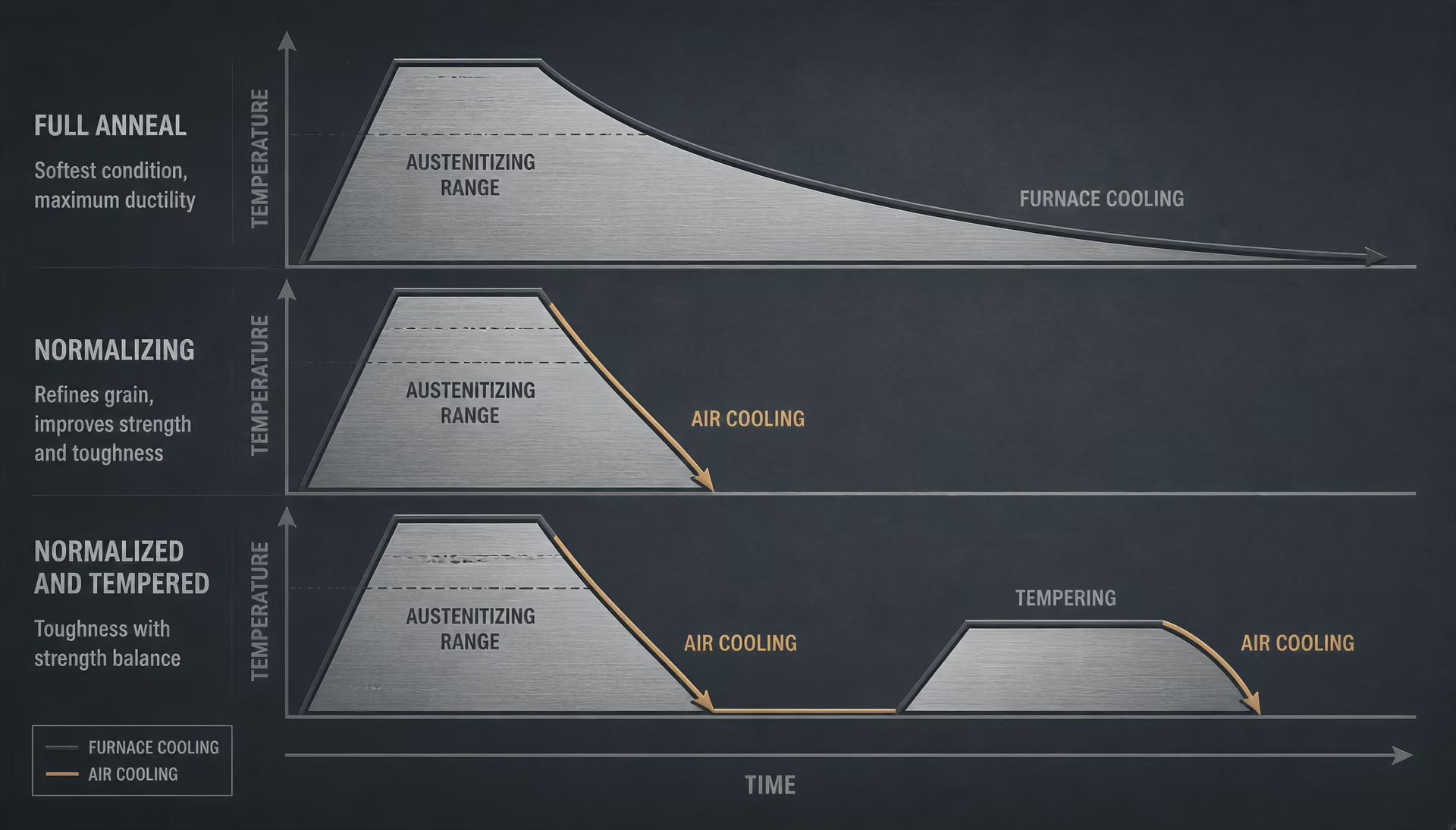
The general metallurgical distinction is still clear. Normalizing is ordinarily an austenitizing treatment followed by cooling in air or another freely circulating gas. The Karlsruhe Institute of Technology vocabulary defines it as austenitization followed by open-air cooling, with the purpose of producing a more uniform grain size and composition. Bodycote’s 2024 description gives an indicative range of approximately 800–920 °C: the steel is heated sufficiently to form new austenitic grains and then cooled freely in air or gas. That range is descriptive, not a specification for all steels.
Annealing is a broader term. It can mean a full anneal, process anneal, spheroidizing anneal, stress-relief anneal, or another controlled heating and cooling operation, depending on the document. The National Bureau of Standards’ 1935 Circular 409 distinguished process annealing from normalizing by placing process annealing below or near the lower critical-temperature range, whereas normalizing was described as heating approximately 100 °F above the critical range and then cooling in still air. Those historical descriptions establish the contrast, but modern requirements remain grade-specific.
Why normalized, annealed, and normalized-and-tempered describe material condition
“Annealed” identifies steel that has received an annealing treatment or is supplied in an annealed state under the applicable specification. In the common full-annealing route, steel is heated into the austenitic range, held for transformation and temperature equalization, and cooled slowly—often with the furnace—to reduce hardness and promote a relatively coarse ferrite-pearlite structure in suitable carbon and low-alloy grades. Process annealing is different: it is generally performed below or near the lower critical temperature to restore ductility in cold-worked low-carbon steel without fully transforming the structure.
“Normalized” normally identifies a steel that has been austenitized and cooled in air. Compared with furnace cooling after full annealing, air cooling usually produces a finer transformation structure and higher strength, although the result depends on hardenability and section size. Normalizing can refine coarse grains, reduce structural irregularity after forging or rolling, and establish a repeatable starting condition before machining or further heat treatment. It is not simply a faster anneal.[2] 4140 Heat Treatment Laboratory Reference. Massachusetts Institute of Technology. MIT laboratory reference, 2007. Source identified in the article; no DOI or URL supplied.
The 4140 laboratory reference from the Massachusetts Institute of Technology illustrates why grade identification is necessary. For normalizing 4140, the 2007 reference gives an approximate austenitizing range of 850–875 °C, followed by a hold for temperature equilibration and air cooling to room temperature. That range cannot be transferred to a plain-carbon grade or to a thick section without checking the applicable data. Alloying changes transformation behavior; dimensions change the cooling rate experienced at the center.
“Normalized-and-tempered” records two successive treatments. First, the steel is normalized. It is then reheated below the relevant transformation range and held to temper the products formed during cooling. Tempering reduces the brittleness associated with hard transformation products and adjusts strength, toughness, and ductility. The hyphenated condition is not another name for normalizing and is not equivalent to annealed material. It tells the user that the supplied steel has a particular combined history.
ISO 683-1:2016 treats normalized and normalized-and-tempered states as specified delivery conditions for non-alloy heat-treatable steels. Strong evidence
ISO 683-1:2016 demonstrates the contractual importance of this language. The standard specifies technical delivery requirements for non-alloy heat-treatable steels supplied in conditions that include normalized and normalized-and-tempered states. In that setting, the condition is part of the product requirement: it can affect specified mechanical properties, inspection, marking, and acceptance. A mill certificate stating “normalized” is therefore not merely describing what happened in a furnace; it records how the product was supplied against the standard.
When a product, grade, or regulatory standard overrides a general definition
The governing document must be read before selecting a furnace schedule. A product standard may specify austenitizing temperature, minimum holding time, air cooling, maximum hardness, tensile properties, impact testing, or a permitted combination of treatments. It may also use “annealed” to include a defined range of practices that would not be identical to a textbook full anneal. Grade designation alone is insufficient when the same chemistry is supplied as plate, bar, forging, or a pressure-containing component.
Regulatory requirements can be stricter still. Under 49 CFR § 179.500-6, certain steel tank heat treatments consist of annealing or normalizing followed by tempering, and the tempering temperature must be not less than 1000 °F. That requirement governs the regulated tank component even if a general handbook description would permit another sequence. The regulation also shows why “normalized” cannot be treated as a stand-alone assurance of service performance: the required tempering step is part of the specified condition.
Delivery condition The documented metallurgical state in which a product is supplied after its thermal treatment sequence.
The practical rule is simple: use broad definitions to understand the metallurgical difference, then use the grade, product standard, drawing, purchase specification, or regulation to determine what the words require. Annealing generally emphasizes controlled cooling and reduced hardness; normalizing generally emphasizes austenitization followed by air cooling and a finer, more uniform structure. The delivery condition is the documented result, not a substitute for the complete thermal history.
2. The iron–carbon foundation: critical temperatures, austenite, and transformation
Ferrite, pearlite, cementite, and austenite
Annealing and normalizing cannot be defined by temperature alone because their results depend on which phases exist during heating and how those phases transform during cooling. The useful starting model is the iron–carbon phase diagram, supplemented by continuous-cooling-transformation (CCT) and time-temperature-transformation (TTT) diagrams. ASM’s Heat Treating of Steel and Metallurgy for the Non-Metallurgist use this framework to connect austenitizing, cooling rate, grain size, and final properties.
| Constituent or condition | Value or description |
|---|---|
| Ferrite carbon solubility at 727 °C | Approximately 0.022 wt% C |
| Plain-carbon eutectoid composition | Approximately 0.76–0.80 wt% C |
| Cementite | Fe₃C |
| Austenite crystal structure | Face-centered cubic |
Iron–carbon terminology
- Ferrite
- The body-centered-cubic form of iron, with comparatively low carbon solubility.
- Cementite
- Iron carbide, Fe₃C, which is hard and brittle.
- Pearlite
- A two-phase aggregate of ferrite and cementite.
- Austenite
- Face-centered-cubic iron that can dissolve substantially more carbon than ferrite.
Ferrite is the body-centered-cubic form of iron, commonly designated α-ferrite. It can dissolve only a small amount of carbon. At 727 °C, for example, the maximum equilibrium carbon solubility in ferrite is approximately 0.022 wt% C; at lower temperatures it is still smaller. Ferrite is comparatively soft and ductile, so a steel containing a large ferrite fraction generally has low hardness and good formability.
Cementite is iron carbide, Fe₃C. It is hard and brittle, and its distribution matters as much as its total amount. Cementite may occur as plates in pearlite, as particles in a spheroidized structure, or as continuous networks at prior-austenite grain boundaries. Those forms do not produce the same machinability, ductility, or fracture behavior.

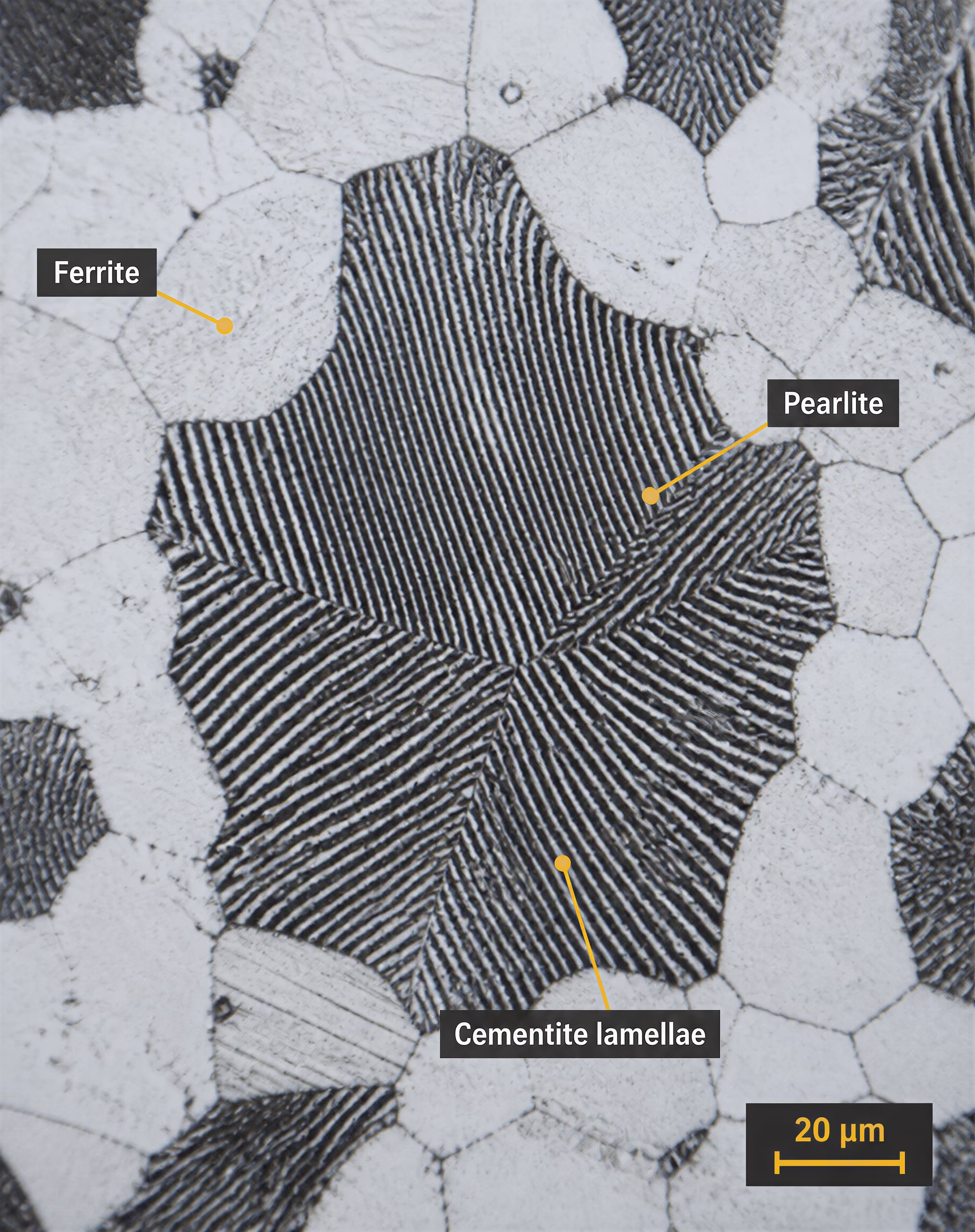
Pearlite is not a single phase. It is a two-phase aggregate of ferrite and cementite, formed when austenite decomposes during relatively slow cooling through the eutectoid temperature. In plain carbon steel, the eutectoid composition is approximately 0.76–0.80 wt% C, depending on the reference and the stated equilibrium conditions. Pearlite formed at a higher transformation temperature has relatively coarse spacing between its ferrite and cementite plates; transformation at a lower temperature produces finer pearlite, which is stronger and harder.
Austenite, designated γ, is face-centered cubic iron capable of dissolving far more carbon than ferrite. This greater solubility is the reason heating into the austenite field is central to normalizing and to full annealing. Carbon and many alloying elements enter solution, partly or wholly, during austenitizing. On cooling, that supersaturated solid solution becomes ferrite, pearlite, bainite, martensite, or mixtures of these products, depending on composition, section size, and the path through the transformation range.
Continuous-cooling-transformation diagram A diagram showing when austenite begins and finishes transforming during specified continuous cooling rates.
The cooling path is decisive. Slow furnace cooling gives carbon atoms time to diffuse, favoring ferrite and coarse pearlite in many hypoeutectoid steels. Air cooling after normalizing removes heat more rapidly and usually produces finer ferrite-pearlite than full annealing. A sufficiently rapid quench suppresses diffusional transformation and can form martensite, while an intermediate rate may produce bainite. Thus, “softening heat treatment” is an inadequate description of every cycle called annealing.
The lower and upper critical ranges
The lower critical temperature is commonly identified as Ac1 during heating: the temperature at which austenite first begins to form in a particular steel under a specified heating condition. On cooling, the corresponding start temperature is usually written Ar1. These are not necessarily equal. Heating and cooling rates, prior microstructure, alloying, and thermal lag shift the observed transformation temperatures, so Ac1 is a transformation start temperature, not a universal furnace setting.
The upper critical temperature depends on carbon content. For hypoeutectoid steels, Ac3 is the temperature at which transformation to austenite is complete on heating. Between Ac1 and Ac3, ferrite and austenite coexist. Above Ac3, the structure is nominally austenitic, although adequate time is still required for carbon and alloying elements to distribute and for the section to equalize in temperature.
For hypereutectoid steels, the relevant upper boundary is often designated Acm rather than Ac3. Between Ac1 and Acm, austenite coexists with proeutectoid cementite. Heating above Acm dissolves that cementite, subject to time, particle size, and alloying effects. Exceeding the required dissolution temperature by too much can promote austenite grain growth, which may reduce toughness even if hardness and tensile strength appear acceptable.
The phrase “critical range” therefore refers to a band, not one fixed point. The National Bureau of Standards’ 1935 circular described process annealing as heating below or near the lower critical-temperature range, while it described normalizing as heating approximately 100 °F above the critical range and then cooling in still air. Those descriptions are useful historical distinctions, but they do not replace the grade-specific requirements in a modern material specification or heat-treatment procedure.
Heating through Ac1 changes the phase balance: carbon-rich regions of the original ferrite-carbide structure begin converting to austenite. Continued heating toward Ac3 or Acm completes the intended transformation and may dissolve carbides. A full anneal normally austenitizes the steel and then cools it slowly, often in a furnace, to encourage a coarse, relatively soft transformation structure. Normalizing also austenitizes, but the workpiece is removed from the furnace and cooled in still or moving air. The faster cooling produces finer grains and a different ferrite-pearlite balance.
The temperature must be tied to the grade and condition. Bodycote reported in 2024 that normalizing is approximately 800–920 °C, with new austenitic grains forming before free cooling in air or gas. That broad interval cannot be applied indiscriminately. An MIT 4140 laboratory reference from 2007 gives approximately 850–875 °C for normalizing AISI 4140, followed by a hold for temperature equilibration and air cooling. AISI 4140 is alloy steel containing chromium and molybdenum, so its treatment cannot be inferred from an unalloyed low-carbon steel cycle.
Why carbon content and alloying elements change the cycle
Carbon changes both the critical temperatures and the products obtained during cooling. In a hypoeutectoid steel, less than the eutectoid carbon content, ferrite forms first from austenite on cooling; the remaining austenite then transforms to pearlite. As carbon rises toward the eutectoid composition, the pearlite fraction increases and the amount of proeutectoid ferrite decreases. In hypereutectoid steel, cementite forms before pearlite. Excessively high austenitizing temperatures may dissolve more cementite than intended and leave a coarse-grained, carbon-rich austenite that transforms to a harder structure.
Manganese lowers the eutectoid transformation temperature and increases hardenability. It delays ferrite and pearlite formation, allowing those reactions to be bypassed at a lower cooling rate than would be required in plain carbon steel. Chromium has a similar hardenability effect and forms stable carbides; it can retard transformation and require longer or hotter austenitizing to dissolve the desired fraction of carbide. Molybdenum strongly delays pearlitic and bainitic reactions, raises resistance to temper softening, and is especially important in steels such as AISI 4140.
Nickel generally lowers transformation temperatures and increases hardenability without forming the same type of carbide network associated with chromium. It stabilizes austenite and improves toughness, especially at low temperature. Silicon raises the activity of carbon in ferrite and is commonly used to suppress cementite formation in selected alloy systems, while also affecting the temperatures and kinetics of transformation. Vanadium, niobium, and titanium form stable carbonitrides. These particles can pin austenite grain boundaries and limit grain growth, but they may require higher temperatures or longer holds for partial dissolution.
Alloying also changes the meaning of “air cooling.” A thin low-carbon section may transform largely to ferrite and pearlite in air, while a thick section of alloy steel with high hardenability may form bainite or martensite at its center. Surface scale, furnace atmosphere, load arrangement, agitation, and section thickness alter the actual cooling curve. CCT diagrams are therefore more useful than a nominal treatment label when predicting the final structure.[3] 49 CFR § 179.500-6. United States Department of Transportation. Code of Federal Regulations, Title 49, 2024.
This is why treatment condition belongs to the material description. ISO 683-1:2016 lists non-alloy heat-treatable steels in conditions including normalized and normalized-and-tempered states; the condition is not merely a shop-floor synonym for “softened.” ASTM A941-16 provides general terminology, while stating that a definition in a specific ASTM standard supersedes an identical general definition. A governing product standard, grade designation, section size, prior condition, and specified furnace practice must control the cycle. Even safety-critical rules show the distinction: 49 CFR § 179.500-6 specifies certain tank-steel treatments as annealing or normalizing followed by tempering, with tempering temperatures not less than 1000 °F. The thermal history is part of the engineering requirement.
3. What steel annealing means in practice
Annealing is not one fixed heating-and-cooling schedule. It is a family of treatments selected to change hardness, ductility, residual stress, carbide shape, grain structure, or transformation products. The name alone is therefore incomplete. A specification or procedure should identify the steel grade, prior condition, target temperature, holding time, cooling method, and required final properties.
Terminology also depends on the governing document. ASTM A941-16 provides general terminology for steel, stainless steel, related alloys, and ferroalloys, but states that a definition in a specific ASTM standard takes precedence over an identical definition in the general terminology standard. That qualification matters because “annealed,” “process annealed,” “full annealed,” and “stress relieved” can describe different conditions in product standards and fabrication procedures.
Annealing normally seeks a softer, more ductile, or more dimensionally stable condition than the starting material. Normalizing is different. It normally includes austenitization followed by cooling in still or moving air, producing a finer and less equilibrium-like structure than conventional furnace cooling. The distinction is not cosmetic: the cooling path controls the transformation products formed as austenite decomposes.
Process annealing versus full annealing
| Treatment | Transformation range | Main objective |
|---|---|---|
| Process annealing | Below or near the lower critical-temperature range | Restore ductility after cold working |
| Full annealing | Into the austenite region | Reduce hardness and produce a soft transformation structure |
| Spheroidizing | Subcritical or cyclic treatment around Ac1 | Produce rounded carbide particles for machining or forming |
| Stress-relief annealing | Normally below Ac1 | Reduce residual stress without bulk austenitization |
Process annealing is generally performed below, or near, the lower critical-temperature range. The National Bureau of Standards described it in 1935 as heating an iron-base alloy below or near that range. In practical work, this treatment is associated especially with low-carbon steel sheet, strip, wire, and other products that have acquired high dislocation density and reduced ductility during cold working.
The steel is heated sufficiently for recovery and, where temperature and time permit, recrystallization, but not normally transformed completely into austenite. Recovery rearranges some lattice defects and reduces residual stress. Recrystallization replaces the deformed ferrite grains with new, relatively strain-free grains. The result is lower yield strength and hardness with improved elongation for a subsequent forming operation. The exact temperature is grade-dependent; a schedule for a low-carbon cold-rolled steel cannot be transferred safely to a medium-carbon alloy steel or a stainless grade.
Time at temperature is important. A short soak may relieve part of the cold-worked condition while leaving substantial deformation retained. A longer soak can produce larger recrystallized grains, surface oxidation, or unwanted dimensional change. Strip thickness, coil geometry, furnace atmosphere, and heating uniformity also affect the result. “Process annealed” should therefore not be treated as a synonym for fully softened.
Full annealing follows a different transformation path. The steel is heated into the austenite region, held until the section has reached a sufficiently uniform temperature, and then cooled slowly, usually in the furnace. For a hypoeutectoid carbon or low-alloy steel, the treatment temperature is commonly above the upper critical temperature, Ac3, so ferrite and pearlite transform to austenite before cooling. For a hypereutectoid steel, the selected temperature is commonly above Ac1 but below Acm, allowing austenitization of the pearlitic matrix while limiting excessive dissolution and grain growth. These are process descriptions, not universal setpoints.
During furnace cooling, austenite transforms at relatively low undercooling into ferrite and pearlite, often with comparatively coarse pearlite colonies and a relatively soft structure. Full annealing can reduce hardness, improve machinability in suitable grades, and reduce the effects of prior hot working or forging. It does not guarantee the lowest possible hardness for every steel. Alloying elements such as chromium, molybdenum, manganese, and nickel shift transformation temperatures and slow transformation kinetics; some alloy steels may require a modified anneal or a separate isothermal treatment.
Normalizing commonly uses approximately 800–920 °C for applicable steels, followed by free cooling in air or gas. Limited evidence
Normalizing demonstrates why the terms cannot be exchanged. The steel is also austenitized, but it is then cooled in air or gas rather than left in a cooling furnace. Bodycote’s 2024 description gives approximately 800–920 °C as a normalizing range for applicable steels, followed by free cooling in air or gas. For 4140, an MIT laboratory reference specifies approximately 850–875 °C, a hold for temperature equilibration, and air cooling to room temperature. Those figures apply to the stated material and procedure, not to every steel called “4140” under every specification.
Air cooling extracts heat faster than controlled furnace cooling. The resulting ferrite-pearlite structure is commonly finer, with higher strength and hardness than a full-annealed structure. Normalizing can refine a coarse forged or cast grain structure and improve structural uniformity, but it may increase distortion or residual stress compared with furnace cooling. ISO 683-1:2016 lists normalized and normalized-and-tempered delivery conditions for non-alloy heat-treatable steels, confirming that the treatment condition is part of the specified product state rather than merely a shop-floor description.
Subcritical annealing, spheroidizing, and stress relief
Subcritical annealing is carried out below Ac1, so bulk austenitization does not occur. Depending on the grade and cycle, it can promote recovery, recrystallization, carbide coarsening, or reduction of hardness without creating a new austenitic grain structure. This makes it distinct from full annealing even when both treatments are intended to improve ductility or machining behavior.
Spheroidizing is a more specific subcritical or cyclic treatment. It changes lamellar cementite in pearlite into rounded or spheroidal carbide particles dispersed in ferrite. In plain-carbon and alloy tool steels, this morphology reduces resistance to cutting and improves cold formability compared with a fine pearlitic structure. It is often used before machining or before a later hardening operation, particularly for higher-carbon grades in which pearlite or cementite networks make cutting difficult.
Factors affecting spheroidizing
- Temperature The cycle may remain just below Ac1 or cycle repeatedly through Ac1.
- Prior condition Carbon content, alloy additions, forging history, and carbide distribution affect the result.
- Time Insufficient time can leave lamellar carbide; excessive exposure can dissolve too much carbide.
- Verification Metallographic examination may be needed because hardness alone does not prove adequate spheroidization.
A spheroidizing cycle may hold just below Ac1 for an extended period, cycle repeatedly through Ac1, or combine heating with very slow cooling through the transformation range. The suitable method depends on carbon content, carbide-forming alloy additions, prior forging history, and the required carbide distribution. Excessive temperature can dissolve too much carbide and produce a less useful structure; insufficient time can leave lamellar carbide. A hardness value alone does not prove that spheroidization is adequate. Metallographic examination may be required.
Stress-relief annealing has another purpose. It reduces residual stresses from welding, machining, cold forming, uneven cooling, or fabrication without deliberately transforming the entire section to austenite. The treatment is normally below Ac1, with a hold long enough for thermal equalization and stress relaxation, followed by controlled cooling to limit the reintroduction of stress. It may change hardness only slightly. Calling it “annealing” does not make it a softening treatment in the same sense as full annealing.
Stress relief must also account for service restrictions. A welded component may contain local microstructures, hydrogen, or metallurgical reactions that are not removed simply by a low-temperature hold. In some applications, the governing standard specifies a complete sequence. For example, 49 CFR § 179.500-6 describes certain steel tank treatments as annealing or normalizing followed by tempering, with the tempering temperature not less than 1000 °F. That safety-critical requirement cannot be replaced by a generic “anneal” instruction.
Furnace cooling and the control of transformation rate
Conventional annealing depends on controlled cooling because transformation rate determines both structure and properties. After austenitization, the steel must pass through the critical temperature range slowly enough for ferrite and pearlite to form rather than martensite or an excessive amount of bainite. Furnace cooling is common because the furnace can reduce the cooling rate and limit temperature gradients between the surface and the core.
The furnace is not simply switched off without thought. Large sections may be held at an intermediate temperature, cooled under programmed control, or removed only after the core has passed through the transformation range. If the surface cools far ahead of the center, differential contraction can create distortion and residual stress. Section size, loading density, furnace circulation, emissivity, and atmosphere all affect the actual thermal history. Two parts set to the same furnace temperature can experience different cooling rates.
Alloy steels make this control more demanding. Manganese, chromium, molybdenum, and nickel can delay pearlite and bainite reactions, so a cooling rate that produces a soft ferrite-pearlite structure in plain-carbon steel may produce harder transformation products in an alloy grade. Prior cold work changes stored energy and recrystallization behavior; prior forging changes grain size and carbide distribution. The required hardness, machinability, ductility, dimensional stability, and later hardening response must therefore be stated before selecting the cycle.
The central practical rule is simple: identify the grade and prior condition, establish the relevant critical temperatures, heat uniformly, and control cooling through the transformation range. “Annealed” is meaningful only when the thermal history behind the word is known.
4. What steel normalizing means in practice
Normalizing is a defined thermal history, not a casual synonym for “softening.” The sequence is: heat the steel into the austenite region, hold long enough for the required section to reach temperature, then cool it freely in still or moving air or gas. The workpiece is not left inside a switched-off furnace to follow a deliberately slow cooling curve. That difference changes the transformation path, the resulting grain structure, the hardness, and the residual-stress condition.
Terminology must also be tied to the governing document. ASTM A941-16 is the general terminology reference for steel, stainless steel, related alloys, and ferroalloys, but it states that a definition in a specific ASTM standard supersedes an identical definition in the general terminology standard. Product standards therefore control where their wording differs. ISO 683-1:2016, for example, identifies non-alloy heat-treatable steels supplied in conditions including “normalized” and “normalized-and-tempered.” Those designations describe a material condition, not merely a furnace operator’s intention.
Austenitization followed by air or gas cooling
During normalizing, the steel is heated above the relevant critical transformation range so that its existing ferrite, pearlite, bainite, or other constituents transform substantially into austenite. Austenite is the face-centred-cubic solid solution of carbon in iron. Heating also dissolves some carbides and removes much of the structural memory produced by prior rolling, forging, casting, or uneven cooling, although the extent depends strongly on alloy composition and temperature.
The required temperature is grade-specific. Bodycote gives approximately 800–920 °C as a general description of normalizing practice, but that range is an example, not a universal prescription. A plain-carbon steel, a low-alloy steel containing chromium or molybdenum, and a microalloyed grade do not have identical critical temperatures or carbide-dissolution requirements. Section thickness, furnace accuracy, prior microstructure, atmosphere, and the applicable material specification matter as well. Excessive heating can be as damaging as insufficient heating.
A useful laboratory reference for AISI/SAE 4140 gives approximately 850–875 °C for normalizing, followed by a hold for temperature equilibration and air cooling to room temperature (MIT, 2007). That range cannot simply be transferred to 1045, 8620, stainless steel, or a pressure-vessel grade. The correct set point is normally established from the grade specification, an approved heat-treatment procedure, or validated furnace practice.

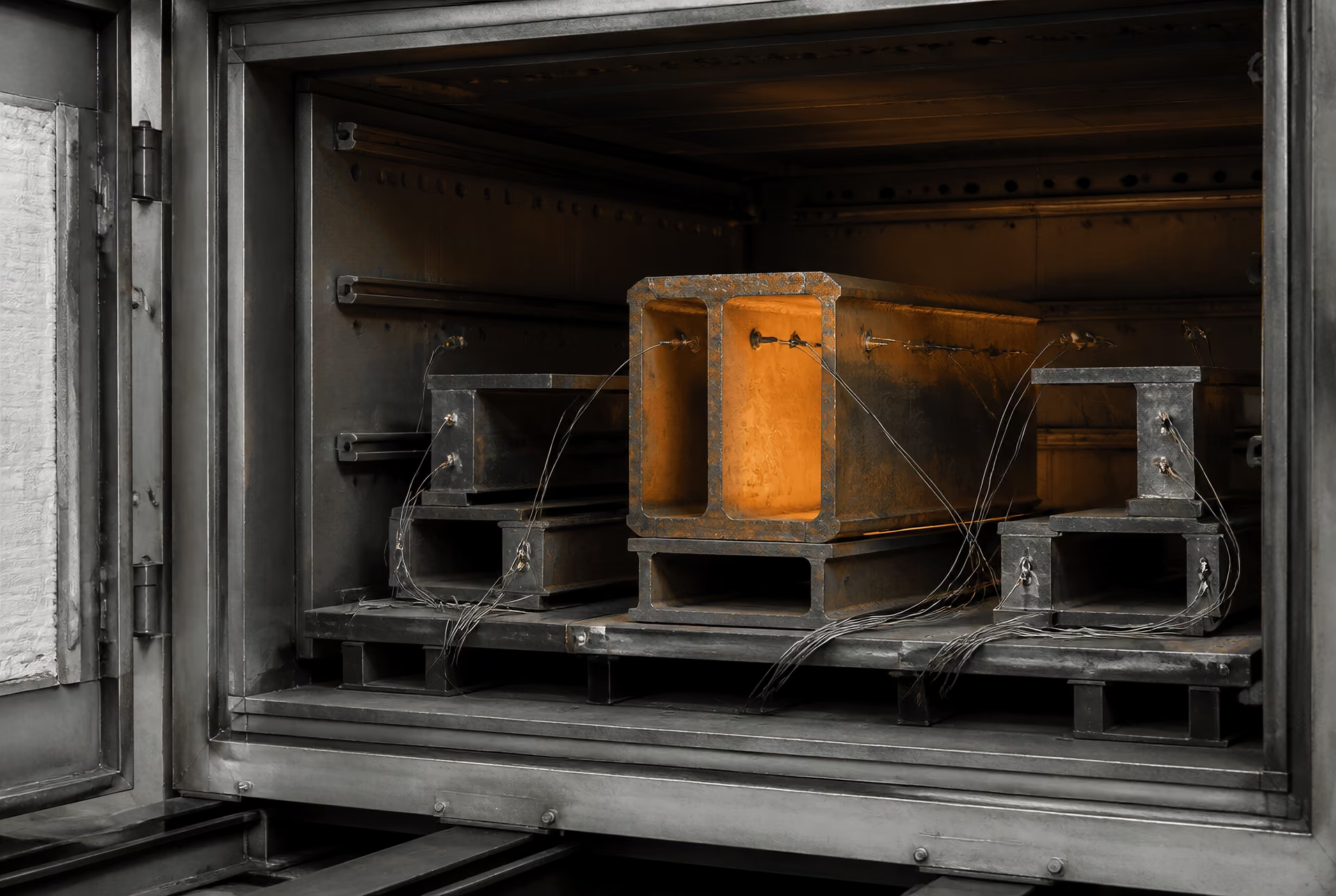
The hold allows the centre of the component to approach the target temperature and gives the austenitization reaction time to proceed. A thin coupon may equalize quickly; a heavy forging requires much longer. Holding time is therefore not a universal number of minutes per millimetre detached from furnace loading and thermal measurements. The treatment must produce the intended austenite without allowing unnecessary grain growth.
Cooling begins when the steel leaves the furnace or when forced circulation starts. “Air cooling” may mean still room air, moving air, or a controlled gas stream, and these conditions are not metallurgically identical. A large section cools more slowly at its core than at its surface. A small section may cool fast enough to form a considerably finer ferrite-pearlite structure. Alloying elements that delay pearlite or bainite formation can also alter the result; some grades may require a specified cooling rate or a subsequent tempering operation.
As the austenite cools through its transformation range, carbon redistributes and new constituents form. In many normalized low- and medium-carbon steels, the usual product is a mixture of ferrite and pearlite, with the proportions governed by carbon content and cooling rate. The air-cooled structure is generally finer and harder than the corresponding furnace-cooled annealed structure. Higher-carbon or alloyed steels may produce different proportions of pearlite, bainite, or other transformation products, so “normalized” does not guarantee one universal microstructure.
The National Bureau of Standards described normalizing in 1935 as heating approximately 100 °F above the critical range and then cooling in still air. That historical description captures the essential contrast with process annealing, which it placed below or near the lower critical-temperature range. Modern specifications refine the details by grade, but the central sequence remains recognizable: austenitize, then cool openly rather than impose a furnace-cooling schedule.
Recrystallization, grain refinement, and structural homogenization
Normalizing can replace a deformed or uneven prior structure with a new population of austenitic grains. In a forged or rolled component, deformation has stretched grains, introduced dislocations, and created directional variation. Once the steel reaches the austenite region, recovery and recrystallization-related processes can remove much of that deformation structure. New austenite grains nucleate and grow, and subsequent transformation during cooling creates ferrite and pearlite associated with those prior-austenite grains.
This is why normalizing is often described as a grain-refining treatment. The phrase needs qualification. The treatment does not guarantee refinement merely because the furnace reached a high temperature. Austenite grain size depends on the starting structure, peak temperature, holding time, heating rate, alloying additions, and cooling conditions. A moderate austenitizing treatment can produce a more uniform and finer structure than the one inherited from a forging. A prolonged soak well above the required temperature can produce coarse austenite, after which the transformed ferrite-pearlite structure is also relatively coarse.
The treatment can also reduce structural nonuniformity. Cast steel may contain segregation, coarse dendritic regions, and locally different phase distributions. Forging and rolling can leave banding, elongated grains, or variations in strain and temperature. Normalizing promotes a more consistent austenitic state before cooling, while diffusion and transformation reduce some of the visible contrast between these regions. It does not erase severe chemical segregation or repair cracks. Nor does it make every location in a large component identical, because the surface and core still experience different cooling rates.
The resulting refinement affects engineering properties. A more uniform ferrite-pearlite distribution can improve consistency in hardness and tensile response, reduce directional variation, and provide a more predictable starting condition for machining or later hardening. Normalizing may also relieve some residual stress, although it should not be treated as a dedicated stress-relief cycle. The stress state after cooling depends on geometry, restraint, thermal gradients, and transformation strain.
The term “homogenization” must likewise be used carefully. Normalizing improves structural uniformity; it is not the same as a high-temperature homogenizing treatment intended to reduce long-range chemical segregation in a cast alloy. Carbon and substitutional alloying elements do not all diffuse at the same rate, and the normalizing hold is often too short to eliminate major composition gradients. The practical result is structural conditioning, not chemical perfection.
Why normalizing is not simply faster annealing
Annealing and normalizing can both begin with heating into the austenite range, but their cooling schedules are different enough to produce different materials. Full annealing normally uses furnace cooling, or another deliberately slow and specified cooling method, so transformation occurs closer to equilibrium. That tends to produce coarser ferrite-pearlite structures, lower hardness, and improved ductility or machinability. Normalizing uses free air or gas cooling, which extracts heat more rapidly and usually produces finer transformation products with higher strength and hardness.
The distinction is not just a matter of time. Cooling rate changes the temperatures at which ferrite and pearlite form, the spacing of pearlite lamellae, the extent of carbon diffusion, and the possibility of bainite formation in alloyed steels. A normalized 4140 component and a furnace-cooled annealed 4140 component may share the same nominal phases yet differ substantially in hardness and response to subsequent quenching. Calling the normalized cycle “fast annealing” hides those transformation differences.
Normalizing is selected when the prior process has left an unacceptable structure or when a specified normalized delivery condition is required. It can condition forgings before machining, refine the structure of hot-worked products, reduce nonuniformity after casting, and provide a repeatable starting state before hardening and tempering. It is not automatically the correct treatment for maximum softness. If low hardness and easy machining are the primary requirements, full annealing may be specified instead.
Nor is normalizing always the final treatment. Federal regulation 49 CFR § 179.500-6 gives a safety-critical example in which specified tank-steel treatment consists of annealing or normalizing followed by tempering, with the tempering temperature not less than 1000 °F. The example shows why the treatment name alone is insufficient: the final properties depend on the complete sequence.
A valid normalizing procedure therefore identifies the steel grade, critical-temperature basis, austenitizing temperature, equalization or holding practice, cooling medium and circulation, section size, and any subsequent tempering requirement. Without those details, “normalized” is an incomplete description.
5. Annealing versus normalizing: a comparison based on thermal history
Annealing and normalizing are not interchangeable names for “softening.” They describe different thermal histories, and the difference lies mainly in the relationship between austenite formation and cooling rate. Annealing usually seeks a relatively soft, stress-relieved, machinable condition through controlled slow cooling. Normalizing generally seeks a refined and more uniform ferrite–pearlite structure through heating into the austenite range and cooling in air or gas.
The exact treatment still depends on grade, section size, prior processing, furnace control, atmosphere, and the governing product specification. ASTM A941-16 provides general terminology for steel and related alloys, but it also states that a definition in a specific ASTM standard supersedes an identical definition in the general terminology standard. A heat treater therefore must read the applicable material specification rather than apply a generic temperature from a handbook.
Heating range and austenite formation
Heating determines which transformations are possible. For a hypoeutectoid carbon steel, heating sufficiently above the upper critical temperature, Ac3, produces austenite throughout the relevant section. On cooling, that austenite transforms mainly into ferrite and pearlite unless alloying, cooling rate, or carbon content shifts the transformation path. In a hypereutectoid steel, the treatment may be set relative to Ac1 and Acm, and complete dissolution of cementite is not always the objective. Alloy additions such as chromium, molybdenum, nickel, manganese, and silicon alter critical temperatures, diffusion rates, hardenability, and transformation products.
Normalizing normally involves austenitizing above the critical range, holding long enough for the section to reach temperature, and then removing the workpiece for free cooling. Bodycote described normalizing in 2024 as heating approximately to 800–920 °C to form new austenitic grains, followed by cooling freely in air or gas. That range is a process description, not a universal instruction. For 4140 steel, an MIT laboratory reference from 2007 gives approximately 850–875 °C for normalizing, with a hold for temperature equilibration and subsequent air cooling. A different section thickness or furnace arrangement can require a different soak time and may produce a different result at the same nominal setpoint.
Annealing includes several treatments, so “annealing temperature” has no single meaning. Full annealing commonly austenitizes a suitable carbon or low-alloy steel and then cools it slowly in the furnace. Process annealing, by contrast, is often applied to low-carbon steel after cold work and may be performed below or near the lower critical-temperature range. The National Bureau of Standards stated this distinction in Circular 409, published in 1935. A process anneal can restore ductility without creating the same austenite grain structure produced by a full anneal or normalizing cycle.
Heating above the critical range also does not guarantee a fine final grain size. Excessive temperature, excessive soak time, or repeated exposure can produce coarse austenite grains. Normalizing often refines a previously coarse or nonuniform structure because the steel is reheated and transformed, but refinement depends on the selected temperature and the number of cycles. Annealing can also produce a useful, uniform structure when furnace practice is controlled; it is not simply an uncontrolled version of normalizing.
| Treatment | Principal purpose | Typical thermal range | Cooling method | Expected structure | Dimensional risk | Common downstream operations |
|---|---|---|---|---|---|---|
| Process annealing | Restore ductility after cold work and reduce forming stresses | Below or near the lower critical range, grade dependent | Controlled furnace or specified slow cooling | Recrystallized or softened ferrite, with structure dependent on prior deformation | Usually low, but distortion can arise from residual stress relief | Cold forming, bending, drawing, light machining |
| Full annealing | Reduce hardness, improve machinability, and produce a softer ferrite–pearlite condition | Austenitizing range appropriate to grade | Furnace cooling or another slow, controlled schedule | Coarser ferrite–pearlite than a normalized condition is common | Moderate; slow thermal gradients and stress relief still matter | Rough machining, forming, subsequent heat treatment |
| Normalizing | Refine or homogenize structure and establish a specified delivery condition | Above the critical range; often about 800–920 °C, but grade specific | Still air, agitated air, or gas | Commonly finer ferrite–pearlite and more uniform prior-austenite grain size | Higher than furnace cooling because surface and core cool differently | Machining, inspection, quenching and tempering, fabrication |
| Normalized and tempered condition | Adjust strength, toughness, and residual stress after normalizing | Normalizing range followed by grade-specific tempering | Air or gas after normalizing; controlled cooling after tempering | Tempered ferrite–pearlite or other grade-dependent tempered products | Controlled by both stages and section size | Service use, welding qualification, final machining |
| Treatment | Cooling method | Typical property tendency |
|---|---|---|
| Process annealing | Controlled furnace or specified slow cooling | Lower yield strength and improved elongation after cold work |
| Full annealing | Furnace cooling or slow controlled cooling | Lower hardness and improved machinability |
| Normalizing | Still air, agitated air, or gas | Finer structure and commonly higher strength and hardness |
| Normalized and tempered | Air or gas after normalizing, then controlled tempering | Adjusted strength, toughness, and residual stress |
The table gives tendencies, not guaranteed properties. ISO 683-1:2016 lists normalized and normalized-and-tempered conditions among the technical delivery states for non-alloy heat-treatable steels. That wording matters: treatment condition forms part of the product requirement, not merely a shop-floor description added after manufacture.
Cooling medium and cooling-rate consequences
Cooling is the decisive difference in many practical comparisons. A furnace-cooled anneal keeps the workpiece at an elevated temperature for a longer period, allowing carbon diffusion and transformation to proceed closer to equilibrium. This commonly produces coarser pearlite spacing and lower hardness than air cooling from a comparable austenitized condition. The result is often easier cutting and greater ductility, especially where the material is not strongly alloyed.
Normalizing removes the steel from the furnace and exposes it to still air, moving air, or a controlled gas stream. The Karlsruhe Institute of Technology vocabulary defines normalizing as austenitization followed by open-air cooling to promote uniform grain size and composition. The faster cooling rate generally produces finer transformation products than furnace cooling. Finer pearlite spacing and a more refined ferrite network commonly raise yield strength and tensile strength relative to a full anneal, while hardness increases and machinability may decline.
Air cooling is not one fixed rate. A thin plate can approach the surrounding gas temperature quickly, while the center of a heavy forging remains hot long after its surface has cooled. A fan, gas composition, rack arrangement, part spacing, and furnace exit temperature all affect the curve. Large sections may cool slowly enough that the core resembles an annealed structure while the surface forms a harder structure. In alloy steels with substantial hardenability, even air cooling can produce bainite or martensite in some regions. A normalized label without section and grade information is therefore incomplete.
The same issue applies to furnace annealing. “Furnace cooling” may mean a programmed rate, a furnace shutoff, staged cooling through transformation, or transfer to a lower-temperature zone. Those practices can produce different pearlite morphologies, residual stresses, and dimensional changes. Cooling through the transformation range is particularly important because volume changes accompany austenite decomposition. Uneven cooling can bend thin components or leave stress in thick ones, even when the final hardness appears acceptable.
Normalizing can also reduce chemical and structural banding when the treatment is properly selected, but it cannot erase every segregation effect. Heavy alloy segregation, forging flow, weld regions, and decarburization may remain visible after one cycle. A second normalizing treatment, diffusion treatment, or a different quench-and-temper route may be required by the specification.
Typical differences in hardness, strength, ductility, and machinability
The usual comparison is straightforward: full annealing gives the softer condition, while normalizing gives higher strength and often finer structure. Annealed steel generally offers lower cutting forces and improved machinability, though very soft steel can produce long, troublesome chips. Normalized steel commonly has greater yield strength, tensile strength, and resistance to localized deformation because its ferrite–pearlite structure is finer and less coarse than that produced by slow furnace cooling.
Ductility cannot be ranked by a single rule. Normalizing may improve uniform elongation and toughness when it replaces a coarse, segregated, or overheated structure. Yet, relative to a carefully executed full anneal, the higher hardness and finer pearlite can reduce ductility in some grades. Carbon content, alloy content, inclusion shape, grain size, and test direction all influence the result. Thickness changes the cooling rate, so two bars of the same grade and nominal treatment can show different tensile and hardness values.
Prior cold work also changes the comparison. Process annealing may restore formability without austenitizing, whereas normalizing can replace the deformed structure entirely but may introduce more thermal distortion. For 4140, normalizing is often an intermediate preparation before quenching and tempering, not the final soft-machining condition. For low-carbon sheet, process annealing may be the relevant treatment, while for a forged medium-carbon component, full annealing or normalizing may be specified.
The correct choice follows the required thermal history. Use the material standard’s condition designation, critical temperatures, section-size limits, hardness or mechanical-property requirements, and any downstream welding or machining procedure. Federal regulation 49 CFR § 179.500-6 illustrates the point in a safety-critical application: certain steel tank treatments specify annealing or normalizing followed by tempering, with the tempering temperature not less than 1000 °F. Neither word alone defines the finished properties. The heating path, cooling path, and subsequent treatment do.
6. Grade-specific practice: carbon steels, low-alloy steels, and 4140
A heat-treatment cycle cannot be selected from the words annealed or normalized alone. Grade identification comes first, followed by the applicable product or process standard, the prior microstructure, the section size, and the furnace procedure. The same furnace setpoint can produce different transformation paths in different steels, while a nominally correct cycle can fail if the workpiece core has not reached the intended temperature.
ASTM A941-16 provides the general terminology for steel, stainless steel, related alloys, and ferroalloys, but it also states that a definition in a specific ASTM standard supersedes an identical general definition. That qualification matters. “Normalizing” is a process description, not a universal recipe. ISO 683-1:2016, for example, treats normalized and normalized-and-tempered conditions as specified delivery conditions for non-alloy heat-treatable steels. The thermal condition is therefore part of the material designation and acceptance requirements, not merely a note added by a shop after manufacture.
Plain-carbon steels and the role of carbon content
Carbon content changes both the phase balance and the temperature range required for austenitization. In a hypoeutectoid plain-carbon steel, whose carbon content is below the eutectoid composition, heating above the upper critical temperature produces austenite after the existing ferrite dissolves. On cooling, proeutectoid ferrite forms before the remaining austenite transforms near the eutectoid temperature. The final structure is commonly ferrite plus pearlite, with the relative amounts controlled strongly by carbon content and cooling rate.
That description is conceptual, not a substitute for a grade specification. A lower-carbon steel generally forms a larger ferrite fraction and reaches lower hardness after either a slow anneal or an air-cooled normalize. Increasing carbon toward the eutectoid composition increases the pearlite fraction and usually raises strength and hardness. It also changes the heat balance: more carbon must be dissolved into austenite, and the permissible overheating margin depends on the specified chemistry and grain-size objectives.
A higher-carbon steel, including a steel at or above the eutectoid composition, follows a different path. Proeutectoid cementite may form rather than proeutectoid ferrite, and excessive austenitizing can promote coarse grains or unwanted carbide dissolution. Calling the same cycle “annealing” for both materials hides these differences. A full anneal normally heats into the austenite region, holds for transformation and equilibration, and cools at a controlled, slow rate, often inside the furnace. The National Bureau of Standards described process annealing in 1935 as heating an iron-base alloy below or near the lower critical-temperature range, a process distinct from full annealing and from normalizing.
Normalizing instead austenitizes the steel and allows it to cool freely in still or moving air. The National Bureau of Standards described the practice as heating approximately 100 °F above the critical range and then using still-air cooling. Bodycote’s 2024 description gives a broad normalizing range of approximately 800–920 °C, during which new austenitic grains form before free cooling in air or gas. That range is useful for explaining the process, but it is not a command to heat every carbon steel to one temperature.
Air cooling is faster than furnace cooling, so the pearlite is generally finer and the normalized steel is commonly stronger and harder than the fully annealed condition. The result depends on mass. A thin part can cool quickly enough to produce a substantially finer transformation structure than a thick forging made from the same heat. Conversely, a large section may cool slowly at its center, producing a core structure unlike the surface structure. The furnace controller records chamber temperature; it does not prove that the workpiece has reached that temperature.
For carbon steels, the practical question is therefore not “What temperature normalizes steel?” It is “What temperature and cooling condition produce the specified ferrite, pearlite, grain size, hardness, and dimensional result in this grade and section?” The answer must come from the relevant material standard, heat-treatment specification, or qualified procedure.
Low-alloy steels and hardenability
Alloying changes normalizing practice more profoundly than a small adjustment to the setpoint might suggest. Elements dissolved in austenite can shift the critical temperatures, alter carbon activity, retard ferrite and pearlite formation, change carbide stability, and modify austenite grain growth. The transformation start and finish times shown on a continuous-cooling-transformation diagram can move to longer times, allowing air cooling to produce bainite or martensite in regions that would form pearlite in a plain-carbon steel.
Hardenability The depth or extent to which steel can develop a harder transformation product under a given cooling condition; it is not the same as maximum hardness.
This is the central meaning of hardenability. It is not the same as maximum hardness. Hardenability describes the depth or extent to which a steel can develop a harder transformation product under a given cooling condition. A low-alloy steel with greater hardenability may respond to air cooling in a heavy section much more strongly than a plain-carbon steel, even when both receive the same furnace treatment. Surface, intermediate, and core cooling rates then become metallurgically significant.
Alloying can also make “above the critical range” an inadequate instruction. The lower and upper critical temperatures may differ from those predicted by a simple iron–carbon diagram, and the required superheat above the relevant transformation range depends on grade, prior condition, grain-size target, and heating practice. A long hold at excessive temperature may dissolve carbides that were intended to remain, enlarge austenite grains, increase distortion, or raise the hardenability of the subsequent transformation structure. A short hold may leave undissolved constituents or an incompletely transformed core.
The cooling medium must be specified with equal care. Furnace cooling, still-air cooling, fan-assisted cooling, and gas cooling are not interchangeable descriptions. Normalizing conventionally uses open-air cooling after austenitization; the Karlsruhe Institute of Technology vocabulary identifies austenitization followed by open-air cooling as the defining sequence. Annealing uses a predetermined slow cooling rate or furnace cooling to reduce hardness and improve machinability or ductility. The distinction is a thermal history, not a label applied after the fact.
Low-alloy material may also require tempering after normalizing, depending on the required mechanical properties and the governing standard. A normalized structure is not automatically a finished condition. In a safety-critical example, 49 CFR § 179.500-6 specifies tank-steel treatment as annealing or normalizing followed by tempering, with tempering temperatures not less than 1000 °F. That regulation demonstrates why a statement such as “normalized” cannot be treated as a complete property specification.
Section size remains decisive. Heat-transfer calculations, thermocouple measurements, load arrangement, furnace circulation, emissivity, and contact with fixtures all affect the actual cooling curve. The center of a heavy component may remain above transformation temperature while its surface is already transforming. A production procedure should therefore define the basis for timing: furnace temperature, load temperature, a recorded workpiece thermocouple, or an approved rule based on section thickness. “Hold for one hour” has no fixed metallurgical meaning unless the starting condition and temperature equilibration are defined.
The MIT 4140 normalizing example at approximately 850–875 °C
A useful named example is AISI/SAE 4140, a chromium–molybdenum low-alloy steel whose response to air cooling is not equivalent to that of a plain-carbon steel. The alloying additions increase hardenability and affect transformation kinetics, so the section size and cooling environment can change the resulting ferrite, pearlite, bainitic, or martensitic fractions. The grade must be confirmed before a 4140 procedure is applied; a similar nominal carbon level does not make another steel metallurgically interchangeable.
The Massachusetts Institute of Technology laboratory reference from 2007 gives the normalizing treatment for 4140 as austenitizing at approximately 850–875 °C, holding for temperature equilibration, and then air-cooling to room temperature. Those three parts belong together. The temperature creates the austenitic starting condition, the hold allows the actual specimen—not merely the furnace atmosphere—to equilibrate, and air cooling establishes the transformation path. Removing the hold or replacing air cooling with furnace cooling changes the treatment.
The MIT schedule is a laboratory or educational reference, not automatically a production specification. It does not by itself establish allowable grain size, hardness, tensile properties, distortion limits, atmosphere controls, loading density, thermocouple location, or acceptance criteria for every component made from AISI/SAE 4140. A production specification may require a different austenitizing temperature, a defined soak based on section thickness, controlled furnace uniformity, or a subsequent tempering treatment. The applicable material standard and drawing take precedence.
Actual workpiece temperature is especially important with 4140 because its higher hardenability makes air cooling more consequential. A small laboratory coupon can cool rapidly and uniformly; a large shaft, forging, or irregular component cannot be assumed to follow the same curve. Edges may transform earlier than the center, and restrained sections may develop residual stress as transformation proceeds. Recording the furnace setpoint alone is weak evidence of treatment quality.
The correct practice is to identify the grade, establish the required condition, select the specified austenitizing range, verify equilibration at the workpiece, and control the cooling method. Annealing and normalizing may both be described as heating and cooling operations, but for carbon and low-alloy steels their temperatures, kinetics, structures, and purposes remain different. Treating them as interchangeable is a process error.
7. Furnace practice and process variables
Furnace practice determines whether a specified annealing or normalizing treatment actually reaches the steel section intended by the procedure. A furnace controller may display 850 °C while the centre of a thick forging remains substantially colder, and a surface thermocouple may indicate the target temperature while a tightly packed load contains colder parts. The displayed value is therefore a furnace setpoint or measured furnace-zone temperature, not automatically the temperature of every workpiece.
The distinction matters because annealing and normalizing depend on transformation temperature and cooling history. Normalizing generally requires austenitization followed by cooling in still or circulating air, whereas a full anneal requires controlled, slow cooling, often within the furnace. Process annealing is a separate treatment category; the National Bureau of Standards described it in 1935 as heating an iron-base alloy below or near the lower critical-temperature range. Its temperature is not interchangeable with a normalizing temperature.
ASTM A941-16 provides general terminology for steel, stainless steel, related alloys, and ferroalloys, but it also states that a definition in a specific ASTM standard supersedes an identical definition in the general terminology standard. The applicable product or heat-treatment specification consequently controls when terminology or treatment requirements differ. ISO 683-1:2016, for example, identifies normalized and normalized-and-tempered delivery conditions for non-alloy heat-treatable steels. “Normalized” is therefore not just a furnace operator’s description of a softened condition; it can form part of the specified metallurgical condition of the product.
Load arrangement, section thickness, and temperature uniformity
Furnace-practice controls
- Load arrangement Provide circulation, radiation, and conduction paths that support uniform heating.
- Section thickness Account for the time required for the controlling section to reach temperature.
- Thermocouples Use representative workpiece locations when furnace readings cannot establish core temperature.
- Atmosphere Control oxidation, scale, and decarburization according to the required surface condition.
- Records Retain charge identity, temperature traces, hold conditions, cooling method, and deviations.
The load must be arranged so that furnace circulation, radiation, and conduction can heat the work uniformly. Parts placed directly against one another create sheltered surfaces and thermal contact paths that differ from those experienced by exposed surfaces. A dense basket of forgings may show a satisfactory furnace-air reading while its interior pieces lag behind the outside pieces. Long bars can also develop end-to-centre differences, particularly where the ends are near the door, support fixtures, or a high-velocity circulation path.
Section thickness is a primary process variable. A thin sheet or small machined component can approach furnace temperature quickly; a heavy plate, large casting, or thick forging needs more time for heat to conduct into its core. The relevant dimension is not always the nominal thickness alone. Shape, junctions, bosses, holes, contact points, and changes in section can create local thermal delays and different transformation responses. A thin flange may already be austenitic while a heavy hub is still below the intended range.
Heating rate must also be controlled. A rapid ramp can produce a large surface-to-core temperature difference, thermal stress, distortion, or cracking in a part containing residual stress from forging, welding, casting, or machining. A slow ramp is not automatically safer in every case: prolonged residence in an intermediate temperature range can increase oxidation and may affect precipitation, carbide dissolution, or prior microstructural condition. The procedure should specify ramps or staging where the grade, geometry, or prior condition requires them.
Load density affects both heat transfer and furnace recovery. Opening the door for loading can reduce furnace temperature, and a heavy charge can produce a further drop when it enters. If the controller responds aggressively, the furnace may overshoot before the load has equilibrated. If air circulation is poor, the outer pieces may become hotter while the centre remains cold. Fan direction, baffle arrangement, basket spacing, support design, and the position of the charge within the working zone should be established during equipment qualification rather than assumed from the controller display.
Temperature uniformity surveys and workpiece thermocouples provide different information. A uniformity survey checks the permitted temperature variation among locations in the empty or defined working zone. Load thermocouples show how a representative component responds during an actual cycle. Both can be needed. For thick or safety-critical parts, thermocouples attached to or inserted into representative locations may be the only reliable way to identify when the coldest region has reached the required temperature. The attachment method must itself withstand the cycle and avoid producing a misleading surface reading.
Soaking, equilibration, and avoiding excessive grain growth
Soaking begins only after the controlling part of the load has reached the required temperature, not necessarily when the furnace display first reaches its setpoint. The purpose is equilibration: the section must be hot enough throughout for the specified transformation or recovery process to occur consistently. In normalizing, that means establishing the required austenitic condition before removing the load for air cooling. The Karlsruhe Institute of Technology describes normalizing as austenitization followed by open-air cooling, with the treatment intended to promote a uniform grain size and composition.
A 4140 laboratory reference from the Massachusetts Institute of Technology gives approximately 850–875 °C for normalizing, followed by a hold for temperature equilibration and air cooling to room temperature. That range applies to the cited 4140 procedure; it is not a universal setting for every 4140 product, section, or specification, still less for every steel grade. Alloy content shifts transformation temperatures and changes hardenability, while prior forging, welding, cold work, and carbide condition affect the time needed for a consistent response.
Holding longer than required does not guarantee better equilibration. At excessive temperature or with excessive time, austenite grains can coarsen. Coarse prior-austenite grains can produce a coarser transformation structure, alter toughness, and change the hardness gradient after cooling. Overheating may also dissolve constituents that the procedure was intended to retain, increase distortion, and intensify surface damage. Normalizing is often selected to refine or reset a nonuniform structure, but an overlong or overheated normalizing cycle can defeat that purpose.
Annealing presents a different cooling requirement. In a full anneal, the furnace cooling schedule must be slow enough for the intended transformation path, rather than merely cooling the load until it is safe to handle. Texas A&M distinguishes normalizing, using still or agitated air after heating above the critical range, from annealing, which uses a predetermined slow cooling rate to reduce hardness and improve machinability and ductility. A furnace that cools too quickly, or a load that is removed while its centre remains hot, can produce a mixed structure and inconsistent machining behaviour.
Exact heating, soaking, and cooling times must be derived from the grade specification, section size, loading arrangement, furnace capability, and validated procedure. The ASM Metals Handbook treatment of steel heat treatment treats austenitizing temperature, cooling medium, variables, procedures, and applications as connected process choices. A time copied from a general chart cannot replace that assessment.
Atmosphere, oxidation, decarburization, and scale
Atmosphere control addresses surface condition as well as appearance. In an oxidizing furnace, iron reacts with oxygen and water vapour to form scale. Scale changes dimensions, contaminates machining operations, and can conceal surface defects. It may detach during handling or shot blasting, leaving a roughened surface and changing the amount of stock available for final machining. The loss is not uniform when different faces have different exposure or when parts touch one another.
Decarburization is more serious than ordinary scale because it changes the chemistry of the near-surface steel. Carbon can diffuse from the surface into an oxidizing or wet furnace atmosphere, producing a lower-carbon layer. That layer may be softer than the core, show reduced wear resistance, respond differently to subsequent hardening, or create a hardness reading that does not represent the interior. The depth depends on temperature, time, steel composition, atmosphere potential, and surface condition. Excessive holding increases the opportunity for both oxidation and carbon loss.
Protective atmospheres, vacuum, sealed containers, or sacrificial packing can reduce these effects, but each method requires control of gas composition, dew point, leakage, flow, furnace cleanliness, and loading practice. A nominal inert-gas label does not prove that the atmosphere prevents decarburization. Water vapour, air ingress, lubricant residues, and contaminated fixtures can change the furnace chemistry. Conversely, a strongly carburizing atmosphere can raise surface carbon and produce a different defect.
Atmosphere should be selected against the required final surface condition. If scale and decarburization are permitted because machining will remove the affected layer, the allowable depth still needs to be defined. If the surface is finished, dimensionally critical, or later subjected to induction hardening, carburizing, nitriding, or fatigue loading, the atmosphere limits become tighter. Surface hardness traverses, metallographic examination, dimensional checks, and scale inspection can confirm whether the cycle produced the specified result.
A safety-critical example appears in 49 CFR § 179.500-6, where certain steel tank heat treatments consist of annealing or normalizing followed by tempering, with tempering temperatures not less than 1000 °F. That requirement illustrates why furnace practice cannot be separated from the governing specification. The acceptable setpoint, load, soak, cooling method, atmosphere, and inspection criteria belong to a qualified procedure for the named steel and geometry. No single annealing or normalizing temperature, holding time, or cooling schedule is valid without those controls.
8. Microstructural outcomes and how to verify them
Pearlite, ferrite, bainite, and martensite in the cooling path
Annealing and normalizing are defined by thermal history, not by the word “softening.” The final microstructure depends on the austenite formed during heating, the steel’s composition, the section size, and the temperature-time path during cooling. Transformation begins only when the cooling curve intersects the relevant transformation range, and the products depend on both temperature and the time available for diffusion.
In a plain-carbon hypoeutectoid steel, slow furnace cooling normally permits austenite to transform first into proeutectoid ferrite and then into relatively coarse pearlite. Carbon has time to diffuse over comparatively long distances, so the pearlite colonies and interlamellar spacing tend to be coarse. This structure usually gives lower hardness and improved machinability compared with a faster-cooled condition, although the actual result depends on carbon content, prior grain size, section thickness, furnace practice, and the specified annealing cycle.
Normalizing generally involves austenitization above the critical range, followed by cooling in still or moving air. Bodycote described normalizing in 2024 as heating approximately to 800–920 °C to form new austenitic grains, followed by free cooling in air or gas. The Karlsruhe Institute of Technology similarly identifies austenitization and open-air cooling as the defining sequence. Air removes heat more rapidly than a furnace, so transformation occurs at lower temperatures and with less time for diffusion. The resulting ferrite-pearlite structure is commonly finer than that produced by full furnace cooling, and hardness and strength are often higher.
That comparison is a tendency, not a guarantee. Alloying elements shift transformation temperatures and retard diffusion. Chromium, molybdenum, nickel, manganese, and silicon can move the pearlite and bainite reactions to longer times, changing the products obtained at a given cooling rate. A section that air-cools to ferrite and pearlite in a low-carbon steel may form bainite in an alloy steel, particularly near the surface or in thinner sections. With sufficiently rapid cooling, some austenite can bypass the diffusional reactions and transform to martensite. Martensite may be untempered and unsuitable for the intended condition unless a specified tempering treatment follows.
4140 is a useful warning against applying plain-carbon expectations to every grade. An MIT laboratory reference from 2007 gives approximately 850–875 °C for normalizing 4140, with a hold for temperature equilibration and air cooling to room temperature. Depending on section size and furnace or air conditions, the resulting structure may include ferrite, pearlite, bainite, or localized harder constituents. The grade designation alone does not establish the outcome; the complete thermal cycle and cooling geometry do.
The National Bureau of Standards circular issued in 1935 separated process annealing from normalizing: process annealing was described as heating below or near the lower critical-temperature range, whereas normalizing was described as heating approximately 100 °F above the critical range and then cooling in still air. Process annealing may relieve work hardening without fully transforming the original structure. It should therefore not be assumed to recreate the ferrite-pearlite structure produced by a full anneal or a normalizing treatment.
Transformation diagrams help explain these differences. A continuous-cooling-transformation diagram shows when austenite begins and ends transforming under a stated cooling rate. The furnace, air, and surface-to-core cooling curves can cross different regions of that diagram. The same furnace charge may therefore contain different structures at the surface, quarter-thickness, and center. Thick components cool more slowly at the core, while sharp corners, exposed ends, and small attachments may cool fast enough to develop harder products.
Grain size, banding, segregation, and homogeneity
Normalizing can refine the austenite grain structure because heating above the critical range allows the prior deformed or thermally altered austenite to transform and then reform during cooling. The result is often a finer, more uniform ferrite-pearlite arrangement than that left by prolonged furnace cooling. Excessive austenitizing temperature or hold time defeats that purpose by promoting austenite grain growth. Grain refinement is therefore a function of the complete cycle, not simply the label “normalized.”
Annealing can reduce hardness and residual stress while retaining a relatively coarse structure if the cycle encourages slow transformation. A coarse grain may be acceptable in one product condition and undesirable in another, especially where impact toughness, fatigue resistance, or machinability is controlled. Grain size must be assessed against the product specification rather than judged from a general visual impression.
Banding is a separate issue. Rolling and forging can elongate ferrite, pearlite, inclusions, and alloy-rich regions along the working direction. During cooling, these regions may transform at different times, producing alternating bands visible in a longitudinal section. Normalizing can reduce the severity of some banding by dissolving and redistributing carbon during austenitization, but it cannot reliably erase severe chemical segregation or all deformation-related features. Multiple normalizing cycles, altered forging practice, or homogenization may be required, and those actions must be authorized by the applicable specification.
Segregation originates during solidification. Manganese, carbon, phosphorus, sulfur, and alloying elements may vary between dendritic and interdendritic regions. Heat treatment can improve structural uniformity through diffusion and transformation, but ordinary annealing or normalizing does not guarantee chemical homogeneity. A centerline region can consequently produce different pearlite, bainite, or martensite fractions from the surrounding material even when the furnace cycle was uniform.
The risk is not limited to martensite. Bainite, carbide networks, unresolved carbides, and locally carbon-rich constituents can produce hardness gradients or poor machinability. Surface decarburization creates a softer ferritic layer, while carburization or oxidation-related scale can complicate hardness readings and metallographic interpretation. Atmosphere, furnace loading, thermocouple location, part spacing, and cooling exposure all matter.
Treatment condition is also a standards issue. ISO 683-1:2016 specifies delivery conditions for non-alloy heat-treatable steels that include normalized and normalized-and-tempered states. Those designations are not interchangeable with an informal statement that material was “annealed.” In a safety-critical example, 49 CFR § 179.500-6 specifies tank heat treatments consisting of annealing or normalizing followed by tempering, with tempering temperatures not less than 1000 °F. The governing product standard controls the required condition and acceptance criteria.
Hardness, metallography, and dimensional inspection
Verification should begin with the material grade, product form, heat number, specified delivery condition, and applicable standard. ASTM A941-16 is the general terminology reference for steel, stainless steel, related alloys, and ferroalloys, but it states that a definition in a specific ASTM standard supersedes an identical general definition. The terminology and acceptance requirement must therefore be read together with the product standard.
| Verification method | What it can reveal | Important control |
|---|---|---|
| Hardness mapping | Surface-to-core and end-to-end variation | Test method, preparation, locations, and conversion rule |
| Metallography | Ferrite, pearlite, bainite, martensite, banding, and decarburization | Section orientation, etchant, and examination location |
| Grain-size assessment | Ferrite or prior-austenite grain condition | Use the method named by the applicable standard |
| Dimensional inspection | Bowing, ovality, growth, contraction, and feature distortion | Defined datums and calibrated equipment |
| Furnace-record review | Whether the claimed thermal history is supported | Actual temperatures, hold, atmosphere, load, and cooling records |

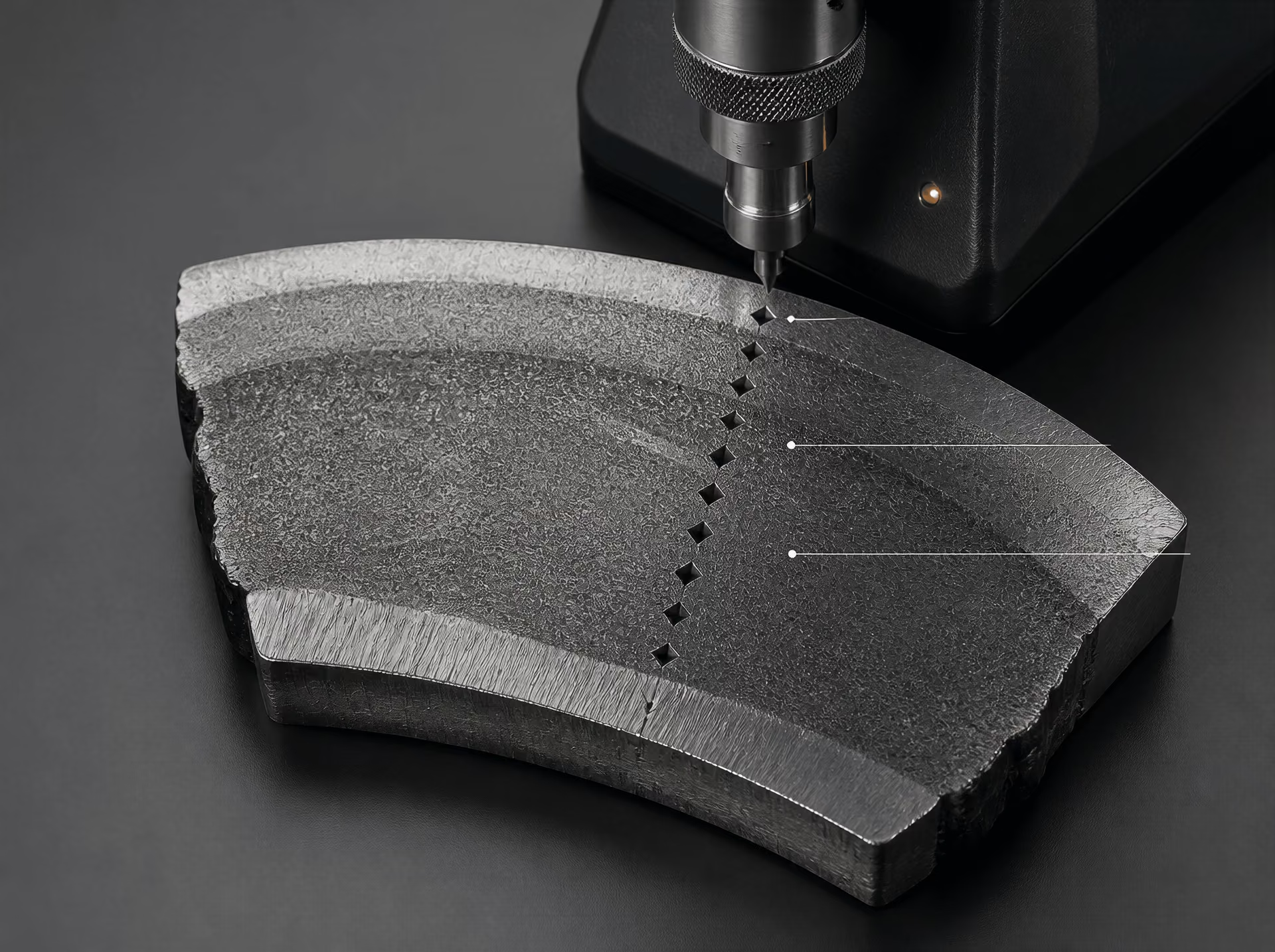
Hardness mapping is a practical first check. Readings should represent the surface and, where permitted, subsurface or section locations, with enough points to reveal edge-to-center and end-to-end variation. A single acceptable-looking impression can miss a martensitic edge, a decarburized surface, or a soft furnace-center region. The test method, surface preparation, scale removal, indenter load, and conversion rule must be recorded. No universal hardness limit should be invented; limits come from the grade, product, and governing specification.
Metallography supplies the explanation that hardness alone cannot provide. A transverse section can reveal ferrite-pearlite distribution, grain size, banding, inclusions, segregation, bainite, martensite, carbide networks, and decarburization. Etching must be appropriate to the steel and examination purpose. Longitudinal sections are especially useful for assessing rolling direction, flow lines, and banding, while transverse sections show radial or through-thickness variation.
Grain-size assessment should follow the method named by the applicable standard, such as a comparative chart or an intercept procedure. The report should identify the location examined and distinguish austenite grain size, when reconstructed or otherwise assessed, from the ferrite grain size visible after transformation. These are related but not identical measurements.
Decarburization checks require a measured hardness or microstructural traverse from the surface toward the unaffected core. Scale removal alone does not prove that carbon loss is absent. Dimensional inspection is equally necessary: furnace heating and cooling can produce distortion, growth or contraction, ovality, bowing, and changes at machined features. Measure critical dimensions before and after treatment using a defined datum system and calibrated equipment.
Finally, review furnace records. Confirm charge identity, set points, actual workpiece temperatures where available, soak time, atmosphere or furnace potential, thermocouple calibration, loading arrangement, transfer time, cooling method, and any interruptions. If the records do not support the claimed thermal history, hardness and microstructure may describe what happened, but they cannot establish that the specified annealing or normalizing treatment was performed.
9. Annealing and normalizing as preparation for later operations
Annealing and normalizing are often grouped together because both alter the structure produced by hot working, casting, welding, or a previous heat treatment. They do not produce the same starting condition. Annealing generally emphasizes softening, stress reduction, and ductility through slow cooling; normalizing austenitizes the steel and then cools it in air, producing a different transformation path and usually a finer, more uniform structure. The practical result depends on grade, section size, prior condition, furnace practice, atmosphere, and the governing product specification.
Terminology must be read against the applicable standard. ASTM A941-16 provides general definitions for steel, stainless steel, related alloys, and ferroalloys, but it also states that a definition in a specific ASTM standard supersedes an identical definition in the general terminology standard. A drawing, purchase specification, or heat-treatment clause therefore controls when its wording differs from a general description of “annealed” or “normalized.”
Machining and forming
A fully annealed condition is commonly selected when low hardness and high ductility are needed before machining or forming. Slow furnace cooling permits diffusional transformations and reduces the hardness associated with rapidly cooled products, although the final ferrite–pearlite morphology depends on carbon content, alloying additions, austenite grain size, and cooling rate. Process annealing is a narrower treatment: the National Bureau of Standards Circular 409 (1935) described it as heating an iron-base alloy below or near the lower critical-temperature range. It is not interchangeable with a full anneal above the critical range.
Lower hardness can reduce cutting forces and tool wear, but “softer” does not automatically mean better machining. A very soft, coarse, or ferritic structure may produce long, continuous chips, smear on the tool, or distort when residual stresses are released. Machining allowances must account for that possibility. Normalizing can provide a more consistent balance of strength and machinability, particularly where an as-forged or as-rolled structure contains coarse grains, segregation, or uneven pearlite spacing. It is still harder than a slow-cooled annealed condition in many carbon and low-alloy steels, so the choice must follow the machining operation rather than a generic claim that normalizing improves machinability.
Normalizing consists of heating into the austenite region and cooling in still or moving air, or in a specified gas. Bodycote’s 2024 description places a commonly cited normalizing range at approximately 800–920 °C, with new austenitic grains forming before free cooling in air or gas. That range is descriptive, not a universal furnace setting. The required temperature may be above Ac3 for a hypoeutectoid steel, above Acm for a hypereutectoid steel, or specified directly by the grade standard. MIT’s 2007 4140 laboratory reference, for example, gives approximately 850–875 °C for normalizing 4140, followed by a hold for temperature equilibration and air cooling.
Forming response also changes with thermal history. Annealed low-carbon or low-alloy steel normally permits greater plastic deformation before cracking, while normalized steel has greater yield strength and may require higher forming loads. Conversely, an annealed structure is not always preferred for hot forming: excessive grain growth during an unnecessarily long soak can leave a coarse structure that later affects toughness and dimensional stability. Normalizing after forging may replace a coarse or nonuniform forged structure with newly formed austenite grains, but the air-cooling rate through the transformation range varies sharply with thickness. A plate surface and its center may therefore acquire different ferrite–pearlite proportions.
Distortion is governed by more than nominal hardness. Removing machining stresses during annealing can change dimensions; air cooling after normalizing can create temperature gradients and transformation strains. Thin sections may cool quickly enough to form harder products than expected, while thick sections cool more slowly and may retain a coarser transformation structure. Fixtures, orientation, section transitions, and uneven furnace loading matter. The treatment record should identify the grade and section, not merely state “heat treated.”
Preparation for hardening and tempering
When a martensitic strength level is required, normalizing is not a substitute for hardening and tempering. Normalizing transforms austenite during air cooling, usually producing ferrite and pearlite in many low- and medium-carbon steels, with possible bainite or martensite in sufficiently hardenable alloy grades and large cooling-rate differences. Hardening instead requires austenitization followed by cooling fast enough to suppress diffusional transformation and form martensite, after which tempering adjusts hardness, toughness, and internal stress.
A prior anneal may make a subsequent hardening cycle more predictable by reducing hardness and breaking up some nonuniformity, but it can also leave coarse grains if the anneal was excessive. Coarse austenite grains formed during the later hardening operation tend to increase hardenability and can reduce toughness. A normalized condition is often chosen before hardening where the incoming forged, cast, or hot-rolled structure is coarse or variable. Reaustenitization during hardening then begins from a more controlled ferrite–pearlite structure and a more consistent carbon distribution.
The sequence is not automatic. Alloy carbides, segregation, banding, prior cold work, and component thickness can require a specified intermediate treatment or a direct hardening route. Excessive normalizing temperature may dissolve carbides or grow grains; insufficient temperature may fail to eliminate the prior structure. Holding time must allow the section to equalize without adding unnecessary grain growth. Atmosphere control also matters because decarburization or oxidation changes the surface that must later meet hardness, fatigue, or dimensional requirements.
Tempering must be treated as a separate operation. ASM Handbook Volume 4A distinguishes annealing and normalizing from quenching, tempering, austempering, and martempering because their cooling paths and resulting structures differ. A safety-critical example appears in 49 CFR § 179.500-6 (2024), where specified steel tank heat treatment includes annealing or normalizing followed by tempering, with the tempering temperature not less than 1000 °F. That requirement does not mean every normalized steel requires tempering; it shows that the prescribed sequence can be part of a regulated material condition.
When a normalized-and-tempered condition is specified
“Normalized and tempered” identifies a treatment sequence and a resulting delivery condition, not a synonym for either operation alone. ISO 683-1:2016 specifies technical delivery requirements for non-alloy heat-treatable steels supplied in conditions that include normalized and normalized-and-tempered states. The designation links the product condition to its intended mechanical-property requirements: the steel has first been normalized, then reheated to temper the transformation products and reduce hardness or residual stress while retaining a specified strength and toughness balance.
This distinction matters during fabrication. Material supplied normalized and tempered has already received a controlled thermal history. A later weld thermal cycle, flame straightening operation, cold-forming step, or local reheating can alter that condition. If the component is subsequently hardened, the prior tempering temperature and the new austenitizing cycle must be considered, since the final structure will no longer be the ISO delivery condition unless the complete component is retreated and retested.
A specification calling for normalized-and-tempered steel may also impose tensile strength, yield strength, elongation, impact energy, hardness, or thickness-dependent requirements. Those values cannot be inferred from the word “normalized.” Nor can a shop replace the specified condition with an anneal simply because both treatments reduce residual stress. The replacement changes hardness, grain structure, machining response, forming behavior, and the response to later quenching.
For production control, the heat-treatment instruction should state the grade designation, austenitizing or annealing range, equalization or holding requirements, cooling medium, tempering temperature where applicable, section size, and acceptance tests. ISO 683-1:2016 establishes the material condition; the component procedure must still account for furnace uniformity, load arrangement, atmosphere, and actual cooling rate. Normalizing establishes a defined air-cooled starting structure. Annealing establishes a slower-cooled, generally softer condition. Whether either is appropriate before machining, forming, hardening, or tempering is a grade-specific engineering decision, not a interchangeable label.
10. Safety-critical and regulated applications
Heat treatment becomes a design-control issue when steel forms part of a pressure boundary, load-bearing structure, transport container, or other safety-critical assembly. In those applications, “annealed,” “normalized,” and “normalized and tempered” are not interchangeable descriptions. Each identifies a different thermal history, and the governing material or construction standard may attach specific mechanical-property, toughness, dimensional, or inspection requirements to that history.
ASTM A941-16 is a useful terminology reference for steel, stainless steel, related alloys, and ferroalloys, but it does not replace the applicable product or construction specification. ASTM A941-16 expressly states that a definition in a specific ASTM standard supersedes an identical general definition in the terminology standard. That hierarchy matters when a purchase specification, pressure-vessel rule, or transportation regulation gives a term a controlled meaning.
The significance of 49 CFR § 179.500-6
49 CFR § 179.500-6 specifies a tempering temperature of not less than 1000 °F for the covered tank requirement. Strong evidence
49 CFR § 179.500-6 provides a concrete example of regulation controlling the sequence of treatments. For certain steel tanks covered by the provision, the specified heat treatment consists of annealing or normalizing followed by tempering. The tempering temperature must be not less than 1000 °F. This is a regulatory requirement for the tanks and conditions within that section, not a universal prescription for every steel component.
The sequence is safety-critical because the first treatment and the tempering step perform different metallurgical functions. Annealing or normalizing establishes the preceding microstructural condition. Annealing generally uses a slower cooling path intended to reduce hardness and relieve or redistribute some effects of prior processing. Normalizing austenitizes the steel and then cools it in still or freely moving air; the faster cooling path than furnace cooling commonly produces a finer transformed structure and different strength and toughness. The exact result depends on carbon content, alloying elements, section thickness, prior deformation, austenitizing temperature, holding time, and cooling conditions.
Tempering then changes the structure produced by the earlier treatment. At a sufficiently high temperature and adequate time, it can reduce residual stresses and adjust the balance among strength, ductility, toughness, and dimensional stability. A minimum of 1000 °F prevents a processor from treating a low-temperature stress-relief cycle as an equivalent substitute. It also places a lower boundary on the thermal exposure intended by the regulation, although the required cycle still has to be applied to the relevant steel grade, thickness, geometry, and specification.
The rule should not be read as evidence that every normalized steel requires tempering at 1000 °F, or that every annealed steel should receive the same treatment. ISO 683-1:2016 distinguishes delivery conditions including normalized and normalized-and-tempered states for non-alloy heat-treatable steels. That distinction shows why condition is part of a material designation and delivery requirement, rather than a casual shop-floor label.
Nor does the regulation erase the difference between annealing and normalizing. The National Bureau of Standards’ 1935 circular described process annealing as heating an iron-base alloy below or near the lower critical-temperature range, while it described normalizing as heating approximately 100 °F above the critical range and then cooling in still air. Modern grade specifications may define temperatures and acceptance criteria differently, but the process distinction remains. Bodycote described normalizing in 2024 as heating approximately to 800–920 °C to form new austenitic grains, followed by free cooling in air or gas. For 4140, an MIT laboratory reference gave approximately 850–875 °C for austenitizing, with a hold for temperature equilibration and air cooling. Those figures illustrate grade-specific practice; they are not substitutes for the controlling specification.
Why tempering requirements cannot be generalized
A tempering temperature cannot be selected from the words “steel,” “annealed,” or “normalized” alone. Carbon and alloy content change transformation behavior. Chromium, molybdenum, nickel, manganese, and other additions affect hardenability, transformation kinetics, carbide precipitation, temper response, and toughness. Section size changes the cooling rate from the surface to the center, so two parts made from the same heat may not acquire the same structure after an apparently identical furnace cycle.
The prior condition also matters. Tempering a quenched martensitic structure is not metallurgically identical to tempering steel that has first been annealed or normalized. A cycle suitable for one condition may leave another condition too hard, too soft, insufficiently stress-relieved, or outside the required toughness range. The tempering time, part temperature, furnace uniformity, loading pattern, and cooling after tempering can alter the result as well.
A higher temperature is not automatically safer, and a longer hold is not automatically equivalent to a specified cycle. Excessive exposure can reduce strength, promote unwanted grain or carbide changes, affect weld-adjacent regions, or create dimensional distortion. Temper embrittlement risks can also depend on alloy chemistry, impurity levels, temperature range, and cooling path. Therefore, a treatment must be tied to the grade designation, product form, section size, prior processing, and governing standard. ASM Metals Handbook and ASM Handbook Volume 4A frame annealing, normalizing, tempering, quenching, austempering, and martempering as distinct treatments with different transformation paths and purposes.
Traceability, procedure qualification, and records
A qualified heat-treatment procedure converts a written requirement into a controlled, repeatable operation. Qualification should establish that the proposed furnace cycle, loading arrangement, atmosphere where relevant, heating rate, austenitizing or annealing range, hold time, cooling method, and tempering cycle can produce the required properties on representative material. The evidence may include hardness, tensile, impact, metallographic, dimensional, or other tests specified by the governing document. Test coupons should represent the material heat, product form, thickness, and thermal mass that matter to the production part; a small coupon processed in a lightly loaded furnace may not reproduce the center of a heavy tank component.
Furnace calibration and temperature uniformity are equally important. A controller set to 1000 °F does not prove that the steel reached 1000 °F throughout its thickness. Calibration status should be known, and thermocouple placement should measure representative locations, including locations likely to heat or cool more slowly. The placement plan, attachment method, instrument identification, and recorded readings should be retained when the procedure or governing specification calls for that level of control.
Batch identification links the physical material to its thermal history. The heat number, plate or part identification, load number, furnace identification, date, operator, and applicable procedure should remain associated throughout processing. Records should show actual temperature traces or logged readings, start and finish times, soak or hold conditions, cooling method, tempering exposure, equipment status, and any deviation or rework decision. Test results and final acceptance should be traceable to the same batch and procedure.
Not every item in that record set is automatically imposed by 49 CFR § 179.500-6 itself. Contract specifications, approved quality systems, other regulations, and the responsible engineer may add requirements. The central point is control: a safety-critical heat treatment must be demonstrable, not merely described after the fact as “annealed and tempered.”
11. Common errors in specifications and shop-floor instructions
Using “annealed” or “normalized” without naming the grade
“Annealed” and “normalized” are treatment descriptions, not complete material specifications. A shop instruction that says “anneal the steel” leaves unanswered which critical temperatures apply, whether the cycle is intended to reduce hardness, remove cold-work effects, refine grains, relieve stress, or produce a specified delivery condition. The same omission occurs with “normalize.” A plain-carbon steel, a low-alloy steel such as AISI/SAE 4140, and a high-hardenability alloy steel will not follow the same transformation path when exposed to the same furnace program.
The terminology must also be read with the governing product standard. ASTM A941-16 is the general ASTM terminology reference for steel, stainless steel, related alloys, and ferroalloys, but it states that a definition in a specific ASTM standard supersedes an identical definition in the general terminology standard. A specification writer therefore cannot assume that a dictionary definition settles the required condition for every product. ISO 683-1:2016, for example, identifies normalized and normalized-and-tempered delivery conditions for non-alloy heat-treatable steels. The condition is part of the product requirement, not a casual synonym for “softened.”
Annealing itself covers several distinct treatments. Process annealing is generally conducted below or near the lower critical-temperature range. The National Bureau of Standards’ 1935 circular makes that distinction explicitly. Full annealing, intercritical annealing, spheroidizing, stress relieving, and subcritical treatments can have different temperatures, holding periods, cooling controls, and intended structures. Calling all of them “furnace annealing” is wrong twice: not every anneal has the same thermal objective, and not every annealing cycle is defined solely by furnace cooling.
Normalizing is also not a single universal recipe. It normally involves austenitization above the relevant critical range, followed by cooling in still or moving air, but the required austenitizing temperature depends on carbon content, alloy additions, section size, and prior structure. Bodycote described normalizing in 2024 as approximately 800–920 °C, with new austenitic grains forming before free cooling in air or gas. That broad range is useful terminology, not permission to apply one setpoint to every grade.
A treatment name alone guarantees neither hardness nor tensile properties. Hardness depends on composition, austenite grain size, cooling rate, section thickness, segregation, prior deformation, and the actual temperature history. If hardness is the acceptance requirement, the instruction must state the test method and location, such as ASTM E10 Brinell or ASTM E18 Rockwell, together with the permitted range and sampling plan.
Confusing air cooling with a guaranteed microstructure
“Air cool” describes a cooling medium, not a guaranteed final structure. A thin 4140 part may cool rapidly enough in still air to produce bainite or martensite in some regions, while a heavy section cools much more slowly and develops predominantly ferrite and pearlite. Agitated air, fan placement, furnace loading, part spacing, and ambient conditions alter the heat-transfer rate. Two furnaces can both issue an “air-cooled” part while producing different transformation histories.
The MIT 4140 laboratory reference from 2007 gives approximately 850–875 °C for normalizing AISI/SAE 4140, followed by a hold for temperature equilibration and air cooling to room temperature. That procedure does not establish that every 4140 component normalized at 850 °C will have the same hardness or grain size. It describes one material, one laboratory procedure, and one intended result. The Karlsruhe Institute of Technology vocabulary captures the defining sequence more accurately: austenitization followed by open-air cooling to promote a uniform grain size and composition. “Promote” is not the same as “guarantee.”
Annealing presents the opposite error. Slow cooling is often specified to soften steel and improve ductility or machinability, but “slow” must have a measurable meaning. Furnace cooling at an uncontrolled rate, cooling at a programmed rate, and transferring a load into an insulated container are not interchangeable. A heavy load may retain heat long after a thin component reaches room temperature. If the transformation range is crossed too quickly, the intended ferrite-carbide structure may not form.
Prior processing must appear in the instruction. Hot rolling, forging, cold drawing, welding, prior quenching, and an earlier normalizing cycle change the starting grain size and stored strain. A normalized steel is not equivalent to the same grade after quenching and tempering merely because both are called heat treated. For safety-critical applications, the consequences are concrete: 49 CFR § 179.500-6 specifies certain tank-steel treatments as annealing or normalizing followed by tempering, with a tempering temperature not less than 1000 °F. The sequence matters.
Copying temperatures across grades and section sizes
A copied temperature can be wrong even when its unit is correct. Normalizing AISI/SAE 4140 at about 850–875 °C is not a general instruction for 1045, 8620, 4130, stainless steel, or a pressure-vessel grade. Alloying elements shift transformation temperatures and alter hardenability; carbon changes the phase fractions available after cooling. The correct range must come from the grade-specific material standard, a qualified procedure, or validated heat-treatment data.
Section size changes the result as well. The furnace may display 850 °C while the center of a large forging remains far below that temperature. Conversely, a thin edge can overheat while the load core is still equilibrating. “Hold 30 minutes” is incomplete unless the basis is stated: 30 minutes after furnace recovery, after the controlling thermocouple reaches setpoint, or per a specified time per millimetre of governing section thickness. The part temperature, not merely the nominal furnace temperature, controls transformation.
Unit errors can be equally damaging. Confusing 850 °C with 850 °F would place the steel far below the intended austenitizing range; confusing 1600 °F with 1600 °C could cause severe overheating, grain coarsening, melting of local constituents, or distortion. Every instruction should print the unit beside each temperature, and conversions should be checked rather than reconstructed at the furnace.
A usable instruction names the grade designation and product standard, treatment condition, heating range, holding basis, cooling medium and degree of agitation, atmosphere, loading arrangement, and inspection method. It also states acceptance criteria: hardness range, tensile properties, microstructural requirements, dimensional limits, or all applicable requirements. A clear record identifies furnace and load thermocouples, actual time at temperature, and cooling completion. Without those details, “annealed” and “normalized” are labels attached after the fact—not reproducible thermal histories.
12. How to read standards, technical datasheets, and heat-treatment procedures
Heat-treatment language has at least three different jobs: defining terms, specifying a product, and describing a process. Confusing those jobs is a common cause of incorrect annealing or normalizing schedules. A reference may explain what normalizing generally means without prescribing the temperature for a particular grade. A product standard may state the required delivery condition without giving every furnace-control detail. A shop procedure must connect both.
Terminology standards versus product standards
ASTM A941-16, Standard Terminology Relating to Steel, Stainless Steel, Related Alloys, and Ferroalloys, is a terminology reference. It helps establish what words such as annealing, normalizing, austenitizing, tempering, and critical temperature mean within ASTM usage. It is not, by itself, a heat-treatment recipe for 4140, 1045, or any other grade. ASTM A941-16 also states that a definition in a specific ASTM standard supersedes an identical general definition in the terminology standard. That rule matters when a material specification gives a narrower or more specialized meaning.
A product standard answers a different question: what condition must the supplied steel meet? ISO 683-1:2016, for example, specifies technical delivery requirements for non-alloy heat-treatable steels and includes normalized and normalized-and-tempered delivery conditions. “Normalized” in that context is part of the product designation and acceptance condition, not merely a description that a furnace operator may apply loosely. The applicable product standard may also set chemical composition, mechanical properties, hardness, grain size, decarburization limits, surface condition, and test requirements.
| Source type | Primary function | What it does not automatically provide |
|---|---|---|
| Terminology standard | Defines general technical terms | A grade-specific furnace recipe |
| Product standard | Defines delivery condition and acceptance requirements | Every furnace-control detail |
| Technical datasheet or handbook | Explains metallurgy and typical practice | Authority to override a controlling specification |
| Regulation | Controls the covered legal application | A universal rule for all steel components |
| Qualified procedure | Translates requirements into production controls | Permission to apply the cycle to an unapproved grade or geometry |
The designation must therefore be read before the furnace schedule. A request for “annealed steel” does not identify the grade, the type of anneal, the required hardness, or whether the condition is to be verified by a tensile test. “Normalize” is equally incomplete unless the grade, section size, starting structure, and governing document are known.
ASM publications supply the metallurgical framework behind these requirements. The ASM Metals Handbook chapter “Heat Treating of Steel” discusses austenitizing, normalizing temperatures, cooling media, furnace variables, procedures, and applications. ASM Handbook Volume 4A places annealing and normalizing among the heat treatments of steel and distinguishes them from quenching, tempering, austempering, and martempering. Metallurgy for the Non-Metallurgist connects the iron–carbon system, critical temperatures, transformation diagrams, furnace practice, and alloying effects.
Those sources explain why two schedules produce different structures. They do not automatically override a purchase specification, drawing, code, or regulation.
Normative requirements versus explanatory guidance
The word “shall” usually signals a normative requirement, but readers should confirm the document’s own conventions. A requirement can control temperature, holding time, cooling method, tempering, sampling, mechanical testing, or permissible variation. “Should,” “typically,” “approximately,” and “for guidance” generally indicate explanation or recommendation rather than an acceptance rule. A technical datasheet may use informal language, so its status must be established: is it a mill certificate, a customer procedure, a laboratory handout, or a marketing explanation?
The distinction is visible in published descriptions. Bodycote’s 2024 explanation describes normalizing as heating approximately to 800–920 °C to form new austenitic grains, followed by free cooling in air or gas. That is a useful process description, not a universal requirement for every steel. For 4140, an MIT laboratory reference from 2007 gives approximately 850–875 °C, a hold for temperature equilibration, and air cooling to room temperature. The narrower range reflects the named grade and laboratory purpose; it should not be copied onto a different alloy or treated as a controlling industrial specification.
Older government material remains useful when its role is understood. The National Bureau of Standards Circular 409, published in 1935, describes process annealing as heating iron-base alloys below or near the lower critical-temperature range. It describes normalizing as heating approximately 100 °F above the critical range, followed by still-air cooling. The statement establishes a clear metallurgical distinction, but it does not replace a current grade standard. Government publications can also control safety-critical work. Under 49 CFR § 179.500-6, certain steel tank treatments consist of annealing or normalizing followed by tempering, with tempering temperatures not less than 1000 °F. That regulatory requirement has priority over a convenient general reference.
Educational laboratory notes, such as the MIT 4140 document, are valuable for showing specimen preparation, furnace practice, thermocouple placement, equilibration, and expected microstructures. University vocabulary resources can clarify sequence: the Karlsruhe Institute of Technology describes normalizing as austenitization followed by cooling in open air to promote uniform grain size and composition. Texas A&M similarly distinguishes still or agitated air cooling after heating above the critical range from the predetermined slow cooling used for annealing. Commercial explanations can provide accessible process context, but none should silently replace a cited specification.
Building a traceable treatment schedule
Building a traceable treatment schedule
- Identify the material Record the exact grade, product form, thickness, and prior condition.
- Define the condition State full anneal, process anneal, normalize, normalized-and-tempered, or another named treatment.
- Specify heating Record the temperature basis, ramp, atmosphere, and loading condition.
- Specify holding Define when the hold begins and how equilibration is established.
- Specify cooling Name furnace, controlled, still-air, agitated-air, gas, oil, or another cooling method.
- Attach verification Link hardness, tensile, impact, metallographic, grain-size, and dimensional checks to acceptance clauses.
Start by recording the governing document and its exact revision. Then identify the steel designation exactly as written, such as AISI 4140, ASTM A29 4140, or the relevant ISO grade. Record whether the material is bar, plate, forging, tube, weldment, or a fabricated component. The same nominal chemistry can be subject to different requirements when supplied under different product standards.
Next extract the required condition: full anneal, process anneal, normalize, normalize-and-temper, quench-and-temper, or another named treatment. Do not infer the condition from a hardness target alone. A soft result may be produced by several thermal histories, while a specification may require a particular microstructure or delivery state.
The schedule should then state the critical-temperature basis. Is the temperature tied to Ac₁, Ac₃, A_cm, a specified transformation range, or a temperature printed directly in the standard? A general range such as 800–920 °C must remain labelled as general guidance. It cannot replace a cited grade requirement. Alloy content, prior cold work, heating rate, section thickness, and measurement location affect the transformation response.
Write the heating instruction in operational terms: furnace loading condition, heating rate if specified, target temperature, permitted range, atmosphere, and whether the charge is protected from oxidation or decarburization. State the holding rule separately. “Hold one hour” may mean one hour after the furnace reaches setpoint, after the coldest section reaches temperature, or a thickness-based time; those are not equivalent.
Record the cooling method precisely—furnace cooling, controlled cooling, still air, agitated air, gas, oil, or another medium—and identify when cooling changes from one method to another. For normalizing, open-air cooling is central to the treatment path. For annealing, the prescribed slow cooling rate or furnace cooling may be the controlling feature. If tempering follows, record the minimum and target temperature, hold time, cooling method, and any repeat-temper requirement.
Finally, attach verification: hardness method and location, tensile or impact tests, metallographic examination, grain-size measurement, decarburization checks, and acceptance limits. Link each value to a clause, drawing note, regulation, or approved procedure. Keep the source citation beside the schedule, not in a separate memory-based note. That prevents a useful ASM temperature range, an NBS explanation, or a commercial summary from becoming an uncited substitute for the specification that actually governs acceptance.
13. Engineering selection framework: choosing annealing, normalizing, or another treatment
Start with the required final properties
The correct treatment begins with the required final condition, not with a habit such as “anneal for softness” or “normalize for strength.” Specify a hardness range, tensile and yield strength, elongation or reduction of area, impact toughness, machinability, dimensional stability, and the required microstructural condition. A component intended for extensive machining may need a ferrite–pearlite structure with low hardness; a pressure-containing part may require a specified normalized-and-tempered condition; a wear surface may need a hard case over a tougher core.
The words annealed and normalized do not have one universal process meaning across every product standard. ASTM A941-16 is the general terminology reference for steel, stainless steel, related alloys, and ferroalloys, but it states that a definition in a specific ASTM standard supersedes an identical general definition. The product specification therefore controls when its wording differs. ISO 683-1:2016, for example, identifies normalized and normalized-and-tempered delivery conditions for non-alloy heat-treatable steels. Treatment condition is part of the material requirement, not merely a furnace operator’s description.
Annealing generally seeks reduced hardness, improved ductility, relief of residual stress, or a structure suitable for machining and later heat treatment. Its cooling schedule is part of the treatment. Full annealing commonly involves austenitization followed by controlled furnace cooling, while process annealing is associated with heating below or near the lower critical-temperature range. The National Bureau of Standards described process annealing in those terms in Circular 409 (1935). Spheroidizing annealing may be selected for high-carbon steels when extended machining or later hardening requires rounded carbide particles rather than lamellar pearlite.
Normalizing is not simply a faster anneal. It normally austenitizes the steel and then cools it in still or moving air, producing a transformation path different from furnace cooling. The Karlsruhe Institute of Technology defines normalizing as austenitization followed by open-air cooling to promote uniform grain size and composition. Bodycote’s 2024 description gives approximately 800–920 °C as a broad normalizing range, but that span is not a specification for every grade. The National Bureau of Standards described normalizing, in general terms, as heating about 100 °F above the critical range and then cooling in still air. Alloy content, carbon level, section thickness, and the governing standard can change the required temperature substantially.
The expected microstructure must be stated as well as the name of the treatment. Air cooling a low-carbon steel may produce ferrite and pearlite, whereas an alloy steel with sufficient hardenability can form bainite or martensite in a thick section even when the furnace cycle is called normalizing. If the required structure is ferrite–pearlite throughout, a nominal normalizing cycle is not enough evidence; hardness mapping, metallography, or qualification testing may be needed.
Account for geometry, prior processing, and distortion risk
A heat-treatment schedule is a thermal history imposed on a three-dimensional object. Section size controls the temperature difference between the surface and core, the transformation rate, and the cooling rate reached at the critical location. A thin plate can air-cool much faster than a large forging. Ribs, keyways, holes, abrupt changes in section, and restrained attachments also produce local stress and distortion. Furnace uniformity, load spacing, atmosphere, thermocouple placement, and transfer time from furnace to cooling medium must therefore be included in the process definition.
Prior processing is equally important. Cold-reduced strip may need stress relieving or recrystallization annealing; heavily cold-worked material can have stored energy and directional properties that a short subcritical cycle will not remove. A cast structure may contain segregation, coarse grains, porosity, or brittle constituents. Normalizing can refine grains and replace part of the cast thermal history, but it cannot close shrinkage porosity or correct unsuitable chemistry. Forgings may already have directional flow and refined grains, so repeating a high-temperature normalizing cycle can coarsen them rather than improve them.
The choice also depends on the desired dimensional result. Furnace cooling in an anneal reduces thermal gradients and usually lowers transformation stresses, but long holds and slow cooling can increase scale, decarburization, and production distortion. Air cooling after normalizing shortens the cycle and often refines the structure, yet it can increase temperature gradients and residual stress in thick or irregular parts. A controlled gas quench, interrupted cooling, or a lower-temperature stress-relief treatment may be safer when dimensional tolerances are tight.
Do not transfer a temperature from one grade to another. MIT’s 2007 laboratory reference gives approximately 850–875 °C for normalizing AISI 4140, with a hold sufficient for temperature equilibration followed by air cooling. That range describes a particular alloy and instructional procedure; it is not a general setting for carbon steel, low-alloy steel, or every 4140 product specification. The applicable material standard, heat-treatment clause, section size, furnace capability, and inspection plan must establish the cycle.
When distortion or cracking risk is high, validate the process using representative coupons or production parts. Measure core and surface temperatures, hardness at multiple locations, dimensions before and after treatment, and the resulting microstructure. A furnace chart showing setpoint alone does not demonstrate that a heavy section reached the required austenitizing condition or that its slowest-cooling region met the specification.
Recognize when quenching, tempering, or special treatments are required
Annealing or normalizing is insufficient when the required strength or wear resistance depends on martensite, bainite, a hardened case, or a controlled precipitation reaction. Through-hardening requires austenitization followed by quenching at a rate adequate for the grade and section. The quenchant may be water, polymer solution, oil, gas, or another qualified medium; the selection must balance hardenability against cracking and distortion. Quenching without tempering is seldom an acceptable final condition for structural parts because untempered martensite has high residual stress and limited toughness.
Tempering after quenching reduces brittleness and establishes the required strength–toughness balance. It is a separate treatment, not a synonym for annealing or normalizing. In a safety-critical example, 49 CFR § 179.500-6 specifies tank heat-treatment routes involving annealing or normalizing followed by tempering, with the tempering temperature not less than 1000 °F for the stated steels and equipment. That requirement illustrates why the final product condition must be read from the governing regulation or material specification.
Case hardening is appropriate when a tough, relatively ductile core and a hard wear-resistant surface are required. Carburizing adds carbon before quenching; carbonitriding adds carbon and nitrogen, usually for smaller parts; nitriding or nitrocarburizing forms hard nitrogen-bearing surface layers with limited bulk transformation. Induction or flame surface hardening rapidly heats only the surface before quenching and is selected where the grade can develop the required martensite.
Austempering may replace direct quenching and tempering when a bainitic structure, lower distortion, or a specified toughness–strength combination is required. Martempering, or marquenching, reduces thermal gradients by equalizing near the martensite-start region before final cooling, but it still requires subsequent tempering. Neither treatment should be selected by name alone: hardenability curves, section size, transformation diagrams, equipment limits, and acceptance tests must support the choice.
The defensible decision is therefore conditional: define the required properties and structure, identify the grade and product standard, reconstruct prior processing, model geometry and cooling, select the treatment family, and validate the resulting part. Annealing and normalizing are options within that sequence, not interchangeable defaults.
14. Reference tables, glossary, and worked interpretation examples
Comparison table for annealing and normalizing
Annealing and normalizing can both begin with heating into the austenitic range, but the treatment is not defined by temperature alone. The cooling path determines the transformation products, hardness, residual stress, and grain structure.
| Feature | Annealing | Normalizing |
|---|---|---|
| Primary purpose | Reduce hardness, relieve stress, improve ductility and machinability | Refine or reset grain structure and produce a more uniform condition |
| Austenitizing practice | Depends on grade and annealing type; process annealing may remain below or near the lower critical range | Usually above the critical range sufficiently to form new austenite |
| Cooling medium | Furnace cooling, or another specified slow cooling method | Still air, agitated air, or open-air cooling |
| Cooling rate | Controlled and slow | Faster than furnace cooling and normally slower than quenching |
| Typical result | Lower hardness and greater ductility; coarse transformation products may result | Finer, more uniform ferrite-pearlite structure than a full-furnace-cooled condition |
| Specification language | “Annealed,” “process annealed,” or a named annealing cycle | “Normalized” or “normalized and tempered” |
| Main risk in casual interpretation | Treating every anneal as a full austenitizing cycle | Treating air cooling as equivalent to furnace cooling |
The National Bureau of Standards circular published in 1935 described process annealing as heating an iron-base alloy below or near the lower critical-temperature range. It described normalizing as heating approximately 100 °F above the critical range and then cooling in still air. Those descriptions establish the distinction, but they do not replace a grade-specific procedure. Bodycote’s 2024 description gives approximately 800–920 °C for normalizing, followed by free cooling in air or gas; that range is a general explanation, not a universal instruction.
Glossary of critical temperatures and treatment conditions
Ac1 is the temperature on heating at which austenite begins to form in a steel of a given composition. The “c” means chauffage, or heating. Ac1 is not one fixed temperature for all steels: carbon content, alloying elements, heating rate, and prior microstructure affect the measured transformation.
Ac3 is the temperature on heating at which a hypoeutectoid steel has completed its transformation to austenite. For a hypoeutectoid grade, a normalizing or full-austenitizing cycle generally must exceed the relevant Ac3 by the amount required by the governing specification or procedure.
Austenitization is heating steel to a temperature at which the required austenite forms, followed by enough time at temperature for the section to reach thermal and structural uniformity. Austenitization is not the same as merely placing a part in a hot furnace. The target temperature, hold, atmosphere, and section thickness all matter.
Soaking is holding at treatment temperature after the load or controlling section has reached the specified condition. A stated soak time may begin when the furnace reaches temperature, when the surface reaches temperature, or when the coldest point reaches temperature; the procedure must identify which basis applies.
Furnace cooling means cooling with the furnace, normally at a controlled or naturally falling furnace temperature. It produces a slower cooling history than air cooling and is commonly associated with softening anneals, although the exact cycle may include staged cooling or a furnace shutdown.
Air cooling means cooling in air rather than inside a closed furnace. “Air” is still incomplete as a process description unless the specification identifies still or moving air, part spacing, loading density, and whether fans are permitted. Section size can make the center cool much more slowly than the surface.
Normalized describes a condition produced by a specified austenitizing treatment followed by air or gas cooling. The term does not mean that a part has received an arbitrary high-temperature cycle. ISO 683-1:2016 lists normalized and normalized-and-tempered conditions among delivery conditions for non-alloy heat-treatable steels.
Annealed describes a condition produced by an annealing treatment defined for the material and product. It may refer to full annealing, process annealing, stress-relief annealing, spheroidize annealing, or another named cycle. The word alone does not disclose the peak temperature or cooling rate.
Tempered describes reheating previously hardened or otherwise transformed steel below the relevant critical range, holding it there, and cooling it under the specified procedure. Tempering is separate from annealing and normalizing. A product described as normalized and tempered has two sequential treatment stages, not one blended label.
Worked interpretation example 1: the MIT 4140 educational schedule
The Massachusetts Institute of Technology laboratory reference from 2007 gives an educational normalizing schedule for 4140: approximately 850–875 °C, a hold for temperature equilibration, and air cooling to room temperature. Read literally, it identifies the intended sequence as austenitize, equalize, and air-cool. It does not establish that every 4140 product should receive exactly that cycle.
The schedule’s limits are important. It does not, by itself, provide a certified product specification, a furnace calibration requirement, a permitted atmosphere, a section-size correction, a loading rule, a maximum cooling-time range, or mechanical-property acceptance criteria. It also does not prove that an annealed 4140 part can be substituted for a normalized part. A production procedure would need the applicable AISI/SAE 4140 material requirement, part dimensions, prior condition, furnace capability, and required hardness or microstructure. The MIT document is useful evidence of laboratory practice, not authority for every commercial or regulated application.
Worked interpretation example 2: a regulated tank requirement
49 CFR § 179.500-6 is a regulatory requirement for specified tank construction, not a general lesson in transformation metallurgy. The provision describes heat treatment consisting of annealing or normalizing followed by tempering, and specifies that the tempering temperature must be not less than 1000 °F for the covered requirement. That wording creates a compliance path with defined legal conditions.
A general explanation might say that normalizing refines grain structure through austenitization and air cooling, while annealing softens steel through slower cooling. The regulation asks a different question: whether the tank material and manufacturing procedure satisfy the prescribed safety rule, including the required sequence and tempering limit. It does not authorize a reader to replace the regulation with a textbook cycle or to assume that any air-cooled, furnace-cooled, or tempered part qualifies.
Source hierarchy and use
For terminology, start with the material or product standard. ASTM A941-16 provides general terminology for steel, stainless steel, related alloys, and ferroalloys, but it states that a definition in a specific ASTM standard supersedes an identical general definition. For process metallurgy, ASM Metals Handbook, the ASM Handbook Volume 4A, and Metallurgy for the Non-Metallurgist provide the technical framework. ISO 683-1:2016 controls its own delivery-condition language. A federal regulation such as 49 CFR § 179.500-6 controls the covered legal application.
Use educational schedules, supplier explanations, and university laboratory notes as supporting references. The governing grade, product specification, drawing, contract, or regulatory standard controls whenever their wording differs from a general explanation.
References
- [1] Normalizing vocabulary entry. Karlsruhe Institute of Technology vocabulary resource, 2024. Source identified in the article; no DOI or URL supplied.
- [2] 4140 Heat Treatment Laboratory Reference. MIT laboratory reference, 2007. Source identified in the article; no DOI or URL supplied.
- [3] 49 CFR § 179.500-6. Code of Federal Regulations, Title 49, 2024. https://www.ecfr.gov/current/title-49/section-179.500-6