



What Steel Density Means in Engineering
Mass density, mass, and volume
Mass density describes how much mass is contained in a given volume of material. The National Institute of Standards and Technology (NIST) defines mass density as mass divided by volume:
Here, is mass density, is mass, and is volume. The SI unit is the kilogram per cubic metre, written . That unit is part of the result, not optional decoration. A statement such as “steel density is 7850” is incomplete until the unit, material description, temperature or condition where relevant, and intended engineering use are understood.
Density is a property assigned to a material state or material specification. Mass belongs to a particular object. Volume belongs to the space occupied by that object or section. A 2 m length of steel plate and a 20 m length made from the same grade can have approximately the same density, but the longer plate has ten times the mass if its cross-section is unchanged. Likewise, two components may have equal mass while occupying different volumes if their densities differ.[1] Steel Handbook: Handbook of Structural Steelwork, 3rd Edition. Steel Handbook: Handbook of Structural Steelwork, 2016.
The frequently quoted value is a conventional engineering value for structural-steel calculations. The Steel Handbook: Handbook of Structural Steelwork, 3rd edition (2016), uses it to calculate tabulated mass per metre. National Research Council Canada guidance published in 2019 and the U.S. Department of Defense UFC 4-023-07 also list steel density as ; the UFC gives approximately . Those references establish a useful design convention, not a claim that every steel grade has exactly that density.
Grade and composition can shift the value. MatWeb reports a typical density of for ASTM A366/A569 low-carbon steel, while ASM MatWeb reports for 300M ultrahigh-strength steel. RoyMech uses for mild steel, and Engineering ToolBox lists steel at approximately . These figures differ modestly, but the difference can matter in high-precision mass estimates, material inventories, buoyancy calculations, or comparisons involving large quantities.
Unit conversion also explains many apparent disagreements. Since
becomes . In customary units, is a weight-density approximation under standard gravitational conditions, whereas is a mass-density unit. NIST Appendix B.9 provides the dimensional basis for such conversions. A calculation should not mix metres with millimetres, kilograms with pounds, or mass density with specific weight without converting first.
Why is a definition rather than a lookup shortcut
The equation defines the relationship among density, mass, and volume. It does not identify the correct numerical density for an unspecified object. To calculate mass, the same relationship is rearranged as
To calculate volume, it becomes
| Quantity | Equation | SI result unit |
|---|---|---|
| Mass density | ρ = m/V | kg/m³ |
| Mass | m = ρV | kg |
| Volume | V = m/ρ | m³ |
These are the three central equations:
\[ \rho=\frac{m}{V},\qquad m=\rho V,\qquad V=\frac{m}{\rho}. \]
The algebra is simple; establishing the inputs is where engineering judgment enters. A steel beam does not have a volume equal to its length. Its volume is the cross-sectional area multiplied by its length:
Consequently, its mass is
For a uniform section, mass per unit length is therefore
Consider a solid rectangular bar measuring 100 mm by 50 mm and 10 m long. Converting the dimensions gives a cross-sectional area of
| Section or object | Area or volume | Density basis | Calculated mass |
|---|---|---|---|
| 100 mm × 50 mm × 10 m bar | 0.005 m²; 0.05 m³ | 7850 kg/m³ | 392.5 kg total; 39.25 kg/m |
| 300 mm × 200 mm × 50.0 mm block | 0.00300 m³ | 7850 kg/m³ | 23.55 kg |
| 50 mm × 25 mm bar | 0.00125 m² | 7850 kg/m³ | 9.8125 kg/m |
| 50 mm × 20 mm × 3.0 m bar | 0.00300 m³ | 7850 kg/m³ | 23.55 kg |
Using the conventional value , its mass per metre is
The 10 m bar has a volume of and a mass of . The density did not change because the bar became longer; the volume and mass changed together.
For a rectangular section, the same method can be written as
Items that can alter assembly mass
- Holes and internal voids reduce the steel volume.
- Weld metal and stiffeners add material.
- Corrosion loss reduces the remaining steel mass.
- Paint, galvanizing, and fire protection add non-steel mass.
- Attached components can make measured assembly mass exceed bare-steel mass.
where , , and must use compatible units. Hollow sections require the area of steel rather than the outside envelope area. Rolled I-sections, channels, angles, and tubes are normally handled through the published cross-sectional area or tabulated mass per metre. The geometry may also include holes, weld metal, stiffeners, corrosion loss, paint, fire protection, or attached components. Each changes the mass or the volume being evaluated.
Temperature matters because steel expands when heated. At a fixed mass, increasing temperature increases volume and therefore decreases density. NIST NCSTAR 1-3 addresses physical properties of structural steels in the context of fire, where thermal expansion and temperature-dependent properties affect analysis. Alloy chemistry, porosity, inclusions, manufacturing condition, and coatings can also alter a measured or effective value. For ordinary structural calculations, these effects are often smaller than the tolerance implied by using , but they should not be silently ignored when the required accuracy is higher.
Related material quantities
- Mass density
- Mass divided by volume, expressed in kg/m³.
- Specific volume
- Volume divided by mass, expressed in m³/kg.
- Specific weight
- Force per unit volume, expressed in N/m³.
- Specific gravity
- A dimensionless ratio of material density to a stated reference density.
Density should also be kept separate from specific weight and specific gravity. Specific weight is force per unit volume:
so its SI unit is , not . Specific gravity is a dimensionless ratio, commonly the density of a substance divided by the density of water at a stated reference condition. Neither quantity can replace mass density without the appropriate conversion or definition.
Specific volume and reciprocal relationships
NIST defines specific volume as volume divided by mass:
Its SI unit is . Because density is , specific volume is its reciprocal:
\[ v=\frac{1}{\rho}, \qquad \rho=\frac{1}{v}. \]
For the conventional steel value,
approximately . This means one kilogram of steel occupies about , or 127.4 cubic centimetres, under the conditions represented by that density.
The reciprocal relationship is useful for checking dimensions and calculations. If a reported steel density is , its specific volume must be slightly larger than that associated with . A result that gives density in but specific volume in has failed a basic dimensional check.
For engineering work, the safest practice is to identify the grade or assumed material, state the density and units, calculate the actual geometric volume, and retain sensible rounding until the final result. The number is often appropriate, but its validity comes from the stated calculation convention and application—not from a universal identity shared by every steel component.
The Engineering Meaning of 7850 kg/m³
The value 7850 kg/m³ is a conventional calculation density for ordinary structural steel. It is not a declaration that every steel product, grade, or temperature condition has exactly that density. Under the National Institute of Standards and Technology (NIST) definition, mass density is
where is mass and is volume. Its SI unit is kilogram per cubic metre (kg/m³). NIST also defines specific volume as , the reciprocal of density, with units of cubic metres per kilogram.
For a steel member of known volume, the basic calculation is therefore
7850 kg/m³ is a widely used engineering convention for structural-steel calculations. Strong evidence
Using gives a suitably consistent result for much structural-steel estimating and design work. The value is repeated because it makes section tables, quantity calculations, fire analyses, and construction references agree with one another. It should be read as an engineering convention with a known level of approximation.
Structural-steel mass tables
Steel-section tables commonly report mass per metre rather than density or total mass. The link between them is the section’s cross-sectional area:
where is mass per unit length in kg/m and is area in m². With the conventional density,
A section with an area of , for example, has a calculated mass per metre of
A 6 m length would then have a nominal mass of , before considering attached plates, weld metal, holes, coatings, or fabrication tolerances.
The Steel Handbook: Handbook of Structural Steelwork, 3rd Edition (2016), states that tabulated structural-steel masses per metre are calculated with a density of 7850 kg/m³. This convention is useful because a section table can be produced from geometry without requiring a separate density measurement for every rolled section. It also permits designers to compare an I-section, channel, angle, hollow section, or plate using the same calculation basis.
For a rectangular bar, the area is simply width multiplied by thickness:
If width and thickness are entered in millimetres, the mass-per-metre formula becomes
with and in mm and in kg/m. A 100 mm by 20 mm bar has
RoyMech uses 7830 kg/m³ for mild steel in its rectangular-bar calculations. That produces 15.66 kg/m for the same dimensions, a difference of only 0.04 kg/m. The discrepancy shows why published tables can differ slightly without either table being unusable: they may apply different conventional densities, rounding rules, nominal dimensions, or product tolerances.
The Federal Highway Administration’s Steel Bridge Design Handbook and NIST NCSTAR 1-3, which addresses physical properties of structural steels, provide the institutional context for treating steel properties as engineering inputs rather than a single universal number. For ordinary quantity calculations, 7850 kg/m³ is usually adequate. For a measured component, a specified grade, or a temperature-dependent analysis, the selected value should match the purpose of the calculation.
The 490 lb/ft³ equivalent[2] UFC 4-023-07. U.S. Department of Defense. Unified Facilities Criteria, 2008.
U.S. customary-unit references commonly express the same conventional density as approximately 490 lb/ft³. The U.S. Department of Defense, in UFC 4-023-07 (2008), lists steel at 7850 kg/m³, equivalent to approximately 490 lb/ft³. The National Research Council Canada gives the same density in its fire-engineering guidance, and Arcadis’s Construction Cost Handbook 2019 repeats 7850 kg/m³ and approximately 490 lb/ft³ in its construction-material table.
The word “approximately” matters. Converting 7850 kg/m³ with standard unit factors gives about 490.06 lb/ft³, so writing 490 lb/ft³ is a sensible rounded expression, not a more exact physical measurement. The equivalent density is also about 7.85 g/cm³ and 0.284 lb/in³. NIST Appendix B.9 provides the dimensional basis for conversions between SI and customary units.
A unit conversion does not change the underlying assumption. If a calculation begins with 490 lb/ft³, it still represents the same conventional steel density as 7850 kg/m³; it does not provide independent evidence that a particular grade has that density. Confusion often arises when a rounded customary value is treated as if it carried more precision than the SI value from which it was converted.
The distinction between mass and weight is also important. Density gives mass per volume. Specific weight is force per volume:
where is gravitational acceleration. Thus, 7850 kg/m³ is not itself a pressure or load intensity. To obtain a gravitational load, the mass must be multiplied by , producing newtons per cubic metre. Structural software may display a member’s “weight,” while its section table may actually be reporting mass in kg/m or lb/ft.
Specific gravity is another different quantity. It is a ratio of a material’s density to the density of a stated reference, commonly water at a specified temperature, and therefore has no units. It should not be substituted for mass density in .
Conventional value versus measured grade value
Steel density varies by grade and condition, although the differences are modest for many ordinary structural estimates. Limited evidence
Actual density varies with alloy chemistry, crystal structure, temperature, manufacturing history, and porosity. The variation is modest for many dense steels, but it is real. A 2024 MatWeb entry gives typical density for ASTM A366/A569 low-carbon steel as 7.80 g/cm³, or approximately 7800 kg/m³. ASM MatWeb lists 300M ultrahigh-strength steel at 7.87 g/cm³, or approximately 7870 kg/m³. Engineering ToolBox lists steel at approximately 7.82 g/cm³, while RoyMech uses 7830 kg/m³ for mild steel.
Those figures span roughly 7800 to 7870 kg/m³. For a large structural takeoff, the difference may be smaller than the effects of dimensional tolerances, corrosion allowance, attachments, or rounding. For a laboratory specimen, aircraft component, precision balance, or detailed thermal model, it may matter.[3] Fire Safety Design of Buildings: NRC Short Course Material. National Research Council Canada. National Research Council Canada publication, 2019.
Temperature changes density because thermal expansion changes volume while the amount of material remains essentially constant. Heating a steel member therefore lowers its density as a mass-per-current-volume quantity. Fire guidance must also account for changing mechanical and thermal properties, not merely insert a room-temperature density into every equation. NRC guidance states steel density as 7850 kg/m³ and defines the steel section factor using heated perimeter divided by cross-sectional area. That geometric ratio influences heat transfer in fire analysis; it is not a replacement for density and does not mean two shapes with equal mass will heat identically.
Paint, galvanizing, scale, moisture, voids, and other coatings further complicate a field measurement. A coating increases assembly mass but is not steel density. Likewise, hollow sections require the volume of steel material, not the outside bounding volume, unless the calculation specifically concerns displacement or another external-volume property.
- Suitable for
- Many nominal structural estimates and standard section tables
- State explicitly
- Density, units, geometry, temperature basis, and inclusion rules
- Replace with grade data when
- Precision, certification, thermal analysis, or measured assembly mass controls
- Check separately
- Coatings, welds, fasteners, voids, corrosion, and trapped contents
The defensible practice is straightforward: use 7850 kg/m³ for the conventional structural-steel calculation basis when a standard, handbook, or project specification calls for it; identify the assumption; and substitute a documented grade-specific or measured density when the accuracy of the result requires one. That preserves the usefulness of the common value without mistaking it for a universal material constant.
Unit Systems and Density Conversion
Density conversions are only reliable when both the mass unit and the volume unit are changed. NIST defines mass density as
where is mass and is volume. The SI unit is kilogram per cubic metre, written kg/m³. NIST also defines specific volume as , the reciprocal of density, with units such as m³/kg. NIST Appendix B.9, “Conversion Factors,” provides the appropriate basis for moving between SI and customary units; its factors should take priority over memory, rounded web tables, or a conversion that changes only the numerator.
kg/m³, g/cm³, and Mg/m³
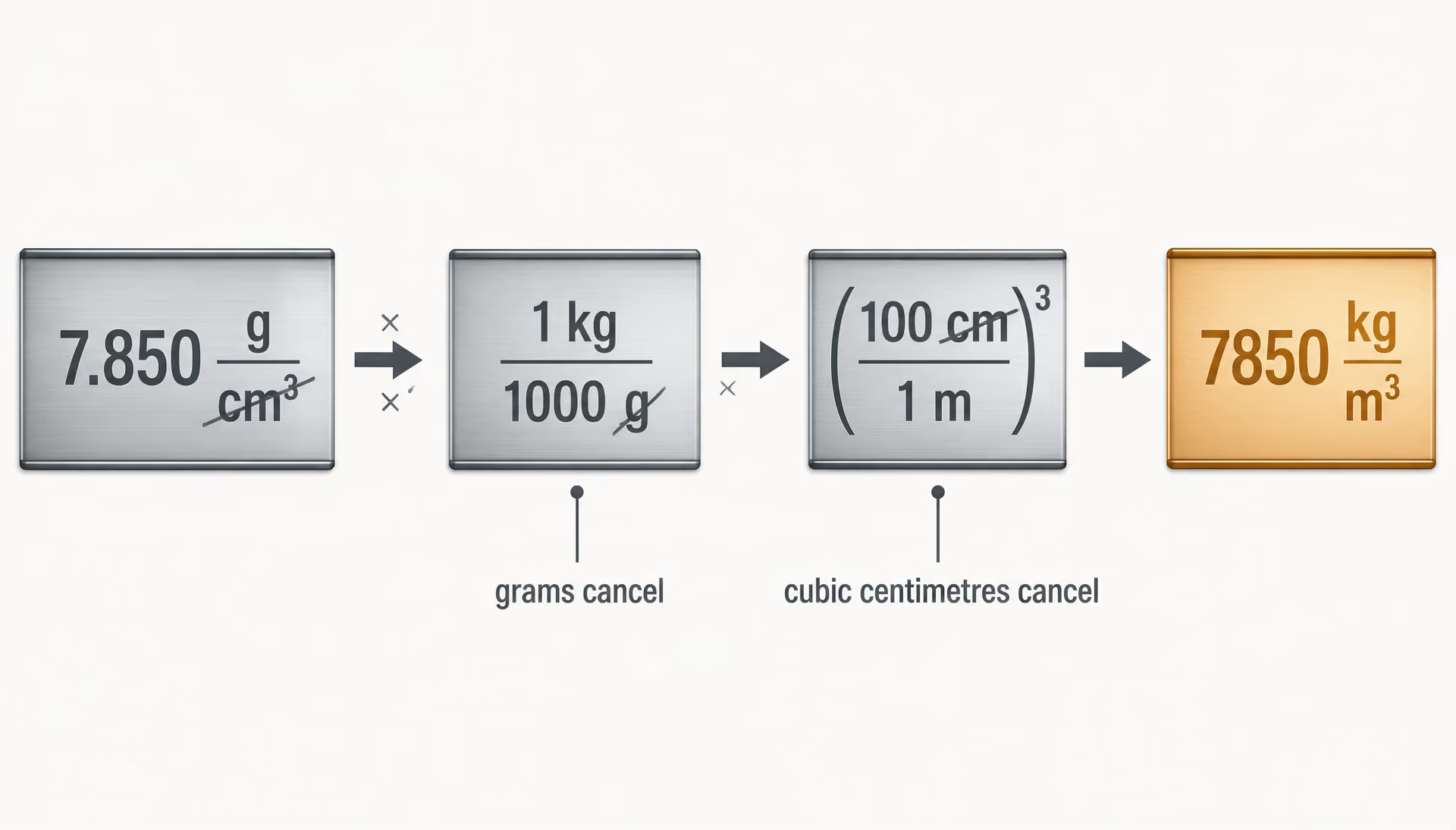
The conventional structural-steel density of 7850 kg/m³ converts directly to 7.850 g/cm³:
The cubic conversion matters. One metre equals 100 centimetres, but one cubic metre equals , or 1,000,000, cubic centimetres. A common error is to convert metres to centimetres only once, producing a result that is wrong by a factor of 100 or 10,000.
The same density is 7.850 Mg/m³:
Thus g/cm³ and Mg/m³ have the same numerical value, although they are different unit expressions. The reason is that both numerator and denominator scale by the same factor. A megagram is 1000 kg, while a cubic metre is 1,000,000 cm³; a gram is one-thousandth of a kilogram, and a cubic centimetre is one-millionth of a cubic metre. In both cases,
This equality of numerical values does not mean that every steel has a density of 7.850 in either unit. It describes the conversion of the selected value.
Structural-steel references frequently use 7850 kg/m³ when calculating tabulated mass per metre. The Handbook of Structural Steelwork, 3rd edition (2016), uses that value for section masses, and the National Research Council Canada (2019) states 7850 kg/m³ in fire-design material data. RoyMech (2024), by contrast, uses 7830 kg/m³ for mild steel. Material-data references give further variation: MatWeb lists 7.80 g/cm³ for ASTM A366/A569 low-carbon steel, while ASM MatWeb lists 7.87 g/cm³ for 300M ultrahigh-strength steel. Engineering ToolBox gives approximately 7.82 g/cm³ for steel.
Those differences are small for many structural estimates, but they are real. Alloy chemistry, temperature, porosity, coatings, and the particular grade or product can alter density. Therefore, 7850 kg/m³ is a conventional engineering value, not a declaration that ASTM A366/A569, 300M, and every other steel grade possess identical density.
For a known mass, density gives volume by rearranging the definition:
At 7850 kg/m³, 100 kg of steel occupies
approximately. Specific volume is the reciprocal:
Density must not be confused with specific weight, which is force per volume and is commonly expressed in N/m³. Nor is density the same as specific gravity, a ratio relative to a reference substance and therefore dimensionless.
lb/ft³ and lb/in³
In customary units, density may be written as pounds per cubic foot (lb/ft³) or pounds per cubic inch (lb/in³). They are not interchangeable forms of the same number. Since
a cubic foot contains
Consequently,
and
The conventional value 7850 kg/m³ converts, using NIST Appendix B.9 factors, to approximately 490 lb/ft³. UFC 4-023-07 (U.S. Department of Defense, 2008) lists steel as 7850 kg/m³, equivalent to approximately 490 lb/ft³. In pounds per cubic inch, the same value is approximately
Usually this is rounded to 0.284 lb/in³.
The warning is simple: do not copy 490 into a calculation expressed in lb/in³. The correct corresponding number is about 0.284, not 490. Conversely, 0.284 lb/in³ cannot be inserted into a volume measured in cubic feet without multiplying by 1728. MatWeb’s typical values show the scale of grade-specific variation: ASTM A366/A569 is listed at 0.282 lb/in³, matching 7.80 g/cm³, while 300M is listed at 0.284 lb/in³, matching 7.87 g/cm³.

Dimensional analysis and cancellation of units
Dimensional analysis makes a conversion auditable. Write every conversion factor as a fraction whose numerator and denominator represent equal quantities, then cancel units before calculating numbers. For example, converting 7.850 g/cm³ to kg/m³ gives
The grams cancel, the cubic centimetres cancel, and the remaining unit is kg/m³:
For a rectangular steel bar, the same method connects geometry to mass. If width and thickness are in metres, cross-sectional area is
and the mass per unit length is
For a 50 mm by 10 mm bar, convert dimensions first:
Then, using 7850 kg/m³,
The metre in area cancels one of the three metres in density, leaving kg/m. If the dimensions were left in millimetres while density remained in kg/m³, the result would carry incompatible units and be wrong by the required powers of 1000. Rounding should occur after conversion and multiplication, not before, particularly when a section schedule or accumulated mass depends on many metres of material.
Calculating Mass from Volume
Mass-from-volume workflow
- Identify the density State whether it is conventional, grade-specific, or measured.
- Convert dimensions Use one coherent unit system.
- Calculate volume Apply the geometry of the object.
- Multiply Use m = ρV.
- Round Match the reported precision to the least precise important input.
The basic mass calculation is simple, but the result is only as reliable as the density basis, dimensions, and units behind it. A reproducible workflow has five steps:
1. Identify the density value and state whether it is a conventional design value, a grade-specific value, or a measured value. 2. Convert every dimension into one coherent unit system. 3. Calculate the volume from the geometry. 4. Multiply volume by density. 5. Round the reported mass to match the least precise important input.
This sequence prevents a common error: treating 7850 kg/m³ as a universal property of all steel. Structural-steel references commonly use that value when calculating tabulated mass per metre. The Steel Handbook: Handbook of Structural Steelwork, 3rd edition (2016), uses 7850 kg/m³ for this purpose. The National Research Council Canada (2019) and U.S. Department of Defense UFC 4-023-07 (2008) also state 7850 kg/m³; the UFC gives approximately 490 lb/ft³. Those are useful engineering conventions, not evidence that every alloy, product, or temperature condition has exactly that density.
The equation m = ρV
NIST defines mass density as mass divided by volume:
Rearranging gives the equation needed here:
where:
- is mass;
- is mass density; and
- is volume.
In SI units, density is measured in kilograms per cubic metre (kg/m³), volume in cubic metres (m³), and mass in kilograms (kg). The units cancel correctly:
That unit cancellation is a useful check, not decoration. If a calculation multiplies kg/m³ by a volume still expressed in mm³, the numerical result is wrong by a factor of unless the cubic-millimetre volume is converted.
NIST’s 2024 SI guidance also defines specific volume as , the reciprocal relationship to density. Specific volume is not mass and should not be substituted for density in . Likewise, specific weight is force per unit volume, usually expressed in N/m³, while specific gravity is a ratio relative to a reference substance. Neither is the same quantity as mass density.
The density basis must be stated before the arithmetic begins. An assumed value of 7850 kg/m³ may be suitable for a structural estimate or a standard section table. It should be labeled as an assumption. A material-data reference lists typical density for ASTM A366/A569 low-carbon steel as 7.80 g/cm³, equal to 7800 kg/m³, while another lists 300M ultrahigh-strength steel at 7.87 g/cm³, or 7870 kg/m³. RoyMech uses 7830 kg/m³ for mild steel. These differences are small for many preliminary calculations but matter when tolerances, shipping masses, balancing, or heat-transfer calculations are important.
Density can also change with alloy chemistry, temperature, porosity, and processing. A coating adds mass but is not part of the bare steel density. A hollow or perforated object must be assigned its actual net steel volume, not the volume of its enclosing box.
Worked solid-block calculation
Consider a rectangular steel block with these measured dimensions:
- length:
- width:
- thickness:
Assume, explicitly, a conventional steel density of:
This calculation does not identify a particular steel grade and does not claim that the block’s actual density is exactly 7850 kg/m³.
First convert the dimensions to metres:
For a rectangular solid:
Therefore:
Now apply :
The dimensions are given to three significant digits, while the density is an assumed conventional value rather than a high-precision measurement. A suitable reported result is therefore:
\[ \boxed{m\approx23.6\text{ kg}} \]
The unrounded value, 23.55 kg, may still be retained in calculation records so that later operations do not compound premature rounding. The final displayed value should not suggest greater accuracy than the dimensions and density support.
The same method works through cross-sectional area. The block’s area viewed from the end is:
Then:
For a constant section, mass per unit length is:
For this block:
Multiplying 78.5 kg/m by 0.300 m again produces 23.55 kg. This area-based form is the usual route for calculating the mass of bars, plates, beams, and other constant-section products.
Mixed-unit and rounding errors
Mixed units cause more failures than the multiplication itself. A dimension in millimetres must be converted before cubing, or the conversion factor must be applied to the completed volume:
Thus, a block measuring mm has:
Converting that result gives:
A common mistake is to divide each linear dimension by 1000 but then divide the volume by 1000 again. That applies a linear conversion to a cubic quantity and produces a mass one million times too small.
Density units can also be converted directly. Since:
a listed density of 7.80 g/cm³ becomes 7800 kg/m³. Alternatively, dimensions may remain in centimetres, volume may be calculated in cm³, and density may remain in g/cm³, producing mass in grams. The method is valid only when every unit in the multiplication belongs to the same system.
Rounding should occur after the main calculation, not after every intermediate conversion. If a measured length is 0.300 m and a thickness is 0.0500 m, reporting a mass of 23.550000 kg implies unsupported precision. Conversely, rounding 7850 kg/m³ to 8000 kg/m³ before multiplication introduces an avoidable 1.9% change. Keep guard digits during the calculation, then report sensible significant digits.
For a final check, compare the result with an alternate density basis. Using 7800 kg/m³ for the same 0.00300 m³ block gives 23.4 kg rather than 23.6 kg. The 0.2 kg difference reflects the density assumption, not an arithmetic error. Temperature, actual chemistry, scale accuracy, welds, fasteners, paint, and attached components may create further differences between calculated bare-steel mass and measured assembly mass.
Calculating Volume from Mass
A measured mass can be converted into an estimated volume when the material density is known or selected. The calculation is simple, but its result is only as reliable as the density value, unit system, and interpretation of the measured object. A scale reports mass for the complete item placed on it; it does not identify which portion of that mass belongs to bare steel.
The equation V = m/ρ
NIST defines mass density as mass divided by volume:
Rearranging gives the required relationship:
Here, is volume, is mass, and is mass density. In the SI system, mass is measured in kilograms, density in kilograms per cubic metre, and volume in cubic metres. The units cancel correctly:
NIST’s 2024 SI guidance also defines specific volume as , the reciprocal of density. Specific volume is useful in some thermodynamic calculations, but for ordinary steel quantity work, is usually the more direct form.
Suppose a steel part has a measured mass of 78.5 kg. Using the conventional engineering density of 7850 kg/m³:
The calculated volume is therefore 0.0100 m³, or 10.0 litres. That is a material-volume result, not automatically the volume of a rectangular box enclosing the part. Voids, holes, curved surfaces, weld profiles, and gaps between components must be treated separately.
The selected density matters. Structural-steel references commonly calculate tabulated mass per metre with 7850 kg/m³. The National Research Council Canada gave 7850 kg/m³ in 2019, and U.S. Department of Defense UFC 4-023-07 listed the same value in 2008, approximately 490 lb/ft³. Those figures are practical engineering conventions. They should not be presented as proof that every steel grade has exactly that density.
For comparison, MatWeb reports a typical density of 7.80 g/cm³ for ASTM A366/A569 low-carbon steel, while ASM MatWeb reports 7.87 g/cm³ for 300M ultrahigh-strength steel. Since 1 g/cm³ equals 1000 kg/m³, those values correspond to approximately 7800 and 7870 kg/m³. RoyMech uses 7830 kg/m³ for mild steel, and Engineering ToolBox lists steel at approximately 7.82 g/cm³. The differences are small for many fabrication estimates, but they are real.
For the same 78.5 kg mass, using 7800 kg/m³ gives:
Using 7870 kg/m³ gives approximately 0.009975 m³. A reported value of 0.0100 m³ may be appropriate when the input mass and density are only known to a few significant figures. Extra decimal places would suggest accuracy that the measurements do not support.
Unit consistency is essential. If mass is in grams and density is in grams per cubic centimetre, the result is in cubic centimetres. Thus, a 500 g piece at 7.80 g/cm³ has:
Do not insert 500 g and 7850 kg/m³ into the same equation without conversion. NIST Appendix B.9 provides the dimensional basis for converting between SI and customary units.
Interpreting a measured mass
A mass reading is not automatically the mass of the steel itself. A painted plate, for example, includes the steel substrate, primer, intermediate coating, and finish. Galvanizing adds zinc. Mill scale adds oxidized material and may remain attached unevenly. Dirt, trapped water, cutting fluid, ice, and moisture inside hollow sections can also raise the reading.
Attached hardware creates another common error. Bolts, nuts, washers, clips, lifting fixtures, weld-on brackets, insulation, and temporary supports may be included on the scale but excluded from the intended steel calculation. Conversely, corrosion or missing material can make the measured mass lower than the original design mass. A hollow section may retain water in an enclosed cavity, producing a result that changes between weighings.
The scale itself introduces uncertainty. Resolution, calibration, vibration, load position, air movement, and zero drift can affect the reading. If a 10 kg component is measured on equipment with an uncertainty of ±0.1 kg, that uncertainty alone is ±1% before density variation is considered. The calculated volume inherits the same relative uncertainty from mass, and density uncertainty contributes as well.
For this reason, a measured-mass calculation should state what was weighed and which density was used. “The volume of the steel” is ambiguous if the object has coating or attached parts. A clearer statement is: “The estimated equivalent bare-steel volume is 0.0100 m³, calculated from a net mass of 78.5 kg and kg/m³.” If the 78.5 kg is the gross mass of a coated assembly, the result is a nominal equivalent volume for the selected density, not a direct measurement of bare steel.
Temperature can also affect the interpretation. Heating causes steel to expand, increasing its geometric volume while its mass remains essentially constant. Density therefore decreases as temperature rises. Fire-engineering calculations may use temperature-dependent properties, while routine room-temperature quantity calculations generally use a conventional reference value. The applicable design condition must be stated.
Back-calculating dimensions
Once volume has been estimated, a theoretical dimension can be obtained from the relevant geometry. For a prismatic member of constant cross-section:
where is cross-sectional area and is length. Therefore:
A 78.5 kg steel bar with a cross-sectional area of 1000 mm² has, using 7850 kg/m³:
This is a theoretical length based on uniform area and the selected density. It is not a substitute for measuring the bar, particularly if the ends are irregular, the section is tapered, or the mass includes coating and fittings.
For a rectangular plate, volume is:
where is length, is width, and is thickness. If length and width are known, thickness can be back-calculated:
A 50 kg plate measuring 2.00 m by 1.00 m, using 7850 kg/m³, has:
or approximately 3.18 mm. The result describes an equivalent uniform thickness. Actual plate thickness may differ because of scale, coating, rolling tolerances, surface roughness, or an incorrect assumption about the net steel mass.
The same principle applies to mass per unit length:
For a rectangular bar, , so:
RoyMech’s 2024 rectangular-section calculation uses 7830 kg/m³ for mild steel rather than 7850 kg/m³, illustrating why a stated density is necessary when comparing calculated and tabulated masses. Complex sections require the actual net cross-sectional area, with holes and voids subtracted. For fire design, do not confuse this area with the steel section factor, which the National Research Council Canada defines using heated perimeter divided by cross-sectional area. That factor describes heat exposure, not ordinary material volume.
Mass per Unit Length of Steel Sections
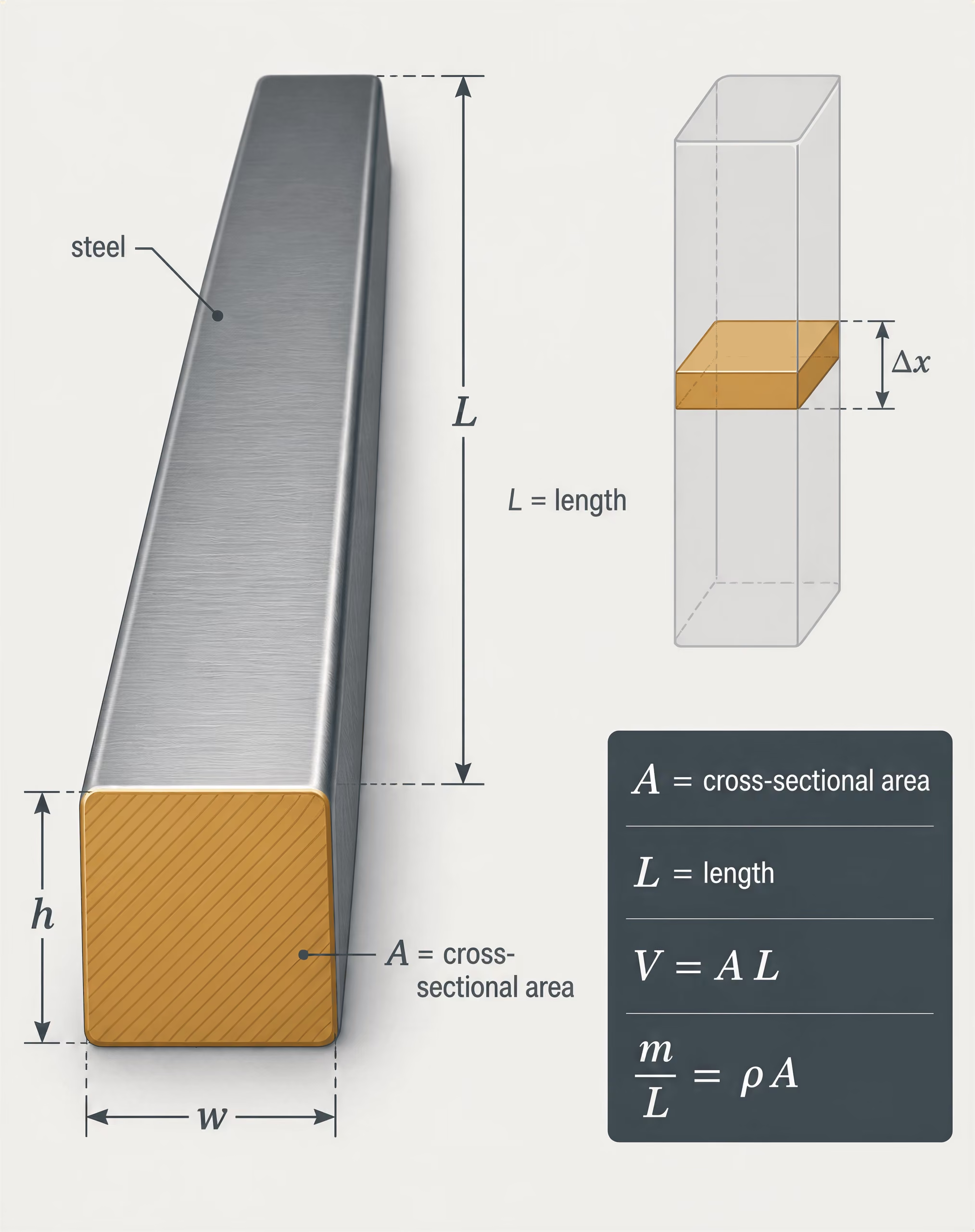
The mass per unit length of a steel section follows directly from the definition of density. NIST defines mass density as
where is density, is mass, and is volume. For a prismatic section, volume equals cross-sectional area multiplied by length:
Substituting this into the density equation gives
and therefore
\[ \boxed{\frac{m}{L}=\rho A} \]
This is the governing relation for mass per unit length. If density is in kilograms per cubic metre and area is in square metres, the result is kilograms per metre:
Cross-sectional area The net area of material in a slice perpendicular to a member's length; it determines volume per unit length and, with density, mass per unit length.
The area is the decisive geometric quantity. A longer piece has greater total mass, but its mass per metre remains unchanged as long as the cross-section and density remain unchanged.
The value is widely used for structural-steel calculations. The Steel Handbook: Handbook of Structural Steelwork, 3rd edition (2016), states that tabulated structural-steel masses per metre are calculated using this density. The National Research Council Canada (2019) and U.S. Department of Defense UFC 4-023-07 also give , with the UFC expressing it as approximately . These are engineering conventions for calculation and tabulation, not a guarantee that every steel grade has exactly that density.

m/L = ρA
The formula is simple, but unit consistency matters. A rectangular section measuring by has an area of
Since
the area is
Using the conventional structural-steel density gives
Thus a uniform steel bar has a nominal mass per metre of about , before allowance for tolerances, coatings, scale, or other attached material.
Density selection can alter the last figures. RoyMech’s rectangular-section calculation uses for mild steel. With that value, the same bar gives
which rounds to . The difference is small for many structural estimates, but it demonstrates why a result should state its density basis rather than presenting a rounded number as a grade-independent physical constant.
The material references supplied for particular steels also show real variation. MatWeb lists a typical density of for ASTM A366/A569 low-carbon steel, equivalent to . ASM MatWeb lists , or , for 300M ultrahigh-strength steel. Engineering ToolBox gives approximately for steel. Those values differ from one another and from , while remaining close enough that many design tables adopt a common convention.
NIST also defines specific volume as , the reciprocal of density. Specific volume should not be confused with mass per unit length: the former describes material volume per unit mass, whereas the latter combines material density with a particular section area.
For a total member length , the corresponding mass is
For example, a bar with a calculated mass per metre of has a nominal mass of
The same relation applies to a plate. A plate wide and thick has a cross-sectional area, taken perpendicular to its length, of
Its mass per metre is therefore
If the plate is long, its nominal mass is . For plate calculations, width and thickness must be measured in directions normal to the length being considered. A plate’s plan area is not the area used in unless the chosen length direction makes that interpretation appropriate.
Mass per metre is not the same as linear weight. Mass per metre has units of ; linear weight is force per unit length, normally or . Under standard gravity,
where is approximately . The bar therefore has a linear weight of approximately
or . Engineering documents sometimes call kilogram-per-metre values “weight,” but the technically correct distinction is useful in load calculations.
Rolled sections and tabulated properties
For rolled I-sections, channels, angles, tees, hollow sections, and other profiles, calculating the area from every flange, web, radius, and corner can be inconvenient. Section tables avoid that repeated geometric work by publishing a nominal cross-sectional area and a corresponding mass per metre. The underlying operation remains the same:
A table may list the area directly in or , followed by mass in . If an area is given in square centimetres, the conversion is
Thus a rolled section with a nominal area of has
and, using ,
A published table may round this to . Its listed value should be read with the table’s stated density, dimensional basis, and rounding policy.
Profile dimensions still matter even when the calculation is hidden. An I-section’s flange width, flange thickness, web thickness, overall depth, and root radii determine its area. Two sections with the same nominal depth can have different areas and therefore different masses per metre. A designation such as a nominal size is not, by itself, a mass value. The relevant table edition and section standard must be checked.
The tabulated area may be theoretical or nominal rather than the measured area of an individual piece. Manufacturing tolerances, fillets, corner radii, camber, and deviations from nominal thickness can produce a small difference between calculated and actual mass. Surface coatings also add mass, although they are normally excluded from the bare-steel section-table value. A galvanized, painted, or fire-protected member should not be assigned the unqualified bare-steel mass if the coating is part of the required assembly mass.
Temperature introduces another distinction. Heated steel expands, so its dimensions and volume change; density expressed as mass divided by the expanded volume consequently changes even though the amount of steel remains the same. Fire calculations may also use the steel section factor, defined by the National Research Council Canada as heated perimeter divided by cross-sectional area. That factor governs heat exposure and is not a substitute for mass per metre.
For a structural member, then, the reliable sequence is to identify the actual profile, obtain or calculate its nominal area, select the density convention required by the design reference, and keep units consistent. The result is mass per unit length; only after multiplying by gravitational acceleration should it be treated as linear weight.
Geometry: Solids, Hollow Sections, and Irregular Profiles
Steel mass follows the material volume, not the apparent size of the outline. For a uniform member, the governing calculation is
where is mass, is mass density, is the net cross-sectional area, and is length. If is in kilograms per cubic metre, must be in square metres and in metres. The result is kilograms.
Structural-steel tables commonly calculate mass per metre with , so a section with an area of has a tabulated mass of
That is a conventional engineering calculation, not a substitute for determining the section's actual area or a claim that every steel grade has exactly that density. The geometry comes first.
Solid rectangular and circular sections
For a solid rectangle,
where is width and is height. A steel bar measuring has
Because ,
Using , its mass per metre is . Using the mild-steel value of \(7830\ \text{kg/m}^3\ reported by RoyMech gives \(39.15\ \text{kg/m}\). The small difference comes from the selected density, not from a different geometric formula.
For a solid circular bar,
where is radius and is diameter. A diameter bar has
At , the mass per metre is approximately .
Diameter must be squared. Doubling a circular bar's diameter does not double its area; it increases the area, and therefore the mass per unit length, by a factor of four. The same principle applies to rectangular dimensions: doubling one dimension doubles area, while doubling both dimensions multiplies area by four.
Dimensions also need a common unit before multiplication. A frequent error is to insert dimensions in millimetres into a formula while leaving density in kilograms per cubic metre. One direct route is to calculate area in , divide by , then multiply by density. Another is to convert every dimension to metres first.

Hollow sections and subtraction of voids
| Profile | Dimensions | Steel area | Mass per metre at 7850 kg/m³ |
|---|---|---|---|
| Solid rectangle | 50 mm × 100 mm | 5000 mm² | 39.25 kg/m |
| Rectangular hollow section | 100 mm × 50 mm × 5 mm wall | 1400 mm² | 10.99 kg/m |
| Circular hollow section | 60 mm outside diameter; 5 mm wall | 863.9 mm² | approximately 6.78 kg/m |
| Solid circular bar | 40 mm diameter | 1256.6 mm² | approximately 9.86 kg/m |
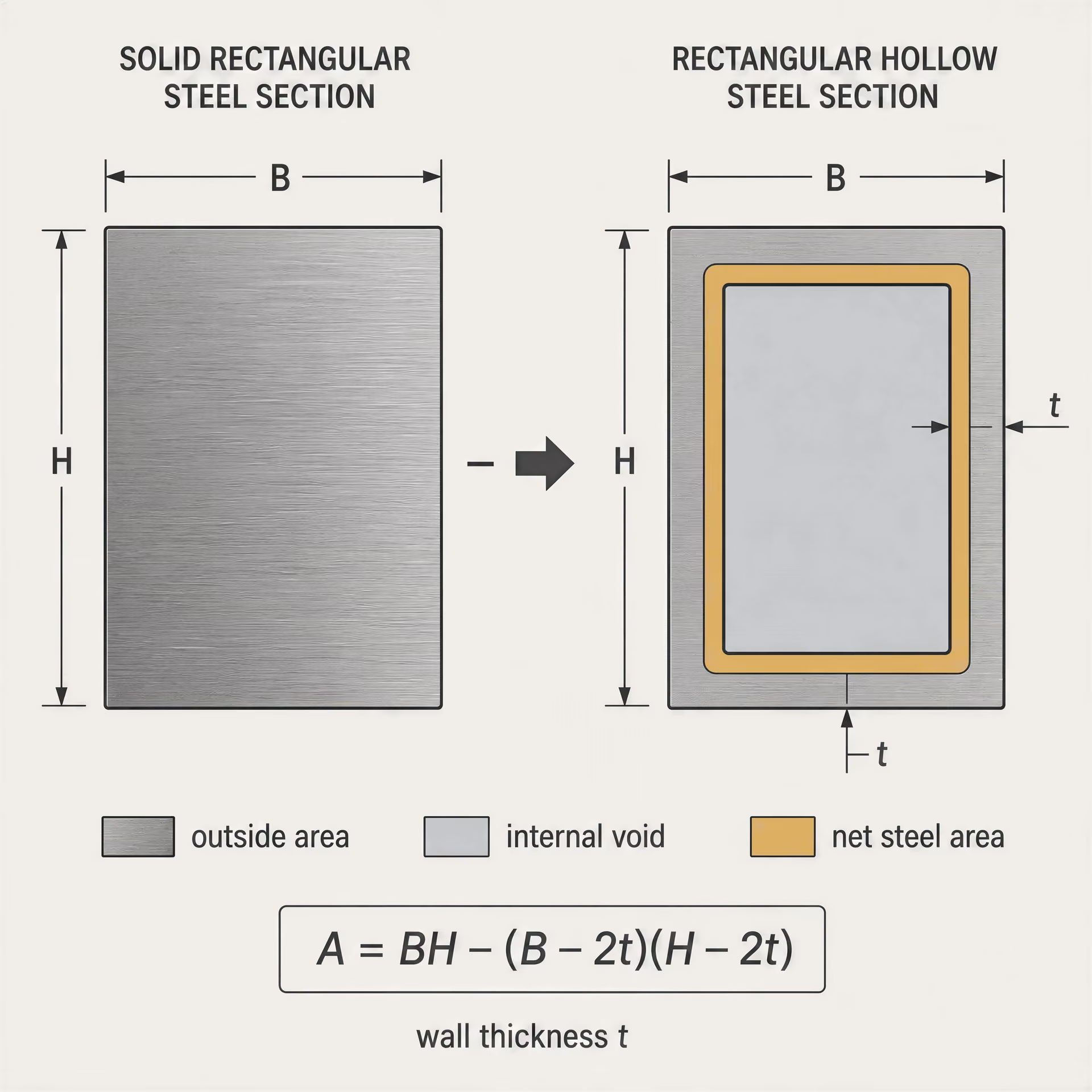
A hollow section is calculated from the material area, obtained by subtracting the void from the outside area. For a rectangular hollow section with outside width , outside height , and uniform wall thickness ,
The inner dimensions are reduced by , since the wall occupies space on both opposite sides. This can also be expanded to
For a rectangular hollow section with a wall,
Thus the mass per metre at is
The outside rectangle alone would produce , which is more than three times as large. Counting the envelope instead of subtracting the opening treats air as steel.
For a circular hollow section, or pipe with outside diameter , inside diameter , and wall thickness ,
and, when the wall is uniform,
A tube with and has , so
Its conventional mass per metre is approximately . A solid bar would have an area of and a mass near .
The outside dimension therefore does not determine mass. A square tube with a wall and one with a wall have the same outside width but very different net areas. Openings, perforations, cores, slots, and internal cavities must all be removed from the volume calculation. Conversely, corner radii, weld beads, folded lips, and nonuniform walls may add material that a simple sharp-corner formula omits. For manufactured sections, the published nominal area or mass per metre can be more reliable than treating the profile as an idealized rectangle.
A grade-specific density can change the result slightly. MatWeb reports for ASTM A366/A569 low-carbon steel, while ASM MatWeb reports for 300M ultrahigh-strength steel. Both densities applied to the same calculated area produce different masses. The difference is modest, but it matters when tolerances, inventories, lifting loads, or long lengths are involved.
Perimeter, area, and section-property confusion
Cross-sectional area measures how much steel is present in a slice perpendicular to the member's length. It controls volume per unit length:
and therefore controls mass per unit length when density is known.
Perimeter is different. The external perimeter of a solid rectangle is
and the circumference of a solid circle is . These describe boundary length, not steel area. A square and a diameter circle can have related boundary dimensions yet contain very different amounts of steel. For a hollow section, engineers may need several perimeters: the outside perimeter, the inside perimeter, or the perimeter exposed to fire or air. None can replace net cross-sectional area in a mass calculation.
Surface area is the area of the member's longitudinal exterior, approximately for a constant profile. It is relevant to coating quantities, heat transfer, corrosion exposure, and temperature response. It is not cross-sectional area. A thin-walled tube can have substantial surface area per metre while containing relatively little steel.
Second moment of area, also called the area moment of inertia, is another quantity entirely. For a rectangle about its centroidal axis parallel to its width,
The cubic dimension shows why height strongly affects bending stiffness, but is not mass and cannot be inserted into . Hollow-section values are found by subtracting the void's second moment from the outside shape's value, with the correct axis and, where necessary, the parallel-axis theorem.
Fire calculations introduce still another ratio. The National Research Council Canada defines the steel section factor using heated perimeter divided by cross-sectional area. Depending on the exposure and protection arrangement, the heated perimeter may include surfaces that are not the same as the geometric outside perimeter. That section factor describes heat transfer per unit steel volume; it does not determine the member's mass.
Irregular profiles are handled by decomposition into simple shapes, subtraction of voids, or direct integration of the boundary-defined area. For a rolled I-section, for example, the flange rectangles and web rectangle can be added, while overlaps are counted only once. The final net area, rather than the silhouette, is the quantity multiplied by length and density.
Why Steel Grades Do Not All Have the Same Density
The value 7850 kg/m³ is useful, but it is not a universal material constant for every steel grade. Structural-steel tables commonly adopt 7850 kg/m³ to calculate mass per metre, and both the National Research Council Canada and U.S. Department of Defense UFC 4-023-07 list steel at that value. The UFC also gives approximately 490 lb/ft³. Those figures are conventional engineering inputs, usually rounded for design and tabulation. They should not be read as a claim that all steels have exactly the same density.
NIST defines mass density as ρ = m/V, measured in kilograms per cubic metre, and defines specific volume as V/m. A grade-specific density therefore changes the calculated mass when the volume is held constant. The difference may be small for ordinary structural work, but it becomes relevant in precision mass estimates, aerospace components, pressure equipment, laboratory measurements, and comparisons between large sections.
The reported data show the point clearly. MatWeb gives a typical density of 7.80 g/cm³ for ASTM A366/A569 low-carbon steel, equivalent to 7800 kg/m³. ASM MatWeb gives 7.87 g/cm³ for 300M ultrahigh-strength steel, equivalent to 7870 kg/m³. The difference is 70 kg/m³, or about 0.9% relative to the lower value. Neither number should replace the material certificate or a controlled measurement when high accuracy is required, but neither supports treating 7850 kg/m³ as exact for both grades.
Chemical composition and alloying
Steel is primarily iron, but its density depends on the complete composition and physical condition of the material. Carbon, manganese, silicon, chromium, nickel, molybdenum, vanadium, and other additions change the mass and volume of the solid. Their effects are not determined simply by adding the density of each pure element to the density of iron. Alloy atoms occupy positions in an iron crystal lattice, distort that lattice, alter its volume, and can promote different phases or precipitates.
Iron itself has different density-related states. At ordinary temperatures, ferritic iron has a body-centred cubic crystal structure, while austenite has a face-centred cubic structure at higher temperatures. Quenching, tempering, rolling, and other treatments can change the proportions of ferrite, pearlite, bainite, martensite, and retained austenite. These microstructural changes are usually less important to bulk density than the overall chemical composition, but they can matter when a calculation requires more than a rounded catalogue value.
Alloy additions also have different atomic masses and atomic volumes. Nickel and molybdenum, for example, are relatively dense elements; aluminium and silicon are less dense than iron. A small addition does not produce a simple one-for-one result because the alloy’s lattice spacing, phase balance, and thermal history also change. The final density is a property of the alloy as manufactured, not a value that can be inferred from tensile strength alone.
Porosity, inclusions, decarburized zones, scale, weld metal, plating, paint, and attached moisture can further affect the measured mass of a component. A nominal steel density normally describes the solid metallic material, not every coating or deposit on a finished part. The distinction matters when mass is measured on a complete assembly rather than calculated from certified dimensions and a material density.
A strength designation supplies no density by itself. “High-strength” describes mechanical performance or a specification category; it does not identify the mass per unit volume. Two steels can have similar yield strength but different alloy systems, heat treatments, and densities. Conversely, a higher-strength steel may have a density close to that of a lower-strength grade. Density must come from a material datasheet, standard-specific information, a supplier certificate, or measurement.
ASTM A366/A569 low-carbon steel
MatWeb reports a typical density of 7.80 g/cm³ for ASTM A366/A569 low-carbon steel, also listed as 0.282 lb/in³. In SI units, 7.80 g/cm³ is 7800 kg/m³ because 1 g/cm³ equals 1000 kg/m³. The word “typical” is important. This is a material-data reference value, not a universal density requirement that every sheet or coil identified with the designation must match to the last kilogram per cubic metre.
The ASTM designation identifies a low-carbon steel product category and its associated requirements, but the designation should not be treated as a direct density specification unless the applicable edition explicitly provides one. Standards generally focus on such matters as chemical limits, dimensions, surface condition, forming characteristics, and mechanical requirements. A standard may permit a composition range rather than one exact chemistry, so a single density cannot represent every permissible heat and processing condition with absolute precision.
For a volume calculation, the MatWeb value gives a direct result. Consider a rectangular plate measuring 2.00 m long, 1.00 m wide, and 10.0 mm thick. Its volume is:
V = 2.00 × 1.00 × 0.0100 = 0.0200 m³.
Using 7800 kg/m³ gives:
m = ρV = 7800 × 0.0200 = 156 kg.
Using the conventional 7850 kg/m³ gives 157 kg. The one-kilogram difference is modest for this plate, which explains why design tables can use a rounded common value. It is still a difference caused by the selected density, not by a change in the geometry.
The same principle applies to mass per unit length. For a rectangular bar, the cross-sectional area must be in square metres before multiplying by density:
m′ = ρA.
A 100 mm × 20 mm bar has an area of 0.0020 m². At 7800 kg/m³, its calculated mass per metre is 15.6 kg/m. RoyMech uses 7830 kg/m³ for mild steel in a rectangular-bar calculation, while Engineering ToolBox lists steel at approximately 7.82 g/cm³. The spread among these references reflects differing conventional or typical inputs, not a contradiction in the definition of density.
300M ultrahigh-strength steel
ASM MatWeb reports a typical density of 7.87 g/cm³ for 300M ultrahigh-strength steel, equivalent to 0.284 lb/in³ or approximately 7870 kg/m³. This value is higher than the 7.80 g/cm³ figure reported for ASTM A366/A569 low-carbon steel and also slightly higher than the 7850 kg/m³ convention used in many structural calculations.
The designation 300M refers to a specific ultrahigh-strength alloy steel family whose properties depend on controlled chemistry and heat treatment. Its strength comes from alloying and processing, including the formation of a hardened and tempered microstructure; the number in a strength designation does not mean “density in a particular unit.” A calculation that knows only that a part is made from “300M” still needs the applicable material specification, product condition, and selected density value.
For the same 0.0200 m³ plate volume used above, 300M at 7870 kg/m³ produces a mass of 157.4 kg. The ASTM A366/A569 reference value produces 156 kg. That 1.4 kg difference is small in a single plate but scales with volume. In an aircraft component, a long bar, or a large batch of parts, using the wrong grade-specific value can affect a mass budget.
Temperature also requires care. As steel heats, thermal expansion increases volume, so density generally decreases if mass remains constant. Fire-engineering calculations may therefore combine temperature-dependent material properties with a section factor based on heated perimeter divided by cross-sectional area. The room-temperature figures above are suitable only when their temperature and application assumptions fit the calculation. Use 7850 kg/m³ as a stated engineering convention, not as evidence that ASTM A366/A569, 300M, and every other steel grade possess identical density.
Density, Specific Weight, and Specific Gravity Are Not Interchangeable
Steel tables often place density, weight, and specific gravity in adjacent columns, then use shortened labels such as “weight of steel.” That arrangement can hide three different quantities. Mass density describes how much mass occupies a volume. Specific weight describes the force exerted by gravity on that mass. Specific gravity compares one material’s density with a reference density. Their numerical values may appear similar in some unit systems, but the quantities are not the same.
Mass density versus weight density
The National Institute of Standards and Technology (NIST, 2024) defines mass density as
where is mass and is volume. Its SI unit is kilogram per cubic metre, written kg/m³. A value of therefore means that a volume of one cubic metre has a mass of approximately 7850 kg when the stated engineering density is used.
Mass density is not mass by itself. A steel plate may have a density of , but its mass depends on its volume:
For a uniform rectangular plate,
so
with length , width , and thickness expressed in mutually consistent units. If dimensions are entered in metres, the density can be entered directly in kg/m³ and the result is in kilograms. If dimensions are entered in millimetres, they must be converted first, or the density must be converted to a compatible unit.
NIST also defines specific volume as , the reciprocal of mass density. For steel represented by ,
Specific volume is useful in thermodynamics and material calculations, but it does not mean specific weight.
Specific weight, usually written , is weight per unit volume:
Its SI unit is newton per cubic metre (N/m³). Since weight is a force, not a mass, specific weight is obtained from mass density by multiplying by gravitational acceleration:
Using and standard gravitational acceleration gives
or approximately . Thus, and can describe the same assumed steel condition, but they describe different properties.
The distinction matters in calculations. Use kg/m³ when calculating mass from volume. Use N/m³ when calculating gravitational load from volume. A one-cubic-metre steel block based on the conventional density has a mass of about 7850 kg and a gravitational weight of about 77.0 kN at standard gravity. Calling both figures “weight” obscures which operation has been performed.
Older engineering tables create further confusion because “weight” was often used informally for mass per unit volume, particularly in customary units. The U.S. Department of Defense UFC 4-023-07 (2008), for example, lists steel at , equivalent to approximately . The same value appears in the Arcadis Construction Cost Handbook (2019). In strict customary-unit usage, mass density would be expressed in lbm/ft³ and specific weight in lbf/ft³. Under standard gravity, however, the numerical values are nearly equal: converts to about , while the corresponding specific weight is about .
That numerical coincidence is the source of many bad conversions. Pound-mass (lbm) and pound-force (lbf) are not interchangeable. The notation should be retained when the distinction affects a load, a force balance, or a conversion. NIST Appendix B.9 provides the dimensional framework for converting SI and customary units; it does not remove the need to identify whether a table gives mass density or force density.
The role of gravitational acceleration
Gravity is not a material property. It is an acceleration that acts on mass. Specific weight therefore changes with the local value of , even when the material and its mass density remain unchanged.
For a steel object,
and, after substituting ,
Dividing by volume produces . At standard gravity, exactly by definition in the SI system. Local gravitational acceleration varies slightly with latitude and elevation, though most structural calculations use standard gravity unless a more precise physical model is required.
This is why density is normally the safer input for mass calculations. A design office can use the same mass density while changing the gravitational acceleration for a particular load calculation. Confusing the two would attach a location-dependent force to what should be a material quantity.
The assumed density also deserves inspection. Structural-steel handbooks commonly calculate tabulated mass per metre using , and the National Research Council Canada (2019) uses that value for steel in a fire-engineering context. RoyMech (2024), by contrast, uses for mild steel in rectangular-bar calculations. Material references list for ASTM A366/A569 low-carbon steel and for 300M ultrahigh-strength steel. Those figures correspond to about 7800 and 7870 kg/m³, respectively. The difference is small for many estimates, but it shows that 7850 kg/m³ is a conventional engineering value, not a universal constant for every grade, heat, temperature, or product condition.
Specific gravity as a ratio
Specific gravity, often written , is dimensionless:
For solids and liquids, the reference is commonly water near , whose density is approximately . A steel density of therefore gives a specific gravity of approximately 7.85 under that convention. No unit remains because the numerator and denominator have the same dimensions.
Engineering ToolBox lists steel at approximately , which would correspond to a specific gravity of about 7.82 against water at the stated reference condition. That number is not , nor is it a specific weight. It is a density expressed in g/cm³, or a dimensionless ratio only after division by the reference water density in matching units.
A specification should therefore state the quantity and unit explicitly: density in kg/m³, specific weight in N/m³, or specific gravity as a ratio. That single habit prevents the common error of treating 7850 as an unqualified “weight” and then applying gravity a second time—or failing to apply it when a force is required.
Temperature, Fire Engineering, and the Steel Section Factor
Density in heated-steel calculations
At room temperature, steel mass is commonly calculated from
where is mass density. For a prismatic member of length and cross-sectional area ,
and its mass per unit length is
The conventional value therefore gives for a steel section with an area of . This is a mass calculation, not a fire-exposure calculation.
NIST defines mass density as , with the SI unit kilogram per cubic metre, and defines specific volume as (NIST, 2024). Those definitions remain valid when steel is heated, but the numerical density can change because the steel expands. If the mass remains essentially constant while the volume increases, the instantaneous density falls. A fire model may therefore use temperature-dependent density, thermal expansion, specific heat, and thermal conductivity rather than one room-temperature value.
For many structural calculations, using is a reasonable engineering convention. The Steel Handbook: Handbook of Structural Steelwork, 3rd Edition (2016), uses that value to calculate tabulated mass per metre. The National Research Council Canada (NRC) gives in its 2019 fire-engineering material, while U.S. Department of Defense UFC 4-023-07 lists the same value, approximately . These references establish a standard calculation basis; they do not demonstrate that every grade has precisely that density.
Grade and product data show the distinction. MatWeb reports a typical density of for ASTM A366/A569 low-carbon steel, whereas ASM MatWeb reports for 300M ultrahigh-strength steel. RoyMech uses for mild steel, and Engineering ToolBox lists steel at approximately . The differences are modest for ordinary mass estimates, but they matter when a specification requires traceable material data or when several assumptions are being combined.
In a heated-member calculation, density contributes to thermal mass. For a unit length of steel, the heat capacity is approximately
where is the specific heat capacity. If , , or changes with temperature, the heat capacity changes too. Density also appears in heat-transfer formulations involving volumetric thermal capacity and, depending on the numerical method, thermal diffusivity. It is one input among several.
It is not the section factor.

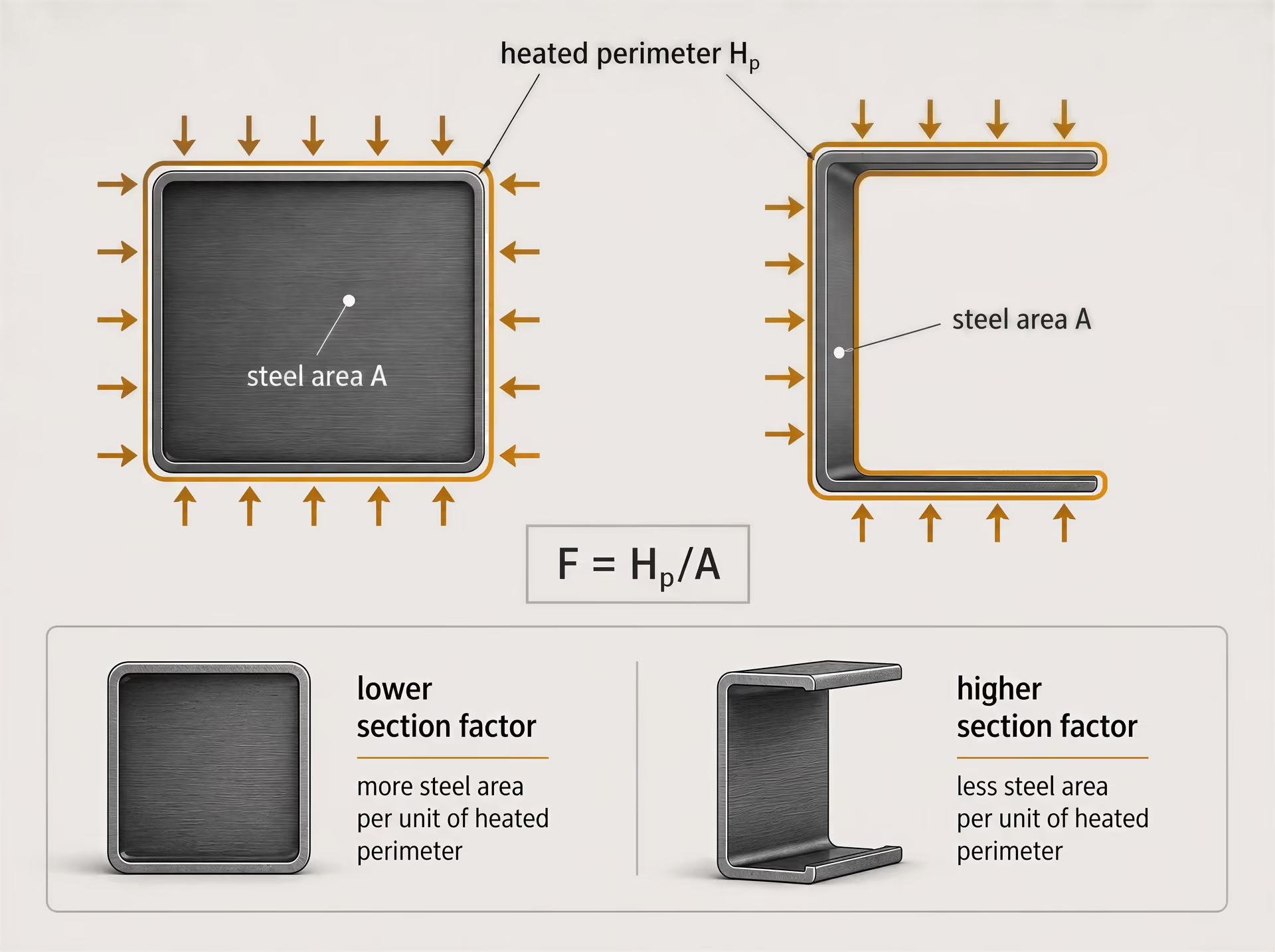
Heated perimeter divided by cross-sectional area
Steel section factor A fire-exposure parameter commonly written F = Hp/A or Am/V, with units of inverse length; it describes heated perimeter relative to steel volume, not mass density.
The NRC Short Course introduces the steel section factor as the heated perimeter divided by the cross-sectional area. It is commonly written as
or, in fire-engineering notation,
Here or represents the exposed or heated perimeter, and represents the steel area for a member of unit length. Since the steel volume in one metre of member is , the two forms are dimensionally equivalent. The section factor has units of inverse length, such as .
Suppose a member has a steel area of and a heated perimeter of per metre of length. Its section factor is
Changing the assumed density from to changes the calculated mass per metre slightly, but it does not change this geometric ratio. The section factor changes only when the heated perimeter or steel area changes.
This explains why two members made from steel assigned the same nominal density can reach different temperatures in a standard fire. A compact section has relatively little exposed surface compared with the amount of steel behind that surface. A thin-walled or sharply profiled section has more heated perimeter for the same steel area and usually responds more quickly. The first member has a lower section factor; the second has a higher one.
Exposure must be defined carefully. A beam heated on three sides has a smaller heated perimeter than the same beam heated on four sides. A slab may shield the upper flange, while an isolated column may be exposed around its full circumference. Re-entrant corners, flange edges, lips, stiffeners, and holes can alter the perimeter used by the calculation method. The geometric perimeter of the steel is not automatically the same as the perimeter receiving fire heat.
Protection introduces another convention. For contour protection, heat reaches the steel through material following the steel profile, so the steel–protection interface and the protection thickness affect the heat-transfer path. Box protection replaces a detailed profile with an enclosing rectangle or other simplified boundary. That box can have a different perimeter and can enclose air gaps or unused space. A void is not steel: it adds no steel mass or steel heat capacity, yet it may affect radiation, convection, and the distance heat must travel through protection.
Protection thickness mainly adds thermal resistance and thermal capacity outside the steel. It can also change the perimeter used in a protected-section-factor formula. The applicable standard or design model must state whether the ratio uses the bare steel perimeter, the protection interface, or an enclosing box perimeter. Applying a bare-section value to a boxed system without checking the definition can produce a physically inconsistent result.
Mass versus thermal response
Mass and temperature rise are related, but they are not interchangeable. For a given steel area, the mass per metre is
The thermal response also depends on how much surface is exposed per metre, represented by , and on the heat entering through that surface. A useful first comparison is that thermal capacity per unit length scales with , while incoming heat scales broadly with the heated perimeter and the heat-transfer conditions. Their ratio therefore contains the same geometric relationship expressed by the section factor.
A heavy section can contain more thermal mass and still heat rapidly if it has a large exposed perimeter. Conversely, a member with less mass per metre may heat more slowly if its exposed perimeter is small relative to its area and it is covered by substantial protection. The result also depends on steel thermal conductivity, specific heat, emissivity, convection, furnace temperature, moisture in protection, contact resistance, and shadow effects between adjacent surfaces.
Temperature changes the interpretation further. Steel expansion alters dimensions and density, while strength and stiffness decline with temperature. Oxidation can remove a small amount of material; coatings can add mass without adding steel heat capacity; hollow sections may contain air that participates in heat transfer but does not contribute the same thermal mass as steel. None of these effects is captured by replacing every density with .
Use as a stated engineering convention when the applicable table or standard calls for it. Use grade-specific data when the calculation requires it. For fire response, calculate or obtain the correct heated perimeter and section factor, then apply the protection and temperature-dependent material model specified by the governing fire standard. Density tells how much steel is present. The section factor helps describe how readily that steel is heated.
Design References and Physical-Property Data
A steel-density calculation is only as defensible as the property value behind it. The often-repeated figure of 7850 kg/m³ is useful, but it should be identified as a conventional engineering value rather than treated as an exact, grade-independent material constant. The National Institute of Standards and Technology (NIST) defines mass density as
where is mass density, is mass, and is volume. NIST gives kilogram per cubic metre (kg/m³) as the SI unit and defines specific volume as , the reciprocal of density. Those definitions, published in the 2024 edition of the NIST Guide to the SI, provide the starting point for every conversion and calculation.
For a uniform member, mass follows from
and volume may come from length multiplied by cross-sectional area:
Combining the expressions gives mass per unit length:
This is why structural-steel tables can report kilograms per metre without separately listing the volume of each metre of section. If a rectangular bar is 50 mm wide and 20 mm thick, its area is . Using 7850 kg/m³ gives . Using 7830 kg/m³ gives . The difference is small in this example, but the selected value remains part of the calculation record.
NIST NCSTAR 1-3e
NIST NCSTAR 1-3e, Physical Properties of Structural Steels, is an institutional reference produced during the investigation of the World Trade Center collapses. Its purpose is not to establish one universal density for all steels. It assembles physical-property information relevant to structural steels, including temperature-dependent behavior and properties needed to understand structural response under fire and elevated-temperature conditions.
That distinction matters. Density is only one physical property, and steel behavior at high temperature cannot be represented by room-temperature density alone. Thermal expansion changes dimensions and therefore changes volume; temperature also affects elastic modulus, yield strength, thermal conductivity, and specific heat. A fire calculation may therefore require temperature-dependent material data rather than a single room-temperature value copied from a general conversion table.
NCSTAR 1-3e should be read alongside the material designation and test information applicable to the member being analyzed. “Structural steel” can include different chemical compositions, production routes, heat treatments, and product forms. A rolled plate, a quenched-and-tempered high-strength component, and a stainless-steel product are not interchangeable merely because each is described informally as steel.
The commonly used value of 7850 kg/m³ remains reasonable for many ordinary structural calculations. It is also consistent with several engineering references. The 2016 Steel Handbook: Handbook of Structural Steelwork, 3rd edition, states that tabulated structural-steel masses per metre are calculated using 7850 kg/m³. The National Research Council Canada likewise lists steel density as 7850 kg/m³ in its 2019 fire-design material, where the steel section factor is defined as heated perimeter divided by cross-sectional area. That section-factor definition is separate from density: , or perimeter divided by steel volume for a unit length, describes heat exposure, not mass.
Federal Highway Administration bridge-steel guidance
The Federal Highway Administration’s Steel Bridge Design Handbook is another institutional reference, but its role is different from that of a general density table. The handbook addresses bridge-steel design and the structural behavior of steel components, connections, plates, girders, fatigue details, fracture considerations, and related design matters. It is therefore an appropriate source when the calculation concerns a highway bridge and the governing design context is a U.S. transportation project.
For a bridge member, the handbook can help establish which grade, product form, limit state, and design convention apply. The designation must be preserved exactly as specified—for example, ASTM A709 Grade 50W is not the same designation as ASTM A572 Grade 50, even though both may appear in discussions of structural steel. Mechanical properties and environmental requirements may differ, and the project documents may impose additional restrictions on toughness, welding, or inspection.
The handbook should not be used to erase a project-specific requirement. If contract documents identify ASTM A709 Grade 50, use that designation and the associated material documentation. If they identify ASTM A709 Grade 50W, do not silently substitute another grade because a generic calculator gives the same density. Density affects mass and volume; it does not establish yield strength, fracture toughness, weldability, corrosion resistance, or fatigue performance.
For preliminary bridge quantities, 7850 kg/m³ is a conventional and traceable assumption. The U.S. Department of Defense UFC 4-023-07, published in 2008, lists 7850 kg/m³ and gives approximately 490 lb/ft³. The two figures are rounded equivalents: converting 7850 kg/m³ produces about 490.1 lb/ft³. Rounding is acceptable when the required accuracy permits it, but the calculation should state which unit system and precision were used.
Choosing a source for a calculation
Selecting a density source
- First Use the governing project specification, material standard, or contract requirement.
- Second Check the applicable design code or institutional handbook.
- Third Use a verified manufacturer or laboratory datasheet.
- Last Use a general online calculator or reference table for screening or arithmetic checks.
Use a clear source hierarchy. The governing project specification, material standard, or contract requirement comes first. A design code or institutional handbook comes second. A verified manufacturer or laboratory material datasheet comes third. A general online calculator or unsourced reference table comes last, mainly for screening or checking arithmetic.
This order prevents a convenient number from overruling the actual design basis. A project may specify ASTM A36, ASTM A572 Grade 50, ASTM A709 Grade 50, ASTM A709 Grade 50W, or another designation. A datasheet for ASTM A366/A569 low-carbon steel reports a typical density of 7.80 g/cm³, equivalent to 7800 kg/m³ or 0.282 lb/in³. A 300M ultrahigh-strength steel datasheet reports 7.87 g/cm³, or 7870 kg/m³ and 0.284 lb/in³. Those values demonstrate why 7850 kg/m³ should not be presented as exact for every grade.
Other references show the same spread in ordinary engineering practice. RoyMech uses 7830 kg/m³ for mild steel when calculating rectangular-bar mass per unit length, while Engineering ToolBox lists steel at approximately 7.82 g/cm³. Neither figure automatically supersedes a governing specification. Each is a stated reference value with its own intended precision and scope.
Record the source, publication or access date, material designation, units, temperature basis where available, and assumed density. Also record whether the result concerns bare steel or includes paint, galvanizing, fire protection, fasteners, weld metal, or other attached materials. Geometry must be stated as well: nominal dimensions, measured dimensions, or tabulated cross-sectional area. For a rolled section, use the manufacturer’s or standard’s tabulated mass when that mass already incorporates fillets, corner radii, and thickness tolerances; multiplying only the overall width by overall depth can overestimate or misrepresent the true area.
Finally, keep density separate from specific weight and specific gravity. Specific weight is weight per volume and depends on gravitational acceleration; specific gravity is a ratio to a reference substance, usually water. Neither term can replace mass density in . For ordinary room-temperature structural estimates, 7850 kg/m³ is often a sound convention. It becomes a poor assumption when the grade, temperature, geometry, porosity, coating system, or required accuracy says otherwise.
A Calculation Protocol for Engineers, Fabricators, and Students
| Quantity | Definition | Typical SI unit | Use |
|---|---|---|---|
| Mass density | m/V | kg/m³ | Calculate mass from volume |
| Specific volume | V/m | m³/kg | Describe volume per unit mass |
| Specific weight | ρg | N/m³ | Calculate gravitational load per volume |
| Specific gravity | ρmaterial/ρreference | Dimensionless | Compare density with a reference |
A reliable steel calculation starts by identifying the requested quantity, not by entering 7850 into a calculator. Density, mass, volume, mass per unit length, specific volume, specific weight, and specific gravity are related, but they are not interchangeable.
Define the quantity being requested
NIST defines mass density as mass divided by volume:
Its SI unit is kilogram per cubic metre, kg/m³. NIST also defines specific volume as volume divided by mass:
Specific volume therefore has units such as m³/kg, not kg/m³. The distinction matters when reading thermophysical-property tables or converting an equation from a textbook.
If the requested result is mass, rearrange the density equation:
If the requested result is volume:
For a structural member, the usual quantity is mass per unit length:
where is the cross-sectional area perpendicular to the member axis. This equation explains why a section table can report kilograms per metre without listing the complete three-dimensional volume of every possible member length.
Weight is different from mass. Specific weight is force per unit volume:
where is gravitational acceleration. A value in N/m³ or kN/m³ is not a mass density in kg/m³. Specific gravity is a ratio, usually the material density divided by the density of a reference substance, commonly water at a stated temperature. It has no unit. Calling 7850 kg/m³ “specific gravity” is therefore a category error.
The requested object must also be defined. “Mass of the steel plate” could mean bare steel only, while “shipping mass of the coated assembly” may include paint, galvanizing, weld metal, bolts, backing plates, and attached hardware. A fire calculation may require exposed heated perimeter divided by steel cross-sectional area, the steel section factor used by the National Research Council Canada in its 2019 guidance. That is a geometric exposure parameter, not density and not mass per metre.
Select the material value with the application in mind. Structural-steel design references commonly use 7850 kg/m³ to generate tabulated mass per metre. The National Research Council Canada lists steel density as 7850 kg/m³, and U.S. Department of Defense UFC 4-023-07 lists the same value as approximately 490 lb/ft³. The Steel Handbook: Handbook of Structural Steelwork, 3rd edition (2016), likewise uses 7850 kg/m³ for tabulated structural-steel masses.
Those references establish a useful engineering convention, not an immutable value for every grade. MatWeb reports a typical density of 7.80 g/cm³ for ASTM A366/A569 low-carbon steel, equivalent to 7800 kg/m³. ASM MatWeb reports 7.87 g/cm³ for 300M ultrahigh-strength steel, or 7870 kg/m³. RoyMech uses 7830 kg/m³ for mild steel, while Engineering ToolBox lists steel at approximately 7.82 g/cm³. The differences are modest for many fabrication estimates, but they are real and can matter in high-accuracy mass balances, material identification, thermal analysis, and certified calculations.
Audit dimensions and units
Before calculating, write every dimension with its unit. Convert all geometric quantities to one consistent system before multiplying. For SI work, use metres for length, square metres for area, and cubic metres for volume. NIST’s 2024 SI guidance, including Appendix B.9, provides the dimensional relationships and conversion framework needed for this check.
The most common error is using 7.85 as though it were kg/m³. The number 7.85 is commonly shorthand for 7.85 g/cm³. These are equivalent to 7850 kg/m³ because:
Thus, for a rectangular bar 50 mm wide, 20 mm thick, and 3.0 m long, first convert the dimensions:
Using the conventional structural value:
The same result can be obtained from mass per unit length:
Retain the units through each intermediate line. They expose mistakes that a calculator will conceal. A width multiplied by a thickness produces area, not volume. Area becomes volume only after multiplication by a length. A 50 mm by 20 mm rectangle is not “1000 mm³”; it is 1000 mm². The missing length is not a minor omission.
For hollow sections, calculate steel area rather than outside envelope area when the result concerns steel mass. For a rectangular hollow section, subtract the internal void area from the external area, taking corner radii and actual wall thickness into account where the section table provides them. For an I-section, use the manufacturer’s or standard’s published cross-sectional area when available; summing nominal flange and web rectangles can introduce errors at fillets, tapers, and rolled profiles.
Be explicit about temperature and condition. Thermal expansion changes dimensions, and density changes inversely with volume if mass remains constant. A calculation at room temperature may not represent a furnace component, cryogenic assembly, or fire-exposed member. NIST NCSTAR 1-3e supplies physical-property context for structural steels, while the Federal Highway Administration’s Steel Bridge Design Handbook addresses bridge steels and their mechanical properties. Neither source turns one rounded density into a universal grade-independent constant.
Coatings require the same discipline. A 10 mm steel plate with paint has nearly the same steel volume as the unpainted plate, but its total assembly mass is higher. Zinc coating, fire protection, corrosion products, weld metal, bolts, and trapped moisture may all belong in an assembly-mass calculation. State whether the result is bare-steel mass, finished-part mass, or transport mass.
Check the result against section data
The final step is an independent comparison. Use a trusted section table, mill datasheet, fabrication drawing, or material certificate, and compare like with like: same section designation, length basis, nominal thickness, density convention, and inclusion rules. A published mass per metre may include nominal geometry but exclude coatings and attachments.
For the example above, a section table should be consistent with 7.85 kg/m for a 50 mm × 20 mm solid rectangle under the 7850 kg/m³ convention. If it reports 78.5 kg/m, inspect the millimetre-to-metre conversion. If it reports 0.00785 kg/m, inspect the area units. If the table differs slightly, check corner radii, actual dimensions, rolled tolerances, and the density selected.
Round only after the calculation and comparison are complete. Keep extra digits in converted dimensions, area, volume, and mass per metre; then report a precision justified by the input data. A result of 23.55 kg should not be presented as 23.550000 kg merely because a spreadsheet displays six decimal places.
Finally, record the assumption beside the answer: “23.6 kg, bare ASTM A366/A569-equivalent rectangular steel, using 7850 kg/m³, nominal dimensions, 3.0 m length.” That statement makes the result reproducible and shows exactly where a different grade, temperature, coating, geometry, or density convention would change it.
Limits of the Simplified Density Calculation
Using
with is often sufficient for a preliminary steel take-off or a structural calculation based on published section tables. It is not a complete description of a fabricated steel item. The result depends on what volume has been used, what material that volume represents, and whether the calculation concerns bare steel, a coated assembly, or a finished component.
The National Institute of Standards and Technology (NIST) defines mass density as mass divided by volume, , and specific volume as in its 2024 SI guidance. Those definitions do not assign one density to every steel grade. The value 7850 kg/m³ is a conventional engineering input: the Handbook of Structural Steelwork, 3rd edition (2016), uses it for tabulated structural-steel mass per metre, while the National Research Council Canada (2019) and U.S. Department of Defense UFC 4-023-07 (2008) also state 7850 kg/m³, with the UFC giving approximately 490 lb/ft³. Such references establish a convenient calculation basis, not a universal material constant.
Nominal dimensions versus as-built dimensions
Section tables normally describe nominal dimensions. A nominal 200 mm by 100 mm rectangular bar, for example, produces a theoretical area of , so its estimated mass per metre is
That figure assumes the section is a solid rectangle with those exact dimensions. The manufactured bar may instead be slightly over or under nominal size within the tolerance permitted by its product standard. Plate thickness, flange width, web thickness, outside diameter, corner radius, straightness, and length can all differ from the drawing value while remaining conforming products.
The difference matters more for large quantities. A small thickness deviation repeated over many plates can change the total mass by hundreds of kilograms. A design office may therefore calculate from nominal dimensions because the governing specification, bill of materials, or section table is based on nominal mass. A fabrication survey, lifting plan, transport document, or forensic assessment may require the actual measured dimensions.
The same distinction applies to hollow sections. For a rectangular hollow section, the steel volume is not the outside rectangle alone; it is the outside area minus the internal void, with corner radii and wall tolerances taken into account when required. The empty interior contributes no steel mass. It may, however, contain water, grout, fire protection, insulation, or other material that belongs in the assembly mass. An apparent discrepancy between calculated and weighed mass can result from including or excluding that contents volume.
Temperature introduces another qualification. Steel expands when heated, so the dimensions and volume used for a hot member are not the same as those measured at the reference temperature used for a room-temperature drawing. Density also changes with temperature because the mass remains essentially constant while volume changes. For ordinary estimating at ambient conditions this effect is usually small, but fire-engineering calculations cannot quietly mix cold dimensions with heated geometry. The National Research Council Canada source also defines the steel section factor using heated perimeter divided by cross-sectional area; that geometric ratio is separate from density and can change as coatings, gaps, or exposed surfaces are represented.

Coatings, scale, welds, and attachments
A density calculation for the steel substrate does not automatically include paint, galvanizing, mill scale, weld metal, bolts, clips, stiffeners, or other attached parts. Surface treatments are often thin relative to the parent steel, yet their total mass can become material on extensive coated areas or on components with several layers. Galvanizing adds zinc, not steel, and should be assigned the appropriate coating thickness and zinc density when the finished mass is required. Paint systems require the dry-film thickness and coating density; a wet application quantity is not the same as the cured mass.
Mill scale presents a different problem. It is an oxidized surface layer formed during manufacture and may remain on the product, be removed by blast cleaning, or be partly lost during handling. Treating it as part of the nominal steel volume can overstate the parent-metal mass, while ignoring it can understate the weighed mass of an uncleaned item. The correct treatment depends on whether the specification defines mass for bare product, coated product, or delivered assembly.
Welds are also real material. Fillet weld legs, groove-weld reinforcement, tack welds, and repair welds occupy volume that is absent from a simple member-length calculation. Their mass is usually estimated from weld size, length, and weld-metal density, or taken from fabrication records. Weld metal may have a composition different from the plate or section, so assigning the parent steel density is an approximation even when the numerical effect is modest.
Fasteners and attachments can be more significant than welds. Bolts, nuts, washers, splice plates, ladders, lifting lugs, bearing plates, stiffeners, handrails, and drainage fittings should be added as separate masses when the question concerns the finished assembly. Conversely, a section-table mass per metre normally excludes connections and site-installed hardware. Double counting is as common as omission: a stiffener may be included in a detailed model and then added again as a fabrication allowance.
When measurement or certification is required
A calculated mass based on 7850 kg/m³ is appropriate only when the governing design or estimating context permits that assumption. It is suitable for many preliminary quantities, standard section schedules, and calculations that explicitly adopt conventional tabulated mass. The choice should be recorded, including the dimensions, unit system, rounding, and whether the result represents bare steel or an assembly.
A material-specific determination requires stronger evidence. Use the applicable grade data or product standard when chemistry, certification, contractual mass, or a tight balance matters. Published data illustrate why: MatWeb gives a typical density of 7.80 g/cm³ for ASTM A366/A569 low-carbon steel, whereas ASM MatWeb gives 7.87 g/cm³ for 300M ultrahigh-strength steel. RoyMech uses 7830 kg/m³ for mild steel, and Engineering ToolBox lists steel at approximately 7.82 g/cm³. These values are close to 7850 kg/m³, but they are not interchangeable proof that every product has identical density.
Measurement should control when the as-built geometry is accessible and the consequences of error are significant. Survey the length, thicknesses, diameters, radii, openings, and hollow-section interiors, then account separately for coatings, scale, welds, fasteners, trapped contents, and attachments. Weighing may be preferable for a completed assembly, provided the scale is calibrated and the weighing condition is documented. A mill certificate or test certificate can establish the supplied grade and product standard, but it does not always establish the mass of later-added paint, welds, bolts, or moisture.
The boundary is practical: 7850 kg/m³ supplies a useful engineering estimate when the permitted model is nominal, ambient, and based on conventional steel-section data. Once grade-specific density, temperature-dependent geometry, manufacturing tolerances, surface treatment, or finished-assembly mass controls the decision, the applicable grade data, product standard, certified information, or measured geometry should control.
References
- [1]Steel Handbook: Handbook of Structural Steelwork, 3rd Edition. Steel Handbook: Handbook of Structural Steelwork, 2016. https://www.uceb.eu/DATA/CivBook/50.%20HandBook%20of%20Structural%20Steel%20Work.pdf
- [2] UFC 4-023-07. Unified Facilities Criteria, 2008. https://www.wbdg.org/FFC/DOD/UFC/ARCHIVES/ufc_4_023_07_2008.pdf
- [3] Fire Safety Design of Buildings: NRC Short Course Material. National Research Council Canada publication, 2019. https://nrc-publications.canada.ca/eng/view/accepted/?id=dd58a59c-70f5-45d8-a05b-332d6d62a83c