

What a Steel Delivery Condition Actually Means
A steel delivery condition includes more than chemical composition and connects product form, manufacturing history, heat treatment, surface state, dimensions, mechanical requirements and testing. Strong evidence
A steel delivery condition is the standards-defined state in which a product is supplied. It is not a supplier’s informal description and it is not a synonym for chemical composition. The condition links the product form, manufacturing history, heat-treatment state, surface state, dimensions, mechanical requirements and specified inspection or testing. Those details determine how the material is to be interpreted and what claims of compliance actually mean.
| Delivery description | What it identifies | What it does not identify |
|---|---|---|
| Hot-rolled plate | Flat product and hot-working history | Complete melt route or final heat-treatment compliance |
| Normalized plate | Normalizing heat-treatment state | Surface finish or furnace route |
| Cold-finished bar | Finishing route, dimensions and surface state | Alloy grade or thermal condition |
| Quenched-and-tempered forging | Forged product with defined thermal state | Primary melt route unless the standard requires it |
A heat number and a grade designation identify important parts of the material’s identity, but they do not describe the whole supplied product. The same broad steel family can be delivered as hot-rolled plate, normalized plate, quenched-and-tempered plate, cold-finished bar or a forged component. These products may share principal alloying elements while differing substantially in yield strength, toughness, hardness, residual stress, dimensional tolerance and weldability.
Delivery condition versus steel grade
A steel grade normally defines a composition range and a set of required properties. Depending on the standard, it may also specify permitted product forms, thickness ranges, impact-test temperatures, deoxidation practice or delivery conditions. It still does not mean that every product carrying the grade designation has passed through the same manufacturing sequence.
Consider structural steel under the EN 10025 series. BS EN 10025-3:2019 covers hot-rolled weldable fine-grain structural-steel products supplied in the normalized or normalized-rolled condition. A designation such as S355N therefore communicates more than a nominal 355 MPa yield-strength class: the “N” designation is tied to the normalized or normalized-rolled delivery state specified by the standard. DIN EN 10025-6:2023-06 addresses a different class of product, namely high-yield-strength structural steels supplied in the quenched-and-tempered condition. A grade from that part of the series cannot be interpreted as though it were simply a higher-strength version of a normalized product.[1] Standard Specification for Steel Forgings, Carbon and Alloy, for General Industrial Use. ASTM International. ASTM A668/A668M-16, 2016.
The distinction is equally clear in ASTM forging standards. ASTM A668/A668M-16 classifies carbon and alloy steel forgings by delivery heat treatment, including annealed, normalized, normalized-and-tempered, quenched-and-tempered, and normalized-quenched-and-tempered conditions. “Forged carbon steel” is therefore not a sufficient description of the supplied state. The forging process establishes product form and deformation history; the specified heat treatment establishes another part of its technical condition.
ASTM A434/A434M-24 covers hot-wrought and cold-finished quenched-and-tempered alloy steel bars. Here, “cold-finished” describes the product route and surface or dimensional state, while “quenched-and-tempered” describes the metallurgical condition. Neither term replaces the alloy grade. A bar can be chemically within the required grade range but fail the delivery specification if it was supplied in the wrong condition, with the wrong surface state or without the required mechanical tests.
Delivery condition The standards-defined state in which a steel product is supplied, including its form, thermal treatment, surface state, dimensions and required verification.
| Route | Principal metallic inputs or feedstocks | Primary operation |
|---|---|---|
| BF-BOF | Iron ore, metallurgical coal, limestone and recycled steel | Blast-furnace ironmaking followed by basic oxygen refining |
| EAF | Primarily recycled steel, direct-reduced iron or hot metal and electricity | Electric melting followed by refining and casting |
The manufacturing route adds another layer. The World Steel Association states in 2024 that the two main steelmaking routes are the blast furnace-basic oxygen furnace (BF-BOF) route and the electric arc furnace (EAF) route. Its raw-materials guidance distinguishes the integrated route, which uses iron ore, metallurgical coal, limestone and recycled steel, from the EAF route, which uses primarily recycled steel, direct reduced iron or hot metal and electricity. The U.S. Environmental Protection Agency described the basic oxygen process in 1995 as refining molten blast-furnace iron with scrap, while treating the electric-arc-furnace process as a separate steelmaking route.
ASTM A434/A434M-24 permits multiple melt-processing routes for its covered quenched-and-tempered alloy steel bars. Strong evidence
[2] Standard Specification for Quenched and Tempered Alloy Steel Forgings for Pressure Vessel Components. ASTM International. ASTM A508/A508M-16, 2016.Those melt routes can affect residual elements, cleanliness, inclusion populations and process controls, but route alone does not define whether the final product is normalized, annealed or quenched and tempered. ASTM A434/A434M-24 permits open-hearth, basic-oxygen and electric-furnace production for its covered bars, subject to the standard’s requirements. ASTM A508/A508M-16 takes a more specific position for quenched-and-tempered vacuum-treated carbon and alloy steel forgings for pressure-vessel components: it requires basic electric-furnace manufacture unless secondary refining or remelting is used. The route requirement is part of that product specification, not a general definition of all quenched-and-tempered steel.

Product form, surface condition and heat-treatment state
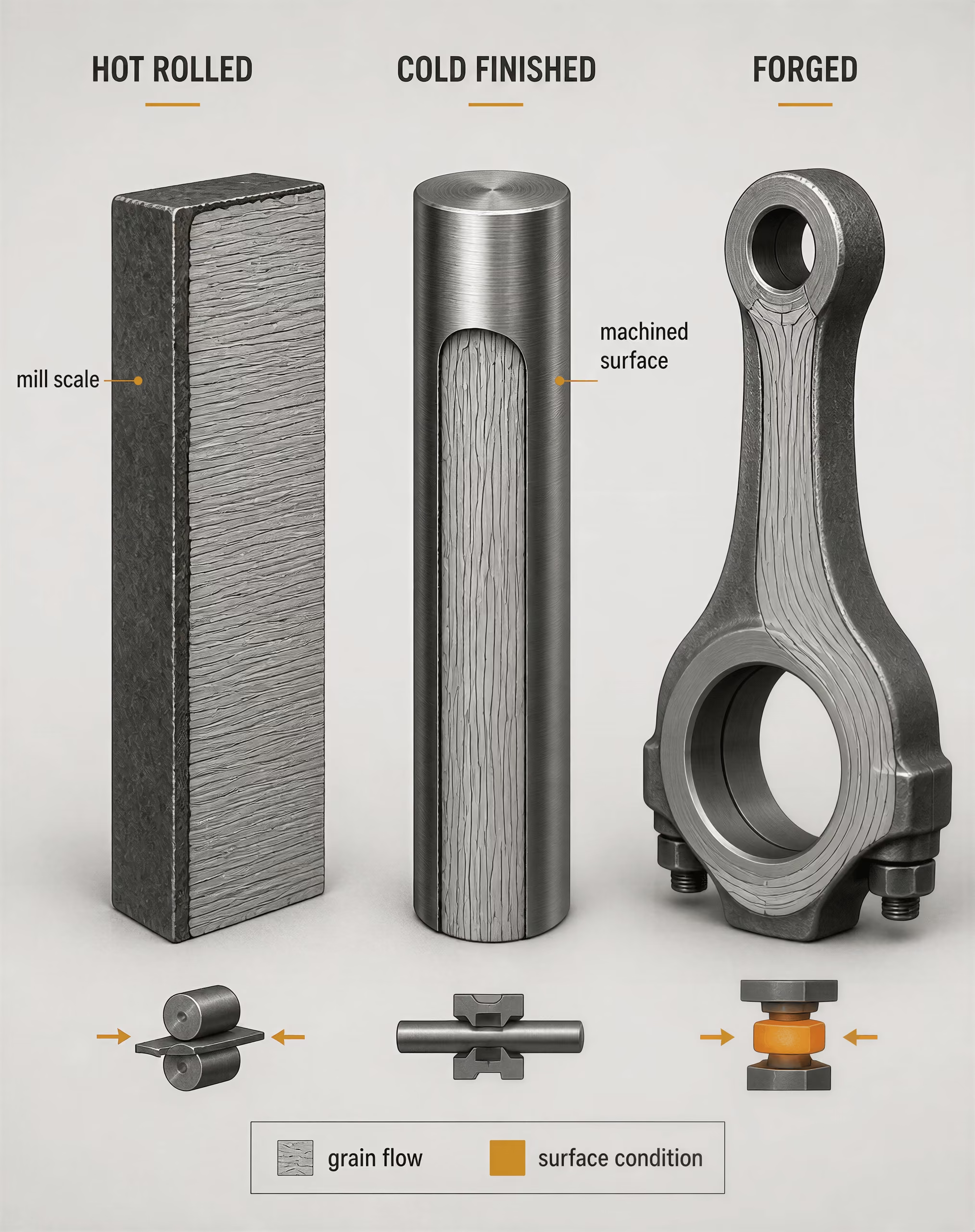
Product form controls how the steel was shaped and which defects, stresses and directional properties may matter. Continuous casting transforms molten steel into slabs, billets and blooms, which are then rolled into flat and long products, according to the World Steel Association’s 2024 process description. A slab may become plate or sheet; a billet may become bar or wire rod; a bloom may become a heavier section or forging stock. Subsequent rolling, drawing, machining or forging changes the geometry and the mechanical response.
A flat product supplied as hot rolled has a different surface and dimensional history from one that has been cold reduced and subsequently annealed. A bar described as cold finished may have been drawn, peeled, ground or turned, with tighter dimensional control and a distinct surface condition. A forging has experienced local or bulk plastic deformation in a way that differs from rolled plate, even when the chemical analysis is similar.
Heat treatment changes the microstructure. Annealing generally reduces hardness and residual stress while improving ductility and machinability. Normalizing produces a refined ferritic-pearlitic structure through heating above the relevant transformation range followed by air cooling. Normalized rolling uses a controlled rolling schedule so that the final rolling passes produce a condition comparable, in specified respects, to normalized material; it is not simply an ordinary hot-rolling label. Quenching creates a harder transformation structure, while tempering reduces some of the brittleness and adjusts strength and toughness. “Quenched and tempered” consequently identifies a controlled sequence, not merely a strength result.[3] Heat-treatable steels, alloy steels and stainless steels — Part 1. International Organization for Standardization. ISO 683-1:2016, 2016.
Surface condition must be read separately from bulk heat treatment. Scale may remain on hot-rolled material, or it may be removed by shot blasting, pickling or another descaling operation. A cold-finished or machined surface can affect dimensional tolerances, roughness and the location of surface-breaking defects without changing the grade chemistry. ISO 683-1:2016 specifies technical delivery requirements for semi-finished products, bars, wire rod, flat products and forgings made from non-alloy steels for quenching and tempering, including defined heat-treatment and surface conditions. That structure shows why “the steel grade” is only one component of the technical description.
The required tests complete the condition. Tensile properties may be specified at a particular thickness and orientation. Impact testing may apply only to a stated quality or temperature. Hardness, ultrasonic examination, grain-size assessment, decarburization limits, surface inspection and dimensional tolerances may also be mandatory. A certificate reporting chemistry alone does not establish compliance with a delivery condition that requires these additional controls.
Why the designation controls interpretation
Terms that must not be conflated
- Normalized
- A heat-treated condition produced by austenitizing and air cooling.
- Normalized rolled
- A controlled rolling condition intended to produce a structure comparable to normalized material.
- Cold finished
- A product route involving drawing, peeling, turning, grinding or related finishing operations.
- Quenched and tempered
- A sequence of austenitizing, rapid cooling and tempering.
The designation tells the user which standard rules apply, which condition was ordered and which comparisons are valid. “Normalized,” “normalized rolled,” “annealed,” “cold finished” and “quenched and tempered” are not interchangeable adjectives. They trigger different assumptions about microstructure, properties, processing limits and acceptance tests.
SAE AMSH6875C illustrates the same principle from an aerospace heat-treatment perspective: it sets requirements for four classes of steel and specifies furnace equipment, procedures, temperatures and test methods. The required treatment is therefore tied to documented process control, not to a statement that the material was heated at some point.
For that reason, a complete material description should identify the standard, grade, product form, dimensions, delivery condition, surface condition and required tests. “S355 steel,” “4140 bar” or “alloy-steel forging” leaves material questions unanswered. A standards-compliant designation narrows them. It states what the product is, how its supplied state was established and which evidence must accompany the claim.
The Manufacturing Route from Raw Materials to Semi-Finished Steel
[4] Steelmaking process. World Steel Association. World Steel Association technical resource, 2024.
Steel production is not one furnace operation. It is a linked sequence in which iron-bearing material becomes iron, iron becomes crude steel, and liquid steel becomes a cast shape for rolling or forging. The World Steel Association identifies two principal routes: the blast-furnace/basic-oxygen-furnace route, usually written BF-BOF, and the electric-arc-furnace route, or EAF route.[^1] Those routes describe how the metallic charge is reduced, melted and refined. They do not, by themselves, define the final delivery condition.
A finished designation may also require a particular composition, cooling practice, surface state, grain structure, tensile strength, impact toughness or heat treatment. ISO 683-1:2016, for example, specifies technical delivery requirements for semi-finished products, bars, wire rod, flat products and forgings supplied in defined heat-treatment and surface conditions.[^2] The route is therefore one part of the manufacturing history, not a substitute for the product standard.
Blast furnace and basic oxygen furnace
The BF-BOF route separates ironmaking from steelmaking. Ironmaking produces hot metal, a carbon-rich liquid iron, in the blast furnace. Steelmaking then reduces the carbon and adjusts the chemistry in the basic oxygen furnace.
A blast furnace is charged from the top with iron ore, metallurgical coke and fluxes such as limestone. Iron ore supplies iron oxides. Coke provides heat and acts as a reducing agent; its carbon monoxide removes oxygen from the ore as the burden descends. Limestone reacts with gangue and other unwanted constituents to form slag. Heated air, commonly called the blast, enters through tuyeres near the furnace base. The resulting hot metal collects below the slag and is tapped for transfer to the BOF.
| Vessel or stage | Material produced or treated | Function |
|---|---|---|
| Blast furnace | Hot metal | Reduces iron oxides and produces carbon-rich liquid iron |
| Basic oxygen furnace | Crude steel | Refines hot metal with oxygen and scrap |
| Electric arc furnace | Liquid steel | Melts a metallic charge using electrical energy |
| Ladle metallurgy | Refined liquid steel | Adjusts chemistry, temperature, gases and inclusions |
A blast furnace is therefore an ironmaking vessel, not a steelmaking vessel. The distinction appears in descriptions from the American Iron and Steel Institute and the U.S. Environmental Protection Agency. The EPA states that the basic oxygen process refines molten blast-furnace iron with scrap, while the electric-arc-furnace process is a separate steelmaking route.[^3] That wording matters: the blast furnace generates an intermediate iron product, whereas the BOF makes crude steel.
In the BOF, a water-cooled lance blows high-purity oxygen into the molten iron. Oxygen combines with carbon, silicon, manganese and phosphorus. Carbon leaves mainly as carbon monoxide and carbon dioxide; oxidized impurities enter the slag. Scrap steel is commonly added as a coolant and metallic feedstock, allowing the heat balance to be controlled while recycling material. Fluxes form a basic slag that captures phosphorus and other oxides.
The BOF tap produces crude steel, but the tapped composition is not necessarily the final composition. Ladle treatment can remove dissolved gases, adjust alloy additions, modify inclusions and set the casting temperature. Vacuum treatment may reduce hydrogen, nitrogen or carbon depending on the grade and process specification. Calcium treatment can alter inclusion shape in suitable compositions. These operations are metallurgical controls, and two heats from the same BF-BOF route can receive different refining and thermal histories.
The integrated route therefore uses more than ore and coke. The World Steel Association lists iron ore, metallurgical coal, limestone and recycled steel among its principal inputs.[^4] The relative proportions vary with plant design, furnace practice, scrap quality and the required steel chemistry.
Electric arc furnace, direct-reduced iron and hot metal
An EAF melts a metallic charge by passing an electric current through electrodes and the charge. The furnace may be charged mainly with recycled steel, but direct-reduced iron (DRI), hot-briquetted iron, pig iron or hot metal can also be introduced. The World Steel Association describes the EAF route as using primarily recycled steel, DRI or hot metal and electricity.[^4]
Recycled steel is already metallic iron, so it does not need the blast furnace reduction step. Its residual alloy content, contamination level, physical form and proportion in the charge affect furnace practice and the resulting chemistry. DRI is made by reducing iron ore in the solid state, commonly with a reducing gas. Unlike blast-furnace hot metal, it has not been melted during reduction and retains a porous structure. Hot metal supplied to an EAF is liquid or previously produced iron from a reduction furnace, and it brings carbon and thermal energy into the heat.
The EAF melts the charge and supports oxidation, slag formation and temperature control. Oxygen injection, carbon addition, foamy slag practice and electrical power are coordinated to reach the target heat. After tapping, secondary metallurgy in a ladle may include deoxidation, alloying, vacuum degassing, inclusion modification and temperature trimming. An EAF heat can thus be refined to demanding requirements, while an integrated plant can produce steels with widely different properties through changes in chemistry, casting, rolling and heat treatment.
Route alone does not determine strength, toughness, weldability or fatigue performance. A low-alloy structural grade made through an EAF and the same grade made through a BOF may meet the same product specification if the specified chemical, mechanical, cleanliness and processing requirements are satisfied. Conversely, two products from the same EAF can differ substantially if one is normalized and the other is quenched and tempered, or if their product thicknesses and cooling rates differ.
Standards sometimes impose route-related requirements. ASTM A434/A434M-24 covers hot-wrought and cold-finished quenched-and-tempered alloy steel bars and identifies open-hearth, basic-oxygen and electric-furnace production as permitted melt-processing routes. ASTM A508/A508M-16 takes a more specific position for quenched-and-tempered vacuum-treated carbon and alloy steel forgings for pressure-vessel components: it requires basic electric-furnace manufacture unless secondary refining or remelting is used.[^5] Such a requirement is a compliance condition, not evidence that every EAF or BOF product has the same performance.

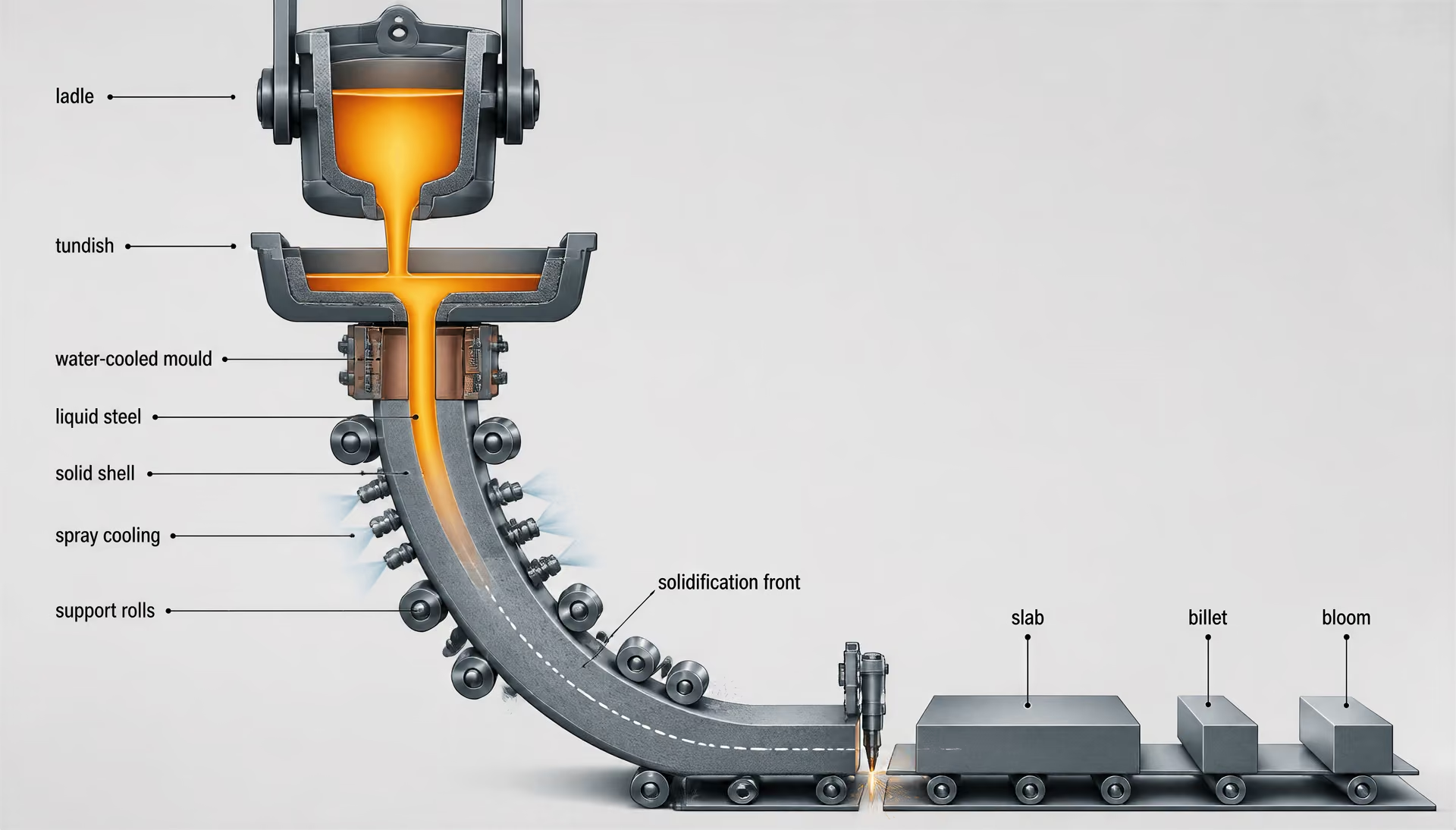
Crude steel, casting and downstream processing
Crude steel is liquid steel after primary steelmaking and before it becomes a cast semi-finished product. It is transferred to a ladle, where secondary metallurgy establishes the chemistry, cleanliness and casting temperature. The ladle may feed a tundish, which acts as a reservoir and distributes steel into the mould of a continuous caster.[5] Steelmaking process. World Steel Association. World Steel Association technical resource, 2024.
Continuous casting transforms molten steel into slabs, billets or blooms.[^1] The mould is water-cooled and open at the top and bottom. A solid shell forms against the mould wall while liquid steel remains inside. Rolls support and withdraw the strand; sprays increase cooling below the mould until the section is sufficiently solid. Oxy-fuel torches or mechanical equipment cut the strand to length.
Slabs generally feed flat-product mills and are rolled into plate, strip or sheet. Billets commonly feed bar and wire-rod mills. Blooms, which are larger sections, may feed structural sections, rails or heavy bars, although terminology and size limits depend on the plant and standard. Casting practice affects segregation, porosity, inclusions and surface defects. Those features can later be reduced by reheating, rolling, cropping, conditioning or forging, but they are not erased automatically.
Downstream processing begins with reheating when hot rolling is required. Rolling compresses the cast section between rolls, reduces thickness or cross-section, and changes the shape and internal structure. Controlled rolling and accelerated cooling can refine grains and develop required strength without a separate full normalization treatment. Plate, bar, wire rod and structural sections may then undergo straightening, descaling, peeling, grinding, cutting or other surface operations.
| Forging class | Cooling or treatment description | Typical purpose or implication |
|---|---|---|
| Annealed | Controlled slow cooling | Lower hardness and improved machinability |
| Normalized | Air cooling after heating above the transformation range | Finer ferritic-pearlitic structure |
| Normalized-and-tempered | Normalizing followed by tempering | Adjusted hardness, toughness and residual stress |
| Quenched-and-tempered | Rapid cooling followed by tempering | Higher strength with reduced quench brittleness |
| Normalized-quenched-and-tempered | Normalizing before hardening and tempering | Controlled starting structure before quenching |
Forging follows a different deformation path. A billet, bloom or ingot is heated and compressed between dies or under a press, producing directional flow and a shape that may be unsuitable for rolling. ASTM A668/A668M-16 classifies forgings by delivery heat treatment, including annealed, normalized, normalized-and-tempered, quenched-and-tempered, and normalized-quenched-and-tempered conditions.[^6] These are delivery conditions, not names for BF-BOF or EAF production.
The final route is consequently a chain: ore or recycled steel enters the ironmaking or melting stage; molten metal is refined into crude steel; liquid steel is cast; and the semi-finished section is rolled or forged before any specified final heat treatment and surface preparation. BS EN 10025-3:2019 addresses hot-rolled weldable fine-grain structural-steel products supplied in the normalized or normalized-rolled condition, while DIN EN 10025-6:2023-06 covers hot-rolled high-yield-strength structural steels supplied in the quenched-and-tempered condition.[^7] The same broad steel family can therefore leave production with different obligations because its processing route after casting, and its defined delivery condition, are different.
[^1]: World Steel Association, “Steelmaking process,” 2024. [^2]: ISO 683-1:2016. [^3]: U.S. Environmental Protection Agency, AP-42, “Iron and Steel Production,” 1995. [^4]: World Steel Association, “Raw materials,” 2024. [^5]: ASTM A434/A434M-24; ASTM A508/A508M-16. [^6]: ASTM A668/A668M-16. [^7]: BS EN 10025-3:2019; DIN EN 10025-6:2023-06.
How Melt Route and Secondary Metallurgy Affect the Product
Primary steelmaking versus secondary refining
The furnace route establishes how iron-bearing materials become liquid steel, but it does not by itself define the finished product. The World Steel Association identifies two principal routes: the blast-furnace–basic-oxygen-furnace (BF–BOF) route and the electric-arc-furnace (EAF) route (World Steel Association, 2024). In the integrated route, iron ore, metallurgical coal, limestone and recycled steel are used. The blast furnace produces iron-rich hot metal; the basic oxygen furnace then refines that hot metal with oxygen and scrap. The U.S. Environmental Protection Agency described the same distinction in 1995: the basic oxygen process refines molten blast-furnace iron with scrap, whereas the electric-arc-furnace process is a separate steelmaking route.
An EAF melts a charge consisting primarily of recycled steel, direct-reduced iron or hot metal, using electrical energy. That description identifies the primary melting method, not the final cleanliness, inclusion population, grain structure or mechanical performance. Two heats made in EAFs can differ substantially because their scrap or direct-reduced-iron inputs, oxidation practice, slag control, alloy additions, tapping temperature and downstream treatment may differ. The same applies to two BOF heats.
Secondary-metallurgy sequence
- Ladle-furnace treatment Adjusts temperature and chemistry and supports desulfurization.
- Argon stirring Mixes the bath and encourages inclusions to rise into slag.
- Vacuum treatment Can reduce dissolved gases and support inclusion control.
- Calcium treatment Can modify inclusion shape in suitable compositions.
- Casting Transfers refined steel through a tundish into a continuous-casting mould.
After primary steelmaking, the liquid heat may undergo secondary metallurgy in a ladle. Ladle-furnace treatment adjusts temperature and chemistry, promotes desulfurization, modifies inclusions with calcium or other additions, and allows alloying elements to be set more closely than is practical during the main melting operation. Argon stirring helps mix the bath and encourages non-metallic inclusions to rise into the slag. These operations affect the steel that will later be cast, forged or rolled, even though the steel’s furnace route remains “BOF” or “EAF.”
Casting and deformation add further history. The World Steel Association states that continuous casting turns molten steel into slabs, billets and blooms, which are then rolled into flat and long products. Forging changes the shape and internal structure differently from rolling, particularly through local deformation and the reduction of cast porosity. A delivery condition therefore combines more than the name of the furnace. ISO 683-1:2016, for example, specifies technical delivery requirements for semi-finished products, bars, wire rod, flat products and forgings in defined heat-treatment and surface conditions.
Heat treatment is a separate link in the chain. ASTM A668/A668M-16 classifies carbon and alloy steel forgings by delivery heat treatment, including annealed, normalized, normalized-and-tempered, quenched-and-tempered, and normalized-quenched-and-tempered conditions. “Quenched and tempered” describes a thermal state, not a furnace route. A steel forged from an EAF heat and a steel forged from a BOF heat may both be supplied quenched and tempered, yet their residual elements, inclusions and gas contents need not be identical.
Vacuum treatment, cleanliness and dissolved gases
Vacuum treatment is a secondary process intended to control dissolved gases and, in some operations, inclusions. Under reduced pressure, dissolved hydrogen and nitrogen become less soluble in liquid steel; stirring and exposure of the melt to the vacuum help remove them. Hydrogen control matters because excess hydrogen can contribute to flakes, internal cracking or delayed damage in susceptible heavy sections. Oxygen control matters for another reason: dissolved oxygen reacts with deoxidizing additions and contributes to oxide inclusions. Vacuum treatment does not mean that every inclusion disappears, nor does it replace control of raw materials, slag carryover, casting and reheating.
Vacuum degassing and vacuum-arc remelting are different operations. Vacuum degassing treats a liquid heat, commonly in a ladle or vacuum vessel, before casting. Vacuum-induction melting melts and refines a charge under vacuum or controlled atmosphere. Vacuum-arc remelting (VAR) then remelts a consumable electrode under vacuum, producing a new ingot with controlled solidification. Electroslag remelting (ESR) uses a conductive slag to remelt an electrode and can improve inclusion control and solidification structure. These remelting routes are not simply stronger versions of EAF melting; they are additional stages with their own controls and limitations.
“Clean steel” must therefore be read as a measured metallurgical condition, not as a synonym for a particular furnace. Relevant evidence can include hydrogen, oxygen and nitrogen results; total oxygen; sulfur; phosphorus; inclusion ratings; macroetch results; ultrasonic examination; and longitudinal or transverse mechanical tests. The required evidence depends on the product standard and purchase specification. A vacuum-treated heat may still fail because of segregation, forging discontinuities or an unsuitable heat treatment. Conversely, a non-remelted product can meet its specified requirements when its permitted process controls and tests are satisfied.
Pressure-vessel forgings show why route requirements sometimes become explicit. ASTM A508/A508M-16 covers quenched-and-tempered vacuum-treated carbon and alloy steel forgings for pressure-vessel components. The standard requires basic electric-furnace manufacture unless secondary refining or remelting is used. That wording does not mean that every EAF product is vacuum treated or suitable for a pressure vessel. It means that this particular specification establishes a permitted primary route and then recognizes secondary refining or remelting as an alternative route within its requirements. The product must still satisfy the specified chemistry, forging, heat-treatment, mechanical and examination provisions.
What route information can and cannot prove
A route designation can prove only what the applicable standard, certificate or manufacturing record states. “EAF” may identify the primary melting furnace, but it does not, without further information, prove vacuum degassing, ESR, VAR, a particular inclusion rating, hydrogen content, grain size or forging reduction. “BOF” does not prove inferior cleanliness, just as “vacuum-treated” does not prove that all internal defects have been eliminated. Claims about route must be separated from claims about test results.
Some standards leave the primary melt route open. ASTM A434/A434M-24 permits open-hearth, basic-oxygen and electric-furnace production for hot-wrought and cold-finished quenched-and-tempered alloy steel bars. The delivery designation then focuses on product form, finish, chemistry, heat treatment and required properties rather than declaring one furnace mandatory. BS EN 10025-3:2019 defines normalized or normalized-rolled delivery conditions for weldable fine-grain structural steel products, while DIN EN 10025-6:2023-06 covers hot-rolled flat products supplied in the quenched-and-tempered condition. Neither delivery condition, by itself, supplies a complete melt history.
Other standards impose route controls, as ASTM A508/A508M-16 does. SAE AMSH6875C also specifies heat-treatment equipment, procedures, temperatures and test methods for four classes of steel, showing that process compliance can extend well beyond the furnace label. The practical reading is straightforward: a delivery condition records a technically defined state and its associated requirements, while the manufacturing route records how that state was produced. They overlap, but they are not interchangeable. Only the governing standard, material certificate and, where required, traceable process documentation can establish which route steps actually occurred.
Normalized and Normalized-Rolled Delivery Conditions
“Normalized” and “normalized-rolled” describe metallurgical conditions, not simply a mill’s preferred production label. Each identifies how the steel’s austenite structure was refined and how the finished product reached its specified mechanical properties. The designation also operates within a product standard: dimensions, chemical composition, impact toughness, tensile properties, surface condition, testing and permissible deviations may all be controlled by that standard.
The manufacturing route remains a separate question. The World Steel Association stated in 2024 that the two principal steelmaking routes are the blast furnace–basic oxygen furnace (BF–BOF) route and the electric arc furnace (EAF) route. Its raw-materials guidance distinguishes an integrated route using iron ore, metallurgical coal, limestone and recycled steel from an EAF route using mainly recycled steel, direct-reduced iron or hot metal and electricity. Either route can supply steel that is subsequently cast and rolled into a normalized or normalized-rolled product, provided the required chemistry, cleanliness and processing controls are achieved.
Continuous casting converts liquid steel into slabs, billets or blooms, which are then rolled into flat or long products, according to the World Steel Association (2024). The casting route, reheating practice, reduction schedule and cooling history affect the starting microstructure, but they do not by themselves establish the final delivery condition. A plate made from EAF steel can be normalized; a plate made through the BF–BOF route can be normalized-rolled. The designation describes the product’s final metallurgical state, not its furnace ancestry.
Normalizing as a heat treatment
Normalizing is a distinct heat-treatment operation performed after hot forming, or after rolling has otherwise produced an unsuitable or non-uniform structure. The steel is heated into the austenitic range, normally above the critical transformation temperature required to form austenite throughout the relevant section, held long enough for the structure to equalize, and then cooled in still air. The exact temperature and holding time depend on grade, section thickness and furnace practice.
During heating, earlier ferrite, pearlite and deformation structures are replaced by austenite. This transformation can dissolve or redistribute some phases and reduce differences created by casting, forging or earlier rolling. Air cooling then transforms the austenite into a relatively fine ferrite–pearlite structure in many non-alloy and low-alloy structural steels. The result is generally more uniform through the section than an uncontrolled as-rolled condition.
Grain refinement is central. When austenite grains are made smaller before transformation, the ferrite grains formed during cooling are also commonly finer. A finer ferritic grain structure tends to raise yield strength and improve toughness without relying solely on increased carbon content. That balance matters in weldable structural steels, where excessive carbon and alloy hardenability can increase the risk of hard heat-affected zones and hydrogen-assisted cracking.
Normalizing can also reduce banding and differences between the surface and centre of a thick product, although the degree of homogenization depends on the original segregation, section size and thermal cycle. It is not a guarantee that every chemical or microstructural variation disappears. Large cast-related segregation, for example, cannot be removed by air cooling alone.
The term “normalized” therefore means that the product has received a normalizing heat treatment, or has reached the equivalent metallurgical condition where the governing product standard permits that interpretation. It does not mean quenched and tempered. Quenching uses a rapid cooling rate to form a harder structure; tempering then reduces brittleness and adjusts strength. DIN EN 10025-6:2023-06 addresses hot-rolled flat products supplied in the quenched-and-tempered condition, which is a different delivery condition from the normalized products covered by BS EN 10025-3:2019.
Other standards show why the wording must be read precisely. ISO 683-1:2016 specifies technical delivery requirements for semi-finished products, bars, wire rod, flat products and forgings made from non-alloy steels for quenching and tempering, including defined heat-treatment and surface conditions. ASTM A668/A668M-16 separately classifies forgings as annealed, normalized, normalized-and-tempered, quenched-and-tempered, or normalized-quenched-and-tempered. “Normalized-and-tempered” is not interchangeable with “normalized”; the added tempering treatment changes the structure and the required verification.
Normalized rolling as a controlled rolling condition
Normalized rolling reaches a normalized-type final structure through controlled hot rolling rather than through a separate full normalizing furnace cycle after rolling. The rolling schedule controls reheating, pass reductions, interpass time and finishing temperature so that deformation refines the austenite before transformation. After the final pass, the product cools under specified conditions and develops a structure equivalent, for the purpose of the standard, to one obtained by normalizing.
Temperature is decisive. If rolling finishes at an excessively high temperature, austenite can recrystallize and grow between passes, weakening the grain-refining effect. If deformation occurs at a lower, controlled temperature within the austenitic range, unrecrystallized or repeatedly refined austenite can provide many nucleation sites for fine ferrite during cooling. The final properties then reflect both deformation and transformation.
Normalized rolling should not be collapsed into thermomechanical rolling. In thermomechanical rolling, deformation is deliberately completed at lower temperatures and may extend into a range where recrystallization is suppressed; the resulting condition is commonly designated TM or M in relevant standards. Normalized rolling instead targets a condition equivalent to normalized material. The boundary is defined by the applicable standard and process qualification, not by a general claim that the steel was “rolled cold” or “rolled under control.”
The distinction also affects repeatability. A separate normalizing treatment can correct some variation inherited from rolling, but it consumes additional furnace time and may alter dimensions, oxidation and surface condition. Normalized rolling seeks the required structure during the hot-working schedule itself. Neither route is automatically superior: the specified grade, thickness, section geometry, toughness requirement and acceptance tests determine whether the delivered material conforms.
BS EN 10025-3:2019 and fine-grain structural steels
BS EN 10025-3:2019 sets technical delivery conditions for hot-rolled flat and long products made from weldable fine-grain structural steels supplied in the normalized or normalized-rolled condition. It covers thicknesses up to and including 250 mm. This is a product-standard obligation, not merely a description of the producer’s sequence of operations.
| Designation family | Delivery condition | Quality implication |
|---|---|---|
| S275N / S275NL | Normalized or normalized-rolled | NL is the lower-temperature impact-toughness quality |
| S355N / S355NL | Normalized or normalized-rolled | NL is the lower-temperature impact-toughness quality |
| S420N / S420NL | Normalized or normalized-rolled | NL is the lower-temperature impact-toughness quality |
| S460N / S460NL | Normalized or normalized-rolled | NL is the lower-temperature impact-toughness quality |
The specified strength grades are S275N, S275NL, S355N, S355NL, S420N, S420NL, S460N and S460NL. The letter N identifies the normalized or normalized-rolled delivery condition. The L suffix identifies the lower-temperature impact-toughness quality. In practical terms, the N and NL qualities impose different Charpy impact requirements, with NL requiring performance at a lower test temperature than N. The exact test temperature, absorbed energy, sampling position and acceptance rules must be taken from the edition and product form being applied.
The standard’s grades are not defined by nominal yield strength alone. Thickness affects the specified yield value, and tensile strength ranges, elongation, chemical limits, weldability-related composition controls and impact properties are also part of compliance. A thick S460NL plate and a thinner S460NL plate therefore share a grade designation while remaining subject to thickness-dependent requirements.
The delivery certificate should consequently identify the standard, grade, quality, product form, dimensions, heat or cast reference, delivery condition and test results. “S355” without the suffix and standard is incomplete. S355N supplied to BS EN 10025-3:2019 is not the same technical statement as a generic S355 product, nor is it equivalent by default to S355NL, quenched-and-tempered S355, or a thermomechanically rolled grade.
That is why normalized and normalized-rolled conditions belong in the specification, not in a supplier’s informal description. The route establishes how the structure was produced; the standard establishes what the delivered product must demonstrate.
Quenched-and-Tempered Steel: From Austenite to Service Condition
Quenched-and-tempered (Q&T) steel is defined by a sequence, not by the vague statement that a product has been “heat treated.” The material is first heated into the austenitic range, held long enough for the required transformation and chemical homogenization, rapidly cooled to form martensite, and then reheated below the lower critical transformation temperature for tempering. The final condition depends on steel chemistry, section size, furnace practice, quench severity, tempering parameters, surface state and the requirements attached to the product standard.
That distinction matters because manufacturing route and metallurgical treatment describe different parts of the production chain. The World Steel Association identifies the blast-furnace–basic-oxygen-furnace route and the electric-arc-furnace route as the two main steelmaking routes (2024). Continuous casting then produces slabs, billets or blooms, which may be rolled into flat or long products. Q&T treatment can follow either route; it is not a synonym for EAF steel, alloy steel or any particular product form. A standard-defined delivery condition adds another layer by specifying what the supplier must deliver and demonstrate.

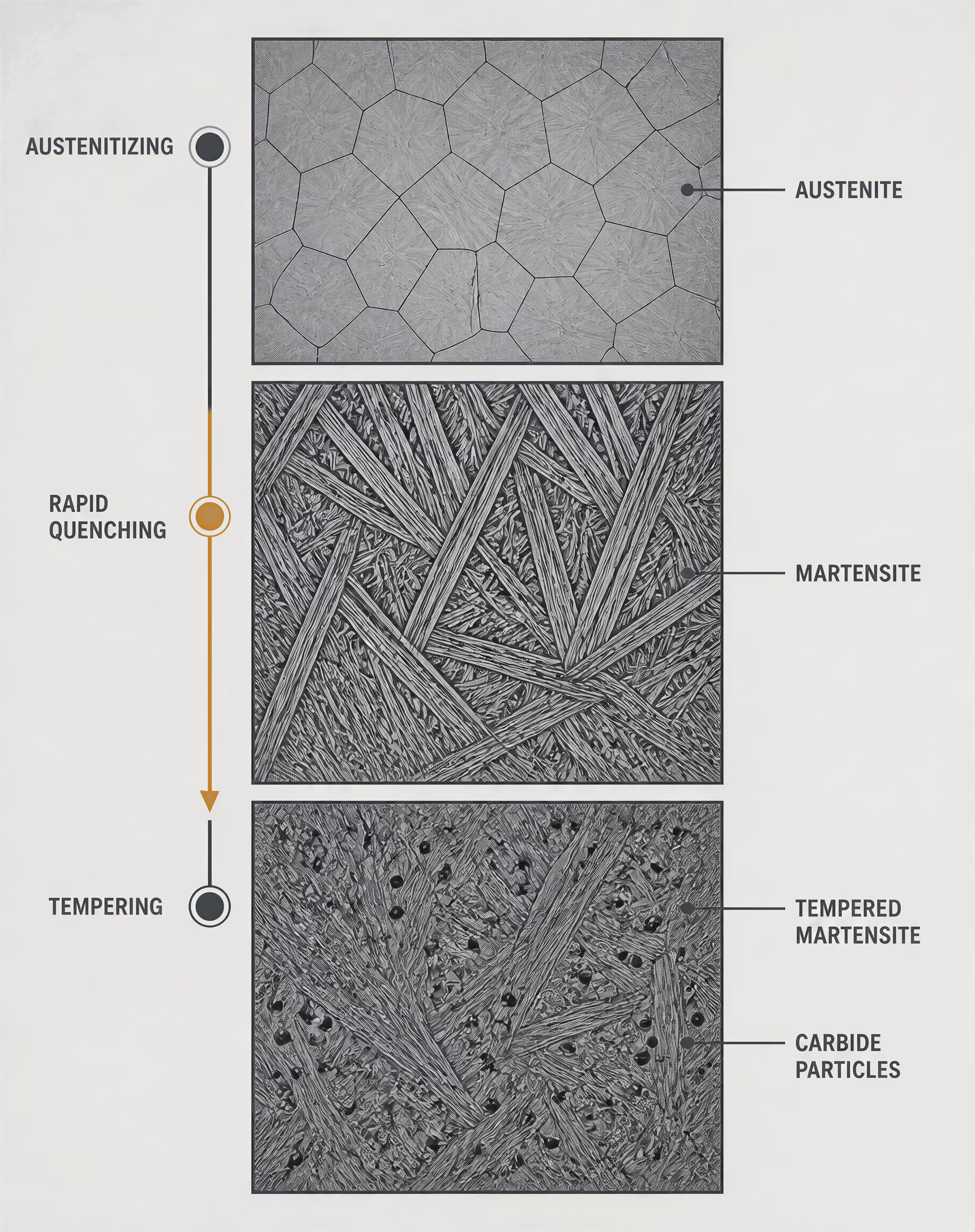
Austenitizing, quenching and martensitic transformation
During austenitizing, ferrite, pearlite or other starting constituents transform into austenite, the face-centred cubic phase that can dissolve substantially more carbon than ferrite. The steel must reach a suitable temperature and remain there for a controlled time. Too little heating or holding can leave undissolved carbides and chemical non-uniformity. Excessive temperature or prolonged exposure can enlarge austenite grains, increase distortion and impair toughness.
Furnace control is therefore part of the metallurgy rather than an administrative detail. The load may not reach the furnace set point at the same time as the surrounding atmosphere, and thick sections heat more slowly than thin ones. Thermocouple placement, furnace uniformity, load spacing and transfer time between furnace and quench all affect the thermal cycle. SAE AMSH6875C, for example, sets heat-treatment requirements for four classes of steel and addresses furnace equipment, procedures, temperatures and test methods. A statement that a component was “austenitized” gives no useful assurance unless the applicable specification also controls these variables.
Quenching cools the austenite rapidly enough to suppress diffusional products such as coarse pearlite and, at suitable temperatures, bainite. The austenite then undergoes a largely diffusionless transformation to martensite. Carbon remains trapped in a distorted body-centred tetragonal lattice, producing high hardness and strength but also substantial internal stress and limited ductility in the as-quenched state. Some austenite may remain untransformed, particularly where the chemistry lowers the martensite-start temperature or the cooling path is insufficient to complete the transformation.
Hardenability The ability of steel to form a hard transformation structure to a given depth under specified cooling conditions; it is not the same as maximum surface hardness.
The result is not determined by nominal carbon content alone. Hardenability describes the ability of a steel to form martensite to a given depth under specified cooling conditions; it is different from the maximum hardness obtainable at the surface. Alloying elements such as manganese, chromium, molybdenum and nickel generally delay diffusional transformations, although their effects depend on concentration and interactions with carbon and other alloying elements. A high-hardenability grade can develop martensitic structure farther from the quenched surface than a lower-hardenability grade of similar carbon content.
Quenching also creates a mechanical problem. The surface cools and contracts before the interior, while transformation itself changes volume. The resulting thermal and transformation stresses can cause distortion, residual stress or cracking. Quenching must therefore be severe enough to produce the specified structure without imposing unnecessary stress. Water, polymer solutions, oil, gas and other media provide different heat-extraction histories; the same grade and nominal treatment can produce different results when the medium, temperature or circulation changes.
Tempering and the strength-toughness balance
Tempering reheats the quenched steel to a controlled temperature below the temperature at which austenite would reform. Time and temperature allow carbon to leave the supersaturated martensite, permit carbide precipitation and reduce the lattice distortion and residual stress created by quenching. The microstructure becomes tempered martensite, although the exact carbide population and matrix condition depend on steel composition and the tempering cycle.
Typical tempering effects
- Hardness Generally decreases from the as-quenched level.
- Tensile strength Generally decreases as tempering becomes more severe.
- Ductility Generally improves.
- Impact toughness Generally improves, subject to composition and temper-embrittlement effects.
- Residual stress Is reduced by the tempering cycle.
As tempering temperature or time increases, hardness and tensile strength generally decrease from the as-quenched level while ductility, impact toughness and dimensional stability improve. This is not a simple trade in which every property changes at the same rate. Alloy additions can retard softening, promote alloy-carbide formation or alter tempering resistance. Some steels also show temper embrittlement over particular temperature-time exposures, so the specified cycle may include restrictions on cooling or on the use of a particular tempering range.
The chosen condition is consequently a service decision. A shaft, pressure-vessel forging and structural plate may all be described as Q&T, yet their required strength, impact energy, thickness range, surface quality and test locations can differ. A product designation must be read with its standard, grade, dimensions and quality class. ISO 683-1:2016 specifies technical delivery requirements for semi-finished products, bars, wire rod, flat products and forgings made from non-alloy steels for quenching and tempering, including defined heat-treatment and surface conditions. It does not turn every heat-treated steel into an ISO 683-1 product.
ASTM A668/A668M-16 demonstrates why the wording matters for forgings. It distinguishes annealed, normalized, normalized-and-tempered, quenched-and-tempered, and normalized-quenched-and-tempered delivery conditions. “Normalized and tempered” is not interchangeable with “quenched and tempered”: normalizing produces a different starting structure and cooling history, and the resulting properties may differ even when a later tempering operation is used.[6] Hot rolled products of structural steels — Part 6. DIN Media. DIN EN 10025-6:2023-06, 2023.
DIN EN 10025-6:2023-06 covers hot-rolled flat products of high-yield-strength structural steels supplied in the quenched-and-tempered condition. The delivery condition carries implications for specified mechanical properties and verification, not merely for the route through a furnace. Surface condition, dimensional tolerances, impact requirements and testing obligations remain part of the product specification.
Why section size and cooling practice matter
A plate or forging does not cool as a single uniform object. The surface contacts the quench medium directly, while heat must travel from the centre toward the surface. The thicker the section, the longer the centre remains at elevated temperature and the lower the effective cooling rate may be at the core. The surface may therefore become predominantly martensitic while the centre contains a greater proportion of bainite, pearlite or tempered transformation products, depending on grade and quench conditions.
Hardenability determines how far the martensitic zone extends, but product thickness determines how difficult it is to cool the interior quickly enough. The two factors must be considered together. A thin bar of a modest-hardenability steel can achieve a relatively uniform through-section structure, whereas a large forging of the same heat may have a hard surface and a softer core. Mechanical properties measured near the surface cannot automatically represent the centre.
Agitation changes the boundary layer between the hot steel and the quench medium. Strong, even circulation can increase and regularize heat extraction; stagnant regions can produce slower or uneven cooling. Quench-medium temperature, concentration, contamination, part orientation, loading pattern and transfer delay have similar practical effects. These variables can alter hardness gradients, distortion and residual stress without changing the material certificate’s nominal grade.
Furnace practice matters before and after the quench as well. An uneven austenitizing temperature can produce inconsistent grain size or incomplete transformation, while inadequate tempering time can leave excessive residual stress. Multiple tempering operations may be required by a particular specification or procedure, but the number and conditions should not be assumed from the phrase “Q&T.”
The manufacturing route still has a separate role. ASTM A434/A434M-24 covers hot-wrought and cold-finished quenched-and-tempered alloy steel bars and identifies open-hearth, basic-oxygen and electric-furnace melt-processing routes as permitted routes. ASTM A508/A508M-16 addresses quenched-and-tempered vacuum-treated carbon and alloy steel forgings for pressure-vessel components and requires basic electric-furnace manufacture unless secondary refining or remelting is used. Those requirements show that steelmaking route, heat treatment and delivery condition can be linked by a specification, but they are not interchangeable descriptions. A reliable interpretation names all three where the standard requires them: how the steel was made, how its structure was changed, and what condition was delivered.
ISO 683-1:2016 and Non-Alloy Steels for Quenching and Tempering
ISO 683-1:2016 is a technical delivery-requirements standard for non-alloy steels intended for quenching and tempering. It does not describe a single factory process or a single finished condition. Instead, it links steel grades to product forms, heat-treatment states, surface conditions, chemical composition, mechanical properties and, where specified, hardenability requirements.
That distinction matters. A designation such as C45 does not, by itself, state whether the material was supplied as a hot-rolled bar, a normalized forging, or a quenched-and-tempered product with a machined surface. Those details belong to the complete order and inspection description.
Products covered by ISO 683-1
| Product form | Relevant delivery considerations |
|---|---|
| Semi-finished products | May proceed to later rolling or forging operations |
| Bars | Size, product route, surface condition and heat treatment |
| Wire rod | Further drawing, forming or heat treatment |
| Flat products | Thickness, surface state, rolling history and mechanical tests |
| Forgings | Deformation history, section size, heat treatment and sampling location |
ISO 683-1:2016 covers semi-finished products, bars, wire rod, flat products and forgings made from non-alloy steels for quenching and tempering. The product form is not a clerical detail: it controls the applicable dimensional tolerances, testing provisions, surface acceptance criteria and, in many cases, the section size used for mechanical testing.
Semi-finished products can proceed to later forging or rolling operations. Bars may be hot rolled, forged or supplied in a subsequently machined condition, depending on the product specification. Wire rod is produced for further drawing, forming or heat treatment. Flat products and forgings have different section geometries and cooling histories, so the same nominal composition cannot be expected to produce identical properties in every form.
The steel family includes familiar non-alloy grades designated with symbols such as C22E, C35E, C45E, C55 and C60, subject to the exact grade tables and designation rules of the edition being applied. The number generally relates to the nominal carbon content in hundredths of a percent, while the letter E identifies a specified maximum sulphur level in the designation system used for certain grades. The designation is only the chemical identity. It is not the full delivery condition.
Manufacturing route sits one level behind this standard. The World Steel Association stated in 2024 that the two principal steelmaking routes are the blast-furnace-basic-oxygen-furnace route and the electric-arc-furnace route. Its raw-materials guidance identifies iron ore, metallurgical coal, limestone and recycled steel for the integrated route, while the EAF route uses primarily recycled steel, direct-reduced iron or hot metal and electricity. The U.S. Environmental Protection Agency described the basic oxygen process in 1995 as refining molten blast-furnace iron with scrap, while treating EAF production as a separate steelmaking route.
Neither route name is a substitute for the ISO delivery condition. After steelmaking, continuous casting may produce slabs, billets or blooms, which are then rolled into flat or long products, as the World Steel Association explains. A purchaser specifying ISO 683-1 still has to identify the required product, grade, treatment and surface state. Melt route may be restricted by another specification or contract, but it should not be inferred from “normalized” or “quenched and tempered.”
Defined heat-treatment and surface conditions
ISO 683-1 frames delivery around defined metallurgical states. Normalized material is heated above the critical transformation range and cooled in air under controlled conditions. The treatment refines and equalizes the structure after rolling, forging or other hot-working operations. It commonly produces a ferrite-pearlite structure in these carbon steels, although the resulting grain size and mechanical values depend on composition, section size and cooling conditions.
Quenched-and-tempered material receives two treatments. Quenching cools the austenitized steel rapidly enough to form a hard transformation product, commonly martensite in suitable sections. Tempering then reheats the steel below the lower critical transformation temperature to reduce quench stresses and adjust strength, ductility and toughness. The final properties are therefore not represented by carbon content alone.
The standard also distinguishes normalized-and-tempered supply where that condition is specified. Tempering after normalizing can reduce residual stress and modify the balance between strength and ductility without using the same transformation path as direct quenching. Other delivery states, including annealed or untreated conditions where permitted for the product and grade, can have markedly different hardness, machinability and as-delivered strength.
Surface condition must be stated alongside the heat-treatment state. A hot-worked surface may retain mill scale and decarburized material. A descaled surface has had scale removed, while peeled, turned, ground or otherwise machined surfaces remove some or all of the outer layer and can impose tighter dimensional and defect requirements. The precise permitted surface descriptions and acceptance rules depend on the product form and the relevant ISO tables.
This is why “C45 steel” is incomplete engineering information. C45 supplied hot rolled and untreated is not equivalent, in service or machining response, to C45 supplied quenched and tempered. A surface layer altered by decarburization can also matter where fatigue, contact stress or dimensional accuracy is important. The chemical grade may be identical; the delivered material is not.
Other standards show the same principle. BS EN 10025-3:2019 covers weldable fine-grain structural steel products supplied normalized or normalized rolled, whereas DIN EN 10025-6:2023-06 covers hot-rolled flat products supplied quenched and tempered. ASTM A668/A668M-16 lists annealed, normalized, normalized-and-tempered, quenched-and-tempered, and normalized-quenched-and-tempered forging conditions. These are delivery classifications, not interchangeable descriptions of the steelmaking furnace.
Reading requirements alongside the grade designation
A compliant material description should be read as a chain: standard, grade, product form, delivery heat treatment, surface condition, dimensions and inspection requirements. For example, “ISO 683-1, C45E, bar, quenched and tempered, machined surface” communicates substantially more than “C45.” The order should also identify the applicable mechanical-property table, test direction or location, section size and any hardenability requirement.
Mechanical values in a delivery standard are conditional. Tensile strength, yield strength, elongation, reduction of area, impact properties where specified and hardness can vary with diameter or thickness because the centre of a large section cools more slowly than its surface. A quenched-and-tempered bar therefore cannot be assessed against a small-section value without checking the relevant size range. Normalized material has the same issue, though its cooling path is less severe.
Chemical analysis confirms the grade but does not confirm the heat treatment. Mechanical testing helps confirm the delivered state but does not, by itself, establish the furnace route. Surface inspection and dimensional checks address still another part of compliance. These records answer different questions.
The contrast with ASTM specifications is useful. ASTM A434/A434M-24 covers hot-wrought and cold-finished quenched-and-tempered alloy steel bars and permits open-hearth, basic-oxygen and electric-furnace melting routes. ASTM A508/A508M-16, by contrast, addresses quenched-and-tempered vacuum-treated carbon and alloy steel forgings for pressure-vessel components and requires basic electric-furnace manufacture unless secondary refining or remelting is used. The requirement is explicit because the specification makes it relevant; ISO 683-1 should not be read as silently imposing the same restriction.
For ISO 683-1, the delivery condition is therefore a controlled technical package. Grade chemistry identifies what steel was made; product form records how it is supplied; heat treatment sets the metallurgical state; surface condition defines the outer material and finish; and the mechanical and inspection requirements establish whether the shipment conforms. Leaving any of these elements unstated can turn a seemingly precise grade callout into an incomplete specification.
Structural-Steel Delivery Conditions under EN 10025
A delivery condition is not simply a mill’s description of how steel was produced. In EN 10025, it connects product form, specified grade and quality, thickness range, heat-treatment state, surface requirements, mechanical properties and inspection obligations. The designation therefore carries technical meaning only within the relevant product standard.
That limitation matters because “structural steel” covers several different product families. A normalized fine-grain plate under BS EN 10025-3:2019 is not interchangeable with a quenched-and-tempered high-yield-strength plate under DIN EN 10025-6:2023-06, even when both are used in welded structures and contain similar alloying elements. Nor does either designation identify the steelmaking route by itself.
The World Steel Association states that the two main steelmaking routes are the blast furnace–basic oxygen furnace (BF-BOF) route and the electric arc furnace (EAF) route. The integrated route uses iron ore, metallurgical coal, limestone and recycled steel; the EAF route uses primarily recycled steel, direct-reduced iron or hot metal and electricity. The U.S. Environmental Protection Agency likewise distinguishes the basic oxygen process, which refines molten blast-furnace iron with scrap, from EAF steelmaking. Those are melt-production routes. Continuous casting then converts molten steel into slabs, billets or blooms, followed by rolling into flat or long products.
A product standard may permit more than one melt route while still prescribing the final delivery condition. Conversely, a particular melt route does not guarantee a particular heat-treatment condition.
BS EN 10025-3:2019 and normalized delivery
BS EN 10025-3:2019 covers hot-rolled flat and long products made from weldable fine-grain structural steels and supplied in the normalized or normalized-rolled condition. Its scope includes specified grades and qualities for product thicknesses up to 250 mm. Typical designations include S275N, S275NL, S355N, S355NL, S420N, S420NL, S460N and S460NL, subject to the product, thickness and quality requirements set out in the standard.
The letter N identifies the normalized or normalized-rolled delivery condition. The L quality designation indicates a specified low-temperature impact requirement that differs from the corresponding non-L quality. These suffixes are not decorative additions. They identify requirements that affect procurement documentation, testing and design verification.
Normalizing is a heat treatment in which the steel is heated into the austenitic range and cooled in air under controlled conditions. The treatment refines and regularizes the ferritic-pearlitic microstructure after rolling. In normalized rolling, the rolling schedule is controlled so that the final deformation takes place in a temperature range producing a comparable structural condition; a separate furnace normalizing operation is not necessarily performed. The two routes are therefore related but not identical processing histories.
The metallurgical intent is a reasonably uniform fine-grained structure with predictable yield strength, tensile strength, elongation and impact performance across the specified thickness range. Carbon and alloy contents, grain-refining additions such as niobium, vanadium or titanium, rolling practice and cooling history all contribute to the result. Normalized delivery is not the same as annealed delivery, and it is not a substitute for quenching and tempering when a design requires the higher strength associated with a Q condition.
For welding, the standard’s fine-grain and weldability requirements must be read together with thickness and carbon-equivalent controls. A plate marked S355NL is not assessed solely by its nominal yield-strength class. Its quality designation, impact-test temperature, product thickness, inspection certificate and applicable chemical limits also form part of the compliance record. EN 10025-3 defines a product category; it does not certify every plate sold as “normalized structural steel.”
DIN EN 10025-6:2023-06 and quenched-and-tempered delivery
DIN EN 10025-6:2023-06 covers hot-rolled flat products of high-yield-strength structural steels supplied in the quenched-and-tempered condition. The product form is narrower than in EN 10025-3: this part addresses flat products, not the full combination of flat and long products covered by the normalized fine-grain-steel part.
The delivery symbols use Q for quenched and tempered steel. Depending on the specified impact requirement, designations include forms such as S460Q, S460QL and S460QL1, with corresponding families extending through higher strength classes such as S500, S550, S620, S690, S890 and S960 where covered by the standard and relevant thickness limits. The exact grade, quality and thickness must be confirmed against the current edition and the order documentation; a general reference to “Q-steel” is insufficient.
Quenching transforms the austenitized steel into a hard, predominantly martensitic or martensite-containing structure by rapid cooling. That condition provides high strength but can also increase hardness, residual stress and susceptibility to hydrogen-assisted cracking if welding controls are inadequate. Tempering follows quenching. It reheats the steel below the transformation range, reducing excessive brittleness and adjusting strength, toughness and residual-stress levels.
This route explains the major contrast with normalized delivery. Normalized grades usually obtain their specified balance of strength and toughness from composition plus controlled rolling or air cooling. Q grades obtain a higher strength-to-thickness capability through hardening followed by tempering. The treatment is not merely a label applied after manufacture: it determines the microstructure that the mechanical tests are intended to represent.
For a quenched-and-tempered plate, the certificate should identify the grade and quality, thickness, heat number, chemical analysis, tensile results, impact results where required, and evidence that the required treatment was applied. Additional forming, welding or stress-relief heating at the fabricator can alter the supplied condition. Welding procedures therefore need heat-input, preheat, interpass-temperature and hydrogen-control limits compatible with the particular Q grade and thickness.
Flat products, thickness and weldable fine-grain steels
Thickness is part of the technical definition, not just a dimensional detail. Yield strength can decrease as thickness increases because cooling, transformation and grain development are less uniform through a thicker section. EN 10025 tables consequently assign mechanical requirements by thickness intervals. A grade name without thickness does not provide the complete property specification.
The distinction between product form is equally important. BS EN 10025-3:2019 includes hot-rolled flat and long products, whereas DIN EN 10025-6:2023-06 concerns hot-rolled flat products. A purchase or fabrication document that states only “EN 10025 structural steel” leaves unanswered which part applies, whether the material is plate or a long product, and whether the required condition is N, NL, Q, QL or another defined quality.
Surface condition also belongs to the delivery specification. Scale, dressing, local repairs, permissible imperfections and any agreed surface requirements can affect inspection and fabrication, particularly where ultrasonic testing, fatigue performance or welded-joint preparation is involved. The condition designation does not replace those requirements.
This structure is common across standards. ISO 683-1:2016 specifies technical delivery requirements for semi-finished products, bars, wire rod, flat products and forgings supplied in defined heat-treatment and surface conditions. ASTM A668/A668M-16 similarly classifies forgings by delivery treatment, including annealed, normalized, normalized-and-tempered, quenched-and-tempered, and normalized-quenched-and-tempered conditions. ASTM A508/A508M-16 goes further for specified pressure-vessel forgings by requiring basic electric-furnace manufacture unless secondary refining or remelting is used.
Those examples reinforce the central point: manufacturing route, metallurgical treatment and standards-defined delivery condition are linked, but they are not interchangeable. For EN 10025 structural products, the standard part, grade, quality, product form, thickness and delivery condition must all appear in the technical description. Without that combination, “normalized steel” or “quenched-and-tempered structural steel” remains too vague for reliable property or compliance decisions.
Bars, Cold Finishing and ASTM A434/A434M-24
Hot-wrought versus cold-finished bars
| Description | Primary meaning | Possible effects |
|---|---|---|
| Hot-wrought | Rolling or forging at elevated temperature | Shape, reduction and broad grain-flow history |
| Cold-finished | Drawing, turning, peeling, grinding or combinations | Tighter dimensions, altered surface and possible work hardening |
| Machined | Material removed to achieve a specified geometry | Surface removal, dimensional control and possible residual stress |
| Quenched-and-tempered | Austenitizing, quenching and tempering | Controlled strength, hardness, ductility and toughness |
A bar’s manufacturing route and finishing route describe different stages of its history. Hot working converts a cast or semi-finished section into bar by rolling, forging, or another deformation process conducted at an elevated temperature. That deformation reduces the cast structure, breaks up segregation on a practical scale, closes some internal discontinuities, and produces the required round, square, hexagonal, or other section. It also establishes the broad grain-flow pattern and working reduction associated with the product.
The finishing route comes later, or at least describes a separate condition of the product. A hot-wrought bar may retain the surface formed during hot rolling or forging, together with scale and dimensional tolerances associated with that process. A cold-finished bar is further drawn, turned, ground, peeled, or a combination of these operations at temperatures low enough that the steel does not undergo ordinary hot-working recrystallization. The operation changes diameter or cross-sectional geometry, improves dimensional control, and can produce a cleaner or smoother surface.
That distinction matters because cold finishing is not merely cosmetic. Drawing and other cold deformations can raise yield strength and hardness through work hardening, while reducing ductility unless a subsequent heat treatment changes the condition. Even when the final tensile strength is controlled by quenching and tempering, cold work can alter residual stress, straightness, hardness distribution, and the way a machined part moves during later processing. Turning or grinding can also remove decarburized or scaled material without producing the same bulk deformation as drawing. “Cold-finished” therefore does not identify one single metallurgical state.
ASTM A434/A434M-24 covers both hot-wrought and cold-finished quenched-and-tempered alloy steel bars. Those product descriptions must not be collapsed into the steel grade alone. A nominal alloy designation can arrive as hot-wrought bar with one surface and tolerance range, or as cold-finished bar with another surface condition, dimensional requirement, and residual-stress history. The delivery condition is the combined result of product form, processing, heat treatment, surface state, dimensions, and specified mechanical tests.
ISO 683-1:2016 makes the same general separation in a wider product field. Its technical delivery requirements cover semi-finished products, bars, wire rod, flat products, and forgings supplied in defined heat-treatment and surface conditions. A bar described as quenched and tempered is not equivalent to one described only as hot-rolled, normalized, or cold-drawn. Those terms answer different technical questions.
Quenched-and-tempered alloy-steel bar requirements
Quenching and tempering is a metallurgical heat-treatment sequence, not a statement about whether the bar was rolled, forged, drawn, or ground. Quenching rapidly cools austenitized steel to form a hard microstructure, commonly martensite in suitable alloy grades and sections. Tempering then reheats the steel below the lower critical transformation range to reduce excessive brittleness and establish the required balance of strength, toughness, and ductility. Alloying elements affect hardenability, so section size and cooling practice influence whether the specified structure and properties reach the centre of the bar as well as its surface.
ASTM A434/A434M-24 uses this quenched-and-tempered condition as the basis for requirements on alloy steel bars. Compliance is not proved by naming the heat treatment alone. The applicable grade, bar size, product type, heat-treatment practice, mechanical tests, and acceptance requirements must agree with the standard and the order or specification invoking it. Tensile strength, yield strength, elongation, reduction of area, and hardness may each describe a different aspect of the result; a hardness value by itself cannot establish every required mechanical property.
Bar size is especially important. A large round bar cools more slowly at its centre than at its surface, and that difference affects transformation, hardness, residual stress, and toughness. A supplier may therefore need a suitable austenitizing temperature, holding time, quench medium, agitation, and tempering cycle rather than simply applying the schedule used for a small bar. The standard’s specified tests and acceptance limits provide the compliance framework; they do not turn every grade and diameter into one universal heat-treatment recipe.
The wording “quenched-and-tempered alloy steel bar” also should not be confused with the classifications used for forgings. ASTM A668/A668M-16 classifies carbon and alloy steel forgings by delivery heat treatment, including annealed, normalized, normalized-and-tempered, quenched-and-tempered, and normalized-quenched-and-tempered conditions. A forging specification and a bar specification may use similar heat-treatment names while imposing different product, test, and dimensional requirements. Product form remains decisive.
Permitted melt-processing routes
ASTM A434/A434M-24 identifies open-hearth, basic-oxygen, and electric-furnace production as permitted melt-processing routes for the covered alloy steel bars. “Permitted” is the operative word. It identifies routes allowed by the specification; it does not mean that every bar is made by all three routes, nor does it make one route a mandatory delivery attribute unless a separate requirement says so.
The route distinction begins before bar rolling. The World Steel Association stated in 2024 that the two main steelmaking routes are the blast furnace–basic oxygen furnace route and the electric arc furnace route. Its raw-materials description separates the integrated route, using iron ore, metallurgical coal, limestone, and recycled steel, from the electric-arc-furnace route, which uses primarily recycled steel, direct reduced iron, or hot metal and electricity. The U.S. Environmental Protection Agency likewise described the basic oxygen process as refining molten blast-furnace iron with scrap, while treating electric-arc-furnace steelmaking as a separate route.
Open-hearth steelmaking is an older route and is not the same process as basic oxygen or electric-furnace melting. ASTM A434/A434M-24’s inclusion of all three routes is therefore a specification boundary, not a claim that their operating details or raw-material balances are interchangeable. Chemistry control, residual elements, cleanliness, hydrogen management, solidification practice, and subsequent conditioning still affect the product, subject to the requirements imposed by the standard.
After melting and refining, continuous casting can produce slabs, billets, or blooms, which the World Steel Association describes as semi-finished products later rolled into flat and long products. A bar’s cast origin, hot reduction, heat treatment, and finishing operations are linked, but they remain separate descriptors. The melt route does not specify whether the bar is hot-wrought or cold-finished; cold finishing does not reveal whether the heat was made in an electric furnace or by basic oxygen; and quenched-and-tempered describes the thermal condition rather than the furnace used to make the steel.
This separation prevents a common compliance error: treating a familiar grade name as a complete product definition. ASTM A434/A434M-24 establishes a controlled relationship among alloy composition, bar form, finishing category, heat treatment, dimensions, and mechanical requirements, while allowing the stated melt-processing alternatives. Other standards can make a different choice. ASTM A508/A508M-16, for example, requires basic electric-furnace manufacture for its quenched-and-tempered pressure-vessel forgings unless secondary refining or remelting is used. The route obligation belongs to the particular standard and product, not to alloy steel in general.
Forgings and the Delivery-Heat-Treatment Classes in ASTM A668/A668M
Forging as a product-form process
A forging is defined first by how its shape is produced, not by the furnace treatment it receives afterward. In forging, a heated steel billet, bloom, bar, or ingot is plastically deformed by pressing, hammering, or upset working into a nearer-final shape. The deformation can close internal voids, break up cast structures, and create directional grain flow that follows the major geometry of the component. Those effects distinguish a forging from a cast product, even when both are made from the same nominal carbon or alloy steel grade.
The route before forging remains a separate question. The World Steel Association states that the two main steelmaking routes are the blast furnace-basic oxygen furnace (BF-BOF) route and the electric arc furnace (EAF) route. The integrated route uses iron ore, metallurgical coal, limestone, and recycled steel; the EAF route uses primarily recycled steel, direct-reduced iron, or hot metal and electricity. These are melt-production routes, not delivery conditions.
After steelmaking and refining, continuous casting may produce slabs, billets, or blooms. A forging producer may then use a cast semi-finished product, or an ingot where the specification and component size require it, followed by reheating and deformation. The U.S. Environmental Protection Agency described the basic oxygen process in 1995 as refining molten blast-furnace iron with scrap, while identifying the electric-arc-furnace process as a separate steelmaking route. Neither furnace route, by itself, establishes whether a finished forging is annealed or quenched and tempered.
The deformation schedule matters. Reduction, upsetting, drawing, reheating between operations, and the final forging temperature affect grain size, segregation distribution, inclusion alignment, and the amount of directional structure retained in the part. A thick hub, ring, shaft, or pressure-containing body may therefore respond differently from a small test forging even when both carry the same grade designation and receive nominally identical furnace instructions.
ASTM A668/A668M-16 organizes carbon and alloy steel forgings by delivery heat treatment. Its classes are not simply supplier descriptions: they connect the stated thermal condition with specified mechanical requirements, test provisions, and acceptance rules. The relevant classes are annealed, normalized, normalized and tempered, quenched and tempered, and normalized, quenched, and tempered.
Annealed, normalized and normalized-and-tempered conditions
An annealed forging is heated to a suitable temperature, held long enough for the section to reach the intended metallurgical state, and cooled at a controlled rate, commonly in the furnace. The purpose is generally to reduce hardness and residual stress, improve machinability, and produce a more uniform ferrite-pearlite or related structure. Annealing does not mean that the forging has no thermal history before the final cycle. Earlier forging reheats and deformation can leave effects that the final anneal modifies but does not erase automatically.
A normalized forging is heated above the relevant transformation range and cooled in still air. Air cooling is faster than furnace cooling, so the resulting ferrite-pearlite structure is usually finer and stronger than an annealed structure of the same composition. Normalizing can also reduce some effects of coarse casting structure and thermal gradients from forging, but its result depends strongly on section thickness and hardenability. A thin section loses heat quickly; a large section cools more slowly at its core.
The normalized-and-tempered condition adds a tempering treatment after normalizing. Tempering below the transformation temperature adjusts hardness, toughness, and residual stress, and can make the mechanical response less sensitive to local cooling differences. It is not equivalent to quenching and tempering. The cooling rate after normalizing remains air cooling, and the microstructure formed before tempering differs from the martensitic structure produced by hardening and quenching.
ASTM A668/A668M uses these conditions as delivery categories rather than as universal recipes for every geometry. The applicable forging size, chemistry, and class determine the required treatment range and tests. Tensile properties are commonly assessed through yield strength, tensile strength, elongation, and reduction of area; where the specification calls for impact testing or additional examination, those requirements also form part of compliance. A reported furnace temperature without the section size, hold time, cooling practice, and test location is incomplete evidence of condition.
The distinction is also product-specific. ISO 683-1:2016 sets technical delivery requirements for semi-finished products, bars, wire rod, flat products, and forgings made from non-alloy steels for quenching and tempering, including defined normalized and quenched-and-tempered conditions. BS EN 10025-3:2019 addresses hot-rolled structural-steel products supplied in the normalized or normalized-rolled condition, while DIN EN 10025-6:2023-06 covers hot-rolled flat products supplied quenched and tempered. Those standards cannot be substituted for ASTM A668/A668M when the item is an ASTM forging.
Quenched-and-tempered and normalized-quenched-and-tempered conditions
In the quenched-and-tempered condition, the forging is austenitized, cooled rapidly enough to form a hard transformation product, and then tempered. Depending on composition and cooling severity, quenching may produce martensite, bainite, or a mixture through part of the section. Tempering reduces brittleness and adjusts strength and toughness. The achieved properties depend on carbon content, alloy additions, prior austenite grain size, quench medium, agitation, transfer time, and the distance from the surface to the test location.
The normalized-quenched-and-tempered condition inserts a normalizing treatment before austenitizing, quenching, and tempering. Normalizing can refine or homogenize the structure after forging and provide a controlled starting condition for hardening. It does not guarantee uniform hardness through a large section. A massive forging may form tempered martensite near its surface while its center develops a different mixture because the core cools more slowly during the quench.
This is why delivery class cannot be read as a synonym for strength grade. AISI 4140, for example, may be supplied in several product forms and thermal states, but an A668/A668M forging classified as quenched and tempered is governed by the forging specification’s requirements, not by a generic 4140 bar datasheet. ASTM A434/A434M covers hot-wrought and cold-finished quenched-and-tempered alloy steel bars; its requirements apply to bars, not automatically to forgings. ASTM A508/A508M-16 separately addresses quenched-and-tempered vacuum-treated carbon and alloy steel forgings for pressure-vessel components and requires basic electric-furnace manufacture unless secondary refining or remelting is used.
The same caution applies to a casting. Cast steel cools from a mould and retains a cast dendritic structure unless later processing changes it; forging imposes plastic deformation and grain-flow effects before delivery heat treatment. A plate, bar, casting, and forging made from broadly similar chemistry therefore do not share one interchangeable “normalized” or “quenched-and-tempered” condition.
For an A668/A668M forging, the defensible interpretation combines the class, chemistry, maximum and minimum section dimensions, forging reduction and geometry, furnace cycle, cooling method, sampling location, and specified mechanical tests. Thermal history supplies the treatment label. Section size and deformation history determine how that treatment was experienced, while the standard’s tests determine whether the delivered forging actually meets its assigned class.
Heat-Treatment Control, Equipment and Verification
A delivery condition is not established by writing “quenched and tempered” on a certificate. It is established by controlling the furnace, the load, the thermal cycle, the cooling operation, and the tests that show the required result was obtained. SAE AMSH6875C treats heat treatment in this practical sense: its requirements address equipment, procedures, temperatures and test methods for steel heat treatment. The named condition is therefore an outcome supported by controlled production evidence, not a supplier’s informal description.
The distinction matters because manufacturing route, metallurgical treatment and delivery condition are linked but not interchangeable. The World Steel Association identifies the blast-furnace/basic-oxygen-furnace route and the electric-arc-furnace route as the two main steelmaking routes. Continuous casting may then produce slabs, billets or blooms, which are rolled into flat or long products. Heat treatment occurs later, or between forming operations, and changes the structure and properties of that product. A steel made by the electric-arc-furnace route is not automatically quenched and tempered; a steel made through the integrated route is not automatically normalized. Product standards may control both route and delivery condition, but they do so as separate technical matters.

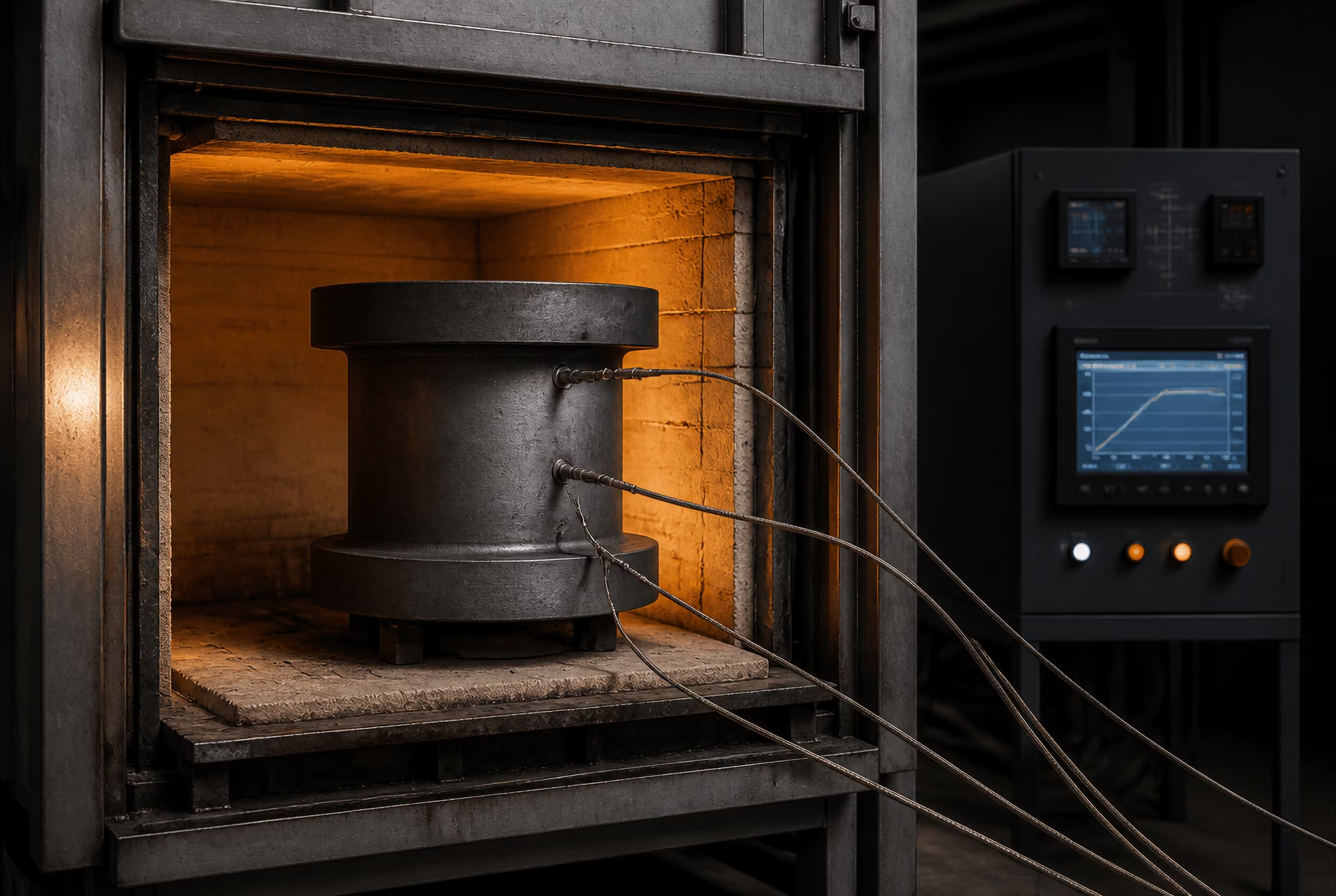
Furnace requirements and temperature control
The furnace must be capable of bringing the complete load to the specified temperature range and holding it there without excessive temperature variation. That requirement is more demanding than showing that one furnace controller displayed the target temperature. A controller commonly measures an atmosphere or furnace-zone temperature, while the steel itself heats more slowly and may be cooler at the centre of a thick section than at its surface. Furnace surveys, working-zone measurements and load thermocouples are used to establish whether the equipment gives acceptable temperature uniformity under the intended operating conditions.
Temperature-sensing equipment requires calibration against a known reference. The applicable procedure normally defines the instrument accuracy, thermocouple type, calibration interval, placement and treatment of failed or drifting sensors. A recorded set point is not equivalent to a verified metal temperature. For thick forgings, large bars and tightly packed loads, the controlling location may be the slowest-heating point rather than the furnace atmosphere. Load arrangement must therefore be specified: parts should not shield one another, obstruct circulation or create a mass that the furnace was not surveyed to handle.
SAE AMSH6875C is useful precisely because it frames heat treatment as a controlled system. It addresses four classes of steel and does not reduce compliance to a single temperature number. Equipment capability, temperature measurement, operating procedure and verification are all part of the process. The relevant product specification still supplies the grade-specific limits. For example, ISO 683-1:2016 gives technical delivery requirements for semi-finished products, bars, wire rod, flat products and forgings made from non-alloy steels for quenching and tempering, including normalized and quenched-and-tempered conditions. The heat treater must apply the required condition to the actual product form and section size.
Furnace atmosphere can also affect compliance. Oxidation, decarburization and carburization may alter the surface chemistry, dimensional allowance and fatigue-sensitive surface layer. A specification may require a controlled atmosphere, protective treatment or subsequent surface removal. The furnace record should identify the equipment, recipe, atmosphere where applicable, temperature readings, alarms and deviations. If a batch was exposed to an uncontrolled excursion, the disposition cannot be inferred from appearance alone.
Procedures, holding time and cooling practice
A heat-treatment procedure should define the sequence, not merely the nominal cycle name. It normally identifies the charge, furnace, heating rate or heating stages where controlled, austenitizing or transformation temperature range, minimum holding time, transfer limits, quench medium, agitation, tempering operation and final cooling method. The required holding period is connected to product geometry and load condition. A thin wire rod coil and a large alloy-steel forging cannot be assumed to reach the same internal temperature at the same time.
Holding begins only when the controlling part of the load has reached the required temperature, unless the governing standard explicitly permits another basis. Starting the timer when the furnace reaches its set point can produce an underheated centre in a heavy section. That error may leave undissolved phases, incomplete transformation or a hardness gradient, even when the chart appears to show a correct cycle.
Quenching is a separate controlled operation. The specification or approved procedure may define water, polymer solution, oil, gas or another medium, together with concentration, temperature, circulation, agitation and contamination limits. Quench delay matters because cooling begins during transfer from furnace to tank. The load must enter the medium within the permitted interval, with sufficient movement or agitation to prevent vapour blankets and uneven cooling. Quench-tank temperature and polymer concentration require measurement; “oil quenched” does not identify the condition of the oil on the day of treatment.
Cooling rate affects more than hardness. It governs the formation of ferrite, pearlite, bainite and martensite, while section size and composition determine how far the required transformation proceeds. Tempering then reduces stresses and adjusts strength, toughness and hardness. A quenched-and-tempered product cannot be represented accurately by its quench temperature alone. ASTM A668/A668M-16 demonstrates the standards approach for forgings by distinguishing annealed, normalized, normalized-and-tempered, quenched-and-tempered, and normalized-quenched-and-tempered delivery conditions. Those labels describe different thermal histories and are not interchangeable.
The specified route may impose additional obligations. DIN EN 10025-6:2023-06 covers hot-rolled flat products of high-yield-strength structural steels supplied in the quenched-and-tempered condition, while BS EN 10025-3:2019 covers hot-rolled weldable fine-grain structural-steel products supplied in the normalized or normalized-rolled condition. A normalized-rolled product is not simply a quenched-and-tempered product with lower hardness; its processing route and resulting microstructure are different. Similarly, ASTM A508/A508M-16 addresses quenched-and-tempered vacuum-treated carbon and alloy steel forgings for pressure-vessel components and requires basic electric-furnace manufacture unless secondary refining or remelting is used. Heat treatment cannot erase a melt-route requirement.
Test methods and documentation
Verification must connect the tested material to the exact heat, product and treatment cycle. Typical evidence includes chemical analysis, hardness, tensile strength, yield strength, elongation, reduction of area, impact testing where specified, metallographic examination and surface or internal inspection. The governing product standard determines which tests are mandatory and where specimens are taken. A specimen machined from a convenient location may not represent the thickest or slowest-cooled region, so sampling location, orientation and distance from the surface must be recorded.
Hardness is useful for process control, but it is not a universal substitute for tensile or impact testing. Two products can show similar hardness while differing in toughness, segregation, grain structure or residual stress. Mechanical tests therefore demonstrate compliance with the stated property requirements, while metallography and process records help explain whether the required structure was produced. Retesting rules, specimen validity, test-machine calibration and laboratory identification also form part of the evidence chain.
The record should identify the material heat or cast, product dimensions, quantity, furnace and load number, procedure revision, operator or system record, temperature chart, thermocouple locations, holding times, quench conditions, tempering cycle, deviations and final disposition. Certificates should cross-reference the test reports rather than present isolated numbers. Traceability must survive cutting, forging, rolling, heat treatment and specimen removal.
Without those records, a certificate stating “normalized” or “quenched and tempered” is an assertion with limited technical support. With controlled equipment, a defined procedure and results tied to the same material identity, the delivery condition becomes demonstrable. That is the difference between a named condition and a verified one.
Surface Condition, Dimensional State and Mechanical Properties
A delivery condition describes more than the name of a steel grade. It links the product form, surface state, dimensional accuracy, heat-treatment condition and specified mechanical properties. Those attributes must still be kept separate. A bar may be supplied in a quenched-and-tempered condition with an as-rolled surface, or in the same broad alloy family after cold finishing and machining. The grade designation may remain unchanged while the inspection results, residual stresses and service response differ.
Manufacturing route is a further distinction. The World Steel Association states that the two main steelmaking routes are the blast furnace-basic oxygen furnace (BF-BOF) route and the electric arc furnace (EAF) route. The integrated route uses iron ore, metallurgical coal, limestone and recycled steel; the EAF route uses primarily recycled steel, direct reduced iron or hot metal and electricity (World Steel Association, 2024). These melt routes influence cleanliness, residual elements and process controls, but they do not by themselves define whether a product is annealed, normalized, quenched and tempered, cold finished or machined.
After casting, slabs, billets and blooms are rolled into flat and long products. That sequence establishes much of the product’s shape and texture, but the final delivery condition may require additional thermal, mechanical or surface operations.
As-rolled, machined, descaled and finished surfaces
“As-rolled” normally identifies a surface retained from hot rolling, not a complete heat-treatment description. The surface may carry mill scale, an oxide layer formed at elevated temperature. Its appearance and thickness depend on reheating, rolling temperature, cooling, steel chemistry and time before descaling. A plate can therefore be as-rolled and normalized, or as-rolled and supplied in another specified thermal state, provided the applicable product standard permits that combination.
Descaling removes some or all mill scale by water-jet treatment, shot blasting, pickling or another defined process. It changes the surface presented for visual inspection, coating, welding or ultrasonic examination. It does not automatically normalize, quench or temper the bulk steel. Severe or poorly controlled descaling can expose laps, seams or rolled-in scale that were previously obscured; that is an inspection effect, not necessarily a newly created material defect.
Machining removes material and can produce a controlled diameter, flatness, profile or roughness. It may also remove surface decarburization, scale and shallow discontinuities. A machined bar is not a different grade merely because its surface has been cut. However, machining can expose subsurface indications, reduce the section available for proof testing and create local tensile stresses or heat-affected marks if cutting parameters are unsuitable. Grinding may introduce local heating, burns or directionally oriented surface damage, while turning can leave tool marks that act as stress raisers in fatigue service.
Cold finishing includes cold drawing, peeling, turning, grinding or combinations of these operations, depending on the product standard. Unlike simple cleaning, cold deformation can raise yield strength and hardness, reduce elongation, alter dimensional accuracy and leave residual stress. A cold-finished product can thus retain the same nominal steel designation while having different properties from a hot-rolled product made from the same heat. ISO 683-1:2016 treats surface condition and heat-treatment condition as separate parts of the technical delivery requirements for semi-finished products, bars, wire rod, flat products and forgings made from non-alloy steels for quenching and tempering.
The specified surface condition also determines what an inspection can prove. Visual examination of bright, machined steel differs from examination through mill scale. Surface roughness affects coating thickness measurements, contact hardness tests and crack detection. For a safety-critical component, the certificate should identify the supplied surface state rather than leaving “finished” to interpretation.
Dimensional tolerances and residual stress
Dimensional state concerns size, shape and permitted deviation: thickness, diameter, width, length, straightness, flatness, ovality and profile. It is not a synonym for surface finish or heat treatment. Hot rolling commonly produces wider dimensional variation than machining or cold drawing because the product contracts during cooling and because roll-gap, temperature and crown controls have finite limits. Cold finishing can tighten tolerances, but it may also produce curvature, uneven plastic strain or anisotropic dimensional change.
Heat treatment can move dimensions as well. Quenching introduces non-uniform thermal contraction and phase transformation; martensite formation occupies a different volume from the parent austenite, and differences between the surface and core can distort a part. Tempering reduces some of the stresses created by quenching but does not guarantee a stress-free product. Normalizing can refine and reset the structure after hot working, yet cooling differences across a thick section may still produce dimensional variation.
Residual stress is locked-in stress that remains after the external load or processing force is removed. It can result from rolling, straightening, cold drawing, machining, welding, grinding or uneven heat treatment. The stress may be tensile at the surface and compressive below it, or the reverse. A part can meet dimensional tolerance at inspection and still distort when material is removed, when a coating is cured, or when the component is welded. Conversely, stress-relief treatment can improve dimensional stability without changing the grade designation.
Tolerance requirements therefore belong in the order and inspection specification, not as an assumption based on the steel name. A plate supplied to BS EN 10025-3:2019 in the normalized or normalized-rolled condition has technical delivery requirements that include more than chemical composition. A quenched-and-tempered flat product under DIN EN 10025-6:2023-06 is likewise governed by dimensional, surface and mechanical requirements in addition to its specified thermal condition.
Hardness, strength, ductility and toughness
Hardness is resistance to indentation or, in some tests, penetration and rebound. Tensile strength is the maximum engineering stress reached in a tensile test; yield strength describes the onset of specified permanent deformation. Elongation and reduction of area indicate ductility. Toughness concerns resistance to fracture, commonly assessed through impact testing at a stated temperature and specimen orientation. These properties overlap, but none can substitute for all the others.
Quenching generally increases hardness and strength by producing martensitic or mixed transformation products. Tempering lowers some of that hardness while improving ductility and toughness. Annealing usually reduces strength and hardness and promotes a more workable structure. Normalizing produces a ferritic-pearlitic structure in many carbon and low-alloy steels, with properties affected by carbon content, section size and cooling rate. A normalized-rolled condition can achieve specified properties through controlled rolling and cooling without being identical in history to a separately normalized product.
The delivery designation must therefore be read with its test requirements. ASTM A668/A668M-16 classifies carbon and alloy steel forgings as annealed, normalized, normalized-and-tempered, quenched-and-tempered, or normalized-quenched-and-tempered. ASTM A434/A434M-24 covers hot-wrought and cold-finished quenched-and-tempered alloy steel bars, so the words “cold-finished” and “quenched-and-tempered” describe different parts of the condition. SAE AMSH6875C adds controlled requirements for furnace equipment, procedures, temperatures and test methods across four classes of steel.
Hardness or tensile strength alone cannot identify the complete microstructure or process history. A tempered martensitic steel and another structure may show similar hardness at one location, while differing in impact toughness, residual stress, cleanliness or response to welding. Test temperature, specimen orientation, section location and sampling frequency matter. For pressure-vessel forgings, ASTM A508/A508M-16 requires basic electric-furnace manufacture unless secondary refining or remelting is used, showing that delivery compliance can include a defined manufacturing route as well as heat treatment and mechanical tests. The certificate is meaningful only when all of these linked conditions are read together.
Weldability, Toughness and Service-Temperature Reasoning
A delivery condition is not a supplier’s informal description of the material. It records a controlled combination of product form, chemical limits, manufacturing route, heat-treatment state, surface condition and specified mechanical properties. Those details matter when steel is welded, because the parent plate and the weld heat-affected zone (HAZ) experience different thermal cycles. Two products from the same broad structural-steel family can therefore require different welding controls and can respond differently to restraint, cooling rate and service temperature.
The manufacturing route is one variable, but it is not the delivery condition itself. The World Steel Association identified the blast-furnace/basic-oxygen-furnace (BF-BOF) route and the electric-arc-furnace (EAF) route as the two main steelmaking routes in 2024. The integrated route uses iron ore, metallurgical coal, limestone and recycled steel; the EAF route uses primarily recycled steel, direct-reduced iron or hot metal and electricity. The U.S. Environmental Protection Agency separately described the basic oxygen process as refining molten blast-furnace iron with scrap, while treating EAF production as a separate steelmaking route. After casting, slabs, billets or blooms may be rolled into flat or long products. The route influences residual elements, cleanliness and segregation, but the applicable product standard still determines what has to be supplied and verified.
Fine-grain structural steels and welding
BS EN 10025-3:2019 is a useful structural-steel example because it covers hot-rolled flat and long products of weldable fine-grain structural steels supplied in the normalized or normalized-rolled condition. Its grades include designations such as S275N, S355N, S420N and S460N, with corresponding low-temperature qualities such as S275NL, S355NL, S420NL and S460NL. The suffix is not decorative. It identifies a specified delivery and toughness category, while the product thickness and quality designation affect the applicable requirements.
Normalizing, or controlled normalizing rolling where permitted, refines the ferritic-pearlitic grain structure and establishes a known starting condition for fabrication. Fine grain size generally supports a useful combination of yield strength, weldability and Charpy toughness. It does not remove welding risk. The HAZ may contain a coarse-grained region next to the fusion boundary, a zone of altered transformation products, and areas that have been tempered or softened by the welding cycle. The maximum temperature, time above critical transformation ranges, cooling rate and subsequent reheating determine those regions.
Carbon equivalent A calculated index that combines carbon and selected alloying elements to estimate hardenability and welding-related cracking tendency.
Carbon equivalent and hydrogen control are central to procedure selection. A higher hardenability tendency, excessive restraint, a cold plate or hydrogen-bearing consumables can promote hydrogen-assisted cold cracking, especially in the HAZ or weld root. Preheating reduces the cooling rate and helps hydrogen diffuse from the joint; interpass-temperature limits prevent excessive grain growth and loss of toughness. Heat input must be controlled in both directions. Too little heat can produce hard, crack-sensitive regions, whereas too much can enlarge the coarse-grained HAZ and reduce toughness.
The term “weldable” describes a general capability under specified conditions. It is not a guarantee that every joint, thickness, process or welder will meet its acceptance criteria. A welding procedure qualification must establish the relevant variables: joint design, process, consumable classification, heat input, preheat, interpass temperature, plate thickness, restraint and any post-weld heat treatment. The delivery condition matters because a procedure qualified on normalized S355N is not automatically transferable to quenched-and-tempered S690Q, even if both are called structural steels.
Dimensional restraint adds another layer. A thick, highly constrained assembly cannot contract freely as weld metal solidifies and the HAZ cools. Residual stress, angular distortion and local plastic strain can be greater than in a lightly restrained test coupon. Product thickness, rolling direction, joint sequence and fit-up therefore belong in fabrication planning, not just in the material certificate.
Quenched-and-tempered steels in loaded structures
Quenched-and-tempered (Q&T) steels obtain their delivery properties through a deliberate sequence: austenitizing, rapid cooling and tempering. Quenching creates hard transformation products, while tempering reduces brittleness and adjusts strength, ductility and toughness. DIN EN 10025-6:2023-06 covers hot-rolled flat products of high-yield-strength structural steels supplied in the quenched-and-tempered condition. Designations such as S690Q, S690QL and S690QL1 distinguish strength and impact-toughness categories at defined test temperatures.
The same heat that makes Q&T steel strong can disturb its properties locally during welding. A HAZ heated above the transformation range may re-form hard martensitic or bainitic constituents on cooling. A region heated below that range may be tempered again and lose hardness and yield strength. In a highly loaded member, that softened band can govern local deformation even though the parent plate retains its certified strength. A procedure qualification must therefore test the actual combination of steel grade, thickness and welding thermal cycle, rather than infer performance from the parent-metal certificate.
Heat input, interpass temperature and preheat need particular control. Excessive heat input may reduce HAZ toughness or create an unacceptable softened zone; insufficient heat input and rapid cooling may produce hard, hydrogen-sensitive microstructures. Post-weld heat treatment can further temper the HAZ and weld metal, but it is not a universal repair for an unsuitable procedure. It can also alter strength and dimensional accuracy.
Q&T delivery is not equivalent to the manufacturing route. ASTM A434/A434M-24 permits open-hearth, basic-oxygen or electric-furnace melt processing for specified quenched-and-tempered alloy steel bars, while ASTM A668/A668M-16 classifies forgings by delivery heat treatment, including annealed, normalized, normalized-and-tempered, quenched-and-tempered and normalized-quenched-and-tempered conditions. These examples show why “alloy steel” or “EAF steel” alone does not identify the mechanical or welding condition. ISO 683-1:2016 likewise defines technical delivery requirements for semi-finished products, bars, wire rod, flat products and forgings supplied in specified heat-treatment and surface conditions.
Impact testing, thickness effects and qualification
Charpy impact testing is a defined test at a defined temperature; it is not a universal promise of toughness at every service temperature. A grade with an “L” quality designation under BS EN 10025-3:2019 has a different specified impact-testing category from the corresponding “N” quality. The designer must connect that category to the lowest metal temperature, stress state, strain rate, plate thickness and consequence of fracture.
Thickness changes both the material’s thermal history and the structural demand. A thick plate cools differently from a thin plate after rolling, normalizing or welding. It can contain greater segregation through the section, develops higher restraint in a joint, and may show different toughness between surface and mid-thickness locations. Welding a 100 mm plate with a high heat input and multiple reheats is not metallurgically equivalent to welding a 12 mm plate with the same nominal grade. The qualification range, impact-test location, sampling direction and acceptance energy must therefore follow the governing product and welding standards.
Thermal history also includes reheating during subsequent weld passes, tack welds, repairs and local flame straightening. Each cycle can refine, coarsen or temper part of the HAZ. For Q&T steel, repeated heating may reduce strength; for normalized fine-grain steel, excessive exposure can impair grain refinement. Qualification testing has to represent the maximum credible heat input, the lowest and highest interpass temperatures and the relevant thickness range. That is why a material certificate cannot replace a welding procedure qualification.
Service-temperature reasoning should finish with the actual structure, not the grade name. Confirm the delivery condition, thickness, specified impact temperature, weld procedure, HAZ toughness evidence and restraint level. Only then can a stated grade be connected credibly to the loads and temperatures the fabrication will experience.
Pressure-Vessel Forgings and Why ASTM A508/A508M Is Different
ASTM A508/A508M-16 is not simply a designation for a carbon or alloy steel with a specified chemistry. Its title identifies a controlled combination of product form, service application, heat-treatment state and steelmaking practice: quenched-and-tempered vacuum-treated carbon and alloy steel forgings for pressure-vessel components. That combination is the point.
A forging made from an alloy-steel family can therefore meet one delivery condition while failing another. The same broad chemistry does not establish whether the steel was vacuum treated, forged into the required shape, quenched and tempered, or accepted against pressure-vessel requirements. Those are separate technical questions, and ASTM A508/A508M-16 joins them in one application-specific specification.
Scope of vacuum-treated pressure-vessel forgings
ASTM A508/A508M-16 addresses forged components used in pressure-vessel construction. The product is not a generic bar later machined into a component; it is a forged carbon or alloy steel pressure-containing part supplied in the quenched-and-tempered condition and subject to vacuum-treatment provisions. The route and delivery condition are consequently part of the specification’s technical identity.
Forging changes the shape and usually the internal working pattern of the steel, but it does not by itself establish the final mechanical properties. Those properties depend on composition, reduction during forging, section size, cooling, quenching, tempering and the location from which qualification specimens are taken. A large pressure-vessel forging also presents a much greater through-section hardenability problem than a small bar. The surface may cool rapidly while the centre cools more slowly, producing different transformation products and different toughness across the section if the heat treatment is not designed and controlled for the component.
Vacuum treatment addresses another part of the risk. Reducing dissolved gases and controlling non-metallic inclusions can matter greatly when a thick forging must retain toughness and withstand cyclic or high-pressure service. The requirement is not a claim that every inclusion is eliminated, nor does it replace forging or heat treatment. It is an additional control on the molten-steel condition before the forging reaches its final delivery state.
This is why “quenched and tempered” alone is insufficient to describe an A508/A508M forging. ASTM A668/A668M-16, a broader forging specification, classifies forgings by delivery heat treatment, including annealed, normalized, normalized-and-tempered, quenched-and-tempered, and normalized-quenched-and-tempered conditions. That classification tells the user how the forging was heat treated. A508/A508M adds application-specific requirements concerning vacuum treatment and the permitted manufacturing route.
The distinction also appears in other standards. ISO 683-1:2016 specifies technical delivery requirements for semi-finished products, bars, wire rod, flat products and forgings supplied in defined heat-treatment and surface conditions. DIN EN 10025-6:2023-06 covers hot-rolled flat products of high-yield-strength structural steels supplied in the quenched-and-tempered condition. Neither reference turns an ordinary structural product into a pressure-vessel forging. Product form, service category and specified route remain decisive.
Basic electric-furnace manufacture and permitted alternatives
ASTM A508/A508M-16 requires manufacture by the basic electric-furnace process, unless an accepted secondary refining or remelting process is used. This wording is a route control, not a statement that all electric furnaces produce identical steel. Furnace practice, charge materials, refining, deoxidation, vacuum treatment, casting and subsequent forging still affect cleanliness and internal quality.
The World Steel Association identifies two principal steelmaking routes: the blast-furnace/basic-oxygen-furnace route and the electric-arc-furnace route. Its 2024 raw-materials description distinguishes their inputs: the integrated route uses iron ore, metallurgical coal, limestone and recycled steel, whereas the electric-arc-furnace route uses primarily recycled steel, direct-reduced iron or hot metal and electricity. The U.S. Environmental Protection Agency likewise distinguishes the basic oxygen process, which refines molten blast-furnace iron with scrap, from the separate electric-arc-furnace process.
That route distinction must not be confused with the later manufacturing steps. Continuous casting transforms molten steel into slabs, billets and blooms, which are then rolled into flat and long products, according to the World Steel Association. A pressure-vessel forging instead requires a suitable cast product followed by sufficient working and a controlled forging operation. Heat treatment comes after, or partly alongside, those forming operations; it is not another name for the electric-furnace route.
A508/A508M’s wording permits alternatives through secondary refining or remelting rather than treating every possible primary melt route as equivalent. Secondary refining may further control composition, gases and inclusions after the initial melt. Remelting processes produce a new ingot from previously made steel and can impose additional control over segregation and cleanliness. The standard’s structure therefore says, in effect, that a different primary route can be acceptable only when the specified refining or remelting condition provides the required technical basis.
The requirement should not be transplanted to every steel product. ASTM A434/A434M-24, for example, covers hot-wrought and cold-finished quenched-and-tempered alloy steel bars and identifies open-hearth, basic-oxygen and electric-furnace production as permitted melt-processing routes. A bar specification can permit those alternatives because its scope, product geometry, service assumptions and acceptance provisions differ. A508/A508M is narrower because a pressure-vessel forging has a different consequence of internal discontinuities, segregation or inadequate through-thickness properties.
Why application-specific standards impose route controls
Pressure-vessel components are not judged only by nominal yield strength and tensile strength. Their failure can involve brittle fracture, fatigue, stress concentration, weld interaction, hydrogen-related damage or a leak-before-break assumption that depends on verified material behaviour. Route controls help constrain the causes that chemistry and tensile testing alone may miss.
For an A508/A508M forging, the specified route works with the forging reduction, vacuum treatment and quenched-and-tempered cycle. The result is a delivery condition with several linked layers: a forged product form; a controlled melt and refining history; a vacuum-treated steel; and a defined heat-treatment state. Remove one layer and the description changes.
That logic explains why a supplier label such as “forged alloy steel, quenched and tempered” is technically incomplete. It may identify the shape and heat treatment while saying nothing about vacuum treatment or the permitted melt route. Conversely, “electric-furnace steel” says something about primary manufacture but not whether the component was forged, quenched and tempered, or accepted under a pressure-vessel specification.
Route controls are therefore justified where the application makes internal quality and traceability safety-critical. They should not be generalized to ordinary bars, plate or structural products merely because those products may share alloying elements or a quenched-and-tempered condition. BS EN 10025-3:2019 concerns normalized or normalized-rolled weldable fine-grain structural-steel products, while DIN EN 10025-6:2023-06 concerns quenched-and-tempered structural flat products. Their delivery conditions answer different service and manufacturing questions.
ASTM A508/A508M-16 is different because it treats the manufacturing route as part of the pressure-vessel material requirement. The steel is defined not by grade chemistry alone, but by what it is, how it was made, how it was treated and where it is intended to function.

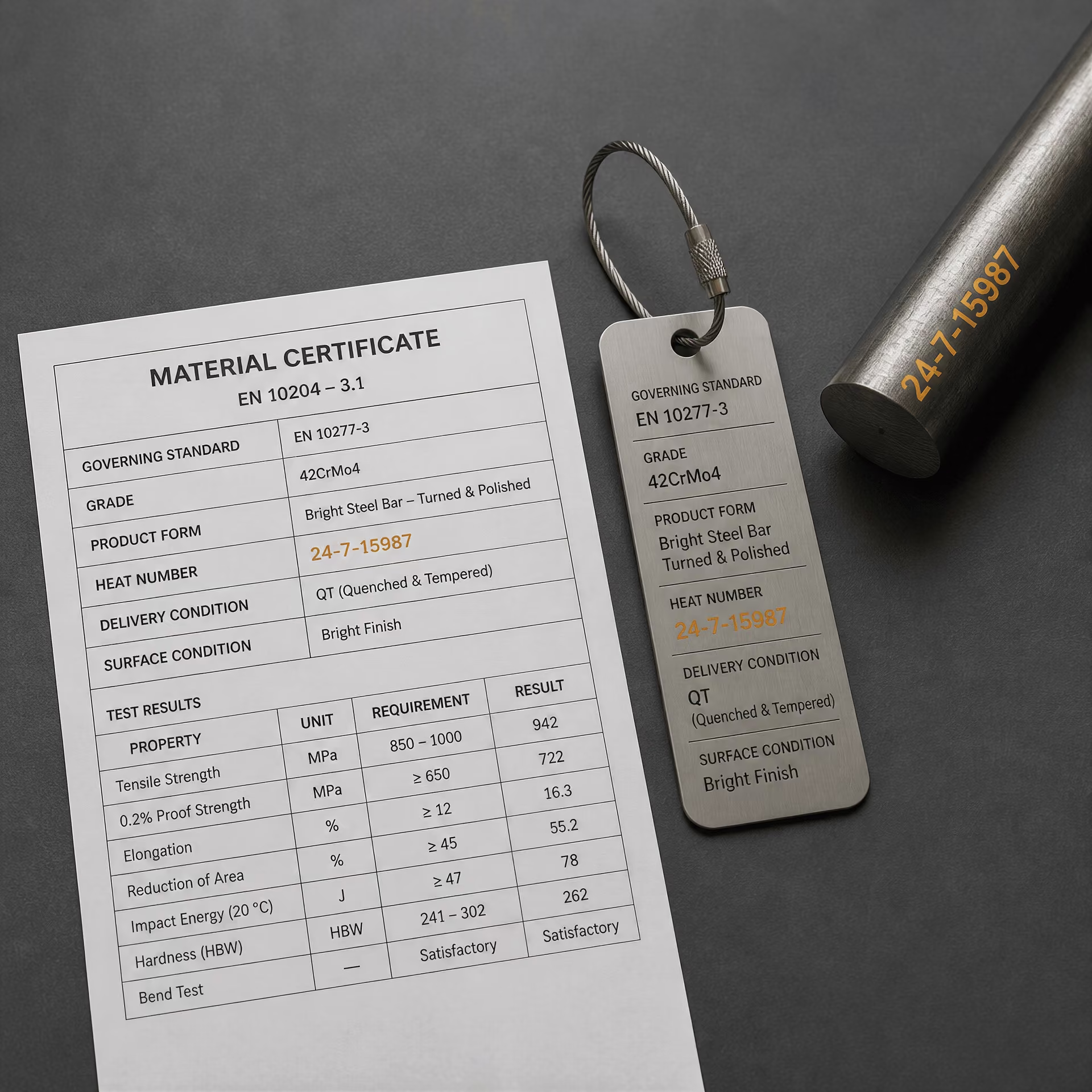
How to Read a Material Certificate and Standard Citation
A material certificate is not a standalone description of steel. It is evidence that a particular product, identified by grade, dimensions and heat or cast number, was supplied against defined requirements. Read it alongside the cited product standard and its edition. “S355N to EN 10025-3” does not carry the same meaning as “S355J2+N to EN 10025-2,” and “42CrMo4 +QT” is not interchangeable with the same grade supplied in an annealed condition.
Grade, product standard and delivery condition
Start by identifying the governing product standard, its publication year or amendment status, and the grade designation exactly as written. The standard controls the chemical limits, permitted product forms, delivery conditions, mechanical requirements, dimensions or tolerances, inspection provisions and any supplementary clauses. A certificate that names only a grade, such as S690Q or 42CrMo4, is incomplete for technical interpretation because the same grade may be covered by different product standards or supplied in different forms.
Next identify the product form. “Plate,” “flat product,” “bar,” “wire rod,” “forging,” “billet” and “seamless tube” describe different product categories, with different testing and dimensional rules. Continuous casting produces semi-finished slabs, billets and blooms; these are then processed into flat or long products, as described by the World Steel Association in 2024. A certificate for a rolled plate therefore does not automatically establish compliance for a forged ring made from steel of similar composition.
The delivery condition is a standards-defined state, not a supplier’s general description. It can combine product form, surface state, heat treatment and mechanical requirements. ISO 683-1:2016 specifies technical delivery requirements for semi-finished products, bars, wire rod, flat products and forgings made from non-alloy steels for quenching and tempering, including normalized and quenched-and-tempered conditions. The notation “+N” generally identifies normalized or normalized-rolled material where the applicable standard defines it; “+QT” identifies quenched-and-tempered material. The precise meaning still comes from the cited standard.
BS EN 10025-3:2019 covers hot-rolled flat and long products of weldable fine-grain structural steels supplied in the normalized or normalized-rolled condition, including grades such as S275N and S355N. DIN EN 10025-6:2023-06 covers hot-rolled flat products of high-yield-strength structural steels supplied in the quenched-and-tempered condition, including designations such as S690Q. These are not merely alternative labels for one supply state. Normalizing, normalizing rolling, quenching and tempering produce different microstructures and therefore different strength, toughness and fabrication limits.
Record the nominal thickness, width, length or diameter, and whether the certificate reports nominal or actual dimensions. Thickness can affect both the specified mechanical values and the sampling location. Surface condition also needs a separate reading: as-rolled, descaled, machined, peeled or ground can have different implications for defects, dimensional inspection and later processing. Do not infer surface quality from a heat-treatment suffix.
Melt route, heat number and traceability
The manufacturing route is a separate field from delivery condition. The World Steel Association identifies two principal steelmaking routes: the blast-furnace/basic-oxygen-furnace route and the electric-arc-furnace route. In its 2024 raw-materials description, the integrated route uses iron ore, metallurgical coal, limestone and recycled steel, whereas the electric-arc-furnace route uses primarily recycled steel, direct-reduced iron or hot metal and electricity. The U.S. Environmental Protection Agency described the basic oxygen process as refining molten blast-furnace iron with scrap, while treating the electric-arc-furnace process as a separate steelmaking route.
A certificate may identify the furnace process, secondary refining, vacuum treatment, electroslag remelting or another route qualification. Do not treat these entries as proof of a heat-treatment condition. ASTM A434/A434M-24 permits open-hearth, basic-oxygen and electric-furnace production for its covered hot-wrought and cold-finished quenched-and-tempered alloy steel bars. ASTM A508/A508M-16, by contrast, requires basic electric-furnace manufacture unless secondary refining or remelting is used. Those clauses impose route requirements because the product standard says so; they do not mean that every quenched-and-tempered steel must be electric-furnace melted.
The heat number, cast number or melt identification is the link between the certificate and the physical material. It should appear on the certificate, product marking, bundle tag, forging documentation or material-control record. Traceability may pass through several identifiers: furnace heat, continuous-cast strand or cast, slab or billet, rolling batch, forging charge and final piece number. Check that the chain is continuous. A test result from heat H1234 cannot be assigned to heat H1235 merely because both carry the same grade and were processed on the same day.
Where the certificate states “ladle analysis,” “product analysis” or “check analysis,” read the term carefully. Ladle analysis represents the reported composition of the molten heat; product analysis is taken from the finished product and may have different permitted deviations. Carbon, manganese, silicon, chromium, nickel, molybdenum, phosphorus, sulfur, nitrogen and microalloying elements should be compared with the limits in the cited standard, not with a generic grade table from another edition.
Mechanical tests, heat treatment and acceptance criteria
Separate the recorded result from the acceptance requirement. A certificate may show yield strength, tensile strength, elongation, impact energy, hardness, reduction of area or a non-destructive examination result. Each value needs its test direction, specimen location, thickness range, test temperature, unit and standard method. For example, an impact result of 40 J is not interpretable without knowing whether it is Charpy V-notch energy at 0 °C, −20 °C or another specified temperature.
Check whether the result is a measured value or a statement of conformity, and whether the standard requires testing of every heat, every batch, every forging or a defined sample. Acceptance can depend on the minimum yield strength, tensile-strength range, minimum elongation, impact-energy average and individual minimum, hardness range, or permitted retest procedure. “Pass” is useful only when the applicable criteria are visible or clearly referenced.
The heat-treatment record should identify the condition, furnace or equipment, batch, treatment dates where required, temperatures, holding time, cooling method and tempering details. SAE AMSH6875C sets requirements for steel heat treatment that include furnace equipment, procedures, temperatures and test methods. ASTM A668/A668M-16 classifies forgings by delivery heat treatment, including annealed, normalized, normalized-and-tempered, quenched-and-tempered, and normalized-quenched-and-tempered conditions. These categories describe what was done to the forging before delivery; they do not identify whether the steel was made by BOF or EAF.
Finally, inspect supplementary requirements. They may cover ultrasonic testing, through-thickness tensile testing, impact testing, grain size, cleanliness, weldability controls, hardness mapping, surface inspection or restricted residual elements. Such requirements are often invoked by a purchase specification or an additional clause rather than by the grade name itself. The certificate is technically meaningful only when grade, product standard and edition, product form, dimensions, delivery condition, route statement, heat identification, treatment record and test evidence all refer to the same material.
Common Misreadings and a Standards-Based Comparison Framework
Why EAF does not mean one universal material behavior
“EAF steel” identifies a steelmaking route, not a finished property set. The World Steel Association states that the two main steelmaking routes are the blast furnace–basic oxygen furnace (BF–BOF) route and the electric arc furnace (EAF) route. It also distinguishes their principal inputs: the integrated route uses iron ore, metallurgical coal, limestone and recycled steel, whereas the EAF route uses primarily recycled steel, direct-reduced iron (DRI), hot metal and electricity.
That distinction matters, but it does not predict the final delivery condition by itself. An EAF charge made mainly from recycled steel can carry residual elements such as copper, tin or chromium that differ from those in a charge based largely on DRI. Scrap selection, dilution with DRI or hot metal, furnace practice, oxygen injection, slag control, secondary refining and vacuum treatment all affect the resulting chemistry and cleanliness. A producer may also cast the steel into slabs, billets or blooms and then apply different reductions, cooling schedules and finishing operations. The World Steel Association describes this sequence directly: continuous casting produces semi-finished slabs, billets and blooms, which are subsequently rolled into flat and long products.
The EAF route therefore does not dictate whether a product is ductile, coarse-grained, inclusion-sensitive, weldable or suitable for a specified fatigue duty. Those outcomes depend on grade chemistry, residual-element limits, nitrogen and hydrogen control, casting and reduction practice, grain refinement, product dimensions and heat treatment. The U.S. Environmental Protection Agency made the route distinction clearly in 1995: basic oxygen steelmaking refines molten blast-furnace iron with scrap, while EAF steelmaking is a separate process. That statement separates the route from later product qualification; it does not create an EAF material category with universal behavior.
Standards can also treat route differently. ASTM A434/A434M-24 permits open-hearth, basic-oxygen and electric-furnace melt-processing routes for specified quenched-and-tempered alloy steel bars, subject to the standard’s other requirements. By contrast, ASTM A508/A508M-16 requires basic electric-furnace manufacture for the covered pressure-vessel forgings unless secondary refining or remelting is used. The route is therefore a compliance variable where the standard says it is, but it remains only one variable. A mill certificate stating “EAF” cannot substitute for the specified grade, product form, dimensions, heat-treatment condition and test results.
Why normalized is not the same as quenched and tempered
Normalized and quenched-and-tempered describe metallurgical delivery conditions, not alternative names for the same treatment. In normalizing, steel is heated above the relevant transformation range and cooled in still air. The treatment refines or resets the ferritic-pearlitic structure and reduces some effects of prior rolling or forging. The resulting strength and toughness depend on carbon equivalent, alloy content, section thickness and cooling conditions.
Quenching is different. The steel is heated to form austenite and then cooled rapidly enough to produce a substantially harder transformation product, commonly martensite or a martensite–bainite mixture. Tempering follows to reduce quench stresses and adjust hardness, strength and toughness. The final structure is consequently not the same as that produced by normalizing, and the two conditions should not be interchanged in a specification or fabrication procedure.
A third term causes repeated confusion: normalized-rolled. Under a normalized-rolling schedule, the final rolling passes are controlled so that the resulting condition resembles normalized steel, although the product may not receive a separate full furnace normalizing treatment. Temperature, reduction and finishing-pass control are part of the route. “Normalized” and “normalized-rolled” are related delivery descriptions, but they are not identical process statements.
BS EN 10025-3:2019 covers hot-rolled flat and long weldable fine-grain structural-steel products supplied in the normalized or normalized-rolled condition. That wording is deliberate. It defines a family of permitted delivery conditions alongside specified grades, qualities and thicknesses up to 250 mm; it does not imply that every product in the family received the same thermal history.
Quenched-and-tempered products are governed by a different property logic. DIN EN 10025-6:2023-06 covers hot-rolled flat products of high-yield-strength structural steels supplied in the quenched-and-tempered condition. The specified strength is obtained through hardening and tempering, with thickness-dependent requirements and corresponding limits on welding, forming and repair heating. A normalized grade with a similar nominal yield strength is not automatically a substitute, because the microstructure, hardness distribution, through-thickness behavior and heat-affected-zone response can differ.
ASTM A668/A668M-16 shows why the delivery wording must be read precisely. It classifies carbon and alloy steel forgings as annealed, normalized, normalized-and-tempered, quenched-and-tempered, or normalized-quenched-and-tempered. These are separate classifications, not stylistic variations. ISO 683-1:2016 likewise specifies technical delivery requirements for semi-finished products, bars, wire rod, flat products and forgings in defined heat-treatment and surface conditions. “Heat treated” is too vague when the governing standard distinguishes these states.
Why equivalent grades are not automatically equivalent deliveries
A grade designation generally controls chemistry and a set of mechanical or technological requirements. It does not always identify the complete product that arrives at fabrication. Two documents may name chemically comparable steels while differing in product form, thickness range, delivery heat treatment, surface condition, sampling location, test temperature, impact-test frequency, ultrasonic examination or permitted manufacturing route.
Product form is the first check. A plate, bar, forging and wire rod do not develop the same deformation history or property uniformity, even when their nominal chemistry is close. Thickness is also decisive: cooling rates and segregation effects change with section size, so a requirement established for a 20 mm plate cannot automatically be applied to a 180 mm forging.
The delivery condition must then be matched exactly. A normalized product, a normalized-rolled product and a quenched-and-tempered product can carry similar yield-strength numbers while having different hardness, toughness and welding restrictions. Surface condition matters as well. “As-rolled,” descaled, machined, cold-finished and forged surfaces impose different assumptions about decarburization, scale, dimensional tolerance and inspection.
Testing provisions can defeat a casual equivalence claim. Check whether tensile and impact tests are mandatory, where specimens are taken, which orientation is used, and whether testing is performed per heat, lot, forging or thickness range. ISO 683-1:2016, BS EN 10025-3:2019, DIN EN 10025-6:2023-06 and the ASTM forging standards each attach requirements to defined product categories rather than to chemistry alone.
Material-comparison checklist
- Route Record the melt and refining route where required.
- Product form Identify plate, bar, wire rod, forging or another form.
- Heat treatment State annealed, normalized, normalized-rolled, quenched-and-tempered or another defined condition.
- Surface and dimensions Record finish, thickness, diameter, tolerances and section size.
- Testing Match tensile, impact, hardness, inspection and sampling requirements to the governing standard.
- Evidence Link the certificate, heat number, treatment record and test report to the physical product.
A practical comparison matrix should therefore place manufacturing route in one column, but never leave it as the deciding column. The remaining columns should identify product form and size range, grade and governing standard, delivery heat treatment, surface condition, mechanical and impact requirements, supplementary inspection, and verification evidence such as the heat number, treatment record, test report and conformity statement. The final comparison should read across the complete row: route → product form → heat treatment → standard and grade → testing and surface requirements → documented evidence. Only then can two nominally similar deliveries be judged technically comparable.
References
- [1] Standard Specification for Steel Forgings, Carbon and Alloy, for General Industrial Use. ASTM A668/A668M-16, 2016. https://store.astm.org/a0668_a0668m-16.html
- [2] Standard Specification for Quenched and Tempered Alloy Steel Forgings for Pressure Vessel Components. ASTM A508/A508M-16, 2016. https://store.astm.org/a0508_a0508m-16.html
- [3] Heat-treatable steels, alloy steels and stainless steels — Part 1. ISO 683-1:2016, 2016. https://www.iso.org/standard/70642.html
- [4] Steelmaking process. World Steel Association technical resource, 2024. https://worldsteel.org/about-steel/steelmaking-process/
- [5] Steelmaking process. World Steel Association technical resource, 2024. https://worldsteel.org/about-steel/steelmaking-process/
- [6] Hot rolled products of structural steels — Part 6. DIN EN 10025-6:2023-06, 2023. https://www.dinmedia.de/en/standard/din-en-10025-6/366216503