



What a Heat-Treatment Atmosphere Actually Controls

Atmosphere as a chemical boundary condition
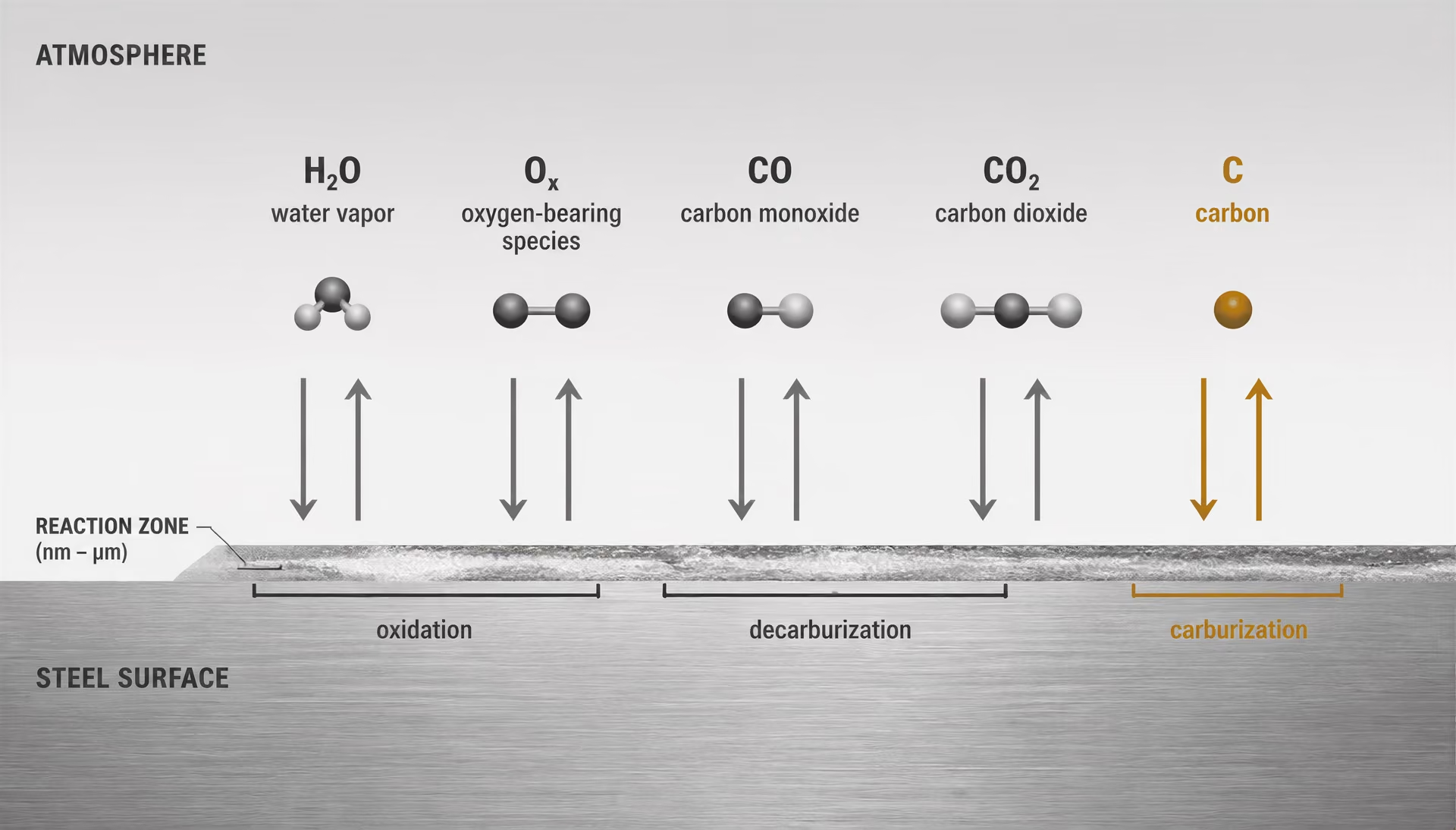
A heat-treatment atmosphere is not simply the gas occupying the furnace. It is the reactive environment at the steel surface while the load is heated, held, and cooled. Its composition establishes the chemical boundary condition against which oxidation, reduction, carburization, decarburization, and other surface reactions proceed. The steel responds to that local environment, not to the furnace controller’s temperature reading alone.
Reactive atmosphere constituents
- Oxygen-bearing species
- Can form iron oxides and produce scale.
- Water vapor
- Can accelerate oxidation and contribute to carbon loss.
- Carbon monoxide
- Participates in carbon-transfer equilibria.
- Carbon dioxide
- Can alter carbon potential and promote decarburization under suitable conditions.
- Hydrogen
- Influences reduction behavior and oxygen potential.
- Methane
- Can contribute carbon under carburizing conditions.
At elevated temperature, gases exchange atoms with the surface. Oxygen-bearing species can form iron oxides and produce scale. Water vapor can accelerate oxidation and contribute to carbon loss. Carbon-bearing species can either replenish carbon at the surface or remove it, depending on the balance between the gas reactions and the carbon activity in the steel. Carbon dioxide, carbon monoxide, hydrogen, methane, oxygen, and water vapor therefore matter as reacting species, not merely as labels for a “protective” gas.
Oxidation produces scale, while loss of carbon from surface layers produces decarburization. Strong evidence
The U.S. Department of Commerce, National Bureau of Standards handbook Heat Treatment and Properties of Iron and Steel (1966) identifies the two primary surface risks directly: oxidation produces scale, while loss of carbon from the surface layers produces decarburization. It also describes water vapor in combustion products as detrimental. Those effects are connected but not identical. A surface may show little visible scale and still have an altered carbon profile. Conversely, a part can retain much of its carbon while carrying an oxide film that interferes with dimensional control, inspection, welding, or subsequent finishing.
Carbon potential The carbon activity imposed by an atmosphere at a specified temperature, indicating whether carbon tends to enter or leave the steel surface.
Carbon potential is the practical expression of the atmosphere’s tendency to add or remove carbon from austenitic steel at a stated temperature. If the gas has a lower effective carbon activity than the steel surface, carbon diffuses outward and decarburization develops. If the gas has a higher effective carbon activity, carbon enters the surface and carburization may occur. When the two activities are balanced, the atmosphere is approximately neutral with respect to carbon transfer, although the result still depends on time, temperature, alloy composition, gas flow, and surface condition.
ASM International’s Furnace Atmospheres for Heat Treating material treats gas reactions, principal gases and vapors, and atmosphere-related steel decarburization as central heat-treating subjects. ASM Handbook Volume 4B also describes carbon-potential control through measurements or relationships involving water vapor, carbon dioxide, and oxygen partial pressure. This is why a carbon-potential setpoint is not a substitute for atmosphere measurement. The relevant chemical state may be inferred from several monitored variables, but those variables must describe the gas actually reaching the load.
The surface response can continue during cooling. Austenitizing in a suitable atmosphere does not guarantee a clean surface if the load passes through an oxidizing or decarburizing condition before it falls below the temperature at which those reactions matter. Quenching can also expose hot steel to water vapor, oxygen, or poorly controlled gases. Atmosphere control therefore belongs to the full thermal cycle, not just the soaking segment.
Why bulk temperature is not enough
Temperature determines reaction rates and phase transformations, but it does not specify the surface chemistry. Two furnace loads can both display 850 °C and leave the furnace with different metallurgical results if their gas conditions differ. One may have a controlled carbon potential and a low tendency to oxidize; the other may contain enough oxygen-bearing species or moisture to create scale and remove carbon. The thermocouple reading cannot distinguish those outcomes.
The distinction becomes critical when the required result includes a defined surface carbon gradient. Consider a hypoeutectoid ferritic steel heated for hardening. A short decarburized layer can transform differently from the unaffected core during quenching, producing a softer surface even though the core reaches the intended austenitizing temperature. The component may pass a visual inspection because scale is limited, yet fail a hardness traverse, metallographic examination, wear requirement, or fatigue requirement. For a carburized grade, excess carbon transfer can be equally unacceptable: the case may become deeper or richer than the process specification permits, with consequences for retained austenite, carbide formation, distortion, and dimensional stability.
Temperature uniformity creates another false sense of security. A furnace can have a small spread between measured zones while the workpiece surface experiences different gas conditions because of load arrangement, circulation, door leakage, burner products, or exhausted atmosphere. A shielded thermocouple may report the intended temperature while a part near an opening receives an oxidizing stream. The controller is then correct about temperature and wrong about the process result.[1] Atmosphere Control for the Protection of Metals During Production Processes. Cambridge University Press. Cambridge University Press chapter, 2012. Cambridge University Press publication
The Cambridge University Press chapter “Atmosphere Control for the Protection of Metals During Production Processes” (2012) distinguishes reheating for working from final heat treatment. That distinction matters because scale tolerated before forging may be removed during later processing, whereas scale or decarburization after final hardening can directly alter the delivered component. An uncontrolled oxidizing atmosphere can cause scaling and, in steel, decarburization in either case; the acceptable consequence is different.
Surface reactions also depend on time. A brief excursion during loading or transfer may be insignificant for one geometry and damaging for another. Thin edges, threads, sharp corners, and high-area surfaces can respond faster than a thick section. Alloying elements may alter oxidation behavior, but they do not remove the need to control the boundary condition. “The furnace reached temperature” is therefore an incomplete process record.
The difference between protection and process control
| Protection | Process control |
|---|---|
| Primary aim | Limit visible oxidation and scale |
| Chemical requirement | Control oxygen, carbon, nitrogen, or hydrogen exchange |
| Verification | Visual appearance may be sufficient for screening |
| Acceptance basis | Surface chemistry and metallurgical test results |
Protection means limiting visible oxidation, scale, and related surface damage. Process control goes further: it requires the atmosphere to produce the specified surface chemistry repeatedly. That distinction separates a clean-looking part from a metallurgically valid part.
A nitrogen-rich or otherwise low-oxidation environment may suppress obvious scale while still allowing decarburization if its carbon potential is wrong. A gas selected only because it prevents discoloration can therefore be unsuitable for hardening, annealing, normalizing, or carburizing. The required question is not “Did the surface stay bright?” It is “Did the surface exchange oxygen, carbon, nitrogen, or hydrogen with the gas in the permitted direction and amount?”
ASM International’s 2017 treatment of furnace-atmosphere controls identifies two principal control groups: furnace-atmosphere control and supply-atmosphere control. Supply-atmosphere control concerns the gas or gas mixture delivered to the furnace—its generation, blending, purity, pressure, and relevant composition. Furnace-atmosphere control concerns the condition that exists inside the heating chamber and at the work surface after leakage, combustion, dissociation, reaction with fixtures, and reaction with the load have altered the supplied gas. A correctly prepared supply can produce an incorrect furnace atmosphere. The reverse is also true: a chamber reading can look acceptable while the supply system is unstable and the next load is exposed to a different condition.
Measurement and verification must match the intended result. Oxygen-potential or dew-point-related readings may reveal oxidizing tendency, while relationships involving water vapor, carbon dioxide, and oxygen partial pressure can support carbon-potential control. The measurement location matters, as does response time. A sensor near the gas inlet may not represent the atmosphere around densely packed parts.
This is also why atmosphere control should not be confused with a coating or post-treatment specification. ISO 17834:2003 concerns thermally sprayed metal coatings for protection against corrosion and high-temperature oxidation up to 1000 °C (1273 K). ISO 12944-4:2017 addresses surface-preparation grades for carbon- and low-alloy-steel structures, including uncoated, thermally sprayed, galvanized, electroplated, sherardized, and painted surfaces. Those standards address protective surfaces or their preparation; they do not replace control of carbon potential during austenitizing.
For heat treatment connected with welding and allied processes, ISO 17663:2023 specifies quality requirements for heat treatment in air or controlled atmospheres, mainly for ferritic steels and for work performed in workshops or on site. Its scope reinforces the central point: atmosphere is part of the quality-controlled operation. A furnace temperature record alone cannot establish that oxidation was limited, that decarburization stayed within specification, or that the intended surface carbon profile survived the cycle.
Oxidation, Scale, and the Steel Surface

How scale forms during heating
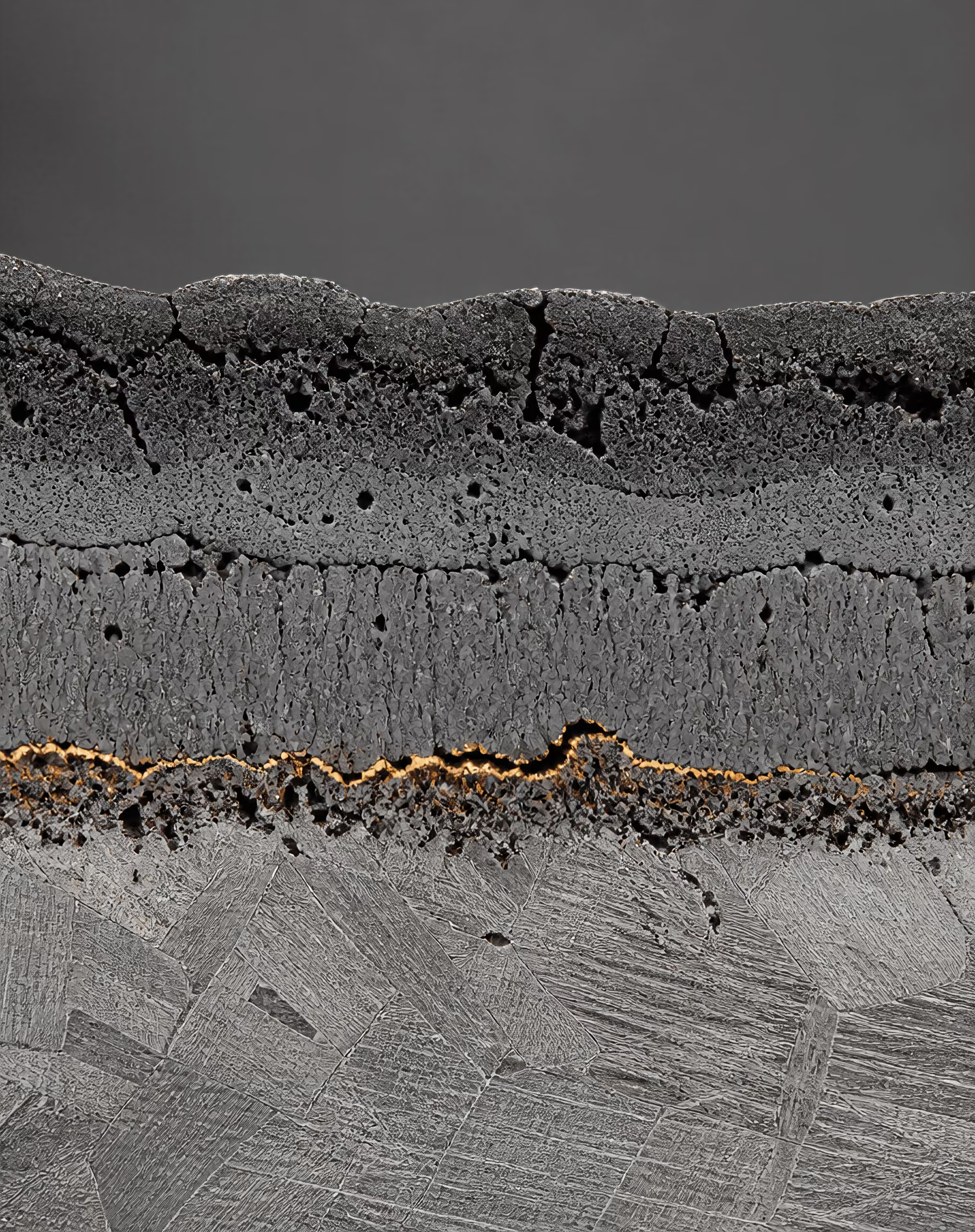
Scale is the oxide formed when a heated steel surface reacts with oxygen-bearing material in the furnace environment. The reaction does not require free oxygen gas alone. Water vapor, carbon dioxide, and oxygen entering with combustion products or leaking air can all participate, with the reaction rate governed by temperature, exposure time, gas composition, steel composition, and the condition of the surface before heating.
At elevated temperature, iron at the surface transfers electrons to oxygen-containing species. The result may include iron oxides such as wüstite (FeO), magnetite (Fe₃O₄), and hematite (Fe₂O₃). These phases do not necessarily occur in the same proportions, and a visible dark film cannot be assigned one composition merely from its colour. The outermost oxide may differ from the layer next to the metal, while alloying elements can modify the scale structure or produce separate oxides. A thin adherent film and a thick, cracked, loosely attached scale are both “oxide,” but they do not have the same metallurgical significance.
The U.S. Department of Commerce, National Bureau of Standards, in Heat Treatment and Properties of Iron and Steel (1966), identifies oxidation as the source of scale and carbon loss from the surface as decarburization. It also describes water vapor in combustion products as detrimental. That distinction matters because oxidation and decarburization can occur together without being the same reaction. Oxidation consumes or transforms surface metal; decarburization lowers the carbon concentration in the steel immediately beneath the surface. A furnace condition can therefore produce a visible scale layer, a carbon-depleted zone, or both.
Consequences of detached scale
- Surface exposure Spallation can expose fresh steel and allow another oxidation cycle.
- Furnace contamination Detached material can obstruct furnace hearths.
- Tooling damage Scale can mark rolls and contaminate dies.
- Dimensional variation Residual scale can affect later forging, rolling, or machining.
Scale formation also changes as the heating cycle proceeds. Early oxidation may create a relatively continuous film. Continued growth can make the scale thicker and less adherent, especially when thermal expansion, furnace handling, or transformation stresses disturb it. Repeated heating and cooling can cause cracking and flaking. Scale may then detach from the workpiece and expose fresh steel, allowing another oxidation cycle. The detached material is not harmless debris: it can mark rolls, obstruct furnace hearths, contaminate dies, and create dimensional variation when material is later forged, rolled, or machined.
Cambridge University Press’s chapter “Atmosphere Control for the Protection of Metals During Production Processes” (2012) separates reheating for working from final heat treatment. That separation is essential. During reheating for forging or rolling, some scale may be removed by descaling, deformation, pickling, blasting, or later machining. The process can tolerate a surface change that would be unacceptable on a finished component, provided the scale and any affected metal are removed without compromising the required section.
Final heat treatment is less forgiving. Austenitizing, hardening, tempering, annealing, and stress relieving may be specified to produce a particular surface condition as well as a bulk microstructure. Scale can alter dimensions, interfere with contact during quenching, conceal grinding marks or cracks, and affect subsequent machining allowances. It can also change the result of visual, magnetic-particle, or other inspection methods. A part that reaches the required hardness in its core can still fail a surface requirement because its oxide and carbon condition were not controlled.
Oxidizing species and furnace leakage
An atmosphere is protective only relative to the reactions it suppresses. Furnace atmosphere control therefore involves both the gas delivered to the furnace and the furnace’s ability to keep unwanted gases out. ASM International’s ASM Handbook, Volume 4B (2017), identifies “furnace- and supply-atmosphere control” as the two principal control groups. Gas quality cannot compensate for an open door, failed seal, damaged muffle, poorly adjusted burner, or pressure condition that draws air into the hot zone.
Air leakage introduces molecular oxygen, nitrogen, and moisture. Oxygen supports direct oxidation, while water vapor can react with iron and can also participate in reactions that change the carbon potential at the steel surface. Carbon dioxide is another reactive constituent. In atmospheres containing carbon monoxide and carbon dioxide, the balance between these gases affects whether the surface tends to gain carbon, lose carbon, or approach equilibrium with the steel. The relevant condition is not simply whether a gas is called “protective”; it is the chemical potential at the work surface.
ASM’s 2017 material on furnace atmospheres treats gas reactions, principal gases and vapors, and atmosphere-related steel decarburization as central parts of heat-treating technology. The Steel Heat Treatment Handbook (CRC Press, 2014) likewise discusses carbon dioxide, ammonia, and other reactive gases in relation to oxidation resistance and surface carbon control. Ammonia, for example, can supply nitrogen in suitable processes, but its decomposition products and the resulting hydrogen and nitrogen balance do not make it a universal anti-scale gas. Each atmosphere must be matched to the steel grade, temperature, furnace design, loading pattern, and required surface carbon condition.
Water vapor deserves particular attention because it can be present even when a furnace appears sealed. Combustion heating produces water as a normal reaction product, and wet charge material, leaks in cooling systems, humid supply gas, or poor drying practice can add more. Dew point, oxygen partial pressure, carbon dioxide, and related measurements can therefore provide more useful process information than a gas label alone. ASM Volume 4B describes carbon-potential control through measurements or relationships involving water vapor, carbon dioxide, and oxygen partial pressure. These variables help establish whether the surface will oxidize, decarburize, carburize, or remain close to the intended steel chemistry.
The required atmosphere also depends on the purpose of the operation. A reheating furnace for hot working may accept controlled oxidation followed by mechanical scale removal, whereas a final hardening furnace for a carburized or high-carbon component generally requires much tighter control of both scale and carbon activity. Treating both operations as equivalent risks accepting a surface condition that invalidates the later inspection or service requirement.
ISO 17663:2023 specifies quality requirements for heat treatment in air or controlled atmospheres, mainly for ferritic steels, and covers work performed in workshops and on site in connection with welding and allied processes. It does not turn atmospheric control into a single gas recipe. It reinforces the process view: atmosphere, equipment, monitoring, records, and the specified result must agree.
Scale removal and its metallurgical consequences
| Removal method | Potential consequence |
|---|---|
| Mechanical descaling | May leave oxide in pits or produce gouging |
| Shot or abrasive blasting | Can alter roughness and round edges |
| Pickling | May increase roughness or create hydrogen-related concerns |
| Grinding | Removes nearby affected metal, changes dimensions, and can generate local heating |
Removing scale is not the same as restoring the original steel surface. Mechanical descaling can expose sound metal, but it may also leave oxide in pits, produce gouging, or create directional marks. Shot blasting and abrasive blasting alter roughness and can round edges. Pickling dissolves oxides through chemical attack, yet excessive or poorly controlled pickling may increase roughness or introduce hydrogen-related concerns in susceptible high-strength steels. Grinding removes scale and nearby affected metal, but it changes dimensions and can generate local heating.
The most serious error is to remove visible oxide and assume that the metallurgical effect has disappeared. If oxidation was accompanied by decarburization, the carbon-depleted layer may extend below the scale. Descaling will not restore its carbon content. Depending on the steel and the treatment, the affected layer may need to be machined away, reprocessed, or accepted only after testing demonstrates that it remains within specification. Surface hardness, case depth, fatigue performance, and crack sensitivity can all depend on what remains beneath the cleaned surface.
Scale removal can also affect inspection results. A thick oxide layer may mask discontinuities, while aggressive cleaning can open tight defects and make them easier to detect. Surface roughness may increase indications in magnetic-particle or penetrant testing, and residual abrasive or chemical contamination can interfere with coating or plating. The inspection method, acceptance criteria, and cleaning procedure must therefore be considered together rather than treated as separate workshop steps.
Not every dark surface requires removal for the same reason. A thin, adherent oxide film, a layered high-temperature scale, temper colour, and residue from a treatment atmosphere may differ in composition, thickness, adhesion, and effect on performance. Their appearance alone is insufficient evidence. Surface examination, hardness measurements, metallographic checks, or chemical and dimensional verification may be needed when the surface condition is critical.
Separate standards address later protection rather than furnace atmosphere itself. ISO 17834:2003 covers thermally sprayed metal coatings for corrosion and high-temperature oxidation protection at temperatures up to 1000 °C (1273 K). ISO 12944-4:2017 defines preparation grades for carbon- and low-alloy-steel structures and distinguishes uncoated, thermally sprayed, galvanized, electroplated, sherardized, and painted surfaces. Those classifications do not excuse poor furnace control. A coating can protect a prepared surface, but it cannot reliably correct an unmeasured decarburized layer, dimensional loss, or oxide trapped in a defect. Surface protection begins with controlling the steel–atmosphere reaction during heating.
Decarburization and Surface Carbon Control
Decarburization is the loss of carbon from the surface of steel during heating. It is not the same as oxidation. Oxidation reacts with iron and alloying elements to form scale, whereas decarburization changes the chemical composition of the steel beneath, or sometimes at the same time as, the scale. A furnace can therefore produce a bright-looking surface with unacceptable carbon loss, or a scaled surface whose underlying carbon content remains close to specification.
The U.S. National Bureau of Standards handbook Heat Treatment and Properties of Iron and Steel (1966) identifies both risks directly: protective atmospheres are used to prevent surface oxidation, or scaling, and carbon loss from surface layers, or decarburization. It also describes water vapor in combustion products as detrimental. The distinction matters because removing scale after treatment does not restore carbon that has diffused out of the steel.

Total, partial, and localized decarburization
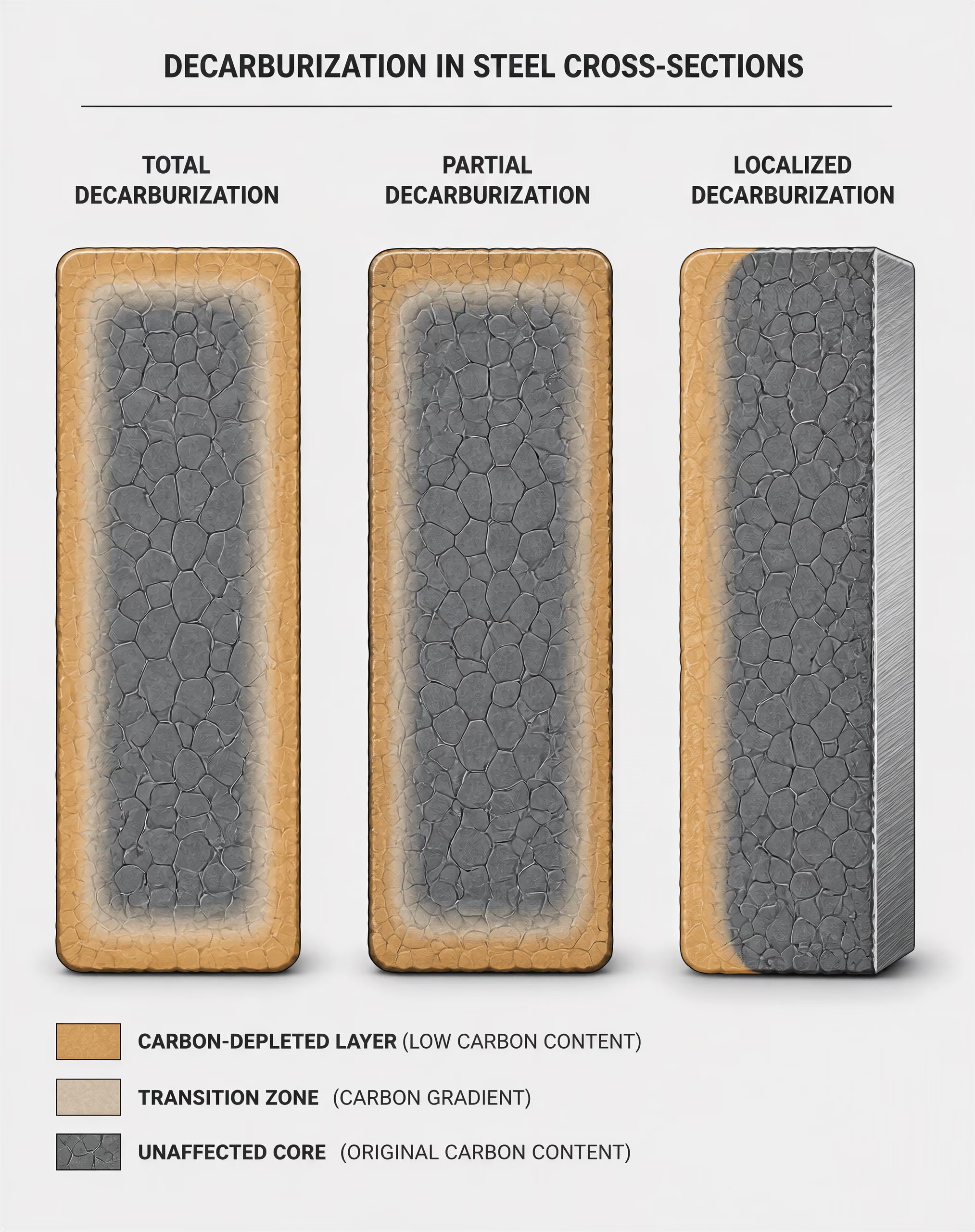
Forms of decarburization
- Total decarburization
- The original carbon-bearing structure has been effectively removed or transformed through the affected layer.
- Partial decarburization
- Carbon decreases from the core toward the surface through a transition region.
- Localized decarburization
- Carbon loss is confined to particular areas such as edges, gaps, or leakage-affected zones.
Total decarburization describes a surface zone in which the original carbon-bearing structure has been effectively removed or transformed through the full affected layer. In a hypoeutectoid steel, heating may leave a ferritic surface layer where pearlite or other carbon-containing constituents should have been present. After quenching, that layer cannot form the same carbon-rich martensite as the unaffected material. “Total” refers to the condition within the decarburized zone, not to the entire cross-section of the component.
Partial decarburization is a gradient. Carbon content decreases from the core toward the surface, and the resulting microstructure changes continuously through a transition region. A quench may produce a lower-carbon martensite near the exterior, then higher-carbon martensite, bainite, or the intended core structure farther inward. The surface can pass a visual inspection while still having insufficient carbon for the specified hardness or wear resistance.
Localized decarburization is confined to particular areas rather than distributed evenly around the component. Causes include furnace leakage, a poorly sealed door, burner impingement, gaps between parts, contaminated fixtures, an exposed edge, or a local difference in gas circulation. Thin sections and sharp edges can respond differently from broad faces because their surface-to-volume ratios and heat-transfer conditions differ. A single hardness traverse across a large part may miss such a defect.
The depth and severity of decarburization depend on temperature, time, steel composition, surface condition, atmosphere chemistry, and gas flow. They should be established for the actual process rather than assigned a universal limit. Metallographic examination, microhardness traverses, carbon analysis, and comparison with a known unaffected region can separate a shallow composition gradient from a deeper structural change. A hardness value taken only at the center is not evidence that the surface was protected.
Cambridge University Press, in Atmosphere Control for the Protection of Metals During Production Processes (2012), distinguishes reheating for working from final heat treatment. Uncontrolled oxidizing conditions may be tolerated differently during a subsequent forging operation than during a final hardening cycle, where the surface chemistry directly affects the finished property. The process objective must therefore define the acceptable carbon change.
Carbon potential and equilibrium reactions
Carbon potential is the carbon activity imposed by an atmosphere at a specified temperature. In practical terms, it is the carbon content that a reference iron or steel surface would approach if it reached equilibrium with that gas. It is not simply the percentage of carbon monoxide in the furnace. The same nominal gas composition can produce different surface conditions when temperature, pressure, water vapor, carbon dioxide, or gas mixing changes.
| Treatment condition | Carbon transfer direction | Typical objective |
|---|---|---|
| Carburizing | Carbon enters austenite | Increase surface carbon intentionally |
| Neutral | Neither significant gain nor loss | Preserve surface carbon |
| Decarburizing | Carbon diffuses outward | Usually an unwanted condition during hardening |
For carburizing, the atmosphere has a carbon potential above the carbon activity of the steel surface. Carbon then enters the austenite and diffuses inward, provided the temperature and exposure time permit it. In a neutral treatment, the atmosphere is adjusted so that the surface neither gains nor loses a significant amount of carbon. In a decarburizing condition, the gas has a lower carbon potential than the steel surface, so carbon diffuses outward and reacts with oxidizing species.
Several reversible reactions describe this control. Carbon monoxide can participate in the surface reaction
\[ 2CO \rightleftharpoons CO_2 + C \]
where deposited carbon can enter austenite. The water-gas reaction,
\[ CO + H_2O \rightleftharpoons CO_2 + H_2, \]
changes the relative amounts of carbon monoxide and carbon dioxide and therefore changes the atmosphere’s carbon activity. Carbon dioxide also reacts with carbon at the steel surface:
\[ CO_2 + C \rightleftharpoons 2CO. \]
These reactions do not operate in isolation. Steel, scale, soot, furnace refractories, and workpiece geometry can shift local equilibrium and reaction rates.
ASM International’s ASM Handbook, Volume 4B: Heat Treating of Ferrous Alloys identifies furnace-atmosphere control and supply-atmosphere control as the two principal control groups. The first concerns conditions inside the furnace; the second concerns the generation, purification, mixing, drying, and delivery of gases before they enter the hot zone. A correctly specified furnace set point cannot compensate for wet gas, an unstable generator, an air leak, or a faulty sensor.[2] ASM Handbook, Volume 4B: Heat Treating of Ferrous Alloys. ASM International. ASM Handbook, 2017. ASM International, ASM Handbook Volume 4B
ASM also describes carbon-potential control through relationships involving water vapor, carbon dioxide, and oxygen partial pressure. Water-vapor and carbon-dioxide measurements infer the equilibrium state from gas ratios. Oxygen probes measure oxygen partial pressure and, with a reference system and temperature compensation, permit calculation of the carbon potential. The measurement is only meaningful when the probe, sampling arrangement, gas circulation, and calibration remain suitable for the furnace condition. A reading from one location may not represent a poorly circulated work zone.
Oxygen partial pressure A measure of the oxygen component's thermodynamic contribution to the atmosphere, used to assess its tendency to oxidize steel.
Oxygen partial pressure is especially important because even a small oxidizing potential can consume carbon at the surface. Simplified reactions such as
and
show why water vapor and carbon dioxide can drive carbon loss. Iron oxidation may occur at the same time, producing scale and changing the interface through which carbon must diffuse. Consequently, a gas that appears “protective” because it contains little free oxygen may still decarburize steel through its water-vapor or carbon-dioxide content.
Why surface hardness can diverge from core hardness
Hardness depends on carbon content, phase transformation, cooling rate, and tempering history. The surface and core experience different carbon activities and different thermal conditions, so they need not produce the same result. In a through-hardening cycle, a decarburized surface may transform to low-carbon martensite or ferrite-plus-martensite while the core forms the intended higher-carbon martensite. The center hardness can meet the drawing while the working surface fails.
The consequence is severe for hardened steels: lower surface carbon reduces attainable martensitic hardness and may reduce resistance to wear, indentation, and rolling contact damage. Tool steels are particularly sensitive because cutting edges and contact faces depend on controlled carbon and alloy-carbide formation. A decarburized edge can lose hardness even when the tool shank tests correctly.
Bearing steels such as SAE 52100 require close control of surface carbon because rolling contact stresses act near the raceway and rolling-element surfaces. A soft or compositionally graded layer can alter residual stress, retained austenite, carbide dissolution, and crack sensitivity. Core hardness alone cannot validate a bearing heat treatment.
Low-alloy steels can show the same divergence, although their hardenability may allow a substantial hardened core beneath a carbon-depleted exterior. Surface microhardness profiles, etched cross-sections, and carbon-gradient measurements are therefore more informative than one bulk hardness reading.
ISO 17663:2023 specifies quality requirements for heat treatment in air or controlled atmospheres, mainly for ferritic steels in welding and allied processes, including work performed in workshops and on site. It provides a quality framework, not a universal carbon-potential recipe. Likewise, ISO 17834:2003 addresses thermally sprayed metal coatings for corrosion and high-temperature oxidation protection up to 1000 °C (1273 K), while ISO 12944-4:2017 classifies surface-preparation conditions for carbon- and low-alloy-steel structures. Neither coating practice replaces control of carbon activity during austenitizing, carburizing, neutral hardening, or tempering. Surface protection and surface carbon control must be specified as separate, verifiable process requirements.
Principal Furnace Atmosphere Families
A furnace atmosphere is part of the heat-treatment system, not merely a gas surrounding the work. Its composition sets the chemical potential at the steel surface while temperature determines reaction rates, diffusion, scale formation, and carbon transfer. The same nominal gas can therefore produce different results in a cold, lightly loaded furnace and in a hot furnace containing oil, scale, binders, or a large mass of steel. ASM International’s ASM Handbook, Volume 4B, divides atmosphere control into two principal groups: furnace-atmosphere control and supply-atmosphere control. The first concerns the furnace, seals, burners, circulation, sensors, and loading; the second concerns the gas generation, purification, mixing, delivery, and monitoring system.
Air and combustion-derived atmospheres
Air is the simplest furnace atmosphere and usually the least controlled. Oxygen, nitrogen, water vapor, and contaminants from the furnace, fixtures, lubricants, and workpiece surfaces participate in reactions with hot steel. Under oxidizing conditions, iron oxides form and grow into scale. At suitable temperatures and gas compositions, carbon also leaves the steel surface as carbon monoxide or carbon dioxide, producing a decarburized layer. The 1966 U.S. National Bureau of Standards handbook Heat Treatment and Properties of Iron and Steel identifies both scale and decarburization as primary surface risks and specifically describes water vapor in combustion products as detrimental.
Air may nevertheless be selected deliberately when surface oxidation is acceptable or when the operation is followed by machining, abrasive cleaning, or removal of a sacrificial surface layer. Cambridge University Press, in its 2012 chapter “Atmosphere Control for the Protection of Metals During Production Processes,” distinguishes reheating for hot working from final heat treatment. Scale during reheating may be tolerated as a manufacturing consequence; scale and carbon loss during hardening, tempering, or annealing can invalidate the required surface condition. The distinction matters for carbon steels such as C45, designated 1.0503 in EN 10083-2, and for alloy grades such as 42CrMo4, designated 1.7225. A heat-treatment specification must state whether surface chemistry is part of acceptance.
Combustion-derived atmospheres range from strongly oxidizing products to deliberately adjusted mixtures produced by controlling fuel, air, excess oxygen, and moisture. Their behavior cannot be inferred from the phrase “燃焼ガス” or “combustion atmosphere” alone. Fuel composition, burner adjustment, leakage of air into the furnace, dew point, furnace temperature, and the ratio of gas flow to furnace load all change the oxygen and carbon potentials at the steel surface. In a poorly sealed furnace, a nominally reducing combustion product can become locally oxidizing near doors, cracks, or exhaust paths.
Endothermic, exothermic, nitrogen-based, and vacuum environments
| Atmosphere family | Article-described role | Important qualification |
|---|---|---|
| Air and combustion-derived | May be selected when oxidation is acceptable or material will be removed | Fuel, air, moisture, leakage, and temperature change behavior |
| Endothermic | Commonly adjusted for carburizing, neutral hardening, or carbon restoration | Generator and carbon-potential stability are required |
| Exothermic | May provide a relatively dry, low-oxygen environment | Production route does not guarantee metallurgical results |
| Nitrogen-based | Reduces oxidizing-species concentration | Residual oxygen and moisture can still react |
| Vacuum | Removes most of the gas phase | Leak rate, moisture, cleanliness, and pressure history remain important |
Generated protective atmospheres are commonly grouped as endothermic and exothermic types. Endothermic gas is produced by reacting a hydrocarbon fuel with air over a catalyst and is commonly adjusted for carburizing, neutral hardening, or carbon restoration. Exothermic gas is generated under a different air-to-fuel balance and may be used where a relatively dry, low-oxygen environment is required. These names describe production routes, not guaranteed metallurgical results. Two furnaces supplied with “endothermic gas” can produce different surface reactions if their generators, dew points, carbon-potential controls, circulation patterns, or leakage conditions differ.
For steel, carbon potential is the decisive issue when the treatment must preserve or change surface carbon. ASM’s 2017 furnace-atmosphere material identifies relationships involving water vapor, carbon dioxide, and oxygen partial pressure as methods of evaluating or controlling carbon potential. Measurements and control calculations must be tied to furnace temperature and the actual gas chemistry. A low-carbon-potential atmosphere may decarburize a high-carbon tool steel, while an excessively high carbon potential can carburize a low-carbon surface or create an unwanted carbon-rich layer. Neither outcome is prevented by calling the gas “protective.”
Nitrogen-based environments are supplied as industrial nitrogen or as mixtures containing nitrogen with hydrogen, carbon monoxide, methane, or other additions. Nitrogen reduces the concentration of oxidizing species, but it is not automatically inert in every steel process. Residual oxygen and moisture can still form oxide scale. At high temperatures, nitrogen may interact with alloying elements and surface reactions, while small amounts of hydrogen can alter reduction behavior and affect safety controls. Nitrogen-rich gas can also dilute a carburizing or neutral atmosphere enough to change carbon potential, even when the furnace analyzer reports a stable oxygen reading.
Vacuum furnaces remove most of the gas phase rather than replacing air with a fixed protective mixture. This sharply reduces oxidation during heating, but the result depends on ultimate pressure, leak rate, pumping conductance, furnace cleanliness, outgassing from oils and binders, and the load’s exposed surface area. Water vapor released from refractory materials or contaminated work can re-enter the chamber and react with hot steel. Vacuum also does not restore carbon already lost from a surface. For grades such as X153CrMoV12, designated 1.2379 under EN ISO 4957, vacuum hardening may protect the surface during austenitizing, but carbon control still depends on the prior condition of the material and the full process sequence.
Reactive additions containing carbon dioxide or ammonia
Some atmospheres contain gases that are chemically active rather than simply protective. Carbon dioxide is a key example. At heat-treatment temperatures, CO₂ participates in the equilibrium among carbon monoxide, carbon, and oxygen-bearing species. Its effect depends on temperature, concentration, gas residence time, steel surface condition, and the accompanying CO, H₂, H₂O, and hydrocarbon levels. Excess CO₂ can lower carbon potential and promote decarburization; under other conditions, its role is part of the controlled reaction system used to set a target surface carbon level. A gas analyzer reading for CO₂ is therefore not, by itself, a carbon-potential measurement.
Ammonia introduces a different set of reactions. Dissociated ammonia supplies nitrogen and hydrogen, and ammonia-containing atmospheres can support nitriding or nitrocarburizing when temperature, dissociation, flow, and steel chemistry are controlled. The nitrogen activity at the surface determines whether nitrides form and how deep nitrogen diffuses. Chromium-, molybdenum-, aluminum-, and vanadium-bearing steels respond differently because their alloy nitrides have different stability and effects on hardness and toughness. Ammonia can also affect oxidation and reduction reactions through its decomposition products. The Steel Heat Treatment Handbook (CRC Press, 2014) treats carbon dioxide, ammonia, and other reactive gases as atmosphere constituents that influence both oxidation resistance and surface carbon control.
Reactive additions may be introduced intentionally, or they may enter accidentally through combustion products, leaks, cleaning residues, or decomposition of furnace charges. Furnace loading changes the balance: a large quantity of oily work can consume reactive species and generate additional carbon-bearing gases, while an empty furnace may expose steel to a chemically different atmosphere at the same controller settings. ISO 17663:2023 consequently frames heat treatment in air or controlled atmospheres as a quality requirement, mainly for ferritic steels and for work carried out in workshops or on site, rather than as a gas-selection exercise.
Surface protection outside the furnace is a separate control subject. ISO 17834:2003 addresses thermally sprayed metal coatings for corrosion and high-temperature oxidation protection up to 1000 °C (1273 K), while ISO 12944-4:2017 classifies surface-preparation grades for carbon- and low-alloy-steel structures, including uncoated, thermally sprayed, galvanized, electroplated, sherardized, and painted surfaces. Those systems cannot substitute for controlling the atmosphere during austenitizing, annealing, carburizing, nitriding, or tempering. The atmosphere must be specified and verified as a process condition: gas identity, temperature, flow, moisture, leakage, loading, and carbon potential all belong to the metallurgical result.
The Chemistry of Furnace Atmosphere Reactions
A furnace atmosphere is not a passive blanket around hot steel. It is a reacting system in which gas–metal reactions, gas–gas reactions, mass transfer, and surface diffusion occur at the same time. The result depends on temperature, pressure, gas composition, flow, furnace leakage, workpiece loading, and the steel’s current surface condition. A small change in moisture or carbon dioxide can therefore alter scale formation or the carbon content of the outermost metal even when the furnace temperature remains correct.
ASM International’s 2017 treatment of furnace-atmosphere controls separates the subject into two principal control groups: furnace-atmosphere control and supply-atmosphere control. The first concerns what exists inside the furnace; the second concerns the gases entering it and the consistency of their delivery. Both matter. A correctly specified gas can produce a damaging atmosphere if air enters through a door seal, an unbalanced pressure zone, or a cracked retort.
Water vapor, hydrogen, carbon monoxide, and carbon dioxide
Water vapor is particularly important because it can oxidize iron and alter surface carbon at the same time. A simplified representation of iron oxidation by steam is:
Simplified reaction representation: \[ \mathrm{Fe + H_2O(g) \rightleftharpoons FeO + H_2(g)} \]
This equation is not a complete description of furnace behavior. Actual oxidation may produce wüstite (FeO), magnetite (Fe₃O₄), and hematite (Fe₂O₃), depending on temperature and oxygen potential. Alloying elements can form additional oxides, and the scale may develop several layers. The equation does show the important competition: increasing the ratio of water vapor to hydrogen favors oxidation, while hydrogen-rich, dry conditions reduce the oxidizing tendency when other gases are controlled.
Hydrogen is therefore more than an inert diluent. The hydrogen–water-vapor ratio is commonly used as an indicator of oxygen potential because the reaction
Simplified reaction representation: \[ \mathrm{H_2(g) + \tfrac{1}{2}O_2(g) \rightleftharpoons H_2O(g)} \]
links hydrogen, steam, and oxygen chemical potential. Hydrogen can also reduce some oxides, but it does not guarantee a clean surface. At the steel temperature, the relevant question is whether the total gas mixture has a sufficiently low oxygen potential for the particular steel, temperature, and surface reaction. Stainless and alloy steels may behave differently from plain-carbon steels because chromium, silicon, manganese, and other elements form oxides with different stability.
Water vapor also affects decarburization. Carbon dissolved in austenite can react indirectly with steam, producing carbon monoxide and hydrogen:
Simplified reaction representation: \[ \mathrm{C_{(dissolved)} + H_2O(g) \rightleftharpoons CO(g) + H_2(g)} \]
The carbon atom is supplied by the steel surface, so the reaction can lower surface carbon even while the bulk remains near its original composition. The 1966 U.S. National Bureau of Standards handbook identifies oxidation and carbon loss as the principal surface risks in heat treatment and specifically describes water vapor in combustion products as detrimental. The visible result may be scale; the less visible result is a carbon-depleted layer with altered hardness response after quenching.
Carbon monoxide and carbon dioxide participate directly in carbon transfer. Their key equilibrium is:
Simplified reaction representation: \[ \mathrm{2CO(g) \rightleftharpoons CO_2(g) + C_{(surface)}} \]
When the gas favors carbon deposition, carbon can enter austenite. When the steel has more carbon activity than the surrounding atmosphere can support, carbon leaves the surface and forms carbon monoxide or carbon dioxide. The reaction is simplified because the deposited or absorbed carbon is not a free graphite film under ordinary carburizing conditions; it is a chemical-potential exchange with carbon dissolved in the steel.
Another useful representation is the oxidation of carbon by carbon dioxide:
Simplified reaction representation: \[ \mathrm{C_{(steel)} + CO_2(g) \rightleftharpoons 2CO(g)} \]
A higher carbon-dioxide content can thus promote decarburization under suitable conditions. Carbon monoxide may also reduce some iron oxides, but the same gas can carburize steel if its equilibrium relation with carbon dioxide and the steel surface favors carbon transfer. The direction is set by gas ratios and temperature, not by the name “protective gas.”
Ammonia adds another reaction pathway because it can dissociate to nitrogen and hydrogen. The Steel Heat Treatment Handbook, published by CRC Press in 2014, discusses carbon dioxide, ammonia, and other reactive gases in relation to oxidation resistance and surface-carbon control. Such atmospheres must be treated as chemical systems, not as fixed recipes: dissociation, moisture, leakage air, and reactions with furnace refractories can change the effective atmosphere before it reaches the work.
Oxygen potential and carbon activity
Oxygen partial pressure, , describes the thermodynamic tendency of the atmosphere to oxidize a surface. At a given temperature, a low oxygen partial pressure generally favors metallic iron over iron oxide, while a higher value favors oxide formation. Oxygen potential is the broader chemical concept; oxygen partial pressure is one measurable or calculated way to express it.
Carbon potential is different. It describes the tendency of an atmosphere to transfer carbon to or remove carbon from a steel surface under specified conditions, commonly with austenite as the receiving phase. An atmosphere can have a low oxygen potential yet still fail to maintain the required carbon potential. Conversely, a gas mixture may provide a suitable carbon potential while remaining sufficiently oxidizing to form unwanted oxide. These measurements are related through gas equilibria, but they are not interchangeable.
For carbon monoxide and carbon dioxide, the carbon-transfer tendency depends strongly on the ratio and temperature. For hydrogen-containing atmospheres, the ratio helps indicate oxygen potential and may also signal decarburizing conditions. Oxygen probes measure an electrochemical response associated with oxygen activity, while dew-point instruments assess moisture indirectly; neither instrument alone establishes every surface reaction occurring in a loaded furnace.
The steel grade matters. A carbon steel such as C45, specified under EN ISO 683-1, responds differently from an alloy steel such as 42CrMo4 under EN ISO 683-2 because alloying elements affect oxide stability, carbon activity, diffusion, and phase transformations. Control values must therefore be tied to temperature, steel composition, treatment cycle, and the required surface condition. A nominal gas composition without those variables is not a valid process description.
Reaction kinetics at the steel surface
Stages controlling surface reaction rate
- Transport Gas moves through the furnace boundary layer.
- Surface arrival The molecule reaches scale or bare metal.
- Adsorption and reaction The species attaches and reacts at the surface.
- Product removal Reaction products leave the interface.
- Solid diffusion Carbon and alloying elements move into or away from the steel.
Thermodynamic equilibrium predicts the preferred direction of a reaction; it does not state how quickly the surface will change. Kinetics supplies that missing part. A gas molecule must travel through the furnace boundary layer, reach the scale or bare metal, adsorb, react, and allow products to leave. Carbon and alloying elements then diffuse into or away from the steel. Any one of these steps can limit the overall rate.
At the beginning of heating, a freshly exposed surface may react rapidly because it has no established scale. As oxide thickens, diffusion through the scale can become controlling. Scale porosity, cracking, and spallation can reopen the surface and produce irregular oxidation. Furnace circulation affects the boundary layer, while workpiece spacing affects how quickly steam, carbon dioxide, and reaction products are removed.
Decarburization also develops as a concentration profile rather than an instant uniform loss. Carbon diffuses from the interior toward a surface whose equilibrium carbon activity is lower. The depth of the affected layer depends on temperature, time, steel composition, prior microstructure, and the atmosphere’s effective carbon potential. Quenching can preserve that profile, making a short surface reaction visible later as a hardness gradient.
Cambridge University Press’s 2012 discussion of atmosphere control distinguishes reheating for working from final heat treatment: uncontrolled oxidizing conditions may be tolerated differently during a forging operation than during a final hardening cycle, where scale and decarburization directly affect the specified surface. ISO 17663:2023 likewise places heat treatment in air or controlled atmospheres within a quality framework, mainly for ferritic steels and for work performed in workshops or on site. Atmosphere chemistry is consequently part of process validity. Correct temperature and holding time cannot rescue a cycle whose oxygen potential, moisture level, or carbon potential allowed the surface to change before the required transformation occurred.
Atmosphere Control: Furnace, Supply, and Measurement
Atmosphere control is not a single gas-flow setting. It is the coordinated control of the furnace enclosure and the atmosphere entering that enclosure, with measurement used to determine whether the intended chemical condition reaches the steel. ASM International’s Furnace Atmosphere Controls in Heat Treating (2017) identifies these as the two principal control groups: furnace-atmosphere control and supply-atmosphere control. The distinction matters because a correctly mixed gas can produce the wrong surface result after it passes through leaks, burners, retorts, circulation paths, or a heavily loaded work zone.
The two control groups identified by ASM
Furnace-atmosphere control concerns the equipment that contains and distributes the atmosphere. Door seals, vestibules, retorts, burner systems, exhaust dampers, fans, hearths, and internal baffles all affect the gas condition surrounding the load. Furnace pressure is part of this group. A slight positive pressure can limit inward air leakage through a door gap, but excessive pressure may force process gas through seals and create an unsafe or chemically unstable exhaust condition. A negative pressure can draw air into the furnace, especially during door movement or through damaged seals.
Temperature distribution and gas circulation also belong to the furnace side of the control problem. A furnace may show a satisfactory average temperature while stagnant regions remain cooler, richer in water vapor, or depleted in a reactive constituent. Fan speed, flow direction, load spacing, baskets, fixtures, and the exposed surface area of the steel alter the local boundary layer. Retorts add another transport resistance: the atmosphere measured outside the retort may not represent the gas inside it, particularly during purge, heating, or a rapid change in composition.
The supply-atmosphere group begins upstream. It includes the source gases, endothermic or exothermic generators, nitrogen-methanol systems, enriching gas, dissociated ammonia, propane, air, steam, and the equipment used to meter, mix, dry, heat, and deliver them. Flow controllers must maintain the intended ratio as demand changes. A regulator that holds pressure but not composition does not provide atmosphere control. A blocked or partially restricted line can produce the same symptom as an incorrect recipe: the furnace controller commands the target carbon potential, yet the work receives a different gas mixture.
Gas reactions continue after mixing. Carbon monoxide and carbon dioxide can participate in the steel surface reaction, while methane and other hydrocarbons may supply carbon under carburizing conditions. Water vapor can oxidize iron and shift the balance of carbon-bearing reactions. The U.S. National Bureau of Standards handbook Heat Treatment and Properties of Iron and Steel (1966) identifies oxidation, which produces scale, and surface carbon loss, which produces decarburization, as primary surface risks; it also describes water vapor in combustion products as detrimental. ASM’s 2017 treatment of furnace atmospheres places gas reactions, principal gases and vapors, and atmosphere-related decarburization at the centre of steel heat-treatment control.
The furnace and supply groups interact continuously. A leak at a door may admit oxygen, but the resulting reading depends on furnace pressure and circulation. A change in load area may consume or generate reactive species, changing the atmosphere even though the supply flowmeters have not moved. A burner adjustment may alter water vapour and carbon dioxide at the same time that it changes heat input. Treating the two groups as interchangeable hides these causes.

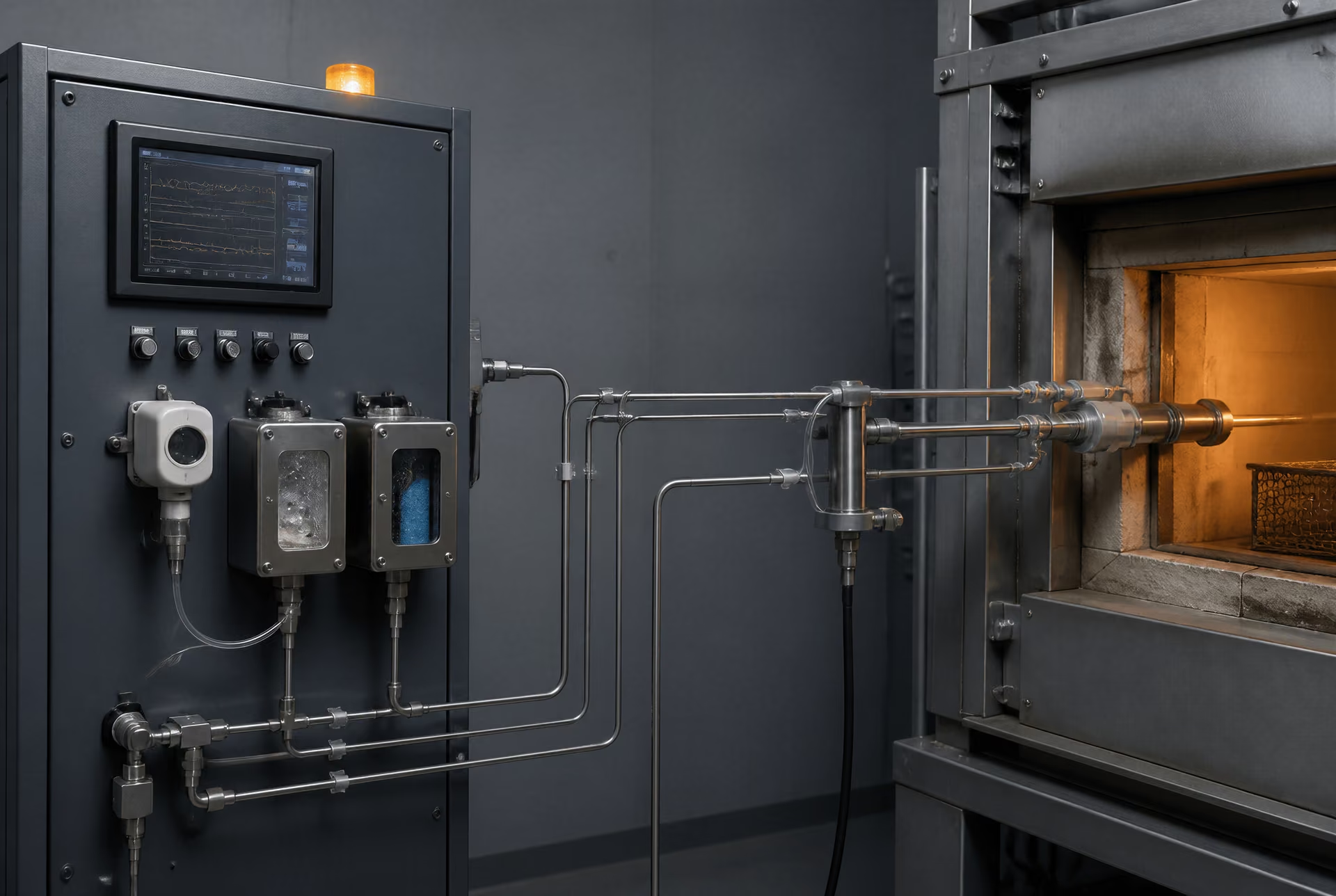
Sensors, sampling, and control loops
| Measurement | What it indicates | Limitation |
|---|---|---|
| Oxygen probe | Electrochemical response associated with oxygen activity | Depends on probe condition, reference air, temperature, and equilibrium assumptions |
| Dew-point instrument | Moisture information | Sampling-line condensation can create a falsely dry result |
| Infrared analyser | Carbon dioxide or carbon monoxide concentration | Measures selected species, not every surface reaction |
| Work-zone inspection | Actual steel response | Usually performed after treatment rather than continuously |
Control loop A process-control arrangement in which a sensor measures a variable, a controller compares it with a target, and a manipulated input is adjusted.
A control loop normally contains a process variable, a sensor, a controller, and a manipulated variable. For carbon-potential control, the process variable may be inferred from oxygen partial pressure, measured with an oxygen probe, or calculated from relationships involving carbon monoxide, carbon dioxide, and water vapour. Dew-point measurement supplies information about water vapour. Infrared analysers can measure carbon dioxide or carbon monoxide, while oxygen analysers provide a direct indication of oxidizing contamination. These instruments do not measure “the atmosphere” as one universal quantity; each responds to a particular chemical species, temperature, pressure, and calibration state.
An oxygen probe installed in the hot work zone can provide a rapid electrochemical signal, but its interpretation depends on probe temperature, reference air, sensor condition, and the assumed gas-reaction equilibrium. A dew-point sensor located in a cooled sample cabinet measures a transported and conditioned sample, not the gas at furnace temperature. Condensation in the sampling line removes water from the sample and creates a falsely dry result. Reactive gases may also react with tubing walls, filters, or condensate before reaching the analyser. Line material, length, diameter, heat tracing, filtration, and sample flow therefore become part of the measurement system.
Calibration must match the instrument and the process. Zero and span checks, reference gases, probe verification, and drift records establish whether a change is real or instrumental. A carbon-potential display calculated from an oxygen-probe millivolt signal can remain stable while the probe becomes coated, the reference-air path is obstructed, or the furnace temperature used in the calculation is wrong. The controller may then make a correct correction to an incorrect measurement.
Response time is equally important. The gas composition at a mixing station changes first; the delivery line changes next; the furnace atmosphere changes after the new gas displaces the old volume; and the steel surface responds after a further delay governed by temperature, geometry, and reaction kinetics. A short sample line near the inlet may show a step change in seconds while a probe near the work remains nearly unchanged for minutes. If the controller acts faster than the process can respond, it can overshoot and hunt. If it acts too slowly, a real decarburizing excursion may continue after the alarm threshold has been crossed.
Feedback must therefore be based on a defined control volume. A recipe set point is a command, not proof of surface protection. The commanded carbon potential, oxygen level, or dew point should be checked against an independent measurement and against the steel result where practical. Surface carbon, scale, microhardness, and metallographic evidence can reveal an atmosphere problem that a remote analyser missed. This is particularly important for grades whose specified case depth, hardness, or surface carbon leaves little tolerance for decarburization.
Why measurement location changes interpretation
The same gas can produce different readings at different positions. Near the supply inlet, the sample may represent the blend before it has contacted the load. Above a dense basket, it may represent a stagnant pocket. Near an exhaust port, it may be diluted by leakage or enriched by reaction products. Inside a retort, it may differ from the open furnace because gas exchange is restricted. A probe mounted in a hot zone can indicate the atmosphere around the probe while the steel surface sits behind fixtures or inside a packed load.
Sampling location also determines whether the reading is predictive or diagnostic. An upstream analyser identifies what the supply system is delivering. A work-zone probe indicates what has survived transport and furnace reactions. An exhaust sample can show the integrated result of leakage, combustion, and load reaction, but it may not identify where the change occurred. None of these positions is automatically correct; each answers a different question.
The steel load is part of that interpretation. Clean, oily, wet, scaled, or heavily oxidized parts release vapours and consume reactive gases during heating. A large surface area can shift the local carbon balance more than a small test coupon. Fixtures and refractory materials can also react with the atmosphere. For this reason, a no-load calibration does not fully validate a production cycle.
ISO 17663:2023 specifies quality requirements for heat treatment in air or controlled atmospheres, mainly for ferritic steels and for work performed in workshops or on site. Its relevance is procedural as well as metallurgical: the controlled condition must be defined, monitored, and linked to the work. Cambridge University Press’s 2012 discussion of atmosphere control likewise separates reheating for working from final heat treatment, warning that uncontrolled oxidizing atmospheres cause scaling and, in steels, decarburization. The valid result is therefore not the value printed beside a gas panel. It is the demonstrated relation between supply composition, furnace condition, measured work-zone atmosphere, exposure history, and the steel surface that emerges.
Atmosphere Selection by Steel Grade and Heat-Treatment Operation
Atmosphere selection must follow both the steel family and the operation being performed. A gas that protects a low-carbon steel during annealing may alter the surface of a high-carbon bearing ring during austenitizing. The required result may also change: reheating for forging can tolerate scale that will be removed later, whereas a finished carburized, hardened, or ground component may not tolerate measurable oxidation or carbon loss.
The U.S. National Bureau of Standards handbook Heat Treatment and Properties of Iron and Steel identifies the two primary surface hazards directly: oxidation forms scale, while carbon loss from the surface forms decarburization. It also describes water vapor in combustion products as detrimental. ASM International’s 2017 treatment of furnace-atmosphere controls separates furnace control from supply-atmosphere control. Both matter. A correctly specified gas can still produce a defective result if flow, dew point, oxygen potential, carbon potential, leaks, burner adjustment, or furnace loading is wrong.
Carbon and low-alloy steels
Plain-carbon and low-alloy grades are often discussed as though their designation alone determines the atmosphere. It does not. AISI/SAE 1018, AISI/SAE 1045, AISI/SAE 4140, and AISI/SAE 4340 can all be heated in furnaces described as “neutral,” yet the acceptable surface condition differs with the operation, section size, and subsequent machining allowance.
For a low-carbon steel such as AISI/SAE 1018, a small amount of surface carbon loss may have little effect on the bulk tensile properties, because the carbon concentration is already low. It can still matter in a thin case-hardened region, at a machined edge, or where the surface must later respond uniformly to carburizing, induction hardening, or nitriding. On AISI/SAE 1045, decarburization at a shaft or gear surface can reduce the carbon available for martensite formation. The result may be a softer skin beneath an apparently acceptable scale-removal operation.
Low-alloy hardening steels such as AISI/SAE 4140 and AISI/SAE 4340 present a different concern. Chromium, molybdenum, manganese, and silicon affect oxidation reactions and hardenability, but alloy additions do not make the surface immune to carbon loss. A surface depleted of carbon can remain weaker after quenching even when the core reaches the specified hardness. Oxide films may also interfere with dimensional inspection, magnetic-particle testing, coating adhesion, or later machining.
For these grades, the atmosphere is selected according to the required carbon balance. A neutral or controlled atmosphere must keep the surface carbon activity close to the steel’s intended value; a carburizing condition is appropriate only when an intentional carbon increase is specified. Carbon potential is not established by naming a gas alone. ASM Handbook Volume 4B describes control relationships involving water vapor, carbon dioxide, and oxygen partial pressure, together with direct or indirect measurement methods. In practice, the furnace control system and its sensors determine whether the stated atmosphere actually exists at the workpiece.
Thin sections heat rapidly and have a high surface-to-volume ratio. They can lose a larger fraction of their carbon-bearing surface layer before the load reaches temperature. Weldments may be more sensitive still: a weld metal, heat-affected zone, and parent metal can have different compositions and prior microstructures, while residual stresses and oxide films vary along the joint. ISO 17663:2023 specifies quality requirements for heat treatment in air or controlled atmospheres in connection with welding and allied processes, applying mainly to ferritic steels and to work carried out in workshops or on site. It therefore supports treating weld heat treatment as a documented process, not as an informal furnace exposure.
Tool, bearing, and high-carbon steels
High-carbon steels impose tighter control because the surface carbon concentration directly affects hardness, wear resistance, retained austenite, and dimensional stability. Examples include AISI/SAE 52100 bearing steel, AISI D2 tool steel, AISI O1, and AISI W1. Their surface condition after austenitizing is not a cosmetic issue.
A decarburized layer on AISI/SAE 52100 can produce a soft region beneath a bearing raceway. Removing scale by light cleaning does not necessarily remove that layer. In a tool steel such as AISI D2, surface carbon loss can reduce the carbon available to form the intended martensitic and carbide-bearing structure. Excessive oxidation can also alter grinding allowance and promote defects during finishing. AISI O1 and AISI W1 are similarly vulnerable during hardening because their performance depends strongly on the carbon retained at the surface.
High-carbon components are not simply protected by making the atmosphere “rich in carbon.” Excess carbon potential can produce soot, carbide deposition, or an altered surface chemistry rather than a controlled result. The required atmosphere must be matched to the grade, austenitizing temperature, exposure time, and furnace response. Vacuum, low-pressure processing, salt, neutral controlled gas, or a deliberately carbon-adjusted atmosphere may each be technically applicable, but the choice depends on the specified surface condition and equipment capability.
Bearing rings and precision tools also expose a dimensional problem. Oxidation consumes surface metal and may create scale in corners, holes, and contacting fixtures. Thermal gradients and uneven gas circulation can make one region oxidize or decarburize more than another. Section thickness, nesting, loading density, prior spheroidized or annealed condition, and the condition of the furnace lining therefore belong in the atmosphere decision. The steel designation is only the starting point.
The same logic applies to spring steels and high-carbon wire. A thin wire may reach the treatment temperature quickly, leaving little time for the operator to detect an atmosphere excursion before surface carbon has changed. Hardened components are especially sensitive because their final properties are already established by a narrow sequence of heating, quenching, and tempering. A surface defect formed during austenitizing cannot be corrected reliably by tempering.
Austenitizing, annealing, normalizing, tempering, and stress relief
| Operation | Atmosphere concern | Surface implication |
|---|---|---|
| Austenitizing | Rapid oxidation and carbon transfer | Can alter hardness and surface carbon |
| Annealing | Long exposure increases reaction opportunity | Scale or carbon loss may require machining allowance |
| Normalizing | Often performed in air for stock later processed | Surface change may be unacceptable for direct-service parts |
| Tempering | Lower temperature does not eliminate oxidation | Low-oxidation conditions protect finish and dimensions |
| Stress relief | Air exposure can scale prepared surfaces | Controlled shielding may be needed for finished components |
Austenitizing is usually the most atmosphere-sensitive operation. The steel is heated into the austenite range, where oxidation and carbon transfer can proceed rapidly. High-carbon and tool steels require control that preserves surface carbon, while low-carbon steels may require carbon protection when the surface will later be hardened or carburized. The load must be heated uniformly without treating the furnace setpoint as proof of workpiece temperature or surface condition.
Annealing generally allows longer furnace exposure than hardening, which increases the opportunity for scale and decarburization. Full annealing, subcritical annealing, and spheroidizing also differ in temperature and time, so one “annealing atmosphere” is not sufficient. For AISI/SAE 1045 or AISI/SAE 4140, surface carbon loss may be acceptable only where machining will remove it; for AISI/SAE 52100 or AISI D2, the same allowance may be unacceptable. Slow cooling does not repair an altered surface.
Normalizing is commonly performed in air for forgings and structural parts when scale removal is planned. That is a production decision, not evidence that air is neutral. Cambridge University Press’s 2012 discussion of atmosphere control distinguishes reheating for working from final heat treatment and links uncontrolled oxidizing atmospheres with scaling and steel decarburization. A normalized shaft intended for direct service, inspection, or induction hardening may therefore need controlled protection even when a forged blank can be normalized in air.
Tempering occurs below the austenitizing range, but oxidation remains possible, particularly during long exposures or repeated temper cycles. A clean, low-oxidation atmosphere protects dimensions and surface finish; it does not need the same carbon-potential strategy used during austenitizing. Temper colors should not be treated as a reliable atmosphere-control measurement, especially when oxide thickness varies across a load.
Stress relief of weldments and machined parts is often performed in air, yet air exposure can scale the surface and alter a prepared joint or finished component. ISO 17663:2023 is relevant when the treatment is associated with welding, including site work. For a component requiring a clean surface, the decision may favor a controlled atmosphere, vacuum, local shielding, or a protected enclosure rather than an exposed furnace.
Finally, furnace atmosphere and later surface protection are separate controls. ISO 17834:2003 addresses thermally sprayed metal coatings for corrosion and high-temperature oxidation protection up to 1000 °C (1273 K), while ISO 12944-4:2017 classifies surface-preparation grades for carbon- and low-alloy-steel structures. Neither standard replaces control during heating. The atmosphere must first produce the specified metallurgical surface; coatings and post-treatment preparation address a different stage.
Heat Treatment in Air Versus Controlled Atmospheres
Air is convenient, but convenience does not make it metallurgically neutral. At elevated temperature, oxygen and water vapour can react with steel, while the surrounding gas can alter the carbon activity at the surface. The result may be scale, decarburization, carburization, or a combination of these conditions. Whether that result is acceptable depends on what happens to the surface afterward and what the part must do in service.
The U.S. Department of Commerce, National Bureau of Standards, Heat Treatment and Properties of Iron and Steel (1966), identifies the two primary surface risks directly: oxidation produces scale, and carbon loss from the surface produces decarburization. It also describes water vapour in combustion products as detrimental. Furnace atmosphere is therefore part of the heat-treatment specification, not merely a way to fill the space around a load.
When air heating creates a surface penalty
Heating carbon steel or low-alloy steel in air forms iron oxides whose composition changes with temperature and local gas conditions. Scale consumes metal, changes dimensions, and can interfere with subsequent machining, welding, coating, or inspection. It may also detach during handling and leave an uneven surface. The oxide itself is not the only concern. A surface exposed to an oxidizing, carbon-poor environment can lose carbon by diffusion from the steel into the gas.
That carbon loss creates a decarburized layer. In a hardened component, the affected region may have lower hardness and lower wear resistance than the interior. In a fatigue-loaded component, the altered surface chemistry and associated microstructural changes can affect the intended response even when the bulk hardness meets the drawing requirement. The depth and severity depend on steel composition, temperature, holding time, surface condition, gas composition, and the carbon activity established at the interface.
A controlled atmosphere does not mean “any gas that is not air.” ASM International’s Furnace Atmosphere Controls in Heat Treating (2017) separates control into two principal groups: furnace-atmosphere control and supply-atmosphere control. The first concerns what exists in the furnace and how it is measured; the second concerns the gases, generators, blending equipment, purification, and delivery that create that condition. Both matter. A correctly selected gas can still produce the wrong result if moisture enters the supply system, the furnace leaks, or the measurement system does not represent the load zone.
For carbon steels, carbon-potential control is central during treatments in which surface carbon must remain stable. ASM describes relationships involving water vapour, carbon dioxide, and oxygen partial pressure as means of assessing or controlling carbon potential. These species are not interchangeable indicators in every furnace design, and a setpoint has meaning only when the measuring method, temperature, gas flow, and furnace response are defined. The Steel Heat Treatment Handbook (CRC Press, 2014) likewise discusses carbon dioxide, ammonia, and other reactive gases because atmosphere chemistry can affect both oxidation resistance and surface carbon control.
The process specification must state the acceptable surface condition. “Heat in air” is incomplete unless the specification also allows the resulting scale and surface chemistry, or requires a later operation to remove or correct them. A requirement for a bright surface, specified maximum decarburization, retained dimensional accuracy, or a functional hardened layer points toward tighter atmosphere control.
Reheating for forming versus final treatment
A common category error is to treat every high-temperature operation as though it had the same surface requirement. Cambridge University Press’s chapter “Atmosphere Control for the Protection of Metals During Production Processes” (2012) distinguishes reheating for working from final heat treatment. That distinction should appear in process planning.
During reheating for forging, rolling, or another forming operation, some scale may be tolerated because descaling, deformation, trimming, or machining will remove the affected material. The purpose of the heating step is primarily to bring the workpiece into a condition suitable for plastic deformation. Air may therefore be acceptable in a process where the oxidized layer is controlled and removed before the final dimensions or properties are established. This is not permission to ignore the atmosphere: excessive scale can reduce yield, damage tooling, obscure defects, and produce surface laps or other manufacturing problems.
Final heat treatment is different. Quenching and tempering, normalizing, annealing, solution treatment, or stress relieving may establish the properties of the surface that remains in service. If the part is finished after treatment, there may be little stock available for removing scale or decarburization. A bearing race, gear tooth, spring, shaft journal, or wear surface cannot be judged by the same criterion as a forging billet that will later be machined.
The distinction also applies to weld-related work. ISO 17663:2023 specifies quality requirements for heat treatment in air or controlled atmospheres in connection with welding and allied processes, mainly for ferritic steels and for work performed in workshops or on site. Its scope reinforces the practical point: the acceptable atmosphere and surface result must be tied to the defined operation, material, equipment, and inspection requirements.
A final-treatment specification should identify whether scale is permitted, whether post-treatment cleaning is required, and how decarburization or other surface changes are to be measured. It should also define the relevant steel designation, such as C45, 42CrMo4, or a grade specified under a particular product standard, because composition affects the response to oxidation and carbon transfer. Atmosphere control cannot repair an ambiguous acceptance criterion.
Vacuum and inert-gas alternatives
Vacuum furnaces reduce the partial pressure of reactive gases by removing most of the furnace gas before heating. Inert-gas systems replace air with gases such as argon or nitrogen, provided that the selected gas is compatible with the steel, temperature, and treatment. These methods serve the same broad purpose as a controlled furnace atmosphere—limiting unwanted surface reactions—but they do not make every reaction impossible.
Vacuum quality, leakage, residual moisture, furnace cleanliness, loading, and pressure history all affect the surface result. Inert gases can contain oxygen or water contamination, and nitrogen can interact with some alloy systems or surface conditions. A gas that is inert for one grade and process may not be inert in the same practical sense for another. Reactive additions may also be deliberately used when carburizing, nitriding, or carbon-potential correction is required.
The choice is consequently a process decision rather than a ranking of furnace types. A controlled atmosphere may maintain surface carbon while limiting scale; vacuum may reduce gas-phase contamination and scale formation; an inert environment may provide a suitable barrier where its purity and chemistry are controlled. None should be described as eliminating all surface reactions without qualification.
Surface protection after heat treatment is a separate subject. ISO 17834:2003 covers thermally sprayed metal coatings for protection against corrosion and high-temperature oxidation up to 1000 °C (1273 K), while ISO 12944-4:2017 classifies surface-preparation grades for carbon- and low-alloy-steel structures and distinguishes uncoated, thermally sprayed, galvanized, electroplated, sherardized, and painted surfaces. Those standards do not replace the heat-treatment atmosphere requirement. The final process document must state whether the surface is to remain as-treated, be cleaned, be machined, or receive a subsequent protective system, and must define the condition that qualifies as acceptable.
Surface Protection Beyond the Furnace Atmosphere
A coating and a furnace atmosphere protect steel at different points in its life. The atmosphere acts while the steel is hot enough for oxidation, carburization, or decarburization reactions to proceed. A coating generally acts later, during storage, service, or exposure to a corrosive or high-temperature environment. Confusing these functions can invalidate a heat treatment even when the finished part appears clean.
The U.S. Department of Commerce, National Bureau of Standards, in Heat Treatment and Properties of Iron and Steel (1966), identifies the two primary surface risks during heating: oxidation produces scale, while carbon loss from the surface produces decarburization. Water vapor in combustion products is described as detrimental. Cambridge University Press makes the same process distinction in Atmosphere Control for the Protection of Metals During Production Processes (2012), separating reheating for working from final heat treatment and linking uncontrolled oxidizing atmospheres with both scaling and steel decarburization.
ASM International's 2017 treatment of furnace-atmosphere control divides the problem into “furnace- and supply-atmosphere control.” That distinction matters even when a separate surface coating is present. A coating may reduce contact between the metal and the furnace gas, but it does not establish a known carbon potential throughout the load, compensate for a leak, or prove that the furnace reached the specified chemical condition. Carbon potential depends on gas reactions and on relationships involving carbon dioxide, water vapor, and oxygen partial pressure; ASM also identifies atmosphere-related decarburization as a central subject in steel heat treating.
Thermally sprayed metallic coatings
Thermally sprayed metallic coatings are produced by heating a metallic feedstock and projecting molten or semi-molten particles onto a prepared substrate. The deposited layer is made from overlapping particles, so its porosity, oxide content, adhesion, thickness, and sealing condition depend on the spray process and the substrate preparation. Aluminum, zinc, zinc-aluminum systems, and other sprayed metals may be selected according to the corrosive or thermal exposure, but the coating must be specified as a system rather than treated as an independent shield.
ISO 17834:2003 addresses thermally sprayed metal coatings intended for protection against corrosion and high-temperature oxidation at temperatures up to 1000 °C (1273 K). Its scope is significant, but its temperature value is not a universal service guarantee. The actual limit depends on the coating metal, substrate grade, thermal cycling, atmosphere, coating thickness, adhesion, and any sealer or finish applied over the sprayed layer. A zinc-rich sprayed surface, for example, cannot be assumed to behave like an aluminum coating during high-temperature exposure merely because both are metallic.
The timing of spraying is decisive. If the coating is applied before austenitizing, its binder, pores, oxides, or substrate interface may react during heating. The layer can soften, volatilize, crack, alloy with the steel, or transfer contaminants to furnace fixtures. Even a coating that remains attached can change heat transfer at the surface and complicate inspection of scale or decarburization. It is therefore normally treated as a post-heat-treatment protection system unless the complete thermal cycle and coating compatibility have been qualified.
A sprayed coating also cannot replace atmosphere control. During hardening of a carbon or low-alloy steel, the required surface carbon condition is created or preserved at the steel–gas interface. A coating that blocks gas contact may prevent the intended carbon exchange rather than control it. If the layer contains reactive oxides or allows local gas access through pores, the result may vary across the part. The furnace must still maintain the specified oxidizing potential and carbon potential, and the treated surface must still be examined for scale, decarburization, and coating-related defects.
Galvanized, electroplated, sherardized, and painted surfaces
ISO 12944-4:2017 distinguishes surface categories and preparation states for carbon- and low-alloy-steel structures. Its categories include uncoated, thermally sprayed, galvanized, electroplated, sherardized, and painted surfaces. These designations describe different coating conditions and preparation requirements; they do not turn corrosion-protection practice into a substitute for heat-treatment specification.
Galvanizing places zinc on steel, usually by immersion in molten zinc, while electroplating deposits a metal from an electrolytic process. Sherardizing produces a zinc-based diffusion coating by heating steel with zinc dust. Paint systems rely on an organic or inorganic coating film, often over a prepared and primed substrate. Their thermal behavior differs sharply. Zinc-containing coatings can melt, evaporate, or react during austenitizing. Electroplated layers may blister or diffuse into the substrate. Sherardized layers already contain an iron–zinc diffusion structure and may change during further heating. Paint can decompose and generate smoke, deposits, or reactive gases.
That distinction is especially important for grades whose surface carbon is part of the specification. AISI 1045, EN 10083-2 C45E, and AISI 4140 may tolerate different surface changes depending on whether the final operation is hardening, tempering, nitriding, or simply stress relief. A visible zinc or paint layer does not demonstrate that the steel beneath it retained the required carbon gradient. Nor does a clean appearance prove that oxidation was controlled. Scale can be thin and adherent, while decarburization can extend below a surface that looks metallic.
The reverse problem occurs after treatment. A hardened AISI 4140 component may require a corrosion-protection coating, but that coating is selected for the service environment and applied only after quenching, tempering, cleaning, and inspection. Applying it before the furnace cycle can alter the heat-treatment chemistry; applying it afterward cannot repair a decarburized layer or restore lost dimensional accuracy.
Surface preparation before and after thermal processing
Before thermal processing, the surface should have a known condition. Oils, drawing compounds, fingerprints, salts, old paint, oxides, and blasting residues can decompose or react in the furnace. Chloride-bearing contamination is particularly undesirable because residues may promote corrosion during cooling or interfere with later coating adhesion. Cleaning must not be confused with decarburization control: removing oil does not correct a carbon-depleted layer already formed during an earlier heat.
Preparation also depends on the planned sequence. A part intended for carburizing, carbonitriding, or nitriding may require masking or selective surface treatment, but the masking material must be qualified for the furnace temperature and atmosphere. A surface prepared for painting under ISO 12944-4:2017 is not automatically prepared for austenitizing. The required roughness, cleanliness, residual stress, and permissible oxide condition can be different.
After thermal processing, scale and residues are removed by methods suited to the steel and the required finish. Abrasive blasting, alkaline cleaning, pickling, machining, or light grinding may be used, but each removes a different amount of material and changes surface texture. Grinding can expose fresh metal while generating local heat; aggressive blasting can round edges or conceal a shallow defect beneath a rough profile. If decarburization is suspected, metallographic examination, hardness traverses, or a specified surface-carbon test is needed. Coating over the area does not make the altered metallurgy acceptable.
The final surface-protection operation should follow inspection of the heat-treated condition. That order preserves the evidence needed to assess scale, oxidation, dimensional change, hardness, and decarburization. ISO 17663:2023 reinforces the process-control principle by specifying quality requirements for heat treatment in air or controlled atmospheres, mainly for ferritic steels and for work performed in workshops or on site. Whether protection is supplied by atmosphere control during heating or by a galvanized, sprayed, plated, sherardized, or painted finish afterward, each measure must be assigned to the stage where it can actually perform its intended function.
Heat Treatment Associated with Welding and Fabrication
The scope of ISO 17663:2023
ISO 17663:2023 is the principal quality framework in the supplied research for heat treatment associated with welding and allied processes. It specifies quality requirements for treatment in air or controlled atmospheres, applies mainly to ferritic steels, and covers work carried out in workshops as well as on site. Its subject is therefore broader than furnace operation. It concerns how a heat-treatment operation is specified, prepared, controlled, measured, recorded, and accepted when the operation affects a welded or fabricated component.
The standard does not prescribe one atmosphere for every welded component. A carbon-manganese pressure-vessel weld, a low-alloy structural-steel repair, and a ferritic stainless-steel fabrication may have different risks and process requirements. The required atmosphere depends on the steel grade, welding procedure, thermal cycle, surface condition, allowable oxidation, dimensional constraints, and whether the operation is stress relief, preheating, post-weld heat treatment, tempering, or another treatment. ISO 17663:2023 supplies quality requirements for controlling those variables; it is not a universal gas-selection table.
That distinction matters because “heat treatment in air” does not mean “heat treatment without atmosphere control.” Air contains oxygen and water vapour, and both can influence the heated surface. The U.S. National Bureau of Standards handbook Heat Treatment and Properties of Iron and Steel identifies the two familiar surface consequences: oxidation forms scale, while carbon loss from the surface produces decarburization. It also identifies water vapour in combustion products as detrimental. A component can meet a nominal furnace temperature and still receive an unacceptable treatment if its surface chemistry changes during the thermal cycle.
The Cambridge chapter “Atmosphere Control for the Protection of Metals During Production Processes” makes another useful distinction: reheating for working is not the same operation as final heat treatment. Uncontrolled oxidizing conditions may be tolerable for a later machining allowance in one manufacturing step but unacceptable for a finished weld zone or a dimensionally controlled component. The treatment specification must therefore state what surface condition is permitted after heating, not merely the target temperature.
For furnace processing, ASM International’s 2017 treatment of furnace-atmosphere controls identifies two principal control groups: furnace-atmosphere control and supply-atmosphere control. The first concerns the conditions actually present around the work; the second concerns the gases, vapours, combustion products, leaks, mixing, and delivery equipment that produce those conditions. A nominal gas name is not proof of a controlled atmosphere. Gas reactions continue at temperature, and their effect depends on composition, flow, moisture, furnace leakage, load arrangement, and exposure time.
Carbon potential illustrates the point. ASM Handbook Volume 4B discusses control through measurements or relationships involving water vapour, carbon dioxide, and oxygen partial pressure. The Steel Heat Treatment Handbook also treats carbon dioxide, ammonia, and other reactive gases as contributors to oxidation resistance and surface carbon control. These relationships are relevant when a treatment must preserve or adjust surface carbon, but they do not convert every welded-component heat treatment into a carburizing or neutral-atmosphere operation. The atmosphere must serve the specified metallurgical result.
Workshop and site heat treatment
Workshop treatment usually permits a furnace, fixed thermocouple locations, established loading procedures, and repeatable gas or combustion controls. Those advantages reduce variation, but they do not remove the need to demonstrate that the actual component reached the required thermal cycle. A large welded assembly may have thick and thin sections, attachments, restraints, and differing heat losses. Furnace air temperature alone may not represent the temperature of the weld, heat-affected zone, or the coolest relevant section.
Site heat treatment presents the same quality problem with fewer fixed resources. Local resistance heaters, induction equipment, gas burners, ceramic pads, or other heating systems may be placed around a weld or repair area. The heated band, temperature gradients, insulation, enclosure, and heat sink created by the parent structure then become part of the process. A local treatment can be metallurgically sound, but only if the specified region and thermal cycle are established and maintained.
Enclosure and shielding require particular care. Insulation can reduce heat loss, yet gaps may admit air and create local oxidation. A purge or shielding arrangement can reduce contact with oxidizing gases, but its effectiveness depends on enclosure geometry, sealing, flow, and monitoring. The surface must also be clean enough that oil, moisture, paint, scale, or fabrication residues do not introduce additional reactions or conceal damage. Surface preparation is not the same subject as atmosphere control: ISO 12944-4:2017 defines preparation grades for carbon- and low-alloy-steel structures and distinguishes uncoated, thermally sprayed, galvanized, electroplated, sherardized, and painted surfaces. ISO 17834:2003, by contrast, addresses thermally sprayed metal coatings for corrosion and high-temperature oxidation protection up to 1000 °C (1273 K). These standards help describe surface-protection conditions, but neither replaces the heat-treatment requirements of ISO 17663:2023.
For a welded repair on site, the procedure should identify heater placement, insulation arrangement, enclosure or shielding method, permitted surface condition, heating and cooling rates where specified, and the locations of temperature sensors. It should also define how interruptions, power loss, rain, wind, or an unexpected temperature excursion are handled. A drawing that marks only the weld centreline is insufficient when the required thermal effect extends through the weld metal, heat-affected zones, and adjacent parent material.
Atmosphere, temperature uniformity, and records
Atmosphere, temperature uniformity, and records form one connected quality system. Separating them creates false confidence. A furnace chart can show that one thermocouple reached the set point while an oxidizing leak, poor circulation, or an overpacked load exposed part of the component to a different condition. Conversely, a controlled gas supply cannot compensate for inadequate sensor placement or a local heater that leaves the far side below the required temperature.
Temperature measurement must represent the component and the specified treatment zone. Sensor type, attachment, identification, calibration status, location, and recording interval should be defined before heating begins. For local work, additional sensors may be needed near weld toes, thickness transitions, attachments, restraints, and areas expected to lose heat rapidly. Uniformity is not assumed from heater symmetry. It is demonstrated through the measured temperatures relevant to the procedure.
Records should link the component, weld or repair identification, equipment, procedure revision, operator, atmosphere or shielding arrangement, sensor locations, calibration information, heating cycle, hold period, cooling cycle, interruptions, and deviations. If atmosphere control is required, records may also need gas or combustion-system checks, purge or flow information, enclosure condition, and evidence that the surface was inspected after treatment. The record should make it possible to determine what happened, not merely confirm that a furnace was switched on.
Surface inspection remains necessary because a valid temperature trace does not prove that oxidation or decarburization was absent. Scale, discolouration, surface roughness, and carbon loss can affect subsequent machining, welding, fatigue performance, dimensional fit, or corrosion protection. The inspection method and acceptance criteria should follow the component specification and applicable quality plan.
ISO 17663:2023 is thus most useful when read as a process-control standard rather than as an instruction to select a particular gas. It connects preparation, heating equipment, atmosphere or shielding, temperature measurement, uniformity, surface condition, personnel competence, and records. That connection is what makes workshop and site heat treatment a demonstrable metallurgical operation instead of a temperature claim.
Defects Caused by Poor Atmosphere Control
Atmosphere defects are process defects, not merely cosmetic stains. Oxidation removes metal from the surface, carbon transfer changes the composition of the steel, and deposits can interfere with heating, quenching, inspection, or later coating. The U.S. National Bureau of Standards handbook Heat Treatment and Properties of Iron and Steel (1966) identifies the two primary surface risks as scale from oxidation and decarburization from carbon loss; it also warns that water vapor in combustion products is detrimental. Cambridge University Press similarly distinguishes reheating for working from final heat treatment: an atmosphere acceptable for a forging operation may be unsuitable when the final surface carbon content and dimensional accuracy must be retained.
ASM International’s ASM Handbook Volume 4B (2017) separates furnace-atmosphere control from supply-atmosphere control. Both matter. A furnace may have a sound gas recipe but still produce defective parts because of leakage, poor circulation, a failed sensor, an obstructed inlet, or contamination carried in with the load.
Scale, pitting, and dimensional change
Scale is the visible product of oxidation. Depending on temperature, exposure time, steel composition, and gas chemistry, the oxide may appear black, blue, gray, red, or layered. A thin, adherent film is not equivalent to a thick, flaky scale that breaks away during handling or quenching. The latter can expose fresh metal and leave pits, while loose oxide may become trapped in fixtures or contaminate the quench.
An oxidizing atmosphere is an obvious cause, but visual scale does not identify the failure by itself. Furnace leakage can admit air through doors, seals, cracks, or pressure fluctuations. Excessive moisture can increase the oxidizing potential of the furnace gas, particularly when the gas balance is already incorrect. Combustion products containing water vapor are specifically identified as harmful in the 1966 National Bureau of Standards handbook. An overlong soak can produce substantial scale even when the atmosphere was correct for part of the cycle. Poor circulation can create local oxidizing zones, so one side of a load may be heavily scaled while sheltered surfaces remain comparatively bright.
Pitting may result from localized oxidation, scale detachment, condensable contaminants, or deposits that create small electrochemical or chemical cells during cooling. Salt, oil, shop dirt, and residues from previous loads can change the local surface reaction. Pits may be shallow and dispersed, or sharply defined where a deposit has reacted with the steel. Surface roughness after descaling does not prove that the furnace atmosphere alone caused it; prior machining marks, forging scale, shot blasting, and mechanical cleaning can produce similar appearances.
Oxidation also changes dimensions. Metal consumed at the surface reduces measured diameter, edge thickness, or the dimensions of threads and precision faces. Scale wedged between mating surfaces can produce the opposite apparent effect until it is removed. Uneven oxidation can alter roundness and flatness, while thermal gradients and transformation stresses may cause distortion independent of oxidation. A bright surface therefore does not guarantee dimensional stability, and a dark surface does not establish the amount of metal lost.
Decarburized layers and hardness loss
Decarburization occurs when carbon leaves the steel surface during heating. The affected layer may be ferritic, partly decarburized, or compositionally graded, depending on temperature, time, steel grade, and the carbon potential of the atmosphere. In a hypoeutectoid grade such as AISI 1045, loss of carbon near the surface can reduce the fraction of pearlite after cooling. In a quenched AISI 4140 component, it can produce a softer surface zone even when the core reaches the specified martensitic hardness.
The defect is often detected as a soft skin, poor wear resistance, reduced fatigue performance, or an unexpectedly shallow hardened case. The surface may look clean because decarburization can occur without heavy scale. Conversely, light scale and low hardness may appear together, but one does not prove the other. A leak, excessive moisture, an incorrect carbon-potential setting, insufficient enriching gas, poor circulation, or an overlong exposure can each produce carbon loss. Furnace temperature and residence time can also be correct while the local gas composition at the load is not.
Carbon potential is not a single dial independent of gas chemistry. ASM International describes control through measurements or relationships involving water vapor, carbon dioxide, and oxygen partial pressure. The relevant reaction balance determines whether the atmosphere oxidizes steel, removes carbon, or transfers carbon to it. The Steel Heat Treatment Handbook (CRC Press, 2014) discusses carbon dioxide, ammonia, and other reactive gases because these constituents affect both oxidation resistance and surface carbon control.
Hardness testing should therefore be performed as a traverse from the surface into the core, not as one reading from an easily accessible face. A progressive hardness increase with depth supports a carbon-gradient diagnosis, but hardness alone cannot identify the exact gas failure. Metallographic examination can reveal ferrite at the surface, altered pearlite, carbide changes, or an interface between affected and unaffected material. Carbon-gradient analysis, such as a surface-to-core chemical assessment, provides stronger confirmation where specifications require a defined decarburization limit.
Carbon pickup, soot, and abnormal surface chemistry
The opposite defect is carbon pickup. A steel surface exposed to an excessively carburizing atmosphere can gain carbon, producing a high-carbon layer that may harden more than intended, form retained austenite, or develop brittle or crack-sensitive constituents after quenching. The effect is especially important when a low-carbon or medium-carbon grade is supposed to retain a controlled surface composition rather than receive a deliberate carburizing treatment.
Soot is a visible warning, not a complete diagnosis. It may arise from excessive hydrocarbon activity, poor gas cracking, an incorrect gas balance, inadequate circulation, cold furnace regions, or contamination from oil and organic residues. A black deposit can be carbon, but it can also contain condensed process products or oxide mixed with carbonaceous material. Deposits may mask scale, prevent uniform heat transfer, interfere with temperature measurement, and transfer onto other parts.
Abnormal surface chemistry is not limited to carbon. Ammonia-containing atmospheres can introduce nitrogen; carbon dioxide and water vapor can alter oxidation and carbon-transfer reactions; air ingress can add oxygen and nitrogen. The result may be a surface that has the expected color but the wrong composition. A gray, rough, or unusually hard layer could reflect carbon pickup, nitriding, oxidation, or a deposited compound rather than a single atmosphere condition.
Diagnosis must connect the part evidence with the furnace record. Record furnace temperature, dew point or moisture indication where applicable, oxygen potential or carbon-potential readings, gas flow, pressure, alarms, door openings, load position, and maintenance events. Compare affected and unaffected locations. Examine cross-sections metallographically, perform hardness traverses, and request carbon or other chemical-gradient measurements when the surface chemistry is in doubt. ISO 17663:2023 sets quality requirements for heat treatment in air or controlled atmospheres, mainly for ferritic steels and for work carried out in workshops or on site; its emphasis supports treating atmosphere records and verification as quality evidence.
Surface appearance remains useful for screening. It is not proof. The same scale, pit, roughness pattern, soft layer, or black deposit can arise from several failures, so releasing or rejecting a heat-treated lot from visual judgment alone is poor practice.
Verification, Acceptance, and Documentation
Temperature records alone cannot establish atmosphere condition or final surface acceptance. Strong evidence
A heat-treatment result is defensible only when the record connects the material, the thermal cycle, the atmosphere, and the evidence from the finished part. A furnace chart by itself does not prove that the steel received the intended treatment. The record should identify the steel grade and applicable material standard, heat or cast number, charge identification, component drawing or work order, furnace identification, loading arrangement, cycle specification, atmosphere or vacuum condition, measured process variables, alarms, deviations, and inspection results. If one link is missing, later review may show what the furnace did without showing which product was exposed to it or whether that product met its requirements.[3] Welding — Quality requirements for heat treatment in connection with welding and allied processes. International Organization for Standardization. ISO Standard, 2023. ISO 17663:2023
ISO 17663:2023 provides the main quality framework for heat treatment performed in air or controlled atmospheres in connection with welding and allied processes. Its scope applies mainly to ferritic steels and covers work performed in workshops and on site. It defines quality requirements, but it does not create one universal hardness, decarburization, dimensional, or metallographic acceptance limit for every steel and process. Those limits must come from the applicable product standard, drawing, welding procedure, heat-treatment procedure, contract, or engineering specification.
Process qualification and routine checks
Process qualification establishes that a defined combination of steel grade, section size, loading pattern, furnace, cycle, and atmosphere can produce the required condition. The qualification record should state the equipment used, thermocouple arrangement, controller and recorder identification, atmosphere-generation or vacuum system, calibration status, and the inspection methods applied to the qualification sample. It should also explain how the sample represents production parts. A thin coupon may demonstrate temperature uniformity while failing to represent the carbon diffusion distance or thermal lag of a thick component.
Qualification must address the atmosphere as a reacting process medium, not as an unspecified protective gas. ASM International identified “furnace- and supply-atmosphere control” as the two principal control groups in 2017. The furnace group includes sealing, circulation, mixing, exhaust, leakage, and distribution; the supply group includes the gases, vapors, generators, purification equipment, flow control, and related measurements. Both can alter the result. A correctly set furnace can still produce scale or decarburization if the supplied gas contains excessive water vapor or if a generator drifts.
A carbon-potential display is not self-validating and should be supported by measurement and calibration records. Limited evidence
The process record should identify the control variable that matters for the steel and treatment. Depending on the process, this may include temperature, time, furnace pressure, vacuum level, gas flow, dew point, oxygen partial pressure, carbon dioxide, or a calculated carbon potential. ASM Handbook Volume 4B describes carbon-potential control through measurements or relationships involving water vapor, carbon dioxide, and oxygen partial pressure. A displayed carbon-potential value therefore requires supporting measurement and calibration information; it should not be treated as self-validating.
Routine checks confirm that the qualified process remains in control. They may include instrument verification, thermocouple checks, leak checks, atmosphere-sensor checks, generator checks, gas-flow confirmation, and review of recorder traces before release. The frequency and acceptance criteria should be defined by the procedure and applicable quality system. No generic value should be substituted for a project requirement.
Process monitoring and product verification answer different questions. Monitoring asks whether the furnace followed the prescribed temperature and atmosphere history. Product verification asks whether the actual steel developed the required hardness, structure, chemistry at the surface, dimensions, and condition. A compliant chart cannot compensate for a failed hardness profile, excessive scale, or a carbon gradient outside the specified limit. Conversely, an acceptable hardness reading does not prove that the atmosphere was correctly controlled throughout the cycle.
Any alarm, interruption, sensor failure, gas change, loading error, power loss, unexpected cooling event, or deviation from the approved cycle requires a recorded disposition. The disposition may involve reprocessing, additional examination, engineering review, or rejection, but the record should identify who evaluated the event and which evidence supported the decision. Silent correction is not traceability.
Surface and subsurface examination
Surface examination begins with direct observation under defined lighting and cleaning conditions. The examiner should record scale, discoloration, pits, soot, deposits, carburized or decarburized areas, cracks, distortion, and damage from handling. Oxidation produces scale, while carbon loss from the surface produces decarburization. The U.S. National Bureau of Standards handbook, published in 1966, specifically identifies water vapor in combustion products as detrimental to steel surface protection. Cambridge University Press likewise states in its 2012 treatment of atmosphere control that uncontrolled oxidizing atmospheres can cause scaling and, in steels, decarburization.
Visual inspection alone cannot establish the depth or severity of carbon loss. Hardness traverses from the surface toward the core can show a softened decarburized layer or an unusually hard carburized region, but hardness depends on the steel grade, microstructure, test method, spacing, and local geometry. The traverse should therefore be tied to a defined sectioning plan and interpreted against the applicable requirement, not against an assumed universal profile.
Metallography supplies different evidence. A polished and etched cross-section can reveal ferrite, pearlite, bainite, martensite, carbides, oxidation penetration, grain growth, quench cracking, and the boundary between altered surface material and unaffected core. It can also show whether a hardness change corresponds to carbon loss or instead to a transformation or tempering effect. The report should identify specimen location, orientation, preparation method, etchant, magnification, and observations. Representative photographs are useful only when their scale, location, and relation to the acceptance criterion are recorded.
Carbon-gradient evaluation is especially important where surface carbon controls wear, fatigue, or transformation behavior. Chemical analysis, microhardness profiling, metallographic examination, or another approved method may be used, depending on the specification. The report should state the method, surface reference, depth increments, measurement uncertainty where required, and result. A single bulk carbon analysis cannot establish a surface gradient. Nor can a core hardness result prove that the surface retained its intended carbon potential.
Dimensional checks complete the product evidence. Measure features identified as sensitive to heating, quenching, or stress relief, including flatness, runout, concentricity, length, bore size, and distortion where applicable. Measurements require a known instrument, calibration status, datum scheme, and stage of inspection. Non-destructive examination may supplement these checks for cracks or near-surface discontinuities, while subsurface examination may require sectioning, ultrasonic testing, radiography, or another specified method. Each technique has a different detection capability.
The coating standards must not be confused with atmosphere acceptance. ISO 17834:2003 concerns thermally sprayed metal coatings for protection against corrosion and high-temperature oxidation up to 1000 °C (1273 K). ISO 12944-4:2017 defines surface-preparation grades for carbon- and low-alloy-steel structures and distinguishes uncoated, thermally sprayed, galvanized, electroplated, sherardized, and painted surfaces. Neither standard supplies a general acceptance limit for furnace decarburization in heat-treated steel.
Traceability of atmosphere conditions
Atmosphere traceability starts with identifying the atmosphere route: air, a named controlled atmosphere, endothermic or exothermic generator gas, nitrogen-based mixture, vacuum, or another specified condition. The record should connect that condition to the furnace, charge, date and time, gas source or generator, control instrument, sensor identification, and recorded values. For vacuum treatment, pressure history, leak-test status, pump condition, and any backfill gas should be recorded where relevant to the procedure.
Time-stamped data are essential. A final chart showing only average temperature and one atmosphere reading can conceal a transient leak, dew-point excursion, carbon-potential drift, or loss of vacuum during a critical portion of the cycle. Records should preserve the measurement interval, alarm events, set points, actual values, sensor substitutions, calibration status, and operator response. If a value is calculated rather than directly measured, the calculation method and input measurements should remain available.
Material and atmosphere records should be cross-referenced rather than filed separately without linkage. The charge number should appear on the furnace run, the run number on the inspection report, and the inspection report should identify the component locations examined. Digital records need controlled revision, access, retention, and protection against unrecorded alteration. Paper charts need legible identification and a documented method for corrections.
This chain allows an auditor or engineer to reconstruct what happened: which steel entered which furnace, under which cycle and atmosphere, what the instruments detected, what deviations occurred, and whether the resulting surface, subsurface structure, dimensions, and hardness met the governing requirements. That is the difference between evidence of furnace operation and evidence that the heat-treated steel is acceptable.
A Practical Decision Framework for Steel Surface Protection
Surface protection begins with a metallurgical specification, not with the name of a gas. Nitrogen, argon, endothermic gas, exothermic gas, hydrogen-containing mixtures, and vacuum can produce very different results when temperature, residence time, leakage, dew point, carbon potential, and steel composition change. A furnace atmosphere is therefore part of the heat-treatment process. It determines whether the surface remains chemically close to the starting steel, gains carbon or nitrogen, loses carbon, or develops oxide that must later be removed.
The U.S. National Bureau of Standards handbook Heat Treatment and Properties of Iron and Steel (1966) identifies the two primary surface hazards directly: oxidation produces scale, while carbon loss produces decarburization. It also identifies water vapor in combustion products as detrimental. The practical question is not whether an atmosphere sounds inert. It is whether the atmosphere, at the steel surface and for the full thermal cycle, produces the specified metallurgical condition.
Define the required final surface
The first decision is whether scale and carbon change are permissible. A reheating operation before forging, rolling, or upsetting may tolerate a surface layer that will be removed by deformation or machining. Austenitizing for a finished tool, bearing component, gear, spring, or wear surface is different: decarburization can reduce hardness and fatigue resistance even when the part looks visually acceptable after quenching.
Write the surface requirement in measurable terms. It may include no visible scale, a maximum decarburized depth, a specified surface carbon concentration, a hardness range at the surface and below it, or an allowance for subsequent grinding. “Bright” is not a sufficient technical specification. Nor is “non-oxidizing,” because an atmosphere can suppress visible scale while still changing surface carbon.
The steel designation must be recorded exactly, including the applicable standard. A treatment for 1.3505 (100Cr6) cannot be specified on the same assumptions as one for C45, 42CrMo4, AISI 52100, or an austenitic stainless grade. Carbon activity, alloying elements, prior surface condition, and the intended phase transformation all affect the acceptable atmosphere. For carburizing steels, carbon potential is a process variable. For plain-carbon and low-alloy steels, excessive carbon loss can be as damaging as oxidation.
Separate the final surface from a coating or post-treatment. ISO 17834:2003 addresses thermally sprayed metal coatings for corrosion and high-temperature oxidation protection up to 1000 °C (1273 K). ISO 12944-4:2017 addresses surface-preparation grades for carbon- and low-alloy-steel structures and distinguishes uncoated, thermally sprayed, galvanized, electroplated, sherardized, and painted surfaces. Those standards do not replace atmosphere control during hardening, annealing, normalizing, or forging reheating.
Match risk to atmosphere and furnace capability
Classify the operation before selecting the atmosphere. Cambridge University Press’s 2012 treatment of atmosphere control distinguishes reheating for working from final heat treatment. That distinction should control the tolerance for scale and carbon change. Reheating stock for removal of the outer layer may accept a different atmosphere strategy from final heat treatment of a finished dimension.
Then identify the dominant risk. Oxidation requires control of oxygen-bearing species, combustion conditions, leaks, and residence time. Decarburization requires control of the chemical potential at the steel surface, not simply low oxygen. ASM International’s ASM Handbook, Volume 4B (2017) identifies “furnace- and supply-atmosphere control” as the two principal control groups. Both matter: a correctly mixed gas can fail after a leaking flange, wet generator, contaminated line, blocked flow path, or badly placed workpiece alters the furnace environment.
Carbon potential may be established through direct measurement or through relationships involving water vapor, carbon dioxide, and oxygen partial pressure. The selected control method must suit the furnace. A probe reading is not automatically a work-zone result if the probe is remote, shielded from the load, contaminated, or exposed to a different flow pattern. Atmospheres containing carbon dioxide, ammonia, hydrogen, and other reactive gases require attention to their specific reactions; the Steel Heat Treatment Handbook (CRC Press, 2014) treats these gases in relation to oxidation resistance and surface carbon control.
Furnace capability sets the boundary of the specification. Check whether the installation can control temperature uniformity, atmosphere flow, pressure, dew point, oxygen potential, carbon potential, and exhaust. Check whether the generator can maintain composition during start-up and load changes. Confirm that seals, doors, retorts, fixtures, and transfer routes do not introduce air or moisture. A furnace that can display a gas value but cannot maintain it at the load cannot validate the treatment.
For welded fabrications and ferritic steels, ISO 17663:2023 provides quality requirements for heat treatment in air or controlled atmospheres, covering work performed in workshops and on site. It is useful when the heat treatment forms part of a welding or allied process, but the applicable material, procedure, inspection, and acceptance requirements still have to be stated for the component.
Investigate deviations systematically
A surface defect should first be mapped, not explained. Is scale or decarburization uniform across the load, or localized to one face, edge, rack position, or furnace zone? Does it follow load position from batch to batch? Does it appear only after a long hold, during start-up, after door opening, or during transfer to the quench? These observations distinguish a chemistry problem from a circulation, sealing, temperature, or handling problem.
Compare the defect map with independent measurements. Does the measured atmosphere represent the work zone, or only the supply line, return duct, or furnace wall? Are the gas analyser, oxygen probe, dew-point instrument, and carbon-potential controller calibrated and responding at the required rate? Is the probe clean and correctly located? Has a reference test piece, shim, foil, or metallographic sample confirmed the instrument indication?
Also ask whether the furnace reached temperature before the atmosphere stabilized, whether the load obstructed flow, whether a generator changed composition under demand, and whether water entered through combustion products, leaks, cleaning residue, or a wet charge. Inspect scale morphology and measure the altered layer by metallography, hardness traverse, microhardness, or carbon analysis as appropriate. A dark surface alone does not establish decarburization; a bright surface alone does not prove carbon retention.
Investigation workflow
- Identify Record the steel designation, section size, prior condition, and operation.
- Define Set measurable limits for scale and carbon change.
- Classify Decide whether the cycle is reheating for working or final heat treatment.
- Select Choose oxidation and, where required, carbon-potential control.
- Verify Check gas supply, generator, seals, flow, pressure, sensors, calibration, and work-zone representation.
- Inspect Specify visual, dimensional, hardness, metallographic, or surface-chemistry checks.
- Document Record deviations, load position, cycle, atmosphere, alarms, transfer time, and affected material.
A usable workflow is:
1. Identify the steel designation, section size, prior condition, and operation. 2. Define whether scale and carbon change are permissible, and set measurable limits. 3. Decide whether the cycle is reheating for working or final heat treatment. 4. Select the atmosphere-control strategy, including oxidation control and, where required, carbon-potential control. 5. Verify gas supply, generator performance, seals, flow, pressure, sensors, calibration, and work-zone representativeness. 6. Specify inspection: visual scale assessment, dimensional review, hardness, metallography, decarburized-depth measurement, or surface chemistry. 7. Document every deviation, including load position, cycle record, atmosphere record, alarm state, transfer time, and affected material.
That sequence treats surface protection as a controlled metallurgical outcome. The gas name is only one input.
References
- [1] Atmosphere Control for the Protection of Metals During Production Processes. Cambridge University Press chapter, 2012. Cambridge University Press publication
- [2] ASM Handbook, Volume 4B: Heat Treating of Ferrous Alloys. ASM Handbook, 2017. ASM International, ASM Handbook Volume 4B
- [3] Welding — Quality requirements for heat treatment in connection with welding and allied processes. ISO Standard, 2023. ISO 17663:2023